AUTHOR READERS (continued 4)
Reading edition
“Hoping Mr. Thompson will write many more books,
“I am yours sincerely, “A—— W——.” (Twelve years old.)
It is surprising to learn, within two or three months after Mr. Seton-Thompson’s success, how many people have been interested in the same way, and are ready to make sacrifices by writing books and lecturing on wild animals.
He is a benefactor and has a cause. Fame and fortune are assured to him, which he justly deserves.
At present writing Mr. Seton-Thompson is speaking twice a day in order to comply with the demand for his services. Everywhere crowded houses welcome him, and always on afternoon occasions the greater portion of the audience is composed of children. The whole human family is his public, because every human being loves wild animals; the rich and the poor, the learned and the unlearned, are alike interested and enthusiastic auditors.
All of Mr. Seton-Thompson’s writings and drawings descriptive of the personality of wild animals are enhanced many fold by his inimitable description of them from his own lips. It is seldom that an author-artist is gifted with the ability to entertain upon the lecture platform, but Mr. Ernest Seton-Thompson is as clever with his voice as with his pen and pencil.
WILLIAM HENRY DRUMMOND, D.D., author of “De Habitant” and other French-Canadian poems, has lived virtually all his life with the French-Canadian people, and while most of the English-speaking public know the French-Canadians of the cities, they have had little opportunity of knowing the habitant as does the doctor. He knows them, and they know and love him so well that he allows them to tell their tales in their own way as they would relate them to English-speaking auditors not conversant with the French tongue.
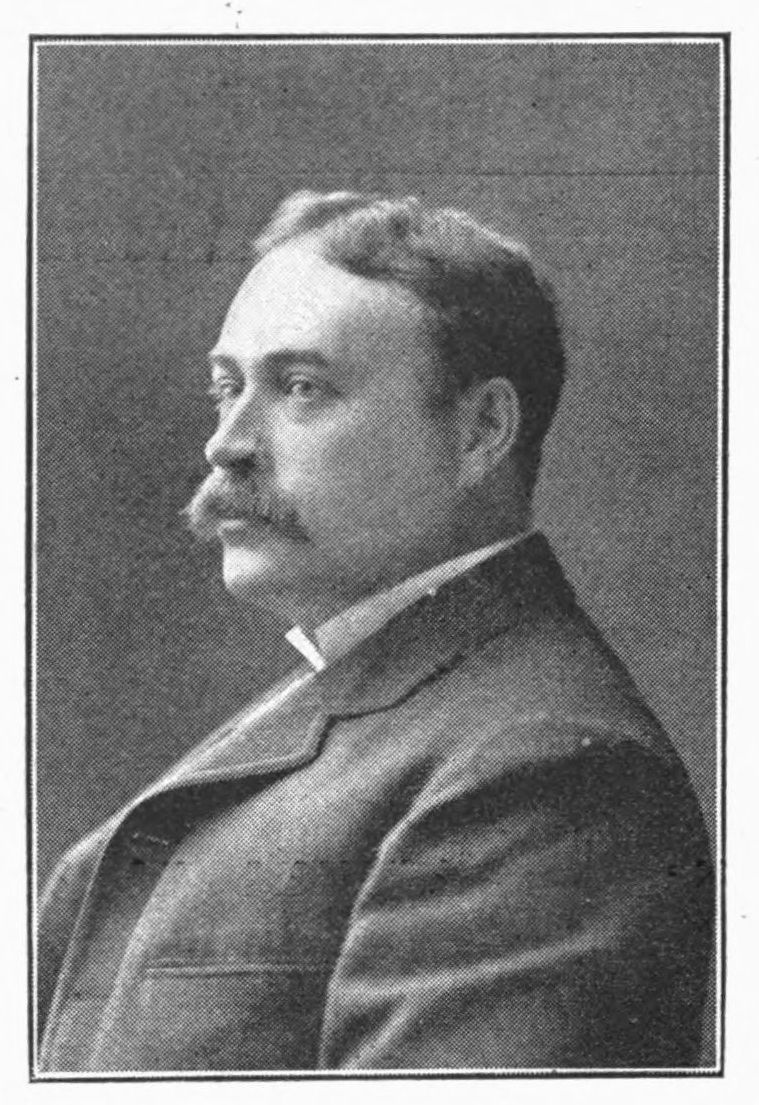
As James Whitcomb Riley’s Hoosier dialect poems have charmed the American people, so have Dr. Drummond’s won the hearts of the Canadians. He reads as charmingly as he writes.
For the sake of those who are not familiar with his work, I quote (by permission of G. P. Putnam’s Sons) a few verses from his poem, “De Habitant.”
“De place I get born me, is up on de reever Near foot of de rapide dat’s call Cheval Blanc, Beeg mountain behin’ it, so high you can’t climb it, An’ whole place she’s mebbe two honder arpent. “De fader of me, he was habitant farmer, Ma gran’fader too, an’ hees fader also, Dey don’t mak’ no monee, but dat isn’t fonny, For it’s not easy get ev’ryt’ing, you mus’ know— “All de sam’ dere is somet’ing dey got ev’rybody, Dat’s plaintee good healt’, wat de monee can’t geev, So I’m workin’ away dere, an’ happy for stay dere On farm by de reever, so long I was leev.” “O! dat was de place w’en de spring tam she’s comin’, W’en snow go away an’ de sky is all blue— W’en ice lef’ de water, an’ sun is get hotter, An’ back on de medder is sing de gon-glou— “W’en small sheep is firs’ comin’ out on de pasture, Deir nice leetle tail stickin’ up on deir back, Dey ronne wit’ deir moder, an’ play wit’ each oder, An’ jomp all de tam jus’ de sam’ dey was crack.”
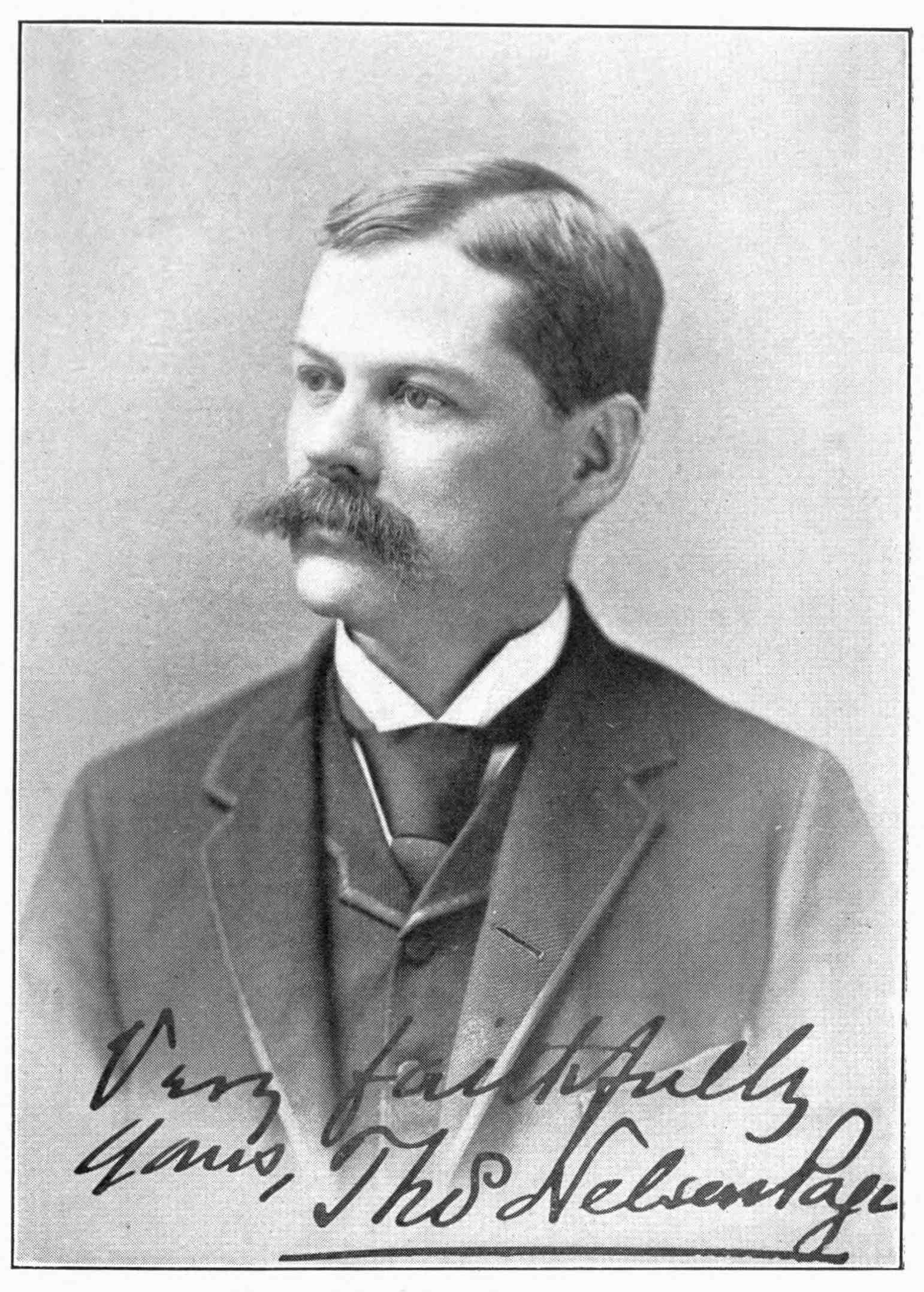
Very dutifully Yours,
Tho Nelson Page
THOMAS NELSON PAGE has been the most successful of the Southern authors who have read from their own writings. He has done more to preserve the traditions of the old South, the old negro character, and the interior home life before the war, than any one else. I wish that I were able to write well enough to say what I would like to of this Southern gentleman of letters. He seems to convey all that is best in a character, whether master or slave, and in such a way that every one who reads his charming descriptive novels is made familiar with life in the South as it actually was before the war.
Shortly after “Marse Chan” made its appearance, I received letters from all parts of the country asking if Thomas Nelson Page, the author of that story, could be secured to give readings. It was some time before I obtained a favorable reply to my many invitations for him to let himself be seen as well as read. He was very shy and quite averse to making an exhibition of himself, claiming that he was not gifted with voice or histrionic ability. He did consent to give joint readings with F. Hopkinson Smith for a short tour, beginning in Boston, January 12, 1892, in cosy little Chickering Hall. I had hoped for a big success financially, but the fame of the two Southern authors had not preceded them at the Hub. They opened with a small audience; but the newspapers gave excellent reports the following day, which assured success for the balance of the season. A Boston success means a success in New England, but I had struck high for large cities. We went to Chicago, Baltimore, Philadelphia, and Washington. The readings were attended by the choicest literary public in each city. Return engagements were made invariably, which were very remunerative, and there was a good deal of money in sight. Mr. Page was paving the way for a magnificent success another season, as was evident from the number of applications that came from every city where he had appeared.
Unfortunately, that season I made one engagement too many in Chicago, for from there I received notice from Mr. Page that he would not give another season to the platform under any conditions. Very shortly afterward I learned that in Chicago he had made the acquaintance of one of the most charming ladies in that city, who seemed to have more influence over him than the alluring promises of lyceum readings. To make a long story short, Mr. Page changed his manager.
He is now living in Washington, and I am happy to say that I can count him as one of my best friends.
Three years ago I was a guest at a dinner at his house given to Anthony Hope, where were present the Hon. Lyman Gage, Secretary of the Treasury, Theodore Roosevelt, Assistant Secretary of the Navy, and James Lane Allen and Mr. John Fox, Jr., the two famous Southern novelists of the time. One can imagine the charming intellectual atmosphere of an occasion like this; none present but that felt there must have been some fault in the reckoning of time, for it was 4 A.M. when the party reluctantly dissolved.
Mr. Page has a beautiful home in Washington, and I know of no one better fitted for such charming surroundings. He is as delightful as a host and in his everyday conversation as he is as a reader of his fascinating Southern stories. One can spend a day with Mr. Page in ordinary travel and conversation and attend his readings at night, and find that he has been as delightfully entertained in the ordinary speech as by the public reading. He has the sweetest-speaking voice that I ever heard. There is no music more delightful to listen to.
For one reason I am glad that I was deprived of his services as a star. Had he continued on the platform he never would have written “Red Rock,” a book which has met with an enormous sale and which gives the most graphic picture of the trials that the Southerners endured during and after the war. It is probably because I had been a soldier four years and had known nearly every character exactly as Mr. Page has presented it to the present generation and preserved it for posterity that I enjoyed it so much. Thomas Nelson Page certainly has not lived in vain.
MR. JOHN FOX, JR., is a young friend of Mr. Page’s of whom I like to write. He is a Kentuckian, a Harvard man, lawyer, New York newspaper man, all-around athlete, and author of “The Cumberland Vendetta,” “Hell for Sartain,” and “The Kentuckians,” which have won him a position among the best writers of America and Europe.
In Thomas Nelson Page’s letter introducing Mr. Fox to me, he writes:
“Get John Fox some engagements. He is going to be a success, and some one else will secure him. Mr. Theodore Roosevelt was praising him to me the other night in a way to warm my heart.”
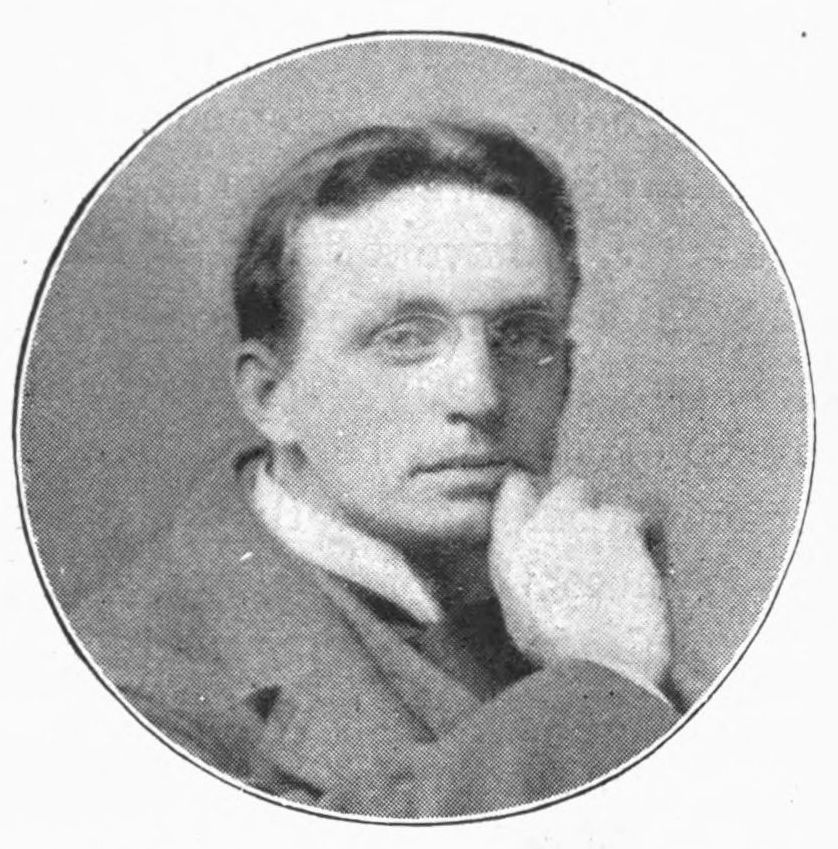
Mr. Fox is surely one of the most popular Southern authors of the time, and is very much appreciated in the South on account of his nativity as well as because of the high character of his literary work; but he has appeared before the most cultivated literary circles in all of the larger cities of the North, giving his dialect readings from his own sketches of life in the Cumberland Mountains. He discovered a dialect and lots of good in the humble people who inhabit that mountainous region, and who are the least known of any of the inhabitants of our country.
For the class he presents he is as thoroughly sympathetic as Thomas Nelson Page is for the old-time Virginia negro “uncles” and “aunties” he so charmingly describes. I do not know a more natural and, in a refined sense, unconventional man on the platform and before his audience than this handsome, well-bred, easy youngish gentleman from Bourbon County, Kentucky.
The Cumberland tableland, which is the scene of his stories, divides the Blue Ridge or Cumberland Mountains in East Tennessee from the “basin,” or central and western sections of that State, and runs, a rugged formation, into Southeast Kentucky. “Charles Egbert Craddock,” as Miss Murfree signs herself, has preceded John Fox in the same field, but the latter brought to his later task of dialect and character portraiture the physical sense of companionship from his ability to actualize in his own life the Cumberland mountaineer’s rugged out-of-door existence.
In my own wanderings as printer, soldier, and later lecture manager, I have often felt the variant charm of the many-sided life of our land. Often, too, have I wondered at men going abroad to find romance and striking character, when so much of it is to be readily seen at home. The Cumberland mountaineers, generally of non-slave-holding stock, hunters even more than farmers, strong Union men in days of need, as a rule, but intensely Southern, nevertheless, afford a field for the story-teller’s art which seems to me of the most interesting and unique character.
John Fox has won its secret and knows how to make others understand. He has a capital presence, a magnetic force and manner, and a most telling voice at his command. On the platform he is pretty much what he is off it, except that he is sensitively watchful of doing his work well. William Dean Howells declares that Fox brings a “fresh vision” and a “novel touch” in the seeing and presenting of his scenes and characters. If that is true of his books, it is more eminently so of his readings and lecture descriptions. He has no mannerisms and gives no evidence of effort. He simply tells and lives in the telling. What he gives is truly his own work. His dialect is perfect, but it is human and actual, not a mere caricature. The figures he gives are wholesome and clean, as is the man who presents them.
RUDYARD KIPLING and I have exchanged a number of letters, but up to the day before he was stricken with his late illness we had never met. After several attempts through his friends and publishers, members of the Century Co., to get an introduction to him, a common friend of the editorial staff said to me:
“Major, it’s no use; Kipling won’t see you.”
“What have I done?” I asked.
“Nothing,” replied my friend. “He says that he has been told that if he meets you he will go lecturing, and he doesn’t purpose to expose himself.”
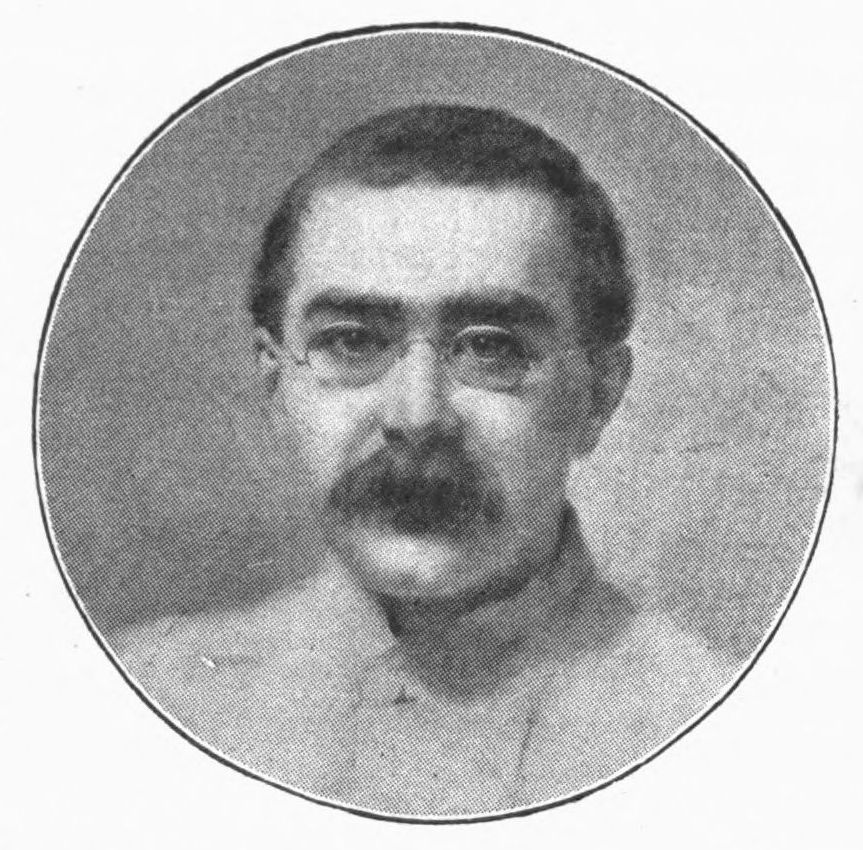
And although his New York house was within a block of mine, he managed to keep out of my sight, much as I tried to meet him.
In 1895, while crossing the continent with Mark Twain on his lecture tour around the world, Mr. Kipling was often mentioned by Mark as the greatest “card” in the world, and I was urged to try to get him. “I am told he is the finest reader and interpreter of his own writings of all of us. Get him,” said Mark. So, on my return from Victoria, B. C., after having seen Mark and his wife and daughter sail out on the Warrimoo for Australia, I determined to call on Mr. Kipling at his home in Vermont, hoping that, on Mark’s suggestion, I might capture him. I received no reply to my various telegrams that I would call on such a day, but I had determined to make the effort. Yet when I started from Montreal to Brattleboro my courage failed. I did not stop, but wrote Mr. Kipling immediately on my arrival in New York, and received the following reply:
“Brattleboro, Vt., Sept. 30, 1895.
“Dear Mr. Pond:
“I am much obliged to you for your letter, but I can’t say that I can see my way to the ententement you propose. There is such a thing as paying one hundred and twenty-five cents for a dollar, and though I suppose there is money in the lecturing business, it seems to me that the bother, the fuss, the being at everybody’s beck and call, the night journeys, and so on, make it very dear. I’ve seen a few men who’ve lived through the fight, but they did not look happy. I might do it as soon as I had two mortgages on my house, a lien on the horses, and a bill of sale on the furniture, and writer’s cramp in both hands; but at present I’m busy and contented to go on with the regular writing business. You forget that I have already wandered over most of the States, and there isn’t enough money in sight to hire me to face again some of the hotels and some of the railway systems that I have met with. America is a great country, but she is not made for lecturing in. With renewed thanks for your very kind letter, believe me,
“Yours sincerely, “Rudyard Kipling.”
Later I sent a complete set of his books, with a request that he favor me with his autograph in each volume (about twenty books). He unpacked, signed, and repacked them, and here is what he wrote:
“Dear Major Pond:
“Your order of the 22d instant has been filled, we trust to your satisfaction, and the stuff is returned herewith.
“We did not know that there would be such a mass of lumber to put through the mill; and we note also that your order covers at least two supplementary orders—(a) in the case of a young lady aged nineteen (not in original contract) and (b) an autograph work for which we have supplied one original hardwood case.
“Our mills are running full time at present, in spite of business depression; but we are very reluctant to turn away any job that offers under these circumstances, and making allowance for time consumed, sorting, packing, crating, and returning finished goods, we should esteem it a favor if you would see your way to forwarding an additional ten ($10) dollars to the Tribune Fresh Air Fund.
“Very sincerely yours, “R. Kipling & Co.”
(Autographs supplied on moderate terms; guaranteed sentiments to order. Verse a specialty. No discount for cash.)
MY “BENEFIT” EXPERIENCE.
I had never believed in benefits for managers, for it is generally looked upon as a sort of give-away—an acknowledgment of an impecunious condition, like the beggar who stands on the street holding out his hat or turning a little hand-organ, labelled with the sign, “I am blind”—and one’s friends are liable to cut an old comrade in the street, or pass by on the other side, as an after-effect of such an appeal to the public.
It had been a hard season, and some of my friends had reaped pretty fair profits and urged me to accept a complimentary benefit, tendering their services and assistance gratuitously. My friend Bill Nye visited the proprietors of Chickering Hall and obtained from them the free use of that edifice for the entertainment, and my printers went so far as to volunteer to furnish programmes, tickets, and such advertising material as I wished. The newspapers, however, didn’t open their advertising columns gratuitously, as that would have been an innovation and an instance unparalleled in that department of newspaperdom, but the editors were very generous with their puffs.
So it was suggested by my friends George W. Cable, Max O’Rell, Bill Nye, and James Whitcomb Riley that I accept a testimonial. It was arranged that George W. Cable should be introduced by his friend Roswell Smith, president of the Century Co.; that Max O’Rell should be introduced by his friend, Gen. Horace Porter; Bill Nye by Col. John A. Cockerell, editor of the New York World, and one of the finest editor-orators of the time; and James Whitcomb Riley was to be introduced by Dr. Edward Eggleston, the Hoosier novelist, author of “The Hoosier Schoolmaster” and “The Hoosier Schoolboy.” Each one of these introducers was considered an attraction in himself.
The occasion was well advertised, circulars were sent out, and I think I never had a more copious response by mail than I had at that time from my friends, all asking for one or two tickets—complimentary, of course.
The time arrived, and my old friends turned out in full force—the old free list. The expenses were about $200, and the receipts about $110. I pocketed my loss of $90, and have discouraged every suggestion of a “benefit” offered since that time.
The entertainment was delightful. No audience ever went out of Chickering Hall with more beaming countenances, and I had congratulations from all my friends. I was asked by one friend, who had paid for her ticket, if I contemplated a tour to Europe. I certainly could afford it after receiving such a rousing benefit!
In an appropriate speech, Mr. Roswell Smith introduced his friend George W. Cable as the most successful magazine writer of his time, and dwelt upon the good fortune his writings had brought to the Century Co., of which he had the honor to be known as president.
His speech brought a hearty round of applause to Mr. Cable, as he stepped forward and read “Posson Jone’,” his favorite Creole story.
Then Col. John Cockerell, in his characteristic eloquence, presented his pet humorist, Bill Nye, who had come from the West on his invitation and accepted a position on the editorial staff of the New York World, and whose writings had quadrupled the circulation of the Sunday edition of that paper. He was eloquent in his eulogistic introduction, and Nye caught the inspiration as he wabbled down to the front of the stage. Without uttering a word he had the audience convulsed for a long time, and when he did begin his story of how he earned his first dollar, the audience fairly bubbled over, while there was not the slightest ripple on the speaker’s round countenance. Nye was bald-headed all over, and more so when in front of an audience.
Then Edward Eggleston, the Hoosier novelist, introduced James Whitcomb Riley, the Hoosier poet, with many happy turns on the term Hoosier and the Hoosier State. Roswell Smith was from Indiana, Nye was part Hoosier, and every one down on the programme was Indianian to some degree except possibly Max O’Rell, the French humorist.
Mr. Eggleston’s introduction of James Whitcomb Riley put the poet in trim for his best Hoosier interpretations, and before he had finished his recital everybody in that audience was Hoosier more or less.
General Porter was saved for the last. His witty introduction of the French humorist was the climax of the day. There had been so much Indiana and Hoosier in the programme, he said, that he felt a little embarrassed and discouraged, as the only novelty about his candidate for the audience’s amusement was that he was not from Indiana.
It was an interesting two hours’ display of ability and genius, wit and humor, such as would be difficult to reproduce at the present time.