AUTHOR READERS (continued 2)
Reading edition
My Minneapolis correspondent, who had bought a single lecture for that city, was one of the doctor’s enthusiastic auditors in Chicago. I had originally planned that Dr. Watson should have an open date in Minneapolis for rest, as a neighboring minister in Liverpool had written: “Watson, poor fellow, is not strong. He has had severe hemorrhages.” But when I found that he was an athlete, with the power of endurance of a gladiator, and when he offered to keep all dates I made if I would release him from preaching, I decided to fill in three more readings in Minneapolis and St. Paul. I felt all the more warranted in doing so as all the auditoriums in which Dr. Watson had spoken up to this time had been crowded to their full capacity. So I told my Minneapolis man that either he must arrange to fill in two matinées and the open evening, or I must buy him off and go back East, where we were sure of a much larger business. He demurred, but “it was to be,” so he finally assented.
Looking up my dates, I found that the day before election was open in Central Music Hall, Chicago, and I decided to place two return readings there for the afternoon and evening of that day. The local manager refused to have anything to do with it, so I did it myself, and enjoyed seeing him quite demoralized because he had not accepted my offer. That afternoon and evening Dr. Watson gave two readings, the gross receipts for which were over $4,000.
What a delightful ride we had the next day on the fast express from Chicago to Milwaukee, where I once worked as a printer on the Sentinel. At that time (1857-58) Milwaukee was the metropolis of the State; now it is a suburb of Chicago. I called Dr. Watson’s attention to the beautiful brick which is used here, and makes such handsome buildings. He thought them inferior in quality to the Scotch bricks, and I think he was right.
He lectured here in Plymouth Church, where I had been with Mr. Beecher and other stars. The church was crowded, and I was told that there had been no such enthusiasm since the palmy days of John B. Gough. A supper after the lecture was attended by the leading minds of the city and State, among whom was my old friend F. N. Finney, son of the late Charles G. Finney of Oberlin. The Woman’s Club, which had secured Dr. Watson for Milwaukee, entertained our entire party the next morning, showing us the sights of the city, including a first-class art gallery and the largest, best-equipped brewery in the world.
We pushed on to Appleton, Wisconsin, where nearly the whole town was in waiting at the depot. The rest of the townspeople met us on the train before reaching the city. At the lecture that evening, the Congregational Church held the biggest crowd it ever had held up to that time. The next day (Sunday) was a proud day for me. “Ian Maclaren” preached for one in my father and mother’s old church, in order that my friends might hear him. It was a great sermon and a great crowd, too. People came over two hundred miles to hear him, and filled the church both morning and evening, and all the surrounding streets as well. It was my second great triumph in Appleton. On a former occasion I had introduced Henry Ward Beecher to the same public, and Dr. Watson’s reception was just as hearty as Beecher’s. In the evening I gave my Beecher lecture. Dr. Watson was a listener and gave me inspiration. I talked Beecher for an hour and a half, and was attentively listened to.
The next day we went to Madison, Wisconsin, where Dr. and Mrs. Watson were the guests of President Adams of the Wisconsin State University. Mrs. Watson was unable to sit up. The doctor addressed the students of the University in the afternoon, and lectured in the First Congregational Church in the evening—the same place where, in 1879, Mr. Beecher had drawn exactly $1,200. The legislature was in session then, but now it was autumn, and no legislature. Dr. Watson drew just $1,000 even money.
We were obliged to take the midnight train from Madison to Minneapolis. When we went on board poor Mrs. Watson was almost broken down, but never a murmur escaped her. Dr. Watson nursed and cared for her all night on the cars as gently as a mother could have done. Still he couldn’t help saying funny things. As she lay in agony in her berth, he said: “Jannie, you must not forget; the boys may get their wheels yet. The audience was not hostile.”
By the time we reached Minneapolis, Mrs. Watson was so feeble that she could hardly bear to be lifted from the car to a carriage; still she did not complain. At the West Hotel we called in a physician, who declared that she was threatened with pneumonia. Colonel West and his daughters were very kind and attentive and relieved the doctor as much as possible. The Caledonian Society and the St. Andrew’s Society were in waiting to show honors to the distinguished visitor, and many other Scotch institutions were out in great force. The lobbies of the hotels were jammed. “Ian Maclaren” was the name on everybody’s lips.
He amused the audience at the beginning of one of his lectures by telling of a letter he had received, asking whether the first name of his pseudonym was pronounced Ian, Eean, Yan, Yon, Yane, John, Jan, or Jane. “In answer to this question,” said Dr. Watson, “I would say that if you want to pronounce it like an Englishman, you will say I-an; if like a Scotchman, Ee-an; and if like a Highlander, Ee-on.”
A luncheon was given him by one society, and after the reading in the evening he had a banquet. I absolutely believed the doctor must be bewildered from so much increasing attention. The smart reporters here got hold of him. His keen discernment enabled him to detect a different atmospherical condition about these and our Eastern newspaper men. There was a freshness and a keen assurance about the Minneapolis reporters that rendered them irresistible. He saw and enjoyed everything. Everybody was in love with him, and everybody wished to do something for him.
Judge Gilfillan, of the United Scotch Societies, introduced him at the first reading by declaring that it had been left to the lion of the evening “to show us the lights and shadows of Scottish character as they are exhibited in the simple, everyday scenes of life.” The doctor stepped forward amid a wave of lasting applause. “It is my duty,” he said, “to notice with a glow of heart the Scottish tone of this introduction, for, as I sat listening, I could scarcely realize that I was in the far Northwest and not in my own country.” Wherever he went he met Scotch people—some by descent, some by marriage, and one by virtue of the fact that her sister had been tended by a Scotch nurse.
We gave three readings in Minneapolis, instead of one, as originally planned, and two in St. Paul. The afternoon in St. Paul was marked by almost as terrific a rain-storm as I ever remember witnessing. The water absolutely piled up in the streets for two or three hours. Through the invitation of Mr. I. W. Whitney of the Great Northern R.R. Co., Dr. Watson visited the residence of Mr. James Hill, president of the railroad, who has the finest collection of pictures west of New York. Dr. Watson, who is an art critic and has seen all the famous collections of Europe, declared this the best-selected and choicest private collection of paintings that he knew of.
We found Mrs. Watson more comfortable on our return, but the physicians said that she had a slight touch of pneumonia and must not be moved for a week, so we were obliged to leave her behind and go on to Des Moines without her. I feared that the tour was about finished. I didn’t see how the doctor could give his readings under such conditions, but he insisted that “Jannie” was a woman of wonderful will power and he was sure she would come through all right. To leave her among strangers, in a strange land, nearly five thousand miles from home, was not a cheering prospect, but Colonel West, owner of the West Hotel, and his daughters were very kind to her, and she was heroic and brave as well. “Good-by, Jannie. The boys will get their wheels,” were the doctor’s last cheering words as he came from her room and we took a carriage for the depot to go to Des Moines.
We left Minneapolis at about seven o’clock, having a Pullman sleeping car all to ourselves. The weather was the most disagreeable possible—a cold, sleety rain, which later changed to a gale so severe as to impede the progress of the train. We lost time all day. When the conductor told the doctor that we were losing time on account of the wind, he exclaimed: “How absurd! Do you mean to tell me that any wind can retard the speed of a heavy locomotive and train like this?” The conductor assured him that nothing else had caused the lateness of the train. He insisted that it was ridiculous, and wouldn’t listen to it; but I have known a gale to lift a locomotive and whole train off the track. Little he knows of the Iowa and Kansas zephyrs.
When I saw that we were bound to be late, I telegraphed my correspondent in Des Moines that the train was losing time. All day we travelled over the boundless prairie, thickly dotted with frail frame houses that appeared hardly able to withstand the gale. This was the first real prairie country the doctor had ever seen, and it was a surprise to him.
As there were no eating stations along the line and no food to be had on the train, we were obliged to go without eating all day, which the doctor did not relish, and declared that this was the last time he would be caught on a long journey without food. I told him that we would go right to the hotel as soon as we arrived and get something. He was obliged to dress on the sleeper, and was very much worried, because he was afraid he would have to lecture without his supper. I began to fear that he was right when he told me in Meriden I might sometimes have to put up with some very disagreeable things.
It was after eight when we reached the hotel. The clerk told us that we could get nothing to eat, as the dining-room closed at eight (it is so with all provincial hotels), but the doctor rushed to the dining-room and made a loud noise on the door, which was opened by a man in evening dress. He proved to be the head waiter.
“I want some food immediately,” said the doctor. The man stood paralyzed.
“I must have some food right away,” the doctor repeated, and rushed by the man to a table where were the remains of the dinner of the latest comer. He attacked it, and the head waiter tried to stop proceedings, but the doctor kept right on. He managed to get part of a meal, and hurried out, the man following him. In the carriage on the way to the Opera House the doctor told me that he hoped he had not permanently injured that man who persisted in trying to prevent him from eating what he could find. I think I never experienced a more amusing incident. It was nearly nine o’clock when Dr. Watson stepped upon the stage. I’ll let the Des Moines Leader tell the story:
“At five minutes before nine o’clock the lecturer came around the flies. During the long wait the audience was entertained with a violin solo and a piano solo. An impromptu choir on the stage started ‘America,’ and four verses were sung. Then came ‘Annie Laurie,’ and it was during the singing of that that Dr. Watson took his seat. ‘How appropriate,’ every one said to his neighbor, and the tedium of the long delay was forgotten. It was a gathering of which any person might be proud, and evinced extraordinary interest concerning the new star in the literary firmament, unknown except in his clerical capacity two years ago.”
The president of the Woman’s Club, under whose auspices the lecture was given, introduced the speaker in a very few words of eulogy on the man and his work. She said, “The long-anticipated hour has come,” and Dr. Watson stood up before the audience. He said that no one could convey a reproach so delicately as a woman, and that when he heard the words “long-anticipated hour” combined with what was complimentary, it reminded him of his childhood days when medicine was administered in sweets. “Only the other day,” he continued, “I was congratulating myself on never being late, either for pulpit or platform, but now the boast has come home to me, as such things usually do.”
At 11:30 we were again on board the sleeper bound for Galesburg. Our journey was interrupted by an enforced long wait at Rock Island—from 8 A.M. to 2:40 P.M.—but it proved a very delightful wait. We took a carriage and drove about the town, visiting the United States Arsenal, where arms and war equipments are manufactured. Through the politeness of the commanding officer, Colonel Buffington, Dr. Watson was most graciously entertained all the forenoon.
At Rock Island, President John Finley of Knox College (then the youngest college president in America) met us with the private car of the superintendent of the road, to convey us to Galesburg. The college students, male and female, had turned out en masse to meet “Ian Maclaren” at the station, and behind a band of music and the students our carriage was escorted to President Finley’s house. Here was a telegram from Mrs. Watson telling her husband that she was much improved and would meet us in Chicago the next morning.
“Astonishing,” said the doctor, his face fairly beaming. “Can I send a telegram right away?” he asked.
“I’ll take it,” said I, for I wanted to do something.
He wrote a telegram after the English manner—as few words as possible—and this is the way it read:
“Mrs. Watson, West Hotel, Minneapolis.
“Much lifted. Watson.”
I made a copy of it, which I handed in at the office, retaining the original. I have never parted with a word of his or Mr. Beecher’s manuscript.
After dinner, Dr. Watson visited the rooms of the new “Abraham Lincoln Memorial to Art and Science.” About a hundred young ladies were in waiting, dressed in white, with a little green ribbon about their necks and each one wearing a white rose. The doctor christened the new society, “Circle of the Order of the White Rose,” and the occasion inspired him to make one of the sweetest addresses I ever heard. I did not know of a man since Mr. Beecher had gone who could rise to such an occasion as Dr. Watson did.
The lecture that evening was to help establish a fund to aid in the objects of the new society. The Knox College students completely filled the Opera House from floor to ceiling. As the doctor stepped upon the stage he was greeted with a Western college cheer, given with a vigor that could not be excelled for volume. It seemed to inspire him for the evening’s work. This was one of the most hearty receptions he had in America. After the lecture we returned to Dr. Finley’s home, where flashlight pictures were taken of the party.
By 11:30 we were on the train for Chicago, Dr. Finley with us, arriving at 6:30 Sunday morning. Our entire party were guests of my old friends, Mr. and Mrs. C. H. McConnell, on the South Side. Although it was such an unseasonable hour to disturb friends, Mr. McConnell met us at the door and welcomed Dr. Watson with heart and hand in such a manner as to cause him to say before we fairly got into the house:
“Major, I’m very glad we’re here.”
At 8:30 A.M., Mrs. Watson arrived from Minneapolis. I met her at the train. She did look feeble, but she insisted on carrying her handbag to the carriage, and was very cheerful and anxious to know how everybody had gotten along without her. I assured her that she had been very much missed, and that from now on we were all right.
That afternoon Dr. Watson preached in the Chicago University for President Harper, and when he returned with Mr. and Mrs. McConnell, found Mr. Lyman Gage (later Secretary of the Treasury) waiting to escort him to his house to dinner. I suppose they went to Mr. Gage’s and waited until the Sabbath was over and then had a good time, because the doctor never visits on Sunday excepting on parishional work, and I heard him say on Monday morning at breakfast, “I’ve already given one reading this morning.”
This Monday was our red-letter day in Chicago, when we took in over $4,000, at the matinée and evening reading; this, too, notwithstanding it poured all day and the audience came in carriages and under umbrellas, or dressed in waterproofs, and giving the lobby of Central Music Hall the appearance of a small river.
Mrs. Watson was improving all the time, but we left her and Mrs. Pond in Chicago with our friends the McConnells, to join us in Niagara Falls the following Saturday night, where we would spend Sunday and see the falls. Dr. Watson and I went on to Oberlin, Pittsburg, and Cleveland.
The strange old Lyceum course in Oberlin is one of the oldest in America, and the Park Hotel is the same old barracks that I have visited year after year with John B. Gough, Beecher, Twain and Cable, Gilmore’s band, Clara Louise Kellogg, and many others. The people of Oberlin gave “Ian Maclaren” a grand ovation. It was the evening of election day, and some of the early election returns were announced at the lecture. It is a time-honored custom in Oberlin that lectures begin at 6:30 in the evening, and invariably open with prayer.
“I never before met a people who would pay an admission fee to hear a long prayer,” said the doctor to me after the lecture.
Dr. Watson was the guest of the college dean. I would not attempt to describe the impressions made on him while in Oberlin. It is an absolutely teetotal town and all dinners are dry. The election returns had brought the news of a McKinley landslide, and the students’ enthusiasm knew no bounds. They surrounded the dean’s house, where Dr. Watson was stopping, built a number of bonfires, and remained there most of the night, shouting, “What’s the matter with McKinley? He’s all right!” Dr. Watson never got over that.
The day after the election, when we reached Cleveland, which is only seven miles from McKinley’s home, I doubt if there could be found a person there that day who was not hoarse. I never saw such a litter of débris before or since. The streets were covered with papers, old box and barrel hoop irons, ashes, and embers of bonfires, and hardly a soul was to be seen at ten o’clock in the morning. They were used up. It did look like the break up of a hard winter or the ruins of a burned district. In registering, Dr. Watson asked the clerk of the hotel, “What’s the matter with McKinley?” and he got it good and strong: “He’s all right!” Everybody in the room and vicinity shouted. He certainly had entered into the spirit of that contest. Notwithstanding all this excitement, the people had roused up in the evening, and we had about $1,100 in cash in the big Music Hall there.
There was no lack of excitement on this tour. The next day the doctor was down for two entertainments in Pittsburg, besides a luncheon and a dinner. We took an early morning train, reaching Pittsburg at noon, where we were met by a delegation of ministers and business men, with Andrew Carnegie at the head. They had planned a luncheon for Dr. Watson, which was waiting, and then to lecture at two o’clock! I looked after the business while the doctor was entertained by his friends. We were getting nearly all we wanted of luncheons. One gentleman had assured Dr. Watson that Major Pond had made a great mistake in placing a matinée lecture, for the new Carnegie Hall could accommodate all the people, and as there was not a soul to be seen when the doctor and Mr. Carnegie drove up to the Opera House, the doctor said to me:
“Major, you have made a great mistake here. One reading is enough. You have the obstinacy of a Scot.”
“Have I?” I replied. “Well, all you will have to do is to give your ‘small audience’ a better lecture this afternoon.”
When he got around on the stage and faced the crowd, he found the most select audience Pittsburg could possibly muster. There was not a vacant seat, and “Standing Room Only” was on the signs in the lobby. We took in $1,800 that afternoon. He went to dinner with Mr. Carnegie, who introduced him to another audience that evening of over three thousand people.
At the eating station in Oil City, the next day, while on our way to Jamestown, the doctor left his hat. I had to go into the baggage car and get his hat box, and he went all the way into Jamestown and Buffalo wearing his silk hat. We had one lecture at Jamestown, with no particular incident except that the President of the Y. M. C. A. kept the audience in agony fifteen minutes with his introductory speech.
The next day, in Buffalo, there were two lectures, a club luncheon, and a supper, after which we went by trolley to Niagara Falls, where our wives were soundly sleeping at 1:30 A.M. Sunday. I don’t believe Dr. Watson had had ten spare minutes during the two weeks previous to that time.
We saw the falls through disagreeable mist and cold drizzly rain. A more uncomfortable day out of doors could not be, but Mr. Isaacs’s cosy Prospect House was unalloyed comfort. Once Mr. Beecher wrote me from this hotel: “Good room, good bed, good table, and good host. What a cluster of blessings! Next to being at home is the blessedness of being away from home in a good hotel.”
Two performances were given in Rochester, and here I succumbed. I could stand it no longer, but went to bed and sent for a physician. The ladies went directly to New York from the Falls, and the doctor “managed” for me, which kept him pretty busy. He came to my room after the evening performance and wished to nurse me during the night. My physician declared me in a serious condition and ordered me to take the first train home. Dr. Watson insisted that under such conditions I was too feeble to move, and ruled against the physician; so I stayed in bed and left for New York the next morning, leaving the doctor in Syracuse to fill two engagements there.
He spoke to two unusually large crowds in Syracuse; at Ithaca the following noon, at Elmira in the evening, and then back to New York. Twice a day he had been keeping up his readings while I dragged and pushed him along, and a better-natured, more delightful spirit never was known. My business was to make the work as easy for him as possible, no matter what fatigue it caused the “manager.” What else is a “manager” for?
I was side-tracked at home two days. I had planned for several readings in Philadelphia, New York, and Boston. The biggest business was yet to come. The Watsons were our guests for a couple of days while I was laid up. One must entertain and house Dr. Watson under one’s roof to know what a buoyant, soul-reviving, happy spirit he possesses. He was in excellent humor and entertained us all day long with whimsical descriptions of cranks who visit him—crank preachers from foreign lands who get their living by appeals in all directions for collections and opportunities to preach. It was certainly the most remarkable, inimitable, and side-splitting facial display of serio-comic genius I ever saw or heard. What an actor he would have made!
Our next stand was Philadelphia, November 14th, where Mr. Harold Pierce, the gentleman who had the doctor in charge for that Saturday afternoon and Sunday, prior to the doctor’s lecture the Monday following, met us and took absolute charge of the doctor and his party. Pierce is a hero-worshipper, but a splendid fellow.
Mr. John Russell Young gave the doctor a luncheon at the Union League Club at one o’clock, at which were a number of Philadelphia’s most distinguished men as guests. At the right of Mr. Young at the table was Dr. Watson; at his left, Archbishop Ryan. Next to Dr. Watson was John Wanamaker. I don’t think that any party has ever been privileged to listen to a more delightful theological discussion than that which took place between the Catholic archbishop and the Presbyterian Scotch minister. It was quite a display of wit and historical knowledge, which made the occasion intensely interesting. It was a protracted luncheon. We did not get up from the table until half-past three. Then the doctor went to the New Century Club for a reception. At least Pierce called it a reception. There was a large auditorium, every seat of which was occupied. The doctor was led out upon the stage and introduced to the audience. He gave there one of the brightest and most interesting lectures of his whole tour, not finishing until five o’clock. He was unprepared for a speech and was obliged to work out his salvation by thinking on his feet. He was equal to the occasion, and made his best speech in America there. He took a carriage direct to the station and went out to Pottstown, where he gave a lecture under the auspices of the Hill School, returning at midnight to Philadelphia. The following Sunday he preached in Germantown, Philadelphia, in the morning. In the afternoon, with John Wanamaker, he was introduced to many Sunday schools and saw the working of John Wanamaker’s famous system for the Sunday religious instruction of the young. In addition to these duties the doctor had been interviewed by all the reporters in Philadelphia, and his face and his name were the prominent features in all the daily papers.
At one of his interviews, speaking of the manner in which his short stories were written, Dr. Watson said:
“Each one was turned over in my mind for months before I put pen to paper. It took a prodigious amount of mental labor before I even had a story formed in my head. Then I blocked it out at one sitting. Then the thing was put aside, while I went over and over in my mind each detail,—each line of dialogue, each touch of description,—determining on the proper place, attitude, share, color, and quality of each bit, so that the whole might in the end be a unit, not a bundle of parts. By and by came the actual writing, with the revision and the correction which accompanies and follows. The actual composition of ‘The Bonnie Briar Bush’ stories occupied fifteen months. They were the more difficult, because in every case the character is revealed in dialogue exclusively. It is different where the writer has a plot—a murder, for instance—because then there is something definite to hold the attention, and one can dash ahead compared with the slow progress I was forced to make.”
The lecture in Philadelphia, in the Academy of Music, on Monday, was attended by the largest and best-paying audience up to date, the gross receipts being $3,009.50 for a single night.
Next came our visit to Washington, on which I had counted much, being well acquainted with nearly all the heads of departments, as well as with President Cleveland and every member of his cabinet. The Doctor was the guest of the Rev. Dr. McKaye Smith, a clergyman of much distinction and social influence, who is a relative of the Vanderbilts, and whose home in Washington is in keeping with the wealth at his command. I had suggested to Dr. and Mrs. Watson that I hoped to show them the Capitol that morning, and get some good snap-shots, as they had engaged to lunch early with the President. There were to be two lectures, afternoon and evening. He informed me that he had accepted an invitation from another—a gentleman who knew everything and who had come from Philadelphia on purpose to show them the sights of Washington. I was disappointed, for I knew the gentleman to be one of the small class of hero followers that pursue celebrities and in many instances succeed in hypnotizing them to that extent that they can believe no one else, not even their well-known friends. This man turned out to be exactly what I tried to intimate to my friends, in as delicate a way as possible and not offend them, what he really was. He has since fled the country, and I doubt if there is a pleasant recollection of him anywhere.
Dr. and Mrs. Watson lunched at the Executive Mansion with President and Mrs. Cleveland, Secretary of State Olney and Mrs. Olney, Mr. H. T. Thurber, private secretary to the President, and Mrs. Thurber. In order to show further his admiration for the great Scotch writer, the President engaged seats for himself and his family, and the entire party attended Dr. Watson’s lecture that evening.
From Washington we went to Baltimore, where the doctor lectured under the auspices of the Peabody Institute and was the guest of President Gilman of Johns Hopkins University. As we had spent the day sight-seeing in Washington, we did not arrive in Baltimore until a quarter after eight, and the doctor proceeded at once to the great hall. We found a man at the door waiting to admit “Ian Maclaren” to the platform. He insisted that it was impossible for me to get inside the door, as there was not a place for me to stand; and it proved absolutely true that every inch of available room was occupied by people standing as thick as they could be crowded in the aisles, around the platform, and against the door. The jam was so solid that it was all Dr. Watson could do to squeeze himself in and get to the rostrum. I did not see the audience or hear him that night. While standing outside, two well-dressed young ladies came up to me and asked if I were not Major Pond.
“Yes,” I said.
“We must see and hear Dr. Watson. Is it not possible?”
“I cannot possibly get in myself,” I said. “There is no earthly use for you to try.”
“Can’t you crowd that door open so we can get inside?”
I said, “I’ll try.”
I made an effort, and managed to squeeze them inside, and the door was pressed against me. I never saw them afterward and never knew whether they were able to see and hear the doctor, but such was the intense interest to hear him. He did not see his host until after the lecture, and it was past midnight when he arrived at President Gilman’s house to have a late supper and a chat, and then to be called at 6:30 the following morning in order to lecture in Philadelphia at noon.
The doctor stood the crowds and endured the high pressure very heroically, occasionally intimating to Mrs. Watson that “the boys’ bicycles are pretty safe,” and remarking to me from time to time, as we left one city for another, “The people are not unfriendly, Major.”
We still had ahead of us Boston and New England, which I believed would surpass everything else. At Providence we had two great crowds, afternoon and evening. The people were simply in love with “Ian Maclaren”; somehow he takes hold of all hearts.
Crowds followed him to the station, and the interest grew more intense as he neared Boston.
In Boston, Dr. Watson was the guest of Mrs. James T. Field.
The crush at the box office had been unbroken for a week. The advance sales were nearly $10,000. It was in Tremont Temple, Wednesday afternoon, November 25th, at two o’clock, that he made his first bow to a Boston audience, and the great house was overflowing with people who came to see and to hear—who remained to laugh and cry; and, when the lecture was at an end, to stand in their places for many minutes with eyes and opera glasses levelled upon the tall and kindly visaged Scotchman. He bore well the scrutiny of those thousands, for there were thousands present, as he shook hands with his brethren of the ministry who occupied the platform seats. For three-quarters of an hour before two o’clock two solid masses of humanity wrestled for admission. Men and women, but mostly women, crowded up the two stairways, an eager, expectant throng. Presently all the seats on the floor and in the balconies were filled, and the Rev. George A. Gordon of the New Old South, the Rev. Dr. Cuckson, the Rev. Alvah Hovey of Newton, and many other ministers of Boston and vicinity took seats on the platform. “Ian Maclaren” was among them, but was not immediately recognized, as he kept well in the background. The Rev. Dr. Gordon stepped forward, and in his strong, sonorous voice, which reverberated to the farthest portion of the great Temple, introduced the lecturer with these words:
“The hour—the expected moment—is come—and now is—when we are to listen to him whose coming we have awaited expectantly—Ee-on Maclaren! John Watson!”
Applause and cheers, waving of handkerchiefs and pealing of the organ were kept up, with now and then a fresh augmentation from some seemingly impossible source, until the full limit and capacity of the audience was exhausted. Then the doctor began:
“You will understand me when I say no English-reading man can approach your city without pleased expectancy. Since our fathers taught us to read, we have known this city of Boston, and we have become familiar with many of the scenes and places of which your people have written. During the few days of my stay here I shall try to identify all the places the Autocrat has told us about, only sorrowing because I cannot see his well-beloved face.”
Then he referred to his intention to say something of the traits of his countrymen, of “an almost inarticulate nation,” and the audience laughed, knowing now that it had come to hear a man of genial nature say things genially.
“A recent writer, whom I cannot identify and whose name I do not want to know, denies that there is anything in our humor that is light in touch, delicate, and graceful. He asserts instead that there is much that is austere and awkward, tiresome and unpleasant. Now each nation takes its humor in its own way, and, as might be expected, the Scotchman, on the surface, does take his seriously, severely, and austerely. None take humor so carefully and conscientiously as the Scotchman.
“Whenever a humorous situation presents itself to the Southern mind it is embraced on the instant, and it is taken home for the enjoyment of the family, and perhaps the neighbors hear it through the doors. Then for days afterward the man who captured it shares it with his fellow-passengers in conveyances, possibly impressing it forcibly upon them.
“In the Scotch mind, when a jest presents itself, the question arises, ‘Is it a jest at all?’ and it is given a careful and analytical examination; and if, after twenty-four hours, it continues to appear to be a jest, it is accepted and done much honor.”
His final lectures in Boston were Saturday afternoon and evening, November 28th. Not even standing room was to be had at either of them.
When the readings were over and Dr. Watson had taken his seat, the audience would not release him without a personal word. In response to the Chautauqua salute he made a pleasant little speech. He had dreaded to come to Boston—he had heard so much of the city, its high standards, its severe judgment. But having come here he could say that nowhere that he had lectured had he been more cordially and sympathetically received, and he would return to his home across the sea with brightest memories of Boston and its neighborhood.
From Boston we returned to New York, where, on the 30th of November, I opened the first of a course of five readings at the Waldorf-Astoria, at eleven o’clock in the morning. At two in the afternoon Dr. Watson delivered the lecture on “Robert Burns” in the Empire Theatre before an immense crowd. The evening of the same day he was the guest of the St. Andrew’s Society, at their dinner at Delmonico’s, where he made a great speech.
We were in Troy and Albany on the 1st of December; had two immense audiences and a private luncheon with the Rev. Dr. and Mrs. Hall, the former an old classmate of Dr. Watson’s in Scotland. That evening at Albany the lecture was in Odd Fellows’ Hall, a new magnificent lecture hall after the style of the former lyceum halls in New England. It was refreshing and delightful to hear the speaker in this immense room, with its perfect acoustics and a large audience all apparently clustered around him. That evening the St. Andrew’s Society gave him a decoration; then, in company with a party of friends, we visited the Orange Club, where we had supper and stories until after midnight.
Then on to Schenectady, where, at one o’clock the next day, the doctor was introduced to a Union College audience by President W. V. Raymond. He lectured in Utica in the evening. Everywhere the crowds were limited by the capacity of the auditoriums. We returned to New York, where on the following morning Dr. Watson lectured at the Waldorf and in the evening at Flushing, L. I. On Saturday, the 5th, he lectured at the Waldorf at eleven, and at Jamaica, L. I., at 2:30. That evening occurred the Lotos Club dinner, which is still regarded as one of the greatest events in the history of the club. When introduced by President Frank R. Lawrence, Dr. Watson said:
“Mr. President, and Gentlemen of the Lotos Club:—“Your president has referred to Bohemia and has indicated that he thinks there will be struck up an alliance between Scotland and Bohemia—on first sight, one of the most unlikely alliances that ever could be consummated. (Laughter.) The president no doubt has many things in his eye, and when we remember the careless garb of a Bohemian and the kilt of Scotland; when we remember a Bohemian’s tendency to live, if he can, in a good-natured way upon his neighbors, and the tendency of my respected ancestors to take any cattle that they could see; and when also we remember that a Bohemian’s sins are all atoned for by his love of letters, and that all the hardness and uncouthness of Scotland may well deserve to be passed over because no country has ever loved knowledge or scholarship more than Scotland—I declare the president is predicting a most harmonious marriage. (Applause.)
“Your kindness, gentlemen, is only crowning the great kindness which I have received during the past months—a kindness which I never expected, and a kindness which I am fully conscious I have never merited. Were I a lad of twenty-five, I declare it would be dangerous, for after the audiences that have been good enough to listen to me, and the favor I have received, also, at the hands of the distinguished men of letters, I declare, if I were twenty-five I might be confused about my position. But, gentlemen, when one receives as much kindness as one has in America, it doesn’t—if you will excuse in this most cultured club an expression not quite within the range of literature—it doesn’t swell one’s head. (Laughter.) But, gentlemen, it does something better; it swells one’s heart. (Applause.)
“Any man who has only entered the republic of letters within a few years, and who is fully conscious of his imperfections and has never counted on attaining to any great standard of art, through his slowness in beginning and through the exigencies of his position, can yet obtain the favorable ear of the public simply because he deals with humanity. Humanity will add what is not possible to men richly endowed with the spirit of letters alone; it will add to such an accomplishment a grace that no recent recruit, no amateur writer, ever can. (Applause.)
“I am convinced, Mr. President, that if those men whom, we look up to and who sit in high places, whose witchery of style and magnificent genius we all respect, could withdraw themselves from the study of certain mottoes which they believe are fantastic, and certain sides of humanity confined only to literary coteries and to great cities, the triumph they have won in the world of letters would be as nothing compared to the triumph they would win if, with all their genius, they laid their hand upon the heart of the common people. (Loud applause.)
“During these months it is impossible that one should travel to and fro without having formed impressions; and it is pleasant to go back with such entirely friendly and kindly impressions of the nation whose best thought and feeling are represented in this room. One thing that profoundly impressed me—I am speaking in perfect seriousness—was the courtesy of your people. (Hear! Hear!) Without any question—and I am not saying this for the saying’s sake—your people are the most courteous people one could meet, whether he be travelling on the road or engaged in ordinary intercourse. Courtesy may be tried by various standards, and possibly the highest form of courtesy is respect to women. I have never seen anywhere, and certainly not among continental nations, who rather boast of their courtesy in this direction—I have never seen such genuine, unaffected, and practical courtesy paid to the weaker and gentler sex as I have seen in America. (Applause.)
“Courtesy also can be tried by general agreeableness. During my tour—and owing to the arduous exercise of my friend, Major Pond, I have never stayed long in one place—I have travelled far and wide and haven’t always been able to ride in parlor cars. I have, consequently, seen a great deal of people; but with the exception of one single person, and she was an immigrant, and, I have no doubt, a delightful woman, although somewhat indifferent as to her personal appearance, with the exception of that single individual, I have met no woman and no man in the cars with whom I would not be willing to sit in the same compartment or the same seat of the car during a day’s journey. That seems to me a remarkable thing, but it may seem to you nothing. To us, from an European standpoint, it means a great deal. It means the comfort of your people; it means the self-respect of your people; it means the manners of your people; it means many things on which I congratulate you as a nation. (Applause.)
“And, sir, what has interested me deeply is that while you are contending with the difficulties which fall to the lot, not only of a new and growing people, but of a nation into which is flowing the very refuse of Europe, there is throughout your people a great love of letters and of art. I have seen again and again in the houses of men who are, as they say in Europe, self-made, great evidence that their love is not set merely on the things that a man holds in his hand, but on the means of culture through which we see into the unseen and the beautiful. Some of the most lovely pictures which can possibly be obtained now are contained in the houses of those men. They do not have their pictures, gentlemen, merely as pieces of furniture, which they have bought for so much money, but the men who have them, as I can bear testimony, are men who can appreciate the beauty of those pictures and who are in no mean degree art critics. On the other side I have been assured that if a bookseller has a rare book, one of those lovely books that we all like to have, with a creamy and beautiful binding like that of the past, and marked, perhaps, with a king’s or a pope’s arms, it is not in England that he finds a purchaser, but in America. And, Mr. President, I would congratulate you on the fact that to your high spirit and great enterprise you are also adding a love of the past, and especially that love of letters and art which are surely the height of perfection. (Applause.)
“I would only add, Mr. President, one other thing, and it is this, that while the good will between the old country and yours can be maintained and is going to be maintained by honorable international agreement, we are encouraged to cherish the hope that the two nations will be bound more and more closely together, until at last the day comes when from Washington to London may go forth a voice on the great international question of righteousness that no nation will dare to pass by. (Applause.) While that can only be secured, and is being secured by the agreement of eminent statesmen, yet surely, gentlemen, the coming and going of individuals treated kindly and hospitably after a most friendly fashion on this side, and I trust also treated after the same fashion on the other side, will weave together many bonds that will not only unite men of letters and men of grammars, but will also unite our two great nations with silken cords that can never be broken. (Applause.)”
The speech by William Winter which followed Dr. Watson’s on this occasion is also well worth being recorded here nearly in full. He said:
“You, my hearers, fortunate children of the lotos flower, have had the singular happiness to come into personal communion with some of the foremost men of your time, whether in action or in thought; with Froude, who depicted so royally the pageantry and pathos of the past; with Grant, who led so superbly the warrior legions of the present; with Mark Twain, the best of modern humorists; with Irving, the prince of actors, and with many more. I need not name them. You will recall them, you will remember them all with deep affection; and I am sure you will agree with me that in every case when the generous heart has paid its homage to a great man, the impulse is not that of adulation, but that of gratitude. (Applause.)
“Such is the feeling of this hour when now you are assembled to pay honor to the finest literary artist in the art of mingled humor and pathos that has come into literature since Sir Walter Scott. (Applause.)
“There are two canons of criticism to which I have fixed my allegiance—that it is always better to show mankind the things which are to be imitated, rather than the things which are to be avoided; and since the moral quality is present in everything, whether as morality or immorality, penetrating all subjects and everything that can be imagined, no work of art should have any avowed and fixed moral. Those principles are imitated in the writings of Dr. Watson. He has himself told you that it is impossible to analyze a spiritual fact. We all know that his race are noble in their influence, that they have exerted a noble influence upon society. We do not know the secret of his charm. I cannot tell it to you; I wish I could. I think perhaps it is that same inaccessible magic which I find in ‘King Lear,’ which I find in the death speech of Brutus:
“‘Night hangs upon mine eyes; my bones would rest, That have labor’d to attain this hour.’ . . . . . . . “‘This day breathed first; time is come round, And where I did begin there shall I end.’
“I find it in Robert Burns when he sang of the cavalier who ‘turned his charger as he stepped upon the Irish shore, and gave his bridle rein a shake with adieu forevermore, my love, adieu forevermore.’ (Applause.) I have felt it in many of the stories, the matchless American stories of Bret Harte. I feel it in that talk of poor old Bowes, the fiddler, when standing on the bridge in the evening; I feel it in the Colonel’s response when the chapel bell rings in the old Charterhouse, and I say that there is but one step from the death-bed of William Lucian to the death-bed of William Maclure. All through literature runs that plaintive note, ‘So from hand to hand the divine torch of genius has passed along.’ When Robert Burns died, in 1796, it might have been thought that the voice of poetry was done, but at that time Byron was playing along the banks of the Dee. Any one might have thought that all was ended; but then others were ripening for the work of generations to come. So when we look about us and see what has been done; when we see Dr. Watson, and Barrie, and Hardy, we feel that the time of mourning for Dickens, and Thackeray, and George Eliot has come to an end.
“I am not surprised to find that this voice comes from Scotland. When I have stood on the old Calton hill under a blue and black sky, and seen the drifting smoke from a thousand chimneys fall over Edinburgh; when from the height of the necropolis I have looked down upon old Glasgow and the grim figure of Drumtochty; when from the slopes of Ben Cruachan 1 have seen the sunsets fade and darken in the valleys; when just before the dawn I have looked down upon the town slumbering in darkness; when I have been in the old broken cathedral of Iona and have heard there the swashes of the murmuring sea, I have not wondered that Scotland has all the poetry, and that deep in the heart of every Scotchman there is a note which thrills to the melodies of Burns, of Hogg, Ramsay, and to the eternal memories of Scott. (Great applause.) Scotland, its beauties, its glories, and its loves! I will read a few verses of mine, unknown, I think, to you, descriptive of my feelings when I parted from the most sacred of its shrines:
“FAREWELL TO IONA.
I.
“Shrined among their crystal seas— Thus I saw the Hebrides: All the land with verdure dight; All the heavens flushed with light; Purple jewels ’neath the tide; Hill and meadow glorified; Beasts at ease and birds in air; Life and beauty everywhere! Shrined among their crystal seas— Thus I saw the Hebrides.
II.
“Fading in the sunset smile— Thus I left the Holy Isle; Saw it slowly fade away, Through the mist of parting day; Saw its ruins, grim and old, And its bastions, bathed in gold, Rifted crag and snowy beach, Where the sea-gulls swoop and screech, Vanish, and the shadows fall, To the lonely curlew’s call. Fading in the sunset smile— Thus I left the Holy Isle.
III.
“As Columba, old and ill, Mounted on the sacred hill, Raising hands of faith and prayer, Breathed his benediction there— Stricken with its solemn grace— Thus my spirit blessed the place: O’er it while the ages range, Time be blind and work no change! On its plenty be increase! On its homes perpetual peace! While around its lonely shore Wild winds rave and breakers roar, Round its blazing hearths be blent Virtue, comfort, and content! On its beauty, passing all, Ne’er may blight nor shadow fall! Ne’er may vandal foot intrude On its sacred solitude! May its ancient fame remain Glorious, and without a stain; And the hope that ne’er departs, Live within its loving hearts!
IV.
“Slowly fades the sunset light, Slowly round me falls the night. Gone the Isle, and distant far All its loves and glories are: Yet forever, in my mind, Still will sigh the wandering wind, And the music of the seas, ’Mid the lonely Hebrides.”
(Very great applause.)
Later in the evening Dr. Watson declared that Mr. Winter’s speech was the most beautiful he had ever heard.
I offered Dr. Watson $24,000 if he would give me twelve more weeks. I never could understand why he did not go on, excepting that he had promised his people he would come back, and he considered a promise worth more than $24,000—this, too, at the close of the nineteenth century, although many of his parishioners told me afterward that they would have been glad to have had him remain longer if he wished.
The doctor had such confidence in human nature that he would believe the very first man he met, a rather amusing instance of which occurred during our visit to Poughkeepsie.
We arrived there shortly after noon on the 9th of December, and were met at the station by the editor and owner of a prominent Poughkeepsie paper, with whom Dr. Watson and I were to dine at one o’clock. As we were being driven from the station to his house, our host began entertaining his guest by regretting that he was to have a small audience, because the lecture had not been properly advertised. This reminded me that when I had first announced that Dr. Watson was going to Poughkeepsie, this gentleman had written me asking if I had not better devote some extra space to advertising in his paper, to which I replied that the manager of the Opera House attended to that matter for me, and that whatever he did went.
I said to the gentleman, “Is there no interest here?”
He said, “None whatever. No advertising has been done.”
The doctor seemed chopfallen and showed me a rather unkind look, as he had been hurried around in a lively manner that day. I didn’t discuss the matter very extensively with our host, but on our way to his house I noticed that my three sheet posters announcing Dr. Watson were on all the bulletin boards, and that lithographs appeared in many of the windows along the streets through which we were driving. I called his attention to this, but he remarked that that kind of advertising had no effect in Poughkeepsie. We arrived at his house, where a number of local ministers and private friends were assembled to meet Dr. Watson at dinner. It was not the kind of meeting that would naturally inspire a man who had been speaking three times a day and travelling between times. I begged to be excused, and asked our host, inasmuch as he was to preside and introduce Dr. Watson, if he would see to getting him to the Opera House at two o’clock, saying that if he would do so, I would go and look after the business. On my arrival at the Opera House at 1:30 I found it packed with people. I hurried to the box office, and the manager told me that he was in trouble, as he had sold every seat in the house, and some of his best patrons, supposing, of course, there would be no difficulty in securing seats, were bitterly disappointed; that he was trying to arrange some chairs for them on the stage, but that they had some hesitancy in going there.
“Your house is sold out?” said I.
“Yes, everything, Major. It is the greatest rush we have had for a long time.”
By two o’clock the house was entirely seated. There were many on the stage, and all the standing room in the galleries was occupied. The manager, against my wishes, made the prices 50 cents, 75 cents, and $1, which precluded there being a very large money house. It was a cold December day, and the disappointed ones hurried away from the theatre, so that when Dr. Watson and his host drove up there was not a soul in sight. When they entered the lobby I said to the editor:
“Will you please step right through the lobby to the stage? There are no more people expected, and you might as well begin at once.”
He looked around to Dr. Watson, as much as to say: “You see, Doctor, it is as I told you; you have not been advertised.” Then the Doctor gave me a very rebukeful look, and I said:
“Please go on, Doctor. I remember what Mr. Beecher once said to me when I told him there was a very small audience in front. He replied: ‘That is not my part of it; but I will try to give them a little better lecture.’”
The gentleman led the Doctor through the alley to the stage door and on to the stage, and as they stepped into view the sight must have astonished him.
The presence of “Ian Maclaren” of course brought a demonstration from that eager audience such as no man but he has ever heard in Poughkeepsie. He was unprepared for the ovation, and I thought that he was rather at his wits’ end to collect himself in order to begin as he wished. But he never was in a more delightful atmosphere. Poughkeepsie’s best, and all of the Vassar girls, were there. There is an intelligent public in that Hudson River town, a fact that is known nowhere better than among themselves. After the performance many rushed to the stage and congratulated the Doctor.
“How is this?” I asked the gentleman who had been so doubtful as to the size of the audience that would turn out to hear Dr. Watson.
His reply was: “Major Pond, where in the world did these people come from?”
“Why,” I said, “somebody has told them about it. We don’t have to advertise ‘Ian Maclaren.’ You just tell somebody he is coming, and he tells somebody else, and so it spreads around. I have just paid a bill of $60 for advertising this lecture, so you see even newspaper men are sometimes mistaken.”
“How many people are there in here?” he asked, and I said:
“I don’t know exactly how many, but there is over $1,000 in the house, at $0.50, $0.75, and $1.”
“Well, Major,” he replied, “this is the greatest thing I have ever known in this city. Now, we want to take the Doctor out to Vassar.”
“Oh, my dear sir, do let the Doctor have one hour’s rest before he takes the train for Kingston to-night. He has been on the move every moment, night and day, for the last two weeks. Won’t you be merciful and let him rest quietly here in the green room?”
No, he could not do that; he had promised President Taylor to take him out to Vassar, and had a carriage in waiting. The Doctor finally yielded. We got into an old, cold, rickety carriage, with a pair of poor horses, and in that chilly afternoon drove four miles, not even having a lap robe. When we were in the carriage and started for Vassar College the Doctor said:
“Well, Major, it might have been worse.”
“Yes,” I said, “Doctor, it might have been worse. We have got over $750 out of that $3 telegram which I sent some time ago, you will remember—and from utilizing the hours your New York friend wanted for a breakfast.” Dr. Watson showed an expression of genuine satisfaction.
Arrived at the college, there was just time to be introduced to President Taylor, see the pretty chapel of which they are so proud, a dormitory, and one or two classrooms. We drove back to the station, urging the driver and the poor horses to the extent of their capabilities, arriving there just in time to catch the train to Rhinecliff, which connected with the steamer to Rondout and the trolley cars to Kingston, arriving at 7:30 P.M. We had dinner, and at eight o’clock “Ian Maclaren” was addressing another great crowd.
No better description of a lively week’s work can be given than to copy verbatim from my diary the entries for the last week Dr. Watson spent in this country:
“Thursday, Dec. 10, 1896.
“Three lectures to-day. Waldorf at eleven, gross receipts were $1,498.50. It was the social event of the season. Had luncheon there with Dr. and Mrs. Watson, Professor Fisher of Yale, and Mrs. Pond. Then we rode in Andrew Carnegie’s carriage to Brooklyn, where Oscar Murray had a $2,200 house waiting for us in the Academy of Music. Mrs. Howard, eighty-four years old—the only surviving charter member of Plymouth Church—came back on the stage to congratulate and thank Dr. Watson. Refreshments at the Hamilton Club, then Doctor and I went to Jersey City, where we all dined previous to the lecture, with the Rev. Dr. Brett, in whose church the lecture was given. The gross receipts were $560. Everybody was very much pleased, and the Doctor never spoke better. Gross business to-day, $4,269.50.
“To-day we have travelled on the trolley from Kingston to Rondout, by boat to Rhinecliff, cars to New York, cab to the Waldorf, carriage to Brooklyn, hack to the Annex Ferry, Annex boat to Jersey City, trolley to lecture hall, and the Doctor back by trolley, ferry, and elevated road to his hotel in New York. I am tired, but Dr. Watson is apparently as fresh as a morning lark. ‘Major, the people are not unfriendly,’ he remarked. ‘I think the boys will get their bicycles.’”
“Friday, Dec. 11th.
“Three more speeches to-day! Up at seven, at the office at half-past eight, and at the Waldorf by ten. Lecture on Burns attracted a full house. Dr. Watson and I donated the net proceeds to the poor fund of St. Andrew’s Society. After lunch at the Waldorf, we drove to the Amphion Theatre, Brooklyn, where he gave ‘Annals of Drumtochty.’ Then back to New York, and to Stamford, in the evening, where he gave a reading. The house was packed.
“Through the kindness of George L. Connor, the Boston express stopped at Stamford at 10:09 and took us back to New York. The Doctor in good form. Got home at 12:30 A.M. As he returned he said to me: ‘People are not unfriendly, Major; those bicycles are pretty certain.’”
“Saturday, Dec. 12th.
“Another three-timer, and the last day of the pleasantest, most vigorous, and most satisfactory short lecture tour I ever had the honor to manage. Dr. Watson addressed the students of the Union Theological Seminary in New York at ten, luncheon at 12:30, lectured in Paterson at three, and Englewood at eight. He is happy and jolly, and gives no sign of being tired in body or voice. Hundreds of thousands of people have been made happier and benefited by coming in contact with him. He has been the centre of loving hearts wherever he went. I love him, and almost envy him the abundance of love people show him, and am thankful that I have been so favored. I have worked hard; he has worked hard, too. It has paid us both, and him a thousandfold more than the thousands of dollars he has cleared in the two short months. It is hard to part with him. How I shall miss him!”
“Sunday, Dec. 13th.
“Went to Plymouth Church. Dr. Watson was the preacher—his last public utterance in America. It was a great sermon. Thousands thronged the neighboring thoroughfares leading to the church, and long before the doors were thrown open to the public the line of anxious people extended from the church to Fulton Street on one side and past Hicks Street on the other. Never did I see such a crowd excepting when the body of Mr. Beecher was lying in state.”
“Monday, Dec. 14th.
“Dr. Watson spent an hour with me in the office signing books and photographs, and telling us about his receptions and entertainments. He christened a Scotch child in Gaelic at eleven, signed a lot of books at Dodd, Mead & Co.’s, signed fifty more books and lithographs for me, attended a big lunch in his honor at the Union League Club, at four went to a reception given by Mr. and Mrs. Andrew Carnegie, and to evening dinner at the house of John Sloane. Everybody seems to want him, and the pressure is very great. His time is all filled between sunrise and midnight.”
“Wednesday, Dec. 16th.
“It is very stormy. Snow-ploughs are at work in every street. Dr. and Mrs. Watson sailed at twelve on the Majestic. The Doctor made me a handsome present and wrote me a letter which is one of my most precious treasures. Here it is:
“‘5 West 51st Street, New York, “‘Dec. 16, 1896.
“‘Dear Major Pond:
“‘The day has come when we leave America and return home, and as I look back on our campaign I am much impressed by the ability with which you conducted the operations from beginning to end, and your unfailing courage, good temper, and kindness.
“‘You will forgive me if at times I was depressed or irritable. It is a Celt’s infirmity; but I have never failed to note your care for our comfort and your sacrifices on our behalf.
“‘Accept with this note a little case for your expeditions, and as often as you use it—out with some greater star—give a thought to Drumtochty and its story-teller.
“‘Accept for Mrs. Pond and yourself this sincere assurance of our regard, and believe me ever,
“‘Yours faithfully, “‘John Watson.’
“Dr. Watson’s copy of ‘The Bonnie Briar Bush’ from which he read on the tour he inscribed to me as follows:
“‘With grateful thoughts for his best-natured friend, from a fiery Celt.—Ian Maclaren.’
“He is a noble man. My heart is too full for utterance. Our tour has been a great success. In ten weeks we have cleared $35,795.91. This beats all records except Stanley’s, and I think I have seen more smiling and happy faces during the last ten weeks than any man has ever before seen in that length of time.”
On his return to Liverpool he wrote me the following letter:
“Sefton Park Church, Liverpool. “Rev. John Watson, 18 Sefton Drive. “Jan. 1, 1897.
“My Dear Major:
“First of all let me wish you both a very Happy New Year, in which wish Mrs. Watson desires to join. May the ‘Stars’ all be bright and shining this year! We had rather a rough passage home, but after the first two days suffered nothing, and arrived home at 3 A.M. on the Thursday morning in good health, to get a warm welcome here.
“A reception was held in the church that day, and an address was presented, with a bouquet of flowers to Mrs. Watson. Letters from all kinds of people poured in to welcome us. I send two papers.
“We have suffered nothing from our journeys; in fact people declare that we never looked better—so there is a feather in your cap, Major; you did send us home as well as we came.
“My heart is warm to America, and I hope some day to see her good people again under your care; but I fear the day is far off. With kindest regards,
“Yours faithfully, “John Watson.”
HALL CAINE is one of the most remarkable of personalities. A man of not over forty years, of slender frame, middle height, and having a slight stoop, he carries in all his movements the evidence of the intense nervous organization with which he is endowed. He is refined and gentle in speech and manner, low-voiced, with simple ways, giving at every turn evidences of kindliness of feeling and sensitiveness to all emotion. He is never fretful, though of so remarkable a nervous temperament. He dresses very quietly.
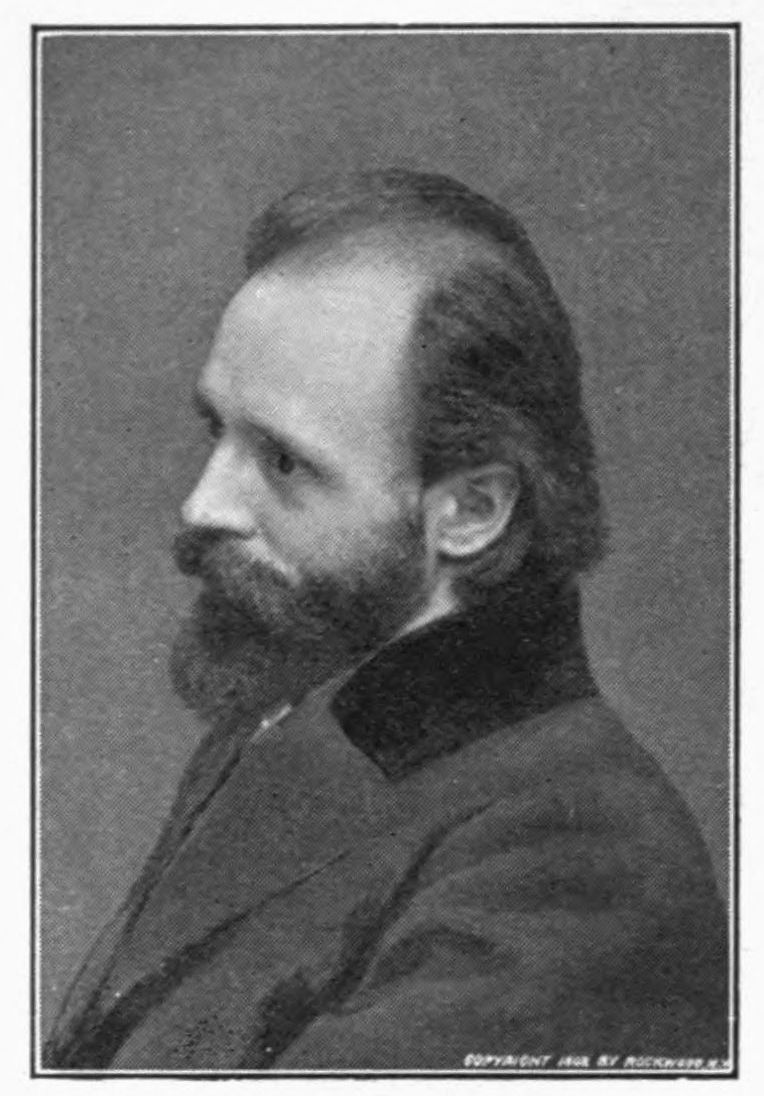
As a speaker he would be very effective if he left his manuscript alone entirely. His voice is low but clear, with a vibrant note of personal appeal in it. Toward the close of a reading or lecture it would grow a little husky, and under the strain of feeling at times a trifle indistinct. Occasionally he would put his notes or manuscript aside and appeal directly to the audience, pouring out for a few minutes an electric, eloquent flood of sentences which would bring enthusiastic response. He is original, though not sensational, in manner. As an author-reader he followed Sir Edwin Arnold in originality by having specially prepared for reading an unpublished story—in substance a condensed novel. His handwriting is an index of his temperament, small, fine, and nervous in style.
The play of “The Christian” was entirely written on fine white note paper not over six by four inches in size. The writing is so small as almost to require a magnifying glass to read it, and it did not occupy more than two-thirds of the page, with the names of the characters, etc., set on separate lines and running to the farther edge of the paper.
I had been in correspondence with him for a number of years with the view of making him a star lyceum attraction. I never could get his consent, although I had very encouraging symptoms. We became great friends. While in Europe, Mrs. Pond and I visited him at Greba Castle on the Isle of Man, and declared it the most interesting part of our English journey that summer. I came home, however, with very little encouragement. He had just finished “The Christian,” and the last page of copy had gone to the printer’s. He was cleaning out his library and workshop, and there were thousands of manuscript pages that he had rewritten and cross-written which he was throwing away. I asked the privilege of saving a few, and am now sorry that I didn’t take the whole barrel. I disliked to see them swept out.
A year later Mr. Caine came to this country to produce the play “The Christian.” While that was being rehearsed there was hardly a day that he did not come to my office, as many of his letters were addressed there and he stayed at the Everett House. He advised with me a good deal concerning many things, which I considered a very high honor. After the play had got thoroughly established, I persuaded him to consent to give a few readings in Boston, Albany, Rochester, Buffalo, Toronto, Detroit, Chicago, Cincinnati, Baltimore, and Washington.
The overwhelming success of the play of “The Christian” had in some way led Mr. Caine to believe that there would be the same sort of rush of people to hear the author of “The Christian.” While there were good-paying audiences and of the most select people, of course there were not galleries and big crowds such as Mr. Caine had been accustomed to see at performances of the play. The disappointment affected him very much. I had all I could do to keep him cheered up.
At Albany and Troy the houses were very small. The play of “The Christian” had its first production in Albany, turning people away, and with thirty curtain calls. There Mr. Caine had banked upon a great reception. The receipts were small, but he was making $500 a day on “The Christian.” then running in New York. Why, I said, should he let a little thing like that worry him. I tried to convince him that so far as money was concerned he did not need it, and that it just happened to be an inopportune time that we visited Albany; in other cities it would be all right. We had fair business in Rochester, a large house in Toronto, an overflowing house in Cleveland, and a matinee in Detroit before a crowded house.
Wherever Mr. Caine went, there were invitations for all sorts of social affairs, which he accepted and enjoyed very much. I learned, while on this trip, that to have him at his best was at a dinner or social club after his performance. There could not be a more delightful, brilliant, entertaining man in conversation.
In Chicago he reserved an evening for the Manxmen residents of that city, who gave him a dinner. They were all from the Isle of Man, his native land. They talked Manx, ate Manx, and drank Manx (principally water). It was a strange crowd, and Mr. Hall Caine towered above everybody else in it. His was the only speech, as no one else there could talk. It was an interesting occasion.
F. MARION CRAWFORD
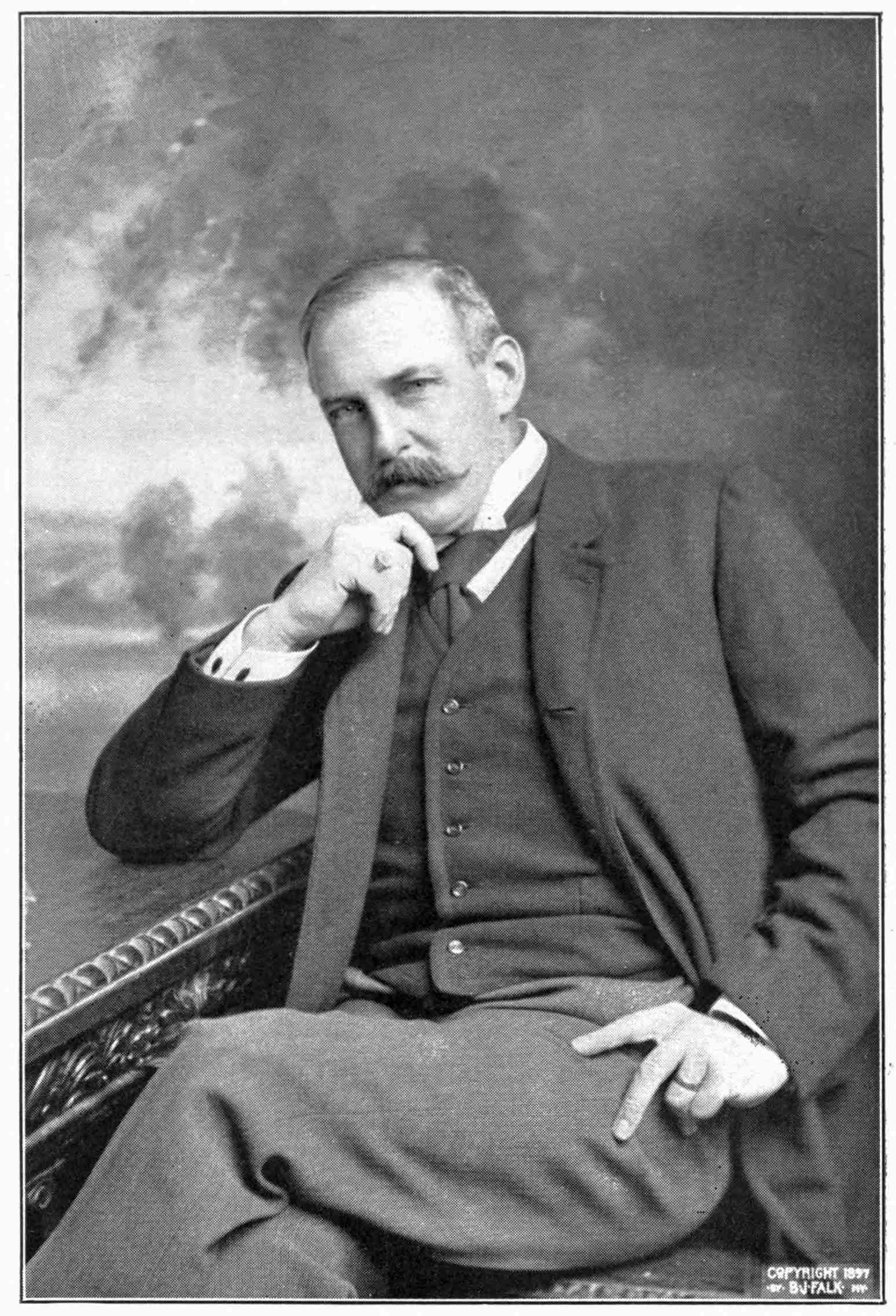
F. Marion Crawford is a man I love very much. I have the honor to call him friend. Had this popular author adopted a career of politics rather than the vocation of letters, he would have secured for himself a position in the councils of the republic almost equal in influence to that which he occupies as a writer of healthy and invigorating novels.
Fortunate in possessing a commanding presence, he has added to this an uninterrupted flow of choice and vivid language, and natural gestures which emphasize his magnificent word-pictures and carry conviction to those who listen to his appeals to manliness and universal tolerance.
He is a man who at all times has spoken his mind on religious subjects, with pride of strong conviction unmixed with defiance; a lecturer who handles his subject in a manner that is at once captivating, judicious, and wisely moderate. He breathes the very spirit of his novels—the spirit of human brotherhood, with hatred for all things petty and mean.
F. Marion Crawford carries his own stationery and pen and ink, and never writes with any other. He uses a “Falcon” pen, and has written every word of every novel with the same penholder. He was always writing. His “Ave Roma Immortalis” was written during this lecture tour. In a copy that he signed and presented to me he wrote,
“To the Major:
“From his friend and old lecturer, “F. Marion Crawford.
“The chapter on Julius Cæsar in this book was written chiefly on the train while we were travelling together in the West in 1898.”
The first thing upon entering his room at a hotel, Mr. Crawford arranges his writing materials, always in the same manner. The table is placed so that the light will fall from his left. He sits with his side to the table, his right arm resting on it, and the paper parallel with its length. He writes a very fine hand, and very rapidly, punctuating as he goes along. When a page is finished it is finished, and a work of art.
He arranges his bath and toilet articles, also, in a uniform way invariably. He never patronizes a local laundry. He has two leather trunks, made to order, that hold two dozen shirts; when one trunkful of shirts has been used he sends them to New York to be laundered, and the other trunk of fresh shirts arrives by express in time for his need.
The novelist carries a hand valise that he had made to order, with very long handles, so that it barely clears the pavement when carried. This enables him to get through a crowd without annoying others with his valise, for it is never in the way. His silver monogram is on every article of his toilet and writing equipment and his travelling-bags.
He wants his room at a temperature of sixty degrees, and so has it. He is very kind and polite to servants, and sees to it that each one who serves him is justly rewarded, not only pecuniarily, but with kind words.
Mr. Crawford asks the name of every servant or waiter who attends him, and addresses him by his name; and if he has occasion to refer to any hotel where he has been, he can recall the name of the one who served him.
He always has a drawing-room in the sleeping-car, and I know of only one instance, in a journey of seven thousand miles, where he failed to secure one. He arranges his drawing-room in exactly the same methodical way as his hotel room. He has a hanging alarm clock that is always in sight.
He sees the bright side of everything, and never says an ill-natured word. He is not fond of company, and receptions are especially irksome to him; but under such conditions he is always the perfect gentleman.
It was a long time before I could persuade him to prepare a lecture and devote a season to the platform. In the spring of 1898 he called at my office and asked me what my proposition was. I told him that I would do the same with him that I did with Stanley and others: make it a partnership arrangement, he taking two-thirds of the profit and I one-third, and I personally conducting the tour.
So we began early in October of that season. He had prepared four lectures: “The Early Italian Artists,” “Italian Home Life in the Middle Ages,” “The Italy of Horace,” and “Leo XIII. in the Vatican,” and returned to Italy for the summer to fit himself for his platform tour. He began on the 28th of October in Bridgeport, Conn., before one of the most select literary clubs in the country. I received a letter from the committee in Bridgeport which had engaged him, thanking me for the most delightful, scholarly lecture that club had ever offered to its members. I saw that Mr. Crawford was a success. His time was booked six nights a week, from November 1st to the following April. It was one of the most extensive and successful tours I have ever made with a star.
He lectured before the Brooklyn Institute of Arts and Sciences, one of the most intelligent audiences in the country. The house was closely packed, and on the platform were a number of the leading citizens of Brooklyn, including St. Clair McKelway, Mayor Schieren, the Rev. Dr. Lyman Abbott, and Dr. Richard S. Storrs. Dr. Abbott said such nice things of the lecture at its close that I asked him if I might have the privilege of publicly quoting his words. In reply, he sent me the following letter:
“Brooklyn, N. Y., Jan. 19, 1898.
“My Dear Major Pond:
“I heard with great interest Mr. Crawford’s lecture on ‘Leo XIII. and the Vatican,’ and am glad to be quoted anywhere as saying what I said at the close of that lecture, that I am sure wherever it is delivered it will help to remove prejudice of Protestants against Romanists and of Romanists against Protestants.
“Mr. Crawford’s literary skill needs no indorsement from me, and his ability in analysis of character and in portrait painting is seen to great advantage in his graphic picture of Leo XIII.
Yours sincerely, “Lyman Abbott.”
He lectured in the Northern cities until the 30th of January, and then made a tour through the principal cities of the South, and up through Texas and Kansas City, Mo., where I met him on the 12th of March and accompanied him across the continent to San Francisco and Southern California, back up the coast to Seattle, Victoria, B. C., Portland, Ore., Helena, Mont., and several other towns in Montana, closing in Fargo, N. Dak., on the 27th of April.
In our travel across the plains from Kansas City to Denver, I pointed out to Mr. Crawford where I had shot my first buffalo and many scenes of Indian fights and adventure, all of which he seemed to enjoy just as much as I did. In all, we spent twenty-two weeks and travelled twenty-six thousand miles. Our journey across the continent, through California, and up the coast was a succession of pleasurable events. With the exception of Mr. Beecher, I never had been associated with a man who interested himself so much in everything in which I was interested. We were inseparable, and there were many incidents of our journey which were really memorable in the cities where we visited.
In the Brigham Young Normal College, Provo, Utah, where over six hundred young men and women were being taught as missionaries to go all over the world and make converts to the Mormon faith, Mr. Crawford gave his lecture on “Leo XIII. in the Vatican” to as attentive an audience as I have ever known, and what was remarkable to Mr. Crawford and me were the characteristic interruptions of the audience. These people are accustomed to being addressed constantly, as all Mormons are preachers or speakers. Mr. Crawford said that he had some of the keenest questions put to him in regard to characters in his book and religious arguments that he had ever encountered. He was so pleased that he gave the college library a complete set of his books, which he signed and forwarded to that institution on his return from the journey.
Mr. Crawford’s lecture in Salt City was largely attended by a most remarkable audience. The Roman Catholic bishop, four Mormon bishops, and clergymen of all the different denominations residing there, were present. In the Methodist Church the lecturer was introduced by the Methodist pastor, and sixty per cent of the audience were Mormons, among whom were several of Brigham Young’s daughters, sons, and daughters-in-law.
The reception to the lecturer by the Ladies’ Press Club was held in the historic Bee-hive House, the former home of Brigham Young, where Mary Ann Angel, his first, and, as he claimed in his will, his legitimate wife, and a number of other wives had lived. Mormons and Gentiles were about equally represented. Among those present were some of the prophet’s daughters and many of his grandchildren and other former polygamous wives. There were army officers from Fort Douglas, with their wives, the Presbyterian and Episcopalian ministers and their wives, all mingling with one another without prejudice. From all appearances they were mutually enjoying the occasion. To me it seemed strange.
The Mormon religion is as firmly founded and progressive as any. The Mormon people, trained in industry and fealty, are as sincere as ever. Many “Gentiles” of former days have married Mormon women and joined the church. They had to do it if they got the wives, for one of their religious tenets is to marry young and increase the church, and the women have never known any other religion. There are now over three thousand missionaries in various parts of the world preaching the Mormon faith and sending converts by thousands every year to Utah. All the valleys and mountain cañons are becoming closely settled with homes made for these immigrant converts. They are spreading all over Nevada, Arizona, Idaho, Montana, Colorado, Northern Mexico, and Manitoba. Industrious, honest, frugal, patiently toiling, they are enriching the great mountain country, and doing it quietly while they work unceasingly. What is to be the result? The Mormon religion is surely growing.
The attendance was very great in Southern California, where Mr. Crawford met a large number of his readers and friends. What was particularly interesting on the tour was the great interest taken in him by all the Catholic priests. Invariably the leading priest called on him wherever he visited. Whenever we arrived at a city where there was a bishop, he would secure a carriage and his first call was on the bishop. He claimed that that was his duty. I had an opportunity to observe that among the best-educated men in the land are the Catholic priests. At Riverside, Cal., Father Sherman, the son of Gen. William T. Sherman, took great pains to entertain us in that interesting city. I would not have missed the opportunity of meeting Father Sherman for a good deal, as his father had been one of my dearest friends.
One night in San Francisco, after having returned from Oakland, we were seated in the grill-room of the Palace Hotel, our supper partly finished, engaged in conversation, when I suddenly said:
“Mr. Crawford, are we in the dining-car? See how these dishes are dancing.”
Mr. Crawford pulled out his watch and said:
“It’s an earthquake, Major. Don’t be frightened. I’ve been in fifty of them. It will only last twenty seconds.”
Then I saw chandeliers swinging, heard glass falling, and saw sober people staggering; meanwhile we were being shaken with vibrations like a milk shake, beginning slowly for, say ten seconds, then coming to the hardest part of the shock. Our table and chairs, and we in them, were being carried along the floor. Suddenly there was a great noise like a tremendous explosion, and then an atmospheric depression indescribable. All who could had rushed out into the streets. Had it not been for Mr. Crawford’s apparent indifference there’s no knowing where the writer would have been. It lasted only forty seconds, so all records agree, but, ah, it seemed a lifetime to most of those who got the benefit of it; for there never could have been a more remarkably exciting scene than the court and corridors of the Palace Hotel presented from the time of the earthquake until daylight. In the grill room were a number of men gathered in groups, with expressions on their faces that showed they were prepared for the worst. None of them smiled or attempted to show unconcern except Mr. Crawford, who kept continually assuring everybody that the whole thing was over—that if a return shock did not come within three minutes there would be none. Every man and woman that I saw was yawning. Whether it was because yawning is catching, or an atmospheric condition caused by the disturbance, it is not easy to tell, but such opening of mouths and such sallow, yellow and green countenances I never witnessed. The elevators began bringing guests to the ground floor, men, women, and children scrambling for the open—in all kinds of costumes that people sleep in, and some badly mixed up; one lady was barefooted, in a man’s overcoat; there were men in pajamas, trousers, and slippers, in overcoats. One man in a simple undershirt tried to jump from the first balcony. He was a short, fat man, weighing, I should say, 350. I thought I recognized him as one of the staff of a certain New York magazine, and called Mr. Crawford’s attention to the fact. He said:
“Yes, that is poor W——.” We hurried to him, only to learn that it was some other person. He was greatly frightened, and embarrassed, too, after coming to his senses; for the undershirt could no more protect his shaking body than the tinfoil on the neck of a champagne bottle could conceal all the champagne. We were glad it was not our friend, but we could not smile for gladness. A smile and an earthquake never appear simultaneously.
Two men fresh from their rooms, in sleeping garb, were supporting a young lady in angel clothes by both arms. They carried her bodily, as she had collapsed. It was pitiable, but not laughable, until next morning. Such calls as this: “Is there a doctor in the house? My wife is dying!” “Oh, can’t you get a doctor quick? I know my husband is dead or dying. Do try. Oh, what will become of us?” “Is there any train leaving right away?” A woman caught hold of a man’s arm, screaming, “Save me! save me!” He tried in his rush and fright to shake her off, but she again cried out: “Save, oh, save me! What shall I do?” Just then he loosened her grasp, saying, “Go to hell!” and she fell prostrate.
Returning to our rooms, I found my bed in the middle of the floor and the centre-table very near the wall; both had moved about four feet. Water was running in the bathroom. On the floor in the hallway lay a young man. I asked him if he felt badly or was in pain. He said: “No, I am in no pain, neither am I frightened. I simply cannot get up. My legs refuse to carry me.” We helped him to a sofa in the corridor, and there left him, at his request, with “Thank you.”
We were to leave for Southern California the following morning. I noticed that Mr. Crawford had some severe spells of coughing on the cars at night, and I thought that the earthquake had affected him more severely than he had cared to tell me. Before retiring he told me that he was going to take me into his confidence, as we were partners and friends, and mentioned the fact that he had been having a good deal of trouble coughing, and that he had had two hemorrhages since I had joined him; that his left lung was very sore, and he might be obliged to return home, but that he intended to finish the tour no matter what the sacrifice, if it were possible. In San Francisco he had been in consultation with a physician who had been recommended to him by his New York physician, and he had been advised to close the tour then and there and return home; but he was in hopes that Southern California might help him. This put a damper on further pleasure for me. I cared nothing whatever as to the business part of it—that never entered my mind; but I assured Mr. Crawford that I would not be the means of his breaking down for a dozen fortunes. He assured me that it was not my fault at all, and that he was going through. He had contracted a cold in New Orleans, and at Pueblo, on a very windy day, he had visited a smelting-works and had inhaled so much of the gas that it had nearly killed him. He received the best of care. We visited Southern California with no serious mishap, went back up to San Francisco for two more lectures, and then to Portland, Ore. At Portland he was seriously ill, and I persuaded him to call in a local physician, who examined him thoroughly, and who told me afterward that only a man of his perfect physique and iron constitution could possibly have continued lecturing. But Mr. Crawford was incorrigible, and insisted that he must be doctored up in order to finish his tour. This physician assured me that the case was very serious, and gave me some medicine and some directions about how to act in case there should be further attacks.
We continued on to Victoria, B. C., and back to Helena, Mont., a town that we had been advised to skip owing to its high altitude. The San Francisco doctor had insisted that it would not do for Mr. Crawford to venture twelve thousand feet above sea-level in Helena. It did no good. We went to Helena. Mr. Crawford gave two lectures there to the two largest audiences we had between the Pacific Ocean and the Missouri River. Then we went on to Winnipeg, and home. I was satisfied that Mr. Crawford’s days were numbered. I had promised to say nothing to any one about it, and I never did mention it, and would not do so now, were it not for the fact that Mr. Crawford has written me that he has fully recovered. During all the time Mr. Crawford kept up his writing, and was always cheerful. It was his wonderful power of abstraction and courage that carried him through this ordeal.
We parted in Chicago. He was so anxious to hurry home that he took the fastest train, while I made $16 by arriving twelve hours later by another route. We exchanged several telegrams on our different routes. I put it down as one of the most enjoyable and delightful companionships that I have ever had.
At the close of this six months’ tour Mr. Crawford sailed for his home in Italy, still in poor health. I hardly expected ever to see him again. I was lonesome without him, and busied myself at odd times with writing him letters, which he never answered. I feared he was ill, or that I had hurt his feelings in some way, but, to my delight, in due time the following letter came, which brought great joy to the Pond household:
“Sant’ Agnello di Sorrento, Italy, “Dec. 16, 1898.
“Dear Old Major:
“A Merry Christmas to you, and to Mrs. Pond, and Bim, and Miss Glass, and all the very best wishes of the season! I am not dead and buried, and as you may have supposed from a rude way I have of never answering a man’s letters till he has written about six times. But I have been very busy with my work, and between times with enjoying a long spell of home with my wife and children. Knowing how you hate Mrs. Pond and Bim, you will probably find this most extraordinary! You must try and get used to the idea. (This letter does not contain a request for a loan for five dollars at the end of it, so you may read it quite calmly—I just thought of that.)
“I look over my old note books of last year, and it hardly seems possible that I could ever have been the talking-piece of baggage that was sent flying over the country for six months to be wound up every day at the same hour. This is a good deal more comfortable, my friend, and there is less wear and tear on one’s throat and good clothes—not to mention one’s temper and digestion. All the same, I am glad I did it once, and saw the country from end to end and from top to bottom, and with a man who knows the West as you do. But if we ever do it again, I shall take a patent reversible india-rubber coffin which can be used as a bath, overcoat, or pulpit, and can be hermetically sealed so as to bring the lecturer home on ice from the point at which he dies!
“Well—I am all right again, thank goodness! Whatever you do, my friend, never let your lecturer go and visit the smelting furnaces in Colorado. That was the beginning of my trouble, and you were not there on that day to prevent me from going.
“We had a little earthquake here not long ago—a sort of little kitten earthquake—but it made me think of that evening in San Francisco, when the house rocked and the boy dropped the cheese into the ice box and ran! That was a good supper, well shaken down—we shall probably never digest another so quickly.