Part 1 — THE WORK OF THE WIND
Reading edition
When the March wind comes blustering down the street, rudely dashing a cloud of dust in our faces, we are uncomfortable and out of patience. We duck our heads and cover our faces, but even then we are likely to get a cinder in one eye, to swallow germs by the dozens, and to get a gray coating of plain, harmless dust. We welcome the rain that lays the dust, or its feeble imitation, the water sprinkler, that brings us temporary relief.
On the quietest day, even after a thorough sweeping and dusting of the library, you are able to write your name plainly on the film of dust that lies on the polished table. Take a book from the open shelves, and blow into the trough of its top. This is always dusty. Where does the dust come from? This is the house-keeper's riddle.
The answer is not a hard one. I look out of my window on a street which is famous as the road Washington took on his retreat from White Plains to Trenton. It has always been the main thoroughfare between New York and Philadelphia, and now is the route that automobiles follow. A constant procession of vehicles passes my house, and to-day each one approaches in a cloud of dust. The air is gray with suspended particles of dirt. The wind carries the successive clouds, and they roll up against the houses like breakers on the beach. Windows and doors are loose enough to let dust sift in. When a door opens, the cloud enters and lights on rugs and carpets and curtains. Any ledge collects its share of dust. The beating of carpets and rugs disturbs the accumulated dust of many months.
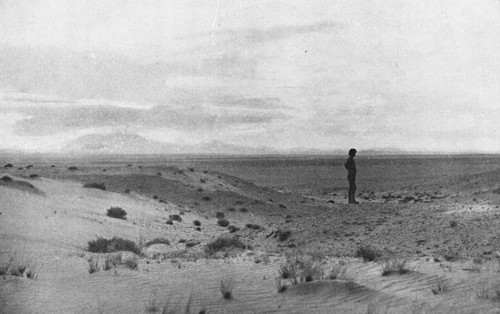
In this lonely Arizona desert the wind drifts the sand into dunes, just as it does on the toe of Cape Cod
The Grand Canyon of the Colorado shows on a magnificent scale the work of water in cutting away rock walls
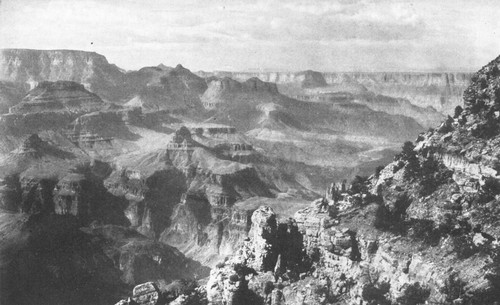
The wind sweeps the ploughed field, and takes all the dust it can carry. It blows the finest top soil from our gardens into the street. It blows soil from other fields and gardens into ours, so the level of our land is not noticeably lowered. The wind strips the high land and drops its burden on lower levels. This is one of the big jobs the water has to do, and the wind is a valuable helper. To tear down the mountains and fill in the valleys is the great work of the two partners, wind and water.
Dead, still air holds the finest dust, without letting it fall. The buoyancy of the particles overcomes their weight. We see them in a sunbeam, like shining points of precious metal, and watch them. A light breeze picks up bits of soil and litter, from the smallest up to a certain size and weight. If the velocity of the wind increases, its carrying power increases. It is able to carry bits that are larger and heavier. The following table is exact and interesting:
Velocity in Miles per HourPressure in Pounds per Sq. Ft.
Light breeze141
Strong breeze429
Strong gale7025
Hurricane8436
The terrible paths of hurricanes are seen in forest countries. The trees are uprooted, as if a great roller had crushed them, throwing the tops all in one direction, and leaving the roots uncovered, and a sunken pocket where each tree stood. On a steep, rocky slope, the uprooting of scattered trees often loosens tons of rock, and sends the mass thundering down the mountain-side. Much more destruction may be accomplished by one brief tornado than by years of wear by ordinary breezes.
The wind does much to help the waves in their patient beating on rocky shores. If the wind blows from the ocean and the tide is landward, the two forces combine, and the loose rocks are thrown against the solid beach with astonishing force. Even the gravel and the sharp sand are tools of great usefulness to the waves in grinding down the resisting shore. Up and back they are swept by the water, and going and coming they have their chance to scratch or strike a blow. Boulders on the beach become pockmarked by the constant sand-blast that plays upon them. The lower windows of exposed seaside houses are dimmed by the sand that picks away the smooth surface outside, making it ground glass by the same process used in the factory. Lighthouses have this difficulty in keeping their windows clear. The "lantern" itself is sometimes reached by the sand grains. That is the cupola in which burns the great light that warns vessels away from the rocks and tells the captain where he is.
In the Far Western States the telegraph poles and fence posts are soon cut off at the ground by the flinty knives the wind carries. These are the grains of sand that are blown along just above the ground. The trees are killed by having their bark girdled in this way. The sand-storms which in the orange and lemon region of California are called "Santa Anas" sometimes last two or three days, and damage the trees by piercing the tender bark with the needle-pointed sand.
Wind-driven soil, gathered from the sides of bare hills and mountains, fills many valleys of China with a fine, hard-packed material called "loess." In some places it is hundreds of feet deep. The people dig into the side of a hill of this loess and carry out the diggings, making themselves homes, of many rooms, with windows, doors, and solid walls and floors, all in one solid piece, like the chambered house a mole makes underground in the middle of a field. So compact is the loess that there is no danger of a cave-in.
The hills of sand piled up on the southern shore of Lake Michigan, and at Provincetown, at the toe of Cape Cod, are the work of the wind. On almost any sandy shore these "dunes" are common. The long slope is toward the beach that furnishes the sand. The wind does the building. Up the slope it climbs, then drops its burden, which slides to the bottom of an abrupt landward steep. There is a gradual movement inland if the strongest winds come from the water. The shifting of the dunes threatens to cover fertile land near them. In the desert regions, the border-land is always in danger of being taken back again, even though it has been reclaimed from the desert and cultivated for long years.
Besides tearing down, carrying away, and building up again the fragments of the earth's crust, the wind does much that makes the earth a pleasant planet to live on. It drives the clouds over the land, bringing rains and snows and scattering them where they will bless the thirsty ground and feed the springs and brooks and rivers. It scatters the seeds of plants, and thus plants forests and prairies and lovely mountain slopes, making the wonderful wild gardens that men find when they first enter and explore a new region. The trade winds blow the warm air of the Tropics north and south, making the climate of the northern countries milder than it would otherwise be. Sea winds blow coolness over the land in summer, and cool lake breezes temper the inland regions. From the snow-capped mountains come the winds that refresh the hot, tired worker in the valleys.
Everywhere the wind blows, the life-giving oxygen is carried. This is what we mean when we speak of fresh air. Stagnant air is as unwholesome as stagnant water. Constant moving purifies both. So we must give the wind credit for some of the greatest blessings that come into our lives. Light and warmth come from the sun. Pure water and pure air are gifts the bountiful earth provides. Without them there would be no life on the earth.