Part 1 — AN ANCIENT BEACH AT EBB TIDE
Reading edition
When the tide is out, the rocks on the Maine coast have plenty of living creatures to prove this northern shore inhabited. Starfishes lurk in the hollows, and the tent-shaped shells of the little periwinkle encrust the wet rocks. Mussels cling to the rocks in clumps, fastened to each other by their ropes of coarse black hair. The furry coating of sea mosses that encrust the rocks is a hiding-place for many kinds of living things, some soft-bodied, some protected by shells. The shallow water is the home of plants and animals of many different kinds. As proof of this one finds dead shells and fragments of seaweeds strewn on the shore after a storm.
Along the outer shores of the Cape Cod peninsula and down the Jersey coast, the sober colouring of the shells of the north gives way to a brighter colour scheme. In the warmer waters, life becomes gayer, if we may judge by the rich tints that ornament the shells. The kinds of living creatures change. They are larger and more abundant. The seaweeds are more varied and more luxuriant in growth.
When we reach the shores of the West Indian islands and the keys of Florida the greatest abundance and variety of living forms are found. The submerged rocks blossom with flower-like sea anemones of every colour. Corals, branching like trees and bushes on the sea floor, form groves under water. Among them brilliant-hued fishes swim, and highly ornamented shells glide, as people know who have gazed through the glass bottoms of the boats built especially to show visitors the wonderful sea gardens at Nassau, Bahama Islands, and at Santa Catalina Island, southern California.
On every beach the skeletons of animals which die help to build up the land; though the process is not so rapid in the north as on the shores that approach the tropics. The coast of Florida has a rim of island reefs around it built out of coral limestone. Indeed, the peninsula was built by coral polyps. Houses in St. Augustine are built of coquina rock, which is simply a mass of broken shells held together by a lime cement. Every sea beach is packed with shells and other remnants of animals and plants that live in the shallow waters. Deeper and deeper year by year the sand buries these skeletons, and many of them are preserved for all time.
Thus what is sandy beach to-day may, a few million years from now, be uncovered as a ledge of sandstone with the prints of waves distinctly shown, and fossil shells of molluscs, skeletons of fishes, and branches of seaweed—all of them different from those then growing upon the earth.
In the neighbourhood of Cincinnati there have been uncovered banks of stone accumulated along the border of an ancient sea. From the sides of granite highlands streams brought down the sand built into these oldest sandstone rocks. The fine mud which now appears as beds of slate was the decay of feldspar and hornblende in the same granite. Limestone beds are full of the fossil shells of creatures that lived in the shallow seas. Their skeletons, accumulating on the bottom, formed deep layers of limestone mud. These rocks preserve, by the fossils they contain, a great variety of shellfish which had limy skeletons. The sea fairly swarmed along its shallow margin with these creatures. We might not recognize many of the shells and other curious fossils we find in the rock uncovered by the workmen who are cutting a railroad embankment. They are not exactly like the living forms that grow along our beaches to-day, but they are enough like them for us to know that they lived along the seashore, and if we had time to examine all the rocks of this kind preserved in a museum we should decide that seashore life was quite as abundant then as it is now. The pressed specimens of plants of those earliest seashores are mere imprints showing that they were pulpy and therefore gradually decayed. Only their shape is recorded by dark stains made by each branching part. The decay of the vegetable tissue painted the outline on the rock which when split apart shows us what those ancient seaweeds looked like. They belonged to the group of plants we call kelp, or tangle, which are still common enough in the sea, though the forms we now have are not exactly like the old ones. Seaweeds belong to the very lowest forms of plants.
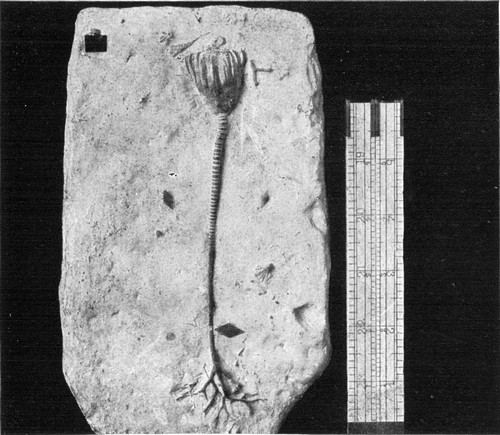
Crinoid from Indiana
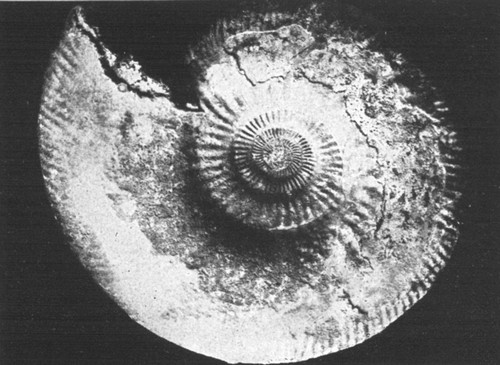
By permission of the American Museum of Natural History Ammonite from Jurassic of England
By permission of the American Museum of Natural History Fossil corals Coquina, Hippurite limestone
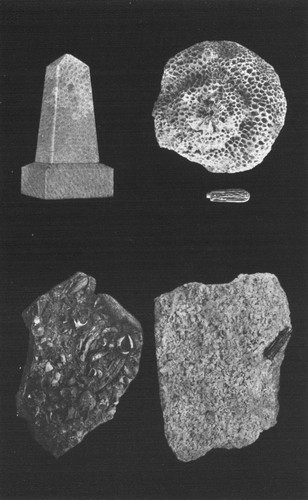
The limestones are full of fossils of corals. Indeed, there must have been reefs like those that skirt Florida to-day built by these lime-building polyps. Their forms are so well preserved in the rocks that it is possible to know just how they looked when they grew in the shallows.
One very common kind is called a cup coral, because the polyp formed a skeleton shaped like a cup. The body wall surrounded the skeleton, and the arms or tentacles rose from the centre of the funnel-like depression in the top. Little cups budded off from their parents, but remained attached, and at length the skeletons of all formed great masses of limy rock. Some cup corals grew in a solid mass, the new generation forming an outer layer, thus burying the parent cups.
A second type of corals in these oldest limestones is the honeycomb group. The colonies of polyps lived in tubes which lengthened gradually, forming compact, limy cylinders like organ pipes, fitted close together. The living generation always inhabited the upper chambers of the tubes. A third type is the chain coral, made of tubes joined in rows, single file like pickets of a fence. But these walls bend into curious patterns, so that the cross-section of a mass of them looks like a complex pattern of crochet-work, the irregular spaces fenced with chain stitches. Each open link is a pit in which a polyp lived.
Among the corals are sprays of a fine feathery growth embedded in the limestone. Fine, straight, splinter-like branches are saw-toothed on one or both edges. These limy fossils might not be seen at all, were they not bedded in shales, which are very fine-grained. Here again are the skeletons of animals. Each notch on each thread-like branch was the home of a tiny animal, not unlike a sea anemone and a coral polyp.
To believe this story it is necessary only to pick up a bit of dead shell or floating driftwood on which a feathery growth is found. These plumes, like "sea mosses," as they are called, are not plants at all, but colonies of polyps. Each one lived in a tiny pit, and these pits range one above the other, so as to look like notches on the thread-like divisions of the stem. Put a piece of this so-called "sea moss" in a glass of sea water, and in a few moments of quiet you will see, by the use of a magnifying glass, the spreading arms of the polyp thrust out of each pit.
The ancient seas swarmed with these living hydrozoans, and their remains are found preserved as fossils in the shales which once were beds of soft mud.
The hard shells of sea urchins and starfishes are made of lime. In the ancient seas, starfishes were rare and sea urchins did not exist, but all over the sea bottom grew creatures called crinoids, the soft parts of which were enclosed in limy protective cases and attached to rocks on the sea bottom by means of jointed stems. No fossils are more plentiful in the early limestones than these wonderful "stone lilies." Indeed, the crinoidal limestone seemed to be built of the skeletons of these animals. The lily-like body was flung open, as a lily opens its calyx, when the creature was feeding. But any alarm caused the tentacles to be drawn in, and the petal-like divisions of the body wall to close tightly together, till that wall looked like an unopened bud.
On the bottom of the Atlantic, near the Bahama Islands, these stone lilies are still found growing. Their jointed stems and body parts are as graceful in form and motion as any lily. The creature's mouth is in the centre of the flower-like top, and it feeds like the sea urchin, on particles obtained in the sea water.
The old limestones contain great quantities of "lamp shells," which are old-fashioned bivalves. Their shells remind us of our bivalve clams and scallops, but the internal parts were very different. The gills of clams and oysters are soft parts. Inside of the lamp shells are coiled, bony arms, supporting the fringed gills.
It is fortunate for us that a few lamp shells still live in the seas. By studying the soft parts of these living remnants of a very old race we can know the secrets of the lives of those ancient lamp shells, the soft parts of which were all washed away, and the fossil shells of which are preserved. Gradually the lamp shells died out, and the modern bivalves have come to take their places. Just so, the ancient crinoids are now almost extinct; the sea urchins and the starfishes have succeeded them.
The chambered nautilus has its shell divided by partitions and it lives in the outer chamber, a many-tentacled creature, that is a close relative of the soft-bodied squid. In the ancient seas the same family was represented by huge creatures the shells of which were chambered, but not coiled. Their abundance and great size are proved by the rocks in which their fossils are preserved. Some of them must have been the rulers of the sea, as sharks and whales are to-day. Fossil specimens have been found more than fifteen feet long and ten inches in diameter in the ancient rocks of some of the Western States. It is possible to read from the lowest rock formations upward, the rise of these sea giants and their gradual decline. Certain strata of limestone contain the last relics of this race, after which they became extinct. As the straight-chambered forms diminished, great coiled forms became more abundant, but all died out.
One of the most abundant fossil animals in ancient rocks is called a trilobite. Its body is divided by two grooves into three parts, a central ridge extending the whole length of the body and two side ridges. The front portion of the shell formed the head shield, and behind the main body part was a little tail shield. The skeleton was formed of many movable jointed plates, and the creature had eyes set in the head shield just as the king crab's are set. Jointed legs in pairs fringed each side of the body. Each leg had two branches, one for walking, the other for swimming. A pair of feelers rose from the head. The body could be rolled into a ball when danger threatened, by bringing head and tail together.
These remarkable, extinct trilobites were the first crustaceans. Their nearest living relative to-day is the horseshoe crab. The fresh-water crayfish and the lobster are more distant relatives: so are the shrimps and the prawns. No such abundance of these creatures exists to-day as existed when the trilobites thronged the shallows. So well preserved are these skeletons that, although there are no living trilobites for comparison, it is possible to find out from the fossil enough about their structure to know how they fed and lived their lives along with the straight-horns which were the scavengers of those early seas and the terror of smaller creatures. The trilobites throve, and, dying, left their record in the rocks; then disappeared entirely. We find their fossils in a great variety of forms, shapes, and sizes. The smallest is but a fraction of an inch long, the largest twenty inches long.
The ancient rocks, in which these lower forms of life have left their fossils, are known as the Silurian system. The time in which these rocks were accumulating under the seas covers a vast period. We call it the Age of Invertebrates, because these soft-bodied, hard-shelled animals, the crinoids, the molluscs, and the trilobites, with bony external skeletons and no backbones, were the most abundant. They overshadowed all other forms of life. The rocks of this wonderful series were formed on the shores of a great inland sea that covered the central portion of North America. In the ages that followed, these rocks were covered deeply with later sediments. But the upheavals of the crust have broken open and erosion has uncovered these strata in different regions. Geologists have found written there, page upon page, the record of life as it existed in the early seas.