Part 1 — THE HORSE AND HIS ANCESTORS
Reading edition
Every city has a horse market, where you may look over hundreds of animals and select one of any colour, size, or kind. The least in size and weight is the Shetland pony, which one man buys for his children to drive or ride. Another man wants a long-legged, deep-chested hunter. Another wants heavy draught-horses, with legs like great pillars under them, and thick, muscular necks—horses weighing nearly a ton apiece and able to draw the heaviest trucks. What a contrast between these slow but powerful animals and the graceful, prancing racer with legs like pipe-stems—fleet and agile, but not strong enough to draw a heavy load!
All these different breeds of horses have been developed since man succeeded in capturing the wild horse and making it help him. Man himself was still a savage, and he had to fight with wild beasts, as if he were one of them, until he discovered that he could conquer them by some power higher than physical strength. From this point on, human intelligence has been the power that rules the lower animals. Its gradual development is the story of the advance of civilization on the earth. Through unknown thousands of years it has gone on, and it is not yet finished.
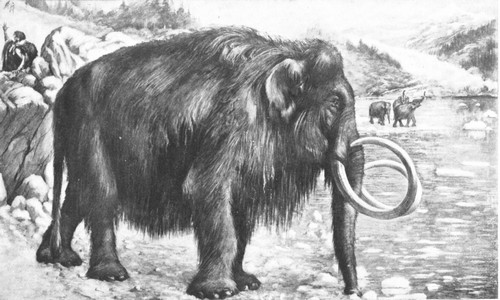
By permission of the American Museum of Natural History Restoration of a Siberian mammoth, Elephas primogenius, pursued by men of the old stone age of Europe. Late Pleistocene epoch
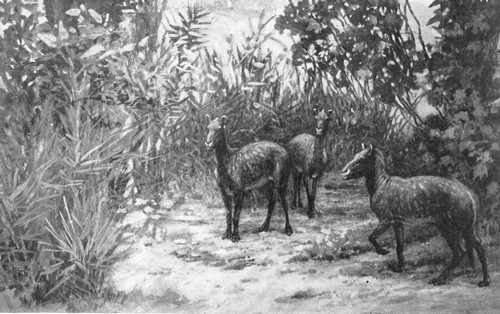
By permission of the American Museum of Natural History Restoration of a small four-toed ancestor of the horse family, Eohippus venticolus. Lower Eocene of Wyoming
Just when and where and how our savage ancestors succeeded in taming the wild horse of the plains and the forests of Europe or Asia is unknown. Man first made friends with the wild sheep, which were probably more docile than wild oxen and horses. We can imagine cold and hungry men seeking shelter from storms in rocky hollows, where sheep were huddled. How warm the woolly coats of these animals felt to their human fellow-creatures crowded in with them in the dark!
It is believed that the primitive men who used stone axes as implements and weapons, learned to use horses to aid them in their hunting, and in their warfare with beasts and other men. Gradually these useful animals were adapted to different uses; and at length different breeds were evolved. Climate and food supply had much to do with the size and the character of the breeds. In the Shetland Islands the animals are naturally dwarfed by the cold, bleak winters, and the scant vegetation on which they subsist. In middle Europe, where the summers are long and the winters mild, vegetation is luxurious, and the early horses developed large frames and heavy muscles. The Shetland pony and the Percheron draught-horse are the two extremes of size.
What man has done in changing the types of horses is to emphasize natural differences. The offspring of the early heavy horses became heavier than their parents. The present draught-horse was produced, after many generations, all of which gradually approached the type desired. The slender racehorses, bred for speed and endurance rather than strength, are the offspring of generations of parents that had these qualities strongly marked. Hence came the English thoroughbred and the American trotter.
We can read in books the history of breeds of horses. Our knowledge of what horses were like in prehistoric times is scant. It is written in layers of rock that are not very deep, but are uncovered only here and there, and only now and then seen by eyes that can read the story told by fossil skeletons of horses of the ages long past.
Geologists have unearthed from time to time skeletons of horses. It was Professor Marsh who spent so much time in studying the wonderful beds of fossil mammals in the western part of this country, and found among them the skeletons of many species of horses that lived here with camels and elephants and rhinoceroses and tigers, long before the time of man's coming.
How can any one know that these bones belonged to a horse's skeleton? Because some of them are like the bones of a modern horse. It is an easy matter for a student of animal anatomy to distinguish a horse from a cow by its bones. The teeth and the foot are enough. These are important and distinguishing characters. It is by peculiarities in the formation of the bones of the foot that the different species of extinct horses are recognized by geologists.
Wild horses still exist in the wilds of Russia. Remains of the same species have been dug out of the soil and found in caves in rocky regions. Deeper in the earth are found the bones of horses differing from those now living. The bones of the foot indicate a different kind of horse—an unknown species. But in the main features, the skeleton is distinctly horse-like.
In rocks of deeper strata the fossil bones of other horses are found. They differ somewhat from those found in rocks nearer the surface of the earth, and still more from those of the modern horse. The older the rocks, the more the fossil horse differs from the modern. Could you think of a more interesting adventure than to find the oldest rocks that show the skeletons of horses?
The foot of a horse is a long one, though we think of it as merely the part he walks on. A horse walks on the end of his one toe. The nail of the toe we call the "hoof." The true heel is the hock, a sharp joint like an elbow nearly half way up the leg. Along each side of the cannon, the long bone of this foot, lies a splint of bone, which is the remnant of a toe, that is gradually being obliterated from the skeleton. These two splints in the modern horse's foot tell the last chapter of an interesting story. The earliest American horse, the existence of which is proved by fossil bones, tells the first chapter. The story has been read backward by geologists. It is told by a series of skeletons, found in successive strata of rock.
The "Bad Lands" of the arid Western States are rich in fossil remains of horses. Below the surface soil lie the rocks of the Quaternary Period, which included the drift laid down by the receding glaciers and the floods that followed the melting of the ice-sheet. Under the Quaternary lie the Tertiary rocks. These comprise three series, called the Eocene, Miocene, and Pliocene, the Eocene being the oldest. In the middle region of North America, ponds and marshy tracts were filled in during the Tertiary Period, by sediment from rivers; and in these beds of clay and other rock débris the remains of fresh-water and land animals are preserved. Raised out of water, and exposed to erosive action of wind and water, these deposits are easily worn away, for they have not the solidity of older rocks. They are the crumbly Bad Lands of the West, cut through by rivers, and strangely sculptured by wind and rain. Here the fossil horses have been found.
Eohippus, the dawn horse, is the name given a skeleton found in 1880 in the lower Eocene strata in Wyoming. This specimen lay buried in a rock formation ages older than that in which the oldest known skeleton of this family had been found. Its discovery made a great sensation among scientists. This little animal, the skeleton of which is no larger than that of a fox, had four perfect toes, and a fifth splint on the forefoot, and three toes on the hind foot. The teeth are herbivorous.
Orohippus, with a larger skeleton, was found in the middle Eocene strata of Wyoming. Its feet are like those of its predecessor, except that the splint is gone. The teeth as well as the feet are more like those of the modern horse.
Mesohippus, the three-toed horse, found in the Miocene, shows the fourth toe reduced to splints, and the skeleton as big as that of a sheep. In this the horse family becomes fairly established.
Hypohippus, the three-toed forest horse, found in the middle Miocene strata of Colorado, is a related species, but not a direct ancestor of the modern horse.
Neohipparion, the three-toed desert horse, from the upper Miocene strata, shows the three toes still present. But the Pliocene rocks contain fossils showing gradual reduction of the two side toes, modification of the teeth, and increase in size of the skeleton.
Protohippus and Pliohippus, the one-toed species from the Pliocene strata, illustrate these changes. They were about the size of small ponies.
Equus, the modern horse, was represented in the Pliocene strata by a species, now extinct, called Equus Scotti. This we may regard as the true wild horse of America, for it was as large as the domesticated horse, and much like it, though more like a zebra in some respects. No one can tell why these animals, once abundant in this country, became extinct at the end of the Tertiary Period. But this is undoubtedly true.
The types described form a series showing how the ancestors of the modern horse, grazing on the marshy borders of ancient ponds, lived and died, generation after generation, through a period covering thousands, possibly millions, of years. Along the sides of the crumbling buttes these ancient burying-grounds are being uncovered. Within a dozen years several expeditions, fitted out by the American Museum of Natural History, have searched the out-cropping strata in Dakota and Wyoming for bones of mammals known to have lived at the time the strata were forming in the muddy shallows along the margins of lake and marsh. Duplicate skeletons of the primitive horse types above have been found, and vast numbers of their scattered bones. Each summer geological excursions will add to the wealth of fossils of this family collected in museums.
The Tertiary rocks in Europe yield the same kind of secrets. The region of Paris overlies the estuary of an ancient river. When the strata are laid bare by the digging of foundations for buildings, bones are found in abundance. Cuvier was a famous French geologist who made extensive studies of the remains of the prehistoric animals found in this old burial-place called by scientists the Paris basin. He believed that the dead bodies floated down-stream and accumulated in the mud of the delta, where the tide checked the river's current.
Skeletons of the Hipparion, a graceful, three-toed horse, were found in numbers in the strata of the Miocene time. This animal lived in Europe while the Pliohippus and the Protohippus were flourishing in America.
A great number of species of tapir-like animals left their bones in the Paris basin, among them a three-hoofed animal which may have been the connecting link between the horse and the tapir families. Cuvier found the connecting link between tapirs and cud-chewing mammals.