M.A., TRIN. HALL. CAMB.; MEMBER OF COUNCIL OF THE PHILOLOGICAL AND EARLY ENGLISH TEXT SOCIETIES; LOVER OF OLD BOOKS. (continued 3)
Reading edition

[Sloane MS. 1986, p. 193, ab. 1450-60. The last page mentions the 19th year of Henry VI., A.D. 1440-1.]
INcipiunt statuta familie bone Memorie dompni Roberti Grossetest, lincolnie episcopi.
Let alle men be warned þat seruen ȝou, and warnyng be ȝeue to alle men that be of howseholde, All servants should serve truly God and their Master; to serue god and ȝou trewly & diligently and to performyng, or the wyllyng of god to be performed and fulfyllydde. primus uersiculus doing fully all that their Master orders, Fyrst let seruauntis doo perfytely in alle thyngis youre wylle, and kepe they ȝoure commaundementis after god and ryȝthwysnesse, and with-oute condicioñ and also with-oute gref or offense. And sey ȝe, that be principalle heuede or prelate to alle ȝoure seruauntis bothe lesse and more, that they doo fully, reedyly, and treuly, without answering. with-oute offense or ayenseyng, alle youre wille & commaundement that is not ayeynys god. 2us T* the secunde ys, that ȝe commaunde them that kepe and haue kepyng of ȝoure howseholde, The upper servants must be honest and diligent, a-fore ȝoure meynye, that bothe with-in and with-oute the meynye be trewe, honest, diligent, bothe chast and profitabulle. 3us ¶ the thrydde: commaunde ye that nomañ be admittyd in ȝoure howseholde, nother inwarde nother vtwarde, and engage no untrusty or unfit man. but hit be trustyd and leuyd that ȝe be trewe and diligent, and namely to that office to the whiche he is admyttyd; Also þat he be of goode maners iv. ¶ The fowrethe: be hit sowȝht and examined ofte tymys yf ther be ony vntrewman, vnkunnyng, Dishonest, vnhonest, lecherous, quarrelsome, and drunken servants must be turned out. stryffulle, [* p. 194] drunke*lewe, vnprofitabulle, yf there be ony suche yfunde or diffamydde vppon these thyngis, that they be caste oute or put fro the howseholde. v. All must be of one accord, ¶ The fyft: commaunde ȝe that in no wyse be in the howseholde men debatefulle or stryffulle, but that alle be of ooñ a-corde, of ooñ wylle, euen lyke as in them ys oon mynde and oon sowle. vi. ¶ The sixte: commaunde ȝe that alle tho that seruen in ony offyce be obedient to those above them, obedient, and redy, to them that be a-bofe them in thyngis that perteynyñ to there office. vii. ¶ The seuenthe: commaunde ȝe that ȝoure gentilmen yomen and other, dayly bere and dress in livery, were there robis in ȝoure presence, and namely at the mete, for ȝoure worshyppe, and not oolde robis and not cordyng to the lyuerey, and not wear old shoes. nother were they oolde schoon ne fylyd. viii. ¶ The viij: Order your Alms to be Commaunde ȝe that ȝoure almys be kepyd, & not sende not to boys and knafis, nother in the halle nothe oute of þe halle, ne be wasted in soperys ne dyners of gromys, but wysely, temperatly, with-oute bate or betyng, given to the poor and sick. be hit distribute and the[n] departyd to powre meñ, beggers, syke folke and febulle. ix. Make all the household dine together in the Hall. ¶ The ix.: Make ȝe ȝoure owne howseholde to sytte in the alle, as muche as ye mow or may, at the bordis of oon parte and of the other parte, and lette them sitte to-gedur as mony as may, not here fowre and thre there: and when youre chef maynye be sett, then alle gromys [* p. 195] may* entre, sitte, And ryse x. Let no woman dine with you. wyfe] MS. wyse ¶ The x.: Streytly for-bede ȝe that no wyfe be at ȝoure mete. And sytte ȝe euer in the myddul of the hye borde, Let the Master show himself to all. that youre fysegge and chere be schewyd to alle meñ of bothe partyes, and that ȝe may see lyȝhtly the seruicis and defawtis: and diligently see ȝe that euery day in ȝoure mete seson be two men ordeyned to ouer-se youre mayny, and of that they shalle drede ȝou xi. ¶ The xi: commaunde ȝe, and yeue licence as lytul tyme as ye may with honeste to them that be in ȝoure howseholde, Let your servants go to their homes. to go home. And whenne ȝe yeue licence m, Assigne ȝe to them a short day of comyng a yeyne vndur peyne of lesyng there seruice. Don’t allow grumbling. And yf ony mañ speke ayen or be worthe] t.i. wroth worthe, say to hym, “what! wille ye be lorde? ye wylle þat y serue you after ȝoure wylle.” and they that wylle not here that ȝe say, effectually be they ywarnyd, and ye shalle prouide other seruantis the whiche shalle serue you to youre wylle or plesyng. xii. Tell your Panter and Butler to come to the table before grace. ¶ The xij is: command the panytrere with youre brede, & the botelare with wyne and ale, come to-gedur afore ȝou at the tabulle afore gracys, Tell off three yeomen to wait at table. And let be there thre yomen assigned to serue the hye tabulle and the two syde tabullis in solenne dayes; ¶ And ley they not the vessels deseruyng for ale and wyne vppon the [* p. 196] tabulle,* but afore you, But be thay layid vnder þe tabulle. xiii. ¶ The 13: Tell the Steward to keep good order in the Hall, commaunde ye the stywarde þat he be besy and diligent to kepe the maynye in hys owne persone inwarde and vtwarde, and namely in the halle and at mete, that they be-haue them selfe honestly, with-out stryffe, fowlespekyng, and noyse; And that they that be ordeynyd to sette messys, and serve every one fairly. bryng them be ordre and continuelly tyl alle be serued, and not inordinatly, And thorow affeccion] MS. affecciori affeccion to personys or by specialte; And take ȝe hede to this tyl messys be fully sett in the halle, and after tende ye to ȝoure mette. xiv. Have your dish well filled ¶ The xiiij: commaunde ȝe þat youre dysshe be welle fyllyd and hepid, and namely of entermes, and of pitance with-oute fat, that you may help others to it. carkyng that ȝe may parte coureteysly to thoo that sitte beside, bothe of the ryght hande and the left, thorow alle the hie tabulle, and to other as plesythe you, thowȝght they haue of the same that ye haue. At the soper be seruantis seruid of oon messe, & byȝth metis, & after of chese. ¶ And yf the[r] come gestis, seruice schalle be haued as nedythe. xv. Always admit your special friends, and show them you are glad to see them. ¶ The xv: commaunde ye the officers that they admitte youre knowlechyd men, familiers frendys, and strangers, with mery chere, the [* p. 197] and* they wylleñ to do that ye wylle to do, that they may know them selfe to haue be welcome to ȝou, and to be welle plesyd that they be come. ¶ And al so muche as ȝe may with-oute peril of sykenes & werynys ete ȝe in the halle afore ȝoure meyny, ¶ For that schalle be to ȝou profyte and worshippe. xvi. Talk familiarly to your Bailiffs, ¶ The xvj: when youre ballyfs comyn a-fore ȝoure, speke to them fayre and gentilly in opyñ place, and not in priuey, ¶ And shew them mery chere, ask how your tenants and store do. & serche and axe of them “how fare owre meñ & tenauntis, & how cornys dooñ, & cartis, and of owre store how hit ys multiplyed,” Axe suche thyngis openly, and knowe ȝe certeynly that they wille the more drede ȝou. xvii. Allow no private meals; only those in Hall. ¶ The xvij: commaunde ȝe that dineris and sopers priuely in hid plase be not had, & be thay forbeden that there be no suche dyners nother sopers oute of the halle, For of suche comethe grete destr[u]ccion, and no worshippe therby growythe to the lorde.
¶ Expliciunt Statuta Familie bone Memorie.

[From the Rawlinson MS., C. 86, fol. 31, in the Bodleian Library.]
Vtter thy langage wyth good avisement; Reule the by Reasoun in thy termoȝ alle; Never mistrust or fail your friend. Mystruste not thy frende for none accusement, 4 Fayle him neuer at nede, what so euer befalle; Solace þi selfe when menn to sporte þee calle; Don’t talk too much. Largely to speke be wele ware for þat cause; Rolle faste this reasoun & thynke wele on þis clause. Spare your master’s goods as your own. 8 What mann þou seruyst, alle wey him drede; His good as þyñ owne, euer þou spare. Lette neuer þy wylle þy witt ouer lede, But be glad of euery mannys welfare. 12 Folus lade polys; wisemenn ete þe fysshe; Wisemenn hath in þer hondis ofte þat folys after wysshe. A lawless youth, a despised old age. Who so in youthe no vertu vsith, In age alle honour him refusith. 16 Deame þee best in euery doute Tyl þe trouthe be tryed oute. A Gentleman says the best he can of every one. It is þe properte of A gentilmann To say the beste þat he cann. 20 Si vieȝ dolere tua crimina die miserere Permiserere mei frangitur ira dei

F. S.[eager]

Anno. 1557.
Dispise not councel, rebuking foly Esteme it as, nedefull and holy.
¶ THE AUCTOURS NAME IN VERDYT.
S Saye well some wyll by this my labour
E Euery man yet Wyll not say the same
A Amonge the good I doubt not fauour
G God them forgeue For it me blame
E Eche man I wyshe It shall offende
R Reade and then iudge Where faulte is amende
Face aut Tace.
CONTENTS.
(Taken from the headings in the Text.)
PAGE
The mornynge prayer 225
Cap. i. Howe to order thy selfe when thou rysest, and in apparelynge thy body 226
Cap. ii. Howe to behaue thy selfe in going by the streate and in the schoole 227
Cap. iii. Howe to behaue thi selfe in seruynge the table 229
Cap. iiii. Howe to order thy selfe syttynge at the table 231
Cap. v. Howe to order thy selfe in the Churche 233
Cap. vi. The fruites of gamynge, vertue and learnynge 234
Cap. vii. How to behaue thy selfe in taulkynge with any man 235
Cap. viii. How to order thy selfe being sente of message 236
Cap. ix. A-gainste Anger, Enuie, and malice 236
Cap. x. The fruites of charitie, loue, and pacience 237
Cap. xi. A-gainge (so) the horrible vice of swearynge 238
Cap. xii. A-gainste the vice of filthy talkynge 239
Cap. xiii. A-gainste the vice of lyinge 239
A praier to be saide when thou goest to bedde 240
The dutie of eche degred. (so) brefely declared 241
For this e-text, the lines have been re-split. Line numbers have been regularized to multiples of 4, as in other selections.

[sign. A. ii.] First, FIrst in the mornynge when thou dost awake, say this prayer: To God for his grace 4 thy peticion then make; This prayer folowynge vse dayly to say, Thy harte lyftynge vp; 8 Thus begyn to pray ¶ The mornynge prayer. “O God! “O God, from whom al good gifts procede! enable us to follow virtue. To thee we repayre 12 in tyme of our nede, That with thy grace thou wouldst vs endue Vertue to folowe 16 and vyce to exchue: Heare this our request, and graunt our desyre, [sign. A. ii. b.] O lorde! moste humbly 20 we do the requyre! Defend us this day. This day vs defende, that we walkynge aryght May do the thynge 24 acceptable in thy syght, That as we in yeares 26 And body do growe, Let us abound with virtues, So in good vertues 28 we may lykewyse flowe To thy honour, and ioy of our parentes, Learninge to lyue well, 32 and kepe thy commaundmentes; flee from vice, In flyinge from all Vice, synne, and cryme, Applyinge our bookes, 36 not losynge our tyme, and go forward in good doing to our live’s end.” May fructifye and go forwarde here in good doynge In this vale of miserie 40 vnto oure lyuees endynge, [sign. A. iii.] That after this lyfe here transitory We may attayne 44 to greater glory.” Repeat the Lord’s Prayer night and morning. The Lordes prayer then se thou recyte, So vsynge to do 48 at mornynge and nyght. HOW TO RISE AND DRESS IN THE MORNING. How to wash and dress yourself. ¶ Howe to order thy selfe when thou rysest, and in apparelynge thy body. Capitulo .i. Cato. Flye euer slouthe 50 and ouer much slepe; Don’t sleep too long. In health the body 52 therby thou shalte kepe. Muche slepe ingendereth 54 diseases and payne, It dulles the the wyt 56 and hurteth the brayne. [sign. A. iii. b.] Rise early; Early in the mornynge 58 thy bed then forsake, Thy rayment put on, 60 thy selfe redy make. cast up your bed, To cast vp thy bed 62 It shalbe thy parte, Els may they say 64 that beastly thou art; and don’t let it lie. So to departe 66 and let the same lye, It is not semynge 68 nor yet manerly. Go down, Downe from thy chamber 70 when thou shalte go, salute your parents, Thy parentes salute thou, 72 and the famely also; wash your hands, comb your head, Thy handes se thou washe, 74 and thy hed keame, And of thy rayment 76 se torne be no seame; [sign. A. iiii.] brush your cap and put it on. Thy cappe fayre brusht, 78 thy hed couer than, Takynge it of 80 In speakynge to any man. Cato. Cato doth councel thee thyne elders to reuerence Declarynge therby 84 thy dutye and obedience. Tie on your shirt-collar, Thy shyrte coler fast 86 to thy necke knyt; Comely thy rayment 88 loke on thy body syt. fasten your girdle, Thy gyrdell about 90 thy wast then fasten, rub your breeches, clean your shoes, Thy hose fayre rubd 92 thy showes se be cleane. A napkyn se that 94 thou haue in redines Thy nose to clense 96 from all fylthynes. [sign. A. iiii. b.] wipe your nose on a napkin, pare your nails, clean your ears, wash your teeth. Thy nayles, yf nede be, 98 se that thou payre; Thyne eares kepe cleane, 100 thy teath washe thou fayre. Have your torn clothes mended, If ought about thee 102 chaunce to be torne, Thy frendes therof shewe 104 howe it is worne, or new ones obtained. And they wyll newe 106 for thee prouyde, Or the olde mende, 108 In tyme beinge spyde, Get your satchell and books, and haste to School, This done, thy setchell 110 and they bokes take, And to the scole 112 haste see thou make. taking too But ere thou go, with thy self forthynke. pen, paper, and ink, That thou take with thee 116 pen, paper, and ynke; For these are thynges for thy study necessary, Forget not then 120 with thee them to cary. The souldiar preparynge 122 hym selfe to the fielde [sign. A. v.] which are necessary Leaues not at home 124 his sworde and his shielde, No more shulde a scoler 126 forget then truly for use at school. what he at scole 128 shulde nede to occupy. Then start off. These thynges thus had, Take strayght thy way Vnto the schole 132 without any stay. How to behave going to, and at, School. Howe to behaue thy selfe in going by the streate and in the schoole .ii. Take off your cap to those you meet; In goynge by the way and passynge the strete, Isocra. Thy cappe put of, 136 Salute those ye mete; Cato. In geuynge the way to suche as passe by, give way to passers by. It is a poynte 140 of siuilitie. [sign. A. v. b.] Call your playmates on your road. And thy way fortune so for to fall, Let it not greue thee 144 thy felowes to call. At School when to the schole thou shalte resort, This rule note well 148 I do the exhort: salute your master, Thy master there beynge, Salute with all reuerence, Declarynge thereby 152 thy dutye and obedience; and the scholars. Thy felowes salute 154 In token of loue, Lest of inhumanitie 156 they shall the reproue. Go straight to your place, undo your satchell, take out your books and learn your lesson; Vnto thy place 158 appoynted for to syt, Streight go thou to, 160 and thy setchel vnknyt, Thy bokes take out, 162 thy lesson then learne [sign. A. vi.] Humbly] Orig. Huubly Humbly thy selfe 164 Behaue and gouerne. stick well to your books. Therein takynge payne, with all thyne industry Learnynge to get 168 thy boke well applye: All thynges seme harde when we do begyn, Virgil. But labour and diligence 172 yet both them wyn; we ought not to recken and coumpt the thyng harde That bryngeth ioye 176 and pleasure afterwarde; If you don’t work, Leaue of then laboure, 178 and the lacke rue, you’ll repent it when you grow up. Lament and repent 180 when age doth insue. Who could now speak of famous deeds of old, Deades that deserued Fame and greate prayse, Buried had ben, 184 we se in olde dayes; [sign. A. vi. b.] had not Letters preserved them? If letters had not then brought them to lyght The truth of suche thynges 188 who coulde nowe resyght? Applye thy minde to learnynge and scyence, Cato. For learnynge in nede 192 wyll be thy defence. Nothinge to science compare we may well, Cicero. The swetenes wherof 196 all thynges doth excell. And Cato the wyse this worthy sayinge hath, Cato. That man wantinge learnynge 200 is as the image of death. Aristot. The rootes of learnynge 202 most bytter we deme; The fruites at last 204 Moste pleasaunt doth seme. Work hard then, Then labour for learnynge whyle here thou shalt lyue, [sign. A. vii.] The ignoraunt to teache, 208 and good example geue; and you’ll be thought worthy to serve the state. So shalte thou be thought A membre most worthy The common welth to serue Orig. ryme 212 In tyme of necessitie. Experience doth teache And shewe to thee playne Men of low birth win honour by Learning, That many to honour 216 By learninge attayne That were of byrthe But symple and bace,— Suche is the goodnes 220 Of Gods speciall grace,— For he that to honour 222 by vertue doth ryse, and then are doubly happy. Is double happy, 224 and counted most wyse. When you doubt, ask to be told. If doubte thou doest, 226 Desyre to be toulde, No shame is to learne, 228 Beinge neuer so oulde; [sign. A. vii. b.] Ignoraunce doth cause 230 Great errors in vs For wantynge of knowledge 232 Doubts to discusse; Then learne to discerne 234 the good from the yll, Wish well to those who warn you. And suche as thee warne, 236 Bere them good will. HOW TO BEHAVE IN SCHOOL AND STREET. On your way home walk two and two orderly when from the schoole ye shall take your waye, Or orderly then go ye, 240 twoo in aray, your selues matchynge So equall as ye may, (for which men will praise you); That men it seynge 244 May well of you saye In commendynge this your laudable wayes, whiche must nedes sounde 248 to your great prayse, don’t run in heaps like a swarm of bees Not runnynge on heapes as a swarme of bees, As at this day 252 Euery man it nowe sees; [sign. A. viii.] Not vsynge, but refusynge, 254 Suche foolyshe toyes like boys do now. As commonly are vsed 256 In these dayes of boyes, Don’t whoop or hallow as in fox-hunting As hoopynge and halowynge as in huntynge the foxe, That men it hearynge 260 Deryde them with mockes. This foolyshnes forsake, this folly exchewynge, And learne to followe 264 this order insuynge. don’t chatter, In goynge by the way Neyther talke nor iangle, or stare at every new fangle, Gape not nor gase not 268 at euery newe fangle, but walk soberly, But soberly go ye with countinaunce graue; Isocra. Humblye your selues 272 towarde all men behaue; [sign. A. viii. b.] taking your cap off to all, Be free of cappe 274 and full of curtesye; Greate loue of al men 276 you shall wyn therby. and being gentle. Be lowly and gentyll 278 and of meke moode; Then men con not 280 but of you say good. Do no man harm; speak fair words. In passynge the strete 282 Do no man no harme; Vse thou fewe wordes, 284 and thy tounge charme, Then men shal see that grace in the groweth From whom vertues 288 So aboundantly floweth. On reaching home when thou arte come 290 where thy parentes do dwell, Thy leaue then takynge 292 Byd thy felowes farewell; salute your parents reverently. The house then entrynge, In thy parence presence [sign. B. i.] Humbly salute them 296 with all reuerence. How to wait at table. ¶ Howe to behaue thi selfe in seruynge the table. Cap. iii. VVhen thy parentes downe to the table shall syt, In place be ready 300 For the purpose moste fyt: Look your parents in the face, With sober countinaunce Lokynge them in the face, hold up your hands, and say Thy handes holdynge vp, 304 this begyn grace: Grace before meate. “Geue thankes to God with one accorde For that shall be 308 Set on this borde. Grace before Meat. And be not carefull what to eate, To eche thynge lyuynge 312 the Lorde sends meate; For foode he wyll not 314 Se you peryshe, [sign. B. i. b.] But wyll you fede, 316 Foster, and cheryshe; Take well in worth 318 what he hath sent, At this tyme be 320 therwith content, 322 Praysynge God.” ¶ So treatablie speakyng 324 as possible thou can, That the hearers therof 326 May thee vnderstan. Make a low curtesy; Grace beynge sayde, 328 Lowe cursie make thou, wish your parents’ food may do ’em good. Sayinge “muche good 330 May it do you.” HOW TO SERVE AT DINNER. If you are big enough, Of stature then 332 yf thou be able, It shall become thee 334 to serue the table bring the food to table. In bringynge to it 336 Suche meate as shall nede [sign. B. ii.] For thy parence vpon 338 that tyme to fede. Don’t fill dishes so full as to spill them Disshes with measure 340 thou oughtest to fyll, Els mayste thou happen 342 thy seruyce to spyll on your parents’ dress, or they’ll be angry. On theyr apparell 344 Or els on the cloth, whiche for to doe wolde moue them to wroth. Have spare trenchers ready for guests. Spare trenchers with napkyns 348 haue in redynes To serue afterwarde, If there come any gesse. Be circumspecte; 352 see nothynge do wante; See there’s plenty of everything wanted. Of necessary thynges 354 that there be no skant, As breade and drynke, 356 se there be plentie; Empty the Voiders often. The voyders with bones 358 Ofte se thou emptie. [sign. B. ii. b.] At hande be ready, 360 If any do call, Be at hand if any one calls. To fetche or take vp, If ought fortune to fall. When the meat is over, when they haue done, 364 then ready make clear the table: The table vp fayre In order to take: 1. cover the salt, Fyrste the saulte 368 Se that thou couer, 2. have a tray by you to carry things off on, Hauynge by thee Eyther one or other thynges from thy handes 372 then to conuaye That from the table thou shalt take awaye. 3. put the trenchers, &c., in one Voider, A voyder vpon 376 the table then haue, The trenchers and napkyns therein to receaue; 4. sweep the crumbs into another, The croomes with a napkyn 380 together them swepe, [sign. B. iii.] It at the tables ende In a voyder them kepe. 5. set a clean trencher before every one, Then before eche man 384 A cleane treanchour lay, The best fyrste seruynge, As iudge thou soone may; 6. put on Cheese, Fruit, Biscuits, and Then cheese with fruite 388 On the table set, With Bisketes or Carowayes, As you may get. 7. serve Wine, Ale or Beer. Wyne to them fyll, 392 Els ale or beare; But wyne is metest, If any there were. When these are finished, Then on the table 396 Attende with all diligence, clear the table, It for to voyde 398 when done haue thy parence: and fold up the cloth. Eche syde of the clothe 400 Do thou tourne in, Foldynge it vp, At the hygher ende begin. [sign. B. iii. b.] Then spread a clean towel, A cleane towell then 404 On the table spreade,— The towell wantynge, the cloth take in steade,— bring bason and jug, The bason and ewer 408 to the table then brynge, and when your parents are ready to wash, In place conuenient theyr pleasure abydynge. and when your parents are ready to wash, when thou shalt see 412 them redy to washe, The ewer take vp, and be not to rashe pour out the water. In powrynge out water 416 More then wyll suffise. Clear the table; The table then voyde that they may ryse. All thynges thus done, 420 forget not thy dutie, make a low curtsey. Before the table Make thou lowe cursie. HOW TO BEHAVE AT ONE’S OWN DINNER. [sign. B. iiii.] How to behave at your own dinner. ¶ Howe to order thy selfe syttynge at the table. Capitulo .iiii. O Chyldren! geue eare 424 your duties to learne, Howe at the table you may your selues gouerne. Socra. Cato. Presume not to hyghe, 428 I say, in no case; Let your betters sit above you. In syttynge downe, to thy betters geue place. See others served first, Suffer eche man 432 Fyrste serued to be, For that is a poynte Of good curtesie. then wait a while before eating. when they are serued, 436 then pause a space, For that is a sygne of nourture and grace. Take salt with your knife, cut your bread, don’t fill your spoon too full, Saulte with thy knyfe 440 then reache and take, [sign. B. iiii. b.] The breade cut fayre, And do not it breake. Thy spone with pottage 444 to full do not fyll, For fylynge the cloth, If thou fortune to spyll, or sup your pottage. For rudnes it is 448 thy pottage to sup, Or speake to any, his head in the cup. Have your knife sharp. Thy knyfe se be sharpe 452 to cut fayre thy meate; Thy mouth not to full 454 when thou dost eate; Don’t smack your lips Not smackynge thy lyppes, 456 As comonly do hogges, or gnaw your bones: Nor gnawynge the bones 458 As it were dogges; avoid such beastliness. Suche rudenes abhorre, 460 Suche beastlynes flie, At the table behaue 462 thy selfe manerly. [sign. B. v.] Keep your fingers clean, Thy fyngers se cleane 464 that thou euer kepe, Hauynge a Napkyn thereon them to wype; wipe your mouth before drinking. Thy mouth therwith 468 Cleane do thou make, The cup to drynke In hande yf thou take, Let not thy tongue 472 At the table walke, Plato. Don’t jabber or stuff. And of no matter Neyther reason nor talke. Temper thy tongue 476 and belly alway, For “measure is treasure,” the prouerbe doth say, Cicero. And measure in althynges 480 Is to be vsed; what is without measure Ought to be refused. Silence hurts no one, For silence kepynge 484 thou shalt not be shent, [sign. B. v. b.] where as thy speache May cause thee repent. Isocra. Bothe speache and silence 488 are commendable, and is fitted for a child at table. But sylence is metest In a chylde at the table. Cato. And Cato doth saye, 492 that “in olde and yonge The fyrste of vertue 494 Is to kepe thy tonge.” Don’t pick your teeth, Pyke not thy teethe 496 at the table syttynge, or spit too much. Nor vse at thy meate Ouer muche spytynge; this rudnes of youth 500 Is to be abhorde; Behave properly. thy selfe manerly Behaue at the borde. Don’t laugh too much. If occasion of laughter 504 at the table thou se, Beware that thou vse the same moderately. [sign. B. vi.] Learn all the good manners you can. Of good maners learne 508 So muche as thou can; It wyll thee preferre 510 when thou art a man. Aristot. Aristotle the Philosopher 512 this worthy sayinge writ, They are better than playing the fiddle, That “maners in a chylde 514 are more requisit then playnge on instrumentes 516 and other vayne pleasure; For vertuous maners Is a most precious treasure.” though that’s no harm, Let not this saynge 520 In no wyse thee offende, For playnge of instrumentes He doth not discommende, but necessary; But doth graunt them 524 for a chylde necessary, yet manners are more important. Yet maners muche more 526 see here he doth vary. Refuse not his councell, 528 Nor his wordes dispise; [sign. B. vi. b.] To vertue and knowledge By them mayste thou ryse. How to behave at Church. ¶ Howe to order thy selfe in the Churche. Cap. .v. Vvhen to the Churche 532 thou shalt repayer, Pray kneeling or standing. Knelynge or standynge, to God make thy prayer; All worldely matters 536 From thy mynde set apart, Earnestly prayinge, to God lyfte vp thy hart. Psal. 1. A contrite harte 540 He wyll not dispyse, whiche he doth coumpt A sweete sacrifice. Confess your sins to God. To hym thy sinnes 544 shewe and confesse, Askynge for them Grace and forgyuenes; [sign. B. vii.] He knows your disease. He is the Phisition 548 that knoweth thy sore, And can to health 550 A-gayne thee restore. Iames the .i. Ask in faith, and what you ask you shall have; Aske then in fayth, 552 Not doubtynge to haue; The thynges ye desyre 554 ye shall then receaue; So they be lawfull Of God to requyre, He wyll the heare 558 and graunt thy desyre; He is more merciful than pen can tell. More mercifull he is 560 then pen can expresse, The aucthor and geuer here of all goodnesse. Math. x. “All ye that laboure 564 and burdened be, I wyll you refreshe In commynge to me.” These are Chrystes wordes, 568 the scripture is playne, [sign. B. vii. b.] Spoken to all suche 570 as here suffre payne; Our wylles to his worde 572 then let vs frame, The heauenly habytacion 574 therby we may clame. Behave nicely in church, In the churche comly 576 thy selfe do behaue, In vsage sober, thy countinaunce graue. and don’t talk whyle you be there, 580 taulke of no matter, or chatter. Nor one with an other whisper nor chatter. Behave reverently; Reuerently thy selfe 584 Order alwaye when to the Churche thou shalt come to pray: the House of Prayer Eche thynge hath his tyme, 588 Consyder the place, Luke .xix. For that is a token of vertue and grace, [sign. B viii.] The Lorde doth call it 592 the house of prayer is not to be made a fair. And not to be vsed As is a fayer. AGAINST GAMING, AND FOR VIRTUE. ¶ The fruites of gamynge, vertue and learnynge. Capitulo .vi. Avoid O Lytle chylde, 596 Eschewe thou euer game,— For that hath brought 598 Many one to shame,— dicing and carding. As dysynge, and cardynge, 600 And suche other playes, which many vndoeth, 602 as we se nowe a dayes. Cicero. But yf thou delyght 604 In any earthly thynge, Delight in Knowledge, Virtue, and Learning. Delyght in knowledge, 606 Vertue, and learnynge, For learnynge wyll leade thee 608 to the schoole of vertue, [sign. B. viii. b.] And vertue wyll teache thee 610 Vice to subdue. Vice beynge subdued, 612 thou canst not but floryshe; Happy is he who cultivates Virtue. Happy is the man that vertue doth norysh. By knowledge lykewyse 616 thou shalt doubtes discerne, By vertue agayne 618 thy lyfe well gouerne. These be the frutes 620 By them we do take, Cursed is he who forsakes it. Cursed is he then that doth them forsake. But we erre in wyt 624 In folowynge our wyll, In iudgynge that good 626 which playnly is yll. Let reason rule you, Let reason thee rule, 628 and not will thee leade To folowe thy fansie, A wronge trace to treade. [sign. C. i.] and subdue your lusts. But subdue thy luste, 632 and conqeur thy wyll If it shall moue thee to doe that is yll; These ills come from gambling: For what hurte by game 636 to many doth growe, No wyse man I thynke but doth it well knowe. Experience doth shewe 640 and make it manifeste That all good men can it but deteste, strife, murder, theft, As strife and debate, 644 murder and thefte, whiche amonge christians, wolde god were lefte, cursing and swearing. with cursynge and bannynge, 648 with swearyng and tearyng, That no honest harte can abyde the hearyng: These be the fruites 652 that of them doth sprynge, [sign. C. i. b.] with many more as euill that cometh of gamynge. How to behave when conversing. ¶ How to behaue thy selfe in taulkynge with any man. Capitulo .vii. If a man demaunde 656 a question of thee, Isocra. In thine aunswere makynge be not to hastie; Understand a question before you answer it; waie well his wordes, 660 the case vnderstande Eare an answere to make thou take in hande, Els may he iudge 664 in thee little wit, To answere to a thynge and not heare it. let a man tell all his tale. Suffer his tale 668 whole out to be toulde, Then speake thou mayst, and not be controulde; [sign. C. ii.] Then bow to him, look him in the face, and answer sensibly, Low obeisaunce makyng, 672 lokinge him in the face, Tretably speaking, thy wordes see thou place. with countinaunce sober 676 thy bodie vprighte Thy fete iuste to-gether, thy handes in lyke plight; not staring about Caste not thyne eies 680 on neither syde. when thou arte praised, therin take no pryde. or laughing, In tellynge thy tale, 684 neither laugh nor smyle, Such folly forsake thou, 686 banish and exyle; but audibly In audible voice 688 thy wordes do thou vtter, Not hie nor lowe, 690 but vsynge a measure. and distinctly, Thy wordes se that 692 thou pronounce plaine, [sign. C. ii. b.] that] orig. thai And that they spoken 694 Be not in vayne; In vttryng wherof your words in due order, 696 Kepe thou an order, Thy matter therby thou shalte much forder; whiche order yf thou 700 Do not obserue, or you’ll straggle off, From the purpose nedes must thou swarue. HOW TO CARRY A MESSAGE. And hastines of speche 704 wyll cause thee to erre, or stutter, or stammer, which is a foul crime. Or wyll thee teache to stut or stammer. To stut or stammer 708 is a foule crime, Learne then to leaue it, take warnyng in tyme; How euyll a chylde 712 it doth become, Thy selfe beynge iudge, hauinge wisedome; [sign. C. iii.] And sure it is taken 716 by custome and vre, whyle yonge you be there is helpe and cure. This generall rule 720 yet take with the, Always keep your head uncovered. In speakynge to any man Thy head vn-couered be. The common prouerbe 724 remember ye oughte, Better unfed than untaught. “Better vnfedde then vn-taughte.” How to take a Message. ¶ How to order thy selfe being sente of message. Cap. viii. If of message 728 forthe thou be sente, Listen to it well; don’t go away not knowing it. Take hede to the same, Geue eare diligente; Depart not awaye 732 and beyng in doute, [sign. C. iii. b.] Know wel thy message before thou passe out; Then hurry away, with possible spede 736 then hast thee right sone; If nede shall requirr it 738 so to be done. give the message; After humble obeisaunce, 740 the message forth shewe Thy wordes well placinge 742 in vttringe but fewe As shall thy matter 744 serue to declare. get the answer, return home, and tell it to your master Thine answere made, then home againe repare, And to thy master 748 therof make relacion As then the answere shall geue thee occasion. Socra. Neither adde nor deminish 752 any thynge to the same, Lest after it proue to thy rebuke and shame, [sign. C. iiii.] exactly as it was told to you. But the same vtter 756 so nere as thou can; No faulte they shall fynde to charge thee with than, In most humble wyse 760 loke done that it be, As shall become beste a seruantes degre. Against Anger, &c. ¶ A-gainste Anger, Enuie, and malice. Cap. ix. The slave of Anger must fall. If thou be subiecte 764 and to anger thrall, And reason thee rule not, nedes must thou fall. Pericles. Conquer thy wyll 768 and subdue thy luste, Thy fansy not folowing, thy cause though be iuste; Anger’s deeds are strange to wise men. For anger and furie 772 wyll thee so chaunge [sign. C. iiii. b.] That thy doynges to wise men wyll appear straunge. Thine anger and wrath 776 seke then to appeace, Plato. For wrath, saith Plato, Leades shame in a leace. Isocra. The hastie man 780 wantes neuer trouble, A hasty man is always in trouble. His mad moody mynde his care doth double. And malyce thee moue 784 to reuenge thy cause, Dread euer god, and daunger of the lawes. Take no revenge, but forgive. Do not reuenge, 788 though in thy power it be, Forgeue the offender 790 being thine enemie. He is perfectely pacient, 792 we may repute plaine, Plato. [That] From wrath and furye 794 himselfe can refrayne. [sign. C. v.] Envy no one. Disdayne nor enuie 796 The state of thy brother, Seneca. In worde nor dede not hurtyng one an other. An ill body breeds debate. Debate and disceate, 800 contencion and enuie, Are the chiefe frutes of an euyll bodie. Salomon. And Salomon saithe 804 “The harte full of enuie, Of him selfe hath 806 no pleasure nor commoditie.” The Fruits of Charity, &c. ¶ The fruites of charitie, loue, and pacience. Cap. x. Charity seeketh not her own, but bears patiently. Charitie seketh not 808 that to her doth belonge, But paciently a-bydinge, sustainynge rather wronge; Charity seeketh not her own, Not enuiynge, but bearinge 812 with loue and pacience,— [sign. C. v. b.] but bears patiently. So noble is her nature,— 814 forgeuing all ofence. Love incites to Mercy. And loue doth moue 816 the mynde to mercie, But malice againe doth worke the contrarie. whiche in the wicked 820 wyll euer beare stroke, Patience teaches forbearance. Pacience thee teacheth therof to beare the yoke. where pacience and loue 824 to-gether do dwell All hate and debate, with malice, they expell. Pithagoras. Loue constant and faithfull, 828 Pithagoras doth call To be a vertue most principall. Plato. Plato doth speake 832 almoste in effecte ‘where loue is not, no vertue is perfecte.’ [sign. C. vi.] Pray God to give thee Charity and Patience, Desire then god 836 to assiste thee with his grace Charitie to vse and pacience to imbrace; to lead thee to Virtue’s School, These three folowinge 840 will thee instructe, That to vertues schoole they wyll thee conducte, and thence to Eternal Bliss. And from vertues schoole 844 to eternall blisse where incessaunt ioie continually is. AGAINST SWEARING. Against Swearing. ¶ A-gainge (so) the horrible vice of swearynge. Cap. xi. Take not God’s name in vain, In vaine take not 848 the name of god; Swere not at all for feare of his rod. or He will plague thee. The house with plagues 852 he threteneth to visit sign. C. vi. b. where othes are vsed: they shall not escape it. Iuste are his iudgementes, 856 and true is his worde, And sharper then is a two edged sworde; Beware of His wrath, wherfore beware thou 860 his heauy indignacion, and live well in thy vocation. And learne to lyue well in thy vocacion wherin that god 864 shall thee set or call; Rysinge againe— if it fortune to fall— By prayer and repentance, 868 whiche is the onely waie. Christ wolde not the death 870 of a sinner, I saye, But rather he turne 872 From his wickednesse, And so to lyue in vertue and goodnesse. [sign. C. vii.] What is the good of swearing? what better art thou 876 for this thy swearyng Blasfamouslye, the name of god tearyng? It kindles God’s wrath against thee. Prouokynge his yre 880 and kyndlinge his wrath Thee for to plauge, that geuinge the hath Knowlage and reason 884 thy selfe for to rule, And for to flee the thynge that is euyl. Seneca. Senica doth councell thee 888 all swerynge to refrayne, Although great profite by it thou mighte gaine: Pericles. Pericles, whose wordes 892 are manifeste and playne, From sweryng admonisheth 894 thee to obstaine; God’s law forbids The lawe of god, 896 and commaundement he gaue, [sign. C. vii. b. swearing, Swearynge amongst vs in no wyse wolde haue. and so does the counsel of Philosophers. The councell of philosoph[ers] 900 I haue here expreste, Amongest whom sweryng was vtterly deteste; Much lesse amongest christians 904 ought it to be vsed, But vtterly of them cleane to be refused. Against filthy talking. ¶ A-gainste the vice of filthy talkynge. Cap. xii. Never talk dirt. No filthy taulke 908 in no wise vse, Thy tonge therby for to abuse. For every word we shall give account Of euery idell worde 912 an accumpte we shall render;— All men I woulde this sayinge to remember;— [sign. C. viii.] at the Day of Doom, To god for it 916 at the generall daie In earnest or sporte we shall speake or saie; whiche daye to the iuste 920 shallbe most ioyfull, And to the wicked againe as wofull. and be judged according to our deeds. As we here doe, 924 so shall we receaue, Vnles we repente and mercy of god craue. If god wyll deale 928 with vs so straight For thinges that be of so small waight, Let lewd livers then fear. Then haue we cause 932 to feare and dreade, Our lyues lewdly if we haue leade. [sign. C. viii. b.] Keep your tongue from vain talking. Thy tonge take hede 936 thou doe refrayne From speakyng wordes that are moste vayne; Aristot. Thy wyll and witte 940 to goodnes applie, Thy mynde exercise in vertuous studie. AGAINST LYING. Against Lying. ¶ A-gainste the vice of lyinge. Capitulo .xiii. Plato. To forge, to fayne, 944 to flater and lye, Requiere diuers collours with wordes fayre and slye, To speak the But the vtteraunce of truthe 948 is so simple and playne truth needs no study, That it nedeth no studie 950 to forge or to fayne; therefore always wherfore saye truth, 952 how euer stand the case, So shalte thou fynde 954 more fauour and grace. practise it and speak it. Vse truthe, and say truth, 956 in that thou goest aboute, For tyme of althinges the truthe wyll bringe out. [sign. D. i.] Shame is the reward of lying. Shame is the rewarde 960 For lying dewe; Then auoyde shame, and vtter wordes trewe. A lyar by his lying 964 this profet doth get, That whan he saith truth no man wyll him credet; Always speak the truth. Then let thy talke 968 with the truth agree, And blamed for it thou shalte neuer bee. Who can trust a liar? Howe maie a man 972 a lyer ought truste? But doubte his dedes, his woordes being vniuste. In tellyng of truth 976 there lougeth no shame, Where vttring of lyes deserueth much blame; If a lie saves you once, And though a lye 980 from stripes ye once saue, [sign. D. i. b.] it deceives you thrice. Thrise for that once 982 it wyll the desceue; Truste then to truth, 984 and neither forge nor fayne, And followe these preceptes: 986 from liyng do refraine. A NIGHTLY PRAYER. A bedward Prayer. ¶ A praier to be saide when thou goest to bedde. God of mercy, O Mercifull god! 988 heare this our requeste, And graunte vnto vs 990 this nighte quiet reste. take us into Thy care. Into thy tuicion, 992 oh lorde, do vs take! Our bodies slepynge, our myndes yet maie wake. Forgive us our sins. Forgeue the offences 996 this daye we haue wroughte A-gainste thee and our neighbour 998 in worde, dede, and thoughte! And graunte vs thy grace 1000 hense forth to flie sinne, [sign. D. ii.] Deliver us from evil, And that a newe lyfe we maie nowe beginne! Deliuer and defende vs 1004 this night from all euell, and our enemy the Devil. And from the daunger of our enemie, the diuell, whiche goeth a-boute 1008 sekyng his praie, And by his crafte whom we maie betraie. Assist us Assiste vs, oh lorde, 1012 with thy holy sprite, That valiantly against him we maie euer fighte; to conquer him And winning the victorie, 1016 maie lifte vp our voice, And in his strength 1018 faithfully reioice, and ascribe all honour to Thee. Saying, “to the lorde 1020 be all honour and praise For his defence bothe now and alwaies!” THE DUTY OF ALL DEGREES OF MEN. [sign. D. ii. b.] Each one’s Duty. ¶ the dutie of eche degred. (so) brefely declared. The Duty of Princes, 1 Ye princes, that the earth 1024 rule and gouerne, Seke ye for knowledge doubtes to discerne. Judges, 2 Ye iudges, geue iudgement 1028 according to righte As may be founde acceptable in the lordes sight. Prelates, 3 Ye prelates, preache purely 1032 the worde of our lorde, That your liuings & prechinges in one maie accorde. Parents, 4 Ye fathers and mothers, 1036 so your children instructe As maye them to grace and uertue conducte. [sign. D. iii.] Children, 5 Ye chyldren, lykewyse 1040 obey your parentes here; In all godlinesse see that ye them feare. Masters, 6 Ye maisters, do you 1044 the thynge that is righte Not lokynge what ye may do by mighte. Servants, 7 Ye seruauntes, applie 1048 your busines and arte, Doinge the same in singlenesse of harte. Husbands. 8 Ye husbandes, loue your wyues, 1052 and with them dwell, All bitternesse set aparte, vsing wordes gentell. The Duty of Wives, 9 Ye wyues, to your husbandes 1056 be obedient alwaie, [sign. D. iii. b.] For they are your heades, and ye bounde to obeie. Parsons and Vicars, 10 Ye persons and vickers 1060 that haue cure and charge, Take hede to the same, and roue not at large. Men of Law, 11 Ye men of lawe, 1064 in no wyse delaie The cause of the poore, but helpe what ye maie. Craftsmen, 12 Ye that be craftes men, 1068 vse no disceite, Geuing to all men tale, measure, and weighte. Landlords, 13 Ye that be landlordes 1072 and haue housen to let, At reasonable rentes do them forth set. [sign. D. iiii.] Merchants, 14 Ye merchauntes that vse 1076 the trade of merchandise, Vse lawfull wares and reasonable prise. Subjects, 15 Ye subiectes, lyue ye 1080 in obedience and awe, Fearyng gods stroke, and daunger of the lawe. Rich Men, 16 Ye rych, whom god 1084 hath goods vnto sente, Releue the poore and helpe the indigente. Poor Men, 17 Ye that are poore, 1088 with your state be contente, Not hauinge wherwith to lyue competente. Magistrates, 18 Ye magestrates, the cause 1092 of the widdow and fatherles [sign. D. iiii. b.] Defende againste suche as shall them opresse. Officers, 19 All ye that are called 1096 to any other office, Execute the same acordinge to iustice. The Duty of all Men. 20 Let eche here so liue 1100 in his vocacion, As maie his soule saue, and profet his nacion. God grant us all to live and die well! 21 This graunting god, 1104 that sitteth on hie, we shall here well lyue and after well die. Famam virtutis mors Abolire nequit quod. F. S.
¶ Imprinted at London in Paules Churchyearde. By william Seares.

[MS. O. 9. 38. Trinity College, Cambridge.]
Almyȝty godde, conserue vs fram care! Where ys thys worle A-wey y-wente? A man must mind what he says; A man that schold speke, had nede to be ware, 4 ffor lytyl thyng he may be schente; Tonggys beth y-turne to lyther entente; hearts are fickle and fell. Hertys, they beth bothe fykel and felle; Man, be ware leste thow repente! 8 Whate euer thow sey, A-vyse the welle! Take care what you say. A-vyse the, man, yn whate place and whare A woord of conseyl thow doyst seyne; A false friend may hear it, Sum man may ley ther-to hys ere; 12 Thow wenyst he be thy frend; he ys thy foo certeyne; and after a year or two will repeat it. Peraventor aftyr A ȝere or tweyne— Thow trowyst as tru as eny stele,— Thys woord yn wreth thow schalt hyre A-gayne! 16 Whate euer thow sey, A-vyse the welle! Hasty speech hurts hearer and speaker. Meny man spekyth yn hastenys: hyt hyndryth hym and eke hys frende; hym were welle beter his tonge to sese 20 Than they both ther-for be schende. Suche wordys beth not to be had yn meynde, hyt makyȝt comforte with care to kele: In the beginning, think on the end. Man, yn the begynnyng thenk on þe eynde! 24 Whate euer thow sey, A-vyse the welle! You tell a man a secret, and he’ll betray it for a drink of wine. To sum man thow mayste tel a pryuy tale: Whan he fro the ys wente A-way, ffor a drawȝt of wyne other ale 28 he wolle the wrey, by my fay, And make hyt worse (hyt ys noo nay) Than euer hyt was, A thowsend dele. Mind what you say. Thys ys my songe both nyȝt & day, 32 Whate euer thow sey, A-vyse the welle! Avoid backbiting and flattering; Be ware of bagbytynge, y the rede; ley flaterynge vndyr thy foote, loke; Deme the beste of euery dede 36 Tylle trowth haue serchyd truly þe roote; refrain from malice, Rrefrayne malyce cruelle & hoote; Dyscretly and wysly speende thy spelle; and bragging. Boost ne brage ys worth A Ioote; 40 Whate euer thow sey, A-vyse the welle! A venomous tongue causes sorrow. Dysese, wharre, sorowe and debate, ys caused ofte by venemys tonge; When words are said, regret is too late. haddywyst cometh euer to late 44 Whan lewyd woordis beth owte y-spronge. The kocke seyth wysly on his songe ‘hyre and see, and hold the stylle,’ And euer kepe thys lesson A-monge, Mind what you say. 48 Whate euer thow sey, A-vyse the welle! Had men thought of this, many things done in England would never have been begun. y dere welle swery by the sonne, yf euery man had thys woord yn thowȝt Meny thynggis had neuer be by-gunne 52 That ofte yn Ingelond hath be y-wroȝt. See The Wise Man, in Babees Boke, &c. p. 48. The wyse man hath hys sone y-tawȝtte yn ryches, poorte, woo, and welle, Thys worthy reson for-ȝete thow noȝt, 56 Whate euer thow sey, A-vyse the welle! To speak aright observe six things: yf that thow wolte speke A-ryȝt, Ssyx thynggys thow moste obserue then: 1. what; 2. of whom; 3. where; 4. to whom; 5. why; 6. when. What thow spekyst, & of what wyȝt, 60 Whare, to wham, whye, and whenne. Thow noost how soone thow schalt go henne; As lome be meke, as serpent felle; In every place mind what you say. yn euery place, A-monge alle men, 64 Whate euer thow sey, A-vyse the welle! Almighty God, “Almyȝty god yn personys thre, With herte mylde mekly y praye, grant me grace to serve Thee! Graunte me grace thy seruant to be 68 Yn woorde and dede euer and aye! Mary, mother, Mary, moder, blessyd maye, Quene of hevyn, Imperes of helle, send me grace night and day! Sende me grace both nyȝt and daye!” 72 Whate euer thow sey, A-vyse the welle!
Explicit &c.

[MS. O. 9. 38. Trinity College, Cambridge.]
Printed in Reliquiæ Antiquæ, v. i. p. 233, from MS. Lansdowne No. 762, fol. 16 b.
A dog in a larder, a sow in a garden, a fool with wise men, are ill matcht.
hoo so makyȝt at crystysmas A dogge lardyner, And yn march A sowe gardyner, And yn may A foole of every wysmanys counsaylle, he schalle neuer haue goode larder, ne fayre gardyn, nother counsaylle welle y-keptt.

[MS. Lansdowne 762, fol. 16 b, written as prose. Printed in Reliquiæ Antiquæ, v. i. p. 233.]
Aryse erly, serue God devowtely and the worlde besely, doo thy werk wisely, yeue thyne almes secretely, goo by the waye sadly, answer the people demuerly, goo to thy mete apetitely, sit therat discretely, of thy tunge be not to liberally, arise therfrom temperally, go to thy supper soberly and to thy bed merely, be in thyn Inne iocundely, please thy loue duely, and Slepe suerly.
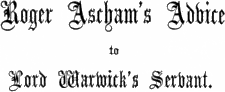
With the different counsels to babees, pages, and servants, throughout this volume, may be compared Roger Ascham’s advice to his brother-in-law, Mr C. H., when he put him to service with the Earl of Warwick, A.D. 1559. Here follows part of it, from Whitaker’s Hist. of Richmondshire, p. 282.
First and formost, in all your thoughts, words, and deeds, Fear God, have before your eyes the feare of God..... serve your lord faithfully, love and serve your lord willingly, faithfullye, and secretlye; be courteous to your fellows. love and live with your fellowes honestly, quiettlye, curteouslye, that noe man have cause either to hate yow for your stubborne frowardnes, or to malice yow for your proud ungentlenes, two faults which commonly yonge men soones[t] fall into in great men’s service. Despise no poor man. Contemne noe poore man, mocke noe simple man, which proud fooles in cort like and love to doe; find fault with your selfe and with none other, the best waye to live honestlye and quiettly in the court. Carry no tales. Carrye noe tales, be noe common teller of newes, be not inquisitive of other menn’s talke, for those that are desirous to heare what they need not, commonly be readye to babble what they shold not. Tell no lies. Vse not to lye, for that is vnhonest; speake not everye truth, for that is vnneedfull; yea, in tyme and place a harmlesse lye is a greate deale better then a hurtfull truth. Don’t play at dice or cards. Use not dyceing nor carding; the more yow use them the lesse yow wilbe esteemed; the cunninger yow be at them Take to your lord’s favourite sport. for pastime, love and learne that which your lord liketh and vseth most, whether itt be rydeing, shooteing, hunting, hawkeing, fishing or any such exercise. Beware of secrett corners and night sitting vp, the two nurses of mischiefe, unthriftines, losse, and sicknes. Beware of idleness. Beware cheifely of ydlenes, the great pathway that leadeth directly to all evills; be diligent alwayes, Always be at hand when you’re wanted. be present every where in your lord’s service, be at hand to call others, and be not ofte sent for yourselfe; for marke this as part of your creed, that the good service of one whole yeare shall never gett soe much as the absence of one howre may lose, when your lord shall stand in need of yow to send. if yow consider alwayes that absence and negligence must needes be cause of greife and sorrowe to your selfe, of chideing and rueing to your lord, and that Diligence will get you praise. dutye done diligently and presently shall gaine yow profitt, and purchase yow great praise and your lord’s good countenance, yow shall ridd me of care, and wynne your selfe creditt, make me a gladd man, and your aged mother a ioyfull woman, and breed your freinds great comforth. God be with you! Soe I comitt and commend yow to God’s mercifull proteccion and good guidance, who long preserve Your ever loving and affectionate brother in lawe.
R. ASKAM.
To my loveing Brother in Lawe, Mr C. H., Servant to the Rt. Hon. the Earle of Warwick, these.

OR A ‘LYTYL REPORTE’ OF HOW YOUNG PEOPLE SHOULD BEHAVE.
[MS. Harl. 5086, fol. 86-90; ab. 1475 A.D.]
In the printed book, some line numbers were shifted to avoid collision with the pilcrow symbol at the beginning of each stanza. For this e-text, numbers have been regularized to multiples of 4.
My God, support me while I translate this treatise from Latin. In this tretys the whiche I thenke to wryte Out of latyn in-to my comvne langage, He me supporte (sen I kan nat endyte), 4 The whiche only after his owne ymage Fourmyd man-kynde! For alle of tendre age It shall teach those of tender age. In curtesye Resseyve shulle document, And vertues knowe, by this lytil coment. 8 ¶ And Facett seythe the Book of curtesye, To know and practise virtues is the most profitable thing in the world. Vertues to knowe, thaym forto haue and vse, Is thing moste heelfulle in this worlde trevly. Therfore in feythe I wole me nat excuse 12 From this labour ywys, nor hit Refuse; For myn owne lernynge wole I say summe thing That touchis vertues and curtesye havyng. Young Babies, adorned with grace, ¶ But, O yonge Babees, whome bloode Royalle 16 Withe grace, Feture, and hyhe habylite I call on you to know this book (for Nurture should accompany beauty), Hathe enourmyd, on yow ys that I calle To knowe this Book; for it were grete pyte, Syn that in yow ys sette sovereyne beaute, 20 But yf vertue and nurture were withe alle; To yow therefore I speke in specyalle, and not on aged men expert therein. ¶ And nouhte to hem of elde that bene experte In governaunce, nurture, and honeste. Why add pain to hell, 24 For what nedys to yeve helle peynes smerte, water to the sea, Ioye vnto hevene, or water vnto the see, [Fol. 86 b.] or heat to fire? Heete to the Fyre that kan nat but hoote be? It nedys nouhte: therfore, O Babees yynge, Babies, my book is for you only, 28 My Book only is made for youre lernynge. and so I hope no one will find fault with it, but only amend it. ¶ Therfore I pray that no man Reprehende This lytyl Book, the whiche for yow I make; But where defaute ys, latte ylke man amende, 32 And nouhte deme yt; [I] pray thaym for youre sake. The only reward I seek is that my book may please all and improve you. For other mede ywys I kepe noone take But that god wolde this Book myhte yche man plese, And in lernynge vnto yow donne somme ese. If you don’t know any word in it, ask till you do, 36 ¶ Eke, swete children, yf there be eny worde That yee kenne nouhte, spyrre whils yee yt ken; and then keep hold of it. Whanne yee yt knowe, yee mowe holde yt in horde, Thus thurhe spyrryng yee mowe lerne at wyse men. And do not wonder at this being in metre. 40 Also thenke nouhte to straungely at my penne, In this metre for yow lyste to procede, Men vsen yt; therfore on hit take hede. I must first describe how you Babies who dwell in households should behave at meals, ¶ But amonge alle that I thenke of to telle, 44 My purpos ys first only forto trete How yee Babees in housholde that done duelle Shulde haue youre sylf whenne yee be sette at mete, and be ready with lovely and benign words when you are spoken to. And how yee shulde, whenne men lyste yow Rehete, 48 Haue wordes lovly, swete, bleste, and benyngne. In this helpe me O Marie, Modir dyngne! Lady Facetia, help me! ¶ And eke, O lady myn, Facecia! My penne thow guyde, and helpe vnto me shewe; [Fol. 87.] Thou art the Mother of all Virtue. 52 For as the firste off alle lettres ys the A, So Artow firste Modir of alle vertue. Off myn vnkunnynge, swete lady, now Rewe; Help the ignorance of me untaught! And thouhe vntauhte I speke of governaunce, 56 Withe thy swete helpe supporte myn ygnoraunce. Fair Babies, when you enter your lord’s place, say “God speed,” A, Bele Babees, herkne now to my lore! Whenne yee entre into your lordis place, Say first, “god spede;” And alle that ben byfore and salute all there. 60 Yow in this stede, salue withe humble Face; Stert nat Rudely; komme Inne an esy pace; Kneel on one knee to your lord. Holde vp youre heede, and knele but on oone kne To youre sovereyne or lorde, whedir he be. If any speak to you, look straight at them, and listen well till they have finished; do not chatter or let 64 ¶ And yf they speke withe yow at youre komynge, Withe stable Eye loke vpone theym Rihte, To theyre tales and yeve yee goode herynge Whils they haue seyde; loke eke withe alle your myhte your eyes wander about the house. 68 Yee Iangle nouhte, also caste nouhte your syhte Aboute the hovs, but take to theym entent Withe blythe vysage, and spiryt diligent. Answer sensibly, ¶ Whenne yee Answere or speke, yee shulle be purveyde 72 What yee shalle say / speke eke thing fructuous; shortly, and easily. On esy wyse latte thy Resone be sayde [Fol. 87 b.] In wordes gentylle and also compendious, Many words are a bore to a wise man. For many wordes ben rihte Tedious 76 To ylke wyseman that shalle yeve audience; Thaym to eschewe therfore doo diligence. Stand till you are told to sit: keep ¶ Take eke noo seete, but to stonde be yee preste; Whils forto sytte ye haue in komaundement, your head, hands, and feet quiet: 80 Youre heede, youre hande, your feet, holde yee in reste; don’t scratch yourself, Nor thurhe clowyng, your flesshe loke yee nat Rent; or lean against a post, Lene to no poste whils that ye stande present Byfore your lorde, nor handylle ye no thyng or handle anything near. 84 Als for that tyme vnto the hovs touching. Bow to your lord when you answer. ¶ At euery tyme obeye vnto youre lorde Whenne yee answere, ellis stonde yee styl as stone But yf he speke; loke withe oon accorde If any one better than yourself comes in, retire and give place to him. 88 That yf yee se komme Inne eny persone Better thanne yee, that yee goo bak anoone And gyff him place; youre bak eke in no way Turn your back on no man. Turne on no wihte, as ferforthe as ye may. 92 ¶ Yiff that youre lorde also yee se drynkynge, Be silent while your lord drinks, not laughing, whispering, or joking. Looke that ye be in rihte stable sylence Withe-oute lowde lauhtere or Iangelynge, Rovnynge, Iapynge, or other Insolence. 96 Yiff he komaunde also in his presence If he tells you to sit down, do so at once. Yow forto sytte, fulfille his wylle belyve, And for youre seete, looke nat withe other stryve, [Fol. 88.] Then don’t talk dirt, or scorn any one, but be meek and cheerful. ¶ Whenne yee er sette, take noone vnhoneste tale; 100 Eke forto skorne eschewe withe alle your myhte; Latte ay youre chere be lowly, blythe, and hale, Withe-oute chidynge as that yee wolde fyhte. If your better praises you, Yiff yee perceyve also that eny wihte 104 Lyst yow kommende that better be thanne yee, rise up and thank him heartily. Ryse vp anoone, and thanke him withe herte free. When your lord or lady is speaking about the household, ¶ Yif that yee se youre lorde or youre lady Touching the housholde speke of eny thinge, 108 Latt theym alloone, for that is curtesy, don’t you interfere, but be always ready to serve at the proper time, And entremete yow nouhte of theyre doynge, But be Ay Redy withe-oute feynynge At hable tyme to done your lorde service, 112 So shalle yee gete anoone a name of price. to bring drink, hold lights, or ¶ Also to brynge drynke, holde lihte whanne tyme ys, anything else, Or to doo that whiche ouhte forto be done, Looke yee be preste, for so yee shalle ywys and so get a good name. 116 In nurture gete a gentyl name ful sone; The best prayer you can make to God is to be well mannered. And yif ye shulde at god aske yow a bone Als to the worlde, better in noo degre Mihte yee desire thanne nurtred forto be. If your lord offers you his cup, 120 ¶ Yif that youre lorde his owne coppe lyste commende rise up, take it with both hands, To yow to drynke, ryse vp whanne yee it take, And resseyve it goodly withe boothe youre hende; [Fol. 88 b.] offer it to no one else, but give it back to him that brought it. Of yt also to nõõne other profre ye make, 124 But vnto him that brouhte yt yee hit take Whenne yee haue done, for yt in no kyn wyse Auhte comvne be, as techis vs the wyse. ¶ Now must I telle in shorte, for I muste so, At Noon, when your lord is ready for dinner, 128 Youre observaunce that ye shalle done at none; Whenne that ye se youre lorde to mete shalle goo, Be redy to fecche him water sone; some pour water on him, some hold the towel for him Summe helle1 water; summe holde to he hathe done 132 The clothe to him; And from him yee nat pace till he has finished, and don’t leave till grace is said. Whils he be sette, and haue herde sayde the grace. Stand by your lord till he tells you to sit, ¶ Byfore him stonde whils he komaunde yow sytte, Withe clene handes Ay Redy him to serve; then keep your knife clean and sharp 136 Whenne yee be sette, your knyf withe alle your wytte Vnto youre sylf bothe clene and sharpe conserve, to cut your food. That honestly yee mowe your owne mete kerve. Be silent, and tell no nasty stories. Latte curtesye and sylence withe yow duelle, 140 And foule tales looke noone to other telle. Cut your bread, don’t break it. ¶ Kutte withe your knyf your brede, and breke yt nouhte; Lay a clean trencher before you, and eat your broth with a spoon, A clene Trenchour byfore yow eke ye lay, And whenne your potage to yow shalle be brouhte, don’t sup it up. 144 Take yow sponys, and soupe by no way, Don’t leave your spoon in your dish. And in youre dysshe leve nat your spone, I pray, Don’t lean on the table, or dirty the cloth. Nor on the borde lenynge be yee nat sene, But from embrowyng the clothe yee kepe clene. Don’t hang your head over your dish, or eat with a full mouth, or 148 ¶ Oute ouere youre dysshe your heede yee nat hynge, And withe fulle mouthe drynke in no wyse; pick your nose, teeth, and nails, Youre nose, your teethe, your naylles, from pykynge, [Fol. 89.] Kepe At your mete, for so techis the wyse. 152 Eke or ye take in youre mouthe, yow avyse, or stuff your mouth so that you can’t speak. So mekyl mete but that yee rihte welle mowe Answere, And speke, whenne men speke to yow. Wipe your mouth when you drink, ¶ Whanne ye shalle drynke, your mouthe clence withe A clothe; and don’t dirty the cup with your hands. 156 Youre handes eke that they in no manere Imbrowe the cuppe, for thanne shulle noone be lothe Withe yow to drynke that ben withe yow yfere. Don’t dip your meat in the salt-cellar, The salte also touche nat in his salere 160 Withe nokyns mete, but lay it honestly On youre Trenchoure, for that is curtesy. or put your knife in your mouth. ¶ Youre knyf withe mete to your mouthe nat bere, And in youre hande nor holdẽ yee yt no way; Taste every dish that’s brought to you, and when once your plate is taken away, don’t ask for it again. 164 Eke yf to yow be brouhte goode metys sere, Luke curteysly of ylke mete yee assay, And yf your dysshe withe mete be tane away And better brouhte, curtesye wole certeyne 168 Yee late yt passe and calle it nat ageyne. If strangers dine with you, share all good food sent to you with them. ¶ And yf straungers withe yow be sette at mete, And vnto yow goode mete be brouhte or sente, Withe parte of hit goodely yee theym Rehete, It’s not polite to keep it all to yourself. 172 For yt ys nouhte ywys convenyent Withe yow at mete, whanne other ben present, Alle forto holde that vnto yow ys brouhte, And as wrecches on other vouchesauf nouhte. [Fol. 89 b.] Don’t cut your meat like field labourers, who have such an appetite they don’t care how they hack their food. 176 ¶ Kutte nouhte youre mete eke as it were Felde men, That to theyre mete haue suche an appetyte That they ne rekke in what wyse, where ne when, Nor how vngoodly they on theyre mete twyte; Sweet children, let your delight be courtesy, and eschew rudeness. 180 But, swete children, haue al-wey your delyte In curtesye, and in verrey gentylnesse, And at youre myhte eschewe boystousnesse. Have a clean trencher and knife for your cheese, ¶ Whanne chese ys brouhte, A Trenchoure ha ye clene 184 On whiche withe clene knyf [ye] your chese mowe kerve; and eat properly. In your fedynge luke goodly yee be sene. Don’t chatter either, and you shall get a good repute for gentleness. And from Iangelyng your tunge al-wey conserve, For so ywys yee shalle a name deserve 188 Off gentylnesse and of goode governaunce, And in vertue al-wey youre silf avaunce. When the meal is over, ¶ Whanne that so ys that ende shalle kome of mete, clean your knives, and put them in their places; keep your seats till you’ve washed; Youre knyffes clene, where they ouhte to be, 192 Luke yee putte vppe; and holde eke yee your seete Whils yee haue wasshe, for so wole honeste. Whenne yee haue done, looke thanne goodly that yee then rise up without laughing or joking, and go to your lord’s table. Withe-oute lauhtere, Iapynge, or boystous worde, 196 Ryse vppe, and goo vnto youre lordis borde, Stand there ¶ And stonde yee there, and passe yee him nat fro till grace is said. Whils grace ys sayde and brouhte vnto an ende, Then some of you go for water, some hold the towel, some pour water over his hands. Thanne somme of yow for water owe to goo, 200 Somme holde the clothe, somme poure vpõn his hende. [Fol. 90.] Other things I shall not put in this little Report, Other service thanne this I myhte comende To yow to done, but, for the tyme is shorte, I putte theym nouhte in this lytyl Reporte, but skip over, praying that no one will abuse me for this work. 204 ¶ But ouere I passe, prayyng withe spyrit gladde Of this labour that no wihte me detray, Let readers add or take away: I address it to every one who likes to correct it. But where to lytyl ys, latte him more adde, And whenne to myche ys, latte him take away; 208 For thouhe I wolde, tyme wole that I no more say; I leve therfore, And this Book I directe To euery wihte that lyste yt to correcte. Sweet children, I beseech you ¶ And, swete children, for whos love now I write, 212 I yow beseche withe verrey lovande herte, know this book, and may God make you so expert therein To knowe this book that yee sette your delyte; And myhtefulle god, that suffred peynes smerte, In curtesye he make yow so experte, that you may attain endless bliss. 216 That thurhe your nurture and youre governaunce In lastynge blysse yee mowe your self auaunce!

[Fol. 90 b.] Don’t be too loving or angry, To Amerous, to Aunterous, ne Angre the nat to muche; bold or busy, To Bolde, ne to Besy, ne Bourde nat to large; courteous or cruel or cowardly, and don’t drink too often, To Curteys, to Cruelle, ne Care nat to sore; 4 To Dulle, ne to Dredefulle, ne Drynke nat to offte; or be too lofty or anxious, To Elenge, to Excellent, ne to Carefulle neythur; but friendly of cheer. To Fers, ne to Famuler, but Frendely of Chere; Hate jealousy, To gladde, ne to Glorious, and Gelousy thow hate; be not too hasty or daring; 8 To Hasty, to Hardy, ne to Hevy in thyn Herte; joke not too oft; To Iettyng, ne to Iangelyng, and Iape nat to ofte; ware knaves’ tricks. To Kynde, ne to Kepyng, and warre Knavis tacches; Don’t be too grudging or too liberal, To Lothe, ne to Lovyng, ne to Lyberalle of goode; too meddling, 12 To Medlous, to Mury, but as goode Maner askithe; too particular, new-fangled, or too daring. To noyous, ne to Nyce, ne to Newfangylle; Hate oaths To Orped, to Overtwert, and Othes, sir, thow hate; and flattery. To Preysyng, to Preve withe Prynces and Dukes; Please well thy master. 16 To Queynt, to Querelous, and Queme welle thy maistre; Don’t be too rackety, To Riotous, to Revelyng, ne Rage nat to muche; or go out too much. To Straunge, ne to Steryng, ne Stare nat abroode; Don’t be To Toyllous, to Talevys, for Temperaunce it hatithe; too revengeful 20 To Vengable, to Envious, and waste nat to muche; or wrathful, and wade not too deep. To Wylde, to Wrathefulle, and Wade nat to depe; The middle path is the best for us all. A Mesurable Mene way ys beste for vs alle;
¶ Yitte. Lerne. or. Be. Lewde.

[Lambeth MS. 853, ab. 1430 A.D., page 30, written without breaks.]
Alternative readings are incorporated from the Collations and Corrigenda section:
The A B C of Aristotle, Harl. MS. 1706, fol. 94, collated by Mr Brock, omits the prologue, and begins after l. 14 with, “Here be-gynnethe Arystoles A B C. made be mayster Benett.”
Who-so wilneþ to be wijs, & worschip desiriþ, Lerne he oo lettir, & looke on anothir Of þe .a. b. c. of aristotil: argue not aȝen þat: 4 It is councel for riȝt manye clerkis & knyȝtis a þousand, And eek it myȝte ameende a man ful ofte For to leerne lore of oo lettir, & his lijf saue; For to myche of ony þing was neuere holsum. 8 Reede ofte on þis rolle, & rewle þou þer aftir; Who-so be greued in his goost, gouerne him bettir; Blame he not þe barn þat þis .a. b. c. made, But wite he his wickid will & his werk aftir; 12 It schal neuere greue a good man þouȝ þe gilti be meendid. Now herkeneþ & heeriþ how y bigynne.
A to amerose, to aunterose, ne argue not to myche. argue not] Angre the [Page 31.]
B to bolde, ne to bisi, ne boorde not to large. omit ne not to large] thou nat to brode
C to curteis, to cruel, ne care not to sore.
D to dul, ne to dreedful, ne drinke not to ofte. omit ne not] thow nat
E to elenge, ne to excellent, ne to eernesful neiþer. omit ne to eernesful] ne curyons
F to fers, ne to famuler, but freendli of cheere. fers, famuler, freendli] Ferde, familier, frenfulle
G to glad, ne to gloriose, & gelosie þou hate. omit to & gelosie þou hate] Ne to galaunt never
H to hasti, ne to hardi, ne to heuy in þine herte. in þine] off
I to iettynge, ne to iangelinge, ne iape not to ofte. iettynge] Iocunde iape not to] Ioye thow nat
K to kinde, ne to kepynge, & be waar of knaue tacchis. omit to and & knaue] knaves
L to looth for to leene, ne to liberal of goodis. for to leene] ne to lovyng goodis] woordys
M to medelus, ne to myrie, but as mesure wole it meeue. medelus] Mellous but as mesure wole it meeue] ne to besynesse vnleffulle
N to noiose, ne to nyce, ne use no new iettis. ne use no new iettis] ne noughte to neffangle
O to orped, ne to ouerþwart, & ooþis þou hate. ouerþwart] ouertwarthe & ooþis þou hate] Ne othez to haunte
P to presing, ne to preuy with princis ne with dukis;
Q to queynte, ne *to quarelose, but queeme weel ȝoure souereyns. quarelose] querelous weel ȝoure souereyns] men alle abowte [* Page 32.]
R to riotus, to reueling, ne rage not to rudeli. omit the second to not to rudeli] thou nat but lyte
S to straunge, ne to stirynge, ne straungeli to stare. ne straungeli to stare] Ne starte nat abowte
T to toilose, ne to talewijs, for temperaunce is beest. for temperaunce is best] But temperate euere
V to venemose, ne to veniable, & voide al vilonye. ne ...] ne violent Ne waste nat to moche
W to wielde, ne to wraþful, neiþer waaste, ne waade not to depe, neiþer &c.] Ne to wyse deme the
¶ For a mesurable meene is euere þe beste of alle. is euere þe beste of] ys best for vs X Y Z x y wyche esed & per se.
[“Whi is þis world biloued” follows.]
Tytelle Tytelle Tytelle thañ Esta Amen.

[MS. Cott. Calig. A. II., ab. 1460 A.D., fol. 88, col. 2.]
Who-so wylle of nurtur lere, Herken to me & ȝe shalle here. When you come before a lord When þou comeste be-fore a lorde 4 In halle, yn bowre, or at þe borde, take off your cap or hood, Hoode or kappe þou of þo. Ere þou come hym alle vn-to, and fall on your right knee twice or thrice. Twyse or þryse with-outen dowte 8 To þat lorde þou moste lowte, With þy Ryȝth kne lette hit be do, Thy worshyp þou mayst saue so. Keep your cap off till you’re told to put it on; Holde of þy cappe & þy hood also 12 Tylle þou be byden hit on to do; Alle þe whyle þou spekest with hym, hold up your chin; Fayr & louely holde vp þy chynn, So aftur þe nurtur of þe book look in the lord’s face; 16 In his face louely þou loke; keep hand and foot still; Foot & hond þou kepe fulle stylle Fro clawyng or tryppyng, hit ys skylle; don’t spit or snot; Fro spettyng & snetyng kepe þe also; get rid of it quietly; 20 Be priuy of voydance, & lette hit go. And loke þou be wyse & felle, behave well. And þerto also þat þow gouerne þe welle. When you go into the hall, In-to þe halle when þou dost wende 24 Amonge þe genteles gode & hende, don’t press up too high. Prece þou not vp to hyȝ for no þyng, Nor for þy hyȝ blood, nere for þy konnyng, Noþur to sytte, neþur to lene, 28 For hit ys neyþur good ne clene. Don’t be shamefaced. Lette not þy contynaunce also abate, For good nurtur wylle saue þy state; Fadyr & modyr, what euur þey be, 32 Welle ys þe chylde þat may the: Wherever you go, good manners make the man. In halle, in chambur, ore where þou gon, Nurtur & good maners makeþ man. To þe nexte degre loke þou wysely Reverence your betters, 36 To do hem Reuerence by and by: but treat all equally whom you don’t know. Do hem no Reuerens, but sette alle in Rowe But ȝyf þou þe bettur do hym knowe. [Fol. 86, back, col. 1.] To þe mete when þou art sette, 40 Fayre & honestly thow ete hyt: See that your hands are clean, and your knife sharp. Fyrste loke þat þy handes be clene, And þat þy knyf be sharpe & kene; And cutte þy breed & alle þy mete 44 Ryȝth euen as þou doste hit ete. Let worthier men help themselves before you eat. If þou sytte be a worthyor man Then þy self thow art on, Suffre hym fyrste to towche þe mete 48 Ere þy self any þer-of gete; Don’t clutch at the best bit. To þe beste morselle þou may not stryke Thowȝ þou neuur so welle hit lyke. Keep your hands from dirtying the cloth, and don’t wipe your nose on it, Also kepe þy hondys fayre & welle 52 Fro fylynge of the towelle, Ther-on þou shalt not þy nose wype; Noþur at þy mete þy toth þou pyke; or dip too deep in your cup. To depe in þy cuppe þou may not synke 56 Thowȝ þou haue good wylle to drynke, Leste þy eyen water þere by, Then ys hyt no curtesy. Have no meat in your mouth when you drink or speak; and stop talking when your neighbour is drinking. Loke yn þy mowth be no mete 60 When þou begynneste to drynke or speke; Also when þou sest any man drynkyng That taketh hede of þy karpyng, Soone a-non þou sece þy tale, 64 Wheþur he drynke wyne or Ale. Scorn and Loke also þou skorne no mon þe[gre]] Marg. has gre for insertion. In what þe[gre] þou se hym gon; reprove no man. Repreue] repraue is written above the line. Nor þou shalte no mon Repreue 68 Ȝyf þou wylt þy owen worshyp saue, For suche wordys þou myȝth out kaste Sholde make þe to lyue in euelle reste; Keep your fingers from what would bring you to grief. Close þyn honde yn þy feste, 72 And kepe þe welle from hadde-y-wyste. [Fol. 86, back, col. 2.] Among ladies, look, don’t talk. In chambur among ladyes bryȝth, Kepe þy tonge & spende þy syȝth; Don’t laugh loud, or riot with ribalds. Lawȝe þou not with no grette cry, 76 Ne Rage þou not with Rybawdry. Pley þou not but with þy peres; Don’t repeat what you hear. Ne telle þou not þat þou heres, not] not put in by a later hand. Nor dyskeuere þou not þyn owen dede 80 For no myrth nor for no mede; Words make or mar you. With fayr speche þou may haue þy wylle, And with þy speche þou may þe spylle. If you follow a worthier man, Ȝyf þou suwe a wordyer mon 84 Then þy self þou art on, let your right shoulder follow his back, and Lette þy Ryȝth sholdur folow his bakke, For nurtur þat ys, with-owten lakke. don’t speak till he has done. When he doth speke, holde þe style; 88 When he hath don, say þy wylle; Be austere (?) in speech; Loke yn þy speche þou be felle, And what þou sayste a-vyse þe welle; don’t stop any man’s tale. And be-refe þou no mon his tale, 92 Noþur at wyne nere at Ale. Christ gives us all wit to know this, Now, criste of his grette grace Ȝeue vs alle bothe wytte & space Welle þis to knowe & Rede, and heaven as our reward. Amen! 96 And heuen to haue for our mede! Amen, Amen, so moot hit be, So saye we alle for charyte!
Explicit Tractus Vrbanitatis.

[Porkington MS. No. 10, fol. 202; ? ab. 1460-70 A.D.]
Hey, hey, hey, hey, þe borrys hede is armyd gay!2 The boris hede in hond I bryng Witt garlond gay in porttoryng. [Fol. 202 b.] I pray yow all witt me to synge Witt hay. ¶¶ Lordys, knyȝttis, and skyers, Persons, prystis and wycars, The boris hede ys þe fur[s]t mes, Witt hay. ¶¶ The boris hede, as I yow say, He takis his leyfe, & gothe his way Soñ aftur þe xij theylffyt day, Witt hay. ¶¶ Then commys in þe secund kowrs with mekyll pryde, þe crannis & þe heyrrouns, þe bytturis by þe syde, þe partrychys & þe plowers, þe wodcokis & þe snyt, Witt hay. ¶¶ Larkys in hoot schow,3 ladys for to pyk, Good drynk þerto, lycyvs and fyñ, Blwet of allmayñ,4 romnay and wyin, Witt hay. ¶¶ Gud5 bred, alle & wyin, daer I well say, þe boris hede witt musterd armyd soo gay, ¶¶ furm̅ante to potdtage,6 witt wennissun fyñ, & þe hombuls of þe dow, & all þat euer commis in, ¶¶ Cappons I-bake witt þe pesys of þe roow, Reysons of corrans, witt odyre spysis moo,
[incomplete.]
2. “When you print I recommend that the first line of the MS. ‘Hey, hey,’ &c. should stand alone in two lines. They are the burthen of the song, and were a sort of accompaniment, or under-song, sung throughout, while an upper voice sang the words and tune. You will see numbers of the same kind in Wright’s Songs and Carols printed by the Percy Society. It was common in the 14th and 15th centuries.” —Wm. Chappell.
This Carol is printed in Reliq. Antiq., vol. ii., and is inserted here—copied from and read with the MS.—to fill up a blank page. The title is mine.
3. ? sewe, stew.
4. ? the name of a wyne. Recipes for the dish Brouet of Almayne (H. O.), Brewet of Almony, Breuet de Almonde, are in Household Ordinances, p. 456; Forme of Cury, p. 29, and Liber Cure Cocorum, p. 12.
5. ? MS. End.
6. Recipe for Potage de Frumenty in Household Ordinances, p. 425. potdtage: small “t” printed above “o”

[Harl. MS. 541, fol. 210; and Egerton MS. 1995; ab. 1480 A.D.]
The following two selections, The Lytylle Childrenes Lytil Boke or Edyllys be and The Young Children’s Book, were printed on facing even/odd pages. They are here presented separately.
In the first version, variant readings from the Egerton MS were printed as numbered footnotes. They are here grouped into text notes together with two sets of readings from the Collations section. All MS designations were added by the transcriber:
Eg.: Egerton MS. 1995 (above).
Adv.: “part of the Advocates Library MS., fol. 84, back”. The collation of this MS ends at line 34.
Cam.: “the Cambridge University MS. ... Hem is always written for him in this MS., and so with other words.”
“ * † The parts between square brackets [ ] are from the Egerton MS.”
Lytylle childrene, here ye may lere Moche curtesy þat is wrytyne here; Clerks say that For clerkis that the vij arteȝ cunne, courtesy came from heaven when Gabriel greeted our Lady. 4 Seyn þat curtesy from hevyn come Whan Gabryelle oure lady grette, And Eliȝabeth with mary mette. childreñ] Adv. childur þat] Adv. dele wrytyne] Cam. brekeyd For] Adv. dele Seyn] Eg. Synne Elizabeth] Cam. cortesey with mary] Adv. oure Lady All virtues are included in it. Alle vertues arne closide yn curtesye, 8 And alle vices yn vylonye. See that your hands and nails are clean. Loke þyne hondis be wasshe clene, That no fylthe on thy nayles be sene. Don’t eat till grace is said, Take þou no mete tylle grace be seyde, 12 And tylle þou see alle thyng arayede. arne closide] Eg. ben closyde are] Adv. byn closide] Cam. clodyd Loke] Adv. Forst loke þyne hondis be] Eg. that thy hondys benne wasshe] Adv. wasshyd on] Eg. in on] Cam. yn þou (l. 11, 12)] Cam. ye grace] Eg. the fyrste gracys tylle] Adv. to or sit down till you’re told. Loke, my son, þat thow not sytte Tylle þe ruler of þe hous the bydde; First, think on the poor; the full belly wots not what the hungry feels. And at thy mete, yn þe begynnyng, 16 Loke on pore men that thow thynk, For the fulle wombe without[* any faylys] Wot fulle lytyl[ what the hungery aylys.] Loke] Adv. And loke Tylle ... the bydde] Adv. To he yt reweleth ye howse ye bytt þe hous the bydde] Eg. the halle the bytte hous the bydde] Cam. hall þe beyt And at thy] Eg. Atte the þe] Cam. they Loke on pore men that] Adv. Loke that on pore men on] Eg. a-pon (and omits that) on] Cam. no without any faylys] Adv. withowtte fayle any faylys] Cam. fayle hungery aylys] Adv. empty ayle aylys] Cam. heydyt Don’t eat too quickly. Ete[ not thy mete to hastely, 20 A-byde and ete esely. Touch nothing till you are fully helped. Tylle þou haue thy fulle seruyse, Touche noo messe in noo wyse. Don’t break your bread in two, Kerue not thy brede to thynne, 24 Ne breke hit not on twynne: or put your pieces in your pocket, The mosselle that þou begynnysse to touche, Cast them not in thy pouche. Ete ... hastely] Cam. yet ... hastey Abyde] Cam. Bot abyde esely] Cam. all yesley ete esely] Adv. etett eysely Kerue not thy brede] Cam. Kot they bred not Ne breke ... twynne] Cam. Ne to theke bat be-tweyn mosselle] Adv. morsselle; Cam. mossels begynnysse to] Cam. dost in] Adv. owt of; Cam. owt of your fingers in the dish, Put not thy fyngerys on thy dysche, 28 Nothyr in flesche, nothyr in fysche. or your meat in the salt-cellar. Put not thy mete in-to the salte, In-to thy Seler that thy salte halte,] [Fol. 210, back.] But ley it fayre on þi trenchere 32 The byfore, and þat is þyne honore. Nothyr in flesche ... thy salte halte (ll. 28-30)] Cam. Ne yn they met, feys, ne fleys. Put not thy mete yn þey salt seleyr Into thy] Adv. nor in the thy salte] Adv. hit ley it fayre] Eg. ley it on þi] Adv. on a on] Cam. yn The byfore] Eg. To-fore the; Adv. Byfore the þyne] Adv. dele þyne The byfore ... honore] Cam. Be-fore the, that ys worschep Don’t pick your ears or nose, Pyke not þyne Eris ne thy nostrellis; If þou do, men wolle sey þou come of cherlis. or drink with your mouth full, And whylle þi mete yn þi mouth is, 36 Drynk þow not; for-gete not this. Ete þi mete by smalle mosselles; or cram it full. Fylle not thy mouth as done brothellis. Pyke not ... come of cherlis] Adv. Pyke not yi tethe wyth yi knyfe Whyles yu etyst be yi lyfe ne] Cam. nother If] Eg. And; Cam. And come] Cam. comest come of cherlis] Eg. comyste of karlys And] Eg. But; Cam. Seche yn þi mouth is] Cam. is yn þi mouth Ete þi mete by] Cam. Kot ... yn done] Eg. dothe; Cam. omit Fylle] Cam. And fylle Don’t pick your teeth with your knife. Pyke not þi tethe with thy knyfe; 40 In no company begynne þow stryfe. Take your spoon out when you’ve finished soup. And whan þou hast þi potage doone, Out of thy dyssh þow put thi spone. Don’t spit over or on the table, that’s not proper. Ne spitte þow not over the tabylle, 44 Ne therupon, for that is no þing abylle. In no ... stryfe] Eg. Whyle þou ettyste by thy lyffe; Cam. Weyles thou hetys, bey they leyffe doone] Eg. Idone þow put] Cam. take owt Ne] Cam. Nether Ne spitte þow not] Eg. Spette not the] Eg. thy Ne therupon ... abylle] Eg. Nor a-pon hyt, for hyt ys not able; Cam. For no cortesey het ys not habell Don’t put your elbows on the table, Ley not þyne Elbowe nor thy fyst Vpon the tabylle whylis þat thow etist. or belch as if you had a bean in your throat. Bulk not as a Beene were yn þi throte, 48 [As a ka]rle þat comys oute of a cote. Be careful of good food; [†And thy mete be o]f grete pryce, [Be ware of hyt, or þou arte n]ot wyse. nor] Eg. nothyr Elbowe ... fyst] Cam. Elbowhes ... fystys whylis þat thow etist] Eg. whyle þou este whylis þat] Cam. wheyle Bulk not as a Beene were yn þi throte] Cam. Bolk not as a bolle yn the crofte karle þat] Cam. charle cote] Cam. cotte of hyt or þou art] Cam. the or ye be [Speke noo worde stylle ne sterke; and be courteous and cheerful. 52 And honowre and curtesy loke þou kepe, And at the tabylle loke þou make goode chere; Don’t whisper in any man’s ear. Take your food with your fingers, and don’t waste it. Don’t grin, or talk too much, Loke þou rownde not in nomannys ere. With thy fyngerys þou towche and taste 56 Thy mete; And loke þou doo noo waste. sterke] Cam. lowde And honowre and curtesy loke þou kepe] Cam. all of curtesy loke ye carpe at] Cam. all loke þou] Cam. omit Loke þou rownde not] Cam. And loke ye thy fyngerys] Cam. omit thy and] Cam. ne doo] Cam. make Loke þou laughe not, nor grenne; And with moche speche þou mayste do synne. or spill your food. Mete ne drynke loke þou ne spylle, 60 But sette hit downe fayre and stylle.] Keep your cloth before you. [Fol. 207.] Kepe thy cloth clene the byforne, And bere the so thow haue no scorne. laughe not] Cam. noþer laughe with moche speche] Cam. thow meche speke mayst] Cam. may ne drynke] Cam. ner drynke ne spylle] Cam. not fayre and stylle] Cam. stere het not thy] Cam. the so] Eg. that Cut your meat, don’t bite it. Byte not þi mete, but kerve it clene, 64 Be welle ware no drop be sene. Don’t open your mouth too wide when you eat, Whan þou etyst, gape not to wyde That þi mouth be sene on yche a syde. And son, beware, I rede, of on thyng, or blow in your food. 68 Blow neþer yn thi mete nor yn þi drynk. If your lord drinks, always wait till he has done. And yif thi lord drynk at þat tyde, Drynk þou not, but hym abyde; Be it at Evyne, be it at noone, 72 Drynk þou not tylle he haue done. kerve it] Eg. cut hit no] Eg. that noo be sene on yche a] Eg. be in euery yche a syde] Cam. yche syde beware, I rede, of] Eg. be ware of I rede of] Cam. of j redde þe of neþer] Eg. þou not; Cam. neuer mete nor yn þi] Eg. mete not yn þi drynk] Cam. drynk þat] Cam. they noone] Eg. morowe, (and omits next line.) Keep your trencher clean. Vpon þi trencher no fyllthe þou see, It is not honest, as I telle the; Drink behind no man’s back. Ne drynk behynde no mannes bakke, 76 For yf þou do, thow art to lakke. Don’t rush at the cheese, And chese come forthe, be not to gredy, Ne cutte þow not therof to hastely. þou see] Eg. be sene; Cam. be saye Ne drynk] Eg. Drynke þou not þou] Cam. yow thow art] Cam. yow ar lakke] Eg. blame forthe] Eg. by-fore the; Cam. before yow gredy] Eg. redy Ne cutte ... hastely] Eg. To cut there-of be not to gredy. cutte þow not therof] Cam. cutte therof or throw your bones on the floor. Caste not þi bones ynto the flore, 80 But ley þem fayre on þi trenchore. Kepe clene þi cloth byfore þe alle; Sit still till grace is said and you’ve washed your hands, And sit þou stylle, what so be-falle, Tylle grace be said vnto þe ende, 84 And tylle þou haue wasshen with þi frend. ynto] Cam. yn þem] Eg. hem byfore þe alle] Eg. þe omitted. stylle, what so be-falle] Eg. stylle withalle ende] Cam. hendyng wasshen] Cam. was Let the more worthy þan thow Wassh to-fore þe, & that is þi prow; and don’t spit in the basin. And spitte not yn þi basyne, 88 My swete son, þat þow wasshist yne; worthy] Cam. wortheyor þan] Eg. thenne to-fore] Eg. by-fore to-] Cam. be- & that is] Cam. omit & þi prow] Cam. gentyll cortesey And spitte not ... soft & stylle (ll. 87, 88, 89)] Cam. omit. And spitte not yn] Eg. Spete not on (and omits next line.) Rise quietly, don’t jabber, but And aryse up soft & stylle, And iangylle nether with Iak ne Iylle, [Fol. 207, back.] But take þi leve of the hede lowly, thank your host and all the company, 92 And þank hym with thyne hert hyghly, And aryse ... Iylle (ll. 89-90)] Eg. And ryse with hym that sate with the stylle, And thanke hym fayre and welle: Aftyr, Iangely not with Iacke ne gylle. nether] Cam. not ne] Cam. ne with þi leve] Cam. leve the hede] Eg. the lorde; Cam. they lorde hyghly] Cam. mekeley And alle þe gentyllis togydre yn same, And bare the so thow haue no blame; and then men will say, Than men wylle say therafter ‘A gentleman was here!’ 96 That a gentylleman was heere. He who despises this teaching And he þat dispiseth this techyng, isn’t fit to sit at a good man’s table. He is not worthy, withoute lesyng, Nether at good mannes tabulle to sitte, 100 Ner of no worshipe for to wytte. þe gentyllis] Eg. omitted. togydre ynsame] Cam. yn the same manere so] Eg. soo that men wylle say] Eg. wylle they sey therafter] Cam. hereafter that] Cam. that he ys was heere] Cam. þere aftyr And he ...] Cam. omit And dispiseth] Cam. dispise Nether at] Eg. Neuyr at a; Cam. neuer at to] Eg. for to Ner] Eg. Nothyr; Cam. ne for] Eg. pur Children, love this little book, and And therfore, chyldren, for charyte, Louyth this boke though yt lytil be! pray that Jesus may help its author to die among his friends, And pray for hym þat made it thus, 104 That hym may helpe swete Ihesus To lyve & dye among his frendes, and not be troubled with devils, And neuer to be combred with no fendes; but be in joy for ever. Amen! And geve vs grace yn Ioy to be; 108 Amen, Amen, for charytee! for] Cam. for sent Louyth ... lytil be] Eg. Lernythe thys boke that ys callyd Edyllys be Louyth this boke] Cam. Loren this lesen And pray] Cam. omit and made] Cam. wret made it thus] Eg. made thys And neuer ... charytee! (ll. 106-108)] Eg. And vs graunte in Ioy to a-byde! Say ye alle Amen for charyde in euery syde And neuer ... no fendes (l. 106)] Cam. omitted. geve vs] Cam. geve hem and vs Amen, Amen] Cam. Sey all, Amen Explicit. lerne or be lewde quod Whytyng. Explicit...] Eg. Amen. Here endythe the boke of Curtesy that ys fulle necessary vnto yonge chyldryn that muste nedys lerne the maner of curtesy. Explicit. Amen. Cam. Expleycyt the Boke of cortesey.