IN GRATITUDE FOR HIS HELP, (continued 4)
Reading edition
13. Serve brawn, beef, swan, pheasant, fritters. As a change for beef, have legs or chines of pork, or tongue of ox or hart.
14. Clear away the 1st course, crumbs, bones, and used trenchers.
15. Serve the Second Course: Small birds, lamb, kid, venison, rabbits, meat pie, teal, woodcock. Great birds.
16. Fill men’s cups and remove their trenchers.
17. Collect the spoons.
18. Take up the lowest dishes at the side-tables, and then clear the high table.
19. Sweep all the bits of bread, trenchers, &c., into a voyder.
20. Take away the cups, &c., from all the messes, putting the trenchers,
&c., in a voyder, and scraping the crumbs off with a carving-knife.
21. Serve wafers in towels laid on the table, and sweet wine. In holiday time serve cheese, or fruit; in winter, roast apples.
22. Clear away all except the chief salt-cellar, whole bread, and carving-knives; take these to the pantry.
23. Lay a fresh cloth all along the chief table.
24. Have ready basons and jugs with hot or cold water; and after Grace, hand basins and water to the first mess, then the second.
25. Take off and fold up the towels and cloth, and give ’em to the
Panter.
26. Clear away tables, trestles, forms; and put cushions on other seats.
27. Butler, put the cups, &c., back into your office.
28. Serve knights and ladies with bread and wine, kneeling.
29. Conduct strangers to the Chamber.
30. Serve them with dainties: junket, pippins, or green ginger; and sweet wines. How to carve a Swan, Goose, Wild-fowl, Crane, Heronsew,
Bittern, Egret, Partridge, Quail, Pheasant.
A Bridal Feast.
First Course. Boar’s head, and a Device of Welcome. Venison and Custard, with a Device of Meekness.
Second Course.
Venison, Crane, &c., and a Device of Gladness and Loyalty.
Third Course.
Sweets, &c., Game, with a Device of Thankfulness.
Fourth Course.
Cheese and a cake with a Device of Child-bearing and a promise of babies.
Latin Graces.
A general Grace.
The eyes of all wait upon thee, O Lord. Glory be to the Father, &c. Lord, have mercy upon us. Lord, bless us. Make us partakers of the heavenly table.
Grace after Dinner.
May the God of peace be with us! We thank thee, O Lord, for thy benefits. Lord, have mercy upon us! Christ, have mercy upon us! I will bless the Lord alway. May the name of the Lord be blessed for ever! Hail, Queen of Heaven, flower of virgins! pray thy Son to save the faithful!
Grace on Fish-Days.
The poor shall eat and be satisfied. Glory be to the Father, &c. The grace of our Lord Jesus Christ be with us all.
In Lent.
Break thy bread to the hungry, and take the wanderer to thy home.
Grace after Dinner.
Four Short Graces.
1. Before Dinner.
2. After Meals.
Bless the Lord for this meal. Mary, pray for us!
3. Before Supper.
Giver of all, sanctify this supper.
4. After Supper.
The Lord is holy in all his works. Blessed be the name of the Lord.
On Easter-Eve.
Christ, have mercy upon us! Seek those things that are above.
Grace after Dinner.
God of Peace, We give thee thanks, O Lord. Pour into us thy Spirit, through Jesus Christ our Lord.
On Easter-Day.
This is the day which the Lord hath made: Let us rejoice and be glad in it. Bless us, O Lord! Our passover is slain, even Christ.
After Dinner.
Of thy resurrection, Christ, the heavens and the earth are glad. Thanks be to God!
Before Supper.
After Supper.
This is the day, &c. Hallelujah. Let us bless the Lord!
Symon’s Lesson of Wysedome for all Maner Chyldryn.
Children, attend.
You’d be better unborn than untaught.
You mustn’t have your own way always.
Tell the truth, don’t be froward, hold up your head, take off your hood when you’re spoken to.
Wash your hands and face.
Be courteous.
Don’t throw stones at dogs and hogs.
Mock at no one.
Don’t swear.
Eat what’s given you, and don’t ask for this and that.
Honour your father and mother: kneel and ask their blessing.
Keep your clothes clean.
Don’t go bird’s-nesting, or steal fruit, or throw stones at men’s windows, or play in church.
Don’t chatter.
Get home by daylight.
Keep clear of fire and water, and the edges of wells and brooks.
Take care of your book, cap, and gloves, or you’ll be birched on your bare bottom.
Don’t be a liar or thief, or make faces at any man.
When you meet any one, lower your hood and wish ’em “god speed.” Be meek to clerks.
Rise early, go to school, and learn fast if you want to be our bishop.
Attend to all these things, for a good child needs learning, and he who hates the child spares the rod.
As a spur makes a horse go, so a rod makes a child learn and be mild.
So, children, do well, and you’ll not get a sound beating.
May God keep you good!
The Birched School-Boy
Learning is strange work; the birch twigs are so sharp.
I’d sooner go 20 miles than go to school on Mondays.
My master asks where I’ve been.
‘Milking ducks,’ I tell him, and he gives me pepper for it.
I only wish he was a hare, and my book a wild cat, and all his books dogs.
Wouldn’t I blow my horn!
Don’t I wish he was dead!
Contents
Full Table of Contents
Preface
John Russell’s Boke of Nurture
Lawrens Andrewe on Fish
Wilyam Bulleyn on Boxyng and Neckeweede
Andrew Borde on Sleep, Rising, and Dress
William Vaughan’s 15 Directions to Preserve Health
Sir Jn. Harington’s Dyet for Every Day
Sir Jn. Harington on Rising, Diet, and Going to Bed
Shorter Selections
General Index
Collected Sidenotes
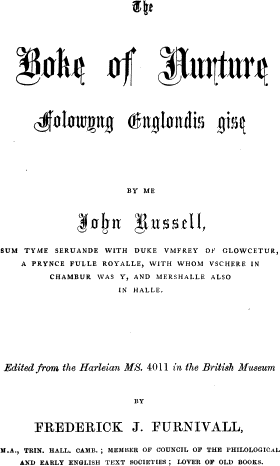
Title-Page Text
CONTENTS.
(Line numbers added by transcriber.)
PAGE LINE
PROLOGUE 1 1
INTRODUCTION. MEETING OF MASTER AND PUPIL 2-3 13
THE PANTER OR BUTLER. HIS DUTIES (AND HEREIN OF BROACHING WINE, OF FRUITS AND CHEESE, AND OF THE CARE OF WINES IN WOOD) 3-9 41
NAMES OF SWEET WINES 9 117
HOW TO MAKE YPOCRAS 9-12 121
THE BOTERY 12-13 177
HOW TO LAY THE TABLE-CLOTH, ETC. 13-14 185
HOW TO WRAP UP BREAD STATELY 14-16 209
HOW TO MAKE THE SURNAPE 16-17 237
HOW TO MANAGE AT TABLE 17-18 257
SYMPLE CONDICIONS, (OR RULES FOR GOOD BEHAVIOUR FOR EVERY SERVANT) 18-21 277
THE CONNYNGE OF KERVYNGE 21-3 313
FUMOSITEES 23-4 349
KERUYNG OF FLESH 24-30 377
BAKE METES (HOW TO CARVE) 30-2 477
FRIED METES; WITH L’ENVOY 33-4 501
POTAGES 34-5 517
DIUERCE SAWCES 35-7 529
KERVYNG OF FISCHE 37-45 546
OFFICE OF A SEWER (OR ARRANGER OF THE DISHES ON THE TABLE, ETC.) 46-7 658
A DYNERE OF FLESCHE: 686
THE FURST COURSE 48 686
THE SECOND COURSE 49 693
THE iijD COURSE 49-50 705
A DINERE OF FISCHE: 719
THE FURST COURSE 50-1 719
THE SECOND COURSE 51 731
THE THRID COURSE 52 744
THE .iiij. COURSE OF FRUTE, WITH FOUR SOTELTEES 52-3 757
THE SUPERSCRIPCIOUN OF THE SUTILTEES ABOUE SPECIFIED 53-4 787
A FEST FOR A FRANKLEN 54-5 795
SEWES ON FISHE DAYES 55-6 819
SAWCE FOR FISCHE 56-9 831
THE OFFICE OFF A CHAMBURLAYNE (HOW TO DRESS YOUR LORD, PREPARE HIS PEW IN CHURCH, STRIP HIS BED, PREPARE HIS PRIVY, ETC.) 59-64 863
THE WARDEROBES (HOW TO PUT YOUR LORD TO BED, AND PREPARE HIS BEDROOM, ETC.) 64-6 939
A BATHE OR STEWE SO CALLED (HOW TO PREPARE ONE FOR YOUR LORD) 66-7 975
THE MAKYNG OF A BATHE MEDICINABLE 67-9 991
THE OFFICE OF VSSHER & MARSHALLE (WITH THE ORDER OF PRECEDENCY OF ALL RANKS) 69-78 1001
THE SUMMARY 78-82 1173
L’ENVOY (THE AUTHOR ASKS THE PRAYERS OF HIS READERS, AND HE OR THE COPIER COMMENDS THIS BOOK TO THEM) 82-3 1235
NOTES (WITH BITS FROM LAWRENS ANDREWE, ON FISH, &c.) 84-123
ILLUSTRATIVE EXTRACTS.
WILYAM BULLEYN ON BOXYNG AND NECKEWEEDE 124-7
ANDREW BORDE ON SLEEP, RISING, AND DRESS 128-32
WILLIAM VAUGHAN’S 15 DIRECTIONS TO PRESERVE HEALTH 133-7
SIR JN. HARINGTON’s DYET FOR EVERY DAY 138-9
SIR JN. HARINGTON ON RISING, DIET, AND GOING TO BED 140-3

[Harl. MS. 4011, Fol. 171.]
In the name of the Father, Son, and Holy Ghost, God keep me! I n nomine patris, god kepe me / et filij for charite, Et spiritus sancti, where that y goo by lond or els by see! I am an Usher to a Prince, and an vsshere y Am / ye may beholde / to a prynce of highe degre, delight in teaching 4 þat enioyethe to enforme & teche / alle þo thatt wille thrive & thee1, Of suche thynges as here-aftur shalle be shewed by my diligence the inexperienced. To them þat nought Can / with-owt gret exsperience; Therfore yf any mañ þat y mete withe, þat2 for fawt of necligence, 8 y wylle hym enforme & teche, for hurtynge of my Conscience. It is charitable to teach To teche vertew and connynge, me thynkethe hit charitable, ignorant youths. for moche youthe in connynge / is bareñ & fulle vnable; If any such won’t learn, þer-fore he þat no good cañ / ne to nooñ wille be agreable. give them a toy. 12 he shalle neuer y-thryve / þerfore take to hym a babulle. IOHN RUSSELL MEETS WITH HIS PUPIL. One May I went to a forest, As y rose owt of my bed, in a mery sesoun of may, to sporte me in a forest / where sightes were fresche & gay, and by the Forester’s leave walked in the woodland, y met with þe forster / y prayed hym to say me not nay, 16 þat y mygh[t] walke in to his lawnde3 where þe deere lay. as y wandered weldsomly4 / in-to þe lawnd þat was so grene, where I saw three herds of deer þer lay iij. herdis of deere / a semely syght for to sene; in the sunshine. y behild oñ my right hand / þe soñ þat shoñ so shene; A young man with a bow was going to stalk them, 20 y saw where walked / a semely yonge mañ, þat sklendur was & leene; his bowe he toke in hand toward þe deere to stalke; but I asked him to walk with me, y prayed hym his shote to leue / & softely with me to walke. þis yonge mañ was glad / & louyd with me to talke, 24 he prayed þat he myȝt withe me goo / in to som herne5 or halke6; and inquired whom he served. þis yonge mañ frayned7 / with hoom þat he wonned þañ, ‘No one but myself, “So god me socoure,” he said / “Sir, y serue myself / & els nooñ oþer mañ.” “is þy gouernaunce good?” y said, / “soñ, say me ȝiff þow cañ.” and I wish I was out of this world.’ 28 “y wold y were owt of þis world” / seid he / “y ne rouȝt how sone whañ.” ‘Good son, “Sey nought so, good soñ, beware / me thynkethe þow menyst amysse; despair is sin; for god forbedithe wanhope, for þat a horrible synne ys, tell me what the matter is. þerfore Soñ, opeñ thyñ hert / for peraveñture y cowd the lis8; When the pain is greatest the cure is nearest!’ 32 “wheñ bale is hext / þañ bote is next” / good sone, lerne welle þis.” ‘Sir, I’ve tried everywhere for a “In certeyñ, sir / y haue y-sought / Ferre & nere many a wilsom way master; but because I know to gete mete9 a mastir; & for y cowd nouȝt / euery mañ seid me nay, nothing, no one will take me.’ y cowd no good, ne nooñ y shewde /where euer y ede day by day 36 but wantouñ & nyce, recheles & lewde / as Iangelynge as a Iay.” ‘Will you learn if I’ll teach you? [Fol. 171 b.] “Now, son, ȝiff y the teche, wiltow any thynge lere? What do you want to be?’ wiltow be a seruaunde, plowȝmañ, or a laborere, Courtyour or a clark / Marchaund / or masoun, or an artificere, 40 Chamburlayn, or buttillere / pantere or karvere?” ‘A Butler, Sir, Panter, Chamberlain, and Carver. Teach me the duties of these.’ “The office of buttiler, sir, trewly / pantere or chamburlayne, The connynge of a kervere, specially / of þat y wold lerne fayne alle þese connynges to haue / y say yow in certayñ, 44 y shuld pray for youre sowle nevyr to come in payne.” ‘I will, if you’ll love God and be “Son, y shalle teche þe withe ryght a good wille, So þat þow loue god & drede / for þat is ryght and skylle, true to your master.’ and to þy mastir be trew / his goodes þat þow not spille, 48 but hym loue & drede / and hys commaundementȝ dew / fulfylle. THE DUTIES OF THE PANTER OR BUTLER. A Panter or Butler must have The furst yere, my soñ, þow shalle be pantere or buttilare, three knives: þow must haue iij. knyffes kene / in pantry, y sey the, euermare: 1 to chop loaves, 1 to pare them, Oñ knyfe þe loves to choppe, anothere them for to pare, 1 to smooth the trenchers. 52 the iij. sharpe & kene to smothe þe trenchurs and square.10 Give your Sovereign new bread, alwey thy soueraynes bred thow choppe, & þat it be newe & able; others one-day-old bread; se alle oþer bred a day old or þou choppe to þe table; for the house, three-day bread; alle howsold bred iij. dayes old / so it is profitable; 56 for trenchers four-day bread; and trencher bred iiij. dayes is convenyent & agreable. Have your salt white, loke þy salte be sutille, whyte, fayre and drye, and your salt-planer of ivory, and þy planere for thy salte / shalle be made of yverye / two inches broad, three long. þe brede þerof ynches two / þen þe length, ynche told thrye; 60 and þy salt sellere lydde / towche not thy salt bye. Have your table linen sweet and clean, Good soñ, loke þat þy napery be soote / & also feyre & clene, bordclothe, towelle & napkyñ, foldyñ alle bydene. your knives bright, bryght y-pullished youre table knyve, semely in syȝt to sene; spoons well washed, 64 and þy spones fayre y-wasche / ye wote welle what y meene. two wine-augers looke þow haue tarrers11 two / a more & lasse for wyne; some box taps, wyne canels12 accordynge to þe tarrers, of box fetice & fyne; a broaching gimlet, also a gymlet sharpe / to broche & perce / sone to turne & twyne, a pipe and bung. 68 with fawcet13 & tampyne14 redy / to stoppe when ye se tyme. To broach a pipe, So wheñ þow settyst a pipe abroche / good [sone,] do aftur my lore: pierce it with an auger or gimlet, four fingers- iiij fyngur ouer / þe nere chyne15 þow may percer or bore; breadth over the lower rim, with tarrere or gymlet perce ye vpward þe pipe ashore16, so that the dregs may not rise. 72 and so shalle ye not cawse þe lies vp to ryse, y warne yow euer more. Serve Fruit according to the season, Good sone, alle maner frute / þat longethe for sesoñ of þe yere, figs, dates, Fygges / reysons / almandes, dates / buttur, chese17 / nottus, apples, & pere, quince-marmalade, ginger, &c. Compostes18 & confites, chare de quynces / white & grene gyngere; OF FRUITS BEFORE DINNER AND AFTER SUPPER. 76 and ffor aftur questyons, or þy lord sytte / of hym þow know & enquere. [Fol. 172.] Before dinner, plums and grapes; Serve fastynge / plommys / damsons / cheries / and grapis to plese; after, pears, nuts, and hard cheese. aftur mete / peeres, nottys / strawberies, wȳneberies,19 and hardchese, also blawnderelles,20 pepyns / careawey in comfyte / Compostes21 ar like to þese. After supper, roast apples, &c. 80 aftur sopper, rosted apples, peres, blaunche powder,22 your stomak for to ese. In the evening don’t take cream, at eve] ‘at eve’ has a red mark through as if to cut it out. Bewar at eve / of crayme of cowe & also of the goote, þauȝ it be late, strawberries, or junket, of Strawberies & hurtilberyes / with the cold Ioncate,23 For þese may marre many a mañ changynge his astate, unless you eat hard cheese with them. 84 but ȝiff he haue aftur, hard chese / wafurs, with wyne ypocrate.24 Hard cheese keeps your bowels open. hard chese hathe þis condicioun in his operacioun: Furst he wille a stomak kepe in the botom opeñ,25 the helthe of euery creature ys in his condicioun; 88 yf he diete hym̅ thus dayly / he is a good conclusioun. Butter is wholesome in youth and old age, anti-poisonous, buttir is an holsom mete / furst and eke last,26 For he wille a stomak kepe / & helpe poyson a-wey to cast, and aperient. also he norishethe a mañ to be laske / and evy humerus to wast, 92 and with white bred / he wille kepe þy mouthe in tast. THE TREATMENT OF WINES WHEN FERMENTING. Milk, Junket, Milke, crayme, and cruddes, and eke the Ioncate,27 Posset, &c., are binding. þey close a mannes stomak / and so dothe þe possate; Eat hard cheese after them. þerfore ete hard chese aftir, yef ye sowpe late, 96 and drynk romney modoun,28 for feere of chekmate.29 Beware of green meat; it weakens your belly. beware of saladis, grene metis, & of frutes rawe for þey make many a mañ haue a feble mawe. Þerfore, of suche fresch lustes set not an hawe, 100 For suche wantoun appetites ar not worth a strawe. For food that sets your teeth on edge, eat almonds and cheese, alle maner metis þat þy tethe oñ egge doth sette, take almondes þerfore; & hard chese loke þou not for-gette. but not more than half an ounce. hit wille voide hit awey / but looke to moche þerof not þou ete; 104 for þe wight of half an vnce with-owt rompney is gret. If drinks have given you indigestion, eat a raw apple. Ȝiff dyuerse drynkes of theire fumosite haue þe dissesid, Ete an appulle rawe, & his fumosite wille be cesed; Moderation is best sometimes, mesure is a mery meene / whañ god is not displesed; at others abstinence. 108 abstynens is to prayse what body & sowle ar plesed. Look every night that your wines Take good hede to þe wynes / Red, white / & swete, don’t ferment or leak; leak] the t of the MS. has a k over it. looke euery nyȝt with a Candelle þat þey not reboyle / nor lete; and wash the heads of the pipes with cold water. euery nyȝt with cold watur washe þe pipes hede, & hit not forgete, Always carry a gimlet, adze, and linen cloths. 112 & alle-wey haue a gymlet, & a dise,30 with lynneñ clowtes smalle or grete. If the wine boil over, Ȝiff þe wyne reboyle / þow shalle know by hys syngynge; put to it the lees of red wine, þerfore a pipe of coloure de rose31 / þou kepe þat was spend in drynkynge [Fol. 172 b.] and that will cure it. the reboyle to Rakke to þe lies of þe rose / þat shalle be his amendynge. Romney will bring round sick sweet wine. 116 Ȝiff swete wyne be seeke or pallid / put in a Rompney for lesynge.32 Swete Wynes.33 The names of Sweet Wines. The namys of swete wynes y wold þat ye them knewe: Vernage, vernagelle, wyne Cute, pyment, Raspise, Muscadelle of grew, Rompney of modoñ, Bastard, Tyre, Oȝey, Torrentyne of Ebrew. 120 Greke, Malevesyñ, Caprik, & Clarey whañ it is newe. HOW TO MAKE YPOCRAS. Ypocras. Recipe for making Ypocras. Good soñ, to make ypocras, hit were gret lernynge, Take spices thus, and for to take þe spice þerto aftur þe proporcionynge, Cinnamon, &c., for lordes34 [MS]. Gynger, Synamome / Graynis, Sugur / Turnesole, þat is good colourynge; long Pepper fo[r] commynte 124 For commyñ peple / Gynger, Canelle / longe pepur / hony aftur claryfiynge. Have three basins look ye haue of pewtur basons ooñ, two, & thre, For to kepe in youre powdurs / also þe licour þerin to renne wheñ þat nede be; and three straining-bags to them; to iij. basouns ye must haue iij bagges renners / so clepe ham we, hang ’em on a perch. 128 & hange þem̅ oñ a perche, & looke þat Sure they be. Let your ginger be well pared, Se þat youre gynger be welle y-pared / or hit to powder ye bete, hard, not worm-eaten, and þat hit be hard / with-owt worme / bytynge, & good hete; (Colombyne is better For good gynger colombyne / is best to drynke and ete; than Valadyne or Maydelyne); 132 Gynger valadyne & maydelyñ ar not so holsom in mete. your sticks of Cinnamon thin, looke þat your stikkes of synamome be thyñ, bretille, & fayre in colewre, hot and sweet; and in youre mowthe, Fresche, hoot, & swete / þat is best & sure, Canel is not so good. For canelle is not so good in þis crafte & cure. Cinnamon is hot and dry, 136 Synamome is hoot & dry in his worchynge while he wille dure. Cardamons are hot and moist. Graynes of paradise,35 hoote & moyst þey be: Take sugar or Sugre of .iij. cute36 / white / hoot & moyst in his propurte; sugar candy, Sugre Candy is best of alle, as y telle the, red wine, 140 and red wyne is whote & drye to tast, fele, & see, graines, ginger, pepper, Graynes35 / gynger, longe pepur, & sugre / hoot & moyst in worchynge;37 cinnamon, spice, Synamome / Canelle38 / red wyne / hoot & drye in þeire doynge; and turnesole, and Turnesole39 is good & holsom for red wyne colowrynge: 144 alle þese ingredyentes, þey ar for ypocras makynge. put each powder in a bladder by itself. Good soñ, youre powdurs so made, vche by þam self in bleddur laid, Hang your straining-bags so that hange sure youre perche & bagges þat þey from yow not brayd, they mayn’t touch,—first bag a gallon, others a pottle. & þat no bagge touche oþer / do as y haue yow saide; 148 þe furst bag a galoun / alle oþer of a potelle, vchoñ by oþer teied. [Fol. 173.] Put the powders in two or three gallons of red wine; Furst put in a basoun a galoun ij. or iij. wyne so red; þeñ put in youre powdurs, yf ye wille be sped, then into the runner, the second bag, and aftyr in-to þe rennere so lett hym be fed, 152 þañ in-to þe second bagge so wold it be ledde. loke þou take a pece in þyne hand euermore amonge, (tasting and trying it now and then), and assay it in þy mouthe if hit be any thynge stronge, and if þow fele it welle boþe with mouthe & tonge, and the third vessel. 156 þañ put it in þe iij. vesselle / & tary not to longe. If it’s not right, And þañ ȝiff þou feele it be not made parfete, þat it cast to moche gynger, with synamome alay þat hete; add cinnamon, ginger, or sugar, as wanted. and if hit haue synamome to moche, with gynger of iij. cute; 160 þañ if to moche sigure þer be / by discressioun ye may wete. If it’s not right, add cinnamon, ginger, or sugar, as wanted. Thus, son, shaltow make parfite ypocras, as y the say; Mind you keep tasting it. but with þy mowthe to prove hit, / be þow tastynge alle-way; Strain it through bags of fine cloth, let hit renne in iiij. or vj bagges40; gete þem, if þow may, 164 of bultelle clothe41, if þy bagges be þe fynere with-owteñ nay. hooped at the mouth, Good soñ loke þy bagges be hoopid at þe mothe a-bove, þe surere mayst þow put in þy wyne vn-to þy behoue, the first holding a gallon, the others a pottle, þe furst bag of a galoun / alle oþer of a potelle to prove; 168 hange þy bagges sure by þe hoopis; do so for my loue; and each with a basin under it. And vndur euery bagge, good soñ, a basoun clere & bryght; The Ypocras is made. and now is þe ypocras made / for to plese many a wight. Use the dregs in the kitchen. þe draff of þe spicery / is good for Sewes in kychyn diȝt; 172 and ȝiff þow cast hit awey, þow dost þy mastir no riȝt. Now, good son, þyne ypocras is made parfite & welle; Put the Ypocras in a tight clean vessel, y wold þan ye put it in staunche & a clene vesselle, and þe mouthe þer-off y-stopped euer more wisely & felle, and serve it with wafers. 176 and serue hit forth with wafurs boþe in chambur & Celle. THE BOTERY. The Buttery. The botery. Keep all cups, &c., clean. Thy cuppes / þy pottes, þou se be clene boþe with-in & owt; Don’t serve ale till it’s five days old. [T]hyne ale .v. dayes old er þow serue it abowt, for ale þat is newe is wastable with-owteñ dowt: 180 And looke þat alle þynge be pure & clene þat ye go abowt. Be civil and obliging, Be fayre of answere / redy to serue / and also gentelle of chere, and þañ meñ wille sey ‘þere gothe a gentille officere.’ and give no one stale drink. be ware þat ye geue no persone palled42 drynke, for feere 184 hit myȝt brynge many a man in dissese / durynge many a ȝere. HOW TO LAY THE CLOTH AND WRAP UP BREAD. [Fol. 173 b.] To lay the cloth, &c. Son, hit is tyme of þe day / þe table wold be layde. Wipe the table Furst wipe þe table with a clothe or þat hit be splayd, Put a cloth on it (a cowche); þañ lay a clothe oñ þe table / a cowche43 it is called & said: you take one end, your mate the other; 188 take þy felow ooñ ende þerof / & þou þat othere that brayde, lay the fold of the second cloth(?) on the outer edge of the table, Thañ draw streight þy clothe, & ley þe bouȝt44 oñ þe vttur egge of þe table, take þe vpper part / & let hyt hange evyñ able: that of the third cloth(?) on the inner. þanñ take þe .iij. clothe, & ley the bouȝt oñ þe Inner side plesable, 192 and ley estate with the vpper part, þe brede of half fote is greable. Cover your cupboard with a diaper towel, Cover þy cuppeborde of thy ewery with the towelle of diapery; put one round your neck, one side on your left arm take a towelle abowt thy nekke / for þat is curtesy, lay þat ooñ side of þe towaile oñ þy lift arme manerly, with your sovereign’s napkin; 196 an oñ þe same arme ley þy soueraignes napkyñ honestly; on that, eight loaves to eat, and three or four trencher loaves: in your left þañ lay oñ þat arme viij. louys bred / with iij. or iiij. trenchere lovis; Take þat oo ende of þy towaile / in þy lift hand, as þe maner is, the salt-cellar. and þe salt Sellere in þe same hand, looke þat ye do this; In your right hand, spoons and knives. 200 þat oþer ende of þe towaile / in riȝt hand with spones & knyffes y-wis; Put the Salt on the right of your lord; Set youre salt oñ þe right side / where sittes youre soverayne, on its left, a trencher or two; oñ þe lyfft Side of youre salt / sett youre trencher oon & twayne, on their left, a knife, . . . .] a space in the MS. then white rolls, oñ þe lifft side of your trenchoure lay youre knyffe synguler & playñ; 204 and oñ þe . . . . side of youre knyffes / ooñ by oñ þe white payne; and beside them a spoon folded in a napkin. youre spone vppoñ a napkyñ fayre / ȝet foldeñ wold he be, besides þe bred it wold be laid, soñ, y telle the: Cover all up. Cover your spone / napkyñ, trencher, & knyff, þat no mañ hem se. At the other end set a Salt and two trenchers. 208 at þe oþer ende of þe table / a salt with ij. trenchers sett ye. How to wrap up your lord’s bread in a stately way. Sir] ? MS. Sir, ȝeff þow wilt wrappe þy soueraynes bred stately, Thow must square & proporcioun þy bred clene & evenly, Cut your loaves all equal. and þat no loof ne bunne be more þañ oþer proporcionly, 212 and so shaltow make þy wrappe for þy master manerly; Take a towel two and a half yards þañ take a towaile of Raynes,45 of ij. yardes and half wold it be, long by the ends, take þy towaile by the endes dowble / and faire oñ a table lay ye, fold up a handful from each end, þañ take þe end of þat bought / an handfulle in hande, now here ye me: 216 wrap ye hard þat handfulle or more it is þe styffer, y telle þe and in the middle of the folds lay Þañ ley betwene þe endes so wrapped, in myddes of þat towelle, eight loaves or buns, bottom to bottom; viij loves or bonnes, botom to botom̅, forsothe it wille do welle, put a wrapper and wheñ þe looffes ar betweñ, þañ wrappe hit wisely & felle; 220 and for youre enformacioun more playnly y wille yow telle, [Fol. 174.] on the top, ley it oñ þe vpper part of þe bred, y telle yow honestly; twist the ends of the towel together, take boþe endis of þe towelle, & draw þem straytly, and wrythe an handfulle of þe towelle next þe bred myghtily, smooth your wrapper, 224 and se þat thy wrappere be made strayt & evyñ styffely. wheñ he is so y-graithed,46 as riȝt before y haue saide, and quickly þeñ shalle ye opeñ hym thus / & do hit at a brayd, open the end of it before your lord. opeñ þe last end of þy wrappere before þi souerayne laid, 228 and youre bred sett in maner & forme: þeñ it is honestly arayd. After your lord’s Soñ, wheñ þy souereignes table is drest in þus array, lay the other tables. kouer alle oþer bordes with Saltes; trenchers & cuppes þeroñ ye lay; Deck your cupboard with plate, þan emperialle þy Cuppeborde / with Siluer & gild fulle gay, your washing-table with basins, &c. 232 þy Ewry borde with basons & lauour, watur hoot & cold, eche oþer to alay. Have plenty of napkins, &c., loke pat ye haue napkyns, spones, & cuppis euer y-nowe to your soueraynes table, youre honeste for to allowe, and your pots clean. also þat pottes for wyne & ale be as clene as þey mowe; 236 be euermore ware of flies & motes, y telle þe, for þy prowe. HOW TO LAY THE SURNAPE AND TABLE. Make the Surnape with a cloth under a double napkin. The surnape47 ye shulle make with lowly curtesye with a clothe vndir a dowble of riȝt feire napry; take thy towailes endes next yow with-out vilanye, Fold the two ends of your towel, and one of the cloth, 240 and þe ende of þe clothe oñ þe vttur side of þe towelle bye; Thus alle iij. endes hold ye at onis, as ye welle may; a foot over, now fold ye alle there at oonys þat a pliȝt passe not a fote brede alle way, and lay it smooth foryour lord to wash with. þañ lay hyt fayre & evyñ þere as ye cañ hit lay; 244 þus aftur mete, ȝiff yowre mastir wille wasche, þat he may. at þe riȝt ende of þe table ye must it owt gyde, The marshal must slip it along the table, þe marchalle must hit convey alonge þe table to glide; So of alle iij clothes vppeward þe riȝt half þat tide, and pull it smooth. 248 and þat it be draw strayt & evyñ boþe in lengthe & side. Then raise the upper part of the towel, Then must ye draw & reyse / þe vpper parte of þe towelle, and lay it even, Ley it with-out ruffelynge streiȝt to þat oþer side, y þe telle; þañ at euery end þerof convay half a yarde or an elle, so that the Sewer (arranger of dishes) may make a state. make is repeated in the MS. 252 þat þe sewere may make a state / & plese his mastir welle. When your lord has washed, whan þe state hath wasche, þe surnap drawne playne, take up the Surnape with your þeñ must ye bere forþe þe surnape before youre souerayne, two arms, and so must ye take it vppe withe youre armes twayne, and carry it back to the Ewery. 256 and to þe Ewery bere hit youre silf agayne. Carry a towel round your neck. a-bowt youre nekke a towelle ye bere, so to serue youre lorde, þañ to hym make curtesie, for so it wille accorde. Uncover your bread; vnkeuer youre brede, & by þe salt sette hit euyñ oñ þe borde; see that all diners have knife, spoon, and napkin. 260 looke þere be knyfe & spone / & napkyñ with-outy[n] any worde. [Fol. 174 b.] Bow when you leave your lord. Euer whañ ye departe from youre soueraigne, looke ye bowe your knees; Take eight loaves from the bread-cloth, to þe port-payne48 forthe ye passe, & þere viij. loues ye leese: and put four at each end. Set at eiþur end of þe table .iiij. loofes at a mese, 264 þañ looke þat ye haue napkyñ & spone euery persone to plese. Lay for as many persons as the wayte welle to þe Sewere how many potages keuered he; Sewer has set potages for, keuer ye so many personis for youre honeste. þañ serve forthe youre table / vche persone to his degre, and have plenty of bread and drink. 268 and þat þer lak no bred / trenchoure, ale, & wyne / euermore ye se. SYMPLE CONDICIONS: HOW TO BEHAVE. Be lively and soft-spoken, clean and well dressed. be glad of chere / Curteise of kne / & soft of speche, Fayre handes, clene nayles / honest arrayed, y the teche; Don’t spit or put your fingers into cups. Coughe] Mark over h. Coughe not, ner spitte, nor to lowd ye reche, 272 ne put youre fyngurs in the cuppe / mootes for to seche. Stop all blaming yet to alle þe lordes haue ye a sight / for groggynge & atwytynge49 and backbiting, of fellows þat be at þe mete, for þeire bakbytynge; and prevent complaints. Se þey be serued of bred, ale, & wyne, for complaynynge, 276 and so shalle ye haue of alle meñ / good loue & praysynge. General Directions for Behaviour. Symple condicions. Symple Condicyons of a persone þat is not taught, y wille ye eschew, for euermore þey be nowght. Don’t claw your back as if after a flea; youre hed ne bak ye claw / a fleigh as þaughe ye sought, or your head, as if after a louse. 280 ne youre heere ye stryke, ne pyke / to pralle50 for a flesche mought.51 See that your eyes are not blinking Glowtynge52 ne twynkelynge with youre yȝe / ne to heuy of chere, and watery. watery / wynkynge / ne droppynge / but of sight clere. Don’t pick your nose, or let it drop, pike not youre nose / ne þat hit be droppynge with no peerlis clere, or blow it too loud, 284 Snyff nor snitynge53 hyt to lowd / lest youre souerayne hit here. or twist your neck. wrye not youre nek a doyle54 as hit were a dawe; Don’t claw your cods, put not youre handes in youre hoseñ youre codware55 fer to clawe, nor pikynge, nor trifelynge / ne shrukkynge as þauȝ ye wold sawe; rub your hands, 288 your hondes frote ne rub / brydelynge with brest vppoñ your crawe; pick your ears, with youre eris pike not / ner be ye slow of herynge; retch, or spit too far. areche / ne spitt to ferre / ne haue lowd laughynge; Speke not lowd / be war of mowynge56 & scornynge; Don’t tell lies, 292 be no lier with youre mouthe / ne lykorous, ne dryvelynge. or squirt with your mouth, with youre mouthe ye vse nowþer to squyrt, nor spowt; gape, pout, or be not gapynge nor ganynge, ne with þy mouth to powt put your tongue in a dish to pick dust out. lik not with þy tonge in a disch, a mote to haue owt. 296 Be not rasche ne recheles, it is not worth a clowt. [Fol. 175.] Don’t cough, with youre brest / sighe, nor cowghe / nor brethe, youre souerayne before; hiccup, or belch, be yoxinge,57 ne bolkynge / ne gronynge, neuer þe more; straddle your legs, with youre feet trampelynge, ne settynge youre leggis a shore58; or scrub your body. 300 with youre body be not shrubbynge59; Iettynge60 is no loore. Don’t pick your teeth, Good soñ, þy tethe be not pikynge, grisynge,61 ne gnastynge62; cast stinking breath on your lord, ne stynkynge of brethe oñ youre souerayne castynge; with puffynge ne blowynge, nowþer fulle ne fastynge; fire your stern guns, or expose 304 and alle wey be ware of þy hyndur part from gunnes blastynge. your codware These Cuttid63 galauntes with theire codware; þat is añ vngoodly gise;— Other tacches64 as towchynge / y spare not to myspraue aftur myne avise,— before your master. wheñ he shalle serue his mastir, before hym̅ oñ þe table hit lyes; 308 Euery souereyne of sadnes65 alle suche sort shalle dispise. Many other improprieties Many moo condicions a mañ myght fynde / þañ now ar named here, a good servant will avoid.’ þerfore Euery honest seruand / avoyd alle thoo, & worshippe lat hym leere. Panter, yomañ of þe Cellere, butlere, & Ewere, 312 y wille þat ye obeye to þe marshalle, Sewere, & kervere.66’ HOW TO CARVE, AND TO LAY TRENCHERS. ‘Sir, pray teach me how to carve, connynge] MS. comynge. “Good syr, y yow pray þe connynge of kervynge ye wille me teche, handle a knife, and cut up birds, and þe fayre handlynge of a knyfe, y yow beseche, and alle wey where y shalle alle maner fowles / breke, vnlace, or seche,67 fish, and flesh.’ 316 and with Fysche or flesche, how shalle y demene me with eche.” “Soñ, thy knyfe must be bryght, fayre, & clene, and þyne handes faire wasche, it wold þe welle be sene. ‘Hold your knife tight, with two fingers and a thumb, hold alwey thy knyfe sure, þy self not to tene, 320 and passe not ij. fyngurs & a thombe oñ thy knyfe so kene; in your midpalm. In mydde wey of thyne hande set the ende of þe haft Sure, Do your carving, lay your bread, and take off trenchers, Vnlasynge & mynsynge .ij. fyngurs with þe thombe / þat may ye endure. with two fingers and thumb. kervynge / of bred leiynge / voydynge / of cromes & trenchewre, 324 with ij. fyngurs and a thombe / loke ye haue þe Cure. Sett neuer oñ fysche nor flesche / beest / nor fowle, trewly, Moore þañ ij. fyngurs and a thombe, for þat is curtesie. Never touch others’ food with your right hand, Touche neuer with youre right hande no maner mete surely, but only with the left. 328 but with your lyft hande / as y seid afore, for þat is goodlye. [Fol. 175 b.] Alle-wey with youre lift hand hold your loof with myght, and hold youre knyfe Sure, as y haue geue yow sight. Don’t dirty your table enbrewe68 not youre table / for þañ ye do not ryght, or wipe your knives on it. 332 ne þer-vppoñ ye wipe youre knyffes, but oñ youre napkyñ plight. Take a loaf of trenchers, and Furst take a loofe of trenchurs in þy lifft hande, þañ take þy table knyfe,69 as y haue seid afore hande; with the edge of your knife raise a trencher, and lay it before your lord; with the egge of þe knyfe youre trenchere vp be ye reysande 336 as nyghe þe poynt as ye may, to-fore youre lord hit leyande; lay four trenchers four-square, right so .iiij. trenchers ooñ by a-nothur .iiij. square ye sett, and another on the top. and vppoñ þo trenchurs .iiij. a trenchur sengle with-out lett; Take a loaf of light bread, þañ take youre loof of light payne / as y haue said ȝett, 340 and with the egge of þe knyfe nyghe your hand ye kett. pare the edges, Furst pare þe quarters of the looff round alle a-bowt, cut the upper crust for your lord, þañ kutt þe vpper crust / for youre souerayne, & to hym alowt. Suffere youre parelle70 to stond stille to þe botom / & so nyȝe y-spend owt, cromes] MS. may be coomes. 344 so ley hym of þe cromes a quarter of þe looff Sauncȝ dowt; and don’t touch it after it’s trimmed. Touche neuer þe loof aftur he is so tamed, put it, [on] a platere or þe almes disch þer-fore named. Keep your table clean. Make clene youre bord euer, þañ shalle ye not be blamed, 348 þañ may þe sewere his lord serue / & neythur of yow be gramed71 FUMOSITEES. Indigestibilities. Fumositees. You must know what meat is indigestible, Of alle maner metes ye must thus know & fele þe fumositees of fysch, flesche, & fowles dyuers & feele, and what sauces are wholesome. And alle maner of Sawces for fische & flesche to preserue your lord in heele; 352 to yow it behouyth to knew alle þese euery deele.” “Syr, hertyly y pray yow for to telle me Certenle of how many metes þat ar fumose in þeire degre.” These things are indigestible: “In certeyñ, my soñ, þat sone shalle y shew the 356 by letturs dyuers tolde by thries thre, F, R, and S / in dyuerse tyme and tyde Fat and Fried, F is þe furst / þat is, Fatt, Farsed, & Fried; Raw and Resty, R, raw / resty, and rechy, ar comberous vndefied; Salt and Sour, 360 S / salt / sowre / and sowse72 / alle suche þow set a-side, also sinews, skin, hair, feathers, crops, with other of the same sort, and lo thus ar thay, Senowis, skynnes / heere / Cropyns73 / yonge fedurs for certeñ y say, heads, pinions, &c., heedis / pynnyns, boonis / alle þese pyke away, 364 Suffir neuer þy souerayne / to fele þem, y the pray / legs, Alle maner leggis also, bothe of fowle and beestis, outsides of thighs, the vttur side of the thyghe or legge of alle fowlis in feestis, skins; the fumosite of alle maner skynnes y promytt þee by heestis, these destroy your lord’s rest.’ 368 alle þese may benym74 þy souerayne / from many nyghtis restis.” ‘Thanks, father, “Now fayre befalle yow fadur / & welle must ye cheve,75 I’ll put your teaching into practice, For these poyntes by practik y hope fulle welle to preve, and pray for you. and yet shalle y pray for yow / dayly while þat y leue / 372 bothe for body and sowle / þat god yow gyde from greve; But please Praynge yow to take it, fadur / for no displesure, yf y durst desire more / and þat y myghte be sure tell me how to carve fish and flesh.’ to know þe kervynge of fische & flesche / aftur cockes cure: 376 y hed leuer þe sight of that / thañ A Scarlet hure.”76 KERUYNG OF FLESH. Carving of Meat. Kervyng of flesh: Cut brawn on the dish, and lift “Son, take þy knyfe as y taught þe while ere, kut bravne in þe dische riȝt as hit liethe there, slices off with your knife; and to þy souereynes trenchoure / with þe knyfe / ye hit bere: 380 pare þe fatt þer-from / be ware of hide & heere. Thañ whan ye haue it so y-leid / oñ þy lordes trenchoure, serve it with mustard. looke ye haue good mustarde þer-to and good licoure; Venison with furmity. Fatt venesoun with frumenty / hit is a gay plesewre 384 youre souerayne to serue with in sesoun to his honowre: Touch Venison only with your knife, Towche not þe venisoun with no bare hand but withe þy knyfe; þis wise shalle ye be doande, pare it, withe þe fore part of þe knyfe looke ye be hit parand, cross it with 12 scores, 388 xij. draughtes with þe egge of þe knyfe þe venison crossande. [Fol. 176 b.] Thañ whañ ye þat venesoun so haue chekkid hit, cut a piece out, and put it in the furmity soup. with þe fore parte of youre knyfe / þat ye hit owt kytt, In þe frumenty potage honestly ye convey hit, 392 in þe same forme with pesyñ & bakeñ whañ sesoun þer-to dothe sitt. Touch with your left hand, Withe youre lift hand touche beeff / Chyne77 / motoun, as is a-fore said, pare it clean, & pare hit clene or þat ye kerve / or hit to your lord be layd; and as it is showed afore / beware of vpbrayde; put away the sinews, &c. 396 alle fumosite, salt / senow / Raw / a-side be hit convayde. Partridges, &c.: take up In sirippe / partriche / stokdove / & chekyns, in seruynge, by the pinion, with your lifft hand take þem by þe pynoñ of þe whynge, HOW TO CARVE LARGE ROAST BIRDS, SWAN, CAPON, &C. & þat same with þe fore parte of þe knyfe be ye vp rerynge, and mince them small in the sirrup. 400 Mynse hem smalle in þe siruppe: of fumosite algate be ye feerynge. Larger roast birds, as the Osprey, &c., Good soñ, of alle fowles rosted y telle yow as y Cañ, Every goos / teele / Mallard / Ospray / & also swanne, raise up [? cut off] the legs, then the wings, reyse vp þo leggis of alle þese furst, y sey the thañ, 404 afftur þat, þe whynges large & rownd / þañ dare blame þe no man; lay the body in the middle, Lay the body in myddes of þe dische / or in a-nodur chargere, with the wings and legs round it, of vche of þese with whynges in myddes, þe legges so aftir there. ye] MS. may be yo. of alle þese in .vj. lees78 / if þat ye wille, ye may vppe arere, in the same dish. 408 & ley þem̅ betwene þe legges, & þe whynges in þe same platere. Capons: Capoñ, & hen of hawt grees79, þus wold þey be dight:— take off the wings and legs; Furst, vn-lace þe whynges, þe legges þan in sight, pour on ale or wine, Cast ale or wyne oñ þem̅, as þer-to belongeth of ryght, mince them into the flavoured sauce. 412 & mynse þem̅ þañ in to þe sawce with powdurs kene of myght. Take capoun or heñ so enlased, & devide; Give your lord the left wing, take þe lift whynge; in þe sawce mynce hit eueñ beside, and if he want it, and yf youre souerayne ete sauerly / & haue þerto appetide, the right one too. 416 þañ mynce þat oþur whynge þer-to to satisfye hym̅ þat tyde. Pheasants, &c.: Feysaunt, partriche, plouer, & lapewynk, y yow say, take off the wings, put them in the dish, then the legs. areyse80 þe whynges furst / do as y yow pray; In þe dische forthe-withe, boþe þat ye ham lay, 420 þañ aftur þat / þe leggus / without lengur delay. Woodcocks, wodcok / Betowre81 / Egret82 / Snyte83 / and Curlew, Heronshaws, Brew, &c. heyrounsew84 / resteratiff þey ar / & so is the brewe;85 þese .vij. fowles / must be vnlaced, y telle yow trew, break the pinions, neck, and beak. 424 breke þe pynons / nek, & beek, þus ye must þem shew. [Fol. 177.] Thus ye must þem vnlace / & in thus manere: Cut off the legs, areyse þe leggis / suffire þeire feete stille to be oñ there, then the wings, þañ þe whynges in þe dische / ye may not þem forbere, lay the body between them. 428 þe body þañ in þe middes laid / like as y yow leere. HOW TO CARVE THE CRANE, FAWN, VENISON, &C. Crane: take off the wings, but not The Crane is a fowle / þat stronge is with to fare; þe whynges ye areyse / fulle large evyñ thare; the trompe in his breast. of hyre trompe86 in þe brest / loke þat ye beware. 432 towche not hir trompe / euermore þat ye spare. Peacocks, &c.: Pecok / Stork / Bustarde / & Shovellewre, carve like you do the Crane, ye must vnlace þem in þe plite87 / of þe crane prest & pure, keeping their feet on. so þat vche of þem̅ haue þeyre feete aftur my cure, 436 and euer of a sharpe knyff wayte þat ye be sure. Quails, larks, pigeons: Of quayle / sparow / larke / & litelle / mertinet, pygeoun / swalow / thrusche / osulle / ye not forgete, give your lord the legs first. þe legges to ley to your souereyne ye ne lett, 440 and afturward þe whyngus if his lust be to ete. Fawn: serve the kidney first, Off Foweñ / kid / lambe, / þe kydney furst it lay, Þañ lifft vp the shuldur, do as y yow say, then a rib. Ȝiff he wille þerof ete / a rybbe to hym̅ convay; 444 but in þe nek þe fyxfax88 þat þow do away. Pick the fyxfax out of the neck. venesoun rost / in þe dische if youre souerayne hit chese, Pig: 1. shoulder, 2. rib. þe shuldir of a pigge furst / þañ a rybbe, yf hit wille hym plese; Rabbit: lay him on his back; þe cony, ley hym oñ þe bak in þe disch, if he haue grece, pare off his skin; 448 while ye par awey þe skyñ oñ vche side / & þañ breke hym̅ or y[e] sece break his haunch bone, cut him down each side of the back, lay him on his belly, betwene þe hyndur leggis breke þe canelle booñ,89 þañ with youre knyfe areyse þe sides alonge þe chyne Alone; so lay your cony wombelonge vche side to þe chyne / by craft as y conne, 452 betwene þe bulke, chyne, þe sides to-gedure lat þem be dooñ; separate the sides from the chine, The .ij. sides departe from þe chyne, þus is my loore, put them together again, þen ley bulke, chyne, & sides, to-gedire / as þey were yore. cutting out the nape of the neck; Furst kit owte þe nape in þe nek / þe shuldurs before; give your lord the sides. 456 with þe sides serve youre soueranyne / hit state to restore. Sucking rabbits: cut in two, then Rabettes sowkers,90 þe furþer parte from þe hyndur, ye devide; the hind part in two; pare the skin off, þañ þe hyndur part at tweyñ ye kut þat tyde, pare þe skyñ away / & let it not þere abide, serve the daintiest bit from the side. 460 þañ serue youre souerayne of þe same / þe deynteist of þe side. [Fol. 177 b.] Such is the way of carving gross meats. The maner & forme of kervynge of metes þat byñ groos, afftur my symplenes y haue shewed, as y suppose: yet, good soñ, amonge oþer estates euer as þow goose, HOW TO CARVE LARGE AND SMALL BIRDS. 464 as ye se / and by vse of youre self / ye may gete yow loos. But furþermore enforme yow y must in metis kervynge; Cut each piece into four slices (?) for your master to dip in his sauce. Mynse ye must iiij lees91 / to ooñ morselle hangynge, þat youre mastir may take with .ij. fyngurs in his sawce dippynge, 468 and so no napkyñ / brest, ne borclothe92, in any wise enbrowynge. Of large birds’ wings, Of gret fowle / in to þe sawce mynse þe whynge this wise; put only three bits at once in the sauce. pas not .iij. morcelles in þe sawce at onis, as y yow avise; To youre souerayne þe gret fowles legge ley, as is þe gise, 472 and þus mowe ye neuer mysse of alle connynge seruise. Of small birds’ wings, Of alle maner smale bryddis, þe whyngis oñ þe trencher leyinge, scrape the flesh to the end of the bone, with þe poynt of youre knyfe / þe flesche to þe booñ end ye brynge, and put it on your lord’s trencher. and so conveye hit oñ þe trenchere, þat wise your souerayne plesynge, 476 and with faire salt & trenchoure / hym̅ also oft renewynge. How to carve Baked Meats. Bake metes.93 Almanere bakemetes þat byñ good and hoot, Open hot ones at the top of the crust, Opeñ hem aboue þe brym of þe coffyñ94 cote, cold ones and alle þat byñ cold / & lusteth youre souereyñ to note, in the middle. 480 alwey in þe mydway opeñ hem ye mote. Take Teal, &c., out of their pie, Of capoñ, chikeñ, or teele, in coffyñ bake, Owt of þe pye furst þat ye hem take, and mince their wings, In a dische besyde / þat ye þe whyngus slake, 484 thynk95 y-mynsed in to þe same with your knyfe ye slake, stir the gravy in; And stere welle þe stuff þer-in with þe poynt of your knyfe; Mynse ye thynne þe whyngis, be it in to veele or byffe; your lord may eat it with a spoon. with a spone lightely to ete your souerayne may be leeff, 488 So with suche diet as is holsom he may lengthe his life. [Fol. 178.] Cut Venison, &c., in the pasty. Venesoun bake, of boor or othur venure, Kut it in þe pastey, & ley hit oñ his trenchure. Pygeoñ bake, þe leggis leid to youre lord sure, Custard: cut in squares with a knife. 492 Custard,96 chekkid buche,97 square with þe knyfe; þus is þe cure HOW TO CARVE DOWCETES AND PAYNE PUFF. Þañ þe souerayne, with his spone whañ he lustethe to ete. Dowcets: pare away the sides; of dowcetes,98 pare awey the sides to þe botom̅, & þat ye lete, serve in a sawcer. In a sawcere afore youre souerayne semely ye hit sett 496 whañ hym̅ likethe to atast: looke ye not forgete. Payne-puff: pare the bottom, cut off the top. Payne Puff,99 pare þe botom nyȝe þe stuff, take hede, Kut of þe toppe of a payne puff, do thus as y rede; perueys] ? parneys Also pety perueys100 be fayre and clene / so god be youre spede. Fried things are indigestible. 500 off Fryed metes101 be ware, for þey ar Fumose in dede. Fried metes. Poached-egg (?) fritters are best. O Fruture viant102 / Frutur sawge,102 byñ good / bettur is Frutur powche;102 Appulle fruture103 / is good hoot / but þe cold ye not towche. Tansey is good hot. Tansey104 is good hoot / els cast it not in youre clowche. Don’t eat Leessez. 504 alle maner of leesseȝ105 / ye may forbere / herbere in yow none sowche. L e n - v o y Cookes with þeire newe conceytes, choppynge / stampynge, & gryndynge, Many new curies / alle day þey ar contryvynge & Fyndynge þat provokethe þe peple to perelles of passage / þrouȝ peyne soore pyndynge, 508 & þrouȝ nice excesse of suche receytes / of þe life to make a endynge. Cooks are always inventing new dishes that tempt people and endanger their lives: Some with Sireppis106 / Sawces / Sewes,107 and soppes,108 Comedies / Cawdelles109 cast in Cawdrons / ponnes, or pottes, leesses / Ielies110 / Fruturs / fried mete þat stoppes 512 and distemperethe alle þe body, bothe bak, bely, & roppes:111 Syrups Comedies, Jellies, that stop the bowels. Some maner cury of Cookes crafft Sotelly y haue espied, how þeire dischmetes ar dressid with hony not claryfied. Cow heelis / and Calves fete / ar dere y-bouȝt some tide 516 To medille amonge leeches112 & Ielies / whañ suger shalle syt a-side. Some dishes are prepared with unclarified honey. Cow-heels and Calves’ feet are sometimes mixed with unsugared leches and Jellies. POTAGES. Potages.113 [Fol. 178 b.] Wortus with an henne / Cony / beef, or els añ haare, Furmity with venison, Frumenty114 with venesoun / pesyñ with bakoñ, longe wortes not spare; Growelle of force115 / Gravelle of beeff116 / or motoun, haue ye no care; mortrewes, 520 Gely, mortrows117 / creyme of almondes, þe mylke118 þer-of is good fare. jussell, &c., are good. vennure]The long r and curl for e in the MS. look like f, as if for vennuf. Iusselle119, tartlett120, cabages121, & nombles122 of vennure, alle þese potages ar good and sure Other out-of-the-way soups set aside. of oþer sewes & potages þat ar not made by nature, 524 alle Suche siropis sett a side youre heere to endure. Such is a Now, soñ, y haue yow shewid somewhat of myne avise, flesh feast in the English way. þe service of a flesche feest folowynge englondis gise; Forgete ye not my loore / but looke ye bere good yȝes 528 vppoñ oþur connynge kervers: now haue y told yow twise. THE SAUCES FOR DIFFERENT DISHES. Sauces. Diuerce Sawces.123 Sauces provoke Also to know youre sawces for flesche conveniently, a fine appetite. hit provokithe a fyne apetide if sawce youre mete be bie; Have ready to the lust of youre lord looke þat ye haue þer redy 532 suche sawce as hym likethe / to make hym glad & mery. Mustard for brawn, &c., Mustard124 is meete for brawne / beef, or powdred125 motoun; Verjuice for veal, &c., verdius126 to boyled capoun / veel / chikeñ /or bakoñ; Chawdon for cygnet and swan, And to signet / & swañ, convenyent is þe chawdoñ127; Garlic, &c., for beef and goose, 536 Roost beeff / & goos / with garlek, vinegre, or pepur127a, in conclusioun. Ginger for fawn, &c., Gynger sawce128 to lambe, to kyd / pigge, or fawñ / in fere; Mustard and sugar for pheasant, &c., to feysand, partriche, or cony / Mustard with þe sugure; Gamelyn for heronsew, &c., Sawce gamelyñ129 to heyroñ-sewe / egret / crane / & plovere; Sugar and Salt for brew, &c., 540 also / brewe130 / Curlew / sugre & salt / with watere of þe ryvere; Gamelyn for bustard, &c., Also for bustard / betowre / & shovelere,131 gamelyñ132 is in sesoun; Salt and Cinnamon for woodcock, thrushes, &c., Wodcok / lapewynk / Mertenet / larke, & venysoun, Sparows / thrusches / alle þese .vij. with salt & synamome: and quails, &c. 544 Quayles, sparowes, & snytes, whañ þeire sesoun com,133 Thus to provoke an appetide þe Sawce hathe is operacioun. How to carve Fish. Kervyng of fische.134 Now, good soñ, of kervynge of fysche y wot y must þe leere: With pea soup or furmity serve a Beaver’s tail, To pesoñ135 or frumeñty take þe tayle of þe bevere,136 salt Porpoise, &c. 548 or ȝiff ye haue salt purpose137 / ȝele138 / torrentille139, deynteithus fulle dere, ye must do afture þe forme of frumenty, as y said while ere. HOW TO CARVE HERRINGS AND SALT FISH. Bakeñ herynge, dressid & diȝt with white sugure; Split up Herrings, þe white herynge by þe bak a brode ye splat hym̅ sure, take out the roe and bones, 552 bothe roughe & boonus / voyded / þeñ may youre lorde endure eat with mustard. to ete merily with mustard þat tyme to his plesure. Take the skin off salt fish, Of alle maner salt fische, looke ye pare awey the felle, Salmon, Ling, &c., Salt samoun / Congur140, grone141 fische / boþe lynge142 & myllewelle143, 556 & oñ youre soueraynes trencheur ley hit, as y yow telle. and let the sauce be mustard, þe sawce þer-to, good mustard, alway accordethe welle. but for Mackarel, &c., Saltfysche, stokfische144 / merlynge145 / makerelle, buttur ye may butter of Claynes or Hackney (?) with swete buttur of Claynos146 or els of hakenay, 560 þe boonus, skynnes / & fynnes, furst y-fette a-way, þeñ sett youre dische þere as youre souereyn may tast & assay. Of Pike, the belly is best, Pike147, to youre souereyñ y wold þat it be layd, þe wombe is best, as y haue herd it saide, 564 Fysche & skyñ to-gedir be hit convaied with plenty of sauce. with pike sawce y-noughe þer-to / & hit shalle not be denayd. Salt Lampreys, cut in seven gobbets, The salt lamprey, gobeñ hit a slout148 .vij. pecis y assigne; pick out the backbones, þañ pike owt þe boonus nyȝe þe bak spyne, HOW TO CARVE PLAICE AND OTHER FISH. 568 and ley hit oñ your lordes trenchere wheþer he sowpe or dyne, serve with onions and galentine. & þat ye haue ssoddyñ ynons149 to meddille with galantyne.150 Plaice: cut off the fins, Off playce,151 looke ye put a-way þe watur clene, afftur þat þe fynnes also, þat þey be not sene; cross it with a knife, 572 Crosse hym þeñ with your knyffe þat is so kene; sauce with wine, &c. wyne or ale / powder þer-to, youre souerayñ welle to queme. Gurnard, Chub, Gurnard / roche152 / breme / chevyñ / base / melet / in her kervynge, Roach, Dace, Cod, &c., split up and spread on the dish. Perche / rooche153 / darce154 / Makerelle, & whitynge, 576 Codde / haddok / by þe bak / splat þem̅ in þe dische liynge, pike owt þe boonus, clense þe refett155 in þe bely bydynge; [Fol. 179 b.] Soles, Carp, &c., Soolus156 / Carpe / Breme de mere,157 & trowt, take off as served. þey must be takyñ of as þey in þe dische lowt, 580 bely & bak / by gobyñ158 þe booñ to pike owt, so serve ye lordes trenchere, looke ye welle abowt. Whale, porpoise, Whale / Swerdfysche / purpose / dorray159 / rosted wele, congur, turbot, Bret160 / samoñ / Congur161 / sturgeoun / turbut, & ȝele, Halybut, &c., 584 þornebak / thurle polle / hound fysch162 / halybut, to hym þat hathe heele, cut in the dish, alle þese / cut in þe dische as youre lord etethe at meele. and also Tench in jelly. Tenche163 in Iely or in Sawce164 / loke þere ye kut hit so, and oñ youre lordes trenchere se þat it be do. On roast Lamprons 588 Elis & lampurnes165 rosted / where þat euer ye go, HOW TO CARVE CRABS AND CRAYFISH. cast vinegar, &c., and bone them. Cast vinegre & powder þeroñ / furst fette þe bonus þem̅ fro. Crabs are hard to carve: break every claw, Crabbe is a slutt / to kerve / & a wrawd166 wight; breke euery Clawe / a sondur / for þat is his ryght: put all the meat in the body-shell, 592 In þe brode shelle putt youre stuff / but furst haue a sight þat it be clene from skyñ / & senow / or ye begyñ to dight. And what167 ye haue piked / þe stuff owt of euery shelle and then season it with with þe poynt of youre knyff, loke ye temper hit welle, vinegar or verjuice and powder. (?) 596 put vinegre / þerto, verdjus, or ayselle,168 Cast þer-oñ powdur, the bettur it wille smelle. Heat it, and give it to your lord. Send þe Crabbe to þe kychyñ / þere for to hete, agayñ hit facche to þy souerayne sittynge at mete; Put the claws, broken, in a dish. 600 breke þe clawes of þe crabbe / þe smalle & þe grete, In a disch þem̅ ye lay / if hit like your souerayne to ete. The sea Crayfish: cut it asunder, Crevise169 / þus wise ye must them dight: Departe the crevise a-sondire euyñ to youre sight, slit the belly of the back part, 604 Slytt þe bely of the hyndur part / & so do ye right, take out the fish, and alle hoole take owt þe fische, like as y yow behight. Pare awey þe red skyñ for dyuers cawse & dowt, clean out the gowt and make clene þe place also / þat ye calle his gowt,170 in the middle of the sea Crayfish’s back; pick it out, 608 hit lies in þe myddes of þe bak / looke ye pike it owt; tear it off the fish, areise hit by þe þyknes of a grote / þe fische rownd abowt. put it in a dische leese by lees171 / & þat ye not forgete and put vinegar to it; to put vinegre to þe same / so it towche not þe mete; break the claws 612 breke þe gret clawes youre self / ye nede no cooke to trete, and set them on the table. Set þem̅ oñ þe table / ye may / with-owt any maner heete. Treat the back like the crab, The bak of þe Crevise, þus he must be sted: array hym̅ as ye dothe / þe crabbe, if þat any be had, stopping both ends with bread. 616 and boþe endes of þe shelle / Stoppe them fast with bred, & serue / youre souereyñ þer with / as he likethe to be fedd. [Fol. 180.] The fresh-water Crayfish: serve with vinegar and powder. Of Crevis dewe douȝ172 Cut his bely a-way, þe fische in A dische clenly þat ye lay 620 with vineger & powdur þer vppoñ, þus is vsed ay, þañ youre souerayne / whañ hym semethe, sadly he may assay. HOW TO CARVE WHELKS AND LAMPREYS. Salt Sturgeon: slit its joll, or head, thin. The Iolle173 of þe salt sturgeoun / thyñ / take hede ye slytt, & rownd about þe dische dresse ye musteñ hit. Whelk: cut off its head and tail, 624 Þe whelke174 / looke þat þe hed / and tayle awey be kytt, throw away its operculum, mantle, &c., his pyntill175 & gutt / almond & mantille,176 awey þer fro ye pitt; cut it in two, and put it on the sturgeon, Theñ kut ye þe whelk asondur, eveñ pecis two, and ley þe pecis þerof / vppoñ youre sturgeoun so, 628 rownd all abowt þe disch / while þat hit wille go; adding vinegar. put vinegre þer-vppoñ / þe bettur þañ wille hit do. Carve Baked Lampreys thus: take off the piecrust, put thin slices of bread on a Dish, Fresche lamprey bake177 / þus it must be dight: Opeñ þe pastey lid, þer-in to haue a sight, 632 Take þeñ white bred þyñ y-kut & liȝt, lay hit in a chargere / dische, or plater, ryght; pour galentyne over the bread, with a spone þeñ take owt þe gentille galantyne,178 In þe dische, oñ þe bred / ley hit, lemmañ myne, add cinnamon and red wine. 636 þeñ take powdur of Synamome, & temper hit with red wyne: þe same wold plese a pore mañ / y suppose, welle & fyne. Mince the lampreys, Mynse ye þe gobyns as thyñ as a grote, lay them on the sauce, &c., on a hot plate, þañ lay þem̅ vppoñ youre galantyne stondynge oñ a chaffire hoote: 640 þus must ye diȝt a lamprey owt of his coffyñ cote, serve up to your lord. and so may youre souerayne ete merily be noote. White herrings fresh; White herynge in a dische, if hit be seaward & fresshe, your souereyñ to ete in seesoun of yere / þer-aftur he wille Asche. the roe must be white and tender 644 looke he be white by þe booñ / þe roughe white & nesche; serve with salt and wine. with salt & wyne serue ye hym̅ þe same / boldly, & not to basshe. Shrimps picked, lay them round a sawcer, and serve with vinegar.” Shrympes welle pyked / þe scales awey ye cast, Round abowt a sawcer / ley ye þem in hast; 648 þe vinegre in þe same sawcer, þat youre lord may attast, þañ with þe said fische / he may fede hym̅ / & of þem make no wast.” “Thanks, father, “Now, fadir, feire falle ye / & crist yow haue in cure, [Fol. 180 b.] I know about Carving now, For of þe nurture of kervynge y suppose þat y be sure, 652 but yet a-nodur office þer is / saue y dar not endure but I hardly dare ask you about a Sewer’s duties, to frayne yow any further / for feere of displesure: For to be a sewere y wold y hed þe connynge, þañ durst y do my devoire / with any worshipfulle to be wonnynge; 656 señ þat y know þe course / & þe craft of kervynge, how he is to serve.” y wold se þe siȝt of a Sewere179 / what wey he / shewethe in seruynge.” THE SEWER’S OR ARRANGER’S DUTIES. The Duties of a Sewer. Office of a sewer.180 “Son, since you wish to learn, “Now sen yt is so, my son / þat science ye wold fayñ lere, þus] Inserted in a seemingly later hand. drede yow no þynge daungeresnes; þus y shalle do my devere I will gladly teach you. 660 to enforme yow feithfully with ryght gladsom chere, & yf ye wolle lysteñ my lore / somewhat ye shalle here: Let the Sewer, as soon as the Master Take hede whañ þe worshipfulle hed / þat is of any place begins to say grace, hath wasche afore mete / and bigynnethe to sey þe grace, hie to the kitchen. 664 Vn-to þe kechyñ þañ looke ye take youre trace, Entendyng & at youre commaundynge þe seruaundes of þe place; I. Ask the Panter Furst speke with þe pantere / or officere of þe spicery for fruits (as butter, grapes, &c.), For frutes a-fore mete to ete þem fastyngely, 668 as buttur / plommes / damesyns, grapes, and chery, Suche in sesons of þe yere / ar served / to make meñ mery, if they are to be served. Serche and enquere of þem̅ / yf suche seruyse shalle be þat day; II. Ask the cook þan commyñ with þe cooke / and looke what he wille say; and Surveyor 672 þe surveyoure & he / þe certeynte telle yow wille þay, what dishes are prepared. what metes // & how many disches / þey dyd fore puruay. And whañ þe surveoure181 & þe Cooke / with yow done accorde, III. Let the Cook serve up the dishes, þen shalle þe cook dresse alle þynge to þe surveynge borde, the Surveyor 676 þe surveoure sadly / & soburly / with-owteñ any discorde deliver them Delyuer forthe his disches, ye to convey þem̅ to þe lorde; [Fol. 181.] and you, the Sewer, And wheñ ye bithe at þe borde / of seruyce and surveynge, have skilful officers to prevent any dish being stolen. se þat ye haue officers boþe courtly and connynge, 680 For drede of a dische of youre course stelynge181, whyche myght cawse a vileny ligtly in youre seruice sewynge. IV. Have proper servants, And se þat ye haue seruytours semely / þe disches for to bere, Marshals, &c., Marchalles, Squyers / & sergeauntes of armes182, if þat þey be there, to bring the dishes from the kitchen. 684 þat youre lordes mete may be brought without dowt or dere; V. You set them on the table yourself. to sett it surely oñ þe borde / youre self nede not feere. FIRST COURSE OF A FLESH DINNER. A Meat Dinner. A dynere of flesche.183 First Course. The Furst Course. 1. Mustard and brawn. Furst set forthe mustard / & brawne / of boore,184 þe wild swyne, 2. Potage. Suche potage / as þe cooke hathe made / of yerbis / spice / & wyne, 3. Stewed Pheasant and Swan, &c. 688 Beeff, motoñ185 / Stewed feysaund / Swañ186 with the Chawdwyñ,187 4. Baked Venison. Capoun, pigge / vensoun bake, leche lombard188 / fruture viaunt189 fyne; A Sotelte And þan a Sotelte: Maydoñ mary þat holy virgyne, 692 And Gabrielle gretynge hur / with an Ave. 5. A Device of Gabriel greeting Mary. Second Course. The Second Course. 1. Blanc Mange (of Meat). Two potages, blanger mangere,190 & Also Iely191: 2. Roast Venison, &c. For a standard / vensoun rost / kyd, favne, or cony, 3. Peacocks, bustard, stork / crane / pecok in hakille ryally,192 heronsew, 696 heiron-sew or / betowre, with-serue with bred, yf þat drynk be by; egrets, sucking rabbits, Partriche, wodcok / plovere / egret / Rabettes sowkere193; larks, bream, &c. Gret briddes / larkes / gentille breme de mere, 4. Dowcets, amber Leche, dowcettes,194 payne puff, with leche / Ioly195 Ambere, poached fritters. 700 Fretoure powche / a sotelte folowynge in fere, þe course for to fullfylle, 5. A Device of an Angel appearing An angelle goodly kañ appere, and syngynge with a mery chere, to three Shepherds on a hill. 704 Vn-to .iij. sheperdes vppoñ añ hille. 3RD COURSE OF A FLESH DINNER. Third Course. The iijd Course. 1. Almond cream. “Creme of almondes, & mameny, þe iij. course in coost, 2. Curlews, Snipes, &c. Curlew / brew / snytes / quayles / sparows / mertenettes rost, 3. Fresh-water crayfish, &c. Perche in gely / Crevise dewe douȝ / pety perueis196 with þe moost, 4. Baked Quinces, Sage fritters, &c. 708 Quynces bake / leche dugard / Fruture sage / y speke of cost, 5. Devices: and soteltees fulle soleyñ: The Mother of Christ, þat lady þat conseuyd by the holygost hym̅ þat distroyed þe fendes boost, presented by the Kings of Cologne. 712 presentid plesauntly by þe kynges of coleyñ. Dessert. Afftur þis, delicatis mo. White apples, caraways, wafers and Ypocras. Blaunderelle, or pepyns, with carawey in confite, Waffurs to ete / ypocras to drynk with delite. Clear the Table. 716 now þis fest is fynysched / voyd þe table quyte Go we to þe fysche fest while we haue respite, & þañ with goddes grace þe fest wille be do. 1ST COURSE OF A FISH DINNER A Fish Dinner. A Dinere of Fische.197 First Course. The Furst Course. 1. Minnows, &c. “Musclade or198 menows // with þe Samoun bellows199// eles, lampurns in fere; 2. Porpoise and peas. 720 Pesoñ with þe purpose // ar good potage, as y suppose // as fallethe for tyme of þe yere: [Fol. 182.] Bakeñ herynge // Sugre þeroñ strewynge // 3. Fresh Millwell. grene myllewelle, deyntethe & not dere; 4. Roast Pike. 724 pike200 / lamprey / or Soolis // purpose rosted oñ coles201 // gurnard / lampurnes bake / a leche, & a friture; 5. A Divice: a semely sotelte folowynge evyñ þere. A young man A galaunt yonge mañ, a wanton wight, piping 728 pypynge & syngynge / lovynge & lyght, on a cloud, and called Sanguineus, or Spring. Standynge oñ a clowd, Sanguineus he hight, þe begynnynge of þe sesoñ þat cleped is ver.” Second Course. The second course. 1. Dates and Jelly, “Dates in confyte // Iely red and white // 732 þis is good dewynge202; 2. Doree in Syrup, Congur, somoñ, dorray // In sirippe if þey lay // with oþer disches in sewynge. 3. Turbot, &c. Brett / turbut203 / or halybut // Carpe, base / mylet, or trowt // 736 Cheveñ,204 breme / renewynge; 4. Eels, Fritters, Ȝole / Eles, lampurnes / rost// a leche, a fryture, y make now bost // 5. A Device: þe second / sotelte sewynge. A Man of War, A mañ of warre semynge he was, red and angry 740 A roughe, a red, angry syre, An hasty mañ standynge in fyre, As hoot as somer by his attyre; called Estas, or Summer. his name was þeroñ, & cleped Estas. 3RD AND 4TH COURSES OF A FISH DINNER. Third Course. The thrid course. 1. Almond Cream, &c., 744 Creme of almond205 Iardyne // & mameny206 // good & fyne // Potage for þe .iijd seruyse. 2. Sturgeon, Fresch sturgeñ / breme de mere // Perche in Iely / oryent & clere // Whelks, Minnows, whelkes, menuse; þus we devise: 3. Shrimps, &c., 748 Shrympis / Fresch herynge bryled // pety perueis may not be exiled, 4. Fritters. leche fryture,207 a tansey gyse // 5. A Device: A Man with a Sickle, The sotelte / a mañ with sikelle in his hande, In a ryvere of watur stande / wrapped in wedes in a werysom wyse, tired, 752 hauynge no deynteithe to daunce: þe thrid age of mañ by liklynes; called Harvest. hervist we clepe hym̅, fulle of werynes ȝet þer folowythe mo þat we must dres, 756 regardes riche þat ar fulle of plesaunce. Fourth Course. The .iiij. course of frute. [Fol. 182 b.] Hot apples, Whot appuls & peres with sugre Candy, Ginger, Withe Gyngre columbyne, mynsed manerly, Wafers, Ypocras. Wafurs with ypocras. 760 Now þis fest is fynysched / for to make glad chere: and þaughe so be þat þe vse & manere not afore tyme be seyñ has, Neuerthelese aftur my symple affeccioñ The last Device, 764 y must conclude with þe fourth compleccioñ, Yemps or ‘yemps’ þe cold terme of þe yere, Winter, with grey locks, sitting on a stone. Wyntur / with his lokkys grey / febille & old, Syttynge vppoñ þe stone / bothe hard & cold, 768 Nigard in hert & hevy of chere. These Devices represent the Ages of Man: Sanguineus, the 1st age, of pleasure. The furst Sotelte, as y said, ‘Sanguineus’ hight [T]he furst age of mañ / Iocond & light, þe springynge tyme clepe ‘ver.’ Colericus, the 2nd, of quarrelling. 772 ¶ The second course / ‘colericus’ by callynge, Fulle of Fyghtynge / blasfemynge, & brallynge, Fallynge at veryaunce with felow & fere. Autumpnus the 3rd, ¶ The thrid sotelte, y declare as y kan, 776 ‘Autumpnus,’ þat is þe .iijd age of mañ, of melancholy. With a flewische208 countenaunce. Winter, the 4th, of aches and troubles. ¶ The iiijth countenaunce209, as y seid before, is wyntur with his lokkes hoore, 780 þe last age of mañ fulle of grevaunce. These Devices give great pleasure, when shown in a house. These iiij. soteltees devised in towse,210 wher þey byñ shewed in an howse, hithe dothe gret plesaunce 784 with oþer sightes of gret Nowelte þañ hañ be shewed in Rialle feestes of solempnyte, A notable cost þe ordynaunce. Inscriptions for the Devices. The superscripcioun of þe sutiltees aboue specified, here folowethe Versus Spring. Sanguineus. Largus, amans, hillaris, ridens, rubei que coloris, 788Cantans, carnosus, satis audax, atque benignus. Loving, laughing, singing, benign. ¶ Estas Summer. Colericus. [Fol. 183.] Hirsutus, Fallax / irascens / prodigus, satis audax, Astutus, gracilis / Siccus / crocei que coloris. Prickly, angry, crafty, lean. ¶ Autumpnus Autumn. Fleumaticus. Hic sompnolentus / piger, in sputamine multus, 792Ebes hinc sensus / pinguis, facie color albus. Sleepy, dull, sluggish, fat, white-faced. ¶ yemps Winter. Malencolicus. Invidus et tristis / Cupidus / dextre que tenacis, Non expers fraudis, timidus, lutei que coloris. Envious, sad, timid, yellow-coloured. A FEST FOR A FRANKLEN. A Franklin’s Feast. A fest for a franklen. “A Frankleñ may make a feste Improberabille, Brawn, bacon and pease, 796 brawne with mustard is concordable, bakoñ serued with pesoñ, beef and boiled chickens, beef or motoñ stewed seruysable, Boyled Chykoñ or capoñ agreable, 800 convenyent for þe sesoñ; roast goose, capon, and custade. Rosted goose & pygge fulle profitable, Capoñ / Bakemete, or Custade Costable, wheñ eggis & crayme be gesoñ. 804 Þerfore stuffe of household is behoveable, Second Course. Mortrowes or Iusselle211 ar delectable Mortrewes, for þe second course by resoñ. veal, rabbit, Thañ veel, lambe, kyd, or cony, chicken, dowcettes, 808 Chykoñ or pigeoñ rosted tendurly, bakemetes or dowcettes212 with alle. fritters, or leche, þeñ followynge, frytowrs & a leche lovely; Suche seruyse in sesoun is fulle semely 812 To serue with bothe chambur & halle. spiced pears, Theñ appuls & peris with spices delicately Aftur þe terme of þe yere fulle deynteithly, bread and cheese, with bred and chese to calle. spiced cakes, 816 Spised cakes and wafurs worthily bragot and mead. withe bragot213 & methe,214 þus meñ may meryly plese welle bothe gret & smalle.” [Fol. 183 b.] Dinners on Fish-days. Sewes on fishe dayes. Gudgeons, minnows, “Flowndurs / gogeons, muskels,215 menuce in sewe, venprides (?) 820 Eles, lampurnes, venprides / quyk & newe, musclade (?) of almonds, Musclade in wortes / musclade216 of almondes for states fulle dewe, oysters dressed, Oysturs in Ceuy217 / oysturs in grauey,218 your helthe to renewe, porpoise or seal, The baly of þe fresche samoñ / els purpose, or seele219, pike cullis, 824 Colice220 of pike, shrympus221 / or perche, ye know fulle wele; jelly, dates, Partye gely / Creme of almondes222 / dates in confite / to rekeuer heele, quinces, pears, Quinces & peris / Ciryppe with parcely rotes / riȝt so bygyñ your mele. houndfish, rice, Mortrowis of houndfische223 / & Rice standynge224 white, mameny. 828 Mameny,225 mylke of almondes, Rice rennynge liquyte,— If you don’t like these potages, taste them only. þese potages ar holsom for þem þat hañ delite þerof to ete / & if not so / þeñ taste he but a lite.” SAUCE FOR FISH. Fish Sauces. Sawce for fishe.226 “Yowre sawces to make y shalle geue yow lerynge: Mustard for salt herring, is / is] ? is repeated by mistake. 832 Mustard is / is metest with alle maner salt herynge, conger, Salt fysche, salt Congur, samoun, with sparlynge,227 mackerel, &c. Salt ele, salt makerelle, & also withe merlynge.228 Vinegar for salt porpoise, Vynegur is good to salt purpose & torrentyne,229 swordfish, &c. 836 Salt sturgeoñ, salt swyrd-fysche savery & fyne. Sour wine for whale, Salt Thurlepolle, salt whale,230 is good with egre wyne, with powder. withe powdur put þer-oñ shalle cawse ooñ welle to dyne. Wine for plaice. Playce with wyne; & pike withe his reffett; Galantine for lamprey. 840 þe galantyne231 for þe lamprey / where þey may be gete; Verjuice for mullet. verdius232 to roche / darce / breme / soles / & molett; Cinnamon for base, carp, and chub. Baase, flow[n]durs / Carpe / Cheveñ / Synamome ye þer-to sett. Garlic, verjuice, and pepper, Garlek / or mustard, vergeus þerto, pepur þe powderynge— for houndfish, 844 For þornebak / houndfysche / & also fresche herynge, stockfish, &c. hake233, stokfyshe234, haddok235 / cod236 / & whytynge— ar moost metist for thes metes, as techithe vs þe wrytynge. [Fol. 184.] Vinegar, cinnamon, and ginger, for fresh-water crayfish, Vinegre / powdur withe synamome / and gyngere, 848 to rost Eles / lampurnes / Creveȝ dew douȝ, and breme de mere, fresh porpoise, For Gurnard / for roche / & fresche purpose, if hit appere, sturgeon, &c. Fresche sturgeoñ / shrympes / perche / molett / y wold it were here. Green Sauce for green fish (fresh ling): Grene sawce237 is good with grene fisch238, y here say; 852 botte lynge / brett239 & fresche turbut / gete it who so may. Mustard is best for every dish. yet make moche of mustard, & put it not away, For with euery dische he is dewest / who so lust to assay. Other sauces are served at grand feasts, but the above will please familiar guests.” Other sawces to sovereyns ar serued in som solempne festis, 856 but these will plese them fulle welle / þat ar but hoomly gestis. Now have y shewyd yow, my soñ, somewhat of dyuerse Iestis þat ar remembred in lordes courte / þere as all rialte restis.” “Fair fall you, father! “Now fayre falle yow fadir / in faythe y am full fayñ, You have taught me lovesomely; 860 For louesomly ye han lered me þe nurtur þat ye han sayñ; but please tell me, plesethe it you to certifye me with ooñ worde or twayñ too, the duties of a Chamberlain.” þe Curtesy to conceue conveniently for euery chamburlayñ.” THE OFFICE OFF A CHAMBURLAYNE. The Chamberlain’s Duties. The office off a chamburlayne.240 He must be diligent, “The Curtesy of a chamburlayñ is in office to be diligent, neatly dressed, clean-washed, 864 Clenli clad, his cloþis not all to-rent; handis & face wascheñ fayre, his hed well kempt; careful of fire and candle, & war euer of fyre and candille þat he be not neccligent. attentive to his master, To youre mastir looke ye geue diligent attendaunce; light of ear, 868 be curteyse, glad of chere, & light of ere in euery semblaunce, looking out for things that will please. euer waytynge to þat thynge þat may do hym plesaunce: The Chamberlain must prepare for his lord to these propurtees if ye will apply, it may yow welle avaunce. a clean shirt, Se that youre souerayne haue clene shurt & breche, under and upper coat and doublet, 872 a petycote,241 a dublett, a longe coote, if he were suche, breeches, socks, his hosyñ well brusshed, his sokkes not to seche, and slippers as brown as a water-leech. his shoñ or slyppers as browne as is þe waturleche. In the morning, In þe morow tyde, agaynst youre souerayne doth ryse, must have clean linen ready, warmed 876 wayte hys lynnyñ þat hit be clene; þeñ warme hit in þis wise, by a clear fire. by a clere fyre withowt smoke / if it be cold or frese, and so may ye youre souerayñ plese at þe best asise. When his lord rises, he gets ready the foot-sheet; Agayne he riseth vp, make redy youre fote shete 880 in þis maner made greithe / & þat ye not forgete puts a cushioned chair before the fire, furst a chayere a-fore þe fyre / or som oþer honest sete [Fol. 184 b.] a cushion for the feet, Withe a cosshyñ þer vppoñ / & a noþur for the feete and over all spreads the foot-sheet: aboue þe coschyñ & chayere þe said shete ouer sprad 884 So þat it keuer þe fote coschyñ and chayere, riȝt as y bad; has a comb and kerchief ready, Also combe & kercheff / looke þere bothe be had youre souereyñ hed to kymbe or he be graytly clad: and then asks his lord Than pray youre souereyñ with wordus mansuetely to come to the fire and dress while he waits by. 888 to com to a good fyre and aray hym ther by, and there to sytt or stand / to his persone plesauntly, and ye euer redy to awayte with maners metely. 1. Give your master his under coat, Furst hold to hym a petycote aboue youre brest and barme, 2. His doublet, 892 his dublet þañ aftur to put in boþe hys arme, 3. Stomacher well warmed, his stomachere welle y-chaffed to kepe hym fro harme, 4. Vampeys and socks, his vampeys242 and sokkes, þañ all day he may go warme; 5. Draw on his socks, breeches, and shoes, Theñ drawe oñ his sokkis / & hosyñ by the fure, 896 his shoñ laced or bokelid, draw them̅ oñ sure; 6. Pull up his breeches, Strike his hosyñ vppewarde his legge ye endure, 7. Tie ’em up, þeñ trusse ye them vp strayte / to his plesure, 8. Lace his doublet, Then lace his dublett euery hoole so by & bye; 9. Put a kerchief round his neck, 900 oñ his shuldur about his nek a kercheff þere must lye, 10. Comb his head with an ivory comb, and curteisly þañ ye kymbe his hed with combe of yvery, 11. Give him warm water to wash with, and watur warme his handes to wasche, & face also clenly. 12. Kneel down and ask him Than knele a dowñ oñ youre kne / & þus to youre souerayñ ye say what gown he’ll wear: 904 “Syr, what Robe or govñ pleseth it yow to were to day?” 13. Get the gown, Suche as he axeth fore / loke ye plese hym to pay, 14. Hold it out to him; þañ hold it to hym̅ a brode, his body þer-in to array; 15. Get his girdle, his gurdelle, if he were, be it strayt or lewse; 16. His Robe (see l. 957). 908 Set his garment goodly / aftur as ye know þe vse; 17. His hood or hat. take hym̅ hode or hatt / for his hed242a cloke or cappe de huse; So shalle ye plese hym̅ prestly, no nede to make excuse Wheþur hit be feyre or foule, or mysty alle withe reyñ. 18. Before he goes 912 Or youre mastir depart his place, afore þat þis be seyñ, brush him carefully. to brusche besily about hym̅; loke all be pur and playñ wheþur he were sateñ / sendell, vellewet, scarlet, or greyñ. Before your lord goes to church, Prynce or prelate if hit be, or any oþer potestate, 916 or he entur in to þe churche, be it erly or late, see that his pew is made ready, perceue all þynge for his pewe þat it be made preparate, cushion, curtain, &c. boþe cosshyñ / carpet / & curteyñ / bedes & boke, forgete not that. Return to his bedroom, Thañ to youre souereynes chambur walke ye in hast; throw off the clothes, 920 all þe cloþes of þe bed, them aside ye cast; beat the featherbed, þe Fethurbed ye bete / without hurt, so no feddurs ye wast, see that the fustian and sheets are clean. Fustiañ243 and shetis clene by sight and sans ye tast. Cover the bed with a coverlet, Kover with a keuerlyte clenly / þat bed so manerly made; spread out the bench covers and cushions, 924 þe bankers & quosshyns, in þe chambur se þem̅ feire y-sprad, set up the headsheet and pillow, boþe hedshete & pillow also, þat þe[y] be saaff vp stad, remove the urinal and basin, the vrnelle & basoñ also that they awey be had. [Fol. 185.] lay carpets round the bed, Se the carpettis about þe bed be forth spred & laid, and with others dress the windows and cupboard, 928 wyndowes & cuppeborde with carpettis & cosshyns splayd; have a fire laid. Se þer be a good fyre in þe chambur conveyed, with wood & fuelle redy þe fuyre to bete & aide. Keep the Privy sweet and clean, Se þe privehouse for esement244 be fayre, soote, & clene, cover the boards with green cloth, 932 & þat þe bordes þer vppoñ / be keuered withe clothe feyre & grene, so that no wood shows at the hole; & þe hoole / hym self, looke þer no borde be sene, put a cushion there, þeroñ a feire quoschyñ / þe ordoure no mañ to tene and have some blanket, cotton, or linen to wipe on; looke þer be blanket / cotyñ / or lynyñ to wipe þe neþur ende245; have a basin, jug, and towel, ready 936 and euer wheñ he clepithe, wayte redy & entende, basoun and ewere, & oñ your shuldur a towelle, my frende246; for your lord to wash when he leaves the privy. In þis wise worship shalle ye wyñ / where þat euer ye wende THE CHAMBERLAIN IN THE WARDEROBES. The 247 In the Wardrobe take care to keep the clothes well, and brush ’em IN þe warderobe ye must muche entende besily 940 the robes to kepe well / & also to brusche þem̅ clenly; with a soft brush with the ende of a soft brusche ye brusche þem clenly, and yet ouer moche bruschynge werethe cloth lyghtly. at least once a week, lett neuer wollyñ cloth ne furre passe a seuenyght 944 to be vnbrossheñ & shakyñ / tend þerto aright, for fear of moths. for moughtes be redy euer in þem to gendur & aliȝt; Look after your Drapery and Skinnery. þerfore to drapery / & skynnery euer haue ye a sight. If your lord will take a nap after his meal, youre souerayñ aftir mete / his stomak to digest 948 yef he wille take a slepe / hym self þere for to rest, have ready kerchief, comb, looke bothe kercheff & combe / þat ye haue þere prest, pillow and headsheet bothe pillow & hedshete / for hym̅ þe[y] must be drest; yet be ye nott ferre hym fro, take tent what y say, (don’t let him sleep too long), 952 For moche slepe is not medcynable in myddis of þe day. water and towel. wayte þat ye haue watur to wasche / & towelle alle way aftur slepe and sege / honeste will not hit denay. TO PUT A LORD TO BED. When he goes to bed, Whañ youre souerayne hathe supped / & to chambur takithe his gate, 1. Spread out the footsheet, 956 þañ sprede forthe youre fote shete / like as y lered yow late; 2. Take off your lord’s Robe thañ his gowne ye gadir of, or garment of his estate, and put it away. by his licence / & ley hit vpp in suche place as ye best wate. 3. Put a cloak on his back, vppoñ his bak a mantell ye ley / his body to kepe from cold, 4. Set him on his footsheet, 960 Set hym̅ oñ his fote shete248 / made redy as y yow told; 5. Pull off his shoes, socks, and breeches, his shoñ, sokkis, & hosyñ / to draw of be ye bolde; [Fol. 185 b.] 6. Throw the breeches over your arm, þe hosyñ oñ youre shuldyr cast / oñ vppoñ your arme ye hold; 7. Comb his head, youre souereynes hed ye kembe / but furst ye knele to ground; 8. Put on his kerchief and nightcap, 964 þe kercheff and cappe oñ his hed / hit wolde be warmely wounde; 9. Have the bed, and headsheet, &c., ready, his bed / y-spred / þe shete for þe hed / þe pelow prest þat stounde, þat wheñ youre souereyñ to bed shall go / to slepe þere saaf & sounde, 10. Draw the curtains, The curteyns let draw þem̅ þe bed round about; 11. Set the night-light, 968 se his morter249 with wax or perchere250 þat it go not owt; 12. Drive out dogs and cats, dryve out dogge250a and catte, or els geue þem̅ a clovt; 13. Bow to your lord, Of youre souerayne take no leue251; / but low to hym̅ alowt. 14. Keep the night-stool and urinal ready for whenever he calls, looke þat ye haue þe basoñ for chambur & also þe vrnalle 972 redy at alle howres wheñ he wille clepe or calle: and take it back when done with. his nede performed, þe same receue agayñ ye shalle, & þus may ye haue a thank / & reward wheñ þat euer hit falle. TO MAKE A BATH. How to prepare a Bath. A bathe or stewe so called. Hang round the roof, sheets Ȝeff youre souerayne wille to þe bathe, his body to wasche clene, full of sweet herbs, 976 hang shetis round about þe rooff; do thus as y meene; have five or six sponges to sit or lean on, euery shete full of flowres & herbis soote & grene, and looke ye haue sponges .v. or vj. peroñ to sytte or lene: and one great sponge to sit on looke þer be a gret sponge, þer-oñ youre souerayne to sytt; with a sheet over 980 þeroñ a shete, & so he may bathe hym̅ þere a fytte; and a sponge under his feet. vndir his feete also a sponge, ȝiff þer be any to putt; Mind the door’s shut. and alwey be sure of þe dur, & se þat he be shutt. With a basinful of hot herbs, A basyñ full in youre hand of herbis hote & fresche, wash him with a soft sponge, 984 & with a soft sponge in hand, his body þat ye wasche; throw rose-water on him; Rynse hym̅ with rose watur warme & feire vppoñ hym flasche, let him go to bed. þeñ lett hym̅ go to bed / but looke it be soote & nesche; Put his socks and slippers on, but furst sett oñ his sokkis, his slyppers oñ his feete, stand him on his footsheet, 988 þat he may go feyre to þe fyre, þere to take his fote shete, wipe him dry, þañ withe a clene clothe / to wype awey all wete; take him to bed to cure his troubles. thañ brynge hym̅ to his bed, his bales there to bete.” To make a Medicinal Bath. The makyng of a bathe medicinable.252 [Fol. 186.] Boil together hollyhock “Holy hokke / & yardehok253 / peritory254 / and þe brown fenelle,255 THE MAKYNG OF A BATHE MEDICINABLE. centaury, 992 walle wort256 / herbe Iohñ257 / Sentory258 / rybbewort259 / & camamelle, herb-benet, hey hove260 / heyriff261 / herbe benet262 / bresewort263 / & smallache,264 scabious, broke lempk265 / Scabiose266 / Bilgres267 / wildflax / is good for ache; withy leaves; wethy leves / grene otes / boyled in fere fulle soft, throw them hot into a vessel, set your lord on it; 996 Cast þem̅ hote in to a vesselle / & sett youre soverayñ alloft, let him bear it as hot as he can, and suffire þat hete a while as hoot as he may a-bide; se þat place be couered welle ouer / & close oñ euery side; and whatever disease he has and what dissese ye be vexed with, grevaunce ouþer peyñ, will certainly be cured, as men say. 1000 þis medicyne shalle make yow hoole surely, as meñ seyñ.” USHER AND MARSHAL: THE ORDER OF PRECEDENCE OF PERSONS. The Duties of an Usher and Marshal. The office of ussher & marshalle.268 This line is in a later hand. my lorde, my master, of lilleshulle abbot “The office of a connynge vschere or marshalle with-owt fable He must know the rank and precedence of all people. must know alle estates of the church goodly & greable, 1004 and þe excellent estate of a kynge with his blode honorable: hit is a notable nurture / connynge, curyouse, and commendable. I. 1. The Pope. The pope hath no peere; T h e s t a t e o f f a Emperowre is nex hym euery where; Kynge corespondent; þus nurture shalle yow lere. 1008 highe Cardynelle, þe dignyte dothe requere; 2. Emperor. 3. King. 4. Cardinal. Kyngis soñe, prynce ye hym Calle; Archebischoppe is to hym peregalle. Duke of þe blode royalle, 1012 bishoppe / Marques / & erle / coequalle. 5. Prince. 6. Archbishop. 7. Royal Duke. II. Bishop, &c. Vycount / legate / baroune / suffrigañ / abbot with mytur feyre, barovñ of þeschekere / iij. þe cheff Iusticeȝ / of londoñ þe meyre; Pryoure Cathedralle, mytur abbot without / a knyght bachillere 1016 Prioure / deane / archedekoñ / a knyght / þe body Esquyere, III. 1. Viscount. 2. Mitred abbot. 3. Three Chief Justices. 4. Mayor of London. IV. (The Knight’s rank.) 1. Cathedral Prior, Knight Bachelor. 2. Dean, Archdeacon. T h e s t a t e o f f a Mastir of the rolles / riȝt þus rykeñ y, Vndir Iustice may sitte hym by: Clerke of the crowne / & theschekere Convenyently 1020 Meyre of Calice ye may preferre plesauntly. 3. Master of the Rolls. 4. Puisné Judge. 5. Clerk of the Crown. 6. Mayor of Calais. [Fol. 186 b.] Provyncialle, & doctur diuyne, Prothonotur, apertli to-gedur þey may dyne. Þe popes legate or collectoure, to-gedur ye assigne, 1024 Doctur of bothe lawes, beynge in science digne. 7. Doctor of Divinity. 8. Prothonotary. 9. Pope’s Legate. V. (The Squire’s rank.) 1. Doctor of Laws. Hym þat hath byñ meyre / & a londynere, Sargeaunt of lawe / he may with hym compere; The mastirs of the Chauncery with comford & chere, 1028 Þe worshipfulle prechoure of pardoun in þat place to appere. 2. Ex-Mayor of London. 3. Serjeant of Law. 4. Masters of Chancery. 5. Preacher. 6. Masters of Arts. The clerkes of connynge that hañ takeñ degre, 7. Other Religious. And alle othur ordurs of chastite chosyñ, & also of pouerte, 8. Parsons and Vicars. alle parsons & vicaries þat ar of dignyte, 9. Parish Priests. 1032 parische prestes kepynge cure, vn-to þem loke ye se. 10. City Bailiffs. For þe baliffes of a Cite purvey ye must a space, 11. Serjeant at Arms. A yemañ of þe crowne / Sargeaunt of armes with mace, 12. Heralds (the chief Herald has first place), A herrowd of Armes as gret a dygnyte has, 1036 Specially kynge harrawd / must haue þe principalle place; 13. Merchants, Worshipfulle merchaundes and riche artyficeris, 14. Gentlemen, Gentilmeñ welle nurtured & of good maneris, 15. Gentlewomen With gentilwommen / and namely lordes nurrieris, may all eat with squires. 1040 alle these may sit at a table of good squyeris. USHER & MARSHAL: WHAT PEOPLE RANK AND DINE TOGETHER. I have now told you Lo, soñ, y haue shewid the aftur my symple wytte the rank of every class, euery state aftir þeire degre, to þy knowleche y shalle commytte, and now I’ll tell you and how þey shalle be serued, y shalle shew the ȝett, how they may be grouped at table. 1044 in what place aftur þeire dignyte how þey owght to sytte: Thestate of a Pope, Emperowre / kynge or cardynalle, Prynce with goldyñ rodde Royalle, Archebischoppe / vsyñg to were þe palle, 1048 Duke / alle þese of dygnyte owȝt not kepe þe halle. I. Pope, King, Prince, Archbishop and Duke. II. Bishop, Marquis, Viscount, Earl. Bisshoppes, Merques, vicount, Erle goodly, May sytte at .ij. messeȝ yf þey be lovyngely. III. The Mayor of London, Baron, Mitred Abbot, three Chief Justices, Speaker, þe meyre of londoñ, & a baroñ, an abbot myterly, 1052 the iij. chef Iusticeȝ, þe spekere of þe parlement, propurly alle these Estates ar gret and honorable, may sit together, two or three at a mess. þey may sitte in Chambur or halle at a table, .ij. or els iij. at a messe / ȝeff þey be greable: 1056 þus may ye in youre office to euery mañ be plesable. IV. The other ranks (three or four to a mess) Of alle oþer estates to a messe / iij. or iiij. þus may ye sure, equal to a Knight, And of alle estatis þat ar egalle with a knyght / digne & demure, unmitred Abbot, Off abbot & prioure sauncȝ mytur, of convent þey hañ cure; Dean, Master of the Rolls, 1060 Deane / Archedecoñ, mastur of þe rolles, aftur youre plesure, [Fol. 187.] under Judges, Alle the vndirIusticeȝ and barounes of þe kynges Eschekiere, Doctor of Divinity, a provincialle / a doctoure devine / or boþe lawes, þus yow lere, Prothonotary, A prothonotur apertli, or þe popis collectoure, if he be there, Mayor of Calais. 1064 Also þe meyre of þe stapulle / In like purpose þer may appere. V. Other ranks equal to a Squire, four to a mess. Of alle oþur estates to a messe ye may sette foure / & foure, as suche persones as ar peregalle to a squyere of honoure: Serjeants of Law, ex-Mayor of London, Sargeaundes of lawe / & hym̅ þat hath byñ meyre of londoñ aforne, Masters of Chancery, 1068 and þe mastyrs of þe chauncery, þey may not be forborne. Preachers and Parsons, Alle prechers / residencers / and persones þat ar greable, Apprentices of Law, Apprentise of lawe In courtis pletable, Merchants and Franklins. Marchaundes & Frankloñȝ, worshipfulle & honorable, 1072 þey may be set semely at a squyers table. worthy] royalle is written over worthy. These worthy Estates a-foreseid / high of renowne, Each estate or rank shall sit at meat by itself, not seeing another. Vche Estate syngulerly in halle shalle sit a-downe, that none of hem se othure / at mete tyme in feld nor in towne, 1076 but vche of þem̅ self in Chambur or in pavilowne. The Bishop of Canterbury shall be served apart from the Archbishop of York, Yeff þe bischoppe of þe provynce of Caunturbury be in þe presence of the archebischoppe of yorke reuerently, þeire seruice shalle be kouered / vche bisshoppe syngulerly, and the Metropolitan alone. 1080 and in þe presence of þe metropolytane none oþer sicurly. The Bishop of York yeff bischopps of yorke provynce be fortune be syttynge must not eat before the Primate of England. In þe presence of þe primate of Englond þañ beynge, þey must be couered in alle þeyre seruynge, 1084 and not in presence of þe bischoppe of yorke þere apperynge. USHER AND MARSHAL: OF BLOOD ROYAL AND PROPERTY. Sometimes Now, soñ, y perceue þat for dyuerse cawses / as welle as for ignoraunce, a Marshal is puzzled by a merchalle is put oft tymes in gret comberaunce Lords of royal blood being poor, For som lordes þat ar of blod royalle / & litelle of lyvelode per chaunce, and others not royal being rich; 1088 and some of gret lyvelode / & no blode royalle to avaunce; also by a Lady of royal blood marrying a knight, And som knyght is weddid / to a lady of royalle blode, and vice versâ. and a poore lady to blod ryalle, manfulle & myghty of mode: The Lady of royal blood shall keep her rank; þe lady of blod royalle shalle kepe þe state / þat she afore in stode, the Lady of low blood shall take her husband’s rank. 1092 the lady of low blode & degre / kepe her lordis estate, y make hit good. Property is not so worthy as royal blood, The substaunce of lyvelode is not so digne / as is blode royalle, so the latter prevails over the former, Þerfore blode royalle opteyneth þe souereynte in chambur & in halle, for royal blood may become King. For blode royalle somtyme tiȝt to be kynge in palle; 1096 of þe whiche matere y meve no more: let god gouerne alle! The parents of a Pope or Cardinal There as pope or cardynalle in þeire estate beynge, þat hañ fadur & modur by theire dayes lyvynge, must not presume þeire fadur or modir ne may in any wise be presumynge to equality with their son, 1100 to be egalle with theire soñ standynge ne sittynge: and must not want to sit by him, Therfore fadir ne moder / þey owe not to desire to sytte or stond by þeyre son / his state wille hit not require, but in a separate room. but by þem self / a chambur assigned for them sure, 1104 [Fol. 187 b.] Vn-to whom vche office ought gladly to do plesure. A Marshal must look to the rank of every estate, To the birthe of vche estate a mershalle must se, and þeñ next of his lyne / for þeyre dignyte; þen folowynge, to officers afftere þeire degre, 1108 As chauncelere, Steward / Chamburleyñ / tresorere if he be: and do honour to foreign visitors More ouer take hede he must / to aliene / commers straungeres, and residents. and to straungers of þis land, resi[d]ent dwelleres, and exalte þem to honoure / if þe be of honest maneres; 1112 þeñ alle oþer aftur þeire degre / like as cace requeres. A well-trained Marshal In a manerable mershalle þe connynge is moost commendable should think beforehand where to place strangers at the table. to haue a fore sight to straungers, to sett þem at þe table; For if þey haue gentille chere / & gydynge manerable, 1116 þe mershalle doth his souereyñ honoure / & he þe more lawdable. If the King sends any messenger to your Lord ¶ Ȝeff þow be a mershalle to any lord of þis land, yff þe kynge send to þy souereyñ eny his seruand by sand, Yeff he be a knyght Squyere yomañ of þe crowñ grome page Childe receve hym as a barouñ honorand knyght with hand Squyer e yemañ in manere grome goodly in fere grome gentille lernere. receive him one degree higher than his rank. The King’s groom may dine with a Knight or Marshal, 1125 ¶ hit rebuketh not a knyght / þe knyges grome to sytte at his table, no more hit dothe a mershalle of maners plesable; and so from̅ þe hiest degre / to be lowest honorable, 1128 if þe mershalle haue a sight þerto, he is commendable. THE DIFFERENCES OF MEN EQUAL IN RANK. A Marshal must also understand the rank of County and Borough officers, ¶ Wisdom wolle a mershalle manerabely þat he vndirstand alle þe worshipfulle officers of the comunialte of þis land, of Shires / Citees / borowes; like as þey ar ruland, 1132 þey must be sett aftur þeire astate dewe in degre as þey stand. ¶ hit belongethe to a mershalle to haue a fore sight of alle estatis of þis land in euery place pight, [Fol. 188.] and that a Knight of blood and property For þestate of a knyght of blode, lyvelode, & myght, is above a poor Knight, 1136 is not peregalle to a symple & a poouere knyght. the Mayor of London ¶ Also þe meyre of londoñ, notable of dignyte, above the Mayor of Queenborough, and of queneborow269 þe meire, no þynge like in degre, at one messe þey owght in no wise to sitt ne be; 1140 hit no þynge besemethe / þerfore to suche semble ye se / the Abbot of Westminster ¶ Also þe abbote of Westmynstere, þe hiest of þis lande / [Fol. 188 a.] above the poor Abbot of Tintern, The abbot of tynterne270 þe poorest, y vndirstande, þey ar boþe abbotes of name, & not lyke of fame to fande; 1144 ȝet Tynterne with Westmynster shalle nowþer sitte ne stande. the Prior of Canterbury ¶ Also þe Pryoure of Caunturbury,271 a cheff churche of dignyte, above the Prior of Dudley, And þe prioure of Dudley,272 no þynge so digne as he:— ȝet may not þe prioure of dudley, symple of degre, 1148 Sitte with þe prioure of Caunturbury: þer is why, a dyuersite. ¶ And remembre euermore / añ rule þer is generalle: the Prior who is Prelate of a Cathedral Church A prioure þat is a prelate of any churche Cathedralle, above any Abbot or Prior of his diocese, above abbot or prioure with-in the diocise sitte he shalle, 1152 In churche / in chapelle / in chambur / & in halle. a Doctor of 12 years’ standing ¶ Right so reuerend docturs, degre of xij. yere, þem ye must assigne above one of 9 (though the latter be the richer), to sitte aboue hym / þat commensed hath but .ix. and þaughe þe yonger may larger spend gold red & fyne, 1156 ȝet shalle þe eldur sitte aboue / wheþur he drynke or dyne. the old Aldermen ¶ like wise the aldremen, ȝef þey be eny where, above the young ones, and þe yongere shalle sitte or stande benethe þe elder riȝt þere; 1. the Master of a craft, and of euery crafft þe mastir aftur rule & manere, 2. the ex-warden. 1160 and þeñ þe eldest of þem, þat wardeñ was þe fore yere. THE DUTIES OF THE USHER AND MARSHAL. ¶ Soche poyntes, with many oþer, belongethe to a mershall; Before every feast, then, think what people are coming, and settle what their order of precedence is to be. þerfore whensoeuer youre sovereyñ a feest make shall, demeene what estates shalle sitte in the hall, 1164 þañ resoñ with youre self lest youre lord yow calle; ¶ Thus may ye devise youre marshallynge, like as y yow lere, þe honoure and worshippe of youre souereyñ euery where; If in doubt, ask And ȝeff ye haue eny dowt / euer looke þat ye enquere, your lord or the chief officer, 1168 Resorte euer to youre souereyne / or to þe cheff officere; and then you’ll do wrong to no one, ¶ Thus shalle ye to any state / do wronge ne preiudice, but set all to sette euery persone accordynge with-owteñ mys, according to their birth and dignity. as aftur þe birthe / livelode / dignite / a-fore y taught yow this, 1172 alle degrees of highe officere, & worthy as he is. Now I have told you of ¶ Now good soñ, y haue shewed the / & brought þe in vre, Court Manners, how to manage to know þe Curtesie of court / & these þow may take in cure, in Pantry, Buttery, Carving, In pantry / botery / or cellere / & in kervynge a-fore a sovereyne demewre, and as Sewer, and Marshal, 1176 A sewer / or a mershalle: in þes science / y suppose ye byñ sewre, as I learnt with a Royal Prince ¶ Which in my dayes y lernyd withe a prynce fulle royalle, whose Usher and Marshal I was. with whom̅ vschere in chambur was y, & mershalle also in halle, All other officers vnto whom̅ alle þese officeres foreseid / þey euer entende shalle, have to obey me. 1180 Evir to fulfille my commaundement wheñ þat y to þem calle: THE USHER AND MARSHAL IS THE CHIEF OFFICER. Our office is the chief, For we may allow & dissalow / oure office is þe cheeff whether the Cook likes it or not. In cellere & spicery / & the Cooke, be he loothe or leeff.273 All these offices may be filled by one man, [Fol. 188 b.] ¶ Thus þe diligences of dyuerse officeȝ y haue shewed to þe allone, 1184 the which science may be shewed & dooñ by a syngeler274 persone; but a Prince’s dignity requires each office to have its officer, and a servant under him, but þe dignyte of a prince requirethe vche office must haue ooñ to be rewlere in his rome / a seruand hym̅ waytynge oñ. (all knowing their duties perfectly) ¶ Moore-ouer hit requirethe euerich of þem in office to haue perfite science, 1188 For dowt and drede doynge his souereyñ displicence, to wait on their Lord and please his guests. hym to attende, and his gestis to plese in place where þey ar presence, that his souereyñ þroughe his seruice may make grete congaudence. Don’t fear to serve a prince; ¶ For a prynce to serue, ne dowt he not / and god be his spede! take good heed to your duties, 1192 Furþer þañ his office / & þer-to let hym̅ take good hede, watch, and his warde wayte wisely // & euermore þer-in haue drede; and you need not fear. Þus doynge his dewte dewly, to dowte he shalle not nede. Tasting is done only for those of royal blood, ¶ Tastynge and credence275 longethe to blode & birth royalle,276 as a Pope, 1196 As pope / emperoure / Emperatrice, and Cardynalle, King, kynge / queene / prynce / Archebischoppe in palle, Duke, and Earl: not below. Duke / Erle and no mo / þat y to remembraunce / calle. Tasting is done for fear of poison; ¶ Credence is vsed, & tastynge, for drede of poysenynge, 1200 To alle officers y-sworne / and grete othe by chargynge; therefore keep your room secure, and close your safe, for fear of tricks. þerfore vche mañ in office kepe his rome sewre, closynge Cloos howse / chest / & gardevyañ277, for drede of congettynge. A Prince’s Steward and Chamberlain ¶ Steward and Chamburlayñ of a prince of royalte, 1204 þey haue / knowleche of homages, seruice, and fewte; have the oversight of all offices so þey haue ouersight of euery office / aftur þeire degre, and of tasting, by wrytynge þe knowleche / & þe Credence to ouerse; and they must ¶ Therfore in makynge of his credence, it is to drede, y sey, tell the Marshal, Sewer, and Carver 1208 To mershalle / sewere278 and kervere þey must allowte allwey, how to do it. to teche hym̅ of his office / þe credence hym to prey: þus shalle he not stond in makynge of his credence in no fray. I don’t propose to write more on this matter. ¶ Moore of þis connynge y Cast not me to contreve: 1212 my tyme is not to tary, hit drawest fast to eve. I tried this treatise myself, in my youth, þis tretyse þat y haue entitled, if it ye entende to preve, y assayed me self in youthe with-outeñ any greve. while y was yonge y-noughe & lusty in dede, and enjoyed these matters, 1216 y enioyed þese maters foreseid / & to lerne y toke good hede; but now age compels me to leave the court; but croked age hathe compelled me / & leue court y must nede. so try yourself.” þerfore, sone, assay thy self / & god shalle be þy spede.” “Blessing on you, Father, “Now feire falle yow, fadur / & blessid mote ye be, for this your teaching of me! 1220 For þis comenynge / & þe connynge / þat y[e] haue here shewed me! Now I shall dare to serve now dar y do seruice diligent / to dyuers of dignyte, where before I was afraid. where for scantnes of connynge y durst no mañ y-se. [Fol. 189.] I will try, and shall learn by practice. So perfitely sethe y hit perceue / my parte y wolle preue and assay; / 1224 boþe by practike and exercise / yet som good lerne y may: May God reward you for teaching me!” and for youre gentille lernynge / y am bound euer to pray that oure lorde rewarde you in blis that lasteth aye.” “Good son, and all “Now good soñ, thy self with other þat shalle þe succede, readers of this Boke of Nurture, 1228 whiche þus boke of nurture shalle note / lerne, & ouer rede, pray for the soul of me, John Russell, pray for the sowle of Iohñ Russelle, þat god do hym mede, (servant of Humphrey, Duke of Gloucester;) The duc has a red stroke through it, probably to cut it out. Som tyme seruaunde with duke vmfrey, duc of Glowcetur in dede. also for the Duke, For þat prynce pereles prayethe / & for suche other mo, my wife, father, and mother, 1232 þe sowle of my wife / my fadur and modir also, vn-to Mary modyr and mayd / she fende us from owre foe, that we may all go to bliss when we die.” and brynge vs alle to blis wheñ we shalle hens goo. AMEN.” IOHN RUSSELLS REQUEST TO THE READER. Little book, commend me Go forthe lytelle boke, and lowly þow me commende to all learners, 1236 vnto alle yonge gentilmeñ / þat lust to lerne or entende, and to the experienced, whom I pray to correct and specially to þem þat han exsperience, praynge þe[m] to amende its faults. and correcte þat is amysse, þere as y fawte or offende. Any such, ¶ And if so þat any be founde / as þrouȝ myñ necligence, put to my copying, 1240 Cast þe cawse oñ my copy / rude / & bare of eloquence, which I have done as I best could. whiche to drawe out [I] haue do my besy diligence, redily to reforme hit / by resoñ and bettur sentence. The transcriber is not to blame; ¶ As for ryme or resoñ, þe forewryter was not to blame, he copied what was before him, 1244 For as he founde hit aforne hym̅, so wrote he þe same, and þaughe he or y in oure matere digres or degrade, and neither of us wrote it, blame neithur of vs / For we neuyre hit made; I only corrected the rhyme. ¶ Symple as y had insight / somwhat þe ryme y correcte; 1248 blame y cowde no mañ / y haue no persone suspecte. God! grant us grace Now, good god, graunt vs grace / oure sowles neuer to Infecte! to rule in Heaven with Thine elect! þañ may we regne in þi regioun / eternally with thyne electe.