Front matter
Reading edition
The Works of
E · P · ROE
HE FELL IN LOVE WITH HIS WIFE
E. P. ROE
REMINISCENCES OF HIS LIFE
BY HIS SISTER, MARY A. ROE
ILLUSTRATED
NEW YORK PETER FENELON COLLIER & SON MCM
E. P. ROE
REMINISCENCES OF HIS LIFE
Copyright, 1899 By Dodd, Mead and Company
INTRODUCTORY NOTE.
Since the death of Edward Payson Roe, in 1888, there have been inquiries from time to time for some record of his life and work, and it is in response to these repeated requests that this volume is issued. While necessarily omitting much that is of too personal a nature for publication, the editor has allowed the subject of these Reminiscences to speak for himself as far as possible, although it has been thought advisable to introduce here and there various papers from outside sources that seem to throw additional light upon his character. It is believed that in this way a clearer picture may be given than would otherwise be obtained of the life of one who was, perhaps, the most popular American author of his generation. The editor's own part of the work has been confined to a simple statement of facts and to supplying connecting links, when such seemed needed, between the various letters and papers.
Thanks are due, and are hereby offered, to all who have kindly contributed material or in other ways assisted in the preparation of this volume.
CONTENTS
CHAPTER PAGE
I. Boyhood and College Days 1
II. Life as Chaplain 13
III. A Winter Camp 41
IV. Marriage—The Raid toward Richmond 58
V. Hampton Hospital 70
VI. The Hospital Farm and Chapel 85
VII. Pastorate at Highland Falls 95
VIII. Resignation from the Ministry 118
IX. Fruit Culture and Literary Work 124
X. Home Life 137
XI. Santa Barbara 154
XII. Return to Cornwall—Letters 181
XIII. Last Book—Death 194
XIV. An Account of E. P. Roe's Books 218
XV. The Tablet and Memorial Address 231
ILLUSTRATIONS
E. P. Roe at the Time of his Death Frontispiece
TO FACE PAGE
E. P. Roe as a Student 10
E. P. Roe as Chaplain, age 26 38
View from the Piazza at "Roelands" 128
The Study at "Roelands" 152
Tablet on Boulder in "Roe Park" 232
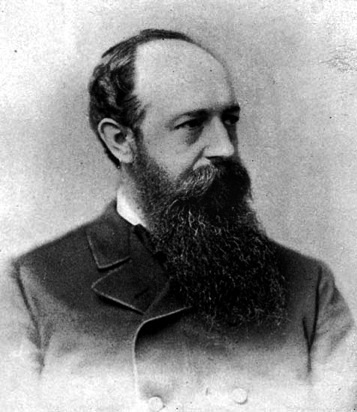
E. P. ROE AT THE TIME OF HIS DEATH.
E. P. ROE
REMINISCENCES OF HIS LIFE
CHAPTER I
BOYHOOD AND COLLEGE DAYS
My brother Edward and I were the youngest of six children, and as he was my senior by but a few years we were playmates and almost inseparable companions in our childhood.
We were born in a roomy old-fashioned house, built by my mother's father for his oldest son, but purchased by my father when he retired from business in New York. A more ideal home for a happy childhood could not easily be found. It stood near the entrance of a beautiful valley through which flowed a clear stream, and was wind-sheltered by high bluffs, yet commanded fine views of the mountains with glimpses of the Hudson showing like lakes between them.
What we called the "side-hill," back of the house, was our chief playground. My brother delighted in climbing the hickory and chestnut trees that grew upon it, and it was here in spring that we searched for wild flowers, from the little hepaticas just peeping above the snow, to the laurel in its full glory. In after years Edward never visited the old home without a tramp to the top of that side-hill or along the wood-road at its base.
Our mother was always an invalid, and the housekeeper, Betsey Williams, who was a member of our family for many years, became like a second mother to us in her care and devotion. But she was no disciplinarian, and I have heard that when Edward was in a childish passion and she felt unable to cope with the situation she would pick him up bodily and carry him to my mother's couch. There he would sit beside her, not daring to move until he could promise obedience, held spellbound by the authority in her keen black eyes, though she was too weak to raise her hand to her head.
Edward's love of nature was inherited from both father and mother. Often, on lovely June days, he would draw mother's wheeled chair through the broad walks of our large square garden, where the borders on either side were gorgeous with flowers, while I gathered and piled the fragrant blossoms on her lap until she was fairly embowered. Yet one scarcely missed those that were plucked.
Back of the garden ran a clear brook, the overflow from a spring of soft, cool water at the base of the side-hill, and in it we often played and tumbled, soaking and soiling many a fresh clean suit.
As is usually the case with younger sisters, I always followed my brother's lead, and one summer day's adventure in particular stands clearly in my memory. We little children had started off with the avowed intention of looking for wild strawberries. We had secretly planned to visit the old house where my mother was born, which was some distance farther up the valley and at that time was unoccupied, but we thought it best not to make any announcement of this project in advance.
Edward had heard that in the cellar there was a stone vault in which our Grandfather Williams kept the money that General Washington had entrusted to his care until it was required to pay off the soldiers of the Revolution while they were encamped near Newburgh. Edward was eager to visit the cellar, thinking that possibly there might still be a few coins left. We entered the empty house by a back door and wandered through the rooms, he entertaining me the while with stories mother had told him of her childhood there.
Then we timidly groped our way down into the large cellar and found the stone vault—but it was filled only with cobwebs and dust!
When we came out and stood in the great kitchen Edward told me another Revolutionary story connected with the spot in our great-grandmother's day.
A company of British soldiers had been quartered upon the family, and the old kitchen swarmed with redcoats and negro servants, for those were still days of slavery in the North. Grandmother Brewster, who was a notable cook, had just placed in the heated brick oven a large baking of bread, pies, and cake. One of the soldiers asked her if they could have these good things provided they could take them away without her knowledge, but while she was in the kitchen. She, believing this impossible, said yes. He waited until everything was removed from the oven and placed upon a large table to cool. Suddenly a quarrel arose between several of the soldiers and one of her favorite colored boys. Fearing the lad would be killed she rushed into the midst of the crowd and at length succeeded in stopping the fight. When at last peace and quiet were restored, she turned round to find her morning's baking gone—and in a moment she understood the ruse they had practised upon her.
As Edward talked the whole story seemed very real to us, but when he had finished we walked up to the old oven, and looking into its cavernous depths he said: "That's here and the stone vault down cellar, but all those people are dead and gone. How strange and lonely it seems! Let's go."
Then we hurried off to a field near by which we called "the rose-patch." Not far from this spot stood formerly an old mill where snuff was manufactured, and the rose-bushes that in bygone days had yielded their blossoms to scent the snuff were still living and flowering. But among the roses was an abundance of wild strawberries, and the two children soon lost all thoughts of the past in their enjoyment of the luscious fruit. But the old deserted house with its Revolutionary associations never ceased to have great attractions for us. Across the road from it, and nearer the creek, was a mound of cinders marking the spot where once stood the forge upon which our grandfather wrought the great iron chain which was stretched across the Hudson for the purpose of keeping British ships from sailing beyond it. Some links of this chain are now kept as relics in the Washington "Headquarters" at Newburgh.
In later years Edward planned to write a story entitled "The Fair Captives of Brooklyn Heights," embodying some incidents in the lives of our Grandfather Williams' sisters, who lived there with their widowed mother. During the Revolution a number of British officers installed themselves at her house, and the old lady promptly locked up her daughters in order to prevent any possible love-making. One of the girls eluded her vigilance, however, married an officer, and fled with him to Canada. She returned after the war was over, but her mother, who had never forgiven the deception, refused to receive her, and she and her husband went to England to live.
In our home at Moodna was always to be found a generous hospitality. Among our most loved and honored guests was Dr. Samuel Cox, who was for many years a prominent clergyman in New York and Brooklyn. My father had been a member of his church and they were lifelong friends. Often, in summer, he and his family spent weeks at a time with us, and we children, as well as our elders, were always charmed listeners to his conversation. He had a fine memory, and it was remarkably well stored with classic poetry. Sometimes he would entertain us with selections from the "Iliad," but more often, when other guests were present and Edward and I were seated on the piazza steps, on warm moonlight evenings, he would repeat whole cantos from "Marmion" or "Lady of the Lake," or perhaps some fine passages from "Paradise Lost."
At times the conversation would turn upon ancient history, and I remember on one occasion he asked Edward and me if we could give him the names of the first Roman triumvirate. At this period of our existence the name "Cæsar" was associated exclusively with an old colored man whom we often visited and who lived upon a lonely road which is still called "Cæsar's Lane." We were vastly astonished, therefore, to learn that the name had ever been borne by any more illustrious personage than our dusky friend. But we listened, entranced, while the doctor told of the rivalries and conflicts of those two great generals, Cæsar and Pompey, for the empire of the world. He could not remember the name of the third triumvir, and it troubled him greatly. That night, about two o'clock, I was startled by a loud knock at my bedroom door, and Dr. Cox called out, "Mary, are you awake?" I replied that I was—as, indeed, was every one else in the house by that time. "It's Crassus," he said, then returned to his room greatly relieved that he had finally recalled the name. Edward and I never forgot our first lesson in Roman History.
This learned clergyman was often very absent-minded. During one of his visits to us he had been for a drive with his wife and our mother. On their return he stopped at the horse-block, near where Edward and I were playing, threw down the reins, and, engrossed in some train of thought, walked into the house, utterly forgetful of the ladies on the back seat. They, very much amused, continued their conversation and waited to see if he would remember them. Finally, however, as he did not reappear, Edward was called to assist them from the carriage and unharness the horse. Some time afterward the doctor rushed out of the front door and around the house, having just remembered where he left the companions of his drive.
The first school Edward and I attended was a private one for boys and girls kept by our eldest brother Alfred, in the village of Canterbury, two miles distant from our home. We trudged over the hills together on pleasant days and drove over when the weather was stormy. I well remember the abnormal interest we felt in the health of an aunt of ours who lived near the school and who had some fine fruit trees on her place. After our inquiries in regard to her welfare had been answered she was sure to invite us to examine the ground beneath those trees, while the merry twinkle in her eyes showed appreciation of the fact that our devotion to her was not altogether disinterested.
Of my brother's later school and college days, the Rev. A. Moss Merwin, now of Pasadena, California, writes:—
"It was at Cornwall-on-the-Hudson I first met Edward, a fellow student in his brother Alfred's classical school. His face and manners were attractive, and intellectually he ranked high among his companions. Well informed as to current events, with a wider knowledge of books than is usual with young men of his years, and with great facility in expressing his thoughts orally and in writing, he commanded our respect from the first. And when we saw from time to time articles from his pen in the New York Evangelist descriptive of stirring events, our respect grew into admiration for him who was facile princeps in our small literary world. Then as we came to know something of his kindness of heart and enthusiasm for the good and true we loved him.
"His particular friends among the boarding pupils enjoyed the privilege of being invited occasionally to the hospitable home of his parents. What a home it was! Abundant comfort without ostentation or luxury. The father a retired business man, kindly, philanthropic, and an ardent lover of plants and flowers. The mother an invalid in her wheeled chair, a woman with sunshine in eye and voice, of unusual intelligence, highly cultivated, with charming conversational powers.
"In the little Presbyterian church near the school, planted mainly through the exertions of his father and elder brothers, there came a time of special religious interest when Edward was deeply impressed. With loving purpose he sought out two of his most intimate companions, and through his instrumentality they then began the Christian life. One became a successful business man in Chicago, and to the day of his death remembered with gratitude the helping hand and earnest words of E. P. Roe. The other friend remembers that soon after that decision, when he and Edward were walking through the grounds of the Friends' meeting-house, they covenanted together to study for the ministry.
"We were together again preparing for college at Burr and Burton Seminary, Manchester, Vermont. How enthusiastic he was over the beautiful scenery of that now far-famed summer resort in the Green Mountains! How delighted to send his father a present through his own earnings by sawing several cords of wood!"
About this time our father's property in New York City was destroyed by fire, and owing to the expense of rebuilding he was obliged for a time to practise close economy. But fortunately it was not found necessary to take any of his children from school or college. To quote Mr. Merwin further:—
"At Williams College we saw much of each other. Roe was a fair scholar, more intent at getting at the meaning of the text, and its mythological and historical relations, than in making what is called a fair recitation. His ability as a writer and speaker was recognized early in his college course when elected speaker of his class at a Washington's Birthday banquet. Friends he easily made, and with many remained in pleasant relations to the close of his life. Trouble with his eyes caused him to shorten his course at college, but the authorities, in view of his subsequent success as a writer, gave him his diploma."
My brother excelled in athletic sports in his youth, particularly in swimming and skating. On one occasion when he was home on vacation, he and a young companion were skating on the river. His friend, who was skimming along in advance of him, suddenly fell into an air-hole and sank out of sight. Edward instantly realized that if he went to the spot to rescue him, he also would break through. With quick presence of mind, therefore, he unwound a long worsted muffler from his neck and threw one end of it into the opening. As soon as the struggling boy rose to the surface, Edward shouted, "Take hold of that tippet and I'll pull you out!" His friend did as he was directed and Edward, by exerting all his strength, succeeded in drawing him out of the water and upon the solid ice, fortunately not much the worse for his immersion.
Adjoining our father's property was that of Mr. Nathaniel Sands, a "Friend" and a gentleman in all that the words imply, who was loved and respected by the whole community. His residence commanded an extended view of the river and mountains and especially of the narrow Gap of the Highlands. At his death the old homestead became the summer residence of his eldest son, Dr. David Sands, the head of a well-known firm of druggists in New York.
While my brother was at the theological seminary, and just about the beginning of the Civil War, he became engaged to Dr. Sands' second daughter, Anna. The young people had known each other from childhood, and this happy culmination of their long friendship was not unexpected by either family.
CHAPTER II
LIFE AS CHAPLAIN
One of Edward's schoolmates at Cornwall, writing of him, said: "We met again on a most memorable evening in the early days of the war, when with two young ladies, one of whom became his wife, we rowed out on the Hudson River, under the shadow of Storm King, while the whole sky from west to east flamed with crimson-tinted clouds, that seemed a portent of the scenes to follow. When we reached the dock on our return the evening papers brought the details of the battle of Bull Run, fought on the previous day."
I remember Edward's intense excitement on his return home that night, and his remark that if he were only through his seminary course he would join the army as chaplain. From that time I believe the purpose was constantly in his mind; and the next year, 1862, although his studies were not then completed, he became chaplain of the famous Harris Light Cavalry, under the command of the gallant Kilpatrick, later Brigadier and Major General, who was always my brother's firm friend.
The following testimony to Edward's work among the soldiers was written upon the field by a correspondent of the New York Tribune.
"Chaplain Roe, of the Second New York (Harris Light) Cavalry, is a man whose praises are in the mouth of every one for timely and efficient services. He is always with the regiment, and his whole time is devoted to the temporal and spiritual welfare of the men. He is their friend, adviser, and counsellor, and commands the respect of all who know him—something that cannot be said of every chaplain in the army."
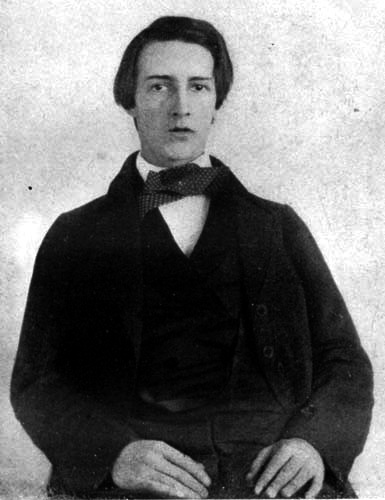
E. P. ROE AS A STUDENT.
The Observer of that year also published a letter written by a private in the Harris Light Cavalry to his parents. In it is found this reference to their chaplain.
"To-day is Sunday, and, as a great exception, it has appeared like Sunday. This morning we had service at headquarters, the chaplain of our regiment officiating, and I think I can safely call him a pious army chaplain, which I cannot say of any others that I ever knew; and notwithstanding the little respect most chaplains have shown to them, and still less encouragement, this one, by his mild, gentle, manly, humble, and Christian-like demeanor, has won the respect of all with whom he has had intercourse, from the most profane and vulgar to the most gentlemanly, which few chaplains have been able to do. In a fight he is seen encouraging the men; in the hospital administering to the soldier's wants, both spiritually and bodily. Last winter, during the worst days of a Virginia winter, I have seen him going from camp to camp, distributing his books and papers; and with his own earnings he would buy delicacies that a poor sick soldier would otherwise in vain long for. These and other innumerable like acts have gradually caused every one to at least respect him, and some to love him. His name is Rev. E. P. Roe, Chaplain Harris Light Cavalry. I have been informed that he had just graduated when he came into the army. I think Dr. P—— may know him. I believe he is a Presbyterian. If you had any idea what a chaplain had to contend with, in order to lead a consistent life, you might then understand why I speak so of him.
"S."
While with this regiment Edward acted as weekly correspondent for the New York Evangelist. A few of his letters to that paper are here reprinted, in the hope that they may still be found of interest. They are characteristic of the writer and give a clearer idea of his life at this time than can be obtained in any other way.
"Camp Hall's Hill, Oct. 15, 1862.
"Messrs. Editors:—Till within a few days past we have been enjoying splendid weather, days as warm and sunny as those of June, and moonlight nights so clear and beautiful that one could sit at his tent door and read ordinary type with perfect ease and pleasure. Of course we improved such favourable weather and held our prayer-meetings nearly every night. I shall never forget one religious service that we had last week.
"As usual a large fire was kindled in front of the chaplain's tent, and the men, having disposed of their suppers, were beginning to assemble. Soon the musical "church-call" sounded to hasten the lagging ones, and by the time our exercises commenced about two hundred were present. Our meetings are of a free and general character, open to all who are willing to take part in them. We commence by singing two or three hymns or patriotic songs in succession, the sound of music calling the men together. A prayer is then offered, after which I endeavor by some anecdote or illustration to force home the truth and necessity of a Saviour upon the minds of those present. The Christian members of the regiment then follow in prayer, singing, and exhortation, till we are dispersed by the roll-call. We have interruptions in this, our usual programme, of such a nature, and with such frequency, that we have great reason to be thankful and encouraged. They are occasioned by the stepping forth of soldiers in front of the fire who have hitherto been silent in our meetings, and who either ask the prayers of Christians that they may be led to the Saviour, or calmly and firmly state their intention to enlist under the banner of the Cross, and urge their comrades to do likewise.
"Towards the close of the service I have mentioned, three young men rose up together, and calmly and firmly one after another stated their resolution, with God's help, to live a Christian life. O that some of our cold, half-hearted professors could have been here then. Would to God that the voices of those young soldiers, as they urged with simple and earnest eloquence their comrades to come to the Saviour likewise, might be heard throughout all the churches of the North, and sound in every prayer-meeting, in our land. Such earnest tones and words would soon disperse the moral and religious apathy that seems to reign undisturbed in many localities, for they would prove that the Spirit of God was present. It was a scene that would have moved the coldest heart, and stirred the most sluggish nature. The starry sky, the full moon overhead flooding all the landscape with the softest and most beautiful radiance, the white tents covering the hillsides, the large fire blazing fitfully up, surrounded by two hundred or more men who might readily be taken at first glance to be a band of Spanish brigands, all conspired to make a picture that any artist would wish to copy. But as you listened to the words of those young men, and the earnest prayer and songs of praise that followed, all such fanciful thoughts of banditti and romance would melt away, and the strange, peculiar costume of those present would become simply the ordinary dress that the rude taste or necessity of the men during their campaign had led them to assume, and the dark-bearded faces, made still more sombre and sinister by the partial light, would resolve themselves into the bronzed honest features of our American soldiers, now expressive of solemn thought and feeling. Never was a sound more unwelcome and discordant than the roll-call which broke up that assembly.
"After the roll-call a group generally lingers around the fire, and I often find in it those who wish to be spoken with on the subject of religion. So it happened this night. A soldier chanced to be passing by our encampment, and, attracted by the sound of music, stopped at our meeting. A few days before he had received a letter from home stating that his mother was very ill and not expected to live many days. He knew he should never see her again, and his heart was tender and sad. Thus prepared for the truth by the Providence of God, his steps were directed to us, and as he sat there and listened to those three young men as they stated their resolution from thenceforth to serve God, he too resolved to be a Christian, and has since found peace in believing. I told him how our prayer-meeting had been started by two or three Christian soldiers meeting openly for prayer, and that the same happy state of things might be brought about in his regiment in a similar manner. He promised that the prayer-meeting should be commenced.
"The 18th of this month (October) was as beautiful and bright a Sabbath morning as ever dawned on Virginia. Though the day and all nature spoke of peace, yet men would not hearken, for it was soon evident that our brief repose was again to be broken. The Third Division of cavalry was encamped on the northwestern edge of the old Bull Run battlefield. The day before we occupied the battlefield itself. The earlier part of the day was spent by the different regiments in preparing to march, and by noon the concentration of the entire command began. Distant outposts, regiments on picket, and scouting parties were drawn in, and soon after the battle-flags of General Kilpatrick, General Davies, and General Custer were seen fluttering through forests or over hills in the direction of the Warrenton and Alexandria pike. Following them were long lines of cavalry and artillery, and above all, a bright October sun that gave to the scene anything but the grimness of war. As evening approached we came out on Warrenton pike. General Davies' brigade had the advance, and part of the Harris Light Cavalry was thrown out as skirmishers. It soon struck the enemy's pickets, and then a running fight was kept up until within a short distance of Gainesville. Our flying artillery took advantage of every high position to send a shell shrieking after the enemy. It was now dark night. The head of our column had advanced up within a short distance of the point where the railroad crossed the pike before entering the village. For a short time there had been an ominous silence on the part of the rebels, and it became necessary to send forward part of the Harris Light Cavalry to find what had become of them. The detachment moved on to cross the railroad embankment, when suddenly, from over its top, at a given signal, a line of fire at least three hundred yards long flashed out into the night, and a perfect storm of bullets rained over their heads. Fortunately the enemy fired too high to do much execution, and only a few were wounded. Our boys returned the volley, and then retired to a small piece of woods, and for a time a hot skirmish was maintained. Having no knowledge of the force that might be concealed in the place, and the position being too strong to be carried by a night assault, further operations were deferred till morning. The 1st Virginia were left on picket close to the enemy and the rest of the command fell somewhat back and went into camp.
"To one not familiar with army life in the field, our mode of encamping that night would have been extremely interesting and suggestive. We were in the face of the enemy, which is no place for careless security. Each brigade was placed by itself, supporting the batteries which were put in position ready to be used at a moment's notice. The horses of each regiment were drawn up in ranks and tied to stakes driven into the ground for the purpose. Each man slept at the head of his horse, which he kept saddled, and part of the time bridled. Within three minutes the entire division could have been out in line of battle. I have known our regiment to saddle their horses, lead out from the woods, form ranks, count four and stand ready to charge into anything that might oppose, within just three minutes by the watch. In the rear of this warlike array the ammunition wagons and ambulances were parked in regular order, the team horses standing ready harnessed. Thus Kilpatrick's little fighting division lay there that night like a panther crouched ready to spring. During the night wagons came up with rations, which were soon distributed. The groupings around the fires, after this, were picturesque in the extreme. Some of the men, shrouded in their great military overcoats, stood quietly warming themselves, throwing out immense shadows that stretched away till lost in the surrounding darkness. The dusky forms of others might be seen passing to and fro in the preparation of their rude meal of fried pork and hardtack, while the flickering blaze revealed the burly forms of a still greater number reposing upon the ground in all varieties of attitude. At last the entire division, except the vigilant pickets and sentinels, was wrapped in slumber. At four o'clock the bugle sounded reveille, and the camp was soon all astir. Soon after we saw a flash in the direction of the enemy, and listened breathlessly a moment for the report of rebel cannon, but the long interval and distant heavy rumble that followed satisfied us that a storm other than that of war was about to break over us; and soon it came, with high cold winds and drenching rain. As we cowered around our smoking, dying fires in the dim twilight of that wild October morning—ah! then we thought of being tucked away in snug feather-beds under the old roof-tree at home; but there was no repining, though we all knew that on the coming night many would sleep colder than ever before—so cold that nothing but the breath of God could give warmth again.
"But we were not long left to reflection of any kind, for regiment after regiment now began to take position upon the line of march. General Custer's brigade had the advance. Soon scattering shots and an occasional boom of a cannon told us that we had again found the enemy. But no stand was made until we reached Broad Run, and there the firing became rapid and sharp. Our brigade now came up and was placed in position, and the battle became general. Every now and then a shell would whiz over our heads and explode, inspiring anything but agreeable emotions. Several charges were made on both sides. I wonder if it is possible to give any idea of a rebel charge. Their cries and yells are so peculiar, so wild, shrill, feverish, so ghastly (I had almost said ghostly), for the sounds seem so unreal, more like horrid shrieks heard in a dream than the utterances of living men. The shouting of our men is deeper and hoarser, and partakes more of the chest tone in its character, but the rebels charge with a yell that is something between the shriek of a woman and the scream of a panther. At times you can close your eyes and imagine that some fierce conflict of another age is passing before you in a dream, so strange and unnatural does it seem to see men engaged in mortal combat. We finally dislodged the enemy from their very strong position and advanced across Broad Run. General Custer took a strong position on a hill above the stream, while General Davies was ordered with his brigade to advance as far as possible toward Warrenton, for General Kilpatrick had received written orders to move out as far as he could upon this road in order to discover the force and intentions of the enemy. The surgeons and ambulances halted in a field between the two brigades. I stayed with them, and was trying to get a feed for my horse, which was evidently beginning to feel the effects of long marches and short rations, when suddenly I heard firing nearly opposite us, on our left flank. At first I thought it was a mere skirmish with some rebels left in the woods and discovered by our men; but the firing became more rapid every moment, and soon General Custer's battery began to shell the woods most vigorously. I saw that the woods were full of men, but could not distinguish ours from the rebels. Two or three aids galloped by in the direction General Davies had taken.
"One remarked in passing, with an ominous look and shake of his head, 'You had better be getting out of here,' which was not a very comforting suggestion to those who had no orders to 'get out of here' or where to get to. It was very evident that something was wrong, and that matters were getting serious. Wagon and ambulance drivers, surgeons and their attendants, contrabands with their led horses—in short, all of us—were like a covey of startled quails, their heads up, aware of danger, but not knowing which way to fly. We could not very well show fight, for a charge by a wagon train would be almost as great a novelty as General Kilpatrick's attacking gun-boats with cavalry, which he actually did last summer on the Rappahannock, and destroyed them, too. But we, not at all envious, were glad to receive orders to retrace our steps; for nothing is so uncomfortable for a soldier as to hear firing in his rear. We were proceeding leisurely and in good order, when an orderly rode rapidly up to our front and turned us off on a by-road through the woods, with an injunction to move rapidly and come out on the main pike near Gainesville. Away we went in the direction of Thoroughfare Gap, the wagons banging and bouncing over stones and stumps, through streams and mud-holes, as we followed the sinuosities of a narrow wood-road which finally led into the open fields. Here I felt like crying and laughing both—crying with rage at what I then considered our disgraceful retreat; but when I afterwards learned what odds we were contending against, I was satisfied that the best generalship was displayed in rapid retreat. And gravity itself would have laughed at the figure we cut. Contrabands and camp followers were careering by in all states of panic. Many had lost their hats in coming through the woods, and it seemed in some cases now that their wool fairly stood upon end, while they, rolling their eyes over their shoulders in the direction of the enemy, exhibited only their whites to the observer in front. Here might be seen an unfortunate darkie hauling on a stubborn mule that with its wonted perversity wanted to turn around and run the other way; there a man trying to raise a horse that had fallen with him; while 'Git up, dar; git up, I tell yer,' resounded from every side. Some poor mules and some led horses fairly got frantic, for what with the beating they received, and with tin kettles rattling and captured chickens cackling between their legs, it was enough to distract any brute; so they kicked and floundered till they burst their girths, and galloped away rejoicing in their freedom. But the comic was soon lost in the tragic. The pursuing enemy was now closing upon us from all sides. The rear guard, which was the Harris Light Cavalry, made many a gallant stand, but what could a few men do against twenty times their number? With many it became a sad race for life and liberty. But before dusk we had the satisfaction of effectually checking the enemy. For the first time in my life I found myself rallying a body of men in a fight. Officers and men coming in rapidly, we soon had a respectable line formed and the enemy's advance was now decidedly checked. Captain Elder, who had brought off all his guns in safety, planted them on an eminence, and soon they were thundering defiance to the baffled enemy. Shell after shell screamed over our heads and exploded. Soon after a part of the First Corps came up, formed a line of battle, and relieved our thinned and wearied ranks. We retired to the friendly shelter of a neighbouring forest, and that deep sleep which follows great excitement and exertion quietly stretched us out as motionless and unconscious seemingly as the lifeless forms of our brave comrades that lay cold and stark along the line of our bloody retreat."
"Many changes and much marching and counter-marching have taken place since the soldiers of the Harris Light Cavalry gathered nightly under the old apple tree, or in front of the chaplain's tent, during the warm moonlight evenings of September and October. The rich autumn foliage that then made even poor old desolated Virginia look beautiful has dropped away, and stern winter, rendered all the more grim and forbidding by the ravages of war, now reigns supreme. Many of our number, also, like the leaves, have dropped away. Some, having obtained and squandered their bounty, have treacherously deserted and sneaked away like thievish hounds. The bullet, accident, and sickness have each conspired to lessen our number, and many a noble-hearted fellow who was always first and foremost in all a soldier's duty is now languishing in some hospital, or sleeping beneath the sod that last sleep from which no bugle call shall waken him.
"It seems as if God was teaching us to look to himself, and not to men, for among those that sickness has for the present removed from our number were three who were the very stay and central pillars of our regimental church. Especially do I feel the loss of Brother Farber, who was as noble a specimen of a Christian soldier as it has ever been my fortune to meet. Uniting culture of heart and mind with a happy disposition, a shrewd and quick perception of character, and a manner that made him popular with all, he was just such an ally as the chaplain needed in the ranks. Though he made his religion respected by all, he also made it attractive, and his society was not shunned, even by the wildest spirits of the regiment. His cheerful smile and words were better than medicine in the hospital, and I almost always found him there when off duty. Nearly two months ago he left us for a hospital in Washington, sick with the typhoid fever, contracted doubtless by over-fatigue in his care of the sick and bodies of the deceased, and by breathing air tainted with disease. I have since received a letter from him stating that he was very sick, and that the surgeon said it would be months before he could join the regiment again, if ever. For aught I know his warfare may now be over and he at rest, for I have received no answer to my reply to his letter. Brothers Vernon and Stillwell are also away sick. Only pastors, and they not fully, can realize the loss that such men are to a chaplain. He has so few capable, warm-hearted co-adjutors in a regiment as a general thing. There is such a torrent of evil influences rushing in on every side, that he sorely feels the need of men possessing firm and established Christian characters, who would quietly and consistently stand up for, and live religion on all occasions. Here he has none of the conventionalities and restraints of society to aid him, and even the heavenly influence of Christian parents, of pure sisters, and loving wives is weakened by distance, absence, and sin. But in grappling with the many and powerful demoralizing influences and vices of camp life, one soon learns that but little can be accomplished except by the direct aid and interposition of the Holy Spirit, for nothing short of the grace of God can enable the soldier to resist the evil that assails him on every side.
"While I was on a brief business visit to the North, the regiment had joined the advance, and on my return I found it out in the neighborhood of Warrenton. After waiting a few days in what remained of our old camp, I found an opportunity of going out to the front with Captain Cook, of our regiment, and a small squad of men. The ride out to Rappahannock Station, where our regiment was last heard from, was full of novelty and interest to one who had never been on a long march before. Captain Cook is a gentleman as well as a good soldier, and his familiarity with the historic region through which we passed made him an exceedingly agreeable companion. The evening of the second day of our journey, which was Sunday, found us considerably beyond Manassas. A dismantled house stood on the brow of a hill in a grove some distance from the road. We rode up to it and concluded to spend the night there. Though it was half ruinous, without windows and doors, and the floor covered with rubbish of every description, but a few moments sufficed to make it sufficiently comfortable for a soldier's purpose. A fire blazing on the hearth, the rubbish cleared away, a blanket hung over the windows and doors, made our night quarters complete. Then gathering around the fire, each broiled his slip of bacon on the end of a stick, and enjoyed this rude repast far better than many a well appointed banquet in the North, for 'hunger was our sauce.' After supper we had, as it were, family prayers. The old dilapidated mansion, the costume, arms, and varied expressions of the soldiers as they lounged around listening to the Word of God, all brought into view by the flickering blaze that roared within the chimney, made a scene that any artist might wish to copy.
"After marching all the next day we joined our wagon train at dusk, near Rappahannock Station, and found that we were just in time, for the whole army was on the move to Fredericksburg. Joining the train, I marched half the night with them in the darkness and rain. As there was no shelter near, the next day was spent in the rain under a tree; and an attack on the wagon train being expected on the following night, my slumbers were neither very sound nor long continued. But such is the wonderful vitality that life in the open air gives, that one soon recovers from loss of sleep and fatigue. Our regiment moved down to Brook's Station, where it remained doing picket duty till it joined the advance on Fredericksburg.
"Our brigade, with our beloved and lamented General Bayard in command, was drawn up on a hillside preparatory to marching, and I assure you that the long lines and dense masses of cavalry made a splendid and imposing appearance. It was nearly night before we filed off towards Falmouth. The night was dark and misty and the roads broken and wild. Sometimes we would plunge down into a deep gully, at others scramble up the slippery and frozen sides of a steep hill. Every now and then horse and rider would be down, to the great merriment of all witnesses. But the joke became too serious when a horse fell and broke one poor fellow's leg.
"Seen through the mist and darkness, the long extended column, winding among the broken hills, now coming out in bold relief on the brow of one of them, and then descending again into the valley or the gloom of some forest, had a shadowy and phantom-like appearance, and seemed more like a procession in a dream than a goodly number of well armed troopers on a march. Especially was this spectral effect heightened when a distant part of the column would pass within the lurid glare of some brilliant camp-fire. After floundering through streams and quagmires, and filing through gorges that reminded one of the old Indian ambuscades, we turned off into a forest to encamp for the night. Selecting a tree from under which the snow had partially melted away, a few of us built a fire, then spread our blankets and slept on the ground in the clear, frosty starlight as well as on the softest couch our limbs had ever pressed. Long before daylight, the bugle sounded 'boots and saddles,' and the woods soon resounded with the customary martial clamor of an encampment.
"Suddenly every sound was hushed, for the distant boom of the two guns that opened the battle of Fredericksburg broke upon our ears. The silence was succeeded by wild shouts of enthusiasm, and soon we were on our way to the scene of action. The sharp rattle of musketry now began to mingle with the report of cannon. As we approached the river the roar of the artillery was truly grand and awful. I can only compare it to a very violent thunder-storm, wherein you hear, at one and the same time, the rumble and mutter of some peal dying away in the distance, the heavy, jarring roll more near, and the loud stunning explosion from the flash overhead. Our cavalry was crowded on a plain in the rear of our batteries. We did not know that the rebels were not replying to our guns, and expected every minute they would get our range. As we remained undisturbed, I concluded that our distance from the river was much greater than I had first supposed; but when the order came to march, and we filed off, by twos, down towards the river, past our batteries, I expected every moment to see the head of our column broken and shattered by shot and shell. I have heard much about "lazy soldiers and large pay," but I thought at that time that the soldier who marches steadily and determinedly forward on such occasions earns in five minutes all the pay he ever gets. But the heavy cannonading was only from our own guns, for the rebels were reserving their fire. We soon found that our orders were not to cross, but to go down the river and do picket duty on the extreme left flank. As we marched along, a shell from one of our batteries on a hill above me passed directly over my head. As it hissed by, it gave me an idea of the infinitely short space of time in which many of our poor boys are dashed into eternity.
"The early dawn of Saturday morning saw us returning to the battlefield. About nine o'clock we mounted the hill, and formed upon the plain on the opposite side of the river. As we were taking our position, I heard a whizzing sound, and saw the earth torn up by a solid shot quite near me. They soon screamed over our heads and fell all around us; but, as a general thing, the enemy fired too high. A few hundred yards to our front, the shells were bursting constantly. We remained on the plain all that day and night, the fire in front of us sometimes slackening, and sometimes ceasing altogether. We often cast anxious glances at some rebel batteries quite near us on the right, and often wondered why they did not open upon us, for if they did, they could have swept us from the plain in a few moments. Either our batteries occupied them, or they reserved their fire for some purpose. A little after noon, we heard that General Bayard, our division commander, was mortally wounded. Soon after word came that cavalry was needed. Two regiments of the enemy were running, it was said, and the Harris Light Cavalry was wanted to follow them up. Off dashed our men in close column, at full gallop, to the place designated, the surgeon and myself going to the hospital to prepare for our wounded. As we started, the road over which the regiment had just passed, and directly in front of us, was torn up by a solid shot. Whose earnest prayers were heard that day, and the Harris Light Cavalry saved from almost a massacre? The order for cavalry had to pass through three different hands before it reached us, and by the time our men arrived at the spot it was discovered that the enemy's retreat was only a feint, and that batteries were so arranged as to place the party who should follow them between two fires. Our regiment approached near enough to the trap, and were exposed to a sufficiently hot fire, for a few minutes, to be satisfied that if they had charged, as was intended, but few would have returned.
"At the hospital we found poor Bayard. Of all the ghastly wounds I saw that day his was the most awful. It needed but a glance to see, as he calmly stated to those who visited him, "that his days on earth were numbered." If his wound had been a mere scratch, he could not have been more cool, quiet, and collected. He talked calmly of his death as of a settled thing, and only inquired particularly how much time he had left on earth. He was told, 'perhaps forty-eight hours.' He did not live twenty-four. My heart sank within me as he gave me his hand in farewell, and I almost murmured, 'Why are the best taken?' The large house to which the wounded were brought was now filled with mutilated and dying men. Cries and groans resounded from every apartment. Ghastly and bloody wounds met the eye in every direction. Some had their eyes shot out; the tongues of some were swollen out of their mouths; some had their bodies shot through; others were torn and mangled by shell and solid shot, and all were crowded wherever there was any space. The surgeons were hacking off limbs and arms by the dozen. The odor of blood was oppressive. One man called me to him, thinking I was a surgeon, and said that one of his wounds had been dressed, but he found that he had another, which was bleeding rapidly. Another poor fellow held up his arm to me, with a great bulging hole in it, and asked with an expression of pain and anxiety that I could scarcely endure, whether I thought he would have to lose it? Such is the horrid reality of war behind the painted scenes of honor, glory, and romance. However cold an ear the poor fellows may have turned to the story of the Cross when in health, as a general thing they were ready enough now to listen to the offers of mercy. One wounded boy had his leg taken off just as he was entering the hospital, which building was under fire all day, and was repeatedly struck. The scene from the windows of the hospital was truly splendid as night came on. Innumerable camp-fires gleamed from the hillsides, and occasionally the darkness was lighted up by the flash of cannon. But weariness, and the knowledge that our own regiment might be engaged the next day, caused me to seek a place of rest. The medical department of our brigade had been rendered small by the absence of some of its members, and it might be that our duties on the morrow would be very arduous. The ground outside the hospital was so tramped up, muddy, and filled with horses, that it was impossible to sleep there. But there was a stone alley-way under the hospital, filled with tobacco in the leaf, part of it lying on the ground, and part drying overhead. One end of this place was already filled with wounded men, but the surgeon in charge said that the other would not be occupied before morning, and that I had better stay there. As a light came I saw something white lying near the wall. I first thought it was a dog, and going up, I stirred the object with my foot. On looking closer, I found that it was a ghastly pile of arms and legs from the amputating-room. But I had seen so much of blood and horror during the day that I had grown callous. I quietly spread my blanket within ten feet of the bloody heap, and listened sadly to the shrieks and groans from the hospital above till I fell asleep. The re-opening of the battle on Sunday morning awoke me, and as I was rolling up my blankets, a shell bursting near warned me to hasten. I joined the regiment, and with it recrossed the river. We have since been doing picket duty on the Rappahannock.
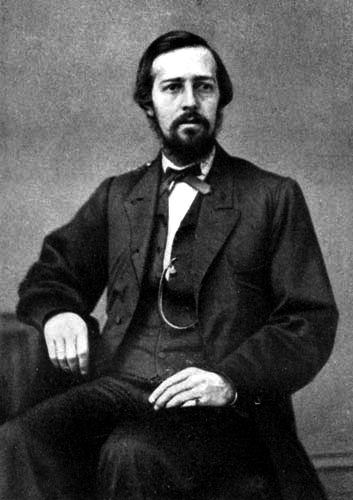
E. P. ROE AS CHAPLAIN, AGE 26.
"Many a careless, light-hearted soldier wore an anxious, troubled look that day, as we stood facing the rebel batteries, and many a loud-mouthed, coarse, swearing fellow was quiet and pale. But I saw no flinching or skulking. You at the North, who cosily read about battles in an arm-chair, know little of a man's sensations who stands in front of the enemy's guns. He hears shot and shell scream and explode over and around him. Before him arises the sulphurous smoke of the conflict. From out of that obscurity he knows that at any moment some swift messenger of death may be speeding on its way to his heart. He thinks of unfinished plans, of bright prospects and hopes for the future. His home, its beloved inmates, and the forms and features of those friends that hold the chief places within his soul rise up before him, and he knows that at any moment he may be snatched from all these, and lie a mangled, bleeding corpse upon the ground. And then come graver and still more solemn thoughts of the shadowy world beyond, and 'conscience, which makes cowards of us all,' awakes. In the mad excitement and tumult of a charge, everything is forgotten. When patiently standing under fire, everything is remembered, and this, of all that the soldier has to do and endure, is the most difficult and dreaded."
An occasional amusing incident would occur, however, to relieve the gloom of these tragic times. I remember hearing my brother tell of one that took place while crossing a narrow pontoon bridge. A mule, ridden by a contraband, and having a number of kettles strung on one side of the saddle and on the other some chickens that had been captured from henroosts along the march, suddenly became stubborn when about half-way across the bridge, and resisted all efforts on the part of his rider to make him move on. He was blocking the way for the whole troop. An officer, seeing the situation, shouted the order: "Charge mule!" Instantly half a dozen men rode up and with the points of their sabres convinced the animal of the necessity for a speedy advance. He started off at a dead run, scattering the rattling kettles and squawking hens by the wayside, the poor contraband holding on with arms clasped around the mule's neck, while the troopers followed in wild pursuit, amid shouts and laughter.
CHAPTER III
A WINTER CAMP
The following letters were written from the winter quarters of the regiment on the Rappahannock, and explain themselves.
"In this letter I merely propose to give some glimpses of camp life. When the army lay quiet for two or three weeks after the battle of Fredericksburg, we began to think of winter quarters; so one fine morning our whole division started out in search of a desirable locality. In some respects it was a rather novel expedition. We were seeking a place that would probably be our home for months; and I assure you, as we marched along, that unknown spot of ground became to us an object of no small anxiety and interest. Those officers who had designs on Washington, rather than Richmond, hoped it would be near the steamboat landing on the Potomac. Many wishes were expressed that wood would be plenty and convenient; for winter quarters without wood is an impossibility. Speculations were indulged in regard to the locality and soil, whether it would be a dry, sheltered little valley, or a bleak cornfield capable of all degrees of mud. The place of encampment selected for our regiment was apparently the latter. I must say that many of us were not very enthusiastic about the position, and we could not feel indifferent, for our comfort and perhaps health depended on the suitableness of the place.
"Imagine yourself, my reader, riding into a large, bleak, hilly cornfield, the stalks still standing, with your whole personal property in this region of the world strapped behind you on the saddle, your horse sinking at every step fetlock deep in the soft, spongy soil, and being coolly told to make yourself comfortable here for the winter. Probably you would feel as we suppose the Israelites did when required to make bricks without straw. But necessity and experience have taught the soldier many lessons, and he knows well how to make the best of everything. In a few minutes the long picket lines are uncoiled and stretched from post to post inserted for the purpose. To these the horses are tied and then unsaddled. The little shelter tents range themselves, as if by magic, in long rows between them, and within a half-hour or so the place begins to assume the appearance of a well laid out encampment.
"But this is merely temporary, and the building of regular winter quarters is next in order. The size and character of the huts being left to the fancy and ingenuity of each individual, there is, with much apparent sameness, a great deal of diversity and originality to be observed. The most simple is merely a 'dug-out,' as it is termed. A hole is dug six or seven feet square, and from two to four feet deep, and over this is placed the tent. The floor and sides are lined with boards if they are to be had, otherwise round poles and rails answer the purpose. Opening into this 'dug-out' is a small trench two or three feet long, wide at its mouth, and narrowing towards the end farthest from the tent. Across this trench are laid any old pieces of iron that can be found, and upon them is placed earth so as to exclude the air entirely except at a small aperture at the farther end, around which is built a sod chimney; and your winter quarters are complete. Thus you may have in your tent all the warmth and cheerfulness of an open fire.
"Myself and servant alone built one of these in an afternoon, and I spent in it some of the coldest weather we have had this winter very comfortably. The 'dug-out' principle enters into the construction of nearly all our little cabins; and, like the foxes, we have holes, and literally live in the 'caves and dens of the earth.' The officers generally build their quarters in the side of a bank, and have them logged up nicely, and they are very comfortable except in a long storm. Sometimes our frail canvas covering sways terribly in the wintry blasts, and I have often laid down to sleep more than half expecting to find my house gone when I awoke. Still our little holes in the ground are a hundredfold better than no shelter at all, and far preferable to those in which the soldier 'sleeps the sleep that knows no waking.' Some of the men who have the faculty of making anything and everything with an axe put up quite large substantial log shanties, with two or three tiers of berths, as in a steamboat. Some have quite a neat, homelike appearance, and are furnished with fanciful little tables and shelves according to the tastes and wants of the occupants. Others are dismal and dirty in the extreme, and are mere dens. Nothing shows the character of the men more thoroughly than the little huts they inhabit. A few are too indolent to build themselves anything, and are still living in their shelter tents. But over the heads of us all is merely a canvas roof, which will often leak, and it is a very common thing to see puddles of water, or a muddy floor, in our winter quarters.
"Still those who are well live in the main a very comfortable life. The abundance of pure air and exercise makes us strong and vigorous. It does not always storm. We have many days that are warm and sunny, and then give me camp life in preference to any other. The soldiers sit and lounge around their cabin doors in motley groups, reading (if they have anything to read), smoking, and gossiping, for a camp is a little miniature city, with its daily budget of news and sensations, its streets, squares, and centers, and also many of its nuisances. For the roar of New York we have a drowsy, diminutive hum, frequently broken rudely by a loud laugh or command, the clangor of weapons, and sometimes, I am sorry to say, by loud oaths. Instead of musical chimes from Trinity and her sister steeples, the silvery notes of the bugles proclaim the hours and duties of the day. Our lights glimmer and flicker out upon the night like long rows of glowworms rather than Broadway lamps; and instead of the heavy tramp of police armed with star and club, the night-long rattle of sabres shows that the guards and sentinels are on their posts of duty. Sometimes there will be a heavy fall of snow during the night, and then the tents and cabins look like huge snow-banks, and the poor horses shiver all the more under the cold white blankets so summarily furnished, the only ones they ever get. These suffer more than the men, for in the main they can have no shelter, and often have to do hard work on short rations. Their gaunt appearance and the number of their dead tells its own story. Our colonel remarked one day that he hoped the mud would get so soft and deep that the horses would sink in sufficiently to enable them to stand upright.
"The greatest hardship of a soldier's life in winter is picket duty. For instance, our whole brigade, recently assigned to Colonel Kilpatrick, left their comfortable quarters a few mornings ago, and went out on picket duty for ten days. A cold, wet snow filled the air and clung to and dampened everything. It settled on one's hair and neck, melted, and ran down his back, producing a general feeling of discomfort. As the men formed preparatory to marching, their uniforms of blue rapidly changed to white, and as they filed off in the dim morning light they presented a shadowy, ghost-like appearance. When you realize what it is to march eighteen or twenty miles in such a storm over horrible roads, and then form a cordon of pickets twenty miles long in a wild, desolate country, you have some idea of the not unusual experience of a soldier.
"When he reaches his destination, it is not a disagreeable journey over, and comfortable quarters in which to dry and refresh himself. All his conditions of comfort are carried on his person, or strapped to his saddle, and he is thankful even for the shelter of a pine wood. Immediately on arrival, without time for rest, a large detachment must form the picket line, and stand ever on the alert from two to four hours at a time, be it day or night. It should not be forgotten, during these long winter evenings when the stormy wind sweeps and howls around your comfortable dwellings, that among the wild woods and hills of Virginia, or on the plains of the far West, the patient sentinel walks his desolate beat, or sits like an equestrian statue on his horse, thus forming with his own chilled and weary frame a living breastwork and defence for your homes. Pray for him, that during these long, lonely hours of hardship and danger our merciful God may excite within his mind thoughts of that better life and happier world where the weary are at rest—where even the names of enemy and war are forgotten."
"The regiment referred to is the Ninth New York Cavalry. Their chaplain is not with them at present. My offer to preach for them on the Sabbath was readily accepted, and though at the time of service it was cold and even raining slightly, a large congregation turned out and remained patiently throughout the service. One of their officers remarked afterwards that he had not had the pleasure of attending anything of the kind before for five months.
"If Christians North, who have piles of reading matter lying idly about their houses, could see how eagerly those men pressed forward to get the few tracts I offered, they would suffer it to remain thus useless no longer. Our soldiers seem to be hungry and almost starving for the want of mental and moral nourishment.
"I often feel it my duty to be somewhat officious, and to offer my service outside of my regiment sometimes, for even such as I can give is better than nothing, which would be their lot if some did not go forward. I think Christians should be aggressive in their character, and seek opportunities to extend the dominion of their King. There are too many professors who are like a certain chaplain, concerning whom I heard an officer remark "that he was a good, inoffensive man, and never disturbed the devil nor any one else in the camp." A prayer-meeting was appointed on Monday evening, but on the morning of that day the regiment received marching orders and departed for parts unknown.
"One of the most remarkable conversions in our regiment is that of a quartermaster's sergeant. The man, although around the camp attending to his duties, is in a critical state of health, bleeding almost daily at the lungs. When but a mere boy he ran away from home because punished severely by his father for some fault, and was not heard from for over two years, during which time he suffered many hardships in the West. Not long after his discovery his father died and left a mother and a sister dependent upon him for support. This responsibility he nobly undertook, and worked hard, early and late, and denied himself everything to give them the comforts of life. Still, he was noted for his fiery and ungovernable spirit, which often got him into trouble. At an early age he went to sea and visited nearly all parts of the world. He engaged extensively in smuggling, which occupation he followed both in English and Spanish waters. He returned home from this roving, reckless life but a short time before the war broke out, and was among the first to enlist. During the past summer he has often been in circumstances of the greatest peril, but escaped unharmed. Once, in the confusion of battle, he found himself directly in front of a battery loaded with grape and canister. For some reason or other his horse would not move but stood stock still, and thus he had to wait for the terrible discharge which soon came. He said it seemed as if a perfect torrent of iron hail rushed by and all around him, and that his only thought was that his time had come now, and that the devil had got him then surely. By a miracle, as it seemed to him, he escaped unharmed, and was enabled to get out of range. Many and many a time he had heard the bullets hiss by his ears, and the shrill screams of shell overhead, but they raised in his mind no thoughts of God or repentance.
"As I described in a former letter, a prayer-meeting was started in the camp, and held in the quarters of the new recruits. He heard the singing, and passing by the next day remarked to a new recruit that 'they seemed happy down there last night—guessed they must have had some whiskey.' The person addressed happened to be one of the three Christian men who first started the prayer-meeting, and he explained to the sergeant the somewhat different source and occasion of their happiness. The sergeant promised to attend that evening, which he did, and the 'still small voice' of the Spirit spoke to him louder than the thunders of the battlefield.
"An evening or two after that I noticed him among those who had come to the chaplain's tent to be conversed with on the subject of religion. I was struck by the contented, happy expression of his face. He told me that he had gone from that prayer-meeting to his tent, and commenced reading a Testament. His tent-mate came along, and he immediately put out his light and hid his book. When he was alone again he knelt and prayed for the first time in his life, and afterwards, he said, 'he felt so happy he could not sleep.'
"The next day, while about his work, something vexed him, and he swore, before he thought, as usual. He said 'it grieved him so that he sat down and cried.' Though, as it were, alone in the world and bereft by death of almost every friend he loved, and now seemingly suffering from an incurable disease, he is a happy Christian man.
"In our meetings he has to be constantly on his guard against over-excitement, since it would cause him to bleed at his lungs, but the expression of his face, as he sits quietly in one corner or beside the fire, shows how intense and keen is his enjoyment of that which he is forbidden to take part in actively. At first his change of life caused a good deal of remark and some merriment in his company. He would be asked 'when he was going up to heaven.' When he commenced his evening devotions there was at first a good deal of jesting. 'The quartermaster is going to pray' would be called out, and remarks of a similar nature. They soon saw that he was sincere and respected him, and 'now,' he says, 'he can hear a pin drop while he is at prayer.'
"This is one of many of the interesting cases of conversion in our regiment. The chief feature of this work, however, seems to be the renewal of backsliders in their allegiance to God. But time will not permit me to write more at present."
"How often when a boy I have shuddered at Indian atrocities. With what morbid pleasure I have searched through the early records of colonial history for details of horror, fatal surprise, and midnight massacre. How I have watched in imagination, with suspended breath, the wary, noiseless approach of the painted savages, till with one wide-ringing war-whoop they rushed upon their unconscious victims, destined now to either death or captivity. The dangers and terrors of open battle seemed nothing to this constant dread of an unseen treacherous foe. I little thought that it would one day be my fortune to live under very similar circumstances, for life in Virginia now is not so very different from that of our forefathers a century or more ago. Pioneers in this wilderness of despotism and treason, we are exposed to dangers and hardships not much inferior to theirs. Ever near us we know there is a great army watching with sleepless vigilance, and, like a wild beast crouching for its leap, it is ready to take advantage of the slightest mistake or show of weakness on our part. It is very strange, truly, when one comes to realize it, this living for years within a few miles of thousands who would take your life in a moment if they got a chance.
"The forests and country around us swarm with guerillas. In place of some savage Indian chief, the terror of the whole border, the frontiers of our army are infested by the ubiquitous Mosby. The capture of a sutler's train near Fairfax and a raid upon an outpost on the Rappahannock occurring at the same time are both ascribed to Mosby in person by the soldiers. If a picket hears a distant gallop in the night upon one flank of the army, and a sudden shot startles the air upon the other flank, Mosby is invariably the author of both alarms. No wonder the poor contrabands say 'Mosby mus' be like de debbel and go all ober to oncst.' He was once captured by our regiment while bearing dispatches and afterwards exchanged. After he was taken he tried to escape by running his horse, but one of our men sent a bullet whistling so near his head that it produced a sober second thought, and he, from that time, followed quietly. But he was not so famous then, and had not so many trained associates like-minded with himself. Now they follow a marching column like hungry sharks about a ship, and woe be to the man that lags behind or strays from the main body.
"This evil has one great advantage, however, and that is the almost entire suppression of straggling. Mosby and his companions have done more to abolish this disgraceful custom in our army than all the orders and edicts from the War Department and Major Generals down. A year or more ago, I saw bodies of men marching in a way that reminded one of a comet, the head of the regiment being the nucleus, the density decreasing rapidly as you went toward the rear, and finally a straggling raft of men scattered over two or three miles of territory constituting the tail. Now you will find a column moving trimly and compactly, and the rear files often looking suspiciously over their shoulders among the dark pines through which they are passing, for sometimes, especially at nights, shots are fired into the rear.
"There are very few in the cavalry that have not had narrow escapes, for our position on the front and flanks of the army always brings us next to Mosby. Just before we crossed the Rappahannock the last time, our division commissary, Lieutenant Hedges, was returning to his quarters from a short ride to another part of the army, when he was hailed and ordered to surrender. 'Never,' he replied, at the same time striking spurs to his horse and leaning down upon him. He succeeded in escaping, but not before the guerilla, or as it is affirmed, Mosby in person, put a ball through his body. For some days he was not expected to live, but is now recovering slowly. I have had two or three narrow escapes myself where it almost seemed that Providence interfered to save my life. Once, when our regiment was doing picket duty at a distant outpost, I rode down to General Kilpatrick's headquarters on some business. As I was starting to return in the dusk of the evening, the general came out and asked me to stay with him that night. I replied that with his permission I would come again in the morning, and that I would rather be with my regiment at night; but as he insisted upon it, I stayed. The next morning, a little after daylight, one of our men was shot dead and robbed upon the road that I would have taken. A woman living near said that two bushwhackers had spent the night upon the road with the avowed intention of murdering and robbing the first man that went by. As no one passed that way during the early part of the night, they went into a house and slept till morning, and again were on the road in time to meet poor Francher of Company B, who had been after his pay. They took this, for his pocket was found turned inside out. It was my sad duty to bury him the next day, and as we lowered him into his lonely grave, I could not help asking myself, Why am I not in his place?
"Once again, last November, while on the march, Lieutenant Whitaker and myself were about to pass over a road between our wagon train and General Kilpatrick's headquarters, when a little incident detained us about fifteen minutes. As we were going by the house of quite a noted secessionist, some of our boys began to make free in his cabbage garden and poultry yard, and a scuffle ensued between the old citizen, his wife and daughter, and the soldiers. An infantry colonel who was at the house came violently out, and instead of quietly showing his rank and firmly ordering the men away, commenced cutting them with his sword, and made some quite serious wounds. It was with great difficulty that we prevented our men from killing him on the spot. But as the colonel outranked us, we could do nothing with him, and so passed on, but before we got fairly started upon the road again we met a man running, breathless, with his hat off, who said that he had just escaped from the guerillas. Lieutenant Newton of the First Vermont Cavalry was passing over the road with several men, when fifteen rebels sprang out upon him, killed one, took two prisoners, and the rest saved themselves only by rapid flight. If we had not been detained, we would have arrived at the same spot a few minutes earlier and received their concentrated fire.
"At times they have captured our mail, and afterwards they have taunted us by shouting out the contents of our letters to our pickets across the Rappahannock. One very dark night they slipped into the quarters of one of our officers while he was on picket, shot his colored servant, and carried him off to Richmond. Thus vigilance is a cardinal virtue in this, as well as in the Christian warfare. But we never suffered as much on the south as on the north side of the Rappahannock. The country between the two rivers is now thoroughly occupied by our troops, and our picket lines so close and well posted as to render it almost impossible for the rebels to indulge themselves this winter in many murdering and horse-stealing expeditions."
CHAPTER IV
MARRIAGE—THE RAID TOWARD RICHMOND
In November, 1863, Edward received a month's leave of absence from his regiment, and during this time was married to Miss Anna Sands. The ceremony was performed by the venerable Dr. Adams in Madison Square church, and was followed by a large reception at the bride's home in Seventeenth Street, New York. Leaving his bride there when the furlough was over, my brother returned to his regiment.
In this letter, written just after reaching camp, he dwells upon some of the contrasts of army life.
"After a long absence I experienced a decided thrill of pleasure on finding myself once more among the white tents and familiar scenes of the camp, for there is something very fascinating about army life, notwithstanding its hardship and exposure. Very pleasant, too, was the hearty welcome I received, and numberless great brown hands, reeking with moisture and pork grease from the meal they were superintending, gave me a grip that made my joints snap again. Still I much preferred it to your fashionable Northern two-fingered touch. It had a language whose meaning I liked. It showed I had the first requisite for doing good amongst them—their confidence and affection. I found only a part, though a large part, of my regiment at this place, which is a dismounted cavalry camp, containing the fragments of twenty or thirty regiments. Men whose horses have given out or been killed at the front come here and remain till they are again mounted and equipped, when they rejoin their commands. Our stay here will probably be brief, for we are ordered to the front as soon as possible.
"One Saturday morning the monotony of camp life was decidedly broken. The day had been warm, and for a time the hum of camp activity had subsided almost into silence. The orderlies went to and fro as usual, but their horses had a listless, indolent canter, characteristic of all exertion at such a time. But as the day declined there were marks of unusual bustle at headquarters. A ball was to be given that evening by the commanding officer. All officers present of our regiment were invited. As far as I could learn, music, dancing, and drinking were to be the staple amusements of the evening. Not caring to participate in the two latter, and as I could enjoy the first in my tent, I expected to remain very quietly at my quarters. At dusk the revelry commenced. At nine o'clock a carriage drove up to our quarters. It contained Captain Downing of our regiment, who had just come in from the front, bringing with him the dead body of one of our officers who had been drowned while bathing. This was sad news indeed, for Lieutenant Stewart was a good soldier and very popular. The captain wished to see the officer in command of our detachment. I went up to the headquarters to assist in finding him. All was gayety and frolic there. It was truly a beautiful scene. The trees were hung with Chinese lanterns of many colors. The guards paced backward and forward on the spacious lawn, their arms glittering in the moonlight, which glimmered through the grand old trees. In the distance the Potomac lay like a silver lake, with here and there a white sail upon its bosom. Over the green turf gayly dressed ladies and officers in rich uniform were tripping some light measure, while the clinking of glasses showed that the wine was passing freely. No one could help enjoying the music from the full military band.
"Having noted the picturesque beauty of the scene, and moralized to myself awhile unnoticed among the throng, I thought I would step over to the hospital and see how the sick boys were enjoying the revel. It was not over fifty yards from the music-stand. Though it might be pleasure to others, it was death to them. One poor fellow, far gone with the typhoid fever, and excited by the music and noise, was talking to himself in wild delirium. He has since died. All were restless and sleepless. I said a few quieting words, and was about leaving when a man asked me if I would not offer a prayer. "I am not a Christian man," he remarked, "but I would like to hear a prayer to-night." Of course I complied, and soon the words of supplication were mingling with the gay notes of the quickstep. I have seen the man since several times, and have good reason to believe that he has become a sincere, earnest Christian. The contrast in his two modes of life will be most marked. He told me that when at home he would often take his wife to church, and then ride on further and trade horses during the service, and call for his wife on his return. As may be imagined, army life had not improved his morals. Still the influence of his Christian wife followed him, and during his days of sickness came back in tenfold power, and the kindly Spirit of our merciful Father, ever-striving, led him to the Saviour.
"After leaving the hospital I met the sergeant of the guard, and found him arming a body of men. "We are going to have trouble to-night," he said to me. The camp below was in a ferment. There were many there who loved whisky as well as the more privileged at headquarters. At first the rioters (who were mainly from a regiment of regulars) threatened to appropriate the officers' stores and break up the ball. But hardly daring to do that, they turned their attention to a sutler's tent and eating-house. They soon demolished his establishment and set fire to his premises. They here obtained the much desired whisky, and excited by liquor, they boldly began preparations to attack another sutler who was unpopular. The riot was now getting formidable. From my tent I could overlook the whole camp and scenes at headquarters. Meantime our regiment was arming and procuring ammunition. Fifty of our men were already acting as guards. They formed and received their cartridges in front of our tents, thus drawing attention to the headquarters of our detachment, which I thought at one time would provoke an attack upon us. I dreaded this, for one of our officers had left his wife in my charge at the commencement of the disturbance. Our men then marched to headquarters, fearing the first attack would be there. For a few moments all was still throughout the camp. Then there were signals in all directions. In a few moments more the mules were stampeded from the corrall. They then proceeded to attack the sutler's tent just below us. Here the guards fired upon them, which caused them to retreat to the burning sutler's tent in the middle of the camp. Then I could see our men coming down from the headquarters on a full run. Wheeling at a certain point, they charged without a moment's hesitation. For a short time shots were fired in rapid succession, when the rioters broke and ran. The ball was arrested. The order was given, 'Every officer to his post.' The ladies, pale and frightened, were huddled together, asking anxious questions. Many of the officers might be seen in their ball-dress walking and riding through the camp with sword and pistol driving the men into their tents. Such volleys of horrible oaths as were heard in every direction I hope may never shock my ears again. Officers cursed the men, and the men cursed the officers. For a time things looked rather serious. Meanwhile our boys stood grim and expectant, ready to quell any show of resistance. In a few minutes the whole camp was under arms, but the ringleaders having been caught, quiet was eventually restored. My heart ached for the young wife who saw the exposure of her husband and felt her own danger, and who was compelled to listen to the awful profanity of the hour. I will say, for the benefit of all concerned, that there was nothing of a political nature in the outbreak. Whatever may be the soldiers' vices, they have not yet sunk so far as to sympathize with Northern 'copperheads.' The cause, as far as I could learn, was the unpopularity of the sutlers, jealousy of our regiment because the guard of honor for the evening was chosen from it, and a desire for whisky, for which a certain class will do and dare anything. After quiet was restored the dancing, music, and drinking were resumed as though nothing had happened. Meanwhile, on one side the poor fellows in the hospital tossed and moaned and raved in their restlessness and delirium, and on the other lay the two rioters stiff and stark upon the ground, their souls rudely thrust out into the unknown amidst riot and intoxication, soon to be sobered but too well by their abrupt plunge into the dusk waters of death. Life presents to the close observer peculiar phases and contrasts at all times, but it seems that in the events of this evening there was a strange mingling of life and death, pleasure and pain. Yet in the sick and repentant soldier God was at least fashioning one soul from out this moral and social chaos for the perfect symmetry of heaven. I had hoped that after the night's uproar we should have a quiet Sabbath, but was disappointed in this, for orders came in the morning to arm, mount, and equip every available man and send them all to the front. And so throughout the day the clangor of arms, the trampling of men and horses, and the words of command, made the quiet peacefulness of a Northern Sabbath a thing scarcely to be imagined."
Late in February, 1864, Edward joined General Kilpatrick in his famous raid towards Richmond. He wrote a brief account of this, which was published in Lippincott's Magazine.
"In the dusk of Sunday evening four thousand men were masked in the woods on the banks of the Rapidan. Our scouts opened the way, by wading the stream and pouncing upon the unsuspecting picket of twenty Confederates opposite. Then away we went across a cold, rapid river, marching all that night through the dim woods and openings in a country that was emphatically the enemy's. Lee's entire army was on our right, the main Confederate cavalry force on our left. The strength of our column and its objective point could not remain long unknown.
"In some unimportant ways I acted as aid for Kilpatrick. A few hundred yards in advance of the main body rode a vanguard of two hundred men thrown forward to warn us should we strike any considerable number of the enemy's cavalry. As is ever the case, the horses of a small force will walk away from a much larger body, and it was necessary from time to time to send word to the vanguard, ordering it to 'slow up.' This order was occasionally intrusted to me. I was to gallop over the interval between the two columns, then draw up by the roadside and sit motionless on my horse till the general with his staff came up. The slightest irregularity of action would bring a shot from our own men, while the prospect of an interview with the Johnnies while thus isolated was always good. I saw one of our officers shot that night. He had ridden carelessly into the woods, and rode out again just before the head of the column, without instantly accounting for himself. As it was of vital importance to keep the movement secret as long as possible, the poor fellow was silenced in sad error as to his identity.
"On we rode, night and day, with the briefest possible halts. At one point we nearly captured a railroad train, and might easily have succeeded had not the station and warehouses been in flames. As it was, the train approached us closely, then backed, the shrieking engine giving the impression of being startled to the last degree.
"On a dreary, drizzling, foggy day we passed a milestone on which was lettered, 'Four miles to Richmond.' It was still 'on to Richmond' with us for what seemed a long way farther, and then came a considerable period of hesitancy, in which the command was drawn up for the final dash. The enemy shelled a field near us vigorously, but fortunately, or unfortunately, the fog was so dense that neither party could make accurate observations or do much execution.
"For reasons that have passed into history, the attack was not made. We withdrew six miles from the city and went into camp.
"I had scarcely begun to enjoy much-needed rest before the Confederates came up in the darkness and shelled us out of such quarters as we had found. We had to leave our boiling coffee behind us—one of the greatest hardships I have ever known. Then followed a long night ride down the Peninsula, in driving sleet and rain.
"The next morning the sun broke out gloriously, warming and drying our chilled, wet forms. Nearly all that day we maintained a line of battle confronting the pursuing enemy. One brigade would take a defensive position, while the other would march about five miles to a commanding point, where it in turn would form a line. The first brigade would then give way, pass through the second, and take position well to the rear. Thus, although retreating, we were always ready to fight. At one point the enemy pressed us closely, and I saw a magnificent cavalry charge down a gentle descent in the road. Every sabre seemed tipped with fire in the brilliant sunshine.
"In the afternoon it became evident that there was a body of troops before us. Who or what they were was at first unknown, and for a time the impression prevailed that we would have to cut our way through by a headlong charge. We soon learned, however, that the force was a brigade of colored infantry, sent up to cover our retreat. It was the first time we had seen negro troops, but as the long line of glistening bayonets and light-blue uniforms came into view, prejudices, if any there were, vanished at once, and a cheer from the begrimed troopers rang down our line, waking the echoes. It was a pleasant thing to march past that array of faces, friendly though black, and know we were safe. They represented the F.F.V.'s of Old Virginia we then wished to see. On the last day of the march my horse gave out, compelling me to walk and lead him.
"On the day after our arrival at Yorktown Kilpatrick gave me despatches for the authorities at Washington. President Lincoln, learning that I had just returned from the raid, sent for me, and I had a memorable interview with him alone in his private room. He expressed profound solicitude for Colonel Dahlgren and his party. They had been detached from the main force, and I could give no information concerning them. We eventually learned of the death of that heroic young officer, Colonel Dahlgren."
CHAPTER V
HAMPTON HOSPITAL
In March, 1864, Edward began his duties as chaplain of Hampton Hospital, having been appointed to this position before the raid described in the preceding chapter was undertaken. Mrs. Roe joined him at Washington and they went to Hampton together. A tribute is here due the brave young wife, who, leaving a home of luxury, accepted without a word of regret the privations of hospital life and was untiring in her devotion to the sick and wounded. The letters which follow show what that life was during the last two years of the war. The first is an appeal for books for the sick soldiers made through The Evangelist, and is preceded by a note of explanation from the editors of that paper.