Front matter (continued 2)
Reading edition
"We have received the following letter from the esteemed and efficient chaplain of the Hampton Hospital, Virginia, Rev. Mr. Roe, who, as it will be seen, is desirous of securing a well-selected soldiers' library for the use of the hospital. Many of our readers formed an agreeable acquaintance with Mr. Roe, through his correspondence with The Evangelist while chaplain of the Harris Light Cavalry; and we would refer all others for an estimate of the man, as also of the nature and extent of his duties in his new position, to an interesting paper in the August number of Harper's Magazine, on the Chesapeake and Hampton Hospitals. We shall take pleasure in aiding this praiseworthy object in every way in our power, and we trust that the money required for the purchase of these books will be speedily contributed.
'U.S. General Hospital, Fortress Monroe, Va. July 27, 1864.
'Readers of The Evangelist:—Pardon me if I say a few plain words in preface to a request. I wish to appeal to a quality that I hope is universal—gratitude. That the North is grateful for the self-sacrifice of its soldiers is well proved by its noble charities in their behalf. But, my Northern friends, you who dwell securely in beautiful and healthful homes, can you not give a little more for those who are giving all for you?
'The U.S. General Hospital at Hampton, Va., is very large this summer. The average is two thousand five hundred patients, and we often have three thousand. Accommodations are in process of construction for still larger numbers. This is now the nearest permanent hospital to General Grant's army. Almost daily transports from the front leave at our wharf sick and mutilated men by hundreds, and we in turn send those North who are able to bear further transportation. Thus our wards become mainly filled with what are termed the "worst cases"—men with whom the struggle for life will be long and doubtful. I could take you through our wards, and show you long rows of men with thigh amputations, fractured thighs; men who have lost arms, hands, and both their feet; and in short, men with great gaping, ghastly wounds in every part of the body. With such injuries nothing will sustain but cheerful courage; despondency is almost always fatal. The only true basis of such courage is God's religion, but to this all-important condition much can be added that is most excellent. But could you ask for more than these men have done and suffered? I think they have done their part. Yours is not so hard, but it is important. In your abundant provisions for their suffering bodies, do not forget rations for their minds. There are hundreds in this hospital who must lie upon their beds, weeks, and even months, before they can even hope to hobble out into the world again with crutch and cane. How shall they spend these long, hot, weary days? Give them cheerful, entertaining, instructive books, and the question is about solved. Who can calculate the value of a brave, cheerful book? It stimulates and strengthens the mind, which reacts upon the weakened body, and the man is at once made stronger, wiser, and better. I felt that first of all I ought to have a religious library, and through some effort, and the kindness of friends, have obtained a very fair collection. But cheerful, light, entertaining books are few and far between, while there is almost an entire dearth of histories, travels, etc. I find that sick soldiers, even the best of them, are like good people North, they do not like religious reading all the time. The works of Irving, John S. C. Abbott, Dickens, Cooper, Scott, and T. S. Arthur, would be invaluable from both a sanitary and a moral point of view, for they would remove the parent of all evils—idleness. Poetry also is very much asked for. My simple request, therefore, is that out of gratitude to the brave suffering men who throng the wards of Hampton Hospital, you would send them good cheerful books. I have an excellent librarian, and I promise that they shall be carefully looked after and preserved. Among the thousands who have been here and gone away, I have scarcely lost a book.
'Messrs. Harpers, and Appletons, and other prominent city publishers, have generously offered me their books at half price for hospital purposes. All contributions in money sent to me, or to the offices of the New York Evangelist, The Observer, and the Brooklyn Daily Union, will be promptly and judiciously laid out for such books as are needed. All contributions in books sent to the above-named places will be forwarded to the hospital in my care.'"
Some years after the war was over, my brother took a trip to Fortress Monroe and visited the scenes of his former labors. I quote from a letter telling of the result of his appeal for a soldier's library and of the subsequent use that was made of the books.
"We entered the fort, presented our letter to General Barry, in command, who received us with the utmost courtesy. The band discoursed delightful music. We examined the mitrailleuse, of which the world has heard so much of late. One of the most interesting points to me was the Post Library. Here among many others I found all the books that once formed our hospital library. Loyal Northern friends, who were ever caring for the soldier's well-being, enabled me to gather and purchase about three thousand volumes. I know that it will be gratifying to them to learn that their gifts, so far from being lost or destroyed, are all here in excellent order, and still doing the work for which they were designed. When a book becomes badly worn it is sent away and rebound. The private soldiers, of which there are several hundred, as well as the officers, have free access to them. I was told by the soldier in charge that between two and three hundred of these books were taken out and read monthly. Under General Barry's careful supervision they will be in use for years to come. He evidently regards his men as something more than machines."
It was inevitable that my brother should witness many sad partings during those long years of conflict, and the strain upon his sympathies was very great, as may be seen from the letters that follow.
"Among the painful and tragic events that occurred in our hospital at Fortress Monroe, there was one wherein heaven and earth were strangely mingled. The arm of a strong, powerful man had been amputated at the shoulder joint. He was full of vitality and made a long but vain struggle for life. Day after day, and week after week, he lay, scarcely daring to move, lest the artery should break and his life blood ebb away. But ever at his side (it seemed to me that she almost never left him) sat his true, patient wife. Strange and incongruous did her slight and graceful form, her pale, beautiful face appear in that place of wounds and death. The rough soldiers were never rough or profane in her presence, and their kindly sympathy often touched me. For long weeks the scale turned for neither life nor death, but at last the sharp agony of hope and fear ended in the dull pain of despair. He must die. The artery broke and bled again and again, and skill would soon be of no avail. Some time previous to this, a message had come to the poor wife that her mother was dying, and she was requested to return home immediately.
"'No,' she said, 'my mother is among friends; my husband is alone; I must stay with him.'
"Late one night, when the certainty of death was apparent, they sent for me, and we three had a long, calm talk in the dim, crowded ward. The brave, true soldier did not regret that he had entered his country's service, though it cost him so dearly, but he spoke a few words in regard to those who caused the war that must ever hang upon them like millstones. Turning to his young wife with an affection beautiful to look upon, he said:—
"'Mary, you have prepared me to die, now you must go home and do the same for your poor mother.'
"These brief words revealed a world of meaning. She had not been sitting at his side in helpless pain, looking with fearful eyes into the dreary future when she should be alone and dependent with her child in a cold, selfish world. Forgetting her own heart-break, she had been untiring in her efforts to brighten his pathway down into the dark valley with the hope of heaven. God had blessed her angel work, for he seemed a Christian. I went away from that bedside more awed than if I had come from the presence of a king.
"Early one morning I was hastily summoned to the ward. It was crowded and confused. The last hours had now come. The artery had broken away beyond remedy, and from the ghastly wound the poor man's life-blood poured away in torrents, crimsoning the floor far and near. His face was pale and wild, for death had come at last in an awful form. In mistaken kindness they had kept his wife from him, fearing the effect of the scene upon her. Drawn by her frantic cries to the ward-master's room, I went and said to her—'My poor friend, you can go to your husband, but for his sake you must be perfectly calm. We can do nothing for him if he is excited.' For his sake, ah! yes, for his sake she could do anything, even master the whirlwind of sorrow at her heart. In a moment she became as quiet and gentle as a lamb, and crept noiselessly to his side. The man rallied and lived a short time, and husband and wife were left alone. We may well draw the veil over that last solemn farewell.
"For a brief space the pair sat on the shores of time, the extreme cape and promontory of life. All around rolled the ocean of eternity. Then one went forward into the unknown, and the curtain between the two worlds fell. In wild agony she clasped his lifeless form. The ward-master sought tenderly to lift her and lead her away. For a moment the tempest in her soul found expression and she sprang upon him like a tigress. Then came again the strange, unnatural calm like that when the Master said, 'Peace, be still!' Quietly, thoughtfully she made all her arrangements and soon went northward to her dying mother, taking the precious dust of him she had loved with her, and we saw her no more. But her sad, pale, patient face will haunt me through life.
"If all the bits of romance in these hospitals were gathered up they would make volumes. I will instance only two cases.
"It is somewhat common to get shot now, and yet for all that it is none the less rather a painful and tragical experience. Well, two of our soldiers were shot; one had his arm taken off, and the other lost an arm and a leg also. They both wrote to their respective fair ones, expressing the fear that they would no longer wish to unite themselves with such mutilated specimens of humanity, and if such were their feelings they were free. The female engaged to the man who had lost an arm availed herself of his release. She could not think of marrying him under such circumstances. The blow was fatal to the poor fellow. He became hopelessly deranged, and is now in the asylum in this city. Still, considering her character, perhaps he escaped a worse fate.
"The lady engaged to the soldier who had lost both his arm and leg replied that she honored him for his wounds; that she loved him all the more for his patriotism and the heroism which led him to incur them; and that if he would permit her she would come on, and take care of him. She did so, and married him."
One turns with a feeling of relief, after the harrowing details in the letters already given, to this account of the Christmas festivities at Hampton Hospital.
"We are told that 'the desert shall blossom as the rose.' We believe it, for even the hospital,—the house of disease and wounds, the spot ever shadowed by the wings of the dark angel,—even this place of sombre associations can wreathe itself in festive garlands and resound with songs. Doctor McClellan, surgeon in charge, has the enlightened opinion that pills and physics are not the only health-restoring influences that can be brought to bear upon his patients. All efforts to celebrate the holidays with spirit have received his hearty sympathy and coöperation. The joyous season, so full of happy memories, has not passed in dull monotony. Though winds blew high and cold, still, throughout Thursday, Friday, and Saturday, the axes rang merrily in the woods. Huge masses of holly, cedar, and pine might be seen moving towards the different wards, and approaching near you would find a nurse or convalescent staggering along beneath the green and fragrant burden. Under the magic of many skilful hands the pliant boughs are soon tied and twisted into a thousand devices. Men with only one hand worked with the rest. Men possessing but a single leg were busy as the others. Thump, thump, over the floor go the crutches, as old battered veterans hobbled about in all directions, to view in different lights the artistic and fantastic results of their labors. Even the dull face of chronic pain lights up and wanly smiles, while dim eyes, fast closing on earthly scenes, gaze wistfully on the fragrant evergreens and query to themselves if they are to be the symbols of their memories at distant homes.
"But though many wards blossomed out into holiday garlands, the crowning glories of the kind were to be found in Ward C. Quaint devices, hanging festoons, wreaths and shields and graceful arches, draped the place in varied beauties like the tapestry of old, which turned rough and gloomy apartments into warm and silken bowers. The feathery cedar, tasselled pine, and far-famed laurel formed the rich background for the bright berries of the Christmas holly which glistened like rubies set in emerald folds. Flags were looped across the stage, and the curtains in the rear also showed the stars and stripes. The hospital choir and glee-club had here prepared an entertainment most agreeable to the tastes of all. Their motto, a beautiful transparency, explains its character, 'We come with songs to greet you.' As darkness fell a throng surrounded every door. Up the high steps to the main entrance, an hour before the doors were opened, crowding, jostling hundreds gathered, seeming like a human wave lifted by some powerful impulse from the sea of heads below. Around the building in circling eddies, knots of men sauntered talking, wondering, and anticipating concerning the pleasures of the evening. Above the swaying masses numerous crutches might be seen. Thus raised aloft they seemed like standards, showing well the spirit of our soldiers. It is not in wounds to keep them at home. If they have the sad misfortune not to have two legs beneath them, they are sure to go on one if anything unusual calls them out. Within, now, the lamps are lighted, down the long and echoing ward, and through the festoons and glistening arches, they wink and twinkle like fireflies in a cedar forest. The doors are opened and, under Doctor McClellan's wise and careful supervision, at least a thousand persons are soon admitted and seated. Those not so fortunate as to get seats fill every space of standing room. The hall is full, and those who cannot gain admittance crowd around outside the windows, where faces gleam in the fitful light, like framed and grotesque pictures.
"At a given signal the orchestra commenced, and the hum and buzz of many voices died away like a breeze in the forest. But it is useless to attempt to describe music—songs and anthems that seem like living spirits which by powerful spells may be called up to float and pass before you, and stir the soul with magic influences. It was no rude affair. Ears that have been educated at the Academy of Music would have tingled with novel and delightful sensations, could they have heard those deep, rich soldiers' voices accompanied by our lady nurses, and the lady teachers of the Tyler House, chanting our national anthems, or exciting irresistible mirth by their comic songs. Mr. Tilden's ripe, powerful, mellow voice moved every heart, and more than satisfied the nicest and most critical ear. Mr. George Terry, changeful as an April day, now convulsed the audience with laughter, and again, a moment afterwards, caused all eyes to overflow. Mrs. Meachann, Miss Eastman, Mr. Sears, and Mr. Allen sustained their parts with marked ability, and little Miss Mary White brought down the house by singing a ballad whose simple beauty was universally appreciated. But where all perfectly performed the parts assigned to them, it is almost invidious to make distinctions. Mr. Metcalf, the leader of the choir, must have been satisfied with the performances, as certainly all others were. 'Home, Sweet Home,' closed the entertainment, and carried us all back to that dear and never-to-be-forgotten place. Again in fancy we gathered around the familiar hearthstone, made warm and bright by blazing fire and sweet memories of other days. God grant that another Christmas day may find us all there.
"But in the hospital there were hundreds confined by sickness, wounds, and weakness to their beds. However good their will may have been they were physically unable to join with their more fortunate companions in outside enjoyments. They were not forgotten or neglected. On Sabbath afternoon the choir again assembled, and commencing with Ward One, we passed through fourteen wards, making the old walls ring again with Christmas anthems. This, with wishing the patients a merry Christmas, and that another return of the happy day might find them all safe at home, and the reading, in Luke ii., of the angelic announcement to the shepherds of the 'unspeakable gift' to us all, constituted the simple service. On Monday there was much high feeding. Sleek cattle and corpulent pigs were roasted whole, and there was a powerful mortality in the hospital poultry-yard. Men who could never carve their fortunes showed wonderful ability in carving turkey. These substantial luxuries, seasoned by the recent victories, made for us a royal feast, to which the sovereigns in blue sat down with unmingled satisfaction."
CHAPTER VI
THE HOSPITAL FARM AND CHAPEL
In a letter to the Hon. William Cullen Bryant, then editor of the Evening Post, Edward gives an account of the establishment of his hospital farm, and tells of its benefit to the men under his care.
"Hon. William C. Bryant—Dear Sir: The meeting in behalf of 'New York's disabled soldiers' has deeply interested me and awakened many war memories. During the last two years of the Rebellion I had some experience, in a small way, which may suggest useful features in a Soldiers' Home. At that time I was one of the chaplains of the Fortress Monroe hospitals, and the campaigns in the vicinity of Petersburg and Richmond often filled our long barracks to repletion and also covered the adjacent acres with temporary tent wards. Lying around the hospital there was an abundance of idle and unfenced land. With the sanction of Doctor McClellan, the surgeon in charge, I had this enclosed and planted with such vegetables as were most useful and conducive to health, the odorous onion taking the lead. The tulip mania had its day, but the weakness of average humanity for this bulb is as old as history—see Numbers xi., 5—and apparently it is only growing more prevalent with the ages. If this is evolution in the wrong direction Mr. Huxley should look after it.
"The labor of the hospital farm was performed by the patients themselves, and very many soon became deeply interested in their tasks. When a man became so far convalescent from illness or wounds as to be able to do a little work, he was detailed for the garden and employed in its lighter labors. As he grew stronger he was put at heavier work. Heroes who had lost arms and legs supplemented each other's deficiencies, the two maimed men contriving to do between them far more than many a stout fellow who now demands $1.50 a day. A man with one hand could sow seed and weed the growing vegetables, while his comrade hitched along on his crutch and vigorously hoed the ground between the rows. I sometimes had as many as a hundred men at work, and I ever found that such tasks benefited body and soul. It did one's heart good to see pallid faces grow brown and ruddy, and flabby muscles round and hard. It did one more good thus easily to banish home-sickness and the miserable incubus of ennui from which the sufferer is prone to seek relief in some form of vicious excitement. For the satisfaction of those who ask for more practical results I can state that we were able to send green vegetables to the hospital kitchens by the wagonload. As the record of the second year at the farm, made at the time, I find among other items the following: 700 bushels of snap beans in the pod, 120 do. lima beans, 130 do. carrots, 125 do. peas, 470 do. potatoes, 250 do. tomatoes, 1,500 bunches of green onions, 30,000 heads of cabbage, 26,900 ears of sweet corn, 2,500 muskmelons, etc. A large poultry yard, enclosing four acres, was also built, and many other improvements made, all being accomplished by the willing labor of the convalescents themselves, who more rapidly regained their strength while thus furnishing the means of health to those still confined within the walls.
"Recalling these facts I am greatly pleased to learn that the 'New York Home' is to be located on a farm, for thus it may be made a home in reality. Providence put the first man into a garden, and few men have lived since who have not felt more at home when a garden lay about the door."
During the years that Edward was at Hampton Hospital, his friend Mr. Merwin was doing a noble work among the soldiers in the hospitals at the front, under the direction of the Christian Commission. My brother at one time wished to be relieved of his duties as chaplain for several weeks, and Mr. Merwin kindly consented to take his place. He afterwards wrote of this time:—
"I found that Edward's presence among the sick and wounded was sadly missed, and that he had labored in many ways to contribute to their comfort and happiness. He brought from the North an experienced farmer and supplied the hospital with an abundance of excellent vegetables. Subsequently a church was erected by his efforts for the growing needs of that post."
While absent at the North my brother raised most of the funds necessary to build this chapel at Hampton. When he revisited the place years afterward, he found the chapel still in use. He was gratified also to learn that the hospital library continued to be of service. He says:
"Some of us rode out to the former site of the hospital. Many pleasant changes have occurred. The acres of ground occupied by sick and wounded men are now covered with orchards and the homes of peaceful industry. The hospital garden has in part become the grounds of a college for freed-men, and is in a high state of cultivation. The college itself is a fine building, and under the able, energetic administration of General Armstrong, is full of promise for the race that we have so long kept in ignorance. He is teaching them many things of vital use, and among these one of the most important is a wise, economical culture of the ground. The chapel to which we have referred is inclosed within the cemetery grounds, and only needs a few repairs now and then, to preserve it a substantial church for many years to come. I was told that there had been religious services in it nearly every Sabbath since the war.
"The soldiers' monument, now seen for the first time, impressed me most favorably. In its severe simplicity it truthfully commemorates the lives and characters of those who sleep beneath. Over three hundred dollars was given to me by the soldiers in twenty-five and fifty cent stamps and one-dollar bills, and with some these gifts were almost like the widow's mite—all they had. It was most gratifying to see how nobly their wish and purpose had been carried out. That it has been so is due to that friend of the soldier and of all humanity, Miss D. L. Dix, who to the mites of the hospital patients added thousands of dollars collected elsewhere."
From another letter I take Edward's description of the chapel.
"The building is cruciform in its shape, and at the foot rises a light and graceful tower and spire, sixty feet high, surmounted by a cross showing each way. The style of architecture is Gothic. The chapel-room is thirty feet by sixty, with a high, arched ceiling. It is beautifully and smoothly plastered, and whitened with some kind of hard finish. Two aisles run down the room, thus making three tiers of seats. These are somewhat Gothic in their form, and are stained black-walnut, surmounted by a white round moulding, which makes a pleasing contrast. In the place where the head of the cross should have been, there is merely a small projection from the main building, forming in the large chapel-room an alcove or recess. A beautiful Gothic frame containing two medium-sized and one large window of stained glass forms the rear of this projection, and aids in lighting the room. All the windows in the chapel part are of stained glass, and they render the light very soft and pleasant. I found them about as cheap as curtains, and much more pretty and durable. The space in the alcove is occupied by a slightly raised platform and a plain, simple pulpit, still lacking a cushion. It is a very easy room to speak in, and in it music sounds remarkably well. The left arm of the cross, towards the hospital, constitutes the library, and is a large, airy room, thirty feet by twenty-four, furnished with tables, book-shelves, and reading-desks. Our collection of books is said to be one of the finest in the hospital service. Here also will be found the magazines, dailies, and weeklies, and prominent among our files will be The Evangelist. The right arm of the cross consists of four small but pleasant rooms, and will now be used as the chaplain's quarters, and at some future time as a parsonage.
"The building is of a dark color, with white doors and window-frames. Around the entire structure has been built a rustic Gothic fence, constructed of smooth pine poles, and forming a heart-shaped enclosure. Therefore we have the following device: the church in the centre of the heart."
Soon after Edward's return from the North to his work at the hospital there was a marked revival of religion among the sick and wounded men. He says:—
"I think the most marked feature of the revival is the reclamation of those who have gone astray—who have found the temptations of camp life too powerful to be resisted. Since I have been in the service I have met hundreds of soldiers who acknowledged that they had been professors of religion at home. They had entered the army with the best of intentions, but the lack of Sabbath privileges, of the sacred influences of the hearth, and all the numberless aids which bolster up a church member at the North, together with the strong and positive allurements to sin in the field, had discovered to them their weakness and they had fallen. But in most cases it would seem that the old vital spark still smouldered at the bottom of their hearts. According to their own confessions, they are restless and dissatisfied, and unable to attain to the stolid or reckless apathy of those who have never tasted of the heavenly manna. Put them under the influence of an earnest prayer-meeting or faithful sermon, and they are like old rheumatic flies in an April sun, or the apparently dead and leafless trees in the warm breath of spring, or the veteran soldier who hears the familiar call to arms after years of ignoble peace. It is very interesting to watch them in our meetings. The first evening they take seats far back, and look around with an uneasy air, as if almost ashamed to be seen. The next evening they sit near the leader. They soon venture to respond faintly to some of the more earnest prayers. At last, unable to restrain the rising tide of feeling, they rise up, and often with tears and penitence confess their backslidings, resolve to be faithful hereafter, and ask the prayers of all present that they may never be so weak as to wander again. They then take their places amongst those whom I call the fighting part of the congregation—those whose active aid I can rely upon.
"In one of the wards, where 'the straightforward Christian' (as I call him) is on duty, they are having a little revival by themselves. He gives its inmates no peace till they become Christians in self-defence. During the beautiful moonlight nights of last month, he organized a little prayer-meeting, which met on the banks of an arm of the bay that runs up into the mainland near the ward, and there claimed and verified the promise of 'Where two or three are gathered together in My name, there am I in the midst of them.'
"God does seem near the soldiers, and the soldiers as a general thing are ready to respond to His gracious invitations, not only here but elsewhere, and in fact in every place where Christians are willing to come down, or rather up to their level, and work among them with a genuine, heartfelt sympathy.
"In a recent letter from the front, my brother, Rev. Alfred C. Roe, Chaplain 104th N.Y.V., writes: 'We have weekly and almost daily conversions. Our prayer-meetings, though held in the trenches, and often in close proximity to the enemy, are largely attended, and unless prevented by important business the colonel is always present. The staff at headquarters is like a Christian family.'
"I have found by experience that the formal presentation of Gospel truth once a week by an officer in chaplain's uniform, or in any other, does not amount to much, unless faithfully followed up by personal effort and the social prayer-meeting. The religion of our Saviour, presented in the spirit of our Saviour, rarely fails to move even the rough soldier. I have found a most efficient colaborer in Chaplain Billingsly, also in Chaplain Raymond."
CHAPTER VII
PASTORATE AT HIGHLAND FALLS
Soon after the close of the war Edward accepted a call to the little church at Highland Falls, about a mile below West Point. This was his only charge, and here he spent nine happy, useful years. His first impressions of the church and congregation may be gathered from the following letter.
"I found myself in a true orthodox Presbyterian church, for although the thermometer stood far below zero and the roads were snowy and unbroken, still the number of ladies present far exceeded that of the gentlemen. I regarded this fact as a good omen, for if a pastor can depend upon a few strong-hearted women (not strong-minded in the cant sense of the phrase), he has only to go forward prudently to certain success. Summing up the entire congregation, small and great, it nearly made that number so well known, alas, in country churches, which is appropriately termed 'a handful.'
"These good people were thinly scattered over a plain little audience room that would seat comfortably one hundred and twenty. The church was bitter cold, and the situation of the pulpit, between the two doors, seemed designed to chill anything like enthusiasm on the part of the speaker. The construction of the building bore evidence that some architect of the olden time determined to achieve celebrity, in that he placed its back toward the street, and faced it toward nothing in particular. This, with minor eccentricities, really entitled the edifice to the antiquarian's attention. But I intend not a disrespectful word against the little church, for precious souls have been gathered there and trained for heaven."
It was in February that Edward received a unanimous call to this church, and from that time he gave himself up to the work of collecting funds for the erection of a new building. The majority of the people were not wealthy and many of them were very poor, but they did all they possibly could, many giving at the cost of great personal sacrifice. The brunt of the enterprise, however, necessarily fell upon my brother. About this time he began giving lectures on his experiences in the Civil War, often travelling many miles to deliver them, going wherever there was a chance to make money and so help forward his cherished object. He also obtained large sums from wealthy city churches and from friends, through personal solicitation.
At the end of two years Edward and his co-workers felt justified in laying the corner-stone of the new church. Here is his description of the ceremony.
"Patient effort seldom fails of its reward, and the day we had long toiled and prayed for, when we could lay the corner-stone of our new church, at length arrived. The 16th of September dawned, cloudy and dubious, like the commencement of the enterprise. The morning hours brought disappointment and heavy rain, as the two long years of work and waiting had brought many discouragements. Rev. Dr. William Adams of New York, who was to have made the address, was unavoidably detained; and the skies frowned so darkly it was thought best to defer the ceremony. But before the hour appointed there was a general brightening up. The clouds broke away and vanished over Crow Nest and the adjoining mountains. The sun smiled out in irresistible invitation and the people gathered in such numbers that it was thought best to go forward with the ceremony. This we were most anxious to do, as the North River Presbytery had honored our church as the place of its Fall meeting, and most of its members could upon this day be present with us.
"As the shadows were lengthening eastward, we gathered among the evergreens that surround the solid foundation of the new edifice. It was just such a gathering as we love to see at a church—representatives from every age and class in the community. Little barefooted urchins climbed up into the cedars and looked on with wondering eyes. All right! the church is as truly for them as for the President, should he honor us with a visit. In a huge block of granite at the northeast corner of the building a receptacle had been cut. Around this we gathered. The Hon. John Bigelow, our former Minister to France, commenced the simple ceremony with a very happy address. In simple periods of classic beauty he spoke of church edifices as the highest and most disinterested expressions of the benevolence and culture of a community; and in words that were good omens of the future he dwelt upon the beneficent influences flowing therefrom. The Pastor next came forward, and stated that a copy of the Scriptures only, as published by the American Bible Society, would be deposited in the stone. In this solemn and emblematic act we wished to leave out everything that would take from the simplicity and force of the figure. God's Word alone in its purity should underlie the material structure, and so we hoped His Word alone, unmixed and undistorted by human opinions, would be the foundation of the spiritual church that should be built there in coming years. Therefore no papers, coins, or records of any kind, were placed in the sealed box with the Bible. If after the lapse of centuries this solid wall were taken down, this solitary Bible, unmarred by pen or pencil, will be a clearer record than long and formal documents, of a church that sought to honor God, and not man, and to keep His name before the people, and not that of some human instrument. With the usual words the massy block of granite was lowered to its place, and, humanly speaking, generations will pass away before these leaves again are turned.
"The Rev. Dr. Wheeler of Poughkeepsie, who kindly offered to act in Dr. Adams's place, spoke in a vein of strong original eloquence which chained the attention of all for a brief time. As an impromptu effort it was singularly appropriate and hope-inspiring. He closed with a prayer, in the fervor of which a lady said that she could almost see the walls and spire rising to beautiful and entire completion. Rev. Mr. Teal of Cornwall pronounced the benediction, and thus closed the ceremony.
"We are building of the blue granite found in abundance upon the ground. The walls rise from the rocky foundation in massive thickness of plain, hammer-dressed stone, and thus are in keeping with the rugged mountain scenery. Time will rather strengthen the work than weaken it. We build from the rock with the rock, and trust that the great Spiritual Rock will underlie it all.
"It will cost us twenty thousand dollars to complete the church, and of this sum we have on hand, or promised, nearly half. The building is under contract to be finished the first of June next, and whatever indebtedness there exists will be provided for by a mortgage. The ladies of the church and the Sabbath-school children have pledged themselves by fairs and concerts to provide for the interest of the debt until the principal is paid. The people are proving that they are in earnest by their deeds. By their hearty sympathy and coöperation, Mr. Cozzens, the proprietor of the hotel, and his lady have greatly contributed to our success.
"The guests of the house have been very liberal and attentive, and show an increasing interest in the enterprise. At a time of hesitancy and doubt a generous gift of five hundred dollars, from C. K. Garrison, Esq., of New York, soon after followed by five hundred dollars more from Richard Schell, Esq., enabled us to go forward with hope and confidence. Mr. Garrison is a native of our region, and happy would it be for the country if, following his example, those who have won wealth and distinction abroad would return and enrich their birthplace by such noble proofs of their benevolence. Monuments of this kind perpetuate one's name better than tombstones. Among the summer worshippers at our little church under the trees, we have been glad to recognize so long the kindly face of Rev. J. G. Craighead of The Evangelist, and long and gratefully will our people remember his words from the pulpit and in the social meeting. Rev. Dr. Robinson of Harrisburgh, Pa., has also been one of our summer residents, and one that we shall soon sadly miss."
Four years longer minister and people worked unceasingly in the interests of their new church, my brother continuing to give his lectures wherever opportunity offered. One delivered at Providence, Rhode Island, was quoted at some length in a daily paper of that city, and is here reprinted.
"The Rev. E. P. Roe, of West Point, lectured last night before a fair audience, at Harrington's Opera House, under the auspices of Prescott Post No. 1, G.A.R., on 'Secret Service at the Front; or Scouting and Guerrillas.' During the war, said the speaker, the northern people regarded guerrillas as irresponsible bands of outlaws, living by violence and plunder, and while leaning to and assisting the rebels, ready to murder and rob without much regard for either side. The majority of the guerrillas were, no doubt, as bad as generally supposed, but there were among them trusty and intelligent scouts, whose employment was to trace out the position and movements of the Union army, and who, no matter how much robbing and murdering they might do on their own account, never lost sight of the main object of their service. The acuteness of these scouts and the various disguises which they assumed were more than surprising. As a division of the Union army passed along, an old citizen might have been seen building a rail fence. Surely that ancient-looking farmer knows nothing, the passing troops would readily think. But under that old felt hat gleamed a watchful eye and listened attentive ears, observing and hearing everything worthy of remark. As soon as the army passed, he throws down his rails and slips off to the swamp, mounts a fleet horse, and soon the numbers, destination and condition of the Union division are reported at the nearest rebel headquarters. Sometimes the woods on both sides of the marching column swarmed with prowling guerrillas; sometimes an affable stranger in Union colors would approach, enter into conversation with the weary straggler, gain all the information he could, and then shoot down his informant. They were very bold in their operations. One day an orderly was riding with important despatches far within the Union lines, when he was startled by a mounted rebel, who made his appearance from the woodside, and who, presenting a pistol at his breast, demanded his arms and despatches. After, as he imagined, cleaning out the orderly, the rebel invited him to come along and accept a little Southern hospitality. The scout rode a little forward, and as he did so, a quiet grin played stealthfully over his furious countenance; a little pistol was withdrawn from a side pocket, the cold muzzle applied to the rebel's ear, and in a very few moments the rebel was disarmed and on his way to a Northern prison. But the bold deeds of the rebels in scouting through the Union lines paled before the achievements of General Sharpe and his bureau of military information. The promotion of this bureau was recommended by General Butterfield to General Hooper, in 1863, for the purpose of ascertaining the numbers, positions, and intentions of the enemy. To this bureau was gathered all the information of the signal corps and of the hundreds of scouts and spies who traversed the rebel army and country. Trusty and intelligent men were picked from the rank and file of the army and placed under command of General Sharpe. The first piece of work undertaken by the general was to obtain a full roster of Lee's army as it lay on the Rappahannock, the numbers and titles of regiments and the names of the corps, division, brigade, regimental and company commanders. He picked out General Heath's brigade of A. P. Hill's corps as the first one to operate on, and by daringly scouting in person through the lines of that brigade, conversing with its pickets, and mingling with its men, he succeeded in obtaining not only a full list of its officers, and an accurate detail of its strength, but a correct description of the personal appearance and habits of these officers. After mastering Heath's division he picked out an intelligent soldier whom he crammed with all he knew himself about the division, dressed him up in a rebel uniform, and sent him into another division of Hill's corps. Of course the man was at once apprehended and taken before a provost marshal, but made such a plain statement, giving the names of the officers of the regiments in Heath's division, to which he claimed to belong, and describing their personal appearance and habits with more accuracy than reverence, that he was dismissed, with a reprimand for his want of respect for his superior officers, and ordered to report back at once to his regiment. After looking around him and ascertaining everything worth noting with regard to the command, he returned to General Sharpe; and thus the particulars, as ascertained by every new scout, facilitated the means of getting more. At length Sharpe had a roster of the whole of Lee's army, and could tell its strength at any time within a thousand or so, that thousand being the changing mass of stragglers, furloughed, and sick, to whom no special location could be assigned. He could also tell the name of every officer in that army, and rebel generals of divisions might have gone to him for information concerning their own subordinates. The great usefulness of thus possessing the precise knowledge of the strength and formation of the enemy's forces was particularly illustrated at Gettysburg, where the anxious spirits of the Union commanders were relieved by ascertaining from General Sharpe that every brigade but one of Lee's army had been engaged in the fight, and that that general had no reserve with which to follow success or break defeat. Not least among the resources from which valuable information was obtained were the contrabands, whose fidelity and truthfulness were remarkable, considering their want of education, and consequent lack of intelligence.
"Amusing and interesting instances were given by the speaker of the hairbreadth escapes and reckless daring of General Sharpe's scouts, and he concluded an entertaining discourse by paying a hearty and well-deserved tribute to their patriotic and fearless devotion, to which was greatly owing, in his opinion, the winning of some of our greatest victories, and the fortunate issue of the war itself."
In 1868 the church was completed, a building "whose granite walls are so thick, and hard-wood finish so substantial, that passing centuries should add only the mellowness of age." Edward would not allow his name deposited in the corner-stone, as many wished, but since his death a bronze tablet, with the following inscription, has been placed in the vestibule.
In Memoriam, Rev. Edward Payson Roe, Minister of the First Presbyterian Ch. of the Highlands. 1866-1875. Author, Pastor, Friend, This Building Stands the Monument of His Earnest Labors. Erected: 1868.
After the completion of the church the old parsonage was enlarged and remodelled, and so during his pastorate thirty thousand dollars were raised and expended in permanent improvements.
While living at Highland Falls Edward continually met the officers and soldiers of West Point. A soldier at one time was the leader of his choir, in which was also a quartet from the military band. He writes as follows of a mountain camp at West Point which recalled some of his own army life:—
"About the middle of August the Cadet Corps left their airy tent villas on the plain at West Point, and took up their line of march for the mountains. The pioneers had preceded, and the road was practicable not only for infantry, but for carriages and stages laden with fair ladies from the hotels. The selected camping ground, though rough indeed compared with the velvet lawns of West Point, was admirably adapted for the purpose. It was a broken, uneven field, on the property of T. Cozzens, Esq. Here in the midst of the wildest mountain scenery the young soldiers experienced, to quite an extent, the realities of life at the front, minus the element of danger. But the mimicry was almost perfect, and so suggestive of bygone days to an old campaigner, that I cannot refrain from indulging in a brief description.
"A wild, romantic drive of three or four miles through winding valleys, jagged boulders and ledges, and overshadowing trees, brought us to the edge of the camp-ground. Along the road ran the familiar military telegraph, the wire now looped up to a convenient tree, now sustained by the slender portable pole that bends but never breaks beneath the seemingly gossamer strand. Just before reaching the place we struck off upon one of those temporary roads that we were ever extemporizing in Virginia. First we saw the white tents through the foliage, then the gleaming of a sentry's musket, the cover of an ambulance, and in a moment more we were in the midst of the encampment, and the spell was complete. Through the strong laws of association the old life rushed back again, and what often seems a far-away dream was as present and real as six years ago. But apart from all its suggestiveness to those who dwelt in canvas cities and engaged in war's realities, the scene was novel, beautiful, and deeply interesting. Here in the midst of the wooded highlands was a fac-simile, reproduced in miniature, of thousands of encampments, created by the Rebellion, in the equally wild regions of the Southern States. Here were our future generals learning to apply practically to the roughness of nature the principles and tactics that might seem comparatively easy on paper or grassy plain. Sloping down to the right, the encampment bordered on Round Pond, a beautiful, transparent little lake, fringed with water-lilies, and mirroring back the rocks and foliage of its rugged banks. Through the courtesy of Mr. Cozzens we and others were soon skimming its surface in an airy little pleasure boat. A quarter of a mile to the left, in full view, with a descent of a hundred feet, Long Pond glistened in the bright August sun. All around rose the green billowy hills as far as the eye could reach. We had hardly noted this beautiful commingling of wood and water before the stirring notes of the drum announced skirmish drill. On each side of the camp a squad marched briskly out, and was soon lost in the forest. Soon from its unseen depths there came a shot, then another, then several, ending in a rapid, scattering fire, and I was back again on the skirmish line in Virginia. By this time the other detachment had reached position, and were 'popping' away in the old familiar style. The hills caught up the reports and echoed them down again multiplied a hundredfold.
"Rock, glen, and cavern paid them back; To many mingled sounds at once, The awakened mountain gave response;"
and these regions of silvan peace and solitude were disturbed as they never had been since the days when Washington made West Point his military base, and Fort Putnam was the chief Highland stronghold.
"On a high eminence to the right fluttered a signal flag. I shall never forget the last time that my special attention was called to that very significant object. It was on a bold ledge of the Blue Ridge west of Culpepper, Va. We were out on picket, lounging away a long bright October afternoon, when in the far distance a white flutter like that of a lady's handkerchief caught the wary eye of the colonel. Listlessness vanished. All glasses were out, but practised eyes discovered, not a token of ladies' favor, but a signal of stern war. Lee was turning our right flank, and then followed the famous race for Centreville heights.
"But the sun had sunk behind a blue Highland, and the tap of the drum announcing parade recalled from reminiscences of the past. Creaking, groaning, crunching up the rough road came stages, carriages, and wagons of all descriptions laden with fair ladies, who in bright summer costumes seemed airy indeed, but from the looks of the jaded horses, were anything but thistle-downs. The wild mountain camp was soon brilliant with Fifth Avenue toilets. There was a general 'presenting of arms,' though not with belligerent aspect, and it required no astrologer to predict a conjunction of Mars and Venus. Old fogy that I was, recalling the days of our humdrum soldiering long and well gone by, here I was in the midst of a brilliant active campaign, where wounds were given and received, human hearts pierced to the very circumference—perhaps deeper sometimes. Yon tall, soldierly figure of the commandant is a secondary one here. Cupid is the field marshal of the day. With the near approach of night there was a suspension of hostilities. The fair invaders gradually drew off their attacking forces, and soon were lost in the deeper shadows that lay at the mountain base. The next morning at 8 a.m., the Cadet Corps returned to their encampment on the plain at West Point."
My brother's attitude toward West Point is clearly shown in the following vigorous defence of the National Academy which was published in The Evangelist.
"The Military Academy here has lately had an unenviable degree of notoriety and of severe criticism. Some go so far as to advise the breaking up of the entire institution. No one so thought when the gallant Reynolds at the cost of his life made such vigorous battle at Gettysburg as to check Lee, and secure to us a favourable position for fighting out the decisive conflict of the war. No one so advised when a graduate of West Point announced the surrender of Vicksburg; when another marched from Atlanta to the sea; and another swept down the Shenandoah Valley like a whirlwind. During our national struggle for life, trained soldiers did for us what educated lawyers, physicians, clergymen, and statesmen do for a community at all times. Next to the courage and patriotism of the people, we have to thank the skill of West Point, that we are One Nation to-day.
"There are those who advocate State military schools, in other words that we have an army officered by men of local interests and feelings. We shall then have generals to whom a single State is more than the whole Union. We shall have patriots educated by the New York ring, and the champions of Tammany Hall. No, the soldiers and sailors of the United States—as they are in the service of the whole country—should be educated by the whole country, and upon their maps State boundaries should be blotted out.
"Others advise, instead of this National Academy, that a course of military instruction be added to our colleges. But in this way students would only pick up a smattering of military science, in connection with a dozen other sciences, that would be quite useless in time of war. If we are to be fully armed against attack, we need men thoroughly educated in military science by the Nation, and therefore bound by every instinct of honor, gratitude, and association to defend her in her hour of peril.
"Does West Point now furnish such an education and such men? Yes, as truly as it ever has done; and I think it could be shown that it was never in better condition than it is this day. But what does the recent 'outrage' indicate, and what the 'persecution of Cadet Smith?' Living near the institution, and yet having no connection with it—nothing to gain or lose—I can form as correct and unprejudiced an opinion as those who base theirs upon partial, imperfect reports of isolated incidents. One needs but to visit the Point daily, or nightly, in order to see that perfect discipline is maintained. The 'outrage' referred to was the expelling of three students by the first class. This action no one defends. From no source have I heard it so severely condemned as by the officers themselves. If it could have been foreseen it would have been prevented. In the most quiet communities there are sudden outbreaks of passion and violence. Is the community where such an event occurs, and which goes on its orderly way the remaining three hundred and sixty-four days of the year, to be called 'lawless?' Is the hasty, passionate act of a few, wrong as it may be, to give character to all? Moreover, in judging acts we should consider the motives. In this case they throw much light on the action. The sentiment of the corps is one of intense disgust at the vice of lying. A cadet cannot commit a more serious offence against the received code of honor. The parties expelled were believed to have been guilty of this offence, and their dismissal was a sudden and lawless expression of the general anger and disgust. The action was contrary to the character of a soldier—the man of discipline and iron rules. But was it contrary to the character of frank, impulsive youth? Are those who have scarcely reached their majority to be judged in the same light as cool, grey-bearded veterans? I do not see how the officers are to blame because they could not foresee the trouble. Is a careful housekeeper 'reckless' because a kerosene lamp explodes? Do you say she ought to use non-explosive material? Then you must send sexagenarians to West Point instead of boys.
"The same principle applies to the 'persecution.' Critical editors, and advanced politicians like Ben. Butler, require of a class of young men gathered from every part of the land what they could scarcely obtain from the reformers of New England as a body. There is no use in ignoring the general and widespread prejudice of race. Many who grieve most at the wrongs of the colored people still feel that instinctive drawing back from social contact. Do those that condemn the young men most severely introduce the colored element largely into their own social circles? If not, then they should not be so ready to throw stones. Colored cadets sent to West Point must be treated in precisely the same way as the others. The law forms them all into a social community with equal rights. Is it to be expected that the utmost cordiality should be shown by hot-blooded, unformed, and often unwise youth, having in somewhat intenser form the same prejudices with those who condemn them? They have probably acted in the matter very much as the sons of the editors and ministers and reformers, who have been so severe upon them, would have acted in like circumstances. That happy day when the brotherhood of the race shall be honestly and lovingly acknowledged I fear is yet far distant, nor is it to be hastened by attempting to force a social intercourse against which there may be a natural aversion. As far as the officers are concerned, I believe that they have tried to treat young Smith with strict impartiality, and to give him every opportunity. The affairs of the Academy seem to go forward like clock-work. Considering the sore and excited state of mind among the cadets, their order and subordination have been remarkable. Of course two hundred and brought together from every diversity of life, could not be expected to act like nicely adjusted machines; but with the exception of those two affairs, what has there been to justify the charges of 'lawlessness' or 'looseness of discipline?'
"In view of its services, it is strange that anyone should speak seriously of breaking up West Point. It has paid back to the nation all that has been spent upon it a hundredfold.
"P.S.—May I add a word in regard to the commandant of this post, who is the officer who has special care of the students in the Academy. Political attacks do not spare anybody, and during the recent troubles slurs have been thrown out even against General Upton. It has been intimated that fear of the authorities at Washington has made him over-lenient and slack in his discipline toward the first class, as President Grant and others high in power have sons in this class.
"These disparaging remarks are made either by those who know nothing of General Upton's character and antecedents, or else they are the grossest slanders. Search the army through and it would be impossible to find a man more utterly devoid of the spirit that truckles to power. Nature never put into his composition the least spice of obsequiousness, and one has only to look into the man's face and hear him speak five words in order to know it. He belongs to that class of men who pay more attention to the poor and humble than to the high and haughty.
"I think my testimony in this matter is worth something. During nearly four years of life in the army, and five years' residence within one mile of the West Point Academy, I have met with a great many officers of the volunteer and regular service, and never has a man more thoroughly impressed me with the fact that he was a gentleman, and conscientious in duty even to the slightest particular, than General Upton. Moreover, he is an enthusiast in his profession, and therefore successful. He is the author of the Infantry Tactics now in use in our army, and said to be the finest in the world. From frequent intercourse with the Point, I know that he maintains a daily discipline among the cadets as nearly perfect as anything of the kind can be. It is my belief that investigation of the recent troubles will show that the institution was never better officered than at present.
"Moreover, General Upton is a sincere Christian—one that lives up to his profession. His influence in this respect is most marked and happy upon the corps. We cannot overestimate the importance of the fact that the officer directly in charge of the young men at the Point is guided in all respects, not only by strict military honor and duty, but by the highest Christian principle."
CHAPTER VIII
RESIGNATION FROM THE MINISTRY
While at Highland Falls Edward wrote his first novel, "Barriers Burned Away." He had told of his plan for a story to be based upon the scenes he had witnessed among the ruins of the great Chicago fire, and when I received a letter from him the following winter asking me to make him a visit as soon as possible, I suspected that he wanted my opinion of what he had written. And I was not disappointed, for on the evening after my arrival he read to me a number of chapters, and we talked over his plan for the story until after midnight, he going over the outlines that he then had in mind, though he afterward made some changes. The next day he called upon Dr. Field, editor of The Evangelist, and owing to his kind encouragement the visit was repeated, the result being that the story was finally accepted for serial publication in that paper.
From that time on, my brother read to me every one of his stories in manuscript, and I enjoyed them the more from the fact that in every case I recognized the originals from which he had drawn his scenes and characters, idealized as they were.
In 1874 his health had become so much impaired by overwork that his physician strongly urged him to give up either writing or preaching. After giving the matter serious consideration and consulting with friends whose advice he valued, my brother reluctantly decided to retire from the ministry. How his people parted with him is told in a letter to The Evangelist, whose readers had followed with so much interest and substantial aid my brother's efforts to build a new church.
"I have been very much surprised. Last Sabbath, the 7th of March, was my birthday. On the 6th I sat quietly in my study until the sun was behind the mountains, and then was sent out of the house on false pretences. The young people of the church were getting up an entertainment, and suddenly took it into their heads that they needed my assistance. There seemed many delays, but we at last got through. Then I received a startling message that a neighbor wished to see me immediately. Surmising sudden illness or trouble, I did not go home, but started off in great haste. I found not sickness, but mystery, at this neighbor's, which I could not fathom. My friend and his wife were unusually entertaining and I could not get away, though I knew I was keeping tea waiting at home. Finally there came another mysterious message—'Two gentlemen and two ladies wished to see me at the parsonage.' 'O, I understand now,' I thought. 'It is a wedding; but they are managing it rather oddly.'
"But imagine my surprise when I opened the door, and found about one hundred and fifty people present. Well, to be brief, they just overwhelmed us with kindness. They gave us fine music, and provided a supper for five hundred instead of one hundred and fifty.
"Mrs. Roe thought that she was in the secret; but they surprised her also by presenting, with cordial words, a handsome sum of money at the close of the evening.
"My resignation has not yet been accepted, but we expect that the pastoral relation will be dissolved at the next meeting of Presbytery. As soon as spring comes in reality, and the embargo of ice and snow is over, we must be upon the wing; and this spontaneous and hearty proof of the friendliness of my people was very grateful to me. During the nine years of my pastorate they have been called to pass through many trying and difficult times. They have often been asked to give beyond their means, and have often done so. With the very limited amount of wealth in the congregation, even the generous aid received from abroad and from visitors could not prevent the effort to erect a new church and parsonage from being an exceedingly heavy burden, involving perplexing and vexatious questions. When I remember how patiently they have borne these burdens, how hard many have worked, and how many instances of genuine self-denial there have been, I feel that too much cannot be said in their praise. It is my hope and my belief that they will deal as kindly with my successor as they have with me."
Dr. Edgar A. Mearns of the United States army was one of my brother's devoted friends who knew him intimately during the years of his ministry. In 1888, from Fort Snelling, Minn., he writes as follows:—
"The sad news of the death of Rev. E. P. Roe, at Cornwall-on-Hudson, reached me to-day, and filled my heart with sadness. During the long years of my sojourn upon the western frontier, I have looked forward with unspeakable pleasure to the time when I could grasp the hand of this true friend, and walk and talk with him, and enjoy once more the society of his dear family. I had planned a leave of absence from my station in the desert-wilderness of Arizona for last spring, in response to his urgent invitations; but other duties awaited me, and I was not permitted to realize the fulfilment of this ardent desire. We were to walk through the woodlands, drive over the mountains, and sail on our native Hudson. I saw in mental vision the very rock under which we used to poke at the woodchucks with a stick, and on which we gathered the walking fern, and seemed once more to hear him discoursing of small fruits in his delightful garden, or reading to the family circle from his latest manuscripts. In the West many hearts have been pierced by this sorrow, for he made friends wherever he went.
"To write a word of the lost friend, who has been a very pillar of support in times of struggle or affliction, will perhaps relieve a pain at the heart which is hard to bear. It is not as an author justly celebrated, that I must speak of him, but of the private life of one who combined every attribute of mind and heart to endear him to his friends. I have known him as a pastor, laboring assiduously among the members of his flock, dispensing liberal charity among the poor, and lightening everybody's burden. He was a rock to lay hold of when other friendships were borne away by the cruel winds of adversity. Then it was that the genial warmth of his smile, the kindly hand-pressure, and the cheerful encouragement of his voice fettered sore hearts to his.
"I have seen him as a hero, struggling in the water and broken ice, bearing in his arms the bodies of children for whom he risked his life. He had heard a cry for help, and that alone was enough to enlist the sympathy and secure the highest sacrifice of which our nature is capable. Then, paying no heed to personal sickness and injury, he strove to comfort the bereaved hearts of mothers, whose boys were drowned, perhaps by exposure laying the seeds of the disease which recently caused his death.
"His zealous devotion to his calling, together with exposure to various hardships encountered on frequent lecturing tours made for the purpose of obtaining funds for the erection of a suitable church for his congregation, made such inroads into his naturally vigorous constitution that, having accomplished his task, he was compelled to resign his charge as pastor, after about nine years of faithful service. The beautiful stone Presbyterian church at Highland Falls is a monument to his untiring efforts."
CHAPTER IX
FRUIT CULTURE AND LITERARY WORK
After my brother's resignation from the ministry, he bought a plain, old-fashioned house with considerable ground about it, at Cornwall-on-the-Hudson, two miles distant from his childhood home, and went there to live.
It soon became evident, however, that Edward could not depend upon his literary work alone for the support of his growing family. He had for some years taken much interest in the cultivation of small fruits, and after the removal to Cornwall he carried on this work upon a larger scale, finding it profitable as well as interesting.
I remember the piles of letters that came to him each day for several years containing orders for plants. Although in general not a methodical man, yet the painstaking care which he was known to exercise in keeping the many varieties distinct enabled his customers to rely implicitly upon his statements as to the kind and value of the plants ordered. He often employed many men and boys on his place, but always engaged them with the understanding that if through carelessness the varieties of plants became mixed the offender was to be dismissed at once, and a few examples soon taught his assistants that he meant what he said. But when they were faithful to their duty, they invariably found him considerate and kind.
The strawberry was Edward's favorite among the small fruits, and he made many experiments with new varieties. When the vines were bearing, sometimes as many as forty bushels of berries were picked in a single day. Some of them were of mammoth size. I remember on one occasion we took from a basket four berries which filled to the brim a large coffee-cup, and notwithstanding their enormous size they were solid and sweet. During this period he wrote the articles on "Success with Small Fruits," published in Scribner's Magazine.
Currants came next in his favor. Writing of them he says: "Let me recommend the currant cure. If any one is languid, depressed in spirits, inclined to headaches, and generally 'out of sorts,' let him finish his breakfast daily for a month with a dish of freshly picked currants. He will soon doubt his own identity, and may even think that he is becoming a good man. In brief, the truth of the ancient pun will be verified, 'That the power to live a good life depends largely upon the liver.' Let it be taught at the theological seminaries that the currant is a means of grace. It is a corrective, and that is what average humanity most needs."
Mr. Charles Downing of Newburgh, a noted horticulturist, was Edward's valued friend. He was especially successful in fruit culture, and it was his custom to forward to my brother for trial novelties sent to him from every part of the country. Then on pleasant summer afternoons the old gentleman would visit my brother, and, side by side, they would compare the much-heralded strangers with the standard varieties. Often forty or fifty kinds were bearing under precisely the same conditions. The two lovers of Nature thus gained knowledge of many of her secrets.
Edward's coming to live in Cornwall was a source of great pleasure to our father, who, although then past eighty years of age, was still vigorous, and as full of enthusiasm for his garden as when he first moved to the country. Often on summer mornings, before the sun was fairly above the eastern mountains, father would drive over to my brother's, taking in his phaeton a basket of fruit or vegetables that he believed were earlier than any in my brother's garden. These he would leave at the front door for Edward to discover when he came downstairs, and return in time for our breakfast. He would laugh with the keenest enjoyment if he found that his beans or sweet corn had ripened first. Frequently he would remain at his son's house for breakfast, and afterwards the two would wander together over the grounds while the dew was still fresh upon the fruit and flowers. Many of the rosebushes and shrubs had been transplanted from the old garden, and it delighted my father and brother to see that they were flourishing and blooming in their new environment.
When Edward first moved to Cornwall several newspapers severely criticised him for giving up the ministry to write novels. I was sitting with him alone in his library one day when such a criticism came to him through the mail. After reading it he handed it quietly to me, went to his desk and took down a bundle of letters, saying: "These are mostly from young men, not one of whom I know, who have written to me of the benefit received from my books." He then read to me some of those touching letters of confession and thanks for his inspiring help to a better life.
When he finished reading the letters he said: "I know my books are read by thousands; my voice reached at most but a few hundred. I believe many who would never think of writing to me such letters as these are also helped. Do you think I have made a mistake? My object in writing, as in preaching, is to do good, and the question is, Which can I do best? I think with the pen, and I shall go on writing, no matter what the critics say."
Still his name was retained on the rolls of the North River Presbytery, and he was always ready to preach when needed, especially in neglected districts. For a long time after father's death he kept up the little Sunday-school that had been father's special care.
His home commanded a fine view of the river and mountains, and he would watch with great delight the grand thunder-storms that so often sweep over the Highlands. I take this description of a storm from one of his letters:—
"This moist summer has given a rich, dark luxuriance to the foliage, that contrasts favorably to the parched, withered aspect of everything last year. The oldest inhabitants (that class so sorely perplexed in this age of innovations) were astonished to learn that a sharp frost occurred in the mountains back of us, just before the Fourth. Even the seasons have caught the infection of the times, and no longer continue their usual jog-trot through the year, but indulge in the strangest extremes and freaks.
"A person living in the city can have little idea of thunder-storms as they occur in this mountain region. The hills about us, while they attract the electrified clouds, are also our protection, for, abounding in iron ore, they become huge lightning-rods above the houses and hamlets at their bases. But little recks old Bear Mountain, or Cro' Nest, Jove's most fiery bolts. The rocky splinters fly for a moment; some oak or chestnut comes quivering down; but soon the mosses, like kindly charity, have covered up the wounded rock, and three or four saplings have grown from the roots of the blighted tree.
"But the storm we witness from our safe and sheltered homes is often grand beyond description. At first, in the distant west, a cloud rises so dark that you can scarcely distinguish it from a blue highland. But a low muttering of thunder vibrates through the sultry air, and we know what is coming. Soon the afternoon sun is shaded, and a deep, unnatural twilight settles upon the landscape like the shadow of a great sorrow on a face that was smiling a moment before. The thunder grows heavier, like the rumble and roar of an approaching battle. The western arch of the sky is black as night. The eastern arch is bright and sunny, and as you glance from side to side, you cannot but think of those who, comparatively innocent and happy at first, cloud their lives in maturer years with evil and crime, and darken the future with the wrath of heaven. At last the vanguard of black flying clouds, disjointed, jagged, the rough skirmish line of the advancing storm, is over our heads. Back of these, in one dark, solid mass, comes the tempest. For a moment there is a sort of hush of expectation, like the lull before a battle. The trees on the distant brow of a mountain are seen to toss and writhe, but as yet no sound is heard. Soon there is a faint, far-away rushing noise, the low, deep prelude of nature's grand musical discord that is to follow. There is a vivid flash, and a startling peal of thunder breaks forth overhead, and rolls away with countless reverberations among the hills. In the meantime the distant rushing sound has developed into an increasing roar. Half-way down the mountain-side the trees are swaying wildly. At the base stands a grove, motionless, expectant, like a square of infantry awaiting an impetuous cavalry charge. In a moment it comes. At first the shock seems terrible. Every branch bends low. Dead limbs rattle down like hail. Leaves, torn away, fly wildly through the air. But the sturdy trunks stand their ground, and the baffled tempest passes on. Mingling with the rush of the wind and reverberations of thunder, a new sound, a new part now enters into the grand harmony. At first it is a low, continuous roar, caused by the falling rain upon the leaves. It grows louder fast, like the pattering feet of a coming multitude. Then the great drops fall around, yards apart, like scattering shots. They grow closer, and soon a streaming torrent drives you to shelter. The next heavy peal is to the eastward, showing that the bulk of the shower is past. The roar of the thunder just dies away down the river. The thickly falling rain contracts your vision to a narrow circle, out of which Cozzens's great hotel and Bear Mountain loom vaguely. The flowers and shrubbery bend to the moisture with the air of one who stands and takes it. The steady, continuous plash upon the roof slackens into a quiet pattering of raindrops. The west is lightening up; by and by a long line of blue is seen above Cro' Nest. The setting sun shines out upon a purified and more beautiful landscape. Every leaf, every spear of grass is brilliant with gems of moisture. The cloud scenery has all changed. The sun is setting in unclouded splendor. Not the west but the east is now black with storm; but the rainbow, emblem of hope and God's mercy, spans its blackness, and in the skies we again have suggested to us a life, once clouded and darkly threatened by evil, but now, through penitence and reform, ending in peace and beauty, God spanning the wrong of the past with His rich and varied promises of forgiveness. At last the skies are clear again. Along the eastern horizon the retreating storm sends up occasional flashes, that seem like regretful thoughts of the past. Then night comes on, cool, moonlit, breathless. Not a leaf stirs where an hour before the sturdiest limbs bent to the earth. This must be nature's commentary on the 'peace that passeth all understanding.'"
At this period Dr. Lyman Abbott made his permanent home in Cornwall, going almost daily to the city to attend to his duties as editor of the Christian Union.
In a short article written for that paper my brother describes a drive taken over the mountains when Dr. Abbott was entertaining the Brooklyn Association of Congregational Ministers.
"Pleasures long planned and anticipated often prove 'flat, stale, and unprofitable' when at last they disappoint us in their sorry contrast with our hopes, while on the other hand good times that come unexpectedly are enjoyed all the more keenly because such agreeable surprises. The other morning the editor of the Christian Union, Dr. Lyman Abbott, who is a near neighbor and a nearer friend, appeared at my door with the announcement that he was to meet on the morrow at the West Point landing the New York and Brooklyn Association of Congregational Ministers, at the same time giving me an invitation to accompany him, which I accepted on the spot. The morning of the 27th found us leading an array of carriages up the Cornwall slope of the mountain, for it had been arranged that the gentlemen whom Mr. and Mrs. Abbott were to entertain for the day should land at West Point and enjoy one of the finest drives in America across the Highlands, instead of a prosaic ride down from Newburgh through the brickyards. The Albany day boat was on time, and so were we, and there stepped on shore a venerable body of divinity, or rather several bodies, led by Rev. Henry Ward Beecher and his brother, Dr. Edward Beecher. A shower the previous evening had left less dust than could be found in the immaculate parlor of a spinster, and the heated air had been cooled to such a nicety of adjustment that we grew warm in the praise of its balminess. With much good-natured badinage and repartee we climbed the West Point hill and took the outer avenue that skirts the river edge of the plain and campus. 'The brethren' gazed with mild curiosity at 'Flirtation Walk' where it led demurely and openly from the main road, but soon lost itself in winding intricacies, mysterious copsewood, and the still deeper mysteries suggested by the imagination. Let no grave reader lift a disdainful nose. Perhaps this same secluded path of frivolous name has had a greater influence on human destiny than himself.
"The trim plain and trimmer cadets were soon left far behind, and nature began to wear the aspect it had shown to our great grandfathers when children. Through the skilful engineering of Mr. Charles Caldwell, a most excellent road of easy grades winds across Cro' Nest and Butter Hill (the latter was rechristened 'Storm King' some years since by the poet, N. P. Willis). As our path zigzagged up the shaggy sides of Cro' Nest, wider and superber views opened out before us, until at last West Point with its gleaming tents, the winding river with its silver sheen, and the village of Cold Spring lay at our feet, while to the southwest a multitude of green highlands lifted their crests like a confusion of emerald waves. A few moments more brought us to the summit, and although we were but a thousand feet nearer heaven than when we started, the air was so pure and sweet and the sky so blue that it might well seem to those who had so recently left the stifling city that they had climbed half-way thither. A half an hour's ride brought us to the northern slope of the mountains. Here we made a halt at Mr. Cobb's 'School on the Heights," and were entertained with unlimited cherries, which by some strange providence had escaped the boys, and also by some exceedingly interesting gymnastic exercises that were performed to the rhythm of gay music. There are probably few finer views on the river than that from Mr. Cobb's piazza and grounds, and thus his pupils are under the best of influences out of doors as well as within. As Mr. Abbott's guests looked down upon the broad expanse of Newburgh Bay, the city itself, the picturesque village of Cornwall, and the great swale of rich diversified country that lay between our lofty eyrie and the dim and distant Shawangunk Mountains that blended with the clouds, they must have felt indebted to their host for one of the richest pleasures of their lives.
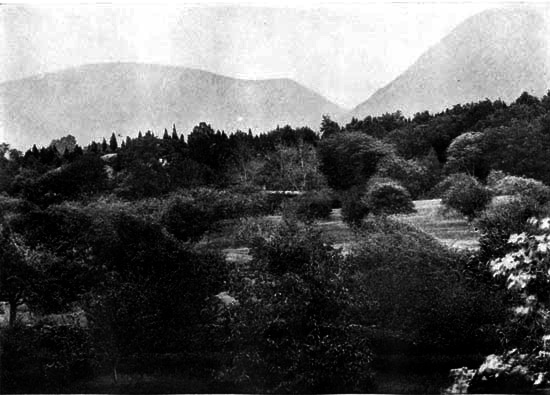
VIEW FROM THE PIAZZA AT "ROELANDS."
"At last Mr. Beecher said that he carried an internal clock which plainly intimated that it was time for dinner. The descensus was easy, but Mrs. Abbott's warm welcome and hot dinner suggested an avernus only by blissful contrast. The fun, wit, and jollity of the remainder of the evening can no more be reproduced than the sparkle of yesterday's dew or the ripple of yesterday's waves. It was a pleasant thing to see those gray-haired men, many of whom had been burdened with care more than half a century, becoming boy-like again in feeling and mirthfulness."
During Edward's residence in Cornwall, each year about the middle of June, when the roses and strawberries were in their prime, it was his custom to send an annual invitation to the Philolethean Club of clergymen in New York City to visit him for a day at his home. Dr. Howard Crosby, Dr. Lyman Abbott, Dr. Schaeffer, and many other well-known clergymen were members of this club. At these meetings the learned and dignified clergymen threw aside all formality and were like a company of college boys off for a frolic. Their keen wit, quick repartee, and droll stories at these times will never be forgotten by those privileged to listen.
In 1882 heavy financial loss came upon us as a family owing to the failure of an elder brother. Edward, in his efforts to help him, became deeply involved, and to satisfy his creditors was obliged to sell the copyrights of several of his earlier books. These were bought by a friend without his knowledge at the time. After several years of incessant labor he worked his way out of these difficulties, and, owing to the immense sale of his books, was able to redeem his copyrights. He then felt free to take rest and change of scene in a trip to Southern California.
CHAPTER X
HOME LIFE
As a matter of course, my brother had frequent calls from newspaper correspondents and others who were interested in, and curious about, the private life of a successful author. The first of the articles here quoted was entitled "A Talk with E. P. Roe," and was printed in a Brooklyn newspaper in 1886; the second appeared in a Detroit journal.
"The works of few novelists of the present day have had such remarkable sales as those of Mr. E. P. Roe, and this will be the more readily granted when it is known that one million copies of his novels have been sold in America alone, to which nearly one-half of that number may be added as representing their sale in England, Canada, Australia, and the different languages into which they have been translated.
"In appearance the novelist is a man of a trifle over the medium size, with a pleasant, intellectual face, which is almost covered with a rich and handsome coal-black beard and mustache. Mr. Roe is in the prime of manhood, being about forty-five years of age, and his manners and conversation are the most kindly and engaging. He is of a generous disposition, hospitable, a kind friend, and never happier than when in the bosom of his family, to which he is devotedly attached.
"It was the pleasure of the writer a few evenings ago to meet the novelist and engage him in conversation regarding himself and his works.
"'I have just returned from an afternoon stroll,' remarked the novelist. 'This is my invariable custom after my day's work. When do I work? Well, I generally sit down immediately after breakfast, which I have about eight o'clock, and with the exception of an hour for lunch, I write continuously from that time until three or four in the afternoon. Then I go out for my walk.'
"'You never work at night, then?' was asked.
"'No; it is a bad practice, and one that I rarely indulge in. There was a time when I did so, but my work always showed it. A writer's work at night is almost always morbid. There is no better time to work than during the morning.'
"'How much work constitutes a day's labor with you?'
"'That varies a great deal. Sometimes I write four or five pages of foolscap, and other days I will write as much as fifteen. I have no average, but do as much as I feel like doing, or have time to do, and then I stop.'
"'Do you derive genuine pleasure from your work?'
"'Always, for I am absorbed in whatever I am writing. I presume I derived the most pleasure from my "Nature's Serial Story," for it was an out-of-door study, and anything about nature always finds a responsive chord in me. Then, two of the characters of that work portray my father and my mother, and their memory is blessed and sacred to me. All the other characters are imaginary.'
"'Are your stories and novels based on facts and real happenings, as a rule?'
"'In every case,' replied Mr. Roe. 'I never manufacture a story; I couldn't do it. Of course, I elaborate and idealize, but the actual facts are always drawn from real life. I am always on the alert for these incidents, and when I see one that I think is adapted for a story I make a note of it.'
"'Speaking of your correspondence, like that of most authors, I presume it is of a various nature?'
"'Yes, indeed,' laughingly replied the novelist. 'It is surprising what letters I sometimes receive, and how difficult it is for some persons to realize that an author's time is valuable. Of course, I am not a stranger to the autograph craze, and of these requests I receive, I think, more than my share. But what is most surprising is the number of manuscripts I receive from young, aspiring authors. I am often asked "to read them, revise them carefully, and express an opinion as to the merit of the contribution." Why, I have frequently been requested to do a whole month's work on a single manuscript. What do I do with these? Well, the best I can. If I have a spare moment, I look over the story or article, and encourage the writer, if possible. But at times the supply is too great for physical endurance.'
"'What exercise do you most indulge in, and what particular one do you recommend?'
"'So far as I am concerned, I like a good, long walk, and this is what I would recommend to all who work with the brain and are confined. Exercise should never, in my opinion, be taken before sitting down to work, always after the task of the day has been completed. Then one receives far more benefit from it than if taken before work. I also like to work in my garden, and there is hardly a better means of exercise. Hunting and fishing are also favorite sports with me, and I keep a good gun and a fishing-rod close at hand.'
"'Have you entirely given up gardening for literature?'
"'Yes, almost entirely, even in an amateur way. Of course I still retain an active interest in everything that is interesting or new about a garden or a farm. But as to any active participation, as formerly, I have been obliged to desist.'
"It may be interesting here to mention that the grounds surrounding Mr. Roe's rural retreat at Cornwall-on-the-Hudson show no lack of proper care and attention. The property consists of twenty-three acres and is all cultivated for floral and farming purposes. The novelist has on these grounds alone over one hundred and twelve different varieties of grapes, and has had in his strawberry beds seventy different varieties of that luscious berry in bearing at one time. One year Mr. Roe's orchards yielded him, among other products, one hundred and fifty barrels of apples, and this year about forty bushels of pears will be taken from his trees.
"'What are your immediate plans?' was asked the novelist, as he courteously showed the writer into the dining-room in response to the merry jingle of the dinner-bell.
"'I am now taking a brief holiday, resting from overwork. In about two months I leave the North for Santa Barbara, California, where I may remain for a year, or may return next spring. All depends upon how my family and myself like the country there. I go there partly for pleasure and partly for work. I shall doubtless gather considerable new material, and this I shall incorporate in future works. I shall study the life of the people of that region, and intend more especially to devote myself to studying nature in the direction of trees, plants, as well as the animals, birds, etc., of that charming country. My return North is uncertain, as I have said, and should everything prove agreeable, I may extend my residence there indefinitely.'
"And here ended the writer's chat with perhaps the most popular author of the day. Mr. Roe is extremely retiring in disposition; he never courts notoriety, but always strictly avoids it whenever possible. And with his large black slouched hat set carelessly on his head a stranger would more readily mistake him for a Cuban planter, with his dark complexion, than the author of the novels which have entered into thousands of American homes."
"Cornwall is situated on the western bank of the Hudson, just north of the Highlands. If you arrive by steamer you find an energetic crowd of 'bus men, who are eager to be of service to you. Most of the vehicles have four horses attached, which seem to tell of a hill in the neighborhood. We passed Cornwall several times by boat, and saw enough of the energy of the hackmen to make us resolve to reach the place some time when they were absent. Consequently we sailed down on Cornwall as General Wolfe sailed down on Quebec—in a small boat, and captured the place easily.
"As we walked up the rickety steps that lead from the water to the wharf, there was no deputation there to meet us.
"'Now the first thing,' said my companion, 'is to find out where Mr. Roe lives.'
"'No, that's the second thing,' I replied. 'The first thing is to find out where we are to get supper.'
"The reasonableness of this proposal was so apparent that further remark was not so necessary as finding a hotel well stocked with provisions.
"We found it in the shape of an unpretentious brick structure at the foot of the hill. By the way, everything is at the foot of the hill at Cornwall Landing. The landlady, who was the pink of neatness, promised us all we could eat on our return, although if she had known my talents in that line she would have hesitated. I noticed that she referred to 'Mr. Roe, the author,' while our fellow voyager in the small boat spoke of him as 'the strawberry man.' Probably the boor who relished the production of Mr. Roe's garden would have been surprised to know that the productions of his pen were even more sought after than that delicious fruit.