Front matter (continued 3)
Reading edition
"But evening is coming on and we have a long hill before us, so we must proceed. A Cornwall road is always either going up or down, and a person gets great opportunities for rising in the world as he turns his back on the Hudson and climbs to Cornwall. The road winds up the hill, often shaded by trees and always accompanied by a mountain torrent whose rocky bed lies deep beside the pathway. This stream lacks only one thing to make it a success—and that is water. No doubt after a heavy rain it would show commendable enterprise, but now the rocks were dry. A thin thread of clear spring water trickled along the bottom of the ravine, now forming a silvery-toned waterfall, then losing itself among the loose rocks, next finding itself again, and sometimes making the mistake which humanity often makes, of spreading itself too much and trying to put on the airs of larger streams.
"Half-way up is a spring, surrounded by benches, welcome to the pedestrian who finds tramping uphill business. The clear, cold water pours out, and an iron dipper, like Prometheus 'chained to a pillar,' invites the thirsty to have a drink. The benches form a semicircle around this fountain, and on the backs thereof some one has painted in large letters the legend 'Please don't cut an old friend.' But 'excelsior' is our motto, and we climb. When we reach the top of the mountain we part company with the rivulet, thinking, with perhaps a sigh, what a vast advantage water has over people—it always goes down hill. Cornwall now begins to show its beauties. It seems to be a big village composed of splendid residences and elegant family hotels—or rather huge summer boarding-houses. Excellent roads run in all directions, up and down, turning now to the right and now to the left, until a stranger loses all idea of the points of the compass.
"About a mile from the landing, if you are in a carriage, or about five miles if you are on foot, you come to an open gateway, through which a road turns that might be mistaken for one of the many offshoots of the public street, were it not that a notice conspicuously posted up informs the traveller that the way is private property. A cottage, probably a gardener's residence, stands beside the gate. The land slopes gently downward from the road and then rises beyond, leaving a wide valley between the street and a large two-story frame building that stands on the rising ground. This is the home of E. P. Roe, author of 'Barriers Burned Away,' 'Opening of a Chestnut Burr,' 'From Jest to Earnest,' and other well-known works, read and enjoyed by thousands in America and in England. Between the house and the road are long rows of strawberry plants that looked tempting even in September. The house stands in about the centre of a plot of twenty-three acres. The side is toward the road, and a broad piazza runs along the length of it, from which glimpses of the distant Hudson can be had through the framework of trees and hills. The piazza is reached by broad steps, and is high enough from the ground to make a grand tumbling-off place for the numerous jovial and robust youngsters that romp around there and call Mr. Roe 'papa.' A wide hall runs through the centre of the house, and the whole dwelling has a roomy air that reminds one of the generous and hospitable mansions for which the South is famous. Mr. Roe's house is without any attempt at architectural ornamentation, unless the roof window in the centre can be called an ornament; but there is something very homelike about the place, something that is far beyond the powers of architecture to supply.
"My fellow-traveller sat down in one of the rural chairs that stood invitingly on the piazza, and I manipulated the door-bell.
"While the servant is coming to open the door I may as well confess that I have undertaken to write the play of Hamlet with Hamlet left out.
"Mr. Roe was not at home.
"I tell this now so that the reader will not be disappointed when the girl opens the door.
"The door opens.
"Could we see Mr. Roe?
"Mr. Roe had left that very morning for New York.
"'He evidently heard in some way we were coming,' said my companion, sotto voce.
"When would he return?
"Perhaps not this week. Would we walk in and see Mrs. Roe?
"The next thing to seeing an author is to see the author's wife, so we accepted the invitation and walked into the parlor. Before we walked out we came to the conclusion that the next thing to seeing the author's wife is to see the author.
"Now, of course, I might have taken an inventory of the articles in the parlor, just as if I were a deputy sheriff, or a tax collector, or something of that sort, but I didn't. I might tell of the piano that stood in one corner and the pile of music that reached from the floor to the top of it, and of the little table covered with stereoscopic views, and the photograph of Mr. Roe framed above it, and of the two low front windows with their river view and their lace curtains, and the large folding-doors opening into the library, the workshop of Mr. Roe, and of the quiet, neutral tints of the carpet, or the many contents of the whatnot in the corner, and the paintings and engravings on the walls, and the comfortable easy-chairs, and the books scattered here and there, and of dozens of other things that made up an author's parlor, but I will not mention one of them.
"I had the idea that E. P. Roe was a kindly old gentleman with gray hair. Kindly he undoubtedly is, but old he is not. His portrait shows him to have a frank, manly countenance, with an earnest and somewhat sad expression. He has dark hair and a full beard, long and black. Mr. Roe is at present writing a series of articles on small fruits for Scribner's Magazine. The publishers of that periodical intend to give a portrait of Mr. Roe, which will be the first ever published. It may appear in the December number, and if it does the readers of this paper are respectfully referred to the pages of that magazine. It seems to be the general idea that Mr. Roe is an old man. For instance, a lady writing from Wheeling, W. Va., to The Household a few weeks since, says:—
"'Some one asked if Rev. E. P. Roe had taken his characters from life or not. Several years ago we had amongst us a certain Professor Roe (vocal teacher, possessing a beautiful tenor voice), said to be a son of the novelist. If he was a son, the character of Walter Gregory in '"Opening of a Chestnut Burr" was certainly drawn from him, and it always seemed to me that Dennis Fleet's wonderful voice in "Barriers Burned Away" was likened to his voice.'
"If this writer could have seen the youthful appearance of Mrs. Roe, she would have no hesitation in denying the professor's alleged relationship to the novelist. Her husband is not yet forty.
"I wish Scribners would publish a portrait of Mrs. Roe. It would certainly add to the popularity of the magazine. Such a lady must be a wonderful help to her husband. I think, as a general thing, the world gives too little credit to the power behind the throne.
"Mrs. Roe deserves at least half the credit of 'Barriers Burned Away,' which is certainly E. P. Roe's most dramatic work, and had, no doubt, a great deal to do with many of his other volumes. This particular work describes the thrilling scenes of the Chicago fire with a vividness and power that is rarely surpassed. When the whole world was thrilled by the dreadful tidings of a city's destruction, Mr. Roe said to his wife that if he could collect some of the actual occurrences that must be transpiring there he thought he could write a book about it. Mrs. Roe at once decided for him. Her advice was that so tersely put by Mr. Greeley. Although nearly a thousand miles intervened, Mr. Roe was in Chicago before the fire had ceased, and the incidents so graphically depicted in 'Barriers Burned Away' were the result of actual observation.
"Most of Mr. Roe's characters are taken from real life, and all of his works are written for a purpose, as can readily be seen in 'What Can She Do?' for example. His next book, which will be published in a few days, will furnish another instance of writing for a purpose. Its title is, 'Without a Home;' the subject it treats is the tenement-house problem, which is at present agitating New York and all large cities. In this work the scenes and personages will be nearly all from real life. If the book were not in press the tenement-house fires in New York on Friday, causing the death of seven persons, would furnish a tragic climax to his story. What could be more terribly pathetic than the frantic mother penned in by the smoke and flame, dragging herself to the bedside of her children to die with them? In choosing the evils of the tenement-house system as a subject, Mr. Roe strikes at one of the worst features of city life.
"It was to finish the last pages of this book that Mr. Roe was now 'Without a Home' himself, and as the printers were clamoring for copy, he had betaken himself to a room in a New York hotel to write without interruption. Mr. Roe is too good-natured to deny himself to visitors, and they make great inroads on his time.
"'If he hears the voice of a friend,' said Mrs. Roe, 'he cannot remain at his desk.'
"So when there is work that must be done, Mr. Roe banishes himself from home and friends and flies to that loneliness which only a great and crowded city can supply.
"Mrs. Roe's favorite book is 'The Opening of a Chestnut Burr,' and this must be a favorite work with many, for it has reached its thirtieth thousand, not to mention the numerous reprints in England and Canada. The realistic incident in this work, which supplies the place the Chicago fire does in the other, is the sinking in mid ocean of the French steamer Ville d'Havre.
"I think, although it is only mere conjecture on my part, that Mrs. Roe herself is the heroine of this book. For that reason I shall not attempt to say anything of the lady, as the reader can turn to the book and satisfy all curiosity there. But if I should find, at some future time, that I am mistaken in my surmise, I shall make that my excuse for the pleasant task of writing again of Mrs. Roe. The old homestead is described in the 'Opening of a Chestnut Burr,' and naturally this would endear the book to those who lived there.
"The library in which Mr. Roe does his writing, when at home, is a sunny room filled from floor to ceiling with books. A large flat desk, covered with papers, stands in the centre of the room, and this is the novelist's work-bench. I shall conclude with a few words regarding Mr. Roe's method of working. Mr. Roe himself has supplied this in a letter written nearly a year ago, to an admirer, and part of which I am allowed to copy. This extract forms a portion of Mr. Roe's work never before published, and the writer himself had no idea it would ever appear in print. The letter bears date November 25, 1878. He says:—
"'My aim is to spend the earlier part of the day in my study, but I cannot always control my time, much of which is lost in interruptions. I sometimes have to go away and shut myself up for a time. I am not as systematic as I ought to be. I like to write the latter part of my books at white heat, first getting full of my story and then writing with a zest. I call from five to eight pages a good day's work, although in some moods I write many more. Again, I will work hard over three or four. I am opposed to night work.
"'I hope to average five hours a day hereafter in my study, and three or four in my garden. I employ from ten to fifteen men and from ten to thirty boys in picking the berries. A large part of my labor is employed in taking up and packing plants. The department of fruit culture to which I give my chief attention, is the keeping of each variety separate and pure. This I trust to no one, and it requires constant vigilance.'
"After leaving the residence of Mr. Roe, we went half a mile or so farther on to Idlewild, once the home of N. P. Willis. Darkness came on before we reached there and we had our labor for our pains.
"Mrs. Roe said that Idlewild is little changed since the poet left it. A recent freshet swept away the bridges he built in the Glen, but otherwise it is the same as it was before. Thus ended our visit to Cornwall-on-the-Hudson."
CHAPTER XI
SANTA BARBARA
My brother's boyhood friend, Mr. Merwin, speaking of his visits at Cornwall later, says: "When honors came in troops, I found Edward was the same kindly unostentatious man, the truly loyal friend. Later, after some correspondence with me, he came to Southern California, where under those sunny skies and semi-tropical scenes his love of Nature found great delight.
"While visiting at Pasadena, as we drove about that beautiful city, he emphasized what he had often told me, that one of the great joys of his life was that which came to him from the hundreds of letters from all parts of the country, and many written by people in humble circumstances, thanking him most heartily for the cheer and encouragement he had given them through his books."
After a short stay with his friend in Pasadena Edward went with his wife and children to Santa Barbara. There they occupied a pleasantly situated cottage, owned by a New England lady and her daughter, under whose excellent care they enjoyed the rest and freedom from restraint that cannot be found in crowded hotels.
In a letter written to the Detroit Tribune my brother gives his experience of a California winter.
"My impression is that January first was the warmest day of the month. Certainly on no other days was I so conscious of the sun's heat, yet the air was so deliciously cool and fresh in the early morning. There had been a heavy dew, and grass, weed, hedge, and flower were gemmed in the brilliant sunshine.
"Walking up town with my mail at about ten in the morning, I found myself perspiring as upon a hot day in August, but there was no sense of oppression. One was exhilarated rather than wilted. After reaching our cottage piazza and the shelter of the climbing roses and honeysuckle, the change was decidedly marked. This is said to be the peculiarity the year round, even in midsummer. One has only to step out of the sun's rays in order to be cool, and the dead, sultry heat which sometimes induces one to yearn for the depths of a cave is unknown.
"As I sat there in the shade, letting the paper fall from my hand in the deeper interest excited by my immediate surroundings, I could scarcely realize that we were in the depths of winter.
"The air was fragrant from blooming flowers; finches and Audubon's warblers were full of song in the pepper trees, while humming birds were almost as plentiful as bumble-bees in June.
"It was evident that the day was being celebrated in the manner characteristic of the place. One might fancy that half the population were on horseback. In twos and fours they clattered along the adjacent streets, while from more distant thoroughfares, until the sounds were like faint echoes, came also the sounds of horses' feet rapidly striking the hard adobe of the roadways. In addition to those who gave the impression of life and movement in the suburbs of the town, large equestrian parties had started for mountain passes and distant cañons, taking with them hearty lunches in which the strawberries were a leading feature. As long as the sun was well above the horizon delicate girls, almost in summer costume, could sit in the shade of the live-oaks in safety, but when the sun declines to a certain point, between four and five in winter, there is a sudden chill in the air, and those who do not protect themselves by wraps or overcoats are likely to be punished with as severe colds as they would take in a Boston east wind.
"It has often seemed to me warmer at eight o'clock in the evening than at four in the afternoon.
"We resolved to have our holiday outing as well as the others, and after dinner were bowling out on the road to Montecito, the favorite suburb of Santa Barbara. The fields by the roadside were as bare and brown as ours in winter when not covered with snow, but drought, not frost, was the cause. The 'rainy season' was well advanced, but there had been no rain in quantity sufficient to awaken nature from her sleep. In this climate vegetation is always a question of moisture.
"When reaching the villa region of Montecito, blossoming gardens and green lawns illustrated this truth. After a visit to the beautiful grounds and fine residence of Mr. A. L. Anderson, so well remembered by thousands as the captain of the favorite Hudson River steamboat the Mary Powell, we drove on to one of the largest orange groves on this part of the coast. Mr. Johnson, one of the proprietors, received us most hospitably, and led the way into a grove that sloped toward the mountains. The ground was scrupulously free from weeds, mellow as an ash heap, and had evidently been made very fertile. Mr. Johnson told me that he fed the trees constantly and liberally, and this course is in accordance with nature and with reason, for the orange tree never rests. While the fruit is ripening the tree is blossoming for a new crop. Always growing and producing, it requires a constant supply of plant food, and one of the causes of the deep green and vigorous aspect of the grove and its fruitfulness consisted undoubtedly in the richness at the roots.
"Another and leading cause was in abundant supply of water.
"From a cañon near by a mountain stream flowed down skirting the grove. This stream was tapped by an iron pipe at a point sufficiently high to furnish by gravity all the water required, and it was distributed by a simple yet ingenious contrivance.
"The utmost vigilance is exercised against insect pests and the mutilation of the roots by gophers. The results of all this intelligent care and cultivation were seen in the surprising beauty and fruitfulness of the trees, which were laden with from one to two thousand golden-hued oranges, in addition to the green ones not to be distinguished from the leaves at a distance. Even so early in the season there were a sufficient number of blossoms to fill the air with fragrance.
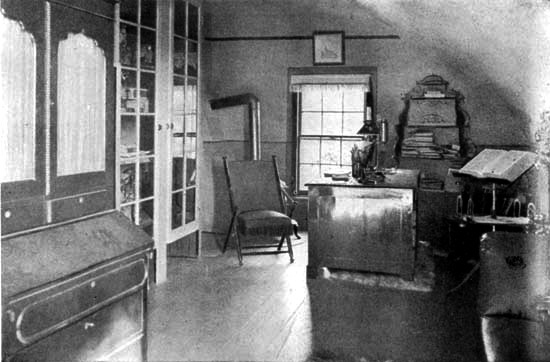
THE STUDY AT "ROELANDS."
"The brook babbled with a summer-like sound, and the illusion of summer was increased by the song of birds, the flutter of butterflies, and the warm sunshine, rendering vivid the gold and glossy green of the groves. Rising near and reflecting down the needed heat were the rocky and precipitous slopes of the Santa Ynez Mountains. Turning on one's heel, the silver sheen of the Pacific Ocean, gemmed with islands, stretched away as far as the eye could reach. Could this be January? On our way home I felt that it might be, for as the sun sank low wraps and overcoats, which could not have been endured an hour before, seemed scarcely adequate protection against the sudden chill.
"Throughout the month there were many days like the first, summer—like sunshine followed by chilly evenings and cool nights. No rain fell and clouds were rarely seen. The temperature gradually became lower even at midday, and occasionally in the early morning there was a white frost on the boards and sidewalks. The roses grew more scattering in the bushes. Nature did not absolutely stop and rest, but she went slow over the cold divide of the year. I know not how it was with the old residents, but a sense of winter haunted me, especially on the quiet, star-lit nights. I sometimes questioned whether this sense resulted from the impressions of a lifetime, made at this season, or was due to climatic influences. To both, I fancy. When a baker's horse and wagon, furnished with bells, jingled by, it was a sleigh until memory asserted itself.
"When abroad, even in the bright, warm sunshine, something in the appearance of the sky, the feel of the atmosphere, and the aspect of the bare, brown fields suggested winter and created a momentary astonishment at the flowers which continued to bloom in the watered gardens.
"I was continually aware of a conscious effort to account for what I saw and to readjust my ideas to a new order of things.
"The season seemed an anomaly, for it was neither summer nor winter, fall nor spring, in accordance with one's previous impressions. The visage of nature had an odd and peculiar aspect. It was as if the face of an old friend had assumed an expression never seen before. There was no ambiguity or uncertainty upon one point, however, and that was the need of winter clothing by day and of blankets at night, roses and sunshine notwithstanding, and those proposing to come here should always remember the chill of shade and apartments without fires.
"Although the mercury never marks extreme cold, the sense of cold is often felt keenly unless adequate provision is made against it. All that is needed, however, is a little prudence, for one never has to guard against sudden and violent changes.
"As in the East, so here, winter is especially dedicated to social pleasures. Much of the gayety centres at the two fine hotels, the Arlington and the San Marcos, both under the efficient management of one proprietor, Mr. Cowles. The townspeople are much indebted to his genial courtesy, and the spacious parlours are often lined with the parents and chaperons of young ladies from the city of Santa Barbara as well as with his guests, while the entertainments have the best characteristics of a dancing party at a private dwelling. It is very fortunate for the young people that there are such unexceptional places in which to meet, for this town is peculiarly a city of cottages, few being large enough for assemblies of any considerable numbers.
"There is consequently much social life in a quiet, informal way.
"One of the remarkable characteristics of the town is the large percentage of what is justly termed good society—a society not resting its claims on wealth or an ancestry long known and recognised in the vicinity, but on the much better qualities of refinement, intelligence, and cultivation. Search for health and a genial climate have brought people here from all parts of the Union, and not a few, after long residence abroad, prefer this Pacific slope to any of the world-renowned regions on the Mediterranean. One therefore soon discovers a marked absence of provincialism and is led to expect that the quiet lady or gentleman to whom he is introduced has seen far more of the world than himself. The small, unpretentious cottage facing the grassy sidewalk may be inhabited by a mechanic, or it may be the dwelling-place of people cosmopolitan in their culture and experience. Strangers are not wholly dependent on each other for society, as is so often true of health resorts, but find a resident population both hospitable and acquainted with life in its most varied aspects. Much of the abundant leisure possessed by many is spent in reading, and to this pleasure a large, well-selected free library contributes greatly."
Edward had the good fortune to arrive at Santa Barbara in time to witness its unique centennial celebration, of which he gives a detailed description.
"Santa Barbara, Cal., January 7, 1887.
"Few more interesting events ever took place in the quaint and quiet town of Santa Barbara than its centennial, and nothing resembling it in any true sense can ever occur again. The Indian element of this region receded and disappeared before the Spanish, and the latter population is fast becoming a minority among the still paler faces arriving from the East. The time perhaps is not distant when Santa Barbara may be known as a New England city. Even in its centennial the great effort made to recall the past and the old resulted in a large degree from the interest taken by new comers in vanishing phases of life. The success of the enterprise was due largely to the organization, young in age and composed chiefly of youthful members, entitled the 'Go Ahead Club.' The name itself suggests the East, and the opposite of the Spanish disposition to permit each day to be a repetition of a former day, yet the club had the tact and friendly feeling to co-operate with the best Spanish element, and to bring about a festival week which interested all classes of people.
"For days even a stranger was impressed by a slight bustle of preparation. When riding up from the steamer we saw, in the dim starlight, that a great arch spanned Main Street. Observation in the bright sunshine of the morrow proved this arch to be a wooden structure and a fine imitation of the front of the old mission with its quaint towers. Busy workmen were draping the edifice with some variety of aromatic evergreen and with palm leaves, and it still remains as a suggestion to new comers of what they missed in not arriving earlier.
"The opening ceremonies of the week naturally centered at the Mission Church, and on Sunday the religious phase of the festival culminated. Even before we were through breakfast groups were seen pressing from town. Later there were the sounds of rapid wheels and the echoing tramp of horses. We soon joined the increasing throng wending its way up the slopes which lift the Mission above the town and place it against the grand mountain background. Spanish colors, red and yellow, hung from tower to tower, while American flags floated from the belfry arches. Within the long, narrow interior of the church the sunshine contended with innumerable candles flickering on the altar, at the shrines, and from the chandeliers. The softly blended light revealed the beautiful decorations drawn from the abundant flora and plant life of the region.
"The elaborate service began, the fragrance of roses was lost in that of the incense, the rustle of dresses and tread of incoming feet in the mellow tones of the chanting priest and the responses of the choir. Every seat and all standing room was occupied, rich and poor sharing alike according to the earliness of their arrival. Next to a dark-visaged Spanish laborer might be seen the delicate bloom of a New England girl's features. Beautiful lace mantillas were worn in several instances. In looking at them one sighed as he thought of the various monstrosities termed bonnets which disfigure modern women. The clergy were in their most gorgeous robes, strong contrasts in tone and color on every side, but above all was a sense of the past touching the present in many and unexpected ways; and this effect was enhanced by a sermon in English, giving an account of the founding of the Mission. Late one afternoon, on a subsequent day, I found the door of the church open and, venturing in, saw the western sun shining through the high narrow windows, lighting up shrines and images with the mellowest light and throwing others into the deepest shadow.
"No one was visible, yet in the silence and desertion of the place one felt more like worship than when, a part of the throng, he witnessed the ceremonials of the preceding Sunday.
"Later still, returning from a ramble in Mission Cañon, I peeped into the old church once more. Twilight had deepened into dusk—all was dark within, except the faintest glimmer of a taper at the altar, where it was evident that some of the Franciscans were engaged in their devotions. As I crept noiselessly away the bells chimed out from the belfry. In the upper gallery of the long corridor stretching from the right of the chapel there was an immediate opening of doors and a shuffling of feet.
"Evidently the bells had summoned to some new duty,—attendance in the refectory at that hour, I trust,—and I could have cordially joined the venerable fathers then, however simple their diet.
"On Monday the festival passed into its secular aspect. The morning was deemed most unfavorable in this climate, where a cloud, even in winter, is far more rare than roses. The sky was overcast with what the Spaniards call a 'high fog.' The sun soon proved, however, to be the victor, for early in the day the leaden pall was shot through and through with light. Not only from the most distant and well-to-do ranches, but from all the small adobe houses and huts that skirt the mountains, the people were on the way to town in the early hours. They appeared on the streets in almost every description of vehicle imaginable, and not a few looked as if they had trudged from a long distance. The majority, both of men and women, had apparently ridden in on their broncho horses, the hardy and often vicious native breed of the region. The townspeople had prepared a brilliant welcome, for the whole length of State Street was decorated with flags and streamers of many and varied devices, the Spanish and American colors blending most amicably. There was bustle and movement, life and color, with an increasing concourse throughout the whole length of the thoroughfare. To a stranger's eye, men in various costumes were riding aimlessly and often furiously to and fro, but as noon approached affairs began to culminate in the blocks above the Arlington Hotel. Here the procession was forming, and it proved to be the chief event of the week. Nature was now assisting to make the occasion all that could be desired. The clouds that had threatened now merely saved the day from an unredeemed glare. After the usual delay in processions, it began to pass the balcony of the Arlington Hotel, where scores of guests were assembled to witness the pageant. First came the grand marshal in a genuine Mexican suit and mantle. Following him were his aides, dressed in rich, various, and characteristic Spanish costumes, some of which were remarkable for their beauty and others were picturesque in the extreme. One young gentleman was habited in blue, lavishly laced with silver. It was the cadet uniform of the Spanish army, and had belonged to his grandfather. Another, clad in cream white satin and gold lace, with crimson sash and other accessories, made a striking figure.
"Indeed, each of the aides graced the occasion in handsome costumes which were, as I was told, no capricious and fancy affairs, but a reproduction of the gala habiliments of the past. They sat their fine horses in Mexican saddles which were in themselves marvels of old and curious workmanship. A like cavalcade in Broadway would draw out the town.
"Next in order came the Spanish division, men and women on horseback, and nearly fifty strong. It was evident that all heirlooms in dress had been rummaged from their receptacles and made to fit the descendants of remote ancestors. It would be hard to say how many different ages and how many provinces in Spain and Mexico were represented.
"To modern eyes the picturesque had the ascendency over other qualities, but all welcomed the man carrying a guitar. At any rate, this division passed all too quickly, singing an ancient Spanish song. Close upon them were a band of soldiers clad in suits of antiquated buff jerkins, armed in old Mexican style with long pikes and muskets that may have been formidable once. It is doubtful whether a band so representative of the old Spanish element will ever appear on the streets of an American town again. Years hence such an attempt will be more of a masquerade than a reproduction. In this instance the genuine Spaniards were too numerous and their traditions too recent and real to permit impositions.
"Many Spaniards and native Californians not in costume now followed, and then came an old-fashioned ox-cart, dating back a century and drawn by oxen yoked by the horns. Within the cart was a wooden plow that had turned some of the earliest furrows in this region, and would have been equally satisfactory at the time of Abraham. In this age of invention one wonders that people remained satisfied so long with such primitive methods and implements. Appropriately following the cart, the like of which had been used by their ancestors, came the shrunken band of Mission Indians, the two foremost of them carrying a portrait, draped in Spanish colors, of Padre Junupero Serra.
"The good father passed away centuries ago, and the Indians he sought to civilize are also nearly extinct, but the principles which actuated him have redeemed his name from forgetfulness and will crown it with increasing honor.
"The half-dozen Indians were chanting some wild song of their own when the fine band from San Luis Obispo struck up and the wail-like echo of the past was lost. Then came another significant and diminishing company, the Grand Army of the Republic. On every public occasion the ranks are thinner and the hair of the veterans grayer. They, too, will soon leave but a name, but it will not be forgotten.
"Driving away sad, if not gloomy thoughts, comes now a vision of beauty and youth; the joy of to-day and the rich promise of the future—an indefinite number of young girls who, in their two-wheeled village carts, or 'tubs,' as the English term them, drew forth rapturous applause. Well they might, for they were in harmony with the loveliness of the June-like day. Their little carts had been transformed into floral bowers. The flowers and greenery so festooned the horses that they were half-hidden, while wheels within wheels of smilax, roses, geraniums, daisies, and other blossoms revolved in unison with the outer circumferences. Each little cart had its own distinctive character, and some had been decorated with rare taste and originality. Not a few of the girls carried parasols constructed entirely of roses, or of geraniums, passion flowers, orange blossoms, etc. Greenhouses had not been stripped for them, nor, indeed, the open gardens from which they had been taken. Truly, no such visible and delightful proof could have been given to our Northern eyes that we had come to the land of flowers. Gardens, orange trees golden with fruit, formed the background for this charming part of the procession, while beyond and above all rose the grand Santa Ynez Mountains, softening their rugged outlines with half-veiling mists.
"Burlesque followed close upon beauty in the form of an old farm cart laden with the coarser vegetables and driven by two young men in the garb of ancient females. The trades' procession came next, and spoke well for the business of the city, but our eyes soon dwelt lovingly on over a hundred school children, who made, by their unrestrained laughter, the sweetest music of the day, while two little girls riding on one much-bedecked donkey caused ripples of merriment as they passed.
"A cavalcade of carriages and of ladies and gentlemen on horseback seemed about to close the procession, when there appeared one of the most interesting features yet seen—a train of pack mules, not merely illustrating the former method of transportation, but that employed to-day by the owner of the train. I hastened to the director, whose dress indicated a rude mountaineer, and expected a half intelligible reply from a Spaniard. The accent of his first word led me to scan his delicate Anglo-Saxon features. I eventually learned that he was a New Yorker, a member of one of its best-known families, and not a native of a little-known wilderness.
"Nevertheless he is a mountaineer. Dressed for a Fifth Avenue company one would not suspect it, his form is so slight and complexion so fair. Dudes would not be abashed at his presence, yet they would expire under one day of his experiences.
"Only by a mule train, led over a scarcely practicable trail, can he reach his distant ranch, that is forty-five miles back in the heart of the mountains. Here, with another young man, a kindred spirit, he cares for an increasing herd of cattle, and if necessary is ready to protect it from wild animals. The grazing grounds are far within a region about as wild as it ever has been. How about the young men who whine when they can find nothing to do?
"The interest of the two closing days of the festival centered at the race course and at the pavilion. The chief attractions at the former place were to be seen on Tuesday, and they were of a mixed character. We were treated to what would seem to be a rather rare phenomenon in Santa Barbara—a genuine Indian summer day of the warmest type, as we know it at the East. A haze partly obscured the Santa Ynez Mountains, softened the outlines of the foothills and blended the ocean with the sky. The air was soft and balmy in the extreme, but one soon detected a slight chill in the shade. All sorts of vehicles, from stages of unwieldy height, open barouches, farmers' wagons of all descriptions, top buggies, down to the numerous little two-wheeled carts, rapidly converged toward the judges' stand. As on all gala occasions here, however, the number on horseback was very large, the ladies sitting their horses with perfect ease and grace. Not a few, like myself, were content to trudge to the rendezvous on foot. The grand stand was soon crowded, and the vast, restless concourse stretched far to the right and left on either side of the race track. The horsemanship of the Spaniards could only be surpassed by the fine action of their steeds, and all lovers of this noblest of animals must have been delighted. In the effort to show how wild cattle were lassoed, thrown, and branded there appeared to be too much needless cruelty, and when a miserable little bull was tormented into savageness, and the semblance of a bull-fight took place, scores of people turned away in disgust.
"The finest equestrianism could not redeem the scene from brutality. The victims were the wretched bull, a fine innocent horse badly gored, and the people who could not endure to see animals suffer needlessly. So also in the afternoon great skill was undoubtedly manifested in lassoing the feet of the wild broncho horses, and in the process of subduing them, yet one pitied the poor creatures too greatly for enjoyment and soon turned away. The helpless beasts were checked in full career, often thrown upon their heads, turning a complete somersault. One animal, I was told, broke its neck in the operation, and so escaped further suffering. Such scenes, no doubt, illustrated much that was common in the life of the early settlers, but happily it is a past phase, and will scarcely be reproduced again in this region.
"It was interesting to observe the many types of people in festival costume, the Indian in his blanket, the Spaniard wearing the broad sombrero, and the belle from New York reflecting the latest mode. There was movement, light, color, vivacity, and excitement.
"Every moment or two the eye caught glimpses of swift, spirited horses and their graceful riders, and yet one's glance was often lured from it all to the grand, mist-veiled mountains beyond. Many of the scenes and objects at the pavilion were very interesting to our foreign eyes and ears. Here Spanish and American life met and mingled in a far more agreeable way. Several ladies had taken charge of the large building, erected for horticultural purposes, and by the aid of greenery, flowers, flags, and a blending of Spanish and American colors, had transformed the spacious interior into a decorated hall well fitted for a festival. In the centre of the hall rose a flower stand suggesting Moorish architecture, its arches making fitting frames for the young girls within. One might buy flowers, but his eye lingered rather on the fair flower-girls in their charming costumes. Among the booths was one in which some Spanish ladies had kindly permitted to be exhibited some of their ancient treasures—velvet mantles, embroidered shawls, etc. Even to masculine eyes they were marvellously beautiful, rich, and intricate in their designs. The ladies stood before them with clasped hands and expressed themselves in exclamation points. The chief attraction, however, was the stage, on which were tableaux and, above all, the genuine Spanish fandango. One of the dances was a waltz, with an intricate figure which you felt might go on forever, and that you could look on a good part of the time. At first it struck one as merely simple, graceful, and very slow, and guided by monotonous music; but while you looked and listened a fascination grew upon you hard to account for. The oft-repeated strain began to repeat itself in your mind; you felt rather than saw how it controlled the leisurely gliding figures—for there is no hopping in the Spanish dances—until at last, in fancy, you were moving with them in perfect time and step. In brief, the dance had the effect of a strain of music which, when first heard, is not at all striking, yet is soon running in your head as if it had a spell not easily broken. On the programme the dance was entitled 'Contra Danza.' Later a Spaniard who has a wide local reputation, I believe, appeared in what was termed 'Son-jarabe.' He certainly left nothing to be desired in his performance after his fashion, but the grace of the lady who accompanied was inimitable. From my somewhat distant point of view she appeared to be dressed in a simple black gown and wore no ornaments. She needed none. No bespangled dancer I ever saw so enchained my eyes. One would almost think that an orange, placed upon her head, would not fall off, and yet a more utter absence of stiffness in movement was never witnessed. She seemed ever approaching, yet ever receding from, her companion; a moment near, then far away, gliding to one side or the other, as if impossible to be reached in her coquetry of elusive grace. Each separate movement was called out in Spanish, and in a varied, half-musical accent not easily described.
"At the closing centennial ball like dances were repeated, the participants wearing Spanish costumes. Here we had a nearer and more distinct view of the fandango. We again saw the 'Contra Danza,' and another, even more intricate, that was as odd as it was full of grace and unexpected action. If 'La Jota' is an old dance, it should certainly take the place of many that have little to redeem them from commonplace, if not worse.
"Son-jarabe was again repeated to the pleasure of all, and especially of the Spaniards, who, in conformance with an old custom, expressed their satisfaction by raining silver down upon the floor from the gallery. There was the same weird intoning by the master of ceremonies, calling off the different measures; the same constantly recurring strains of music that haunted one long afterward, and the same slow yet singularly graceful movement of the dancers. All were in Spanish costume, although many American young men and maidens were also participants, yet had been taught so well by their Spanish friends that they were scarcely to be distinguished from them. The Spanish dances that I saw did not strike me as at all voluptuous, and no one appeared who was not dressed in accordance with the strictest ideas of decorum. The whole pageant passed away with the ball, and nothing remains to remind us of the centennial but the green arch spanning State Street. The old Mission stands out gray and silent, except that its bells occasionally chime out for reasons unknown to me."
Writing again, in April, my brother describes the change wrought by the first heavy rainfall of the season.
"One of the drawbacks to Santa Barbara is the dust, and it is a disagreeable accompaniment of a dry climate which must be accepted. Towards the end of January there were occasionally high, gusty winds which reminded one of March experiences at home. At times the dust rose in clouds and obscured the city, and to my taste the wildest snowstorm would be preferable to these chilling, stifling tempests. They were not frequent or long continued, however, and the old inhabitants said they presaged rain, the great bounty for which the whole State was longing.
"A rainless winter is a terrible misfortune, and when February finds the ground hard and dry there is deep and natural anxiety.
"In one dry season, years ago, forty thousand head of cattle perished. With present means of communication this probably would not happen again, but a check would be given to budding prosperity which would take several fruitful years to overcome. There were scores of people hesitating whether to buy or build who would decide favorably if the usual rainfall occurred. When, therefore, on the 5th the first storm of the season set in, rejoicing and congratulations were general. Seldom before have I so realized what a heavenly bounty rain is. The whole population were hoping, waiting, longing, and one would be callous indeed not to sympathize. For that matter, the interests of temporary visitors were also deeply involved, as may be illustrated by the pleasure I had in watching from my study window the bare, brown foothills become greener daily. With intervals, designed, it would seem, to give the parched earth time to take in the precious moisture, the rains continued for about ten days. At last there was a steady down-pour for nearly twenty-four hours, and then dawned a morning that for brightness, clearness, and beauty left nothing to be imagined. The birds were fairly ecstatic in their rejoicings and nature seemed to be tripping forth like a young girl to her work. It may be that she will have to perfect most of the products of the earth without another drop of rain, and she will prove equal to the task.
"A fruitful year in this section does not depend on seasonable storms and showers, as with us, but upon the number of inches of the winter rainfall, the soil retaining sufficient moisture to carry the crops through in safety. Many tourists came in the height of the storm and some had a hard time of it. The hotels were crowded; and not a few, miserably seasick, were driven from house to house in pouring rain searching for rooms. Except on State Street the highways of the city are little more than country roads, the bottom of which, as in Virginia, seems to have fallen out. One stage load was spilled into the mud and no doubt carried away sinister memories of "sunny Santa Barbara." The weather, which was the salvation of the country, was well anathematized by transient visitors, and one lady was overheard to remark that she had seen the first of the place and hoped that she had seen the last. Thus judgments and opinions are formed. Those who remained and saw the exquisite phases of spring rapidly developing under the vivid sunshine would be in no hurry to see the last of Santa Barbara, and a more perfect summer morning has rarely been seen than dawned on the last day of the month."
CHAPTER XII
RETURN TO CORNWALL—LETTERS
I spent the summer of 1887 with Edward and his family at Santa Barbara; and he left me there in September on his return to his home at Cornwall. He expected to come back during the winter of 1889; and just a week before his sudden death, while I was at the Western Chautauqua, near Monterey, I had my last letter from him, telling of his plans for a California story which he hoped to write when once more at Santa Barbara.
That evening, Major-General O. O. Howard gave a lecture upon the Battle of Gettysburg, and at its close I had some conversation with him, in the course of which I spoke of the letter just received. He had been well acquainted with my brother at West Point. I remember his saying at this time: "I gave a copy of 'A Knight of the Nineteenth Century' to a young man about whose course of life I felt great anxiety, and that book, he wrote me, was the means of his entire reformation."
This is but one of many similar instances that came before me personally during my sojourn in the West.
At the time of Edward's departure from Santa Barbara he had engaged to write a story for Harper's Magazine which should be a sequel to "Nature's Serial," and which was to be fully illustrated by Mr. William Hamilton Gibson. It was therefore necessary for him to be near the scenes of his proposed story and in easy communication with Mr. Gibson.
It may not be out of place to print here the following letters. Many of them are separated by long intervals of time and have no direct connection with each other, but they are expressive of the warm friendship that existed between my brother and the talented artist.
"Santa Barbara, July 17, 1887.
"My dear Mr. Gibson,—The longer I remain here and the more I see of this region the oftener I think of you: and the more earnestly I am bent on your coming here with your sketch-book.
"The scenery is just in your line, yet different from any thing you have yet done. Phew! what a book we could make together out here. During the past week Mrs. Roe and I went over the Santa Ynez Mountains, and I wished for you at every turn of the San Marcus Pass. Then there are scores of these, with beautiful cañons. But I will tell you about them in September, when I hope to see you.
"I expect to give much of September and all of October to the study of the Highlands, and only wish you can so arrange as to be with me as much as possible.
"I've been toiling over the Earthquake story, and while you and the critics will say it is no great 'shakes,' I shall have to remember how the mountain labored. I have at least a month's more work upon it, and am giving up the whole of my time to it, now that I am in the mood for writing.
"How are you enjoying the summer, and are you very busy?
"Lucky you did not get into that fight with the Park Commissioners during your July heats. If you had there would have been some 'ha'r lifted,' as they say out on the plains. You would make a better subject for a scalping-knife than I. Have you seen much of Mr. Alden? He sent me two fine photographs of himself recently.
"I trust that Mrs. Gibson and the boy are keeping well through the intense heat of which we read in the papers. This climate surpasses anything I ever imagined. We have had but one hot day thus far. July has been delightfully cool, about the same as last December, with the exception that the evenings and nights are a little warmer. The sea-bathing is superb. Mrs. Roe and all five children are enjoying it this afternoon.
"Yours sincerely,
E. P. Roe."
"Washington, Conn., September, 1887.
"Hurrah! Hurrah! Welcome home, one and all! Such is the burden of my emotions as I read in to-day's paper that Mr. Roe, the Roe-manser, has returned to civilization from the Santa Barbarans, and is once more at 'Shanty Clear.'
"Seriously, I am immensely delighted that you are once more with us, and shall look forward to an early meeting. And now apropos—we, my wife and I, have enjoyed many a memorable season of pleasure at your country home. Can we not persuade you and Mrs. Roe to give us a visit at ours? for here is my favorite camping ground and my home acre. As soon as you feel sufficiently rested from your trip, and providing you are so disposed, will you make us happy by spending a few days with us?—that is if you still remember your neglectful correspondent and care to hobnob with him as of yore.
"That proposed Highland trip is immensely tempting, and I shall hope to arrange to take a few days outing with you, but alas! it cannot be until early November or the very last of October. I am so full of obligations until then.
"Don't call this a letter. It is written in the face of a yawning mail-bag and must be judged accordingly.
"Your sincere friend,
"Gibson."
Mr. Gibson's own work was so pressing that autumn that he was unable to spare the time for the Highland trip mentioned in his letter, when many of the sketches were to be made for the projected story. The remaining letters are from my brother to Mr. Gibson.
"December 15, 1880.
"Some one rang at my door to-day—he must be nigh of kin to Santa Claus—and left your superb volume. It almost took away my breath.
"I gave you 'Small Fruits' only. But the fruits of your pencil and pen are the reverse of small.
"Do you realize what a benefactor you are in sending me, on this dull cloudy day, exquisites of the finest seasons of the year? Spring is months away, but I have had the sweetest glimpse of spring beside my winter fire. The blazing wood supplied the warmth,—and your fancy did the rest in reproducing June.
"I am deeply in your debt. Draw on me for unlimited quantities of strawberries."
"April 16, 1882.
"I was determined to find you a four-leaf clover, and yesterday I succeeded.
"It will bring you no end of good luck."
"January 31, 1884.
"Don't worry when you are not in writing condition. If needful you can drop a postal now and then. The best way is to come up Saturday night and have a talk. You need a little change and mountain air.
"I am writing by this mail for Mr. and Mrs. Dielman to come at the same time. Why would it not be a good plan to get together and talk over the completion of the story and take a sleigh ride?
"You have no idea how a little change freshens one up, and if you can spend Sunday and Monday we will all have a country frolic. I need one myself. I have been over-working and was very ill from nervous trouble for a few days. I went right to Nature, tramped and rode in the open air. So come Saturday by all means, for we all want to see you.
"Beautiful red-pine grosbeaks are feeding about the piazza like chickens. With your powers you could go and pick them up."
"December 13, 1884.
"I should have written to you or seen you before, but I have been working hard to get the St. Nicholas serial well advanced.
"My heart is in the continuation of 'Nature's Serial.' Take the press generally, that book is being received remarkably well. I tell you frankly my aim now is to prepare one of the most beautiful books that has ever been published in this country. From what Dielman has said I have no doubt but that he'll go in with me. I also mentioned Mr. Frost to Alden and I shall also go see Mrs. Foote. It is possible she may be willing to take a part of the illustrations.
"But I shall be heartbroken if you cannot take the part of Hamlet in the performance. If you will, you can make old Cro'nest and Storm King your monuments, and few will pass up or down the river without mentioning your name.
"I shall begin to make my studies in January. In the meantime it will be a summer story, although I expect to close it at Christmas, and it will be full of just such material as suits your pencil.
"I would like at least four illustrations for each number, as many full-paged as possible.
"Mrs. Roe joins me in regards to Mrs. Gibson."
"December 29, 1884.
"What can I say to you? How make you appreciate how greatly we appreciate and value your beautiful remembrance? We all went into ecstasies over the picture, which arrived in perfect safety. It should have gone into the book if I had seen it before, and had had any influence. As it is, it rounds out 'Nature's Serial' to my mind, and leaves it a past experience without alloy, except as I remember the imperfection of my own work. Can you wonder at my desire to be at work with you again some day?
"But we will leave that for the present, as you say, I living in hopes that the way will open for you to explore the Highlands with me, and to reveal their beauties to the public far better than I can. You see Nature as I do, only you interpret it to me, and make it more beautiful than the reality appears.
"I will have the picture framed as you suggest, and when you soon come to Cornwall again it will greet you from an honored place in our parlor.
"Mrs. Roe and the girls, with our guests, were as greatly pleased as myself.
"Mr. and Mrs. Drake also sent us a beautiful bit of art. I am just delighted with the way Mr. Drake is taking hold of my St. Nicholas serial. I send the magazine for the year to W. H. Gibson, Jr.
"You did indeed win a victory over the 'incrementitious' critic. I should think he would wish to crawl into a small hole, and 'pull the hole in after him.' Indeed you are triumphing over all your critics, and winning your rightful place. I knew this would be true years ago, because of your own truth to Nature.
"Such an experience may never come to me, probably because I do not deserve it, but I am content to make some warm friends, like the writer of the enclosed letter. If what some of my critics say is true, a good many people who write and speak to me are awful and unnecessary liars.
"I enjoyed your triumph as greatly as if it were my own. It was the neatest thrust under the fifth rib I ever saw, and I fear I shall never have enough Christian meekness not to enjoy seeing a fellow receive his congé when so well deserved. Dr. Abbott and I took part in the 'wake' up here.
"That the coming year may be the most prosperous and happy that you and yours have ever known is the wish of your sincere friend."
"February 17, 1885.
"I have made arrangements with the best guide of the Highlands, one who knows every lake, pond, road, peak, man, woman, child, and dog in the mountains.
"We start out on our first explorations the latter part of May, when Nature is in her loveliest mood. Say you'll go.—I think the whole serial can be finished by October. You and Mrs. Gibson can get excellent board at Cornwall. Thus you will identify yourself with the Hudson as you have with New England. I expect by then to have finished my St. Nicholas story and then will have the decks cleared for action. Our regards to Mrs. Gibson and the baby."
"March 18, 1885.
"I went down to attend Mr. Cyrus Field's reception. The trains were so delayed that I was nearly all day getting to the city.
"Well, I met Mr. Stoddard, and spent a pleasant hour with him at the Century Club on the evening of March 7th. He asked to be introduced to me, and I remarked 'that I was surprised that he would take such a literary sinner by the hand.' He replied, 'We are a pair of them.' We chatted pleasantly a few moments in the supper-room, and then he concluded, 'Well, you are a good fellow to forgive me.'
"Some time after he asked me to go upstairs with him, and we had a smoke together. I introduced him to Colonel Michee of West Point, who is about to publish a book.
"Stoddard gave me his autograph unsolicited, written with his left hand and then backwards. I told him that I was glad he appreciated you. We had a long, merry talk, and in his conversation he said he would be very glad to have a copy of 'Nature's Serial' with your, Dielman's, and my autographs. This request was wholly unsuggested, and he truly appeared to wish the book. Therefore, when you are at Harper's will you write your name on the fly-leaf, and then ask them to express the book to me? I will get Dielman's autograph. Altogether it was a spicy interview. I received that eulogy of your work in the Boston paper, and had said the same in substance to two or three of Harper's firm before."
"September 16, 1887.
"Your hat in the air was almost as inspiring as the sight of old Storm King.
"It was very pleasant to be welcomed, and the day after my arrival I had to shake hands with nearly every man, woman and child, white and black, that I met.
"Mrs. Roe took cold before we started on the long trip, and has been very ill; is so yet, though she is gaining now steadily. I do not know when I can see you.
"I long for the quiet of home life. It will require a sheriff and his posse to get me out of the house again. Put down your promise to visit me and tramp the Highlands in big capitals. If you should be in town and have a spare night come up here for a smoke and talk."
"January 1, 1888.
"Thanks for your letter. It was almost as long as mine.
"I spent most of 'watch-night' on old Storm King with my children and Mr. Denton. We expected some other friends, who were detained by the storm. Coasting in a snowstorm proved very agreeable after all, especially as the road was lined with torches. The sleighs went like express-trains, and I was glad to get all safe home to the oyster supper which Mrs. Roe had ready for us as the old year took its departure.
"I have amused myself in watching old Storm King, that in the wild rain has been taking on many aspects. We have had a sort of family holiday with the few friends coming and going, and I have enjoyed all, seeing the children have a good time.
"I have had so much work on hand that I had to keep busy the greater part of each day.
"I suppose your little boy has enjoyed the season immensely. Does he still believe in Santa Claus, or have you and Mrs. Gibson, in the interest of truth (see discussion in papers), felt bound to explain that you filled his stocking with articles bought at a certain store? My little girl is still considering how in the mischief the old fellow got down the chimney.
"The sleighing is all gone. When it comes again we want you and Mrs. Gibson to take some mountain rides with us.
"Happy New Year to you all."
But other literary friends besides Mr. Hamilton Gibson were welcome guests at Edward's Cornwall home; among them were Mr. and Mrs. R. H. Stoddard, Mr. John Burroughs, Mr. Stedman, Mr. Alden, of Harper's Magazine, and Mr. Julian Hawthorne.
CHAPTER XIII
LAST BOOK—DEATH
During the winter of 1887-88 Edward wrote his last book, "Miss Lou," a tale of Southern life during the Civil War. In the spring he went down to Virginia to visit some scenes he wished to describe, and while there had a slight attack of neuralgia of the heart. The physician he called in ordered him to return home at once, and rest for a time.
In June he seemed to have completely recovered his health, and sent his usual invitation to the Philolethean Club of New York clergymen, who then made their eighteenth and last visit.
On the 19th of July, however, my brother complained during the day of not feeling very well, although he walked about the grounds inspecting his plants as was his custom. After dinner, in the evening, he sat in his library reading aloud from one of Nathaniel Hawthorne's works to his daughter and one of her young friends. Suddenly he paused, placed his hand over his heart, and said, "There comes that sharp pain again. I shall have to go upstairs to my wife for some remedy." But he left the room with a smile. After he had taken the remedy, which did not give relief, his wife sent in haste for a physician, who as soon as he arrived saw there was no hope of my brother's recovery. After about forty minutes of extreme agony, Edward seemed to feel relieved, rose to his feet, and attempted to cross the room, but turned quickly toward his wife with a look of surprise and joy, exclaiming, "O my God!"—then fell lifeless to the floor.
At the age of fifty, in the full vigor of manhood, his earthly career came to an end. His funeral was held in the little church at Cornwall, where he had first consecrated his life to the service of Christ, and where he and his family had worshipped for so many years.
Then he was laid to rest in the quiet graveyard on a beautiful knoll overlooking the Hudson, beside his parents and his own baby boy.
Only a little earlier in that month, and just three weeks before his death, Edward invited the Authors' Club, of which he was a member, to spend a day at his Highland home.
These lines were written in acceptance by Mr. E. C. Stedman:—
"Know'st thou the bank where 'Triumph de Gands' are red (My books might be were I on berries fed); Where Cro'nest lowers and Hudson laughs below it, And welcome waits each editor or poet? Know'st thou in fact the realm of E. P. Roe? Hither, O hither, will I go."
I insert here several accounts of this last meeting, written after my brother's death by members of the Club who were present.
"I had the pleasure of meeting E. P. Roe twice. The first time was in May, 1888, at the Authors' Club in New York. It was a balmy spring evening. I had strolled into the club-rooms feeling rather lonesome among so many strangers, for I was then a new member of the Club, and, stopping at the table to admire a great basketful of apple-blossoms, I fell into conversation with a tall, fine-looking, genial-faced gentleman, who told me that he had just brought the flowers down from his farm on the Hudson for 'the boys.' I was mentally guessing who this gentleman with the noble brow and the black flowing beard could be, when some one approached and called him 'Roe.' We were soon left alone again, and I hastened to say: 'Have I the honor of speaking to E. P. Roe?' Placing a hand on my shoulder, and bending near me with a kindly smile, he answered: 'I am E. P. Roe; and may I ask your name?' Finding that I was from the South, he seemed to be especially glad of my acquaintance, and we were soon off in a corner, seated face to face, he asking questions fast, and with the greatest interest, and I answering to the best of my ability, concerning the war history and the mountain scenery of my native State. He was particularly anxious to get at the exact social relation between the whites and blacks at the close of the war—especially the feeling of the blacks toward the whites—with a view of making correct statements in a novel that he thought of writing. Each member of the Club soon wore an apple-blossom boutonnière, and the rooms were full of the delicate perfume of these delicious flowers. That night, on leaving the Club, I took home with me a spray of the blossoms, and put it in water, and on the following day it shed its fragrance for the pleasure of one who was then an invalid. In her name I wrote Mr. Roe a note of thanks for the flowers, and I received from him a characteristic reply. He wrote:—
"'... I was delighted that my hastily gathered apple-blossoms gave such pleasure to your wife. How little it costs to bestow a bit of brightness here and there, if we only think about doing it!'
"The Authors' Club was invited by Mr. and Mrs. Roe to spend Saturday, the 16th of June, at their home near Cornwall-on-Hudson, where we were cordially promised a feast of strawberries and pleasant outdoor pastimes. The day was a perfect, a happy, and a memorable one to all who accepted the hospitality of the novelist. He met us at the river landing with a hearty hand-shake and a word of welcome for each guest, and personally conducted us to carriages which had been provided to convey us to his farmhouse, which we soon found to be an ideal home of unpretentious elegance. At luncheon our host addressed us, begging us to lay aside all formality, and get all the pleasure possible from his fruits and flowers, green grass and cooling shade. The strawberries in his patch were enormous, and each visitor to the vines in turn found Roe at his side, parting the leaves for him, and showing him where to pick the finest specimens. He was ubiquitous that day. If one strolled off among the myriad roses, and stopped to pluck a bud, he found the shapely hand of the farmer-author pulling for him a more beautiful one. If you flung yourself on the grass to dream awhile, Roe was lying down by you, telling you how happy this union of friends made him feel.
"The day wore on to sunset, when a dance, to the music of banjos, was improvised on the lawn, the banjos being played by some handsome youths in lawn-tennis attire, who, with their gayly beribboned instruments, made a pretty scene. Roe clapped his hands with delight as he moved from group to group. I heard him say, 'How often will I recall this scene! I can bring you all back here just as you are now, whenever I want to.' His wife and daughters were unceasing in gracious attentions to their guests.
"When the time for parting arrived, and the carriages were drawn up, Mr. Roe hurried from one to another of us, begging each and all not to go, assuring us of ample accommodation if we would stay over night. A few remained, and those who left did so reluctantly, some of them, I am sure, quite sorrowfully. I remember wondering at myself for being overcome by such a feeling of sadness as I waved the family a last farewell from the departing carriage. I had said good-by to the famous writer as we came down the broad steps of his vine-covered veranda, he with his arm about my waist.
"Never lived a more lovable and kindlier man than E. P. Roe; and when, soon after that golden day, I read one morning of his sudden death, my heart welled up with tears over the bereavement of that stricken household in the shadow of old Storm King; yet I felt that their grief must be illumined by the pure light that hallowed the name 'of him who uttered nothing base.'"
"Elrod Burke."
"I fancy there are few of those active, tireless Americans, who, nevertheless, steal time from their business to read many newspapers and many books, who have heard of an association of men in New York called the Authors' Club. Authors, in their eyes, are apt to seem like inhabitants of a world apart, a world separated by a broad boundary from the sphere of average commercial labor. Authors are, as it were, abstractions; they are heard and not seen. They are heard through their books, which are the concrete essence of themselves; yet the author is, after all, an extremely concrete personage, who strives as hard as anyone for his living, and whose reward is seldom commensurate with his efforts. It is the exceptional great man of literature—the great author being a better illustration than the small one—who is lucky enough to enjoy felicity during his lifetime.
"But I did not start out here to make the old argument—which has been so often a fanciful and sentimental argument—against literature as a remunerative profession. My idea was a simple one: To assume that authors are more generally hidden from public view than almost any other class of men, and that, for this reason especially, the least important bit of gossip touching the private doings, goings, and sayings of authors interests, without question, a very large number of people. The writer of a famous novel or poem may walk the length of Broadway, yet remain absolutely a stranger to the crowd among whom he walks. A nobody of a politician passing over the same space would, I am sure, be liberally recognized as a somebody, and not the least sort of a somebody by any means. The stranger to the crowd, however, the author derives practical benefit from the 'charm of mystery.' To be at once celebrated and unknown is for him a desirable condition. His books are read. He piques curiosity. What more could he ask for?
"The Authors' Club, being merely an association of authors, is therefore somewhat outside of public view. Its peculiar distinction is that it brings together various men whom the world honors, and a few more whom the world may or may not learn to honor. It is a very modest little Club, possibly with a very large future before it. If I should praise it for one thing heartily, that would be the good fellowship which animates it and which has permitted it to thrive. Among the older members of the club—the members who actually possess reputation—are Stoddard, Stedman, Curtis, Edward Eggleston, John Hay, M. U. Conway, Mark Twain, George H. Boker, Henry Drisler, E. P. Roe, Andrew Carnegie, Henry James, E. L. Godkin, Parke Godwin, S. Weir Mitchell, Noah Brooks, and (in an honorary sense) J. R. Lowell, Holmes, Whittier, R. L. Stevenson, and Harriet Beecher Stowe. The younger members count such names as Gilder, Lathrop, Bunner, Boyesen, Bishop, Luska, Will Carleton, Rutton, Matthews, McMaster, Miller, Bronson Howard, Mabie, DeKay, Boyle O'Reilly, Thorndike Rice, and others hardly less well known. Of all the men whom I just mentioned none has a wider reading public than Edward P. Roe, some of whose books have passed through twenty or more editions.
"Mr. Roe is one of those authors 'who make money,' whose writing is not thrown on the barren soil of neglect. His income from books is much ampler, I believe, than the income of any other man of letters, obtained from the same source, in America. Because he is so popular he does not necessarily possess the elements of greatness. True greatness seldom 'makes money.' Even brilliant originality in literature has a comparatively small audience. This is the line of logic, since the finest writing appeals only to the finest minds, and the latter are stray blossomings in an oasis of respectability. It is not, in the circumstances, difficult to explain Mr. Roe's popularity. He tells a pleasant story with unaffected simplicity; he is always on the side of conservative feeling; he is eager to help men and women, as well as to amuse them; he is, in short, the most earnest and effective representative of a numerous 'home gathering' that is now writing in this country. Why, then, should he not be popular? The bold or merely erratic genius of distinctly literary writers might not be appreciated or comprehended by Mr. Roe's public. Even so aggressive a person as that turbulent and pyrotechnic Frenchman, Guy de Maupassant, attacks criticism in a way which should be a lesson to Mr. Roe's least generous critics. Without any kind of preconception or theory M. Maupassant says: 'A critic should understand, distinguish, and explain the most opposite tendencies, the most contrary temperaments, and admit the most adverse researches of art.' On such a broad basis of criticism every admissible popularity may be fairly accounted for.
"Mr. Roe, the man, is an exact counterpart, one may say, of Mr. Roe, the author. As an author, in the first place, he is remarkably candid. He has been so candid, indeed, that the tendency of certain critics to treat him disingenuously is rather absurd. These critics want him to write books, apparently, which he does not propose to write; they overlook the fact that Mr. Roe has stated very clearly just what he desires to write. In a preface to one of his novels he says, in effect, that if his books are not beautiful works of art they are at least books which tender peace and resignation to many lives. (I am not quoting, by the way, but am presenting the idea which must have been in Mr. Roe's mind when he wrote that preface.) There are so many clever books published nowadays which pervert the young and sensitive conscience—a word not included in the vocabulary of our 'disagreeably' artistic novelists—that it may be wise to accept Mr. Roe's novels as good morality, if not as the best literature.
"It is not every author who puts himself into his books. Drunkards have written temperance tracts. Blackguards have written treatises on ideal existence. Posing fops have railed against the hardships which beset noble ambition. Mr. Roe has written the best that is in him for the best that is in thousands of men and women. I have tried to indicate briefly what he is as an author. As a man, he is not less genial, sincere, and agreeable than his books. The cleverest authors are, as a rule, far more entertaining and astonishing in their books than in themselves. In themselves, to speak the truth, they are not likely to be either entertaining or astonishing. I should look to few of them as acceptable hosts. Mr. Roe proved himself, and proved how good a host he was, on a recent Saturday afternoon, when some thirty or forty members of the Authors' Club accepted his invitation to spend a day at his house and grounds on the historic heights of Cornwall.
"Nearly all those who accepted Mr. Roe's invitation travelled to Cornwall by water. And they were not a bad lot, taking them together. There was E. C. Stedman, for example, the most popular writer among writers, the youngest man, by all odds, for his age—fuller of the exhilaration of youth than most of his juniors by twenty years; C. C. Buel, associate editor of the Century, who will soon marry Miss Snow, an adopted daughter (if I am not mistaken) of 'John Paul,' otherwise known as Mr. Webb; Mr. Webb himself, wearing that contentedly placid air which he never seems to shake off, and always on time with a good story or joke; A. J. Conant, whose yarns are famous, and whose tall form swayed benignly under a huge slouch hat; Hamilton W. Mabie, the youthful and smiling editor of the Christian Union; W. L. Keese, one of the few men who can speak with authority on the acting of Burton; Theodore L. De Vinne, recently returned from Europe, where he had vast trouble in keeping warm; W. H. Bishop, who has got beyond the 'promising' stage in novel writing and who will spend his summer in France; Henry Harland ('Sidney Luska'), as cheerful as his stories are sombre—just the sort of personality that does not repeat itself in literature; Raymond S. Perrin, who is kind enough to save some of his friends from disaster by presenting his first published book—price $5—to them; W. S. Walsh, close shaven as a priest, and editor of Lippincott's; Noah Brooks, once upon a time presiding genius of the Lotus Club, and the author of several charming books for boys; Edward Carey, associate editor of the New York Times; Leonard Kip, Albert Matthews, John H. Boner, R. R. Bowker, and several representatives of the Century's staff.
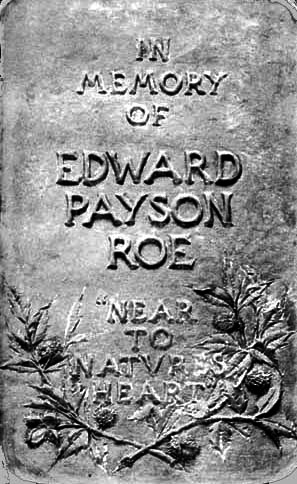
TABLET ON BOULDER IN "ROE PARK."
"When this crowd of writers—numbering about thirty in all—reached Mr. Roe's home, they found Richard Henry Stoddard and Julian Hawthorne installed there. Mr. Stoddard may now be classed properly among our 'venerable' poets, although he enjoys excellent health and gets through an immense amount of work. Hawthorne, in a flannel shirt, with a soft red tennis cap on his handsome head, was by far the most picturesque figure of the group. As to the host, Mr. Roe, he is a man of somewhat striking presence. He is of medium height, strongly built, with a gravely pleasant and intelligent face; his dark hair is brushed off a high forehead, his beard and mustache are long and black; he has kindly gray eyes, and his manner is that of a man who has spent the greater part of his life in the atmosphere of home. To do good, to help others—that appears to be his earnest ambition. The notes of religion and morality dominate the note of literature in him. In fact, he is much less an author than a teacher. Once he preached from the church pulpit, now he preaches through his books, and he finds the latter method far more profitable, at least, than the former.
"Mr. Roe does not confine himself, however, to the making of such books as please the great Philistine class. He is an authority on the cultivation of small fruits and flowers. What he has written upon this interesting subject possesses scientific value. Upon his grounds at Cornwall he raises some beautiful specimens of the rose, and strawberries as large and luscious as any found in New Jersey soil during June. The day selected for the authors' visit to Cornwall happened to be at the height of the strawberry season, and the manner in which these usually sedate persons made their way to Mr. Roe's strawberry bushes immediately after greeting their host reminded one of the skirmishing of boys in a melon patch. The berries, many of them with the circumference of a young tomato, were dug remorselessly from their cool shadows, while a particularly hot sun poured down upon the backs of thirty perspiring authors. But the fruit was worthy of the effort used in plucking it, for Mr. Roe has brought strawberry culture to a rare state of perfection. His berries, whether large or small, have a singularly sweet and delicate flavor; they are richly colored, and their meat is as firm as that of a ripe peach.
"Mr. Roe's grounds are quite spacious, and lie directly under the shade of Storm King. They are included in the plateau of a hill, and the scenery round about—especially in the direction of the Hudson—is wonderfully varied and picturesque. Mr. Roe's father and grandfather resided at Cornwall, and now a fourth generation of the family is identified with this lovely bit of country. The house occupied by the novelist is not the one built by his ancestors. It is a plain, old-fashioned structure, built as every similar structure should be—with a broad, breezy hall running from end to end, thus dividing the lower part of the house into two comfortable compartments. The various rooms—and there are plenty of them—are neatly but not pretentiously furnished, books and pictures being their chief ornaments. On the top floor Mr. Roe has his workshop—a long, narrow, uncarpeted room, under a slanting roof, well ventilated, and filled with lazy lounges and chairs, common book-shelves, a large writing-desk, and a cabinet containing specimens of Hudson River birds. Mr. Roe's latest hobby is to collect birds and to study their songs. He stuffs the birds and jots down in a note-book brief comments upon their songs. He is endeavoring, especially, to make an exact list of the time—to the fraction of a second—at which each bird begins to sing in the early dawn. 'I like to get my facts from nature,' he said to me, 'not from other men's books.'
"Mr. Roe is one of the most hospitable of men, a fact which his thirty author-friends would have discovered if they had not known that it was a fact. A day seldom goes by that does not bring him a visitor who receives a royal welcome; a night seldom passes that does not find occupants for his spare rooms. Whoever takes the trouble to call upon him he is glad enough to see. If his half-million readers could call upon him simultaneously they would be led cheerfully to the strawberry patch. Authors may thrive on the stones of a city because they must; but the ideal home for an author is that of E. P. Roe at Cornwall.
"George Edgar Montgomery."
"It was on one of the most delightful days of last month that Mr. Roe received in an informal way at his hillside home his fellow-craftsmen of the Authors' Club of New York.
"A rambling old house placed back from the road and perched upon one of the many hilltops that rise from the river in that most picturesque section known as the Highlands of the Hudson, Mr. Roe's home had about it that air of comfort and serenity that one would naturally imagine as the most appropriate surroundings for the author of 'Nature's Serial Story.'
"Mr. Roe was so peculiarly a companionable man that his friends were legion, and among the busy workers who constitute the Authors' Club none were more popular than he—the busiest worker of them all.
"He met us at the landing, his genial face speaking a welcome even before his voice was heard, and 'Roe! Roe! Roe!' came the greeting from his expectant guests ere they filed off the boat. He saw that we were all comfortably bestowed in the numerous carriages that he had in waiting, led the procession up the steep road that climbed the Cornwall hills, and standing at the foot of his veranda steps, welcomed each visitor who 'lighted down' with his cheery smile and his cordial hand-clasp. He turned us loose in his strawberry bed—that pet domain of one who had so practically shown how it was possible to achieve 'Success with Small Fruits;' he loaded us with roses—dear also to one who lived as he did 'Near to Nature's Heart;' and then with brief words of hospitality that were alive, hearty and inspiring, he bade us make free with his house and home for the day. That we enjoyed it, every action testified. Released from care and labor for a day, surrounded by all the attractions that make a June day among the Highlands doubly delightful, and made so cordially to feel ourselves at home, enjoyment was easy, and the day was one to be marked with a red letter by all whose good fortune it was to have been one of that merry party.
"Mr. Roe's Cornwall home showed the lover of Nature and of his chosen profession. 'This has been your inspiration here, has it not?' I asked. 'Yes,' he replied, with a loving glance at the quiet country landscape that we overlooked from the broad veranda; 'here and hereabouts I have got very much of my material. I love it all.'
"The comfortable rooms of that quaint, old-fashioned house had many a touch that showed the affection for his surroundings.
"'Well, Roe,' said Stedman, ever ready with his apt quotations, 'this castle hath a pleasant seat,' and he said truly. The homelike house, the thrifty farm-lands, the verdant patches filled with fruits and flowers, and the green growths of the kitchen garden bespoke the man who added to the gentleman-farmer the practical student of the helpful products of the earth.
"'Down there,' he said, indicating one portion of his land, 'I have planted twenty-five varieties of peas. I wish to test them, to study their quality and discover which are the best for the producer to raise and which have the best flavor. I like to make these experiments.'
"A bountiful spread for the sharpened appetites of those who found in that flower-laden air an increase of desire awaited us in the cool dining and reception-rooms—thrown into one to comfortably seat so large a company—and it was a question who enjoyed it most, guests or host, for his kindly attentions and his invitation to eat and spare not gave an extra sauce to the good things offered us. An after-dinner ride through the charming country thereabout, so many sections of which had been written into his characteristic stories; a siesta-like reunion beneath the shade of the trees that dotted his ample lawn and almost embowered his home; an oft-repeated desire that we should not go city-ward until 'the last train;' a quiet chat as this most delightful of hosts passed from group to group; the zest with which the pleasant-faced wife and the son and daughter of our host seemed to enter into his and our enjoyment of the day—these, and the many minor details of a June day's outing among the historic Highlands that may not find expression here, gave to us all an experience that no one among us would have missed, and which each one of us will recall with peculiar and tender memories now that the good man who made them possible to us has dropped his unfinished work and left us so suddenly and so unexpectedly.
"Elbridge S. Brooks."
Of the many tributes to my brother's memory I shall here quote but two. The first is from Julian Hawthorne and is addressed to the Editors of the Critic; the second is the resolution of sympathy sent to Mrs. Roe by the members of the Authors' Club.
"You will probably be asked to find room in your columns for many letters from the friends of E. P. Roe. I apply for admission with the others, on the ground that none of them could have loved him more than I did. The telegram which to-day told me of his death has made my own life less interesting to me. He was so good a man that no one can take his place with those who knew him. It is the simple truth that he cared for his friends more than for himself; that his greatest happiness was to see others happy; that he would have more rejoiced in the literary fame of one of his friends than in any such fame of his own winning. All his leisure was spent in making plans for the pleasure and profit of other people. I have seen him laugh with delight at the success of these plans. As I write, so many generous, sweet, noble deeds of his throng in my memory,—deeds done so unobtrusively, delicately and heartily,—that I feel the uselessness of trying to express his value and our loss. He was at once manly and childlike: manly in honor, truth, and tenderness; childlike in the simplicity that suspects no guile and practises none. He had in him that rare quality of loving sympathy that prompted sinners to bring their confessions to him, and ask help and counsel of him,—which he gave, and human love into thebargain. Among his million readers, thousands wrote to thank him for the good that his books had awakened in their souls and stimulated in their lives. He knew the human heart, his own was so human and so great; and the vast success of his stories, however technical critics may have questioned it, was within his deserts, because it was based on this fact. No one could have had a humbler opinion of Roe's 'art' than he had: but an author who believes that good is stronger than evil, and that a sinner may turn from his wickedness and live, and who embodies these convictions in his stories, without a trace of cant or taint of insincerity,—such an author and man deserves a success infinitely wider and more permanent than that of the skilfulest literary mechanic: and it is to the credit of our nation that he has it."
Authors' Club, 19 West 24th Street, New York. January 19, 1889.
Mrs. E. P. Roe,
Dear Madam—I am instructed by the General Meeting of the Authors' Club to communicate to you the following minute of a resolution that was then adopted. It runs as follows:—
"On motion of Mr. E. C. Stedman it is unanimously resolved that by the death of Mr. E. P. Roe this club has lost a member who was endeared to his fellow-members by more than ordinary ties. His kindly disposition and charm of conversation and manner, his wide charity, made him an always welcome companion, and though circumstances did not admit of his frequent attendance at its meetings, his constant interest in the club was evinced by numerous attentions which showed that he was present in spirit if not in person.
"This club recalls with a sense of sorrowful satisfaction that the last act of the late Mr. Roe in connection with the club was the generous entertainment of its members by himself and his wife, a few weeks before his death, at his home at Cornwall-on-the-Hudson, an event which will ever dwell in the grateful remembrance of those who were present on the occasion, and in scarcely a less degree of those members who were unable to avail themselves of the privilege.
"At its Annual Meeting this club desires to assure Mrs. Roe and the members of her family of its sincere sympathy with her in the bereavement which she has sustained, to convey to her its grateful acknowledgment of the abundant hospitality she exercised toward the club on the occasion of its visit to her home last June, and to thank her for her generous gift of an admirable portrait of her late husband."
I have the honor to be, Madam, with great respect,
Your faithful servant,