Juvenile Department.
Reading edition
THE DAISY AND THE FERN.
The day was hot, the sun shone out And burned the little flowers, Who earthward drooped their weary heads, And longed for cooling showers. One little daisy, hot and tired, And scorching in the sun, Had altered much, for fair was she When the morning had begun. "Come, put yourself beneath my shade!" A graceful fern thus spake, "For if you stay out there, dear flower, You'll shrivel up and bake." So daisy leaned towards the fern And hid beneath her shade, And on the fern's cool, mossy root Her burning petals laid. No sunlight fell on her, but, oh! The poor fern had it all; She drooped down low, and lower still, Who once was straight and tall. "Daisy," she said, "I'm dying fast, My life is near its end, My time with you is almost past, So farewell, little friend." Then daisy wept, her tears ran down Upon the poor fern's root; A thrill of fast returning life Through the languid fern did shoot. Full soon she grew quite fresh again, No longer did she burn; For little daisy's tears of love Had saved the dying fern.
Maud Egerton Hine, a child of less than eight years old.
CHEMISTRY OF A HEN'S EGG.
Before proceeding to inquire into the interior composition of the egg, we will consider the exterior covering, or the shell—the physical and chemical structure of which is exceedingly interesting and wonderful. The white, fragile cortex called the shell, composed of mineral matter, is not the tight, compact covering which it appears to be; for it is everywhere perforated with a multitude of holes too small to be discerned by the naked eye, but which, with the aid of a microscope, are distinctly revealed. Under the microscope the shell appears like a sieve, or it more closely resembles the white perforated paper sold by stationers. Through these holes there is constant evaporation going on, so that an egg, from the day that it is dropped by the hen, to the moment when it is consumed, is losing weight and diminishing in volume. This process goes on much more rapidly in hot weather than in cold, and consequently perfect eggs are not so readily procured in summer as in winter. If, by any means, we stop this evaporating process, the egg remains sound and good for a great length of time. Covering the shell with an impervious coat of varnish, or with mutton suet or lard, aids greatly in their preservation. The substance used to stop transpiration must not be soluble in watery fluids, or liable to be removed. By chemical agencies, that is, by actually filling up the little holes in the shell by lime placed in solution (the solution holding the proper chemical substances to form an impervious coating of carbonate of lime over the entire surface), we have preserved eggs for months, and even years, in a sweet condition. Not long ago, eggs broken in a laboratory in Boston were found to be quite fresh, which, according to the memorandum made upon the vessel, were placed in the solution four years ago.
The shell of the egg is lined upon its interior everywhere with a very thin but pretty tough membrane, which, dividing at or very near the obtuse end, forms a small bag which is filled with air. In new-laid eggs this follicle appears very little, but it becomes larger when the egg is kept. In breaking an egg, this membrane is removed with the shell to which it adheres, and therefore is regarded a part of it, which it is not.
The shell proper is made up mostly of earthy materials, of which ninety-seven per cent is carbonate of lime. The remainder is composed of two per cent of animal matter and one of phosphate of lime and magnesia. Carbonate of lime is the same material of which our marble quarries and chalk beds are composed: it is lime, or oxide of calcium, combined with carbonic acid, and is a hard, insoluble mineral substance, which does not appear to form any portion of the food of fowls. Now, where does the hen procure this substance with which to form the shell? If we confine fowls in a room and feed them with any of the cereal grains, excluding all sand, dust or earthy matter, they will go on for a time and lay eggs, each one having a perfect shell made up of the same calcareous elements. Vanvuelin, the distinguished chemist, shut up a hen ten days and fed her exclusively upon oats, of which she consumed 7,474 grains in weight. During this time four eggs were laid, the shells of which weighed nearly 409 grains: of this amount 276 grains was carbonate of lime, 17-1/2 phosphate of lime, and 10 gluten. But there is only a little carbonate of lime in oats, and from whence could this 409 grains of the rocky material have been derived? The answer to this question opens up some of the most curious and wonderful facts connected with animal chemistry, and affords glimpses of many of the operations of organic life, which, to the common mind, seem in the highest degree paradoxical and perplexing. The body of a bird, like that of a man, is but a piece of chemical apparatus made capable of transforming hard and fixed substances into others of a very unlike nature. In oats there is contained phosphate of lime, with an abundance of silica; and the stomach and assimilating organs of the bird are made capable of decomposing or rending asunder the lime salts and forming with the silica a silicate of lime.
This new body is itself made to undergo decomposition, and the base is combined with carbonic acid, forming carbonate of lime. The carbonic acid is probably derived from the atmosphere, or more directly, perhaps, from the blood. These chemical changes among hard, inorganic bodies are certainly wonderful when we reflect that they are brought about in the delicate organs of a comparatively feeble bird, under the influence of animal heat and the vital forces. They embrace a series of decomposing and recomposing operations which it is difficult to imitate in the laboratory.
In the experiment to which allusion has been made, the amount of earthy material found in the eggs and the excrement of the hen exceeded that contained in the food she consumed. This seems paradoxical, and can only be explained upon the ground that birds as well as animals have the power, in times of exigency, of drawing upon their own bodies for material which is required to perform necessary functions.
The shell of an ordinary hen's egg weighs about one hundred and six grains, that is, the inorganic portion of it; and if a bird lays one hundred eggs in a year, she produces about twenty-two ounces of nearly pure carbonate of lime in that period of time, which would afford chalk enough to meet the wants of a farmer, or perhaps even of a house carpenter of moderate business, for a twelvemonth.
If a farmer has a flock of one hundred hens, they produce in egg shells, about one hundred and thirty-seven pounds of chalk annually; and yet not a pound of the substance, or perhaps not even an ounce, exists around the farm-house within the circuit of their feeding grounds. This is a source of lime production not usually recognized by farmers or hen fanciers, and it is by no means insignificant. The materials of the manufacture are found in the food consumed, and in the sand, pebble stones, brick-dust, bits of bones, etc., which hens and other birds are continually picking from the earth.
The instinct is keen for these apparently innutritious and refractory substances, and they are devoured with as eager a relish as the cereal grains or insects. If hens are confined to barns or outbuildings, it is obvious that the egg-producing machinery cannot be kept long in action, unless the materials for the shell are produced in ample abundance.
Within the shell the animal portion of the egg is found; which consists of a viscous, colorless liquid called albumen, or the white, and a yellow globular mass called the vitellus, or yolk. The white of the egg consists of two parts, each of which is enveloped in distinct membranes. The outer bag of albumen, next the shell, is quite a thin, watery body, while the next which invests the yolk, is heavy and thick. But few housekeepers who break eggs ever distinguish between the two whites, or know of their existence even.
Each has its appropriate office to fulfil during the process of incubation or hatching; and one acts in the mysterious process as important a part as the other. If we remove this glairy fluid from the shell and place it in a glass, and plunge into it a strip of reddened litmus paper, a blue tinge is immediately produced, which indicates the presence of an alkali. The alkali is soda in a free condition, and its presence is of the highest consequence, for without it the liquid would be insoluble. A portion of the white of an egg, when diluted with water, and a few drops of vinegar or acetic acid added to it, undergoes a rapid change. The liquid becomes cloudy and flocculent, and small bits of shreddy matter fall to the bottom of the vessel. This is pure albumen, made so by removing the soda held in combination by the use of the acid. A pinch of soda added to the solid precipitate redissolves it, and it is again liquid. There is another way by which the albumen is rendered solid: and that is by the application of heat. Eggs placed in boiling hot water pass from the soluble to the insoluble state quite rapidly, or, in other words, the albumen both of the white and yolk becomes "coagulated."
No contrast can be greater than that between a boiled and unboiled egg. Not only is it changed physically, but there is a change in chemical properties, and yet no chemist can tell in what the change consists. It is true, the water extracts a little alkali, and a trace of sulphide of sodium; but the abstraction of these bodies is hardly sufficient to account for the change in question.
The hardening of the albumen of egg by heat constitutes the cooking process, and this deserves a moment's consideration.
Great as is the physical difference between a fully cooked and an uncooked egg, it is no less remarkable in the degree of digestibility conferred upon it by the process. Uncooked, it passes by the most simple processes of assimilation from the digestive to the nutritive and circulatory organs, and is at once employed in nourishing or sustaining the bodily functions. Unduly cooked, the egg resists the action of the gastric juices for a long time, and becomes unsuited to the stomachs of the weak and dyspeptic. A raw or soft-boiled egg is of all varieties of food the most nourishing and concentrated; a hard-boiled egg is apt to trouble the digestion of the strong and healthful, and its nutrient properties are sensibly impaired. The yolk contains water and albumen, but associated with these is quite a large number of mineral and other substances which render it very complex in composition. The bright yellow color is due to a peculiar fat or oil, which is capable of reflecting the yellow rays of light, and this oil holds the sulphur and phosphorous which abound in the egg. If the yolk be removed and dried, and the yellow oil separated, it will be found to form two-thirds of the substance. The whole weight in its natural state is about three hundred grains, of which three-fifths is water; of the white more than three quarters is water.
The yolk and albumen of a fecundated egg remains as sweet and free from corruption during the whole time of incubation as it is in new-laid eggs, and there is but little loss of water; whereas an unfecundated egg passes rapidly into putrefactive decay and perishes.
Any one who eats three or four eggs at breakfast consumes that number of embryo chicks.
All the materials which enter into the legs, bones, feathers, bill, etc., of the new-born chick, exist in the egg, as nothing is derived from outside. The little creature which has just pecked its way out of its calcareous prison-house, has lime and phosphorus in his bones, sulphur in his feathers, iron, potash, soda and magnesia in his blood, all of which mineral constituents come from the egg, and are taken into the stomach when it is eaten as food.
The valuable or important salts are contained in the yolk, and hence this portion of the egg is the most useful in some forms of disease. A weakly person, in whom nerve force is deficient and the blood impoverished, may take the yolks of eggs with advantage. The iron phosphoric compounds are in a condition to be readily assimilated, and although homœopathic in quantity, nevertheless exert a marked influence upon the system. The yolks of eggs, containing as they do less albumen, are not so injuriously affected by heat as the white, and a hard-boiled yolk may be usually eaten by invalids without inconvenience. The composition of a fresh egg, exclusive of the shell, may be presented as follows:
Water74.0parts.
Albumen14.0parts.
Oil or fat10.5parts.
Mineral Salts1.5parts.
———
100
The whole usually weighs about a thousand grains, of which the shell makes a tenth part.
The chick-making materials, exclusive of water, form only one-quarter of the weight of the liquid contents, or only about two hundred grains.
This seems to be a small beginning upon which to rear a full-grown rooster. The bulk or quantity as found in hens' eggs, and indeed in the eggs of all birds, is wonderfully disproportionate to the size of the mother bird. The laying of eggs must be regarded as a particularly exhausting process, and yet fowls will keep it up for a long time and not lose much in flesh. We have known a hen of the game variety which has laid twenty-two eggs in twenty-two consecutive days, and they average in weight one thousand grains each. This gives in amount twenty-two thousand grains, or rather more than three pounds avoirdupois, of which about two and a quarter pounds is water. The dozen or more ounces of rich, nutritive material, parted with in twenty-two days, would seem to be a prodigious draught upon the small physical structure of the bird, but there were no indications of exhaustion.
Whilst it is true that the quickening of an egg which results in the birth of a chick, is no more marvellous a process or result than the embryotic development of any creature endowed with the mysterious principle of life, yet there are some circumstances connected with it which make it a matter of greater perplexity and wonder. Here is an oval white body consisting of a calcareous shell, within which there are some semi-fluid substances, consisting mainly of albumen and water, without any signs of life. In fact, there is no life; it is simply a mass of dead, inanimate matter. Talk as much as we will about the germinal principles involved in the structure of the egg, we are totally unable to recognize it, or form any conception of its nature.
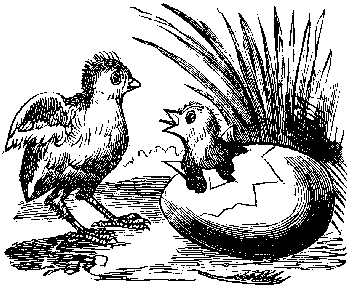
There is no evidence of the presence of any germ or principle of life whatever. The egg left to itself decays like other organized substances, but with our assistance in simply transferring it to a place where the temperature is in a certain uniform condition, in a few weeks, the albumen, water, oil and mineral salts are transferred into a living chick, which thrusts its little beak through the shell, and in ten minutes is running about, almost able to take care of itself.
Here is the development of life apparently without the agency of the mother, and what a marvel! The chemist may place together in a body in a warm place, just such elements or substances: he may carefully weigh the water, the albumen, the phosphotic compounds, the sulphur, the iron, soda, etc., and construct a very accurate egg mixture, but out of it all there will never come a living chick. In this, we obtain some idea how little we actually know about life, how dark is the region where the life principle begins, or where the vital forces originate. The indefatigable man of science has pushed his inquiries close up to the boundary between the inanimate and the animate; but he has never been able to obtain the least glimpse of anything upon the life side of the line. However great maybe our curiosity, our skill or knowledge in this state of existence, there is not the least probability that we shall ever be able to endow matter with life, or know much more than we do at present of its origin or nature.
Auntie, to a little four-year-old who is resting his head on the table—"Ah, Louis, you are sleepy; you will have to go to bed." "Oh, no, auntie, I aren't sleepy; but my head is loose, so I laid it down here."
HE WAS ONLY A NEWSBOY.
It was a very small funeral procession that wended its way slowly from the King's County Hospital to the Holy Cross Cemetery at Flatbush, New York. There were no handsome carriages, no long string of hacks, only the hearse containing a small, plain coffin, followed by a solitary coach. But the mourning was just as sincere as at the largest and most imposing funeral. And it was not confined to the four boys who accompanied the body of their dearest friend to its last resting-place. A hundred hearts were touched by grief. A hundred faces were wet with tears.
"It's only a newsboy," said a policeman. True, only a newsboy, a waif from the streets of the great city. But no philanthropist was ever kinder, no friend more true, no soldier braver, than little Joe Flanigan. Every newsboy about the offices of New York's great journals knew and loved him. All owed him a debt of gratitude for the many good deeds he had done in his humble way.
Little Joe first appeared on the streets of New York two years ago. He was small and slight, with great brown eyes and pinched lips that always wore a smile. Where he came from nobody knew and few cared. His parents, he said, were dead and he had no friends. It was a hard life. Up at four o'clock in the morning after sleeping in a dry-goods' box or an alley, he worked steadily till late at night. He was misused at first. Big boys stole his papers, or crowded him out of a warm place at night, but he never complained. The tears would well up in his eyes, but were quickly brushed away and a new start bravely made. Such conduct won him friends, and after a little no other dared play tricks upon Little Joe. His friends he remembered and his enemies he forgave. Some days he had especially good luck. Kind-hearted people pitied the little fellow and bought papers whether they wanted them or not. But he was too generous to save money enough for even a night's lodging. Every boy who "got stuck" knew he was sure to get enough to buy a supper as long as Joe had a penny.
But the hard work and exposure began to tell on his weak constitution. He kept growing thinner and thinner, till there was scarcely an ounce of flesh on his little body. The skin of his face was drawn closer and closer, but the pleasant look never faded away. He was uncomplaining to the last. He awoke one morning after working hard selling "extras," to find himself too weak to move. He tried his best to get upon his feet, but it was a vain attempt. The vital force was gone.
"Where is Little Joe?" was the universal inquiry. Nobody had seen him since the previous night. Finally he was found in a secluded corner, and a good-natured hackman was persuaded to take him to the hospital in Flatbush, where he said he once lived. Every day one of the boys went to see him. One Saturday, a newsboy who had abused him at first and learned to love him afterward, found him sitting up in his cot, his little blue-veined hand stretched out upon the coverlet.
"I was afraid you wasn't coming, Jerry," he said, with some difficulty, "and I wanted to see you once more so much. I guess it will be the last time, Jerry, for I feel awful weak to-day. Now, Jerry, when I die I want you to be good for my sake. Tell the boys"—
But his message never was completed. Little Joe was dead. His sleep was calm and beautiful. The trouble and anxiety on his wan face had disappeared. But the expression was still there. Even in death he smiled.
It was sad news that Jerry bore back to his friends on that day. They feared the end was near and were waiting for him with anxious hearts. When they saw his tear-stained face they knew that Little Joe was dead. Not a word was said. They felt as if they were in the presence of death itself. Their hearts were too full to speak.
That night a hundred boys met in front of the City Hall. They felt that they must express their sense of loss in some way, but how they did not know. Finally, in accordance with the suggestion of one of the larger boys, they passed a resolution which read as follows:—
Resolved, That we all liked Little Joe, who was the best newsboy in New York. Everybody is sorry he has died.
A collection was taken up to send delegates to the funeral, and the same hackman who bore little Joe to the hospital again kindly offered the use of his carriage. On the coffin was a plate, purchased by the boys, whose language was expressive from its very simplicity. This was the inscription:—
Little Joe, Aged 14. The Best Newsboy in New York. WE ALL LIKED HIM.
There were no services, but each boy sent a flower to be placed upon the coffin of his friend. After all, what did it matter that Little Joe was dead?
He was only a newsboy.
This is not a fancy sketch. Every word of the above story is true.
Office Boy (to country editor): "A man was in while you were out, who said he was the genuine John Wilkes Booth."
Editor (hastily): "He's a fraud. You didn't give him anything did you?"
Office Boy: "No. He left a dollar for a six months' subscription."
Editor: "Well, well. And so John Wilkes Booth is still alive. It beats all."
AN UNWASHED PRINCE.
The Crown Prince of Prussia, was always a very sensible man in the management of his household, and he is ably seconded by his wife. On one occasion the governor of his children came to him and said:
"Your Highness, I must complain of the little Prince; he refuses to have his face washed in the morning."
"Does he?" answered the Crown Prince. "We'll remedy that. After this let him go unwashed."
"It shall be done," said the governor. Now the sentries have to salute every member of the royal family—children and all—whenever they pass. The day after, the little four-year-old Prince went out for a walk with his governor. As they passed a sentry-box where a grim soldier stood, the man stood rigid without presenting arms. The little Prince—accustomed to universal deference—looked displeased, but said nothing. Presently another sentry was passed. Neither did this one give a sign of recognition. The little Prince angrily spoke of it to his old governor, and they passed on. And when the walk was finished, and they had met many soldiers, who none of them saluted the Prince, the little fellow dashed in to his father exclaiming:
"Papa—papa—you must whip every man in your guards! They refuse to salute when I pass!"
"Ah! my son," said the Crown Prince, "they do rightly; for clean soldiers never salute a dirty little Prince." After that the boy took a shower bath every morning.
THE LEGEND OF THE WILLOW.
One day a golden-haired child, who lived where no trees or flowers grew, was gazing wistfully through the open gate of a beautiful park, when the gardener chanced to throw out an armful of dry cuttings. Among them the little girl discovered one with a tiny bud just starting.
"Perhaps it will grow," she whispered to herself, and, dreaming of wide, cool boughs and fluttering leaves, she carried it carefully home, and planted it in the darksome area. Day after day she watched and tended it, and when, by-and-by, another bud started, she knew that the slip had taken root.
Years passed, and the lowly home gave place to a pleasant mansion, and the narrow area widened into a spacious garden, where many a green tree threw its shadow. But for the golden-haired child now grown into a lovely maiden, the fairest and dearest of them all was the one she had so tenderly nourished. No other tree, she thought, cast such a cool, soft shade; in no other boughs did the birds sing so sweetly.
But while the tree lived and flourished, the young girl drooped and faded. Sweeter and sadder grew the light in her blue eyes, till by-and-by God's angel touched them with a dreamless sleep. Loving hands crowned the white brow with myrtle, and under the branches she had loved laid her tenderly to rest.
But from that hour, as if in sorrow for the one that had tended it, the stately tree began to droop. Lower and lower bent the sad branches, lower and lower, until they caressed the daisied mound that covered her form.
"See!" said her young companions, "the tree weeps for her who loved it." And they called it the Weeping Willow.
HOW TO BECOME PROSPEROUS.
Let every youth be taught some useful art and trained to industry and thrift. Let every young man lay aside and keep sacredly intact a certain portion of his earnings. Let every one set out with a determination to engage in business for himself as soon as he can. Begin in a small, safe way, and extend your business as experience will teach you is advantageous. Keep your own books and know constantly what you are earning and just where you stand. Do not marry until in receipt of a tolerably certain income, sufficient to live on comfortably. Let every man who is able buy a farm on which to bring up his sons. It is from the farm the best men are turned out, morally and intellectually. Bear in mind that your business cannot be permanently prosperous unless you share its advantages equally with your customers.
Change the Subject.—"Always," said papa, as he drank his coffee and enjoyed his morning beefsteak—"always, children, change the subject when anything unpleasant has been said. It is both wise and polite."
That evening, on his return from business, he found his carnation-bed despoiled, and the tiny imprint of slippered feet silently bearing witness to the small thief.
"Mabel," he said to her, "did you pick my flowers?"
"Papa," said Mabel, "did you see a monkey in town?"
"Never mind that. Did you pick my flowers?"
"Papa, what did grandma send me?"
"Mabel, what do you mean? Did you pick my flowers? Answer me yes or no."
"Yes, papa, I did; but I fout I'd change the subject."
The noblest mind the best contentment has.