Bay State Faugh-a-Ballaghs.[1] III. THE SECOND IRISH MASSACHUSETTS REGIMENT—THE TWENTY-EIGHTH TO THE FRONT—ANOTHER CHAPTER ABOUT OUR RACE IN THE WAR OF THE UNION.
Reading edition
Bay State Faugh-a-Ballaghs.[1] III. THE SECOND IRISH MASSACHUSETTS REGIMENT—THE TWENTY-EIGHTH TO THE FRONT—ANOTHER CHAPTER ABOUT OUR RACE IN THE WAR OF THE UNION.
"To the troops (the Irish Brigade) commanded by General Meagher, was principally committed the desperate task of bursting out of the town of Fredericksburg and forming under the withering fire of the Confederate batteries, to attack Marye's Heights, towering immediately in their front. Never at Fontenoy, Albuera or at Waterloo was more undaunted courage displayed by the sons of Erin than during those six frantic dashes which they directed against the almost impregnable position of their foe.... The bodies which lie in dense masses within forty yards of the muzzles of Colonel Walton's guns are the best evidence what manner of men they were who pressed on to death with the dauntlessness of a race which has gained glory on a thousand battle-fields, and never more richly deserved it than at the foot of Marye's Heights on the 13th day of December, 1862."
Of this brigade of five regiments the Twenty-Eighth Massachusetts Volunteers, Colonel Richard Byrnes, was the second Irish regiment raised in Massachusetts in defence of the Union in 1861. The tribute above quoted is the testimony of the war correspondent of the London Times, the files of which are to be found in our Boston Athenæum. He was the famous Dr. Russell, the Crimean and other wars' correspondent of the London Thunderer. He should surely be a judge of heroic service and undaunted bravery. He was an eye-witness, as was the writer of these lines, of what he speaks, and could with great truth form a personal knowledge of the facts, and with ocular proof depict the thrilling and tragic drama enacted on the bloody slopes of Fredericksburg, Va., on that midwinter day. The nature of the ground on the left bank of the Rappahannock afforded ample views of the scenes being enacted on the other side, and it requires no difficult stretch of the imagination or of the sympathies of humanity to enter into the feelings of men, who, seeing this fearful havoc of their Federal comrades, awaited their turn for Burnside to order them, "his latest chance to try," across the ensanguined river. When the order did come for the fresh Irish troops, it was only to find themselves mingled in the slaughter with their prone dead and dying comrades from the old Bay State, the Twenty-Eighth Massachusetts, distinguishable by the fresh and natural sprigs of green with which they had on that fateful morning decorated their military caps, but which were now in too, too many cases, crimsoned with blood and brains, or embedded in the crushed skulls of the gallant heroes, who, only a few short hours before, so jauntily wore them.
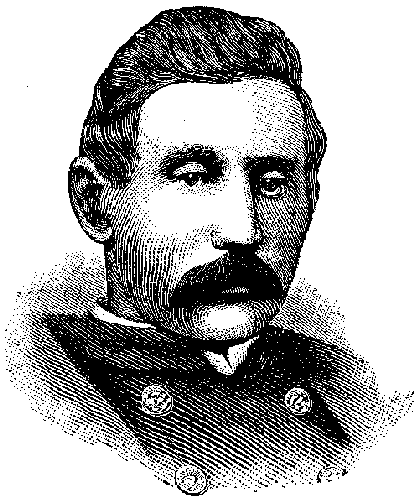
Col. Richard Byrnes.
"Why should we be sad, boys, whose business it is to die!" sung Wolfe at Quebec. The strain was melancholy and its vein mercenary. It was not the business of these gallant citizen soldiers to die. They should have lived to see a country restored to peace and greatness as a proof of their patriotism, valor and sacrifices. "But," says Dr. Russell in another part of his Fredericksburg letter to the London Times, "that any mortal men could have carried the position before which they were wantonly sacrificed, defended as it was, it seems to me idle for a moment to believe." And these valiant, adopted citizens of the Republic hesitated not to obey the cruel order to charge and charge again and again up to those impregnable works with a fortitude and persistence that could not possibly be expected from troops who adopted the trade of soldier and "whose business it was to die."[2]
On another occasion, General Hancock said of a charge in which the Twenty-Eighth Massachusetts participated: "I have never seen anything so splendid." He was a judge of what a good charge consisted. Great credit is most justly due to Colonel Richard Byrnes, of whom a most excellent likeness is herewith presented, and of whom the writer will have something more to say before he finishes a brief record of this famed Irish-American Regiment.
The evidences of fine discipline and military bearing given by the first Irish regiment, the Ninth Infantry, organized in Massachusetts, and which, when it went to the front sustained so admirably those earlier promises to the great satisfaction of the national and state authorities, prompted the latter to form a second similar corps. Accordingly Gov. Andrew and Gen. Schouler consulted with the Right Rev. Bishop Fitzpatrick of the Boston diocese and Mr. Patrick Donahoe with this view. The outlook was favorable and the state officials received patriotic and most cheerful assurances from these and other Irish-American gentlemen taken into counsel on the subject. The authority of the general government was at once secured and the formation of the Faugh-a-Ballaghs, to be numbered the Twenty-Eighth Massachusetts Infantry Volunteers, was speedily begun. An announcement appeared in The Pilot stating that on September 28, 1861, the war office sanctioned the formation of the regiment to be commanded by Colonel Thomas T. Murphy of the Montgomery Guard of New York, and accordingly recruiting was begun with head-quarters at 16 Howard Street, Boston. An address was issued which spiritedly set forth that for this Irishmen and sons of Irishmen, should rally forth for their country's cause, "now that Governor Andrew has been granted authority to raise another Irish regiment.... This is to afford an opportunity to all those whose allegiance, patriotism and home welfare all combine to enlist their sympathies for the country of their adoption and the safety and protection of the Union; to unite one and all to uphold its integrity and render it inviolable for future ages. Signed Patrick Donahoe and Dr. W. M. Walsh." Among the gentlemen authorized to recruit for it, were Messrs. Alexander Blaney of Natick, Florence Buckley of South Natick, E. H. Fitzpatrick of New Bedford, Owen E. Neale of Fitchburg, S. W. Moore of Marlboro', C. W. Judge of Haverhill and Daniel O'Donovan of the same locality, Martin Kirwin of Lawrence, A. A. Griffin of East Cambridge, John Riley of Worcester, Paul Eveny of Salem, and Lieutenant Ed. F. O'Brien of Burlington, Vt.
The nucleus of the Faugh-a-Ballaghs was rendezvoused at Camp Cameron, Cambridge, where the good, pious and patriotic Rev. Father Manasses Dougherty of St. Peter's Church, Concord Avenue, ministered to the spiritual and many of the temporal wants of the sick and the well until a regular chaplain was assigned to the command. Many a gallant soldier who, shortly afterwards, sank into a bloody grave, recalled with love and veneration the tender and manly ministrations of this dear Soggarth Aroon. A chaplain of the regiment, Father McMahon, is now the bishop of the diocese of Hartford, Conn. Among the first acts of Company A, Captain William Mitchell commanding, was to pass, by a unanimous vote, the resolve: "That in consideration of the untiring zeal and patriotic feelings of Mr. Patrick Donahoe in prompting and aiding the organization of the Second Irish Massachusetts Regiment (the Twenty-Eighth) this company will, hereafter, be known and called the Donahoe Guard." This paragraph was further supplemented with the assurance from the company to the patriotic gentleman whom they had named as patron, that their conduct as soldiers and Irishmen in the field would never give cause of disgrace to the name they had thus, with so much hearty unanimity, voted to assume. Here let us for the close of this chapter leave the "boys," many of whom are looking forward to a glorious future in which the fate of their native Ireland is romantically blended. How often have they thrilled with martial fervor, as they read or heard Thomas Davis's Fontenoy, that famed Fontenoy, which would have been a Waterloo,
"Were not those exiles ready then, fresh, vehement and true."
Ah, yes, they will learn the science of war and if fate reserves them in the glorious fight for the Union, their practical knowledge, their tested courage will then be used by the grace of the God of Hosts to help free their native land.