Volume 2 — REIGN OF CHARLES II.: 1673-1685. (continued 4)
Reading edition
‘My grandfather, whose thoughts were much employed, and went on as his horse carried him, without thinking of his way, found himself at Tweedside, out of his road, and at a place not fordable, and no servant. After pausing, and stopping a good while, he found means to get over, and get into the road on the other side, where, after some time, he met his servant, who shewed inexpressible joy at meeting him, and told him, as he rode first, he thought he was always following him, till upon a great noise of the galloping of horses, he looked about and missed him; this was a party sent to his house to take him up, where they searched very narrowly, and possibly hearing horses were gone from the house, suspected the truth and followed. They examined this man, who, to his great joy and astonishment, missed his master, and was too cunning for them, that they were gone back before my grandfather came up with him. He immediately quitted the high road, after a warning by so miraculous an escape, and in two days sent back his servant, which was the first notice they had at home of his not having fallen into their hands.’315
Sir Patrick escaped to Holland, whence he returned with the Prince of Orange to take a high place in the councils of his country under a happier régime.
Dec. 2.
We have seen many instances of Catholics deprived, under acts of parliament, of the privilege of educating their own children. This statutory power was now applied by the government to gentlefolk of what were called fanatical principles. The Lady Colville was imprisoned in the Edinburgh Tolbooth for her irregularities of religious practice, and particularly for ‘breeding up her son Lord Colville in fanaticism and other disloyal principles.’—Foun. Dec.
1685. Jan.
1685.
‘One James Cathcart, a pretended mathematician and astrologer, emitted a printed paper at Edinburgh, inviting any to come to him, and get resolutions of any difficult questions they had to ask, such as anent their death, their marriage, what husbands or wives they would get, and if they would prosper and succeed in such projects of love, or journeys, &c.; as also professed skill to cure diseases. This was a great impudence in a Christian commonwealth to avow such an art; for if he had it by magic, then he was a sorcerer; if not, he was an impostor and abuser of the people, which even is death.... In his paper, he cited some texts of Scripture, allowing an influence to the stars.’—Foun.
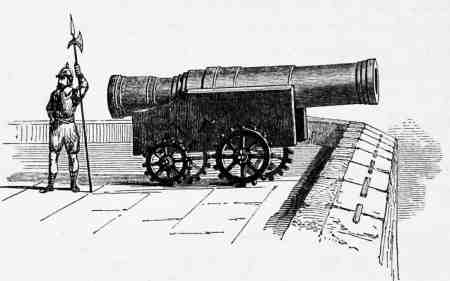
Mons Meg.