Volume 2 — REIGN OF CHARLES I.: 1625-1637. (continued 2)
Reading edition
1630.
In November 1630, a curious circumstance is noted regarding the Dr William Leslie above named. Licence was granted to him by the Privy Council to return temporarily to medicate to the Marquis of Huntly, he being the person ‘whose judgment in matters of that kind the said marquis does only trust,’ it being provided ‘that the said Dr William shall behave himself modestly, without giving offence and scandal in matters concerning the religion.’—P. C. R.
It is remarkable that, while the histories of our country and its national church are careful to note every particular of the conflict between presbytery and episcopacy at this period, there is nowhere the slightest allusion to these sufferings of the remnant of Romanists, towards which Presbyterians and Episcopalians alike contributed. It is to be feared that the actual severities which were dealt upon the party were not the worst evils in the case. In the external conformity which was forced upon many—so many that only sixty avowed papists were thought to be left in Scotland—we cannot doubt that there was involved a hypocrisy which would be bitterly felt—always the more bitterly where there was an upright and honourable spirit—and which would in the long-run have the most demoralising effects.
1630.
A full history of the proceedings of the Romish priests in Scotland, during the reigns of James VI. and Charles I., would shew examples of heroic courage, self-devotion, and religious enthusiasm, equalling any that can be adduced from the reformed denominations. ‘Capuchin Leslie, called the Archangel,’ appears, from his biography,24 to have been a man of singular gifts and earnestness. The eldest son of the Laird of Monymusk, in Aberdeenshire, he had been brought up at Paris, and there converted to Romanism in his youth. Before attaining majority, he had gone to those heights in devotion and asceticism which produce hallucinative voices and lights. Making his way through unnumbered dangers to his native castle, he there set himself to the work of preaching. He collected the people in the woods, or beset them as they were leaving the parish church; addressed them in a style of burning eloquence, with threats of the fate reserved for heretics; and is said to have brought thousands into his views in a few weeks. His admiring biographer tells how he confounded the minister of Monymusk by asking him to exhibit any reference to the church of Geneva in the Bible, shewing him at the same time the Scriptural foundation of the true church, by pointing out Paul’s Epistle to the Romans! His mother and other relatives were brought over to the ancient faith. For two years he exposed his life in this manner, but was at length obliged to leave the district by one of these threatening edicts. Meanwhile, his family, being discovered to be Catholics, had their property confiscated, and his mother was obliged to retire to a hovel, where she endeavoured to support herself by spinning. It is related that Father Archangel, being resolved at all hazards to visit her, dressed himself like a gardener, and cried herbs through the village till he discovered his mother. After a hurried interview, he was obliged to leave her once more, and depart from the kingdom. He nevertheless returned and recommenced his labours; and this extraordinary man ultimately sunk at an early age, under a fever caught while making a skulking journey across the Border.
Apr. 21.
John Hart, printer in Edinburgh, being about to bring out an edition of the Bible, the Town Council gave him formal permission to take a new apprentice ‘for the advancement of the said wark,’ ‘notwithstanding the time of three years be not past, since he replaced an apprentice last;’ ‘providing always it sall not be lawful to him to tak and have ane other prentice before the expiring of six years.’—Ed. Coun. Reg.
As restrictions on the taking of apprentices still exist in various trades, we must not be too ready to smile at this as a peculiar trait of the barbarous political economy of a past age.
May 29.
On the birth of the prince, afterwards Charles II., which took place between eleven and twelve this forenoon, the Lyon King at Arms was despatched by the king from London, to carry the news to Scotland. The Lyon arrived in Edinburgh on the third day thereafter, June 1st, when immediately cannon were shot, bells rung, and a table spread in the High Street, between the Cross and the Tron, for two hundred persons, including the nobility, Privy Council, and judges, the company being waited on by the heralds and trumpeters in their official dress.—Bal.
‘In this May were five Saturdays, five Mondays, twa changes of the moon, twa eclipses of the sun, ane other of the moon, all in our horizon.’—Chron. Perth.
June 20.
1630.
Writers of the religious history of Scotland during the seventeenth century, pause upon a remarkable administration of the communion which took place at this date in the Kirk of Shotts. The great attraction on the occasion was a young clergyman, afterwards famous, named John Livingstone. In consequence of the impression now made, a great portion of the assembled multitude remained at the place over the night; so it was necessary for the favourite preacher to hold forth next day. He did so with such power, and such a ‘down-pouring of the spirit,’ that the congregation was thrown into ‘unusual motion,’ and five hundred traced their conversion to that sermon alone. Amongst the hearers were three young men of Glasgow, who, journeying to Edinburgh on a pleasure-excursion, chanced to stop at the village for breakfast and the refreshment of their horses. So affected were they, that they entered into no amusements in Edinburgh, but speedily returned home, and were ever after noted as serious Christians. This is understood to have been the first instance of what has since been a common custom; that is, to have services on the Monday following the communion.—Gillies.
In this year and for some time afterwards, the parish of Stewarton, in Ayrshire, was the scene of ‘a very solemn and extraordinary out-letting of the spirit,’ few Sundays passing ‘without some one being converted, or some convincing proofs of the power of God accompanying his word.’... ‘Yea, many were so choked and taken by the heart, that, through terror, ... they have been made to fall over, and thus carried out of the church, who after proved most solid and lively Christians.’ The fervour spread from house to house along both sides of Stewarton Water. The profane called it the Stewarton Sickness.
1630.
‘The poor people, purely from conscience, were seized with such an apprehension of God’s wrath, and fear of eternal damnation because of their sins, that rest they could have none. This they were able to demonstrate to be no melancholy fancy, but a rational apprehension of their real danger, being at that time both ignorant, profane, and absolutely strangers to Jesus Christ, by [beside or apart from] whom they could have neither hope of mercy nor title to salvation; and this was beyond the reply of any divine. When by godly ministers ... they were directed to the performance of those duties which accomplish conversion from Satan to Christ, their peace became as strong as their terror had been troublesome....’25 ‘The Countess of Eglintoun did much countenance them, and persuaded her noble lord to spare his hunting and hawking some days to confer with some of them whom she had sent for to that effect. Her lord, after conference with them, protested that he never spoke with the like of them, and wondered at the wisdom they manifested in their speech.’26
The Stewarton Sickness took its first rise in the ministrations of Mr David Dickson, minister of Irvine, afterwards a conspicuous figure in the time of the National Covenant. He was accustomed each Monday, being the market-day of the burgh, to give a sermon for the benefit of those who came there with their commodities for sale; and thus it was that the Stewarton people had opportunities of kindling under his eloquence. ‘At Irvine, Mr Dickson’s ministry was singularly countenanced of God. Multitudes were convinced and converted; and few that lived in his day were more honoured to be instruments of conversion than he. People under exercise and soul-concern came from every place about Irvine and attended upon his sermons, and the most eminent and serious Christians from all corners of the church came and joined him at his communions, which were indeed times of refreshing from the presence of the Lord.’27 ‘Yea, not a few came from distant places and settled at Irvine, that they might be under the drop of his ministry. Yet he himself observed that the vintage of Irvine was not equal to the gleanings of Ayr in Mr Welch’s time.’28
‘John Lockhart tells me (1727) that he was in company with an old Christian who was a young man in the time of the famous Stewarton Sickness.... In a great many, it came to a kindly conversion ... but in severals it came to nothing, and in a little time wore off, and the persons became just what they were formerly.’—Wodrow.29
July.
1630.
At this time there lived near the town of Dunse a poor woman generally believed to be possessed by an evil spirit. The Earl (afterwards Duke) of Lauderdale, when a prisoner in Windsor Castle in 1659, sent an account of her to Mr Richard Baxter, who has published it in his Certainty of the World of Spirits. The earl, then a boy at school, used to hear conversations about the possessed woman between his father and the minister of Dunse, who was fully convinced of the fact of the possession. This clergyman and some other clergymen proposed to the Privy Council a fast for her benefit; but it was not allowed by the bishops. ‘I will not,’ says the earl, ‘trouble you with many circumstances; one only I shall tell you, which I think will evince a real possession. The report being spread in the country, a knight of the name of Forbes, who lived in the north of Scotland, being come to Edinburgh, meeting there with a minister of the north, and both of them desirous to see the woman, the northern minister invited the knight to my father’s house (which was within ten or twelve miles of the woman), whither they came, and next morning went to see the woman. They found her a poor ignorant creature, and seeing nothing extraordinary, the minister says in Latin to the knight: “Nondum audivimus spiritum loquentem.” Presently a voice comes out of the woman’s mouth: “Audis loquentem, audis loquentem.” This put the minister into some amazement (which I think made him not mind his own Latin); he took off his hat, and said: “Misereatur Deus peccatoris!” The voice presently out of the woman’s mouth said: “Dic peccatricis, dic peccatricis;” whereupon both of them came out of the house fully satisfied, took horse immediately, and returned to my father’s house at Thirlstane Castle, in Lauderdale, where they related this passage. This I do exactly remember. Many more particulars might be got in that part of the country; but this Latin criticism, in a most illiterate ignorant woman, where there was no pretence to dispossessing, is enough, I think.’
It may be remarked that the speaking of various languages which they had never learned, was one of the marks required by the canons of the Romish Church to distinguish those under real possession. The Dunse demoniac was remarkably superior in this respect to her contemporaries, the nuns of Loudun, who, in their demonstrations of possession in the celebrated case of Urban Grandier, spoke very bad Latin, not to mention their utter inability to converse in Greek or Hebrew, and yet were held by the authorities as genuine vessels of diabolic influence.
The fact of there being a reputedly possessed woman in Dunse at this time, as the Earl of Lauderdale has stated, is verified by the Privy Council Record, which contains, under date July 13, 1630, an order for bringing before them Margaret Lumsden, ‘the possessed woman in Dunse,’ together with her brother and father-in-law, that order might be taken concerning them, ‘as the importance and nature of such a great cause requires.’
Sep. 23.
1630.
Susanna Chancellor, daughter of the Laird of Shieldhill, was accused before the presbytery of Lanark of consulting with charmers, and ‘burying a child’s clothes betwixt [three] lairds’ lands, for health.’ By penitently presenting herself on her knees before the reverend brethren, she was saved from the due punishment.—R. P. L.
Oct.
At no great distance from the Castle of Strathbogie—the modern Huntly—where the great marquis held state, dwelt two gentlemen of figure, Gordon of Rothiemay and Crichton of Frendraught. In consequence of a dispute about the salmon-fishings in the Doveran, these two gentlemen fell into litigation and bad blood; and at length, from finding Rothiemay obdurate, Frendraught had to get assistance from his neighbours to execute the laws upon his antagonist. On New-year’s Day 1630, a bloody encounter took place between them, and Rothiemay was so severely wounded as to die three days after.
1630.
Frendraught could plead that he had been only carrying out the behests of the law against one who set legal rights and decrees at defiance. But the Marquis of Huntly and other Gordons felt that it was a hard thing for Rothiemay to lose his life on such an account, and Frendraught accordingly fell under their displeasure. The young Laird of Rothiemay, calling in the assistance of the outlaw James Grant, laid waste the lands of Frendraught, who was driven in succession to the Earl of Moray, the king, and the Privy Council for the protection of the laws. It was found necessary by the Council to send a commission to allay the heats which this affair had called forth. When Sir Robert Gordon and other commissioners arrived on the ground in May, they found James Grant and two hundred Highlanders assembled at Rothiemay, ready to lay waste Frendraught’s estate with fire and sword; and it was with no small difficulty that they were stayed. Sir Robert, as a connection of both Frendraught and the Gordon family, was well qualified to bring about a reconciliation, and this he effected with the assistance of the Marquis of Huntly. It was arranged that Frendraught should purchase the forgiveness of the Rothiemay family by paying a sum of money. ‘And so, all parties having shaken hands in the orchard of Strathbogie, they were heartily reconciled,’ says Sir Robert in his gossiping history. One cannot but see in this mode of stilling quarrels an encouragement to new ones. Frendraught, having acted all along under law, ought to have been protected by the law, instead of thus having to pay a fine of fifty thousand merks30 to buy off the vengeance of a family by whom the law was disregarded and broken. But in those days the law could only be executed by favour of the leading men of the country. These leading men had their passions and their partialities. Sir Robert Gordon probably purchased Frendraught’s safety on the best terms which, in the circumstances, could be obtained.
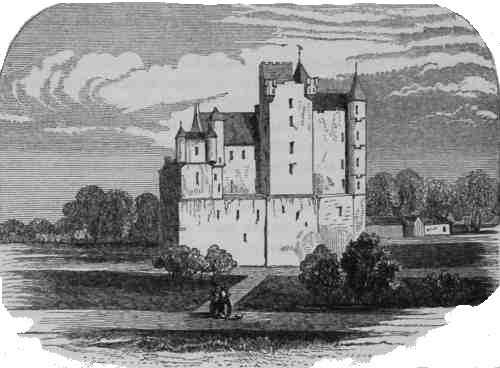
Bog an Gicht Castle.
1630.
These circumstances form merely the introduction to a long series of disastrous mischances which befell the Laird of Frendraught, and which have made his name memorable in Scottish tradition. In the course of autumn, a gentleman named John Meldrum, who had assisted him in the fray with Rothiemay, quarrelled with him for not being satisfactorily rewarded for his help on that occasion. To make matters right, this gentleman came and took two horses from Frendraught’s lands! Frendraught, hearing that the culprit was harboured by a brother-in-law, Leslie of Pitcaple, came thither to seek back his property; but the encounter only led to one of his friends wounding a son of Pitcaple with a pistol-shot. Here was a new trouble for the unfortunate Frendraught. In great concern for what had taken place, he rode to the Marquis of Huntly at the Bog—the modern Gordon Castle—to beseech his intercession for the stanching of the quarrel. At the same time comes Pitcaple, full of designs of vengeance against Frendraught. The marquis was obliged to detain the latter as his guest, to save him from Pitcaple, who went away in great wrath.
Next day, when Frendraught proposed to go home, the marquis caused his son, Viscount Melgum, to accompany him with some other friends, in order to protect him from any attack which Pitcaple might make upon him by the way. It chanced that the Laird of Rothiemay, so lately reconciled to Frendraught, was present on this occasion; he generously offered to be one of the escort. So Frendraught set out with his gallant company, and reached home in safety.
It was only in conformity with the customs of the age that the laird and his lady should invite Lord Melgum, Rothiemay, and the rest of the party to remain for the night. They did so. The gentlemen consented; and after a merry supper, were conducted to bedrooms in the tall narrow old tower, which, with a modern addition, formed the Castle of Frendraught. In the first floor, over a vault, through which there was a round hole, lay Melgum and two servants; in the second was Rothiemay, also with some servants; in the third, two gentlemen named Chalmers and Rollock, and some more servants, were accommodated.
Oct. 8.
1630.
About midnight, the tower took fire in a sudden manner, ‘yea, in ane clap,’ says Spalding, and involved the whole of the inmates in destruction, except Chalmers, Rollock, and a servant who slept beside Lord Melgum. Swift as the fire was, three persons escaped, and Lord Melgum might have also saved himself, if he had not, under a friendly impulse, run up stairs to rouse Rothiemay. While he was engaged in this act, ‘the timber passage and lofting of the chamber takes fire, so that none of them could win down stairs again.’ So they turned to a window looking towards the court-yard, where they were heard repeatedly calling: ‘Help, help, for God’s cause!’ The windows being stanchioned, and the access by the stair cut off by the flames, it was impossible to render any assistance, and accordingly the six persons enclosed in the burning tower were all piteously burnt to death. Melgum was but twenty-four years of age, and left a widow and child; Rothiemay was unmarried. It is stated by Lady Melgum’s chaplain, that in that last moment of extremity, Lord Melgum induced Rothiemay to make open profession of the Catholic faith; and so, ‘they two being at a window, and whilst their legs were burning, did sing together Te Deum; which ended, they did tell at the window that their legs were consumed, recommending their souls to God, and the nobleman his wife and child, first to God, and then to the king.’31 A popular ballad of the day speaks of their being called on to leap from the window:
‘How can I leap, how can I win, How can I leap to thee? My head’s fast in the wire-window, My feet burning from me.’ He’s ta’en the rings from aff his hands, And thrown them o’er the wall; Saying: ‘Give them to my lady fair, Where she sits in the hall.’
1630.
This dismal event created a universal feeling of horror, and plunged the friends of the deceased into the greatest grief. The Laird and Lady of Frendraught were, to all appearance, deeply concerned for what had taken place. On the morning after the fire, the lady, ‘busked in a white plaid, and riding on a small nag, having a boy leading her horse, without any more in her company, in this pitiful manner she came weeping and mourning to the Bog, desiring entry to speak with my lord; but this was refused; so she returned back to her own house, the same gate she came, comfortless.’—Spalding. Her repulse was the more remarkable, as Lady Frendraught was a cousin of the marquis, and brought into bonds of sympathy with him and his family by being a Catholic. A fixed suspicion that she and her husband were the authors of the fire, had taken possession of the Huntly and Rothiemay families, as well as of the populace generally, though not the slightest evidence of guilt has ever been brought against them, and their loss of valuable papers, and of gold and silver articles, to the value, it was alleged, of a hundred thousand marks, rendered any concern of theirs in the fire-raising the very reverse of probable. The laird himself acted in the manner of an innocent man anxious to clear himself of suspicion. He came immediately to the Chancellor Lord Dupplin at Perth, desiring his protection, and offering to submit to trial. The Privy Council do not seem ever to have felt that there were any grounds for charging him with the guilt popularly imputed to him.
More particular suspicions fell upon John Meldrum of Redhill, the quondam adherent of Frendraught, but who had latterly fallen into such bad terms with him; likewise upon John Tosh, the master-household of Frendraught. These persons were accordingly apprehended, brought to Edinburgh, and examined. A servant-girl called Wood was also seized and subjected to torture, with a view to extracting her knowledge of the circumstances; but this only produced prevarications, making her evidence of no avail,32 and for which she was scourged and banished the kingdom.
In March 1631, the Marquis of Huntly, having resolved ‘not to revenge himself by way of deed,’ as his panegyrist Spalding does not fail to tell us—as if it were a great merit—proceeded to Edinburgh in order to lay his wrongs before the Privy Council. Four commissioners appointed by this body soon after proceeded to Frendraught, which they examined with great care, in company with several noblemen and gentlemen of the district. They found evidence that the fire had originated in the ground-vault of the tower, where there were marks of it in three several places, one of these being directly under the round hole in the roof which communicated with Melgum’s apartment above. They could not determine whether it was accidental; but they felt assured that ‘no hand without could have raised the fire without aid from within.’33
1630.
While these matters were pending, there occurred an incident in itself of little importance, but which marks the spirit of the time. The young Earl of Sutherland, brother to Lady Frendraught, and whose late father was cousin-german to Huntly, in the course of a journey to Edinburgh, resolved to spend a night with the marquis, and for that purpose sent forward his message from Elgin. When he arrived in the evening at Bog of Gight, the marquis gave him a cold reception, and told him that he must either break with his brother-in-law Frendraught, or with himself, as he could no longer be the friend of both. The earl answered that he would prefer the marquis to Frendraught, but that he could not with honour throw off his sister’s husband as long as he was law-free. Huntly immediately answered: ‘Then God be with you, my lord,’ and turned away. The Earl of Sutherland lodged that night at a neighbouring hostelry, and in the morning pursued his way south. The singularity of such an event, in an age when it was disrespectful to pass a friend’s door without partaking of his hospitality, gives it great significance.
John Tosh, after submitting to examinations by torture, and denying all guilt, was charged (August 3, 1632) with the offence of setting fire to the tower from within; but the charge was never brought before an assize, the assessors finding that an insuperable bar lay in his having passed through the ordeal of torture without confession. There were some suspicious circumstances against him, chiefly of the nature of inconsistencies in his own declarations; but it was certainly possible to account for these upon a different theory from that of his being guilty.
John Meldrum was tried a twelvemonth later, and as it clearly appeared that he had uttered deadly threatenings against Frendraught’s life, even specifying burning as the means, he was found guilty, and executed. The theory of his guilt seems to have been, that he had set fire to the tower, in the belief that the laird slept there, and effected his purpose by thrusting combustibles and fire through three slits in the wall. It must be admitted that Meldrum was the only man, of all concerned, in whom motive for murder appears; but his guilt is, after all, far from being clear. The wall was ten feet thick, and the commission had decidedly pointed to an origin within. No trace of combustibles was ever adduced, and it was proven that he had been at Pitcaple, ten or twelve miles off, that night. On the whole, when the matter is viewed without the passions of the time, it seems most likely that the fire was accidental.
As for the Gordon family, it remained fully convinced of the guilt of the Laird and Lady of Frendraught; and since full retribution could not be obtained by the law, they behoved to have it in some other way. How they proceeded, will be hereafter described.
Dec.
1630.
At Carron, on Speyside, dwelt a branch of the family of the Grants of Glenmorriston, and near by, at Ballindalloch, was a more important family of the same name. In consequence of a homicide which James Grant of the Carron family had committed some years before, there was a fierce feud between these two families. James, finding his enemies irreconcilable, and seeing no prospect of peace, became lawless and desperate. The power of the Earl of Moray proved ineffectual to repress his constant incursions upon the lands of Ballindalloch, or to obtain possession of his person. Ballindalloch himself consequently became desperate. One day, learning that John Grant of Carron and some of his people were in the forest of Abernethy cutting timber, he set upon him with a party, and killed him, but not without loss of life on his own side. He did this on the presumption that Carron aided his relative the outlaw.—G. H. S.
Dec. 3.
The Earl of Moray interposing his power as lord-lieutenant for the protection of Ballindalloch, James Grant vowed to be avenged by his own hand. On the day here noted, he came with a number of associates to Pitchass, the residence of his enemy, who, for his part, had also a number of friends attending him. ‘To train him out, he sets his corn-yard on fire, and haill laigh bigging, barns, byres, stables, wherein many horse, nolt, and sheep were burnt; and sic bestial as was not burnt, they slew and destroyed. But young Ballindalloch kept the house and durst not come out and make any defence. In like manner, James Grant, with his complices, passed to the town and lands of Tulchin, pertaining to old Ballindalloch, and burnt up and destroyed the haill bigging thereof, corns, cattle, goods and geir, and all which they could get, and to the hills goes he.’
Dec. 13.
The Earl of Moray, unable to see any better mode of dealing with this case than to ‘gar one devil ding another,’ made a paction with three broken men, the principal of whom was brother to the late chief of the Clan Mackintosh; who undertook to bring James Grant to him dead or alive. ‘They find him in the town of Auchnachill, at the head of Strathaven, within a house, and ten men with him.... James and his men wins out and takes to flight. They follow sharply, slew four of his men, wounded himself with arrows in eleven parts of his body, and when he could do no more, he was taken, and his six other men.’ As soon as his wounds were cured, he was conducted to Edinburgh, and imprisoned in the Castle, being ‘admired and looked upon as a man of great vassalage;’ but his six men were all hanged.—Spal.
1630.
Grant lay a prisoner in Edinburgh Castle for nearly two years. It is related that, a former neighbour, Grant of Tomnavoulen, passing one day under his prison windows, he called to him, asking, ‘what news from Speyside?’ ‘None very particular,’ rejoined his acquaintance; ‘the best is that the country is rid of you.’ ‘Perhaps we shall meet again,’ said James.34
His wife having conveyed to him some ropes in what was believed to be a cask of butter, Grant came over the walls of the Castle (October 15, 1632) at night, and being received into the arms of his bastard son, immediately left town by a western road. For nine days he lay sick in the woods of Herbertshire, near Denny, and then vanished into the Highlands. The Privy Council, exasperated at his escape, offered a large reward for his apprehension, but in vain. He remained quiet till November 1633, when he began to resume the offensive, ‘partly travelling through the country, sometimes on Speyside, sometimes here, sometimes there, without fear or dread.’ His wife having retired in a delicate condition to a small lodging at Carron on Speyside, where Grant was known to visit her occasionally, young Ballindalloch hired a party of the broken Clan Macgregor, under a renowned outlaw of their tribe, named Patrick Dhu Ger, to beset him there. Grant being at Carron one night with only his bastard son and a single attendant, the Macgregors surrounded the house, and began to uncover it, in order to get at their victim. ‘James Grant, hearing the noise, and seeing himself so beset, that he was not able to keep that house nor win away, resolved to keep the door with the other two as long as they might, and shot out arrows at two windows, [so] that few did venture to come near the door, except their captain ... whilk James Grant perceiving, and knowing him well, presently bends a hagbut, and shoots him through both the thighs, and to the ground falls he. His men leave the pursuit, and loup about to lift him up again; but as they are at this work, James Grant, with the other two, loups frae the house and flies, leaving his wife behind him. He is sharply pursued, and many arrows shot at him; yet he wan away safely to a bog near by with his two men. Patrick Ger died of the shot, within short while, a notable thief, robber, and briganer, oppressing the people wherever he came, and therefore they rejoiced at his death.’—Spal.
1630.
Another year elapsed, during which there had been some abortive attempts at a paction between Grant and young Ballindalloch. One evening in the depth of winter (December 7, 1634), as the latter was sitting at supper in his house of Pitchass, Grant’s wife came in and whispered something in his ear. He rose, took his wife’s plaid about him, and his sword and target in his hand, and went out with the lady, his wife following under anxiety about his welfare. He thus easily fell into an ambuscade which James Grant had set for him, and was hurried off during the night, over moss and muir, to a kiln in the low country near Elgin, where he was kept in bonds under a strong guard, without any of the comforts of life, for three weeks. From this miserable condition, he escaped by the aid of one of his guards named Leonard Leslie, and got in safety to Innes House, where he was kindly entertained. By his own exertions, one Thomas Grant, the owner of the kiln, was hanged next summer for harbouring the outlaw James; two other men were banished for the same offence. Meanwhile, the Macgregors were active in despoiling and laying waste the lands of Corse and Craigievar, in professed revenge for the slaughter of Patrick Ger; but in February 1636, by the exertions of Stewart of Craigievar, seven of them were taken and hanged at the Cross of Edinburgh. This, again, brought into prominence a lawless Macgregor, known popularly under the name of Gilderoy, who, desiring vengeance on the Stewarts, burned some of their lands in Athole. Thus it was that wickedness continued its own existence in those days when public justice was weak.
One Thomas Grant, believed to be the same person who had thrown a taunt at James in Edinburgh Castle, was reputed to have undertaken, for Ballindalloch, to bring the outlaw to him dead or alive. James, hearing of this, came to Thomas’s house, and, missing him, killed sixteen of his cattle. Lighting upon Thomas lying in bed at a friend’s house near by, with his bastard brother, the pitiless outlaw took them both out naked and killed them (April 5, 1636). A few days after, he came with four men to Strathbogie, and by chance craved food at the hangman’s house. The hangman, frightened at the appearance of his visitors, stole away and gave information to the bailie, who presently came with an armed party and surrounded the house. Then a desperate and bloody conflict took place, in the course of which the bailie lost two of his men. Grant after all got clear of his assailants under cloud of night; leaving, however, his bastard son and two of his men a prey to justice. Very soon after (July 27), Gilderoy and some of his associates were likewise brought to Edinburgh, and hanged.
1630.
Notwithstanding the accumulated guilt of James Grant, he subsequently obtained a remission, and lived to take part in the troubles attending the introduction of the Covenant.
Dec. 14.
The Privy Council issued a thundering order for the putting down of those ‘vagabonds, thieves, and limmers,’ the Egyptians, of whom large bands were going about in the north parts of the kingdom, armed, extorting whatever they needed from such of the lieges as were not able to resist them.
1631. Jan. 11.
We get some idea of the difficulties which beset the people of a country before time and means have been obtained for forming roads, bridges, and other public works of utility, from a petition presented to the Privy Council by the minister of Rattray regarding the river Ericht, a well-known stream which debouches from the Highlands in his neighbourhood, amidst a scene truly romantic to the gaze of the modern tourist, but formerly pregnant with trouble to the people of the country. A much-frequented road or line of communication between the north and south parts of the kingdom crossed this stream at Craighall without a bridge. In a time of stormy weather, this river runs with such force that there is no ford, ‘and very oft for the space of aucht days together all passage at that water, either by coble, horse, or foot, is interrupted, to the great hinder of his majesty’s subjects, and to the extreme hazard of many of their lives, of whom, during the short time the supplicant has attended the kirk of Rattray, auchteen persons to his knowledge have perished in that water.’ An order was given for a general subscription to build a bridge.—P. C. R.
Mar. 31.
There being a scarcity at this time on the continent, while Scotland possessed a considerable quantity of wheat, the Privy Council, considering these facts, and, moreover, that wheat is not ‘the common grain wherewith the whole lieges are ordinarily fed,’ granted licence for the exporting of 4000 bolls.—P. C. R.
Apr. 10.
1631.
The Town Council of Edinburgh forbade the wearing of plaids by women in the streets, under pain of corporal punishment. The plaid was the Scottish mantilla, and, serving to hide the face, was supposed to afford a protection to immodest conduct. A few years later (1636), the Council found that women were still addicted to the use of the plaid, or went about with their skirts over their heads, ‘so that the same is now become the ordinar habit of all women within the city, to the general imputation of their sex, matrons not being able to be discerned from loose-living women, to their awn dishonour and scandal of the city.’ For these faults, heavy fines were announced.
It is amusing to find ladies subjecting themselves to false imputations, by following this denounced fashion, when they had only to walk about with their faces exhibited in order to refute or repel all scandal.
July 16.
Died this day Francis, eighth Earl of Errol, noted about forty years before for his concern in the various papist rebellions, by which the reign of King James was so much troubled. ‘He was buried in the church of Slaines, in the night, convoyed quietly with his own domestics and country friends with torch-light. It was his will to have no gorgeous burial, nor to convocate his noble friends with making great charges and expenses, but to be buried quietly, and such expenses as should be wared prodigally upon his burial, to give the same to the poor. This was a noble man, of a great and courageous spirit, who had great troubles in his time, which he stoutly and honourably still carried, and now in favour died in peace with God and man, and a loyal subject to the king, to the great grief of his kin and friends.’—Spal.
July.
When word came to Scotland regarding the seven hundred Protestants expelled from the Palatinate, and who had arrived in Nuremberg in great distress, there was a strong feeling excited in their behalf, and a collection for their relief was resolved on. It appears that, within a twelvemonth, one thousand pounds sterling was collected and sent to London; to which was afterwards added five hundred more. A considerable sum, considering the time, means of the people, and the object.—P. C. R.
Aug.
1631.
A levy of 6000 Scots passed to Germany for the assistance of Gustavus Adolphus of Sweden against the emperor. They were under the command of James Marquis of Hamilton, who appeared to have raised them on his own account, and without any sanction from the king, though in reality Charles was interested in the expedition, as calculated to favour the restoration of his brother-in-law the Elector Palatine of the Rhine. This body of troops contributed to the great victory of Leipzig, which threw the whole of Northern Germany into the power of Gustavus, and it afterwards helped in the recovery of Magdeburg; but bravery and zeal could not save it from the diseases which afflicted a country reduced by war to the last extremity of wretchedness. A year saw it the mere shadow of what it originally was, while the marquis was recalled in disgust to his own country. Nevertheless, the remains of the force adhered to the Swedish service.
Monro, in his confused way, gives a list of the Scottish officers who were under the command of Gustavus in the latter part of 1632, adding in some instances particulars of their subsequent career. It may be transferred to these pages, as the memorial of a brave and honourable movement of the Scottish nation, and because the very names of these Monroes, Leslies, and Ramsays of two hundred years ago, can scarcely be read in such an association of ideas without exciting some interest in a Scottish bosom.35
‘Field Officers.—The Marquis of Hamilton, general of the British army; Sir James Spence, general over Scots;36 Sir Patrick Ruthven, governor of Ulm, and since general;37 Sir Alexander Leslie, governor over the cities along the Baltic coast, and since field-marshal over the army in Westphalia [subsequently Earl of Leven]; Major-general James King, since lieutenant-general;38 Sir David Drummond, general-major and governor of Stettin, in Pomerania;39 Sir James Ramsay, general-major, had a regiment of Scots, and since was governor of Hanau.40
1631.
‘Colonels that served then of Scots.—My Lord of Reay ( M‘Kay), colonel to a brigade of Scots; Sir John Hepburn, colonel, succeeded to command the Scottish brigade, and since was slain in France; Sir John Ruthven, colonel to a brigade of Dutch, and since general-major; Sir James Lumsden, colonel to a regiment of Scots; Alexander Ramsay, colonel and governor of Creutzenach; Robert Leslie, colonel to a regiment of Scots; Robert Monro, baron of Foulis, colonel of horse and foot over Dutch, and since died of his wounds at Ulm; John Monro of Obstell, colonel to a regiment of Scots, and since slain on the Rhine at Weteraw; Ludovick Leslie, colonel to a regiment of Scots, which was Sir John Hamilton’s; Robert Monro, colonel to a regiment of Scots, which was my Lord of Reay’s; James Kerr, colonel to a regiment of Scots, and since general-major; Sir Frederick Hamilton, colonel to a regiment of Scots and Irish; the Master of Forbes, colonel to a regiment of Scots;41 Alexander Hamilton, colonel to a regiment of Scots;42 the Earl of Crawfurd-Lindsay, colonel to a foot-regiment of Dutch, and since slain;43 William Baillie, colonel to a regiment of foot of Dutch; Sir William Ballantyne, colonel to a foot-regiment of English; Sir James Ramsay, colonel to a foot-regiment of English, and since died at London; Alexander Forbes, called Finnesse Forbes, colonel to a regiment of Finnes; Walter Leckie, colonel to foot.
‘Scots Colonels that served this time in Sweden, Liefland, and Spruce.—James Seaton, colonel to foot of Swedes; Colonel Kinninmond, colonel to foot of Swedes, since dead; Colonel Thomson, colonel to foot of Swedes, since dead; Colonel Scott, colonel to foot of Finnes, since dead; William Cunningham, colonel to foot of Scots, in Spruce; Francis Ruthven, colonel to foot of Dutch, in Spruce; Sir John Meldrum, colonel in Spruce to foot.
‘Lieutenant-colonels.—Thomas Hume of Carolside, —— Douglas, Henry Muschamp, Alexander Leslie, Alexander Cunningham, —— Vavasour, William Gunn, John Leslie, Finnesse Forbes, Alexander Forbes, called the Bald, Robert Stewart, Hector Monro, Sir George Douglas, George Leslie, John Lindsay of Bainshow, —— Monypenny, Alexander Lindsay, John Sinclair, William Stewart, Henry Lindsay, William Lindsay, James Henderson, Sir Arthur Forbes, Robert Weir, John Lyell, James Dickson, —— Sandilands, William Borthwick, —— Macdowgal, James Hepburn, Robert Hannan, John Monro, Robert Lumsden, William Herring, Sir James Cunningham, William Spence, John Ennis, Poytaghee Forbes, John Forbes of Tulloch, George Forbes, Alexander Hay, David Leslie [Lord Newark].’
Sep.
1631.
The persecution of the Catholics had, in 1629, reached a pitch of keenness which it was not possible to maintain. The king occasionally ventured to interfere with special letters in favour of certain Romanists of rank, his personal friends, allowing them to stay in the country on hope of conversion, or else permitting them a temporary return from exile to see after their private affairs. The Privy Council itself could not always keep up the proper degree of severity. Being partly a lay-body, it would now and then take a mild view of a case, though in a hesitating manner.
Sir John Ogilvy of Craig, after enduring imprisonment for a time in Edinburgh Castle, was allowed to live in Edinburgh and in St Andrews under a modified restraint. Finally, he was permitted to go home to his dwelling-house of Craig, ‘upon promise of ane sober and modest behaviour without scandal or offence to the kirk.’ ‘Nevertheless,’ as the Council proceeds to remark, ‘Sir John, since his going home, has behaved himself very scandalously, daily conversing with excommunicat persons, privately resetting seminary and mass priests, and restraining his bairns and servants from coming to the kirk, to the heigh offence of God and disgrace of his majesty’s government.’ For this reason, he was ordered (September 22) to go into ward in St Andrews, ‘until he be freed and relaxed by the Lords.’
1631.
A supplication presented by Sir John, some weeks later, to the Council, complained of his having been condemned without a hearing, and while he was ‘innocent of these imputations.’ He went on to say that he had nevertheless done his best to yield obedience to their order. He ‘took journey from his awn house [in Forfarshire] toward St Andrews, being heavily diseased by reason of a dizziness in his head, so that he was not able to travel on horseback for fear of falling from his horse, and therefore was compelled, although with great pain and travel, to make journey upon his foot, being led all the way with two men. At last he atteined with great trouble to the town of Dundee,’ where, however, sickness stopped him. He petitioned, for the sake of his health, to be allowed to return to Craig, ‘where, if he die, he may have the presence and comfort of his wife and children.’ The Lords yielded to this supplication, on condition of his giving a bond that ‘he sall cause his eldest son and the remanent of his children and domestics, resort to the kirk every Sabbath when possibly they may; that he sall not travel on the Sabbath from his own house, or profane the same by any slanderous behaviour in his own person, nor in any that is in his power; that he sall remain in his awn house and twa mile about the same; and that he sall not reset priests, nor be found reasoning against the religion presently professed.’
On the 17th of November 1631, the Privy Council, considering that the Earl of Nithsdale is ‘vehemently suspected in his religion, and that the remaining of Lord Maxwell, his son, in his company, may prove very dangerous to the youth, and now in his tender years infect and poison him with opinions wherefra it will be difficult thereafter to reclaim him,’ ordered his lordship to ‘exhibit’ his son, that ‘direction may be given for his breeding and education in the true religion.’—P. C. R. When we remember that the Earl of Nithsdale was the most powerful man in the southern part of the kingdom, and had so lately as 1625 acted as the royal commissioner to parliament, and since conducted a large auxiliary force for the service of the king’s brother-in-law in Germany, the character of this interference with his domestic arrangements becomes the more noticeable.
Patrick Con of Achry, having early yielded to the orders of Council, and retired from the country, was nevertheless excommunicated by the presbytery of Aberdeen; in consequence of which, those left in charge of his estate appropriated it and threw him into destitution. He presented a petition to the king for permission to return for a time, and to have the benefit of a temporary relaxation of the pains of excommunication, in order that he might recover his property; and this permission, extending to a twelvemonth, was granted, on condition ‘that, during the said space, he give no scandal or just offence to the kirk nor government.’ We shall presently see something more of Patrick.
In February 1632, Gordon of Craig petitioned the king for what the Council had some time before refused; and his majesty, ‘conceiving his demand to be very reasonable, and (in respect of his age and infirmity of body) to require our princely commiseration,’ enjoined the Council either to allow him to join his son abroad or live in such part of Scotland as he himself chose. The Lords found it ‘no ways fitting’ that Gordon should be allowed to leave the country, but gave him a licence to take his choice of a place of residence within the country.
1631.
At length the interferences of the king in behalf of the proscribed papists produced in his Scottish councillors a degree of disapprobation which could no longer be repressed. A diocesan assembly met at Aberdeen, and elected Mr William Gould as a commissioner to proceed to lay their views before the Privy Council (July 1632). It was represented by this venerable person, that, when the exiled papists were allowed to return temporarily, all of their profession were ‘thereby encouraged, upon expectation of finding the like liberty, to return to the country when they sall be reduced to the same extremity.’ Some who had been brought to the point of yielding obedience, were now become once more ‘so obstinate that they will abide the last dint of excommunication.’ The returned exiles had ‘come not alone;’ but through their means, priests were introduced in great numbers, and ‘going about the houses of simple ones, perverts them.’ The hands and hearts of pastors were much discouraged when they found that, after their great trouble with the process of excommunication, and in urging the Council to the execution of the laws, all ended in a licence to return from banishment, ‘in ane increase of obstinacy.’ The petition concluded with a wish that the Council would lay their grievances before the king, with a view to inducing him to be more strict with the papists. The Council complied with this request, and at the same time (July 12, 1632) caused two of the returned exiles, Dr William Leslie and Mr Robert Irving, to be brought before them to exhibit their licences—a movement, however, which was not attended with any remarkable result.
Nov. 17.
The Privy Council heard of the apprehension of one Andrew Anderson, ‘are busy and trafficking papist,’ believed to be engaged at and about Dumfries in arranging for the conducting of gentlemen’s sons beyond sea, that they might be educated in the popish religion. Immediately on his apprehension, he had been committed to the Pledge-chamber in Dumfries. The Lords sent for him, that he might be subjected to examination in Edinburgh; but before any progress had been made in his case, he died in the Tolbooth. The Council could only issue an order to the provost and bailies to inquire into the ‘form, manner, and cause of his death.’—P. C. R.
1631.
Serious people in Scotland were at this time much scandalised by reports from England, regarding clergymen who openly preached Arminianism, and others who wrote in favour of a lax observance of the Sabbath. At home, the bishops and other leaders of the church were manifestly departing from the old Scottish observances. ‘The house of one Dickson in the Potterrow, in the suburbs of Edinburgh, was, to some of them, their place of recreation on Sabbath afternoons. It was remarked of Spottiswoode, and some other of the bishops, that they sojourned [travelled] more on that than on other days. And Mr Thomas Foster, minister at Melrose, having but one hutt of corn in his barn-yard, would needs shew his Christian liberty, by causing his servants cast it in upon that holy day. Thus fast were we hastening to destruction.’44
1632.
Witches being so numerous at this time, it was not surprising that ‘John Balfour in Corshouse’ took upon him the profession of a discoverer of witches, ‘by remarking the devil’s mark upon some part of their persons, and thristing of preens in the same.’ ‘Upon the presumption of this knowledge,’ say the Privy Council, he ‘goes athort the country abusing simple and ignorant people for his private gain and commoditie.’ Measures were taken for looking into John’s pretensions to such knowledge, ‘and how and by what means he has the same.’—P. C. R.
1633. Feb. 7.
‘There began a great storm of snow, with horrible high winds, whilk were noted to be universal through all Scotland.... The like had never been seen in these parts, for it would overturn countrymen’s houses to the ground, and some persons suddenly smo’ered within, without relief. It also threw down the stately crown bigged of curious ashler wark, off the steeple of the King’s College of Old Aberdeen. This outrageous storm stopped the ordinary course of ebbing and flowing on sundry waters, by the space of twenty-four hours, such as the waters of Leith, Dundee, Montrose, and other ports—whilk signified great troubles to be in Scotland, as after ye sall hear how truly came to pass.’—Spal.
An irregular tide on the east coast of Scotland is no unexampled phenomenon, and could easily be explained; but it would probably defy a Humboldt or a Whewell to explain another wonder which a grave church historian of the eighteenth century—a ‘writer’ in Edinburgh, too—sets down as occurring at the same time. ‘What was yet more marvellous,’ says he, ‘the moon, though in her first quarter, set not, but was seen from the Wednesday to the Thursday at even.’45
1633.
George Nicol, the son of a tailor in Edinburgh, and who had been secretary or clerk to Sir Archibald Acheson, under an unlucky zeal for the public good, resolved to expose some malpractices of the Scottish rulers which had fallen under his attention, or which he believed to exist. Being in London, he presented to the king some information against the Chancellor, the Earls of Morton and Stratherne, the Lord Traquair, the Lord Advocate, &c., for mismanagement of the treasury. These officers were summoned to London to meet the charges brought against them, when it soon appeared that Nicol had advanced what he could not prove.
Mar. 5.
He was returned to Scotland under the power of the men whom he had accused, and was adjudged by the Privy Council guilty of leasing-making, and to stand at the entry of the session-house for an hour, and two hours at the Cross, with a paper on his head bearing, ‘Here stands Mr George Nicol, who is tried, found, and declared to be a false calumnious liar,’ and thereafter to receive six stripes on his naked back by the hand of the hangman, and then to be led back to the Tolbooth with his shoulders still exposed.46
This prototype of Scottish political reformers met ‘with much compassion from the promiscuous beholders, who generally believed he suffered wrongfully.’ He was afterwards deported to Flanders.
Colin Campbell, Laird of Glenurchy, who had succeeded his father Duncan in 1631, seems to have outrivalled him in his taste for elegant things. In the quaint memoir of his family written about this time, it is stated: ‘The said Sir Colin bestowit and gave to ane German painter, whom he entertainit in his house aucht month, and that for painting of thretty brods of the kings of Scotland, and of Great Britain, France, and Ireland, and twa of their majesties’ queens of guid memory, and of the said Sir Colin his awn and his predecessors’ portraits, whilk portraits are set up in the hall and chalmer of dais of the house of Balloch, the soum of ane thousand pounds.’47
He also patronised the portrait-painter, George Jameson, now in the zenith of his fame, and settled in Edinburgh. From a letter written by this distinguished person to Sir Colin, June 23, 1635, it appears that he charged for his portraits twenty merks each, he furnishing ‘claith and colours.’ The laird had given an order for pictures of a considerable number of his friends, and Jameson promised, if he began in July, to have sixteen ready in September.48
1633.
His labours are thus spoken of in the family chronicle: ‘Sir Colin gave unto George Jameson, painter in Edinburgh, for King Robert and King David Bruces, kings of Scotland, and Charles I., king of Great Britain, and his majesty’s queen, and for nine more of the queens of Scotland their portraits, whilk are set up in the hall of Balloch, the soum of twa hundred threescore pounds.’... ‘For the knight of Lochow’s lady, and the first Countess of Argyle, and six of the ladies of Glenurchy their portraits, and Sir Colin his awn portrait, whilk are set up in the chalmer of dais of Balloch, [he gave] ane hundred fourscore pounds.’49 If we are to presume that Scots money is meant in all these instances, it would appear that this eminent artist was content to execute a bust portrait at a pound sterling!
June 13.
The king arrived in Edinburgh, accompanied by the Duke of Lennox, the Marquis of Hamilton, and divers other Scotch and English lords and gentlemen, to the number of about five hundred. His furniture and plate were carried about with him in princely form. He, riding on horseback, was received at the West Port in a theatrical manner, after the fashion of the allegorical entertainments with which Ben Jonson has made us familiar. There was a kind of theatre under an arch, where a nymph representing Edinburgh appeared on a mountain, which was so arranged as to move at the approach of majesty. The nymph was attired in a sea-green velvet mantle, with sleeves and under-robe of blue tissue, and blue buskins on her feet: about her neck she wore a chain of diamonds; her head-dress represented a castle with turrets, and her locks dangled about her shoulders.
A speech of welcome was delivered by this fair lady, together with the keys of the city. Meanwhile, the provost, Alexander Clark, and the bailies, in furred red robes, with about threescore councillors and others, in black velvet gowns, had taken up a position on a wooden stand at the other side of the gate. Thence the provost addressed the king in a brief speech, presenting him at the same time with a gold basin worth five thousand merks, into which were shaken out of an embroidered purse a thousand golden double angels, as a token of the town’s love and service. ‘The king looked gladly upon the speech and gift both; but the Marquis of Hamilton, master of his majesty’s horse, hard beside, meddled with the gift, as due to him by virtue of his office.’
1633.
The provost then mounted his own horse, which was sumptuously attired, and, followed by the councillors and others on foot attended his majesty along the Grassmarket. Here appeared ‘a brave company of town’s soldiers all clad in white satin doublets black velvet breeches, and silk stockings, with hats, feathers, scarfs, bands, and the rest correspondent. These gallants had dainty muskets, pikes, and gilded partisans, and such like,’ and attended his majesty as a guard. At the gate in the middle of the West Bow, there was another theatre, presenting a Highland scene, labelled with the word Grampius, and from which a female, representing the genius of Caledonia, welcomed his majesty in verse. Coming to the west end of the Tolbooth, he there found an arch across the narrowed street, surmounted by a crown; Mars, as the protecting deity of the country, on one side, and Minerva on the other. Here, on the withdrawal of a curtain, Mercury appeared, as just arrived from the Elysian fields with his majesty’s deceased progenitors. This was a part of the spectacle really interesting to the king, for the portraits struck his tasteful eye as well executed; and so they were, being the work of George Jameson of Aberdeen.50 Here there was a fourth speech.
‘At the Mercat Cross, he had a fifth speech, where his majesty’s health was drunk by Bacchus on the Cross, and the haill stroups [spouts] thereof running over with wine in abundance. At the Tron, Parnassus hill was erected curiously, all green with birks, where nine pretty boys, representing the nine nymphs or muses, was nymph-like clad [in varying taffetas, cloth of silver, and purple].’ Amidst the trees, appeared Endymion, like a shepherd, in a long coat of crimson velvet, with gilt leather buskins, telling the king, in William Drummond’s verse, that he had been despatched by Cynthia to celebrate the day.
‘Roused from the Latmian cave, where many years That empress of the lowest of the spheres, Who cheers the night, and kept me hid, apart From mortal wights, to case her love-sick heart; As young as when she did me first enclose, As fresh in beauty as the Maying rose, Endymion, that whilom kept my flocks Upon Ionia’s flowery hills and rocks, And sweet lays warbling to my Cynthia’s beams, O’ersang the swannets of Meander’s streams,’ &c.
1633.
At the Nether Bow, where he made his exit from the city, another speech was addressed to him. ‘Whilk haill orations his majesty, with great pleasure and delight, sitting on horseback, as his company did, heard pleasantly; syne rode down the Canongate to his own palace of Holyroodhouse, where he stayed that night. The provost with the rest returned home.’—Spal.51
Next day (Sunday) the king received Cornelius Smoski, the Polish ambassador, in great state, in his privy chamber at Holyrood; and on the ensuing day, the Prince Shemei and his brother, two proper gentlemen, sons of the Duke de Arscotte, had audience in the same place. The ambassador was entertained, while in Scotland, ‘upon his majesty’s charges.’—Bal.
On the same day, the king made a procession in his coach to the Castle, where he was magnificently banqueted, ‘served with his awn official’s and with his awn provision, vessels, and plate.’ Thence he returned next day, conducted by his nobility in state, in his royal robes, to the Abbey Kirk of Holyrood, and there was solemnly crowned by the Bishop of Brechin. ‘It is markit that there was are four-nuikit table in manner of ane altar, having standing thereon twa books called blind books, with twa chandlers, and twa wax-candles, whilks were unlichtit, and are basin wherein there was nothing. At the back of this altar there was ane rich tapestry, wherein the crucifix was curiously wrought; and as thir bishops who was in service passed by this crucifix, they were seen to bow their knee and beck, which with their habit was noted, and bred grit fear of inbringing of popery.’—Spal.
1633.
On the 20th, the Estates sat down, after one of those formal processions so often alluded to in Scottish history as the Riding of the Parliament. Such had been the custom from an early period; but latterly the riding was an affair of greatly increased splendour, and never had it been so grand as on this occasion. The procession started at the Abbey Close, or court in front of the palace, and extended along the principal street of the city to the Tolbooth, where the parliament was to be held. First went the commissioners for burghs, ‘ilk ane in their awn places, weel clad in cloaks, having on their horses black velvet footmantles.’ Then in order went the commissioners for barons or minor gentry, the lords of spirituality, and the bishops, the latter being all present but the Bishop of Aberdeen, who lay sick at home. The temporal lords, the viscounts, and earls followed in order of rank and date, the Earl of Buchan carrying the sword, and Rothes the sceptre; after whom came the Marquis of Douglas (lately Earl of Angus) bearing the crown, and with the Duke of Hamilton on his right hand, and the Marquis of Hamilton on his left. All the nobles rode in scarlet furred robes, with footmantles. ‘Then cam his majesty riding upon ane gallant chestnut-coloured horse having in his head ane fair bunch of feathers, with ane foot-mantle of purpour velvet. His majesty made choice to ride in King James IV.’s robe-royal, whilk was of purpour velvet, richly furrit and lacit with gold, hanging over his horse-tail ane great deal,’ and borne by five grooms in a line. The king ‘had upon his head ane hat and ane rod in his hand. The lion heralds, pursuivants, macers, and trumpeters followed his majesty in silence.’ At the Nether Bow, where he entered the bounds of the city, the king was saluted by the provost, who attended him closely the rest of the way. Within the city there was a space of the street staked off, sanded, and lined with a guard of armed citizens. At a style or passage in the Luckenbooths, the king lighted, and was conducted by the Lord High Constable, the Earl of Errol, to ‘the outer door of the Heich Tolbooth,’ where ‘the Earl Marischal, as Marischal of Scotland, with all humility received him, and convoyed him to his tribunal.’ On the second day of the parliament, the king went in his coach, and after the business was ended, walked back to the palace, moving so swiftly as to throw his foot-guard into a perspiration, ‘being ane able footman as was within, the town.’—Spal. The whole reception of King Charles was magnificent to a degree unprecedented. The people viewed their sovereign as a stranger of great distinction, and were more awed than won by his grandeur, while under all lurked the dread of that constant tampering with the national church and worship which for some years had been so conspicuous.
June 23.
1633.
(Sunday) ‘the king came to St Giles’s Church to hear sermon, and after he was set down in his awn place, the ordinary reader being [engaged in] reading the word and singing psalms, before sermon, Mr John Maxwell, minister of Edinburgh, came down from the king’s loft, caused the reader remove from his place, and set down there two English chaplains, clad with surplices, who with the help of other chaplains and bishops there present, acted their English service. This being ended, in came Mr John Guthrie, Bishop of Moray, clad also with a surplice, went up to the pulpit, and taught a sermon. At thir things many marvelled.
‘Sermon being ended, the king and all his nobles goes into the banqueting-house, prepared by the town of Edinburgh, that they might feast him. The banqueting-house was so near the kirk, and so great noise in it of men, musical instruments, trumpets, playing, singing, also shooting of cannon, that no service was had in the afternoon, either in the greater or lesser kirk of St Giles.’—Row.
Another contemporary says: ‘The people of Edinburgh, seeing the bishop teach in his rochet, whilk was never seen in St Giles’s Kirk sin’ the Reformation, and by him who sometime was are of their awn town’s puritan ministers, were grievit, thinking the same smellit of popery.’ Here lay the canker of this flowery scene. Could any one have foretold that, in the course of a series of circumstances flowing from these matters of dress and ceremonial, the youthful king now present in such grandeur would perish on a scaffold; that Bishop Guthrie would, for what he did this very day, be deposed and excommunicated; and that Maxwell, who was now on the eve of being made a bishop, would be deposed and frightened out of his country, be half cut to pieces in a massacre in Ireland, and finally die of grief on account of his sovereign’s irretrievable misfortunes—how strange it would have appeared!
June 24.
This day, being St John’s Day, the king went in state to the Chapel Royal, Holyroodhouse, and there, after a solemn offertory, touched about a hundred persons for the king’s evil, ‘putting about every one of their necks a piece of gold, coined for the purpose, hung at a white silk riband.’—Bal.
On the same day, the city gave a banquet to the English nobility, ‘with music and much merriment. After dinner, the provost, bailies, and councillors, ilk are in others’ hands, with bare heads, cam dancing down the High Street with all sort of music, trumpeters, and drums. The nobles went to the king, and told him their entertainment, joy, and gladness, whereat the king was weel pleasit.’—Spal.
July 8.
1633.
After a sporting tour by Linlithgow, Dunfermline, and Falkland, ‘his majesty came to Perth, and was weel receivit with tenscore of men for guard, all in white doublets and red breeks, with partisans. Mr William Bell delivered him a speech.... There was are sword-dance dancit to his majesty the morn after his coming, upon an island made of timmer on the water of Tay, and certain verses spoken to his majesty by ane boy, representing the person of the river Tay, and some conference in his majesty’s praise betwixt Tay and another representing Perth, made by Andrew Wilson, bailie.’—Chron. Perth.
The king on this occasion lodged in the house which had belonged to the late Earl of Gowrie, and where his father had had a memorable adventure in 1600. The arrangement for the sword-dance is more particularly described in the record of the corporation of glovers. His majesty ‘went down to the garden, and being set upon the wall next the water of Tay, whereupon was ane fleeting stage of timber clad about with birks, upon the whilk thirteen of this our calling of glovers, with green caps, silver strings, red ribbons, white shoes, and bells about their legs, shewing rapiers in their hands, and all other abulyiement, dancit our sword-dance, with mony difficile knots, five being under and five above, upon their shoulders, three of them dancing through their feet and about them, drinking wine and breaking glasses. Whilk, God be praisit, was actit and done without hurt or skaith till any. Whilk drew us till great charges and expenses, amounting to the sum of 350 merks.’52
We have no actual account of Highlanders present on this occasion; but it fully appears that Charles, ten days before, caused a letter to be sent to the Laird of Glenurchy, desiring that there might be a ‘show and muster’ of that class of his subjects at Perth, ‘in their country habit and best order.’ The laird was requested to ‘single out and convene a number of [his] friends, followers, and dependers, men personable for stature, and in their best array and equipage, with trews, bows, dorlochs [swords], and others their ordinary weapons and furniture, and to send them to the burgh of Perth,’ for the king’s contentment.53
If these mountaineers made their appearance as requested, there must have been precisely the same mixture of Highland and more civilised costumes at Perth on this occasion, as was presented in Edinburgh at the visit of George IV. in 1822.
July 10.
1633.
On his return to Edinburgh, the king crossed the Firth of Forth, in fair weather; nevertheless, a boat perished in his sight, containing thirty-five of his domestics, all of whom excepting two were drowned.54 ‘His majesty’s silver plate and household stuff perished with the rest; a pitiful sight, no doubt, to the king and the haill beholders ... betokening great troubles to fall betwixt the king and his subjects, as after does appear.’—Spal.
July 12.
The aged Marquis of Huntly desired to take advantage of the king’s presence in Scotland to interest him in the affair of Frendraught; but in his journey from the north to Edinburgh he fell sick at Candechyll, a country-house he had on Dee-side, and could go no further. ‘He sent his lady with the Lady Aboyne [his daughter-in-law] to complain unto his majesty anent the fire of Frendraught; who took their own time as commodiously as they could, and, accompanied with some other ladies in mourning weed, pitifully told the king of the murder ... humbly craving at his hands justice. The king with great patience heard this complaint, whilk he bewailed, comforted the ladies the best way he could, and promised justice.’ They could get no more for the present, but humbly took their leave at the king, and returned to their lodgings.—Spal.
This mourning procession for justice was in imitation of similar incidents which took place while James lived in Holyrood. The two ladies were not altogether unsuccessful, as they did not return from Edinburgh till they had urged on the trial of John Meldrum, and seen him executed. He ‘died but any certain or real confession, as was said, anent this doleful fire.’—Spal.
The king left Edinburgh on the 13th of July, on his journey to London. ‘It is said his majesty commendit our Scottish enterteinment and brave behaviour, albeit some lords grudgit with him.’—Spal.
July 30.
Licence was given to one Edward Graham to have the keeping of a camel belonging to the king, and to take the animal throughout the kingdom that it might be shewn to the people, ‘by tuck of drum or sound of trumpet, from time to time, without trouble or let,’ he and his servants engaging to behave themselves modestly, and not exhibit the camel on the Sabbath-day.—P. C. R.
Aug. 19.
1633
The moral wildness which still clung to the Highlands was evinced by a rude incident which happened in the course of a deer-stalking adventure of Alexander Gordon of Dunkintie and his eldest son. Having gone into the savage wilderness at the head of Strathaven, the two gentlemen suddenly lighted upon a party of natives, believed to be of the Clan Chattan, who were sleeping upon the hillside. Suspecting these men to be rogues, the two gentlemen shot at them, and wounded one. The men then set upon Gordon and his son, and killed both, but not before two more of their party had fallen. The servants of the Gordons then retreated to give an alarm.
When Dunkintie’s second son soon after came to the spot with a few friends, he found his father’s and brother’s bodies lying on the ground, beside one of the slain Highlanders, while the other two slain men were very cunningly buried in one hole. The young man piously disposed the bodies of his father and brother in two chests, to be taken to Elgin for interment. Then cutting off the head of one of the Highlanders, he caused it to be erected on a pointed stick, and carried before the coffins on their way to the grave. ‘Upon the 22d day of August, with great lamentation, they were buried within the Marquis’s Aisle, and immediately thereafter this limmer’s head was set up on ane iron stob, upon the end of the Tolbooth of Elgin, in example of others to do the like.’
The Marquis of Huntly took the death of these his near relatives greatly to heart, and used his utmost influence to detect the offenders and bring them to justice, but in vain: ‘some thought this strange that the great marquis should see his blood destroyed without trial or reparation.’—Spal.
Nov.
1633.
The parish of Duddingstone, near Edinburgh, had for its pastor Mr Robert Monteath, who came to have a strange history. Of Arminian tendencies, and perhaps further infected with Romanism from his parishioner the Marchioness of Abercorn, he incurred the enmity of the Calvinists in consequence of pasquinading them. Such a walk as his would have required great circumspection; he, on the contrary, fell under the serious blame of adultery with the wife of another parishioner, Sir James Hamilton of Priestfield. The unfortunate minister fled to France, there joined the Catholic church, and attached himself to the service, first of M. de la Porte, Grand Prior of France, and afterwards of the famous Cardinal du Retz, who, forming a high opinion of his talents, bestowed on him a canonry in Notre Dame. He wrote Histoire des Troubles de la Grande Brétagne depuis l’an 1633 jusques 1649 (Paris, fol. 1661), of which an English translation appeared in 1735, bearing the words ‘by Robert Monteth of Salmonet.’ It is told of him that, on arriving in France, being asked of what family he was, and finding that ‘blood’ was essential to his prospering there, he described himself as one of the Monteaths of Salmonet—a word that sounded well, while the fact was that his father was a mere fisherman (user of a salmon-net) on the Forth at Stirling; but another account denies this story, and makes Salmonet a real house of that age, and one in tolerable esteem, being a branch of the Monteaths of Kerse.
William Coke and Alison Dick were burnt for witchcraft on the sands of Kirkcaldy. An account, which has been preserved in the session records of the parish, of the expenses incurred on the occasion, reveals some parts of the process of witch-prosecution, including the lamentable fact of the concern borne in such matters by the ministers of religion. There is first paid, for the kirk’s part, £17, 10s., composed as follows: Mr John Miller, when he went to Preston for a man to try them, £2, 7s.; to the man of Culross, when he went away the first time [probably a pricker], 12s.; for coals for the witches, £1, 4s.; in purchasing the commission, £9, 3s.; for one to go to Finmouth for the laird to sit upon their assize as judge, 6s.; for harden to be jumps to them, £3, 10s.; for making of them, 8s. Then, of the town’s part, for ten loads of coal to burn them, 5 merks, £3, 6s. 8d.; for a tar-barrel, 14s.; for tows, 6s.; to him that brought the executioner, £2, 18s.; to the executioner for his pains, £8, 14s.; for his expenses here, 16s. 4d.; for one to go to Finmouth for the laird, 6s.; in all, £17, 1s. Sum of the expense, £34, 11s. Scots.
1634. Mar. 25.
James Smith, ‘servitor to the Earl of Winton,’ having to build some houses in the village of Seaton, found that he could not obtain the proper timber required without sending for it to Norway. It occurred to him that the wood might most conveniently be paid for by sending thirty-six bolls of wheat of his own growth, the one article to be exchanged against the other. This was a very rational idea; but how to carry it out? In those days, exportation, as already explained, was a thing generally unpopular, as being supposed to cause scarcity at home; and the sending out of corn was forbidden by particular laws. It affords a curious idea of the difficulties which might then attend the simplest movements in life, through the efficacy of erroneous doctrines in political economy, that James Smith had to petition the government before he could get the Norwegian timber for those houses about to be built at Seaton. By favour probably of the Earl of Winton, who sat in the Council, he was permitted to export the thirty-six bolls of wheat to ‘Birren [Bergen] in Norway.’—P. C. R.
Mar.
Thomas Menzies, burgess of Aberdeen, who had been driven into exile on account of popery some years before, now petitioned the king for leave to return for a few months, to dispose of his estate and recover some money owing to him, in order ‘that he may abandon the kingdom, without staying any longer to give offence to the present professed religion.’ The king, seeing that Thomas had comported himself modestly during his exile, was pleased to recommend the case to his Scottish Council, by whom the necessary permission and protection were granted.—P. C. R.
June 3.
A fulmination took place in the Privy Council concerning the south-country papists. They gave final decision in the case of Robert Rig, wright at the Brig-end of Dumfries, who had been more than once before the presbytery of that district for marrying Elspeth Maxwell, ‘ane excommunicat papist.’ Robert, on being questioned, owned that ‘he was married by a popish priest, upon the 17th of November last, being Sunday, at night, with candle-light, above the bridge of Cluden, in the fields, and that four were present at the marriage, beside the priest, whereof some were men and some were women, whom he knew not, because they had their faces covered.’ Mr Thomas Ramsay, minister of Dumfries, was present to support the proceedings of the presbytery in the case. Robert himself was full of contrition, and humbly craved pardon for his offence. The lords, having fully considered everything, found that ‘Robert Rig has violat and contravened the laws of this kingdom, in marrying ane excommunicat woman, by a priest who has no power to exerce any function within this kingdom,’ and they sentenced him to be imprisoned during their pleasure in the Tolbooth of Edinburgh; ‘no person from the said Elspeth Maxwell, his wife, to have access to him by word or write.’
1634.
The Council, soon after, had in hands the case of Elspeth herself, who for some time had been expiating her candle-light nuptials by imprisonment in Dumfries jail. A group of people, fourteen of them women, mostly wives of tradesmen in Dumfries, were also now or had lately been, prisoners in the same jail, ‘for hearing of mass and being present thereat sundry times within thir twelvemonths bygane, as their confessions bears.’ The Council ordered that all these people should be ‘exhibit’ before them, on a certain day, ‘to the intent such order may be ta’en with them as may give terror to others to commit the like.’
In obedience to the charge of the Council, Mr Thomas Ramsay, minister of Dumfries, and John Williamson, one of the bailies, appeared on the 3d of July, and exhibited nearly the whole of these delinquents. Eight ‘declared that they were heartily sorrowful for the scandal they had given to the kirk by hearing of mass, and craved pardon for the same;’ adding a faithful promise ‘in all time coming to obey the laws, and for that effect to resort to the kirk, hear preachings and to communicate, and that they should not hear mass nor reset Jesuits.’ These were commanded to remain in their lodgings in Edinburgh till further orders. Seven, wholly women, ‘refused to conform to the religion presently professed within the kingdom; in respect whereof, the Lords ordains them to be committed to ward within the Tolbooth of Edinburgh, therein to remain upon their awn expenses till they be freed and relieved by the said Lords.’ Five days after, the whole were committed to the hands of Patrick, Archbishop of Glasgow, to be dealt with as he might think fit.’—P. C. R.
June 11.
Walter, first Earl of Buccleuch, who had died in London towards the close of the preceding year, was buried in the magnificent manner then customary. His body, having been embalmed, was sent down to Scotland ‘in one John Simpson’s ship of Kirkcaldy;’ but the ship, meeting a storm, was driven to the coast of Norway, and only with great difficulty, and after a long delay, reached Leith. After resting twenty days in the church there, the corpse ‘were thence, by his honourable friends, transported to his awn house of Branxholm, where they remained till the 11th of June,’ when the funeral was at length solemnly effected at Hawick.
1634.
A striking sight it must have been, that long heraldic procession which went before the body of the deceased noble, along the banks of the Teviot, on that bright June day. First were forty-six saulies in black gowns and hoods, with black staves in their hands, headed by one called a conductor, who was attended by an old man in a mourning-gown; a trumpeter in the Buccleuch livery following, and sounding his trumpet. Next came Robert Scott of Howshaw, fully armed, riding on a fair horse, and carrying on the point of a lance a little banner of the defunct’s colours, azure and or. Then a horse in black, led by a lackey in mourning, a horse with a crimson velvet foot-mantle, and ‘three trumpets in mourning on foot, sounding sadly.’ Then, the great gumpheon of black taffeta carried on a lance, the deceased’s spurs carried by Walter Scott of Lauchope, his sword borne by Andrew Scott of Broadmeadows, his gauntlets by Francis Scott of Castleside, and his coat of honour by Mr Lawrence Scott.
The next great section of the procession was a purely heraldic display. Eight gentlemen of the Clan Scott bore each the coat of arms of one of the various paternal and maternal ancestors of the defunct. Other gentlemen of the name—Scott of Harden, Scott of Scotstarvet, &c.—carried the great pencil, the deceased’s standard, his coronet, and his ‘arms in metal and colour.’ Near whom were three more trumpets, and three pursuivants, all in mourning. ‘Last of all cam the corps, carried under a fair pall of black velvet, decked with arms, larmes [tears], and cipress of sattin, knopt with gold, and on the coffin the defunct’s helmet and coronet, overlaid with cipress, to shew that he was a soldier. And so in this order, with the conduct of many honourable friends, marched they from Branxholm to Hawick Church, where, after the funeral-sermon ended, the corps were interred amongst his ancestors.’55
June 14.
An arrangement was made by royal authority for putting the sale of tobacco under some restriction, so as to insure that only a good and wholesome article should be presented to the public. Sir James Leslie, knight, and Thomas Dalmahoy, servant to the Marquis of Hamilton, were to sell licences to retailers, and account to the royal revenue for the proceeds, as might be arranged between the parties. Thus it was hoped that the great abuses from ‘the ungoverned sale and immoderate use of tobacco’ might be abated.—P. C. R. Numberless entries in the Record shew that great difficulty was experienced in carrying out this arrangement.
June 19.
1634.
The Privy Council had under its consideration a supplication from the Bishops of Orkney and Caithness, setting forth the miserable condition to which those districts were like to be reduced by famine. Owing to tempestuous weather, the corns of the bypast year had not filled, or proved answerable to the people’s expectation, ‘the boll of aits in many parts not giving ane peck of meal.’ In the consequent deficiency of seed, ‘the thrid rig lyeth unsown, and in many parts the half is not sown.’ Even now, from the scarcity of victual, ‘multitudes die in the open fields, and there is none to bury them, but where the minister goeth furth with his man to bury them where they are found. The ground,’ it was said, ‘yields them no corns, and the sea affords no fishes unto them as it wont to do. The picture of Death is seen in the faces of many. Some devour the sea-ware, some eat dogs, some steal fowls. Of nine in a family, seven at once died, the husband and wife expiring at one time. Many are reduced to that extremity that they are forced to steal, and thereafter are execut, and some have desperately run in the sea and drowned themselves. So great is the famine, that the people of mean estate have nothing, and those of greater rank nothing that they can spare.’
The lords recommended the case of these poor people to the charity of their countrymen generally.—P. C. R. Supplies of food were soon after sent, but not in time or quantity to save a deplorable mortality.
July.
A project was submitted to the government by Colonel Robert Monro, for erecting in Scotland an hospital for the reception of disabled Scottish soldiers. It received some encouragement, and a general contribution was authorised under the colonel’s care; but it does not appear that the scheme was ever in any degree realised.—P. C. R.
‘About this time, a pot [eddy-pool] of the water of Brechin, called South Esk, became suddenly dry, and for a short space continued so, but bolts up again, and turns to its own course; which was thought to be an ominous token for Scotland, as it so fell out.’
1634.
A sudden desiccation or stoppage of the flow of rivers, is a phenomenon not unknown to modern science. The rivers Teviot, Clyde, and Nith, were all of them reduced, on the 27th of November 1838, to such a smallness that the mills everywhere ceased to work. The small feeding-streams were observed on this occasion to be completely dried up. The phenomenon was variously attributed to an earthquake (though none was felt), to a high wind obstructing the current, and to a frost. Mr David Milne made some careful inquiries into the subject, and ascertained that on the previous evening the thermometer had suddenly sunk to 26 degrees all over the south of Scotland, producing a very low temperature. He considered the depletion to be caused by the frost, arresting the small rills in the upper parts of the rivers, and yet not sufficient to prevent the water further down from flowing away.56
Tired of the slow march of legal vengeance, and enraged that only John Meldrum could be brought to death for the Frendraught tragedy, the Gordons commenced this year to execute what they called justice with their own hand. The plan they followed was to take advantage of the propensity of the neighbouring Highland clans to despoil the country of Moray. The broken men of the Clan Gregor, the Clan Cameron under its chief Allan M‘Ian Dhui, the Macdonalds of Glengarry and Clanranald, the Clan Lachlan, were all ready instruments to their hands; and bands of them, to the amount of several hundreds, were easily mustered. ‘They came to the house of Chalmers of Ormiston, bound himself and his wife hand and foot, spoiled his house, and reft and away took ane thousand pounds or thereby.... They in like manner spoiled and herried the house of Andrew Geddes in Gairmouth.... They came to the house of John Mair in Braemurray, and robbed and spoiled the said John of his goods, and gave Mr James Cumming (being in the house for the time) eleven wounds with his own durk.... They violently lifted and took away ane hership of fifty head of oxen off the mount of Dallas.... They stole three mares from Thomas Gilyean in Halton, together with ane black horse, and ... they violently drove away eleven horse and mares belonging to John Hay in Orton; ... by the whilk and many more grievous oppressions and depredations, committed upon his majesty’s good subjects in the in-country of Moray by thir broken limmers and sorners, who go about the country in great troops and companies, with unlawful weapons, the haill inhabitants in these bounds are in continual fear of their lives and spoiling of their goods, and dare not keep their horse or cattle in the country.’
Sep. 25.
1634.
A gentleman having come from Moray to Edinburgh, on purpose to give information of these outrages, the Privy Council granted a commission to fifteen men of name in the country, not one of them a Gordon, to raise armed forces for the purpose of pursuing the ‘limmers’ and bringing them to justice.
Nov. 13.
It soon after appears, from the proceedings of the Privy Council, that the real authors of these disorders were believed to be the Marquis of Huntly and a certain number of men of his house, lairds respectively of Buckie, Carnbarrow, Tulloch, Lesmore, Letterfour, Ardlogie, Innermarky, Park, Cluny, &c.; together with the Earl of Athole, Lord Lovat, Innes of Balveny, the Lady Rothiemay, and a few other persons. And the grand aim of the outbreak had developed itself in an attack upon the lands of Frendraught. These lands had been visited with fire and sword, and swept of all cattle and other ‘geir’ that could be carried away, The act of Council speaks also of the laird’s servants killed and maimed, his tenants and domestics frightened away from him, and himself at the hazard of his life stealing away under night to claim the protection of the Council in Edinburgh. The disorders of the country, it further says, are come to such a height, ‘that almost nowhere in the north country can his majesty’s subjects promise safety to their persons or means ... the very burghs and towns themselves are in continual fear of some sudden surprise, by fire or otherwise, from thir broken men.’
1634.
It appears, however, that Frendraught had not passively yielded to these assaults. On a hership of goods being taken away in September, ‘he with some horsemen followed sharply, and brought back his haill goods again but strake of sword.’ In October, a hership of threescore nolt and elevenscore sheep was successfully taken away; but shortly thereafter, on six hundred of the limmers coming into his neighbourhood, he raised a force of two hundred foot and a hundred and forty horsemen, and falling upon them by surprise, dispersed them in flight. It was in November that, seeing the overpowering force which was mustering against him, he went to claim the protection of the Council. While the law was there issuing writs in his favour, the Gordons openly broke out and took away another large hership of cattle and sheep. ‘To hold siller among their hands,’ they took their prey to a fair, and sold it, accepting a dollar for each cow, and a groat for each sheep. Among other violent acts, finding one of Frendraught’s men on the outlook for information, they hanged him as a spy. The quantity of plunder they took from Frendraught almost reaches a fabulous amount. After all they had already done, they ‘raised out of the ground thirteenscore of nolt and eighteenscore of sheep,’ which they took and stored in the Castle of Strathbogie, with a view to obtaining the protection of the marquis for their misdeeds. They also burnt fourscore stacks on his home-farm.—Spal.
It was fully believed in the country that these violences were committed under the sanction of the Lady Rothiemay, who had the death of both a husband and a son to avenge upon Frendraught. At her trial in Edinburgh, two years after, it was charged against her, that she had received and entertained the Highlanders and their leaders, on their coming to make the attack on Frendraught. Certain it is, they now came with their prey to Rothiemay, entered the house, and began to live in riotous style upon Frendraught’s bestial, killing at once threescore bullocks and a hundred sheep. ‘Some they salted, some they roasted, and some they ate fresh.’ They also compelled Frendraught’s tenants to supply them with meal, malt, and poultry. According to Spalding, there was an appearance of force exercised on the lady and her two daughters, who were thrust into a kiln-barn to be out of the way of the depredators. But no one doubted that, in reality, the lady was happy to see them in her house. In her dittay, it is alleged that, on their return from the first day’s adventures, she had tables spread for them, and she and her daughters received them with salutations. On the evening of the day when they burned Frendraught’s stackyard, with twelvescore bolls of corn, the lady expressed herself as well pleased with their success; and at Christmas ‘she dancit with the licht horsemen in the place of Rothiemay, the cushion-dance, [bearing the cushion] upon her shoulder.’ Till the house, indeed, was summoned and rendered to the sheriff of Banff, in January 1635, she had given no token of disrelish for any of the proceedings of the depredators.
1634.
In November, a herald with a trumpeter, sent by the Privy Council, came to summon the misdoers at the market-crosses of the northern burghs. Between Banff and Elgin, ‘he meets with Captain Gordon [brother to the Laird of Park, and one of the chief delinquents], to whom he told his commission, and made intimation of his charges ... who at the giving thereof was weel fearit of his life. Captain Gordon discreetly answered, their blood was taken maist cruelly within the house of Frendraught—justice is sought, but none found; whilk made them desperately to seek revenge upon the Laird of Frendraught, his men, tenants, and servants, at their own hands; but as to the rest of the king’s lieges they would offer no injury.... The herald, glad of this answer, and blyth to win away with his life, took his leave, and the trumpeter sounded ... to whom the captain gave five dollars of wages.’ The herald also went to the Bog to summon the marquis, an extraordinary piece of audacity: however, the marquis, who, in reality, had taken no active part in the business, entertained the poor man civilly, and allowed him to go on to Elgin, Forres, and Inverness, for the fulfilment of his mission, as well as to return peaceably through Moray when all was done.
Dec. 30.
The marquis represented to the Council that, from age and infirmity, he was unable to obey their summons; but he sent several of the gentlemen of his house who had been called upon to appear, and these were all put into the Tolbooth of Edinburgh. The Council at the same time caused the sheriff of Aberdeen to raise two hundred men and proceed to the disturbed country. This officer found no violators of the law in his own county, but learned that there was a host of them at Rothiemay, in the county of Banff. These, being beyond his own bounds, he was obliged to leave to the sheriff of Banff. The latter officer soon after went in similar force to the place of Rothiemay, and, past expectation, ‘found open yetts, enterit the place, sought the haill rooms, but no man was there, for they had fled about twa hours before the sheriff’s coming; whereupon he disbanded the gentlemen.... But the sheriff was no sooner gone, but they came all back again to Rothiemay, where they held house in wonted form.’