Volume 2 — INTERREGNUM: 1649-1660.
Reading edition
The execution of the king, among its other bad effects, put enmity between the ruling powers of Scotland and England. A set of Scottish commissioners protested against it before the English parliament—were slighted, and turned out of the country under a guard. The leaders at Edinburgh, notwithstanding their condemnation of the late ‘Engagement,’ upheld monarchy in principle; and therefore, while England was declaring itself a commonwealth or republic, Scotland proclaimed the late king’s son—a youth of nineteen, living in exile—as Charles II., King of Great Britain, France, and Ireland. At the same time, the Scots were determined not to receive the young king as their sovereign, or to befriend him in any way, until he should have accepted that Solemn League and Covenant, which proclaimed a crusade against all doctrine inconsistent with pure Presbyterianism.
With this difference as to a principle, Scotland was, in 1649 and the early part of 1650, as purely a republic as England. The state authority rested, as it had practically done for years past, in a standing Committee of Estates, in which the Marquis of Argyle, the Chancellor Earl of Loudon, and Sir Archibald Johnston of Warriston, were the most prominent figures. Religion, however, being the chief matter of concernment in those days, it naturally came about that a similar standing committee, called the Commission of the Kirk, had a great influence in public affairs. Under the excitement produced by the struggle against the late king, these ruling parties, as well as the people at large, had contracted an exclusive and overweening attachment to Presbyterianism and its objects, as expressed in the Solemn League, insomuch that no person could be allowed to remain at peace without signing that document; while to give it adherence and support was to manifest the highest of virtues, or rather, to do that which was held as a summary of all virtue. The racking concentration of attention on one subject during a long course of years, to the neglect of all other healthy objects—the constant temptation to dissimulation under a constraint which left no choice between avowed profession and moral and legal outlawry—the effects of an ultra-austere code of morals, which allowed no excuse for natural impulses—the confounding effect of a system which subordinated all the really weighty matters of the law to the mechanical fact of a signature—produced results on the general surface of society of a kind by no means pleasant to contemplate. There was throughout a sad want of the milder graces of Christianity. The miraculous workings of divine vengeance against the opponents of the children of Israel, and against apostates and idolaters among themselves, were dwelt on in every pulpit and in numberless publications, with constant application to those who went against the Covenanted work. The breathings of divine love in the sermon on the mount, and in the whole life of Jesus, were little, if ever, heard of.
One thing must clearly be admitted in regard to the conduct of the Scots following upon the death of Charles I., that it was marked by a consistency speaking much more of sincerity than of wisdom. Though conscious that they could not command a sixth part of the force which England could muster—though the Engagement had shewn what it was to meet the veterans of Edgehill and Naseby in the field—they did not scruple to do that which was sure to incur a war with the young republic, because so they wrought out the plan of the Covenant, to which they had sworn, and so did they believe they would advance the glory of God.
Commissioners sent to the young king at the Hague negotiated for his coming to Scotland as their Covenanted monarch. He would fain have evaded the condition; but on that point no concession could be made. He, therefore, while the treaty was going on, was induced to sanction a descent upon Scotland, which Montrose had planned, with a view to raise the royalists. In the spring of 1650, the marquis, furnished with a royal commission, landed in Orkney, with a handful of German soldiers and some arms and ammunition. Advancing through Ross-shire with about fifteen hundred men, he utterly failed to meet the support which he expected. A body of troops sent against him under Colonel Strachan, fell upon his little army in Strathoikel, and quickly routed it. The unfortunate commander fled into Assynt—was given up by a treacherous friend, and, being then brought to Edinburgh, was there hanged as ‘an excommunicat traitor’ (May 21, 1650).
Seeing no better course now open to him for the recovery of his kingdoms, Charles agreed that, on coming into Scotland, he should sign the Covenant. The Scotch leaders, with their knowledge of his concern in Montrose’s expedition, should have seen that he could be no sincere adherent of that bond. They should have scrupled to accept such a signature, or even to ask it. But it was just one of the unfortunate consequences of the worship that had come to be paid to this document, that adherences to it were demanded, nay, forced, without any regard to conscientious objections, and accepted in the face of the most glaring proofs that it was secretly protested against and hated, and would on the first opportunity be thrown aside. Accordingly, a young prince, wholly a man of pleasure, is now seen giving a false vow to a body of earnest religious men, who had every reason to know what the votary felt, meant, and Mould ultimately do in the case. Charles landed at the mouth of the Spey, and was received with all outward appearances of respect by the Scottish leaders and the chief divines, while they trusted him with no real power. He visited Aberdeen, Perth, and Stirling, everywhere a mere puppet, and much at a loss, it is said, to endure the long sermons to which his situation compelled him to listen.
Cromwell, fresh from the reduction of Ireland, came into Scotland with an army in July, to put down this movement. A large force was prepared by the Scots, and placed in front of Edinburgh. It might have been larger, if the leaders, in their extreme zeal for purity of religion, had not deemed it proper to reject all who were yet unreconciled to the church for their concern in the Engagement, as well as all pure royalists. Cromwell, after all, found the campaign less simple than he anticipated. Distressed by want of provisions and by sickness, he was even inclined to withdraw along the east coast. But the Scottish army posted on the Doon Hill, near Dunbar, made such a movement impossible. In these circumstances, he must soon have been brought to a capitulation. But the imprudence of the Scottish leaders, in forcing General Leslie to attack the English, proved his salvation. He gained a complete victory (September 3), killing three thousand, and taking several thousand prisoners, many of whom were sent to the plantations as slaves. Edinburgh and its Castle fell into his hands, along with most of the southern provinces.
The Scottish government gathered the remains of its strength at Stirling, and was soon able again to present a respectable front to Cromwell, though only by admitting to its leaguer those troops, Engagers and royalists, who had formerly been rejected. The determination of the leaders was marked by a formal crowning of the king at Scone (January 1, 1651), the Marquis of Argyle putting the emblem of sovereignty on the royal head. By this time, the eyes of many had been opened to the false position in which the country lay with respect to their former associates of England, and some began to fraternise with Cromwell. A division took place in the church regarding the king, some adhering to certain resolutions in his favour, others protesting against them; hence respectively called Resolutioners and Protesters. From this time, the latter party, called also Remonstrants, embracing the great bulk of those who took the most scrupulous views regarding the Covenanted work, proved a sore thorn in the side of the more moderate party, who for the meantime had gained an ascendency. After a long inactivity, Cromwell, in July 1651, made a movement to Perth, so as to threaten the Scottish army in rear, but left a way open into England. At the urgency of the king, who hoped for assistance in the south, the Scots marched across the west border, and advanced through Lancashire, hotly followed by Cromwell. In a well-contested and bloody action at Worcester (September 3, 1651), the Scottish army was utterly routed; and Charles with difficulty escaped abroad, Scotland had now expended nearly the whole of her military strength in a vain endeavour to support her ecclesiastical system, in connection with a limited monarchy, against the English commonwealth. Her towns and principal places of strength fell into the hands of the English troops. The Committee of Estates were surprised and taken prisoners at a place called Alyth, on the skirts of the Grampians. The General Assembly was dispersed, and no church-courts above synods were allowed to meet. Henceforth, the Resolutioners and Remonstrants, the moderate majority and furious minority of the church, were allowed to gnaw at and tear each other to pieces, with little result but that of making many calm men despair of peace under such a mode of church-government. With little ceremony, the country was declared to be united with England. In 1653, the remnants of the party friendly to royalty drew together in the Highlands under the Earl of Glencairn and Lord Kenmure, and for upwards of a year, under these nobles, and latterly under General Middleton, with the assistance of certain clans, they were able to maintain their ground. At length, even this guerrilla opposition ceased. Eight thousand English troops and four forts—at Ayr, Leith, Perth, and Inverness—proved sufficient to keep our ancient kingdom in subjection. The essentially aggressive spirit of the Solemn League was revenged by nine years of humiliation, during which all classes seem to have suffered, but especially the nobles, who were ground to the dust by heavy fines. It is admitted, nevertheless, that the country was benefited by the keeping down of the religious factions, as well as by the impartiality of a corps of English judges, who superseded the native bench.
During the greater part of this time, Cromwell was the undisputed ruler of Scotland, as well as of England and Ireland. At length, after his death in 1658, confusion and difficulty were renewed, and to these an effectual stop was not put till, by the happy intervention of General Monk, Charles II. was restored as king (May 1660).
1649.
1649.
In the early part of this year, the Scottish Estates are found engaged in various objects of apparently a contradictory character. They were eager, through their commissioners in London, to save the king’s life; so much so that, on some one proposing that they should wait over three or four days for a general fast, the idea was overruled in favour of the immediate employment of worldly means. They were at the same time bringing to punishment, or scarcely less penal repentance, thousands of people who had taken arms for the king in the preceding year. After Charles I. was no more, they sat on under the sanction of the name of ‘our sovereign lord Charles II.,’ and yet if that sovereign lord had ventured to set his foot on Scottish soil, it is most probable that he would have been immediately made a prisoner and treated as a dangerous person. The truth is, the powers now in the ascendant were only monarchists in subordination to a superior principle, which had in view the establishment of a perfect Presbyterian church, as meditated in the Solemn League and Covenant. While they so far favoured Charles I., then, as not to desire his death, they regarded as wholly mischievous all who had befriended or proposed to befriend him or his son on other terms than an adherence to the Covenant.
1649.
The Highlanders were not sensible of these refining distinctions. They rose in a considerable body in February under Thomas Mackenzie of Pluscardine, a brother of the Earl of Seaforth; professing only a desire to restore the king. This little band took Inverness, but was soon put down. The only effect was, that the ruling powers now wreaked vengeance on their old opponent, the Marquis of Huntly, who had been a pining prisoner in Edinburgh Castle for sixteen months, and was not likely to have long troubled them, since he was manifestly dying of a dysentery. We have seen this noble entering life as Master of the king of France’s Scottish guard. A great prince he was in the north. Through the whole civil war, he had been constant to the king as simply the king, but had not always acted with consummate prudence. Now comes at length an evil day for the House of Gordon, when the wrath accumulated against it for its seventy years’ opposition to a ‘truth’ which it could never appreciate, must be discharged. It might have been expected that the Marquis of Argyle, who was Huntly’s brother-in-law, and to appearance all-powerful, would interfere to save him. To that end, his sister, the Marchioness of Douglas, and his three daughters—the Lady Drummond, the Lady Seton, and the Countess of Haddington, went and threw themselves on their bended knees before Macaleinmore. He declined to meddle with what the parliament had decreed, the truth being, that no lay power was then able to stand against an object on which the leading clergy had set their hearts. The poor ladies pleaded even to have a respite of a few days, hoping that nature would save their brother and parent a public and cruel death; but even this boon could not be obtained. On the 22d of March, the marquis is brought down from his airy prison, along the High Street of Edinburgh, clad in the deepest mourning, very weak in body, we are told, but cheerful in spirit, as not wishing to live after his master was gone, and placed on a scaffold at the Cross, where the Maiden stands prepared to receive him in her dismal embraces. He writes a few lines to his children, and speaks a few sentences to the multitude. The gleaming axe descends, and the noble of a score of illustrious titles is no more.124
After all, the Highlanders were not disposed to be at peace. One Sunday in May, about fifteen hundred Mackenzies and Mackays came over the Kessock Ferry to Inverness, while the people were at church, and proceeded to great insolencies. ‘Instead of bells to ring in to service,’ says a clergyman who was present, ‘I saw and heard no other than the noise of pipes, drums, pots, pans, kettles, and spits in the streets, to provide them with victuals in every house. In their quarters the rude rascality would eat no meat at their tables, until the landlord laid down a shilling Scots upon each trencher, terming this argiod cagainn, or chewing money, which every soldier got, so insolent were they.’ This doughty band was in a few days half cut to pieces by two troops of horse under Colonels Strachan and Kerr, and about a thousand of them came back as prisoners to Inverness, where, ‘those men who, in their former march, would hardly eat their meat without money, are now begging food, and, like dogs, lap the water which was brought them in tubs and other vessels in the open streets.’125 Such are amongst the scenes proper to a time of civil broil.
The clergy were sensible of the benighted state of the Highlands, and longed to see the Gael brought to a sense of the beauty of a pure faith. As one small effort towards the object, the General Assembly ordained a collection to be made for the purpose of keeping forty Highland boys at school. It appears, however, that very little was efficiently done for the education of youth in the Highlands, till fully a century later. Dr Shaw, in his History of the Province of Moray, published in 1775, makes the remarkable declaration: ‘I well remember when from Speymouth (through Strathspey, Badenoch, and Lochaber) to Lorn there was but one school—viz., at Ruthven in Badenoch; and it was much to find, in a parish, three persons that could read and write.’
1649.
A perfect accord reigned between the clergy and the Estates, the latter ratifying whatever the former required. A seasonable testimony against the sins and dangers of the times being issued by the church-commission, the Estates passed an act responding to it, ‘heartily concurring in the grounds thereof against toleration and the present proceedings of the Sectaries in England;’ declaring for ‘one King, one Covenant, one Religion;’ promising all strenuous endeavour for ‘the settling truth and peace in these kingdoms upon the propositions so often agreed to’—that is, by the forcible putting down of every profession in England and Ireland but that of pure Presbyterianism. At the request of the church, lay patronages were abolished, and acts were passed imposing capital punishment on blasphemy, the worship of false gods, and incest. The church had for some time been under great concern about ‘the growth of the sins of witchcraft, charming, and consulting,’ and it now appointed a conference of ministers, lawyers, and physicians, ‘to consider seriously of that matter, and advise therein amongst themselves,’ and afterwards report. The Estates, fully entering into these views, passed an act not expressly against witchcraft, for that had been done, as we have seen, so long ago as Queen Mary’s days, but to meet the fact that there are people who consult devils and familiar spirits, thinking to escape punishment because consulters of spirits are not mentioned in the former act. For this reason, the parliament enacted the punishment of death to ‘consulters,’ at the same time ratifying ‘all former acts against witches, sorcerers, necromancers, and consulters with them, in the whole heads, articles, and clauses thereof.’126
The perfect simplicity and earnestness of all this is, in the conception of the author, as certain as its being obviously short of the better wisdom and better temper of our own time. The evil effects of the pursuit of rigorous extremes in state policy, in religious doctrine, and in ecclesiastical systems, had not then been experienced. No one yet dreamed of there being any harm in intolerance, but, on the contrary, it seemed a sin and a scandal to omit any means which promised to compel the wandering to come in. As to witchcraft and consulting, which we have learned to regard as imaginary offences, it was enough for the jurist of the seventeenth century that these words were entered in the Levitical law as descriptive of crimes deserving punishment.
1649.
One direction in which the earnestness of the time more especially projected itself, was towards an absolute exclusion of all shortcoming in religion, or even in what might be called church politics. Not only did an act of parliament thrust out of offices and places of trust all who had been in the slightest degree concerned in the Engagement—who must have been a large portion of the middle and upper classes of lay society—but the church-courts were equally unsparing of any clergy who had touched the unclean thing, or proved at all slack in faith and zeal. As a specimen—In September, a ‘visitation’ sat at the appointment of the General Assembly in the synodal province of Angus and Mearns, under the moderatorship of Mr Andrew Cant. It called several ministers of twenty years’ standing before it to preach, that there might be trial of doctrine and efficiency. In all, eighteen ministers were deposed, on the ground of insufficiency, ‘silence during the time of the late Engagement,’ ‘famishing of congregations,’ and corruption of life or doctrine.—Lam. This was only one of ‘diverse commissions’ which had gone east, west, north, and south, as Robert Baillie expresses it, and ‘deposed many ministers, to the pity and grief of my heart; for sundry of them might have been, for more advantage every way, with a rebuke, keeped in their places; but there was few durst profess so much.’ In short, as invariably happens in revolutions and times of danger, an institution professedly of a popular cast was ruled by this Mr Cant and two or three of his fellows, with as uncontrolled a power as usually belongs to institutions of an avowedly despotic character; and, doubtless, unavoidably so. It is at the same time evident that large numbers of individuals could not thus be made to suffer for merely sentimental offences, without some perilous consequences. It only afforded too good a precedent, as well as excuse, for retributory acts of the same kind after a reaction had set in. It is clear that the throwing of so many people out of their ordinary means of livelihood must have added not a little to the distresses of a time which, from natural as well as political causes, was one of general suffering.
Feb.
1649.
Among the persons of some figure who had taken part in the Engagement, and were consequently liable to punishment at the hands of the now triumphant Whiggamores, was Mr Robert Farquhar, a rich Aberdeen merchant (provost of the city), who had at an earlier period been a most serviceable friend to the Covenanting cause, in as far as he helped it with large sums of money. In 1640 and 1641, he had advanced to the leaders ‘far more than he was worth:’ they ordered him to receive £4000 of the ‘brotherly assistance’ money paid by the English parliament to the Scots at the close of the first troubles; and this sum he brought down to Burntisland by sea, at great hazard from pirates; when no sooner had he arrived, than the Covenanting leaders forcibly borrowed the money again from him to supply the urgent necessities of the state. At the end of the second troubles in 1647, the debt of the state to Robert Farquhar was £133,132 Scots; and the parliament passed an act appointing him to receive, as to account, £5000 sterling of the second instalment of £200,000, then to be paid by the English parliament to the kingdom of Scotland. Two years, however, passed on, without anything being realised, and by accumulation of interest, the debt had reached the enormous sum of £180,859 Scots, so that Farquhar was much distressed in his affairs.
1649.
We can readily imagine the feelings of a government creditor to so large an amount, who had done something that usually provoked fines on the part of that government, on his receiving a summons to come to Edinburgh. He prepared to obey with fear and trembling; but the extraordinary sagacity attributed to the citizens of Aberdeen did not desert him. Near by, lived Mr Andrew Cant, the minister of his native city, whom he knew to be influential with the Committees ruling in Edinburgh. On the Sunday evening preceding the Monday morning on which he was to take horse for the south, he caused his wife to prepare a good supper, to which he proceeded to invite Mr Cant, for, as has been already intimated, Sunday-evening entertainments were among the domestic institutions of the age. The remainder of the story may be given in the words of the contemporary narrator. Mr Andrew, he says, ‘refuses to come once, twice; at last Mr Robert resolves with himself to have him at any rate, and forthwith goes to his house himself and very earnestly, in submissive and humble terms, entreats him to let him be honoured with his company at supper. The minister refuses, in respect of the coldness of the night. He still urges him to go, and he should find ane sure antidote for any cold. At last, being overcome by Mr Robert’s importunity, he goes home with him—all this time it is observable how he called him no other but still Mr Robert—and being set by the fire, and made very welcome, Mr Robert goes to his closet, and brings to the hall a gown of black velvet, lined with martricks, and would have Mr Andrew put it on, which, with small entreaty, he did. (Thereafter, in all his discourses, he calls him either provost or commissary, and not Mr Robert.) So, having supped, and made a plentiful meal, and being again set by the fire, Mr Robert asks the minister if he had any service to command to Edinburgh, for he was cited to appear there, before the parliament, to make his accounts, and therefore besought Mr Andrew that he would recommend him to some of his most confident friends; which he promised to do. At last, bedtime drawing near, Mr Andrew rises to begone, and would have casten off the gown; but Mr Robert entreated him not to do so, nor wrong him that far, in respect he had brought him from his own warm house, in so cold and rigid a night, to partake of so homely fare, for no other end but to bestow that chamber-gown upon him, as befitting his age and gravity.... Such as it was, he humbly entreated him to accept of it, as an assurance and token of his love and affection to him; which Mr Andrew did without more ceremonies. So Mr Robert did accompany him home, with his gown on his shoulders, and at parting Mr Andrew told him “he should not do weel to go without his letters.” He said he would not. To-morrow he gets his letters, one to Argyle, another to Loudon, and the third to the Register Warriston, with two to some ministers, which made him welcome to Edinburgh, and afterwards to dance about that fire which, as he feared, should, if not burned him, at least scalded him very sore.’127
On the 1st of August, the Estates passed an act acknowledging Farquhar’s enormous debt, and arranging for its reduction by the payment to him of the third of all the fines imposed on delinquents north of the Tay; so that, instead of having his own feathers plucked, he was invested with a power of plucking others. In the subsequent year, he received the honour of knighthood from Charles II.
1649.
It is worthy of notice that a few wealthy merchants like this Mr Robert Farquhar (another of great note was Sir William Dick of Edinburgh, afterwards to be noticed) had proved the principal means of fitting out the Covenanting troops on several occasions. The register of parliament is swelled at this time with their claims, and the efforts of the government to give them satisfaction. The meagre Excise revenue, which never perhaps reached thirty thousand pounds, was pledged and forestalled to the teeth. One other resource much looked to was that of the fines imposed on gentlemen who had shewn disinclination to the good cause. It must be observed, that to have failed to subscribe any sort of declaration of opinion that was required, to have, above all, refused a signature to the Covenant, even to dally under a summons to appear before one of the revolutionary committees, inferred a severe pecuniary exaction. Thus the war was made in some degree to support itself, but not the less of course to the general impoverishment of the country.
July 18.
As an illustrative case—exhibiting this oppressive mulcting system, and that general interference with personal liberty which the revolutionary government (by the unavoidable necessity, we may admit, of its position) was accustomed to visit upon its subjects, when these were in any degree slack of obedience—we may mention the case of James Farquharson of Inverey, in Aberdeenshire; premising that the statement is his own in a petition to the Estates. Having been summoned by the Committee of Estates in May 1647, but not duly receiving the notice, he failed of course to attend, and was consequently punished with a fine of £4000 [Scots?]. The exaction of this fine was assigned to Forbes, Laird of Leslie, probably in recompense of services or repayment of public debt; and Forbes immediately became the prosecutor of Farquharson at law. It was in vain that Farquharson, when apprised of his liability, offered to stand a trial for any offence laid to his charge. In the spring of 1649, he, being a man of seventy-three years of age, was dragged from his house, his wife and young children, to Edinburgh, where probably this Deeside baron had never been in his life. There he was clapped up in the Tolbooth, and kept for twelve weeks, till, afraid to perish in so horrible a den, and sensible of the hard condition of his family at home, he at length succeeded in attracting some charitable attention from the Estates. It was only, after all, on his agreeing with the Laird of Leslie for a composition of his fine, that this gentleman, who boldly challenged any trial, but was never tried, could obtain his liberty.
June.
1649.
One Alexander Stewart, calling himself professor of physic,128 travelled about the country, picking up a scanty livelihood by the exercise of his art, but also beholden in part for his subsistence to the kindness of friends. He had lived in this way twenty years, without any fixed habitation of his own, and it chanced in the summer of this year that he had to travel from the house of his brother, the minister of Rothesay, to St Johnston, ‘hoping to have had some residence there in the exercise of his calling,’ when he was seized as ‘an intelligencer and seminary priest,’ carried to Edinburgh, and imprisoned in the Tolbooth. He was under the necessity of petitioning the Estates, setting forth his innocency of all offence against kirk or state, and shewing that he had already cleared himself before the presbytery of St Johnston, ‘who could find nothing of that kind against him;’ yet he was suffered to lie ‘miserably in prison, destitute of all help.’ The Estates, having apparently ascertained that a mistake had been made in the seizure of this poor mediciner, ordered his liberation.
This was a year of extreme dearth. Wheat was at seventeen pounds Scots per boll; oats, twelve pounds; and other grains in proportion. Owing, also, to the coldness and dryness of the spring, the herbage and hay proved deficient, and cheese and butter consequently attained high prices—the former three, and the latter six pounds per stone. ‘In the beginning of June, the parliament licensed Englishmen to buy and transport oxen, kine, sheep of all sorts, likewise horses and colts; which was one of the most hurtful acts could be made to ruin Scotland, and advance the designs of the enemies thereof; bestial of all sorts being at so high a rate these four years past in this country, and flesh in the common markets scarce buyable but at very exorbitant rates; the like has not been seen in this kingdom heretofore since it was a nation.’—Bal.
The luxuries of life were correspondingly dear at this time: the best ale, 3s. 4d. (3-1/3d. sterling); sack wine, 36s.; and French wine, 16s. per pint.
Aug.
‘About Lammas and afterwards, in many parts of this kingdom, both among bear and oats, there were seen a great number of creeping things—which was not ordinar—which remained in the head of the stalk of corn, at the root of the pickle.’—Lam.
‘About Lammas ... there was a star seen by many people of Edinburgh, betwixt twelve and two hours of the day, even when the sun shined most bright; which was taken for a comet, and a forerunner of the troubles that followed.’—C. P. H.
1649.
No such comet is noted by astronomers, the only two in the first half of the seventeenth century being in 1607 and 1618. It was probably a star of high magnitude, or planet rendered visible by some extraordinary state of the atmosphere.
The anxiety about witchcraft manifested by the General Assembly and parliament this year, was not allowed to expend itself in empty words. ‘This summer,’ says Lamont in his Diary, ‘there was very many witches taken and brunt in several parts of this kingdom, as in Lothian and Fife.’ The register of the Committee of Estates shews no fewer than five several commissions issued on the 4th, and two on the 6th of December, for the trial of witches in various parts of the country. The procedure, as far as revealed to us, seems to have been this: The suspected were first taken in hand by the minister and his session or consistory, with a view to obtain proof or extort confession. Generally, the poor wretches—moved partly by their own religious feelings—confessed; then a commission was sought for and granted to certain gentlemen of the district, for the trial of the accused. The trial seems to have been little more than a form, for condemnation and execution almost invariably followed.
Margaret Henderson, ‘Lady Pittathrow,’ described as sister to the Laird of Fordel, and residing in Inverkeithing, was delated by sundry persons who had lately suffered for witchcraft, ‘to be ane witch, and that she has keepit several meetings and abominable society with the devil.’ So says a grave petition of the General Assembly to parliament (July 19). Fearing punishment, she withdrew to the city of Edinburgh, and there lurked ‘till it pleasit the Almighty God to dispose in His providence that she is now apprehendit and put in firmance in the Tolbooth.’ The Assembly now craving her trial, so that ‘this land and city may be free of her, and justice done upon her,’ the Estates were pleased to issue a command to Mr Thomas Nicholson, his majesty’s advocate, to proceed with her arraignment before the justice-general; and if she be guilty of the said crime, ‘to convict and condemn her, pronounce sentence of death against, cause strangle her, and burn her body, and do every requisite in sic cases.’ The diarist Lamont gives us the conclusion of the case. ‘After remaining in prison for a time, [she] being in health at night, was upon the morning found dead. It was thought and spoken by many that she wronged herself, either by strangling or poison; but we leave that to the judgment of the great day.’
1649.
There was a kind of infection in witchcraft, for one unhappy victim was sure to accuse others, albeit with no more justice than what there was in the charge against herself. It was probably in consequence of such ‘delations’ on the part of Lady Pittathrow that we find the presbytery of Dunfermline and minister of Inverkeithing giving in a supplication to parliament (July 31, 1649), shewing that there had been ‘declarations of witchcraft against the wives of the magistrates and other persons of the burgh of Inverkeithing, whom the said magistrates refused to apprehend.’ The presbytery had visited the burgh, and ‘dealt with the magistrates and town-council to give the full power and commission to certain honest men of the town, to apprehend, put in firmance, and tak trial of such persons as they should allow and judge worthy to be apprehendit and tried, as said is.’ The surprise of these worthy bailies on being told that the wives of their own bosoms were witches, would have been not a little amusing to a man of the nineteenth century, could he have been present to witness it. We are told that they at first seemed to see the reasonableness of deputing their ordinary power to a set of ‘honest men’ for the trial of their suspected helpmates; but when their ghostly visitors had left them, they were brought to view things in a different light. The magistrates now ‘slights that work, and refuses to give the power in manner foresaid.’ For this reason it had become necessary to apply to parliament for a commission to the ‘honest men’ to do the duty of the magistrates, and this was readily granted. What came of the magistrates’ wives under this perilous accusation, does not appear.129
1649.
In August, a poor woman, named Bessie Graham, living in Kilwinning, was apprehended and thrown into prison, for some threatening words she had used in drink against a neighbour woman who had since died. During a confinement of thirteen weeks, she was visited by the minister, Mr James Fergusson, who, it was thought, might ascertain whether she was a witch or not. He found her obdurate in non-confession, and was greatly inclined to think her innocent. One Alexander Bogue, ‘skilled in searching the mark,’ came to examine her person, and finding a spot in the middle of her back, thrust in a pin, which neither inflicted pain nor drew blood. Still the minister hesitated to believe her guilty. He entered on a course of prayers for divine direction. Soon after, going one evening to the prison with his bedral, Alexander Simpson, he made a strenuous attempt to induce Bessie to confess, but without effect. To pursue his own narrative: ‘When I came to the stair-head, I resolved to halt a little to hear what she would say. Within a very short space, she begins to discourse, as if it had been to somebody with her. Her voice was so low, that I could not understand what she said, except one sentence, whereby I perceived she was speaking of somewhat I had been challenging her of and she had denied.... After a little while, I heard another voice speaking and whispering as it were conferring with her, which presently I apprehended to be the foul fiend’s voice.... She, having kept silence a time, began to speak again; and before she had well ended, the other voice speaketh as it were a long sentence, which, though I understood not what it was, yet it was so low and ghostly, that I was certainly persuaded that it was another voice than hers. Besides, her accent and manner of speaking was as if she had been speaking to some other; and that other voice, to the best of my remembrance, did begin before she had ended, so that two voices were to be heard at once.
‘By this time fear took hold on Alexander Simpson, being hindmost in the stair, and thereby he cries out. I did exhort him with a loud voice not to fear; and we came all of us down the stair, blessing God that had given me such a clearance in the business.’
This poor woman, on a subsequent conference with Mr Fergusson, confessed all she was accused of, except the imputed witchcraft. She said: ‘She knew she would die, and desired not to live; and she thought we would be free before God of her blood, because that, however she was free, yet there were so many things deponed against her, that it was hard for us to think otherwise of her than we did; yet she knew well enough her own innocence.’ Bessie was soon after tried, condemned, and executed, denying her guilt to the last.130
1649.
In the ensuing month, Agnes Gourlay was examined by the kirk-session of Humbie, concerning some practices of hers for charming the milk of kine. It was alleged that Anna Simpson, servant to Robert Hepburn of Keith, having found fault with the milk she drew from her master’s cows, Agnes told her of a way to remedy the evil, and soon after came and put it in practice. Throwing a small quantity of the milk into the grupe or sewer of the cow-house, she called out: ‘God betak us to! May be, they are under the earth that have as much need of it, as they that are above the earth!’ after which she put wheat bread and salt into the cows’ ears. Agnes by and by confessed that she had so done, and was ordained to make public repentance in sackcloth.131
Lord Linton, son of the Earl of Traquair, married Henrietta Gordon, daughter of the lately executed Marquis of Huntly, and relict of George Lord Seton; she being an excommunicated papist. ‘The minister of Dawick, being an old man, did marry thir foresaid persons privately, without proclamation of their banns, according to the custom; for which, shortly after, he was excommunicate, his church declared vacant, and he by the state banished.’—Lam. Lord Linton was fined in £5000 Scots, and likewise excommunicated and imprisoned.—Nic.
Dec. 18.
1649.
The reader will remember the strenuous opposition of John Mean, merchant in Edinburgh, to the Episcopal innovations, and his sufferings in that cause; likewise the strong suspicion entertained that it was his wife who discharged her stool at the bishop’s head when the Service-book was introduced into St Giles’s in July 1637. It was natural that John, who was a man of good account in the world, as well as a most earnest Presbyterian, should have flourished under the present order of things. We therefore hear without surprise that the Post in Edinburgh—the germ of a most important institution—was now under the care of John Mean. It seems to have been confined as yet to the transmission of letters between London and Edinburgh. At the date noted, he addressed a petition to the Committee of Estates, regarding ‘his great charges and expenses in attending the Letter-office in this city, and his allowance therefor.’ He states that ‘the benefit arising by the letters sent from this to London and coming from thence hither, by the ordinary post, will amount to four hundred pounds sterling yearly or thereby, all charges being deduced for payment of the postmaster from Newcastle to Edinburgh inclusive, and no proportion thereof laid upon the Berwick pacquet.’ In consideration of his charges, John was allowed to retain for himself the eighth penny upon all the letters sent from Edinburgh to London, and the fourth penny upon all those coming from London to Edinburgh.—R. C. E.
In the year 1649, as is believed, a cateran named Mac-Allister, with a band of followers, kept a large portion of Caithness in terror. The people of Thurso having somehow given him offence, he determined to revenge himself by suddenly coming down upon them on a Sunday and burning them in church. He and his men had provided themselves with withes of twigs to fasten the doors, in order to keep the people in, while fire should be set to the building. Some one remonstrating with him for contemplating such an unholy design on the Sabbath-day, he avowed that, in spite of God and the Sabbath both, he would shed blood. Fortunately, some humane person became aware of the design, and set off at speed to give the alarm. This had scarcely been done, when the caterans, twenty in number, arrived. There were seven doors to the church, as may be verified by an inspection of the ruins at this day. An old woman dexterously thrust her stool into one near which she sat, so as to prevent it from being closed; the people were eager to defend the rest as far as they could. Mac-Allister himself came to the door of a gallery at the south-west angle of the building, accessible by an outer stair. Here sat Sir James Sinclair of Murkle, an able and determined man, who made a practice of coming to church armed. Meeting the robber in the doorway, he thrust his sword through him, but with no apparent effect. His servant, however, superstitiously fearing that Mac-Allister was impervious to cold steel, cut a triangular silver button from Sir James’s coat, and with that shot the fellow in the head. He tumbled over the stair, saying in Gaelic: ‘Hoot-toot, the bodach has deafened me!’ It was a mortal wound in the ear. The rest of the party were then set upon by the congregation, and after a hard contest, overpowered, many of them, like their master, being killed.132
1650. Mar. 9.
1650.
The Marquis of Douglas, formerly Earl of Angus, one of the greatest and wealthiest of the nobility, was a Catholic; and his wife, a daughter of the first Marquis of Huntly, was a not less firm adherent of the ancient faith. For many years past, the presbytery of Lanark had acted as an inquisition over them, sending deputations every now and then to Douglas Castle, to deal with them for their conversion, intermeddling with their domestic affairs, and threatening them with excommunication if they did not speedily give ‘satisfaction.’ With great difficulty, and after many conferences, they had prevailed on the Lady Marquesse to attend the parish church, and allow her children to be instructed in the Presbyterian catechism: a mere external conformity, of course, but involving a homage to the system which seems to have pleased the ecclesiastical authorities. It took six years to bring the marquis to an inclination to abjure popery and sign the Covenant; and great was the rejoicing when he performed this ceremony before the parish congregation. A moderator of presbytery reported his ‘great contentment’ in seeing his lordship communicate and give attentive ear to the sermons. Seeing, however, that the lady remained immovable, the reverend court deemed it necessary to demand of the noble pair that their children should be secluded from them, in order that assurance might be had of their being brought up in the Protestant religion. This seems to have been too much for the old peer. He plainly broke through all engagements to them, by going and joining Montrose.
As his lordship fell into the hands of the Estates, by whom he was imprisoned in Dumbarton Castle, the presbytery obtained an increased power over the lady. They now brought her before them, to examine her touching her ‘malignancy and obstinate continuance in the profession of popery.’ Imagine the daughter of the superb Huntly, the mother of the future head of the chivalric house of Douglas, forced to appear ‘with bated breath and whispering humbleness’ before the presbytery of Lanark! She really did give them such smooth words as induced them to hold off for a little while. But they soon had occasion once more to bewail the effects of their ‘manifold expressions of lenity and long-suffering’ towards her, which they saw attended by no effect but ‘disobedience.’ The process for her excommunication and the taking away of her children was in full career in January 1646; and yet by some means which do not appear, it did not advance.
1650.
1650.
Meanwhile the marquis had been suffering a long imprisonment for his lapse with Montrose, and his estate was embarrassed with a fine of 50,000 merks. It had become indispensable for the good of his family, that he should be somehow reconciled to the stern powers then ruling. At the beginning of 1647, the descendant of those mail-clad Douglases who in the fifteenth century shook the Scottish throne, was found literally on his knees before the Lanark presbytery, expressing his penitence for breach of covenant, and giving assurance of faithfulness in time to come. The Estates consequently contented themselves with one half of his fine, and an offer of the use of his lands for the quartering of troops, and he was then liberated. Soon after, he agreed to consign his children to be boarded with the minister of the parish of Douglas, while a young man should attend to act as their preceptor; but the satisfaction produced by this concession was quickly dashed, when the presbytery learned that his lordship was secretly arranging to send his youngest son to be bred in France. It was really a curious game between their honest unsparing zeal on the one hand, and his lordship’s craft and territorial consequence on the other. Every now and then we have a peep of the demure lady, not less resolute in adhering to her faith than they were pertinacious in seeking to bring her to the superior light. How the recusant pair must have in secret chafed under the mute acquiescence which they were forced to give, in a rule outraging every sense of natural right, and every feeling of self-respect! With what smothered rage would they view those presbyterial deputations on their approach to Douglas Castle—more formidable than a thousand of the troops of Long-shanked Edward had ever been to the good Sir James! During the predominance of the Hamilton Engagement, there was a slight intermission: in those partially clouded days of the church, the presbytery was obliged to speak a little less resolutely. In October 1648, the cloud had passed away: Cromwell was now in the Canongate, conferring with Argyle, Loudon, and Dickson. We accordingly find the Lanark inquisition laconically ordering that, failing immediate satisfaction, his lordship be summoned and the lady ‘excommunicat.’ The noble marquis appeared in this month before them, to answer sundry challenges—‘for not keeping his son at the school with a sufficient pedagogue approven by the presbytery; for not delivering his daughter to some Protestant friend by sight [that is, under the approbation] of the presbytery; for not having a sufficient chaplain approven as said is, for family exercise in his house; for not calling home his son, who is in France;’ and, finally, for his grievous oppression of his tenants. On all of these points, he was forced to make certain professed concessions. And we soon after find this proud grandee pleading to have his son brought from the school of Glasgow to that of Lanark, but ‘not to come home to his parents except the presbytery permit.’ Still there was no real progress made with either the marquis or his lady, and simply because they continued to be Catholics at heart, and had it not in their power to give more than lip-worship to any other system.
Such being the case, what are we to think of the conclusion of the affair with the marchioness, when, on the 9th of March 1650, two ministers went to pass upon her that sentence of excommunication which was to make her homeless and an outlaw,133 unless she should instantly profess the Protestant faith; at the same time telling her ‘how fearful a sin it was to swear with equivocation or mental reservation.’ The lady of course reflected that the system represented by her visitors was now triumphant over everything—that, for one thing, it had brought her brother Huntly, not a twelvemonth ago, beneath the stroke of the Maiden. She ‘declared she had no more doubts,’ and at the command of one of the ministers, held up her hand, and solemnly accepted the Covenant before the congregation. ‘After he had read the Solemn League and Covenant, and desired her to hold up her hand and swear by the great name of God to observe, according to her power, every article thereof, she did so; and after divine service was ended, he desired her to go to the session-table and subscribe the Covenant, and, before the minister and elders, she went to the said table and did subscribe.’
‘Heaven scarce believed the conquest it surveyed, And saints with wonder heard the vows I made.’
1650.
On the very day that this was reported by the two ministers to the presbytery, the court, ‘hearing that of late the Marquis of Douglas and his lady had sent away one of their daughters to France, to a popish lady, to be bred with her in popery, without the knowledge of the presbytery, and without any warrant from the Estates, thought the fault intolerable, and so much the more, because they had sent away one of their sons before to the court of France.’ For some time after, the reverend presbytery dealt earnestly with the marquis for the withdrawal of his children from France, but without success. They also had occasion to lament that he and his lady rarely attended public worship, and failed to have private exercises at home. Of their own great error in forcing this noble family into hypocritical professions, and interfering so violently with their domestic arrangements, no suspicion seems ever once to have crossed their minds.134
Mar.
At the same time that the presbytery of Lanark was driving on matters with the Marchioness of Douglas, it had another serious affair on its hands. Towards the close of the preceding year, the marquis had sent eleven women of his parish to Lanark, as accused of witchcraft by one Janet Couts, ‘a confessing witch,’ then in prison at Peebles. There was a difficulty about the case, for the burgh declined to maintain so many persons pending their trial. It was therefore necessary to send them back to Crawford Douglas under security. Afterwards, one George Cathie, ‘the pricker,’ being brought to Lanark, the women were brought forward again, when, ‘before famous witnesses—namely, Gideon Jack and Patrick Craig, bailies in Lanark, James Cunningham of Bonniton, &c., Mr Robert Birnie himself [the minister of Lanark] being also present, and by consent of the women, the said George did prick pins in every one of them, and in divers of them without pain the pin was put in, as the witnesses can testify.’ The women were accordingly detained in prison. As ‘it was not possible for the parish out of which they came to furnish watches night and day for them,’ the county ‘did ordain that each parish should, proportionally to their quantity, furnish twelve men every twenty-four hours; whereupon the presbytery did ordain that the minister of that parish out of which the watches shall come for their turn, shall come along with them, to wait upon the suspected persons, and to take pains, by prayer and exhortation, to bring them to a confession.’
1650.
We next see the presbytery sending a deputation to the Council of State in Edinburgh, to urge that a commission should be appointed for the trial of the witches. While this was in preparation, they sent to the parish to collect evidence against the poor women. It might have been supposed that, when, after a sermon in the church, no one came forward to say a word against them, some doubts might have entered the minds of the presbytery. Such, however, was not the case. They sent again and again, till at length charges were made against three of the suspected. Meanwhile, one whom Janet Couts herself ‘cleansed,’ was liberated. Six more, against whom no charge was made, were allowed to go home on giving security that they would reappear if called upon. Finally, two, named Janet M‘Birnie and Marion Laidlaw, were at this date tried by the commission on various points delated against them; as that, ‘on a time Janet followed William Brown, a slater, to crave somewhat, and fell in evil words, after which time, within twenty-four hours, he fell off ane house and brake his neck; that Janet was the cause of the discord between [the laird of] Newton and his wife, and that she and others was the death of William Geddes;’ that ‘Marion and Jean Blacklaw differed in words for Marion’s hay, and, after that, Jean her kye died;’ and that she, the said Marion, ‘had her husband by unlawful means, and a beard!’ After most strictly examining the witnesses on their oaths, the commission could find nought proven against the two prisoners, and they were therefore dismissed on giving caution to appear again if called upon.
It does not appear that this result in any degree modified the views of the reverend presbytery regarding witchcraft. On the very day when this case was reported to them, they received a communication from Mr Richard Inglis, the chaplain or preceptor whom they had established in the Marquis of Douglas’s family, setting forth the confession of ‘ane warlock called Archibald Watt, alias Sole the paitlet, pointing out the way of his making covenant with the devil, as also many meetings since his covenant keeped with the devil, and other witches, in divers places.’ And immediately they sent a gentleman to Edinburgh for ‘a commission for ane assize to sit upon the foresaid warlock.’
The end of the prosecution of the eleven women is highly instructive. Janet Couts, before her death, which probably was by burning, withdrew the charge she had made against them. It is on the same day when the presbytery orders one of their number to go and read a paper to this effect in the church of Douglas, that they make the above arrangement for the prosecution of the warlock; shewing that they had not been in the least staggered on the general question, by finding the gross mistake they had made in this instance.—R. P. L.
1650. Mar.
The church was now in the highest power—every vestige of episcopacy banished, popery treated as a crime, the doctrine of the headship of Christ in full paramountcy, and enabling the clergy to exercise an unlimited authority over the external religious practice and professions of the community. It was ruled that each head of a family should conduct worship and reading of the Scriptures daily in his house, catechise, reprove, and exhort amongst his children, servants, and dependents. On Sunday, after private devotions by the several members of the family, and a general service in the parlour, the master was to take care that all within his charge repaired to public worship. This being finished—in those days it lasted many hours—he was to exercise the family on what they had heard, and the remainder of the day was to be spent in ‘reading, meditation, and secret prayer.’ Diligence and ‘sincerity’ in these duties were strongly enjoined, and individuals were encouraged to confer with and prompt one another on religious subjects. But it was forbidden that families should meet together for religious exercises, as it had been found that such practices tended to schism.135
It may be remarked, that the ministrations of the parochial ministers were not then confined to two services on Sunday. In Edinburgh, after March 1650, there was ‘a lectorie’ every afternoon in the week at four o’clock, the ministers of the city taking the duty by turns. ‘Which did much good to the soul and body, the soul being edified and fed by the Word, and the body withhalden from unnecessar bebbing [drinking], whilk at that hour of the day was in use and custom.’—Nic.
1650.
The morals of the flock were superintended with something beyond pastoral care. Promiscuous dancing was strictly prohibited. For ‘the downbearing of sin,’ women were not allowed to act as waiters in taverns, ‘but allenarly men-servands and boys.’136 An elder had a certain little district assigned to him, which he carefully inspected once a month. Any scandalous sin which he discovered, or even the existence of any stranger without a certificate of character, he had to report to the kirk-session. The being drunk, or the utterance of a profane word, inferred kirk-discipline. The inspecting elder was also to take cognizance of how everybody spent his time on Sunday. For acts of a licentious character, both sexes were alike punished in the manner most likely to mortify persons of a sensitive nature. Whatever their quality, they had to stand three Sundays in sackcloth before the congregation. A second fault brought the same punishment for six Sundays; a third kept the delinquent on the seat of shame for half a year. That all this was done in honour and sincerity, and not primarily from the love of power, is shewn by the impartial severity which the clergy exercised upon each other; regarding not only moral aberrations, but such faults as that of conversing with ‘malignants’ (persons inclined to be loyal to the king without regard to the terms of the Solemn League and Covenant), and any shortcoming in efficiency either as preachers or as disciplinarians.
‘None of the clergy in those days,’ says one of their successors in the next age, ‘durst be scandalous in their conversation, or negligent in their office.... In many places the spirit seemed to be poured out with the word.... There were no fewer than sixty aged people, men and women, who went to school, that even then they might be able to read the Scripture with their own eyes. I have lived many years in a parish where I never heard an oath, and you might have rid many miles before you heard any.... You could not have lodged in a family where the Lord was not worshipped by reading, singing, and public prayer. Nobody complained more of our church-government than our taverners, whose ordinary lamentation was, their trade was broke, people were become so sober.’137
It is to be feared that Mr Kirkton wrote under the influence of that palliative spirit with which we are apt to look back upon a past age or upon the days of our youth, for, undoubtedly, strong evidences exist that the period now under review was not free from great vices and criminalities of a very deep shade. The diarist John Nicoll mentions, under February 1650, that ‘Much falset and cheating was detected at this time by the Lords of Session; for the whilk there was daily hanging, scourging, nailing of lugs [ears] and binding of people to the Tron [the public weighing-machine in Edinburgh], and boring of tongues; so that it was ane fatal year for false notars and witnesses, as daily experience did witness.’
1650.
Nicoll enumerates many of the offenders. One was John Lawson, of Leith, who had taken a leading part in causing a house, left by one who died of the plague, to come by a false service to one who had no claim for it. ‘He was brought to the Tron betwixt eleven and twelve before noon, and fast bund thereto, with ane paper on his head declaring his fault.... His tongue was drawn out with ane turkes [pincers] by the common hangman, and laid on ane little buird, ... and run through with ane het iron or bodkin.’ Another delinquent was Thomas Hunter, a writer, guilty of perjury; for which he was declared incapable of ‘agenting ony business within the house and college of justice.’ William Blair, ‘messer,’ was hanged ‘for sundry falsets committed by him in his calling.’
1650.
At the same time, gross offences connected with the affections never abounded more, if we can believe Nicoll, than they did at this time. Some of an indescribable kind appeared in an unheard-of frequency, and continued indeed to do so all through the time of the Interregnum. In Lamont’s Diary, the number of gentlemen in Fife who are stated as having broken the seventh commandment during the time of the Commonwealth, is surprisingly great. Even the sanctimonious Chancellor Loudon himself had to give satisfaction to the kirk in 1651. The writer of the Statistical Account of Melrose remarks the surprising number of penitents which he finds in the session-books during the seventeenth century—‘far exceeding the average of the present day, when the population is nearly trebled.’ The churchmen of that period themselves not merely admit, but loudly proclaim the extreme immorality of their people, the following being cited, for example, among the causes for a solemn fast in 1653: ‘the growth of sin of all sorts, particularly pride, uncleanness, contempt of ordinances, oppression, violence, fraudulent dealing—maist part of the people growing worse and worse.’ We might set this down in great measure as the effect of entertaining a high view of human duty, were it not for the many facts which have been reported by diarists and others. In short, it fully appears that human nature was not effectually restrained by the rigorous discipline now temporarily reigning, but only shewed a tendency to go into moral aberrations of an abnormal and horrible kind. At the same time, the land was full of persecution on account of merely sentimental offences—Catholic gentlemen forced to leave their native country; moderate Presbyterians obliged to do penance, or else thrust from their offices, for being concerned in the Duke of Hamilton’s final expedition in behalf of the late king; corpses denied Christian burial if their owners had not subscribed or adhered to the Covenant.138 ‘There was ane honest man in Glasgow, called John Bryson, who, being at the Mercat Cross of that city, and hearing a proclamation there, and a declaration against the Marquis of Montrose, wherein he was styled traitor and excommunicate rebel, did cry out and called him as honest ane nobleman as was in this kingdom. The magistrates of that town, being informed of his speeches, was forced to take and apprehend him, and carried him to Edinburgh by ane guard of the town’s officers, presented him to the Committee of State then sitting there; wha, by their order, was casten into the Thieves’ Hole, wherein he lay in great misery by the space of many weeks.’—Nic.
Mar.
Throughout this and the ensuing two months, there ‘fell out much unseasonable weather, the like whereof was not usual, for weets, cold, frosts, and tempests.’—Nic.
The same writer informs us that on the 28th of May, ‘there rained blood the space of three miles in the Earl of Buccleuch’s bounds, near the English Border; whilk was verified in presence of the Committee of State.’
In the ensuing month there was an epidemic called the Irish Ague, ‘which was a terrible sore pain in the head, some saying that their heads did open. The ordinary remedy was the hard tying up of their head. A disease not before this known to the inhabitants of this kingdom.’
Gerard Boate, physician to the parliamentary forces in Ireland, who wrote about this time his Natural History of Ireland, specifies agues among the Endemii Morbi of that country, evidently alluding, in the opinion of a living medical authority,139 to the well-known Irish typhoid fevers. This ailment, the flux, and plague, had prevailed to a deplorable extent in Ireland during the time of the civil war.
May 15.
1650.
‘The new Psalm-books were read and ordained to be sung through all the kingdom.’—Nic. This was the translation of the Psalms which is still used by the Church of Scotland and all Presbyterian congregations in the kingdom. It was based on a homely version produced originally in 1643, by Francis Rous, a member of the Long Parliament, who ultimately became provost of Eton, and died in 1658. What was rather odd, Rous was at this time joined to the sectaries, against whom the Scotch church entertained so bitter a feeling. It must be admitted that his version underwent great improvements in the hands of the committees of the General Assembly appointed for its revision. As now finally set forth, it was in many respects most felicitous. The general strain and metre is that of the old homely native ballad. It is occasionally harsh and obscure, has a few Scottish idioms, and sometimes requires an obsolete pronunciation to make out the prosody; yet, with all these obvious faults, it perhaps comes nearer to the simple archaic beauty of the original than any other metrical translation.140
May 21.
1650.
The Marquis of Montrose, taken in an unsuccessful attempt to restore the king without the ceremony of the Covenant, was hanged in Edinburgh on a gibbet thirty feet high. The heroic firmness displayed at his death harmonised well with the gallantry exhibited in his short but brilliant career. It affords a striking idea of the taste of men of the highest rank in that age, that the Marquis of Argyle appeared on a balcony to see him driven on the hangman’s hurdle to the prison from which he was two days after to walk to the gallows, and that Lord Lorn took post at a window near the scaffold, to see the body cut to pieces after death. The head being stuck on the Tolbooth of Edinburgh, and the limbs sent for exhibition over the ports of Glasgow, Perth, Stirling, and Aberdeen, Charles II. was compelled to behold those ghastly relics of the most loyal of his subjects, when, less than a month after, he progressed through the country. If Montrose had died free of excommunication, his body would have been given to his friends; as matters stood, it was inhumed beneath a gibbet at the Burgh-moor. There was, however, a female heart that secretly wept for the untimely end of the great marquis. His niece, Lady Napier, sent men by night who dug up the body, and stole away the heart; and this relic she consigned to a steel case made out of the hero’s sword, which again she enclosed in a gold filagree box, which had been presented by a doge of Venice to her husband’s grandfather, the inventor of the logarithms. It will be found that, after the Restoration, when it became the fate of Argyle and others to atone by their blood for the severities inflicted on Montrose, the remains of the culprit of 1650 were gathered together and treated with a funeral that might have been honourable to a king. The heart and its case were, however, retained in the possession of the Napier family for several generations, and only were lost sight of amidst the confusions of the French Revolution.141
July.
Cromwell having crossed the Tweed with his army on the 22d of this month, a large body of troops assembled on Leith Links to oppose him, all animated with a good spirit in behalf of their king and country, but unluckily not all equally sound in the faith of the Solemn League and Covenant. Thousands were sent back, ‘to the discontentment of much people.’ The leaders thought it safer to meet Cromwell with twenty thousand who were of right principles, than with thirty thousand of whom a third were merely patriotic and loyal. While the army, as honest John Nicoll remarks, ‘stood daily in purging upon the Links,’ the young king came to review them, and doubtless was right sorry to see so many hearty soldiers turned away from his banners.
1650.
A Glasgow citizen, full of zeal against the English army, as a type of the abomination of toleration, came to this singular leaguer, but even after all its purgation, did not find the service satisfactory. ‘While Oliver Cromwell,’ he says, ‘is reported to be come over the Border with his army, at my first hearing of it, I was so stirred in my spirit at the evil of toleration, that I never remember that I attained to the like again; and while I am pouring out my heart before the Lord on that account, there is a thought darted in upon my heart, that I should be healed of an impurity in my stomach which I had been under for several years ... and it really proved so, as since that time I was never troubled therewith.... That same morning, while I am casting up the Bible, that place came first to my hand and eye which saith, “Though Noah, Job, and Daniel would pray, yet would I not hear them.” Whereupon I was exceedingly confounded in reference to our present case, and some weeks thereafter, having gone to Leith to join myself to the forces there, I dried up in my prayers so as I would pray none at all, and was glad to take the first opportunity that offered to retire.... When Dunbar was foughten, and the news thereof came to Glasgow within a day or two thereafter, while I am thinking thereupon, it is borne in upon my mind, that our way in that business was not what it ought to have been; and after some getting it laid to heart, I was challenged for my implicit engaging therein; whilk came to that height that I resolved never more to follow any course upon the opinion of any person whatsomever, which accordingly the Lord has helped me to mind in some weak measure....’—Spreull.
Aug.
While the two hostile armies lay about Edinburgh, ‘there was such great scarcity, that all sorts of vivres, meat and drink, could hardly be had for money, and such as was gotten was fuisted [musty], and sald at a double price. The haill inhabitants were forced to contribute and provide for the [Scottish] army, notwithstanding of this scarcity; as also to furnish feather beds, bowsters, cods, blankets, sheets ... for the hurt soldiers to lie upon, with pots and pans for making ready their meat; and to collect money for providing honest entertainment to the hurt soldiers that lay in the [Heriot’s] Hospital and Paul’s Wark.’—Nic.
Sep.
The bellman was accustomed to intimate the death of a citizen through the streets, and in the same way give invitations to the funeral. At this time the Edinburgh official was ordered to give up the phrase, ‘faithful brother or sister,’ and retain brother or sister only.142—Nic.
Oct.
1650.
This was a sore time for the southern counties of Scotland. Owing to the futile opposition presented to Cromwell by the ultra-Presbyterians in the west, a large detachment of the English army had to parade through the country. ‘Much corns destroyed by them and their horses ... the kirks and kirk-yards made stables and sentries for their guards and horses.... The corns of the field were not only destroyed by this foreign enemy, and by the Scots armies at home, wha rampit and raged through the land, eating and destroying wherever they went, but also the Lord from the heavens destroyed much of the rest by storms and tempests of weet and wind. The seas also were closed up by the enemy, whase ships enclosed us on every side, so that no man was able to travel by sea, neither yet by land without a pass.’—Nic.
‘Cromwell and his army of cavalry domineered in all parts where they came,’ and in especial about Edinburgh, and in East Lothian. The good Earl of Winton, to whose well-furnished table all the noblemen and gentlemen had ever been welcome, was pitifully abused by them; his fair house of Seaton made a common inn; himself threatened to be killed, if they had not whatsoever they called for; his rich furniture and stuff plundered, and all the enormities that could be offered by Jews or Turks to Christians, he suffered daily; and when he complained to those of our nobility who now rule all, he got no redress, but [was] ordered with patience to give them whatsoever they called for. Their general, Cromwell, stayed in Edinburgh, a stately lodging being appointed for him.143 He went not to their churches, but it is constantly reported that every day he had sermons in his own lodgings, himself being the preacher, whensoever the spirit came upon him; which took him like the fits of an ague, sometimes twice, sometimes thrice in a day.
1650.
‘One of his commanders being quartered with one of the magistrates of the city, that he might be used with the more reverence, and entertained with the more graceful respect, the master of the house brought the preacher of the parish, a discreet and modest man, to accompany him, whose conversation, he hoped, would be pleasing to him. The preacher, after he had blessed the table, according to our Scottish custom, prayed for the continuance and prosperous success of the Covenant, which did so offend the English captain and those gentlemen who attended upon him, as the preacher was threatened and abused most beastly, for presuming in their presence to extol their rotten Covenant (as he termed it); and with many reproachful terms told the preacher, that they had in England trodden his Covenant under their feet, and they hoped, before it was long, to consume it in Scotland with fire, and with disgrace to extinguish the memory thereof. The preacher would have answered, but he durst not....
‘In the time that the English stayed, there were daily and continual complaints given in; the people being unable to endure their insolent carriage, so that there were many brawls, fighting, and killing in private corners, where the Scots might be their masters. And one day in Edinburgh, upon the High Street, and before the general’s lodgings, where the English were always going forth in at the gate, one of their officers was coming forth and going to his horse in great chafe, because he had complained of a great injury done to some of the troop by the Scots, where they were quartered, and not being justly satisfied with the general’s answer, when he had mounted his horse, he spake aloud these words: “With my own hands I killed that Scot which ought this horse and this ease of pistols, and who dare say that in this I wronged him?” “I dare say it,” said one standing by; “and thus shall revenge it;” and with the word pulling forth his sword, thrust him quite through the body, and with a prompt celerity, as if he had been all in motion, just as he struck him—who was already falling to the ground—and mounting his horse, rides the way with a fierce gallop, and winning the port, goes to the fields, and by an honourable flight frees himself from all danger.’144
Nov. 13.
1650.
At this distressing time, when the best part of the country was in the hands of foreign invaders, and the ancient monarchy of Scotland threatened with destruction, there occurred a calamitous event which must have been peculiarly bewailed. The palace of Holyrood, being then in the occupation of a party of the English troops, took fire, and was in great part destroyed. The most interesting portion of the building—the north-west tower, containing the apartments of Queen Mary—was fortunately preserved; but the principal façade was laid in ruins, so that the general appearance was, on a restoration, much changed. About the same time, the English soldiery, for the sake of fuel, broke down the furniture of the University buildings, the High School, and of three churches—College, Greyfriars, and Lady Yester’s—besides the plenishing of many houses in town and country.
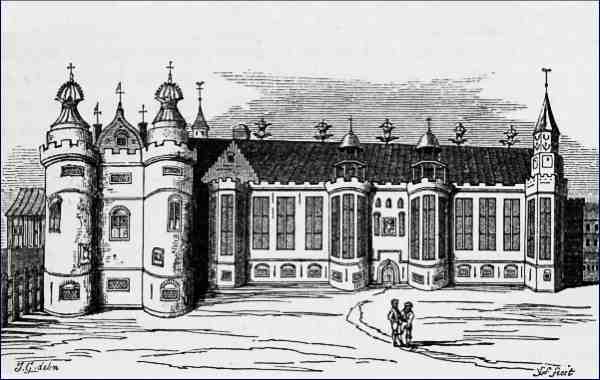
Holyrood Palace, as before the Fire of 1650.
‘In all parts of the land, where the English army come, the ministers fled, and the Lord’s houses were closed and laid waste; so that the word of the Lord became very precious to many.’ ‘The land [was] mourning, languishing, left desolate, every part thereof shut up, and no safe going out nor coming in ... the Lord hiding his face all this time for the sins of Scotland.’—Nic.
Dec.
‘I thought it good to remember here how that the names of Protestant and Papist were not now in use ... in place thereof raise up the name of Covenanters, Anti-Covenanters, Cross-Covenanters, Puritans, Babarteris, Roundheads, Auld Horns, New Horns, Cross-petitioners, Brownists, Separatists, Malignants, Sectaries, Royalists, Quakers, Anabaptists.’—Nic.
1651. May 6.
1651.
The bitter feeling of the ruling powers towards the English sectarian army was shewn in the way they treated any erring enthusiast who, in the spirit of dissent, sent information to Cromwell. One Archibald Hamilton, who acted in this manner, was ‘condemned to be hanged on a gallows in chains, so long as one bone could hang at another of him.’ We now find the son of an old acquaintance in their hands for this high offence. His father was that John Mean, a merchant of Edinburgh, who had been in trouble as a resister of Episcopal fashions in the reign of King James, and whom we have just seen in the capacity of post-master in Edinburgh.145 His mother was believed to be the identical female who cast the stool at the bishop’s head in St Giles’s Church, on the first reading of the Service-book in 1637. The delinquent confessed his guilt, and was condemned by a council of war sitting at Stirling; but as he was going to be hanged, the king pardoned him, ‘in respect his father, old John Mean, in Edinburgh, put him out to General Leslie as a knave and one corrupted by the English, and entreated him to cause apprehend him.’—Bal.
The son of a pair so peculiarly noted, being pardoned by Charles II. for treason in favour of Cromwell, is a curious conjunction of circumstances.
June 22.
Some idea of the enormous sacrifices made by Scotland to resist the English sectarian army, may be formed from a tolerably exact account, which has been preserved, of what was done in that cause by the county of Fife alone, between the 1st of June 1650 and the present date, being somewhat less than thirteen months.
1651.
In June 1650, when Cromwell was about to invade Scotland, Fife146 sent forth 1800 foot and 290 horse, the former ‘with four pounds of outreik money for every man, with a four-tailed coat, stockings and shoes,’ the latter at 300 merks each; being in all 151,800 merks. In the ensuing month, a second levy, precisely the same as the first, was made by the county. In September, 700 men were raised for the artillery force, with a third levy of 290 horse and 350 dragoons. In January, two regiments, amounting in whole to 2400 men, were raised in the county by the Earls of Kelly and Crawford, and to this force the county gave twenty-four pounds per man for arms and bounty. So much for the personal force contributed, being in all 7920 men out of a population which, so lately as 1801, was under 100,000. Then the county made large contributions of meal and other provisions, besides money, and also horses, for the use of the army; 5000 bolls of meal at one time, 3000 at another, 100 stone of cheese, tents, dishes, and axes, oats for the horses, quarters for ten horse regiments, and so forth. The sum of the whole was reckoned up to 2,395,857 merks, which we assume to have been equal to £137,309.—Bal.
It is difficult to understand how a province of a country so poor as Scotland then was147 could spare so much means towards even so cherished an object as the resistance of the English sectaries.
Sep. 1.
During the occupation of the southern parts of Scotland by the English army, Dundee had become the retreat of many of the principal people of the country, and a storehouse of much valuable property. On the Sunday before the battle of Worcester, it was assaulted by General Monk, who played upon it with battering-pieces all night, and in the morning entered and subjected it to massacre and pillage. Upwards of a thousand men and sevenscore women and children, are said to have been killed. ‘It is reported by credible men that the English army had gotten above twa hundred thousand pound sterling, partly of ready gold, silver, and silver wark, jewels, rings, merchandise and merchant wares, and other precious things, belonging to the city of Edinburgh, beside all that belonged to the town, and other people of the country, wha had sent in their guids for safety to that town.’—Nic.
This year was one of even greater dearth than the preceding, bear being £20 Scots per boll—equal to £1, 13s. 4d.—in many parts of the country. The best sack wine was 4s. sterling, and French wine 1s. 6d. per pint. The best ale 4d. a pint.148 ‘Yet God’s providence was such toward the nation, that even when our awn corns failed us, the English nation did bring in abundantly wheat, bear, peas, and such like, and brought down the dearth of our mercats, by [beyond] expectation.’—Nic.
Nov. 13.
1651.
James Somerville, younger of Drum and Cambusnethan, author of the Memorie of the Somervilles, was this day married to Martha Bannatyne of Corehouse, at Lesmahago kirk, he being nineteen, and she eighteen. The bridegroom’s own account of the affair: ‘A matchlier pair was not seen within the walls of that kirk this last century, nor a greater wedding—considering the great consternation the country had been in for some few months preceding—for nobility and gentry; there being one marquis, three earls, two lords, sixteen barons, and eight ministers present at this solemnity, but not one musician. They liked better the bleating of the calves of Dan and Bethel—the ministers’ long-winded and sometimes nonsensical graces, little to the purpose—than all musical instruments of the sanctuary, at so solemn an occasion, which, if it be lawful at all to have them, certainly it ought and should be upon a wedding-day, for divertisement to the guests, that innocent recreation of music and dancing being much more warrantable and a far better exercise than drinking and smoking of tobacco, wherein these holy brethren of the Presbyterian [persuasion] for the most part employed themselves, without any formal health or remembrance of their friends; a nod with their head, or a sigh, with the turning up of the white of the eye, served for that ceremony.’
1651.
It is pleasant to find that little more than two months after Worcester fight, it was possible to bring such a large and brilliant company to a wedding in Scotland. Even when the public at large is the stricken deer, there will be individual ‘harts ungalled’ who will ‘go play.’ Somerville’s description of his first visit to his bride’s house and of herself, is interesting. It was just after the rout of Dunbar, when the young Laird of Corehouse, who had been at that battle, spent a few days at Cambusnethan, and insisted on young Somerville accompanying him to the banks of the Clyde. ‘They set forth, weel furnished with hawks and dogs, which gave them much sport, the fields and ways between Cambusnethan and Corehouse being fitted for hawking and hunting. At night they came to the Corehouse, where they were courteously received by the lady, and modestly by the young ladies.... Martha, the youngest, was not seen till supper, and then came into the room in a plain country dress. The truth is, she needed nothing else, being always an ornament to her clothes when at the best.... At her age of fifteen complete, she attained to her full height, which was so far above the stature of most women, that she was accounted among the tallest of our nation, but so as that diminished nothing of her handsomeness, every part answering thereto, as a slender waist, large shoulders, big breast, henches full and round.... Her visage was long, her nose high, her brow brent and smooth as alabaster, her chin and cheeks somewhat full, with a little red, especially in hot weather. There was nothing bore so little proportion to her body as her hand and foot, both being extremely little, but weel-shapen, white and full of flesh. Her skin was smooth and clear, but what was covered not so white as I have seen several of her complexion that was purely sanguinean; her hair, being of a bright flaxen, which darkened as she grew in age, added much to her beauty; wherein there was no blemish, her mien being answerable to that, and her person gave occasion to those that saw her at church or any other public meeting, to assert she graced the place and company where she was. It has often been observed that, when this gentlewoman walked upon the street—which was but upon occasion, being better employed at home—the eyes not only of the men, but also of her own sex, was upon her, so far as their sight could serve them, admiring her parts and handsomeness.’—Mem. Som.
Nov.
The western clergy sought in their meetings to learn the cause of the heavy wrath which the Almighty was pouring out upon the land. ‘After long attendance, their resolutions ended in confusion, distraction, and division among themselves, prognosticating much more desolation on the land. Whilk did manifestly appear among all estates and ranks of people; for religion and justice being the twa pillars of the land, were houghed [tripped] and near drawn down.... There were no courts of justice, sic as the Secret Council, Session, and Exchequer sitting for the time. All our records and registers carried aff the kingdom to the Tower of London; the Lords of Council, Session, and Exchequer, with their clerks and members of court not daring [to] kythe149 in their strength for the use of the lieges, but, for fear of the English armies, were forced to abandon themselves; for the whilk cause the people of the land were forced to suit justice frae the English governors and commanders. As for Edinburgh, there was no magistrate there, nor no common council since the fecht at Dunbar; and therefore all petitions and complaints went to the captain of Edinburgh Castle and governor of Leith, wha in effect (to speak truly) proceeded more equitably and conscientiously in justice nor our awn Scottish magistrates.’—Nic.
1651.
We hear about this time of a paper given in by ‘a godly Scot’ to the Commission of the Kirk, alleging that the causes of the evils of the country lay, among other things, in the undertaking of solemn engagements unwarranted by the word of God, in a fleshly zeal in carrying on of these obligations by cruel oppressions for the constraint of the unwilling, and the idolising of individuals and receiving doctrine from them implicitly.150
At this very time, a lively controversy was going on between Sir Alexander Irvine of Drum, in Aberdeenshire, and the presbytery of Aberdeen, as to the title which the latter body assumed of controlling his spiritual interests. A quarrel had taken place between the parties regarding the settlement of an incumbent in Sir Alexander’s parish, and he had appealed from the power of the local court to the English commander, Colonel Overton—a proceeding which must have been deeply grievous to the presbytery. A sentence of excommunication having been consequently pronounced against the knight, he uttered a protest against it in animated terms. It proceeded, he said, ‘from men more full of fiery zeal to advance their own interests than the gospel of Jesus Christ.’ They had urged him by threats to subscribe the Solemn League and Covenant, ‘as gif it had been a matter of salvation for me to swear to establish by arms Presbyterian government in England.’ And not only would they have had him to forswear himself, but ‘they did urge with the like threatenings my wife and three young maids, my dochters, who, for their age and sex, are not capable of such politic theology.’ To make good their charge against him of being a papist—a ‘pretext to satisfy their restless ambition and execute their rage upon all who will not implicitly obey them’—they ‘enforced my servants to reveal upon oath what they saw, heard, or knew done in my house—beyond which no Turkish inquisition could pass.’ Sir Alexander, therefore, now appeared by procurator, declaring, ‘I separate myself from the discipline of presbytery, particularly that of Aberdeen, as a human invention that is destructive to the civil peace of Christians;’ further appealing them before Colonel Overton, or any other judge who shall be appointed by the English commissioners, ‘to hear yourselves censured and condignly punished for your open contempt of their authority, for your false slanders raised against me, and for your cruel proceedings and erring sentence of excommunication.’151
1651.
Whitelocke, in January 1652, quotes letters which speak of the ‘great pride and insolency of the presbyteries in Scotland,’ with particular reference to the Laird of Drum’s case. It is stated that the laird wrote a letter of thanks to Lieutenant-general Monk, ‘for relieving those who were oppressed in their consciences by the presbyteries.’ The Cromwellian army was on principle favourable to toleration, and adverse to all sorts of church-discipline. Monk was therefore ready to issue an order, ‘that no oaths should be imposed by any of the kirk-officers upon any person without order from the state of England, nor any covenant, and, if they do, that he will deal with them as enemies.... The provost and bailiffs of Aberdeen were to proclaim this.’
1651.
From a petition presented to the king after the Restoration by his son, the bitterness of Sir Alexander’s experiences throughout the troubles appears to have been much the same in character as that of which an example has been given in the case of Farquharson of Inverey. ‘His lands were the first of Scotland that were spoiled.’ He was ‘twice fined in £4000 sterling, his house of Drum four times garrisoned and at length totally plundered, and his wife and children turned out of doors.’152 For five years his revenues were detained from him by ‘one Forbes’—doubtless the same minion to whom the government had committed the fining of old Inverey.153 Another Aberdeenshire laird, Sir Gilbert Menzies of Pitfoddels, being really a Catholic, had come even worse off. Throughout the whole period of the troubles, not only were his lands taxed like those of his neighbours for the support of the Covenanting armies, but he suffered endless finings, quarterings, and repeated banishments, on account of his inability in personal sentiment to go along with the popular movement. It appears from a petition he presented after the Restoration, that fully £12,000 sterling had been extorted from his estate, leaving it greatly reduced in extent and ‘like to ruin;’ as a matter of course, he and his family had undergone the greatest poverty abroad, and in one of the flights made by his family from Scotland, his wife and one of his sons had perished in a storm at sea.154 We obtain from these historiettes, which are but examples of a large class, some notion of the grounds of the charges brought by cavalier writers against the men who, in all sincerity, believed they were establishing the reign of Christ upon the earth. Trusting to force for the attainment of the ideal which they had placed before them, they stirred up a spirit which made their object only the more unattainable.
Dec.
One good consequence of the English military rule now established in Scotland was the introduction of some improved police regulations into Edinburgh. Householders were compelled to hang out lanterns, from six to nine at night, at their doors and windows; by which arrangement, ‘the winter night was almost as light as the day.’ The expense was reckoned to be about forty-five pounds a night. Rigorous measures were also taken for the cleaning of the streets and lanes, and for preventing foul water being thrown forth from windows.
It would appear that these regulations were steadily kept up during the English occupation. In April 1657, there was a petition from the magistrates of Edinburgh to the commissioners of justiciary craving remission of certain fines, amounting in all to £50 sterling, which had been imposed on the magistrates ‘for not cleansing the streets.’ They alleged that they had ‘employed scavengers’ with a view to giving the commissioners satisfaction.—B. A.
Nicoll, writing towards the close of 1651, gives a second and most unflattering picture of the moral conditions of Scotland. ‘Under heaven,’ he says, ‘there was not greater falset, oppression, division, hatred, pride, malice, and envy, nor was at this time, and diverse and sundry years before (ever since the subscribing the Covenant); every man seeking himself and his awn ends, even under a cloak of piety, whilk did cover much knavery.’ He adds: ‘Much of the ministry, also, could not purge themselves of their vices of pride, avarice, and cruelty; where they maligned, they were divided in their judgments and opinions, and made their pulpits to speak ane against another. Great care they had of their augmentations, and Reek Pennies,155 never before heard of but within thir few years. Pride and cruelty, ane against another, much abounded; little charity or mercy to restore the weak, was to be found among them.... This I observe not out of malice to the ministry, but to record the truth, for all offended, from the prince to the beggar.’
1651.
It is instructive to observe that no sooner had the ecclesiastical system recently paramount received a blow, than dissent, so long repressed, began to make itself heard. Nicoll notes that ‘much hypocrisy and falset formerly hid did now break out amang our Scots, wha, leaving their former principles of religion, became papists and atheists.’ Many sought favour with the English by supporting their rule, advising that liberty of conscience which was regarded with such abhorrence by the Scottish church, and calling for a restraint to be put upon the power of presbyteries as ‘anti-Christian and tyrannical.’ ‘Others vilipend the Covenant, holding it lawful for all men to break it, as being ane human institution;’ at the same time denouncing many of the clergy as not worthy to teach, declaring the Sabbath to be unnecessary, and propounding that children should not be baptised ‘till they could give confession of their faith.’