"Dick Cheveley" (continued 5)
Reading edition
I had read enough about shipwrecks and disasters at sea to be aware that such a circumstance sometimes occurs. The end of a plank called a butt occasionally starts away from the timber to which it has been secured, and the water pressing its way in, opens the plank more and more, till the sea comes in like a mill-sluice; and unless the damage is at once discovered, and a thrummed sail is got over the spot, there is little chance of a ship escaping from foundering. When a butt starts from the fore end, and she is going rapidly through the water, her destruction is almost certain, as a plank is rapidly ripped off, and no means the crew possess can prevent it. Though I had heard crashing noises which had made me fear that the masts had been carried overboard, yet I judged from the movement of the ship that they were standing. She was seldom on an even keel, but when she heeled over it was always on one side. As yet all the strain to which she had been subjected had produced no leaks, as far as I could judge from the small quantity of water in the hold, and that was chiefly what had come out of the butt. Had I not put the remnants of the olives and biscuits in my pockets I should have starved. When hunger pressed, I took a small portion, sufficient to stop its gnawings. I suffered chiefly from thirst, as I was afraid of getting up to go to the water-butt, lest I should be thrown over to the opposite side after I had drawn out the spile, before I could catch any water as it spouted out, and that much of it would be lost. I felt the necessity of economising my store, for I so mainly depended on it for existence, as it enabled me to subsist on a much smaller quantity of food than I could have done without it. At length I could bear my tortures no longer, but getting up, cautiously crawled towards the butt, stopping to hold on directly I felt the ship beginning to give a lurch.
I must again observe, that close down to the keel as I was, I felt this much less severely than I should have done at a higher level. I went on, until I believed that I was close to the butt, then waiting for another lurch. Directly it had taken place, I drew myself carefully up, and searched about for the spile. I found it, and drew it out, and let the water spout out into my mouth. How I enjoyed the draught. It restored my strength and sadly flagging spirits. I stopped to breathe, and then again applied my mouth to the hole. I should have been wiser had I refrained, for before I could drive in the spile I was hove right away to the opposite side of the hold, almost into the opening of the water-butt which had burst. I could hear the water rushing out, and it was some time before I could recover myself sufficiently to crawl back to try and stop it. I was almost wet through before I could accomplish this, though I had to mourn the loss of no small quantity of the precious fluid. My purpose accomplished, I made my way back to my couch. Hours passed by. Sometimes I would fancy that the storm was never to end. In my disordered imagination, I pictured to myself the ship, officers, and crew under some dreadful doom, destined to be tossed about on the wide Atlantic for months and years, then perhaps to be dismasted and lie floating motionless in the middle of the Sargasso Sea, of which I had read, where the weeds collect, driven by the current thrown off by the gulf-stream, till they attain sufficient thickness for aquatic birds to walk over them.
I remembered the description that Mr Butterfield had given me of the captain of the “Emu.” I thought, perhaps, that he had committed some dreadful crime, and was being thus punished for it. The only one of the crew whom I remembered, Gregory Growles, was certainly a bad specimen of humanity. Perhaps, though pretending to be honest traders, they were pirates; and even when I had obtained my liberty they would not scruple to make me walk the plank, should my presence be inconvenient. I cannot, however, describe the hundred-and-one gloomy ideas which I conjured up. How far they were from the truth time only was to show. The ship continued her eccentric proceedings with more or less violence. The tempest roared above my head. Crashing sounds still rose from the cargo which had shifted, and which it appeared to me must ere long be smashed to atoms. The worst of the matter was, that I had no one to blame but myself. Had I been seized and shut up in the hold by a savage captain, I should have felt myself like a martyr, and been able to lay my sufferings on others. When I was able to reflect more calmly on my situation, I remembered that the storm must inevitably some day or other come to an end. I had read of storms lasting a week, or even a fortnight, and sometimes longer, but if I could hold out to its termination, as by means of the biscuits and olives I might do, I hoped that I should at last effect my liberation. I must not, however, take up more time by further describing the incidents of this memorable portion of my existence.
Chapter Thirteen.
Still in the hold—Dreamland again—Chicken-pie—Return of the rats—I improve my plans for catching them—Two rats at one meal—My state of mind—“Mercy! Mercy!”—While there’s life there’s hope—I recommence my exertions to get out of the hold with some success—Purer air—My weakness returns—I recover my strength—Still no outlet—I perform my ablutions—My desire to live at all hazards returns—“Where ignorance is bliss ’tis folly to be wise”—The yarn of Toney Lawson—The evil effects of getting drunk—The “Viper”—Toney obliged to give in—Toney’s thoughts of escape—The fate of the “Viper” determines the question—Toney’s wonderful escape.
Perhaps one of the most painful circumstances connected with my imprisonment was the impossibility of calculating how the time went by.
I remember that I suddenly awoke after dreaming that I was at a jolly picnic with old friends near Roger Riddle’s cottage. That the cloth was spread with pies and tarts, a cold sirloin of beef, a dish of fowls, and a tempting ham, and that we were eating and drinking, and laughing and singing, in the merriest way possible. I had just had the breast and wing of a chicken and a slice of ham placed on my plate, and was running over to get the mustard-pot, when to my surprise it became covered with feathers, and off it flew. I was jumping up to catch hold of it, not wishing thus to lose my dinner, but instead found myself in total darkness, and gradually came to the disagreeable consciousness that I was in the hold of the “Emu,” and that I had only a few small biscuits and three olives remaining of my stock of provisions, independent of the pickles in the corner of my handkerchief.
The ship, however, was perfectly quiet. The gale must have ceased some time before, to allow the sea to go down. By putting my ears to the planks I could catch the sound of a gentle ripple as she glided along, but no other noise was to be heard. The bulkheads had ceased to creak, the masts to complain, the cargo to crash, and all was perfectly quiet overhead.
My hunger showed me that I must have been a long time asleep, and I could not resist the temptation of eating the remainder of my biscuits and olives. I had thus only the pickles to exist on, unless I could catch some rats with which to eat them. I took a draught of water, and then sat down to consider the plans I had before thought of to trap my game.
One occurred to me as the most feasible. Though I could not see I could feel, and my idea was to form a bag with a piece of the canvas, and give it a small mouth so contrived that I could close it suddenly with a string. Among the articles in my pocket was a stock of string of various thicknesses; I found on measuring it that I had not only sufficient to make the bag, but enough to gather in the mouth with an additional piece to hold in my hand. My gimlet would serve as an awl or sailmaker’s needle, though not an efficient substitute. I had been so long accustomed to the darkness that I fancied I could pass the string through the holes I had made without difficulty. My hunger was an incentive to perseverance.
With my knife I first of all cut a piece off my canvas of sufficient size for my purpose. I am sure that I could not have done it so well at any time before, had I attempted to perform the operation in the dark. I then turned in the edges, and passing the string through the holes I had made, united the two sides. Sometimes I could not get the string through without another boring, at others I succeeded at the first attempt, tying the string at each stitch. It was a slow operation, but the result was beyond my most sanguine expectations.
I had a long, thickish piece of hard twine, which I devoted to the mouth of the bag. I had to make the holes for these with great regularity, so as not to leave an opening large enough for a rat to jump out at. I worked on without stopping till my task was accomplished, as I was anxious to ascertain whether it would answer the object I had in view.
While I was working I heard the rats running about, and two or three knocked their noses against my feet, showing that they had again come out of their holes, and were either hunting for food or gambolling for their pleasure.
I had, however, retained a small piece of biscuit in my pocket, which, although I longed to eat it up, I had sufficient resolution to devote as a bait to the rats.
Placing myself near the shattered butt, which seemed to be the spot most numerously frequented by them, I put down the bag with my foot at one end of it, holding the string in my hands, and leaving only a very small opening, which I could close of a sudden.
I waited eagerly. Rats ran about near my feet, leapt over the bag, and skipped and frolicked, uttering squeaks of delight. Still none came actually into the bag. At last one more curious than his fellows poked his nose into the opening. I felt him running along inside, having discovered a biscuit within. With a sudden jerk I quickly closed the mouth of the bag. I felt about with my fingers, and soon came upon Master Rat inside. As I didn’t wish to give him the opportunity of biting me, I grasped him tightly by the neck, and squeezed out his life.
After drawing him out, I again put down the bag to tempt some more of his kindred, while I held him up by the tail. In a few minutes I felt others approaching, curious to explore the interior of the bag. I again gave a sudden jerk, and found that I had caught no less than three, who, as they felt themselves drawn up, began fighting and biting at each other, and would, I believe, had I not speedily put them out of existence, have been like the Kilkenny cats, and left only their tails behind them.
I had now ample food, though not of the character most people would have desired, and had also a bag to keep it in. I soon disposed of the first rat, with which I ate some small pieces of pickle as a relish, and I must confess that I enjoyed my meal amazingly. To me it appeared of a peculiarly delicate character. I could have eaten another rat with perfect satisfaction, but I considered it prudent to wait, so as not to give myself a surfeit.
Before long, however, I was again hungry, and on this occasion I ate two rats with some small pieces of pickle and drank a pint or more of water.
I now felt sufficiently strong to recommence my attempt at escape. I was prepared for difficulties of all sorts, as I knew that the cargo had been much displaced during the storm. I have so often described my journeys to and fro, that I am afraid of becoming wearisome, but I must mention what now took place.
As I made my way along I tumbled over several things which had not been there before, and had evidently been thrown out of their places by a violent jerk of the ship. At last I got to the bulkhead through which with such infinite pains I had previously made my way. What was my dismay to find it stopped! Human hands could certainly not have put the obstacles there that I found. As I was feeling about I discovered a huge case of some sort which had been thrown down from above, and stopped up the way. It was not likely that my strength would be able to remove it.
After feeling about to ascertain if there was any opening at the side or top through which I might squeeze myself, and finding none, I returned for my handspike, thinking that I would at all events try to force the case on one side or the other. It was so large, however, that when making the attempt I could not move it in the slightest degree, and after trying in all ways, I had to abandon the enterprise.
I had been sensible of the greater closeness of the atmosphere, and I had now no doubt that the case prevented the air which descended from above from circulating through the hold as it before had done. The temperature also, I had no doubt, was increasing as the ship got into more southern latitudes, and I had some fears of being stewed alive. I was already streaming with perspiration from my efforts.
I was, indeed, in a weak state, which was but natural, so that I was unable to undergo any exertion without feeling far more exhausted than I had previously done. Sick and weary, I returned to my resting-place. I was seriously afraid of falling really ill. If I did so, what hope could I have of escaping? The olives and pickles and biscuits, which had hitherto preserved me in health were exhausted. Rats’ flesh might serve to keep me alive for a few days, but alone would certainly be very unwholesome. I was already beginning to feel a repugnance to eating it. Perhaps this was in consequence of my having devoured two rats at one meal.
My chief refreshment was cold water, and that I found a great luxury. I must have swallowed prodigious quantities of it, still the butt held out; though, if my imprisonment lasted much longer, that also must come to an end. I had never heard of hydropathy, but I was heartily willing to sing its praises, and I have ever since been a resolute water-drinker.
I lay down to rest after my exertions, but my cogitations were not of an agreeable character. I was in different moods. Sometimes I thought that I would abandon all further attempts at escaping, and yield to my fate; then I would shout out as loudly as my weak voice would allow: “Help! Help! I am dying! Help! Help! Will any one come to take me out of this place? Mercy! Mercy!” Finally a more courageous spirit animated me. “I’ll not yield while I have life!” I exclaimed. “I’ll cut my way with my knife through case after case, and draw out the contents so that I may make a passage through them.”
I got up, feeling resolute and bold, taking my knife and my handspike with me. I had no means of sharpening the blade of my knife except on a hard piece of oak, and that was not very effectual.
On reaching the place where the opening had been, I felt all over the side of the chest. It didn’t feel to be as even and regular as I had expected to find it. I began at once to use my knife, so as to cut a hole into the centre. As I pressed against it, the plank yielded slightly. The operation must inevitably be a long one, so instead of cutting on I took the handspike, and dealt several blows as hard as I could strike. The first blow I struck produced a creaking sound. I renewed my efforts. The plank began to give way. I struck again and again. The side flew inwards. I then struck about so as to knock off the splinters. I crept through the opening thus made, and from the articles I then found I was convinced that it was the old crate through which I had before made my way, and which had fallen down in front of the opening. I was sure of this when I found that I could creep out through the smaller fracture on the opposite side.
Still I was not free. No light permeated between the bales and packages. I felt about, but could not recognise any of the things with which I was before acquainted. Many of the packages appeared so placed that I might, without great care, bring them down on myself. Still, being thus far free, I determined to persevere. I thought that if I could once more get near the hatchway, I might be able to shout and make myself heard. I tried in all directions to find an opening. At last I thought that I discovered one at the spot from which the crate had fallen. I clambered up one huge bale, then got on another, and I was then on a higher level than I had been since I first fell into the hold. I was rejoiced at the prospect of liberating myself, when a faintness came over me, and I sank down on the top of the bale.
As I thus lay I pictured to myself the crew above me going through their usual avocations. I fancied that I could even hear their footsteps on the deck, as they walked about or hauled at the ropes. I was sensible of a gentle movement of the ship, which instead of tumbling furiously about, was gliding on, rising and falling slowly to the sea. The air was purer than that in the part from which I had made my way, and I could breathe more freely. Had my strength been sufficient I should have again shouted, as I felt sure I must have been heard, but when I attempted to raise my voice it failed me altogether. I could scarcely utter an articulate sound. I tried again and again, but in vain. I was conscious that I was becoming weaker and weaker.
One thing I was determined on, and that was not to return to the dreadful hold. I looked back at it with horror, and I shuddered to think of the amount of rats’ flesh I had eaten. Yet in many respects I was not better off than before. I had not found any food. My position might be perilous in the extreme, for I could not tell what was around me. I might, should a sudden breeze come on, be thrown back again to the bottom of the hold. For some time I could not move, or exert my mental or physical powers. I again thought that I was going to die; but I was not really so weak as I supposed, for at length, a desire to live returning, I raised myself and tried once more to work my outward way. I could find no outlet, and as my voice had failed me, I was unable to shout, but I could manage to move about. I was very thirsty, and notwithstanding my previous resolution not to return to the lower part of the hold, I thought the wisest thing I could do was to go down and get a draught of water. I believed that I could easily find my way. I let myself down off one bale and then another, till I came to the crate. I crept through it, and curiously enough I felt as if I had returned home. I walked up to the water-cask as if it had been an old friend, with delight, and took a draught of water. It was cool and refreshing, and revived me greatly. I felt hungry; I had hoped never again to eat another rat, but the keenness of my appetite overcame my scruples, and I took one out of the bag. I even thought of placing the bag ready to catch some more. I, however, only ate one of the creatures, though not without difficulty, in spite of my hunger. I then bathed my face and washed my hands, to look a little more respectable should I ere long make my appearance among the crew. For this purpose I withdrew the spile, and allowed the fresh water to trickle first over my hands, and then over my face. This still further refreshed me, and I wished that I had performed a similar operation oftener. Had I not suspected that the water at the bottom of the hold must have been by this time very foul, I should have taken off my clothes and had a bath.
I refrained, however, from doing this, and contented myself with the pleasant sensation of feeling cleaner than I had been for a long time. I suspect that had I had a looking-glass placed before me, I should not have known myself. On feeling my arms and legs, they seemed like those of a skeleton; my cheeks were hollow, and my hair long and tangled. The rat which I had last eaten had dulled the sense of hunger. I felt a peculiar sensation afterwards, which convinced me more than ever that I could not long exist on rats’ flesh. I fancy that I might have been wrong.
It was night when I made my last attempt to get upwards, so I thought that I would take a sleep and renew my efforts in the daytime, when I should have a better chance of attracting notice should I get near the hatchway. I accordingly lay down to rest, hoping that it would be the last time I should have to sleep in the hold. I took only short snatches of sleep.
When I awoke I lay for some time without moving, and could not help thinking over and over again of the events which had occurred since I left the quay at Liverpool. I knew that the end of my confinement must be approaching in some form or other; I should either die, or be restored to the open air. In spite of the wretched condition to which I had been reduced, I had a strong wish to live. I especially wanted to go back to assure Aunt Deb that I had not intentionally run away, and also to relieve the minds of my father and mother, and brothers and sisters, of the anxiety I believed they must have felt on my account. Suddenly also I remembered with painful distinctness the remarks Mr Butterfield had made respecting Captain Longfleet, the commander of the “Emu,” and his ruffianly crew. Certainly their appearance was not in their favour; and old Growles, who had received me so surlily, was not a good specimen of British seamen. What if the ship should prove to be a pirate, instead of an honest trader? I had heard of the crews of vessels, fitted out at Liverpool, assisting slavers on the coast of Africa in carrying out their nefarious trade, some committing all sorts of atrocities.
Should the “Emu” prove to be one of these, even if I were not hove overboard, I might be sold as a slave in the Spanish possessions, perhaps to labour in the mines among the hapless Indians, who are thus employed by their cruel taskmasters. “Where ignorance is bliss, ’tis folly to be wise,” and I should have been much less anxious had I not heard so much about such things. I remembered especially a yarn old Riddle told me one day about a messmate of his, Toney Lawson. I may as well try to give the yarn in his own words, though that may be a hard matter, and I can scarcely hope to do full justice to his narrative.
“Toney, d’ye see, was once on a time knocking about Plymouth, after he had been paid off from the ship he last sailed in, when who should he meet but Joe Gubbins, who had served with him for many years gone by. Joe had always been a wild slip of a fellow when he was a youngster.
“Said Joe to Toney, ‘What are you doing in these ’ere parts, old Ship?’
“Toney told him how he had been paid off and had pretty well emptied his pockets of shiners, and was thinking that before long he must join another craft.
“‘That’s just what I was a thinking of too, so just step in here, mate, and we’ll have a talk about the matter over a glass or two,’ and he pointed to the door of a public-house which stood temptingly open to entice passers-by.
“Toney was not one of those chaps to get drunk on every occasion, but he had no objection to good liquor when it came in his way. So, intending to pay for what he had, he went in with Joe. Joe boasted of a craft he had served aboard—a privateer, he called her. She had taken no end of prizes, and had made every one on board her as rich as Jews, only somehow or other they didn’t keep their money as well as Jews did, ‘and that’s the reason why my pockets ain’t lined as well as they were a few weeks ago,’ observed Joe. Toney, who was a steady sort of a man, didn’t quite like the account Joe gave of the ‘Viper’s’ cruise Joe was talking about.
“‘Why, to my mind, she’s no better than a bloodthirsty pirate,’ he said.
“Joe laughed. ‘You’re too particular, mate,’ said he. ‘’Tain’t no worse than many another crew afloat.’
“However, he didn’t press the point any longer, but emptying his glass, called upon Toney to drink up his, and ordered more and more liquor in, when Toney said he would not take another drop. At last Toney didn’t know what happened except that he found himself slipping off from his seat on to the sandy floor, and could not, for the life of him, get up again. He thought it would be better to go to sleep where he was, so he coiled himself away to have a snooze. When he woke he tried to recollect what had happened.
“He remembered that he had been sitting with Joe Gubbins, and that he somehow or other got down on the floor, so he felt about, thinking he was there still. But all was dark; and instead of a sandy floor and the legs of the tables and chairs, his hand touched only some hard pitchy planks. He stretched out his arm as high as he could, and found that there was a deck close above him. He crawled along, and came right against a bulkhead. He knew then that he must be on board a craft of some sort. He was not a man to make a fuss about nothing; and as he was still only half awake, he thought he might as well turn round and go to sleep again.
“When he roused up a second time, he felt the vessel moving to the heave of the sea. He had been too long afloat not to know that she was making good way through the water with a fresh breeze. As he was getting somewhat hungry, he didn’t want to be any longer down in the hold. He thought it was time to sing out and let those on board know where he was. Having a good pair of lungs of his own, he shouted pretty lustily, but no one came near him, nor hailed him.
“‘This seems a curious job,’ he said to himself; ‘have they taken me for a bale of goods and hove me down here to stay till they discharge cargo?’
“Presently he heard the sound of a gun fired overhead; right aft, he judged, for he knew well enough by the movements of the vessel which way she was going. Then another, and another followed; then came a cheer, though he heard it but faintly down where he was. The guns again went off. He guessed that the craft he was on board of was being chased, and that the cheer was given because the crew had knocked away some of the enemy’s spars. He could hear two or three shots strike the hull of the vessel, so he knew that they were not having the game all to themselves. Being fond of fighting, he wished that he was on deck to take his share in it. There was no use wishing without trying to get out, but whichever way he moved he found a strong bulkhead.
“Though he kicked with all his might he could not start a plank. He tried again and again, till every muscle in his body ached. At last he had to give it up. His temper was not growing very sweet, as may be supposed. He began to think whether it was Joe Gubbins that had brought him aboard, for he didn’t come of his own accord, of that he was certain. He vowed that he would pay Joe off whenever he fell in with him. At last the firing ceased. He felt, by the quiver running through every plank and timber that the craft was carrying as much sail as she could bear. There was no more cheering, and he could not tell whether she had got away altogether, or was still trying to escape from a big enemy. He tried to fancy why he was kept down there all this time. He supposed that he had been forgotten by whoever brought him aboard. He could not tell whether the vessel was a king’s ship or a privateer, but that she was not a merchantman he was pretty sure. Perhaps, if she was a man-of-war, or a privateer, she was being chased by a Frenchman, but if she was a pirate she was more likely to be running from an English frigate than any other. Still it was not likely that a pirate would venture into Plymouth Sound.
“In either case Toney didn’t relish the thoughts of being captured. In one there would be a French prison in store for him, and in the other a man-of-war captain would not believe that he had been brought aboard against his will, and would declare that he had stowed himself away to escape. At last he got so hungry that he began to fear he should be starved to death. He tried another shout. His voice didn’t reach those on deck. He knew by this time that it must be night. Having nothing better to do, he was going off to sleep when he heard a bolt withdrawn from the outside, and a light streamed in to where he lay.
“‘Who are you?’ he asked, springing up and knocking his head against the deck above him with a force which sent him backwards.
“‘I’m coming to see how you’re getting on, mate,’ answered his visitor.
“‘Badly enough,’ said Toney, ‘I’m as hungry as a shark, and don’t like being shut up down here. Who are you?’
“‘I’ve been sent down here to ask if you’ll, like a wise man, join this craft. She wants hands, and as you’re well-known to be a good seaman, you’ll get a good berth aboard.’
“‘I never join a craft unless I know what sort of a captain and messmates I’m a-going to have,’ said Toney.
“‘There are times when a man mustn’t be over particular,’ said his visitor. ‘You’re a fool if you don’t say yes, so just come on deck and sign articles. You’ll learn all about this craft afterwards.’
“‘No, no,’ said Toney; ‘I never buy a pig in a poke. Tell me what? Want to know, then I’ll tell you whether I’ll join or not.’
“‘You’ll join, whether you like it or not,’ said his visitor with a growl. ‘You’ve chosen to come aboard, and we don’t allow idlers.’
“‘I didn’t choose to come aboard,’ said Toney. ‘Somebody brought me aboard when I was obfuscated, I suppose, and I’ll have a reckoning with that somebody before long.’
“‘If that’s your notion you’ll stay where you are,’ said his visitor, and he slammed the door and bolted it.
“Toney was a determined fellow, but there was one thing he couldn’t stand, and that was hunger. He got worse and worse. He could not sleep, and he could not shout out. By the time his visitor came again he was as meek as a lamb.
“‘Are you going to join or are you not?’ was the question.
“‘I give in,’ said Toney.
“‘Come along then,’ said his visitor.
“Toney crawled out and up the ladder of the main hatchway. He found that he was on board a brigantine, a rakish-looking craft, with several officers standing aft by the captain, and a numerous crew, among whom he saw Joe Gubbins. He couldn’t help lifting his fist and shaking it at Joe, who stood with a brazen face looking as if the threat could not be intended for him.
“‘Are you hungry, my man?’ asked an officer, whom he supposed to be the captain.
“‘Can’t say but what I am,’ said Toney.
“‘Then there’ll be plenty of grub for you when you’ve signed these articles.’
“‘Should like to know what they are, sir,’ said Toney.
“‘There’s the book; you may read them,’ said the captain. ‘Put your name down at the bottom of the page.’
“Now Toney was no great hand at reading or writing. He could just manage to scrawl his name. He tried to make out what the articles were about, but it was more than he could do.
“‘Come, my man, are you ready for your grub?’ asked the captain.
“Toney felt as if he should drop if he didn’t get something to eat, and just then a whiff from the galley came across his nose. He took the pen and managed to write his name, in a fashion.
“‘That’ll do, my man,’ says the captain. ‘You’re now one of the crew, and under my orders. We’ve pretty strict discipline aboard here. There’s the yard-arm, and there’s the sea alongside.’
“Toney was now allowed to go forward and enjoy a good blow out, which he much needed. He felt more like himself afterwards. He soon showed that there was not a better seaman aboard.
“Nothing particular occurred to show the character of the vessel. Joe kept out of his way until he got into a better temper, and they became very good friends again. They ran to the southward till they were in the latitude of the Guinea Coast, when they fell in with a craft, into which they discharged part of their cargo in exchange for some bags of gold. They now carried on in a strange way, chasing several vessels, capturing some and taking their cargoes out of them, in spite of what their crews could say, afterwards putting them on board a Spanish or a Portuguese craft and getting doubloons in exchange. Their guns and their numerous crew made resistance impossible. They were wonderfully successful in their proceedings, until one day they fell in with a British frigate and had to up stick and run for it. The African coast had become too hot for them, so they stood away for the Caribbean Sea and Spanish Main. Here they carried on worse than before. The crews of all vessels which resisted were made to walk the plank, and the vessels, after everything had been taken out worth having, were sent to the bottom.
“Toney, being an honest man, could not stand this; but he knew that, being tarred with the same brush, if taken he would share the fate of the rest. He determined to cut and run on the first opportunity. A strict watch was kept on him; and Joe, who knew his thoughts, hinted that the yard-arm would be his fate if he made the attempt and failed. Still he was resolved to try and get off, but the matter was settled for him in a way he little expected. The brigantine, during a heavy gale one night, was struck by lightning and blew up, Toney and two others only finding themselves floating among the wreck. Joe Gubbins was one of these. Toney managed to get hold of the mainmast and clambered into the top, where he got his legs out of the water and was trying to help Joe Gubbins, when Joe, with a shriek, disappeared. The other man shared the same fate. Toney expected to die, but the next day he was picked up by an English sloop-of-war; and as he took care not to give a very clear account of the craft he had been aboard of, he was allowed to enter as one of her crew. Here he met Roger Riddle, to whom he gave the account of his adventure.”
I thought to myself perhaps the “Emu” is employed in the same sort of trade as the “Viper,” and if so, I shall be as badly off as Toney Lawson.
Chapter Fourteen.
The hold—My provisions become exhausted—A fresh attempt at escape—Pressed by hunger, I persevere—The spar-deck—Not out yet—A ray of light—My prostrate condition—My mind gives way—A curious trio—The main hatchway—Fresh difficulties arise—A last effort—I am rescued—Ghost of a ghost—I make a new friend and meet with an old one—The crew of the ship—My new quarters—I receive a piece of advice from my new friend—Mark’s adventures, and how he came aboard the “Emu”—Poor Jack Drage—Mark gets into trouble.
The recollection of Toney Lawson’s adventure didn’t tend to make me feel any more comfortable than before. I could scarcely hope to be as well off as he was, or to have so fortunate an escape. My provisions being exhausted, I was aware that I must soon get out of the hold or perish, yet I didn’t anticipate much satisfaction from obtaining my liberty. No time was, however, to be lost, and I therefore nerved myself up for a fresh struggle. Feeling that I had my knife about me, and having put on my shoes, I prepared to make a desperate attempt to effect my escape. I crawled on through the crate, and once more attempted to climb up over the packages into the main hold.
I tried to do this in several directions, but I found no opening so promising as the one which I had before explored. My weakness prevented me from making the exertions that were required to force my way between the bales. I was in momentary fear of falling down a crevice, and being jammed to death. My situation in some respects was infinitely worse than that of Toney Lawson, who was bolted in, but then people knew where he was. No one on deck was aware of my deplorable condition. Still I crawled on, resolved to succeed. While feeling about, I discovered a space between three or four bales. I crept in very much as a rat does into his hole, only he knows where he is going. I could not tell whether I should get through or have to force my way out again legs first. Still the cravings of hunger induced me to venture. On I crept, when on putting up my hand I found that there was nothing above me which I could touch, so that I was able to stand upright, though there might be some depth in front down which I might fall.
I moved with the greatest caution. It turned out, however, that they were only bales piled one upon another, and that I was standing in a sort of well. Still there were stepping-places, and with the ropes which bound the bales I was able to work my way upwards. Higher and higher I got. I could now distinctly hear the footsteps of the men on the deck, which I guessed, therefore, could be no great distance above me. The ship must have been moving calmly along, and I was thus preserved from being jerked off from the place to which I was clinging. I still moved on till I reached a part of the hold filled chiefly, it appeared to me, with large packing-cases and casks. I was almost on a level floor. It might have been the spar-deck. Wearied with the fatigue I had undergone, I sat down on a box to rest. I could now distinctly hear not only the tread of the men’s feet, but their voices. They were the first human voices which had reached my ears for days, or rather weeks. I tried to shout to attract their attention, but my voice had completely failed me. Not a sound could I utter. I felt that I had not strength to move an inch further.
Twice I made the attempt, and had to sink back again on my seat. I was gazing upward, the only direction from which help could come, when a ray of light streamed right upon me. Forgetting my weakness, I started up. It must come, I knew, from the partly open hatchway, or from a fracture in the hatch itself. This I afterwards found to have been the case, the fracture being covered up with a tarpaulin, which had at that instant been removed. Again I endeavoured to shout out, but my voice was not under the control of my will. No sounds issued from my mouth. I stretched out my hands in an imploring attitude, fancying that I should be seen. I attempted to make my way directly under the opening, but ere I could reach it I sank down utterly exhausted.
I had never before been so completely prostrated. I didn’t lose my senses, but all physical power had deserted me. I could scarcely move my hands or feet; still I thought that the hatch must be again opened before long, and that I could not fail to be discovered. I earnestly prayed that help might be sent me. How it was to come I could not tell. Notwithstanding what was before me, I still desired to be set free. Although I was not sleeping, strange fancies filled my brain. I saw people flit about in the darkness, suddenly coming into the light, and then disappearing. Some were people I knew, and others were strangers. Aunt Deb and Mr Butterfield came by, tripping it lightly, holding each other’s hands, he in a bob wig with a sword by his side, she in high-heeled red shoes and a cap decked with flowers and ribbons. She smiled and ogled, as if about to dance a minuet. I almost laughed as I saw them, they appeared so vivid and real. Then Captain Longfleet came upon the scene as I fancied him, dressed in a cocked-hat and feathers, a long sword buckled to his side, high boots, a red coat, and a waistcoat braided with gold.
I fancy that I must have seen some picture of the sort of a pirate captain to cause him thus to be presented to my imagination. He walked about flourishing his sword till he met Aunt Deb, to whom, instead of cutting her head off, as I thought he was about to do, he made a profound bow, and then vanished. Many other figures quite as bizarre and unnatural appeared before me. I mention these trivial circumstances to show the state of my mind. I had been so long by myself that I must be pardoned if I appear egotistical. Again all was quiet. I lay for some time, if not unconscious, with very little power of thought. I was afraid that another night would come on, and that I should have to endure my sufferings for some hours longer, if death did not put an end to them. I could still hear the tread of the men’s feet, and even the voices of the officers, shouting their orders. How I wished that I could shout also, for then I knew I should be heard. I tried once more to move, and managed to drag myself on till I got directly under the hatchway. Although I could not shout, to my surprise I heard myself groaning.
There being light sufficient to enable me to observe objects, my eye fell upon a loose piece of wood. I grasped it with all my remaining strength, and began beating away on the top of a cask, which proved to be empty from the sound which emanated from it. I beat on and on, but no notice appeared to be taken of the noise I was making. I was too ill and weak to reason on the subject, but I remembered hearing a loud voice shouting out some orders. Presently there came a tramp of feet overhead, backwards and forwards and from side to side they seemed to run. The crew were evidently engaged in shortening or making sail, which it was I was unable to tell. I had sense enough remaining to know that whilst this was going forward on deck it was not likely that notice would be taken of my feeble knocking, for feeble it was, though it sounded loud to me.
Presently I felt a greater movement than I had experienced for some time, and the ship heeled over on one side. My fear was that the cases on which I lay might be again shifted, and that I might be thrown down to some lower depth of the hold, with bales and casks above me. Of course I am describing what I fancied might happen, not what was likely to occur. I now guessed that a number of the crew must have gone aloft to shorten sail, and that even if they had heard the noise they would not have had time to ascertain what had caused it. I now more than ever feared that, before I could be liberated, I should become utterly exhausted, and should fall into a swoon from which I might never recover.
I was too weak to pray, or any longer exert myself. Still my senses did not altogether desert me. I lay on my back, looking up towards the hatchway. The ship heeled over more and more. To me, who had been accustomed to live so long down near the keel, it appeared at a frightful angle, and I though, she would go over altogether. Again I heard voices shouting out orders, and the crew, I supposed, went aloft to take in more sail. I was afraid that another storm was coming on. Fearful would be the consequences to me if such should be the case. Presently I heard something dragged over the hatchway. The ray of light which had hitherto tended to keep up my waning spirits was obscured.
A tarpaulin had been placed over the hatchway. Perhaps the crew were about to batten down the hatches. In vain I tried, while this was going forward, to strike the cask. I had not sufficient strength to do it. A fearful faintness was coming over me. Perhaps the movement of the ship contributed to this. I think I must have fainted, for I cannot recollect what happened. I had no strength to hold on or to grasp the stick, and might have been thrown helplessly about like a shuttlecock till life was extinct.
I fancy that some time must have passed. When I recovered my senses, my first impulse was to feel for the stick. It was close to me. I had power to grasp it. The top of the chest on which I lay was perfectly level, but I expected to find it heeling over as before. Instead of that, no movement took place. The ship was apparently gliding forward on an even keel. The storm had ceased, or probably the ship had only been struck by a sudden squall, which had passed over.
My first impulse was again to try and strike the cask and to shout out, but I could only utter a few low groans. I managed, however, to give some blows on the cask, which resounded through the hold. The noise was loud enough, I fancy, to be heard on deck, or indeed in every part of the ship. I beat on and on. Presently the tarpaulin was drawn off, and I heard some feet moving directly above me. A voice said distinctly, “Below! What’s that?”
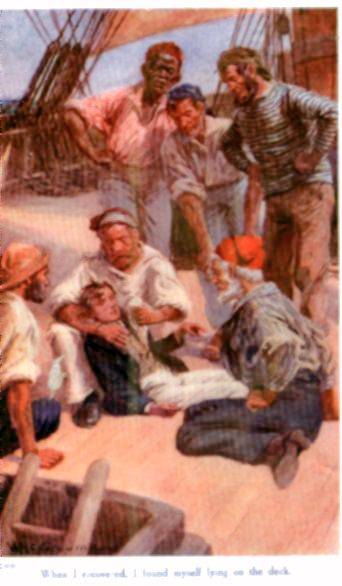
Almost immediately the hatch was removed, and as I looked up a flood of light burst down upon me. For some seconds I could see nothing. Gradually I made out a number of human faces peering down through the hatchway.
“Why, what can that be?” exclaimed one of the men.
“Ghost of a ghost,” cried another.
“It can’t be a live thing,” said a third.
“Why, Jack, I do believe it’s a boy,” exclaimed a fourth; “we must get him up whatever he is, but how could he have come there?”
Presently a ladder was let down. None of the men seemed inclined to descend, evidently having some doubts as to my character, till the last speaker, calling the others cowards, came down. Instead of at first reviving me, the effect of the fresh air was to make me faint away. When I recovered I found myself lying on the deck, surrounded by a number of strange faces. A seaman—the one who, I suppose, had brought me up—was supporting me and applying a wet cloth to my head and shoulders, while another, kneeling down, was examining my countenance.
“Why, youngster, how did you come aboard here? Where have you been ever since we sailed from the Mersey?” he asked.
Too weak to answer, I could only stretch out my hand and then point to my lips, to show that I wanted food and water.
“If you’ve been down in the hold all these weeks, no wonder that you want something to eat,” he remarked.
Still he didn’t move, or propose to obtain any refreshment for me. As my lack-lustre eyes looked up at him, I recognised Gregory Growles, the old seaman to whom I had at first spoken with my cutter under my arm. No wonder that he didn’t recollect me in my present forlorn and dirt-begrimed condition. At last the seaman against whom I leant told one of his messmates to get me some water. With indifference, if not unwillingness, the man did as requested, and going to the water-butt on deck brought me a mugful, which I greedily drank.
“By the feel of his ribs he wants something more substantial than water,” observed my friend. “We must get the poor young chap into a berth, and feed him up, or he’ll be slipping his cable. There doesn’t seem to be much life in him now.”
“That will be seen.”
“What business had he to stow himself away, and make us all fancy that a ghost was haunting the ship?” cried Growles, in a surly way. “We shall hear what the captain has to say to him. To my notion, as he’s made his bed, so he’ll have to lie on it.”
“Come, come, mate, it would be hard lines for the poor young chap if he were left to die, without any of us trying to bring him through. I, for one, can’t stand by doing nothing, so just one of you lend a hand here, and we’ll put him into my berth, and get the cook to make some broth for him,” said the kind-hearted seaman.
While he was speaking, a person, who was evidently one of the officers, came forward and expressed his surprise at seeing me, and inquired why he hadn’t been informed of my having been discovered?
The men replied, that I had only just been found and brought on deck, and that they thought I was dying.
“It would have saved trouble to have hove him overboard before he came to himself,” said the mate, with a careless laugh. “The captain doesn’t allow of stowaways, and we don’t want any aboard here.”
He said this, I suppose, to frighten me, indifferent to the consequences.
“He’s very bad, sir,” said my friend, touching his hat, “and, maybe, it won’t much matter what is done with him; but if you’ll give me leave, I’ll take him below to my berth, after we’ve washed off the dirt that sticks to him. He wants food more than anything else to bring him round, and when he’s himself we can make some use of him at all events. We want a boy forward very badly, and he’ll be worth his salt, I’ve a notion.”
“You may do what you like with him, Tom Trivett,” answered the officer, “only don’t let us be bothered with him. We’ve trouble enough with young Riddle, the mutinous young rascal. He’ll have to look out for himself, if he don’t mind.”
The officer was the third mate of the ship, who happened just then to have charge of the deck. He made further inquiries about how I had been found, and asked the men whether they had before known of my being on board?
Trivett replied that they were entirely ignorant as to how I had come into the ship, but that hearing peculiar noises, they lifted the hatch, and that he had gone down and discovered me.
“We shall hear by-and-by what he has to say for himself. In the meantime, Trivett, take care of him, and I’ll let the captain know he’s been found. He’s the ghost you fellows have been frightened about,” said the mate.
“We were no more frightened than he was,” I heard some of the men utter, “but who could tell where all those strange noises we heard came from when any of us went down into the hold. He’s precious ready to call us cowards, but he was more frightened than we were. Why, he would never go down unless he had a couple of hands with him.” While this was going on, Tom Trivett continued swabbing my head and neck. When the mate walked aft he called to the cook to bring him a bucket of warm water from the caboose, as well as a lump of soap, a scrubbing-brush, and a piece of canvas.
The sun was shining brightly, and the air was warm, so that I did not feel the exposure so much as it might have been felt. Tom forthwith set about to scrape me clean, taking his own pocket-comb to disentangle my matted hair after he had washed it. The operation, though somewhat hazardous, greatly refreshed me. Before it was concluded, Julius Caesar, the black cook, who had some tender spot in his heart, brought out a basin of soup, from which Trivett fed me as tenderly as a nurse would a young child. This still further revived me.
“You shall have some more, boy, when I have done a-cleaning you,” said Tom.
The rest of the crew sat round making remarks, but not even offering to assist their shipmate, evidently perfectly indifferent as to what happened to me, though perhaps curious to see whether I should revive under the treatment to which I was being subjected. Judging by the colour of the water after I had been washed in it, I must have been as black as a coal. I rather think Julius Caesar must have fancied that I was one of his own race, and must have been greatly astonished at seeing a blackamoor washed white. When the operation was concluded, Growles again came and had a look at me.
“Why, I do believe it’s none other than the young chap who came aboard us at Liverpool,” he exclaimed. “I thought as when I saw him so often that he was up to something, but never fancied that he was going to stow himself away, or I should have been on the watch for him. Well, he’ll have to pay pretty smartly for the trick he has played us.”
My friend Tom took no notice of this and similar remarks made by others of the crew; but after having again fed me, he called to a stout-looking lad who was coming forward from the companion-hatchway to assist in carrying me to his berth under the topgallant forecastle. The lad, without hesitation, did as he was directed, and took up my legs, while Tom lifted me by the arms. As I was being carried along, my eyes turned towards the lad who was stepping backwards, when I at once recognised him as Mark Riddle, though he looked very different to the smart young chap he was when I last saw him, and he evidently did not know me.
“Can’t you find a shirt and a pair of trousers for the poor fellow?” cried Tom; “his own want washing terribly.”
Mark ran aft, and in a short time returned with the garments, in which Tom clothed me.
Notwithstanding the food which had been given me, I was still too weak to speak. He and Tom lifted me into an upper bunk on the starboard side. As he did so, I stretched out my hand and seized his, which I pressed between my bony fingers. I could just say, “Thank you, Mark.” He looked at me very hard, but still did not seem to have a suspicion who I was. This was not surprising, as he did not even know that I had gone to Liverpool. I was so altered, that even my mother would scarcely have recognised me. He, however, asked Tom Trivett who I was. Tom replied that I was a young stowaway, but that he knew no more about me than did the man in the moon.
“Go and fetch the remainder of the broth,” I heard Tom say. “A little more will do him good, and then if he gets a sound sleep he’ll come round, I have a notion.”
“If he does, it will only be to lead a dog’s life,” murmured Mark, as he left to get the broth.
Tom stood by me arranging the blankets, and trying to make me comfortable till Mark returned with some soup, with some biscuits and rice floating in it. Though I could drink the liquid, it was with difficulty that I could masticate the latter, but I managed to get down a few pieces.
“He has eaten enough now,” said Tom; “but, I say, Mark,” he whispered, “you keep an eye on him whenever you can, so that none of the fellows play him any tricks. They’d do so, though they knew he was dying, out of devilry.”
“Aye, aye,” answered Mark. “They shan’t hurt the poor young chap if I can help it, though I’ve enough to do to keep clear of them myself.”
“Well, we shall be three now, and shall be better able to stand up against them,” said Tom.
I heard no more; for after taking the food a drowsiness crept over me, and I fell into a sound sleep. When I awoke I was in the dark, and felt very much more comfortable than I had for a long time. At first I fancied that I was down in the hold, but the loud snoring and groaning of the men in the neighbouring bunks made me remember what had happened. I felt about, and was soon convinced that I was in Tom Trivett’s bunk, in a clean shirt and trousers, and a blanket over me. I heard the watch below turn out, the others shortly afterwards came in, but no one took any notice of me.
When the latter were fast asleep I heard some one come into the berth and stop near my bunk.
“Who’s that?” I asked.
“Glad to see you can speak again, my lad,” said the person whom by his voice I knew to be Tom Trivett. “Do you feel better?”
“Yes, thank you,” I answered. “You’ve saved my life, and I’m very grateful to you.”
“Don’t talk o’ that, lad,” he said, “it’s not much good I can do in the world, but I couldn’t bear to see you allowed to die from neglect, though I’m afraid there are hard times coming for you. You’re among as rough a lot as ever sailed on the salt ocean, and that’s saying a good deal. I want to give you a piece of advice; I mayn’t have another chance of giving it. Don’t be in a great hurry to get well, for though the fellows, bad as they are, won’t have the cruelty to ill-treat you while you’re sick, as soon as you come round they’ll be down upon you, and you’ll find that they’ll give you more kicks than ha’pence. However, you must not mind them. Don’t attempt to retaliate, for they’re too many for you. Above all things don’t grow sulky as poor Mark did, and has ever since well-nigh had his life knocked out of him. Now I must go on deck as it’s my watch, but remember what I have said.”
I again thanked Tom, and just as he was going I asked him if he could get me any more food.
“I’ll try and get you something as soon as the cook turns out; but he’s asleep in his bunk, and at this hour it would be a difficult job to find any. I’ll tell Mark, however, to ask him when he wakes, though I’d advise you to go off to sleep again.”
Saying this, Tom left the berth, and I once more closed my eyes. I was awakened by the men turning out.
The light streamed in at the door, showing me that it was morning. In consequence of the advice I received from Tom, I kept quiet and pretended to be asleep. Soon afterwards I saw Mark Riddle standing by my side.
“Tom told me you’re hungry, boy,” he said; “so I managed to get something for you from the pantry. I hope it won’t be discovered, or the third mate will be giving me a rope’s-ending.”
He had brought me a captain’s biscuit and a slice of ham, with a tin mug of water.
“I’ll bring you a cup of hot coffee,” he said, handing me the food.
Hungry as I was I could not help exclaiming, “What, don’t you know me, Mark?”
He looked at me very hard, still not remembering me.
“No, I don’t think I ever saw you before,” he answered; “but how do you happen to know my name?”
“I didn’t think I was so changed,” I said. “I’m Dick Cheveley.”
“Dick Cheveley!” he cried out, looking at me still harder; “Dick Cheveley on board this ship! And yet it must be; and are you really Dick Cheveley?”
“I don’t believe I’m anybody else, though I have sometimes fancied I must be.”
“Yes, yes, I see you’re Master Cheveley,” cried Mark, “though I can’t say I feel much happier to see you for your own sake, though I’m right glad for mine to have you with me,” taking my hand and grasping it. “Oh, Master Cheveley, what did bring you aboard?”
I briefly told him while I was discussing the food he brought me.
“It’s a bad business for you, Master Dick,” he said; “but the only thing now to be done is to make the best of it. They’re a precious bad lot, and the captain and officers are no better. I’ve made up my mind to run as soon as I can, and I’d advise you to do the same.”
“That I certainly will when I have somewhere to run to, but at present it seems we should have to run overboard,” I answered.
“We must wait until we get into harbour. We shall have to touch at a good many places, and if we keep our wits about us we shall manage it one way or another.”
“We’ll talk about that by-and-by, but tell me how you happened to be here. I heard that you had been sent on board a man-of-war,” I said.
“So I was, and I wish I had remained aboard her, too; but as I had been sent against my will, I cut and run on the first chance I got. She was the ‘Beagle’ sloop of war. We were ordered to cruise on the Irish coast. We were not far off the town of Belfast, when a boat’s crew to which I belonged pulled ashore under charge of a mid-shipmite. While he went into a house to deliver a message, I ran off as fast as my legs could carry me. I at last reached a cottage in which there was a whiteheaded old fellow, a girl, and two young men. I told them that I had been pressed and ill-treated, and was trying to make my escape from the cruelty of the English. The young men said at once that they would protect me, and would answer that I should not be retaken. The old man warned them that they were playing a dangerous game, and said that he would have nothing to do with the business, advising them to take me back to the boat. The girl, however, pleaded for me, and observed that now I had run, my punishment would be ten times greater, and that it would be cruel and inhospitable to refuse me shelter. She prevailed on her old grandfather. That evening the young men took me down aboard a little ‘hooker,’ which they said was just going to sail for Liverpool, and that if I liked I could go in her. Her cargo, they said, was timber and fruit, but turned out to be faggots and potatoes. I knew that at Liverpool there was no chance of being discovered, and I at once agreed. We reached the Mersey in a couple of days. As ill-luck would have it, I landed close to where the ‘Emu’ was getting ready for sea. Knowing that I could not venture to return home, I went on board and asked if a boy was wanted. The first mate at once said yes, as one of the apprentices had cut and run and could not be found. I thought I was in good luck, but we hadn’t been to sea many days before I found that I had fallen out of the frying-pan into the fire. The other apprentice, poor Jack Drage, told me that he had been kicked and cuffed from the first moment that he had stepped on board, and that if he had had any friends on shore, he’d have taken French leave as the other had done. Things had grown worse instead of better, and he was already weary of his life. I advised him not to give in; that in time things must mend; but he was a poor-hearted fellow and only wrung his hands and cried, declaring that he was utterly miserable. I did my best to keep up his spirits, but it was all of no use. One night during a gale we had soon after sailing, he disappeared. Whether he had thrown himself overboard into the sea, or been knocked overboard no one could tell. Of course it was entered in the log that he had been knocked overboard. In my opinion he sacrificed his life rather than endure his miseries. I told the first mate so, and he knocked me down. The next time he called me a sulky rascal, but I answered that I was not going to do away with myself like Jack Drage, and that I would make a complaint of him to the British Consul whenever we touched at a port. On this he knocked me down again. I know that I was taken with the sulks, and for days afterwards didn’t speak to him or any one else; but as I had no wish to be killed, I did what I was ordered to do, and got on somewhat better. Ever since that not a day passes that I don’t get a kick or have a marline-spike hove at my head by either the officers or men forward. They’re all very much alike for that matter, except Tom Trivett, and he’s as good a fellow as ever lived. He has a hard life of it, for the men are always playing him tricks; and the officers spite him, and are constantly making him do dirty jobs which no able seaman should be called on to perform. But, I say, I mustn’t stand talking here any longer, or I shall be suspected of being your friend. Don’t let any one find out that we know each other, and we shall get on all the better. I’ll tell Tom Trivett, and he’ll bring you the coffee if I can’t manage it; meanwhile you stay quiet in the bunk, even if you feel well enough to get up.”
“There is no chance of my being able to do that for some days,” I answered, “for I don’t think I could stand if I were to try.”
Mark now left me, and I fell back nearly exhausted from having talked so long to him.
After some time Tom appeared with a basin of hot black coffee, with some biscuit floating in it.
“Can’t I have a little milk?” I asked.
“We’ve not any cows on board here,” he answered with a laugh; “and there are no dairies in the Atlantic, unless Daddy Neptune happens to keep sea-cows.”
“You must have thought me very silly to ask for milk,” I said, as I ate up the sopped biscuit, and drank the hot coffee, which was well sweetened with sugar.
“It shows you are something of a greenhorn, lad,” he answered, laughing, “but no wonder your wits aren’t of the brightest after having been shut up in the dark so long; you shall have something else by-and-by. Remember what I told you; don’t be getting well too soon, that’s all.”
Chapter Fifteen.
My convalescence—Julius Caesar befriends me—We pass the Cape de Verde Islands—Our hopes of a change of diet disappear—My turn at last—A severe discipline—Captain Longfleet—“Please, sir, I couldn’t help it”—“There goes the baby and his nurse”—Caesar’s sympathy—How I owed my life to Tom Trivett—Bad food—“It makes me sick to cook it”—The deputation to the captain—The discontent increases among the crew—Crossing the line—“What ship is that?”—We receive a visit from Daddy Neptune and his court—Rough play, and what it might have come to.
I intended to take the advice of my friend and not get well too soon, but in reality there was no malingering in the case, for I remained too low and weak to get out of my bed.
Tom Trivett all the time, having given up his berth to me, slept in a far more uncomfortable bunk right forward, but never uttered a word of complaint, or tried to induce me to turn out. His was true Samaritan charity, and I was grateful to him. He even, I knew, tried to influence the rest of the crew for good, but did not succeed. They let him alone, which was all he could expect of them. The third mate, who knew I was there, never came near me to inquire how I was getting on.
Mark paid me a visit whenever he could venture to do so, and brought me my food when Tom was on duty.
The only other man who was kind to me was Julius Caesar, the black cook, and he frequently sent me wholesome messes which he had concocted for my special benefit; but he had to charge Mark and Tom not to let the other men see them, lest they should be gobbled up on their way. Mark told me this, for Julius Caesar himself never came to have a look at me.
“If I come, den dey say I friend of his—it worse for him.”
Both Mark and Caesar slept in the larboard berth, so that they had no business in the one I occupied.
I should explain that the space under the topgallant forecastle was divided by a bulkhead running fore and aft into parts forming separate cabins, one called the starboard, and the other the larboard berths, with bunks built up on both sides, one above another, or rather, in two stories, to explain myself better.
In moderate weather they were tolerably comfortable, but with the sun beating down on the deck they were fearfully hot. In a gale of wind, as the seas dashed against the bows or she pitched into them, the noise and movement were tremendous. However, to that I in time got accustomed.
Sometimes the decks and upper works leaked, and the water coming in wetted the clothes and bedding. However, in other respects they were better than the forepeak in a flush-decked ship, which is generally close and hot, full of horrible odours, and totally destitute of ventilation, and often wet into the bargain, from unseen leaks which are not of sufficient consequence to trouble the officers, as they do not affect the safety of the ship.
At length, one day Tom told me that we were within sight of the Cape de Verde Islands, at which he believed the captain intended to call. He was very glad, he said, of this, as he hoped to be able to get me a supply of oranges and limes, which he thought would do me more good than anything else.
The very name of fruit made my mouth water, and I thought I would give a great deal just to have one good suck at an orange. Great was my disappointment, therefore, when shortly afterwards Mark came in, and said that a strong north-easterly wind had sprung up, and that we were standing away from the islands, but that the captain, he believed, intended to put into Rio de Janeiro.
“I must wait patiently till we get there,” I said. “I hope it won’t take us long.”
“We have to pass through the horse latitudes, and to cross the line first, and Rio is some way to the south of that, so I’m afraid you must suck your fingers instead of oranges,” he answered.
I was now rapidly getting better, and I began to pine for fresh air and exercise.
“You’ll be wiser to stay where you are, Master Dick,” said Mark. “No one believes that you’re a gentleman’s son, and if they did I’m very sure it would make very little difference. I should, perhaps, benefit by your getting about, as you would have all the dirty work to do which now falls to my lot. It’s only surprising that the captain has allowed you to remain so long in the berth, for he knows that you’re aboard, though he takes no notice of you. Still I’d advise you, as long as you can, to stay where you are.”
I had not long the opportunity. Two days afterwards the third mate came into the berth with a short, knotted rope in his hand.
“Come, youngster, you have been long enough malingering here,” he exclaimed; “I find the cook has been serving out no end of good grub to you, and you’ve done nothing for it. We don’t want idlers aboard the ‘Emu;’ show a leg there pretty smartly.”
I attempted to rise. Tom had washed and dried my clothes. I got hold of my trousers, and slipt my legs into them. When I attempted to stand upright, my knees gave way and down I sank. At the same moment the mate’s colt descended on my back. I was taken so completely by surprise that I shrieked out with pain. I tried to lift myself up by the supports of the bunk, and succeeded in getting on my feet.
“I thought I’d cure you. Do you want another dose of this rope?”
“Oh! No, sir! No, sir! Don’t! I’ll dress as fast as I can,” I called out.
The moment I let go I felt that I must slip down again. Still the fear of another lash made me exert myself in a way I could not otherwise have done, and I tried very hard to put on my waistcoat and jacket, and to tie my handkerchief, by sitting down on a lower bunk.
“Now, come along!” said the mate; “the captain wants to speak to you.”
I attempted to walk, but as I tottered on my knees again failed me, and I should have fallen had not the mate caught me by the shoulders and dragged me along the deck.
It was a severe discipline, but it was effective, for the air and the necessity of moving quickly brought back strength to my limbs, and by the time I reached the quarterdeck I was able to keep my feet, though I should have fallen had not the mate still held me.
We there found the captain pacing to and fro. On turning he stopped when he saw me.
“Is this the young stowaway, Mr Huggins?” he asked, eyeing me very sternly. “What business had you to come aboard, boy, without leave?”
“Please, sir, I couldn’t help it,” I said, and I told him that when merely intending to look round the ship I had fallen into the hold.
“A likely story, youngster, which I don’t intend to believe. You came on board to please yourself, and now you’ll learn to please me, and do the work you’re set to do.”
“I’ll do my best, sir,” I answered, for I saw he was not a man to be trifled with; “but I am not fit for much at present.”
“You contrived to live down in the hold in an extraordinary manner—how did you manage it?”
I told him in a few words.
“Another likely story,” he remarked. “In other words, you stole the ship’s provisions as long as you could get at them, or you had an accomplice who kept you fed—he’ll be made to smart for it.”
On hearing this, I began to tremble for the consequences to Mark. Though the captain didn’t mention his name, I guessed that he pointed at him. I was much inclined to say who I was, and to speak of Mr Butterfield, but shame prevented me, and the captain made no inquiries on the subject.
“Now go forward,” he said; “look out sharp, get back your strength, and make yourself useful.”
He turned on his heel, not deigning to hold any further conversation with so insignificant a person as he considered me.
The mate let me go. I tried to walk, but staggered like a drunken man, and could only just manage to reach the side, and catch hold of a belaying-pin. I remained there until the captain turned round, when, afraid of his looks, I once more set off to make my way along the deck, the mate taking no trouble to help me, while the crew jeered and laughed at me; till Tom Trivett, who had been at work on the other side, crossing over, took my arm and led me along to the forehatch, where he bade me sit down.
“There goes the baby and his nurse,” said one of the men.
“Tom will be getting him some pap presently,” said another—at which they laughed in chorus.
The third mate, seeing Tom standing over me, ordered him back to his work. Mark made an attempt to join me, but was sent to perform some task or other, and I was left alone and forlorn to endure the gibes of my hardhearted shipmates.
Caesar, however, came out of his caboose, and whispered as he passed—
“Neber you mind, Dick, as long dey only use der tongue.”
He grinned and pointed with his finger, so that the rest fancied that he was only mocking me as they were.
Notwithstanding this, the fresh air and the necessity of exerting myself did me good, and after I had taken some food that Caesar brought me when the men went into their berth to dinner, I felt quite another creature.
At nightfall I was allowed to slink into my bunk, of which Tom still refused to deprive me.
“I’m very well where I am. I’m accustomed to it, and you are not, Dick,” he said, when I begged him to let me change places.
The next day I was still better, and after this I rapidly recovered my strength, notwithstanding the cuffs and kicks and rope’s-endings I frequently received, and the hard work I had to perform.
My clothes were soon again as dirty as they were when I came out of the hold, and torn and tattered besides.
“Never mind, Dick,” said Tom; “I’ll rig you out in a suit of mine, which I’ll cut down to suit you when we get into colder latitudes. It doesn’t much matter about having old clothes now the weather is so hot.”
Mark regretted that he could not help me, as he had only the clothes he stood up in, which would have been almost as bad as my own had they not been of stronger material, and thus held out better.
Though the rest of the crew ill-treated Mark and me, and Tom also when they had the chance, the captain and officers tyrannised over them in the most brutal fashion. It was no unusual occurrence for the first mate to heave a handspike at one of the men when he did not go about his work in a way to please him, and both captain and mates swore at the men on all occasions in the most fearful way.
At first I was horrified, but in time I got as much accustomed to it as they were, and was only thankful that the oaths were not accompanied by a rope’s-ending.
All this time the discipline was really very slack, and the men behaved to each other as they pleased, and never failed to neglect their duty whenever the mates’ eyes were off them. Still they resented, notwithstanding, the treatment they received, growling fiercely, if not loudly, when the quality of their provisions had begun to fall off. At first the food had been pretty good, but it now became worse and worse, and the men swore that they would stand it no longer. At last, when some rancid pork had been served out with musty peas and weevilly biscuits, the men went aft in a body, headed by the boatswain, Sass Jowler, and Growles, who were deputed to be spokesmen, to the quarterdeck, where the captain was walking.
“I axes you, Captain Longfleet, whether you think this ere stuff is fit food for British seamen?” said the boatswain, holding up a piece of the pork at the end of a two-pronged fork.
“It makes um sick to cook it,” said Caesar, who was standing behind the rest.
“And I wants to know, in the name of the crew, whether this ’ere biscuit as is all alive with maggots, is the stuff we poor fellows forward should be made to put into our mouths?” cried Growles.
“What’s that you’re talking about, you mutinous rascals?” cried the captain; “stop a bit, and I’ll answer you.”
Saying this, he sprang back into the cabin, and while the men stood staring at the door without advancing, he reappeared with a pistol in the one hand and a cutlass in the other. I observed that he had a second pistol in his belt.
“You know I never miss my aim, you scoundrels. The first man that utters a word on the subject I’ll shoot through the head. The food’s good enough for better men than you, so be off forward, and let this be the last time I hear any complaint. If not, look out for squalls.”
The men stood irresolute, and no one liked to run the chance of having a pistol-bullet sent through his head.
“Are you going, you villains?” thundered the captain, pointing his pistol at the boatswain.
He used a good many other stronger expletives, which need not be repeated.
The boatswain was a bold fellow, but his courage gave way, and he stepped back. The others, overawed by the determined manner of the captain, imitated the example of their leader, knowing that the pistol might be turned towards any one who stood his ground, and together they retreated forward, tumbling over each other in their endeavour to put as wide a distance as possible between themselves and their now furious commander.
For my part, I felt a greater amount of respect for him than I had ever done before. His eye did not for a moment quail, his arm appeared as firm as iron. Had he shown the slightest hesitation, the men, in the temper they were in, would have been upon him, and he would have lost his authority.
Mark and I remained at one side of the deck, where we happened to be at the time. Tom Trivett had not come aft, having refused to take any part in the affair, whereby he gained still greater ill-will than before from his shipmates.
The discontent which had thus shown itself, though kept down for a time, was by no means quelled. We had to eat the food, bad as it was, though perhaps not altogether as bad as the samples exhibited to the captain.
The third mate came forward much oftener than before, and tried hard to win back the men into something like good-humour, but his efforts were unavailing.
“You see, Mr Simmons, as how we poor fellows have got to work hard, and except we gets good grub we can’t do it,” I heard the boatswain remark in an insinuating tone; “it’s very hard lines for us to have to eat rancid pork and weevilly bread, when we knows well enough that the captain and mates has good grub in the cabin. Share and share alike, and we sha’n’t complain. But we must abide by it till the ship gets into harbour, and then we suppose that the captain will be getting good stores aboard and will serve out fresh meat and vegetables.”
“Oh! Of course he’ll do that,” said Mr Simmons, pleased, as he thought, at having brought the men to reason. “You know Captain Longfleet is a just man, though he’s a determined one, and won’t stand nonsense. Everything will go well, I hope, by-and-by.”
I should have observed that our boatswain held a very different position among the crew to that occupied by a warrant officer on board a man-of-war. He was merely one of the men, and was so called from certain duties he had to perform, and was a sort of link between the officers and the crew.
We were now in the tropics. When there was a breeze the heat was supportable enough, but when it fell calm we could scarcely bear our clothes on, and went about in shirts and trousers, with bare feet, and were glad to have the opportunity of getting into the shade. The pitch boiled up out of the seams, and old Growles declared that he could cook a beefsteak on the capstan-head, if he only had a beefsteak to cook.
The heat did not improve the temper of the men, and the ship became to Mark and me a regular hell afloat. Matters were almost as bad with Tom Trivett, but he could hold his own better than we could.
One day Mark came to me.
“I say, Dick,” he exclaimed—a common fate had made us equal, and he had long ago dropped the master—“I’ve been hearing that to-morrow we’re to cross the line. I wonder what sort of place we shall get into on t’other side; as far as I can make out, it’s a kind of bar, and those who go over it for the first time have to pay toll to old Daddy Neptune, who is coming aboard to collect his dues.”
I was surprised that Mark had never heard of the line, and so I tried to explain to him what it was. As to Neptune coming on board, I knew that that was all nonsense, and so I told him.
During that evening and the next morning some of the men were busily engaged in their berth, into which they allowed no one but themselves to enter.
Soon after noon the captain, having taken his observations, gave notice that we were about to cross the line. Mark and I had been sent aft, when we heard a voice hail as if from under the bows.
“What ship is that?”
“The ‘Emu,’” answered the captain, who with the officers was standing on the poop.
“Where did you come from, and for what port are you bound?” asked the voice.
“From Liverpool, and we’re bound to Rio and round Cape Horn,” answered the captain.
“All right, Captain Longfleet; with your leave my wife and I will pay you a visit and bring some of our children and attendants, and if you have any youngsters who have not crossed the line before, we shall have a word to say to them.”
“You’re welcome, Father Neptune, for I suppose no one else would be desirous of giving me a call out in these seas.”
It was amusing to observe Mark’s look of astonishment when immediately afterwards a party of grotesque figures appeared clambering over the bows. The first was an old fellow with a long white beard, a gold paper crown on his head, and a sceptre in his hand, and dressed in a flowing robe painted all over with curious devices. With him came a huge woman, also wearing a crown and garments of many colours, a necklace of huge beads and a couple of clasp-knives hanging down from either side of her face to serve as ear-rings; another figure followed them equally curiously dressed, with a basin under one arm, a pair of sailmaker’s shears hanging round his neck, and a piece of rusty hoop shaped like a razor in his hand. A fourth person, tall and gaunt, was seen in a cocked-hat, a thick cane in one hand, and a box of pills of large proportions in the other. Following them came a party of monsters in green dresses with long tails, and heads covered by oakum wigs.
The captain, wishing to humour the men, shouted out—
“Glad to see your majesty on board my ship. You’re welcome to come aft and look out for any of those whose acquaintance you have not before made.”
On this the whole gang came tramping aft. Mark and I saw that their eyes were fixed upon us. We had no place to fly to but up the mizen rigging. We made the attempt, but were quickly caught by some of the monsters, who managed to climb up in spite of their tails.
The barber had in the meantime placed a huge tub on the deck, and a couple of small casks. On these we were compelled to sit down, when he immediately with a paint-brush began to daub our faces over with the contents of a bucket of grease. He then drew out his razor, and scraped us in the most cruel fashion, taking off the skin at every stroke.
The doctor in the meanwhile, with mock solemnity, felt our pulses, and then observing that we were terribly sick, crammed one of the boluses out of his box into our mouths, and forced it down with his tarry finger.
“A bath would do them good,” he growled out.
We were seized, and soused head over heels in a tub till we were well-nigh drowned. In vain we struggled and shrieked. Every time we opened our mouths the barber shoved his brush into them, and the monsters then ducked our heads under water to wash them out, as they said.
More dead than alive we were at last allowed to go, but had scarcely strength left to crawl away.
Tom Trivett was next dragged aft, though he declared that he had often crossed the line. Daddy Neptune refused, however, to believe him, protesting that he had never seen his face in those parts before. Though he fought bravely he was overpowered, and was even worse treated than we had been, the monsters, aided by the doctor and barber and Mrs Neptune, holding his arms and legs.
The captain and officers all the time in no way interfered, but seemed to enjoy the cruel sport. They wished, indeed, to allow the sailors to take their full fling according to their barbarous fancies.
Mark and I, seeing how our friend was treated, attempted to go to his rescue, but we had better have remained quiet, both for his sake and our own, for we were cuffed and kicked even worse than before, and with difficulty again made our escape.
A double allowance of grog was served out, which made the men even more savage than before; and when they were tired of ill-treating us they took to rough play among themselves. Daddy Neptune’s crown was torn off, his sceptre broken in two, his wife was despoiled of her finery; the doctor’s hat and spectacles shared the same fate; he was made to swallow his own pills, and the barber had his brush nearly shoved down his throat.
They would have come to serious blows had not the captain ordered them to knock off and return to their duty. The mates, with boats’ stretchers in their hands, had to rush in among them before they could be induced to desist. Not until a breeze sprang up, and they were ordered aloft to make sail, were they brought into anything like order.
For days afterwards Mark and I limped about the deck, with aching heads and sore faces, and Tom Trivett could with difficulty get through his duty.
This relaxation of discipline had no good effect on the men. They still grumbled and growled as much as ever at every meal over the food served out to them.
Chapter Sixteen.
Land ho!—Cape Frio—The Sugar-loaf Mountain—The Castle of Santa Cruz—The harbour of Rio de Janeiro—A taste of fruit—We receive some passengers—A gale springs up—Man overboard—Poor Tom Trivett—Captain Longfleet’s inhumanity—Mark and I are treated worse—I overhear a conversation—A proposed mutiny—The plot—Differences will arise—Who’s to be captain?—I determine to reveal the plot—I consult with Mark—Our determination—Southern latitudes—The Southern Cross—The Falkland Islands—Mark escapes, but I am retaken—Highland blood—Mark’s probable fate—A battle with an albatross.