"Dick Cheveley" (continued 3)
Reading edition
“I am very sorry if I have brought you or any others into trouble,” I said. “If you’ll ask Roger Riddle, he’ll tell you that I have no ill-feeling towards smugglers. I was the means of getting his son Mark out of prison. If you keep me here you’ll make my father and mother very miserable, for they won’t know what has become of me. You can’t be so cruel, surely.”
The men went talking on. I was sure they heard me, though they made no answer. It then occurred to me that perhaps they had shut me up in the chest for the purpose of carrying me on board a vessel, and that I should then be set free and enjoy the light of heaven and the warmth of the sun. Then I recollected having read how cruelly boys are treated on board ship, and that if I were sent under such circumstances I should have to lead a dog’s life at the best. Well, it was some consolation to have reason to hope that I was not to be murdered as I at first feared, or to be kept shut up in this horrible vault for an indefinite period, when I might be forgotten, and possibly be allowed to die of starvation.
These thoughts passed rapidly through my mind. As soon as I grew calm, I listened to ascertain what the men were about. As far as I could judge, in a short time they quitted the vault, and I was left alone. I listened and listened. No sound could I hear. A sufficient amount of air came through the chinks in the chest, and enabled me to breathe without difficulty. I had no notion of staying where I was without some endeavour to extricate myself. I knew that after a time I should grow weak from want of food. I was in total darkness, and the chest, for so I supposed it, was large enough to enable me to move about. It struck me, as I was feeling round the sides, that it was perhaps a bunk, such as is fitted on board ship for the men to sleep in. If my captors had not taken away my jacket I should have had my knife, and I might then, I thought, have cut my way out; but they left me without any means of effecting my purpose. The only way of freeing myself was to knock out by main strength either the top or one side of the bunk or chest. I feared that if I at once commenced doing this the noise I should have to make would attract the attention of my jailers. I therefore lay still for some time, listening attentively. Not a sound of any description reached my ears. I thought that it must now be day, though no light penetrated into the vault. If it had I should have seen it, I thought, through the chinks of the chest. It was very roughly put together, and this circumstance gave me better hope of being able to force it open. At length I determined to commence operations, and placing myself on my back, with one hand to defend my head, and one foot against the end, I struck out with the other on the part above me. A cracking sound encouraged me to go on. Each time I struck out the planks appeared to move slightly. I used so much force that every nerve in my body was jarred, and I was afraid of laming myself. Notwithstanding that, I persevered, stopping every now and then to listen, lest my captors should return; but as no one came I was satisfied that they had gone away, and now redoubled my efforts. Several loud cracks were the result; and at length, to my intense satisfaction, the planks above me fell off, shattered by my foot.
I was thankful for my success. At all events I should not have to die shut up in a chest. But I was very far from being free. Getting up on my feet I thrust my head through the hole I had made, and tore back the broken pieces of plank. Had I possessed a light I should have seen how next to proceed, but I was still in total darkness. I could not tell what I might find outside the chest. Moving carefully I climbed out, moving about with my feet to find the ground, which was lower I thus ascertained than the bottom of the chest, but how much lower I could not tell. I therefore held tight on with my hands while I let myself down, and I then discovered that it had been placed on another chest of about the same size; but I had to move very cautiously, as there might be still some lower depth beneath my feet, though I didn’t think that very likely. The ground was dry and hard, without either bricks or flagstones. This I found out by stopping down and touching it with my hand. I now began to move on very carefully, feeling my way from chest to chest. I discovered in my progress not only chests, but casks and bales. I had little doubt, therefore, that I had been conveyed to the smugglers’ store, but where it was situated I was totally unable to surmise. That it was some way inland I thought probable, as I could not hear the sound of the surf breaking on the sea shore, which I thought I should have done had I been near the coast. I tried to think if I recollected any building which it was at all probable would be thus used by the smugglers. There were, I at last remembered, two mills not far from the coast, but one was in the possession of too respectable a farmer to allow any lawless proceedings to be carried on in his premises. The other was an old windmill that had been abandoned the last two or three years; two of the arms had fallen down, and the whole building was in a very ruinous and tottering condition. The property I had heard was in Chancery, the exact meaning of which I didn’t understand, but knew no one was ever seen about the place, and that the villagers from the neighbouring hamlet were unwilling to approach it after dark, there being a report that it was haunted by a headless miller, who had been killed while in a fit of drunkenness by his own machinery. Could this be the place, I thought. The idea didn’t make me feel more comfortable, not that I had any strong belief in ghosts or other spirits walking the earth in bodily shape; but yet I didn’t feel perfectly certain that such beings did not exist, and I confess to having had an indefinite dread of seeing the headless miller appear out of the darkness surrounded by a blue light. I tried to banish the idea, and felt much more at my ease. I suddenly recollected that although I was in darkness it was daylight outside, and that the headless miller was possibly resting quietly in his grave in the churchyard a mile away.
One thing I had to do, and that was to get out of my prison as soon as possible. I felt round and round the vault. My great object was to discover the steps by which my captors and I had descended, but to my dismay I could not find them. Either they had been drawn up through a trap-door above, or we had come through a door in the side of the vault which had been closed by them when they went out. I searched and searched in vain for such a door, one side consisting of a blank wall partly of stone and partly of perpendicular timbers, which I concluded supported the superstructure. This made me more certain than before that I was in a vault beneath the old mill. I was in hopes by this time that the smugglers had gone away, and that I should thus be able to make my escape without interruption. How to do so was the question. I remembered that we had descended the building by steps to the bottom of the vault. I concluded, therefore, that the roof must be a considerable height above my head. There were numerous boxes, chests, and bales, as far as I could judge, in the vault, and if I had had light I should have found, I thought, little difficulty in piling one upon another, and thus reaching the top; but in the dark this was a difficult and hazardous undertaking. I could scarcely expect to place them with sufficient evenness to make a firm structure, and they might, after I had got up some distance, topple down again with me under them, and perhaps an arm or a leg broken. Still I could think of no other way of getting out. I again felt about, and tried to lift some chests and bales, but they were mostly too heavy for my strength; I might, however, discover some which I could tackle.
It must be remembered that all this time I was perfectly ignorant of my surroundings. I was, indeed, in the position of a blind man suddenly placed in a position which he had never before visited without any one to give him a description of the scenery. The only knowledge that I had obtained of the vault was from the sense of touch. I now determined to take a further survey, if so I could call it, of my prison, to start from a certain point to feel my way round, and reach as high as I could, to extend my arms, and to grope along the floor from one side to the other. One point I considered was to my advantage. My captors would suppose that I was shut up in the chest, and would therefore not have taken much trouble to secure the outlet to the vault. Probably, indeed, they had gone away, as they would certainly avoid being seen in the neighbourhood of the old mill during daylight. I didn’t suppose that they intended to murder me, and I therefore expected that they would come back again at night to bring me some food, or perhaps to carry me off and ship me on board some vessel, for such I was convinced was their intention. I must therefore effect my escape before nightfall. The necessity of obtaining food would alone induce me to do this, though as yet I did not feel very hungry.
Serious as the situation was, I did not give way to despair. I could not believe that I was doomed to die, but how my deliverance was to be effected was more than I could tell. Again starting from the chest in which I had been shut up, and which I could distinguish by the short fragments of the top, I continued groping my way round and round the vault. My first object was to try and find the door, which I was persuaded existed, as I thought I had previously missed it. Any one who has played at blind man’s buff may have a faint idea of my situation. Only the objects round me remained stationary, whereas in the game people run away from the blinded person, and he has to try and catch them as they run round him. I had the advantage over the blinded man in the game. I was sure that in time I should gain a knowledge of my locality. Time, however, was precious, and it would not do for me to delay my search.
I would have given anything for a tinder-box and flint and steel, so that I might light up the vault even for a few seconds; but as that was not to be had, I tried to make use of my other senses. Stretching out my arms and feet as I went along, touching one place with my left hand, while I felt about my head as far as I could reach straight out with my right; I then brought my left up to the spot my right had last touched, and so I went on. Occasionally my right foot struck against a bale or chest which extended beyond the others above it. Had there been an opening in the pile of goods I was sure that I could not have missed it. For the supposed door I searched in vain, and at length came to the conclusion that the only entrance to the vault was from the roof above. It did not occur to me that there might be one above my reach by which my captors might have made their exit with the assistance of a short ladder. Though I had moved slowly, what with the exercise I had taken during the night, and the efforts I had made to get out of the chest, I felt very tired; and, discovering a bale of convenient height, I sat down to rest myself, and to consider with such calmness as I could command, what I should next do.
Chapter Seven.
A prisoner in the vault—The headless miller—I continue my explorations—My perilous position—My further attempts at escape—The recess—An unexpected shower-bath—A glimpse of light—I escape from the vault, but not from prison—A lower chamber in Old Grime’s mill—The result of my further endeavours to escape—My signal of distress—The Revenue-men—My rescue—The search for the smugglers’ goods—My hunger relieved—On guard—Meeting with my father—The last of old Grime’s mill.
Strange as it may seem, I fell asleep. How long my eyes had been closed I could not tell. I fancied I heard the voices of people coming down through the roof. A door directly opposite to me opened, through which a pale light streamed, when what was my amazement to see “Old Grimes” the miller dressed in his short frock, his iron-grey hair streaming over his shoulders, and holding on his head with both hands, proving that it could not retain its position without such assistance. He glared at me with his saucer-eyes; his lips moved, but what he said I could not make out. Had he approached I thought I would have spoken to him and asked what he wanted, but he did not advance beyond the doorway. Presently he faded from my sight. The light grew dimmer and dimmer. I thought that I got up and tried to make a straight course for the door; but when I reached the wall opposite I could not find it, and so groped my way back to my seat.
It was not until fully a minute after I was awake that I became aware that I had been dreaming. I was soon convinced that the vision of Old Grimes was a mere dream, but I was not quite so well satisfied about the voices I had heard. I listened, expecting to hear them again, but all was silent as before. I now got up, resolving to try and make my way out. Though I had not previously experienced any inconvenience from the want of breakfast, I began to feel excessively hungry; and if I had come across a package of hams or tongues, or a cask of salted herrings, I should have eaten them raw with considerable satisfaction. The more hungry I felt the more desperate I became. I at last fixed on a place for commencing operations. There appeared to be more woodwork there than anywhere else, or else the chests were piled upon each other. At all events they would afford me a foothold. That I might have less chance of slipping I had kicked off my boots, supposing that I could easily find them again. I climbed up and up. Of course I had to move very cautiously, not leaving go with one hand until I had a firm grasp of some fixed object with the other. I got up a considerable distance, and pressing against a board, it gave way, and a tremendous crash followed, as if a number of boxes filled with bottles had fallen to the ground. Putting up my hand, I felt a beam above my head; could it be one of the rafters, or the roof? I was for some time afraid to move, lest I should fall headlong down. I passed my hand along the beam, but could not reach the floor it supported. I now tried to crawl cautiously along on the top of the woodwork or the pile of chests, for I could not determine which they were. Every now and then I stopped and stretched out my hand, but could feel nothing above me.
I must again beg my readers to try and picture to themselves my unpleasant position. The only wonder to myself is that I kept up my spirits. I did not forget that any moment something might give way below me, and that I might pitch down to the floor of the vault on my head. I had gone on some way, when, stretching out my hand, I discovered nothing beyond me. I was on the very edge of the erection. The only thing I could do was to go back the way I had come, or to descend to the floor. Fearing that I should be unable to pass the spot where I had thrown over the cases, I resolved to adopt the latter alternative.
I bethought me that if I had had a pole it would have assisted me greatly to discover the trap-door leading to the vault. It was easier to climb up than to climb down, as I could not feel with my feet as I could with my hands. The attempt, however, must be made. Having got to the edge of the plank and ascertained that it was secure, I gradually let myself down, when I found myself resting on another plank or the edge of a chest, I could not tell which. Let any one try in the dark to do what I was attempting to do, and it will be found no easy matter. Could I have stood securely, I might have crouched down till I could have got hold of the plank on which my foot rested, but there was scarcely room for that, and if I let go the plank above me I might tumble over on my back; yet there was no other way of descent, so holding on with my left hand I tried to find something which I might grasp with my right lower down.
My satisfaction was considerable when my hand came in contact with the rope-handle of a large chest. It appeared to be secure, and holding it I was able to stoop down and fix my other hand on the ledge on which my feet rested. One stage of my descent was thus accomplished. I now held the ledge tight with both hands, let my legs slip off, and felt about with my feet for another resting-place. For some seconds I was swinging about, holding on by my hands. There might be another ledge not half an inch below my feet. I stretched down my toes to the utmost. I could not discover it. Should I let go I might have a serious fall. I worked my way on, hoping to be more fortunate. At last my feet struck against the end of a chest, and after making a little further exertion I found that it was secure, and that I could venture to stand upon it.
I was still uncertain how far I was off the ground; all the difficulty I experienced arose from being in darkness. I could probably, I knew, have scrambled over the whole of the building with perfect ease had there been light. I might already be close to the ground, but at the same time I might be many feet above it, and I therefore could not venture to step down without going through the same process as before. Leaning on my elbows, I stretched my arms along the top of the chest. I slipped off, and unexpectedly found my feet touch the ground. I was too eager to escape to allow myself time to rest after my exertions. I once more began to search round the vault, hoping to find an oar, a boat’s mast or spar, or somewhat that might serve my purpose. I felt about in vain; indeed it was not likely that the smugglers should have placed such things in the vault.
I at last reached the part where the boxes or chests, as I supposed they were, rested, and I began to stumble among them. The region in which I had spent the last two or three hours was considerably disarranged. I fancied that I knew every part, and now I was completely thrown out in my calculations. One chest stood up on end on another. I feared, should I move it, that I might bring others down on my head. I should have liked to have put them all back in their places, but that was impossible. By great care I made my way among them; when I at last reached the walls, it was the part I had not before examined. How I could have passed it I could not account for, unless I had been prevented reaching it by the chests piled up in front, and which I had displaced. As I was extending my arms my hands touched what felt like a wooden latch. There was no doubt about it; it was the latch of a door. I lifted it up and pulled it towards me. The door opened, but all was dark within the recess. I felt sure that it must be the entrance to the vault. I was going to step forward when it occurred to me that it might lead to a lower vault and that I should be precipitated into an unknown depth should I move without feeling my way. I knelt down, extending my hands, when they touched the ground as far as I could reach. This satisfied me that my first conjecture was correct.
Cautiously feeling my way, I stepped forward and explored the recess as I had the larger vault. Contrary to my expectation, I could discover no ladder. I was thus no nearer to my deliverance than before. I felt round and round this smaller vault, without being able to decide as to its object. That it was the entrance to the vault I thought very likely. I wished that I could find out the height of the roof, and of what it was composed. It seemed probable that it was lower than that of the larger vault. I thought that I might drag in some of the smaller chests and place one on another against the wall and climb up. I made my way accordingly back to the large vault, in search of some which I could move.
In going along my foot struck an object on the ground. It was a long spar—the very thing I was in search of. I supposed it had fallen down with the boxes, having either been placed upon them or assisting to support them. It appeared, as far as I could judge, to be twelve or fourteen feet long, and was thick enough to enable me to swarm up it, and thus to serve the purpose of a ladder. I first tried to reach the roof of the large vault with it, but it was not long enough, though I lifted it as high as I could; and then carrying it in my hands went back to the recess, and, eager to ascertain the height, I struck upwards. It at once met with resistance, not as I supposed, from a beam or vaulted roof, but from some soft object. That soft object must be removed.
I poked and poked again and again, now in one part, now in another, when suddenly down came a shower of powder, which, before I could make my escape, covered me from head to foot. I was certain that it was, from the smell and feel, flour, though old and musty. The flour filled my nose, eyes, and mouth, nearly suffocating me. I, however, willingly endured this dry shower-bath, for as it fell a glimpse of light came through a hole which I had burst in the upper part of the sack, which had evidently been drawn across the trap leading to the vault for the purpose of concealing it. I worked away with my pole until I had pretty nearly emptied the sack of flour, and then, with a little more exertion, I brought the whole down, and had a clear view upwards. For a minute or so my eyes, long accustomed to darkness, were so dazzled with the light that I could not make out anything distinctly. They were, besides, so full of flour that it took me some time to clear them.
After this I did not delay in endeavouring to get out of the vault. Having placed the upper end of the pole against the corner of the trap, I tried to swarm up it. At first my exertions made the pole slip, and I ran the risk of having a disagreeable fall; but descending, I placed the half rotten sack with some of the flour round the foot, and then drew in several pieces of wood, with which I further secured it.
I now made another determined effort to climb up it by twining my arms and legs round it. With considerable effort I succeeded in catching hold of the edge or sill of the trap, and then getting up my knees I was out of the vault, but not out of prison. I was, however, far better off than before. Instead of darkness, I had light—instead of a close vault, an airy chamber, on the lower floor of which sacks of flour had evidently been kept. There were no regular windows, but only a few slits high up above my head to admit light and air. The door was securely closed. The room was in much better order than I should have supposed from the generally ruinous appearance of the building from the outside.
Of course, having thus far freed myself, I did not despair of getting out by some means or other. I was in a hurry to do so lest the smugglers should come back, and thrust me back into my prison, or treat me even worse. Looking round the room I observed an opening on one side opposite the windows. It struck me that if I could get to it I might make my way into the main part of the building. Once there, there could be no difficulty in escaping. In the last few minutes I had forgotten my hunger, but it again came upon me; and as I had no other food, I thought I would try some of the flour, which would stay my appetite, even though eaten raw. I believe that a person eating nothing else for several days would make himself ill, if he did not die. I made a hole in one of several sacks leaning against the wall, and which had been there probably since the occupant’s death. It was excessively musty, but hunger prevented me from being particular, and rolling it up into little balls I swallowed several in rapid succession. Having eaten on till I had sated my appetite, I hauled up the pole with which I had made my escape from the vault below.
I then placed it against the foot of the small door high up in the wall. It was sufficiently long. But then the thought occurred to me, will the door be closed so that I shall be unable to open it? That point must be settled by experiment; so having assured myself that the upper end would not slip, I began to ascend. It was not at all an easy task, and I did not feel satisfied that it would not give way. Up and up I went, remembering what my father often used to say, that “fortune favours the brave.” I gained the top, and holding on to the sill beneath the door, pressed against it. It moved, and, contrary to my expectation, opened. It was a difficult matter notwithstanding to get in; but I managed at last to get my knee on the sill, and then creeping forward I found myself in a gallery in the main part of the mill, in the centre of which was the shaft and the machinery for working the grindstones beneath. I ran round the gallery till I came to a ladder leading to the floor below, expecting that I should find the main door open. It was firmly closed and locked, so that I could not get out. This was a disappointment.
Having in vain tried to find any other outlet, I ran up the steps again to the gallery, looked out of one of several windows to ascertain if I could reach the ground by any of the woodwork; but the height was too great to allow me to drop out without danger of breaking my legs. I observed several people in the distance passing along by a path which led by the foot of a hill on which the mill was situated. My first thought was that they were smugglers; but then I recollected that such characters were not likely to be abroad in a body during daylight, and the glitter of the gold lace round the cap of one of them convinced me that they were the revenue-men. I shouted at the top of my voice. Hungry and faint as I was, it did not sound as loud as usual. They did not hear me. I was afraid they would go on. Again and again I shouted. One of the men turned his head. Having no handkerchief, in a moment I stripped off my shirt, and waved it wildly out of the window. The men saw it, and came hurrying up the hill.
“Who are you, youngster?” shouted one of the men as they came near.
“Master Cheveley, son of the Vicar of Sandgate,” I answered.
“Why, he looks more like the ghost of a miller,” said one of the men.
“How did you get up there?” inquired the first speaker a head boatman in charge of the party.
“I got up out of a vault where the smugglers put me,” I answered. “Make haste and come in, for I’m almost starved.”
“Here’s a door,” cried the head boatman; “but I say, mates, it’s locked. Is there no other way in?” he shouted.
“None that I know of,” I answered. “I have been trying to open the door, but could not.”
“We’ll see what we can do,” said the man.
And he with two others placing their shoulders to it quickly sent it flying inward shattered into fragments, the rotten wood giving way before their sturdy shoves.
I ran down to meet them. The head boatman, a strong seamanlike-looking man, at once began to question me as to what had happened. I told him as briefly as I could adding—
“But, I say, I’m desperately hungry, as I’ve only had some lumps of musty flour to eat for several hours, and thirsty too. I shall faint if I don’t have some food.”
“We’ll get you that, youngster; and then you must try and show us the way into the vault,” said the speaker. “We may get a better haul than we’ve had for many a day if it should prove one of the smugglers’ hiding-places.”
He then directed one of the men to run down to the next farmhouse and bring up some bread and cheese, or anything else he could obtain, and a jug of milk, or if that was not to be procured, some water.
I thanked him, begging the man to make haste, for now that the excitement was over I could scarcely stand.
“Do you know you are whitened all over?” he asked. “You look as if you had come out of a flour-bin!”
I had for the moment forgotten how I must have looked. The man good-naturedly began to brush the flour off my clothes and hair, and one of them lent me his handkerchief to wipe my face. They inquired what had become of my jacket and waistcoat. I told them how the smugglers had taken them from me.
“Perhaps the fellows may have hidden them somewhere about here. They wouldn’t like to have the things found on them. Jenkins and Brown, do you go and search all round. Maybe we’ll come upon another opening into the vault.”
The two men hurried off to obey the orders they had received, while the others examined the mill; and the chief boatman sat by me fanning my face, for he evidently thought me in a bad way. The time appeared very long since the man had started for the provisions, but I believe he was not absent many minutes. I was thankful when he returned, bringing a basket with some eggs, and ham, and cheese, and some delicious bread, and a bottle of milk. I fell to immediately like a hungry wolf, and felt very much better by the time I had finished.
“We’ll keep the remainder in case you want any more, my lad. And now we must get you to show us the way into the vault,” said the officer.
I was quite ready to do this, for I confess that I had a bitter feeling against the smugglers on account of the treatment I had received. We soon reached the trap which had been covered over by the sacks of flour. The men looked down, not quite liking to descend into the darkness. The spar by which I had got up was still in its place. I offered to go down first, but this the chief boatman would not allow, and he and another man at once lowered themselves to the bottom. It was, however, so dark beyond the smaller vault, that they declared they could see nothing, and they had to wait until a man was sent to the farm for a lantern. We then too descended, but as the lantern only dimly lighted up the vault, I could scarcely believe that it was the same place in which I had spent so many hours. I had fancied that it was of immense size and height, and crowded with piles of boxes, and bales, and casks. Instead of this there were only a few old packing-cases, in one of which I found I had been shut up. There were besides about a dozen bales, most of them apparently damaged, and what the revenue-men considered of more value, nearly half-a-hundred small casks of spirits, and some boxes of tobacco. These had been covered over with planks. I had not felt them on my exploring expeditions in the dark. The revenue-men were well satisfied with their haul, as they called it, though they had thought that it was possible they might find some articles of value.
As I was anxious to return home to relieve the anxiety of my father and mother, I begged the chief boatman to let me do so at once.
“We cannot let you go alone; some of these smugglers might meet you and give you a clout on the head for having shown us their hiding-place. Wait a bit until I can send one of the men with you. We must first get these casks up. We can’t spare a hand at present, as one of the men must go on to the station to give information of our find, and to procure some carts for carrying the things away.”
In hunting about the men had discovered a coil of rope and some blocks, which had evidently been used for lowering the casks into the vault. The seamen were not long in fitting up a tackle to hoist them out. While one of the men was sent off as proposed, the rest worked away with a will. In a short time the chief contents of the vault were hoisted up and rolled outside.
“Here’s a job for you, my lad,” said the chief boatman. “You stay by these things, and give us notice if you see any suspicious characters coming, while we get up the remainder.”
This task I gladly undertook, for I was heartily sick of the vault where I had spent so many unpleasant hours, and glad to breathe the fresh air outside. I sat down on the cask, nibbling away at some of the contents of the basket, for my appetite had returned. At last a drowsiness stole over me, and slipping off the cask, against which I placed my back, I fell fast asleep. I was awakened by hearing some one shouting, and looking up I saw a person running towards me. I sprang to my feet, when what was my surprise to see my father, who rushed forward, and at the joy of seeing him I leaped into his arms.
“Why, Dick, my boy,” he exclaimed, “we have been in fearful anxiety about you. How have you got into this plight? Where have you been? What has happened?”
I answered him as fast as I could.
“I won’t find fault with you now, though you had no business to steal out of the house at night. You have had a narrow escape. Though the ruffians who carried you off and put you into the vault might not have intended to leave you to starve, they most probably would have been unable to return. Several have been captured, and so hot is the hue and cry after the rest that they would have been afraid to come back to the spot to bring you food, or to carry you off, as you fancy they intended to do.”
The chief boatman now came out of the mill, and was evidently well pleased to hand me over to my father, who thanked him for the attention he had paid me.
Just as we were setting off the carts arrived with a party of revenue-men, armed to the teeth, to carry off the smugglers’ goods, for it was thought likely that a rescue might be attempted. We had got to no great distance, when on looking back I saw a cloud of smoke issuing from the old building. It increased in density, and presently flames burst out.
“Could they have set the place on fire?”
“Not intentionally,” said my father; “but it is very evident that the mill is burning, and from the nature of the materials of which it is composed there is not the slightest chance of its escaping destruction.”
Tired as I was, I persuaded him to go back to see what had happened. As we got nearer the building we saw that the whole of it was enveloped in flame. The revenue-men were busily engaged in loading the carts. They had soon found that any attempt to save the mill would be useless, and that they would only run the risk of losing their lives. We were at some short distance when a tremendous roar was heard, the ground shook beneath our feet, and the whole building came toppling down, a vast heap of burning ruins; while planks, and beams, and masses of earth, were thrown up into the air, showing that an explosion had taken place in the vault where I had been confined. No one suspected that any casks of powder had been deposited there, but that such was the case there was no doubt. I had now reason to be very thankful that I had not found a tinder-box, for I should certainly have tried to light a fire in the vault, and probably the sparks would have communicated to the powder. How the fire originated no one could tell, but I suspected that one of the men had lit his pipe, and that the ashes had fallen out upon some loose grains of powder. We, as well as the revenue-men, had a narrow escape from being crushed by the ruins which fell close to us.
Such was the end of Old Grime’s mill.
Chapter Eight.
My reception at home—Aunt Deb again gives her advice—My father and I pay another visit to Leighton Hall—Our guard—Interview with Sir Reginald—A score that was not settled to my satisfaction—My awkward position—My father receives a threatening letter—Aunt Deb decides on action—Preparations for my departure—The journey in the coach—Our fellow-travellers—A false alarm—My aunt’s character further comes out—Our arrival at Liverpool—Our reception—Mr Butterfield—I explore Liverpool—My first visit to the “Emu”—I gain some information—I lose my way—Aunt Deb’s anxiety on my account—A small difficulty well got out of—I pay another visit to the “Emu”—My ideas as to officers and seamanship receive a somewhat rude check—I make the acquaintance of Gregory Growles—I lose my cutter—“Thief! Thief!”—I speak to Mr Butterfield as to my going to sea—His opinions on the subject—He makes me a kind offer—Matters still unsettled—A reference to Aunt Deb.
My father supported me as we walked home; for, now that the excitement was over, I felt so exhausted that without his assistance I could not have got along. Before we had got far, however, we fortunately fell in with some of the people who had been sent by my father to look for me. They, taking me in their arms, saved me from the necessity of making further exertions. As we went on we met several seafaring men, boatmen and others, who I thought scowled at me as I passed.
The news of the capture of the goods having got abroad, it had been reported that I had given the information. My mother and sisters received me affectionately. To my satisfaction I found that Aunt Deb was out in the village. On her return, having heard some account of my adventures, looking at me sternly she said—
“Well, Master Richard; and so you have been continuing your foolish pranks, and throwing us all out of our wits. Depend upon it, nephew, you’ll come to a bad end if you don’t manage to act with more discretion during your future course in life.”
I felt too tired just then to reply to Aunt Deb’s remarks as I should have liked to do. I merely said—
“I could not help being carried off by the smugglers; and as I have been the means of getting a good many of them captured, and also of enabling the revenue-men to seize their stores, I hope that Sir Reginald will now feel anxious to reward me by obtaining for me the appointment I have so long wished for.”
“If it suits Sir Reginald’s convenience he may do so,” said my aunt. “We shall see; we shall see.”
I had to give an account of my adventures to every one in the house, and I was very thankful when I was able to go to bed, feeling no inclination to put myself in the way of going through any fresh adventures.
Next morning, after breakfast, I asked my father if he would accompany me to Leighton Park, that I might make another appeal to Sir Reginald.
“You’ll only get a flea in your ear, John,” remarked Aunt Deb. “Sir Reginald will just consider you troublesome. You are much more likely to succeed if you let him alone.”
My father, however, for a wonder, ventured to differ with Aunt Deb, and agreed to take me to see the baronet. He had become, I found, very anxious about my safety, being convinced that the smugglers would, if they had the opportunity, punish me severely for having interfered in their affairs. This made him more than ever anxious to get me away from home. Not satisfied that even during the walk to Leighton Park we might not be attacked, he directed old Thomas, the gardener, to arm himself with a blunderbuss and a brace of pistols, and to follow, keeping us always in sight. He didn’t think it would become him as a minister of the gospel to carry fire-arms through his own parish, and he was afraid to entrust them to me.
“Remember, Thomas, that if you see any smugglers come near, you are to march up and point your blunderbuss at their heads.”
“You may be sure, sir, as I’ll do that,” answered Thomas. “I have been a man of peace all my life, but I’m ready to fight in your cause, and I believe the Lord will forgive me if I kill any one.”
“I don’t think there is much chance of that,” said my father. “Your appearance with your blunderbuss loaded up to the muzzle will be sufficient to deter any of the ruffians from attacking us.”
We set out together. Thomas gradually dropped behind to the required distance. As we walked along I looked every now and then over my shoulder to be sure that he was following, for I had an uncomfortable feeling that the smugglers would be on the watch for me. We, however, reached the park without any adventure.
Sir Reginald kept us waiting longer than usual before we were admitted into his presence.
“Well, Mr Cheveley, we have succeeded at last in giving a blow to the smugglers which will put a stop to their proceedings for some time to come at all events. Though the ‘Saucy Bess’ got off, we captured some of her crew and several of the men assisting them.”
“I congratulate you, Sir Reginald,” said my father; “and I ventured to call on you to explain that my son Richard has rendered considerable service to the cause. It was through him that information of the intended run the other night was obtained, and he also discovered one of the smugglers’ hiding-places, ‘Grime’s Mill,’ and was the means of enabling the revenue-men to capture a considerable store of their contraband goods.”
Sir Reginald smiled.
“I’m glad to hear this,” he observed; “for to say the truth, I have had strong doubts as to your son’s connexion with the smugglers. He is intimate, I find, with an old sailor, Roger Riddle, who though too cunning to be caught is known to aid and abet them in their proceedings. By his means young Mark Riddle, who is both smuggler and poacher, made his escape from my lock-up room only last week. Had it not been for my respect for you, I could not have passed the matter over, and I am happy now to be able to set the services you say he has rendered against his former conduct. I am the more willing to do this as young Riddle was taken just as he landed from the ‘Saucy Bess,’ and we shall now get rid of him, as he will be either committed to prison for two years or sent off to sea to serve his Majesty for seven years.”
I was very sorry when I heard this, but of course did not express my feelings to Sir Reginald. My father looked rather uncomfortable; he was a nervous man, and Sir Reginald always awed him. He, however, mustered courage to proceed.
“I hope, Sir Reginald, that my son’s good conduct will induce you to interest yourself in his favour, and that you will forward his views by exerting yourself to obtain the appointment he so greatly desires. I am very anxious to get him away from the neighbourhood, as I am afraid the smugglers, who are aware that he has been instrumental in the capture of their friends and goods, will revenge themselves on his head. I dare not let him leave the house alone, and even coming here I was obliged to bring an armed attendant for his protection.”
“I have told you, Mr Cheveley, that I consider his late conduct is a set-off against his unpardonable proceeding. I will, however, remember his wish; and, should an opportunity occur, will forward his views. I must now wish you good morning, for my time is much occupied with my magisterial and parliamentary duties, and you must excuse me.”
The baronet prepared to bow us out of the room. He shook hands with my father, who took the hint and backed towards the door, and gave me only a formal nod, without allowing a smile to irradiate his features.
We found old Thomas waiting at the hall door with his blunderbuss on his shoulder. My father walked on with hurried steps some distance, not uttering a word. At last he said—
“To what did Sir Reginald allude when he talked of your connexion with young Riddle?”
I told him how Mark had been seized and locked up and how I had unintentionally assisted him to escape.
“I believe what you say, Richard; but you can’t be surprised at the baronet being annoyed, and I’m afraid from his tone that we must not expect much from him.”
We had got about two-thirds of the way home when we saw three men coming towards us, one of whom I recognised as Burden. I had not yet told my father that I believed him to be one of the men who had shut me up in the old mill. He started as he saw me, and then scanned me narrowly, as if uncertain whether it could really be myself.
Though I knew that old Thomas and his blunderbuss were close behind us, I felt very uncomfortable, as I could not tell how the men might be inclined to act. Mustering courage at last, I looked Burden in the face. My father nodded to him and the other men, as he was accustomed to do to his parishioners. They hesitated for a moment, and then passed on. I looked back and saw them watching old Thomas, but they didn’t speak to him, and he trudged sturdily after us without paying them any attention.
“I wonder what was the matter with Burden?” asked my father, as we got to some distance.
I then told him it was my belief that he was one of my captors.
“We can’t prove it, even if he were,” said my father. “He deserves punishment, but the law is expensive and uncertain, and I should prefer letting him alone.”
As far as I could tell the matter was likely to rest here. I lost a jacket and waistcoat, but was not otherwise the worse for my adventure. The next day, however, a letter came by the post addressed to my father, at the top of which was a death’s head and cross-bones, very rudely drawn, and beneath it the words:—
“Informers must look out for what informers deserve. The young master who got off t’other day must look out for squalls. He has been and dug his own grave, and in it he’ll lie before long; so he had better say his prayers. He won’t have long to say them. This comes from one who knows him. John Grimes.”
My father turned pale when he read the letter. Aunt Deb insisted on seeing it, and then my mother wished to read the contents. She almost fainted.
“This is terrible,” she exclaimed. “Yet, surely, the smugglers will not have the barbarity to injure a mere boy like Dick.”
“I’m not so certain of that,” said Aunt Deb. “Warnings ought not to be neglected. I have long been contemplating paying a visit to my second cousin, Godfrey Butterfield, who is now a flourishing merchant at Liverpool. I’ll write and say that I am coming, and bringing with me one of my nephews. I shall not wait for an answer, but will set off immediately; for I’m certain I shall be welcome.”
When Aunt Deb said this I saw a smile on the countenance of my elder sisters and brothers, who had not been so much affected by the threatening letter as the rest of the family.
“I’ll post the letter at once, and we will set off this evening. What do you say, John?”
My father at once agreed to Aunt Deb’s proposal.
“Thank you!” exclaimed my mother. “I shall be much more at my ease when Dick is out of the reach of these terrible men.”
Aunt Deb wrote and despatched her letter, and the rest of the morning was employed in making preparations for the journey. Ned had to give up one of his jackets and waistcoats, which exactly fitted me, and my other things were quickly packed in a small chest. I also unrigged and did up the cutter which Roger Riddle had given me, as I fancied I should have an opportunity of sailing it at Liverpool. I made Ned also promise to go and call on the old man, and to tell him how sorry I was to hear that Mark had been sent off to sea, and how much I regretted not being able to wish him good-bye before I went.
We had some distance to drive before we reached the town at which the coach stopped. My father at once sent off for a postchaise, and old Thomas went on the box, armed as before with a blunderbuss and a couple of horse-pistols. As we drove through the village Aunt Deb made me sit back, while she leant forward as if there was no one else inside. Whether or not this precaution was necessary I don’t know; but at all events we reached our destination without being stopped by highwaymen.
There were two places vacant in the coach, and although I should have preferred going outside, Aunt Deb insisted on my remaining with her. The other passengers were fat old women, who eat apples and drank gin-and-water for supper, and then snored, and sneezed, and groaned all night long. I know that I wished myself anywhere but where I was. The old ladies talked of highwaymen, coaches stopped, and passengers murdered, till they talked themselves into a state of nervous fear. One or the other was constantly poking her head out of the window, and declaring that she saw a man galloping after the coach with a blunderbuss over his shoulder. However, as the guard gave no signal, I was very sure that their imaginations had conjured up the robber.
“Pray, ladies, do sit quiet,” at length exclaimed Aunt Deb, who being a strong-minded woman was not influenced by similar fears. “It will be time enough to cry out if a highwayman does come to demand our purses, and we’ll hope that the guard will shoot him dead before he has had time to open the door.”
“Oh! How dreadful!” shrieked out one of the ladies. “I would sooner let him have everything he asked for than see a handsome highwayman shot.”
“Fiddle-de-dee about a handsome highwayman,” said Aunt Deb, in a scornful tone. “They’re ugly ruffians, and miserable arrant cowards to boot. If one does venture to stop the coach, I’ll not give him any of my property as long as I have hands to defend it.”
Notwithstanding Aunt Deb’s remarks, our fellow-travellers continued in the same state of alarm the greater part of the night, and to comfort themselves took further sips of gin; until, becoming perfectly fuddled, they dropped off to sleep.
I almost wished that a highwayman would appear, to see how Aunt Deb would behave; but morning at length dawned, and I fell asleep, nor did I wake till the coach stopped for breakfast. We travelled on all day with the same unpleasant companions, and I was glad to find that we were to go no farther that night. I remember that I dropped off to sleep before supper was over, and was very unwilling to get up the next morning when Aunt Deb called me. The fear of offending her, notwithstanding, made me jump out of bed and hurry on my clothes, and I was in time to take my seat in the coach, which came up soon after breakfast. She still refused to let me go outside, and I had to endure another day’s misery, shut up with her and a lady and a fat gentleman, who took snuff and snored, and nearly tumbled over me in his sleep, and a young woman with a baby, who at intervals kept up a chorus of squalls, which considerably aggravated my respected aunt; and I really thought that, if she had given way to her feelings, she would have tossed it out of the window.
As sublunary troubles always do, the journey came to an end, and the coach deposited us at the door of Mr Butterfield, Aunt Deb’s cousin. The worthy merchant—a bald-headed, rosy-faced gentleman, of large proportions, who wore brown cloth knee-breeches, large silver buckles, a flowered waistcoat of ample length, with a snowy neckcloth, and a frilled shirt, a coat of the same hue as his unmentionables—received us, as he descended the steps, with a cordiality I little expected.
“Glad to see you, Cousin Deb, though times have changed since you and I played hide-and-seek in our great-aunt’s garden. You have shot up in one direction and I have grown in the other considerably. And this is John Cheveley’s boy, is he? You are welcome to Liverpool, lad. We’ll see what we can make of you here. Plant you on a high stool, and set you quill-driving. Are you a good hand at figuring? We don’t value the Latin and Greek most lads have crammed into their heads to the exclusion of all other useful knowledge. Pounds, shillings, and pence are what we have to do with in our commercial city.”
Thus the old gentleman ran on without even waiting for me to answer. He then conducted us to our bedchambers; and as soon as we had washed our hands we descended to the supper-room, where the board was amply spread. He did not again allude to the high stool and quill-driving, but his remark had made a deep impression on my mind. There was nothing I hated so much as the thought of being shut up in a counting-house. He asked me if I was accustomed to go out alone, and satisfied on that score from what Aunt Deb and I said, he told me that I might amuse myself the next morning by exploring Liverpool, provided I took good note of the way home. This was just what I thought of doing, and to my relief Aunt Deb said she would be too tired to go out.
Accordingly the next morning, after breakfast, I got ready to sally forth. Mr Butterfield had gone to his office, and did not see me. I in reality cared very little for exploring the town, and accordingly inquired my way to the river. Instead of the stream I expected to find I saw a broad expanse of water, with vessels of all rigs and sizes in spacious docks, or moored alongside the quays. I was going along the quay when I saw a large ship taking in cargo. Making my way on till I got astern of her, I observed that she was called the “Emu.” I walked up and down admiring her amazingly.
“Now if I can’t go on board a man of war, and wear a cockade and a dirk by my side, I should like to take a voyage in a ship like that. What a magnificent craft! What proud fellows the captain and officers must be to belong to that ship. I wonder whether the captain would like me as a midshipman? The crew—I can fancy how they sit on the forecastle and sing ‘Rule Britannia,’ ‘Poor Tom Bowling,’ ‘One night it blew a hurricane.’ Happy chaps! I should like to belong to her. I think I’ll go on board and ask the captain to take me.
“Mr Butterfield evidently intends that I should go into his counting-house. Dreadful work to have to set on a high stool, to dot and carry one, and to scribble away all day. I could not stand it. It would kill me. It was bad enough to have to go to school, and then we had a good many play-hours; but in these stuffy, musty, dark offices, I have heard that they have only half-an-hour for dinner, and work away till ten o’clock at night. That sort of life would never suit me.
“Yes, I’ll go and see the captain, and I’ll tell him that I was intended for the navy, that I should have become an admiral some day, and that will make him treat me with consideration.”
Such were my cogitations as I stood, with my hands in my pockets, gazing at the “Emu.” When it came to the point I felt somewhat nervous about going to speak to the captain. Perhaps he would not treat me with the respect I should desire. He might not have a vacant berth, and I could scarcely expect a stranger to make a place for me. At last, after walking backwards and forwards very often, I ascended a plank which led me to the gangway in the after part of the ship, and stepped on board.
For some time, all the men being occupied in hoisting in cargo, no one took notice of me. I was thinking that I must go and speak to the captain if I were to speak to him at all, when one of the men coming aft asked me what I wanted.
“I wish to see the captain of this ship,” I said.
“He is not on board, and is not likely to be until she sails,” he replied. “Do you bring any message for him? If you do, you had better see the second mate.”
“No thank you,” I replied; “I want to see the captain,” in as important a tone as I could command.
“Well, then, you may find the captain at the ship-broker’s in Dale Street.”
This threw me out, for I knew that the second mate would not have power to receive me on board, and I did not like the thought of having to confront the captain in an office full of clerks. I therefore, losing courage, turned round and walked on shore again. Still I could not tear myself from the ship, but continued pacing backwards and forwards, now taking a look at her lofty masts and spars, now at her hull freshly painted, now at the men working at the cranes and tackles hoisting in cargo.
While I was thus engaged a sailor-like man, who I supposed was an officer, stopped near me.
“Please, sir,” I said, “could you tell me where that ship is going to?”
“Yes, my lad. She’s bound out by Cape Horn into the Pacific, and up the west coast of America, and perhaps to go across to Australia, and may be away for two or three years.”
“Thank you, sir,” I said. “She’s a very fine ship.”
“As to that there are many finer, but she’s a tidy craft in her way,” remarked the seaman, turning on his heel.
“Now that is just the sort of voyage I should like to make. To double great Cape Horn. What a grand idea! And visit the country of the Incas and Peruvians, and the wonderful coral islands of the Pacific. I am much inclined to ask Mr Butterfield if he can get me on board her. Perhaps she’s one of his ships, and I shall then very likely come back as a mate. I might have to remain a long time in the navy before I became a lieutenant, and after all perhaps one might enjoy a much more independent life in the merchant service.
“Yes, I’ll ask the old gentleman; but then I’m afraid Aunt Deb will interfere. She doesn’t want me to go to sea, and she’ll say all sorts of things to prevent him doing what I wish. There’s nothing like trying, however; and if he agrees, I must get him to obtain Aunt Deb’s consent to my going. I’m sure my father won’t make any objection.”
Having arrived at this conclusion, I was now eager to get back to have a talk with Mr Butterfield. I forgot that he was not likely to leave his office till much later in the day. I had become desperately hungry also, and as I had come out without any money in my pocket, I was unable to buy a bun or a roll to appease my appetite. I set off, fancying that I should have no difficulty in finding my way, but I wandered about for a couple of hours or more before I succeeded in getting back to Mr Butterfield’s house.
Aunt Deb received me with a frown.
“Now where have you been all this time?” she asked. “I’ve had luncheon an hour or so, or more. I suppose the servant has cleared the things away, and you can’t expect her to bring them up again for your pleasure.”
“Thank you, Aunt Deb,” I answered. “But I’ll just run and see.”
To my infinite satisfaction, on going into the parlour I found the table still covered with roast beef, and pies, tarts, and puddings; for Mr Butterfield liked the good things of this life, and wished his friends to enjoy them also. Didn’t I tuck in. I often afterwards thought of that luncheon; it presented itself to me in my dreams; I recollected it with longing affection during my waking hours. I helped myself to two or three glasses of wine to wash down the food. With a sigh of regret I felt that I could eat no more. I then stowed myself away in a comfortable arm-chair in the corner of the room, and very naturally fell fast asleep. I had a dim recollection of seeing Aunt Deb come into the room to look for me, but as I didn’t speak, she left the room supposing that I had gone out of the house to take another walk. When I awoke Martha was laying the things for dinner.
“Why, Master Cheveley, Miss Deborah has been asking for you for ever so long,” she said. “You had better go and see her, for she’s in a dreadful taking, I can assure you.”
I knew Aunt Deb too well to venture into her presence under the circumstances if I could avoid it, so I ran into my room, washed my hands, and brushed my hair, so as to present myself in a respectable state before Mr Butterfield. I watched for him till he went into the drawing-room, and then followed. Aunt Deb had not yet come down. I was thinking of asking him about my going to sea on board the “Emu.” He didn’t give me the opportunity, but he at once questioned me as to what I had seen in the city.
“You think Liverpool a very fine place?” he remarked.
“Yes, sir, a very fine place indeed,” I answered boldly.
But when he came to inquire where I had been, and what part I admired most, I was nonplussed, and had nothing to say about the matter. My thoughts had been entirely occupied with the docks and the shipping.
“Ah, yes, Liverpool has become an important port; superior to Bristol, or Hull; and some day we shall be equal to London, we flatter ourselves.”
I thought this would be a good opportunity of telling him how fond I was of the sea, and that I hoped he would let me go on board one of his ships, when just at that moment Aunt Deb entered. She began scolding me for having absented myself so long from her, but Mr Butterfield interfered.
“The lad naturally wishes to see a new place, where he may spend some time perhaps. So don’t be too hard on him, Cousin Deborah.”
We soon went down to dinner, and Aunt Deb said no more. I ate as many of the good things as I could, but after so large a luncheon I had less room than usual. Mr Butterfield placed my moderation to the score of my modesty.
“Come, come, lad, eat away,” he said. “These things were given to us for our benefit, and can’t fail to do us good.”
I at last had to give in, letting Martha take away my plate with a large portion of its contents untasted. I should have liked to have remained to talk to Mr Butterfield when Aunt Deb retired, but she insisted on my coming up, afraid that the old gentleman in his hospitality would be giving me more wine than would be good for me. I had thus no opportunity of talking to him alone. The following morning I begged leave to go out again. Mr Butterfield willingly consented, though Aunt Deb observed that I should be better employed at home summing and writing.
“He’ll have enough of that by-and-by. In the meantime he can learn his way about the city,” said the old gentleman.
I thanked him very much, and he went away to his office.
Going into my room, I bethought me that I would take my cutter down to the river and give her a sail. It took me some time, however, to step the mast and set up the rigging. As soon as this was done, not thinking it necessary to see Aunt Deb first, I started off, carrying the little vessel under my arm. The boys in the streets, I thought, admired her exceedingly. It made me feel that I was a nautical character amid the seafaring population. Though I didn’t exactly recollect the way, after making various turnings, I found myself at the quay where the “Emu” lay. “Now,” I thought to myself, “I’ll go on board, and if I can’t see the captain, I’ll have a talk with the crew. They’ll perceive by my cutter that I’m not a greenhorn, and I can offer to show them what I know by explaining how I sail her.” With more confidence than I had felt on the previous day, I walked up the plank. I could nowhere see the captain, nor any other officer, and therefore turned towards the spot where the men were at work taking in the cargo.
“Well, boy, what do you want?” inquired a rough, surly-looking old seaman, who was handling a large case?
“I have come to see the ship; and as I like her, I think of getting the captain to take me as an officer,” I answered, with as much confidence as I could assume.
“Officer!” the old sailor answered, with a hoarse laugh. “You an officer, jackanapes; why we should want a cow on board to give you milk.”
“What is your name?” I asked, determined not to be put down.
“Gregory Growles,” answered the seaman.
“Well, look, Gregory Growles, if that’s your name, I understand sailing this cutter as well as you do,” and I began to explain how I was wont to navigate her according to Riddle’s instructions. I then announced the names of the ropes and sails.
Gregory Growles, with his arms akimbo, and several of the other seamen, stood listening to me, evidently highly amused. When I had finished, they all laughed in chorus.
“You know the ABC, maybe, of seamanship; but, look here, just tell us the names of some of the ropes and spars of this ship.”
I looked about exceedingly puzzled, for I could not give the name of one of them.
“I thought so,” said Growles. “You had better go to school again, and learn a little more before you think of topping the officer over us.”
“I only want to become a midshipman,” I said; “I could soon learn when I got to sea.”
“We have no midshipmen on board the ‘Emu,’” said Growles.
“Come, youngster, clear out of this, for we have to go on working, and you’re in the way.”
Abashed, I retired to the after part of the deck, followed by the derisive laughter of the seamen, who went on, as before, hauling and hoisting in the cargo. I walked about, examining various things on the deck, and looking into the cabin, and thinking what a fine place it was, for it was handsomely furnished, and how I should like to be its occupant. No one took any further notice of me, and at last I unwillingly returned on shore. I looked out for a place to sail my vessel, but the landing-place was crowded with boats, and it struck me that if I let her go I should find it impossible to recover her. I had, therefore, to carry her about all day without any advantage, and my arms ached, though I held her sometimes under one arm and sometimes under another, and occasionally placed her on my shoulder. Several boys asked me what I would take for her, and one or two begged that I would let them examine her. At last one biggish fellow snatched her off my shoulder. I tried to recover her, but another tripped me up. Getting up, I made chase, but the thief, turning sharp round the corner, disappeared. I shouted in vain for him to come back. My cutter was gone. There was no one to whom I could appeal for help—no watchman, no constable. Some persons I met said it was a great shame, but they didn’t help me. Others only laughed, and observed that such things were very common. I waited about. A number of boys joined me and shouted “Thief! Thief!” but, as may be supposed, I could not find him, and had to return home very disconsolate at my loss. That evening, much to my satisfaction, Aunt Deb had a bad headache, and could not make her appearance at dinner. This gave me an opportunity of speaking to Mr Butterfield.
“I should be happy to further your views, my lad, but I have promised your Aunt Deborah to take you into my counting-house, and I have only been waiting a day or two until a boy has left, whose place I intend you to fill. You’ll begin low down, but by perseverance and industry you will, in the course of a few years, rise to a respectable position. Many lads fancy they would like to go to sea, and bitterly repent it afterwards. You will have a far more comfortable life on shore, and the position of an English merchant is as honourable a one as a man could desire to follow.”
These remarks didn’t at all suit my taste. I thanked Mr Butterfield, but told him that my heart had long been set on going to sea, and that I didn’t expect to be happy in any other calling.
“That’s what many lads say, but afterwards find out that they have made a very great mistake,” he remarked.
“But they don’t all do that, or we should have no sailors,” I argued. I then told him that I had been on board the “Emu,” which, I concluded, would sail in a few days, and that I should much like to go in her.
“She’s not my vessel,” he answered, “though I know something of the captain. He is a good sailor, though he is not the man under whom I should wish to place a lad. However, when your aunt is better, I’ll talk the matter over with her; and should she consent, then I’ll see what can be done.”
I fancied that I had made some way; and, in spite of the loss of my cutter, I went to bed more contented in my mind than I had been for some time.
Chapter Nine.
Mr Butterfield’s office—My future prospects—I again visit the “Emu”—Aunt Deb’s good advice—I rebel—All sailors are not beggars—My next visit to the “Emu”—Shall I stow myself away?—Conflicting ideas—Looking over the ship, I meet with an accident—Once more a prisoner—The hold of the “Emu”—Not a stowaway—My possible fate—No bones broken—“The blue above and the blue below”—Perseverance conquers all difficulties—On the high seas—Sea-sick—On the kelson—I give way to despair—“Help! Help!”—The yarn of Sam Switch’s ghost—I feel the pangs of hunger—I review my past life—Never say die—Water, water everywhere, but not a drop to drink—My efforts meet with some success.
Aunt Deb made her appearance at the breakfast-table, but nothing was said about my plans for the future. As soon as I had finished, Mr Butterfield, looking at his watch, told me to run out for a quarter of an hour or twenty minutes, and said that when I came back he would take me down with him to his office.
“I shall not keep you there,” he remarked; “you will afterwards come back to your aunt, who will probably find something for you to do.”
I obeyed, and as soon as I got out of the house I ran off in the direction of the country. I wanted to see green fields and hedges and trees. I enjoyed the fresh air and exercise, and was longer away than I intended. On my return I found Mr Butterfield waiting for me at the door.
“Punctuality is the soul of business. Remember that,” he remarked. “You have kept me waiting for ten minutes. Come along.”
I begged pardon, saying that the time had passed faster than I had expected.
He walked along with sedate steps, for he was not given to rapid locomotion, his gold-headed cane heavily striking the ground as he went. He had not spoken since we left the house, and I felt that I was passing from the position of a guest to that of a junior clerk. Still, not being overwhelmed with bashfulness at any time, and as I was anxious to know what had passed between him and Aunt Deb regarding my future career, I looked up and asked him.
“Your aunt will communicate her wishes to you,” he answered. “You will see presently the sort of work you will be expected to perform in my office. Let me tell you that many lads would consider themselves fortunate if they had the opportunity I am ready to give you.”
He said no more. His manner, it struck me, was far less cordial than it had been, and I could not help thinking that I was indebted for this to Aunt Deb, who had probably given him an account of my adventures at home. Now I am bound to say that I consider Mr Butterfield was right; but I did not think so at the time.
We at length reached Water Street, and entered the office of Tallow, Candlemas, and Co. It was a dingy-looking place, consisting of a small outer room, the walls covered over with posters announcing the sailing of ships and other information. In it was an enclosed space, behind which sat on high stools two venerable-looking clerks, busily engaged in writing. Speaking a few words to them, Mr Butterfield passed on to an inner room, where, at a long desk running from one side to the other were arranged eight or ten persons of various ages, all scribbling away as fast as their pens could move. Their thin and pallid faces did not prepossess me in favour of the life they were leading. At the farther end, in a darker corner, was a vacant stool.
“That will be your place, Richard, when you come here to-morrow or next day,” said Mr Butterfield. “You will gradually rise, till one day I may hope to see you one of my head clerks.”
I looked askance at the dark corner, and I then scanned the faces of the occupants of the other seats. I could say nothing likely to please Mr Butterfield, and I therefore kept silence.
“You will begin work on Monday. Now go back to your aunt, who wishes to have you with her for the present.”
I longed to say, “I thought, sir, you were going to talk to my aunt about my going to sea;” but before I could speak, Mr Butterfield, turning round, walked into his private office and left me standing by myself and looking, I felt, very foolish. As I did not wish to undergo a long inspection from the younger clerks, who were peering at me from over the desks, I passed out, breathing more freely when I found myself in the open street.
Of course I ought to have returned home; but instead of that I made my way down to the docks to amuse myself as before, by looking at the vessels. I was not long in finding out the “Emu.” She was now considerably lower in the water, having apparently got most of her cargo on board, although there were still some bales and packages lying alongside ready to be shipped. I had a great longing to go on board and try to see the captain, and to ask him if he would take me. I could see no one, however, whom I could imagine to be the captain; and I therefore, after walking up and down the quay for some time, and looking at a number of other vessels, guessed by my hunger that it must be near luncheon-time, and took my way homewards. On entering the house I met Aunt Deb, who was coming down into the dining-room, by which I knew that I was not late.
“I am glad to find that you are more punctual than usual, Dick,” she said. “You will soon, I hope, become regular in your habits. Follow the example of so excellent a man as my cousin, Godfrey Butterfield. You are pleased with your excellent prospects in his office, I hope?”
To this remark I made no reply, but said, “I thought, Aunt Deb, that Mr Butterfield was going to speak to you about my wish to go to sea. He told me that he would do so, and that he would have no difficulty in getting me on board a ship.”
“Fiddle-de-dee about going to sea!” replied Aunt Deb. “My cousin did speak to me on the subject, and I told him at once that I would never consent to your doing so, and that I felt sure your father would not do so either. What! To throw away the brilliant prospects which through my means have been opened out to you? What! Desert your family and me, your affectionate aunt, and the kind friend who so generously consents to become your patron from the regard he has for me? What! Go and run all the risks of a turbulent ocean, and perhaps lose your life, and cause sorrow to those who have an affection for you, merely to gratify an insane fancy? No, Dick—no! I told my cousin Godfrey Butterfield, at once, that if he had any regard for me he would never encourage you in so mad a proceeding; and I begged him, as soon as possible, to give you employment in his office, so as to turn your mind away from the silly ideas you have entertained.”
“I’m not at all obliged to you, Aunt Deb, for what you have done,” I said, my choler rising. “It was no idle fancy in my mind, but my fixed resolution to become a sailor; and a sailor I’ll be, notwithstanding your opposition.”
“Hoity-toity!” exclaimed Aunt Deb, who was not accustomed to be set at defiance. “You will understand, Dick, that you were placed in my charge, and must obey my directions; and that I intend you to go into Mr Butterfield’s office, and to work hard there, so that you may do credit to my recommendation some day, and render support to your family. In case of your father’s death, what would become of you all? I, who have devoted my life to your family, should have the charge of their maintenance.”
“Sailors are not beggars, and I should very likely make as much money by going to sea as by any other means.”
“Fiddle-de-dee,” again exclaimed Aunt Deb; “eat your luncheon, and don’t talk nonsense.”
As I was very hungry, I obeyed her, but at first I felt as if the food I put in my mouth would choke me. Ultimately, however, I was able to get on as well as usual. Aunt Deb’s behaviour to me during the next few days did not contribute to reconcile me to my proposed lot. She kept me working at writing and adding up long columns of figures, not failing to scold me when I made mistakes. I pictured to myself my future dreary life—to have to sit in a dull office all day, and then to have to come home with no other society than that of Mr Butterfield and Aunt Deb as long as she remained at Liverpool. I knew nobody at Liverpool, and did not see how I was to form any acquaintances of my own. After luncheon, on Saturday, Aunt Deb, in consideration, she said, of my diligence, allowed me to go and take a walk by myself, as she felt indisposed to leave the house. I very naturally wandered down to the docks to have a look at the “Emu” before she sailed, and to inspect any other vessels that might take my fancy. I much missed my cutter yacht, as I found there existed places where I could have sailed her. I had spent some time in walking about, when I again got back to the quay where the “Emu” was moored. As I was pacing to and fro, I thought of the high stool in the dark corner of Mr Butterfield’s office; the dreary, dreary days I was doomed to sit there; the dull, dull evenings in the society of Aunt Deb and her cousin, and the not more lively Sundays, with attendances at three services, for Aunt Deb was very strict in this respect. Hapless fate, with nothing better to expect than a head clerkship. The business I knew I should detest. Then I thought of the free life on the ocean, the strange lands I should visit, the curious people I should see, and the liberty I fancied I should enjoy.
As I had had a fair education, and knew that I could master navigation, I expected without difficulty to work my way up till I became an officer, and then to have the command of such a fine ship myself, just such a one as the “Emu.” But how was I to get to sea? Mr Butterfield positively refused to obtain an appointment for me without the consent of Aunt Deb and that of my father, and I was confident such would not be given. Would the captain take me without further introduction, if I should offer myself? I had sense enough to know that that was very unlikely.
Suddenly the idea seized me, should I stow myself away on board, and not appear until the ship had sailed out to sea? I had a notion, notwithstanding, that this would not be a wise proceeding. I should certainly not be treated as an officer, and should very probably be sent forward to become a drudge to the crew. Still, what other chance had I to get to sea? I thought and thought.
Well, I’ll go on board at all events. The blue Peter was flying at the masthead, besides which there was a board announcing that she would sail with the morning’s tide. It was the custom, in those days especially, for merchantmen to sail on a Sunday. The stages leading on board had been removed, with the exception of a single plank to the gangway. My longing to go on board increasing, I indulged it. None of the crew were moving about aft. The officers, if any were on board, were, I supposed, in their cabins. I looked forward, where I saw a few of the crew, who were preparing for their supper. The cook just then made his appearance from the caboose with a large bowl containing a smoking mess of some sort. I had never been below on board ship. I thought I should like to look round and see what sort of place the hold was. The tackle which had been used for lowering the cargo was not yet unrove, and hung over the main hatchway, which had been left open for stowing some goods which, as it turned out, had not yet arrived. Seeing that no one was observing me, I seized the rope, and swung myself down till my head disappeared below the coamings of the hatchway.
Now at this place space had been left to permit of the lower hold being reached. The rope I grasped was not as long as I thought it was, and suddenly the end slipped through my fingers, and down I fell, hurting myself so much that I was unable to rise. Afraid of calling out for assistance, I lay there for some time, till the pain increased so much that I fainted away. When I came to my senses, what was my horror to find myself in total darkness, and on lifting up my hand as high as I could reach I discovered that some planks had been placed across the aperture through which I had fallen, and I was shut in. Though I had been doubtful about acting the stowaway, here I was, shut up against my will. Had I carried out the idea which occurred to me, I intended to have done it in a very different fashion, as I expected to find some comfortable place where I might obtain air, if not light and access to the store-room and water-casks. I had no notion of running the risk of starving myself, having had sufficient experience of the uncomfortable sensations accompanying inanition when I was shut up in the mill. I had thought myself very badly off then, but I was now in a much worse condition, and suffering great pain, and, as far as it appeared to me, with more than one limb broken. I tried to move, to ascertain whether this was the case. First I moved one arm, and then another. They were sound, though they hurt me. Then I tried my right leg, and then my left. They were certainly unfractured.
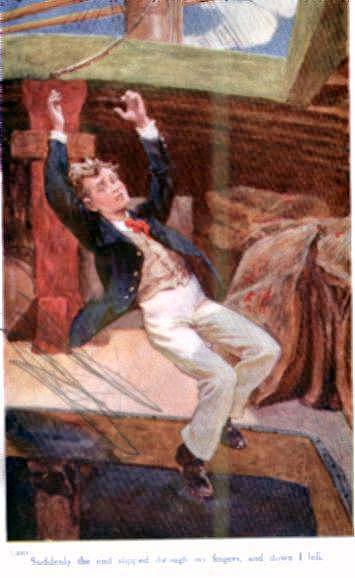
I was doubtful about one of my ankles. It pained me more than any other part of my body. I drew it up and felt it all over. It was tender to the touch, but none of the bones appeared to be out of their places. This examination occupied some time. I did not call out for fear of the consequences. The pain which had hitherto prevented me thinking about what would follow now decreased, and I began to consider the awkward position in which I was placed. I tried to persuade myself that I had not positively intended to act the part of a stowaway. I could not but know that I had thought about it, yet I had only gone below for the sake of seeing the hold of a ship. I could say that when I was discovered, with a tolerably clear conscience, so I fancied. Should I be discovered? That was the question. For what I could tell I might be entombed beneath the cargo and be unable to get out till I was starved to death. The thought was too dreadful for contemplation, and I tried to put it from me. I remembered how I had escaped from the old mill and the way I got out without any one to help me.
“Perseverance conquers all difficulties,” I said to myself as I said then. My situation in some respects was very similar, only on that occasion I had expected, on obtaining my freedom, to meet my friends, and now I should find myself confronted by a rough crew and an irate captain, who might send me on shore, and, for what I could tell, have me put into jail if there was time for doing so. I had, at first, no idea of the size of the place in which I was shut up. I only knew that I could touch the boards above my head by extending my hand when sitting upright. I thereby knew that there would not be room for me to stand. I now crawled about and ascertained that I was in a tolerably wide place, extending fore and aft and from side to side. I was, in fact, in the lower hold or bottom of the ship, far, far down beneath a mass of cargo. How long I had been there was also a mystery to me. I might have remained in a fainting state only for a few minutes, or hours might have passed. I knew that I began to feel hungry, though I had had an ample luncheon—for on Saturdays Mr Butterfield dined early—which showed that I could not be very much hurt, and that I must have been some considerable time on board. I had, however, as I intended to stay out till dark, put a couple of buns, which I had bought at a pastrycook’s, into my pocket. I refrained, as yet, from eating them, not knowing how long I might have to remain below. I thought that it must now be night, and as I supposed the crew would be asleep forwards and the captain and officers aft, they would not hear me, even if I shouted out at the top of my voice. I therefore concluded that it would be foolish to exhaust myself uselessly. “I’ll wait for daylight, when they’re moving about, and I shall have a better chance of making myself heard,” I thought.
The place where I lay was dry and clean, though it smelt horribly of tar and other odours from which the hold of a vessel is seldom free, and was besides disagreeably close. After a considerable period had elapsed, and when the pain had much gone off, a drowsiness stole over me, and having got into a comfortable position, I fell fast asleep. I think I must have awoke at intervals, for I remember hearing a curious rippling sound beneath me. It must have had a lulling effect, for I dropped off again.
The next time I woke I heard not only a rippling sound, but a dashing of water against the sides, and presently the ship began to pitch slowly and gently. The idea at once occurred to me that I must be at sea. If so, it was where I had long wished to be, though the circumstances accompanying my entrance into a naval life differed greatly from such as I had intended them to be. Could it then be daylight?—if so, I had been much longer below than I had calculated on. The ship, I remembered, was to sail with the morning tide. That might have meant one or two o’clock, for how the tides ran I didn’t know. There must have been time, at all events, for her to get away from the wharf, and to descend the Mersey. In that case the day must now be well advanced. Probably, I thought, the ship has had a fair wind, and with a favourable tide must have got rapidly along. I could not sing:—
“I’m on the sea, I’m on the sea, I am where I would ever be; With the blue above, and the blue below, In silence wheresoe’er I go.”