"Dick Cheveley" (continued 2)
Reading edition
“‘We are prisoners, caught like rats in a trap!’ cried the men from all parts of the ship. The entrance to the harbour is guarded by heavy forts on either side, between which we had run some distance, and their guns pointed down on our decks might sink us before we could get outside again. The officers, on hearing the report, hurried aft, scarcely able to believe that it was true. They found, however, on seeing the Frenchmen, that there was no doubt about the matter. Just then a flaw of wind came down the harbour, when our third lieutenant, Mr Webbley, hurrying up to the captain, said, ‘I believe, sir, if we can get her under sail, we shall be able to fetch out.’ ‘We will try it at all events!’ cried the captain; ‘send the men to their stations, and hand those French gentlemen below.’ The mounseers, on finding that they were not yet masters of the ship, began to bluster and draw their sabres, but the marines quickly made them sound another note, and in spite of their ‘Sacrés!’ they were hurried off the deck under a guard. The men flew aloft, and in three minutes every sail was set, and the yards braced up for casting. The frigate was by this time completely afloat, the cable was cut; her head paid off, the sails filled, and away she stood from the shore. The wind freshening, she quickly gathered way. The launch and the French boat were cut adrift, and we had every hope of escape. Directly we began to loose sails, we saw lights appear in the batteries, and observed a stir aboard the brig. She soon afterwards opened fire on us, as did the fort on the starboard bow, and in a short time every fort which could bring a gun to bear on us, began to blaze away. We were now, however, going rapidly through the water, but there was a chance of our losing a topmast, as the shot came whistling through our sails, between our rigging. The wind shifting, made it seem impossible that we could get out without making a tack, but our captain was not a man to despair, and I am pretty sure that there was no one on board who would have given in, as long as the frigate was afloat. Fortunately the wind again shifted and blew in our favour. Blocks and ropes came falling from aloft, we could see the holes made in the canvas, by the shot passing through them. Several of the masts and spars were badly wounded, and two thirty-six pound shot came plump aboard, but no one was hurt. As soon as the hands came from aloft, they were ordered to their quarters, and we began firing away in return at the forts, as well as at the impudent little brig, which we at length silenced. As may be supposed, we gave a right hearty cheer when we saw the shot the Frenchmen were firing at us fall far astern, and we found that we were well clear of the harbour. We made sail for Corsica, where we found a squadron under Commodore Linzee, engaged in attempting to drive the French from that island. The first expedition in which we took part was to Martello Bay. It was guarded by a strong round tower, to which the same name had been given. The troops to the number of fourteen hundred, were landed the same evening, and while they took possession of a height, which overlooked the tower, we, and the ‘Fortitude’ frigate were ordered to attack it from the sea. The ‘Fortitude’ got the worst of it, for the French turned their fire chiefly on her, while for three hours we kept blazing away, without producing any visible effect. Some guns had been got up by the troops to the height, and by the use of hot shot they managed to set on fire some bass junk which lined the parapet. At last the gallant little garrison had to give in, when it was found, that they numbered only thirty-three men, and had but one six and two sixteen pounders; yet so well did they work their guns, and so strong was the tower, that they had held it for nearly two days against a large body of troops and our two frigates. During the time the ‘Fortitude’ had lost six killed, and fifty-six wounded. Three of her lower-deck guns had been dismounted, and she had been set on fire by the red-hot shot discharged at her, besides other damages. The tower, I believe, took its name from the myrtles growing on the shores of the bay. In consequence of the way this little tower had held out, the government had a number of similar towers built on the English coast, which were called after the original, ‘Martello’ towers. We next attacked a fortification called the Convention redoubt, which was considered the key to the town of San Fiorenzo. The redoubt was commanded by a rocky hill, rising to the height of seven hundred feet above the level of the sea. As it was nearly perpendicular at its summit, it was considered inaccessible, but British sailors had to show the Frenchmen that where goats could find a foothold they could climb.
“Looking up at the hill, it certainly did appear as if no human being could reach the summit. Not only, however, did our men get up there, but they carried several eighteen-pounders with them. On the right there was a descent of many hundred feet, down which a false step would have sent them headlong, and on the left were beetling rocks, while along the path they had to creep, only one man could pass at a time. The pointed rocks, however, served to make fast the tackle by which the guns were hoisted. To the astonishment of the Frenchmen, the eighteen-pounders at length began firing down upon their redoubt, which was then stormed by the troops, and quickly carried. Part of the garrison were made prisoners, but a good number managed to scamper off on the opposite side. We, however, took possession of a fine thirty-eight-gun frigate, called the ‘Minerve,’ which the Frenchmen had sunk, but which we soon raised and carried off with us. She was then added to the British navy, and called the ‘San Fiorenzo,’ and was the ship on board which King George the Third used often to sail when he was living down at Weymouth. She also fought one or more actions when commanded by Sir Harry Neale, one of the best officers in the service. However, young gentlemen, these things took place so long ago that I don’t suppose you will care much to hear about them.”
“Oh, yes, we do. Please go on!” cried out several voices from among us. “It is very interesting, we could sit here all day and listen to you.”
“If that is the case, I’ll go ahead to please you,” said old Riddle.
“In those days we didn’t let grass grow on our ship’s bottoms. Soon after we left San Fiorenzo we took Bastia, the seamen employed on shore being commanded by Captain Nelson, of the ‘Agamemnon.’ After we had besieged it for thirty-seven days the garrison capitulated, we having lost a good many officers and seamen killed and wounded.
“We next attacked Calvi, which we took with the loss of the gallant Captain Serocold and several seamen killed, and Captain Nelson and six seamen wounded. It was here Captain Nelson had his right eye put out. I saw a good deal of service while on board the ‘Juno.’ Whilst still on the station I was transferred with Andrew Barton and others, to the ‘Dido,’ twenty-eight-gun frigate, commanded by Captain Towry. These small craft used to be called ‘Jackass’ frigates, but the ‘Dido’ showed that she was not a ‘Jackass’ at all events. Soon after I joined her she and the ‘Lowestoff,’ thirty-two-gun frigate, were despatched by Admiral Hotham to reconnoitre the harbour of Toulon. We were on our way, when, one evening, we discovered standing towards us two large French frigates. We made the private signal, when, supposing that we were the leading frigates of the fleet, they both wore and stood away. We chased them all night, but in the morning, when they discovered that there were only two frigates, and both much smaller than themselves, they tacked and stood towards us. One of the Frenchmen was the ‘Minerve,’ of forty guns, and the other the ‘Artemise,’ of thirty-six guns. When the ‘Minerve’ was about a mile away from us, on the weather bow, and ahead of her consort, she wore, and then hauling up on the larboard tack, to windward, commenced firing at us. I was still, you will understand, only a powder-monkey. My business was to bring the powder up from the magazine in a tub, upon which I had to sit till it was wanted to load the guns. Still, I could see a good deal that was going forward through the ports; besides which I heard from the men what was taking place. My old messmate, Tom Noakes, had joined the ‘Dido.’ He was now seated on his tub next to me—the biggest powder-monkey I ever knew. Poor Tom was not at all happy. He said that we smaller fellows had only half the chance of being killed that he had, as a shot might pass over our heads which would take his off. I tried to console him by reminding him that there were a good many parts of the ship where no shots were likely to pass, and that he had less chance of being hit than the men who had to stand up to their guns all the time. We stood on till the ‘Minerve’ was on our weather beam, when we could see her squaring away her yards, and presently the breeze freshening, she bore down upon our little frigate with the evident intention of sinking us. So she might have done with the greatest ease, but having fired our broadside just as her flying jibboom was touching our mainyard, we bore up, and her bow struck our larboard quarter. So great was the shock, that for the moment many thought we were going down, but instead of that our frigate was thrown athwart the ‘Minerve’s’ hawse, her bowsprit becoming entangled in our mizen rigging. The Frenchmen immediately swarmed along their bowsprit, intending to board us. Our first lieutenant then shouted for ‘boarders to repel boarders,’ but as the French crew doubled ours, we should have found it a hard matter to do that. Fortunately the Frenchman’s bowsprit broke right off, carrying away our mizen-mast, and with it the greater number of our assailants, who failed to regain their own ship. With our mizen-mast of course went our colours, but that the Frenchmen might not suppose that we had given in, Harry Barling, one of our quarter-masters, getting hold of a Union Jack, nailed it to the stump of the mizen-mast. All this time, you must understand, we had been blazing away at each other as fast as we could bring our guns to bear. The ‘Minerve’ at last ranged ahead clear of us, but we continued firing, till the ‘Lowestoff,’ seeing how hard pressed we were, came up to our assistance, and tackled the Frenchman. In a few minutes, so actively did she work her guns, that she had knocked away the enemy’s foremast and remaining topmast. As the ‘Minerve’ could not now possibly escape, we threw out a signal to the ‘Lowestoff’ to chase the ‘Artemise,’ which instead of coming to the assistance of her consort was making off. She however had the heels of us, and we therefore, returning again, attacked the ‘Minerve,’ which, on her mizen-mast being shot away, hauled down her colours. We had our boatswain and five seamen killed, two officers and thirteen men wounded. The ‘Lowestoff’ had no one hurt, and so, although she certainly contributed to the capture of the prize, we gained the chief credit for the action, which, considering the difference in size between our frigate and the Frenchman, we certainly deserved. But in those days we didn’t count odds. We thought that we had only to see the enemy to thrash him. Even our best captains, however, sometimes made a mistake.
“I afterwards belonged to the ‘Terpsichore’ frigate, Captain Richard Bowen, which formed one of a squadron under Lord Nelson, who was then Sir Horatio, to attack Santa Cruz, in the Island of Teneriffe. The squadron consisted of three seventy-fours and one fifty-gun ship—which afterwards joined us—three frigates, and the ‘Fox’ cutter. It was some time before we could get up to the place. At last we managed to embark nearly seven hundred seamen and Marines in the boats of the squadron, nearly two hundred on board the ‘Fox’ and others, including a detachment of Royal Artillery, in some captured boats. Sir Horatio himself took the command. Shoving off from the ship some time after midnight, we pulled in for the town. The plan was to make a dash for the mole, and then to fight our way forward along it, we fully believing that the enemy would run as soon as we appeared. When the leading boats, under the command of Captains Freemantle and Bowen, had got within half gunshot of the mole head, the enemy took the alarm, and immediately opened fire on us from forty heavy guns. A hot fire it was, I assure you. The ‘Fox’ cutter, crowded with men, was sunk by the heavy shot which struck her, and nearly a hundred of those on board perished. I was in the ‘Terpsichore’s’ barge with my brave captain, when, just before she reached the mole, a shot struck her, and down she went, drowning seven of my shipmates; but the captain, with the rest of us, managed to get on shore. In spite of the hot fire with which we were met from the mole head, we succeeded in effecting a landing, and drove the enemy before us. Having spiked the guns which had done us so much mischief, we advanced along the mole, led by Captain Bowen, and our first lieutenant, Mr Thorpe. Here we encountered a tremendous fire of musketry from the Citadel and houses, so that the greater number of our party were either killed or wounded. Our brave leader, Captain Bowen, was among the first who fell, and soon afterwards Lieutenant Thorpe was killed. Nearly all the rest of the officers were killed or wounded. It being found at last that there was no chance of success, we were ordered to fall back.
“We had neither seen nor heard anything of Sir Horatio who would have been certain, had not something happened to him, to have been ahead. We now learned that just as he was landing and about to draw his sword, he had been struck by a shot on the elbow, and that he had been carried on board his ship by the few men who remained in the boat, the rest having landed. One of them, John Lovell, who I knew well, as soon as he saw the Admiral wounded, took the shirt from his own back, and tore it into strips, to bandage up his shattered arm. In the meanwhile we were waiting for the arrival of Captains Trowbridge and Waller with another squadron of boats. They however missed the mole head, but though some landed to the southward of it, in consequence of the heavy surf breaking on the shore, others put back. Captain Trowbridge, not finding the Admiral and the other officers he expected to meet there, sent a sergeant to summon the Citadel to surrender. The poor fellow did not return, having probably been shot. The scaling-ladders had also been lost in the surf. When morning broke we altogether mustered only 340 men. Every street in the place was defended by artillery, and we heard that a large force of 8000 men was advancing. The enterprise had therefore to be abandoned. Captain Trowbridge proposed to the Governor that we should re-embark with our arms, and he engaged that the squadron should not further molest any of the places in the Canary Islands. These terms were agreed to. We obtained also permission to purchase such provisions as we required. The affair was a disastrous one. We gained nothing, for besides 150 men killed or drowned, among whom were several brave officers, we had upwards of 100 wounded, and the Admiral lost his right arm.
“People call this sort of thing ‘Glory,’ but for my part I could not make out what advantage we expected to gain, or what business we had to go there at all.”
“I say, Mr Riddle, were you ever shipwrecked?” sang out one of the old sailor’s auditors, who was getting rather tired of the long yarn about his battles with which he had been indulging us.
“Bless you, young gentlemen, that I have, well-nigh a score of times I might say. Some time after this I belonged to the ‘Nautilus’ sloop of war, commanded by Captain Farmer. We belonged to the squadron of Admiral Lewis, then cruising in the Hellespont, when we were ordered to England with despatches of the utmost importance. We had a fresh breeze from the north-east as we threaded our way through the numerous islands of that sea. When at length we got off the island of Anti Milo, the Greek pilot we had with us declared he knew nothing of the coast to the westward. As, however, our captain was anxious to make a quick passage for the sake of the despatches, he determined to try and pilot her himself. Though the weather looked threatening, we sailed at sunset from Anti Milo, and shaped a course for Cerigotto. As the night grew on the wind increased to a heavy gale, torrents of rain fell, the thunder roared and rattled, the flashes of lightning were as vivid as I ever saw in my life. Sometimes it was almost brighter than day, then pitchy dark. The captain had just given orders to close reef the topsails, intending to bring the ship to till daylight, when a bright flash of lightning showed us the Island of Cerigotto right ahead, about the distance of a mile or so. Now, knowing his position, the captain resolved to run on, believing all danger past. The watch below was ordered to turn in. Those who remained on deck stowed themselves away under shelter of the hammock nettings.
“We of course kept a bright look-out, though it was not supposed that we had anything to fear. Except the officer of the watch, the rest had gone below—the captain and master probably to examine the chart—when the look-out on the forecastle shouted out ‘Breakers ahead!’ ‘Put the helm a lee!’ cried the officer of the watch. Almost before the order could be obeyed we felt a shock which lifted us off our feet, and sent those below out of their hammocks. We knew too well that the ship was ashore. In one instant the sea struck the ship, now lifting her up and then dashing her down upon the rocks with tremendous force. It seemed like a fearful dream. Almost in a moment the main-deck was burst in, and soon afterwards the lee bulwarks were carried away. The captain and officers did their best to maintain discipline. The first thing to be done was to lower the boats, but before they could be got into the water they were all either stove or washed away, and knocked to pieces on the rocks. Only a whale-boat of no great use was launched by the boatswain and nine other hands. As soon as they got clear of the rocks they lay on their oars, but it would have been madness in them to come back, as the boat already contained as many people as she could carry with safety. The captain accordingly ordered her to pull towards the Island of Pauri, in the hope that assistance might there be obtained for us. The ship continued to strike heavily. Every instant I expected that she would go to pieces, when one and all of us would have been lost. About twenty minutes after she struck the mainmast fell over the side towards a rock, which we could distinguish rising above the water, followed by the foremast and mizen-mast. Hoping that the rock would afford us more security than the ship herself, I, with others, made my way towards it, though at no little risk of being carried off by the seas. On reaching it we shouted to the rest to come on, as at any moment the ship might go to pieces. The whole crew followed our example. Many parts of the rock itself were scarcely above water. It seemed, as far as we could judge, to be about 400 yards long, and half as many wide. Here all hands collected, for as yet none had been washed away or lost, but many of the people had no clothing on, or only just their shirts, in which they had turned out of their hammocks. We had not a scrap of food, and we knew that it might be some hours before the whale-boat could bring us assistance. Scarcely had we reached the rock when we knew by the crashing, rending sounds, and the loud thundering noise, as the planks and timbers were dashed against it, that our stout little ship had gone to pieces. When day dawned we saw the foaming sea covered on all sides with fragments of the wreck, while several of our shipmates were discovered clinging to spars and planks, they having returned to the ship in the hopes of obtaining either food or clothing. It was known to the captain and officers that we were about twelve miles from the nearest island. There was but little chance of the boat getting back to us during the day. We secured a flag which had been washed up. This we hoisted to the end of a spar, and fixed it in the highest part of the rock. The day was bitterly cold, many of the men were almost perished for want of clothing. The officers made inquiries if any man had a flint. At last one was found. At the same time a small keg of powder which had been floating about was thrown up. The powder, though damp, served instead of tinder. We were able to get a fire alight. It gave us some occupation to collect fuel, though at the risk of being carried away by the seas, as they rolled up on the rock. We got also a quantity of canvas, and with this, and the help of some planks, we put up a tent, which afforded us some shelter. Though we had no food to cook, the fire warmed us, and enabled us to dry our clothes. We kept it burning all night in the hope that it would serve as a beacon. Another night passed away. In the morning we saw to our joy a boat pulling towards us. She was our own whale-boat, with the boatswain and four hands; but they brought no food nor water, as they found neither one nor the other on the Island of Pauri. The boatswain tried to persuade our captain to leave the rock, but he refused to desert us; so he ordered the boatswain to take ten men and make the best of his way to Cerigotto, and to return as soon as possible with assistance.
“We had been badly enough off before. Matters now grew worse, the wind again increasing to a heavy gale, which sent the seas washing nearly over the rock. We should have all of us been carried away, if we had not secured ropes round a point which rose higher than the rest. I don’t like, even now, to think of that night. The cries and groans of my poor shipmates still ring in my ears. Now one man sank down, now another. The cold was terrible, even to those who, having been on watch, were well clothed. In the morning, several of our number were missing, and others lay dead on the rock. We were looking out for the whale-boat, when a sail was seen standing directly down for us. In our eagerness to get off, we began to form rafts of the spars and planks we had collected. As the ship approached, she hove-to and lowered a boat, which came towards us till almost within pistol-shot, when her crew rested on their oars, and looked at us earnestly. Who they were we could not tell. The man at the helm waved his hat, and then, seeming suspicious of our character, steered back to the ship. In vain we waved and shouted, the fellows paid no attention to us. To our bitter disappointment, we saw the boat hoisted up, when the ship again made sail. We were now in despair. I’d before felt somewhat hungry and thirsty, but till now never knew what real thirst was. Some of the men drank salt water, but that only made them worse.
“Another day came to an end. Fortunately the weather had moderated, and we tried to keep ourselves warm by huddling close together. Death was now making rapid progress amongst us. Those who had drunk salt water went raving mad, and threw themselves into the sea; others died of exhaustion, among them our captain, and first lieutenant. I never expected to see another day, when, the voice of the boatswain hailed us. The cry was at once raised for ‘water! Water!’ but to our bitter disappointment, he told us he had brought none, as he could only get some earthen jars, in which it was impossible to bring it through the surf. He said, however, that a large vessel would arrive the next morning, with provisions and water. The thought of this kept up our spirits. When daylight returned, we eagerly looked out for the expected vessel, but she didn’t appear, and all that day we had to wait in vain. More of our people died. It seemed a wonder that any of us should have survived, suffering so terribly from hunger and thirst as we were. Some attempted to satisfy their hunger in a way too horrible to describe. All day long we were on the look-out, expecting the boats to appear which the boatswain said would come, but hour after hour passed. I can tell you they were the most dreadful hours I ever remember. To remain longer on the rock seemed impossible. It was agreed therefore next day to build a raft on which we might reach some shore or other. It would be better, we thought, to die afloat than on that horrible spot. As soon as daylight broke we set to work, lashing together all the larger spars we could find, but our strength was not equal to the task. Still we contrived to make a raft. At length we launched it, but scarcely was it in the water, when the sea knocked it to pieces. Many of our poor fellows rushed in to try and secure the spars, and several of them were swept away by the current. Unable to render help, we saw them perish before our eyes. In the afternoon the whale-boat again came to us, but the boatswain told us that he had been unable to get the Greek fishermen to put to sea while the gale continued. He brought us neither food nor water, though many of us thought he might have managed to bring off some of the goats and sheep from the island. Even if we had eaten them raw, they would have assisted to keep body and soul together. I had hitherto kept up, but at last I lay down, unable to move hands or feet, or to raise my head from the rock. During the night many more of my unhappy shipmates died. I was lying on the rock, just conscious enough to know that the day had returned, when, I heard some one sing out, ‘The boats are coming! The boats are coming!’ I raised my head and tried to get up on my knees. Looking out, I saw four fishing vessels with the whale-boat pulling towards us. I can’t tell you the joy we felt. Many of us who had before been unable to move, sat up, some few even were able to stand on their feet, while we made an attempt to cheer, as the boats drew near. They brought us water and food. Our second lieutenant, now commanding officer, would allow only a small portion to be given to each man at a time, and thus saved us from much suffering. When our strength was a little restored, we were carried on board the boats, which at once made sail for Cerigotto, where we were landed in the evening. Of our complement of one hundred and twenty-two people, only sixty-four remained. When I think of all we went through, it seems surprising that any of us should have lived to reach the shore. We were treated in the kindest way by the people of the island. After staying with them for eleven days, at the end of which time most of us had somewhat recovered our strength, we proceeded to Cerigo, and thence sailed for Malta. There have, I’ll allow, been more terrible shipwrecks. Few people, however, have suffered as much as we did during the six days we were on the rock, without food or water. As soon as I was recovered, I was drafted on board the ‘Ajax,’ seventy-four, commanded by Captain Sir Henry Blackwood. We lay off the mouth of the Dardanelles, forming one of the squadron of Vice-Admiral Sir John Duckworth. I’m fond of old England, as I hope all of you young gentlemen are, but I must own that the spot where we lay is a very beautiful one.
“It had just gone four bells in the first watch, and all hands except those on duty were asleep, when we were roused up by the cry of fire! Directly afterwards the drum beat to quarters, and the guns were fired, as signals of distress. A boat was also sent off with one of the lieutenants and a midshipman, to summon assistance from the other ships. We all stood ready to obey the orders we might receive. The captain and one of the officers at once went down to the cockpit, from which clouds of smoke were bursting out. They quickly had to beat a retreat. We then, forming a line, passed the buckets along full of water, to pour down upon the seat of the fire, as far as it could be discovered. So dense was the smoke, that several of the men who were closest and whose duty it was to heave the water, were nearly suffocated. It was soon evident that the flames had the mastery of the ship. The carpenter endeavoured to scuttle the after part, but had to abandon the attempt. In less than fifteen minutes after the alarm had been given, the flames raged with such fury, that it was impossible to hoist out the boats.
“The jolly-boat alone had been lowered by the captain’s orders, directly he came on deck. The fire was now bursting up through the main hatchway, dividing the fore from the after part of the ship. The captain accordingly ordered all hands forward. There we were nearly six hundred human beings huddled together on the forecastle, bowsprit, and sprit-sail yard, while the after part, from the mainmast to the taffrail, was one mass of fire. Smoke in thick columns was now rising from all parts of the ship, while the flames crackled and hissed, then they caught some of the poor fellows who had taken refuge in the tops. Some kept silent, but others shrieked aloud for mercy. Above the roar of the flames, and the cries of the men, the sound of the guns could be heard when they went off as the fire reached them. Captain Blackwood retained his composure and cheered us up by reminding us, that the boats of the squadron would soon arrive. They came at last. It was no easy matter to get on board. Many of the men jumped into the sea, in their eagerness to reach them. Others stood, shouting and shrieking to them to come nearer. I, at last seeing a boat which had not as yet taken many men aboard her, and thinking it was time to save myself, leapt overboard, and was soon picked up. Many who had imitated my example were of necessity left swimming or floating, and would have perished had not other boats arrived and saved them. The ship’s cable had some time before this been burnt through. All this while she was drifting towards the island of Tenedos—now her stern, now her broadside alternately presented to the wind. One of the men in the boat had been hurt. I took his oar. I found that the boat I was aboard of belonged to the ‘Saint George,’ and was under the command of Lieutenant Willoughby. As soon as we fell in with another boat, we put the rest of the people on board her, and rowed back again, to try and save some more. This we succeeded in doing. The third time we returned to our burning ship. Just then she rounded-to, and we saw several men hanging by ropes under her head. The brave Lieutenant resolved to rescue these poor fellows before she again fell off. Straining at our oars, we dashed up to her, and succeeded in taking all of them on board, but before we could get clear of the ship she again fell off, carrying us with her, and as she surged through the water nearly swamping us. At the same time flames reached the shank and stopper, when her remaining bower anchor fell over her sides, very nearly right down upon us. Just then, the cable caught our outer gunwale, over which it ran, apparently one sheet of fire. The flames were at the same time raging above our heads, and rushing out from her bow-ports. Our destruction seemed certain; we might have left the boat to try and save ourselves by swimming, but we were too much exhausted to try and reach any of the other boats; all we could do was to try and keep the flames from off our own. Just as we had given up all expectation of escape, the anchor took the ground, and though the cable was nearly burnt through, it had strength sufficient to check the ship’s head, which enabled us to clear ourselves; though we were somewhat scorched, no one was otherwise much hurt. In a short time the wreck drifted on shore on the north side of the island of Tenedos, where she blew up with a tremendous explosion, which must have been heard miles away. We who were saved had reason to be thankful, but of the ship’s company two hundred and fifty perished that night by fire or water, including several of the officers, together with the greater number of the midshipmen, who, being unable to swim, were drowned before they could reach the boats. There were three women on board, one of whom was saved by following her husband down a rope from the jibboom. The boatswain had two sons on board. When the alarm of fire was given, he had rushed down, and bringing up one of them, had thrown him into the sea, where he was picked up by the jolly-boat. He then descended for the other, but never returned, being, as several of the midshipmen probably were, suffocated by the dense smoke rising from that part of the ship. I could go on into the middle of next year, as the saying is, telling you of my shipwrecks and adventures, but I have a notion that you would get tired of listening before I had brought my yarn to an end.”
“Oh, no! No! Go on, Mr Riddle, go on, go on!” we shouted out.
“Well, then, young gentlemen, I’ll just tell you the way we once took a Spanish sloop-of-war.
“I belonged at the time to the ‘Niobe’ frigate out in the West Indies. We had been cruising for some weeks without taking a prize, when we captured a Spanish merchant schooner, after a long chase. From some of her crew our captain learnt that a Spanish corvette, of twenty guns, lay up a harbour in Cuba. He determined to cut her out. He had intended sending the boats away for that service, when our second lieutenant, as gallant an officer as ever stepped, proposed to take in our prize under Spanish colours, and running alongside the corvette, to capture her by boarding. Having shifted the prisoners to the frigate, the second lieutenant, with three midshipmen and thirty volunteers, I being one of them, went on board the schooner. There were batteries on either side, with heavy guns which would have opened fire upon us had it for a moment been suspected what we really were. The lieutenant and one of the midshipmen blackened their faces, and rigged themselves out in check shirts and handkerchiefs bound round their heads. The rest of the crew wanted to do the same, but the lieutenant would only allow me and another man to rig up as he had done, and regular blackamoors we made of ourselves. We laughed, I can tell you, as we looked at each other and talked the nigger lingo, so that even if a boat had come alongside they would not have discovered who we were. We had besides a real black and mulatto on board belonging to our crew. The rest of the people were sent below, with their cutlasses and pistols ready for the moment they were wanted. Everything was prepared by the time we got near the mouth of the harbour. The midshipman, a fine young fellow, taking the helm, the lieutenant sat on the companion-hatch smoking a cigarette, and Sutton, the other man, and I, with the mulatto and negro, lolled about the deck with our arms folded. On we stood close under the batteries, which, if we had been discovered, would have sunk us in pretty quick time, but as the schooner was very well-known in the harbour, her real character was not suspected. As soon as we got inside the harbour, we saw the corvette anchored right in the centre. The breeze headed us. That would be all in our favour, we knew, when we had to come out again. We made four or five tacks, taking care not to do things too smartly. The lieutenant turned his eye every now and again on the batteries. I think he expected, as I can tell you I did, that the Spaniards would before long smell a rat, and begin blazing away at us. They seemed, however, to have no suspicion, and we were allowed to beat up the harbour without being interfered with. We had got nearly up to the corvette, when we saw two or three boats coming off from the shore towards us. We well knew that if they got alongside they would soon find out that the schooner had changed hands. We could see only a few people on the deck of the corvette, and the rest of her crew we guessed were either below or gone ashore. In the latter case we hoped soon to master her. As the boats drew near us the breeze freshened, and the lieutenant ordering the helm to be put down, we luffed up alongside the corvette, before those on board suspected what we were about to do. No sooner did they discover what we were up to, than they began shouting and shrieking, some running to the guns, others to get hold of muskets and cutlasses, while numbers of the crew came swarming up from below. Several officers made their appearance. We didn’t give them much time, you may be sure, to defend themselves, before, led by our brave lieutenant, we threw ourselves upon their deck, and were soon slashing away with our cutlasses. But few of them stopped to meet us, so completely did we surprise them, but leaped below faster than they had come up. The officers for a few seconds held out, but they were quickly disarmed and placed under a couple of sentries in the after part of the poop. Three or four hands only had been left on board the schooner, and the lieutenant at once ordered her to lead the way down the harbour, while the corvette’s cable was cut and the topsails loosed. We had made such quick work of it, that the soldiers in the fort didn’t discover what had happened until the corvette was under way, with her topsails and courses set, following the schooner. They then began to open a hot fire on us and the schooner, but the breeze freshening, we made such good way, that they could not get a proper range; their shot, however, came pretty thickly on board, passing through the sails, cutting away a rope now and then, and several times hulling us, but not a man was hurt. As soon as we could get some powder and shot from below, we fired in return, though there was but little use in doing that, you may be sure. We gave three hearty cheers when we at last got clear of the harbour, and sailed away with our prize for Jamaica, accompanied by our frigate. Our lieutenant and all engaged gained great credit for the way the enterprise had been accomplished.
“Had I been a wise man, I should have stuck to the navy; but soon after this, I had the misfortune to belong to a ship commanded by a very different sort of officer to any I had before served under. If ever there was a hell afloat she was one. Well-nigh a quarter of the crew at a time were on the black list. Not a day passed that one or more were not flogged. At last, two other men and I, when off the coast of America, leaped into a boat alongside and made for the shore. If we had been caught, we should have been well-nigh flayed alive. So we took good care to keep in hiding till the ship had sailed. I afterwards shipped on board an American merchantman, but I would not join Uncle Sam’s navy on any account. I can’t say that I found myself in a perfect paradise, and I was not sorry, after two or three years, to get on board an English merchant vessel. I became mate of her, and in one way or another saved money enough to buy my cottage here, with a boat and nets, and to settle down with my wife and family. I mustn’t keep you any longer, young gentlemen, listening to what befell me in the meantime; but if you’ll pleasure me by coming here another day, I’ll go on with my yarn.”
“Thank you, my friend,” said Mr Reynell, getting up, “it’s time for all of us to be returning home, but I am very sure these young gentlemen will be very much obliged to you, if we can manage to make another excursion here, to listen to some more of your adventures.”
While some of us gathered round the old sailor, asking him questions, the rest were employed carrying the baskets of provisions to the carriage, which set off on its return, we soon afterwards following on foot. Although many of the party declared that they had no wish to go to sea, the accounts I had heard only strengthened my desire to become a sailor, and I determined more resolutely than ever to use every means to accomplish my object.
Chapter Five.
I form plans against the smugglers—Ned’s brotherly advice—I continue to visit old Riddle—He presents me with a cutter—My first lessons in sailing—Reception of my present at home—Aunt Deb again gives her opinion—A present in return—Sudden disappearance of Mark, which leads to a further expression of sentiments on the part of Aunt Deb—I visit Leighton Hall—My interview with the Squire—I obtain permission to visit Mark in prison—“Better than doing nothing”—I console Old Roger—“A prison’s a bad place for a boy”—Returning homewards, I unexpectedly gain some important information—The barn—The smuggler’s conference—Rather too near to be pleasant—I contrive to escape—Am pursued and captured by the smugglers, but finally released—Aunt Deb’s disapproval of my friendship for Mark Riddle.
I have taken up so much space in describing the adventures of old Riddle, that I must be as brief as I can with my own. Although I had been inclined to think smugglers very fine fellows, I had lately heard so much against them that I began to consider it would be a very meritorious act if I could gain information which might lead to the capture of some of them; besides which, I flattered myself Sir Reginald would be so highly pleased at my conduct that he would exert himself more than he at present seemed inclined to do, to obtain me an appointment as midshipman on board a man-of-war. I kept my ideas to myself; I didn’t venture to mention them even to the old sailor, as I suspected that if not actually in league with the smugglers, he was friendly to them. I thought it better also to say nothing about it to my father, for although I knew that he would be pleased should I succeed, he might very naturally dread the danger I should have to run in my undertaking. How to set about the matter was the difficulty. I had no intention of acting a treacherous part, or to try to become friendly with the smugglers, for the purpose of betraying them. My plan was to hunt about to try and find out their hiding-places, and where any cargoes were to be run; then to give information to the baronet. The only person to whom I confided my plan was Ned, under a promise of secrecy. He tried to dissuade me, pointing out that it was a very doubtful proceeding at the best, and that, should I succeed, the smugglers would be sure to take vengeance on me.
“They will either shoot you or carry you off to sea, and drown you, or put you on board some outward-bound ship going to the coast of Africa, or round Cape Horn; and it may be years before you get back, if you ever return at all,” said Ned.
Still his arguments didn’t prevail with me, and I only undertook to be cautious. Had he not given his promise to keep my intentions secret, he would, I suspect, have told our father or Aunt Deb, and effectual means would have been taken to prevent me from carrying out my plan. A considerable time passed by, and although I was on the watch, I could gain no information regarding the proceedings of the smugglers. During this period I paid several visits to old Riddle, who always seemed glad to see me. I was highly delighted one day when he presented me with a cutter, which he had carved out and rigged expressly for me. It was about two feet long and of a proportionable width, fitted with blocks, so that I could lower or hoist up the sails, and set such canvas as the wind would allow. The inside was of a dark salmon colour, the bottom was painted and burnished to look like copper, while the rest was of a jet black. Altogether I was highly delighted with the craft—the first I had ever possessed—and I only wished she was large enough to enable me to go aboard her, so that I might sail in her.
Near old Rogers’ house was a lagoon of considerable length and breadth, filled by the sea at high tide. It was open to all winds, and was thus a capital place for sailing a model. He and Mark at once accompanied me to it, and they having trimmed the sails, and placed the rudder in the proper position, the model vessel went as steadily as if the ship had had a crew on board. When she had finished her voyage across the lagoon, the old sailor, taking her out, showed me how to trim the sails. I then, carrying her back to the place whence she started, set her off myself. I had fancied that I could make her sail directly before the wind; but he explained the impossibility of doing this without a person on board to steer, as she would have a tendency to luff up to the wind. He evidently took a pleasure in teaching me, and I didn’t grow weary of learning, so that at the end of the first day I fancied I could manage my little craft to perfection. I called her “The Hope.” He promised to have the name painted on her stern by the next day I came. I went almost day after day for a week or more. At last old Roger declared I could sail “The Hope” as well as he could. Sometimes Mark came with me, but he didn’t take as much interest in the amusement as I did, he being more accustomed to practical sailing; besides which he had other employments into which he didn’t think fit to initiate me. As I before said, he frequently went fishing on the Squire’s ponds, and from a light fowling-piece which I saw in his room, together with several nets and other contrivances for catching game, I suspected that he also spent some of his time in the Squire’s preserves. I didn’t like to hint to him that I had any suspicion on the subject. When he saw my eyes directed towards a gun, he observed—
“I sometimes go out wild-duck shooting in the winter. My gun is not large enough for the purpose, so when I can contrive to get up close enough I now and then kill a bird or two.”
“I should think your gun was more suitable for killing partridges or hares or pheasants,” I remarked.
“Ah, yes, so it may be; but then pheasants and partridges and hares are game, and I should run the risk of being hauled up before the Squire if I were to bag any.”
He laughed in a peculiar way as he spoke. I tried to get information from him about the smugglers; but if he knew anything he held his tongue, evidently considering it wiser not to trust me. At last, as I wanted to show my cutter to Ned, my sister, and the rest, I told old Roger that I should like to carry it home. To this he raised no objection.
“You’ll find her rather a heavy load, Master Dick,” he said. “However, you can rest on your way. I advise you to stow the sails first, so that if you meet a breeze they will not press against you.”
I did as he advised me, lowered the mainsail and stowed it as he had shown me how to do, and lowered the foresail and jib. Mark had gone out that morning and had not returned, or he would have helped me, I had no doubt. Wishing old Roger, Mrs Roger, and Nancy good-bye, I set out.
Sometimes I carried the cutter on one shoulder, sometimes on the other, and then under my arm; but before I got half way I began to wish that there was a canal between old Roger’s cottage and the vicarage. My arms and shoulders ached with the load. After resting some time, I once again started and managed at last to get home. “The Hope” just as I had expected, met with general admiration from my brothers and sisters. They were much astonished to see me unfurl the sails, and all wished to come and see her sail. I promised to give them that pleasure, provided they would undertake to carry the cutter between them. Aunt Deb was the only person who turned up her nose at seeing my model.
“Mr Riddle might have thought of some other present to give the boy,” she observed; “there was no necessity indeed for his giving a present at all. Dick’s head is already too much turned towards sea matters, and this will only make him think of them more than ever. I shall advise your father to return the vessel to the old sailor, with the request that he will dispose of it to some one else. In my opinion, it was very wrong of him to make such a present without first asking leave.”
I thought it better to say nothing, and Aunt Deb didn’t carry out her intentions. My mother, who was always generously inclined, gave me leave to take a few pots of jam in return. A few days afterwards Ned and I, and two of my sisters, set out to carry our present. They had been interested in what I had told them about the old sailor and his pretty daughter, and wanted to see them. On our arrival they received us in a friendly way, and Mrs Riddle and Mary hurried to place chairs for my sisters. They thanked us much for the present we had brought. I observed that they all looked graver than usual. I inquired for Mark.
“He hasn’t come home since yesterday evening,” answered his father. “I don’t fancy that any harm has befallen him; but still I can’t help thinking all sorts of things. If he doesn’t come back soon, I must set out to look for him.”
I found that Mark had taken his gun, and said that he was going along the shore to get a shot at a gull, but it was not as yet the season for wild fowl to visit the coast. Still I could not help fancying that old Roger knew more about Mark’s intended proceedings than he thought fit to tell me. It struck me that perhaps the smugglers had something to do with the matter. Had I been alone I should have offered to have accompanied him; but he didn’t ask me, and indeed seemed to wish that we should take our departure. Telling my sisters, therefore, that it was time to go home, we wished the family good-bye, and set out on our return. At tea that evening my sisters mentioned the disappearance of Mark.
“Depend upon it that boy has got into mischief of some sort,” observed Aunt Deb; “though I never saw him that I know of, I am very sure from the remarks Dick has made that he is a wild monkey, and a very unfit companion for a young gentleman.”
I defended Mark, and asserted that it was just as likely that he had met with some accident.
“At all events, I intend to go over to-morrow morning, and inquire what has happened to him,” I said. “I don’t remember making any remarks which would lead you Aunt Deb, to suppose that he was otherwise than a well-conducted fellow. He seems much attached to his family, and they’re evidently very fond of him.”
“Perhaps his father spoils him as other parents are apt to do,” remarked Aunt Deb, glancing at the Vicar. “The sooner you break off your intimacy with him the better in my opinion—and now you are aware of my sentiments.”
The latter was a remark Aunt Deb usually made at the conclusion of an argument, by which she intended it to be understood that her opinion was not to be disputed.
Next morning, without waiting for breakfast, taking only a crust of bread and a cup of milk, I set off, anxious to learn what had happened to my friend Mark. On nearing the cottage I saw Mary at the door.
“Oh! Master Dick, I’m so glad you’re come,” she exclaimed. “Father and mother are in a great taking. Mark has got into trouble. When he went out yesterday evening he met Jack Quilter and Tom Bass, and they persuaded him to go shooting where he ought not to have gone, and all three were caught by Sir Reginald’s keepers. They had a fight for it, and Quilter and Bass knocked one of the keepers down, and would have treated him worse if Mark had not interfered. Three other keepers coming up, they were all carried off to the Hall, where they have been locked up ever since. Father only heard of it yesterday evening after you went. He at once set off to try and see Sir Reginald, and he only got back late last night, or rather this morning, so he has only just now got up. He said that the Squire was very savage with him, and threatened to send Mark off to sea. It was with great difficulty that father got leave to see Mark, who told him how he had saved the keeper’s life, but the Squire would not believe it, and said that he had been caught poaching, and must take the consequences.”
“I’m very sorry to hear this,” I said to Mary; “but don’t despair of your brother getting off. I’ll ask my father to plead for him; and if he won’t do that, I’ll go myself and tell the Squire what a capital fellow Mark is. It would be a shame to send him to sea against his will, although he might be ready enough to go of his own accord.”
After I had talked the matter over with Mary for some time, I went into the cottage, where I found Mrs Riddle looking very downcast, and soon afterwards old Roger made his appearance. He repeated what Mary had said, and added that he intended to engage the services of Lawyer Roe to defend Mark, though the expenses would be greater than he could well bear. I was afraid, however, that Lawyer Roe could do nothing for Mark, taken as he had been with a gun in his hands, in Sir Reginald’s preserves, should the baronet resolve to prosecute. I again offered to go off at once to see Sir Reginald. I however much doubted that my father would undertake the mission, especially as Aunt Deb would endeavour to persuade him to have nothing to do with the matter. Mrs Riddle and Mary pressed me to take some breakfast, which they had just prepared, and as by this time I was very hungry, I gladly accepted their invitation. As it was important to get early to the Hall, directly breakfast was over I started, resolved to employ every means I could to get Mark liberated. It didn’t occur to me that probably Sir Reginald would pay no attention to my request, or that he would consider my interference as a piece of impertinence. I made up my mind to speak boldly and forcibly, and felt very confident that I should gain my object. Old Roger accompanied me part of the way, but he thought it was better not to be seen near the Hall, lest it should be supposed I had been influenced by him. I was but a little fellow, it must be remembered, and without any experience of the world, or my hopes would not have risen so high.
“Never fear, Mr Riddle,” said I, as I parted from the old sailor. “I’ll manage, by hook or by crook, to get Mark set free, so tell Mrs Riddle and Mary to keep up their spirits.”
When I reached the Hall, I walked boldly up to the front porch, and gave a sturdy pull at the bell. A powdered footman opened the door. In a firm voice I asked to see Sir Reginald.
“He is at breakfast.”
“Then say Mr Richard Cheveley has called, and begs to see him on an important matter.”
The footman gave an equivocal smile down at me, and went into the breakfast-room at one side of the Hall.
I heard a lady’s voice say—
“Oh! Do let him come in.”
The servant reappearing, showed me into the breakfast-room, in which several ladies were at one end of a well-covered table. Lady Knowsley was seated, presiding at the tea-urn, with several young ladies on either side, and Sir Reginald at the foot.
I made my bow as I entered. Lady Knowsley held out her hand without rising, and Sir Reginald turned partly round in his chair and gave me a nod, then went on eating his breakfast, while the young ladies smiled. The footman placed a chair for me in a vacant place at the table.
“You have had a long walk, and must be ready for breakfast,” said Lady Knowles, in a kind tone.
“Thank you, I took some on my way,” I answered, not wishing to loose time by having to repeat an operation I felt that I could not perform in the presence of so many young ladies with my accustomed appetite.
“You must have got up another appetite by this time,” observed Sir Reginald. “Come youngster! Here is an egg and some ham. Julia, cut him a slice of bread, and Lady Knowles will supply you with tea. Fall to, now, and let me see what sort of a man you are.”
Thus pressed, I was compelled to eat what was set before me, which I did without any great difficulty. Sir Reginald was too polite to ask me the object of my visit till I had finished. He pressed me to take more, but I declined, and I then told him that I had heard that Mark Riddle had been taken poaching with some other lads who had led him astray.
“That is your opinion, Master Cheveley,” observed Sir Reginald, with a laugh; “why the fellow is the most arrant young poacher in the neighbourhood. My people have been aware of it for a long time, but have hitherto been unable to capture him.”
“I hope that they are mistaken, Sir Reginald,” I observed; “I have seen a good deal of Mark Riddle, and his father is a very fine old sailor.”
“He may be that, although I have reason to believe that he is, besides, as determined a smuggler as any on the coast, though he is too cunning to be caught,” answered the baronet. “No, no, Master Cheveley; young Mark must be sent to prison unless he is allowed as a favour to go to sea instead.”
I was determined not to be defeated, notwithstanding what the baronet had said. I still pleaded for Mark, and the ladies, who are generally ready to take the weaker side joined with me.
“Suppose he is guilty. He is very young. If he would promise not to poach again, will it not be kind to let him off?” said Lady Knowles.
“It would be kinder to give him a lesson which he will not forget,” said Sir Reginald; “notwithstanding all his promises, he would be certain to poach again. He might end by killing a keeper, and have to be sent to the gallows, as has been the fate of many. Poachers and smugglers must be put down at all costs.”
In spite of my intention to persevere, I found that I hadn’t the slightest chance of moving the feelings of the baronet. I, however, supported by the ladies, got leave to pay Mark a visit, and I learned from them that he and the other men were not to be sent off to prison until the following day, when the constables would come to carry them away. I stayed for some time, the young ladies chatting pleasantly with me, till at length thinking that I ought to take my departure, I asked to be allowed to go to Sir Reginald’s study, to obtain an order for me to visit Mark.
“I’ll get it for you,” said Miss Julia; “we all feel compassion for the poor lad, who has evidently been led astray by bad companions.” In a short time she returned, with an order to the constable in charge of the prisoners.
Thanking her very much, and wishing her and her sisters and Lady Knowles good-bye, I hastened round to the back of the house, where the lock-up room was situated.
The constable, on seeing the order, admitted me without hesitation.
“Well, Master Dick, this is kind of you to come and see me when I’m in trouble,” said Mark, immediately stretching out his hand. “From what I hear, it will go hard with me.”
I asked him if he could not prove that he had been misled by others, and would promise not to go poaching again.
“No; that I can’t, either one or the other,” he answered promptly. “I went of my own free will, and if I was let out, as long as I had a gun and powder and shot, I should go and make use of it. But I don’t want to go to prison; and if I’m sent to sea, I should like to choose how and when I am to go.”
“You must find it very dull work sitting here all day, having nothing to do,” I remarked. “Would you like to make some blocks? I have got some wood and a sharp knife, with a saw and file, in my pocket. It will be better than doing nothing.”
Mark gave a sharp look in my face, and said—
“Yes, that I should. I never like to have my hands idle. You shall have the blocks for your cutter when I have finished them.”
Thinking only of the amusement it would afford Mark, I handed him out the necessary tools, and promised to obtain some more wood for him to work on should he be sent to prison. The other two men were lying down, apparently asleep, while I paid my visit to Mark. They took no notice of me. After I left, instead of going directly home, I returned to old Roger, that I might report the ill-success of my visit to Sir Reginald.
“I feared it would be so from the first,” said Roger. “A prison is a bad place for a boy, and I’d rather he had been sent off to sea.”
“I’ll ask my father to try what he can do, though I’m afraid he’ll not be more successful than I have been.”
“Do, Master Dick,” said Mrs Riddle. “We should not let any stone remain unturned. I would not have our Mark sent to prison for anything. It would be the ruin of the boy.”
I of course promised to do my best. It was getting late in the day, for I had spent a considerable time at the Hall, and a further period had been occupied in getting to old Roger’s cottage. Mrs Riddle insisted on my stopping to take tea, and as I had had no dinner I was very glad to accept her invitation. I remained on afterwards for some time, talking to the old sailor, so that it was pretty late when I at length set out to return home. As I had told Ned where I was going I knew that they would not be anxious about me, and therefore did not hurry my steps. I had got about half way, when feeling tired I sat myself down to rest, with my back against the side of an old barn, at a spot whence I could obtain a good view of the sea. I sat for some time watching the vessels passing up and down channel, and observing a few boats putting out for their night’s fishing from Leighton Cove. The weather was warm, and I was sheltered from the light breeze which blew off the land. I had been on foot all day since early dawn, and very naturally became drowsy. Instead of at once jumping up I sat on, and in consequence fell fast asleep. When I awoke I found that the sun had set, and that the daylight was fast departing. I was just going to get up, when I heard voices proceeding from the inside of the barn. Though not intending to play the part of an eavesdropper, I could not help listening to what they said. The men spoke in low voices, so that I didn’t catch everything, but I heard enough to convince me that the speakers were smugglers arranging a spot where a cargo was to be run the first night when there would be no moon, and the wind blowing off shore. As far as I could make out, it was to be close to where I then was. Below me was a little sandy bay, where the boats could come ashore even should there be a heavy sea running outside.
One of the speakers, whom I knew to be Ned Burden, lived in a cottage hard by, and he was to show a light in his window should the coast be clear. At present the weather was far too favourable for their purpose, but they counted on a change in four or five days. At last I heard them fix on the following Wednesday. I was afraid of moving lest the smugglers should hear me, and I knew that if they discovered my whereabout they would look upon me as a spy, especially as everybody was aware of the way my father, had been speaking against smuggling. Still they went on talking, and I heard some more of their designs.
In order to draw off the Revenue-men from the spot, it was proposed to set one or two hayricks on fire at a large farm near Sandgate, when it was supposed that they would collect to try and extinguish the flames, so as to prevent the fire communicating with the other surrounding ricks. As this was sure to be no easy work, it was calculated that the smugglers would have time to run the cargo, and carry the goods away into the interior. It was an opportunity I had long been looking for. I could now, by giving the information I possessed, secure the favour of Sir Reginald, and thus induce him to further my object. I sat on, scarcely daring to breathe, lest I should be heard, and heartily wishing that the men would go away. They had evidently, however, met there for the purpose of discussing various subjects. Ned Burden probably didn’t wish to go far from home, and apparently was unwilling to receive his visitors in his own cottage. He had therefore fixed upon this spot. At last I began to think that they intended to spend the night there. I heard footsteps approaching, and I now feared that I should be discovered; but the new comers followed the path which led to the opposite side of the barn to that where I was sitting. I judged by the voices that there were three of them. They once more went over the matters that the others had before discussed, having apparently no fear of being overheard. They all spoke in their ordinary voices, only occasionally dropping them. “Now is the time,” I thought, “of making my escape; while they are talking they will not hear me, and I may creep away to a distance without being discovered.” I put my plan into execution. The men continued talking on; their voices sounded fainter and fainter as I got farther away from the barn. Fancying that I was safe, I at last rose to my feet, intending to run as fast as my legs could carry me. Scarcely, however, had I began to move forward, when I heard a shout, followed by the sound of footsteps. I fully expected, should the smugglers fancy that I had overheard them to get a knock on the head if I was overtaken. I had always been tolerably fleet of foot, and as I had no desire to be so treated, I set off running as hard as I could. I hadn’t got far, however, before I fancied I heard some one coming. In a short time I was nearly certain of it, but I didn’t stop to listen. In daylight I should have had no difficulty in keeping ahead of my pursuers, but the ground was rough, and I had to turn aside to avoid bushes and rocks. Still the impediments in my way would also assist to stop them, and I didn’t despair of escaping. I had to cross over a ridge, at the top of which I was exposed to view. I had just reached it, when I heard some one shout. “You may shout as loud as you like,” thought I, “but I’m not going to stop in consequence.” Down the hill I rushed, hoping soon to find shelter, so as to be able to turn off to one side or the other, and thus to evade my pursuers. I knew that a little way on was a lane which led directly to the village, and that if I could once get into it I might run on without much chance of being overtaken. I could see before me a thick hedge, through which I should have to get into the lane. I was making my way towards it, when down I came into a deep ditch or watercourse, the existence of which I had forgotten. It was perfectly dry, but I was severely hurt by the fall, and for some seconds I lay unable to move. I soon, however, recovered, and attempted to scramble out on the opposite side. But the bank was steep, and the top was above my reach. I fancied that it would be lower farther down, and ran or rather scrambled on in that direction. It didn’t occur to me at the time that it would be wiser to remain perfectly still, when my pursuers, if they were continuing the chase, would have passed me unobserved in the darkness. I at last reached a part where the bank was broken away, and began climbing up, when I heard footsteps close to me; and, as I gained the top, I saw a man coming along at full speed on the opposite side. I determined, however, not to be caught if I could help it; but to my dismay, when I began to run, I found that I had sprained my ankle. This, though it didn’t stop me altogether, prevented me from running as fast as before; but if I could get through the hedge I thought that I might keep ahead, or that the smugglers would not venture to follow me. To ascertain how far off they were I gave a glance over my shoulder. This was fatal to my success, for my foot caught in a low bush and down I came. In vain I endeavoured to regain my feet. Next instant I found myself in the grasp of two men.
“Hulloa! Youngster; what made you try to get away from us?” asked one of them, in an angry tone.
“I am on my way home, and wish to get there as soon as possible,” I answered.
“Who are you?” asked the man.
I told him without hesitation.
“And your father has joined Sir Reginald and the other squires about here in persecuting the smugglers.”
“I don’t see what that has to do with my being in a hurry to get home,” I replied.
“Maybe not; but we want to know where you were lying hid just before you took to running,” said the other man.
“I was not lying hid anywhere,” I answered. “I was going along from paying a visit to Roger Riddle, after seeing his son Mark, who was caught by the Squire’s keepers, and accused of poaching, when being tired I sat down to rest and fell asleep.”
“Whereabouts were you sleeping?” asked the smuggler.
“On the ground,” I answered.
“So I suppose,” said the man, with a laugh. “But whereabouts on the ground?”
“Not far from the old barn, to the best of my recollection; but it was too dark when I started to make out where I had been.”
This answer seemed to satisfy my interrogator. I was afraid that he would inquire every moment whether I had heard the conversation going on within the building.
“Well, my lad,” he said, “take care you don’t shove your nose into places where you’re not wanted. If you’re a friend of old Riddle’s, I don’t suppose you’ll have any ill-feeling against the smugglers. So now, good-night. You would have saved us a long run if you hadn’t been in such a hurry to get home.”
Thankful to escape so easily, I told the men I was sorry to have given them so much trouble. They accompanied me to a gate not far off, over which I climbed into the lane. I then, as fast as my sprained ankle would let me, made the best of my way home. I found that my family had been somewhat alarmed at my non-appearance. My father, who always took matters coolly, accepted my excuses, but Aunt Deb scolded me roundly for having played truant.
“What business had you to go to trouble Sir Reginald about that young scapegrace Riddle?” she asked, in her usual stern manner. “He’ll consider that you and your friend are alike. He’ll not be far wrong either. You have lost all chance, if you ever had one, of interesting Sir Reginald in your favour. You may as well give up all hope at once of being a midshipman. Now I suppose you want some supper, though you don’t deserve it. You’re always giving trouble to Betsy in coming home at irregular hours.”
“Thank you,” I said, “I’m not so very hungry. I’ll go into the kitchen and get some bread and cheese; that is all I want before I go to bed.”
So thus I made my escape. I had no opportunity that night of informing my father of what I had heard, but when we went to our room I gave Ned an account of my adventures.
“I would advise you, Dick, not to interfere in the matter,” said Ned. “It’s all very well for our father to preach against smuggling; the smugglers themselves don’t mind it a bit; but were he to take any active measures they would very likely burn the house down, or play us some other trick which would not be pleasant.”
Notwithstanding what Ned said, I determined to inform Sir Reginald of what I had heard, still hoping that by so doing I should gain his favour.
Chapter Six.
I revisit the baronet—My information and its worth—Am somewhat taken aback at my reception—Well out of it—Mark’s escape—Old Riddle’s gratitude—A night of adventure—The run—Night attack on Kidbrooke Farm—The fire—My curiosity overcomes my prudence—The struggle on the beach—The luck of the “Saucy Bess,” and ill-luck of Mark—I am again captured by the smugglers—Buried in a chest—My struggle for freedom, and its result—A vault in the old mill—My explorations in the vault.
The next morning I found my father in his study before breakfast. I told him of my having overheard the smugglers arranging the plans for running a cargo shortly, and asked him whether he wished me to let Sir Reginald know.
“You are in duty bound to do so,” he answered. “At the same time you must take care it is not known that you gave the information. He’ll certainly be pleased, and will be more inclined than before to assist you. You had better set off directly breakfast is over, and I will write a note for you to deliver, which will be an excuse for your appearance at the Hall. Do not say anything about the matter to any one else, as things that we fancy are known only to ourselves are apt to get abroad.”
I followed my father’s advice, and said nothing during breakfast. As soon as it was over I set out. Aunt Deb saw me, and shouted out, asking me where I was going; but pretending not to hear her, I ran on. I suspect I made her very irate. I noted the people I met on my way, and among others I encountered Ned Burden. He looked hard at me, but said nothing beyond returning my “Good morning, Mr Burden,” with “Good morning, Master Dick,” and I passed on. I looked back shortly afterwards for a moment, and saw that he had stopped, and was apparently watching me. As soon as I reached the Hall I gave my father’s note to a servant, saying that I was waiting to see Sir Reginald. In a short time the man came back and asked me to follow him into the study.
“Well, Master Richard Cheveley,” remarked the baronet, without inviting me to sit down, “I wonder you have the face to show yourself here after what has occurred.”
“What have I done, sir?” I asked with astonishment.
“Connived or assisted at the escape of the poachers I had shut up in my strong room yesterday evening, waiting the arrival of the constables to convey them to prison.”
“I beg your pardon, Sir Reginald. You must be under a mistake,” I exclaimed. “I have in no way assisted any poachers to escape. I merely yesterday, with your permission, visited the boy Mark Riddle. He had been captured with two persons much older than himself, and he was, I believe, led astray by them.”
“You, or somebody else, left them some tools—a file and a small saw—with which they managed to cut away a bar in the strong room and effect their escape. Here are the instruments, which they must have dropped as they were getting off. Do you recognise them?”
As Sir Reginald was speaking I recollected giving the knife and file and saw to Mark, that he might amuse himself by cutting out some blocks. When I saw them I at once acknowledged them as mine, telling the baronet my object in giving them to Mark.
“It was thoughtless, to say the least of it, and a very suspicious circumstance, young gentleman,” remarked Sir Reginald.
“Have they not been retaken?” I inquired, anxious to know what had become of my friend Mark.
“No, there is but little chance of that,” he answered, in a tone of vexation. “Now, let me know what you have come about. Your father gives no reason for your visit.”
Without claiming any merit, I at once gave a clear account of all I had heard on the previous evening. Sir Reginald appeared much interested, and his manner became more friendly than at first.
“I am ready to believe that you had no intention to assist young Riddle to escape,” he said at last, after taking notes of all I told him. “Now return home, and keep your own counsel.”
I confess that I was secretly very glad Mark had made his escape. I hoped that he would return to his father, and keep in hiding till the affair had blown over, and also give up poaching for the future. I wanted as soon as possible to go and see the old sailor, and learn what had become of Mark, but I knew that my father would be expecting me; and accordingly, after leaving the Hall, went directly home. My father complimented me more than I deserved on the way I had conducted the matter. I didn’t tell him just then of my having unintentionally assisted Mark and the other poachers to make their escape.
“If the smugglers and their cargo are taken, you will deservedly have the credit of the affair, and Sir Reginald will, I hope, feel bound to assist you as you desire,” he observed.
I had to wait till the next day to go over and see old Roger. I almost expected to find that Mark had returned home, and was concealed in the house; but none of his family knew anything about him, except that he had escaped from Sir Reginald’s strong room. They all thanked me warmly for the assistance I had given him, and of which they had heard by some means or other. They would not believe that I had had no intention, when I lent him my knife and other things, of helping him to get out. I took care to return home at an early hour, as I had no wish to encounter Ned Burden or the other men on the way. I waited somewhat impatiently for the result of the information I had given. I was very sure the baronet would take the necessary steps for capturing the smugglers. The weather, which had for a long time been fine, now completely changed. A strong westerly gale sprung up, the sky was clouded over, and as there was no moon the nights were very dark. The evening on which I had heard the smugglers propose to run the cargo arrived. I should have been wise to have gone to bed at the regular hour, as if I had had nothing to do in the matter. Instead of that, as soon as Ned was asleep I slipped on my clothes and went out by the back door, which I carefully closed behind me. As soon as I got clear of the village, and could see to a distance, I turned my eyes towards Kidbrooke Farm, which the smugglers had planned to attack in order to draw off the coastguard-men from the spot where the cargo was to be run. In a few minutes I observed a bright light burst forth from the surrounding darkness, and rapidly increase until it assumed the appearance of a huge bonfire. I then knew that the outlaws had carried out the first part of their plan, as I concluded they would the second. It seemed to me that the whole farm and all the stacks would speedily be in a blaze. Eager to see the fire, I ran towards the farm. On getting nearer, the hum of human voices showed me that a number of people had assembled, some of whom were engaged in throwing water over the stacks, others in pulling down the burning one. As I got up to them, I found that they were mostly labourers from Leighton, together with those belonging to the farm, with a few of the villagers from Sandgate. There were, I remarked, none of the revenue-men present, by which I concluded that they had not been drawn away from the coast, as the smugglers expected they would be. Precautions having been taken in time, and there being plenty of hands to extinguish the flames, the fire didn’t communicate to the other ricks; and, as far as I could see, even a portion of the first was saved.
It would have been better for me had I returned home and gone to bed again; but I was curious to know if the “Saucy Bess” had succeeded in running her cargo, or whether Sir Reginald had acted on the information I had given him, and had sent the coastguard-men to watch for the smugglers and capture them. Without stopping, therefore, in the neighbourhood of the burning rick, I hurried away towards the spot at which I had heard Ned Burden and his companions propose to run the cargo. I must have been running on for twenty minutes or so when I heard a pistol-shot fired; it was succeeded by two or three others. This made me more than ever eager to ascertain what was going forward. I doubled my speed. The path was tolerably good, and I knew the way. All the time I had not met a single person. After some time I heard more shouts, sounding much nearer, and cries mingled with the clashing of cutlasses, so it seemed to me. I had no doubt that the coastguard-men and the smugglers were having a desperate fight, the latter endeavouring to defend their property, and the former to capture it. Which would succeed in their object seemed doubtful. I pictured the whole scene, though as yet I could see nothing. This I was eager to do, forgetting that bullets flying about were no respecters of persons. At last I reached the top of a cliff overlooking the bay, whence I could see a lugger, which I guessed to be the “Saucy Bess,” with her sails loose, a short distance from the shore, and two or three boats near her; while on the sands were a number of men, who from their movements, and the babel of tongues arising from the spot, were evidently struggling. That the revenue-men had the best of it, I had no doubt. It appeared to me that they had captured part of the cargo, and some of the smugglers, and that others were endeavouring to rescue their comrades. That this was the case I had little doubt, when I saw the lugger’s head turned seawards, and presently she disappeared in the gloom of night I was now satisfied that Sir Reginald had acted on the information I had given him, and that he would find it had been correct. I was at last about to return home, when, just as I reached a lane leading from the cliffs, I heard footsteps close to me, and, turning round, saw three men approaching. Whoever they were I thought it better to keep out of their way, and began to run. But they must have seen me, and at once made chase. I could easily have kept ahead, but unfortunately stepping into a deep rut, I stumbled, and before I got under weigh again the men were upon me.
“Where are you bound for, youngster?” cried one of them, whom I recognised by the voice to be Ned Burden.
“I came to see what was going forward,” I answered.
“Not the first time you have done that, young gentleman,” said one, in an angry voice. “We know who you are. Somebody gave information about the run which was to be made to-night, and putting two or three things together no one will doubt that it was you. Shall we heave him over the cliffs, or what shall we do with him, mates?”
“Let us take him along with us, at all events,” said one of the other men. “If he has spoiled our plans to-night, he deserves to be knocked on the head.”
“Spoilt our plans indeed he has,” said Burden; and he presently detailed to his companions how he had caught me listening at the old barn, and how, not supposing that I had heard anything of importance, he had let me go.
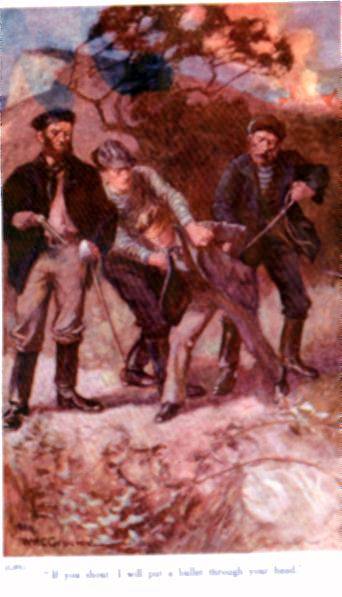
I could not deny this, and I saw that it would be useless to attempt to defend myself. My captors, without more ado, proceeded to tie my arms behind my back, and to bind a handkerchief over my eyes.
“Remember, youngster,” said Burden, “if you shout out or utter a word we’ll send a bullet through your head.”
From the fierce way in which he spoke I thought he was very likely to do this. I did not tell him that I knew who he was, as I was sure that this would only make matters worse for me. I did not, however, believe that they really meant to kill me; but what they would do was more than I could guess. Two of them taking me one by each arm led me along the road, without wasting another word on me. They walked very fast indeed. Had they not supported me I should have fallen several times. Every moment I thought they would stop. I tried to ascertain in what direction they were leading me, but very soon lost all means of doing so. At length they made me sit down on what I supposed was a bank. I tried to judge from what quarter the wind was blowing, but the spot was sheltered, and sometimes it blew on one cheek and sometimes on the other. I could hear the roar of the waves, by which I knew that I could be at no great distance from the shore. While one of them held me tightly by the arm, the others withdrew to a distance to consult as to how they should proceed. After a time they came back, and we continued our march at the same rate as before. On and on we went. I was getting very tired, and would gladly have again sat down. When I complained, the men laughed at me.
“You’ll soon have time enough to rest yourself, youngster,” said one of them. “You may consider yourself fortunate that things are no worse with you.”
Finding that it would be useless to say anything more, I held my tongue. I must own that I now bitterly regretted having interfered against the smugglers. They were fully convinced that I had done so, and I could not defend myself. I had heard of the fearful punishment that they had at times inflicted on informers; and even should they spare my life, I thought it too probable that they would ship me off to some distant part of the world, or shut me up in a cavern or some other place from which I could not make my escape. It seemed to me that several hours had passed since I was captured, and that it must now be broad daylight; but the bandage was so tightly secured over my eyes that I could not move it with my eyebrows, nor could I, from my arms being fastened behind my back, get my hands free to do so. Again and again I begged my captors to listen to me and loosen my arms, as the ropes hurt me. When I declared that I could go no farther, one of the men answered fiercely:—
“We’ll soon see that, youngster.”
He gave me a prod with the point of a knife or cutlass, I could not tell which. It showed me that they were not likely to treat me very ceremoniously. “I must make the best of a bad matter, I suppose,” I thought, and did not attempt to stop. Suddenly the men brought up, and then turning sharp round told me to lift my feet, and I found that we were walking up some wooden steps. This I could judge of by the sound made by our feet. Then we went along a level floor. Presently, after passing through two or three doorways, as I supposed, we descended also by wooden steps, till I felt convinced, by the closeness of the atmosphere, that we had reached a vault.
“You may make yourself comfortable here, young gentleman, for the rest of your life,” said one of the men, with a hoarse laugh. “I’ve a notion that you’ll not again be inclined to go and inform against poor fellows who are carrying on their business without wishing to do you or any one else harm.”
“Stay; that jacket of his, and his waistcoat, are a great deal too good for him,” observed another man.
And forthwith, having released my arms, they took off the garments they spoke of.
My first impulse, on getting my hands free, was to try and get the bandage from my eyes, but one of the men caught hold of my hands and prevented me from accomplishing my object. I, however, clutched hold of my clothes with the other, unwilling to give them up; but they quickly mastered me, leaving me only my shirt and trousers. I now began to fear that they intended some serious violence. In vain I struggled; I felt myself lifted up by the shoulders and feet, and placed on a rough board. As I now had my hands free, I immediately tore off the bandage. A gleam of light, which came from one side, showed me that I was in what appeared to be a large chest, placed on its side; but before I could turn myself round the lid was shut down, and I heard the men securing it. I was thus imprisoned in, so far as I could tell, a living tomb. I shouted and shrieked, and tried to force open the lid. My captors were holding it on the outside, and it seemed to me were driving in screws. I could hear them talking outside, but what they said I could not make out. Could it be possible that they intended to leave me here to perish by hunger? The act would be too diabolical for the worst of wretches to think of, and yet what other reason could they have for shutting me up in such a place? Finding that I could not release myself, I thought I would try to move their feelings.