"Devon Boys" (continued 7)
Reading edition
“What do mean?” I cried angrily.
“There, don’t wriggle that way or I shall stick the needle in you. To go and have a big genuine fight like that and never let me know.”
“Here, Bob, quick!” cried the doctor, and my old school-fellow had to go and help bandage another’s wound.
“He will have his grumble,” I said to myself, smiling as well as I could for one in pain.
The daylight grew broader, and the blackened counting-house and cottages more desolate-looking, the whole place seeming to be suffering from the effects of some terrible storm, and as I lay there I saw the doctor go on busily bandaging the poor fellows’ wounds, every one suffering the pain he was caused without a murmur. The worst cases he temporarily bandaged, leaving the rest till the men were better able to bear it, and at last he came round to my father, who was wounded in two places.
“Die? No: there are some ugly chops and holes, but I’m not going to let any of the brave fellows die,” cried the doctor cheerily. “Now the first thing is to get the women back and a roof over that long shed in case it should rain. I’ll have a lot of ling cut for beds, but I must have some help. Perhaps I had better ride over to the village—no, I’ll send my boy. But I say, Duncan, I think you ought to have given better account of the Frenchmen.”
“Why, they had to get fifteen or sixteen wounded men away,” I cried, and then winced.
“And serve ’em right,” said the doctor. “Here, Bob!”
Bang, bang!
“What’s that?”
“Bigley’s signal; and by the way, doctor, the poor lad is wounded too. Come along and see.”
“No, I’ll go,” said the doctor. “You are not fit.”
“But I’m going all the same,” cried my father; and I saw them go off along the cliff path.
“Here, Mars Sep,” said our foreman, “I’m going to climb up yonder to see what’s going on; will you come?”
“I don’t think I can do it,” I said, “but I’ll try;” and with the help of his hand now and then I managed to climb up the west slope of the Gap right to the very top, where, in the bright sunny morning, we saw a sight that filled us with horror, for a couple of well-filled boats were rowing towards us from the side of a large sloop of war, from whose port-holes projected a row of guns that seemed to threaten fresh destruction to our coast.
But all at once we saw a flag run fluttering up to the peak and then blow out clear, with the result that the boats began to alter their course, turning completely round and rowing back to the man-of-war.
As they were going back we could see sail after sail drop down from the yards of the sloop; and as the boats reached her and were hoisted up to the davits, she began to move swiftly towards the west, her canvas growing broader minute by minute till she passed out of our sight.
“Why, she’s gone,” said our foreman. “Is she coming back?”
“I hope not,” I cried. “Look!” I pointed towards the east over a depression in the Gap side through which we could catch a glimpse of the sea, and there in the bright sunlight we could make out a couple of vessels crowding on under all sail; and, little as I knew of such matters, I was able to say that one was a small frigate and the other a man-of-war cutter that looked very much like our old friend.
“After the Frenchman—eh?” said our foreman, gazing hard, wide-eyed and open-mouthed, as his cheeks flushed and he seemed to forget his wounds. “Well, then, all I can say is, that I hope they’ll be caught.”
“Let’s get down,” I said. “See, there’s the doctor bringing Bigley Uggleston back on his pony. I wonder how he is.”
Chapter Forty Two.
A Fight at Sea.
We descended slowly and painfully, to get down in time to receive a severe scolding from the doctor, while my father confirmed the news, as Bigley was half-lifted off for Bob to mount the pony and go off for help.
The British ships had had news brought them of the attack, and had started at daybreak in full chase, and an hour afterwards all who could climbed to where we could catch sight of the sea, to find out the meaning of the firing that was going on.
It was plain enough. A large three-masted lugger was in full flight with the frigate after her, and sending shot after shot without effect, till one of them went home, cutting the lugger’s principal mast in two, and her largest sail fell down like a broken wing, leaving the lugger helpless on the surface. Then a boat was lowered, and we saw her going at full speed, pulled as she was by a dashing man-o’-war crew, and we watched anxiously to see if there was going to be a fresh fight. But no; the man-o’-war long-boat pulled alongside and the men leaped aboard to send up the English colours directly, while the frigate went on in full chase of the French sloop, and we soon after saw that the lugger was being steered towards the mouth of the Gap.
But meantime the doctor had been busy with poor Bigley, who had been laid upon a soft bed of heather to form his couch while his wound was examined.
“Why, you cowardly young scoundrel!” he cried cheerfully, “the bullet is embedded in the muscles of the calf of your leg, and it came in behind. You dog: you were running away.”
“So would you have run away, doctor,” I said warmly, “if half a dozen Frenchmen were after you and firing.”
“Never, sir!” cried the doctor fiercely, as he probed the wound; “an Englishman never runs. There, I can feel it—that’s the fellow.”
“Oh, doctor!” groaned poor Bigley.
“Hurt?” said Doctor Chowne. “Ah, well! I suppose it does. And so you, an Englishman, ran away—eh?”
“English boy,” said Bigley grinding his teeth with pain, while I felt the big drops gathering on my forehead, and was wroth with the doctor for being so cool and brutal.
“English boy!—eh?” he said. “Well, but boys are the stuff of which you make young men. Ha, ha, ha! What do you think of that?”
“You’re half-killing me, doctor!” groaned poor Bigley.
“Not I, my lad. I’ve got the rascal; come out, sir! There you are—see there! What do you think of that for a nasty piece of French lead to be sticking in your leg? If I hadn’t fished it out it would have been there making your leg swell and fester, and we should have had no end of a game.”
As he spoke he held out the bullet he had extracted at the end of a long narrow pair of forceps; and, as Bigley looked at it with failing eyes, he turned away with a shudder and whispered to me, as I supported his head upon my arm:
“I’m glad Bob Chowne isn’t here to see what a miserable coward I am, Sep. Don’t tell him—there’s a good chap!”
I was about to answer, but his eyes closed and he fainted dead away.
“Poor lad!” said the doctor kindly. “Why, he was as brave as a lion. I talked nonsense to keep up his spirits and make him indignant while I hurt him in that cruel way. Poor lad! Poor lad!”
“Doctor Chowne,” I cried with the tears in my eyes, “I felt just now as if I hated you!”
“Just you say that again!” he cried, laughing grimly. “You forget, you young dog, that I have you by the hip. You are my patient, and I have as tight a hold of you as an old baron in the good old times had of his prisoners. There! He is coming to, and I sha’n’t have to hurt him any more to-day.”
“Will he have to lose his leg, doctor?” I whispered.
“What! Because of that hole? Pshaw, boy! The bullet is out, and nature has begun already to pour out her healing stuff to make it grow together. I’ll make him as sound as a roach before I have done. Now we must see to getting our wounded under cover. I didn’t think the Gap would ever be turned into such a hospital as this. Why, Sep, it’s quite a treat to get such a morning’s practice in surgery. There! I’ll go and wash my hands, and I must have some breakfast or I shall starve.”
Breakfast! Starve! At such a time as this! I looked at him in horror, and he read my thoughts and laughed.
“Why, you young goose!” he exclaimed, “do you think I can afford to be miserable and have the horrors because other people suffer? Not a bit of it. I’m obliged to be well and hearty and—unfeeling—eh? Ah, well, Sep! I’m not such an unfeeling brute as I seem; and I’d give fifty pounds now to be able to find those poor fellows breakfast and shelter at once.”
The doctor was able to supply his patients with refreshments without the expenditure of fifty pounds, for Mother Bonnet had just come up to announce that she had been back to the cottage to find it untouched, after going away in alarm when the Frenchmen landed, and she said that she had the fire lit and coffee and tea on the way for every one who wanted it.
“Mother Bonnet, you’re a queen!” cried the doctor; and then turning to me: “Rather strange that they should have spared the cottage and old Jonas’s goods, eh, Sep? There’s something behind all this.”
We were not long in finding out what was behind all this. I had my own suspicions without the doctor’s, and they were soon confirmed by the coming of the big three-masted lugger, which was brought close in by the man-o’-war’s men, who landed with a lieutenant at their head, and came up the Gap to see our condition.
He was a bright, manly fellow, and my father and he became friends at once, while he was quite humorous in his indignation.
“The cowardly scoundrels!” he cried. “Oh, if we had only been here! How delighted my Jacks would have been to have a go at them!”
“Do you think so?” said my father smiling.
“Think so, sir? Why, my boys have been half mad with disappointment. Poor fellows! Just about a dozen of you. Well, there’s no mistake about your having made a brave defence, Captain Duncan. Not a man unhurt. Sir, I’m proud to know you.”
“My men behaved better than I did, sir,” said my father modestly.
“Oh, of course, sir,” cried the lieutenant laughing; “but avast talking. What can we do for you? I’m here ashore with the lugger and prisoners till my ship comes back, so what shall we do? You don’t want doctoring, I see?”
“We want covering in first of all, sir,” said the doctor, pointing to the unroofed shed.
“Of course you do,” cried the lieutenant; “and all your men wounded. Here, heave ahead, my lads, and half of you run back to the lugger and bring up all the spare sails and spars you can get hold of. If there are no spars bring the sweeps.”
“Ay, ay, sir,” cried the sailors; and half of them went off at the double back along the valley, while the others, under the command of their officer, set to work and shovelled and brushed out all the burnt charcoal and smouldering wood from the long shed, and then from the counting-house, and after that they were busy at work cutting ling and heath with their cutlasses, when the men despatched to the lugger came back loaded with sails and spars.
At it they went, and in a very short time had rigged up a roof over the shed for our poor fellows, carried in a quantity of ling, and spread over that more sail-cloth, making quite a comfortable bed with room for a dozen men, and ample space for the doctor to go between.
Then, with the tenderness of women, the great bronzed fellows lifted the wounded men who could not walk, slipped under them a hammock, and one at each corner carried them in and laid them down.
“There you are, messmates,” said the biggest of the men; “now, then, a quid apiece for you to keep down the pain. Make ready: pockets, ’bacco boxes,” he shouted, and his comrades laughingly obeyed.
“Thank you, my lads, thank you,” cried the doctor, going round and shaking hands with all in turn; “why, it would be a pleasure to have to do with such men as you. But there, you’re safe and sound.”
“At present, sir,” said the big sailor; “but hark! They’re at it yonder.”
We listened and sure enough there was the distant sound of heavy firing coming from the west.
“And we not in it, mates,” said the big sailor dolefully.
The wounded being cared for and the miners’ wives beginning to come back, we left them in the doctor’s charge, and, in response to the lieutenant’s invitation, went back with him to the lugger.
“I’ll send your fellows up all I can,” he said, “but you two come to the lugger cabin, and I think I can scrape you up a bit of a meal.”
We were ready enough to go for many reasons, one of them being curiosity; and having shaken hands with Bigley, and asked my father to do the same, for the poor fellow was very miserable and despondent, away we went.
“The rascals!” said the lieutenant, “they’ve got all your silver then? How much was it worth?”
“Nearly two thousand five hundred pounds’ worth,” said my father.
“What a haul!” exclaimed the lieutenant, “and so compact and handy. Never mind, captain, hark at our guns talking to them. They’ll have to disgorge. But, I say, some one must have told them where to come.”
“I’m afraid so,” said my father.
“Who was likely to know?—this smuggling rascal that we have got in the French lugger?”
“Who is he? An Englishman?”
“No, sir, a Frenchman who speaks English pretty well. The officer on the revenue cutter knows him. A Captain Gualtière, I believe.”
“Oh!” I exclaimed.
“You know him then?” said the officer sharply.
“Yes,” said my father; “he picked up my son and two companions one day after their boat had been blown out to sea.”
“He seems to have picked up something else beside, sir,” cried the officer—“knowledge of where you kept your silver. And you may depend upon it his lugger has been playing leader to the French sloop, and showed the captain where to land. Two thousand five hundred pounds in bars of silver! We must have that back.”
“I’m afraid you are not quite right, sir,” said my father sadly. “I think we shall find that the betrayal of my place was due to a smuggler who used to live in yonder cottage, information respecting whose cargo landing I was compelled, as a king’s officer, to give to the commander of the cutter. It has been an old sore, and it has doubtless rankled.”
“Oh, father!” I said sadly, “do you think this really is so?”
“Yes, Sep,” he replied, “and so do you; but don’t be alarmed, I shall not visit it upon his son. The poor lad thinks the same, I am sure, and he is half broken-hearted about it.” We reached the beach soon after, where a couple of Jacks were in charge of the boat, and soon after we were pulled alongside of the lugger, to find that the men left on board, in charge of a midshipman of about my own age, had been busy repairing damages, fishing, as they called it, the broken spar, while the lugger’s crew sat forward smoking and looking on, in company with their skipper, who rose smiling, and saluted.
“Aha! Le Capitaine Dooncaine,” he cried; “and m’sieu hees sone. I salute you both.”
“Salute me?” cried my father angrily. “After this night’s work?”
“This night’s work, mon capitaine?” he said lightly. “Vy node. I am prisonaire; so is my sheep, and my brave boys. But it ees ze fortune of var.”
“Yes; the fortune of war,” said my father bitterly.
“I do node gomplaine myself. You Angleesh are a grand nation; ve are a grand nation. Ve are fighting now. If ze sloop sail vin she vill come for me. If she lose ze capitaine vill be prisonaire, and behold encore ze fortune of war.”
“Sir,” said my father, “it is the act of pirates to descend upon a set of peaceful people as your countrymen did last night, thanks to your playing spy.”
“Spy? Espion? Monsieur insults a French gentleman. I am no spy.”
“Was it not the work of a spy to bring that French sloop here to ravage my place and steal the ore that had been smelted down?”
“True, saire, it vas bad; but ze espion was your own countrymen, saire. Ze Capitaine Gualtière does no do such not you calls dirty vorks as zat.”
“Jonas Uggleston! It was he, then?” cried my father. “I felt sure of it; but I believed you to have had a hand in it, Captain Gualtière.”
“A hand in him, sair. Ze Capitaine Ugglee-stone ask me to join him, it there is months ago, sair; but I am a smugglaire, and a shentilhomme, node a pirate.”
“Captain Gualtière,” said my father, “you once saved my boy’s life, and I have insulted you—a prisoner. Sir, I beg your pardon.”
My father took off his hat, and before he realised what was about to take place, the Frenchman had thrown his lithe arms about him and kissed his cheek.
“Sair,” he exclaimed with emotion, “I am a prisonaire, but I look upon ze Capitaine Dooncaine as a friend.”
They then shook hands, and my father coloured up as he saw the officer of the frigate look on as if amused.
“Monsieur,” said Captain Gualtière; “I am no longer the maitre here; but you vill entaire my cabine, and I pray you to take dejeuner—ze breakezefast vis me.”
The result was that we had a surprisingly good meal, and very refreshing it proved, though I was in terrible pain all the time, and kept on wondering whether I ought to eat and drink.
The lieutenant from the frigate kept getting up and going on deck to listen to the firing, which was very heavy in the distance, though nothing could be seen, and he exclaimed once against the great headland, the Ram’s Nose, which shut off the view.
“It’s so hard,” he said; “here have I been longing for an engagement, and the first one that turns up I am away from my ship, and cannot even see the fun.”
I saw my father, who was wincing with pain, smile at the lieutenant’s idea of fun.
“Why, you are safer here,” he said.
“Safer!” exclaimed the lieutenant contemptuously. “Now, Captain Duncan, would you have liked it when you were on active service?”
“That I certainly should not, sir.”
“Ah, well,” said the lieutenant, “I suppose I must be contented with our little prize here. This Gualtière has long been wanted. A most successful smuggler, sir.”
The conversation was ceasing to interest me, so I went on deck, when the middy came up to me directly from where he was standing listening to the firing.
I looked at him with the eyes of admiration, for his uniform, dirk, and pistols gave him a warlike aspect, and besides he was in temporary command of the sturdy Jacks who were overawing the smuggler’s men.
“Won’t you sit down?” he said, turning up a little keg.
I sank upon the seat with a sigh, for I felt weak.
“Ah! You are a lucky fellow,” he said.
“Why?” I asked.
“Why? To be in a fight last night and get wounded.”
“Oh!” I exclaimed laughing.
“Ah, you may laugh!” he said. “I call it first rate. You’re only a landsman, and get all that luck. It’s of no use to you. Why, if it had been me, of course I am too young for promotion, but it would have been remembered by and by. I say, tell us all about it.”
I told him, and to my surprise I found before long that all the sailors were listening intently.
“Ah!” exclaimed the middy as I finished; “don’t I wish we had all been there.”
“And don’t I wish you had all been there!” I said dolefully; “our place is regularly wrecked.”
“Never mind,” cried the middy, shaking my hand. “They ar’n’t getting much by it. Hark! How our old girl is pounding away at ’em. I’ll be bound to say that the spars and planks are flying, and—oh, don’t I wish I were there!”
Chapter Forty Three.
Bigley Feels his Position.
During the day, after leaving an adequate guard over the prisoners in the lugger, the lieutenant came up the Gap twice, and worked hard with his men to get our poor work-people in a more comfortable state, though now plenty of the Ripplemouth folk had been over, and help and necessaries were freely lent, so that the night was made fairly comfortable for the wounded and their families. We slept in the ruins of the counting-house, whose roof was open to the sky, for my father had not the heart to go home and rest there; and when he sent Bigley over, and I felt that I should like to go and keep the poor fellow company, I, too, had not the heart to go and leave my father alone.
The next morning the lieutenant came to fetch us to breakfast on board the lugger; but we made a very poor meal, our injuries being more painful, and I felt weak and ill; but there was so much to see and hear that I kept forgetting my sufferings in the interest of the time.
There were our men to go and see, and sit and talk to where they were too poorly to get up. There was Mother Bonnet to speak to when she started for the Bay to attend on Bigley; and I had her to see again when she came back, all ruffled and indignant, after a verbal engagement with our Kicksey, who would not let the old woman interfere, because she wanted to nurse Bigley herself.
Then towards afternoon, when the lieutenant had nearly gone mad with suspense about the frigate and at being bound to stop there with the lugger, according to his orders, news came by a fishing boat, that there had been a desperate engagement, and the frigate had been sunk.
But on the top of that came news by a man who was riding over from Stinchcombe, that it was the French vessel that had been sunk.
This stopped the lieutenant just as he was putting off in the lugger, and soon after a fresh news-bearer came in the shape of another fisherman, who announced that the Frenchman was taken.
There was a regular cheer at this, and I saw Captain Gualtière’s brow knit; but he passed it off, and sat with the officer straining his eyes to the west in search of the prize to our flag.
It was no wonder that he looked as triumphant as our people seemed chap-fallen when towards evening the frigate appeared alone, with every stitch of canvas that she could show spread to the western breeze, but the spy-glasses showed that she was in anything but good trim, for her main-mast was gone by the board, only a short stump rising above the deck, and as she came nearer, her shattered bulwarks told of a desperate fight.
There was a signal of recall flying; and at this the lieutenant shook hands warmly, and with the middy bade us good-bye, setting sail directly after with the prisoners in their own vessel, and towing the frigate’s boat behind.
We learned afterwards that there had been a most desperate engagement, far away to the west, and that the Frenchman was becoming hopelessly beaten with half her guns silenced, and that she was on the point of striking her colours, when a lucky shot from one of her big guns cut through the frigate’s main-mast, and it toppled over into the sea, whereupon the French sloop made her escape, sinking the cutter which bravely tried to check her, and carrying off her crew as prisoners.
We only obtained this information in driblets; but one thing was certain, the French sloop had got right away, and my father frowned as he thought of his lost silver.
He bore up famously for a few days, working hard, in spite of Doctor Chowne’s orders, in trying to make his wounded work-people comfortable, and then when by the doctor’s orders I was lying at home on a sofa in the same room as Bigley, my poor father broke down and took to his bed.
“I’m not surprised,” Doctor Chowne said to me shaking his head. “You’re all a set of the most obstinate mules that ever kicked. I should have had you all well by now, only young Bigley there would walk on his crippled leg and irritate it; you would keep rolling and dancing about and keeping your ribs from mending; and your father has gone on walking about just as if nothing was the matter, when all the time he ought to have been in bed.”
“But a little rest will soon set him right, will it not, doctor?” I said anxiously.
“A little rest? He’ll be obliged to take a great deal now, and I’m glad of it. Hang him: I’ll bring him in a bill by and by!”
The doctor was quite right; we had all been very disobedient, and suffered for it; but in spite of the pain, and fever, and weakness, that was a very pleasant time. How we used to lie there listening to the birds! Sometimes it was the blackbirds piping softly in the garden. Then from high up over the hill we could faintly hear the skylark singing away, and then perhaps mingling with it would come the wild querulous pee-ew! pee-ew! Of the grey and white gulls, as in imagination we saw them gliding here and there about the cliffs.
But there was war in our cottage at the Bay—desperate war. Mother Bonnet coming every morning with fish and cream and chickens and fruit for her boy, as she called Bigley; and our Kicksey snorting and indignant at the intrusion, and telling old Sam that it was just as if master was too poor to pay for things.
Then by degrees my father grew well enough to sit out in the little battery by his guns, and breathe the soft sea-breezes that came in from the west; and here he used to receive our foreman, who came over every morning to report how much lead had been smelted and cast, and how the mine was growing more productive.
For as fast as the men grew well enough, they returned to their duties. The cottages were restored as quickly as was possible, and every day the traces of the French attack grew less visible; but still my father did not get quite well.
Bob Chowne was over with us a great deal, and I believe he did both Bigley and me a vast deal of good from being so cantankerous. He would do anything for us; fetch, carry, or turn himself into a crutch for Bigley to lean upon, as he hopped down the garden to a chair; but he must be allowed to snarl and find fault, and snarl he did horribly.
One day when I was beginning to feel quite strong again, and I was able to take a long breath once more without feeling sharp pricking sensations, and afterwards a long dull aching pain, I went down the garden to find Bigley standing before my father with his head bent and listening patiently to what seemed to be a scolding.
“I’ve told you before, my lad. Ah, Sep, you there?”
“Yes, father,” I said. “I beg your pardon. I did not know.”
“There, stop,” cried my father. “It is nothing that you may not hear. Bigley Uggleston is talking again about going, and I am bullying him for it.”
“I can’t help it, Captain Duncan,” cried poor Bigley passionately. “I want to be frank and honest; and it always seems dreadful to me that, after what has taken place and your terrible losses, I should be staying here and receiving favours at your hands.”
“Now, my good lad, listen to me,” said my father. “Do you think that I am so wanting in gentlemanly feeling that I should wish to visit the sin of another upon your head?”
“No, sir; but I am in such a strange position.”
“You are, my lad; but you see your father has always had the worthy ambition to give his son a good education, and make him something better than he has been himself.”
“Yes, sir, but—”
“Hear me out, Bigley. It has been my misfortune twice over to give him deadly offence, and the last time he visited it upon me by giving information to the French, which led to, as you call it, my serious losses.”
“Yes, sir,” cried Bigley, “and I am miserable. I feel as if I could not look you in the face.”
“Why not?” said my father kindly. “Yours is a good, frank, honest face, my lad, and you have always been my boy’s companion and friend. Come, come, no more of this nonsense. I have right on my side, and some day your father will awaken to the fact that the information I gave was given in the way of duty, and have a better opinion of me. As to you—”
“I must go, sir—I must go,” cried Bigley, “I cannot stay here any longer.”
“No, you must not go,” said my father firmly. “It is evidently your father’s wish that you should stay, or he would say so when he sends you money so regularly. There, come, we’ll say that he has done me a great deal of injury, and caused me a very heavy loss.”
“Yes, sir, that is always on my mind.”
“And that kept you from getting better, my lad. So now I’m going to make a bargain with you. Get quite strong again, as I hope to be myself before long, and come and help us at the mine to recover the lost ground again.”
“May I?” cried Bigley eagerly.
“Of course,” said my father; and as I saw quite a cloud disappear from poor Bigley’s countenance, I tossed up my cap and cried, “Hurrah!”
Chapter Forty Four.
Bigley Makes a Discovery.
The time glided on and the war did not trouble us, for we were too busy in the Gap, where everything had been restored and even improved, and my father was fighting bravely to recover from the terrible loss the French descent had caused to the property, for the rebuilding of cottages and repairs of machinery, after the store of silver had been taken, left him very much impoverished; but, as he used to say, it was only a question of time to get right.
Bigley worked regularly with me, living at the smuggler’s cottage with Mother Bonnet for his housekeeper; and he used to hear regularly from his father, who expressed no intention of ever returning, merely saying that he was glad that his son was doing so well, and quite accepting the position. He used to send money, but now Bigley had ceased to use it, for he received a regular payment from my father, and this other money used to be sent to a bank.
The mine was fairly productive, but I knew that my father had been compelled to borrow a good deal, and this preyed upon his mind so much that one day he said to me:
“Sep, I think I shall be obliged to sell the Gap, with the mine and all it holds. I don’t like this life of debt, and the prospect of years of toil before I can clear it off.”
“But it would be such a pity, father,” I exclaimed.
“It would, my boy, but I am not so sanguine as I was. That terrible night shook me a great deal, and if it were not for the thought of you I should give up at once.”
He repeated this to me two or three times, and it made a very unpleasant impression that troubled me a very great deal.
Bob Chowne, who was shortly going up to London to study at one of the hospitals, came over one evening, and we all three, as in the old days, had tea at the smuggler’s cottage, Mother Bonnet beaming upon us, and never looking so pleased as when we wanted more of one of her home-made loaves.
Then after tea we decided, as the sea was so calm, to have a few hours’ fishing, and taking the boat we rowed out as far as the Goat and Kids, the grapnel was thrown out, and we began to fish.
It was a glorious evening, and we took rock-whiting, pout, and small conger at such a rate that I cried, “Hold, enough!”
“No, no, keep on,” said Bob Chowne. “Let’s see how many we can catch.”
“It will be a good feast for the work-people,” said Bigley, as I hesitated; and knowing how glad they all were of a bit of fish I turned to again, throwing in my baited hooks, and hauling in the fine fellows every minute or two.
But at last the darkness forbade further work, so the lines were reeled-up, the fish counted over into the two baskets, and Bigley proceeded to haul up the grapnel.
The intention was good, but the grapnel refused to be hauled up. The boat’s bows were dragged right over it, and Bigley stood up and tugged till the boat was perceptibly pulled down, but not an inch would the grapnel budge.
“It has got between a couple of rocks, I suppose,” said Bigley.
“Here, stand aside!” cried Bob Chowne, “let the doctor come.”
He caught hold of the stout line, stood in Bigley’s place, and hauled till his wrists ached.
“Here, come and pull, Sep,” he cried; and I joined him and hauled, but in vain.
Then we changed the position of the boat, and dragged and jerked in one direction and then in another. Every way we could think of did we try, but could not stir the anchor, and as we were giving up in despair Bob said:
“I know; some big sea-monster has swallowed the hook and he won’t move. Here, let’s get ashore.”
“But we must not lose a new grapnel,” cried Bigley. “Here, I know what we’ll do.”
He hastily unfastened the rope from the ring-bolt in the bows, and secured it to the boat-hook by a hitch or two, and then cast it overboard.
“There!” he said; “that will buoy it, and I’ll come out to-morrow and get it up somehow.”
Then taking the oars he rowed us ashore, where a couple of the mine men were smoking their pipes and shining like glowworms as they waited to see what sport we had had.
The news spread respecting our exceptionally good fortune; and as soon as the two men had helped to haul the boat right up beyond the reach of the tide, as the grapnel was gone, they ran up to the miners’ village and came trooping back with the rest, armed with baskets, dishes, and in some cases only bare-handed, to receive their portions of our big haul.
They gave us a cheer, and soon afterwards we parted, Bob Chowne to sleep at the smuggler’s cottage, while I went back to the Bay.
I woke at daylight next morning, and not feeling disposed to sleep, I dressed and started off for the Gap to rouse up Bigley and Bob and propose a bathe; but as I came in sight of the Gap mouth I found Bigley already astir and just going down to the boat.
I shouted and ran down to him waving my towel, to which he answered by waving another, showing that he had risen with a similar idea to my own.
“I thought I would have a bathe, and do some business too,” he said; and then, in answer to my inquiring look, “Try and get up the grapnel,” he added.
“Oh!” I exclaimed; “but why didn’t you rouse up Bob?”
“Rouse up Bob!” he said gruffly. “Go and try and rouse up that block of stone!”
“What! Have you tried?” I said.
“Tried! I’ve shaken him, and punched him, and done everything I could but drenched him, and that would be a pity. He don’t want to get up; so let him lie. Here, help me run the boat down.”
I laid hold of one side, we balanced her on an even keel, and as it was down a steep slope we soon ran her into the water, jumped aboard, and began paddling out down the narrow part that formed the bed of the river on the seaward side of the pebble ridge.
The tide was very low, the sun up bright and high, and the water so clear that there was every rock below us so close that it seemed as if we could not go over some of them without touching.
“We’ll row out to the buoyed grapnel,” said Bigley; “make fast, and while you have your bathe I shall dive down, follow the rope, and see if I can find out how the grapnel has got fast.”
“If you can,” I said.
“Well, I’m going to try,” replied Bigley. “I don’t suppose it’s above three fathoms deep.”
“You can’t dive down three fathoms?” I said.
“Can’t I?” replied Bigley laughing. “I’m going to show you. Look here!”
He pointed to a big long stone in the bows of the boat weighing some twenty-pounds. To this a thin line was attached, and I saw his meaning at once.
“Yes,” I said, “that will do it, only don’t forget to let go.”
“No fear,” he replied; and we paddled on, with the beautiful view of the cliffs opening out as we rowed farther from the shore.
We had nearly a quarter of a mile to go before we struck against the floating boat-hook close to the now exposed rocks, when Bigley threw in his oar, hoisted the rough buoy aboard, unhitched the rope, ran it through the ring-bolt, and hauled on till he had the boat’s stem right over the grapnel, which still refused to come; so we made fast.
Bigley then began to undress rapidly, while I proceeded to work more slowly, being curious to watch what he was doing.
I had not long to wait, for after making fast one end of the thin line to the thwart of the boat he poised the stone on the gunwale, leaped in, and then putting his left arm round the grapnel rope he got well hold of the stone, and drew it over to descend with it rapidly to the bottom.
I crept to the bows and looked over to see his white body far below in the clear water, and then he came up again to rub his eyes, pant, and hold on by the side of the boat.
“Why, what’s the matter?” I said; “seen a shark?”
“No,” he cried, “but I’ve seen something else. Here, haul up the stone.”
“Bother the stone!” I exclaimed, “I came to bathe.”
“Haul it up quickly,” he said; and I obeyed, and afterwards lifted it on to the gunwale.
He seemed very excited, but he would not speak about what he had seen, only beg me to do what he told me, which was to untie the line from the stone and then make a running noose and put it loosely round.
I did all this, wondering at his mysterious way, but only expecting that it was to fasten round the grapnel so as to pull in a fresh direction.
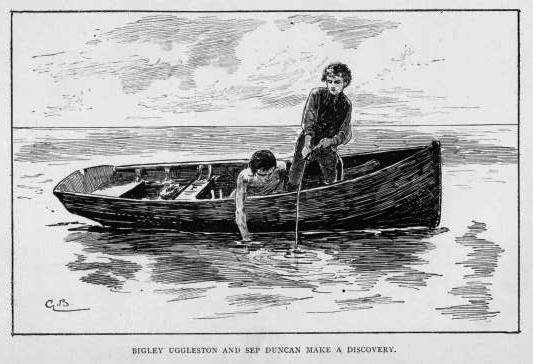
As soon as I had done he took hold of the loop that was round the stone, drew a long breath, and asked me to lift it over into the water.
This I did, and he went down head-first, while I again watched him below among the waving weeds all indistinct in the troubled sea.
He was down for a full minute as I crouched there with my head over the side. He seemed to be so long that I began to grow alarmed lest he had become entangled, and I was about to haul up the line attached to the stone. I looked down anxiously with my face closer to the surface, but only to make him out in a bleared indistinct manner, and then he shot up like a line of light and swam to the side and held on.
“Thought I shouldn’t be able to do it,” he said; “but I’ve got the line round.”
“Well, what next?” I said. “But I say, is a grapnel worth all this trouble?”
“A grapnel?” he said with a peculiar smile.
“Yes.”
“Wait a minute till I am in the boat.”
He climbed in, and came to my side.
“Now,” he said; “haul up steadily. I think she’ll come.”
I tightened the line, and for a moment or two there was a dead resistance. Then something heavy began to stir, and I hauled away steadily, hand over hand.
“I’ve got it,” I said as I gazed down. “It was right in amongst some strong weed. Here it comes.”
I pulled away till I had nearly got it to the top, and then Bigley came to my help, reached over, and the object I was dragging up bumped against the boat, slipped out of the noose, and went down rapidly just like a mass of stone.
“What did you fasten the line to that for?” I said.
“What did I do it for, Sep?” he panted. “Didn’t you see what it was?”
“No,” I said bluntly.
“What did it look like?”
“Box covered with sea-weed,” I replied.
“Well, don’t you see now?”
“No,” I replied.
“Why, Sep, how dull you are this morning!” he cried. “Didn’t you see that you had hold of one of your father’s silver chests?”
“One of my father’s what?” I roared.
“One of the silver chests. Sep, it was over these rocks, against that one, I suppose,” he cried, pointing to a huge block just below the surface, and a favourite haunt of conger, “that the Frenchman’s boat capsized.”
“What, the one with the silver?” I cried.
“Yes, and I believe all the chests are at the bottom there.”
“And they were coming back to try for them when the frigate came in sight!” I shouted.
“Yes, yes, yes.”
“Hurrah! Hurrah! Hurrah!” I cried, leaping up in the boat, and waving my arms about like an idiot. “Why, Bigley, it will set father free of all his troubles. Here, I’m half mad. What shall we do? Hold hard a moment: I’m going down to see.”
I had only my breeches on, and tearing these off, I stepped on to the gunwale, leaped up, turned over, and dived down into the clear cold water, trying with all my might to reach the bottom, but only describing a curve, and coming up again about twenty feet from the boat.
I swam back to have another try, but Bigley stopped me as I was about to dive off.
“No, no,” he said; “it’s of no use. You can’t get down there without a killick or some other weight.”
“But I’m not sure it is the silver,” I cried in a despairing tone.
“But I am,” he said. “The boxes are lying all about. They look like stones if you stare down, because they are all amongst the weed; but when I got down to feel for the grapnel I was right upon them. It’s in amongst them somehow. That was why I came up again and tried to fasten the line round one.”
“But are you quite sure, Big?” I said, trembling with eagerness.
“Quite sure,” he said. “There can’t be any mistake about it. The Frenchman’s boat ran on the rock and capsized, and all the chests must have gone to the bottom like a shot.”
“And my poor father suffering all that worry, when here lay all his silver at the bottom, close to the shore. Here, what shall we do, Bigley? We must stop and watch it, for fear anybody else should come and find it.”
“No fear of that,” he said, drawing the rope once more through the ring-bolt, and then securing the boat-hook to the end, and throwing it overboard to act as a buoy. “Here, let’s dress and go and tell him.”
“Yes, yes,” I cried, trembling with eagerness, and hurrying on my clothes, as he did his, we rowed ashore, and after hauling the boat back to its safe place, climbed up the slope, and prepared to walk to the Bay.
“Big,” I said; “I’m afraid to leave it. Suppose while we are gone someone goes and takes it all away.”
“Ah! Suppose they do,” he said. “But it isn’t such an easy task. Nobody knows of it but us, Sep, and we can keep the secret.”
“You are right,” I said. “Come along, and let’s make haste and tell him.”
We strode along the cliff path that morning faster, I think, than we had ever gone before, and when we came in sight of our place I was going to rush in and tell my father, but something struck me that it would be only fair to let Bigley go, as he had made the discovery, so I told him to go first.
He would not, though, and we went up to the cottage together, to find Kicksey kicking up a dust in the parlour with a broom.
“Is father up yet?” I cried.
“Yes, my dear, hours ago, and half-way to Barnstaple before now.”
“What!” I cried.
“He’s going to London, my dear, and here’s a letter that Sam was to bring over to you if you didn’t come back to breakfast.”
I tore open the letter and read it in a few moments.
It was very brief, and merely told me that he had had a letter the past night making so stern a demand upon him for money that he had decided to go up to London at once and sell the mine.
“Big,” I said dolefully; “we’ve come too late. What shall we do?”
I gave him the letter to read, and he wrinkled up his brow.
“Go after him and catch him,” he cried.
“Yes; but how?”
“I don’t know,” he panted; “let’s try.”
“But the silver?”
“Is locked up safely where we found it, lad,” he cried. “It is a secret. Come on.”
“But how, Big? He is riding.”
“Then we must walk. A man can walk down a horse. Now, let’s see if it can’t be done by boys.”
Chapter Forty Five.
Trying an Impossibility.
We two set out to perform an impossibility: for though, starting together on a long journey, a good steady walker might tire out a horse carrying a man, and in a fortnight’s work, before we had got half-way to Barnstaple, I knew that my father would have arranged to catch the coach, and I remembered that the coach would change horses every ten or twelve miles; and as all this forced itself into my mind, I sat down on a stone by the road-side.
“Tired?” said Bigley, wiping the perspiration from his face.
“No, not yet; but I’ve been thinking, and my thoughts get heavier every moment,” I replied.
“What do you mean?” cried Bigley.
“That we cannot do this,” I said; “and we should be doing something far more sensible if we go back home, and write a letter to my father. Why, it would get to him days before we could.”
Bigley took off his cap and rubbed his ear.
“I’m afraid you are right,” he said; “but I don’t like to go back.”
“Then let’s go on to Barnstaple, and write to him from there.”
“To be sure!” cried Bigley, jumping at the compromise. “Come along.”
“No, I said; it will not do. I’ve left his letter behind, and I don’t know where to write.”
“Oh, Sep!” cried Bigley reproachfully. “Then, we must go back.”
We stood looking at each other just as we had made a fresh start, and the weariness we were beginning to feel brought with it a strange low-spirited sensation that was depressing in the extreme.
“Come along,” I said. “Let’s get back, or we shall lose another day before we can get off a letter.”
“Wait a minute,” said Bigley; “there’s the half-way house not a quarter of a mile away. We’ll go on there and have some bread and cheese and cider, then we shall be able to walk back more quickly.”
It did not take us long to reach the pretty little road-side ale-house, where the first thing I saw was the doctor’s pony tied up to the gate by the rough stable or shed.
“Some one ill?” I said. “Shall we tell Doctor Chowne what we were going to do?”
I had hardly spoken these words when my father appeared at the door.
“Why, Sep, Uggleston!” he exclaimed; “you here?”
“Why, father!” I cried, catching him by the arm. “I thought you had gone.”
“The pony broke down, my boy,” said my father, “and I have had to bring him back here—walking all the way; and I was undecided as to whether I should pay someone to take him home, or lead him myself, and make a fresh start to-morrow.”
“Come back,” I said with a look full of delight. “He ought to come back, eh, Big?”
Bigley nodded and smiled, and then I eagerly told him all.
“It was Bigley’s doing, father,” I exclaimed. “He found it out.”
“My lad,” said my father huskily, “you have saved me, for I could only have sold my property at a terrible loss.”
“And you will come back with us, father,” I said.
“Come back, my boy? Of course. Why, Bigley, my lad, you have always looked at me as if I felt a grudge against you for being your father’s son; now, my boy, I shall always have to look at you as a benefactor, who has saved me from ruin.”
Bigley tried to say something about that dreadful night, and the attack on the mine premises, but my father stopped him.
“Never mind about all that,” he said; “let’s get back and see if you are right, and that it is not a solitary chest which the Frenchmen have left us.”
“No fear of that, sir,” cried Bigley. “I was down long enough to see that there was quite a lot of them.”
“Or of pieces of rock,” said my father smiling. “I’m older than you are, my lad, and not so sanguine.”
“But I feel so sure, sir,” cried Bigley.
“That’s right, my lad. I’m glad you do; but you have seen them, I have not.”
“But Sep saw them too.”
“I saw the box we hauled up,” I said; “but I could not be sure about what was at the bottom amongst the rocks and weeds.”
Bigley looked so disappointed that my father smiled.
“Come,” he cried; “you think I am ungrateful, and throwing cold water upon your discovery, when there is plenty over it as it is. So come, let us assume that the treasure is there, and begin to make our plans about how to recover it.”
At the last moment we had been obliged to leave the pony at the little inn, and we were walking steadily back as this conversation went on.
“Well, sir, it will be very easy,” said Bigley eagerly.
“Not so easy,” said my father. “We shall want a couple of men who can dive.”
“Oh no, you will not, sir,” replied Bigley. “I have thought it all out. All we shall want will be a clear day with the sea smooth.”
“Yes, highly necessary, Bigley,” said my father.
“Then we should want a very long smooth pole, and if we could not get one long enough two poles would have to be fished together.”
“And then you’d fish for the boxes?” I said.
“No,” said Bigley seriously; “you would have to sink the pole just down to where the chests lie, and rig up a block at the top, run a rope through it, hold one end of the rope in the boat to which the pole is made fast, and at the other end have a thick strong bag made of net.”
“Well, what then?” said my father.
“Why, then you would put a big pig of lead in the bag, let me take hold of the bag, let the rope run slack, and I should go down to the bottom in an instant. Then I should lift a box into the net-bag and come up, leaving it there for you in the boat to haul it up.”
“Yes, that sounds very simple,” said my father; “but could you do it?”
“Could I do it!” cried Bigley. “Why, sir, we did get one up to the top without any proper things. I can dive.”
“Yes, he can dive, father,” I said eagerly. “You need not be afraid about that.”
My father looked at us both, and grew very silent, as we trudged on, to reach the cottage at last utterly tired; and though Bigley proposed that we should go on and see whether the buoy we had left was all right, my father said that it might very well wait till morning, and Bigley stayed for the night.
“I thought your father would have been ever so much more eager and excited about it,” said Bigley, speaking to me from the inner room where he slept, the door having been left open.
“He is excited,” I said in a low voice, for across the passage I could hear him walking up and down in his own room; and that kept on till I dropped off asleep, and dreamed that the French had landed with four large boats and a great pole which they lowered down into the sea. Then they seemed to have got me fastened to the rope that ran through the wheel-block at the head, and they had fastened a pig of lead on to my chest, which pressed upon me as they hauled me up out of the boat, and then let go.
It was all wonderfully real. I felt myself suspended over the water, which looked black as ink instead of lit up by the sun as it was when Bigley went down. And as I hung there, the oppression from the pig of lead was terrible, and it seemed to please Captain Gualtière, who was there in a boat opposite, giving orders and laughing at my struggles to escape. “Now,” I heard him say in his Frenchy English, “cease to hold ze ropes, and laissez let him go.”
Then there was a dull splash, and with the weight always upon me I seemed to part the waters and go down, down, down, into the deep black depths, which appeared to have no bottom. There was a growing sensation of suffocation; my boots hurt my feet, and the blister I had made upon my heel smarted, and all at once the pony, as it stood at the half-way house door, kicked out at me, just as I was beginning to suffocate; and this broke the rope, and I shot up to the surface.
In other words, I started up awake, to find that I had been lying on my back, that I was bathed in perspiration, and that my father was still walking up and down his bed-room.
“What stuff to go and dream!” I said to myself, as I felt very much relieved. “That comes of eating cold beef and pickled cucumber for supper.”
I turned upon my side to settle myself off to sleep again; but I could not doze off; and do what I would, the thought of being sent down into the black water with a pig of our lead upon my chest, and the pony down below ready to kick out at me kept haunting my mind, while across the passage there was my father still keeping up the regular tramp.
Just then the clock at the bottom of the stairs began to strike, and I thought that it must be a dark morning and about four, but to my astonishment it struck eleven, and I felt sure that it must be wrong.
And all this while there was the restless pace up and down my father’s room, making the jug in the basin rattle faintly, and after turning over three or four times I made up my mind that it was impossible to sleep, so I would dress, and then go and wake Bigley and sit and talk.
I had just made up my mind to this, as it seemed to me, when Bigley stood in the doorway and said:
“Now, Sep, old fellow, wake up.”
I started up in bed and stared, for the room was flooded with sunshine, and I knew that I must have been sound asleep, while from across the passage came the regular pace of my father walking up and down, and the jug clattered in the basin.
“Has he been walking up and down all night?” I said sleepily.
“Oh, no!” said Bigley. “I have only just called him, and heard him get up. But make haste. It’s a splendid morning, and the sea’s like glass.”
“And the skin’s all off my heel,” I said; “and it’s as sore as sore, and so is one of my toes.”
“Sep!” shouted my father just then; “make haste down, and tell Ellen that we want the breakfast as early as possible.”
“Yes, father,” I said; but at the same moment Kicksey’s voice came up the stairs as she heard what he said, and it was to announce that breakfast would be ready in ten minutes’ time.
Chapter Forty Six.
Treasures from the Deep.
It was a glorious morning. There had been no wind for nearly three weeks beyond pleasant summer breezes, and the water was as clear as crystal, which is not so very often the case on our shore.
My father had soon completed his preparations, there being a fine larch in the woody part of the Gap; and this was soon felled, stripped, and cleared of branch and bark. Bigley soon found a suitable rope and block in his father’s store, and a couple of boats were got ready, with a suitable bag of rough canvas, in which several holes were cut out so as to allow the water to pass readily through.
All this was got ready in a couple of hours, three pigs of lead were placed in the boat, in case one would be lost, and with the foreman to help, and a couple of men to pull, we set off from the beach with no lookers-on, and in a short time we were fast to the line that marked the spot where the boxes were supposed to lie.
Bigley gave vent to a sigh of satisfaction, for he had been in a terrible fidget, telling me over and over again that he was sure the boat-hook which served as a buoy had been washed away, and totally forgetting that the cluster of rocks known as the Goat and Kids were so familiar to the fishermen about that the spot could easily have been found again.
However there we were. The line was hauled tightly in over the bows of our boat, the pole thrust down straight to the bottom, but only to keep rising up until one of the pigs of lead was lashed on to the thick end, when it consented to stay. The block with its wheel had already been secured in its place, and the rest of the gear being ready nothing remained but to make the first descent, and for which Bigley was eager.
“I scarcely like to send you down, Bigley,” said my father just at the last. “I hardly feel justified in doing so.”
“Why not, sir?” cried Bigley. “It’s only like diving for fun.”
“But if anything happened?”
“Why, nothing can happen, sir. It’s as easy as can be.”
“One moment,” said my father; “let’s see how the tackle works.”
He gave the word, the men slackened the rope, and the bag with the pig of lead in it went down with a splash and sank rapidly to the bottom, where it was allowed to stay for a few minutes and then hauled up.
“There, sir, that goes right enough, only when it went down it would have taken me with it, and when it came up it would have brought the first chest of silver.”
“If you have not been mistaken,” said my father drily. “Well, sir, we shall see,” said Bigley colouring; and standing up in the boat he made a spring and dived off, curving down and rising again like a seal before swimming back to the side with a mastery over the water that I never could approach, though there was a time when I could swim and dive pretty well.
“Now, then,” cried Bigley, taking hold of the bag without waiting for farther orders, “let the rope run quite clear, and don’t haul till I come up and tell you.”
“Do you feel sure that you can do it, my lad?” cried my father eagerly. “Oh yes, sir!”
“Then, mind, if there is any difficulty you will give up at once.”
“I will not do it, Captain Duncan, if I cannot,” said Bigley laughing. “Now, then, off!”
The bag, which with the lead inside had been resting on the gunwale, was lowered into the water; Bigley seized it, and in an instant over he turned to go down head-first, with the line running rapidly through the block, and then all at once growing slack.
My father and the foreman held the end, but like the rest they leaned over the side of the boat to watch the movements of the white figure they could indistinctly see far below, for the water was of course disturbed, and our movements in the boats kept up a series of ripples which blurred the surface.
My heart beat fast, for Bigley seemed to be down a long time, though it was only a few seconds before he rose rapidly to the surface and swam to the boat.
“Well, my lad,” cried my father excitedly, “there is nothing, then?”
“I couldn’t manage it the first time,” panted Bigley. “I got hold of a box, but it was awkward work getting it into the bag. I could not hold it and get the chest in too. Haul up, please.”
“But are you sure you can do it?” said my father.
“I am certain, sir,” replied Bigley; and the men began to haul up the bag.
As Bigley was about to give the word to let go once more there came a loud “Ahoy!” from the shore; and turning my head I saw that Bob Chowne had come over and was asking to be fetched.
“It is impossible,” said my father—“he must wait;” and I knew as well as if I were listening to him that Bob was saying something about our always having all the fun.
“Let go,” cried Bigley; and away he went again, the weight drawing him down so rapidly that I felt a little envious, and as if I should like to make one of the trips.
He was up again more quickly this time.
“Haul up,” he cried; “it’s of no use. I can’t get the box into the bag. Here, I see!” he cried, “make fast that maund to the rope and put the lead in there.”
He pointed, as he held on by the boat’s edge, to a fish-basket in the stern of the boat; and as soon as the bag had been hauled aboard the rope was set free and fastened, scale-fashion, to the basket.
Bigley’s countenance brightened at this, and seizing it directly he gave the word, declaring that he was all right; and away he went once more, and came up again so quickly that we felt there was something wrong.
“What’s the matter?” I cried.
“Haul up and see,” was his reply; and as the men hauled, everyone held his breath till the basket came up slowly and heavily to the surface.
“It’s a box or a stone,” I cried; and then I gave a shout, in which all the men joined, for there was a square box in the basket and my father lifted it out.
“He’s right! He’s right!” cried my father excitedly. “Bigley, my dear lad, I could not believe that it was true!”
“Over with the basket, sir,” cried Bigley; “quick!” and he went down again and once more rose.
“All ready!” he cried; and so it was, for another box was hauled in—another unmistakable case of our silver, for there were the marks upon it; and my heart beat with pride and pleasure at our success.
“How do you feel?” cried my father. “Don’t go down more than you can bear.”
“I feel like this, sir,” cried Bigley seizing hold of the two handles of the basket and going down once more, to come up again almost as quickly, and another box was hauled up.
Just then there was a cheer from the shore, and on looking in that direction there was the doctor now beside Bob Chowne, and they evidently realised what was taking place, for both shouted and waved their hats.
They would have come off to us, but there was no boat to be had nearer than Ripplemouth; so they watched us while Bigley went down again and again till ten boxes had been recovered, when my father refused to let him go down any more, in spite of his prayers and declarations that he was all right and could go down as often as we liked.
My father was determined, though, and made him dress himself and help row ashore with us so as to carry the chests up to the cottage; but as soon as they were landed my father sent up to the mine and all the men were fetched to bear the silver up, and it was placed in safety in the restored cellar.
The spot had of course been left buoyed, and a couple of men were awarded the task of watching the place till after dinner, when towards four o’clock we all went down again, Bigley declaring himself ready to dive.
By this time I had come to the conclusion that I was behaving in a very cowardly way in letting him do all the work, and without saying a word I determined to quietly undress ready, and take the next turn.
The doctor and Bob Chowne, who had said just what I anticipated, joined us this time, while everyone occupied in the Gap came down to see the astounding fact that the Frenchmen had not got the silver after all.
We rowed out and made fast as before, and Bigley went down; but instead of paying any attention to his dive I let the others watch him, got ready, and then, as a fresh box was recovered, I leaped overboard, crying, “My turn now!” and swam to the basket.
“You, Sep?” said my father in a hesitating tone.
“Yes, father,” I shouted. “Let go.”
The men obeyed, and almost before I could realise it, I felt a snatch at my arms, and was dragged rapidly down.
In spite of my preparation I was so surprised that I almost lost my presence of mind; but, as luck had it, the basket settled down close to a box, and somehow or another I got one hand under it and tilted it over into the basket, to which I was holding on tightly the while.
Then in a blind confused way, with the water seeming to thunder in my ears, I loosened my hold, and almost directly my head popped out into the fresh air, and I swam to the boat amidst a furious burst of cheering.
I felt quite ashamed, and hardly knew what was said to me, for the idea was strong upon me that I had failed. But I had not, for the next minute one of the little chests was hauled up and into the boat, my father leaning over and patting my bare wet shoulder.
“Bravo, Sep!” he exclaimed; and those two words sent a glow through me, cleared away the confusion, and made me think Bigley a long while down when he took his turn, I was so impatient to begin again.
He was soon up, another hauled in, and this time I did not let the weight drag at my shoulders, but plunged with it, went down, shuffled a chest into the basket more easily, and came up.
Then Bigley obtained another, and suggested that the next dive should be from the stern of the boat.
He was quite right, and in the course of about an hour we had gone on turn for turn and obtained nineteen of the chests, so that there was only one more to recover.
The doctor had twice over suggested that we had been too long in the water, but everyone was in such a state of excitement, and there was so much cheering as box after box of silver was recovered, that his advice was unheeded, and in the midst of quite a burst of cheers I seized the basket by the handles and took my fifth plunge into what seemed to be a sea of glowing fire, so glorious was the sunshine as the sun sank lower in the west.
I knew where the last one lay, just where it had been shot when the boat overturned, and it was on its side in the midst of a number of blocks of stone tangled with weed. The boat had been shifted a little, and I came down right by it, turned it over and over into the basket; but as I did so I slipped, and something dark came over me. My legs passed between a couple of stones, and then as I tried to recover myself and rise the darkness increased, a strange confusion came over me, and then all was blank till I heard someone say:
“Yes; he’ll do now.”
My head was aching frightfully, and there was a strange confused sensation in my head that puzzled me, and made me wonder why my feet were so hot, and why my father was leaning over me holding my hand.
Then he appeared to sink down out of sight as a door was shut, and I heard him muttering as I thought to himself, and he seemed to say something about being better that everything should have been lost than that have happened.
I couldn’t make it out, only that he was in terrible trouble, and his face looked haggard and thin as he rose up again and bent over me to take me in his arms as he looked closely in my face.
Then, as he held me to his breast, I could feel that he was sobbing, and I heard him say distinctly in a low reverent tone:
“Thank God—thank God!”
Chapter Forty Seven.
Last Memories.
I heard all about it afterwards; how they had hauled up quickly as I did not rise to the surface, in the belief that I might be clinging still to the basket; but though the last chest was there, that was all.
Bigley seized the handles and went down, staying so long that everybody grew cold with horror, and when they hauled up he was helpless, and with one hand holding fast to the side of the basket.
It was our foreman who went down next, and managed to get his arm round me, where I was entangled in a tremendous growth of sea-weed, and with one of my legs hooked, as it were, between and round a piece of rock. By great good fortune he was able to drag me out, and rise with me to the surface, but so overcome that he could hardly take a stroke; and as for me, Doctor Chowne had a long battle before he could bring me back as it were to life.
I have little more to tell of my early life there on the North Devon coast, for after that time rolled on very peacefully. We had no more visits from the French, not even from Captain Gualtière, and we saw no more of old Jonas Uggleston. He had settled in Dunquerque, he told his son in his letters, and these always contained the advice that he was on no account to leave the service of Captain Duncan, but to do his duty by him as an honest man.
And truly Bigley Uggleston did do his duty by my father and by me, for year by year we grew closer friends, the more so that Bob Chowne drifted away after his course of training in London, and finally became a ship’s surgeon.
As for us, we led a very uneventful life, going steadily on with the management of the mine, which never was productive enough to make a huge fortune, but quite sufficient to keep my father fairly wealthy, and give employment and bread to quite a little village which grew up in the Gap.
For the recovery of the silver was the turning-point in my father’s mining career. After that all went well.
As I said, Jonas Uggleston never came back, but one day a bronzed white-headed old sailor was seated at the door of the smuggler’s cottage when I went to call on Bigley, and this old fellow rose with quite a broad grin on his face.
I stared for a moment, he was so foreign-looking with his clipped beard and quaintly cut garb. Then I realised who it was: Binnacle Bill come back to his old wife, Mother Bonnet.
“Couldn’t leave the master before,” he said. “But now I’ve come, and you’ll give me a job now and then, and Master Bigley, I should like never to go away no more.”
Binnacle Bill did not go away any more, for he was at once installed boatman, and bound to have boat, tackle, and baits ready every time Bigley and I felt disposed to have an hour or two’s fishing in the evening.
If Bob Chowne came down his work grew harder, for Bob was as fond of fishing as ever. He used to come to see his father sometimes, for he was devotedly attached to him, and the old doctor’s place was full of the presents his son sent him from abroad.
But Bob always came over to the Bay, grumbling and saying that he was sick of Ripplemouth; and then he grumbled at old Sam and Kicksey about the dinner, or the fruit, or the weather, and then he used to grumble at his two old school-fellows as we walked along the cliff path, or went out with him in the boat.
“Ah, you two always were lucky fellows,” he said to us one day, when I told him that I was going to spend my winter evenings setting down my old recollections with Bigley Uggleston’s help. “Nothing to do but enjoy yourselves, and idle, and write. But what’s the good of doing that? Nobody will ever care to read about what such chaps as we’ve been, did in such an out-of-the-way place as this.”
“Never mind,” I said, “I mean to set it all down just as I can recollect; and as to anybody reading it—well, we shall see.”
“Ah, well,” said Bob, “just as you like; but if I was a grumbling sort of fellow, and given to finding fault, I should say it’s just waste of time.”
This was too much for Bigley, who burst into a hearty fit of laughter, in which I joined.
Bob stared at us both rather sulkily for a moment, and then uttered his favourite ejaculation, which was “Yah!”
The End.
| Chapter 1 | | Chapter 2 | | Chapter 3 | | Chapter 4 | | Chapter 5 | | Chapter 6 | | Chapter 7 | | Chapter 8 | | Chapter 9 | | Chapter 10 | | Chapter 11 | | Chapter 12 | | Chapter 13 | | Chapter 14 | | Chapter 15 | | Chapter 16 | | Chapter 17 | | Chapter 18 | | Chapter 19 | | Chapter 20 | | Chapter 21 | | Chapter 22 | | Chapter 23 | | Chapter 24 | | Chapter 25 | | Chapter 26 | | Chapter 27 | | Chapter 28 | | Chapter 29 | | Chapter 30 | | Chapter 31 | | Chapter 32 | | Chapter 33 | | Chapter 34 | | Chapter 35 | | Chapter 36 | | Chapter 37 | | Chapter 38 | | Chapter 39 | | Chapter 40 | | Chapter 41 | | Chapter 42 | | Chapter 43 | | Chapter 44 | | Chapter 45 | | Chapter 46 | | Chapter 47 |