"Devon Boys" (continued 2)
Reading edition
“It’s of no use to try,” said Bigley, “not till the water’s nearly gone. You can’t catch ’em.”
“Why, you knew that all along!” I cried.
“To be sure I did; but you wouldn’t have believed me if I’d said so. Let’s wait. In half an hour it will be all right, and we can get the lot.”
So we waited impatiently, wading and creeping from stone to stone, and trying to count the fish in the weir pool; but not very successfully, for some we counted over and over again, and others were like the little pig in the herd, they would not stand still to be counted.
All at once it seemed as if a big retiring wave left room for nearly all the water left to run out, and though another wave came and drove some back, the next one took it away, leaving room for the weir to drain, and with a shout of triumph we charged down now at the luckless fish, which were splashing about in about six inches of water among the sea-weed and stones.
I forgot all about not meaning to get wet, for I was in over my boot-tops directly. But what did it matter out there in the warm sunshine and by the sea!
It was rare sport for us, though it was death to the fishes. But the weir was contrived to obtain a regular food supply, and we thought of nothing but catching the prisoners and transferring them to the basket.
Bob was pretty successful with the net, but he only caught the mullet. The honour of capturing the eleven-pound salmon, for such it proved to be, was reserved for Bigley and me, as I managed to drive the beautiful silvery creature right up on to the stones, and there Bigley pounced upon it, and bore it flapping and beating its tail to the basket.
As we worked, the remainder of the water sank away, leaving only a pool of an inch or so deep, and from which Bob fished three small mullet, the total caught being eleven, the largest five pounds, and the salmon eleven, the same number of pounds as there were mullet.
We bore our capture up to the cottage in triumph, where old Jonas presented me and Bob with a fine mullet a piece, the salmon and the rest being despatched at once by Binnacle Bill to Ripplemouth for sale.
It was now getting so near tea-time that we set off for home, it being understood that Bigley was to come with us as far as my home, where we were all to have tea, after which he was to set off one way, and I was to go the other; that is to say, walking part of the way home with Bob.
This I did; but when we set off I could not help feeling how much pleasanter it would have been to have gone with Bigley, for I did not anticipate any very pleasant walk. And I was right; for, whether it was the new bread, or the strength of our milk and water, I don’t know—all I do know is, that Bob was as sour as he could be, and insisted upon my carrying his mullet, because he said I should have nothing to carry going home.
Chapter Seven.
I Startle my Father.
My father was first up next morning, and had been out for an hour before I went down the garden to join him, and found him walking the quarter-deck.
You must not think by these words that he was on board a ship. Nothing of the kind. He called by that name a flat place at the bottom of the garden just at the edge of the cliff, where there was a low stone wall built to keep anyone from falling over a couple of hundred feet perpendicular to the rocks and beach below.
This was my father’s favourite place, where he used to spend hours with his spy-glass, and along the edge of the wall, all carefully mounted, were six small brass cannon, which came out of a sloop that was wrecked below in the bay, and which my father bought for the price of old metal when the ship was broken up and sold.
I used to think sometimes that he ought to have called the place the battery, but he settled on the quarter-deck, and the quarter-deck it remained.
Always once a year on his birthday he would load and fire all the cannons, and it was quite a sight; for he used to call himself the crew and load them and prime them, and then send me in for the poker, which had all the time been getting red-hot in the kitchen.
Then he used to take the poker from me, and I used to stop my ears. But as soon as I stopped my ears, he used to frown and say, “Take out the tompions, you young swab!”
So I used to take out the tompions—I mean my fingers—and screw up my face and look on while with quite a grand air my father, who was a fine handsome man, with a fresh colour and curly grey hair, used to stand up very erect, give the poker a flourish through the air, and bring the end down upon a touch-hole.
Then bang! There would be a tremendous roar, and the rocks would echo as the white smoke floated upwards.
A quarter of a minute more and bang would go another gun, and so on for the whole six, every one of them kicking hard and leaping back some distance on to the shingle.
When all were fired, my father used to push them on their little carriages all back into their places; then he used to “bend,” as he called it, the white ensign on to the halyards, and run it up to the head of a rigged mast which stood at the corner, and close to the edge of the cliff, and after this shake hands with himself, left hand with right, and wish himself many happy returns of the day.
It was not his birthday that one on which I ran down the garden to join him; but there he was by his guns, busy with his spy-glass sweeping, as he called it, the Bristol Channel and talking to himself about the different craft.
“Hallo, Sep, my boy!” he said; “here’s a morning for a holiday landsman—or boy. Well, I didn’t see much of you yesterday.”
“No, father,” I said; “I was out all day with Doctor Chowne’s boy and young Uggleston.”
“Rather a queer companion for you, my boy, eh? Uggleston is a sad smuggler, they say; but let’s see, his boy goes to your school?”
“Yes, father, and he’s such a good fellow. We went to his house down in the Gap, and had dinner, and Mr Uggleston was very civil to me, all but—”
“Well, speak out, Sep. All but what?”
“He spoke once, father, as if he did not like your having bought the Gap.”
“Hah! Very likely; but then you see, Sep, I did not consider myself bound to ask everybody’s permission when I was at the sale, much more Mr Jonas Uggleston’s, so there’s an end of that.”
“He seemed to think he would have to turn out and go, father,” I said, looking at him rather wistfully, for it appeared to me as if it would be a great pity if old Uggleston and Bigley did have to turn out, because we were such friends.
“If Mr Jonas Uggleston will behave, himself like a Christian, and pay his rent,” said my father, “he’ll go on just the same as he did under old Squire Allworth, so he has nothing to complain about whatever.”
“May I go and tell him that, father!” I said eagerly.
“No: certainly not.”
“I mean after breakfast, father.”
“So do I, my boy,” he replied. “Don’t you meddle with such matters as that. So you had a good look round the place, eh?”
“Yes, father.”
“See many rabbits?”
“Yes, father, plenty.”
“That’s right. I want to keep that place for a bit of shooting, and I’m thinking of buying a bigger boat, Sep, and I shall keep her there.”
“Oh!” I cried, “a bigger sailing boat?”
“Yes, a much bigger one, my boy—big enough to take quite a cruise. You must make haste and get finished at school, my lad, and then I can take you afloat, and make a sailor of you, the same as your grandfather and great-grandfather used to be.”
“Yes, I should like to be a sailor, father,” I said.
“Ah, well, we shall see,” he replied; “but that is not the business to see to now. The first thing is to take in rations, so come along and have breakfast.”
I was quite willing, and in a few minutes we were seated in the snug cottage parlour with the window open, and the scent of the roses brought in by the breeze off the sea.
“Why, Sep,” said my father, after I had been disposing of bacon and eggs and milk for some time, “how quiet you are! Isn’t the breakfast so good as you get at school?”
“Heaps better, father;” for schools were very different places in those days to what they are now.
“Then what makes you so quiet?”
“I was thinking how nice it would be if it was always holidays.”
“With the sun shining warmly like it is now, and the sky blue, and the sea quite calm, eh?”
“Yes, father.”
“You young goose—I mean gander,” he said laughing. “Pleasure that has not been earned by hard work of some kind is poor tasteless stuff, of which everybody would soon tire; and as to its being always hot and sunshiny, why, my dear boy, I’ve been out in the tropics when the sky has been for weeks without a cloud, the seams oozing pitch, and the rails and bolts and bell all so hot you could not touch them, and we would have given anything for a thick mist or a heavy rain, or a good puff of cool wind. No, no, my dear boy, England and its climate are best as they are. In all my travels I never found a better or more healthy place; and as to the holidays—bah! Life was not made for play. Kittens are the most playful things I know, but they soon give it up, and take to work.”
“Yes, father,” I said with a sigh, “but school exercises are so hard.”
“The better lad you when you’ve mastered them. It’s hard work to learn to be a sailor, but the more credit to the young man who masters navigation, and gets to know how to thoroughly handle a ship; better still how to manage his men, for a crew is a very mixed-up set of fellows, Sep.”
“Yes, father, I suppose so. But I am trying very hard at school.”
“I know you are, Sep. Have another egg—and that bit of brown. You’ve got room, I know. Make muscle.”
He helped me to what I was by no means unwilling to take, and then continued:
“Of course you are trying hard, and I know it. Otherwise I shouldn’t have been so glad to see you home for the holidays you’ve earned, and be ready to say to you, ‘Never mind about holiday lessons, I don’t approve of them, my lad; put them aside and I’ll make excuses for you to the doctor. Work as hard as you can when you are at school, and now you are at home, play as hard as you can.’ We must have a bit of fishing. I’ve got some new lines, and a trammel net to set, and we’ll do a good deal of boating. You sha’n’t stand still for want of something to do. What’s that?”
“Only a stone, father,” I replied, for in pulling out my handkerchief, the piece that I had put in my pocket on the previous day flew out, and fell with a crash in the fireplace.
“What do you want with stones in your pocket?” he said rather crossly, as he rose and picked up the piece to throw it out of the window; but, as soon as he had it in his hand, its appearance took his attention. He turned it over, weighed it in his hand, and then held it more to the light.
I went on eating my breakfast and watching him closely, for I did not want to lose that piece of stone, and I was afraid that he would ask me more questions about it, sooner than bear which I was ready to see him throw the piece of rock out of the window, when, if he threw it far enough, the chances were that it would go over the cliff and fall upon the beach.
Just as I feared, the questions came as he put on his glasses and examined the fragment more closely.
“Where did you get this, Sep?” he said—“on the beach?”
“No, father, up on this side of the Gap.”
“Whereabouts?”
“About three hundred yards from Uggleston’s cottage, and half-way up the slope, where the rocks stand up so big on the top.”
“Hah! Yes, I know the place. It was lying on the slope, I suppose?”
“Well, ye–es, father.”
“Humph, strange!” he muttered. “There can’t be any metals there. Somebody must have dropped it.”
I hesitated. I wanted to speak out, but I was afraid, for I did not know what he would say if he heard that we had blown up one of the rocks with gunpowder, and sent all those stones hurtling down the side of the cliff.
“Yes,” continued my father, “somebody must have dropped it. A good specimen—a very good specimen indeed.”
Just then he raised his eyes, and caught me gazing at him wistfully.
“Hallo!” he said, “what does that mean? Why are you looking so serious and strange?”
“Was I, father?”
“Yes, sir: of course you were. No nonsense. Speak out like a man, and a gentleman. Not quite the same thing, Sep, for a gentleman is not always a thorough man; but a thorough man is always a gentleman. Now, what is it?”
I did not answer.
“Come, Sep,” he said sharply, “you’re getting a great fellow now, and I want you, the bigger you grow, the more frank and open. I don’t want you to grow into one of those men who look upon their father as someone to be cheated and blinded in every way, instead of as their truest and firmest friend and adviser. Now, sir, you have something on your mind.”
“Yes, father,” I said slowly.
“Hah! I thought as much. In mischief yesterday?”
“I’m afraid so, father.”
“Well, out with it. You know my old saying, ‘The truth can be blamed, but can never be shamed.’”
“Yes, father.”
“Well, I’m sure my boy could not bear to be shamed.”
“Oh, no, father.”
“Of course not,” he said quietly. “And I’m sure you’ve got manly feeling enough not to be afraid of being blamed; so out with it, sir, and take your punishment, whatever it is, as the son of a sailor should.”
“Yes, father,” I exclaimed with a sort of gasp, and then I told him what we had done with the powder.
“Humph! Nice fellows!” he exclaimed as I ended. “Why, you might have blown each other to pieces. Powder wants using only by an experienced man, and young Chowne, who seems to have played first fiddle, seems to know more about his father’s powders than that out of a keg. Humph! So you blew down one of the lumps of stone?”
“Yes, father.”
“Well, why didn’t you say so at once?” he continued tartly, “and not shuffle and shirk. It was a foolish, monkeyish trick, but I suppose no great harm’s done. What did you do it for?”
“To see the stones rush down, sir,” I said.
“Humph! Well, don’t do so any more.”
“I will not, father,” I said hastily.
“That’s well. Now we will not say any more about it. Many stones come down?”
“Yes, father, they swept a bare place down the side of the cliff right to the old rock.”
“Here, Sep,” said my father excitedly, holding out the lump of mineral, “did you pick this up before or after?”
“After, father; where the rock was swept bare.”
My father looked at me quite excitedly.
“Done breakfast?” he said sharply.
“Yes, father.”
“Put on your hat and come with me to the Gap. Stop a moment. Did your school-fellows notice that piece of rock—did you show it to them?”
“No, father. I was alone when I found it.”
“So much the better. Then, look here, Sep; don’t say anything to them about it, nor about what you see to-day.”
“No, father; but—”
“Don’t ask any questions, boy. I am not sure but you may have made a very important discovery in the Gap. I had no idea of there being any metals there.”
“And are there, father?”
“We are going to see, my boy. So now, keep your counsel. Put on your cap and we will walk over to the Gap at once, when you can show me the exact spot where you found this piece.”
I grew as excited as my father seemed to be, but with this difference, namely, that as I grew warmer he grew more cool and business-like.
After I had given him some better idea of the place where the specimen had been found, he decided that we would not go round by the cliff path, and past Jonas Uggleston’s cottage, but take a short cut over the high moorland ground at the back of the bay, and so on to the Gap, where we could descend just where we lads had blown down the rock.
It was not a long walk that way, though a hilly one, and before half an hour had passed we were close to the edge of the ravine, and directly after on the spot from whence the stone had been dislodged.
Here for the first time I noticed the handle of a hammer in my father’s pocket as he stooped down and examined the place where the rock lay, and then shook his head. “No, not here,” he said. “Go on first.” I led the way and he followed, noting where the rock had bounded off, and then descending to where it had charged the other pieces and rushed on down, baring a portion of the side of the ravine, as I have said, to the very rock.
“Hah!” ejaculated my father suddenly, as he seemed to pounce upon a fragment of stone something like the first I held. “Here’s another, and another, and another,” I said. “Yes, plenty,” he replied rather hoarsely, as he picked up a couple more pieces. “Place them in your pocket, boy.”
As he spoke he looked about him up and down, and ended by uttering another sharp exclamation, for in one place there was a rugged patch of rock just like the fragments we held, and seeming as if the cliff-side there was one solid mass.
“Look here, Sep,” he said quietly; “be smart, and gather up all the rough pieces of common grey slate you can find and throw them about here I’ll help.”
I set to work and he aided me vigorously, with the result that in a short time we had hidden the bright metallic-looking patch, and then he laid his hand upon my arm.
“That will do,” he said. “Now, keep a silent tongue in your head. I’ll talk more to you afterwards. Let’s go home now. Stop,” he cried, starting; “don’t seem to look, but turn your head slightly towards the sea. Your eyes are better than mine. Who’s that standing on the piece of rock over yonder. Can you see?”
“No, father, not yet.”
“Look more to the north, boy. Just over the big rock that stands out of the cliff-side. There’s a man watching us.”
“Yes, I see, father,” I cried.
“Who is it?” he whispered, as he led the way along by the steep slope so that we might descend and go up the Gap by the stream side and reach the shore.
“Yes, I know, I’m sure now,” I cried. “It’s old Jonas Uggleston.”
“Humph! Of all men in the world,” said my father. “Well, the place is my own now, and no one has a right to interfere.”
He walked on silently for a few minutes, and then said softly: “I would rather no one had known yet.” Then aloud to me: “Come, Sep, let’s get home and see what these rocks are made of. I’m beginning to think that you have made a great find.”
Chapter Eight.
The Doctor and I Build a Furnace.
My father was very silent as we walked swiftly back home, where he locked up the specimens we had obtained, and then after a few minutes’ thought he signed to me to follow him and started for Ripplemouth.
About half-way there we met Doctor Chowne on his grey pony with Bob walking beside him, and directly after the doctor and my father were deep in conversation, leaving us boys together.
“What’s the matter!” said Bob. “Your father ill?”
“No,” I replied; “I think it’s about business.” How well I can recollect Doctor Chowne! A little fierce-looking stoutish man, in drab breeches and top-boots, and a very old-fashioned cocked hat that looked terribly the worse for wear. He used to have a light brown coat and waistcoat, with very large pockets that I always believed to be full of powders, and draughts, and pills on one side; and on the other of tooth-pincers, and knives, and saws for cutting off people’s legs and arms. Then, too, he wore a pigtail, his hair being drawn back and twisted up, and bound, and tied at the end with a greasy bit of ribbon. But it was not like anybody else’s pigtail, for, instead of hanging down decently over his coat collar, it cocked up so that it formed a regular curve, and looked as if it was a hook or a handle belonging to his cocked hat.
Before my father and he had been talking many minutes, the doctor turned sharply round in his saddle, with one hand resting on the pony’s back. He was going to speak, but his hand tickled the pony, which began to kick, whereupon Doctor Chowne, who looked rather red-faced and excited, stuck his spurs into the pony’s ribs, and this made him rear and back towards the cliff edge, till the doctor dragged his head round so that he could see the sea, when he directly ran backwards and stood with his tail in the bank.
“Quiet, will you?” cried the doctor, and, as the pony was not being tickled, he consented to stand still. “Here, Bob!” said the doctor then.
“Yes, father.”
“Go home.”
“Go home, father! Mayn’t I go along with Sep Duncan?”
“I said go home, sir,” said the doctor sternly; and Bob turned short upon his heel, and I saw him go along the road cutting viciously at the ferns and knapweeds at every step.
“Come along, Sep,” said my father, and I followed them as they walked slowly back towards our cottage, my father holding on by the pony’s mane as he talked quickly to the doctor.
For my father and Doctor Chowne were great friends, having once served for a long time in the same ship together; and so it was that, when my father left the service and settled down to his quiet life at the little bay, Doctor Chowne bought the practice off the last doctor’s widow, and settled himself, with his boy, at Ripplemouth.
As I say, the doctor and my father were very great friends, such great friends that when one day my father felt himself to be dangerously ill, and sent over in great haste for Doctor Chowne, that gentleman galloped over and examined him carefully, and then began to bully him and call him names. He told him there was nothing the matter with him but fancy, and made him get up and go out for a walk, and told him afterwards that if they had not been such great friends he—the doctor—would have run him up a twenty-pound bill for attendance instead of nothing at all.
And there before me were those two, one walking and the other riding, with their heads close together, talking in a low eager tone, while I was thinking about how hard it was for Bob Chowne that he should be sent away, and began to wish that I had not found that piece of stone.
We reached home, and our Sam, who kept the garden in order, and cleaned the boots and knives, and washed the boat, was called to take the doctor’s pony, after which Doctor Chowne whispered something to my father.
“Oh, no,” my father said. “He found it, and we can trust him.”
Doctor Chowne whispered something else, and it set me wondering how my father could be such good friends with a man who made himself so very disagreeable and unpleasant to every one he met; but all at once it seemed to strike me that I was always good friends with Bob Chowne, who was the most disagreeable boy in our school, and that though he could be so unpleasant, there was something about him I always liked; for though he bullied and hectored, he was not, like most bullying and hectoring boys, a coward, for he had taken my part many a time against bigger and stronger fellows, and at all times we had found him thoroughly staunch.
As soon as Sam had gone off with the pony, my father called Kicksey, our maid, a great, brawny woman of forty, who was quite mistress at our place, my father being, like Doctor Chowne and Jonas Uggleston, a widower.
Kicksey came in a great hurry, with her muslin mob-cap flopping and her eyes staring, to know what was the matter.
“Light the back kitchen fire,” said my father.
“No,” said Doctor Chowne, “put some wood and charcoal ready, and fetch a dozen bricks out of the yard.”
“Is Master Sep ill?” cried Kicksey. “Oh, no: there he is. I was quite—”
“There, be quick,” said my father; “and if anybody comes, go to the gate and say I’m busy.”
Kicksey stared at us all, with her eyes seeming to stand out of her head like a lobster’s, she was so astounded at this curious proceeding, but she said nothing and hurried out.
And here I ought to say that her name was Ellen Levan, only, when I was a tiny little fellow after my mother died, she used to nurse me, and in my childish prattle I somehow got in the habit of calling her Kicksey, and the name became so fixed that my father never spoke of her as Ellen; while our Sam, who was an amphibious being, half fisherman, half gardener, with a mortal hatred of Jonas Uggleston’s Bill Binnacle, and the doctor’s man, always called her Missers Kicksey and nothing else.
“Now, then, Duncan, are we to do this together, or is—”
He made a sign towards me.
“Let him stop and help,” said my father. “I can trust Sep when I’ve told him not to speak. But can you stop? I understood you to say that you were going to see a couple of patients.”
“Only old Mrs Ransom at the Hall, and Farmer Dikeby’s wife. The old woman’s got nothing the matter but ninety-one, and as for Mistress Dikeby, she has had too much physic as it is, and if I go she won’t be happy till I give her some more, which she will be far better without. No: I am going to stay and see this through.”
“I shall be very glad.”
“And so shall I, Duncan. I said you were an idiot to buy that Gap, and I told you so; but no one will be better pleased than I shall if it turns out well.”
He held out his hand and my father took it without a word.
“Now, then,” said the doctor, “let’s see the stuff.”
My father opened the corner cupboard and took out the pieces of rock, and Doctor Chowne put on his glasses and examined them carefully, frowning severely all the time and without a word.
“Do you think it is tin?” said my father at last.
“No, sir, I don’t,” said Doctor Chowne, throwing down one of the pieces in an ill-humoured way. “I’ll take my oath it isn’t.”
“Oh!” ejaculated my father in a disappointed tone; “but are you sure?”
“Sure, sir? Yes. I’m not clever, and I’m better at gunshot wounds and amputations than at medical practice, but I do know a bit about metals and mining. Why, didn’t we touch at Banca in ’44 and see the tin mining there?”
“Yes,” said my father; “but I took no interest in it then.”
“Well, I did, my lad. Tin? No. Tin would either be stream-tin, looking like so much grey stone, or else tin in quartz, all little blackish grains.”
“Then this is—”
“Like the yellow iron you showed me once, and wanted to make me believe was gold—a mare’s nest?”
My father looked at him with his brow all wrinkled up.
“No,” said the doctor quickly, “it is not tin, Duncan, but very fine galena—”
“Galena?” said my father; and I stared at the glittering blackish ore like metallic coal.
“Yes, sir, galena-lead ore, and I shall be very much surprised if we do not find in it a large proportion of silver.”
“Silver!” cried my father excitedly. “Then it is a great find.”
“Great find, my boy? A very great find. Now get a hammer and let’s powder some of this up, and see whether we can melt it. Got a pair of bellows?”
“Oh yes, big ones.”
“Hah! That’s right,” said the doctor. “Now the way would be to take our powdered specimens to the blacksmith’s forge, and melt them there, but that would be like letting the whole country-side know about it, and we’ve no occasion to do that. I suppose no one knows as yet?”
“No—I’m not sure,” said my father; and he mentioned how Jonas Uggleston seemed to be watching him.
“That’s bad. But never mind; the place is yours. Have you got your deeds?”
“No,” said my father, “Lawyer Markley said they would be ready in a day or two. That was last week.”
“Take the pony and ride over to Barnstaple at once, and get them. Don’t come back without them, or, mark my words, there’ll be some quibble or hindrance thrown in the way. Make quite sure of the place at once I say.”
“But to-morrow, when we’ve tested these stones,” said my father.
“My dear Duncan,” cried the doctor, “I’m a disagreeable crotchety fellow, but you know you can trust me. Now, take my advice, and go directly. If I saw a patient in a bad way, should I put off my remedies till to-morrow; and if you saw that you were getting your ship land-bound on a lee shore, would you wait till to-morrow before you altered your course?”
“No,” said my father smiling. “There, I’ll go.”
He started directly, and as soon as we heard the pony’s hoofs on the road the doctor turned to me.
“Come along, Sep,” he said, “and let’s see if we can’t make your father’s fortune.”
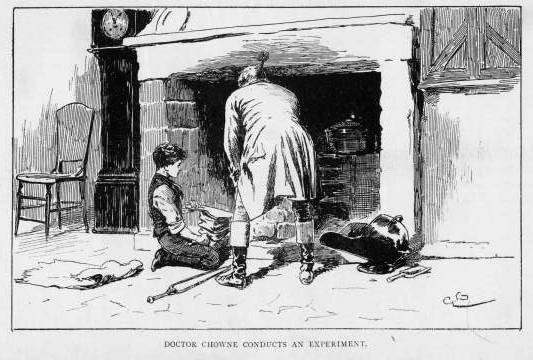
He was quite at home in our house, and I followed him into the back kitchen, where he set me at work powdering up the specimens with a hammer on a block of stone, while he built up in the broad open fireplace quite a little furnace with bricks, into which he fitted a small deep earthen pot, one that he chose as being likely to stand the fire, which he set with wood and charcoal, after mixing the broken and powdered ore with a lot of little bits of charcoal, and half filling the earthen pot. This he covered with more charcoal, shut in the little furnace with some slate slabs, and then, when he considered everything ready, started the fire, which it became my duty to blow.
This did not prove necessary after the fire was well alight, for the doctor had managed his furnace so well that it soon began to roar and glow, getting hotter and hotter, while, as the charcoal sunk, more and more was heaped on, till the little fire burned furiously, and the bricks began to crack, and turn first of a dull red, then brighter, and at last some of them looked almost transparent.
All this took a long time, and our task was a very hot one, for from between the places where the bricks joined, the fire sent out a tremendous heat, where it could be seen glowing and almost white in its intensity.
But hot as it was on a midsummer day, the whole business had a great fascination for me, and I would not have left it on any account.
The doctor, too, seemed wonderfully interested. Kicksey came about two o’clock to say that the dinner was ready, but the doctor would not leave the furnace; neither would I, and each of us, armed with a pair of tongs from the kitchen and parlour, stood as close as we could, ready to put on fresh pieces of charcoal as the fire began to sink.
“How long will it take cooking, sir?” I said, after the furnace had been glowing for a long time.
“Hah!” he said, “that’s what I can’t tell you, Sep. You see we have not got a regular furnace and blast, and this heat may not be great enough to turn the ore into metal, so we must keep on as long as we can to make sure. It is of no use to be sanguine over experiments, for all this may turn out to be a failure. Even with the best of tools we make blunders, my lad, and with a such a set out as this, why, of course, anything may happen.”
“Anything happen, sir?” I said.
“To be sure. That ore ought to have been put in a proper fire-clay crucible.”
“What’s a crucible, sir?” I said.
“A pot made of a particular material that will bear any amount of heat. Now perhaps while we are patiently waiting here that pot in the furnace may have cracked and fallen to pieces, or perhaps melted away instead of the ore inside.”
“Oh, but a pot would not melt, sir, would it?” I said.
“Melt? To be sure it would, if you make the fire hot enough. Did you ever see a brick-kiln?”
“Yes, sir.”
“And did you never see how sometimes, when the fire has been too hot, the bricks have all run together?”
“And formed clinkers, sir? Oh yes, often.”
“Well, then, there you have seen how a mixture of sand and powdered stone and clay will melt, so, why should not that earthen pot?”
“Then if that pot melts or breaks all our trouble will have been for nothing, sir?”
“Yes, Sep, and we must begin again.”
“But shouldn’t we find the stuff melted down at the bottom of the fire?”
“Perhaps; perhaps not; we might find it run into a lump, but we should most likely find it not melted at all, and then, as I said, we should have to begin over again.”
“That would be tiresome,” I said. “But never mind, we should succeed next time, perhaps.”
“We should try till we did succeed, Sep, my lad. There, that’s the last of the charcoal.”
“Shall I fetch some more?” I cried.
“No, my lad, perhaps what has been burned may have melted it, so we’ll wait and see.”
“And take out the pot?”
“No, we couldn’t do that. We must wait till it cools down. Maybe by and by I can take out a brick, and we shall be able to see whether the ore has melted.”
I waited impatiently for this to be done, and about an hour later the doctor took the top brick from the glowing furnace with the tongs, and touched the charcoal embers, which fell at once down to a level with the top of the pot, the interior having burned away, so as to leave quite a glowing basket or cage of fire.
Chapter Nine.
The Result of the Smelting.
But there was nothing to see yet, and the brick was replaced, the fire roared once more, and for what must have been quite another quarter of an hour we waited before the doctor took out the brick again.
It was now possible to make out what seemed to be a regular ring red-hot in the midst of so much glowing ember with which the pot was filled; and into this the doctor thrust the poker, to find that it passed through what was light as feathers.
“I must be gentle,” he said quietly, as he thrust the poker lower, till he could gently tap the bottom of the pot.
“It’s quite sound,” he said, as he gave the poker a stirring motion and ended by withdrawing it.
“I think we may let out the fire,” he said; and we proceeded to bear away the slates we had used for screens, and then to take down the glowing bricks one by one, and toss them into the yard.
This done, I proposed throwing a bucket of water over the heap of embers, in the midst of which stood the pot.
“No, thank you, young wisdom,” said Doctor Chowne. “I should like to have some result to show your father when he comes back. If you did what you say, the pot would fly all to pieces, and where would our work be then?”
“I say, Doctor Chowne,” I said, looking at him rather wistfully, “I wish I knew as much as you do.”
“Learn then,” he said. “I did not know so much once upon a time.”
As he spoke, he slowly and carefully drew the ashes down from about the pot, and as they were spread about the brilliant glow began to give place to a pale grey feathery ash, which flushed red, and then yellow, whenever the air was disturbed, while the earthen pot that had been red-hot changed slowly to a dull drab.
“There, Sep,” said the doctor, “that pot will take pretty well an hour to get thoroughly cool, so we may as well go and have some dinner. What do you say?”
“I was thinking, sir,” I said, “that if there is any metal in that pot now, it would be something like the lead when we are casting sinkers for fishing. Why couldn’t we lift the pot with the tongs, and pour out what’s at the bottom and run it into a mould.”
“Have you got a mould, Sep?” he said.
“Yes, sir; three different sizes—up here on the shelf.”
I went to a corner of the back kitchen, and reached down three dusty clay moulds, one of which the doctor took and set upon the floor.
“You are right,” he cried. “There, take your tongs, and we’ll catch hold of the pot together, and set it out here. Then, both together, mind, we’ll pour out what there is into the mould.”
It was easy enough. We each got a good hold of the pot, lifted it out with its glowing feathery charcoal ashes half filling it, and then, after setting it down to get a more suitable hold, we tilted it sidewise, and then more and more and more, but nothing came out save some glowing ashes, which fell beyond the mould in a tiny heap.
“Higher still, Sep, higher, higher,” the doctor kept on saying; and we tilted it more and more; but still nothing came till, just as we were about to turn it upside down, there was a flash of something bright and silvery, and a tiny drop of fluid metal ran out on to the mould, and down the side.
“That’s it. Up with it, Sep. A little more this side. Now then.”
Up went the bottom of the pot higher still, and out came a little rush of glowing charcoal, and directly after a bit of heavy clinker, and that was all.
“Oh, I say, doctor,” I cried, “what a pity!”
“Pity, my lad! I don’t think so. Here, let me do it.”
He lifted up the piece of hard clinker and set it upon the slate slabs by itself, and then taking hold of the mould with the tongs, he raised it and gave it a tap or two on the floor, to get rid of the feather ash, and I could see that there was what seemed to be a piece of thin lead beginning in a sort of splash running to the edge in a thread, then down the side of the mould, to finish off in a little round fat button of metal.
“Hah! I don’t think we’ve done so badly after all, Sep,” he said, as he placed the mould upon the table; “but first of all, brush those embers lightly aside, and let’s see if there is anything left.”
I took a wisp of birch and did as I was told, but there was nothing to be seen, and when the doctor took the pot out into the yard, and carefully examined it, he found nothing there, and brought the little clay vessel back.
“You must take care of that pot, Sep,” he said. “It is nothing to look at, but a thing which will stand fire in that way may prove valuable. Now, then, my lad, bring that bit of refuse, and we will go in and have some dinner. These things will be quite cool by the time we have done.”
We carried our treasures into the parlour, and, to Kicksey’s great delight, had a wash and our dinner, while she obtained leave to clear away what she was pleased to call our “mess.”
But the doctor did not let the dinner pass without carefully examining the rugged piece of metal and the button, and then the piece of refuse, the remains of the broken-up specimen.
For my part I was not at all dazzled by the result of our experiment, and at last, with my mouth full of jam and bread and cream, I said:
“But that’s only a shabby little bit to get out of all those bits I broke up, isn’t it, sir?”
“Do you think so, Sep?” he replied smiling.
“Yes, sir!”
“Well, I think quite differently. We put in rough stony uncleansed ore, and we have got out this piece. If there’s plenty of it in the sides of the Gap, my boy, and it is properly worked, your father will be a rich man from the produce of the lead alone; and I feel pretty sure,” he continued, as he examined the scrap of metal through his glass, “that there is a great deal of silver in this as well. Here, what are you doing?” he cried.
“I was looking to see if father was coming,” I cried, as I turned back at the door.
“You need not look,” he said quietly, “for it will be three hours at the least before he can get back. The pony must have a rest at the town.”
I came back slowly, for I felt that what the doctor said was true, and it seemed to be all so curious that our bit of mischief should turn out so strangely that I did what was a very unusual thing for me in those days, sat down and thought.
The piece of metal was lying before me, and I took it up and examined it, turning it over and over in my hands, while I could not keep a strong feeling of doubt from creeping in.
“Perhaps the doctor is wrong,” I said to myself, and this may be worth nothing at all; and as I thought in this fashion, I longed for my father to come back, so as to hear what he had to say about the value of the metal. For in those days I had a very frank loyal feeling towards my father, and a belief in his being about the best man anywhere in the neighbourhood, and that he knew better than anybody else.
The silence in the room was broken by the entrance of Kicksey to take away; and as she did so she took the opportunity of informing us that she had cleared everything away, and that the kitchen was as clean once more as a new pin.
As I have before said, the doctor, as my father’s old friend and companion, was quite at home in our house, and, after refreshing himself with a pinch of snuff, he proceeded to have some tobacco in another form, for he went to the corner cupboard and got out the jar and a long pipe, which he filled and lit, and then sat there in silence, watching the piece of rugged metal.
As he sat watching the metal and surrounding himself with smoke, I sat and watched him, till it became so tiresome and dull that I rose quietly at last, and stole out into the garden and had a look at the sea, all aglow now with the evening sunshine, and looking curiously like the burning charcoal when it had been spread out on the kitchen floor.
It was very beautiful, but I had watched that too often, so I crossed the garden and went out into the lane to see if I could find anything amusing there.
For it seemed to me that it might be very nice for my father to have found a mine of lead and silver, and that it would be very interesting to see it dug out and melted, as we had melted those pieces that day—of course in a large way; but I did not feel as if I wanted to be rich, and I would a great deal rather then have been wandering out there on the cliff with Bob Chowne or Bigley Uggleston, when I heard a shout, and, looking in the direction, there, high up on the cliff path, and coming towards me with long strides, was my last-named school-fellow.
“Hallo, Big!” I shouted, running towards him; “where are you going?”
“Coming to look after you,” he said. “Why didn’t you come over again?”
“Because I was wanted at home,” I replied. “You might have come over to me.”
“I couldn’t. I didn’t like to. Father was put out this morning, because he saw you and your father on our grounds.”
“Your grounds!” I said. “Oh, come, that is a good one.”
“Well, father always talks about it as if all the Gap belonged to him. What were you doing there?”
“Having a walk,” I was obliged to say.
“Oh, well, you might have stopped.”
“Didn’t I tell you my father wanted me,” I replied in a pettish way. “I’ve only just got out again.”
“I’ve been waiting at home to see if my father would come back. He started off to walk to Barnstaple.”
“Your father has?” I cried involuntarily. “Why, that’s where my father has gone.”
“What! To Barnstaple, Sep?”
I nodded.
“I say,” he said, “I hope they won’t meet one another.”
“Why?” I exclaimed.
“Because they might quarrel. I say, Sep, I wish your father and my father were good friends like we are.”
I shook my head at that, and felt rather lofty.
“I don’t see how that can ever be,” I replied; and then I felt quite uncomfortable as I recalled my father being uneasy about old Jonas watching us that morning. I felt, too, that it would be much worse now if Jonas got to know that there was a mine upon the estate, and it seemed as if we were going to be at the beginning of a good deal of trouble.
“Father went up the Gap after you had gone,” said Bigley, “and I saw him go right up to the place where we blew down the big rock, and when I saw him go there I went indoors and got his spy-glass and watched him out of the window.”
“I say, you oughtn’t to watch people,” I said sharply.
“I know that,” replied Bigley; “but I was afraid there was going to be a bother, and I wanted to tell you if there was.”
“Well, what did he do?”
“Why, if he didn’t seem to make it all out exactly just where we had been, and he followed down the place where the stone fell, and then went on down till he came to the rough part where the rock was all bared, and stooped and looked it all over and over. Oh, he has got eyes, my father has. I could see as plain as could be through the spy-glass that he picked up bits of the stone, and once he knelt down and I think he smelt the stones.”
“Smelt them!” I exclaimed.
“Yes, to find out about the gunpowder. He has found it all out, I’m sure.”
“So am I,” I said sadly, but without telling Bigley I meant something else.
“And then he went right down slowly just where the big rock slipped along, and down to the stream, and washed his hands and came home.”
“And did he speak to you about it?”
“No,” replied Bigley. “I expected him to say a lot. I didn’t mind, for I should have told him all about it, and I don’t think he would have been very cross with me; but he didn’t say a single word about it, though I saw him shake his fist several times when he was talking to himself, and soon after he set off to walk in to Barnstaple, and, as I told you, he hasn’t got back.”
Just then there was the clattering of hoofs, and I looked up and saw my father coming down the zigzag road.
“I must go now,” I said. “Don’t think me unkind, Big, old chap. Or you stop and I’ll come out to you again.”
“Yes, do,” he said. “I’ll go and sit down on the rocks till you come. Only, mind you do.”
I promised that I would and we parted, one going down towards the sea, the other along the lane, where I met my father looking very hot and tired; but he seemed in good spirits, so I supposed that he had not met old Jonas.
“Well, Sep,” he cried, “how about the experiment? What luck?”
“Oh, we melted the stones, father, and got out of them a little bit of lead.”
“It was lead, then?” he said eagerly, as we reached the cottage.
“Yes, father, and Doctor Chowne says he thinks there’s silver in it as well.”
“You young dog!” cried the doctor, coming out pipe in mouth. “Why, you are telling all the news, and there’ll be nothing left for me to do.”
“Only show the stuff,” I said.
“Ah, yes; show the result,” said the doctor. “But come in, Duncan, the tea’s waiting, and I want a cup myself.”
“And I am regularly tired out,” cried my father. “Here, Sam, feed the pony well, for he has worked hard.”
Sam, who had heard the pony coming, took the rein and led it off to the stable, while I followed my father into the little parlour, where the doctor caught him by the arm.
“Here’s the specimen, father,” I said; but he did not turn his head, for the doctor was speaking to him.
“Did you get the deeds?” he said.
“Chowne, you’re as good as a witch,” cried my father.
“Why?”
“As I came out of the lawyer’s office, who should I see but old Jonas Uggleston coming along the street, and as I went into the hotel I saw him turn in where I had been.”
“But did you get the deeds?” cried the doctor.
“Specimen, Sep?” said my father. “Oh, that’s it, is it? Well, it doesn’t look worth all this trouble.”
“Duncan, what a man you are!” said Doctor Chowne pettishly. “I’ve said twice over, Did you get the deeds?”
“I beg your pardon, Chowne. Yes, of course. He wanted to put me off, said I’d better let them stop with him, and that there was no hurry, and that a little endorsing was wanted.”
“Oh, of course!” said the doctor.
“But when he saw that I was in earnest, and that I meant to wait for them, he set to work and got the business done—that is, all that was wanted. In fact, it was a mere nothing.”
“And he wanted to keep them in his charge unsigned, with the chance of making more of the estate to somebody else if that somebody else turned up.”
“Jonas Uggleston to wit?” said my father.
“Exactly. Duncan, old fellow, you see that you were just in time.”
“That’s what I felt, Chowne; but there the deeds are safe and sound; the Gap is thoroughly mine—my freehold.”
“And you may congratulate yourself on being the owner of a valuable lead and silver mine.”
“Then you feel sure of that, Chowne?” said my father, who seemed quite overcome.
“I am certain of it; but of course I can’t say what is the quantity.”
“Silver?”
“Probably. Lead, certain.”
“Then, Sep, my boy—” cried my father excitedly, catching me by the shoulder.
“Yes, father,” I said.
I believe now that my father was going to say something about my growing up to be a rich man; but he checked himself, and only said quietly:
“Come and sit down to tea.”
Chapter Ten.
We Bale the Rock Pool.
Now there was very little done during the rest of our holidays; all I remember was, that instead of old Jonas Uggleston being very disagreeable, and making himself my father’s enemy, he grew very civil and pleasant, and nodded to my father when they met, and called him “Captain.”
He was wonderfully kind to me too, asking me into the house, and seeming very pleased whenever he knew that Bigley had come over to see me.
The news that there was lead and silver in the Gap soon spread, and a great many people came to see my father, and wanted to buy the little estate; but he said no, that he should work it himself, for he wanted some occupation; and he and the doctor planned it all out, how to begin in a small way; and men were set to work to wall in the part where the mine was to be opened, and to build sheds and pumping-house.
But after a few days this became monotonous to us boys, who had plenty of things to tempt us about the cliffs and the shore, and I’m going to put down one or two of our bits of adventure which we had about this time.
Our little bay or cove was one of three or four little bays within one big bay, formed by Norman’s Head at the west and Barn’s Nose in the east, and all round from point to point there was one tremendous wall or cliff of reddish or bluish rock, nowhere less than a couple of hundred feet high; and the only places where you could get down to the sea were at the heads of the coves, or where one of the little streams from the moor made its way down to the beach. Here and there when the tide was low lay patches of blackish sand, but the foot of the cliffs nearly all the way was one jumble of great rocks, beginning with lumps, say as big as a chest of drawers, and running up to rugged masses as large as cottages.
They did not look so big when you were up on the cliff path, six or seven hundred feet above them; but when the tide went down, and we boys went for a ramble over and among them, it was to find the smaller blocks nearly as high as our heads, while the big ones made the most magnificent climbing any lad could wish for who was an enemy to the knees of his breeches and the toes of his boots.
Of course we could have gone east or west along the cliff path as peaceably as the sheep; but what was a walk like that to wandering in and out among the sea-weed-hung masses, full of corners and ways as a maze; with rock pools amongst them, and chasms and rifts, and rock arches and hollows, and caves without end?
Some of these blocks were of a sort of limestone or grit, and they were rugged and rounded at the corner, and lumpy, but the slaty rocks were generally flat-sided, and split off regularly, forming smooth flat forms that often rose one above another in rough steps, so that you could easily climb to the tops, or, where they had fallen and split away from the cliff, and lay resting against one another, you could walk under what seemed to be like great stone lean-to sheds, whose floors were as often as not water as pure and clear as crystal.
It was a wonderful place, and never ceased to attract us, for there was always something to find when the tide had gone down leaving the rocks bare.
All the things that lived or grew upon them had been seen by us hundreds of times, but after some months at school they always seemed new again, and we got our little pawn nets and baskets, and went prawning with as great zest as ever.
There are plenty of ways to go prawning, I daresay, but I’ll tell you how we managed. We each used to have a small ring net, fixed at the end of a six-foot stick that answered two or three purposes, and, with our little baskets slung at our backs, set off along the shore.
I remember one morning very well. It was about three weeks after finding the lead vein that Bob Chowne and Bigley came over to the Bay, and we started, our Sam saying that it was going to be a very low tide.
Off we went down by the little waterfall which came along by the back of our house, and down to the beach, getting as close to the sea as the rocks would let us, and looking out for the first pool where the sea had left a few prisoners.
We were not long in seeing one, and then the thing was to approach as quietly as possible and look in.
These pools were generally fringed with sea-weed, great greenish-brown fronds in one place, dark streaks of laver in another, and lower down the bottom would be all pink with the fine corallite, while all about the sea-anemones would dot every crack and hole, like round knobs of dark red jelly, where the water had left them high and dry, spread out like painted daisy flowers, where they were down in the pool.
No matter how cautiously we approached, something would take fright. Perhaps it would be a little shore crab that betrayed itself by scuffling down amongst the corallite or sea-weed, perhaps a little fierce-looking bristly fish, which shot under a ledge of the rock all amongst the limpets, acorn barnacles, or the thousands of yellow and brown and striped snaily fellows that crawled about in company with the periwinkles and pelican’s feet.
Those were not what we wanted, but the prawns, which would be balancing themselves in the clear water, and then dart backwards with a flip of their tails right under the sea-weed or ledges.
I remember that day so well because it was marked by a big black stone, of which more by and by; and everything connected with our doings that morning seems to stand out quite clear, as the Welsh coast did under the clear blue sky.
We reached our first pool, and Bob Chowne shouted, “There’s one!” while I was certain I saw two more. Then Bob and Bigley softly thrust in their nets, and it became my duty to poke about among the sea-weed and under the ledges where we had seen the prawns take shelter.
At about the second stirring of the overhanging weed on one side, out darted a big prawn. “I’ve got him!” cried Bob, and we all shouted “Hooray!” but when the net was raised, dripping pearls in the bright sunshine, the prawn was not there, for, preferring open water to nets, it had shot between the two and taken shelter under the ledges on the other side.
But there he was, for there was no way out to where the sea sucked and gurgled among the rocks three or four yards away, and we continued our hunt, not to dislodge this one, but three more, one being larger, and two much less.
For a good ten minutes they dodged us about, hiding in all manner of out-of-the-way corners, till all at once it seemed as if they must have gone. The water, that had been brilliantly clear when we started, was now thick with sand and broken sea-weed, and Bigley lifted out his net to clear it and to let the water settle a little before we started again.
“I don’t know where they’ve got to,” said Bob sourly. “Prawns are not half so easy to catch as they used to be.”
“Hallo! Why, here’s one,” cried Bigley just then, as he found one of the biggest kicking about among the sea-weed that he had turned out of the bottom of his net.
This first capture was soon transferred to the basket, and the fact of one being taken so encouraged Bob that he set to with renewed energy, and the result was that we caught two more out of that pool, the biggest of all—at least Bob Chowne said it was—having to be left behind in the inaccessible crack where he had hidden himself.
Another pool and another was visited with excellent luck, for the tide was down lower than usual, and prawns seemed plentiful, there having been plenty of time for them to collect since they were last disturbed, for we boys were the only hunters on that deserted shore. So on we went, one poking about among the weeds till the prawn darted backwards into the nets held ready, and we had soon been able to muster over a dozen.
Then, all at once, we came upon quite a little pool right under a large mass of rock with a smaller and deeper pool joined to it by a narrow channel between two blocks of stone, and farther from the sea.
We caught sight of several prawns darting under cover as we came in sight, but, to our disgust, found that we could not attack them, the pool being so sheltered by overhanging rocks that the only possible way seemed to be by undressing and going into what was quite a grotto.
Travellers tell us how the natives of some far-off islands dive into the sea and do battle with sharks; but no boy ever lived who could dive into a pool and catch a prawn in his native element—at least I never knew one who could, and we were going to give it up after a few frantic thrusts with our nets, when an idea occurred to me.
“Here, I know!” I cried. “Let’s bale out the little low hole, and that will empty the big one.”
“To be sure,” cried Bob. “Go it! But we’ve got nothing to bale with.”
“Big’s shoes,” I cried as I caught sight of them hanging from his neck, tied together by their thongs, and each with a knitted worsted stocking plugging up the toes.
Big made not the slightest objection, but laughed as he pulled out his stockings and thrust them into his breeches’ pockets.
The next minute he and I were scooping out the water at a tremendous rate, making quite a stream flow down from the upper part under the rock, and it soon became evident that in less than an hour both would be dry.
We worked away till I was tired and gave place to Bob Chowne, Bigley all the while working away and sending out great shoefuls over the lower edge of the rocks.
I sat down to rest, and as I watched where the water fell I suddenly made a dart at something thrown out, but it only proved to be a prickly weaver.
Five minutes later, though, Big threw out a prawn which had come down with the current, and this encouraged him to work harder, but Bob began to be tired, and he showed it by sending a shoeful of water at me, making me shout, “Leave off!”
Then he sent one flying over Bigley, who only laughed and worked on for a few moments till Bob was not looking, and then sent a shower back.
Bob jumped out of the hole like a shot and turned upon Bigley angrily:
“You just see if I’m going to stop down there and be smothered with water. Yah! Get out, you ugly old smuggler.”
As he spoke he flung Bigley’s great shoe with a good aim down by his feet, and splashed him completely all over.
Some lads would have jumped out and pursued Bob in a fury, but Bigley only brushed the water out of his eyes and began to laugh as if he rather enjoyed it.
“Come on, Sep,” he cried to me; “you and I will finish, and if he comes near we’ll give him such a dowsing.”
I went to his help, and we worked so well that no less than six more prawns came down to our pool, and were scooped out; and at last the upper one was completely emptied, but it was nearly an hour’s work.
“Now then, I’ll go in,” said Bob, and he crept in through the rift between the two pools, and under the overhanging rocks.
“Oh!” he cried as soon as he was in, “what a jolly place! And—ugh! Here’s a conger.”
“No!” we cried together.
“Yes there is, long as my arm, and he’s squirming about. Here, give me a landing-net. I’ll poke him, and make him come out to you chaps.”
We handed him the net, and he began banging and thrusting at the rock for some time without result.
“Well, isn’t he coming?” I cried.
“No; he gets up in a corner here so that I can only feel his slippery tail with the stick, and he won’t come out.”
“Take hold of it with your hand and pull,” said Bigley.
“Oh yes, I daresay. Just as if I didn’t know there’s only one place where you can hold on.”
“Where’s that?” said Bigley.
“With your hand in his mouth. You come and put yours in.”
Of course Bigley did not respond to the invitation, and the banging and rattling went on for a few minutes longer.
“Why don’t you chaps stand away from the light? I can’t see,” cried Bob. “That’s better: now I can tell. Look out, boys, look out! Here he comes.”
“Catch him in the net, Bob,” I shouted.
“Yah! Don’t talk stuff,” was the answer. “Look out! Is he coming your way?”
“No!” we both shouted, and then “Yes!” for there was a quick movement in the channel between the two pools, and the next instant a large eel was splashing and writhing in the water and sea-weed of the pool which we had baled.
“Here he is, Bob!” we shouted; and, as we finished the struggle which resulted in our getting the eel into one of the nets, and then out on the open rocks, and in a position to make it cease its writhings, Bob Chowne backed out to look on and help us gloat over our capture, which proved to be a plump young conger of a yard long.
“Well, that’s something,” said Bob. “Now I’m going after the prawns. No, you go, Sep,” he said. “I don’t see why I should do all the work.”
I went into the dripping grotto nothing loth, and by careful search among the wet weed I found first one prawn and then another, till I had thrown out six, the work being tolerably easy, for the little horny-coated fellows made known their presence by their movements, flipping their tails sharply and making a noise that betrayed their hiding-places.
The grotto-like place, shut in by some rocks overshadowed by others, was so gloomy that it was hard to make out everything, but twice over I noted a bit of a rift on my left all fringed with sea-weed and slippery with anemones, where it was not rough with limpets and barnacles.
“Was it down here, Bob, down on the left, that you found the conger?”
“No,” he shouted, “on the right.”
I looked round, and found the crack where the conger must have been, and then came a summons from without.
“Well, can’t you find any more?”
“No,” I said; “but there’s a big hole here. Perhaps there’s another conger.”
“Put your hand in and pull him out, then,” cried Bob with a sneer.
I did not answer, for I felt now very plainly how much easier it is to give orders than to obey them. But a little consideration taught me that there was nothing to fear, for if there was a conger in the hole the chances were that he would have thrust his head into the farthest corner, and that it would be his tail that I should touch.
“Now, then,” cried Bob. “Ar’n’t you going to find any more prawns?”
“I don’t know,” I said, as I carefully introduced my hand and arm, going down on one knee so as to get closer, and so by degrees hand, arm, and shoulder had nearly disappeared, as I touched the far end of the cleft.
“Nothing,” I said to myself, as I felt about with my cheek touching the wet slippery sea-weed. Then I uttered a loud “Ugh!” and started away.
“What’s the matter?” cried my companions.
“I don’t know,” I cried. “Here’s something alive in a hole here.”
“Well, why don’t you pull it out?” cried Bob.
“I—I don’t know,” I said. But I’m afraid I did know. The feeling, though, that my companions were laughing at me was too much, and with a sudden burst of energy I thrust my hand right into the rift again, felt down cautiously till my hand touched, not the slimy serpentine form of an eel, but the hard back of a shell-fish, and as I touched it, there was a curious scuffling down beneath my fingers that told me it was a crab.
“Hooray, boys!” I shouted. “Crab!”
“Have him out, Sep! Mind he don’t nip you!” they shouted; and after a minute’s hesitation I plunged my hand into the hole again, knowing that I must feel for a safe place to get hold of the claw-armed creature, so that I should not have to suffer a severe pinch or two, from its nippers.
I was pretty quick, but the crab was quicker, and as I caught it the left claw seized tight hold, but only of my sleeve.
My natural instinct was to start back, and this had the effect of dragging the crab out of its lurking place, and I ran to the opening holding out my arm, just as the crab dropped with quite a crash into the little channel, and then began running sidewise back towards me and the darkness.
I stopped my prisoner with my foot, and he scuffled back and into the little empty pool, where he tried hard to hide himself under the sea-weed fronds, but Bigley worked him out, and by clever management avoided the pincers, which were held up threateningly, and popped him into one of the baskets.
“It’s my turn now,” said Bigley. “Think there’s anything else?”
“I don’t know,” I said. “Try.”
“What’s the good of saying that?” said Bob laughing. “He couldn’t get in.”
“Oh, couldn’t I?” cried Bigley. “You’ll see. Mind that eel don’t slip out. Now you’ll see.”
He rolled up his sleeves nearly to the shoulder, and picking out the widest spot began to crawl in, dragging himself slowly through, and at last drawing his legs in after him, and standing in a bent position right under the rock.
“There!” he cried triumphantly. “Who can’t get in? Now then, where are these cracks?”
“Right up at the other end,” I cried; and he groped on into the narrower part, Bob and I looking into the slippery grotto-like place enjoying his slow cumbersome manner, and paying no heed to the fact that the tide had turned, and that already a little water had run into the little pool where we had baled.
“Found anything, Big!” we shouted, though he was only a couple of yards away.
“N–no. Nothing here. I’m going to try this other hole. Oh, I say, isn’t it deep?”
“Mind! Mind!” shrieked Bob, and Bigley scuffled back.
“What—what is it?” he panted.
“Ha-ha-ha-ha!” roared Bob. “Did he bite you?”
“What a shame!” grumbled Bigley in his gruff voice. “I didn’t try to scare you. I don’t care though. You won’t frighten me again.”
He crept back, and we could hear him grunting and panting.
“I say, it is deep,” he said. “I’ve got my arm in right to the shoulder and there’s nothing here. Stop a minute; here’s a crack round this corner where I can get my hand. It’s quite a big opening with water in it, and slippery things in the rock, and—Ugh!—oh!—ah!”
Chapter Eleven.
A Terrible Danger.
Bigley dragged his arm out of the crack and came scuffling back to us, and as soon as he reached the opening we could see that he looked quite pale.
“Why, Big, what is it?” I cried eagerly.
“Don’t frighten him. He has seen the ghost of an old cock shark,” cried Bob Chowne grinning.
“Oh, I don’t know,” he panted. “Something soft, and cold, and alive.”
“Why, it was a jelly-fish,” we said together. “Did it sting?”
“No. You wouldn’t find jelly-fishes in a hole like that. It felt like a tremendously great polly-squiggle with a big parrot’s beak, and my hand nearly went in.”
“Get out!” said Bob, “there are no big ones.”
“How do you know?” retorted Bigley. “That felt just like a large one.”
“Did he take hold of you with his suckers?” I said.
“No, I didn’t give him time.”
“If it had been a polly-squiggle it would have got you fast directly with its suckers,” I said oracularly.
“Never mind what it was, old Big. Go in and fetch it out again.”
“No; one of you two go, I don’t like,” said Bigley. “You can’t see where you’re putting your hand; and suppose he bites it off?”
“Why, then, you could have a wooden peg,” said Bob sneeringly. “Here, come out, my poor little man, and let me go in. I’ll soon fetch out my gentleman, you see if I don’t. Here, come out.”
Bob Chowne never meant to go in. His face said as much as he looked round at me; but his words had the effect he intended, for Bigley grunted and went back as far as the narrow crack in the grotto would allow, and boldly thrust in his hand.
“Mind, Big,” I said seriously, “be ready to snatch away your fist.”
He did not answer, but we heard him draw his breath hard; then there came a splashing noise, and directly after our school-fellow backed towards us.
“I’ve got him,” he shouted, his voice sounding hollow and strange.
“What is it?”
“I dunno,” he cried, and then, wrenching himself round, he dropped something soft down upon the rock.
“Why, it’s a crab!” I cried.
“A soft one,” shouted Bob. “He can’t nip now.”
As he spoke he poked the curious-looking object with his finger, making it wince and threaten with its claws, but they were perfectly soft, and it was evident that the creature had only just crept out of its old shell, and was hiding away in the dark hole waiting for the new armour to form.
“Well, he is a rum one,” said Bob, growing bolder. “Why, he’s just like a counterfeit is when you pull his tail out of a whelk shell.”
“Not quite so soft,” I said, gaining confidence and handling the crab in turn, for it was not so fleshy feeling as the back part of hermit crabs, which we called counterfeits in our part of the world.
“What shall we do with if?” said Big. “It isn’t good to eat now.”
“Kill the nasty, bloaty thing, and throw it in for bait for the fishes.”
“No, no,” I said, “put it down and let it creep back. It will grow into a fine crab, and we know its hole and can come and get it some day when the tide’s down.”
“That’s it,” said Big; and taking the pulpy, soft crab, which pinched at his hands without the slightest effect, he crept back and thrust it into its hiding-place once again.
We two were looking in after him when—thud!—plash!—came a wave, breaking just below us and drenching us from head to foot, while a quantity of the water rushed into our baled-out hole, filled it, and began running swiftly up the channel, so swiftly that we saw at a glance it would only take another or two to fill the upper pool.
“Here, come out, Big. Quick!” I cried. “Tide’s coming in. Now, Bob, get the baskets and nets.”
I ran down a few yards, and was only just in time to snatch mine up before a wave washed right over the spot where they had lain. For the tide was coming in rapidly, and, as I have shown, we were on a part of the shore that was only bare about once a month.
“All right,” cried Bob. “I’ve got mine and old Big’s.”
“Where are Big’s shoes?” I said.
“Down by the pool. Come on, Big, old chap,” shouted Bob.
“I’ll get them,” I said, and I ran to the bottom pool and had to fish them out of the bottom where they had been left.
As I took them out I felt ready to drop them, but I did not, for I flung them and my net and basket as far up the shore as I could, and held out my hands to Bigley, who was looking out at me from the grotto-like place.
“Why don’t you come out?” I cried. “Can’t you see the tide’s coming in?”
“Yes—yes,” he said in a curious hollow voice, “I can see, but I can’t move. I’m stuck fast. Help!”
I felt a chill of horror, and in those moments saw the tide rising higher and higher till it had filled the little cavern and drowned my poor school-fellow, we his companions being unable to drag him out.
Those thoughts only occupied moments, but they made an impression that I have never forgotten, and I don’t think I ever shall have the memories weakened.
I saw it all plainly enough. Poor fellow! He had been startled by the incoming tide and tried to creep out, but not in about the only part that would permit of his passing, but in the first that offered, and he had become fixed, and, as in a few words he explained, the harder he tried to free himself the tighter prisoner he became.
“Here, Bob! Bob!” I shouted in such a tone of anguish that he came running from the back of the rocks to where I was standing knee-deep in water.
“Get out!” he shouted as soon as he saw me. “You can come. Look here, if you play me a trick like—”
“No, no, don’t go,” I shouted. “Bob: he’s fast!”
Bob dashed down to me now as quickly as the rough place would let him. He had thrown down his load at my first appeal for help, and as he came splashing through the water he looked horribly pale.
He saw the position in an instant, and stood by me too much horrified to act; and, as he told me afterwards, his thoughts were just like mine. How long would it take to go to the Gap and bring Bigley’s father with a boat?
“Can’t you get any farther?” I cried at last as a fresh wave came rushing in, and nearly swept me off my legs.
“No; I’m fast; I can’t move,” said Bigley in a hoarse whisper. “Run for help.”
“No, no,” shouted Bob. “Don’t go, Sep. We must get him out.”
The curious dreamy feeling of helplessness had left us both now; and, taking hold of our companion’s hands, we set our feet against the rock and dragged with all our might, while poor Bigley struggled and strained, but all in vain. He had by his unaided efforts got to a certain distance and then stopped. Our united power did not move him an inch.
We stopped at last panting, and all looking horror-stricken in each other’s faces. It was a calm enough day, but down there among the rocks the tide rushed in with such fierce power and so rapidly that we were being deluged by every wave which broke, while at intervals the greater waves threatened to be soon big enough to sweep us away.
“Don’t stop looking,” cried Bob Chowne frantically. “Sep, Sep! Pull, pull!”
He dashed at poor Bigley again, and we dragged with all our might; but the efforts were vain, and again we stared at each other in despair.
“Try again!” I cried breathlessly, and with a horrible feeling coming over me as I once more seized my school-fellow’s hand.
Bob followed my example, and again we dragged and hauled at the poor fellow, whose great eyes stared at us in a wildly appealing way that seemed to chill me.
It was of no use. We could not stir him, and we stopped again panting, as a bigger wave struck us and drove us against the rocks, and ran gurgling up into the grotto where poor Bigley was fixed.
“Shall I run for help?” groaned Bob, who was crying and sobbing all the time.
I shook my head, for I knew it was of no use, and then dashed at poor Bigley again, to catch hold of his hand, not to drag at it, but to hold it in both mine.
I don’t know why I did it, unless it was from the natural feeling that it might encourage and comfort him to have someone gripping his hand in such a terrible time.
I tried not to think of the horror as the water splashed and hissed about us, and gurgled horribly in the grotto; but something seemed to be singing in my ears, and I heard again the shrieking of a poor boy who was drowned years before by getting one leg fixed in a rift among the rocks when mussel gathering and overtaken by the tide.
He, poor fellow, was drowned, for they could not drag him out, and it seemed to me that our poor schoolmate must lose his life in the same way unless we could devise some means to rescue him.
We looked round despairingly, and for a moment I tried to hope that the tide might not, upon this occasion, rise so high; but a glance at the top of the rocks showed them to be covered with limpets and weed, indicating that they were immersed at every tide, as I well enough knew, and I could not suppress a groan.
“Sep,” said poor Bigley, drawing me closer to him, with his great strong hand, and gazing at me with a terribly pathetic look in his eyes. “Sep, tell poor father not to take on about it. We couldn’t help it. An accident. Tell him it was an accident, will you?”
I could not answer him, and I turned to Bob Chowne, who was standing with his fingers now thrust into his ears.
“Bob!” I cried. “Bob, let’s try again!”
He sprang to poor Bigley’s other hand, and we dragged and tugged with slow steady strain and sharp snatch, but without any effect; and every now and then, as we pulled, the waves came right up, and drove us against the rock.
“It’s of no use, boys,” said Bigley at last. “I’m fast.”
“Help!” yelled Bob Chowne with all his might; but in that great solitude his voice had no more effect than the wail of a sea-bird. There was not a soul in sight either on cliff path or the shore. Out to sea there were sails enough, small craft and goodly ships going and coming from Bristol and Cardiff; but no signals on our part were likely to be seen. And besides, if they had been understood, it would have been an hour’s row to shore from the nearest, and before a quarter of that time had elapsed the rocks where we stood would be under water.
“Big, Big!” I cried piteously in my despair and wonder to see him now so pale and calm; “what shall we do?”
“Nothing,” he said in a low whisper. “Only be quiet now; I’m going to say my prayers.”
I dropped down on my knees by him and hid my face, and how long I knelt there I don’t know; but it was till I was lifted by the tide and driven heavily against the rocks.
“It’s of no use,” said Bigley then, after a tremendous struggle. “I can’t get out. You must go.”
“For help?” I said.
“No; run both of you, or you’ll be drowned.”
As he spoke a wave came in, broke and deluged us, and I don’t know what my words would have been if Bob Chowne had not wailed out:
“Nobody sha’n’t say I didn’t stick to my mate. I sha’n’t go. I won’t go. Sep Duncan may if he likes, but I shall stop.”
He caught frantically at poor Bigley’s collar as he spoke, set his teeth, and then closed his eyes.
“No, no! Run, Bob; run, Sep!” panted Bigley, as if he was being suffocated; “the water will be over us directly, and you must go and tell poor father where I am.”
“I sha’n’t go and leave you two,” I said sullenly; and I also caught hold of him, set my teeth, and swung round as a bigger wave than ever came rolling smoothly in, and regularly seemed to leap at us as it broke upon the rocks, and after deluging us, rushed up, and came down again in a rain of spray.
What followed seems wild and confused, for the sea was rising fast, and we were deluged by every wave, while the greater ones that came every now and then threatened to snatch us away; but everything was as if it occurred in a dream.
Somebody said to me once that Bob Chowne and I behaved in a very heroic manner, standing by our school-fellow as we did; but I don’t think there was much heroism in it. We couldn’t go and leave him to drown. I wanted to run away, and Bob Chowne afterwards said that he longed to go, but, as he put it, poor fellow, it seemed so mean to leave him to drown all alone.
At all events we stayed, and, as I say, what followed appears to me now to have been dreamy and strange. The water came splashing over us always, but every now and then a great solid wave drove us together, lifting us to strike against the rocks, and then letting us fall heavily, but only to leap in again, and snatch us up as they beat, and swirled, and hissed, and dragged at us like wild creatures, and if we had not held on so tightly to poor Bigley, we must have been washed outwards from the shore.
As I say I don’t know how long this lasted, only that we were getting more and more helpless and confused, when a tremendous wave came rolling in and struck full in the grotto-like opening where poor Bigley was wedged. I felt as if my arms had been suddenly wrenched from their sockets, and then I was being carried out by the retiring wave.
It was so natural to us sea-side boys that I involuntarily struck out, tossing my head so as to get the water out of my eyes, and then I saw that Bob Chowne was swimming too, a short distance from me.
My next glance was in the direction of the little cave now some ten yards away, about whose mouth the water was rising and falling; and as I looked, there was nothing but water; then Bigley seemed to crawl out quickly into the next rising wave, and then he too seemed to be swimming towards the shore.
It appeared to be so impossible that I could not believe it, or do anything but swim in amongst the rocks where the long slimy sea-tangle was washing to and fro; but there was no fancy about it, as I found, for Bigley was standing knee-deep in the water, and ready to give us each a hand as we staggered in.
“Why, Big,” I exclaimed, “how did you manage to get out?”
He could not answer me, nor yet Bob Chowne, when he repeated the question, but walked slowly and heavily up towards the cliff, and sat down upon a dry stone, to rest his head upon his hands, while we respected his silence.
It was some time before he could speak, and when he did, it was in a dull half-stupefied way, to explain what was simple enough, namely, that when that last big wave came, it struck him violently and buried him deep, the blow, and the natural effort to escape from the water, making him shrink backwards into the hole, a task he achieved without much difficulty; while, when, as the wave retired, he made another effort to pass out, he involuntarily tried where the rocks were a little farther apart, or placed his body in a different position, for he glided out over the slimy rock with ease.
His explanations were, however, like our questions, confused; and we had only one thought now, which was to get home and obtain dry clothes, so we parted as we reached the nearest combe, Bigley going one way bare-footed, and we the other, Bob Chowne afterwards going home in a suit of mine.
Chapter Twelve.
We make another Slip.
I’m afraid that we thought very little about Bigley’s escape from a horrible death, for by nine o’clock the next morning he was over at the Bay, and while we were talking outside, Bob Chowne came trotting up, holding on to the mane of his father’s pony, for the doctor had ridden over to see my father.
Half an hour later we were down on the beach to look for our baskets and nets which had been covered by the tide, and which we were too much exhausted to hunt for after our escape.
For a long time we had no success, for, until the tide ran lower, we were not quite sure of the spot; but we hung about hour after hour till the cluster of rocks were uncovered, and as soon as the water was low enough we were down at the place, and, but for the labour necessary to bale out the lower pool, we should, I am sure, have crawled in again to try how it was Bigley was held.
It did not take much examination to show that, however, for it was plain enough now to see how one part of the opening was a good deal narrower than the other; and here it was that Bigley had become fast, never once striving in his horror to get back, but always forward like an animal in a trap.
As I stood there looking, the whole scene appeared to come back again, and I shuddered as I seemed to see my school-fellow’s agonised face gazing appealingly in ours, and for the moment the bright sunny day looked overcast.
“Come away,” I said nervously; “let’s look for the nets.”
“Ha, ha, ha!” laughed Bob, who had quite recovered his spirits and took up his usual manner; “look at old Sep! He’s frightened, and thinks it’s his turn to be stuck in the rock.”
“Never mind; let’s look for the nets,” said Bigley, who seemed to be more in sympathy with me, and we set to work, finding one before long, buried all but a scrap of the net in the beach sand and shingle.
This encouraged us, and we hunted with more vigour, finding another wedged in between some blocks of rock, and soon after we discovered something that we had certainly expected would have been swept out to sea, namely, one of the baskets.
It was the one which contained the crab, and it had been driven into a rock pool surrounded by masses of stone, which had held it as the tide retired.
To our great satisfaction the crab was still inside alive and uninjured; but we found no more relics of our expedition. The other baskets were gone with the eel and prawns, and the third net was wanting. I must except, though, one of Bigley’s shoes, which had been cast up four hundred yards from the rock pool, and lay at high-water mark in a heap of sea-weed, battered wreck-wood and shells.
I am not going to enumerate all our adventures during those holidays; but I must refer to one or two more before passing on for a time to the more serious matters in connection with the silver mine in the Gap, where, while we were enjoying ourselves on the shore or up one of the narrow glens baling out holes to catch the trout, business matters were progressing fast. Our mishap was soon forgotten, and we determined to have another prawning trip, for, as Bob Chowne said, there was no risk over it, if we didn’t go and stick ourselves between two stones ready for the tide to come in and drown us. “But it was an accident,” said Bigley gravely. “Oh, no, it wasn’t,” cried Bob; “an accident’s where you can’t help it—where a boat upsets, or a horse falls down, or a wheel falls off, or you slip over the edge of the cliff.”
“Well, that was an accident too,” I said; “wasn’t he nearly drowned?”
“No,” cried Bob, “not nearly; and how could it be an accident when he crept into the hole, and turned round and stuck fast when he tried to get out?”
It was of no use to argue with Bob that morning, as we three ran down to the shore after finding that old Uggleston’s lugger was at sea, crushing the weed under our feet, and enjoying the curious salt smell that ascended to our nostrils. We had another net, and a big basket, borrowed of our Sam. It was not so handy as our old ones, for two of us had to carry it; but as I said it would hold plenty, and we could lay a bit of old net over the prawns to keep them from flicking themselves out.