"Devon Boys" (continued 3)
Reading edition
“I don’t believe we shall catch any to-day,” said Bob, who was in one of his hedgehog fits, as Bigley used to call them. But he was wrong, for after walking about a mile along the shore, so as to go right away from the cottages, the first pool we stopped at gave us three fine fat fellows.
In another we were more successful, and as we roamed: farther and farther away the better became our sport.
This time we went on past the Gap, and under the tremendous cliffs that kept the sun from shining down upon the shore in winter. Then on and on with our numbers always increasing, for we passed very few pools that did not contain one prawn at least.
“I tell you what,” said Bob, as we stopped to rest, net in hand; “we’ll go to old Big’s this afternoon, and get Mother Bonnet to boil the prawns, and then have a thorough good feast. You’ll find us some bread and butter, won’t you, Big?”
“Of course,” he replied; “but we haven’t got them home yet.”
“No,” said Bob, “we haven’t got them home; but you’re not going to get stuck in a hole this time, are you?”
Bigley shook his head, and the remarks were forgotten, as we discovered, just washed in by the tide, a good-sized cuttlefish, that was quite dead, however, having been killed I suppose by being bruised against the rocks, so we were not favoured with a shower of ink.
A little farther on we came to a bare smooth patch of dark sand, over which the sea ran gently, sweeping before it a rim of foam which sparkled and displayed iridescent colours like a soap-bubble. Here we found our first jelly-fish, a beautifully clear disc of transparency about the size of a penny bun, and from which, when we plunged it in the first rock pool, hung down quite a lovely fringe of the most delicate hues.
Perhaps it was too nearly dead from being washed ashore, for it did not sting, as some of these creatures do slightly, when encountered while bathing.
We thought the jelly-fish curious, but it was not good to eat, so it was left in the little rock pool with a few tiny shrimps, to get well or die, and we went on kicking over the little shells, getting our feet wet, and finding more prawn-haunted pools, as we made for one big rock which lay close to the water’s edge, a quarter of a mile farther on, where it stood up in the midst of a clump of smaller ones, the beach around being tolerably level for some distance.
“That’s where old Binnacle always goes when he wants to find a lobster,” said Bigley; “and I shouldn’t wonder if we get one, for he hasn’t been there lately.”
“How do you know?” I said.
“Because he hasn’t sold one, nor given us one, nor had one himself.”
“There, hark at him!” cried Bob. “How can you tell?”
“Easy enough.”
“But how?”
“Haven’t lobsters got shells?”
“Yes.”
“And aren’t they red?”
“Why, of course they are.”
“Well, don’t they always throw the shells out on the heap by the pig-sty?” cried Bigley. “And there hasn’t been one there since I came home. Old Bill has been too busy making a new net to go lobstering.”
“I say, what a day for a bathe!” cried Bob suddenly, as we approached the big rock which formed out here a point, from which a series of smaller rocks ran right to sea, for the heads of some were level with the surface, and others only appeared at times.
“Why, you couldn’t bathe here,” said Big; “you ought to know that.”
“Why not?” cried Bob.
“Because the tide hits against those rocks, and then runs right out to sea like the river runs down the Gap after a storm.”
“Oh, I don’t believe all these old stories,” cried Bob contemptuously; “and suppose it did run out, couldn’t I swim out of the stream and come ashore?”
“No.”
“Oh, couldn’t I? Precious soon let you see.”
“Hi! Look there,” cried Bigley, “there’s father’s boat.”
“Where?” I said.
“Out yonder. He has been with Binnacle Bill to Swincombe, and that’s them coming back.”
“Why, you can’t see anything but a bit of sail,” cried Bob scoffingly, as he shaded his eyes and looked far-off into the west.
“No, but I know the shape of it,” cried Bigley. “There isn’t another boat hereabouts with a sail like that.”
“I don’t believe you know it,” cried Bob. “It’s a Frenchman, or a Dutchman, or a Welsh boat.”
“Well, you’ll see,” said Bigley decisively, and the matter dropped, for we were close up to the big rock now, a mass that stood about a dozen feet above the beach, and to our great delight there were several little pools about, all of which seemed to be well occupied by the toothsome delicacies we sought.
The baskets were set down and we were soon hard at work catching prawn after prawn; but, though we peered into every crack, and routed about as far as we could reach, there was no sign of a lobster large or small.
“Never mind,” said Bob sourly, “they’re rather out of season if you do catch them now. I don’t mind.”
For another half hour or so, with the tide coming whispering and lapping in, we went on prawning, getting a dozen fine ones.
Then Bob insisted upon bathing, and it was only by an effort we stopped him from going into the water at so dangerous a spot.
It was Big who took off his attention at last, by telling him that he could not scale the big rock and get on the top.
“Tchah!” cried Bob sneeringly; “why, I could almost hop on it.”
We laughed at him, and he began to peer about for one of the surrounding pieces to form a step to help him part of the way, but all were too distant, the great stone lying quite isolated. There was one spot, though, where the big stone was split, as if some gigantic wedge had been driven in to open it a little way, and here, as it was encrusted with limpets, there seemed to be a good prospect for us to climb up the roughened sides.
As it proved it was like many tasks in life, it looked more difficult than it really was, and by the exercise of a little agility and some mutual help we contrived to get to the top, where there was a large depression like a caldron, scooped out by the action of the sea upon a heavy boulder lying therein, and which looked as if, when the waves beat, it must be driven round and round and to and fro.
We all sat down with our legs in the hole, following Bigley’s example as he set himself to watch the coming of his father’s boat, which was growing plainer now every minute, and trying, by spreading all the sail she could, to reach the Gap.
“I wonder how long she’ll be?” said Bob, sitting there with his chin upon his hands.
“About an hour,” replied Bigley.
“What! Coming that little way? Why, she’s close here.”
“It isn’t close here, and the boat’s a good six miles away, I know,” replied Bigley. “Distances are deceiving by the sea-side.”
“Hark at the doctor,” cried Bob; “he’s going to give us a lecture. I say, this isn’t school.”
It was very pleasant seated there on that smooth, warm platform of rock in the glowing sunshine, and with the soft sea-breeze fanning our cheeks. There was plenty of room, and before long we were all lying down in various attitudes. Bob turned himself into a spread-eagle by lying upon his back, and tilting his cap over his nose as he announced that he was going to sleep.
We both laughed and did not believe him, as we each took up the position most agreeable to him, Bigley stretching himself upon his breast, folding his arms and placing his chin upon them, so as to gaze at his father’s boat with undivided attention.
As for me, I lay on my side to stare at the great wall of cliff that ran along the land, and curved over and over into great hills and mounds.
It was very beautiful to watch the many tints in the distance, and the bright colours of the broken rock. The upper parts were of a velvety green; then in the hollows where the oak-trees flourished there were endless tints, against which the soft grey of the gulls, as they floated along, seemed to stand out bright and clear.
We three lads had been walking and climbing and exerting ourselves for hours now, and the strange restful sensation of stretching one’s self on that warm, smooth mass of rock was delicious.
To make it more agreeable, the soft wind fanned our faces, and the sea seemed to be whispering in a curious lulling way that was delightful.
I remember raising myself a little to look at Bob Chowne in his lazy attitude. Then I stared at Bigley, who had doubled back his long legs, as he watched the boat, whose sails seemed to be coming nearer now, and then I sank back in my former attitude, to gaze at the cliffs and the soft blue sky flecked with silvery gauzy clouds.
Then one of the big grey gulls fixed my attention, and I lay staring at it hard, and watching its movements, as I wondered why it was that it should keep flying to and fro, for nothing apparently, turning itself so easily by a movement of the tail, and curving round and round without an effort.
That gull completely fascinated me. Sometimes it floated softly so near that I could plainly see its clear ringed eye and the colour of its beak, the soft white of its head and under parts, the delicate grey of its back, and the black tips of its wings, which formed soft bends that sustained the great bird with the slightest exertion. For now and then it beat the air a little, then the wings remained motionless a minute at a time, and the secret of flying seemed to me to be to float about in that clear transparent air, just as a fish did in the sea.
It was very wonderful to watch it, feeling so dreamy and restful the while. The gull seemed to have fixed its eyes on me, and to know that I was noting all its graceful evolutions, and I felt that it was flying and floating and gliding to and fro, and round and round, now up, now down, on purpose to show off its powers to me, for it never occurred to me that the bird was waiting till my eyes were closed to make a pounce down upon the big basket and help itself to the prawns.
No, it all seemed done for my special benefit, and lulled by the lapping of the sea, and with the fanning motion of the gull’s wings having a curiously drowsy effect, I lay there watching—watching, till I seemed to be able to float with the gull, and to be gliding onward and onward through space, up and down, up and down, in a soft billowy, heaving movement, with the blue sky above me, the green cliff-side draped with oak and ivy below, and all about me, and pervading me and sustaining me as the sea did when I swam, there was the soft pure air.
Was I a gull or myself? I did not know, only that I seemed to be floating deliciously on with wide-spread invisible wings, and that there was no such thing as the earth and shore, over which I laboriously plodded, for me.
It was one soft dreamy ecstasy, such as comes to the weary sleeping in the summer breeze out in the open air. Now and then I seemed to hear the wild softened harshness of the gull’s cry, then all was still again, and I was floating on and on, wishing nothing, wanting nothing, only to go on, when all at once a huge roc-like bird seemed to sweep over between me and the sunshine, to grasp me as Sindbad was seized, and raise me up.
But this roc spoke and cried harshly:
“Quick! Wake up! You have been to sleep.”
“Sleep?” I said, rousing myself. “Sleep?”
“Yes; we’ve all been to sleep, and—Here, Bob! Wake up! Wake up!”
He shook Bob Chowne, who was so sound that it was with difficulty he could be made to sit up, and in that little interval I realised why it was that Bigley looked so scared.
It was plain enough: tired out with our prawning, we had been thoughtless enough to let our weariness get the better of us, and while we had slept the enemy had not only approached, but surrounded us and cut us off from the shore. In fact, as we stared about us, a wave struck the rock and sent its soft spray right up to where we were standing.
“Here, what’s the matter?” cried Bob. “I say, what is it? Oh, I say, where are the prawns?”
Prawns? They and the baskets were far away now, while the nets might be anywhere. Between us and the shore the water for a good hundred yards was six feet deep at least, and there was a swim of a hundred and fifty before we could begin to wade, while, if we did not start at once, there would be a swim of nearly half a mile, for the points of the little bay where we were would soon be covered, the rocks were perpendicular, and to stay in the bay was to be drowned.
Chapter Thirteen.
A Perilous Swim.
“I say, what shall we do?” cried Bob.
“We must take off our clothes and swim for it,” said Bigley.
“No, no,” I cried, for the idea was appalling. “Let’s stay here.”
“What, and be swept off?” said Bob. “No; Bigley’s right. We must swim for it. No, I see! There’s your father’s lugger, Big. Let them come and take us off.”
“They durstn’t come in on account of the rocks,” said Bigley slowly.
“Then, let them send the boat. Let’s hail them.”
“Yes, they might send the boat,” said Bigley thoughtfully, “and they would if we could make them understand.”
“Shout,” cried Bob.
“What’s the use when they’re nearly two miles away.”
“’Tisn’t so far, is it?” I said in an awe-stricken whisper.
“Almost,” he said. “The wind’s against them, and they’re beating up very slowly, and keeping off so as to run straight in when they get past the point. You see they don’t want to go in at the Gap till it’s high-water and the pebble bar is covered.”
“But they must hear us,” cried Bob, “and send a boat to fetch us off. I don’t know that I could swim so far as the shore, and we should have to undress and lose all our clothes. Here, ahoy! Boat—oh! Ahoy!”
The sound died away in the vast space, but there was no movement aboard of the lugger, and after each had hailed in turn, and we had all shouted together, we looked at each other in despair.
“Oh,” cried Bob, “what a set of stupids we are! Only just now we went and got into trouble, and lost our nets and baskets, and now we’ve been and done it again. Here, Big, it’s all your fault, what are we going to do?”
Bigley looked to sea, and he looked to shore, and then down at the water, that kept lapping round the rock and rising and falling. The small blocks all about us had long been covered, and at its most quiescent times the sea was now within some three feet of the top, while as the waves swayed and heaved, they ran up at times nearly to where we stood.
The peril did not seem very great, because we did not quite realise our position; but stood disputing as to which would be the better proceeding—to try and swim ashore, or to wait till we could attract the notice of those on board the boat.
Several attempts were made to do the latter, for the stripping to swim with the loss of our clothes was not a course to be thought upon with equanimity; and though we shouted and waved handkerchiefs, the lugger pursued its slow way, and it was quite plain that we were not seen.
Meanwhile the water was steadily rising up the sides of our little island rock, and our position was beginning to wear a more serious aspect.
“We shall have to swim ashore, boys,” said Bigley, speaking in a tone which seemed to indicate that he would rather do anything else.
He looked towards the cliff as he spoke, and being so much taller than we, of course he had a much better view.
“Oh!” he exclaimed, with a look of horror, “the tide is round both points, and we shall have to swim right along ever so far before we can land.”
“No, no,” cried Bob, “let’s swim straight in.”
“I tell you,” cried Bigley, “if we do, we shall be drowned.”
“What nonsense!” cried Bob. “Why, we’d climb up the rocks.”
“There is not a place where you could climb,” said Bigley gloomily. “I know every yard all along here, and there isn’t a single spot where you could get up the cliff.”
“It’s too far to swim,” I said gloomily. “I know I can’t go so far as that. Could you, Bob?”
He shook his head.
“Oh, yes, you could,” cried Bigley excitedly. “It would be swimming with the stream, you know, and it would carry us along—I mean the tide would, and you’ve only got to think you could do it, and you would.”
Bob Chowne shook his head, and I began to feel chilled and oppressed by the task we had before us.
“No, I couldn’t swim so far,” cried Bob suddenly. “It would take a strong man who could keep on for hours to do that.”
“I tell you that you could do it,” cried Bigley, who seemed to be quite passionate now. “Don’t talk like that, Bob, or you’ll frighten Sep Duncan out of trying.”
“I’m not going to try,” I said gloomily. “It would be no use. I could swim to the shore but not round the point.”
“What’s the good of talking like that?” cried Bigley. “You both can swim it, and you must.”
“Why, I don’t believe you could, Big,” cried Bob in a whimpering tone.
“I do,” said the great fellow doggedly, “and I’m going to try, and so are you two fellows.”
“That we are not,” we cried together.
“Yes, you are, for it’s our only chance, unless they see us from the boat. You’ll have to try, for the water will be up and over here before long, and what will you do then?”
“Drown, I s’pose,” said Bob.
“Nonsense!” cried Bigley, who astonished us by the eager business way he had put on. “Who’s going to stand still and drown, when he can swim to a safe place? Here, let’s try and get ’em to see us aboard the lugger,” he cried. “All together! Let’s wave our caps and handkerchiefs.”
We did all wave our caps and handkerchiefs, together and separately, but the boat went slowly on, as if there was no one in danger, and we turned and looked at each other in despair.
“They must be asleep,” said Bob angrily. “Oh, it’s too bad.”
“No,” said Bigley sadly. “They can’t be asleep, because there’s someone steering, and someone else attending to the sails when they go about. It’s only because they cannot see us. The rocks and cliffs hide us from them.”
“Why, we can see them,” said Bob bitterly.
“Yes, because they are against the sky,” I said. “We are against the cliff. Oh, look at that!”
My schoolmates wanted no telling, for they were looking aghast at the way in which the water had washed up, and lapped over the edge of the rock upon which we stood. It fell directly, but it had risen high enough to show that in a few minutes it would sweep right to where we were, and in a few more completely cover the stone.
At this Bigley began to wave his jacket frantically, but the boat still glided slowly on with its sail lit up by the sunshine, and the sea glittering as far as we could see.
“It’s of no use; we must swim,” cried Bigley; but we neither of us stirred, though he began resolutely to take off his big shoes. We saw what he was doing, but our eyes were strained towards the boat, which was much nearer now, making a long reach in towards the land, and it seemed so strange that those on board should be calmly sitting there, while we were in such peril, looking longingly for a sign that we were seen.
And still the water slowly rose, threatening several times, and then making a bold leap which carried it right over the stone, though it barely wetted our feet.
As it came over, Bigley stooped down quickly and caught up his shoes and clothes to keep them dry, and it seemed very ridiculous to me that he should trouble himself about that, when in a few more minutes they must be afloat.
Another wave and another came over us, and though I kept on waving my handkerchief at times, there seemed to be no hope of help from the lugger. So in a fit of despair, after a glance towards the shore, I began to follow Bigley’s example and undress, feeling that it was forced upon me, and that I must make an effort and swim for my life.
Bob Chowne stood with his forehead all wrinkled up watching me for a few minutes, and then he began to undress slowly; but a wave came and rose right up to our knees as it swept in, telling us plainly enough that before many minutes had passed we should be unable to stand there, and in frantic haste we tore off our garments, and followed Bigley’s lead in tying them together in a bundle, in the faint hope of being able to take them in our teeth and carry them ashore.
We were ready none too soon, for the tide rose rapidly, and it was evident that the time had come for our plunge.
“I’ll go first, boys, and you follow,” cried Bigley. “Now, don’t hurry, and try and keep together. I won’t swim fast. Ready?”
There was no answer.
“Are you ready, I say? I want to give the word, and for us all to take the water together.”
Still neither of us answered; and we stood there, bundles in hand, unwilling to quit the firm rock on which we stood knee-deep, for the treacherous sea.
“I say, boys! Are you ready!” cried Bigley again.
Still there was no answer, and the reluctance to stir would have continued longer, but an unexpected termination was put to our indecision by a larger wave sweeping over us, and making Bob Chowne slip and stagger.
He tried hard to recover himself, and we to catch him, but the wet rock was bad for the feet, or he placed his foot upon a piece of sea-weed. At all events over he went with a splash and disappeared.
We two followed, bundles and all, and as Bob rose we were one on each side, and started swimming level with the shore so as to round the point between us and the western side of the Gap.
Driven to it as we were, Bob Chowne and I forgot our dread and began to swim steadily and well; but we had not been in the water five minutes before I found that we had undertaken to do that which was impossible, and that we had quite forgotten all about this being a dangerous spot for bathing.
I think we all discovered it about the same moment, but Bigley was the first to speak.
“Be cool, boys, as the doctor says,” he called out to us. “This is no use. We’re not going with the tide, but fighting against it.”
“But the tide’s coming in,” I said.
“Yes, underneath,” cried Bigley; “but the top part of the water’s running out like a mill-race, and we must go with it now. Follow me.”
There was no help for it. The tide carried us along into a tremendous current, caused by the meeting of two waters at the point formed by the ridge of rocks which ran down into the sea, and to my horror, as I swam steadily on, still holding to my bundle, I found that we were in a line with the cliff about which I had watched the gull flying, but that it was getting farther and farther away.
It was all plain enough. We were well in the fierce current that ran off the point, and being carried straight out to sea.
My first idea was to shout this to my companions; but I felt that if I did I should frighten them, and I knew well enough that as soon as anyone grew frightened when he was swimming the best half of his power had gone.
It was a great thing to recollect, and I held my tongue. It was hard work, and something seemed to keep prompting me to shout the bad news, but somehow I mastered it, and instead of swimming faster made myself take my strokes more slowly, so as to save my breath.
Bigley told me afterwards, and so did Bob Chowne, that they felt just the same, and would not shout for fear of frightening me, swimming steadily on, though where we did not know.
“I say, how warm the water is!” cried Bigley; and we others said it was. Then I thought of something to say.
We had each tied our clothes up as tightly as we could in our pocket-handkerchiefs, and so it was a long time before they were regularly saturated and heavy.
“I say,” I cried, “my bundle’s just like a cork, and holds me up beautiful. How are yours?”
Bob Chowne panted out that his was better, and to prove hew good and buoyant his was Bigley thrust it before him, and swam after it, giving it pushes as he went.
All this took up our attention for a little while from the horror of our position, for a horrible position it was indeed. It was a glorious sunny day, and sea and sky were beautiful, but the fierce current that set off from the point was sweeping us rapidly away, and it was only a question of how long we could keep on swimming—a quarter of an hour, half an hour, an hour—and then first one and then another must sink, unless in our efforts to save the first weak one we all went down together, and the glittering sea flowed over our heads with only a few bubbles of air to show where we had been.
We must have been swimming twenty minutes when Bigley uttered a shout, and looking up, Bob and I for the first time caught sight of a little dinghy coming towards us, and far beyond it the lugger lying with her sails flapping in the breeze.
The boat was a long way off, but the man in it had evidently seen us, and was coming down to our help, and a thrill of exultation ran through me, as I struck out more vigorously to reach the haven of safety.
The minute before we were all swimming steadily and well, but the sight of help coming seemed to have completely unnerved us, and in place of taking slow long regular strokes, and steady inspirations, with the sides of our heads well down in the water, we all quickened our strokes and strained our heads above the surface, while, as if moved by the same thought, we all together shouted “Boat!”
“Ahoy!” came back from what seemed a terrible distance, and the feeling of fear I had begun to experience increased more and more.
A couple of minutes earlier I had not thought about the distance I could swim, but had kept on swimming. Now I could think of nothing else but was it possible that I could keep on long enough for the boat to reach me; and, instead of steadily trying to decrease the distance, and so help the boatman, I began to make very bad progress indeed.
“Hooray!” shouted Bigley just then. “Keep up, boys, and don’t lose your bundles. It’s father, and he’ll soon pick us up.”
Bundles?—bundles? Where was my bundle?
I dared not turn my head to look, but it was not by me, and I must have let it float away just when most excited by the coming of the boat, but I could say nothing then.
“Steady!” shouted Bigley again, checking his own speed, for he had been getting ahead of us, and he waited till we were abreast of him, both swimming too heavily and fast.
“Don’t do that,” he cried. “Go steady. Go—”
He said no more, poor fellow, for the curious dread that unnerves people in the water, and robs them of the power and judgment that are their saving, seemed to have attacked him, and he began to swim in a more and more laboured fashion.
His example affected us, and away went all coolness. We were all swimming, and the tide was carrying us along towards the boat, that seemed to be getting farther away instead of nearer to my dimming eyes. Then in my rapid splashing I struck up the water, and grew confused; and feeling all at once that I was regularly exhausted, I turned over on my back to float.
It was an unlucky movement, for I did it hastily and with the consequence that my head went under. I inhaled a quantity of the stinging briny salt water, and raising my head as I choked and sputtered, I turned back again, struck out two or three times, and then began to beat the surface frantically like a dog which has been thrown into the water for the first time.
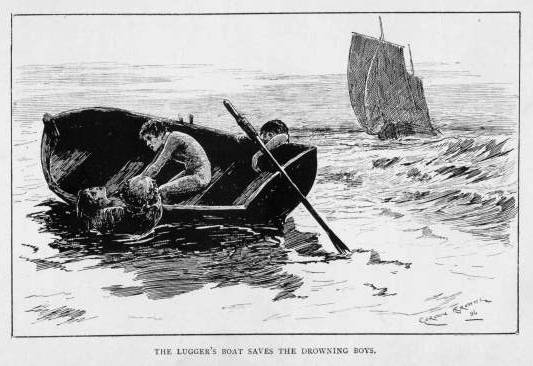
I can remember no more of what occurred during the next few minutes, only that I was staring up at the sky through dazzling water-drops; then that all was dark, and then light again, and not light as it was before. Then it was once more dark, and then I was sitting in a boat half blind, shivering, and helpless, with the boat rocking about tremendously, and Bob Chowne over the side holding on to the gunwale with one hand, to my wrist with the other.
It all seemed very wild and strange; but my senses were coming back fast, and in an indistinct manner I saw someone swimming and plashing the water about twenty yards from the boat. It was a man in a blue woollen shirt, and his head was bald and shining in the sun, as I saw it for a moment, and then, whoever it was, reared himself high as he could in the water, and then struck off and swam away from us out to sea.
He did not go far, but stopped suddenly and shouted to us; and as he did so, I saw a gleam of something white, and then that he was holding someone’s face above water.
Chapter Fourteen.
Just in Time.
“Ahoy, lad!” he shouted. “Shove a scull over the stern, and scull her this way.”
This roused me, and I jumped up to seize a scull, but felt giddy and nearly fell, for Bob Chowne had hold of my wrist.
“Take hold of the gunwale, Bob,” I panted, as I tried again, and this time felt better, getting an oar over behind, and sending the boat along, as I had learned to years before.
It was slow and awkward work, with Bob hanging on to the side with his eyes fixed, and his face white; but I got her along, and before I had been sculling many minutes, a great brown hand was thrown over on the opposite side to where Bob clung, and Jonas Uggleston said hoarsely:
“Lay in your oar, mate, and lean over, and take hold of Bigley here. Get your arm well under him. That’s right. Keep his head out of the water. I’m about beat for a bit.”
I obeyed him in a dreamy way, getting Bigley’s arm over into the boat, while I knelt down and put mine round him, and held him close to the side.
“Can you hold on, youngster?” said old Jonas hoarsely. This was to Bob Chowne, who stared at him wildly, and did not speak.
“Nice chance for me,” growled old Jonas. “There, hold fast, my lads. I’m going to get in over the starn.”
The boat rose and fell and rocked as he came round, passed me hand over hand, to pause by the stern, and I thought he was going to climb in; but he altered his mind, and went on round by where Bob Chowne clung, held on with one hand, while he thrust his right arm under the water, and the next moment he had hoisted Bob right up and rolled him over into the boat, where he lay for a few moments apparently quite helpless.
“Now, young Duncan,” said old Jonas, “you hold him fast. I’ll get in this side. She won’t go over.”
It was done in a moment; he let himself sink down, and turn, gave a spring as I turned my head round to watch him; the gunwale of the boat seemed to go down level with the water, and he was on board, while, before I could realise it, he was bending over me to get his arms under poor Big’s and drag him into the boat, this time sending the gunwale so low that a quantity of water came in as well.
Old Jonas set his son up in the stern with his back against the rowlock, and it was no easy job, for Big was limp, and tremendously heavy; but the bumping about seemed to do him some good, for, just as I was about to ask in a voice full of awe if he was dead, poor Bigley uttered a low groan.
“Hah! He’s coming to, then,” said old Jonas, panting heavily, as he seated himself on the middle thwart. “Here, you young doctor, take that pannikin, and bale out some of that water you’re lying in. You don’t want another bath, do you?”
Bob Chowne got up on to his knees in the bottom of the boat, shivering and blue, and stared wildly at us all in turn.
“Cold, eh?” growled old Jonas. “Well, then, I’ll bale, and you two row to the lugger.”
He glanced round at his son, who was showing signs of returning animation; but it evoked no sympathy before us, whatever he might have felt, for he only frowned as, in a shivering mechanical way, we two wretched boys seized an oar apiece, sat down on the wet thwarts and began to row.
“Now, then,” shouted old Jonas, “look where you’re going. Pull, doctor! Easy, captain! That’s better.”
Between his words he kept sending out pannikins of water rapidly to ease the boat, for it was above our ankles as we sat and pulled.
“Nice fellows all of you!” grumbled old Jonas. “Why, you all look blue. Fool’s trick! Who put it up?”
“I—I don’t know what you mean, Mr Uggleston,” I said.
“Who proposed to swim off to the lugger? Was it Bigley?”
“N–no, Mr Uggleston,” I panted, half hysterically, as I tugged at the oar, an example followed by Bob Chowne, who was very silent and very blue.
“Soon as I get you aboard, I’ll give you all a good rope’s-ending, and chance what your fathers say,” grumbled old Uggleston, as he sent the water flashing over the side. “I suppose it was my Bigley as set you at it, wasn’t it?”
“No, sir,” I said, as I rapidly grew more composed now. “We were on the rock yonder, and had to swim for it. We wanted to get to shore.”
“And the current took you out, eh? Of course it would. Then you weren’t swimming for the lugger, eh?”
“Oh, no, sir,” I cried; “we had forgotten all about the boat.”
“Then, where were you going to swim to—Swansea?” he cried.
“I don’t know, sir,” I said dolefully.
“No more do I,” he snarled. “’Cross the sea to Ireland, eh? And no biscuit and water. Ah, you ought to be all rope’s-ended. How came you on the rock?”
I told him.
“Lucky I saw you all standing on it white-skinned against the black rocks. I see you all dive in and took my spy-glass, and see you swimming this way, and when I told Binnacle Bill, he said just what I thought, that you was swimming out to the lugger, and wouldn’t do it, and so I took the boat and come to you, and I’m sorry I did now.”
“Sorry, sir?” I said.
“Ay, sorry. You’re a set o’ young swabs. What’s the good of either of you but to give trouble. Here, where are your clothes? Under the cliff?”
“No, sir,” I said dolefully. “We undressed on the big flat rock there, and tied them up in bundles.”
“Bundles? Where are they then?”
“Lost mine,” said Bob, speaking for the first time.
“Oh, you’re coming round then, are you?” cried old Jonas. “You’ve lost yours then; and has my Bigley lost all his kit?”
“Yes, sir; we’ve all lost our bundles, unless they get thrown up by the tide.”
“Which they won’t,” snarled old Jonas. “Rope’s end it is, for if I don’t thrash that big ugly cub of mine as soon as I get him aboard, I’ll—Now then, what are you yawing about that way for? Easy, captain! Pull, doctor, will you? Now, both together. Regular stroke. That’s better. And so’s that,” he said, as he scooped out the last few drops of water with the tin pannikin, and finished off by sopping the remaining moisture with a piece of coarse flannel stuff which he wrung out over the side.
Bob and I did not speak, but tugged at our oars, as absurd-looking a crew as was ever seen upon the Devon coast, while we kept looking pityingly at poor Bigley.
Poor fellow! He had placed his arms one on either side, resting upon the gunwale, and appeared to be hard set to keep his head up from his chest. Then he had one or two violent fits of coughing, and ended by sitting back in the bottom of the boat with a weary sigh and closing his eyes.
“Look, sir, look!” I cried in agony, for I thought Bigley must be dying.
“Well, I am looking at him, boy. He’s coming round. I can’t do anything for him here, can I? Pull hard, you young swabs, both of you, and let’s get aboard. I don’t know what folks want to have boys for.”
We rowed hard, bending well to our oars, and after a few minutes I ventured to speak again, for Bigley looked terribly ill.
“Do you think he’s getting better, sir?” I said.
“Better, boy? Yes,” he said, not unkindly, for I suppose my anxiety about his son moved him. “He’ll be all right when I’ve warmed and laced him up with the rope’s end. I’m going to make you all skip as soon as I get you aboard and there’s room to move.”
“But he looks so ill, sir,” I said, quite ignoring the rope’s-ending.
“Of course he does, my lad. So would you if you had gone down as far as he did, and swallowed as much water. Easy. In oars.”
I did not know we had rowed so far, but just then the boat bumped up against the side of the lugger, and old Jonas rose, took the painter as he stepped into the bows, and handed it to Binnacle Bill, whose grim old face relaxed into a grin as he saw our plight.
“What have you got, Master Uggles’on?” he said. “White seals?”
“Ay, something o’ the sort,” grumbled old Jonas. “Here, boys, on board with you.”
We needed no second order, but scrambled over the side into the lugger, while, at a word from his master, Binnacle Bill unbolted the piece of the lugger’s bulwarks that answered the purpose of a gangway, and as, by main force, old Jonas lifted up Bigley, the old sailor leaned down, put his arm round the poor limp fellow, and lifted him on deck, where he lay almost without motion.
The next thing was to make fast the little boat astern, after which Binnacle Bill seized the tiller, the sails filled, and the boat began to glide through the sunny sea, while Bob and I picked out the sunniest spot we could find, and watched old Jonas as he bent over Bigley and poured a few drops of spirit between his teeth from a bottle he had fetched from the little cabin.
“Rowing’s put you two right,” said Jonas. “Ah, I thought that would do him good.”
Certainly it did, for in a few minutes’ time Bigley was able to sit up in an oil-skin coat of his father’s, while we two were accommodated with a couple of Jersey shirts, which when worn as the only garment are nice and warm, but anything but becoming.
The little lugger tacked and tacked again before we could make the mouth of the Gap; and, probably because he was too busy over Bigley and the boat, old Jonas said no more about the rope’s end, but ran us right in over the pebble bar into the little river, when Binnacle Bill was sent over to our cottage to fetch some clothes for me and Bob, he being about my size, and till they came we lay in old Jonas’s bed.
Then a tremendous tea was eaten, Bigley being well enough to join in, and afterwards in cool of the evening old Jonas rowed us round and along the coast to see if we could pick up our bundles; but they had either sunk or gone off to sea, and we returned without.
Bigley was evidently very poorly, but he wouldn’t give up, and started to walk part of the way back with us.
I noted one thing as we were going. Bob Chowne and I held out our hands to say “Good-night,” and to thank old Jonas for saving our lives.
“Oh, it was nothing,” he said, shaking hands very warmly with Bob Chowne, but taking no notice of mine. “It’s all right. Good-bye, lads, but don’t do it again.”
We said we would not, and started off home, where we both expected severe scoldings; but before we had gone fifty yards up the cliff path old Jonas hailed us with a stentorian, “Ahoy!”
“What is it, father?” shouted Bigley.
“Bring those boys back,” roared old Jonas. “I forgot to give ’em the rope’s end.”
I need not tell you we didn’t go back. But when we parted from Bigley half a mile further on, I said to him:
“Why wouldn’t your father shake hands with me?”
“Hush! Don’t take any notice,” said Bigley in low voice; “he’s very angry still about Captain Duncan buying the Gap and finding the silver mine. That’s all!”
“That’s all!” Bigley said. But it was not.
Chapter Fifteen.
Back to School.
I tried very hard not to meet Doctor Chowne when he next came over to our cottage, which was two days after the escape from drowning, for he was very frequently in confab with my father.
They went into the little parlour, and so as to be out of the way I went into the cliff garden to watch the sea seated astride of one of the gates; but, as luck would have it, my father and the doctor came out to talk in the garden, and as there was no way of escape without facing them, I had to remain where I was and put on the boldest front I could.
“Oh, you’re there, are you, Mr Sep?” exclaimed the doctor grimly.
“Yes, sir,” I said.
“That’s right; I only wanted to ask a favour of you.”
“What is it, sir?” I said.
“Oh, wait a minute and I’ll tell you,” said the doctor in his grimmest way. “It was only this. You see I’m a very busy man, twice as busy as I used to be since your father has taken to consulting me. What I want you to do is this—”
He stopped short and stared at me till I grew uncomfortable.
“This, my lad,” he continued. “To save time, I want you to tell me when you are going to try next to kill my boy.”
“To kill Bob, sir?”
“Yes, I want to be ready, as I’ve so little time to spare. I want to order mourning from Exeter, and to give orders for the funeral.”
“I—I don’t understand you, sir,” I stammered.
“Not understand me, my lad! Why, I spoke plainly enough. You’ve tried to kill my Bob twice; third time never fails.”
“Doctor Chowne!” I exclaimed.
“Your most humble servant, sir,” he continued sarcastically. “I only wanted to add, that I should like you to do it as soon as you can, for he is costing me a great deal for clothes and boots.”
“There, there, Chowne,” said my father, taking pity upon me, “boys will be boys. I daresay your chap was just as bad as mine, and old Uggleston’s baby quite their equal.”
“They lead my Bob into all the mischief,” cried the Doctor sharply.
“Oh, no doubt, no doubt,” said my father in his driest way.
“And I should like to know as near as I can when it’s to come to an end?”
“There, there, never mind,” said my father good-humouredly. “Give them another chance, and if they spoil these clothes we’ll send into Bristol for some sail-cloth, and have ’em rigged out in that.”
“Sail-cloth!” cried the doctor, “old carpet you mean. That’s the only thing for them.”
“Holidays will soon be over, Chowne, and we shall be rid of them.”
“Yes, that’s a comfort,” said the doctor; and, as he turned away, I looked appealingly at my father, who gave me a dry look, and taking it to mean that I might go, I slipped off and went in to Ripplemouth.
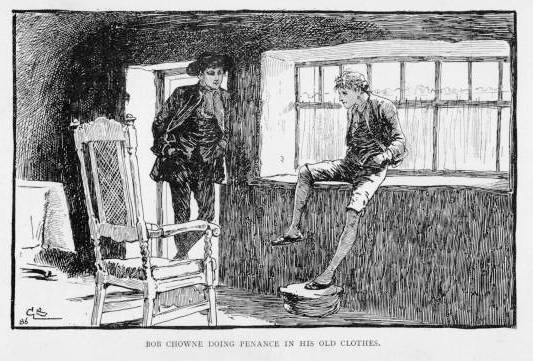
I soon found Bob, sitting in a very ragged old suit, out of which he had grown two years before, and he looked so comical with his arms far through his sleeves, and his legs showing so long beneath his trouser bottoms, than I burst out laughing.
“Yah! That’s just like you,” cried Bob viciously. “I never saw such a chap. Got plenty of clothes, and it don’t matter to you; but look at me!”
“Well, I was looking at you,” I said. “What an old guy you are!”
“Do you want me to hit you on the nose, Sep Duncan?” he said.
“Why, of course not,” I said. “I came over to play, not fight. Where are your Sunday clothes?”
“Where are they?” snarled Bob, speaking as if I had touched him on a very sore spot. “Why, locked up in the surgery cupboard along with the ’natomy bones and the sticking-plaster roll.”
“What! Has your father locked them up?”
“Yes, he has locked them up, and says he isn’t going to run all over the country seeing patients to find me in clothes to lose—just as if I could help it.”
“But haven’t you been measured for some more?”
“Yes, but they won’t be done yet, and father says I’m to go on wearing these the rest of the time I’m at home.”
I looked at him from top to toe as he stood before me, and it was of no use to try to keep my countenance. I could not, and the more I tried the more I seemed to be obliged to laugh.
As for Bob he ground his teeth and clenched his hands, but this only made him look the more comic, and I threw myself in a chair and fairly roared, till he came at me like an angry bull; but as I made no resistance, only laughed, he lowered his fists.
“I can’t help it, Bob; I was obliged to laugh,” I cried. “There, you may laugh at me now; but you do look so droll. Have you been out?”
“Been out? In these? Of course I haven’t. How can I? No: I’m a prisoner, and all the rest of my holiday time is going to be spoiled.”
“Oh, I say, don’t talk like that, old boy,” I cried. “Why didn’t you keep the suit I lent you?”
“I don’t want to be dependent on you for old clothes,” he said haughtily.
“Well, I’d rather wear them than those you have on, Bob. Oh, I say, you do look rum!”
“If you say that again I shall hit you,” cried Bob fiercely.
“Oh, very well, I won’t say it,” I said; “but I say, wouldn’t you wear a suit of old Big’s?”
I said it quite seriously, but he regularly glared and seemed as if he were going to fly at me, but he neither moved nor spoke.
“Never mind about your clothes,” I said. “Big’s sure to be over before long. Let’s get out on the cliff, or down by the shore, or go hunting up in the moor, or something.”
“What, like this?” said Bob, getting up to turn round before me and show me how tight his clothes were.
“Well, what does it matter?” I said. “Nobody will see us.”
“It isn’t seeing you,” he replied, “it’s seeing me. No, I sha’n’t go out till I get some clothes.”
Bob kept his word, and for the rest of the holidays when I went out it always used to be with Bigley Uggleston. But we did not neglect poor Bob, for we went to see him nearly every day, and played games with him in the garden, and finished the gooseberries, and began the apples, contriving to enjoy ourselves pretty well.
As for the doctor, it was his way of dealing with his son, and I suppose he thought he was right; but it was very unpleasant, and kept poor Bob out of many a bit of enjoyment, those clothes being locked away.
I said that Bob would not go out. I ought to have said, by daylight, for he used to go with us after dark down to the end of the tiny pier, where we sat with our legs swinging over the water, each holding a fishing-line and waiting for any fish that might be tempted to take the raw mussel stuck upon our hooks.
But somehow that narrow escape of ours seemed to act like a damper upon the rest of our holidays, and I spent a good deal of my time with Bigley, watching the preparations made by the masons at the works in the Gap.
We all declared that we were not sorry when one morning old Teggley Grey’s cart stopped at our gate to take up my box. Bob Chowne’s was already in, and he was sitting upon it, while Bigley was half-way up the slope leading over the moor waiting by the road-side with his.
I said “Good-bye” to my father, who shook my hand warmly.
“Learn all you can, Sep,” he said, “and get to be a man, for you have a busy life before you, and before long I shall want you to help me.”
I climbed in, and old Teggley drew out the corners of his lips and grinned as if he was glad that Bob Chowne was so miserable. For Bob did not move, only sat with his hands supporting his face, staring down before him, bent, miserable, and dejected.
“What’s the matter, Bob?” I said, trying to be cheerful. “Got the toothache?”
“Yes,” he said sourly, “all over.”
“Get out! What is it? Father made you take some physic?”
“Yes, pills. Verbum nasticusis, and bully draught after.”
“What! Has he been scolding you?”
“Scolding me! He never does anything else. I sha’n’t stand it much longer. I shall run off to sea and be a cabin-boy.”
“Hi, hi, hi!”
“What are you laughing at?” snapped Bob, turning sharply upon old Teggley.
“At you, Mars Bob Chowne, going for a cabin-boy.”
Whop!
That last was a severe crack given to admonish the big bony horse old Teggley drove; but he was a merciful man to his beast, and always hit on the pad, the collar, or the shafts.
“S’pose I like to go for a cabin-boy, ’tain’t no business of yours, is it?” cried Bob snappishly.
“Not a bit, my lad, not a bit. I’ll take your sea-chest over to Barnstaple for you when you go.”
“No, you won’t,” grumbled Bob viciously, “for I won’t have one.”
“Ahoy! Bigley,” I shouted, looking out from under the tilt. “Hooray for school!”
“Aha! Look at him—look at him!” shouted Bob, whose whole manner changed as soon as he saw Bigley’s doleful face. “I say, old Grey, here’s a little boy crying because he is going back to school.”
Bigley did not say anything, only gave Bob a reproachful glance as he handed his box up to the carrier, and then climbed in.
“Gently, Mars Uggles’on,” cried the old carrier, who seemed to consider that he had a right like other people to joke Bigley about his size; “gently, my lad, or you’ll break the sharps. I didn’t know I was going to have a two-horse load.”
“Look here, old Teggley Grey!” cried Bigley firing up; “if you say another word about my being so large, I’ll pitch you out of the back of the cart, and drive into Barnstaple without you.”
“Do, Bigley, do,” cried Bob in ecstasy. “Here, I’ll hold the reins. Chuck him out.”
“Don’t talk that way, Mars Bob Chowne,” whined the old man. “You wouldn’t like me to be hurt.”
“Oh, just wouldn’t I!” cried Bob spitefully. “Pitch him overboard, Bigley, old boy, and hurt him as much as you can.”
“No, no, you wouldn’t, Mars Bob Chowne. You wouldn’t like me to have to be carried home on a wagon, and your father have to tend me for broken bones and such.”
“I tell you I would,” cried Bob savagely; “and I hope you’ll bite your tongue, and then you won’t be so ready to ask questions. There!”
“Me ask questions!” exclaimed the old carrier in an ill-used tone. “As if I ever did. Well, never mind, he’ll know better some day.”
The old man sniffed several times quite severely, and sat bolt upright at the side of the cart, looking out at his horse’s ears, and left us to ourselves. Bob’s fit of melancholy was over, and he was ready to make remarks upon everything he saw; but neither Bigley nor I spoke, for we were intent upon something the latter told me.
“I don’t want to tell tales,” he said to me in a low tone, “but father makes me miserable.”
“But do you think it is so bad as you say?”
Bigley nodded.
“He goes and sits on a stone with his spy-glass where he can see them, but they can’t see him, and he stops there watching for hours everything they do, and comes back looking very serious and queer.”
“Well, what does it matter?” I said. “He won’t hurt us. He can’t, because he is my father’s tenant, and if he did he’d have to go.”
“Don’t talk like that, Sep,” whispered Bigley. “It’s bad enough now, and it would be worse then.”
“I say, what chaps you two are!” cried Bob Chowne. “Why don’t you talk to a fellow?”
No one answered, and Bob turned sulky and went and sat on the front of the cart, where he began to whistle.
“What do you mean by being worse?” I said.
Bigley shook his head.
“I don’t know; I can’t say,” he whispered. “I mean I don’t want father to be very cross.”
“I say, Big,” I whispered. “Your father really is a smuggler, isn’t he?”
Bigley looked sharply round to gaze at old Teggley Grey and Bob Chowne, creeping as he did so nearer to the tail-board of the cart, and I followed him.
“I oughtn’t to tell,” he whispered back.
“But you’ll tell me. I won’t say a word to a soul,” I said.
“Well, I don’t know. I’m not sure, but—”
Bigley paused, and looked round again before putting his lips close to my ear and whispering softly:
“I think he is.”
“I’m sure of it,” I whispered back; “and I know he goes out in his lugger to meet French boats and Dutch boats, and makes no end of money by smuggling.”
“Who told you that?” whispered Bigley fiercely.
“Nobody. It’s what everybody says of him. They all say that he’ll be caught and hanged some day for it—hung in chains; but of course I hope he won’t, Big, because of you.”
“It’s all nonsense. It isn’t true,” said Bigley indignantly, “and those who talk that way are far more likely to be hung themselves. But I wish your father hadn’t bought the Gap.”
“I don’t,” I said. “He had a right to buy it if he liked, and I don’t see what business it is of your father. Why don’t he attend to his fishing?”
Bigley looked up at me sharply, to see if I had any hidden meaning.
“He does attend to his fishing,” he said angrily; “and if he hadn’t been attending to his fishing he wouldn’t have been out in his boat that day, and saved you from being drowned.”
I never liked Bigley half so well before as when he spoke up like that in defence of his father; but I was in a sour disappointed mood that day, because the holidays were over and I was going back to school, so I said something that was thoroughly ungenerous, and which I felt sorry for as I spoke.
“Yes, he saved us all from being drowned, I suppose,” I said; “but he hadn’t been fishing, for there were no fish in the boat.”
“Just as if anybody could be sure of catching fish every time he went out,” cried Bigley angrily. “There, you want to quarrel because you are miserable at having to go back to school, but I sha’n’t. I hate it. Go and fall out with old Bob Chowne.”
This made me feel angry and I drew away from him, for it was trying to make out that I was as quarrelsome as Bob Chowne delighted to be. But I felt so horribly in fault directly after that I went back to my place and sat by him in silence.
After a time the old carrier turned to us with a request that we would get out and give the horse a rest up the hill.
We all obeyed, two of us jumping out over the tail-board, the other by the front, and leaping off the shaft.
It was plain enough that the holidays were over, and that the joyous hearty spirit of the homeward-bound was there no more, for Bob Chowne took one side of the road in front of the horse, and the old carrier the other, while Bigley and I hung back behind and walked slowly after them on opposite sides after the fashion of those in front.
Then came the stopping of the cart, and mounting again and descending a couple more times, before we reached Barnstaple, dull, low-spirited, and ready to find about a score of boys just back, and looking as doleful as we did ourselves.
Chapter Sixteen.
Our Silver Mine.
School life has been so often narrated, that I am going to skip over mine, and make one stride from our return after Midsummer to Christmas, when we all went back home in a very different frame of mind.
The country looked very different to when we saw it last, but it was a mild balmy winter, with primroses and cuckoo-pints pushing in the valleys, and here and there a celandine pretending that spring had come.
The roads were dirty, but we thought little about them, for we knew that the sea-shore was always the same, and, if anything, more interesting in winter than in summer.
I was all eagerness to get home and see what had been done in the Gap, for my father in his rare letters had said very little about it.
Bigley was equally eager too. Six months had made a good deal of difference in him, for, young as he was, he seemed to be more manly and firm-looking, though to talk to he was just as boyish as ever, and never happier than when he was playing at some game.
He, too, was ready enough to talk about the Gap, and wonder what had been done.
“I hope your father has made friends with mine,” he kept on saying as we drew nearer home. “It will be so awkward if they are out when you and I want to be in. Because we do, don’t we?”
“Why, of course,” I cried. “And it will be so awkward, won’t it?”
“No,” I said stoutly, “it won’t make any difference; you and I are not going to fall out, so why should we worry about it? I say, look at Bob Chowne!”
Bigley turned, and there he was once more seated upon his box, right up on the big knot of the cord, just as if he liked to make himself uncomfortable. Then his elbows were on his knees and his chin was in his hands, as he stared straight before him from out of the tilt of the big cart.
“Why, what’s the matter, Bob?” I said.
“Nothing.”
“Why, there must be something or you wouldn’t look like that. What is it?”
“Oh, I don’t know; only that we’re going home.”
“Well, aren’t you glad?”
“Glad? No, not I. What is there to be glad about? I haven’t forgotten last holidays.”
“What do you mean?” said Bigley and I in a breath.
“Oh, wasn’t I always getting in rows, because you two fellows took me out and got me in trouble. I haven’t forgotten about that old suit of clothes.”
“But I say, Bob,” I cried, “didn’t you do your part of getting into trouble?”
“Oh, I don’t know. Don’t bother, I’m sick of it. I’m tired of being a boy. I wish I was a man.”
“Nay, don’t wish that,” cried the old carrier, who had been hearing everything, though he had not spoken before. “Man, indeed! Why, aren’t you all boys with everything you can wish for? How would you like to be a man and have to do nothing else every day but sit in this here cart, and go to and fro, to and fro, from year’s end to year’s end, and never no change?”
As we drew near the Bay Bob Chowne grew more fidgety and despondent, but we tried to cheer him up by making appointments to go fishing and exploring the shore; but my first intent was to run over to the Gap, and see what was going on there.
As the carrier’s cart descended the hill and we came in sight of the cottage, I saw some one at the gate, and leaning out on one side I saw that it was my father and the doctor, but before I could say so there was a jerk which nearly threw me off, and I heard a familiar voice cry:
“There you are, then. Out with your box, lad. Here’s Binnacle Bill come to carry it. How do, young gentlemen! Well, young doctor, I’ve got that rope’s-ending saved up for you whenever you like to come.”
Old Jonas did not offer to shake hands with either of us, but Bigley did after handing out his box.
“You’ll come on to-morrow,” he said quickly.
“Yes, we’ll come,” I said, answering for both; and I observed that old Jonas smiled grimly, though he did not speak.
Then Bob and I were alone and jogging down the zigzag road, traversing another five hundred yards before we reached our gate, where my father and the doctor were waiting for us.
“Brought the lads home quite safe, captain,” said old Teggley Grey. “Shall I take Mars Robert’s box on to the town, doctor?”
The old carrier remained unanswered, for we were both being heartily shaken by the hand, while old Sam came up smiling to carry in my box.
“Yes, take on the other box, Grey,” cried the doctor. “We shall walk home, Bob.”
“After a good tea,” put in my father; and I found that meal awaiting us all, and very hearty and cosy it looked after the formal repasts at school.
“Why, you’ve both grown,” said the doctor, as we sat down in the snug old room, where every object around seemed to be welcoming me.
“Yes, that they have,” said my father. “Your Bob has the best of it too.”
“Trifle,” said the doctor, “trifle. Well, sir, how many suits of clothes shall you want this time? I’ve never heard any more of the ones you lost.”
I saw Bob turn red and take a vicious bite out of a piece of bread and butter.
“They’re nearly six months older now,” said my father smiling, as he performed the feminine task of pouring out the tea, “and they’ll be more careful.”
“Will they?” said the doctor emphatically. “You see if the young varlets are not in trouble before the week’s out, sir.”
“Let’s hope not,” said my father. “Come, boys, help yourselves to the ham and eggs.”
“Come, boys, help yourselves to the ham and eggs!” said Bob Chowne to me, as soon as we were alone. “Who’s to help himself to ham and eggs when he’s having the suit of clothes he lost banged about his unfortunate head? It regularly spoiled my tea.”
“Why, Bob,” I cried, “you had three big cups, six pieces of bread and butter, two slices of ham, three eggs, a piece of cake, and some cream.”
“There’s a sneak—there’s a way to treat a fellow!” he cried, growing spiky all over, and snorting with annoyance. “Ask a poor chap to tea, and then count his mouthfuls. Well, that is mean.”
“Why, I only said so because you declared you had had a bad tea.”
“So I did—miserable,” he retorted. “I seemed to see myself again sitting at home in those old worn-out clothes, and afraid to go out at any other time but night, when no one was looking.”
“Now, Bob: where are you?” cried his father. “I’ll take him off at once, Duncan, or he’ll eat you out of house and home.”
“Hear that?” cried Bob, “hear that? Pretty way to talk of a fellow, isn’t it. I don’t wonder everybody hates me. I’m about the most miserable chap that ever was.”
“Not you, Bob. Come over to-morrow.”
“What for?”
“Oh, I don’t know. We’ll go rabbiting or something.”
“Now, Bob!” came from the doctor.
“Here, I must go. Good-bye. I’ll come if I can. I wish I was you, or old Bigley, or somebody else.”
“Or back at school,” I said laughing.
“Yes, or back at school,” he said quite seriously; and then his arm was grasped by his father.
“Just as if I was a patient,” he grumbled to me next day. “Father don’t like me. He only thinks I am a nuisance, and he’s glad when I’m going back to school. I shall run off to Bristol some day and go to sea, that’s what I shall do.”
But that was the next day. That evening I stood with my father at the gate till Bob and his father were out of sight in the lane, and then we went back into the parlour, where my father lit his pipe and sat smoking and gazing at me.
“Well, Sep,” he said after a pause, “don’t you want to know how the mine is getting on?”
“Yes, father,” I said; “but I didn’t like to ask.”
“Well, I’ll tell you without, my boy. I’ve not got much profit out of it at present, because the expenses of starting have been so great; but it’s a very fine thing, my boy.”
“Is it going to make you rich, father?”
“I hope so, boy, for your sake. There’s plenty of lead, and out of the lead we are able to get about four per cent of silver.”
“Four per cent, father!” I said; “what—interest?”
“No, boy, profit. I mean in every hundred pounds of lead there are four pounds of pure silver, but of course it costs a good deal to refine.”
“And may I go and see it all to-morrow?” I asked.
“To be sure; and I hope, after a year or two, you will be of great use to me there.”
I felt as if I could hardly sleep that night when I went to bed. There had been so much to see about the place, so much talk to have with old Sam and Kicksey, that it hardly needed the thought of seeing the mine next day to keep me awake.
I thought I should never go to sleep, I say; but I awoke at half-past seven the next morning, feeling as if I had had a thoroughly good night’s rest, and as soon as breakfast was over I started with my father on a dull soft winter’s morning to see the mine.
Bob and Bigley were to come over; but I felt that it would be twelve o’clock before Bob came, and that I should meet Bigley; so no harm would be done in the way of breaking faith in the appointment.
We walked sharply across the hill and descended into the Gap, but before we had gone far we met old Jonas Uggleston.
“Morning!” he said pleasantly. “Morning, squire!” to me. “Seen my Bigley yet?”
“No.”
“Ah! He has gone your way. Tell him I want to see him if he comes.”
We said we would, and old Jonas went his way and we ours.
“Why, father,” I said, “how civil he has grown!”
“Yes,” said my father gravely, “he has; but I would almost rather he had kept his distance. Don’t tell your school-fellow I said that.”
“Of course not, father,” I said confidently; and we went on to the mine—the silver mine, and I stood and stared at a part of the valley that had been inclosed with a stone wall. There were some rough stone sheds, a stack of oak props, and a rough-looking pump worked by a large water-wheel, which was set in motion by a trough which brought water from the side of the hill, where a tiny stream trickled down.
There was one very large heap of rough stone that looked as if barrows full of broken fragments were always being run along it, and turned over at the end, for the pieces to rattle down the side into the valley; there was a small heap close by, and under a shed there was a man breaking up some dirty wet stuff with a hammer.
That was all that was to see except some troughs to carry off dirty water, and the rough framework and trap-doors over what seemed to be a well.
“Why, Sep,” said my father laughing, “how blank you look! Don’t you admire the mine?”
“Is—is this a silver mine, father?” I faltered.
“Yes, my lad, silver-lead. Doesn’t look very attractive, does it?”
I shook my head.
“But is it going to be worth a great deal of money?”
“Yes, my boy; only wait and you’ll see. But I suppose you expected to see a hole in the earth leading down into quite an enchanted cave—eh?—a sort of Aladdin’s palace, with walls sparkling with native silver?”
“Well, not quite so much as that, father,” I replied; “but I did expect to find something different to this.”
“So do most people when they go to see a mine, Sep, and they are horribly disappointed to find that they have not used their common sense. They know that if they dig down into the earth to make a well, in twenty feet or so, perhaps less, they come to water; and it has never occurred to them that if they dig down to form a mine, it must naturally be a wet dark muddy hole just like this one upon which you look with so much disgust. But wait a bit, my boy. We shall soon have furnaces at work and be smelting our ore and converting some of it into silver. There’ll be more to see then. You don’t care to go down?” he said, leaning his hand upon a windlass over the trap-doors.
“Is there anything to see, father?” I said rather dolefully.
“To see! Well, there are the sides of a big well-like hole which you can see from here. Look!”
He threw open a trap-door, and I gazed into a well-like place with a couple of ropes hanging down it, and I noted that the walls were made of the stone that had been dug and broken out. The place looked dark and damp, and there was the trickling of dripping water. That was all.
“Well, Sep, what do you say?—will you go?”
“Is it all like this, father?” I said.
“Yes, precisely, my lad. Shall I have you let down?”
“No, thank you,” I said; “I think I’ll stop up.”
He nodded and smiled, and after staying with him for a time while he examined some of the ore that the man was breaking up he set me free, but not till I had asked him how many men he had at work, and been told that at present there were only six.
Chapter Seventeen.
We have a Little Fishing.
I went away to see if I could find Bigley, feeling very much put out, and full of hope that Bob Chowne, when he came, would not ask me to take him to see the mine.
For, truth to tell, I had made rather a fuss about that mine, talking about silver-lead in a very important way at school; and, as I recalled my words, I felt quite a shudder of horror as I thought of all the boys in my class coming and standing at the mouth of the mine, and bursting into a roar of laughter at this being the silver cavern in the earth.
There was no likelihood of any of them coming save Bob Chowne; but there was no knowing what he would say when we got back if I offended him and he was in one of his teasing fits.
I walked down to the end of the Gap, past the cottage, and was just going to ask if Bigley had come back, when I saw old Jonas and Binnacle Bill, with another man, putting off in the lugger, which was lying by a buoy about a quarter of a mile from the shore.
After five months at school it seemed such a pretty sight to see the red sails hoisted and fill out, and the lugger begin to move slowly over the smooth water, that I sat down on a stone and watched the boat, wishing I were in her, till she gradually grew more distant, and there was a dull thud close beside me.
I looked round but saw nothing, and I was turning to watch the lugger again, when I heard a fresh pat on the slate rubbish by me, and soon after a piece of flat, thin shale struck the clatter stream behind me.
“Some one throwing,” I said to myself, and looking up, there, about six hundred feet above me on the cliff path, were Bigley and Bob Chowne.
I shouted to them, and they ran to the nearest clatter stream and began to slide down standing. Sometimes they came swiftly for a few yards; sometimes they stopped and each had a check, a fall, and a roll over, but they were up again directly, and in less than half the time it would have taken them to walk they were down by my side.
“Here, where have you been?” cried Bob, who was in the highest of glee. “Old Big says it’s such a dark quiet day that the fish are sure to bite, and he’s going to ask his father to let us have the boat, and row out.”
“But Mr Uggleston isn’t at home.”
“No, that he isn’t,” said Bigley, who had just caught sight of the lugger. “That is tiresome.”
“But they haven’t taken the boat,” cried Bob, “so it don’t matter.”
“Yes, it does,” said Bigley gravely, “because I shouldn’t like to take the boat without leave.”
“Why, of course you wouldn’t if your father was at home,” said Bob quickly; “but I’m quite sure Mr Uggleston wouldn’t like us two to be disappointed when we’d come on purpose to go.”
“Oh, I don’t think he’d mind,” said Bigley.
“But I know he would,” cried Bob, who spoke in the most consequential manner. “Your father is rough, but he is very good at bottom.”
“Why, of course he is,” cried Bigley.
“Then he wouldn’t like us to be cheated out of our treat, so you get the mussels for the bait, and some worms, and let’s go.”
Bigley hesitated. He wanted to go, for the sea was as smooth as a mill-pond—a rare thing in winter; and perhaps we should have to wait for some time before another such day arrived.
He looked at me and I wanted to go too. That was plain enough, and the chance seemed so tempting that, even if I did not openly abet Bob, I said no word to persuade Bigley not.
“You’d got all the lines and bait ready, hadn’t you?” said Bob cunningly.
“Yes, everything’s ready, and I meant to ask father as soon as I got back. Here, hi! Mother Bonnet, how long will father be?”
“Oh, all depends on the wind,” said the fresh-looking old lady coming out, smiling and smoothing her hair. “They’ve gone across to Swansea, my dear. It will be a long time ’fore they’re back.”
“There, you see, you can’t ask, and it’s no use to signal to them in the lugger, because they couldn’t understand, so you’ve got to take the boat, and we shall be back long before they are.”
“But it would be so horrible if we were to meet with any accident this time,” said Bigley. “You know how unlucky we were over the prawns. There, we’d better not go!”
“There’s a Molly for you!” cried Bob. “Just because we got in a muddle twice over in catching prawns and crabs you think we’re always going to be in a mess.”
“No, I don’t,” said Bigley; “but it would be so queer if we got into a scrape the very first time we go out.”
“Get out! Oh, I say, you do make me grin, old Big. There, go and get your lines, and a gaff, and the basket of bait. Let’s be off while the sea is so smooth.”
Bigley hesitated, and after a good deal of banter from Bob, and an appeal to me, he went off, sorry and yet pleased, to get the lines and bait.
“And now he’ll be obliged to go, Sep. Don’t let’s give him time to think, or he’s such an old woman he’ll back out.”
“But—”
“Get out! Don’t say but. There, we won’t go out far, only to the mouth there by the buoy, and we can catch plenty of fish without any trouble at all.”
I gave way—I couldn’t help it, and we two went on, so that when Bigley came with the baskets and lines we were waiting for them, and his scruples were nearly overcome.
“Think it will matter if we take the boat?” he said dubiously, for he evidently shared our longing to go.
I said no, I did not think it would, for we could clean it out after we had done fishing, and we had been boating so often with other people that I for one felt quite equal to the management of the little vessel.
But all the time there was a curious sensation of wrong-doing worrying me, and I wished that I had not been so ready to agree. It was as if I felt the impression of trouble that was coming; but I kept the feeling to myself.
“Well,” said Bigley, “I did mean to ask for leave.”
“Of course you did,” cried Bob Chowne; “but as your father is off you can’t. Come along, boys, and let’s get a good haul this time.”
He seized the bait-basket and made the shells of the mussels rattle as he trotted down towards where the little five-pointed anchor or grapnel lay on the beach, and began to haul in the boat.
As the light buoyant vessel came gliding over the smooth surface, and grated and bumped against and over the stones, the thoughts of whether we were doing right or wrong grew faint, and then, as the bait-basket was thrown in, and the lines followed, they were forgotten.
“In with you, lads!” cried Bob, making a spring, and leaping from a dry stone right into the boat; but his feet slipped, and he came down sitting in the basket of mussels with an unpleasant crash.
“Now, look here!” he cried in a passion, “if you fellows laugh at me I won’t go.”
Of course this made us all the more disposed; but we turned our backs and went down upon our knees to begin seeing to the hooks upon one of the reeled-up lines.
“There, you are laughing both of you!” cried Bob, who was easing the pain he felt, or thought he was, by lifting up and setting down first one leg and then the other.
“That we are not!” I cried, and certainly our faces were serious enough, as we hurriedly popped the lines over the bows, when I jumped in, and, catching up the little grapnel, Bigley took one big stride with his long legs, and was on the gunwale, which went down nearly to the water with his weight; but as the boat rose again, the impetus of the thrust he gave her in leaping aboard carried her out a couple of lengths.
There was no thought now of any wrong-doing, as Bob and I seized an oar apiece and began to paddle as the boat rose and fell and glided over the swelling tide.
“Pull away, Sep!” cried Bob. “Here, old Big, you’re sitting all on one side and making the boat lop. Get in the middle or I’ll splash you!”
Bigley moved good-humouredly, and the boat danced beneath his weight.
“Heave ho! Steady!” shouted Bob. “Don’t sink us, lad. I say, what a weight you are! Let’s put him ashore, Sep. He’s too big a Big for a boat like this.”
“Make good ballast,” said Bigley, laughing good-humouredly. “Boats are always safer when they are well ballasted.”
“I daresay they are, but I like ’em best without Big lumps in ’em. I say, how far out shall we go?”
“Oh, about a quarter of a mile, straight out, over the Ringlet rocks. You pull, I’ll watch the bearings, and drop out the grapnel. Pull hard!”
We rowed away steadily, while, to save time, Bigley took out his pocket-knife and, taking a board from the bait-basket, laid it upon the seat, and began to open the mussels and scrape out the contents of the shells ready for placing them upon the hooks when we reached the fishing ground.
For I may tell you that knowing the bottom well has a great deal to do with success in sea-fishing. A stranger to our parts might think that all he had to do was to row out in a little boat a few hundred yards, and begin to fish.
If he did that, the chances are that he would not catch anything, while a boat three or four lengths away might be hauling in fish quite fast.
The reason is simple. Sea fish frequent certain places after the fashion of fresh-water fish, which are found, according to their sorts, on muddy bottoms; half-way down in clear deeps; among piles; in gravelly swims; at the tails of weeds; or under the boughs of trees close in to the side of river or lake.
So with the sea fish. If we wanted to catch bass, we threw out in places where the tide ran fast; if we were trying for pollack, it was along close by the stones of the rocky shore; if for conger, in deep dark holes; and if for flat-fish, right out in deep water, where the bottom was all soft oozy sand.
Upon this occasion we had decided for the latter, and with Bigley giving a word now and then to direct us, as he watched certain points on the shore, we rowed away for quite half a mile, but keeping straight out from the Gap.
“Now we’re just over the Ringlets,” cried Bigley suddenly.
“Heave over the anchor then!” I shouted.
“No, go on a bit farther, about fifty yards, and then we shall be on the muddy sand. I know.”
We boys pulled, and then all at once Bigley shouted “In oars!” and we ceased rowing as the grapnel went over the side with a splash, and the cord ran across the gunwale, grating and scrorting as Bob called it, till the little anchor reached the bottom, and the drifting of the boat was checked.
“I say, isn’t it deep?” I said.
“Just about nine fathoms,” said Bigley. “You’ll have plenty of hauling to do.”
“I say, look!” I cried, as I happened to look shoreward, “you can see right up the Gap nearly to the mine.”
“Isn’t the sea smooth?” said Bob. “It’s just like oil. Now then, first fish. Put us on a good big bait, Bigley, old chap.”
The hooks were all ready with the weights and spreaders, and Bigley began calmly enough to hook and twist on a couple of the wet and messy raw mussels for Bob, and then did the same for mine, when we two began to fish on opposite sides of the boat, letting the leads go rapidly down what appeared to be a tremendous distance before they touched the ooze.
It seemed quite a matter of course that we two were to fish, and Bigley wait upon us, opening mussels, rebaiting when necessary, and holding himself ready to take off the fish, should any be caught.
I never used to think anything about Bigley Uggleston in these days, only that he was overgrown and good-tempered, and never ready to quarrel; and it did not seem to strike either of us that he was about the most unselfish, self-denying slave that ever lived. I know now that we were perfect tyrants to him, while he, amiable giant that he was, bore it all with the greatest of equanimity, and the more unreasonable we were, the more patient he seemed to grow.
We fished for some few minutes without a sign, and then Bob grew weary.
“It’s no good here, Big, they won’t bite. Let’s go on farther.”
“Bait’s off, perhaps,” suggested Bigley.
“No, it isn’t. I haven’t had a touch.”
“Perhaps not, but the flat-fish suck it off gently sometimes. Pull up.”
Bob drew in the wet line hand over hand, till the lead sinker hit the side of the boat; and Bigley proved to be right, both baits were off his hooks, and as they were being rebaited I hauled in my line to find that it was in the same condition.
By the time Bob’s lead was at the bottom, my hooks were being covered with mussel, and I threw in again.
As mine reached the sandy ooze, and I held the line in one hand, there was a slight vibration of the lead, but it passed away again, and I fished, to pull up again at the end of a few minutes and find both baits gone.
Bob’s were the same, and so we fished on till he declared that it was of no use, that it was the tide washed the bait off, and that there wasn’t a fish within a hundred yards. “But I’m sure there are lots,” said Bigley. “Why, how can you tell?” cried Bob. “You can’t see two feet down through the water, it’s so muddy.”
“I know by the baits being taken off,” replied Bigley decidedly. “There are fish here I’m sure, and—”
“I’ve got him,” I shouted, beginning to haul in, for I could feel something heavy at the end of the line which had given several sharp snatches as I hauled.
“Oh, what a shame!” cried Bob. “I don’t see why they should come first to old Sep. Here, I know what it is. Only an old bow-wow.”
“No, it isn’t,” I exclaimed as I caught a glimpse of something white, looking like a slice of the moon far down below the boat. “It’s a flat-fish, and a big one.”
I proved to be right, as I hauled it flapping over the side, and Bigley seized what proved to be a nice plaice, and took the hook from its jaws.
As the line, being rebaited, was thrown in again, there was a serious examination of the prize, which was about to be transferred to the basket brought to hold our captures, when Bob shouted, “I’ve got him!” and began to haul in with all his might.
We both adjured him to be careful, but in his excitement he paid no heed, only dragged as hard as he could, and hoisted in a long grey fish, at which he gazed with a comical aspect full of disgust.
I laughed, and as I laughed he grew more angry, for his prize was what he had previously called a “bow-wow” and attributed to me. For it was a good-sized dog-fish, one which had to be held at head and tail lest in its twining and lashing about it should strike with its spine and do some mischief.
“Here, let me take him off,” cried Bob.
“No, no; you mind the line isn’t tangled,” cried Bigley; but Bob gave him a push, the dog-fish, which was nearly a yard long, was set free, and began to journey about amongst Bob’s line, while, when he placed his foot upon its head, the fierce creature bent half round, and then let itself go like a spring, with the effect that it struck Bob’s shoe so smart a blow with one of its spines that the shoe was pierced by the toe, and it required a tug to withdraw the spine.
“Are you hurt, Bob?” we both cried earnestly.
“No, not a bit. My toes don’t go down as far as that. Ah, would you?”
This was to the fish, which was lashing about fiercely.
“Let me do it, Bob. I’ll kill it in no time, and I know how to manage him.”
“So do I,” said Bob independently, as he made another attack upon the dog-fish, which resented it by a fresh stroke with its spine, this time so near to Bob’s leg that he jumped back and fell over the thwart.
“I say, that was near,” he cried. “You have a try, Big.”
Our school-fellow wanted no second bidding, and taking hold of the line, he drew the fish’s head under his right foot, pressed down its tail with his left, took out the hook, and then with his knife inflicted so serious a cut upon the creature that, when he threw it over, it only struggled feebly, as it sank slowly and was carried away.
“There’s a cruel wretch!” cried Bob. “Did you see how vicious he was with his knife?”
“It isn’t cruel to kill fishes like that,” retorted Bigley. “See what mischief they do hunting the other fish and eating everything. See how they bite the herrings and mackerel out of the nets, only leaving their heads.”
“He wouldn’t have said anything if the dog had spiked him,” I said.
“Why, so he did spike me,” cried Bob; “and—”
“I’ve got another,” I cried, beginning to haul up, and as I hauled Bob sent his freshly-baited and disentangled hook down to the bottom.
I had caught another flat-fish about the size of the first, and directly after Bob caught one. Then there was a pause, and I took another dog-fish, and after that we fished, and fished, and fished for about half an hour and caught nothing.
It was December, but the air was still, and we did not feel it in the slightest degree cold. I suppose it was the excitement kept us warm, for there was always the expectation of taking something big, even if the great fish never came.
Just as we were thinking that it was of no use to stay longer the fish began to bite again, and we caught several, but all small, and then all at once, as I was lowering my lead, I cried out:
“Look here! I can’t touch bottom.”
“Nonsense!” said Bob, lowering his line, but only to become a convert, and exclaim accordingly.
“Why, we’re drifting,” cried Bigley, going to the line that held the anchor, to find that it had been dragged out of the muddy sand, and that we had slowly gone with the tide into deeper water, whose bottom there was not length enough of rope for the grapnel to touch.
“I’ll soon put that right,” cried Bigley, unfastening the line and letting about three fathoms more run out, but even then the anchor did not reach bottom, and without we were stationary it was of no use to fish.
“Haul in your lines, lads,” cried Bigley, setting us an example by dragging away at the cord which held the anchor. “We must row back a bit. We’ve drifted into the deep channel. I didn’t know we were out so far.”
“Oh, I say, look!” cried Bob. “It’s beginning to rain, and we’ve no greatcoats.”
“Never mind,” said Big, getting hold of the anchor as we drew in our leads, and laid them with the hooks carefully placed aside, ready for beginning again.
“Now, then, who’s going to pull along with me!”
“You pull, Sep,” said Bob. “I want to count the fish.”
I took an oar, and just as I was about to pull the boat’s head round I looked towards the mouth of the Gap, which was nearly three-quarters of a mile away, and though at present the smooth sea was just specked here and there by the falling drops, over shoreward there was what seemed to be a thick mist coming as it were out of the mouth of the Gap, and a curious dull roar towards where we were.