Prologue
Reading edition
A magic date: 1492. The year began with Christopher Columbus watching the Moors surrender the city of Granada, their last stronghold in Spain, to the joint monarchs Ferdinand and Isabella. He reminded them of the triumph in a summation he wrote later of what he too had accomplished that year. “I saw the banners of your Highnesses raised on the towers of the Alhambra in the city of Granada, and I saw the Moorish king go out of the gate of the city and kiss the hands of your Highnesses and of my lord the Prince.” Shortly after the victory, he added, “your Highnesses ... determined to send me, Christopher Columbus to the countries of India, so that I might see what they were like, the lands and the people, and might seek out and know the nature of everything that is there....”
This remarkable coincidence—the expulsion of the Moors from Spain and Columbus’s almost simultaneous discovery of the “Indies”—resulted in a burst of explosive expansionism. The following year, 1493, Columbus established Spain’s first colony in the New World on the island of Hispaniola, occupied now by Haiti and the Dominican Republic. By 1515 Cuba had been conquered and its cities of Santiago and Havana established as bases for further exploration. In 1519 Hernán Cortés swept out of Cuba into Mexico and found a new source of wealth for his country, his followers, and himself by looting the Aztec empire of stores of gold and silver the Indians had been accumulating for centuries. A decade later Francisco Pizarro began his dogged and even more lucrative conquest of the Incas of Peru.
Meanwhile, what of the Northern Mystery, as historian Herbert E. Bolton aptly named the unknown lands above Mexico? Was it not logical that similar treasures awaited discovery there? And so the fever for adventure and riches drew three more distance-defying explorers—Hernando de Soto, Francisco Vásquez de Coronado, and Juan Rodríguez Cabrillo—into three different parts of what is now the United States. Each reached as far as he did because inside him burned the awesome, often contradictory, but always steel-bright fires of medieval Spain.
Our tangible connection to this age of pathfinding and discovery is a scattering of historic places stretching from Florida to California. They are evidence of Spanish life and color in the old borderlands. This book draws into a whole the stories of several such places. Here are the beginnings of Spanish North America.
6
Routes of the Explorers
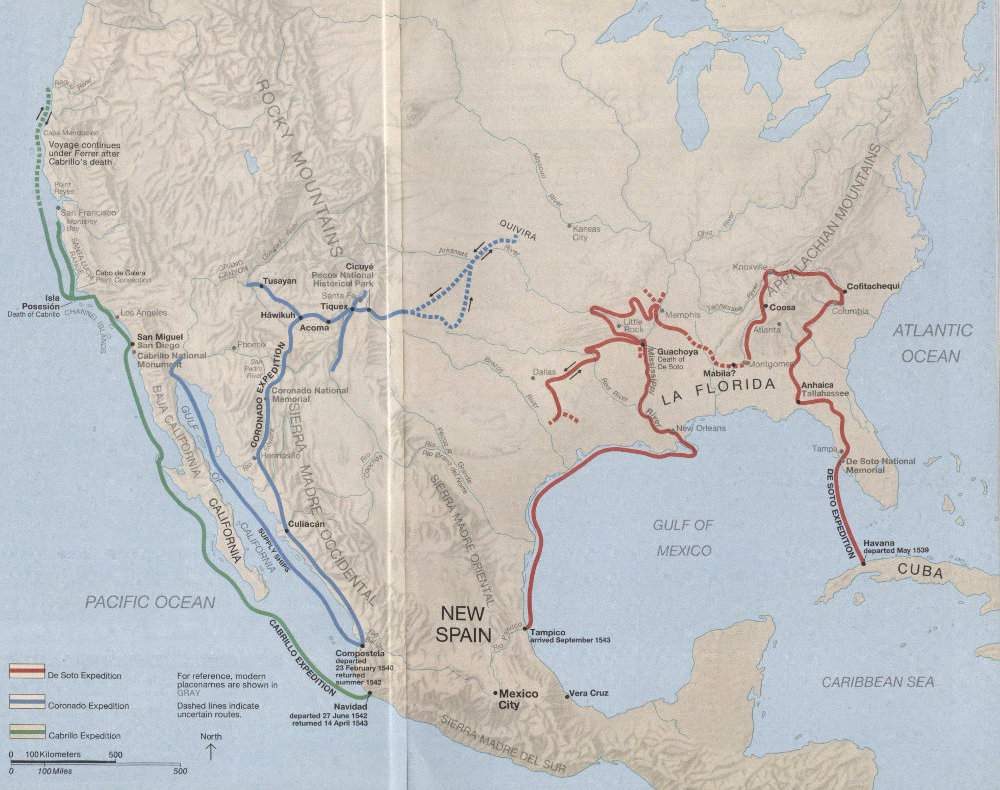
Routes of the Explorers High-resolution Map
The first Spanish expeditions into the northern borderlands of New Spain sampled the continent’s wondrous diversity. De Soto made his great march across a luxuriant country so stunning and productive that the expedition’s journals are full of admiring description. He encountered complex native societies, which were often organized into powerful chiefdoms—generous in peace but formidable in war. Centuries of settlement has greatly altered this landscape. Not so Coronado’s country. A traveler to the Southwest can still see places evocative of the first Spanish encounters with Indians of the pueblos and Plains. A sailor retracing Cabrillo’s route up the California coast runs past mountains that, in the words of the chronicler, “seem to reach the heavens ... [and are] covered with snow”—mountains he called the Sierra Nevada. They are today’s Santa Lucia range. Cabrillo’s voyage is now best followed in the imagination.
8
Timeline
1440-60 The Portuguese explore coast of Africa
1492 Moors defeated in Spain; Columbus lands in New World
1497 Vasco da Gama sails to India by way of Africa
1513 Ponce de León claims Florida for Spain
1519-21 Magellan’s fleet sails around the world
1521 Cortés conquers the Aztecs
1528 Narváez attempts a colony in Florida
1529-36 The wanderings of Cabeza de Vaca
1532 Pizarro overthrows the Incas of Peru
1539-43 De Soto expedition
1540-42 Coronado expedition
1542-43 Cabrillo’s voyage
1562 French Huguenots settle in Florida
1565 Menendez establishes St. Augustine
1584 Ralegh plants colony on North Carolina coast
1598 Oñate expedition into Southwest
1607 English settle at Jamestown
1620 Pilgrims settle at Plymouth
9
First Expeditions North
De Soto Coronado Cabrillo
1539 Lands in Florida in late May; marches through upper Florida; major battle at Napituca; guerilla war with Apalachees; winter camp at Anhaica (Tallahassee)
1540 Following Indian trails, expedition swings in a wide arc through Georgia, South Carolina, North Carolina, and Alabama, encountering major chiefdoms. Bloody battle at Mabila (central Alabama) in October Departs from Compostela with an army of 300 cavalry and infantry, several hundred Indian allies, friars, and a long pack train. Alarcón sails up the Gulf of California with three vessels. Expedition penetrates American Southwest, reaches Háwikuh in July; engages the Zuñi in battle; Coronado wounded. Tovar explores Hopi villages in Arizona. Alarcón reaches mouth of Colorado River. Cárdenas sights the Grand Canyon. Alvarado marches to Acoma, Pecos, and beyond. Accompanies an exploring expedition up the northwest coast as almirante (second in command). Expedition abandoned after its leader is killed fighting Indians.
1541 Winters among ancestral Chickasaw Indians of Mississippi and suffers attack by them; crosses Mississippi in May; travels in great loop through Arkansas; discovers buffalo hunters and a people who live in scattered houses and not in villages; endures severe winter at Autiamque Journeys to Quivira (Kansas). Winters at Tiguex; puts down an Indian revolt. Gathers a new exploring fleet for Mendoza.
1542 Reaches the rich chiefdom of Anilco; at nearby Guachoya, De Soto sends out scout parties who find nothing but wilderness; De Soto dies, is succeeded by Moscoso. After fruitless wandering in east Texas, Moscoso retraces route to Anilco The army departs for home in April, arrives in Mexico City in mid-summer. Coronado reports to Viceroy Antonio de Mendoza on expedition, resumes his governorship of Nueva Galicia. Months later Coronado is tried for mismanagement of expedition but acquitted. Dispatched by Mendoza to continue exploration of the northwest. June: Sails from Navidad, near Colima, Mexico. September 28: Sights “a sheltered port and a very good one.” This is San Diego Bay, which he names San Miguel. October: Sails through the Channel Islands, suffers fall and injury. November: Reaches the northernmost point of the voyage, perhaps Point Reyes, California, but turns back.
1543 Winter camp at Aminoya on Mississippi; survivors—half the original number—build boats to float downriver; in September, they reach Pánuco River, in Mexico January 3: Dies on San Miguel Island (Channel Islands). February: The fleet sails north again, perhaps as far as Oregon before turning back. April: Fleet arrives back at Navidad, nine months after embarking.
10