PART III
Reading edition
I. —Labour—Supply and Demand.
II. —Land and its Relation to Labour.
III. —Portuguese Slavery.
IV. —The Future of Belgian Congo.
I LABOUR—SUPPLY AND DEMAND
Everywhere in West Africa the cry goes up, “Give us more labour.” The British, German, Portuguese and French merchants all declare that if only they could get the labour, they might put a different face on the whole of the problems of production in West Africa. The principal reason for this shortage is unquestionably the fact that West Africa is sparsely populated, but this one fact does not, by any means, explain the situation. In Liberia alone does there appear to be any appreciable quantity of surplus labour, and upon its resources considerable demands are made by other colonies. This surplus obviously arises from the fact that Liberia is completely undeveloped, but if in the near future some energetic power should take charge of that territory, a period would certainly be put to indiscriminate recruiting amongst the native tribes.
It is true that in some territories in West Africa there is an increase in the population, but taking the whole areas into review, the labour force has seriously decreased within recent years. Statistics, though at present little more than estimates, go to prove that in several colonies this falling off is becoming a grave question. Recently the religious denominations in Lagos have been holding “intercessions” with reference to the high rate of mortality. If this intercession should lead the natives from faith to works, we may still hope to see the abandonment of those European customs which are doing untold harm to the physique of the native women and children.
The causes of decrease in the population, generally speaking, are beyond human ken and one can only express opinions which someone else will promptly contradict. For example, almost every traveller wrecks his reputation on that old-time rock of controversy—polygamy. Sir Harry Johnston mentions in one of his books the case of a polygamist with 700 children, but the greatest polygamist I have ever met in Africa possessed 1000 wives, yet he had no children! Argument based upon two such instances, however, is profoundly unsatisfactory, because with so large a company of wives in one case, and children in the other, it is obvious that many other considerations repose beneath the surface. There is one outstanding fact which everyone knows, but few speak about except in whispers; human nature is pretty positive in West Africa, no matter of what hue the skin, and scientists may argue until eternity upon the relative effects of polygamy and monogamy on the birth rate, but all their deductions are wide of the mark whilst they have so little actual monogamy anywhere in West Africa.
SLEEPING SICKNESS AND LABOUR
Sleeping sickness has made the most terrible ravages wherever it has established a firm hold on the tribes, but this scourge would seem to be spending its force. Seven years ago Uganda recorded over 8000 deaths from sleeping sickness within twelve months, and the latest Government report shows that there has been a gradual reduction until in the year 1910 there were only 1546. Happily this encouraging feature is present on the West Coast also. The Congo suffered more than any other colony, due, probably to a large extent, to the systematic oppression under which the population groaned during the Leopoldian régime. Now, however, the absence of the scourge in many of the old districts is quite noticeable. Villages that we knew to be swept by this plague ten years ago are once more flourishing, and in some cases where the birth rate was almost nil the villages are again joyous with the laughter of little children.
The worst sleeping sickness areas remaining in West Africa appeared to me to be the Bangalla region of the Congo and the Portuguese island of Principe. In the latter it has reached such proportions that the whites are leaving the island. The Portuguese still keep a considerable number of slaves on the cocoa farms, all of them either infected or exposed to the disease. As one passes from roça to roça, these slaves, stricken with disease, with emaciated bodies and gaunt features, stare piteously at the passer-by from eyes that seem to stand out from their heads, mutely appealing for the freedom of their distant village homes on the mainland. Looking at the matter from the materialistic standpoint of labour-supply, but makes this ruinous conduct on the part of the Portuguese appear doubly reprehensible.
“Civilization,” too, has contributed to a decrease in the working population, but in a varying degree. All the Powers have sinned in this respect. I never read of punitive expeditions with “many natives killed” without inwardly fuming at the folly of the administration which should know how precious from an economic standpoint alone, is the life of every single native. Yet in some places the tribes are hustled, tormented and even butchered in a manner little realized as yet by the European public. Think of the loss of life by violent death in both Belgian and French Congo, and in German West Africa! Think of the countless thousands of bleaching bones scattered over the highways through Portuguese Angola!
Within the last twenty-five years well over 60,000 slaves have been shipped to San Thomé alone; add to this the thousands sold and still in slavery on the mainland, and you probably have a total of over 100,000 slaves passing into the possession of the whites in Portuguese West Africa. That stream of human merchandize involved a wastage of another 100,000 lives, for a Portuguese slave-trader once admitted that if he got half his total gang to the coast, he was lucky, but that generally he could not deliver more than three out of ten!
It is a haunting thought that since the “85” scramble for Africa, the civilized Powers who rearranged the map of the African continent, ostensibly in the interests and for the well-being of the natives, have passively allowed the premature destruction of not less than ten millions of people. Now these Powers complain bitterly that they are short of labour and jump at any expedient which presents itself to obtain labour for their hustling developments.
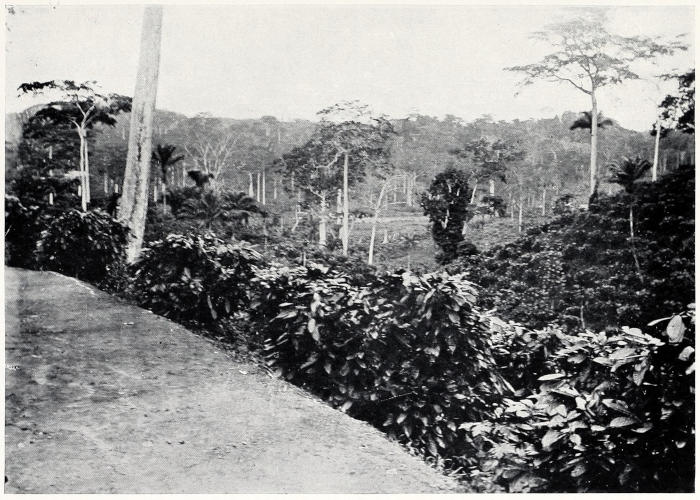
COCOA FARM, BELGIAN CONGO.
The sins of King Leopold are visiting themselves upon his successors in every part of the Congo basin. The prospective gold mines, the cocoa farms, the public departments, all of them are handicapped owing to lack of an adequate labour force. If only the Belgians could restore to life an odd million of the able-bodied men and women done to death under the régime of their late sovereign, what a different outlook their colony would possess!
The Belgians now propose bringing Chinese for the Katanga Mines, but seeing that their former experience of Chinese coolies was not a happy one, and considering other drawbacks, I very much doubt whether they will ultimately launch the experiment of bringing thousands of Chinese across Africa. The original idea of the Belgian Government was that of bringing the coolies into the Congo under a regulation which would secure their repatriation at the termination of the contracts, coupling that regulation with others similar to those adopted by Great Britain in South Africa. Mr. R. C. Hawkin,[8] whose knowledge of South African politics is not only wide, but intimate, at once pointed out that the Belgian Administration was restricted by the Berlin and Brussels Acts. This opened up a situation so obviously awkward that nothing more has been heard about the introduction of Chinese labour into the Congo, at least for the present.
WHAT GERMANY LACKS
Germany, like Belgium, differs from France and England in that she has no other colonies from which to draw a labour force. Quite recently her colonists, at their wit’s end for labour, passed a resolution agreeing to import 1000 Indian coolies for labour in the mines. It had not occurred to them that the British India Office might object. How much trouble, to say nothing of expense, they would have saved themselves if only they had asked the office-boy in Downing Street!—they need have gone no higher.
This is another instance of the strange features which now and again attend German colonization, good as well as bad. Their authorities had apparently entirely forgotten the regrettable Wilhelmsthal affair, but probably the real reason was that this incident (which many Englishmen will not readily forget) was regarded by them as altogether too trivial to be noticed. This unfortunate affair—though in some respects comparatively unimportant, yet in reality a grave matter—certainly merits a permanent record in some form, because it is just one of those blundering incidents which bring in their train a whole crop of labour difficulties.
AN ANGLO-GERMAN INCIDENT
A German Railway Construction Company had been allowed to recruit British Kaffir subjects from South Africa. In the autumn of 1910 trouble arose because deductions were made from the labourers’ wages, and they further complained of bad food and housing. The Railway authorities seem to have then embittered the situation by refusing to allow the men food and water. This conduct in a tropical country was little, if at all, short of inhuman, and the labourers naturally struck work and apparently assumed a somewhat threatening attitude. The situation was then handled in a style characteristically German. The Company itself, ignoring the civil authorities, called in the troops, who shot seven of these British subjects in cold blood and wounded several others. How one-sided the whole affair was is demonstrated by the fact that not a single German soldier was even injured. This incident, from every point of view an outrage, was regarded as so trivial that no one appears to have been punished, nor so far as we know has any compensation been paid to the wounded or to the relatives of the murdered Kaffirs.
German colonial knowledge of British public opinion cannot be of a very far-reaching nature when it ignores this incident in asking for British labour to develop its colonies. To Englishmen it cannot be a matter of surprise that the India Office has not yet granted permission to recruit labour from the Indian Empire.
Germany and Belgium are the only two Powers in West Africa which do not possess colonies in other parts of the world from which to recruit labour, hence they are dependent upon other Powers. To the proud German Empire, this situation is irritating, while Great Britain, France, and also Portugal, to a limited extent, can each of them augment the labour force of any given colony by recruiting from their other colonial possessions.
The Portuguese colonies of Angola, San Thomé and Principe, which comprise the major portion of Portuguese West Africa, experience the greatest difficulty in obtaining labour. It is perfectly true that during the last half-century, close on a hundred thousand labourers have left the shores of Angola for the cocoa islands and other places, but these it must be remembered were almost exclusively slaves which had been bought or captured in the remoter regions of Angola, Rhodesia, Barotseland, and, more especially, the Congo Free State. The Portuguese colonists of Angola are so pressed for labour that they started some years ago an “anti-slavery” movement against the Portuguese planters of the islands. No doubt there was an honest element in this movement, but it is equally beyond question that the mainspring of the movement was local anxiety to keep all the slaves in the Angola colony, which is to this moment rotten with slavery. If Angola, a territory more than twice the size of France, were properly developed, it would require first of all a complete abolition of slavery, and then an immense augmentation of the labour supply. When we were at Lobito, the Robert Williams Railway Company and the Electrical Syndicate between them were at their wit’s end for two thousand more men, but these could not be obtained.
The two colonies of San Thomé and Principe are by far the most serious problem. The area of the two islands is not large—only 400 square miles together—but they are extraordinarily fertile; the very air seems to intoxicate with abounding fertility; everything flourishes, cocoa, sisal and rubber; everything multiplies and replenishes on the earth, but man; for some reason there appears to be a curse upon those islands, they are almost without an indigenous population and the wretched slaves imported to fill the ranks die off like flies. The future of the Portuguese cocoa colonies is doubtful because it is obvious that they cannot be run permanently by a temporary solution of the labour question.
THE BRITISH DEMAND
Both France and England at present manage their labour difficulties with greater ease than any of the other Powers, and this because both have a floating supply in their colonies, which, owing to the high standard of colonial development as expressed in railways and steamers, motors and good roads, is readily transferred to the more needy districts. At the same time every now and then we hear laments that expansion is rendered impossible owing to the lack of men.
When Lord Sanderson’s Commission took up the study of contract coolie labour, the areas appealing for labour included the Gold Coast colony, and the Government Secretary of the mines, Mr. Cogill, put in a plea that the colony should be allowed to recruit labour for its mines from India. In this plea he was supported by Sir John Rodger and the Acting-Governor, Major Bryan. This application is not easy to understand, for everyone knows, or should know, that Indian labour generally is unsuited to mining work. There is, however, some reason to believe that the inspiration of this plea came from sources requiring indentured labour from other parts of the world, and that the demand for Indian coolie labour was put forth in the hope of establishing necessity and thereby paving the way for a less acceptable demand.
The bulk of labour in West Africa is employed under indenture or contract, the majority of the latter being for three years, but a great deal of unskilled labour is employed on a yearly, or in some colonies—particularly the Portuguese—a five years’ contract. The latter are paper contracts, and in practice may mean anything or nothing at all. Very few unskilled labourers in Africa are prepared to accept willingly a single contract of longer duration than one or at the most two years, and if a contract system exists whereby labourers are bound for longer periods at a single service, it may be generally assumed that some form of pressure or intrigue has been at work.
Now that public attention is being focussed upon labour conditions, it becomes increasingly imperative that Governments should lay down the broad lines upon which they are prepared to allow contract labour. Nor must the labourer only be considered, the employer has the right to be heard in framing such conditions. In spite of much evidence to the contrary, I am still inclined to the belief that, as a class, the employers of labour everywhere in Africa detest as much as anyone labour conditions which are unfair. Even the Portuguese planters of San Thomé hate the slavery they practice, but by a long series of blunders they have been led into their present position.
The greatest care requires to be exercised if contract labour is to be kept free from the taint of slavery. The Indian authorities, in spite of every precaution, frequently find that the most reprehensible practices attach to the recruitment of labour for the East and West Indies. In the African continent, where domestic slavery is so widely prevalent, the need for watchfulness is a hundredfold greater.
RECRUITING
The conditions which govern the immigration of indentured labour should differ but little from those which cover local contracts, with the one exception that local labour contracts should always be of short duration—never longer than a year. Contracts for over-sea labour must be longer to cover the cost of transport, but even these are seldom satisfactory to either employer or employee for a period longer than three years. The Jamaican and Fiji indenture, which in practice involves a contract of ten years, is for many reasons highly objectionable.
The chief danger is beyond question with the recruiters. In India these men according to Mr. Broun,—an Indian Civil servant of large experience—“are the worst kind of men they could possibly have. They are generally very low class men.” They seem to bribe, deceive and bully by turns, anything indeed to bring the Indian coolie into their toils. In Portuguese West Africa the recruiter has for years been a slave-trader pure and simple, purchasing slaves from the Congo rebels, and also from the chiefs in the Rhodesian borderland. The Portuguese Government has now issued a regulation that all such recruiters must be duly licensed. In Belgian, German and French colonies, recruiting is undertaken very largely by Government officials.
Recruiting—whether by the irresponsible recruiter, the licensed agent, or by the Government official—calls for the closest attention of the Administration. The official will demand from a chief, the unofficial recruiter will bribe him for a given number of labourers; in the former case the chief fears to refuse, in the latter he becomes a party to a form of slavery.
The German official carries this operation through with the least amount of sentiment. I asked a planter in the Cameroons whether he obtained all the labour he wanted with a fair amount of ease. He looked at me in astonishment, and replied, “With ease, of course. I only notify the Government that I want labour and they bring it to me!” On another occasion, when I was discussing Portuguese administration with a French cotton planter from the Cunene, he began roundly abusing the Portuguese Government, and upon my inquiring wherein they differed from the German administration across the river, he replied, “The Germans stand no nonsense over labour. If the native villages are small and distant from the planters, they just burn down the villages and drive the natives nearer the planters. The Government can then quite easily make a list of the able-bodied men and supply them as they are required.” How far this may be a general characteristic of German treatment of native races, I cannot say, but what I have seen of German colonial methods does not impress me that their occupation is far removed from a sort of military despotism. In the matter of official recruitment of labour, the Germans are by far the most vigorous of any of the West African Powers. In this official recruitment the individual labourer concerned has very little say indeed; that he should desire to enjoy his freedom is apparently no concern of anyone, all he knows is that he has to work for the white man for a given period, and in German South West Africa the “contract” must be made “as long as possible.”
DOMESTIC SLAVERY
The hardships of contract labour are greatly increased by the prevalence of domestic slavery. We are sometimes told that domestic slavery is inseparable from native social life, and that from time immemorial it has been an integral part of African law and custom. For that matter so has cannibalism! There are many apologists for domestic slavery, including students of such eminence as Mr. R. E. Dennett and the Editor of the African Mail; the latter considers it would be foolish to abolish the House Rule Ordinance—or in other words the legalization of domestic slavery in Southern Nigeria. It is difficult to understand how a man with Mr. Dennett’s experience could possibly write the paper on this question which was reprinted in a journal of the Royal Colonial Institute. Mr. Dennett knows, or should know, that the horrors of early history in the middle Congo, the blood-curdling stories of Kumasi, the present-day slavery of the Portuguese colonies and a thousand other labour scandals rested and still rest in the ultimate resort upon domestic slavery. The cheap sneers at the sentimentalist, the innuendo that they are mere stay-at-home critics is entirely misplaced and no one knows this better than Mr. R. E. Dennett.
Domestic slavery is slavery pure and simple, although I agree that under the African chiefs it may not be so bad as under the old planter systems. Front rank statesmen with large administrative experience have recorded the lamentable results attaching to domestic slavery, and so recently as 1906 Africa’s greatest constructive Administrator—the Earl of Cromer—penned the following significant passage:—
“If the utility of the Soudan, considered on its own productive and economic merits, is not already proved to the satisfaction of the world—if it is not already clear that the reoccupation of the country has inflicted, more perhaps than any other event of modern times, a deadly blow to the abominable traffic in slaves, and to the institution of domestic slavery, which is only one degree less hateful than that traffic—it may confidently be asserted that we are on the threshold of convincing proof.”[9]
The broad lines of domestic slavery are common throughout West Central Africa. The slave becomes the property of the head of the house or chief, who can “contract” him to third parties without reference to the one primarily concerned, that is to say the slave himself, who in turn cannot hire out his labour without the consent of his master, and he may also be transferred in payment of debt. Upon the death of the owner, the slaves with their families—who are the property of the chief—are divided amongst the heirs with other goods and chattels of the deceased. The domestic slave can by native law everywhere, and by European law in some parts, be recaptured if he runs away. According to British law the slave becomes the property of the master in Southern Nigeria “by birth or in any other manner.” This only legalizes native law, it is true, but “in any other manner” throws the door widely open to a transfer of human beings in a way highly repugnant to British sentiment.
A REVOLTING CUSTOM
In the middle Congo a system is rapidly extending which violates every moral code in that it is none other than a wholesale prostitution. Under this custom, known locally as that of the “Basamba,” a man hires out a proportion of his wives on a monthly or yearly agreement. The basis is the principle of absolute ownership; a weekly or a monthly “hire” in cash, or its equivalent, is paid, and all the offspring handed over to the husband and owner. Thus the owner, or husband, obtains first a financial return for the hire of his surplus wives, and secondly he claims the offspring. In the event of males, they become domestic slaves, with which the chief may satisfy administrative and other demands for labour; while in the case of girls the chief possesses a further source of revenue either by hiring them out to “temporary husbands,” or by purchasing other and older women for the same purpose. This method of increasing the number of wives and slaves is by no means limited to the middle Congo, but in no other part of West Africa were we able to find it carried on so extensively. In those regions it is quite common to find men with ten wives hired out in the different villages, and a few cases exist of men who now carry on their trade with no less than fifty, and even one hundred, such surplus wives!
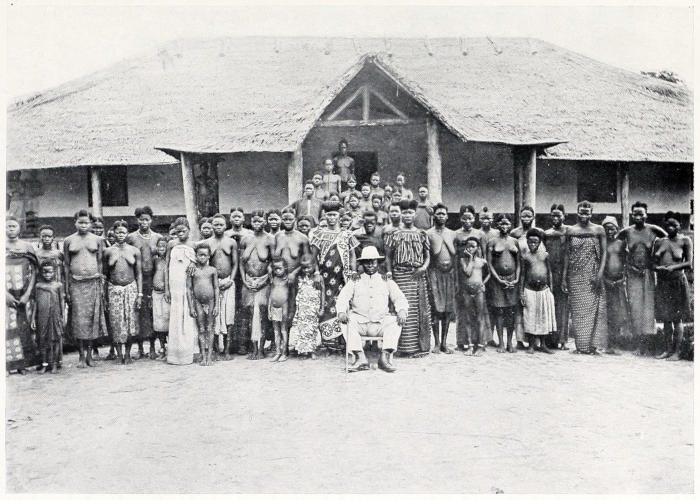
A CONGO CHIEF WITH SOME OF HIS WIVES AND “BASAMBA” CONCUBINES.
There are other means of obtaining domestic slaves. Many of them are, of course, “inherited,” and not a few are passed over as part dowry with a wife; others are taken for debt and some are captured in tribal warfare.
The relation between contract labour and domestic slavery is more intimate than appears on the surface. In West African practice an employer desiring a given number of labourers invites or “calls” the chief whom he informs of his requirements; if a merchant, he generally accompanies his request for boys with a gift; if a Government official, the demand more often than not is accompanied by a threat. At a later date the chief returns with the required number of labourers. If asked whether they are willing to work, they generally assent, for they fear to oppose their chief who, even if European prestige were not behind him, still possesses all the power of native law and customs—to say nothing of the awe-inspiring fetish.
Admittedly, however, normal domestic slavery in Africa is widely removed from predial slavery with which our school books made us familiar. Eliminating from domestic slavery the sacrifices for which slaves were always, and in some places are still, reserved; eliminating also European demands for labour, the system is not everything that is bad, nor are the chiefs invariably cruel and despotic towards their slaves. It is nevertheless equally true that the frequency of “palavers” which deal with escaping slaves is an evidence that the yoke of slavery is often intolerable, and that in spite of native law, in spite of European law and practice, and still more in spite of the fetish, the slaves attempt, and sometimes make good their escape.
SLAVE CAPTURE
Over large areas in the British colony of Southern Nigeria the police can, and do, recapture and restore such slaves to their owners, and two years ago it came as a shock to many that an escaping slave seeking refuge on the deck of a British Government ship could be forcibly recaptured and restored to his master; not only so, but he was actually flogged by British police for running away! It is, however, not altogether an easy matter to secure recapture of runaway slaves under British law, and therefore to the charge of “running away” is sometimes added larceny—the theft of a canoe or a cloth; the canoe, of course, being the boat by which the wretched slave made good his escape, and the cloth that which he uses to cover his nakedness. The following is a fair specimen of the warrants issued for the recapture of slaves in Southern Nigeria:—
COPY.
No. 1881
74
Warrant To Arrest Accused.
Form 2.
In the Native Council of Warri, Southern Nigeria. To..............................Officer of Court.
Whereas Joe of Lagos is accused of the offence of (1) running away from the Head of his House two years ago; (2) Larceny of cloth value 16s., two handkerchiefs, and a canoe. You are hereby commanded to arrest the said Joe of Lagos and to bring him before this Court to answer the said charge.
Issued at Warri, the 28th day of November, 1910.
(Signed): PERCY GORDON, Senior Member of Court.
The British Government alone amongst the Powers in West Africa really dislikes this system and shows some inclination to secure its abolition. The Portuguese like it, and in the main descend to the level of it, manipulating the system to suit, so far as possible, their labour requirements. The Belgians cannot recognize it without violating the Berlin and Brussels Acts, so they leave it alone to bring forth a whole crop of abuses.
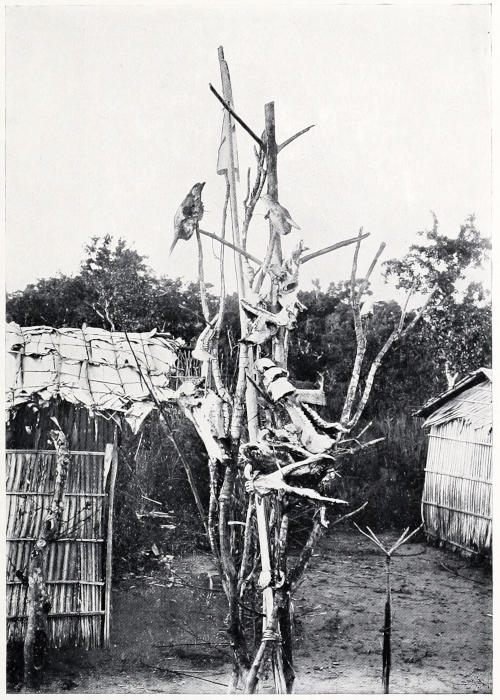
A HUNTER’S “LUCKY” FETISH.
The Lieutenant-Governor of French Guinea has recently taken a strong line upon the question of domestic slavery, which other Governments might emulate. He has issued instructions to all his subordinate officials in which he says:—
“We cannot allow the system of captivity to continue any longer; it is a matter of duty as well as of dignity to put an end to the present situation.... You are to profit by every occasion which offers for making the captives understand that it is immoral for one man to possess another.... Whenever you or your colleagues make a journey you are to gather the natives together and explain to them our wish.... In all cases which are brought before you, you are resolutely to refuse to examine those which relate to master and slave; make them understand that for us there are no slaves, and that in justice and law we only admit the relations of employer and employee. You are to follow up with the utmost rigour all crimes committed against human liberty, and to employ all the severity of the laws against barbarous masters or slave-traders who are still too numerous on the frontiers of neighbouring colonies.... Every captive who appeals to your authority is to be welcomed by you and protected against every abuse of force. You will disregard every stipulation which in civil contracts, wills, etc., would postulate the condition of family captivity.... There are no longer any captives in Guinea—such is the formula which must rule your conduct.”
If transfer to French Congo is a promotion, the quicker the French Government promotes this enlightened official to that sphere, the better for French reputation in that unhappy region.
FORCED LABOUR
In Africa forced labour, like contract labour, rests very largely upon domestic slavery. What is generally understood by forced labour is indistinguishable from the corvée of Germany, or from that which obtained in earlier times in Prussia and France. It is simply a communal undertaking upon works of general welfare, mainly roads from town to town, although the word corvée was also applied to all feudal demands, but in those cases some wages were given in return for the labour.
The old African communities exacted, and in many cases still exact, labour from their domestic and agricultural slaves for which they were and are paid, according to the whim or the benevolence of the chief. This labour was, and is, devoted to the clearing of paths, keeping bridges in repair, gathering harvests, porterage, canoeing, boat-building, and indeed any undertaking which involves a considerable labour force. These exactions, however, are always made at a time which avoids interference with agricultural necessities; moreover, in the nature of the case, the labour was never used very far from the village.
European administrations have stepped into West Africa, and have taken the place of the chiefs, and in so doing have adopted corvée under the plea of works of public utility—a blessed phrase which covers a multitude of questionable “necessities.”
In the Gambia every able-bodied male is compelled under the penalty of a fine, or six months’ imprisonment, to give labour for the construction of roads, bridges, wells and clearings round the villages in his own district. They must also provide carriers when required. Apparently the Governor is the only arbiter of the time to be given to such works and whether or not any remuneration may be made. In Southern Nigeria the Governor may call up all able-bodied males between 15 and 50, and all able-bodied women between 15 and 40, to give labour upon road-making and creek-clearing for a period of six days each quarter. Refusal to obey involves a fine of £1 or imprisonment not exceeding one month. Similar regulations prevail in Northern Nigeria.
In German Togoland the natives must give twelve days a year, or commute this by paying six marks; but the labour can only be used upon roads and bridges in the district in which the labourers reside. Almost identical regulations prevail in the French and Portuguese Congo. These regulations—qua regulations—are unobjectionable and, after all, only assume powers exercised for generations by the chiefs. In practice, however, under the term works of “public utility,” frequent and irregular demands are constantly being made to the irritation of the people. Think of what a single punitive expedition involves—no matter on how small a scale. Modern weapons of warfare, ammunition, tent kits, provisions and the thousand and one odds and ends of the modern paraphernalia of war, all this is carried in the main by forced labour. I shall doubtless be reminded that the chiefs always exacted labour for war. That I admit, but “civilized warfare” is so infinitely more elaborate than the simple native spear and arrow warfare, that they are not to be put in the same category.
Carriers too are demanded in numbers and for distances which violate every native restriction. It is but two years ago that a British official in Southern Nigeria decided to start off upon a journey on Sunday morning, and because the carriers did not come quickly enough, he marched into the two nearest churches and seized the congregations, including the native minister, and to demonstrate further his petty authority and repugnance of loftier ideals, insisted on this native clergyman carrying a box containing his whisky. At this distance it is the ludicrous which probably strikes the imagination, but it is an entirely different matter locally. The missionaries of Southern Nigeria, no matter what their denomination, are of a very devout and noble-minded order; they have instilled into the minds of the natives a deep reverence of all things pertaining to worship, and nothing will ever efface from the native mind that—to say the least—irreverent conduct of the representative of the Christian Government of Great Britain.
It is difficult sometimes to discriminate between contract labour, forced labour and slavery, the boundary lines having been obliterated by vigorous administrations demanding labour for this and that work of public utility, which in reality bear little relation to an enterprise for the general welfare. In Belgian Congo this is carried further than in any other West African colony. The Belgians insist that there is no forced labour in the Congo, and this is perfectly true from the legal point of view, but nevertheless almost the whole administrative machinery and Government undertakings are maintained by forced labour. To roads and bridges Belgium has added telegraphs, mines, plantations, and recruitment for the army; the ranks of both—labourers and soldiers—being filled almost entirely by forced labour.
BELGIAN FORCED LABOUR
Loud were the complaints made to us in our recent journeys through the Congo of the incessant demands for labour by the Administration.
Wearied with a day of struggle through Congo forests and swamp, I was resting one moonlight evening in the centre of a primitive Congo village; a group of native chiefs were sitting round me discussing political conditions. The absence of a certain token led me to question one individual somewhat pointedly as to the cause.
“If I tell you, white man, you won’t betray me?”
“Your chief knows me well enough for that,” I replied.
“Well, there were eight of us,” he explained, “called by Bula Matadi. We were bound to go, bound to leave our wives and our children and go down river several days by steamer. When we arrived, the head white official gave us a ‘book’ (contract) for three years, and sent us to cut a road for the ‘Nsinga’ (telegraph wire). We worked for some days, discussing every night how we could escape. One afternoon the white man went into the forest and four of us who were working together ran down to the river where we found an old canoe and one paddle hidden in the grass. We crowded in and pushed off, one guiding the canoe with the single paddle, whilst the others paddled with their hands. We managed to get into a creek hiding ourselves until the next night, when, with the help of some stout sticks for paddles, we began the long journey home, paddling in the night and hiding ourselves and our canoe during the day. We lived on roots and nuts for eight days, and then, when hiding in the forest, we heard some women talking we ‘frightened’ them and they fled, leaving their baskets behind. These contained palm nuts, on which we lived for another six days. On the fifteenth day we reached home again, but our people did not at first recognize us.”
“Why?”
“Because, white man,” chimed in the old chiefs, “they were so emaciated that the flesh had shrunk from their cheek-bones, their ribs stood out like skeletons, and they could barely speak.”
Such is Belgian forced “Contract Labour” in the Congo.
What are the boundary lines between legitimate forced labour and that which public opinion, as trustee for native rights, should refuse to tolerate?
The broad line of division is unquestionably between genuine works of public utility on the one hand, and profit-bearing works on the other.
Road-making, bridge-building, creek-clearing, are all of them works from which the whole community benefits, but the requisition of this labour should not be left to the arbitrary will of a temporary official, but subject to clearly-defined regulations. Any legislation upon forced labour for works undertaken for the public good should only permit the requisition, in lieu of taxation, as is the case in German Togoland, where the native has the alternative of paying a head tax of six marks per annum or giving his labour for twelve days, subject to the labour being required for the improvement of his own district.
As in Ceylon and other British colonies, the natives should be allowed to commute the labour by a money payment. To labour exacted under these rigid conditions, there can assuredly be no strong objection, and, generally speaking, the native tribes would loyally co-operate in such proposals.
FORCED LABOUR AND PROFITS
To employ forced labour upon any kind of work which carries with it a financial advantage partakes of slavery. A merchant obtaining forced labour at his own price is thereby, in principle, engaging in slavery, and if by obtaining such labour he is able to enter into unfair competition, he is further guilty of doing a gross injustice to his fellow-merchants. The Belgians are extremely prone to this form of labour. In the Congo there is a good deal of State commercial enterprise, which may yet ruin the individual merchant. The Belgian Government is doing the larger proportion of transport on the vast fluvial system of the Congo, and thereby competes with the Dutch House and other transport companies.
These transport steamers are all driven with wood fuel cut from the forests. Every few miles along the banks of the Congo river there may be seen stacks of fire logs cut into lengths of about eighteen inches, which have been either cut by the employees of the Government or by the villagers. No company is permitted to purchase Government wood, and ordinary steamers purchasing from the villagers have to pay 2 francs a fathom for such fuel. Journeying down the Congo a few months ago, three of us carefully examined conditions at one of the wooding posts, manned by twenty-six men and ten women, most of whom had been “demanded” from the chiefs in more distant parts of the Congo, and drafted to the spot in question. Several had already served three years—the nominal term of the contract—but, without any option in the matter, their contracts had been renewed. Each of the men had to cut one fathom of wood per diem; some were paid 7 francs and others only 5 francs a month, with a 3-francs allowance for food. The maximum cost, therefore, was 10 francs for the thirty fathoms of wood cut in the month. Thus the State provides itself with wood at a fraction over threepence per fathom, for which company steamers must pay 2 francs. Under such systems not only are human liberties violated, but commerce suffers prejudice. There is not a little danger that the Belgian authorities intend giving a considerable extension to State enterprises, which in all probability will be prosecuted with this form of forced labour.
The question of State railways and telegraph lines is a difficult one, both partaking of works of public utility, yet both are as a rule profit-bearing. There is the further consideration that all profits go to relieve local taxation. Given representative Government or given even an elective element in the Administration, there may be some justice in imposing this form of forced labour upon the general community, but under the autocratic systems of Crown Colony Administration, large demands for forced labour cause, not unnaturally, widespread disaffection. Fortunately British colonies are almost entirely free from the employment of such labour and to this no doubt is due the excellent management of all railway systems under British control.
The most economic and the most politic line to follow is that of the employment of free labour. Supervision is reduced to a minimum, abuses of authority are rare, the work goes more smoothly, the song takes the place of the boot and the lash, the native labourer goes home when the day’s toil is over vowing vengeance on no one, and the white man returns to his somewhat primitive home with a mind undisturbed by conscious wrong-doing.
II LAND AND ITS RELATION TO LABOUR
It will not, I think, be contested that throughout West Africa there is no native conception of private ownership of land. This is almost an article of religious faith amongst the African races generally. Let one tribe murder a member of another community and a palaver will be called and compensation paid. If wife-stealing or kidnapping of boys takes place, the tribes involved will remain calm and settle their dispute by making peaceful and honourable amends. Let one tribe exploit the palm, or without leave settle on the lands of another, and, on the instant, the ultimatum is despatched—“Depart forthwith, or accept the alternative!” Indeed the occupation of the communal lands of another tribe is recognized by most tribes as an overt act of warfare, the signal that all negotiations for peace are at an end.
Perhaps no more eloquent testimony of the attachment of native tribes to their lands is to be found anywhere than in the great Equatorial regions of the Congo. The early ’eighties witnessed in the Congo basin three convulsive movements; the entrance of the white man from the west, following on Stanley’s journey across the continent; the incursion of the Arabs from the north, and the Lokele wars towards the south. This latter movement was destined to change the whole situation in the Equatorial regions, south of the main Congo. The Lokeles, probably pressed by the Arabs from the north, started a “land war” with their southern neighbours, the object being to obtain an extension of tribal land. This pressure set in motion a land war, which ultimately extended over an area nearly five times the size of Great Britain and ran right through the south reaching down to the Lukenya river, and in some places even across the greatest of the southern tributaries—the Kasai. Tribes fought each other for the maintenance of their ancient boundaries until the whole of the Equatorial region was in a state of warfare, which only ceased when starvation claimed victims by the thousand. Then only were boundaries re-adjusted by peaceful agreements; even so the whole population for months was in such dire straits for food, that men sold their wives, and mothers their children, for a single basket of manioca. One realizes how passionately the natives are attached to their lands as they recount the horrors of those terrible years. Said one to me recently—“At first we fought to protect our lands, but in the end we had to fight to obtain ‘meat’—human flesh—to stay the pangs of hunger.”
FIXED LAND BOUNDARIES
The native boundaries are almost invisible to the European eye, but to the African student of nature those boundaries are fixed and immovable as the eternal hills. The limits of tribal lands, within the orbit of which the clans may move and hunt whenever they will, are the stream, the palm plantation, the hilly range and the bridges across streams and rivers. Upon the chief and his advisers devolves the sacred duty of maintaining intact these tribal lands, alienation being foreign to the native ideas. So jealously is this guarded that many paramount chiefs in native law have no power to grant even occupancy rights. For six months the cession of Lagos to the British Crown was held up because King Docemo had signed a treaty which appeared to violate this principle of native law. The population declared that the ownership of the land of Lagos was not vested in the paramount chief, but in the seven White Cap chiefs, who, fearing the terrible consequences of alienating the tribal lands, fled to the bush. It became necessary for the British representatives to give the most explicit assurances and sacred promises on the point, in order to secure the ratification of the treaty of cession.
It is perfectly true that titles have been granted to native tribes and to white men, but it is equally true that originally there was never the remotest idea that this involved the European conception of total alienation. In the Holt v. Rex case of Southern Nigeria, the Crown held that “under native law strangers cannot obtain freehold rights—only occupancy rights.” The tribal conception of occupancy rights also carries with it the communal idea; a native clan settling by permission within the territory of another tribe really constitutes the first step in progressive incorporation. In the first instance of white settlers, there are abundant stories of the native interpretation of this principle—some of them distinctly objectionable, although there were pure motives behind them; others are amusing, such as that of the chiefs “borrowing” saws, axes, string, rope, nails and what not. Again and again they have freely and openly helped themselves to palm nuts and other produce from the white man’s ground. No doubt much of what the European calls “pilfering” was really quite innocently founded upon the communal conception of the primitive races.
The impetuous scramble for African territory, which began thirty years ago, made, and continues to make, a considerable breach in this old primitive system. White men, acting through the doubtful medium of interpreters not infrequently corrupted in advance, have secured from chiefs titles to land of all dimensions. These chieftains, as a whole, never fully grasped the meaning of the titles obtained with honeyed words, and which they are now unable to repudiate. That this is so is partly proved by the fact that in some colonies areas have been conceded twice and even three times over. Swaziland is, of course, the most flagrant example, where it will be remembered a situation so complex was created that it ultimately became impossible for any Court to decide as to who were the real owners of specific areas.
In West Africa things are not, and never can be, quite so bad, although in some colonies, the Gold Coast for example, German Cameroons and French Congo, land difficulties are being piled up for the endless confusion of future administrators. In Belgian Congo there is no immediate probability of trouble, due partly to the fact that capital has little confidence in Belgium’s heritage, but more because the major part of the population has disappeared.
LAND AND LABOUR
There is a vital connection between land and labour in all tropical and sub-tropical colonies. The economic future of native races is immobilized in the proportion in which their lands are taken from them. The almost phenomenal success of the cocoa industry in the British colony of the Gold Coast is due entirely to the fact that the natives are the proprietors of the cocoa farms. Throughout the colonial world, there is no more striking contrast between a landed and a landless native community than the British Gold Coast colony and the neighbouring Portuguese colony of San Thomé. In both territories cocoa flourishes, both produce excellent cocoa, in both nature is very kind, but while the one will march on conquering the cocoa markets of the world, the other is doomed to ultimate disaster.
The San Thomé cocoa producer is only a labourer—in fact a slave—and he is perishing at such a rate that the depleted ranks must be filled from outside sources to the number of 3000 to 4000 labourers every year. This constant inflow of labour cannot continue indefinitely, even if European sentiment permitted—which it will not—the revolting concomitants by which this labour has been maintained. The economic future of these colonies from which the supplies are drawn will soon forbid the emigration which at present is necessary to the island of San Thomé The population of the Gold Coast, on the other hand, happy in the enjoyment, in the main, of its own lands, reproduces and to some extent even increases itself every year. The native occupies his rightful place as producer, while the white man finds his true sphere, first as the inspirer of native efforts to place on the market cocoa of increasingly good quality, secondly as the medium by which the cocoa produced is conveyed to the manufacturer, and thirdly that by which surplus European manufactures are brought to the door of the native in exchange for his products.
This relationship of land to labour is receiving increasing recognition by students of colonial policy. The Republican Government of Portugal, finding both labour and land problems in hopeless confusion in the African colonies, has recently introduced a comprehensive measure embracing both factors in the development of African colonies. The ordinance is probably too generous in proportions to be carried through effectively in any colony, and stands little chance of complete application in Portuguese colonies, which suffer already from an excess of legislation, coupled with a rooted contempt for “Lisbon dictation.” This new ordinance, however, is a valuable contribution to West African legal literature.
The Provisional Government first lays down the proposition that every native in the Portuguese colonies is under “a moral and legal obligation to work.” The proposition upon land is in the following terms: “In all the Provinces beyond the seas, wherever there are public lands vacant, uncultivated, and not used for any special purpose, natives may occupy and cultivate them subject to conditions laid down in the present ordinance.”
The native in Portuguese colonies, therefore, must work. The sphere of labour he may choose, but idleness is henceforth a punishable offence.
Women, sick men, minors under fourteen years of age, chiefs and those in regular employment, are either exempt from the operation of the ordinance or deemed to have fulfilled its obligations.
Any native may contract his services, but, in the first instance, for a period limited to two years. The agreement is null and void unless the wages are fixed and recorded in the contract. Any clause giving the employer the right to administer corporal punishment likewise renders the contract invalid. The engagement may be made with or without the assistance of Government officials, but any document signed in the presence of a Government authority carries with it both the right and the responsibility of official intervention in any subsequent dispute between the parties. If, however, the contracting parties enter into the agreement without reference to the authorities, the employer cannot look for official assistance in disputes with the employés, although the latter under all circumstances may rely upon official protection and assistance. All contracts must bear the impress of the labourer’s thumb. Wages may not be withheld, nor may pressure be exerted to force merchandize upon the employé in lieu of wages.
Recruiting agents must obtain a licence from the Governor of the province, and any infraction of this section of the ordinance is punishable by a fine of £100 to £1000. A heavier penalty still awaits any recruiting agent who attempts to contract labourers for prescribed regions: presumably that death-trap of Portuguese colonies, the island of Principe. The punishment for such violation may be imprisonment for one year, a fine of £200, and at the expiration of the term of imprisonment, expulsion from the colony. Similar penalties await any agent contracting labourers beyond the bounds of his judicial area.
The Republican Government evidently realizes that contract labour, however benevolent it may be made to appear on paper, is not always a heavenly condition, and that the labourer may repent of his bargain before expiration. Section 18 provides for almost every concomitant which attaches to restrained labour. The pill, however, is sugared by a preliminary and somewhat unctuous preamble, that the whole trend of employment must be that of “moral education.” In pursuance of this laudable object, powers of arrest are conferred, “precautions” against running away are permitted, and if a second offence occurs, the offender, “when caught,” may be taken to the authorities “to be chastised.” There are, however, certain limits to these powers, for the employer may neither shackle nor chain an employé, nor may he deprive the labourers of food, nor impose any fines which involve deductions from wages.
If the native of the Portuguese colonies dislikes the yoke of any master, he may, like Adam, “till the soil,” for, as already stated, all vacant public and uncultivated lands are at the disposal of the colonists. The first general restriction is that this liberty is only open to those “who do not possess immovable property to the value of £10.” The object of this restriction is nowhere elucidated, but apparently it is that of fixing the population upon definite areas.
LEASEHOLD BECOMES FREEHOLD
If, then, the native does not possess immovable property to that amount, he may occupy a piece of land measuring 2¼ acres for himself, and an additional acre for every member of his family with the exception of males above fourteen years of age.
A man with two wives, a mother, three daughters, and also three sons under fourteen years of age, could occupy under this regulation a little over ten acres, but the occupation must be an effective one. A dwelling-house must be erected, and two-thirds of the area must be under cultivation, otherwise the title becomes void, and the authorities will expel the occupants. The right of occupancy is inalienable.
During the first five years of occupation, the colonist is exempt from all dues, but at the close of this period taxation is levied and may be paid either in cash or kind. Failure to pay these dues renders the occupier liable to eviction without any compensation for improvements.
After an occupation of twenty years, characterized by the fulfilment of all legal responsibilities, the occupier automatically acquires the freehold. These cultivators or small holders are exempt from serving either in the army or the police; they are likewise freed from any form of forced labour, hammock carrying, or paddling, but they are not exempt from taking part in military operations with their respective chiefs, when such expeditions are undertaken by command of the authorities.
District commissioners, civil and military officials are urged to induce natives to avail themselves of the land provisions, and are empowered to assign them plots of land. They are also instructed to prepare local regulations safeguarding the rights of the colonists, compile land registers, etc., for which no fees are to be exacted from the natives.
If a native will not labour for another, if he will not sow a field or trade in produce, if in short he is only prepared to stretch forth an unwashed hand and mutter “Matabeesh, Senhor!” then the official representative of the Government will deal with him. The danger is that other than “wastrels” may be swept into the official net, particularly whilst such operations are so highly profitable to the Portuguese colonies.
First the delinquent is summoned to answer the charge of idling without visible means of support; then the paternal authorities are to read him a homily on “moral education,” and forthwith despatch him to a place where work is waiting for him. If he still refuses to work he may be sent to “correctional labour.” There he will receive food and lodging and be given one-third the market rate of wages. “Correctional labourers” may, according to Section 58, be hired out by private persons upon the same terms as the prisoners of State. Such persons willing to employ “correctional labourers” are requested to make formal application, but only those are eligible to receive such labourers who have never been convicted in any court. If they receive such labourers a given sum per capita must be paid to the State and a fine of £20 paid for any shortage in “returns” alive or dead, the number hired out must be returned to the Authorities. If, however, escape is feared, the correctional labourers may be returned to State prisons each night.
If the whole ordinance is to be applied to the Portuguese colonies in a measure of completeness hitherto foreign to the Portuguese possessions, then there is some hope that even the leopard may be able to change his spots.
HUMAN VALUES
There is little likelihood that the Portuguese land laws will be rendered effective on the spot, especially when we remember that many thousands of miles throughout which such laws are intended to operate are not yet under any sort of administrative control. The step which is finding most favour in British West African colonies is that of declaring all lands, whether occupied or not, as native land under some sort of ultimate trusteeship of the Governor for the benefit of the natives. No purpose can be served by denying that this would place very large powers in the hands of a single individual, even though the powers so conferred may only be exercised “in accordance with native law and custom.” It would beyond question give to the Governor powers which in the hands of some individuals might be exceedingly dangerous.
The majority of British Governors of Crown colonies could undoubtedly be allowed to supersede the paramount chiefs in every respect, providing the constitution of the Crown colonies permitted the bringing into full play of this one vital condition, viz. that his actions would always be “in accordance with native law and custom,” but Crown Colony government excludes at present any form of representative government which is the unwritten law of every African tribe.
Docemo, and his successor Prince Eleko, in Southern Nigeria, exacted, and exact to-day, an abject obeisance from their counsellors, which, if demanded by a British Governor, would secure his prompt recall. No chieftain, whether he be Mohammedan or Pagan, ever enters the presence of the native Council Chamber of Lagos without prostrating himself flat upon the ground and kissing it three times before receiving permission to sit down. Yet this paramount chief could not alienate a square yard of land without the sanction of his advisers.
No British Governor is at present in this position. In practice, his powers under Crown Colony government are in the ultimate resort absolute and uncontrolled, except by question, answer and debate, in the British House of Commons. When, however, the subject-matter reaches this stage, the man on the spot has probably already committed the Government, and the department is therefore bound to defend him.
Admittedly, somebody must protect the native from the wiles of unscrupulous white speculators, no less than from the subtle and treacherous conduct of individual natives. It is the duty of the Governor, as the responsible authority of the Crown and trustee of native welfare, to do this; let him by all means have power to prevent the alienation of land and to grant occupancy rights, but under a system of government which will give the natives themselves that which they possess by native law and custom—a collective voice in such decisions. It should not be beyond the wit of man to frame a system of governmental control over native tribal lands which would satisfy the great mass of the people, for let it never be forgotten that Africans in the aggregate are reasonable and by no means difficult to deal with along lines which are demonstrably equitable.
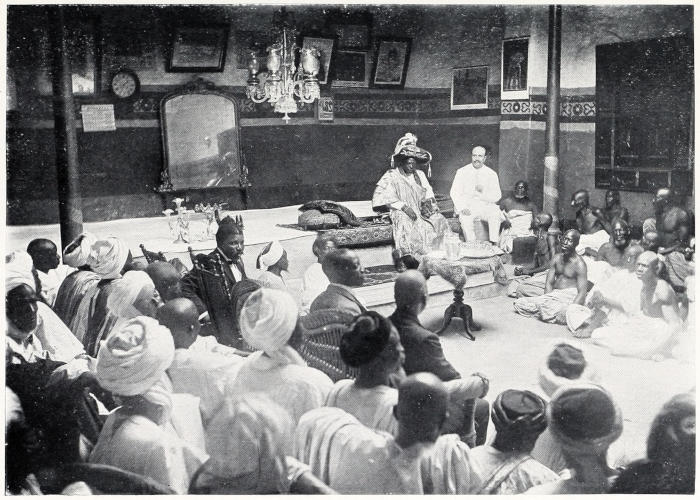
PRINCE ELEKO AND COUNCIL, SOUTHERN NIGERIA.
III PORTUGUESE SLAVERY
In Portuguese West Africa one sees the best and the worst treatment of native races. The best for the free native, the best for the educated coloured man and the best for the coloured woman. In every other colony—and in this respect British colonies are becoming the worst—race prejudice not only prevails but is on the increase. In the Portuguese colonies there is a pleasing absence of race prejudice; natives of equal social status are as freely admitted to Portuguese institutions as white men; the hotels, the railways, the parks and roads possess no colour-bar, and if the Portuguese colonies could be purged of their foul blot of slavery, the natives of other African colonies might well envy their fellows in Portuguese Africa. Alongside intimate social relations with the native is a widespread plantation slavery in Angola, San Thomé and Principe.
ANGOLA
Angola, one of the largest political divisions of West Africa, is bounded on the north by the Congo, the east by Rhodesia and on the south by German Damaraland; a considerable section of the northern territory, including the whole Lunda country, comes within the operations of the General Act of Berlin. Apart from the Lunda province and strips of land bordering the rivers, the colony cannot be said to give any promise of an agricultural future, although if one nation is adept over all others in turning wastes into gardens, that nation is the Portuguese, to whom gardens and plantations are second nature. A Portuguese house without its shady vinery, its delicate fernery and luxuriant kitchen garden is unthinkable; even the little children in the streets, instead of building castles and grottos, find infinite delight in laying out miniature gardens, in which they arrange flowers and ferns with artistic taste.
Economically, however, Angola does not pay, its finances are like many of its old houses—very unstable and subject to leakage. Walk its streets, visit its families, Government departments or merchants’ houses, and certain it is that every other man you meet will remind you forcibly of Micawber. The Portuguese community in any part of Angola can be roughly classed as the Moneylenders and Borrowers. Each, however, appears to be supremely happy and lives in absolute assurance that something will turn up every day to render life more agreeable.
Loanda, the capital, is a strange admixture of ancient and modern dwellings, old churches, a roofless theatre and dilapidated bull-rings. But despite its shortcomings, the Portuguese have made Loanda the most restful health-restoring sea-port in West Africa. Boma, the capital of the Congo, is distant only twenty-four hours’ steam, but it is surely the most unhealthy and the most foodless place in Africa. The Belgians, if they liked, might supply fresh provisions to its starving and dying population,—for everyone in Boma is dying, it is only a question of time. In Boma, fowls, eggs, fruit, fish and vegetables are priceless, while every day shiploads can be purchased very cheaply in Loanda, and if shipped twice a week to the Lower Congo, would at least make life, though short, more comfortable.
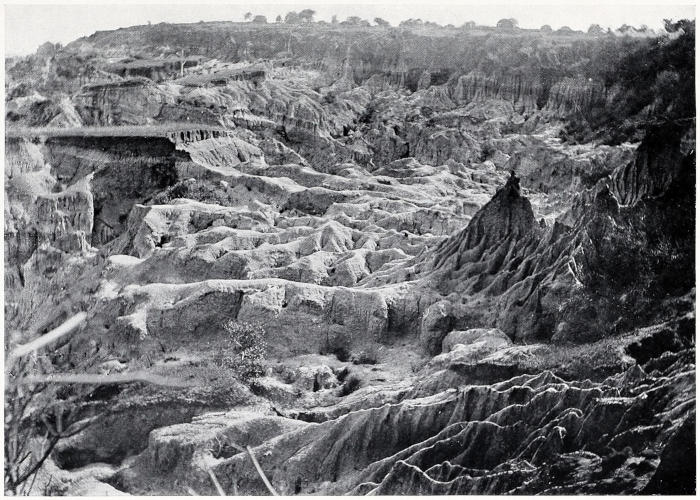
LAND FORMATION, LOANDA, PORTUGUESE ANGOLA.
There is one place every visitor to Loanda should inspect—the old Dutch Church dedicated to “The Lady of our Salvation.” Some American dollars would be well spent in preserving this relic, for it is one of the many instances which demonstrate that slaving was a pious occupation in the early seventeenth century. The whole of the interior was once composed of blue and white tiles of pictorial design, and one on the north wall of the chancel is still complete; this apparently represents the conquest of Angola by the Dutch, who are seen in broad-brimmed hats, braided coat-tails and parade boots, fighting and slaughtering the hosts of savages. The whole operation against the unfortunate infidels is being directed, and presumably blessed, by the Lady of our Salvation enthroned in the clouds.
If Portuguese enterprise has made Loanda a restful spot for weary travellers, British capital—in the person Robert Williams—has turned an unknown strip of desert land into a nourishing sea-port now known as Lobito Bay. It is from this port, with excellent anchorage and transport facilities, that the West Coast will connect with the Cape railway. This Lobito—Katanga railway, though it has only completed some 450 of the 1200 miles to Katanga, promises commercial success when opened, for it should then constitute the cheapest transport route to Rhodesia and the Congo; that is unless the Portuguese, with their usual short-sighted economic policy, kill the enterprise with tariffs before it has had a real chance of life.
There are only two other ports of any consequence in Portuguese Angola—Mossamedes and Benguella; the latter a harbour with perpetual “rollers” which make a stay on board anything but a comfortable experience. The town itself, like most Portuguese institutions, is going to ruin: the only redeeming feature being the maintenance of its public gardens, fountains and Eucalyptus avenues. Catumbella, an inland town, lies midway between Lobito Bay and Benguella, and with the latter town, constituted the principal centre of the slave-trade. The old slave-compounds and prison-houses confront the traveller in every part of Catumbella and Benguella, and although many have fallen into disuse, some still have the appearance of occasional occupation.
PORTUGUESE “HOTELS”
Loanda, Lobito and Benguella all possess “hotels.” Those of the capital proper are a strange mixture of cleanliness, tobacco-ash and half-hidden dirt, but at least they are free from the presence of those unfortunate white women who intrude themselves with such persistence on the attention or inattention of passing white travellers in Benguella, and live by running accounts paid irregularly by white men in that most loathsome of all towns in West Africa. Those wishing to visit Benguella should order their rooms months ahead and not be surprised if on arrival Senhor has forgotten all about the order and has neither room nor bed at his disposal. A sound and vigorous rating, however, will generally extort a promise of a room somewhere, a promise which will seldom be fulfilled until all other guests have retired to beds severally robbed of one portion or another to make up an incomplete set for the newly-arrived guests. Nor must the tired travellers be surprised if a black boy enters the bedroom, without knocking, and demands the “other master’s pillow,” only to be followed later by another woolly pate thrust round the doorway sleepily requesting the surrender of a counterpane or towel, for yet “another master.”
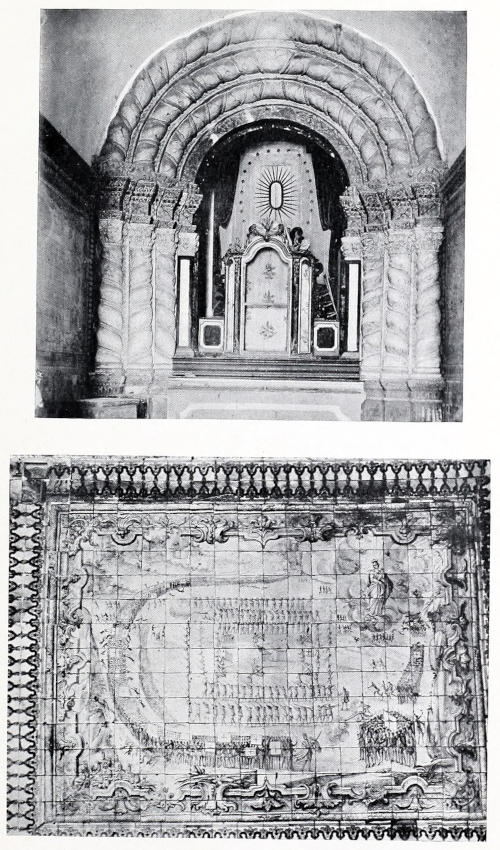
CHANCEL AND NORTH WALL OF DISUSED DUTCH CHURCH, LOANDA. See p. 171.
It is useless to expostulate with the hotel manager, who will reply with a veritable flood of apologies and threaten to break the head, and neck if necessary, of every black boy in the place, and yet the guest knows with mathematical certainty that he will again have to go through the same course of torture before getting a troubled sleep on that straw mattress in yonder whitewashed room. This is the whole trouble with the Portuguese, commercially and diplomatically; their eternal protestations of sincerity, integrity and courtesy on the one hand, and, on the other, a total incapability of observing the most sacred promises. It is an old story, the same which confronted Wellington in the early nineteenth century. The Portuguese is very like the African; you despair of curing him of his weaknesses—which are, after all, seldom intentionally vicious—and yet you love him, because his kindly nature compels you.
The chief interest for the British public in Portuguese colonies arises from two distinct causes—financial interests and treaty obligations. Our financial interests are not large; they involve certain railway schemes, the supply of labour for the Transvaal mines, and a few plantation and merchant enterprises. Our treaty obligations, binding us in definite alliance with Portugal, may at any moment involve Great Britain in a grave international situation. The value, or otherwise, of such an alliance is open to a difference of opinion. It is, however, imperative that our ally should observe all moral standards which the civilized Powers are pledged to maintain with all the forces at their disposal. Travellers, consuls, merchants, sea captains and government officials have repeatedly called attention to the prevailing slavery and slave-trade in Portuguese West Africa; both of which detestable practices are in gross violation of Anglo-Portuguese treaties, the Brussels and Berlin Acts. All, or any, of the civilized Powers can at any moment—and in point of responsibility should—intervene and demand the abolition of slavery in Angola, San Thomé and Principe, and if Portugal continued to beg the question by calling slavery by some other name, that Power, or those Powers, could, if they so desired, shake her out of her indifference by casting the anchor of a battleship in sight of the ports of San Thomé and St. Paul de Loanda. I am not advocating such a course for one moment, but it is vital that the British public should realize that in the event of any Power signatory to anti-slavery Conventions waking up for any reason, disinterested or otherwise, to treaty obligations, and making some effort to discharge those liabilities, such Power would be at once confronted by the possibility of Britain’s navy defending Portuguese colonies, although run by slave labour. A pretty spectacle indeed, Britain’s matchless fleet defending the slaver, only wanting old Jack Hawkins on the Bridge, to complete the picture!
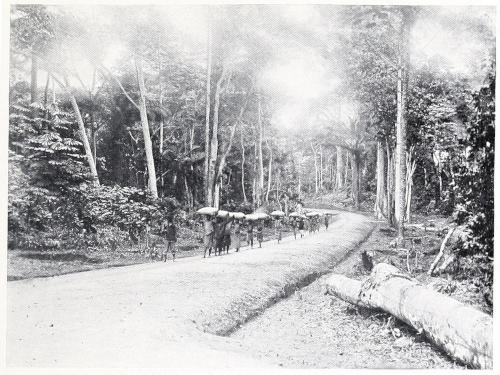
COCOA CARRYING, BELGIAN CONGO.
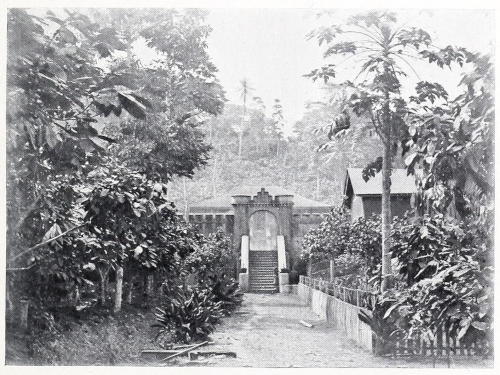
ENTRANCE TO COCOA ROÇA, PRINCIPE ISLAND. (PORTUGUESE.)
MAINLAND SLAVERY
Portugal shares with every other West African Power the problem of shortage of labour and with it the short-sighted energy of the impatient employer, who, beyond the ken of the official eye, frequently resorts to illegal means for increasing his supply. Domestic slavery survives in Portuguese Angola as well as in Nigeria, and in Belgian and French Congo. One can only estimate very roughly the slave population of Africa, but probably not less than a million human beings are to-day ignorant of the blessings of personal liberty. Mr. Nevinson, in his admirable book on “Modern Slavery,” says of Angola alone, “including the very large number of natives who, by purchase or birth, are the family slaves of the village chiefs and other fairly prosperous natives, we might probably reckon at least half the population as living under some form of slavery.” We cannot acquit many Powers in Africa from the charge of profiting administratively from this form of human chattelage, but when Portugal sets up a tu quoque plea we are compelled to differ. The dividing line between the Powers is that whilst many of them profit by this practice occasionally and for restricted periods, the Portuguese descend to the lowest level, adopt the native practice themselves and thus become not the “hirers,” but the owners. In this way they endeavour to meet their interminable shortage in the labour supply. To what lengths they are prepared to carry this system may be gathered from the report of Professor A. Prister in the Hamburger Fremden-Blatt for 28th July, 1906:—“In Angola, even in San Paolo de Loanda, under the eyes of the Governor, the Bishop and the high officials,” he alleges, are to be found “regular ‘bridewells’ for the production of slaves.” One of these, he says, he visited on the estate of “one of the richest Portuguese,” sixteen miles from Loanda. There he saw a large number of women, with only a few men, at work. “Each woman has a little hut, in a courtyard enclosed by a wall, in which she lives with her young ones. The woman is always pregnant, and carries her last child on her back, during work, in Kaffir manner. The overseer of this plantation, who treated me in every respect with Portuguese friendliness, and took me for a great admirer of his breeding establishment, told me that about four hundred negroes were there, and added with a laugh that he had over a hundred young ones in the compound. This is just as if a cattle-breeder were boasting of the fine increase in his herds. When the young one is so far grown up that he can be put to some use, at from six to eight years of age, he enters into a so-called contract, or he steps quite simply into the place of a dead serviçal. For instance, Joseph is told that his name is no more Joseph but Charles, and immediately the dead Charles is replaced. He never fell ill; he never died; he only lives a second life.” It is to be hoped that such incidents are rare even in Angola, but it brings home forcibly to the British mind the sort of colonies the “matchless navy” of Great Britain may be called upon one day to defend.
CONTRACT LABOUR AND SLAVERY
Certain apologists of the Portuguese are very fond of comparing the British indentured labour system with labour conditions on the Angolan mainland and the islands. The labour system of the East and West Indies are by no means ideal, but there is a world of difference, not only in the daily management of this labour, but fundamentally.
In San Thomé the contracted labourer from Angola is a slave: he calls himself a slave, and the Mozambique free man holds him in contempt as a slave; either he was captured, or purchased on the mainland with cash by the plantation owners just as men purchase cattle or capture wild animals. Every single slave with whom I spoke, both on the mainland and on the islands, gave me the clearest account, replete with convincing detail, of the manner in which he or she had been either kidnapped or purchased. Not a few of the slaves had “changed hands” several times before the ultimate sale to the planter.
The Slave’s Case
In the back streets of Angolan ports, on the highways of Lobito and Benguella, and in the shady by-paths of Catumbella, the traveller may at any time penetrate the secrets of the tragedies which attach themselves to the souls of men and women who have lost their freedom. The same tragedies but with attendant secrets darker still, are locked within the breasts of the slaves on the Portuguese cocoa islands in the Gulf of Guinea. There by the roadside, on the banks of crystal streams, up in the cocoa roças, and along the valleys thick with cocoa-trees, the traveller has abundant opportunities for penetrating the secrets of the miserable slaves.
THE VOICE OF THE SLAVE
Behind the mountainous coast of Angola, the town of Novo Redondo hides itself in a hollow, as if ashamed of its history, or perhaps so that its traffic in human beings during past centuries might escape the attention of watchful cruisers. There, amongst a group of slaves and freemen, I met a woman with a story more eloquent than others because it was also so recent, so vivid and so forceful. She had not been long on the coast, for only a few months ago she had for the first time witnessed the Atlantic breakers tossing themselves with their impetuous fury on that strip of rocky shore. The hour was that of the mid-day rest, and the woman was sitting sadly apart from the other labourers. A glance at her attitude, coiffure and other characteristics rendered her a somewhat singular figure in that group of serviçaes, still there was a familiarity which surely could not be mistaken—somewhere in Central Africa those cicatrized arms, that braided head, had a tribal home.
“True, white man, I have come from far; from the land of great rivers and dark forests.”
“How were you enslaved?” I asked.
“They charged me with theft and then sold me to another tribe, and they in turn to a black trader. This man drove me for many ‘moons’ along the great road until a white man at D⸺ bought me and sent me here.”
“Where am I going now? Who can tell? I suppose I shall be sold to a planter.”
There was no need of the slave’s reiterated assertion that she had been nearly ten months marching down to the coast; the locality of her tribe was plainly set forth on the forearm by the indelible cicatrizing knife of her race. The journey from the Batetela tribe of the Congo to the shores of Novo Redondo cannot be much less than 1,500 miles. This was one of the most recent cases we discovered and shows that the slave trade in Portuguese territory is a question of the moment.
Fifty years ago, it is said, a ragged urchin ran the streets of San Thomé, holding sometimes for a five reis piece, sometimes for as many kicks, the heads of mules and horses for the affluent slave-planters of that island. That ragged urchin to-day possesses a mansion in three capitals of Europe, and a stately car rushes to and fro with the sovereign lord of some thousands of slaves. The sycophants, time-servers, and others of the crowd of parasitic admirers, who cluster round this august person, care little for the misery beneath that sordid splendour. His wretched slaves spend their days from 5.30 in the morning until sunset cultivating cocoa, that their master may fare sumptuously every day in Europe, and finance dethroned Royalty which is not ashamed to use these ill-gotten funds in half-hearted endeavours to regain a discredited crown. The slaves know nothing of this; one thing only they know is that when the bell rings at sunrise they must devote their energies to the production of the cocoa bean until sunset, and that this weary monotony has in it not a glimmer of hope of cessation.
Along that picturesque road, known as the Mother of God road (philosophers might give us some reason why the slavers in all history annex the Holy Virgin), we once met a group of slaves with a sadness written on their faces which seemed almost to cry out, “We are lost souls.”
“Are you well fed?”
“Yes, white man, we are fed.”
“Housed?”
“Yes.”
“Are you freemen?”
“No, we are only slaves.”
“Would you like your liberty?”
“Aye, would we not, but Master won’t liberate us.”
Amongst that group was one old man quite grey, who declared he had been on the islands over thirty years, and his conversation so interested me that I asked him to describe his journey to the coast. This, though a story over thirty years old, was full of terrible interest. The old man had by this time gained some confidence, and when speaking of the district where he was first sold I became convinced that his home was in the far hinterland of the Congo. With unexpected suddenness I startled him by uttering one of the rhythmic morning greetings of his native tongue. The old man started at first, as if struck with a whip, then, like a man half awake, he appeared to reach after some unseen thing; then at last it suddenly broke in upon him that the language he had heard was the music of his boyhood; his wrinkled old face was wreathed in smiles, his tired eyes lit up, and then in short animated sentences he poured forth question after question.
“Oh! white man, tell me about Luebo, tell me about Basongo.”
“Tell me is Kalamba still alive?”
The impetuosity of the questions, the lively gestures, the hungering look in those brown eyes showed how the old man thirsted for information of his little village away on the banks of the broad Kasai.
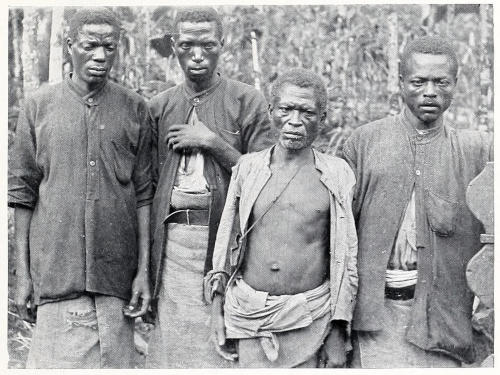
SLAVES ON SAN THOMÉ.
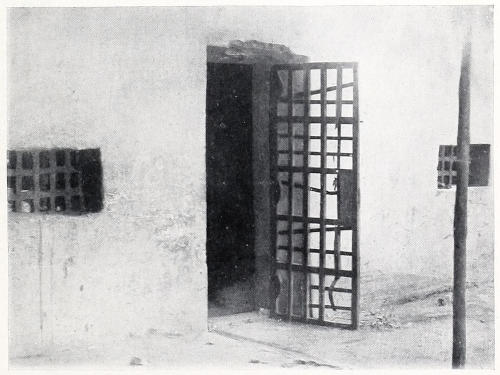
DISUSED SLAVE COMPOUND IN REAR OF HOUSE, CATUMBELLA.
The island of Principe has a horror all its own, for it is infested with the dread sleeping sickness. Conditions are so bad that the Portuguese dare not send the free labourers from Mozambique, lest their current of labour from that part of West Africa should take alarm and cease. White men and women are fleeing from danger, but the authorities still keep slaves within biting distance of the fever impregnated fly. Dr. Correa Mendes, a courageous Portuguese medical authority, has urged that every living animal should be killed as the only hope of saving Principe; but none have yet dared to propose the liberation of the slaves.
The slaves of Principe present an even more melancholy appearance than do those of San Thomé. They appear to possess an instinctive knowledge that they are confined in a death-trap, and their appeals for liberation are piteously violent.
I cannot readily forget a conversation with four young slaves on Principe. Of these, but two had known freedom; the others had been born of slave parents. On the features of one, the traces of sleeping sickness in an advanced stage were plainly marked, and though still labouring at his task, it was plain that death had already marked him for its own.
I asked the usual questions.
“Are you well fed?”
“Yes, Senhor.”
“Clothed and housed?”
“Yes, Senhor.”
“You are not flogged or beaten?”
“Oh! are we not!”
“But I am told the planters never beat you.”
“Tell me then, Senhor, how was this deep wound caused?”
In support of this statement the whole group of slaves chimed in with exclamations and assertions that they were constantly flogged and beaten.
“Do you desire your freedom?”
“Senhor, why taunt us? Did you ever know an African who did not love his home and country?”
“Well, I think there are people in Europe who will endeavour to emancipate you.”
“Senhor, I fear when you get on yonder ocean, you will forget the poor slaves of Principe and San Thomé!”
This latter reply was uttered with so desponding a note that I ventured to make the slaves a promise, which British honour—no less than British responsibility—should see fulfilled.
“Listen, I am now going to Europe and shall soon meet the liberty-loving British people. I know how they detest slavery; I know how they will struggle for your liberty. Take this promise yourselves—and pass the word round the plantations to the other slaves—God helping us, we will set you free within two years.”
The effect of this promise was good to behold, the eyes brightened, there was an elasticity in movement and grateful word of thanks as the slaves resumed their never-ending task. Even the slave in the fell grip of sleeping sickness appeared to share in the joy of a freedom he could not hope to experience.
Not all the slaves are purchased for plantation work, as the following typical instances will shew. Beautiful black women have their price. The day was indeed a hot one as I strolled along the shores of the Atlantic below the mouth of the Congo, when a finely-built young woman met me. Originally captured over 2,000 miles away, her fine figure and bright features had obtained for her captor a high price as “domestic” for the white man. To him it was nothing that she longed to exchange her captive life for that home away in the far interior, or that the roar of the waves was a perpetual reminder of the gentle lappings of the lake shore of Tanganyika. The woman was his slave, purchased with “honest money”—his slave until he ceased to want her, and then—well, he would sell her to the nearest planter and buy another, for healthy young girls are always marketable not only in Portuguese territory but in other parts of West Africa.
Another day two white-clad European travellers might have been seen moving in and out amongst the villages outside a Portuguese town of Angola, exchanging greetings with half-dressed natives. Presently it is realized that this is no casual visit of curious strangers, for it is obvious that the white man’s handshake is but an excuse for a closer scrutiny of the arm, the temple, or the chest, and the natives gather round the travellers as they proceed from group to group. Something now arrests attention, for the white man is sitting down amidst a party of four or five women.
In a few minutes confidence has been gained, and the women submit to an examination of certain marks cut years ago on their arms and foreheads. The white man first tries a sentence in a tongue unknown to the group of interested onlookers, but there is no response from those to whom it was addressed. He tries another, and there is a sudden silence; all eyes are directed to a woman who, after a faint cry of amazement, is gazing fixedly into space, for the white man had by that sentence struck a chord silenced by long years of sorrow and suffering. The woman gazed on silently and intently as if trying to recall a half-forgotten past. She travels in thought back over yonder mountains, across the hot plain, and on by rippling streams and through valleys thick with ripe corn, away across the Cuanza river, on for months to Lake Dilolo, where she sees again as in a vision the white man who bought her from the native slave-trader. In fancy she leaves the cornfields of Angola, crosses the upper Kasai, and is away north beyond Lusambo, and westward to the little Congo village with its deep green plantain groves and manioca fields.
A remark breaks the spell, and she realizes that it was but a dream, for she is still a captive; but the white man speaking her native tongue is no dream—he is still there speaking the language that sounds like the far-off music of another life. The light of hope dawns in her eyes as she turns on the traveller, pleading, “White man, can’t you take me home?”
THE PLANTERS’ CASE
It must not be supposed that all the San Thomé planters on the island believe in, or defend, present conditions, any more than it must be supposed that, without exception, they are habitually guilty of inhuman maltreatment of the slaves. The charge of maintaining slavery most of them emphatically deny, and in support of their contention point to legal contracts which cover the original transaction by which the labour was obtained. They also remind the investigator that the labourers are paid. There are, however, some honest planters who admit that the original “contract” was not altogether genuine, and the statements made by the planters and the slaves respectively with regard to the wages paid, differ so absurdly that one is compelled to dismiss both.
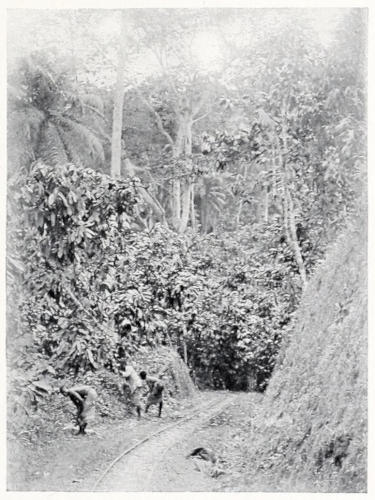
SLAVES ON COCOA ROÇA, PRINCIPE ISLAND.
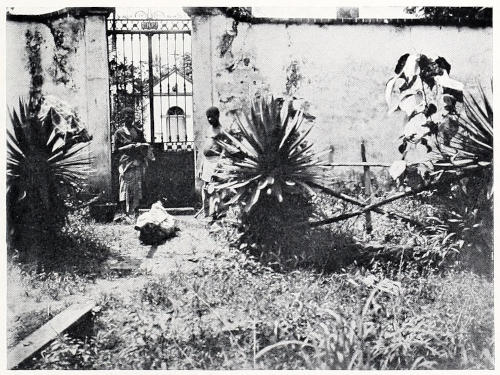
THE END OF THE SLAVE. TWO SLAVES CARRYING DEAD COMRADE IN SACK TO BURIAL.
To many managers definite acts of cruelty would be highly repulsive. It is furthermore very obvious that not a few owners and planters do everything which science and money can provide to make the lot of the slave a happy one. The planters argue with much warmth and sincerity of conviction that the labourers are better housed, fed, and clothed on the plantations than they would be in their mainland villages. Their melancholy demeanour and their insistent desire for liberty, the low birth rate and frightful mortality amongst the slaves is put down very largely to the gross obstinacy and stupidity of the enslaved negroes.
If the planters are questioned upon the desire of the slaves to regain their liberty they reply that this would be an act of injustice because many of the labourers have forgotten the districts from which they were originally “recruited” and that even if complete repatriation were carried through the men and women repatriated would probably fall a prey to evil influences on the mainland.
The attitude assumed by the Portuguese authorities towards the question of slavery in their West African colonies has hitherto been first of all one of inferential denial that slavery exists, and secondly they call attention to the elaborate regulations framed for protecting the natives from any infringement of their liberties.
On paper, the labourers are contracted for short periods of service in Angola and the cocoa islands; are said to have a happier lot than any other contract labourers in the world; and that any who so desire are free to return to their homes at the termination of their contracts. A great deal more is on paper which, if practices only accorded with the minimum of professions, would assure the cessation of slavery in Portuguese West Africa.
Perhaps nothing written in the earlier days upon this question has brought out so forcibly the “ownership” feature of labour conditions as the disclosures made in the Cadbury—Standard libel action. In that trial Sir Edward Carson called attention to a circular forwarded to Messrs. Cadbury referring to the sale of an estate in San Thomé. The stock enumerated included one item, “Two hundred black labourers ... £3555.” This gives the average price of the slaves as £18 per capita, taking the sick with the healthy and the young with the old. Various prices are quoted as the value of the slaves, but this depends, of course, upon physique, sex and age. Mr. Joseph Burtt, the Commissioner of the cocoa firms, gives £25 to £40, whilst Mr. Consul Nightingale stated £50 as the average price. When in Portuguese West Africa several of the slaves were even able to tell us the prices at which they were purchased by the different middlemen, and occasionally even by Portuguese themselves.
The evidence now to hand of the existence of both the slave-trade and slavery is overwhelming.
SIR EDWARD GREY’S “BEYOND DOUBT”
On November 22nd, 1909, the Portuguese Foreign Minister called upon Sir Edward Grey, apparently with the object of discussing this question, and in conversation the Foreign Minister informed M. Du Bocage that the information he “had received from private sources placed beyond doubt[10] the fact that it had been the custom for natives to be captured in the interior by people who were really slave-dealers; the captured natives were then brought down to the coast and went to work in the Portuguese islands.”
On the 26th of October last, Sir Arthur Hardinge, whose intimate knowledge of slavery questions is probably unequalled, informed the Portuguese Minister for Foreign Affairs that when he was in Brussels, he “had heard serious complaints in official circles at Brussels of the way in which slaves were kidnapped by Angola caravans from the Kasai district of the Congo, which shewed that the charges made did not emanate solely from missionaries or philanthropic sentimentalists.”
In July, 1909, an exhaustive series of regulations were issued from Lisbon. The 139 articles covered almost every actual and conceivable feature of the whole labour question, but as Mr. Consul Mackie pointedly remarked—
“The Angolan native ... is contracted in a wild state under circumstances of doubtful legality, and is so convinced that he is a slave that nothing short of repatriation, which should therefore be compulsory, would serve to persuade him that, at least in the eyes of the law, he is a free agent. It would obviously be useless to argue that the ‘serviçal’ is not a slave merely because he is provided with a legal contract, renewable at the option of his employer, in which he is officially proclaimed to be free.”
The evidence, therefore, that the Portuguese colonial labour systems are pure slavery is confirmed (a) In a British Law Court, (b) by the British Foreign Minister, (c) by the British Consul on the spot, and (d) by Sir Arthur Hardinge. Could anyone desire more emphatic evidence than is now provided? and this does not exhaust the available sources, for even the Portuguese themselves have now been forced to admit that the slave-trade is very much in evidence.
Writing to Sir Arthur Hardinge on October 23rd last, the Portuguese Foreign Minister admitted that there was—
“Slave-traffic with the inhabitants with Luando, in the district of Lunda.... It was ascertained that in reality the Bihean natives were in the habit of settling their debts and disputes by means of ‘serviçaes.’ Two convoys proceeding from Luando were captured, and the serviçaes handed over to the delegate of the Curator concerned, to be retained until claimed by their relatives, to whom the necessary notice was sent.”
It is instructive to note that the Portuguese Minister in this passage makes no distinction between serviçaes and slaves, yet when unofficial critics declare that in practice the terms are indistinguishable, they are condemned for deliberately confusing the public mind. It is also of importance to bear in mind that the Lunda Province is included in the territories which come under the operations of the Berlin Act, whereby every European Power is under the most solemn responsibility to secure throughout these territories the abolition of slavery.
PORTUGUESE OFFICIAL ADMISSION
There is further the evidence, from a Portuguese source, in the fact that in 1911 eleven Portuguese are reported to have been expelled for engaging in the slave-traffic. The Governor of Angola informed Mr. Drummond Hay that nothing severer than the order of expulsion was administered owing to the lack of “conclusive evidence,” but four months later the Portuguese Foreign Minister admitted that the Europeans “by the inquiry were found guilty of acts of slave-traffic.” Sir Arthur Hardinge pointed out that
“the 5th article of the Brussels General Act contemplated severer penalties in the case of persons engaging in the slave-trade than an order of expulsion before trial or a prohibition to return to the colony, which such persons, if convicted of a serious criminal offence there, would hardly need.”
When, therefore, the long stream of unofficial testimony upon the existence of the slave-trade and slavery in the Portuguese colonies is confirmed in turn by the British Minister at Lisbon and by the British Consul of Angola, and moreover when Sir Edward Grey, who always chooses language with exceptional care, officially informs civilization that the charges are proved “beyond doubt,” and finally when the Portuguese authorities are driven to admit it, then surely the time has come to cease gathering evidence and to set about some substantial and far-reaching measures of reform.
To meet a situation which is a grave international scandal and a potential menace to European peace, what do the Portuguese offer to civilization? They claim good treatment of the labourers, humane regulations and repatriation of the slaves.
It is common ground that the slaves upon the islands are, generally speaking, well fed, housed and fairly well clothed, but the slaves themselves are emphatic in their assertions that they are frequently beaten. This the Portuguese deny, but those who know West Africa are perfectly well aware that it is impossible to keep something like 40,000 slaves working on the cocoa farms at the rate of “a man per hectare” without a considerable amount of “pressure.”
The regulations are exhaustive upon every feature of the labourer’s life except emancipation, from the time he is “recruited” until he is buried, but as Mr. Consul Mackie has recently pointed out, “The absence of any (regulations) for the return journey in the event of the labourer declining to accept the conditions of the contract is somewhat suspicious.” That the keeping of statistical records is part of the ordinary administrative routine is a common-place, but that this elementary duty may be performed, a regulation was issued three years ago, yet to this day that instruction has never been carried out, with the result that no reliable information is possible with regard to the birth and death rates.
MORE REGULATIONS
According to regulations, every labourer’s history is carefully recorded and the fullest details endorsed upon the contract, yet in the case of 135 out of 163 slaves repatriated in the early part of last year it was impossible to state how long they had been upon the islands. This is not only a further evidence of the futility of Portuguese regulations, but it constitutes additional evidence as to the fictitious nature of the supposed “contract systems.”
To the tragedy of slavery on Principe is added the ever present horror of sleeping sickness which is everywhere raging on the island. To the lasting disgrace of the Portuguese Government it still permits the retention of slaves on the island where conditions are so bad that, as I have already pointed out, the eminent Dr. Mendes has advised the killing of all the cattle on the island in the hope of checking the ravages of the disease. Here again the Portuguese Government has been content to meet the situation with paper “regulations,” which would be comic if it were not for the distressing condition of these wretched slaves. According to these regulations all the slaves “must wear trousers to the heel, blouses with sleeves to the wrist, and high collars ... they must wear on their backs a black cloth covered with glue!” It is barely necessary to state that these regulations are openly disregarded in every particular.