PART I (continued 2)
Reading edition
There is evidence that the position maintained by the Christian Churches as a whole upon this aspect of its work leads to widespread immorality amongst Church members, but wherever it becomes too notorious, the delinquents are, with certain exceptions, excluded from membership. It will be readily seen therefore that should any single Christian denomination once lower its standard in this respect, converts would flock to it in thousands. The African Church does this, and springing from the people themselves, meets the situation. Its members probably represent the Christian natives of the near future in Southern Nigeria, men for the most part commercially successful, boldly solving their own problems, living an easy-going and comfortable life, their religious standard lowered to their own desires. Can we criticize them? If we do, we must beware, for they will tell us that it is more honest to live open polygamous lives than the fraudulent lives of professing Christians—white and black—whose hypocritical attitude, particularly on sex questions, is a by-word on the West Coast of Africa. I fear there is too much truth in this retort. White men, at least, must hold their peace, and there lies the greatest danger!
POLYGAMY AND THE BIRTH RATE
It is generally accepted that polygamy is productive of a high birth rate, and Sir William Muir has given this as one reason for the almost miraculous advance of Mohammedanism. It may have been, and may still be true to-day of Mohammedanism that polygamy produces a high birth rate, but that existing polygamists in tropical Africa to-day produce a greater number of births than monogamists is, I am satisfied, open to serious question. At the same time I think it is clear that prior to European occupation, polygamist Africa maintained a higher birth rate than is possible under modern conditions.
The reason for this is not far to seek, for the chiefs, possessing as they did unrestricted power over the community, could terrorize into complete submission every unit of the tribe. Wherever polygamy existed the wife was kept faithful to the one husband by the knowledge that unchastity was forthwith rewarded by instant death. The young men also knew that a liaison meant either that they were sold into slavery, involving in all probability ultimate sacrifice, or they would be hanged on the nearest tree.
This is so even to-day amongst those tribes beyond the reach of white men. One day, when crossing towards the main Congo river, I suddenly heard wild shrieks from a person evidently in great danger. Rushing to the spot, I found a woman bound hand and foot, and standing over her was a burly young chief with an executioner’s knife raised aloft. In a moment more that woman’s head would have been hacked off had I not promptly gripped the man’s arm. With a terrible oath he attempted to spring upon me, but the headmen of the village, who had also hurried to the scene, fell upon him and wrenched the knife from his hand. For a quarter of an hour nothing would stay the man’s fury; it took six of us to hold him. Ultimately, however, he calmed down and explained to me that his wife had been unfaithful and that she merited the death penalty. I gave him some presents to appease him further and he agreed to forgive the woman if I would “reward him.” As the gift he asked was to me a trivial matter, and the only chance of saving the woman’s life, I gave it to him. The woman herself, in gratitude, at once wrenched from off her wrists a bracelet which she presented to me as a keepsake. I fear, however, that after I left the village, she suffered a cruel death for her unfaithfulness. It will be readily seen that these conditions are only possible in regions where there is no restraining hand.
The question of the birth rate under monogamist and polygamist marriages in West Africa has always been of absorbing interest to me and my diaries are full of jottings bearing upon the subject, but very few are worth a permanent record. Amongst the Christians of Accra many monogamists have considerable families and from personal observation twins appeared to be fairly frequent. In the hinterland, we were informed, that the “baku”—or tenth child—is by no means rare amongst the “Twi” people. The largest family we found amongst the monogamists of the Bangalla region of the Congo was five children, the average appearing to be three. But West Africa is very weak in reliable statistics.
In our recent journeys, I selected four areas and obtained with some accuracy the composition of several groups of villages. It was impossible to accept the figures from some districts because the people, fearing there was some subtle move behind our requests, either gave evasive replies or figures which were obviously inaccurate.
The following six groups, however, are reliable. They were gathered from areas hundreds, and in one case over a thousand miles apart:—
Men. Women. Average woman per man. Offspring. Average per man. Average per woman.
Boys. Girls. Total.
Five Hinterland Villages of the Kasai.
A 241 316 1.315 70 81 151 0.626 0.477
(201 monogamists)
River-side Villages on the Upper Congo.
B 26 45 1.875 14 15 29 1.115 0.644
C 41 54 1.317 5 4 9 0.222 0.166
D 16 42 2.625 10 6 16 1 0.380
Hinterland Village, Upper Congo.
E 31 69 2.225 23 20 43 1.387 0.623
Remote Hinterland Village, Upper Congo.
F 196 319 1.627 171 148 319 1.627 1
In group “C,” the principal polygamist possessed fifteen wives, but only two children. Sixteen monogamists had no children.
Group “A” is taken from the Kasai, where monogamy most widely prevails, but of the two hundred and one monogamists, one hundred and three had no children. The principal polygamists possessed six, eight and thirteen wives respectively. The two first had no children at all and the chief with thirteen wives had two boys and three girls.
From these figures no deduction is possible as to the advantage of either polygamy or monogamy upon the question of birth rate. One deduction only is clear.
The birth rates in the following order are with estimated distance from effective civilized Government:—
Average birth-rate per woman. Distance from effective civilized Government.
Group C 0.166 10 minutes’ walk
” D 0.380 30 ” ”
” A 0.477 1 hour’s ”
” E 0.623 1 ” ”
” B 0.644 1½ ” ”
” F 1 2 days’ ”
The birth rate figures are lamentably low, and being selected from areas so widely apart give anything but an encouraging indication for the future of the Congo. The deductions from these figures is unmistakable and only confirms what one hears everywhere, not only in the Congo but all over the West Coast of the utter demoralization which is flooding these territories.
The Congo is by far the worst. Europe was staggered at the Leopoldian atrocities and they were terrible indeed, but what we, who were behind the scenes, felt most keenly was the fact that the real catastrophe in the Congo was desolation and murder in the larger sense. The invasion of family life, the ruthless destruction of every social barrier, the shattering of every tribal law, the introduction of criminal practices which struck the chiefs of the people dumb with horror—in a word, a veritable avalanche of filth and immorality overwhelmed the Congo tribes.
THE ONLY HOPE
To-day one sees the havoc which King Leopold created when he let loose upon the Congo tribes the scum of Europe. None have escaped the infection; girls of tender years and even boys not yet in their teens delight in practices of which in the old days the chiefs would have kept them in complete ignorance for another five years. Upon the women the results have been by far the most revolting, for in the Congo the majority of women have lost their womanhood and have fallen into a daily condition from which even the beasts of the forest refrain.
The truth is that in the greater part of West Africa neither monogamy nor polygamy is the prevailing relationship between man and woman. Doctors, administrators and missionaries all know it, and are all powerless at present to bring the situation under control. It is useless for the administration to make laws for practices beneath the surface, the only thing the officials can do, and should do without delay, is to see to it that an ever higher example is set to the natives. This is where the Belgian and French Congo officials have failed so utterly.
The Christian missionary alone touches the evil, and though he is defeated again and again, he plods steadily on preaching a perfect chastity—too lofty a standard for most natives at present—but without doubt gathering round him an ever increasing number not only of men but of women who, apart from occasional lapses, set a bright example to the whole countryside.
MOTHERHOOD
The birth of children is in primitive Africa rarely attended by anything abnormal. If a native nurse is confronted with complications, she immediately throws up the case in despair and appeals to the witch doctor, but normally the birth of children is taken as quite an ordinary part of the daily life. One day we were passing through a native village, and there, lying on a plantain leaf, were two chubby little twin girls but half-an-hour old; the mother was sitting close by “resting.” This picture was so beautifully simple that my wife went with a boy to bring up the camera and plates, but on arriving at the spot in about twenty minutes the woman had picked up her twins and carried them home! That is primitive Africa, but in the coast towns where African womanhood delights in corsets and other European follies, the suffering at childbirth is in many cases almost as acute as that amongst the European community. With several Congo tribes, the belief is firmly rooted and put into practice that in order to change the colostrum flow to that of milk, co-habitation is essential.
With many tribes throughout West Africa, the period of lactation is prolonged; frequently the mother nurses the child until it is two, three, and even four, years old. A case of adultery was brought before the District Commissioner’s Court at Ikorodu in Southern Nigeria in April last year, and in the evidence it came out that the accused woman was suckling a child four years of age. The District Commissioner ordered her to cease nursing the child within three months.
The death rate amongst the young children in West Africa is very high and no doubt arises from the deplorable manner in which they are brought up. There is practically no attention given to diet or cleanliness, with the result that any disease which attacks a family quickly spreads through the community.
Amongst the Dagomba of the Northern territories of the Gold Coast colony, the woman who has given birth to a child leaves her husband’s compound and goes to that of the father-in-law, taking the child with her, where they stay for a year. At the end of this period the wife and child return to the home of the husband and father.
Twins
TWINS
It is a mistake to assume, as some writers do, that the taboo on twins is a prevailing custom amongst West African tribes. The distribution of the taboo is extremely erratic. Twins are unwelcome in the Northern territories of the Gold Coast, yet the reverse is the case amongst the Egbas of Nigeria. In the Congo territories, twins cause the greatest joy to a tribe and the mother is lauded wherever she goes, whilst amongst the tribes of the oil rivers of Nigeria, the birth of twins is regarded as the most fearful calamity which can fall upon the community.
In the Upper Congo regions, the traveller may frequently see two earthenware pots hoisted on forked stakes which have been driven in the ground, one on either side of the path, and these are in honour of twins born in the nearest compound. Every person passing by those pots will religiously pluck two leaves and throw one at the foot of each forked pole as a votive offering to “Bokecu” and “Mboyo,” as all good twins are named.
The tragedy of the oil rivers is one of the most distressing in West Africa. Throughout the Eastern, and to a considerable extent of the Central Province, the cruel custom prevails of putting to death one, sometimes both twins. The British Government spares no pains in the effort to combat and overcome these practices, but though much good has resulted, the custom still holds its own.
Not only are the children killed, but the mother is immediately driven from home for she is no longer regarded as a chaste woman and rapidly becomes an outcast from Society, living upon the proceeds of prostitution. In some districts, however, this custom is less rigorous, and the mothers of twins are allowed to form isolated villages and to engage in trade. Some tribes, again, whilst driving them from the homes of their husbands, permit them to engage in agricultural pursuits upon the husband’s lands.
The missionaries are doing much towards weaning the tribes from this murderous practice. One missionary society working amongst the Ibunos, a tribe of five thousand people, claims that through the conversion to Christianity of a large section of this tribe, the horrible practice of murdering the twins and making the women outcasts has ceased. It is of course difficult to control absolutely a statement of that kind, but it is only the Christian missionary who can hope to deal effectively and permanently with a subterranean evil like twin murder.
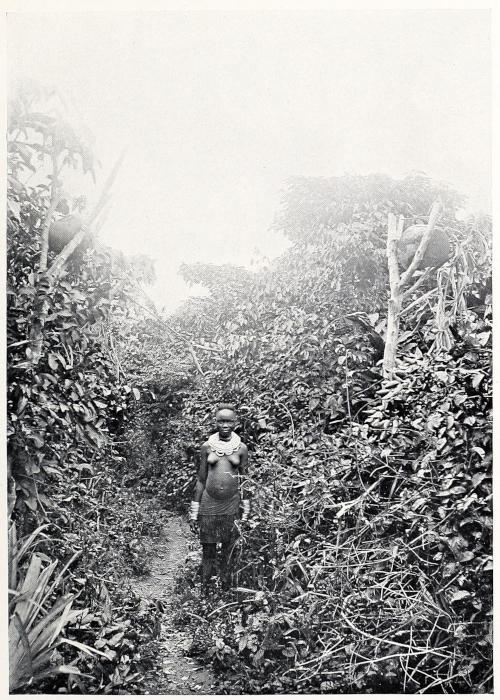
“TWIN POTS” HOISTED ON FORKED STICKS EITHER SIDE OF PATHWAY, IN HONOUR OF NEWLY BORN TWINS, BANGALLA, CONGO.
An interesting custom which survives in the Upper Congo is that a man may never see or speak to his mother-in-law, and should he by accident turn a corner in the village compound and meet her face to face, he must at once send a propitiatory offering. If she should come into the house where he is sitting, he will promptly raise a mat and hold it between them, so that they may not see each other.
On the whole the lot of the African woman is a hard one. She has her occasional pleasures it is true, but from childhood hers is a lifelong drudgery with, however, the one sure recompense, that in old age it is the joy and the privilege of the younger generation to support her.