PART III (continued 2)
Reading edition
Finally the Portuguese point to their highly-regulated system of repatriation. Sir Edward Grey and Sir Arthur Hardinge have emphasized that “one excellent test” of a desire for reform “will be the rate and method of repatriation.” Since the year 1888 some 67,614 slaves are known to have been shipped to San Thomé and Principe from the Angola mainland, but it is also known that a good deal of smuggling has been carried on. Then, too, there are some slaves born on the islands prior to the year 1888, and these are claimed as the property of the planters. At the same time the death rate has been very high and the birth rate extremely low, with the result that the estimate of the slave—or according to the Portuguese the Angola serviçal—population of about 37,000 is probably fairly accurate.
In 1903 a repatriation fund was established with the object of providing the repatriated slaves with a sum of money upon their landing again on the mainland, and there was a further complicated arrangement which could have no chance of being effectively carried out, whereby “recontracted” slaves should receive their bonus in 6 per cent. instalments every quarter. This was no philanthropic contribution, but actually represented a regular deduction of 50 per cent. from the “wages” of the slaves and serviçaes, until May, 1911, when the deduction was raised to two-thirds, leaving the labourer only one-third, and as most of the slaves appear to die prematurely, the benefit they receive from their “wages” is a negligible quantity.
From the year 1903, when this fund was instituted, until 1907 these deductions from wages were actually left in the hands of the planters. In December, 1907, they admitted to holding £100,000—a not inconsiderable capital fund for working their plantations. In 1908 the fund was transferred to the Government bank, but in the autumn of that year it had by some means, yet to be discovered, shrunk to about £62,000. After about nine years’ working this fund stands to-day at approximately £100,000.
METHODS OF EMANCIPATION
In Sir Edward Grey’s despatch to Sir Francis Hyde Villiers of November 3rd, 1910, he pointed out that public opinion would be favourably impressed with a “regular and satisfactory” method of repatriation. During the early part of this year 900 slaves were repatriated to Angola and 500 more were due to leave at the end of June. Probably, therefore, it may be safely estimated that since 1908 something like 2000 will have been returned to the mainland before the close of this year, but even so this still leaves something like 35,000 still in slavery. Though this “rate of repatriation” shews some improvement, it cannot be regarded as satisfactory in view of the fact that unless it is materially accelerated, it will take not less than twenty years to liberate the whole of the slaves on the two islands.
Turning to the method of repatriation, it is clear that this is being carried on in the most inhuman and barbarous manner. When we were at Benguella, the condition of the repatriated slaves was so distressing that we offered the Governor a sum of money to provide the miserable creatures with food and medicine. This His Excellency could not receive, nor could he allow the Curador to accept it.
The planters, realizing that civilization demands that “repatriation” should take place, are just now permitting it, but they are at the same time doing everything in their power to discredit it. There is some evidence that they are only liberating the sick and worn out, for of twenty-eight slaves recently liberated, whose ages were known, Mr. Consul Drummond Hay tells us their average age was forty-two years, and their period of labour on the islands averaged thirty-one years.
The Portuguese journal Reforma in its issue of August 19th, 1911, exposes in convincing language the condition and real objects of this so-called repatriation:—
“The greater part of these ‘serviçaes’ were put on board without being told what their destination was, and without any money.
“The first batches that came here had some money—one of them had 150,030 reis (£30)—but the last lots arrived without any; thus some were expatriated instead of being repatriated.
“These people did not bring a single penny, and it was through charity alone that they received food and shelter. Almost every one of these unfortunate people, who have done twenty years of hard labour, arrived in ruined health, and some of them died shortly after their arrival.
“It is probable that this form of repatriation is a stratagem which will, on account of the protests that will be raised against it in this province, enable the planters to argue that repatriation is unproductive of any good results, and that the truth is, as they have said all along, that people who have once gone to those islands never want to leave them again, well knowing that they could not find a better spot in this world.”
THE “ARRIÈRE PENSÉE”
The Brussels Conference of 1890 foresaw this danger and made provision for it in Articles 52 and 63. The latter stipulated that:—
“Slaves liberated under the provisions of the preceding Article shall, if circumstances permit, be sent back to the country from whence they came. In all cases they shall receive letters of freedom from the competent authorities and shall be entitled to their protection and assistance for the purpose of obtaining means of subsistence.”
Portugal was signatory with other European Powers to the Brussels Act.
Further evidence of the inhuman manner in which the slaves are repatriated appeared in the Portuguese journal, A Capital, of June last. The writer, Hermano Neves, reported that an officer on a Portuguese ship informed him that in one trip there were 269 liberated serviçaes, that of these unfortunate beings landed at Benguella only one was given any money; the remainder, unable to obtain employment and without money to buy food, were left to starve. “A few days later, there lay in the outskirts of Benguella, out in the open, no less than fifty corpses; those who did not or cared not to resort to theft in order to live had simply died of starvation.”
How comes it that in spite of endless “regulations,” almost every line of which boasts humane sentiments, and of a Government in Portugal which blazes upon the housetops its devotion to the cause of human freedom, these deplorable conditions prevail in the West African colonies? The reason has been advanced without any equivocation for years, namely:—the Portuguese colonies are out of control. Portugal may send a shipload of regulations out of the Tagus every week and the planters will welcome them—as waste paper. Some of us have said this for years and have suffered the inevitable abuse, but with the publication of the recent White Book, we actually find this contention corroborated by the Portuguese Government. Senhor Vasconcellos, replying to Sir Arthur Hardinge’s representations upon the abuses, admitted that:—
“The Governors whom he had sent out to give effect to its (the Government’s) instructions had been to a great extent paralysed by the power of vested interests.”
This is, of course, obvious to all those who realize the inner meaning of the fact that within ten years the cocoa islands have had something like twenty-five Governors. An admission of this nature by the responsible Portuguese Minister goes quite as far, if not farther, than the most extreme critic of Portuguese colonial administration.
The existence of slavery and the slave-trade now corroborated by officials of the first rank in London and Lisbon, supported by Consuls, and now by the Portuguese themselves, leaves no longer any need for unofficial persons to spend further efforts in an endeavour to establish the fact. Sir Edward Grey’s “beyond doubt” is in itself sufficient for the great mass of sane men. With the breakdown of the Portuguese regulations and the violation of international treaties, coupled with the Portuguese admission that their colonies are out of hand, what can be done to set free the slave in San Thomé and Angola?
BRITISH SUBJECTS ENSLAVED
The question is frequently asked what would be done if the slaves were set free. We are told that to dump down on the West Coast of Africa 40,000 penniless slaves originally drawn from homes in the far hinterland, might involve great hardship. We all agree, for we now know that thousands of slaves were obtained for Portuguese colonies from Belgian Congo, through the help of the revolted Congo State soldiery—a body of men numbering according to circumstances, from 1000 to 5000, who only kept up their rebellion by purchasing slaves with arms and ammunition from the Portuguese half-castes and natives. Again, no one can read the thrilling story by Colonel Colin Harding in “Remotest Barotseland” without being convinced that the Portuguese obtained many slaves from British territory. Lake Dilolo, the greatest of all the slave-markets, is but a comparatively short march from Rhodesia, and, in view of local conditions, it is inconceivable that natives of British Rhodesia have not been drawn into the slave-traders’ toils in that region. This feature has recently received an emphatic confirmation from Mr. F. Schindler, a missionary of over twenty years’ experience in Angola. He writes:—
“I have seen thousands of slaves coming from the Belgian Congo and Rhodesia being taken westwards by Bihean slave-traders and in some cases by half-caste Portuguese, and both by their tribal mark and by their speech I had no difficulty in recognizing them as belonging to tribes that are not found in Angola.”
How many of these slaves were, and are, enslaved on the mainland, and how many ultimately found their destination to be the cocoa islands, it is impossible to say, but we do know that generally it was the hinterland native which the slave-traders shipped to San Thomé and Principe. Moreover, some of us have seen these people of the Batetela and Kasai tribes on the roads and plantations of the islands, the cicatrized arms, legs, chests and backs plainly indicating their origin.
The first essential, therefore, is that of determining the countries of origin of the slaves on the islands. To whom can this task be assigned? Obviously not to the planters; it might be entrusted to a disinterested Portuguese Commission, but others have responsibilities and vital interests—Great Britain and Belgium would both possess, if not the right of membership, certainly the right to watch proceedings on behalf of any natives whom they had reason to believe had been obtained originally from British or Belgian colonies.
THE APPEAL FOR LIBERTY
The planter holds that the slaves are happier on the islands than they could ever be on the mainland; this interested and ex parte statement cannot obviously be accepted as final. The native, and the native alone, should be allowed to determine his, or her, destiny. I admit it is conceivable that a few slaves, for various reasons, would elect to stay with their owners, and no compulsion should be put upon such to leave the islands, but beyond all question the majority of the 37,000 slaves have a deep-rooted and a passionate desire to return to the homes of their birth. When visiting the cocoa islands in October, 1910, Mr. Consul Drummond Hay sent his interpreter amongst the slaves to ascertain whether they desired their liberty, and in his report to Sir Edward Grey says: “My interpreter went among the Angola ‘serviçaes’ and his inquiries as to whether they wished to be repatriated were mostly answered in the affirmative.” This, be it remembered, was said by the slaves on what are admittedly the show plantations. Take these slaves aside and engage them in conversation, and before many minutes have passed, the appeal will involuntarily burst forth, “White man, give us our liberty!”
Having ascertained the districts of Central Africa of those who desire emancipation and a return to their villages, it should then be the duty of the representatives of Portugal, Britain and Belgium, to see to it that their respective subjects are quickly and safely returned. Much has been made of the difficulties which would attend any schemes of repatriation, but in many quarters these difficulties have been purposely exaggerated. Given an honest desire to repatriate, the task would at once become simple. Take first the Angola natives. The Portuguese could, if they chose, send them back in batches of 50 or 100 for a given district; a body of such dimensions attaching itself to an up-country caravan, travelling under official protection and possibly with a small escort, would present too solid a company to permit of attack. Moreover, officials, traders and missionaries, might all be notified of such companies journeying from the coast and instructed to aid them as far as possible. The Lobito—Katanga Railway Company would doubtless be willing to give cheap passes to batches of slaves originally secured from the different centres through which its line now passes. It would be distinctly to their interest to do so, apart from humanitarian considerations.
We now know that providing the Portuguese Government would set at liberty the slaves originally captured from the upper reaches of the Kasai, the Belgian Government is prepared to send ships to San Thomé to carry them back to the Congo, transfer them to steamboats which would take them back to their homes, or at least within a day or two’s march. This journey could now be accomplished in less than a month, whereas several of the slaves obtained from Belgian territory informed us that their original journey in the chain gang to the coast had involved a tramp of considerably over one year. There is reason to believe that not only would Belgium undertake this task, but she would do so without requiring any financial return whatever.
The third and probably the smallest section of the slaves on the islands—British subjects—can assuredly present no difficulties. Great Britain could with the greatest of ease collect her slaves at San Thomé and transfer them to Rhodesia and Barotseland, via the Cape.
Portugal should be invited to send an international commission to West Africa, composed principally of Portuguese, but with a British and Belgian element, assisted by men experienced in the tribal languages and cicatrices of the hinterland peoples. This commission to be empowered to investigate the whole question and to issue freedom papers to all slaves appealing for liberty. In view of the advertised hatred in which the present Portuguese Government professes to hold every form of servitude, such commission might easily be appointed in friendly co-operation with the Powers primarily concerned. If this were done, the Portuguese Government and nation would at once merit and undoubtedly receive the warm appreciation and support of the civilized world.
A GRAVE STATEMENT
If, however, the Portuguese Government, after admitting their incapacity to control their West African colonies, refuse the co-operation of friendly Powers and maintain a system of labour which violates in several respects international treaty obligations, it is obvious that, however much Great Britain may regret it, she cannot continue an Alliance which may at any moment involve her in a position of the utmost gravity.
It would be idle to overlook the extremely serious nature of the statement made by Sir Edward Grey in the House of Commons on April 3rd, 1912. The Foreign Secretary then declared that the defensive treaty of alliance between Great Britain and Portugal, though it had not been confirmed since 1904, was, like all similar, treaties which, “not being concluded for any specified term, are in their nature perpetual.”
Thus it would seem that if any one or more Powers signatory to the anti-slavery clauses of either the Berlin or Brussels Acts, should awake to their clear rights and solemn responsibilities and proceed by any show of force to insist upon the abolition of slavery and the slave-trade in Portuguese colonies, the maritime and land forces of Great Britain could under this Alliance be forthwith summoned to protect these Portuguese colonies against the “Aggressors.”
There are some things impossible to the strongest of Ministers, and the Portuguese Government must realize that the British people, however much they might desire to do so, cannot allow the continuance of an Alliance with a Power which by persistent violation of international obligations exposes not only herself, but her ally, to a defence of slavery and the slave-trade. Now is the time for Portugal to accept the friendly advice and help of Great Britain, but as Mr. St. Loe Strachey has recently said:—
“Either the Portuguese must put an end to slave-owning, slave-trading and slave-raiding in the colonial possessions which we now guarantee to them, or else our guarantee must at once and for ever cease.”
IV THE FUTURE OF BELGIAN CONGO
Belgium for the time being is in the saddle, but for how long? Will she prove strong enough, wise enough, great enough to bring order out of the chaotic state of affairs into which her late ruler plunged the Congo territories? It would require a bold man to give an unqualified affirmative to this question. Cover several thousand miles of that territory, live for months with the aboriginal tribes, discuss administrative problems with Congo officials, watch the operations, and listen to the conversations of the German and Portuguese merchants—and a permanent Belgian control of the Congo becomes a matter of considerable doubt.
Belgian Congo, the largest single political division of Africa—French Sahara alone excepted—possesses land and climate of distinct features, and, properly administered, could pour into the European markets raw materials now demanded by many of our industries. The total area of the old Congo State was just over 900,000 square miles, or eight times the size of Great Britain and Ireland. A considerable proportion of the territory is covered by a series of gigantic swamps, with ribs of dry land and ironstone ridges dividing rivers and lakes. The whole of these low-lying territories are covered with thick forest undergrowth, which renders them impenetrable except along the native tracks. Throughout the Equatorial regions it would be extremely difficult to discover a single acre of open country, and in the territory covered by the Bangalla and its tributaries it is only with difficulty that even a camping ground can be obtained. Mobeka, the State Post at the confluence with the main Congo, was actually built by gangs of forced labourers carrying baskets of soil in an almost endless stream for a distance of nearly two miles inland. This post was formerly the head-quarters of the notorious Lothaire and it remains to-day a monument to the luxury with which he surrounded himself; the carved woodwork from Europe, the doors and windows, and general upholstery are indicative of the high favour, or fear, in which this gentleman was held by King Leopold. Northward beyond the Aruwimi and southward of the Kasai the character of the country changes considerably. The eternal forests of the Equatorial regions give place to rolling veldt or open plains. Instead of swamps and marshes there are hills and valleys, although, unhappily, neither fertile nor occupied by a virile or extensive population.
ECONOMIC EXHAUSTION
For nearly a quarter of a century the Congo territories have suffered from uncontrolled exploitation. Twenty-five years ago the forests were thick with mature Landolphia rubber vines. This species of rubber is of very slow growth and probably some thousands of the larger vines extend over 100 years. Scientifically tapped in the season, this great vegetable asset would to-day have been almost unimpaired and the Congo could still have continued pouring forth 5000 tons of rubber per annum to Europe. Nothing of the kind was attempted; the stores of vegetable wealth carefully husbanded by nature for generations were exposed to ruthless plunder, the mad scramble for rubber at any cost to humanity and common-sense denuded the forests. The vine growths of a generation were hacked to pieces, and even to-day millions of dead fragments of vine may be seen scattered all over the hinterland forests. Even the roots were not spared, for the unhappy natives, driven to desperation by the white rubber collectors tore up the roots and forced them to disgorge their stores of latex. Rubber is still to be found, but in much smaller quantities, in the Aruwimi district in the north, the Lomame and Lukenya basins in the east, and also in certain districts in the Lake Leopold region, but no merchant should to-day enter the Congo with a view to making money from virgin rubber.
King Leopold knew all along what the Belgian Government now knows—that the greatest economic asset of the Congo would have disappeared by the time the Belgians inherited the colony, and he met the situation by the issue of two decrees: one instructing all agents and Government officials to lay down rubber plantations round every factory, and the other promulgating heavy fines and penalties for the severance of indigenous rubber vines. The latter decree was generally treated by whites and natives alike as an instruction “pour rire”—a fact known and probably anticipated by King Leopold. The instruction to lay down rubber plantations happened to meet to perfection a feature in the system of Congo State exploitation.
In those early days—from about 1897 to 1904—there might be seen at every rubber collecting centre gangs of men, women and even children, chained or roped together by the neck, and these were the hostages which were being held by the “Administration” until a sufficiency of rubber had been brought in to redeem them. Generally these hostages were captured from amongst the old, the sick and afflicted, or even from the women and children, the object being to force the young and able-bodied into the forests to gather the rubber which would “redeem” the father, mother, sister or child.
THE CHAIN GANG
The question which had hitherto confronted the officials was that of finding work for the hostages, for the Royal Rubber Merchant was known to favour every expedient which would strengthen the faith of the natives in the dignity of labour. The instructions, therefore, to lay down rubber plantations exactly met the situation, and the thousands of hostages throughout the Congo were forthwith set to the task of clearing forests and planting rubber. This removed from the wretched hostages their last hope of prolonged liberty, for it became doubly advantageous to capture and retain them. The slightest shortage of rubber was a sufficient pretext for capturing more hostages and thus provide labour for the plantations. A perfect equation was in this way maintained—if less rubber came in from the forests, more hostages would be laying down this new source of potential revenue. Tongue cannot tell, neither can pen portray the miseries involved in the laying down of these plantations, but the sight of the suffering natives can never be effaced from memory. The Congo chain gang respected neither position, age nor sex, sickness or health; it held fast alike the old chief, the weakly man, the young girl and the expectant mother—a terrified mass of humanity trembling under the dreaded crack of the whips. The sentry overseers regarded them as the carrion of the Congo, for their relatives were guilty of the greatest of all offences, inability to satisfy the impossible demands for rubber. The infant in terror clung closer to the mother, as the woman winced under the lash of the whip. The young wife brought forth her first-born in her captivity and was left without any attention to battle with her weakness, or to succumb. To make a recovery was to resume her work of rubber planting within two or three days, with the new-born babe tied to her back. Darker deeds, too, were committed, and some rubber trees of to-day were literally planted in the blood of victims.
A writer, “Father Castelin,” greatly impressed with the wisdom of this undertaking, but apparently caring nothing about its tragedy of human suffering, estimated from documents placed at his disposal that the “new source of revenue” which had been bequeathed to the Belgian nation, provided 13,000,000 rubber trees. This “new source of revenue” could hardly fail to provide an annual return of less than two francs a tree, thus assisting the budget with an asset of more than a million sterling per annum. This alluring prospect so impressed the new Belgian Colonial Minister that he added to his difficult and recently acquired administrative task that of rubber production on a “business basis.”
When Monsieur Renkin introduced his famous Congo reform bill, it contained a proposal to extend the existing plantations by 50,000 acres. This in itself was a serious departure from recognized colonial principles in that it wedded the newly acquired colony, for better or for worse, to commercial undertakings. The whole enterprise from beginning to end is beyond question a miserable fiasco.
In our recent travels we have visited large numbers of these plantations. They are all of them characterized by neglect, the majority have been abandoned and are everywhere falling a prey to rapidly growing forest undergrowth. A considerable proportion of the trees, as if in protest against the violence which their planting involved, are now drying up from the roots. In spite of the millions of rubber trees planted in the Congo, many of these being more than ten years old, no plantation rubber has yet been profitably exported, nor is there any hope entertained by the officials on the spot that plantation rubber will ever be an economic success.
Inseparably interwoven with the exhaustion of the economic resources is the exhaustion of the people themselves and the break up of their social life. Stanley estimated the whole of the Congo population at something over 40,000,000. This was, of course, the merest guess, but probably the Powers at Berlin did commit to the care of King Leopold not less than half that number, i.e. 20,000,000. To-day the official estimate gives the total population at something under 8,000,000. It may be asked whether I should estimate that more than 12,000,000 of people perished under King Leopold’s régime. I can only reply—certainly not less. The only ascertainable data upon which an estimate can be based would amply confirm such a statement. Many towns whose population was known almost to a man twenty-five years ago have disappeared entirely, and there is not one town to-day but has lost over 75 per cent. of its population within the last three decades. There is one redeeming feature, viz., that since Belgian occupation there is some evidence that in several districts the appalling death rate and low birth rate show signs of regaining a more normal standard. This was the most apparent in the old sleeping sickness areas, for we noticed that wherever the Belgian reforms had been most completely applied, there the ravages of sleeping sickness appeared to be more or less checked.
SOME BELGIAN BLUNDERS
When Belgium annexed the Congo, she for many months retained the old Congo State flag; she still retains the sobriquet “Bula Matadi”; she retained, and still retains many of the old Congo officials, and finally she retained her interest in rubber. These indications did not escape the notice of the natives who are never slow to detect circumstantial evidence, to say nothing of the enlightening influence of the old witch doctor! The consequence is that the natives distrust the new “Bula Matadi” as much as they did the old one, for to many of them there is no visible change. Thus Belgium finds herself in possession of a colossal colony whose economic resources are exhausted, whose population has been seriously diminished, and whose native tribes everywhere mistrust her administration.
The foregoing features present Belgium with a problem not to be solved easily by the most experienced and powerful of colonizing Powers. International obligations, too, cannot but make that task more difficult. The Congo must still work out its salvation under the guardian eye of the fourteen signatories to the Berlin Act. It is still the duty of each of these Powers to “watch over the moral and material welfare of the native tribes.” Not only so, but the Congo colony is further restricted by separate treaties with all the Great Powers, which together provide a shoal of difficulties through which it will not be easy to steer the Administration without disaster.
The Congo territories, however, are not without assets, which, in the hands of a bold statesman, are capable of making Central Africa one of the greatest wealth-producing areas of the Continent.
The first asset is in the riverine system of the Congo. The main river has five large tributaries, each of which provides from 500 to 1000 miles of navigable waterway; the Busira, for example, 200 miles from the mouth gives no soundings at a depth of 1000 feet. Each of these in turn possesses numerous smaller, but still navigable tributaries. Altogether this fluvial system renders water transport possible for over 10,000 miles, whilst for large canoes and launches there is more than twice the waterway. I know of no district, no matter how remote from the great fluvial highway, which is removed more than four days’ march from a river bank. In some parts of the main river the width is considerably over five miles, and in others it takes a canoe nearly half a day to thread its way between the network of islands which cover the river between north and south banks. There is, however, the outstanding drawback that as a commercial asset the whole waterway is blocked at the mouth, strictly speaking ninety miles from the ocean. There the cataract region begins which has hitherto defied engineering skill. Between Matadi and Leopoldville, a distance of just over 350 miles, seven such natural impediments prove an insurmountable barrier to water transport. This distance is covered by a railway which connects the lower river with Stanley Pool, the upper river port. The line is undoubtedly a thing of beauty, but travelling on it is certainly not a “joy for ever,” climbing up almost impossible slopes, skirting ravines and lightly circling mountain ranges—a triumph of engineering skill, whose construction, it is estimated, cost a life a sleeper. Its 2 ft. 6 in. gauge and its miniature rolling stock are, however, totally incapable of dealing with the potential transport of a colony more than half as large as Europe.
THE CONGO RAILWAY
At present transport on the Congo railway is in hopeless confusion and the merchant is fortunate indeed whose goods occupy less than a month traversing that 350 miles, for the bulk of goods require six weeks to reach Leopoldville, the port of Stanley Pool, from Matadi on the lower river. When we were at Matadi there was still 1000 tons awaiting transport, a small task for European and American freight trains, but an entirely different matter on a line where we saw a Congo engine with twenty tons only in her trucks make no less than three attempts up an ordinary incline. The Congo railway, at present the only link between the ocean and the Upper Congo, presents to the Belgian Government a two-fold problem. The first question is whether it is possible to turn the whole track into a broad gauge, capable of bearing heavier rolling stock with reasonable safety—an initial problem of doubtful solution, and with it the second is coupled. If this line were practically rebuilt, at immense cost to the Belgian Exchequer, what reasonable guarantee has Belgium that for all time the French Government will refrain from constructing a railway from the seaboard of French Congo to Kwamouth on the confluence of the Kasai with the main Congo? Given such a condition, it is all over with the Belgian Congo railway. We know that many patriotic and far-sighted Frenchmen are seriously considering this proposition. Then, too, the French are great railway engineers, and I am informed that the physical conditions of the country through which such railway would pass are entirely good. If the French line were built, the Upper Congo would be brought at least five days nearer Europe for passengers and mails, while merchandise would probably save three weeks to a month in reaching its destination.
Even if Belgium provided an unchallengeable connecting link between the lower and upper reaches of the two fluvial systems, the Congo river is beset with political potentialities of no mean order. It remains to-day an international highway which presumably any five European Powers may, if they so choose, bring under the control of a five-Power river board of management. As an asset the Congo river is gravely depreciated by the topographical features from Stanley Pool to the mouth which place the whole Congo colony at the mercy of the Power which holds French Congo, and thereby the highway to the ocean.
Given security of control and also of communication, what economic future, actual and potential, is there for Belgian Congo?
VEGETABLE ASSETS
That rubber of the indigenous kind exists to-day in the recesses of the forest is true. This, as I have said, applies especially to the Aruwimi, Lake Leopold and Kasai regions, but only in comparatively small quantities. This indigenous product finds a sale to-day only because of the high prices which rubber has commanded during recent years. Many manufacturers are now refusing to touch native rubber at all, because it is so full of impurities. There are, indeed, many competent observers who state that when in a few years’ time the yield of cultivated rubber, coupled probably with a successful manufacture of synthetic rubber has forced down the price of the better qualities, then the common and impure varieties from West Africa will be driven out of the market altogether. Of the various classes of rubber, that of the Congo is probably the worst, consequently the future of the colony cannot be based on an exploitation of the indigenous rubber latex.
Ivory has in the past figured largely in the Congo budgets, but the ruthless exploitation of rubber had its counterpart in the wanton destruction of elephants in order to obtain rapidly every tusk of ivory. The old Congo State agents frequently sent out parties of soldiers in search of elephants; to these men ivory took a secondary place to “meat,” naturally, therefore, they cared very little for the ivory, and the results of these battues were frequently deplorable. I remember once witnessing one of these parties return with “meat” from two young female elephants and in the canoes they had also brought with them the dead bodies of two baby elephants which they had deliberately killed.
The two remaining products to-day are gum copal and palm oil. In the closing year of the Congo State the former was certainly exploited en regie, but mainly in those districts where exhaustion was overtaking the rubber forests. The latter produce has never formed any appreciable article of export.
Gum copal is to-day found in almost unlimited quantities in many parts of the Equatorial Zone and throughout the towns and villages the traveller meets natives everywhere engaged in its preparation. The gum taken from the upper part of the tree and near the surface of the earth is excellent in quality and much of it would easily command 1s. a lb. in Birmingham or London. The natives, however, readily accept 2d. per lb. but with any degree of competition prices would of course rise. Several companies are buying to-day faster than they can export.
Whilst passing through the towns, we were frequently assailed with the cry, “White man, won’t you buy our copal?” I questioned some of the merchants upon the possibility of an early exhaustion and was informed that in the Equatorial regions the exudation, if removed, replaced itself within a single season. My observation of some hundreds of copal trees in different areas leads me to regard this as a somewhat optimistic statement. It is certain that considerable profit can be made from the purchase and export of this virgin product, for at the rate now ruling it can be purchased and transported to Europe at an inclusive cost of about 4d. per pound.
Palm oil exists all over the Congo. In many districts the palm forests cover several square miles, but whether it can be produced at a profit is somewhat doubtful.
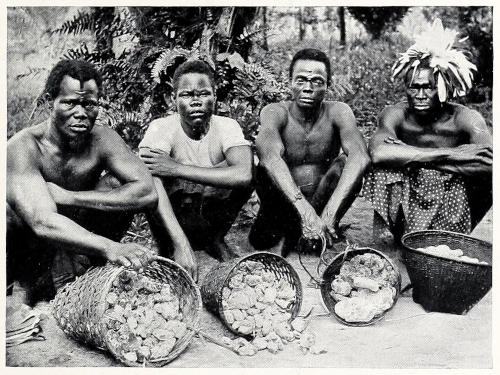
GUM COPAL FOR SALE, UPPER CONGO.
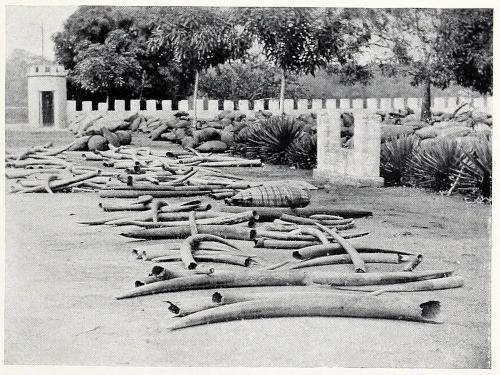
GOVERNMENT IVORY AND RUBBER, UPPER CONGO.
There remain, therefore, but two actual virgin products possessing any certainty of a future—copal, and the fruit of the palm tree; rubber can only be regarded as an ever decreasing asset.
What, then, are the potential assets?
OTHER ASSETS
In the mineral world there are some possibilities in gold, diamonds and copper, but all these are somewhat doubtful assets and contribute but little to the general welfare of the community which must rest primarily upon agricultural development.
Almost any tropical product will grow in the Congo, for the area is so vast that it provides land suited in one part or another to coffee, cotton, rubber, cocoa, hemp and corn. The product of the future will not be determined only by the nature of the land upon which a given article can be grown, but rather by the one that is most suited to the native agriculturist.
The real difficulty is that few Belgians seem capable of thinking anything beyond rubber on the one hand, and the native as a servile labourer on the other. Colonial opinion in Belgium and on the Congo itself appears to be firmly wedded to this restricted view of colonial expansion. This circumscribed vision can comprehend the serf, the labourer, or the domestic slave, but the free, industrious and successful coloured citizen, carving out an economic future, in which the State can indirectly share, is apparently beyond the mental horizon of most of those who at present control the destinies of the Congo tribes. True statecraft would have placed a halo round Annexation Day, making it one of great rejoicing throughout the Congo by declaring that through the action of a generous Administration rubber collecting by the State would from that date cease for all time. But through lack of colonial imagination this great opportunity for regaining the confidence of the native tribes was thrown away, and the Administration rehoisted the old Congo State flag with a miniature Belgian flag relegated to the corner, at the same time letting it be known that upon rubber production—the synonym of horror to the native mind—the future would depend.
The failure of the rubber cultivation enterprise is complete. Whatever the man in the street may think, the Belgian Government knows that Monsieur Renkin’s scheme for relieving the Belgian Exchequer has utterly failed. The twenty to thirty millions of productive rubber trees dangled before the eyes of the Belgian tax-payer exist only on paper.
Cotton has been proposed, but what possibilities has cotton cultivation, not only in the Congo but anywhere in West Africa, where it comes into competition with cocoa or palm oil? Cotton requires that the worker should toil under the fierce rays of a tropical sun; it demands constant attention if it is to be kept free from weeds and undergrowth, and when the harvest is gathered the native can never receive the financial reward which attaches to palm oil and kernels or to cocoa. In a crude way the West African is a careful mathematician, and though in his primitive condition he knows nothing about square yards, acres and compound interest, he can soon tell what products he can grow most profitably on a given piece of ground—and cotton is not one of them.
CONGO POSSIBILITIES
If the Belgian colonial authorities could divorce themselves from rubber and concentrate on cocoa they might yet turn the Congo wilderness into a garden. A few enterprising Belgians have already seen possibilities in the cocoa bean. Its cultivation is at present undertaken by the Belgian Government, the Roman Catholic Missions, and by a few small companies. The principal area is that of the Mayumbe, a compact territory between the Belgian Congo and the Portuguese river, the Chiloango; there are other plantations a thousand miles from the mouth of the Congo on the banks of the Aruwimi and also of the main Congo, but these latter are characterized by such neglect that no one regards them seriously.
It is difficult to imagine a tract of country more ideally suited to the cultivation of cocoa than that of Mayumbe. The hills and valleys abound in water-courses, the soil is good and the climate reminds the traveller very much of the Gold Coast territories. Some of the plantations run for miles along winding valleys, but the great trouble with Mayumbe is that perpetual nightmare—common to the whole of West Africa—scarcity of labour!
Within three days’ steam of the Congo, the British colony of the Gold Coast has solved the question of labour, has started an industry which gives the native producer a return of over a million and a half sterling per annum, has provided the European consumer with a great cocoa area which twenty-five years ago produced little beyond internecine warfare and jujus, and yet the Belgian Government has never even given a practical consideration to this unique example of colonial expansion which could so easily be applied to the Congo.
Rubber and cotton have but a small future in the Congo. Sisal, gold and copper have a possibility, but cocoa, the products of the palm tree, and any other vegetable oils, give promise of a real future, provided cheap transport and sound statesmanship are forthcoming.
An oppressive sense of hopelessness affects the traveller in the Congo as he speeds up and down those mighty rivers, across the numerous lakes, or tramps through the silent forests. He sees the possibilities of that land, the earth he treads gives forth an intoxicating odour of fertility. The tribes amongst whom he lives and moves are nature’s children and the little incidents of daily travel impress him with the fact that, given a chance, those sturdy bodies and stout limbs could turn Congoland into a paradise of affluence and luxury. Then, as he muses on these things and dreams of ideal homes and villages, and tropical plantations pouring forth exchange values of oil and cocoa for cotton goods and hardware, the practical mind, like Newton’s apple, comes down to earth again and weighs actualities and asks the pertinent question—“Can Belgium do it?”
The Congo demands large financial aid from the Mother country. This is a fact which has never been realized by the ordinary Belgian—and he might object if he knew. Even the British subject, whose colonial conception has grown with him from childhood, has very little idea of the large sums of money which are found by Great Britain towards aiding her Crown colonies along the path of progress. Belgium cannot expect to run the Congo successfully without large drafts from her home Exchequer; her colony, measuring nearly a million square miles, will require at the very least a million pounds sterling per annum for twenty years. Belgium can beyond question find that sum of money, providing her people are prepared to share the black man’s burden which their late Sovereign made so heavy. The difficulty, however, is that King Leopold and his entourage made such prodigious fortunes that the Belgian people have always regarded the Congo as a veritable El Dorado. The Belgian colonial authorities reiterated again and again, until quite a recent date, that the Congo would never involve the nation in financial sacrifices. Couple this impression, so wickedly fostered by politicians who should have known better, with the fact that the Belgian has no colonial conception, and the reader will agree that any statesman will have a difficult task in persuading the Belgian nation to make large and continuous grants from the Home Exchequer.
BRITISH COLONIAL CONCEPTION
The British conception rests upon a profound belief in the old scriptural paradox: “He that loseth his life will save it.” The Colonial Office in Downing Street does not, like its sister bureau—the Foreign Office—display texts of scripture on its ceilings, and the Colonial Secretaries might not in this material age admit scriptural guidance in Imperial affairs, but woven into the fibre of our administration is a basis of Christian philosophy which, though it admits occasional incidents of a regrettable nature, yet pursues in the long run the straight course of sacrificing men and money for backward nations and countries, quite regardless of consequences. The cynic will say, “Yes, with the certainty that the goose well cared for will lay golden eggs.” Certainly, but that is part of the Divine contract for pursuing that which is right. This, however, is what few Belgians understand—or any other colonial Power for that matter—but it is part and parcel of colonial statecraft without which tropical colonies at least can never be a success.
The financial problem, difficult though it may be, is the easiest of solution. That of finding the men is at present insoluble. This is, in part at least, due to another fatal error made by Belgium when she annexed the Congo—the retention in her service of all the old Congo officials. They are there to-day, many of them pressing on to higher positions in the colony. The fact that these men, trained to oppression by King Leopold and openly upholding the old Leopoldian conceptions, are still in high favour does not escape the quick-witted native, and of course tends to alienate still further the native and governing communities.
LACK OF MEN
There are, however, other dangers arising from this situation. These “old hands” are educating the juniors, and in the process are instilling into their young and inexperienced minds a dissatisfaction with present conditions and emphasizing to them that the older system of “teaching the natives the dignity of labour” was better all round. They are always careful to add “without atrocities, of course,” but what they cannot see is that the old Leopoldian system was impossible “without atrocities.” It will be readily agreed that when the burden of the Congo begins to make itself felt upon the Belgian nation these reactionaries—“Men from the spot,” “Men of long experience”—will find a ready echo throughout Belgium. Again, as in the financial position so also in the administrative future of the colony, the call comes for the really bold statesman, strong enough to break completely with the past and to clean out of the Congo these soi dísant administrators, who, incapable of appreciating colonial requirements, should return to their original employments of running music halls, tram driving, breaking stones on the highway, ’bus conductors, waiters, bricklayers, clerks, and so forth.
“How,” I am often asked, “could these men be replaced?” First, the very fact that such men are no longer in the service would undoubtedly attract the better families of Belgium, for it may be remarked that many of the merchant houses are able to obtain an excellent type of man. I asked some of them why they did not enter the Government service, but almost invariably I received this kind of answer: “What! join a service with A⸺ in it!” “What! accept a position under B⸺!” These replies were eloquent and convincing to one who easily realized how utterly impossible it would be for the better type of man to associate with “A⸺” and “B⸺,” their records being so well known in the Congo, however much they might be covered up at home. Here again is further evidence of the lack of colonial imagination amongst the higher officials in Brussels. If Belgium cannot find—as admittedly she cannot—a sufficiency of experienced men in Belgium, cannot she find them in France and England? She can find them, of course, in both countries, but hesitates to employ other nationalities for the higher positions, with the result that very few men are prepared to accept positions with futures “only for Belgians.”
A Scandinavian captain recently gave me a good example of the results of this folly. He informed me that a friend of his reached Stanley Pool one day with his ship after an up-river journey of three weeks. Arriving at “The Pool,” as the upper river port is designated, the then superintendent of the marine—who, it was openly stated, knew more about the manufacture of cheap pickles than stevedoring—instructed him to load up 90 tons of cargo and sail within three hours!
In vain the captain protested that it could not be done in the time, and the only reply he received was a batch of natives hurried down to bundle the cargo pell mell on board; they pitched the cargo into the holds in any order and the captain heaved up his anchor and got away as instructed “within three hours,” but the task of sorting the whole cargo at every little post over that 1000 miles’ run, turned a normal journey of two weeks into one of over a month. I cannot vouch for this incident, but it is typically Congolese.
The Congo territories denuded of their stores of virgin wealth, with no new sources in sight; the people decimated and disheartened; the Home Government possessing no Colonial experience, and still worse no Colonial conception; the local officials still firmly wedded to the old theories, constitute anything but a happy augury for the future. That Belgium possesses many men animated by the loftiest sentiments is beyond question, but mere sentiment does not meet a situation which requires a broad outlook, a large experience and real sacrifice both in men and money.