CURIOUS CREATURES. (continued 5)
Reading edition
“The medicines arising out of it are also many. The first place belongeth to the Caule, which hath moe benefits or vertues in it, than can be expressed. The bloud of a Crocodile is held profitable for many thinges, and among other, it is thought to cure the bitings of any Serpent. Also by annoynting the eyes, it cureth both the dregs, or spots of blood in them, and also restoreth soundnesse and clearenesse to the sight, taking away all dulnesse, or deadnesse from the eyes. And it is said, that if a man take the liquor which commeth from a piece of a Crocodyle fryed, and annoynte therewithall his wound or harmed part, that then he shall bee presently rid of all paine and torment. The skinne both of the Land and Water Crocodile dryed into powder, and the same powder, with Vineger or Oyle, layd upon a part or member of the body, to be seared, cut off or lanced, taketh away all sense and feeling of paine from the instrument in the action.
“All the Ægytians doe with the fat or sewet of a Crocodile, (is to) annoynt all them that be sick of Feavers, Alcair, (Cairo.) Scaliger writeth that it cureth the Gangren. The Canyne teeth which are hollow, filled with Frankinsence, and tyed to a man or woman, which hath the toothach, cureth them, if the party know not of the carrying them about: And so they write, that if the little stones which are in their belly be taken forth and so used, they work the same effect against Feavers. The dung is profitable against the falling off of the hayre, and many such other things.”
The Basilisk and Cockatrice.
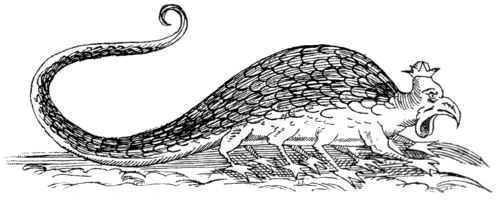
Aldrovandus portrays the Basilisk with eight legs. Topsell says it is the same as the Cockatrice, depicts it as a crowned serpent, and says:—“This Beast is called Baziliscos, and by the Latine, Regulus, because he seemeth to be the King of Serpents, not for his magnitude or greatnesse: For there are many Serpents bigger than he, as there be many foure-footed Beastes bigger than the Lyon, but, because of his stately pace, and magnanimious mind: for hee creepeth not on the earth like other Serpents, but goeth halfe upright, for which occasion all other Serpentes avoyde his sight. And it seemeth nature hath ordayned him for that purpose; for, besides the strength of his poyson, which is uncurable, he hath a certain combe or Corronet uppon his head, as shall be shewed in due place.”
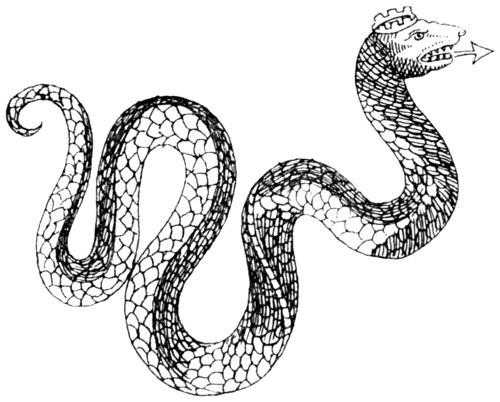
Pliny thus describes “The Serpents called Basilisks. There is the same power40 also in the serpent called the
Du Bartas says:—
“What shield of Ajax could avoid their death By th’ Basilisk whose pestilentiall breath Doth pearce firm Marble, and whose banefull eye Wounds with a glance, so that the wounded dye.”
The origin of the Cockatrice is, to say the least, peculiar:—“There is some question amongest Writers, about the generation of this Serpent: for some, (and those very many and learned,) affirme him to be brought forth of a Cockes egge. For they say that when a Cocke groweth old, he layeth a certaine egge without
“But the vulger opinion of Europe is, that the Egge is nourished by a Toad, and not by a Snake; howbeit, in better experience it is found that the Cocke doth sit on that egge himselfe: whereof Levinus Lemnius in his twelfth booke of the hidden miracles of nature, hath this discourse, in the fourth chapter thereof. There happened (saith he) within our memory in the Citty Pirizæa, that there were two old Cockes which had layd Egges, but they could not, with clubs and staves drive them from the Egges, untill they were forced to breake the egges in sunder, and strangle the Cockes....
“There be many grave humaine Writers, whose authority is irrefragable, affirming not onely that there be cockatrices, but also that they infect the ayre, and kill with their sight. And Mercuriall affirmeth, that when he was with Maximilian the Emperour, hee saw the carkase of a cockatrice, reserved in his treasury among his undoubted monuments.... Wee doe read that in Rome, in the dayes of Pope Leo the fourth (847 to 855), there was a cockatrice found in a Vault of a Church or Chappell, dedicated to Saint Lucea, whose Segonius and Julius Scaliger do affirme, that the sayd pestiferous beast was killed by the prayers of the said Leo the fourth....
“The eyes of the Cockatrice are redde, or somewhat inclyning to blacknesse; the skin and carkase of this beast have beene accounted precious, for wee doe read that the Pergameni did buy but certaine peeces of a Cockatrice, and gave for it two pound and a halfe of Sylver: and because there is an opinion that no Byrd, Spyder, or venomous Beast will endure the sight of this Serpent, they did hang uppe the skinne thereof stuffed, in the Temples of Apollo and Diana, in a certaine thinne Net made of Gold; and therefore it is sayde, that never any Swallow, Spider, or other Serpent durst come within those Temples; And not onely the skinne or the sight of the Cockatrice worketh this effect, but also the flesh thereof, being rubbed uppon the pavement, postes, or Walles of any House. And moreover, if Silver bee rubbed over with the powder of the Cockatrices flesh, it is likewise sayde that it giveth it a tincture like unto Golde: and, besides these qualities, I remember not any other in the flesh or skinne of this serpent....
“We read also that many times in Affrica, the Mules fall downe dead for thirst, or else lye dead on the ground for some other causes, unto whose Carkase innumerable troupes of Serpentes gather themselves to feede there uppon; but when the Bazeliske windeth the sayd dead Lucanus saith,
——Late sibi submovet omne Vulgus, et in vacua regnat Basiliscus arena.
Which may be thus englished;
He makes the vulgar farre from him to stand, While Cockatrice alone raignes on the sand.
“Now we are to intreate of the poyson of this serpent, for it is a hot and a venemous poyson, infecting the Ayre round about, so as no other Creature can live neare him, for it killeth, not onely by his hissing, and by his sight, (as is sayd of the Gorgons) but also by his touching, both immediately, and mediately; that is to say, not onely when a man toucheth the body it selfe, but also by touching a Weapon wherewith the body was slayne, or any other dead beast slaine by it, and there is a common fame, that a Horseman taking a Speare in his hand, which had beene thrust through a Cockatrice,
The Salamander.
Many writers have essayed this fabled creature, but almost all have approached the subject with diffidence, as if not quite sure of the absolute entity of the animal. Thus, Aristotle does not speak of it authoritatively:—“And the Salamander shews that it is possible for some animal substances to exist in the fire, for they say that fire is extinguished when this animal walks over it.” Pliny, on Salamanders, writes:—“We find it stated by many authors, that a serpent is produced from the spinal marrow of a man. Many creatures, in fact, among the quadrupeds even, have a secret, and mysterious origin.
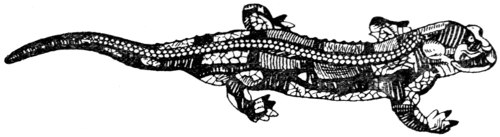
“Thus, for instance, the salamander, an animal like a lizard in shape, and with a body starred all over, never comes out except during heavy showers, and disappears the moment it becomes fine. This animal is so intensely cold as to extinguish fire by its contact, in the same way that ice doth. It spits forth a milky matter from its mouth; and whatever part of the human body is touched with this, all the hair falls off, and the part assumes the appearance of leprosy.... The wild boar of Pamphylia, and the mountainous parts of Cilicia, after having
This idea of an animal supporting life in the fire is not confined to the Salamander alone, for both Aristotle and Pliny aver that there is a fly which possesses this accomplishment. Says the former:—“In Cyprus, when the manufacturers of the stone called chalcitis burn it for many days in the fire, a winged creature something larger than a great fly is seen walking and leaping in the fire: these creatures perish when taken from the fire.” And the latter:—“That element, also, which is so destructive to matter, produces certain animals; for in the copper-smelting furnaces of Cyprus, in the very midst of the fire, there is to be seen, flying about, a four-footed animal with wings, the size of a large fly: this creature, called the ‘pyrallis,’ and by some the ‘pyrausta.’ So long as it remains in the fire it will live, but if it comes out, and flies a little distance from it, it will instantly die.”
Ser Marco Polo thoroughly pooh-poohs the idea of the Salamander, and says it is Asbestos. Speaking of the Province of Chingintalas, he says:—“And you must know that in the same mountain there is a vein of the substance of which Salamander is made. For the real truth is that the Salamander is no beast, as they allege in our part of the world, but is a substance found in the earth; and I will tell you about it.
“Everybody must be aware that it can be no animal’s nature to live in fire, seeing that every animal is composed
“Now this, and nought else, is the truth about the Salamander, and the people of the country all say the same. Any other account of the matter is fabulous nonsense. And I may add that they have, at Rome, a napkin out of this stuff, which the Grand Kaan sent to the Pope, to make a wrapper, for the Holy Sudarium of Jesus Christ.”
That extremely truthful person, Benvenuto Cellini, in his thoroughly veracious autobiography, tells us the following Snake Story:—“When I was about five years old, my father happened to be in a basement-chamber of our house, where they had been washing, and where a good fire of oak-logs was still burning; he had a viol in his hand, and was playing and singing alone beside the fire.
“The weather was very cold. Happening to look into the fire, he spied in the middle of those most burning flames a little creature like a lizard, which was sporting in the core of the intensest coals. Becoming instantly aware of what the thing was, he had my sister and me called, and, pointing it out to us children, gave me a great box on the ears, which caused me to howl and weep with all my might. Then he pacified me good-humouredly, and spoke as follows: ‘My dear little boy, I am not striking you for any wrong that you have done, but only to make you remember that that lizard which you see in the fire is a salamander, a creature which has never been seen before, by any one of whom we have credible information.’ So saying, he kissed me, and gave me some pieces of money.”
Even Topsell is half-hearted about its fire-resisting qualities, giving no modern instances, and only, for it, quoting old authors. According to his account, and to the picture which I have taken from him, the Salamander is not a prepossessing-looking animal:—“The Salamander is also foure-footed like a Lyzard, and all the body over it is set with spots of blacke and yellow, yet is the sight of it abhominable, and fearefull to man. The head of it is great, and sometimes they have yellowish bellyes and tayles, and sometimes earthy.”
He also says its bite is not only poisonous, but incurable, and that it poisons all it touches.
The Toad.
Toads were always considered venomous and spiteful, and they had but one redeeming quality, which seems to be lost to its modern descendants:—
“Sweet are the uses of adversity; Which, like the toad, ugly and venomous, Wears yet a precious jewel in his head.” (As You Like It, Act ii. sc. 1.)
Pliny says of these animals:—“Authors quite vie with one another in relating marvellous stories about them; such, for instance, as that if they are brought into the midst of a concourse of people, silence will instantly prevail; as also that, by throwing into boiling water, a small bone that is found in their right side, the vessel will immediately cool, and the water refuse to boil again until it has been removed. This bone, they say, may be found by exposing a dead toad to ants, and letting them eat away the flesh; after which the bones must be put into the vessel one by one.
“On the other hand, again, in the left side of this reptile there is another bone, they say, which, when thrown into water, has all the appearance of making it boil, and the name given to which is ‘apocynon’ (averting dogs). This bone it is said has the property of assuaging the fury of dogs, and, if put in the drink, of conciliating love, and ending discord and strife. Worn, too, as an amulet, it acts as an aphrodisiac, we are told.”
Topsell writes so diffusely on the virtues of these “toad stones” that I can only afford space for a portion of his remarks:—“There be many late Writers, which doe affirme that there is a precious stone in the head of a Toade, whose opinions (because they attribute much to the vertue of this stone) is good to examine in this place.... There be many that weare these stones in Ringes, beeing verily perswaded that they keepe them from all manner of grypings and paines of the belly, and
“This stone is that which in auncient time was called Batrachites, and they attribute unto it a vertue besides the former, namely, for the breaking of the stone in the bladder, and against the Falling sicknes. And they further write that it is a discoverer of present poyson, for in the presence of poyson it will change the colour. And this is the substaunce of that which is written about this stone. Now for my part I dare not conclude either with it, or against it, for many are directlie for this stone ingendered in the braine or head of the Toade: on the other side, some confesse such a stone by name and nature, but they make doubt of the generation of it, as others have delivered; and therefore, they beeing in sundry opinions, the hearing whereof might confound the Reader, I will referre him for his satisfaction unto a Toade, which hee may easily every day kill: For although when the Toade is dead, the vertue thereof be lost, which consisted in the eye, or blew spot in the middle, yet the substance remaineth, and, if the stone be found there in substance, then is the question at an end; but, if it be not, then must the generation of it be sought for in some other place.”
The Leech.
The Leech has, from a very early age, been used as a means of letting blood; but, among the old Romans, it had medicinal uses such as we know not of now. It was used as a hair dye. Pliny gives two receipts for making it, and it must have been powerful stuff, if we can believe his authority:—“Leeches left to putrify for forty days in red wine, stain the hair black. Others, again, recommend one sextarius of leeches to be left to putrefy the same number of days in a leaden vessel, with two sextarii of vinegar, the hair to be well rubbed with the mixture in the sun. According to Sornatius this preparation is, naturally, so penetrating, that if females, when they apply it, do not take the precaution of keeping some oil in the mouth, the teeth, even, will become blackened thereby.”
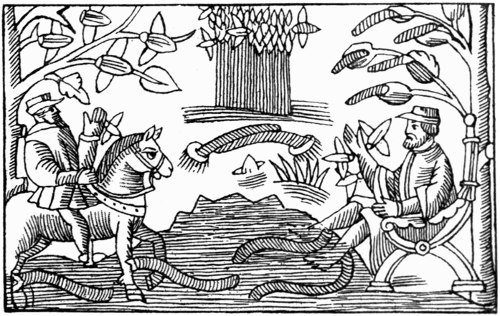
Olaus Magnus gives us the accompanying picture of the luxurious man in his arm-chair by the river-side, catching his own leeches, and suffering from gnats; and also
The Scorpion.
Of the Scorpion, Pliny says:—“This animal is a dangerous scourge, and has a venom like that of the serpent; with the exception that its effects are far more painful, as the person who is stung will linger for three days before death ensues. The sting is invariably fatal to virgins, and nearly always so to matrons. It is so to men also, in the morning, when the animal has issued from its hole in a fasting state, and has not yet happened to discharge its poison by an accidental stroke. The tail is always ready to strike, and ceases not for an instant to menace, so that no opportunity may possibly be lost....
“In Scythia, the Scorpion is able to kill even the swine, with its sting, an animal which, in general, is proof against poisons of this kind in a remarkable degree. When stung, those swine which are black, die more speedily than others, and more particularly if they happen to throw themselves into the water. When a person has been stung, it is generally supposed that he may be cured by drinking the ashes of the Scorpion mixed with wine. It is the belief also that nothing is more baneful to the Scorpion than to dip it in oil.... Some writers, too, are of opinion that the Scorpion devours its offspring, and that the one among the young which is most adroit avails itself of its sole mode of escape, by placing itself on the back of the mother, and thus finding a place where it is in safety from
Topsell has some marvels to relate concerning the generation of Scorpions:—“And it is reported by Elianus, that about Estamenus in India, there are abundance of Scorpions generated, onely by corrupt raine water standing in that place. Also, out of the Baziliske beaten into peeces, and so putrified, are Scorpions engendred. And when as one had planted the herbe Basilica on a wall, in the roome or place thereof hee found two Scorpions. And some say that if a man chaw in his mouth, fasting, this herbe Basill before he wash, and, afterwards, lay the same abroade uncovered where no sun commeth at it for the space of seaven nights, taking it in all the daytime, he shall at length find it transmuted into a Scorpion, with a tayle of seaven knots.
“Hollerius, to take away all scruple of this thing, writeth that in Italy, in his dayes, there was a man that had a Scorpion bredde in his braine, by continuall smelling to this herbe Basil; and Gesner by relation of an Apothecary in Fraunce, writeth also a storie of a young mayde, who by smelling to Basill, fell into an exceeding head-ach, whereof she died without cure, and, after her death, beeing opened, there were found little Scorpions in her braine.
“Aristotle remembreth an herbe which he calleth Sisimbriæ, out of which putrified Scorpions are engendered. And wee have showed already, in the history of the Crocodile, that out of the Crocodile’s egges doe many times come Scorpions, which at their first egression doe kill theyr dam that hatched them.”
There is a curious legend, that if a Scorpion is surrounded by fire, so that it cannot escape, it will commit suicide by stinging itself to death.
The Ant.
No one would credit the industrious Ant, whose ways we are told to consider, and gather wisdom therefrom, was avaricious and lustful after gold; but it seems it was even so, at least, in Pliny’s time; but then they were abnormally large:—“The horns of an Indian Ant, suspended in the temple of Hercules at Erythræ (Ritri) have been looked upon as quite miraculous for their size. This ant excavates gold from holes, in a country to the north of India, the inhabitants of which are known as the Dardæ. It has the colour of a cat, and is in size as large as an Egyptian wolf. This gold, which it extracts in the winter, is taken by the Indians during the heats of summer, while the Ants are compelled, by the excessive warmth, to hide themselves in their holes. Still, however, on being aroused by catching the scent of the Indians, they sally forth, and frequently tear them to pieces, though provided with the swiftest Camels for the purpose of flight; so great is their fleetness, combined with their ferocity, and their passion for gold!”
The Bee.
The Busy Bee, too, according to Olaus Magnus, developed, in the regions of the North, a peculiarity to which it seems a stranger with us, but which might be encouraged, with beneficial effect, by the Temperance Societies.
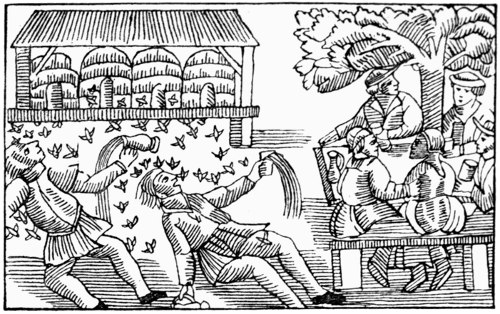
The Bees infested drunkards, being drawn to them by the smell of the liquor with which they had soaked their bodies, and stung them.
The Hornet.
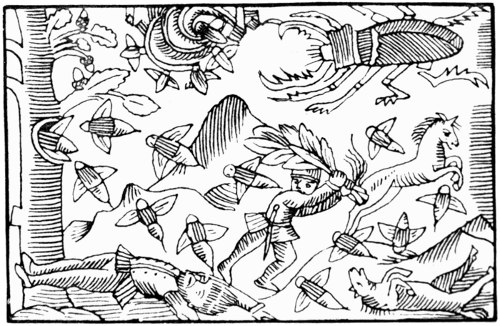
So also, up North, they seem to have had a special