CURIOUS CREATURES. (continued 2)
Reading edition
The Centaur.
This extraordinary combination of man and animal is very ancient—and the first I can find is Assyrian. Mr. W. St. Chad Boscawen, in one of his British Museum Lectures (afterwards published under the title of From under the Dust of Ages), speaking of the seasons and the zodiacal signs, in his lecture on The Legend of Gizdhubar, says:—“Gizdhubar has a dream that the stars of heaven are falling upon him, and, like Nebuchadnezzar, he can find no one to explain the hidden meaning to
“By his name he was the son of Hea, whom Berosus identifies as Cronos, as Chiron was the son of Cronos. Like Chiron, he was celebrated for his wisdom, and acted as the counsellor of the hero, interpreting his dreams, and enabling him to overcome the enemies who attacked him. Chiron met his death at the hand of Heracles, one of whose poisoned arrows struck him, and, though immortal, he would not live any longer, and gave his immortality to Prometheus.... Zeus made Chiron among the stars a Sagittarius. Here again we have a striking echo of the Chaldæan legend, in the Erech story. According to the arrangement of tablets, the death of Hea-bani takes place under the sign of Sagittarius, and is the result of some fatal accident during the combat between Gizdhubar and Khumbaba. Like the Centaurs, before his call to the Court of Gizdhubar, Hea-bani led a wild and savage life. It is said on the tablets ‘that he consorted with the wild beasts. With the gazelles he took his food by night, and consorted with the cattle
“Hea-Bani was true and loyal to Gizdhubar, and when Istar (the Assyrian Venus), foiled in her love for Gizdhubar, flew to heaven to see her father Anu (the Chaldæan Zeus), and to seek redress for the slight put upon her, the latter created a winged bull, called ‘The Bull of Heaven,’ which was sent to earth. Hea-Bani, however, helps his lord, the bull is slain, and the two companions enter Erech in triumph. Hea-Bani met with his death when Gizdhubar fought Khumbaba, and ‘Gizdhubar for Hea-Bani his friend wept bitterly and lay on the ground.’”
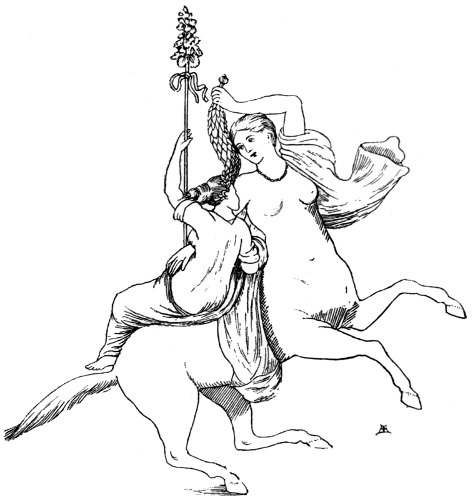
Thus, centuries before the Romans had emerged from barbarism, we have the prototype of the classical Centaur, the man-horse. The fabled Centaurs were a people of Thessaly—half-men, half-horses—and their existence is very cloudy. Still, they were often depicted, and the two examples of a male and female Centaur, from a fresco at Pompeii, are charmingly drawn. It will be seen that both are attended by Bacchantes bearing thyrses—a delicate allusion to their love of wine; for it was owing to this weakness that their famous battle with the Lapithæ took place. The Centaurs were invited to the marriage of Hippodamia with Pirithous, and, after the manner of cow-boys “up town,” they got intoxicated, were very rude, and even offered violence to the women present. That, the good knights, Sir Hercules and Sir Theseus, could not stand, and with the Lapithæ, gave the Centaurs a thrashing, and made them retire to Arcadia. They had a second fight over the matter of wine, for the Centaur Pholus gave Hercules to drink of wine meant for him, but in the keeping of the Centaurs, and these ill-conditioned
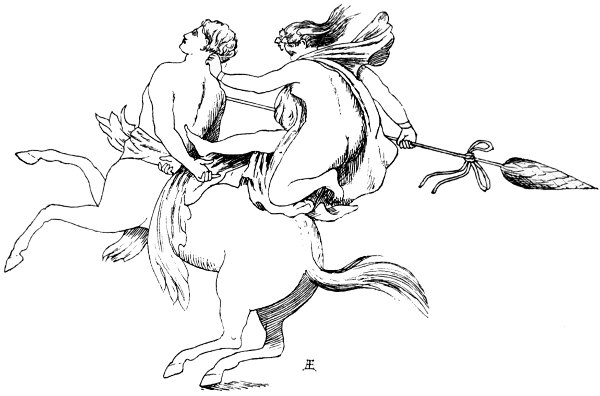
Pliny pooh-poohs the mythical origin of the Centaurs, and says they were Thessalians, who dwelt along Mount Pelion, and were the first to fight on horseback. Aldrovandus writes that, according to Licosthenes, there were formerly found, in the regions of the Great Tamberlane, Centaurs of such a form as its upper part was that of a man, with two arms resembling those of a toad,
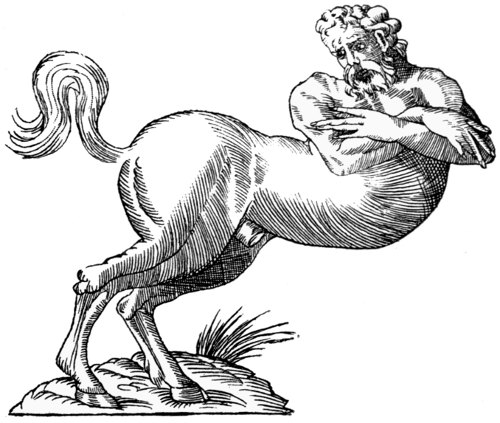
“The Onocentaur is a monstrous beast; Supposed halfe a man, and halfe an Asse, That never shuts his eyes in quiet rest, Till he his foes deare life hath round encompast. Such were the Centaures in their tyrannie, That liv’d by Humane flesh and villanie.” —Chester.
The Gorgon.
In the title-page of one edition of “The Historie of Foure-footed Beastes” (1607) Topsell gives this picture of the Gorgon; and he says, respecting this curious animal, the following:—“Among the manifold and divers sorts Gorgon is brought foorth in that countrey. It is a feareful and terrible beast to behold: it hath high and thicke eie-lids, eies not very great, but much like an Oxes or Bugils, but all fiery bloudy, which neyther looke directly forwarde, nor yet upwards, but continuallye downe to the earth, and therefore are called in Greeke Catobleponta. From the crowne of their head downe to their nose, they have a long hanging mane, which makes them to look fearefully. It eateth deadly and poysonfull hearbs, and if at any time he see a Bull, or other creature whereof he is afraid, he presently causeth his mane to stand upright, and, being so lifted up, opening his lips, and gaping wide, sendeth forth of his throat a certaine sharpe and horrible breath, which infecteth, and poysoneth the air above his head, so that all living creatures which draw the breath of that aire are greevously afflicted thereby, loosing both voyce and sight, they fall into leathall and Hesperia and Lybia.
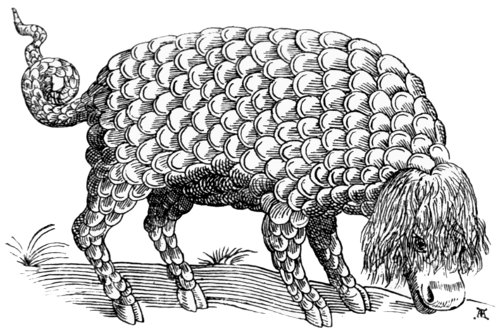
“The Poets have a fiction that the Gorgones were the Daughters of Medusa and Phorcynis, and are called Steingo, and by Hesiodus, Stheno, and Eyryale inhabiting the Gorgadion Ilands in the Æthiopick Ocean, over against the gardens of Hesperia. Medusa is said to have the haires of his head to be living Serpentes, against whom Perseus fought, and cut off his hed, for which cause he was placed in heaven on the North side of the Zodiacke above the Waggon, and on the left hand holding the Gorgons head. The truth is that there were certaine Amazonian women in Affricke divers from the Scythians, against whom Perseus made warre, and the captaine of those women was called Medusa, whom Perseus overthrew, and cut off her head, and from thence came the Poet’s fiction describing Snakes growing out of it as is aforesaid. These Gorgons are bred in that countrey, and have such haire about their heads, as not onely exceedeth all other beastes, but also poysoneth, when he standeth upright. Pliny calleth this beast Catablepon,29 because it continually looketh downwards, and saith all the parts of it are but smal excepting the head, which is very heavy, and exceedeth the proportion of his body, which is never lifted up, but all living creatures die that see his eies.
“By which there ariseth a question whether the poison which he sendeth foorth, proceede from his breath, or from his eyes. Whereupon it is more probable, that like the Cockatrice, he killeth by seeing, than by the breath of his mouth, which is not competible to any other beasts in the world. Besides, when the Souldiers Marius followed Iugurtha, they saw one of these Gorgons, and, supposing it was some sheepe, bending the head continually to the earth, and moving slowly, they set upon him with their swords, whereat the Beast, disdaining, suddenly discovered his eies, setting his haire upright, at the sight whereof the Souldiers fel downe dead.
“Marius, hearing thereof, sent other souldiers to kill the beaste, but they likewise died, as the former. At last the inhabitantes of the countrey, tolde the Captaine the poyson of this beast’s nature, and that if he were not killed upon a Sodayne, with onely the sight of his eies he sent death into his hunters: then did the Captaine lay an ambush of souldiers for him, who slew him sodainely with their speares, and brought him to the Emperour, whereupon Marius sent his skinne to Rome, which was hung up in the Temple of Hercules, wherein the people were feasted after the triumphes; by which it is apparent that they kill with their eies, and not with their breath....
“But to omit these fables, it is certaine that sharp poisoned sightes are called Gorgon Blepen, and therefore we will followe the Authoritie of Pliny and Athenæus. It is a beast set all over with scales like a Dragon, having no haire except on his head, great teeth like Swine, having wings to flie, and hands to handle, in stature betwixt a Bull and a Calfe.
“There be Ilandes called Gorgonies, wherein these monster-Gorgons were bredde, and unto the daies of Pliny, the people of that countrey retained some part of their prodigious nature. It is reported by Xenophon, that Hanno, King of Carthage, ranged with his armie in that region, and founde there, certaine women of incredible Juno, for a monument of their straunge natures, which remained there untill the destruction of Carthage. By the consideration of this beast, there appeareth one manifest argument of the Creator’s devine wisdome and providence, who hath turned the eies of this beaste downeward to the earth
The Unicorn.
What a curious belief was that of the Unicorn! Yet what mythical animal is more familiar to Englishmen? In its present form it was not known to the ancients, not even to Pliny, whose idea of the Monoceros or Unicorn is peculiar. He describes this animal as having “the head of a stag, the feet of an elephant, the tail of
Until James VI. of Scotland ascended the English throne as James I., the Unicorn, as it is now heraldically portrayed (which was a supporter to the arms of James IV.) was almost unknown—vide Tempest, iii. 3. 20:—
“Alonzo. Give us kind keepers, heavens: what were these?
Sebastian. A living drollery. Now I will believe that there are unicorns.”
Spenser, who died before the accession of James I., and therefore did not write about the supporters of the Royal Arms, alludes (in his Faerie Queene) to the antagonism between the Lion and the Unicorne.
“Likë as the lyon, whose imperial poure A proud rebellious unicorn defyes, T’avoide the rash assault, and wrathful stoure Of his fiers foe, him to a tree applyes, And when him rouning in full course he spyes, He slips aside: the whiles that furious beast, His precious horne, sought of his enimyes, Strikes in the stroke, ne thence can be released, But to the victor yields a bounteous feast.”
Pliny makes no mention of the Unicorn as we have it heraldically represented, but speaks of the Indian Ass, which, he says, is only a one-horned animal. Other old naturalists, with the exception of Ælian, do not mention it as our Unicorn—and his description of it hardly coincides. He says that the Brahmins tell of the wonderful beasts in the inaccessible regions of the interior of India, among them being the Unicorn, “which they call Cartazonon, and say that it reaches
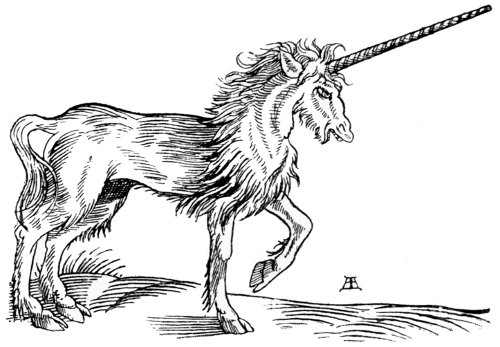
Guillim, who wrote on heraldry in 1610, gives, in his Illustrations, indifferently the tail of this animal, as horse or ass; and, as might be expected from one of his craft, magnifies the Unicorn exceedingly:—“The Unicorn hath his Name of his one Horn on his Forehead. There is another Beast of a huge Strength and Greatness, which hath but one Horn, but that is growing on his Snout, whence he is called Rinoceros, and both are named Monoceros, or One horned. It hath been much questioned among Naturalists, which it is that is properly called the Unicorn: And some hath made Doubt whether
“Touching the invincible Nature of this Beast, Job saith, ‘Wilt thou trust him because his Strength is great, and cast thy Labour unto him? Wilt thou believe him, that he will bring home thy seed, and gather it into thy Barn?’ And his Vertue is no less famous than his Strength, in that his Horn is supposed to be the most powerful Antidote against Poison: Insomuch as the general Conceit is, that the wild Beasts of the Wilderness use not to drink of the Pools, for fear of the venemous Serpents there breeding, before the Unicorn hath stirred it with his Horn. Howsoever it be, this Charge may very well be a Representation both of Strength or Courage, and also of vertuous Dispositions and Ability to do Good; for to have Strength of Body, without the Gifts and good Qualities of the Mind, is but the Property of an Ox, but where both concur, that may truly be called Manliness. And that these two should consort together, the Ancients did signify, when they made this one Word, Virtus, to imply both the Strength of Body, and Vertue of the Mind....
“It seemeth, by a Question moved by Farnesius, That the Unicorn is never taken alive; and the Reason being demanded, it is answered ‘That the greatness of his Mind is such, that he chuseth rather to die than to be taken alive: Wherein (saith he) the Unicorn and the valiant-minded Souldier are alike, which both contemn Death, and rather than they will be compelled to undergo any base Servitude or Bondage, they will lose their Lives.’...
“The Unicorn is an untameable Beast by Nature, as Job, chap. 39, ‘Will the Unicorn serve thee, or will he tarry by thy Crib? Can’st thou bind the Unicorn with his Band to labour in the Furrow, or will he plough the Valleys after thee?’”
Topsell dilates at great length on the Unicorn. He agrees with Spenser and Guillim, and says:—“These Beasts are very swift, and their legges have no Articles (joints). They keep for the most part in the desarts, and live solitary in the tops of the Mountaines. There was nothing more horrible than the voice or braying of it, for the voice is strain’d above measure. It fighteth both with the mouth and with the heeles, with the mouth biting like a Lyon, and with the heeles kicking like a Horse.... He feereth not Iron nor any yron Instrument (as Isodorus writeth) and that which is most strange of all other, it fighteth with his owne kind, yea even with the females unto death, except when it burneth in lust for procreation: but unto straunger Beasts, with whome he hath no affinity in nature, he is more sotiable and familiar, delighting in their company when they come willing unto him, never rising against them; but, proud of their dependence and retinue, keepeth with them all quarters of league and truce; but with his female, when once his flesh is tickled with lust, he groweth tame, gregall, and loving, and so continueth till she is filled and great with young, and then returneth to his former hostility.”
There was a curious legend of the Unicorn, that it would, by its keen scent, find out a maiden, and run to her, laying its head in her lap. This is often used as an emblem of the Virgin Mary, to denote her purity. The following is from the Bestiary of Philip de Thaun, it:—
“Monoceros est Beste, un corne ad en la teste, Purceo ad si a nun, de buc ad façun; Par Pucele est prise; or vez en quel guize. Quant hom le volt cacer et prendre et enginner, Si vent hom al forest ù sis riparis est; Là met une Pucele hors de sein sa mamele, Et par odurement Monosceros la sent; Dunc vent à la Pucele, et si baiset la mamele, En sein devant se dort, issi veut à sa mort; Li hom suivent atant ki l’ocit en dormant U trestont vif le prent, si fais puis sun talent. Grant chose signifie.”...
Topsell, of course, tells the story:—“It is sayd that Unicorns above all other creatures, doe reverence Virgines and young Maides, and that many times at the sight of them they grow tame, and come and sleepe beside them, for there is in their nature a certaine savor, wherewithall the Unicornes are allured and delighted; for which occasion the Indian and Ethiopian hunters use this stratagem to take the beast. They take a goodly, strong, and beautifull young man, whom they dresse in the Apparell of a woman, besetting him with divers odoriferous flowers and spices.
“The man so adorned they set in the Mountaines or Woods, where the Unicorne hunteth, so as the wind may carrie the savor to the beast, and in the meane season the other hunters hide themselves: the Unicorne deceaved with the outward shape of a woman, and sweete smells, cometh to the young man without feare, and so suffereth his head to bee covered and wrapped within his large sleeves, never stirring, but lying still and asleepe, as in his most acceptable repose. Then, Tzetzes, who did not live above five hundred yeares agoe, and therefore I leave the reader to the freedome of his owne judgment, to believe or refuse this relation; neither is it fit that I should omit it, seeing that all writers, since the time of Tzetzes, doe most constantly beleeve it.
“It is sayd by Ælianus and Albertus, that, except they bee taken before they bee two yeares old they will never bee tamed; and that the Thrasians doe yeerely take some of their Colts, and bring them to their King, which he keepeth for combat, and to fight with one another; for when they are old, they differ nothing at all from the most barbarous, bloodie, and ravenous beasts. Their flesh is not good for meate, but is bitter and unnourishable.”
It is hardly worth while to go into all the authorities treating of the Unicorn; suffice it to say, that it was an universal belief that there were such animals in existence, for were not their horns in proof thereof? and were they not royal presents fit for the mightiest of potentates to send as loving pledges one to another? for it was one of the most potent of medicines, and a sure antidote to poison. And they were very valuable, too, for Paul Hentzner—who wrote in the time of Queen Elizabeth—says that, at Windsor Castle, he was shown, among other things, the horn of an Unicorn of above eight spans and a half in length, i.e., about 6½ feet, valued at £10,000. Considering that money was worth then about three times what it is now, an Unicorn’s horn was a right royal gift.
Topsell, from whom I have quoted so much, is especially voluminous and erudite on Unicorns; indeed, in no other old or new author whom I have consulted are there so many facts (?) respecting this fabled beast to be found. Here is his history of those horns then to be found in Europe:—
“There are two of these at Venice in the Treasurie of S. Marke’s Church, as Brasavolus writeth, one at Argentoratum, which is wreathed about with divers sphires.30 There are also two in the Treasurie of the King of Polonia, all of them as long as a man in his stature. In the yeare 1520, there was found the horne of a Unicorne in the river Arrula, neare Bruga in Helvetia, the upper face or out side whereof was a darke yellow; it was two cubites (3 feet) in length, but had upon it no plights31 or wreathing versuus. It was very odoriferous (especially when any part of it was set on fire), so that it smelt like muske: as soone as it was found, it was carried to a Nunnery called Campus regius, but, afterwards by the Governor of Helvetia, it was recovered back againe, because it was found within his teritorie....
“Another certaine friend of mine, being a man worthy to be beleeved, declared unto me that he saw at Paris, with the Chancellor, being Lord of Pratus, a peece of a Unicorn’s horn, to the quantity of a cubit, wreathed in tops or spires, about the thicknesse of an indifferent staffe (the compasse therof extending to the quantity of six fingers) being within, and without, of a muddy colour, with a solide substance, the fragments whereof would boile in the Wine although they were never burned, having very little or no smell at all therein.
“When Joannes Ferrerius of Piemont had read these thinges, he wrote unto me, that, in the Temple of Dennis, neare unto Paris, that there was a Unicorne’s horne six foot long, ... but that in bignesse, it exceeded the horne at the Citty of Argentorate, being also holow almost a foot from that part which sticketh unto the forehead of the Beast, this he saw himselfe in the Temple of S. Dennis, and handled the horne with his handes as long as he would. I heare that in the former yeare (which was from the yeare of our Lord), 1553, when Vercella was overthrown by the French, there was broght from that treasure unto the King of France, a very great Unicorn’s horne, the price wherof was valued at fourscore thousand Duckets.32
“Paulus Poæius describeth an Unicorne in this manner; That he is a beast, in shape much like a young Horse, of a dusty colour, with a maned necke, a hayry beard, and a forehead armed with a Horne of the quantity of two Cubits, being seperated with pale tops or spires, which is reported by the smoothnes and yvorie whitenesse thereof, to have the wonderfull power of dissolving and speedy expelling of all venome or poison whatsoever.
“For his horne being put into the water, driveth away the poison, that he may drinke without harme, if any venemous beast shall drinke therein before him. This cannot be taken from the Beast, being alive, for as much as he cannot possible be taken by any deceit: yet it is usually seene that the horne is found in the desarts, as it happeneth in Harts, who cast off their olde horne
“The horne of this beast being put upon the Table of Kinges, and set amongest their junkets and bankets, doeth bewray the venome, if there be any suche therein, by a certaine sweat which commeth over it. Concerning these hornes, there were two seene, which were two cubits in length, of the thicknesse of a man’s Arme, the first at Venice, which the Senate afterwards sent for a gift unto Solyman the Turkish Emperor: the other being almost of the same quantity, and placed in a Sylver piller, with a shorte or cutted33 point, which Clement the Pope or Bishop of Rome, being come unto Marssels brought unto Francis the King, for an excellent gift.”... They adulterated the real article, for sale. “Petrus Bellonius writeth, that he knewe the tooth of some certaine Beast, in time past, sold for the horne of a Unicorne (what beast may be signified by this speech I know not, neither any of the French men which do live amongst us) and so smal a peece of the same, being adulterated, sold ‘sometimes for 300 Duckets.’ But, if the horne shall be true and not counterfait, it doth, notwithstanding, seeme to be of that creature which the Auncientes called by the name of an Unicorne, especially Ælianus, who only ascribeth to the same this wonderfull force against poyson and most grievous diseases, for he maketh not this horne white as ours doth seeme, but outwardly red, inwardly white, and in the Middest or secretest part only blacke.”
Having dilated so long upon the Unicorn, it would be a pity not to give some idea of the curative properties of
It was also considered a cure for Epilepsy, the Pestilent Fever or Plague, Hydrophobia, Worms in the intestines, Drunkenness, &c., &c.,—and it also made the teeth clean and white;—in fact, it had so many virtues that “no home should be without it.”
And all this about a Narwhal’s horn!
The Rhinoceros.
The true Unicorn is, of course, the Rhinoceros, and this picture of it is as early an one as I can find, being taken from Aldrovandus de Quad, A.D. 1521. Gesner and Topsell both reproduce it, at later dates, but reversed. The latter says that Gesner drew it from the life at Lisbon—but having Aldrovandus and the others before me, I am bound to give the palm to the former,
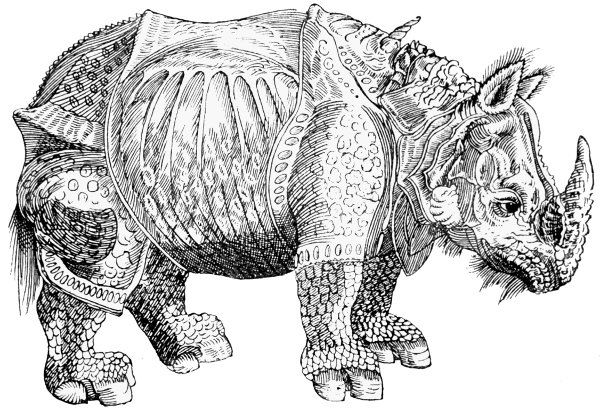
Topsell approaches this animal with an awe and reverence, such as he never shows towards any other beast; indeed, he gets quite solemn over it, and he thus commences his Apologia:—“But for my part, which write the English story, I acknowledge that no man must looke for that at my hands, which I have not received from some other: for I would bee unwilling to write anything untrue, or uncertaine out of mine owne invention; and truth on every part is so deare unto mee, that I will not lie to bring any man in love and admiration with God and his works, for God needeth not the lies of men: To conclude, therefore, this Præface, as the beast is strange, and never seene in our countrey, so my eyesight cannot adde anything to the description; therefore harken unto that which I have observed out of other writers.”
They were very rare beasts, among the early Roman Emperors, but in the later Empire they were introduced into the Circus, but many centuries rolled on before we, in England, were favoured with a sight of this great animal. Topsell had not seen one, and he wrote in 1607, so we accept his Apologia with all his errors:—“Oppianus saith that there was never yet any distinction of sexes in these Rhinocerotes; for all that ever have been found were males, and not females, but from hence let no body gather that there are no females, for it were impossible that the breede should continue without females.
“When they are to fight they whet their horne upon a Lisborne, was brought into the presence of an Elephant, the Elephant ran away from him. How and what place he overcometh the Elephant, we have shewed already in his story, namely, how he fastneth his horne in the soft part of the Elephantes belly. He is taken by the same meanes that the Unicorne is taken, for it is said by Albertus, Isodorus, and Alumnus, that above all other creatures they love Virgins, and that unto them they will come be they never so wilde, and fall a sleepe before them, so being asleepe they are easily taken, and carried away. All the later Physitians do attribute the vertue of the Unicorn’s horne to the Rhinocereos horn.”
Ser Marco Polo, speaking of Sumatra, or, as he called it, Java the Less, says in that island there are numerous unicorns. “They have hair like that of a buffalo, feet like those of an elephant, and a horn in the middle of the forehead, which is black and very thick. They do no mischief, however, with the horn, but with the tongue alone; for this is covered all over with long and strong prickles, (and when savage with any one they crush him under their knees, and then rasp him with their tongue). The head resembles that of a wild boar, and they carry it ever bent towards the ground. They delight much to abide in mire and mud. ’Tis a passing ugly beast to look upon, and is not in the least like that which our stories tell us of as being caught in the lap of a virgin; in fact, ’tis altogether different from what we fancied.”
The Gulo.
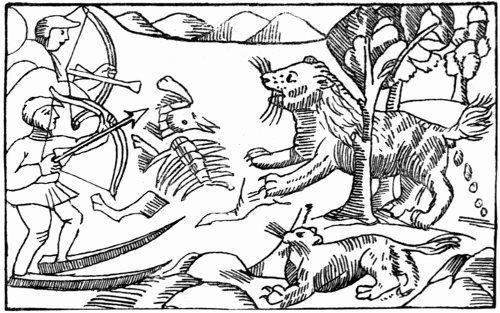
Olaus Magnus thus describes the Gulo or Gulon:—“Amongst all creatures that are thought to be insatiable in the Northern parts of Sweden, the Gulo hath his name to be the principall; and in the vulgar tongue they call him Jerff, but in the German language Vielfras; in the Sclavonish speech Rossamaka, from his much eating, and the Latin name is Gulo, for he is so called from his gluttony. He is as great as a great Dog, and his ears and face are like a Cat’s: his feet and nails are very sharp; his body is hairy, with long brown hair, his tail is like the Foxes, but somewhat shorter, but his hair is thicker, and of this they make brave Winter Caps. Wherefore this Creature is the most voracious; for, when he finds a carcasse, he devours so much, that his body, by over-much meat, is stretched like a Drum, and finding a streight (narrow) passage between Trees, he presseth between them, that he may discharge his Mechovita thinks in his Sarmatia. The flesh of this Creature is altogether uselesse for man’s food; but his skin is very commodious and pretious. For it is of a white brown black colour, like a damask cloth wrought with many figures; and it shews the more beautiful, as by the Industry of the Artist it is joyn’d with other garments in the likenesse or colour. Princes and great men use this habit in Winter, made like Coats; because it quickly breeds heat, and holds it long; and that not onely in Swethland, and Gothland, but in Germany, where the rarity of these skins makes them to be more esteemed, when it is prised in ships among other Merchandise.
“The Inhabitants are not content to let these skins be transported into other Countries, because, in Winter, they use to entertain their more noble guests in these skins; which is a sufficient argument that they think nothing more comely and glorious, than to magnifie at all times, and in all orders their good guests, and that in the most vehement cold, when amongst other good turns they cover their beds with these skins.
“And I do not think fit to overpasse, that when men sleep under these skins, they have dreams that agree with the nature of that Creature, and have an insatiable stomach, and lay snares for other Creatures, and prevent them themselves. It may be that it is as they that eat hot
“The guts of this Creatures are made into strings for Musicians, and give a harsh sound, which the Natives take pleasure in; but these, tempered with sweet sounding strings, will make very good Musick. Their hoofs made like Circles, and set upon heads subject to the Vertigo, and ringing ears, soon cure them. The Hunters drink the blood of this beast mingled with hot water; also seasoned with the best Honey, it is drunk at Marriages. The fat, or tallow of it, smeered on putrid Ulcers for an ointment is a sudden cure. Charmers use the teeth of it. The hoofs, newly taken off, will drive away Cats and Dogs, if they do but see it, as birds fly away, if they spy but the Vultur or the Bustard.
“By the Hunter’s various Art, this Creature is taken onely in regard of his pretious skin; and the way is this;—They carry into the wood a fresh Carkasse; where these beasts are wont to be most commonly; especially in the deep snows (for in Summer their skins are nothing worth) when he smels this he falls upon it, and eats till he is forced to crush his belly close between narrow trees, which is not without pain; the Hunter, in the mean time, shoots, and kills him with an arrow.
“There is another way to catch this Beast, for they set Trees, bound asunder with small cords, and these fly up when they eat the Carkasse, and strangle them; or else he is taken, falling into pits dug upon one side, if the Carkasse be cast in, and he is compelled by hunger to feed upon it. And there is hardly any other way to catch him with dogs, since his claws are so sharp, that
Of this animal Topsell says:—“This beast was not known by the ancients, but hath bin since discovered in the Northern parts of the world, and because of the great voracity thereof, it is called Gulo, that is, a devourer; in imitation of the Germans, who call such devouring Creatures Vilsruff, and the Swedians Cerff, and in Lituania and Muscovia it is called Rossomokal. It is thought to be engendered by a Hyæna and a Lionesse, for in quality it resembleth a Hyæna, and it is the same which is called Crocuta: it is a devouring and unprofitable creature having sharper teeth than other creatures. Some thinke it is derived from a wolf and a dog, for it is about the bignesse of a dog. It hath the face of a Cat, the body and taile of a Foxe; being black of colour; his feet and nailes be most sharp, his skin rusty, the haire very sharp, and it feedeth upon dead carkases.”
He then describes its manner of feeding, evidently almost literally copying Olaus Magnus, and thus continues:—“There are of these beastes two kindes, distinguished by coulour, one blacke, and the other like a Wolfe: they seldom kill a man or any live beastes, but feede upon carrion and dead carkasses, as is before saide, yet, sometimes, when they are hungry, they prey upon beastes, as horses and such like, and then they subtlely ascend up into a tree, and when they see a beast under the same, they leape downe upon him and destroy him. A Beare is afraide to meete them, and unable to match them, by reason of their sharpe teeth.
“This beast is tamed, and nourished, in the courts of Princes, for no other cause than for an example of incredible voracitie. When he hath filled his belly, if Polonia, Swede-land, Goat-land, and the princes of Germany. Neither is there any skinne which will sooner take a colour, or more constantly retaine it. The outward appearance of the saide skinne is like to a damaskt garment, and besides this outward parte there is no other memorable thing woorthy observation in this ravenous beast, and therefore, in Germany, it is called a foure-footed Vulture.”
As a matter of fact, the Glutton or Wolverine, which is not unlike a small bear, can consume (while in confinement) thirteen pounds of meat in a day. In its wild state, if the animal it has killed is too large for present consumption, it carries away the surplus, and stores it up in a secure hiding-place, for future eating.
The Bear.
As Pliny not only uses all Aristotle’s matter anent Bears, but puts it in a consecutive, and more readable form, it is better to transcribe his version than that of the older author.
“Bears couple in the beginning of winter. The female then retires by herself to a separate den, and then brings 34 The male remains in his retreat for forty days, the female four months. If they happen to have no den, they construct a retreat with branches and shrubs, which is made impenetrable to the rain, and is lined with soft leaves. During the first fourteen days they are overcome by so deep a sleep, that they cannot be aroused by wounds even. They become wonderfully fat, too, while in this lethargic state. This fat is much used in medicine, and it is very useful in preventing the hair from falling off.35 At the end of these fourteen days they sit up, and find nourishment by sucking their fore paws. They warm their cubs, when cold, by pressing them to the breast, not unlike the way in which birds brood over their eggs. It is a very astonishing thing, but Theophrastus believes it, that if we preserve the flesh of the bear, the animal being killed in its dormant state, it will increase in bulk, even though it may have been cooked. During this period no signs of food are to be found in the stomach Aros, in order to relax the bowels, which would otherwise become in a state of constipation; and they sharpen the edges of their teeth against the young shoots of the trees.
“Their eyesight is dull, for which reason in especial, they seek the combs of bees, in order that from the bees stinging them in the throat, and drawing blood, the oppression in the head may be relieved. The head of the bear is extremely weak, whereas, in the lion, it is remarkable for its strength: on which account it is, that when the bear, impelled by any alarm, is about to precipitate itself from a rock, it covers its head with its paws. In the arena of the Circus they are often to be seen killed by a blow on the head with the fist. The people of Spain have a belief, that there is some kind of magical poison in the brain of the bear, and therefore burn the heads of those that have keen killed in their public games; for it is averred, that the brain, when mixed with drink, produces, in man, the rage of the bear.
“These animals walk on two feet, and climb trees backwards. They can overcome the bull, by suspending themselves, by all four legs, from his muzzle and horns, thus wearing out its powers by their weight. In no
Olaus Magnus, in writing about bears, gives precedence to the white, or Arctic bear, and gives an insight into the religious life of the old Norsemen, who, when converted, thought their most precious things none too good for the “Church.” If we consider the risk run in obtaining a white bear’s skin, and the privations and cold endured in getting it, we may look upon it as a Norse treasure. “Silver and Gold have I none; but such as I have, give I unto thee.” He gives a short, but truthful account of their habits, and winds up his all too brief narration thus:—“These white Bear Skins are wont to be offered by the Hunters, for the high Altars of Cathedrals, or Parochial Churches, that the Priest celebrating Mass standing, may not take cold of his feet, when the Weather is extream cold. In the Church at Nidrosum, which is the Metropolis of the Kingdom of Norway, every year such white Skins are found, that are faithfully offered by the Hunters Devotion, whensoever they take them, and Wolves-Skins to buy Wax-Lights, and to burn them in honour of the Saints.”
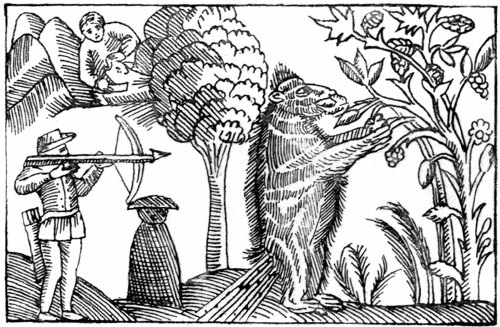
Olaus Magnus is very veracious in his dealings with White Bears, but he morally retrogrades when he touches upon the Black and Brown Bears. The illustrations of this portion of Olaus Magnus are exceedingly graphic. In treating of the cunning used in killing bears, he says:—“In killing black and cruel Bears in the Northern Kingdoms, they use this way, namely, that when, in Autumn the Bear feeds on certain red ripe Fruit (Query Cranberries) on trees that grow in Clusters like Grapes, either going up into the Trees, or standing on the ground, and pulling down the Trees, the cunning Hunter,
“The Bears watch diligently for the passing of Deer; and chiefly, the Shee-Bear when she hath brought forth her Whelps; who not so much for Hunger, as for fearing of losing her Whelps, is wont to fall cruelly upon all she meets. For, she being provoked by any violence, far exceeds the force of the He-Bear, and Craft, that she may revenge the loss of her Young. For she lyes hid amongst the thick boughs of Trees, and young
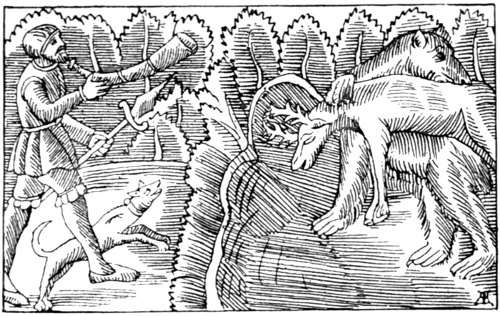
Magnus then retails the usual fables about bears
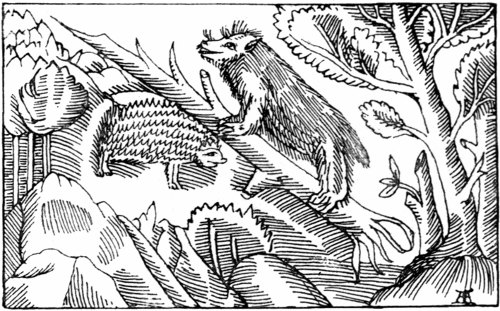
“Though the Urchin have sharp pointed prickles, whereby he gathereth Apples to feed on, and these he hides in hollow Trees, molesting the Bear in his Den: yet is he oppressed by the cunning and weight of the Bear: namely when the Urchin roles himself up round as a ball, that there is nothing but his prickles to come at: yet with this means he cannot prevail against the Bear, which opens him, to revenge the wrong he did her in violating her Lodging. Nor can the Bear eat the Hedge-Hog, it is such miserable poor and prickly meat. Wherefore returning again into his Cave, he sleeps, and grows fat, living by sucking his paw.
“The Bears also fight against the Bores, but seldome get the victory, because they can better defend themselves with their Tusks, than the Bull or the Deer can by their Horses keep off the Bears with their biting and kicking, from the Mares that are great with Foals. Young Colts save themselves by running, but they will always hold this fear, and so become unprofitable for the Wars. Wherefore they use this stratagem: some Souldier puts on a Bear’s skin, and meets them, by reason that they are horses that the Bears have hunted.”
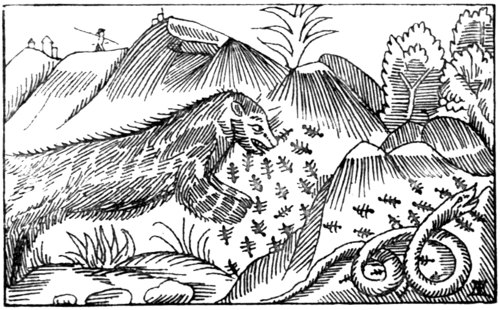
The Northern Bears seem to have been wonderful creatures, for they used to go mad after eating Mandragora, and then they were in the habit of making a meal off ants, by way of recovering their sanity. They were then, as now, noted for their love of honey, and this illustration depicts them as coming out of, and going into the ground after bees and honey; nay, it would seem as if they even invaded the barrels put up in the trees to serve as hives. But man was more cunning than they, and a good bear-skin in those cold regions, had a value far exceeding honey.
“Since that in the Northern Countries, especially Podolia, Russia, and places adjacent, because of the great
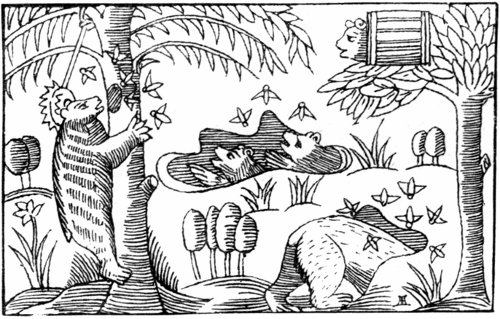
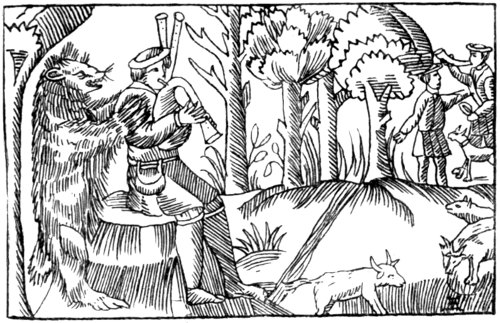
Every one of my readers, who is not a Scotsman, will appreciate the delicate musical taste of the bear, in the matter of bagpipes—Bruin cannot stand the skirling, and, in the illustration, seems to be remonstrating with the piper.
“It is well enough known that Bears, Dolphins, Stags, Sheep, Calves and Lambs, are much delighted with Musick: and, again, they are to be driven from their Heards by some harsh sounding Pipes, or Horns, that when they hear the sound they will be gone into the Woods, a great way off. Now the Shepheards of the Cattel know this well enough: they will play upon their two horned Pipes continually, which sometimes are taken away by Bears, until such time as the Bear is forced by Hunger to go away to get his food. Wherefore they take a Goat’s Horn, and sometimes a Cow’s Horn, and make such a horrid noise, that they scare the wild beasts, and so return safe to their dispersed flocks. This two horned Pipe, which in their tongue they call Seec-Pipe, they carry to the fields with them, for they have learned by use, that their Flocks and Heards will feed the better and closer together.
“The Russians and Lithuanians are more near to the Swedes and Goths on the Eastern parts: and these hold it a singular delight, to have always the most cruel Germany, to spoil Travellers, and to cast them to their Bears to eat, most strict Laws are made against them, that they may never come there again.
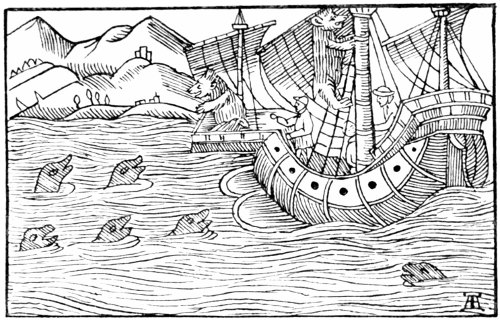
“There is another Sport, when Bears taken, are put into a Ship, and shew merry pastimes in going up and down the Ropes, and sometimes are profitable for some
“But that tame Bears may not onely be kept unprofitably to feed, and make sport, they are set to the Wheels in the Courts of great men, that they may draw up Water out of deep Wells; and that in huge Vessels made for this purpose, and they do not help alone this Way, but they are set to draw great Waggons, for they are very strong in their Legs, Claws, and Loins; nor is it unfit to make them go upright, and carry burdens of Wood, and such like, to the place appointed, or they stand at great men’s doors, to keep out other hurtful Creatures. When they are young, they will play wonderfully with Boys, and do them no hurt.”
Topsell goes through the usual stories of bears licking their cubs into shape, and subsisting by sucking their claws—but he also affords us much information about bears, which we do not find in modern Natural Histories:—“At what time they come abroad, being in the beginning of May, which is the third moneth from the Spring. The old ones being almost dazled with long darknes, comming into light againe, seeme to stagger and reele too and fro, and then for the straightnesse of their guts, by reason of their long fasting, doe eat the herbe Arum, called in English Wake-Robbin, or Calves-foot, being of very sharpe and tart taste, which enlargeth their guts, and so, being recovered, they remaine all the time their young are with them, more fierce, and cruell than at other times. And concerning the same Arum, called also Dracunculus, and Oryx, there is a pleasant vulgar tale, whereby some have conceived that Beares eat this herbe before their lying secret, and by vertue thereof (without meat, or sence of cold) they passe away the whole winter in sleepe.
“There was a certaine cow-heard, in the Mountains Helvetia, which, comming downe a hill, with a great caldron on his backe, he saw a beare eating a root which he had pulled up with his feet; the cowheard stood still till the beare was gone, and afterward came to the place where the beast had eaten the same, and, finding more of the same roote, did likewise eat it; he had no sooner tasted thereof, but he had such a desire to sleepe, that hee could not containe himselfe, but he must needs lie down in the way, and there fell a sleep, having covered his heade with the caldron, to keep himself from the vehemency of the colde, and there slept all the Winter time without harme, and never rose againe till the spring time; which fable if a man will beleeve, then, doubtlesse, this hearbe may cause the Beares to be sleepers, not for fourteene dayes, but for fourscore dayes together.
“The ordinary food of Beares is fish; for the Water beare, and others will eate fruites, Apples, Grapes, Leaves, and Pease, and will breake into bee hives sucking out the honey; likewise Bees, Snayles and Emmets, and flesh, if it bee leane, or ready to putrifie; but, if a Beare doe chance to kill a swine, or a Bull, or Sheepe, he eateth them presentlie, whereas other beasts eate not hearbes, if they eate flesh: likewise they drinke water, but not like other beastes, neither sucking it, or lapping it, but as it were, even bitinge at it.
“They are exceeding full of fat or Larde-greace, which some use superstitiouslie beaten with oile, wherewith they anoint their grape-sickles when they go to vintage, perswading themselves that if no bodie knows thereof, their tender vine braunches shall never be consumed by catterpillers.
“Others attribute this to the vertue of Beare’s blood, and Theophrastus affirmeth, that if beare’s grease be kept Theophrastus likewise affirmeth, that at the time when beares lie secret, their dead flesh encreaseth, which is kept in houses, but beare’s fore feet are held for a verie delicate and well tasted foode, full of sweetnes, and much used by the German Princes.
“And because of the fiercenesse of this beast, they are seldome taken alive, except they be very young, so that some are killed in the Mountaines by Poyson, the Country being so steepe and rocky that hunters cannot followe them; some taken in ditches of the earth and other ginnes. Oppianus relateth that neare Tygris and Armenia, the inhabitauntes use this Stratigem to take Beares.
“The people go often to the Wooddes to find the Denne of the Beare, following a leam hound, whose nature is, so soone as he windeth the beast, to barke, whereby his leader discovereth the prey, and so draweth off the hounde with the leame; then come the people in great multitude, and compasse him about with long nets, placing certaine men at each end: then tie they a long rope to one side of the net, as high from the ground, as the small of a Man’s belly; whereunto are fastned divers plumes and feathers of vultures, swannes, and other resplendant coloured birdes, which, with the wind make a noise or hissing, turning over and glistering; on the other side of the net they build foure little hovels of greene boughes, wherein they lay foure men covered all over with greene leaves; then, all being prepared, they sound their Trumpets, and wind their horns; at the
“When a Beare is set upon by an armed man, he standeth upright, and taketh the man betwixt his forefeet, but he, being covered all over with yron plates can receive no harm, and then may easily, with a sharpe knife or dagger pierce thorough the heart of the beast.
“If a shee beare having young ones be hunted, shee driveth her Whelpes before her, untill they be wearied, and then, if she be not prevented, she climbeth uppon a tree, carrying one of her young in her mouth, and the other on her backe. A Beare will not willingly fight with a man, but, being hurt by a man, he gnasheth his teeth, and licketh his forefeete, and it is reported by an Ambassador of Poland, that when the Sarmatians finde a beare, they inclose the whole Wood by a multitude of people standing not above a cubit one from another; then cut they downe the outmost trees, so that they raise a Wall of wood to hemme in the Beares; this being effected, they raise the Beare, having certaine forkes in their hands, made for that purpose, and, when the Beare approacheth, they, (with those forkes) fall upon him, one keeping his head, another one leg, other his body, and so, with force, muzzle him and tie his legges, leading him away. The Rhætians use this policy to take Wolves and Beares; they raise up great posts, and crosse them
“The inhabitants of Helvetia hunt them with mastiffe Dogges, because they should not kill their cattell left at large in the fielde in the day time; They likewise shoote them with gunnes, giving a good summe of money to them that can bring them a slaine beare. The Sarmatians use to take Beares by this sleight; under those trees wherein bees breed, they plant a great many of sharpe pointed stakes, putting one hard into the hole wherein the bees go in and out, whereunto the Beare climbing, and comming to pull it forth, to the end that she may come to the hony, and being angry that the stake sticketh so fast in the hole, with violence plucketh it foorth with both her fore feet, whereby she looseth her holde, and falleth downe upon the picked stakes, whereupon she dieth, if they that watch for her come not to take her off. There was reported by Demetrius, Ambassador at Rome, from the King of Musco, that a neighbor of his, going to seek hony, fell into a hollow tree, up to the brest in hony, where he lay two days, being not heard by any man to complain; at length came a great Beare to this hony, and, putting his head into the tree, the poore man tooke hold thereof, whereat, the Beare, suddenly affrighted, drew the man out of that deadly danger, and so ranne away for feare of a worse creature.
“But, if there be no tree wherein Bees doe breed neere to the place where the Beare abideth, then they use to annoint some hollow place of a tree with hony, whereinto Bees will enter and make hony combes, and when the Beare findeth them, she is killed as aforesaide. In Norway they use to saw the tree almost asunder, so that when the beast climbeth it, she falleth downe upon piked stakes laid underneath to kill her; and some make a hollow place in a tree, wherein they put a great pot of water, having annointed it with hony, at the bottome wherof are fastened certaine hookes bending downeward, leaving an easie passage for the beare to thrust in her head to get the honie, but impossible to pull it foorth againe alone, because the hookes take holde on her skinne; this pot they binde fast to a tree, whereby the Beare is taken alive and blinde folded, and though her strength breake the corde or chaine wherewith the pot is fastened, yet can shee not escape or hurt any bodie in the taking, by reason her head is fastened in the pot.
“To conclude, other make ditches or pits under Apple trees, laying upon their mouth rotten stickes, which they cover with earth, and strawe uppon it herbes, and when the beare commeth to the Apple tree, she falleth into the pit and is taken.
“The herbe Wolfebaine or Liberdine is poison to Foxes, Wolves, Dogs, and Beares, and to all beasts that are littered blind, as the Alpine Rhætians affirme. There is one kinde of this called Cyclamine, which the Valdensians call Tora, and with the juice thereof they poison their darts, whereof I have credibly received this story; That a certain Valdensian, seeing a wilde beare, having a dart poysond heerewith, did cast it at the beare, being farre from him, and lightly wounded her, it being no sooner done, but the beare ran to and fro in a wonderful perplexitie through the woods, unto a verie sharpe cliffe of a rocke, where the man saw her draw her last breath, as soon as the poison entered to her hart, as he afterward found by opening of her bodie. The like is Armenia full of poison, with the pouder whereof they poison figs, and cast them in those places where wilde beastes are most plentifull, which they eat, and so are killed.
“Concerning the industrie or naturall disposition of a beare, it is certaine that they are very hardlie tamed, and not to be trusted though they seeme never so tame; for which cause there is a storie of Diana in Lysias, that there was a certaine beare made so tame, that it went uppe and downe among men, and woulde feede with them, taking meat at their handes, giving no occasion to feare or mistrust her cruelty; on a daye, a young mayde playing with the Beare, lasciviously did so provoke it, that he tore her in pieces; the Virgin’s brethren seeing the murther, with their Dartes slew the Beare, whereupon followed a great pestilence through all that region: and when they consulted with the Oracle, the paynim God gave answeare, that the plague could not cease untill they dedicated some virginnes unto Diana for the Beare’s sake that was slaine; which, some interpreting that they should sacrifice them, Embarus, upon condition the priesthoode might remaine in his family, slewe his onely daughter to end the pestilence, and for this cause the virgins were after dedicated to Diana before their marriage, when they were betwixt ten and fifteene yeare olde, which was performed in the moneth of January, otherwise they could not be married: yet beares are tamed for labours, and especially for sports among the Roxalani and Libians, being taught to draw water with wheeles out of the deepest wels; likewise stones upon sleds, to the building of wals.
“A prince of Lituania nourished a Beare very tenderly,
“There are many naturall operations in Beares. Pliny reporteth, that, if a woman bee in sore travaile of child-birth, let a stone, or arrow, which hath killed a man, a beare, or a bore, be throwne over the house wherein the Woman is, and she shall be eased of her paine. There is a small worme called Volvox, which eateth the vine branches when they are young, but if the vine-sickles be annointed with Beare’s blood, that worme will never hurt them. If the blood or greace of a Beare be set under a bed, it will draw unto it all the fleas, and so kill them by cleaving thereunto. But the vertues medicinall are very many; and first of all, the blood cureth all manner of bunches and apostems in the flesh, and bringeth haire upon the eyelids if the bare place be annointed therewith.
“The fat of a Lyon is most hot and dry, and next to a Lyon’s a Leopard’s; next to a Leopard’s a Beare’s; and next to a Beare’s, a Bul’s. The later Physitians use it to cure convulsed and distracted parts, spots, and tumors in the body. It also helpeth the paine of the loins, if the sicke part be annointed therewith, and all ulcers in
“The liver of a sow, a lamb, and a bear put togither, and trod to pouder under one’s shoos, easeth and defendeth cripples from inflamation: the gall being preserved and warmed in water, delivereth the bodie from Colde, when all other medicine faileth. Some give it, mixt with Water, to them that are bitten with a mad Dogge, holding it for a singular remedie, if the party can fast three daies before. It is also given against the palsie, the king’s evill, the falling sickenesse, an old cough, the inflamation of the eies, the running of the eares, delevery in child birth, the Hæmorrhods, the weaknes of the backe, and the palsie: and that women may go their full time, they make ammulets of Bear’s nails, and cause them to weare them all the time they are with Child.”
The Fox.
By Englishmen, the Fox has been raised to the height of at least a demigod—and his cult is a serious matter attended with great minutiæ of ritual. Englishmen and Foxes cannot live together, but they live for one another, the man to hunt the fox, the fox to be hunted. faute de mieux, they hunt the Dingo, or native dog. No properly constituted Englishman could ever compass the death of a poor fox, otherwise than by hunting. The Vulpecide—in any other manner—is, in an English county, a social leper—he is a thing anathema. Running away with a neighbour’s wife may be condoned by county society, at least, among the men, but with them the man that shoots foxes is a very pariah, and it were good for that man had he never been born.
Every other nation, even from historic antiquity, has reckoned the Fox as among the ordinary feræ naturæ, to be killed, when met with, for the sake only of his skin, for his flesh is not toothsome: and when he arrives at the dignity of a silver or a black fox, his fur enwraps royal personages, as being of extreme value.
The Fox is noted everywhere for its “craftiness,” and was so famed long before the epic of Reineke Fuchs was evolved, and, indeed, this may be said to be its principal attribute. Many are the stories told by country firesides of his stratagems, both in plundering and in his endeavours to escape from his enemies. Indeed, no country ought to be able to compare in Fox lore with our own. Its sagacity, cunning, or call it what you like, dates far back. Pliny tells us that “in Thrace, when all parts are covered with ice, the foxes are consulted, an animal, which, in other respects, is baneful from its
The Fox is most abundant in the northern parts of Europe, and therefore we hear more about him from the pages of Olaus Magnus, Gessner, and Topsell.
The former says:—“When the fox is pressed with hunger, Cold and Snow, and he comes near men’s houses, he will bark like a dog, that house creatures may come nearer to him with more confidence. Also, he will faign himself dead, and lie on his back, drawing in his breath, and lolling out his tongue. The birds coming down, unawares, to feed on the carkasse, are snapt up by him, with open mouth. Moreover, when he is hungry, and finds nothing to eat, he rolls himself in red earth, that he may appear bloody; and, casting himself on the earth, he holds his breath, and when the birds see that
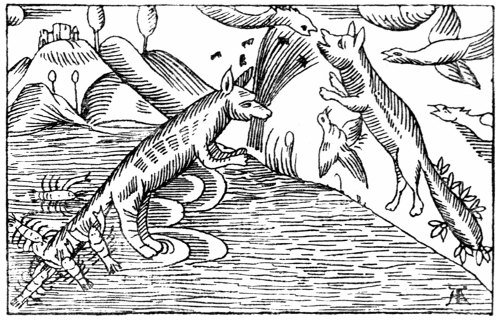
“Again, when he sees that he cannot conquer the Urchin, for his prickles, he lays him on his back, and so rends the soft part of his body. Sometimes fearing the multitude of wasps, he counterfeits and hides himself, his tail hanging out: and when he sees that they are all busie, and entangled in his thick tail, he comes forth, and rubs them against a stone or Tree, and kills them and eats them. The same trick, almost, he useth, when he lyes in wait for crabs and small fish, running about the bank, and he lets down his tail into the water, they admire at it, and run to it, and are taken in his fur, and pull’d out. Moreover, when he hath fleas, he makes a little bundle of soft hay wrapt in hair, and holds it in his mouth; then he goes by degrees into the water, beginning with his tail, that the fleas fearing the water, will run up all his body till they come at his head: then he dips in his head, that they may leap into the hay; when this is done, he leaves the hay in the water, and swims forth.
“But when he is hungry, he will counterfeit to play with the Hare, which he presently catcheth and devoureth, unlesse the Hare escape by flight, as he often doth. Sometimes he also escapes from the dogs by barking, faigning himself to be a dog, but more surely when he hangs by a bough, and makes the dogs hunt in vain to find his footing. He is also wont to deceive the Hunter and his dogs, when he runs among a herd of Goats, and goes for one of them, leaping upon the Goat’s back, that he may sooner escape by the running of the Goat, by reason of the hatefull Rider on his back. The
“If he be taken in a string, he will sometime bite off his own foot, and so get away. But, if there be no way open he will faign himself dead, that being taken out of the snare, he may run away. Moreover, when a dog runs after him, and overtakes him, and would bite him, he draws his bristly tail through the dog’s mouth, and so he deludes the dog till he can get into the lurking places of the Woods. I saw also in the Rocks of Norway a Fox with a huge tail, who brought many Crabs out of the water, and then he ate them. And that is no rare sight, when as no fish like Crabs will stick to a bristly thing let down into the water, and to dry fish, laid on the rocks to dry. They that are troubled with the Gowt, are cured by laying the warm skin of this beast about the part, and binding it on. The fat, also, of the same creature, laid smeered upon the ears or lims of a gowty person, heals him; his fat is good for all torments of the guts, and for all pains, his brain often given to a child will preserve it ever from the Falling-sicknesse. These and such-like simple medicaments the North Country people observe.”
A portion of the above receives a curious corroboration from Mr. P. Robinson in his book, The Poets’ Beasts. Speaking of the Lynx, he says:—“But it is not, as is supposed, ‘untamable.’ The Gækwar of Baroda has a regular pack of trained lynxes, for stalking and hunting pea-fowl, and other kinds of birds. I have, myself, seen a tame lynx that had been taught to catch crows—no simple feat—and its strategy was as diverting as its agility amazing. It would lie down with the end of a string in its mouth, the other end being fast to a
“The crows would very soon discover the bone, and collecting round in a circle, would discuss the probabilities of the lynx only shamming, and the chances of stealing his dinner. The animal would take no notice whatever, but lie there looking so limp and dead, that at last one crow would make so bold as to come forward. The others let it do so alone, knowing that afterwards there would be a free fight for the plunder, and the thief, probably, not enjoy it, after all. So the delegate would advance with all the caution of a crow—and nothing exceeds it—until within seizing distance. There it would stop, flirt its wings nervously, stoop, take a last long look at the lynx to make sure that it really was asleep, and then dart like lightning at the bone. But, if the crow was as quick as lightning, the lynx was as swift as thought, and lo! the next instant there was the beast sitting up with the bird in its mouth!...
“Next time it had to practise a completely different manœuvre. The same crows are not to be ‘humbugged’ a second time by a repetition of the being-dead trick. So the lynx, when a sufficient number of the birds had assembled, would take the string in its mouth, and run round and round the stake, at the extreme limit of its tether, as if it were tied. The crows, after their impudent fashion, would close in. They thought they knew the exact circumference of the animal’s circle, and getting as close to the dangerous line as possible, without actually transgressing it, would mock and abuse the supposed betethered brute. But all of a sudden, the circling lynx
Topsell gives some curious particulars of the Fox, and, speaking of their earths, he says:—“These dens have many caves in them, and passages in and out, that when the Terrars shall set upon him in the earth, he may go forth some other way, and forasmuch as the Wolfe is an enemy to the Foxe, he layeth in the mouth of his den, an Herbe (called Sea-onyon) which is so contrary to the nature of a Wolfe, and he so greatly terrified therewith, that hee will never come neere the place where it groweth, or lyeth; the same is affirmed of the Turtle to save her young ones, but I have not read that Wolves will prey upon Turtles, and therefore we reject that as a fable.... If a Foxe eat any meat wherein are bitter Almondes, they die thereof, if they drinke not presently: and the same thing do Aloes in their meate worke uppon them, as Scaliger affirmeth upon his owne sighte or knowledge. Apocynon or Bear-foot given to dogs, wolves, Foxes, and all other beasts which are littered blind, in fat, or any other meat, killeth them, if vomit helpe them not, which falleth out very seldome, and the seeds of this hearbe have the same operation. It is reported by Democritus, that, if wilde rue be secretly hunge under a Hen’s wing, no Fox will meddle with her, and the same writer also declareth for approoved, that, if you mingle the gal of a Fox, or a Cat, with their ordinary foode, they shall remaine free from the danger of these beasts.
“The medicinall uses of this beast are these: first, (as Pliny, and Marcellus affirme) a Fox sod in water until nothing of the Foxe be left whole except the bones, and the Legges, or other parts of a gouty body, washed, and daily bathed therein, it shall drive away all paine and Galen attributeth the same vertue to an Hyæna sod in Oyle, and the lame person bathed therein, for it hath such power to evacuate and draw forth whatsoever evill humour aboundeth in the body of man, that it leaveth nothing hurtfull behinde.
“Neverthelesse, such bodies are soon againe replenished through evill dyet, and relapsed into the same disease againe. The Fox may be boyled in fresh or salt water with annise and time, and with his skin on whole, and not slit, or else his head cut off, there being added to the decoction two pintes of oyle.
“The flesh of a Foxe sod and layed to afore bitten by a Sea hare, it cureth and healeth the same. The Foxe’s skinne is profitable against all moyste fluxes in the skinne of the body, and also the gowt, and cold in the sinnewes. The ashes of Foxe’s flesh burnt and drunk in wine, is profitable against the shortnesse of breath and stoppings of the liver.
“The blood of a Foxe dissected, and taken forth of his urine alive, and so drunk, breaketh the stone in the bladder, or else (as Myrepsus saieth) kill the Foxe, and take the blood, and drink a Cupfull thereof, and afterward with the same wash the parts, and, within an houre the stone shall be voyded: the same vertue is in it being dryed and drunke in wine with sugar.
“Oxycraton and Foxes blood infused into the Nostrils of a lethargick Horsse, cureth him. The fat is next to a Bul’s and a Swine’s, so that the fat or larde of Swine may be used for the fat of Foxes, and the fat of Foxes for the Swines grease in medicine. Some do herewith annoynte the places which have the Crampe, and all
“The same, with powder of Vine twigs mollified and sod in lye, attenuateth, and bringeth downe, all swelling tumours of the flesh. The fat alone healeth the Alopecias and looseness of the haire; it is commended in the cure of all sores and ulcers of the head, but the gall, and time, with Mustard-seede is more approved. The fat is also respected for the cure of paine in the eares, if it be warmed and melt at the fire, and so instilled; and this is used against tingling in the eares. If the Haires rot away on a Horse’s taile, they recover them againe, by washing the place with urine and branne, with Wyne and Oyle, and afterward annoynt it with foxe’s grease. When sores or ulcers have procured the haire to fall off from the heade, take the head of a young foxe burned with the leaves of blacke Orchanes and Alcyonium, and the powder cast upon the head recovereth againe the haire.
“If the braine be often given to infants and sucking children, it maketh them that they shall remaine free from the falling evill. Pliny prescribeth a man which twinkleth with his eies, and cannot looke stedfastly, to weare in a chaine, the tongue of a foxe; and Marcellus biddeth to cut out the tongue of a live foxe, and to turne him away, and hang uppe that tongue to dry in purple thred, and, afterward put it about his necke that is troubled with the whitenesse of the eies, and it shall cure him.
“But it is more certainely affirmed, that the tongue, either dryed, or greene, layed to the flesh wherein is any Dart or other sharpe head, it draweth them forth violently, and rendeth not the flesh, but, only where it is
“The lightes of foxes drunke in Water after they have beene dryed into powder, helpeth the Melt, and Myrepsus affirmeth, that when he gave the same powder to one almost suffocated in a pleurisie it prevailed for a remedy. Archigene prescribeth the dried liver of a Fox for the Spleneticke with Oxymell: and Marcellinus for the Melt, drunke after the same manner; and Sextus adviseth to drinke it simply without composition of Oxymell. The gall of a Foxe instilled into the eares with Oyle, cureth the paine in them, and, mixed with Hony Atticke, and annointed upon the eies, taketh away al dimnes from them, after an admirable manner. The melt, bound upon the tumors, and bunches of the brest, cureth the Melt in man’s body. The reynes dried and mingled with Honie, being anointed uppon Kernels, take them away. For the swelling of the Chaps, rub the reines of a Fox within the mouth. The dung, pounded with Vineger, by annointment cureth the Leprosie speedily. These and such other vertues medicinal, both the elder and later Phisitians have observed in a Fox,—wherewithal we wil conclude this discourse.”
The Wolf.
The Wolf, as a beast of prey, is invested with a terror peculiarly its own; when solitary, it is not much dreaded idiosyncrasies:—
“It is said that Wolves doe also eate a kind of earth called Argilla, which they doe not for hunger, but to make their bellies waigh heavy, to the intent, that when they set upon a Horsse, an Oxe, a Hart, an Elke, or some such strong beast, they may waigh the heavier, and hang fast at their throates till they have pulled them downe, for by vertue of that tenacious earth, their teeth are sharpened, and the waight of their bodies encreased; but, when they have killed the beast that they set upon, before they touch any part of his flesh, by a kind of natural vomit, they disgorge themselves, and empty their bellies of the earth, as unprofitable food....
“They also devoure Goates and Swyne of all sortes, except Bores, who doe not easily yeald unto Wolves. It is said that a Sow, hath resisted a Wolfe, and when he fighteth with her, hee is forced to use his greatest craft and suttelty, leaping to and from her with his best activity, least she should lay her teeth upon him, and so at one time deceive him of his prey, and deprive him of his life. It is reported of one that saw a Wolfe in a Wood, take in his mouth a peece of Timber of some thirty or forty pound waight, and with that he did practise to leape over the trunke of a tree that lay upon the earth; at length, when he perceived his own ability
“Their maner is, when they fal upon a Goat or a Hog, or some such other beast of smal stature, not to kil them, but to lead them by the eare with al the speed they can drive them, to their fellow Wolves, and, if the beast be stubborne, and wil not runne with him, then he beateth his hinder parts with his taile, in the mean time holding his ear fast in his mouth, whereby he causeth the poore beast to run as fast, or faster than himselfe unto the place of his owne execution, where he findeth a crew of ravening Wolves to entertaine him, who, at his first appearance seize upon him, and, like Divels teare him in peeces in a moment, leaving nothing uneaten but onely his bowels....
“Now although there be a great difference betwixt him and a Bul, both in strength and stature, yet he is not affraid to adventure combat, trusting in his policy more than his vigor, for when he setteth upon a Bul, he commeth not upon the front for feare of his hornes, nor yet behind him for feare of his heeles, but first of al standeth a loofe from him, with his glaring eyes, daring and provoking the Bul, making often profers to come neere unto him, yet is wise enough to keepe a loofe till he spy his advauntage, and then he leapeth suddenly upon the backe of the Bul at the one side, and being so ascended, taketh such hold, that he killeth the beast, before he loosen his teeth. It is also worth the observation, how he draweth unto him a Calfe that wandereth from the dam, for by singular treacherie he taketh him by the nose, first drawing him forwarde, and then the poore beast striveth and draweth backward, and thus they struggle togither, one pulling one way, and the other another, till at last the Wolfe perceiving advantage, and feeling when the Calfe pulleth heavyest, suddenly he letteth go his hold, whereby the poore beast falleth backe upon his buttocks, and so downe right upon his backe; then flyeth the Wolfe to his belly which is then his upper part, and easily teareth out his bowels, so satisfieng his hunger and greedy appetite.
“But, if they chance to see a Beast in the water, or in the marsh, encombred with mire, they come round about him, stopping up al the passages where he shold come out, baying at him, and threatning him, so as the poore distressed Oxe plungeth himselfe many times over head and eares, or at the least wise they so vex him in the mire, that they never suffer him to come out alive. At last, when they perceive him to be dead, and cleane Sextus saith that, in case a Wolf do see a man first, if he have about him the tip of a Wolf’s taile, he shal not neede to feare anie harme. All domestical Foure footed beasts, which see the eie of a wolfe in the hand of a man, will presently feare and runne away.
“If the taile of a wolfe be hung in the cratch of Oxen, they can never eat their meate. If a horse tread upon the foote steps of a Wolfe, which is under a Horse-man or Rider, hee breaketh in peeces, or else standeth amazed. If a wolfe treadeth in the footsteps of a horse which draweth a waggon, he cleaveth fast in the rode, as if he were frozen.
“If a Mare with foale, tread upon the footsteps of a wolfe, she casteth her foal, and therefore the Egyptians, when they signifie abortment doe picture a mare treading upon a wolf’s foot. These and such other things are reported, (but I cannot tell how true) as supernaturall accidents in wolves. The wolfe also laboureth to overcome the Leoparde, and followeth him from place to place, but, for as much as they dare not adventure upon him single, or hand to hand, they gather multitudes, and
“And this is the nature of this beast, that he feareth no kind of weapon except a stone, for, if a stone be cast at him, he presently falleth downe to avoide the stroke, for it is saide that in that place of his body where he is wounded by a stone, there are bred certaine wormes which doe kill and destroie him.... As the Lyon is afraide of a white Cocke and a Mouse, so is the wolfe of a Sea crab, or shrimp. It is said that the pipe of Pithocaris did represse the violence of wolves when they set upon him, for he sounded the same unperfectly, and indistinctly, at the noise whereof the raging wolfe ran away; and it hath bin beleeved that the voice of a singing man or woman worketh the same effect.
“Concerning the enimies of wolves, there is no doubt but that such a ravening beast hath fewe friends, ... for this cause, in some of the inferiour beasts their hatred lasteth after death, as many Authors have observed; for, if a sheepe skinne be hanged up with a wolves’s skin, the wool falleth off from it, and, if an instrument be stringed with stringes made of both these beasts the one will give no sounde in the presence of the other.”
Here we have had all the bad qualities of the Wolf depicted in glowing colours; but, as a faithful historian, I must show him also under his most favourable aspect—notably in two instances—one the she-wolf that suckled Romulus and Remus, and the other who watched so tenderly over the head of the Saxon Edmund, King and Martyr, after it had been severed from his body by the Danes, and contemptuously thrown by them into a thicket. WOLF! The head was applied deftly to the body, which it joined naturally; indeed, so good a job was it, that the junction could only be perceived by a thin red, or purple, line.
It must be said of this wolf, that he was thorough, for not content with having preserved the head of the Saintly King from harm, he meekly followed the body to St. Edmund’s Bury, and waited there until the funeral; when he quietly trotted back, none hindering him, to the forest.
Were-Wolves.
But of all extraordinary stories connected with the Wolf, is the belief which existed for many centuries, (and in some parts of France still does exist, under the form of the “Loup-garou,”) and which is mentioned by many classical authors—Marcellus Sidetes, Virgil, Herodotus, Pomponius Mela, Ovid, Pliny, Petronius, &c.—of men being able to change themselves into wolves. This was called Lycanthropy, from two GreekVersipellis, or able to change the skin. It must be said, however, for Pliny, amongst classical authors, that although he panders sufficiently to popular superstition to mention Lycanthropy, and quotes from others some instances of it, yet he writes:—“It
This curious belief is to be found in Eastern writings, and it was especially at home with the Scandinavian and Teutonic nations. It is frequently mentioned in the Northern Sagas—but space here forbids more than just saying that the best account of these eigi einhamir (not of one skin) is to be found in The Book of Were-Wolves, by the Rev. S. Baring-Gould.
The name of Were Wolf, or Wehr Wolf, is derived thus, according to Mr. Gould:—“Vargr is the same as u-argr, restless; argr being the same as the Anglo-Saxon earg. Vargr had its double signification in Norse. It signified a Wolf, and also a godless man. This vargr is the English were, in the word were-wolf, and the garou or varou in French. The Danish word for were-wolf is var-ulf the Gothic, vaira-ulf.” Lycanthropy was a widespread belief, but it gradually dwindled down in the sixteenth and seventeenth centuries to those eigi einhamir, the witches who would change themselves into hares, &c.
Olaus Magnus tells us Of the Fiercenesse of Men who by Charms are turned into Wolves:—“In the Feast of Christ’s Nativity, in the night, at a certain place, that they are resolved upon amongst themselves, there is gathered together such a huge multitude of Wolves changed from men, that dwell in divers places, which afterwards the same night doth so rage with wonderfull fiercenesse, both against mankind, and other creatures that are not fierce by nature, that the Inhabitants of that country suffer more hurt from them than ever they do from the true
“They go into the Beer-Cellars, and there they drink out some Tuns of Beer or Mede, and they heap al the empty vessels one upon another in the midst of the Cellar, and so leave them: wherein they differ from natural and true Wolves. But the place, where, by chance they stayd that night, the Inhabitants of those Countries think to be prophetical: Because, if any ill successe befall a Man in that place; as, if his Cart overturn, and he be thrown down in the Snow, they are fully perswaded that man must die that year, as they have for many years proved it by experience. Between Lituania, Samogetia, and Curonia, there is a certain wall left, of a Castle that was thrown down; to this, at a set time, some thousands of them come together, that each of them may try his nimblenesse in leaping. He that cannot leap over this wall, as commonly the fat ones cannot, are beaten with whips by their Captains.
“And it is constantly affirmed that amongst that multitude there are the great men, and chiefest Nobility of the Land. The reason of this metamorphosis, that is exceeding contrary to Nature, is given by one skilled in this witchcraft, by drinking to one in a Cup of Ale, and by mumbling certain words at the same time, so that he who is to be admitted into that unlawful Society, do accept it. Then, when he pleaseth, he may change his humane form, into the form of a Wolf entirely, going into some private Cellar, or secret Wood. Again, he can, after some time put off the same shape he took
“But for to come to examples; When a certain Nobleman took a long journey through the Woods, and had many servile Country-fellows in his Company, that were acquainted with this witchcraft, (as there are many such found in those parts) the day was almost spent; wherefore he must lie in the Woods, for there was no Inne neare that place; and withall they were sore pinched with hunger and want. Last of all, one of the Company propounded a seasonable proposall, that the rest must be quiet, and if they saw any thing they must make no tumulte; that he saw afar off a flock of sheep feeding; he would take care that, without much labor, they should have one of them to rost for Supper. Presently he goes into a thick Wood that no man might see him, and there he changed his humane shape like to that of a Wolf. After this he fell upon the flock of sheep with all his might, and he took one of them that was running back to the Wood, and then he came to the Chariot in the form of a Wolf, and brought the sheep to them. His companions being conscious how he stole it, receive it with grateful mind, and hide it close in the Chariot; but he that had changed himself into a Wolf, went into the Wood again, and became a Man.
“Also in Livonia not many years since, it fell out that there was a dispute between a Nobleman’s wife and his servant, (of which they have plenty more in that Country, than in any Christian Land) that men could not be turned into Wolves; whereupon he brake forth into this speech, that he would presently shew her an example of that businesse, so he might do it with her permission: he goes alone into the cellar, and, presently after, he Prussia, giving small credit to such a Witchcraft, compelled one who was cunning in this Sorcery, whom he held in chains, to change himself into a Wolf; and he did so. Yet that he might not go unpunished for this Idolatry, he afterwards caused him to be burnt. For such heinous offences are severely punished both by Divine and Humane Laws.”
Zahn, on the authority of Trithemius, who wrote in 1335, says that men having the spine elongated after the manner of a tail were Were-wolves. Topsell takes a more sensible view of the matter:—“There is a certaine territorie in Ireland (whereof M. Cambden writeth) that the inhabitants which live till they be past fifty yeare old, are foolishly reported to be turned into wolves, the true cause whereof he conjectureth to be, because for the most part they are vexed with the disease called Lycanthropia, which is a kind of melancholy, causing the persons so affected, about the moneth of February, to forsake their owne dwelling or houses, and to run out into the woodes, or neare the graves and sepulchers of men, howling and barking like Dogs and Wolves. The true signes of this disease are thus described by Marcellus: those, saith he, which are thus affected, have their faces pale, their eies dry and hollow, looking drousily and cannot weep. Their tongue as if it were al scab’d, being very rough, neither can they spit, and they are very thirsty, having many ulcers breaking out of their bodies, especially on their legges; this disease some cal Lycaon, and men oppressed therewith, Lycaones, because that there was one Lycaon, as it is fained by the poets, who, for his wickednes in sacrificing of a child, was by Jupiter turned into a Wolf, being utterly distracted of human understanding, and that which the poets speake of him. And this is most strange, that many thus diseased should desire the graves of the dead.”
The Antelope.
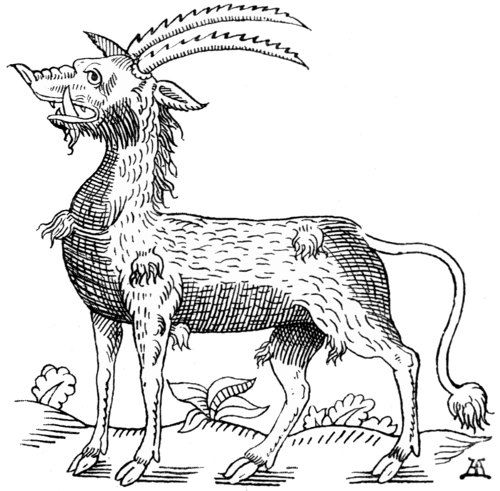
When not taken from living specimens, or skins, the artists of old drew somewhat upon their imaginations for their facts, as is the case with this Antelope, of which Topsell gives the following description:—“They are India, and Syria, neere the River Euphrates, and delight much to drinke of the cold water thereof. Their bodie is like the body of a Roe, and they have hornes growing forthe of the crowne of their head, which are very long and sharpe; so that Alexander affirmed that they pierced through the sheeldes of his Souldiers, and fought with them very irefully: at which time his company slew as he travelled to India, eight thousand, five hundred, and fifty; which great slaughter may be the occasion why they are so rare, and seldome seene to this day, by cause thereby the breeders, and meanes of their continuance (which consisted in their multitude) were weakened and destroyed. Their hornes are great, and made like a saw, and they, with them, can cut asunder the braunches of Osier, or small trees, whereby it commeth to passe that many times their necks are taken in the twists of the falling boughes, whereat the Beast with repining cry, bewrayeth himselfe to the Hunters, and so is taken. The vertues of this Beast are unknowne, and therefore Suidas sayth an Antalope is but good in part.”
The Horse.
Aldrovandus gives us a curious specimen of a horse, which the artist has drawn with the slashed trunk breeches of the time. He says that Fincelius, quoting Licosthenes, mentions that this animal had its skin thus slashed, from its birth, and was to be seen about the year 1555. Its skin was as thick as sole-leather. It was, probably, an ideal Zebra.
Topsell gives us some fine horse-lore, especially as to their love for their masters:—“Homer seemeth also Patroclus, and also shewed Achilles what should happen unto him; for which cause Pliny saieth of them that they lament their lost maisters with teares, and foreknow battailes. Accursius affirmeth that Cæsar three daies before he died, found his ambling Nag weeping in the stable, which was a token of his ensewing death, which thing I should not beleeve, except Tranquillus in the life of Cæsar, had related the same thing, and he addeth moreover, that the Horsses which were consecrated to Mars for passing over Rubicon, being let to run wilde abroad, without their maisters, because no man might meddle with the horses of the Gods, were found to weepe abundantly, and to abstaine from all meat.
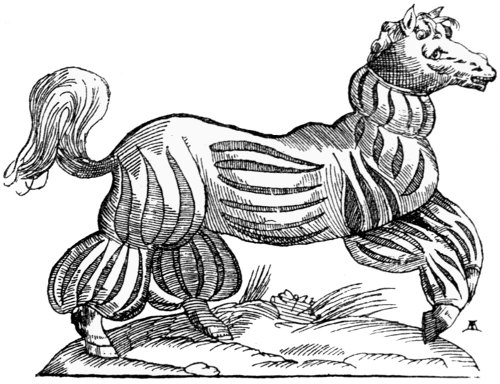
“Horsses are afraid of Elephants in battaile, and likewise Cyrus fought against Crœsus, he overthrew his Horse by the sight of Camels, for a horse cannot abide to looke upon a Camell. If a Horse tread in the footpath of a Wolfe, he presently falleth to be astonished; Likewise, if two or more drawing a Charriot, come into the place where a Wolfe hath trod, they stand so still as if the Charriot and they were frozen to the earth, sayth Ælianus and Pliny. Æsculapius also affirmeth the same thing of a Horsse treading in a Beare’s footsteppes, and assigneth the reason to be in some secret, betweene the feete of both beastes....
“Al kind of Swine are enemies to Horses, the Estridge also, is so feared of a Horse, that the Horsse dares not appeare in his presence. The like difference also is betwixt a Horse, and a Beare. There is a bird which is called Anclorus, which neyeth like a Horse, flying about; the Horse doth many times drive it away; but because it is somewhat blind, and cannot see perfectly, therefore the horsse doth oftentimes ketch it, and devoure it, hating his owne voice in a creature so unlike himself.
“It is reported by Aristotle, that the Bustard loveth a Horsse exceedingly, for, seeing other Beastes feeding in the pastures, dispiseth and abhorreth them; but, as soone as ever it seeth a Horsse, it flyeth unto him for joy, although the Horsse run away from it: and, therefore, the Egyptians, when they see a weake man driving away a stronger, they picture a Bustard flying to a Horsse....
“Julius Cæsar had a horsse which had cloven hooves like a man’s fingers, and because he was foaled at that time when the sooth-sayers had pronounced that hee should have the government of the world, therefore he
“If one do cut the vaines of the pallet of a horse’s mouth, and let it runne downe into his belly, it will presently destroy and consume the maw, or belly worms, which are within him. The Marrow of a horse is also very good to loosen the sinewes which are knit and fastned together, but first let it be boiled in wine, and afterwards be made cold, and then anointed warmly either by the Fire, or Sun. The teeth of a male horse not gelded, or by any labor made feeble, being put under the head, or over the head of him that is troubled or startleth in his dreame, doth withstand and resist all unquietnes which in the time of his rest might happen unto him. The teeth also of a horse is verye profitable for the curing of the Chilblanes which are rotten and full of corruption when they are swollen full ripe. The teeth which do, first of all, fall from horses, being bound or fastned upon children in their infancie, do very easily procure the breeding of the teeth, but with more speed, and more effectually, if they have never touched the ground....
“If you anoint a combe with the foame of a horse, wherewith a young man or youth doth use to comb his head, it is of such force as it will cause the haire of his head neither to encrease or any whit to appeare. The foame of a horse is also very much commended for them which have either pain or difficulty of hearing in their ears, or else the dust of horse dung, being new made and dryed, and mingled with oyle of Roses. The griefe or soreness of a man’s mouth or throat, being washed or annointed with the foame of a Horse, which hath bin
The Mimick Dog.
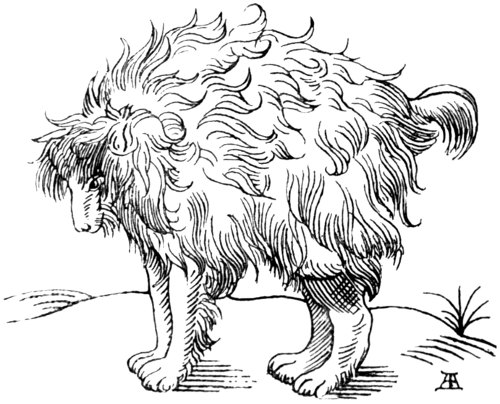
“The Mimicke or Getulian Dogge,” is, I take it, meant for a poodle. It was “apt to imitate al things it seeth, for which cause some have thought that it was conceived by an Ape, for in wit and disposition it resembleth an Ape, but in face, sharpe and blacke like an Hedgehog, having a short recurved body, very long legs, shaggy haire, and a short taile: this is called of some Canis Lucernarius. These being brought up with apes in their youth, learne very admirable and strange Egypt in the time of king Ptolemy, which were taught to leap, play, and dance, at the hearing of musicke, and in many poore men’s houses they served insteed of servaunts for divers uses.
“These are also used by Plaiers and Puppet-Mimicks to worke straunge trickes, for the sight whereof they get much money; such an one was the Mimick’s dog, of which Plutarch writeth that he saw in a publicke spectacle at Rome before the Emperor Vespasian. The dog was taught to act a play, wherein were contained many persons’ parts, I mean the affections of many other dogs; at last, there was given him a piece of bread, wherein, as was saide, was poison, having vertue to procure a dead sleepe, which he received and swallowed; and presently, after the eating thereof, he began to reele and stagger too and fro like a drunken man, and fell downe to the ground, as if he had bin dead, and so laie a good space, not stirring foot nor lim, being drawne uppe and downe by divers persons, according as the gesture of the play he acted did require, but when he perceived by the time, and other signes that it was requisite to arise, he first opened his eies, and lift up his head a little, then stretched forth himself, like as one doth when he riseth from sleepe; at last he geteth up, and runneth to him to whom that part belonged, not without the joy, and good content of Cæsar and all other beholders.