CURIOUS CREATURES. (continued 3)
Reading edition
“To this may be added another story of a certaine Italian about the yeare 1403, called Andrew, who had a red Dog with him, of strange feats, and yet he was blind. For standing in the Market place compassed about with a circle of many people, there were brought
It is curious to note some of the remedies against hydrophobia—and I only give a portion of the long list.
“For the outward compound remedies, a plaister made of Opponax and Pitch, is much commended, which Menippus used, taking a pound of Pitch of Brutias, and foure ounces of Opponax, adding withall, that the Opponax must be dissolved in vinegar, and afterwards the Pitch and the vinegar must be boiled together, and when the vinegar is consumed, then put in the Opponax, and of both together make like taynters or splints, and thrust them into the wound, so let them remaine many dayes together, and in the meane time drinke an antidot of sea crabs and vineger, (for vineger is alway pretious in this confection). Other use Basilica, Onyons, Rue, Salt, Rust of Iron, white bread, seedes of hore hound, and
“For the simple or uncompounded medicines to be taken against this sore, are many: As Goose-grease, the roote of Wilde roses drunke; bitter Almonds, leaves of Chickweed, or Pimpernell, the old skinne of a snake pounded with a male sea Crab, Betony, Cabbage-leaves, or stalkes, with Persneps and vineger, lime and sewet, poulder of Sea-Crabs with Hony; poulder of the shels of Sea-Crabs, the haires of a Dog layed on the wound, the head of the Dog which did bite, mixed with a little Euphorbium; the haire of a man with vineger, dung of Goates with wine, Walnuts with Hony and salte, poulder of fig tree in a sear cloth, Fitches in wine, Euphorbium, warme horse-dung, raw beanes chewed in the mouth, fig tree leaves, greene figs with vineger, fennel stalkes, Gentians, dung of pullen, the Lyver of a Buck-goate, young swallowes, burned to poulder, also their dung; the urine of a man, an Hyæna’s skin, flower de luce with honey, a Sea hearb called Kakille, Silphum with salt, the flesh and shels of snayles, leeke seeds with salt, mints, the taile of a field mouse cut off from her alive, and she suffered to live, rootes of Burres, with salt of the Sea plantaine, the tongue of a Ramme with salt, the flesh of al Sea-fishes, the fat of a sea-Calfe and Vervine, besides many other superstitious amulets which are used to be bound to the Armes, neckes, and brests, as the Canine tooth bound up in a leafe, and tyed to the Arme. A worme bred in the dung of Dogges, hanged about the necke, the roots of Gentian in an Hyæna’s skin, or young Wolfe’s Skin, and such like; whereof I know no reason beside the opinion of men.”
Let us now see what medicinal properties exist in dogs
“The vertues of a Dog’s head made into poulder, are both many and unspeakable, by it is the biting of mad dogs cured, it cureth spots, and bunches in the head, and a plaister thereof made with Oyle of Roses, healeth the running in the head. The poulder of the teeth of Dogges, maketh Children’s teeth to come forth with speed and easie, and, if their gums be rub’d with a dog’s tooth, it maketh them to have the sharper teeth; and the poulder of these Dogs teeth rubbed upon the Gummes of young or olde, easeth toothache, and abateth swelling in the gummes. The tongue of a Dogge, is most wholesome both for the curing of his owne wounds by licking, as also of any other creature. The rennet of a Puppy drunke with Wine, dissolveth the Collicke in the same houre wherein it was drunke,” &c., &c., &c.
The Cat.
Aldrovandus gives us a picture of a curly-legged Cat, but, beyond saying that it was so afflicted (or ornamented) from its birth, he gives no particulars. Topsell, too, is singularly silent on the merits of Cats; but yet he mentions some interesting particulars respecting them:—“To keepe Cats from hunting of Hens, they use to tie a little wild rew under their wings, and so likewise from Dove-coates, if they set it in the windowes, they dare not approach unto it for some secret in nature. Some have said that cats will fight with Serpentes, and Toads, and kill them, and, perceiving that she is hurt by them, she presently drinketh water, and is cured: but I cannot consent unto this opinion.... Ponzettus sheweth by
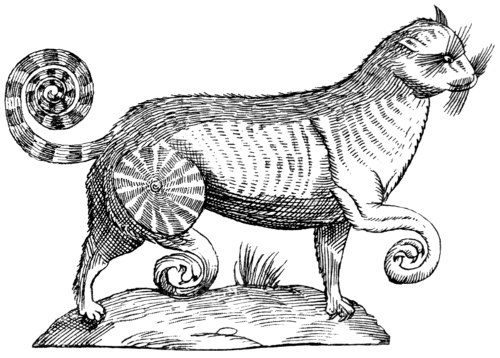
“Those which will keepe their Cattes within doores, and from hunting Birds abroad, must cut off their eares, for they cannot endure to have drops of raine distil into them, and therefore keep themselves in harbor.... They cannot abide the savour of oyntments, but fall madde thereby; they are sometimes infected with the falling evill, but are cured with Gobium.”
The Lion.
Of the great Cat, the Lion, the ancients give many wonderful stories, some of them not altogether redounding to his character for bravery:—“A serpent, or snake doth easily kill a lion, where of Ambrosius writeth very elegantly. Eximia leonis pulchritudo, per comantes cervicis toros excutitur, cum subito a serpente os pectore tenus attolitur, itaque Coluber cervum fugit sed Leonem interficit. The splendant beautie of a lion in his long curled mane is quickly abated, and allayed, when the serpent doth but lift up his head to his brest. For such is the ordinance of God, that the Snake, which runneth from a fearefull Hart, should without all feare kill a courageous Lyon; and the writer of Saint Marcellus life, How much more will he feare a great Dragon, against whom he hath not power to lift up his taile. And Aristotle writeth that the Lyon is afraid of the Swine, and Rasis affirmeth as much of the mouse.
“The Cocke also both seene and heard for his voice and combe, is a terror to the Lion and Basiliske, and the Lyon runneth from him when he seeth him, especially Lucretius describes this terrour notably, affirming that, in the morning, when the Cocke croweth, the lions betake themselves to flight, because there are certain seedes in the body of Cockes, which when they are sent, and appeare to the eyes of Lions, they vexe their pupils and apples, and make them, against Nature, become gentle and quiet.”
The Leontophonus—The Pegasus—The Crocotta.
The Lion has a dreadful enemy, according to Pliny, who says:—“We have heard speak of a small animal to which the name of Leontophonus36 has been given, and which is said to exist only in those countries where the Lion is produced. If its flesh is only tasted by the Lion, so intensely venomous is its nature, that this lord of the other quadrupeds instantly expires. Hence it is that the hunters of the Lion burn its body to ashes, and sprinkle a piece of flesh with the powder, and so kill the Lion by means of its ashes even—so fatal to it is this poison! The Lion, therefore, not without reason, hates the Leontophonus, and, after destroying its sight, kills it without inflicting a bite: the animal, on the other hand, sprinkles the Lion with its urine, being well aware that this, too, is fatal to it.”
We have read, in the Romances of Chivalry, how that Guy, Earl of Warwick, having seen a Lion and a instances:—
“Mentor, a native of Syracuse, was met in Syria by a lion, who rolled before him in a suppliant manner; though smitten with fear, and desirous to escape, the wild beast on every side opposed his flight, and licked his feet with a fawning air. Upon this, Mentor observed on the paw of the lion, a swelling and a wound; from which, after extracting a splinter, he relieved the creature’s pain.
“In the same manner, too, Elpis, a native of Samos, on landing from a vessel on the coast of Africa, observed a lion near the beach, opening his mouth in a threatening manner; upon which he climbed a tree, in the hope of escaping, while, at the same time, he invoked the aid of Father Liber (Bacchus); for it is the appropriate time for invocations where there is no room left for hope. The wild beast did not pursue him when he fled, although he might easily have done so; but, lying down at the foot of the tree, by the open mouth which had caused so much terror, tried to excite his compassion. A bone, while he was devouring his food with too great avidity, had stuck fast between his teeth, and he was perishing
The same author mentions two curious animals, the Leucrocotta, and the Eale, which are noticeable among other wonders:—“Æthiopia produces the lynx in abundance, and the sphinx, which has brown hair and two mammæ on the breast, as well as many monstrous kinds of a similar nature; horses with wings, and armed with horns, which are called pegasi: the Crocotta, an animal which looks as though it had been produced by the union of the wolf and the dog, for it can break anything with its teeth, and instantly, on swallowing it, it digests it with the stomach; monkeys, too, with black heads, the hair of the ass, and a voice quite unlike that of any other animal.”
The Leucrocotta—The Eale—Cattle Feeding Backwards.
“There are oxen, too, like that of India, some with one horn, and others with three; the leucrocotta, a wild beast of extraordinary swiftness, the size of the wild ass, with the legs of a Stag, the neck, tail, and breast of
“Among the same people there is found an animal called the eale; it is the size of the river-horse, has the tail of the elephant, and is of a black or tawny colour. It has, also, the jaws of the wild boar and horns that are moveable, and more than a cubit in length, so that, in fighting, it can employ them alternately, and vary their position by presenting them directly, or obliquely, according as necessity may dictate.”
The Eale, with its movable horns, is run hard by the Cattle of the Lotophagi, which are thus described by Herodotus:—“From the Augilæ at the end of another ten days’ journey is another hill of salt and water, and many fruit-bearing palm trees, as also in other places; and men inhabit it, who are called Gavamantes, a very powerful nation; they lay earth upon the salt, and then sow their ground. From these to the Lotophagi, the shortest route is a journey of thirty days: amongst them the kine that feed backwards are met with; they feed backwards for this reason. They have horns that are bent forward, therefore they draw back as they feed; for they are unable to go forward, because their horns would stick in the ground. They differ from other kine in no other respect than this, except that their hide is thicker and harder.”
Animal Medicine.
We have already seen some of the wonderfully curative properties of animals—let us learn something of
“The bird, also, which is called the Ibis, a native of the same country of Egypt, has shewn us some things of a similar nature. By means of its hooked beak, it laves the body through that part by which it is especially necessary for health, that the residuous food should be discharged. Nor, indeed, are these the only inventions which have been borrowed from animals to prove of use to man. The power of the herb dittany, in extracting arrows, was first disclosed to us by stags that had been struck by that weapon; the weapon being discharged on their feeding upon this plant. The same animals, too, when they happen to have been wounded by the phalangium, a species of spider, or by any insect of a similar nature, cure themselves by eating crabs. One of the very best remedies for the bite of the serpent, is the plant with which lizards treat their wounds when injured in fighting with each other. The swallow has shown us that the chelidonia is very serviceable to the sight, by the fact of its employing it for the cure of its young, when their eyes are affected. The tortoise recruits its powers of effectually resisting serpents by eating the plant which is known as cunile bubula; and rue, when it fights with the serpent in pursuit of mice. The Stork cures itself of its diseases, with wild marjoram, and the wild boar with ivy, as also by eating crabs, and, more particularly, those that have been thrown up by the sea.
“The snake, when the membrane which covers its body, has been contracted by the cold of winter, throws it off in the spring, by the aid of the juices of fennel, and thus becomes sleek and youthful in appearance. First of all it disengages the head, and then it takes no less than a day and a night in working itself out, and divesting itself of the membrane in which it has been enclosed. The same animal, too, on finding its sight weakened during its winter retreat, anoints and refreshes its eyes by rubbing itself on the plant called fennel, or marathrum; but, if any of the scales are slow in coming off, it rubs itself against the thorns of the juniper. The dragon relieves the nausea which affects it in spring, with the juices of the lettuce. The barbarous nations go to hunt the panther, provided with meat that has been rubbed with Aconite, which is a poison. Immediately on eating it, compression of the throat overtakes them, from which circumstance it is, that the plant has received the name of pardalianches (pard-strangler). The animal, however, has found an antidote against this poison in human excrements; besides which, it is so eager to get at them, that the shepherds purposely suspend them in a vessel, placed so high, that the animal cannot reach them, even by leaping, when it endeavours to get at them; accordingly, it continues to leap, until it has quite exhausted itself, and at last expires: otherwise, it is so tenacious of life that it will continue to fight, long after its intestines have been dragged out of its body.
“When an elephant has happened to devour a chameleon, which is of the same colour with the herbage, it counteracts this poison by means of the wild olive. Bears, when they have eaten of the fruit of the Mandrake, lick up numbers of Ants. The Stag counteracts the effect of poisonous plants by eating the artichoke. Wood pigeons, jackdaws, blackbirds, and partridges, purge themselves once a year by eating bay leaves; pigeons, turtle-doves, and poultry, with wall pellitory, or helxine; ducks, geese, and other aquatic birds of a similar nature, with the bulrush. The raven, when it has killed a chameleon, a contest in which even the conqueror suffers, counteracts the poison by means of laurel.”
The Su.
Topsell mentions a fearful beast called the Su. “There is a region in the new-found world, called Gigantes, and the inhabitants thereof, are called Patagones; now, because their country is cold, being far in the South, they cloath themselves with the skins of a beast called in their owne toong Su, for by reason that this beast liveth for the most part neere the waters, therefore they cal it by the name of Su, which signifieth water. The true image thereof, as it was taken by Thenestus, I have heere inserted, for it is of a very deformed shape, and monstrous presence, a great ravener, and an untamable wilde beast.
“When the hunters that desire her skinne, set upon her, she flyeth very swift, carrying her yong ones upon her back, and covering them with her broad taile; now, for so much as no dogge or man dareth to approach neere unto her, (because such is the wrath thereof, that in the pursuit she killeth all that commeth near her:) The hunters digge severall pittes or great holes in the
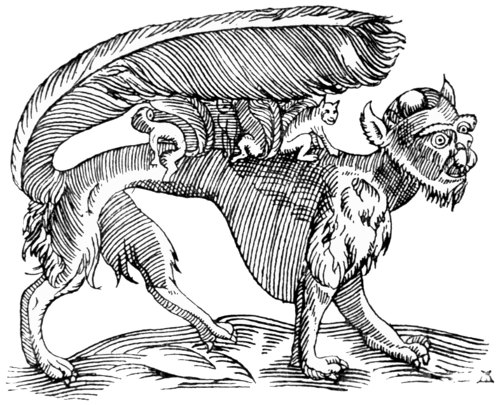
“This cruell, untamable, impatient, violent, ravening, and bloody beast, perceiving that her natural strength cannot deliver her from the wit and policy of men, her hunters, (for being inclosed, she can never get out againe) the hunters being at hand to watch her downfall, and worke her overthrowe, first of all to save her young ones from taking and taming, she destroyeth them all with her own teeth; for there was never any of them taken alive, and when she seeth the hunters come about her, she roareth, cryeth, howleth, brayeth, and uttereth such a fearefull, noysome, and terrible clamor, that the men which watch to kill her, are not thereby a little amazed; but, at last, being animated,
The Lamb-Tree.
As a change from this awful animal, let us examine the Planta Tartarica Borometz—which was so graphically delineated by Joannes Zahn in 1696. Although this is by no means the first picture of it, yet it is the best of any I have seen.
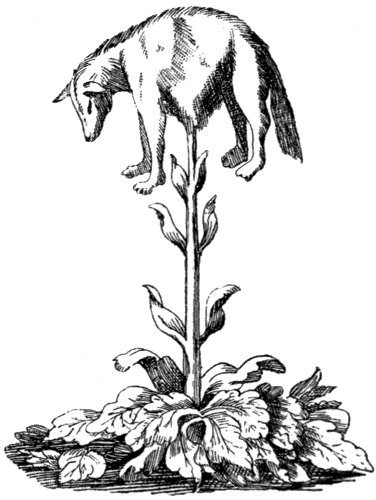
A most interesting book37 on the “Vegetable Lamb of Tartary” has been written by the late Henry Lee, Esq., at one time Naturalist of the Brighton Aquarium, and I am much indebted to it for matter on the subject, which I could not otherwise have obtained.
The word Borometz is supposed to be derived from a Tartar word signifying a lamb, and this plant-animal was thoroughly believed in, many centuries ago—but there seem to have been two distinct varieties of plant, that on which little lambs were found in pods, and that as represented by Zahn, with a living lamb attached by its navel to a short stem. This stalk was flexible, and allowed the lamb to graze, within
In his “Histoire Admirable des Plantes” (1605) Claude Duret, of Moulins, treats of the Borometz, and says: “I remember to have read some time ago, in a very ancient Hebrew book entitled in Latin the Talmud Ierosolimitanum, and written by a Jewish Rabbi Jochanan, assisted by others, in the year of Salvation 436, that a certain personage named Moses Chusensis (he being a native of Ethiopia) affirmed, on the authority of Rabbi Simeon, that there was a certain country of the earth which bore a zoophyte, or plant-animal, called in the Hebrew Jeduah. It was in form like a lamb, and from its navel, grew a stem or root by which this Zoophyte, or plant-animal, was fixed attached, like a gourd, to the soil below the surface of the ground, and, according to the length of its stem or root, it devoured all the herbage which it was able to reach within the circle of its tether. The hunters who went in search of this creature were unable to capture, or remove it, until they had succeeded in cutting the stem by well-aimed arrows, or darts, when the animal immediately fell prostrate to the earth, and died. Its bones being placed with certain ceremonies and incantations in the mouth of one desiring to foretell the future, he was instantly seized with a spirit of divination, and endowed with the gift of prophecy.”
Mr. Lee then says: “As I was unable to find in the Latin translation of the Talmud of Jerusalem, the passage mentioned by Claude Duret, and was anxious Kilaim, chap. viii. § 5 (a portion of the Talmud), the passage occurs: “Creatures called Adne Hasadeh (literally ‘lords of the field’) are regarded as beasts.” There is a variant reading, Abne Hasadeh (stones of the field). A commentator, Rabbi Simeon, of Sens (died about 1235), writes as follows, on this passage: ‘It is stated in the Jerusalem Talmud that this is a human being of the mountains: it lives by means of its navel: if its navel be cut, it cannot live. I have heard in the name of Rabbi Meir, the son of Kallonymos of Speyer, that this is the animal called Jeduah. This is the Jedoui mentioned in Scripture (lit. wizard, Lev. xix. 31); with its bones witchcraft is practised. A kind of large stem issues from a root in the earth on which this animal, called Jadua, grows, just as gourds and melons. Only the Jadua has, in all respects, a human shape, in face, body, hands, and feet. By its navel it is joined to the stem that issues from the root. No creature can approach within the tether of the stem, for it seizes and kills them. Within the tether of the stem it devours the herbage all around. When they want to capture it, no man dares approach it, but they tear at the stem until it is ruptured, whereupon the animal dies.’ Another commentator, Rabbi Obadja, of Berbinoro, gives the
“The author of an ancient Hebrew work, Maase Tobia (Venice, 1705), gives an interesting description of this animal. In Part IV. c. 10, page 786, he mentions the Borametz found in Great Tartary. He repeats the description of Rabbi Simeon, and adds, that he has found, in ‘A New Work on Geography,’ namely, that ‘the Africans (sic) in Great Tartary, in the province of Sambulala, are enriched by means of seeds, like the seeds of gourds, only shorter in size, which grow and blossom like a stem to the navel of an animal which is called Borametz in their language, i.e. lamb, on account of its resembling a lamb in all its limbs, from head to foot; its hoofs are cloven, its skin is soft, its wool is adapted for clothing, but it has no horns, only the hairs of its head, which grow, and are intertwined like horns. Its height is half a cubit and more. According to those who speak of this wondrous thing, its taste is like the flesh of fish, its blood as sweet as honey, and it lives as long as there is herbage within reach of the stem, from which it derives its life. If the herbage is destroyed or perishes, the animal also dies away. It has rest from all beasts and birds of prey, except the wolf, which seeks to destroy it.’ The author concludes by expressing his belief that this account of the animal having the shape of a lamb is more likely to be true than it is of human form.”
As I have said, there are several delineations of this Borametz or Borometz, but there is one, a frontispiece to the 1656 edition of the Paridisi in Sole—Paradisus Terrestris, of John Parkinson, Apothecary of London, in which, together with Adam and Eve, the lamb-tree is shown as flourishing in the Garden of Eden; and Du Bartas, in divine Weekes And Workes” in his poem of Eden, (the first day of the second week), makes Adam to take a tour of Eden, and describes his wonder at what he sees, especially at the “lamb-plant.”
“Musing, anon through crooked Walks he wanders, Round-winding rings, and intricate Meanders, Fals-guiding paths, doubtfull beguiling strays, And right-wrong errors of an end-less Maze: Not simply hedged with a single border Of Rosemary, cut-out with curious order, In Satyrs, Centaurs, Whales, and half-men-Horses, And thousand other counterfaited corses; But with true Beasts, fast in the ground still sticking, Feeding on grass, and th’ airy moisture licking: Such as those Bonarets, in Scythia bred Of slender seeds, and with green fodder fed; Although their bodies, noses, mouthes and eys, Of new-yean’d Lambs have full the form and guise; And should be very Lambs, save that (for foot) Within the ground they fix a living root, Which at their navell growes, and dies that day That they have brouz’d the neighbour grass away. O wondrous vertue of God onely good! The Beast hath root, the Plant hath flesh and blood The nimble Plant can turn it to and fro; The nummed Beast can neither stir nor go: The Plant is leaf-less, branch-less, void of fruit; The Beast is lust-less, sex-less, fire-less, mute; The Plant with Plants his hungry panch doth feed; Th’ admired Beast is sowen a slender seed.”
Of the other kind of “lamb-tree,” that which bears lambs in pods, we have an account, in Sir John Maundeville’s Travels. “Whoso goeth from Cathay to Inde, the high and the low, he shal go through a Kingdom that men call Cadissen, and it is a great lande, there groweth a manner of fruite as it were gourdes, and when it is ripe men cut it a sonder, and men fynde
And in the “Journall of Frier Odoricus,” which I have incorporated in my edition of “The Voiage and Travayle of Syr John Maundeville, Knight,” he says: “I was informed also by certaine credible persons of another miraculous thing, namely, that in a certaine Kingdome of the sayd Can, wherein stand the mountains called Kapsei (the Kingdomes name is Kalor) there groweth great Gourds or Pompions, (pumpkins) which being ripe, doe open at the tops, and within them is found a little beast like unto a yong lambe.”
The Chimæra.
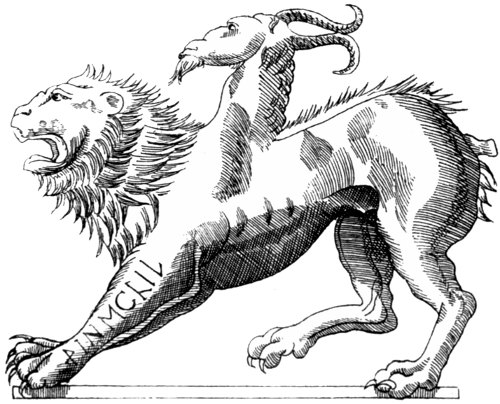
Aldrovandus gives us the accompanying illustration of a Chimæra, a fabulous Classical monster, said to possess Chimæra, now called Yanar, is in ancient Lycia, in Asia Minor, and was a burning mountain, which, according to Spratt, is caused by a stream of inflammable gas, issuing from a crevice. This monster is easily explained, if we can believe Servius, the Commentator of Virgil, who says that flames issue from the top of the mountain, and that there are lions in the vicinity; the middle part abounds in goats, and the lower part with serpents.
The Harpy and Siren.
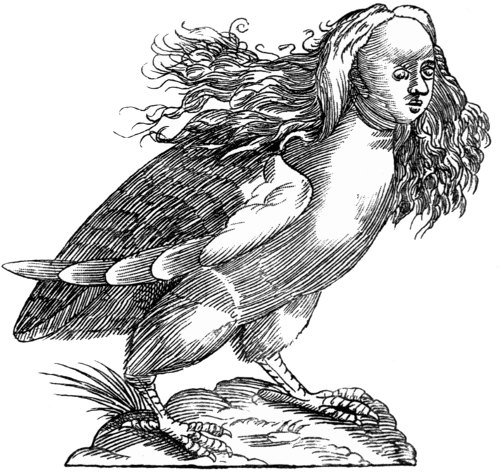
The conjunction of the human form with birds is very easy, wings being fitted to it, as in the case of angels—and vide the winged bulls of Assyria, and the classical Pegasus, or winged horse. With birds, the best form in which it is treated in Mythology is the Harpy. This is taken from Aldrovandus, and fully illustrates the mixture of bird and woman, described by Shakespeare in Pericles (iv. 3):—
“Cleon. Thou’rt like the harpy, Which to betray, dost, with thine angel’s face, Seize with thine eagle’s talons.”
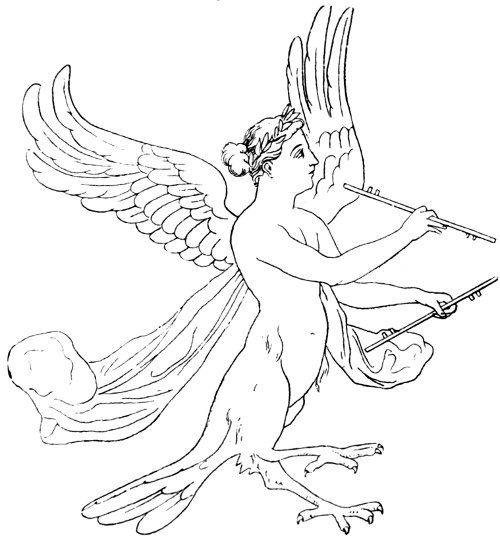
Then, also, we have the Siren, shown by this illustration, taken from Pompeii. These Sea Nymphs were like the Harpies, depicted as a compound of bird and woman.
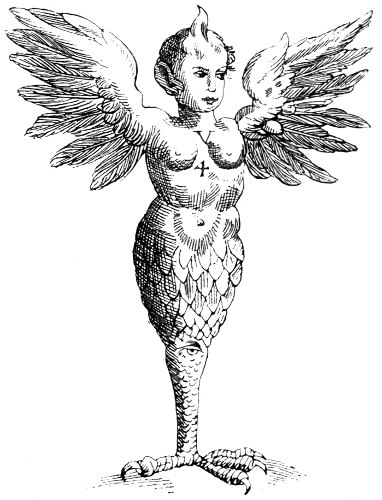
Licetus, writing in 1634, and Zahn, in 1696, give the accompanying picture of a monster born at Ravenna in
Marcellus Palonius Romanus made some Latin verses upon this prodigy, which may be thus rendered into English:—
A Monster strange in fable, and deform Still more in fact; sailing with swiftest wing, He threatens double slaughter, and converts To thy fell ruin, flames of living fire. Of double sex, it spares no sex, alike With kindred blood it fills th’ Æmathian plain; Its corpses strew alike both street and sea. There hoary Thetis and the Nereids Swim shudd’ring through the waves, while floating wide The fish replete on human bodies——. Such, Ravenna, was the Monster which foretold Thy fall, which brings thee now such bitter woe, Tho’ boasting in thy image triumph-crowned.
The Barnacle Goose.
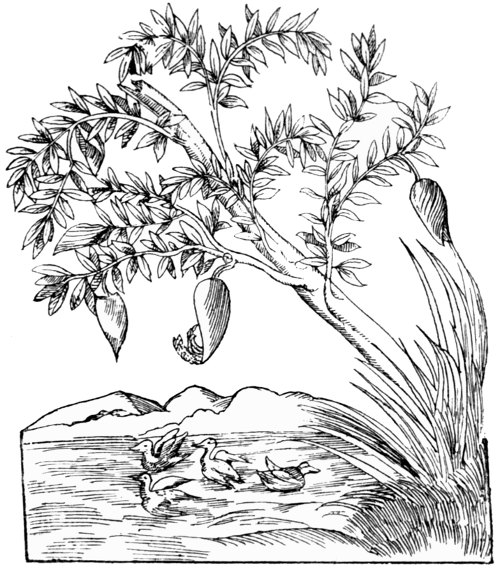
Of all extraordinary beliefs, that in the Barnacle Goose, which obtained credence from the eleventh to the seventeenth centuries, is as wonderful as any. The then accepted fact that the Barnacle Goose was generated on trees, and dropped alive in the water, dates back a hundred years before Gerald de Barri. Otherwise Giraldus Cambrensis wrote in 1187, about these birds, the following being a translation:—
“There are here many birds which are called Bernacæ, which nature produces in a manner contrary to nature, and very wonderful. They are like marsh-geese, but in coitu, like those of other birds, nor does the bird sit upon its eggs to hatch them, and in no corner of the world have they been known to build a nest. Hence the bishops and clergy in some parts of Ireland are in the habit of partaking of these birds, on fast days, without scruple. But in doing so they are led into sin. For, if any one were to eat of the leg of our first parent, although he (Adam) was not born of flesh, that person could not be adjudged innocent of eating flesh.”
We see here, that Giraldus speaks of these barnacles being developed on wreckage in the sea, but does not mention their growing upon trees, which was the commoner belief. I have quoted both Sir John Maundeville, and Odoricus, about the lamb-tree, which neither seem to consider very wonderful, for Sir John says: “Neverthelesse I sayd to them that I held yt for no marvayle, for I sayd that in my countrey are trees yt beare fruit, yt become byrds flying, and they are good to eate, and that that falleth on the water, liveth, and Borometz, says: “Even as I my selfe have heard reported that there stand certaine trees upon the shore of the Irish Sea, bearing fruit like unto a gourd, which at a certaine time of the yeere doe fall into the water, and become birds called Bernacles, and this is most true.”
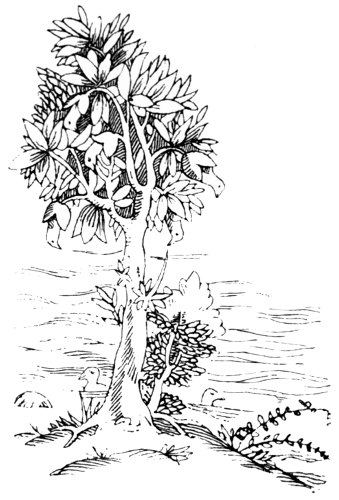
Olaus Magnus, in speaking of the breeding of Ducks in Scotland, says: “Moreover, another Scotch Historian, who diligently sets down the secret of things, saith that in the Orcades, (the Orkneys) Ducks breed of a certain Cosmographia Universalis:—“In Scotland there are trees which produce fruit, conglomerated of their leaves; and this fruit, when, in due time, it falls into the water beneath it, is endowed with new life, and is converted into a living bird, which they call the ‘tree goose.’ This tree grows in the Island of Pomonia, which is not far from Scotland, towards the North. Several old Cosmographers, especially Saxo Grammaticus, mention the tree, and it must not be regarded as fictitious, as some new writers suppose.”
In Camden’s “Britannia” (translated by Edmund Gibson, Bishop of London) he says, speaking of Buchan:—“It is hardly worth while to mention the clayks, a sort of geese; which are believed by some, (with great admiration) to grow upon the trees on this coast and in other places, and, when they are ripe, to fall down into the sea; because neither their nests nor eggs can anywhere be found. But they who saw the ship, in which Sir Francis Drake sailed round the world, when it was laid up in the river Thames, could testify, that little birds breed in the old rotten keels of ships; since a great number of such, without life and feathers, stuck close to the outside of the keel of that ship; yet I should think, that the generation of these birds was not from the logs of wood, but from the sea, termed by the poets ‘the parent of all things.’”
In “Purchas, his Pilgrimage,” is the voyage of Gerat de Veer to China, &c., in 1569—and he speaks of the
Du Bartas thus mentions this goose:—
“So, slowe Boötes underneath him sees, In th’ ycie iles, those goslings hatcht of trees; Whose fruitfull leaves, falling into the water, Are turned, (they say) to living fowls soon after. So, rotten sides of broken ships do change To barnacles; O transformation strange! ’Twas first a green tree, then a gallant hull, Lately a mushroom, now a flying gull.”
I could multiply quotations on this subject. Gesner and every other naturalist believed in the curious birth of the Barnacle goose—and so even did Aldrovandus, writing at the close of the seventeenth century, for from him I take this illustration. But enough has been said upon the subject.
Remarkable Egg.
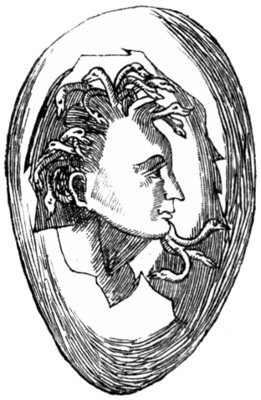
No wonder that a credulous age, which could see nothing extraordinary in the Barnacle goose, could also, metaphorically, swallow such an egg, as Licetus, first of all, and Aldrovandus, after him, gives us in the accompanying true
Moon Woman.
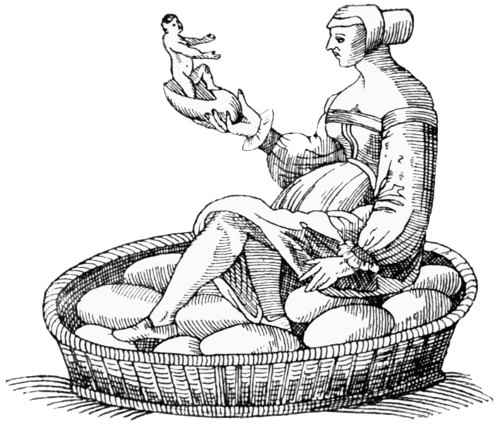
One would have imagined that this Egg would be sufficient to test the credulity of most people, but Aldrovandus was equal to the occasion, and he gives us a “Moon Woman,” who lays eggs, sits upon them, and hatches Giants; and he gives this on the authority of Lycosthenes and Ravisius Textor.
The Griffin.
There always has been a tradition of birds being existent, of far greater size than those usually visible.
The Maoris aver that at times they still hear the gigantic Moa in the scrub—and, even, if extinct, we know, by the state of the bones found, that its extinction must have been of comparatively recent date. But no one credits the Moa with the power of flight, whilst the Griffin, which must not be confounded with the gold-loving Arimaspian Gryphon, was a noble bird. Mandeville knew him:—“In this land (Bactria) are many gryffons, more than in other places, and some say they have the body before as an Egle, and behinde as a Lyon, and it is trouth, for they be made so; but the Griffen hath a body greater than viii Lyons, and stall worthier (stouter, braver) than a hundred Egles. For certainly he wyl beare to his nest flying, a horse and a man upon his back, or two Oxen yoked togither as they go at plowgh, for he hath longe nayles on hys fete, as great as it were hornes of Oxen, and of those they make Cups there to drynke of, and of his rybes they make bowes to shoote with.”
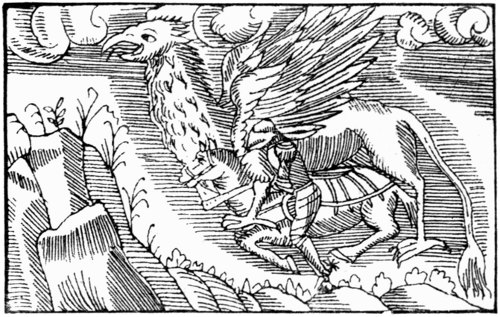
Olaus Magnus says they live in the far Northern
Ser Marco Polo, speaking of Madagascar, says:—“’Tis said that in those other Islands to the south, which the ships are unable to visit because this strong current prevents their return, is found the bird Gryphon, which appears there at certain seasons. The description given of it is, however, entirely different from what our stories and pictures make it. For persons who had been there and had seen it, told Messer Marco Polo that it was for all the world like an eagle, but one indeed of enormous size; so big in fact, that its wings covered an extent of 30 paces, and its quills were 12 paces long, and thick in proportion. And it is so strong that it will seize an Elephant in its talons, and carry him high into the air, and drop him so that he is smashed to pieces: having so killed him, the bird gryphon swoops down on him, and eats him at leisure. The people of those isles call the bird Ruc, and it has no other name. So I wot not if this be the real gryphon, or if there be another manner of bird as great. But this I can tell you for certain, that they are not half lion and half bird, as our stories do relate; but, enormous as they be, they are fashioned just like an eagle.
“The Great Kaan sent to those parts to enquire about these curious matters, and the story was told by those who went thither. He also sent to procure the release of an envoy of his who had been despatched thither, and had been detained; so both those envoys had many
This quill seems rather large; other travellers, however, perhaps not so truthful as Ser Marco, speak of these enormous quills. The Moa of New Zealand (Dinornis giganteus) is supposed to have been the largest bird in Creation—and next to that is the Æpyornis maximus—whose bones and egg have been found in Madagascar. An egg is in the British Museum, and it has a liquid capacity of 2.35 gallons, but, alas, for the quill story—this bird was wingless.
The Condor has been put forward as the real and veritable Ruc, but no living specimens will compare with this bird as it has been described—especially if we take the picture of it in Lane’s “Arabian Nights,” where it is represented as taking up three elephants, one in its beak, and one in each of its claws.
The Japanese have a legend of a great bird which carried off men—and there is a very graphic picture now on view at the White Wing of the British Museum, where one of these birds, having seized a man, frightens, very naturally, the whole community.
The Phœnix.
Pliny says of the Phœnix:—“Æthiopia and India, more especially produce birds of diversified plumage, and such
“It is said that there is only one in existence in the whole world, and that that one has not been seen very often. We are told that this bird is of the size of an eagle, and has a brilliant golden plumage around the neck, whilst the rest of the body is a purple colour; except the tail, which is azure, with long feathers intermingled, of a roseate hue; the throat is adorned with a crest, and the head with a tuft of feathers. The first Roman who described this bird, and who has done so with great exactness, was the Senator Manilius, so famous for his learning; which he owed, too, to the instructions of no teacher. He tells us that no person has ever seen this bird eat, that in Arabia it is looked upon as sacred to the Sun; that it lives five hundred and forty years. That when it is old it builds a nest of Cassia and sprigs of incense, which it fills with perfumes, and then lays its body down upon them to die: that from its bones and marrow there springs at first a sort of small worm, which, in time, changes into a little bird; that the first thing it does is to perform the obsequies of its predecessor, and to carry the nest entire to the City of the Sun near Panchaia, and there deposit it upon the altar of that divinity.
“The same Manilius states also, that the revolution of the great year is completed with the life of this bird, and that then a new cycle comes round again with the same characteristics as the former one, in the seasons and the appearance of the stars; and he says that this begins about midday of the day in which the Sun enters the sign of Aries. He also tells us that when he wrote to B.C. 96) it was the two hundred and fifteenth year of the said revolution. Cornelius Valerianus says that the Phœnix took its flight from Arabia into Egypt in the Consulship of Q. Plautius and Sextus Papinius, (A.D. 36). This bird was brought to Rome in the Censorship of the Emperor Claudius, being the year from the building of the City, 800, (A.D. 47) and it was exposed to public view in the Comitium. This fact is attested by the public Annals, but there is no one that doubts that it was a fictitious Phœnix.”
Cuvier seems to think that the bird described above was a Golden Pheasant, brought from the interior of Asia—at a time when these birds were unknown to civilised Europe.
Du Bartas, in his metrical account of the Creation, mentions this winged prodigy:—
“The Heav’nly Phœnix first began to frame The earthly Phœnix, and adorn’d the same With such a Plume, that Phœbus, circuiting From Fez to Cairo, sees no fairer thing: Such form, such feathers, and such Fate he gave her That fruitfull Nature breedeth nothing braver: Two sparkling eyes; upon her crown, a crest Of starrie Sprigs (more splendent than the rest) A goulden doun about her dainty neck, Her brest deep purple, and a scarlet back, Her wings and train of feathers (mixed fine) Of orient azure and incarnadine. He did appoint her Fate to be her Pheer, And Death’s cold kisses to restore her heer Her life again, which never shall expire Untill (as she) the World consume in fire. For, having passed under divers Climes, A thousand Winters, and a thousand Primes; Worn out with yeers, wishing her endless end, To shining flames she doth her life commend, Dies to revive, and goes into her Grave To rise againe more beautifull and brave. With Incense, Cassia, Spiknard, Myrrh, and Balm, By break of Day shee builds (in narrow room) Her Urn, her Nest, her Cradle, and her Toomb; Where, while she sits all gladly-sad expecting Some flame (against her fragrant heap reflecting) To burn her sacred bones to seedfull cinders, (Wherein, her age, but not her life, she renders.) ········ And Sol himself, glancing his goulden eyes On th’ odoriferous Couch wherein she lies, Kindles the spice, and by degrees consumes Th’ immortall Phœnix, both her flesh and plumes. But instantly, out of her ashes springs A Worm, an Egg then, then a Bird with wings, Just like the first, (rather the same indeed) Which (re-ingendred of its selfly seed) By nobly dying, a new Date begins, And where she loseth, there her life she wins: Endless by’r End, eternall by her Toomb; While, by a prosperous Death, she doth becom (Among the cinders of her sacred Fire) Her own selfs Heir, Nurse, Nurseling, Dam and Sire.”
The Swallow.
“And is the swallow gone? Who beheld it? Which way sailed it? Farewell bade it none?” (W. Smith, Country book.)
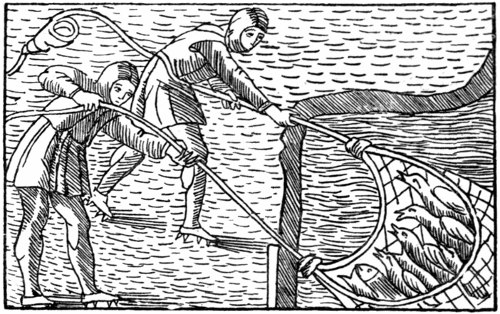
Olaus Magnus answered this question, according to his lights, and when, discoursing on the Migration of Swallows he says:—“Though many Writers of Natural Histories have written that Swallows change their stations; that is, when cold Winter begins to come, they fly to May; For Husband-Men, from their Nests, built higher or lower, take their Prognostications, whether they shall sowe in Valleys, or Mountains or Hills, according as the Rain shall increase or diminish. Also the Inhabitants hold it an ill sign, if the Swallows refuse to build upon their houses; for they fear those House-tops are ready to fall.”
This is proper, and good, and what we might expect from Olaus Magnus; but it is somewhat singular to see, printed in Notes and Queries for October 22, 1864, the following:—
“The Duke de R—— related to me, a few days ago, that in Sweden, the swallows, as soon as the winter begins to approach, plunge themselves into the lakes, where they remain asleep and hidden under the ice till the return of the summer; when, revived by the new warmth, they come out from the water, and fly away as formerly. While the lakes are frozen, if somebody will break the ice in those parts where it appears darker than in the rest, he will find masses of swallows—cold, asleep, and half dead; which, by taking out of their retreat, and warming, he will see gradually to vivify again and fly.
“In other countries they retire very often to the Caverns, under the rocks. As many of these exist between the City of Caen, and the Sea, on the banks of the river Orne, there are found sometimes, during the winter, piles of swallows suspended in these vaults, like bundles of grapes. I witnessed the same thing, myself, in Italy; where, as well as in France, it is considered Rhodocanakis.”
Of course, these stories of curious hybernation were pooh-poohed, although it could not be denied that the subaqueous hybernation of swallows is given in Goldsmith’s “Animated Nature,” and many other Natural Histories, which succeeded his.
The wintering of swallows in caverns, has another eye-witness in Edward Williams (Iolo Morganwg), who in his “Poems, Lyrics, and Pastorals,” published 1794, says:—“About the year 1768, the author, with two or three more, found a great number of swallows in a torpid state, clinging in clusters to each other by their bills, in a cave of the sea-cliffs near Dunraven Castle, in the County of Glamorgan. They revived after they had been some hours in a warm room, but died a day or two after, though all possible care had been taken of them.”
The Martlet, and Footless Birds.
Of the Martin, or, as in Heraldry it is written, Martlet, Guillim thus writes:—“The Martlet, or Martinet, saith Bekenhawh, hath Legs so exceeding short, that they can by no means go: (walk) And thereupon, it seemeth, the Grecians do call them Apodes, quasi sine pedibus; not because they do want Feet, but because they have not such Use of their Feet, as other Birds have. And if perchance they fall upon the Ground, they cannot raise themselves upon their Feet, as others do, and prepare themselves to flight. For this Cause they are accustomed to make their Nests upon Rocks and other high places, from whence they may easily take their flight,
The Alerion is a small bird of the eagle tribe, heraldically depicted as without beak or feet.
Butler in “Hudibras” writes—
“Like a bird of paradise, Or herald’s Martlet, has no legs, Nor hatches young ones, nor lays eggs.”
The Bird of Paradise was unknown to the ancients, and one of the earliest notices of this bird is given in Magalhaen’s voyage in 1521:—“The King of Bachian, one of the Molucca Islands, sent two dead birds preserved, which were of extraordinary beauty. In size they were not larger than the thrush: the head was small, with a long bill; the legs were of the thickness of a common quill, and a span in length; the tail resembled that of the thrush; they had no wings, but in the place where wings usually are, they had tufts of long feathers, of different colours; all the other feathers were dark. The inhabitants of the Moluccas had a tradition that this bird came from Paradise, and they call it bolondinata, which signifies the ‘bird of God.’”
By-and-by, as trade increased, the skins of this bird were found to have a high market value, but the natives always brought them, when they came to trade, with their legs cut off. Thence sprang the absurd rumour that they had no legs, although in the early account just quoted, their legs are expressly mentioned. Linnæus apoda or legless; whilst Tavernier says that these birds getting drunk on nutmegs, fall helpless to the ground, and then the ants eat off their legs.
“But note we now, towards the rich Moluques, Those passing strange and wondrous (birds) Manueques. (Wond’rous indeed, if Sea, or Earth, or Sky, Saw ever wonder swim, or goe, or fly) None knowes their Nest, none knowes the dam that breeds them; Foodless they live; for th’ Aire alonely feeds them: Wingless they fly; and yet their flight extends, Till with their flight, their unknown live’s-date ends.”
Snow Birds.
But we must leave warm climes, and birds of Paradise, and speak of “Birds shut up under the Snow.”
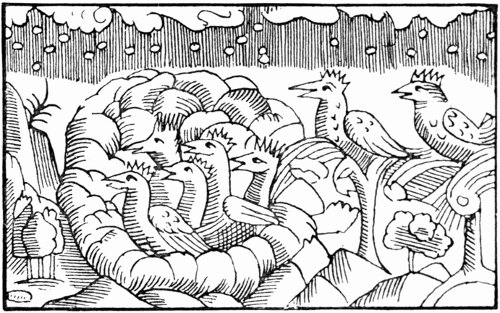
“There are in the Northern Countries Wood-Cocks, like to pheasant for bigness, but their Tails are much shorter, and they are cole black all over their bodies, with some white feathers at the end of their Tails and Italian (Gatulo) like to a long Pear, and they swallow them whole, and that in so great quantity, and so greedily, that their throat is stuffed, and seems greater than all their body.
“Then they part their Companies, and thrust themselves all over into the snow, especially in January, February and March, when Snow and Whirlwinds, Storms, and grievous Tempests, descend from the Clouds. And when they are covered all over, that not one of them can be seen, lying all in heaps, for certain weeks they live, with meat collected in their throats, and cast forth, and resumed. The Hunter’s Dogs cannot find them; yet by the Cunning of the crafty Hunters, it falls out, that when the Dogs err in their scent, they, by signs, will catch a number of living Birds, and will draw them forth to their great profit. But they must do that quickly; because when they hear the Dogs bark, they presently rise like Bees, and take up on the Wing, and fly aloft. But, if they perceive that the Snow will be greater, they devour the foresaid Fruit again, and take a new dwelling, and there they stay till the end of March: or, if the snow melt sooner, when the Sun goes out of Aries; for then the snow melting, by an instinct of Nature (as many other Birds) they rise out of their holes to lay Eggs, and produce young ones; and this in Mountains
“These Birds fly in great sholes together, and they remain in high Trees, chiefly Birch-Trees; and they come not down, but for propagation, because they have food enough on the top of their Trees. And when Hunters or Countreymen, to whom those fields belong, see them fly all abroad, over the fields full of snow, they pitch up staves obliquely from the Earth, above the Snow, eight or ten foot high; and at the top of them, there hangs a snare, that moves with the least touch, and so they catch these Birds; because they, when they Couple, leap strangely, as Partridges do, and so they fall into these snares, and hang there. And when one seems to be caught in the Gin, the others fly to free her, and are caught in the like snare. There is also another way to catch them, namely with arrows and stalking-horses, that they may not suspect it....
“There is also another kind of Birds called Bonosa, whose flesh is outwardly black, inwardly white: they are as delicate good meat as Partridges, yet as great as Pheasants. At the time of Propagation, the Male runs with open mouth till he foam; then the Female runs and receives the same; and from thence she seems to conceive, and bring forth eggs, and to produce her young.”
The Swan.
The ancient fable so dear, even to modern poets, that Swans sing before they die—was not altogether believed even in classical times, as saith Pliny:—“It is stated that
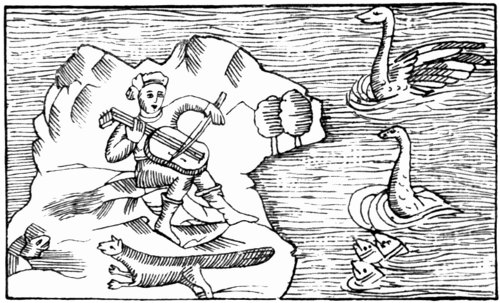
Olaus Magnus relates the fable—and quotes Plato, that the swan sings at its death, not from sorrow, but out of joy, at finishing its life. He also gives us a graphic illustration of how swans may be caught by playing to them on a lute or other stringed instrument, and also that they were to be caught by men (playing music) with stalking-horses, in the shape of oxen, or horses; and, in another page, he says, that not far from London, the Metropolis of England, on the River Thames, may be found more than a thousand domesticated swans.
The Alle, Alle.
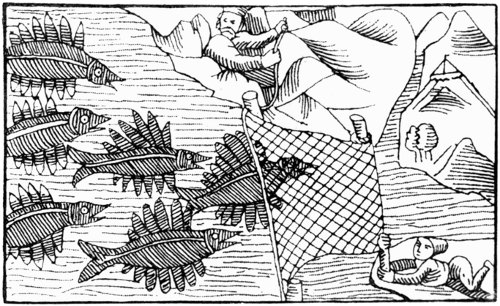
“There is also in this Lake (the White Lake) a kind of bird, very frequent; and in other Coasts of the Bothnick Swedish Sea, that cries incessantly all the Summer, Alle, Alle, therefore they are called all over, by the Inhabitants, Alle, Alle. For in that Lake such a multitude of great birds is found, (as I said before) by reason of the fresh Waters that spring from hot springs, that they seem to cover all the shores and rivers, especially Sea-Crows, or Cormorants, Coots, More Hens, two sorts of Ducks, Swans, and infinite smaller Water Birds. These Crows, and other devouring birds, the hunters can easily take, because they fly slowly, and not above two or four Cubits above the Water: thus they do it on the narrow Rocks, as in the Gates of Islands, on the Banks of them, they hang black nets, or dyed of a Watry Colour upon Spears; and these, with Pulleys, will quickly slip up or down, that in great Sholes they catch the Birds that fly thither by letting the Nets fall upon them: and this is necessary, because those Birds fly so slowly, and right forward; so that few escape. Also, sometimes Ducks, and other Birds are taken in these Nets. Wherefore these black, or slow Birds, whether they swim or fly, are always crying Alle, Alle, which in Latine signifies All, All, Omnes) and so they do when they are caught in the Nets: and this voyce the cunning Fowler interprets thus, that he hath not, as yet, all of them in his Nets; nor ever shall have, though he had six hundred Nets.”
The Hoopoe and Lapwing.
Whether the following bird is meant for the Hoopoe, or the Lapwing, I know not. The Latin version has “De Upupis,” which clearly means Hoopoes—and the translation says, “Of the Whoups or Lapwings”—I follow the latter. “Lapwings, when at a set time they come to the Northern Countries from other parts, they foreshew the nearnesse of the Spring coming on. It is a Bird that is full of crying and lamentation, to preserve her Eggs, or young. By importunate crying, she shews that Foxes lye hid in the grasse; and so she cries out in all places, to drive away dogs and other Beasts. They fight with Swallows, Pies, and Jackdaws.
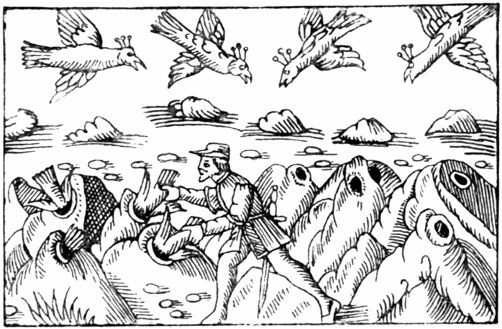
“On Hillocks, in Lakes, she lays her Eggs, and hatcheth
The Ostrich.
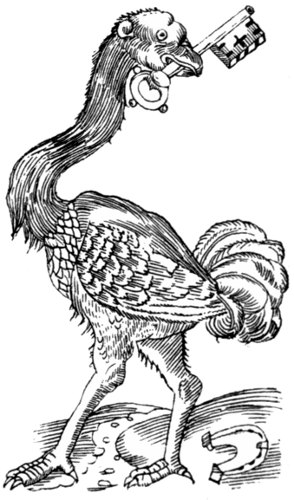
Modern observation, and especially Ostrich farming, has thoroughly exploded the old errors respecting this bird. We believe in its powers of swallowing anything not too large, but not in its digesting everything, and certainly not, as Muenster would fain have us believe, that an Ostrich’s dinner consists of a church-door key, and a horse-shoe. As matters of fact, we know that, when pursued, they do not bury their heads in the sand, or a bush; and instead of covering their eggs with sand, and leaving the sun to hatch them,
Pliny, however, says differently:—“This bird exceeds in height a man sitting on horseback, and can surpass him in swiftness, as wings have been given to aid it in running; in other respects Ostriches cannot be considered as birds, and do not raise themselves from the earth. They have cloven talons, very similar to the hoof of the stag (they have but two toes); with these they fight, and they also employ them in seizing stones for the purpose of throwing at those who pursue them. They have the marvellous property of being able to digest every substance without distinction, but their stupidity is no less remarkable: for although the rest of their body is so large, they imagine when they have thrust their head and neck into a bush, that the whole body is concealed.”
Giovanni Leone Africano writes that “this fowle liveth in drie desarts and layeth to the number of ten or twelve egges in the sand, which being about the bignesse of great bullets weigh fifteen pounds a piece; but the ostrich is of so weak a memorie, that she presently forgetteth the place where her egges were laid, and, afterwards the same, or some other ostrich hen finding the said eggs by chance hatched and fostereth them as if they were certainely her owne. The chickens are no sooner crept out of the shell but they prowle up and downe the desarts for their food, and before theyr feathers be growne they are so swifte that a man shall hardly overtake them. The ostrich is a silly and deafe creature, feeding upon any thing which it findeth, be it as hard and indigestible as yron.”
The Halcyon.
Of this bird, the Kingfisher, Aristotle thus discourses:—“The halcyon is not much larger than a sparrow; its colour is blue and green, and somewhat purple; its whole body is composed of these colours as well as the wings and neck, nor is any part without every one of these colours. Its bill is somewhat yellow, long and slight; this is its external form. Its nest resembles the marine balls which are called halosachnæ (probably a Zoophyte, Alcyonia) except in colour, for they are red; in form it resembles those sicyæ (cucumbers) which have long necks; its size is that of a very large sponge, for some are greater, others less. They are covered up, and have a thick solid part, as well as the cavity; it is not easily cut with a sharp knife, but, when struck or broken with the hand, it divides readily like the halosachnæ. The mouth is narrow, as it were a small entrance, so that the sea water cannot enter, even if the Sea is rough: its cavity is like that of the Sponge. The material of which the nest is composed is disputed, but it appears to be principally composed of the spines of the belone, for the bird lives on fish.”
Pliny says:—“It is a thing of very rare occurrence to see a halcyon, and then it is only about the time of the setting of the Vergiliæ, and the summer and winter solstices; when one is sometimes to be seen to hover about a ship, and then immediately disappear. They hatch their young at the time of the winter solstice, from which circumstance those days are known as the ‘halcyon days;’ during this period the sea is calm and navigable, the Sicilian sea in particular.”
“Halcyon days” is used proverbially, but the Kingfisher King Lear (ii. 1):—
“Turn their halcyon beaks With every gale and vary of their masters.”
And Marlowe, in his Jew of Malta (i. 1):—
“But now, how stands the wind? Into what corner peers my halcyon bill?”
The Pelican.
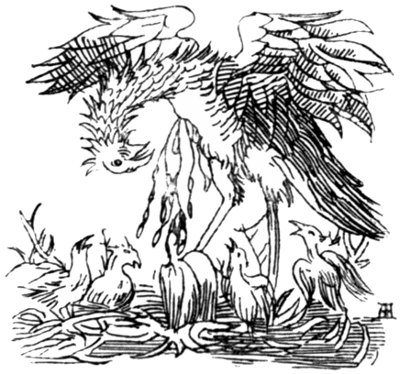
The fable of the Pelican “in her piety, vulning herself,” as it is heraldically described—is so well known, as hardly to be worth mentioning, even to contradict it. In the first place, the heraldic bird is as unlike the real one, as it is possible to be; but the legend seems to have had its origin in Egypt, where the vulture was credited with this extraordinary behaviour, and this bird is decidedly more in accordance with the heraldic ideal. Du Bartas, singing of “Charitable birds,” praises equally the Stork and the Pelican:—
“The Stork, still eyeing her deer Thessalie, The Pelican comforteth cheerfully: Prayse-worthy Payer; which pure examples yield Of faithfull Father, and Officious Childe: Th’ one quites (in time) her Parents love exceeding, From whom shee had her birth and tender breeding; Not onely brooding under her warm brest Their age-chill’d bodies bed-rid in the nest; Nor only bearing them upon her back Through th’ empty Aire, when their own wings they lack; But also, sparing (This let Children note) Her daintiest food from her own hungry throat, To feed at home her feeble Parents, held From forraging, with heavy Gyves of Eld. The other, kindly, for her tender Brood Tears her own bowells, trilleth-out her blood, To heal her young, and in a wondrous sort, Unto her Children doth her life transport: For finding them by som fell Serpent slain, She rends her brest, and doth upon them rain Her vitall humour; whence recovering heat, They by her death, another life do get.”
The Trochilus.
This bird, as described by Aristotle, and others, is of a peculiar turn of mind:—“When the Crocodile gapes, the trochilus flies into its mouth to cleanse its teeth; in this process the trochilus procures food, and the other perceives it, and does not injure it; when the Crocodile wishes the trochilus to leave, it moves its neck that it may not bite the bird.”
Giovanni Leone—before quoted—says, respecting this bird:—“As we sayled further we saw great numbers of crocodiles upon the banks of the ilands in the midst of Nilus lye baking them in the sunne with their jawes wide open, whereinto certaine little birds about the bignesse of a thrush entering, came flying forth againe presently after. The occasion whereof was told me to
Du Bartas gives another colour to the behaviour of the Trochilus:—
“The Wren, who seeing (prest with sleep’s desire) Nile’s poys’ny Pirate press the slimy shoar, Suddenly coms, and, hopping him before, Into his mouth he skips, his teeth he pickles, Clenseth his palate, and his throat so tickles, That, charm’d with pleasure, the dull Serpent gapes. Wider and wider, with his ugly chaps: Then, like a shaft, th’ Ichneumon instantly Into the Tyrants greedy gorge doth fly, And feeds upon that Glutton, for whose Riot, All Nile’s fat margents scarce could furnish diet.”
Woolly Hens.
Sir John Maundeville saw in “the kingdome named Mancy, which is the best kingdome of the worlde—(Manzi, that part of China south of the river Hoang-ho) whyte hennes, and they beare no feathers, but woll as shepe doe in our lande.”
Two-Headed Wild Geese.
Near the land of the Cynocephali or dog-headed men, there were many islands, and, “Also in this yle, and in many yles thereabout are many wyld geese with two heads.” But these were not the only extraordinary breed of wild geese, extant.
“As the wise Wilde-geese, when they over-soar Cicilian mounts, within their bills do bear, A pebble stone both day and night: for fear Lest ravenous Eagles of the North descry Their Armies passage, by their Cackling Cry.”
Aristotle mentions the Crane as another stone-bearing bird:—“Among birds, as it was previously remarked, the Crane migrates from one extremity of the earth to the other, and they fly against the wind. As for the story of the stone, it is a fiction, for they say that they carry a stone as ballast, which is useful as a touchstone for gold, after they have vomited it up.”
Four-Footed Duck.
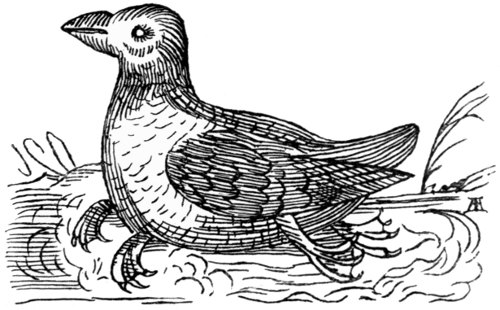
Gesner describes a four-footed duck, which he says is like the English puffin, except in the number of its
If we can believe Pliny, there are places where certain birds are never found:—“With reference to the departure of birds, the owlet, too, is said to lie concealed for a few days. No birds of this last kind are to be found in the island of Crete, and if any are imported thither, they immediately die. Indeed, this is a remarkable distinction made by Nature; for she denies to certain places, as it were, certain kinds of fruits and shrubs, and of animals as well; ...
“Rhodes possesses no Eagles. In Italy, beyond the Padus, there is, near the Alps, a lake known by the name of Larius, beautifully situate amid a country covered with shrubs; and yet this lake is never visited by storks, nor, indeed, are they ever known to come within eight miles of it; whilst on the other hand, in the neighbouring territory of the Montres, there are immense flocks of magpies and jackdaws, the only bird that is guilty of stealing gold and silver, a very singular propensity.
“It is said that in the territory of Tarentum, the woodpecker of Mars is never found. It is only lately, too, and that but very rarely, that various kinds of pies have begun to be seen in the districts that lie between the Apennines, and the City; birds which are known by the name of Variæ, and are remarkable for the length of the tail. It is a peculiarity of this bird, that it becomes bald every year at the time of sowing rape. The partridge does not fly beyond the frontiers of Bœotia, into Attica; nor does any bird, in the island in the Euxine in which Achilles was buried, enter the temple there consecrated to him.
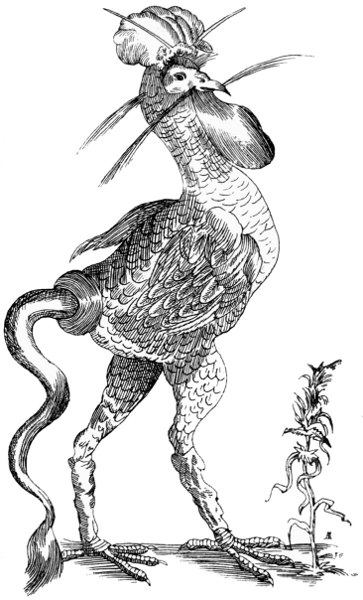
“In the territory of Fidenæ, in the vicinity of the City,
Fish.
Terrestrial and Aerial animals were far more familiar to the Ancients than were the inhabitants of the vast Ocean, and not knowing much about them, their habits and ways, took “omne ignotum pro magnifico.”
We have seen the union of Man and Beast, and Man and Bird; and Man and Fish was just as common, and perhaps more ancient than either of the former—for Berosus, the Chaldean historian, gives us an account of Oannes, or Hea, who corresponded to the Greek Cronos, who is identified with the fish-headed god so often represented on the sculptures from Nimroud, and of whom, clay figures have been found at Nimroud and Khorsabad, as well as numerous representations on seals and gems.
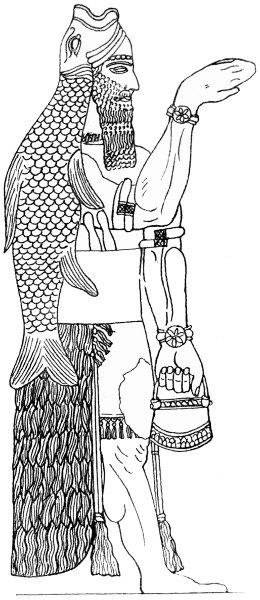
Of this mysterious union of Man and Fish, Berosus says:—“In the beginning there were in Babylon a great number of men of various races, who had colonised Chaldea. They lived without laws, after the manner of animals. But in the first year there appeared coming out of the Erythrian Sea (Persian Gulf) on the coast where it borders Babylonia, an animal endowed with reason, named Oannes. He had all the body of a fish, but below the head of the fish another head, which was that of a man; also the feet of a man, which came out of its fish’s tail. He had a human voice, and its image is preserved to this day. This animal passed the day time among men, taking no nourishment. It taught them the use of letters,
Helladice quotes the same story, and calls the composite being Oes; while another writer, Hyginus, calls him Euahanes. M. Lenormant thinks that it is evident that this latter name is more correct than Oannes, for it points to one of the Akkadian names of Hea—“Hea-Khan,” Hea, the fish—and must be identified with the fish-God in the illustration.
Alexander Polyhistor, who mainly copied from Berosus, says that Oannes wrote concerning the generation of Mankind, of their different ways of life, and of their civil polity; and the following is the purport of what he wrote:—
“There was a time in which there existed nothing but darkness, and an abyss of waters, wherein resided most hideous beings, which were produced on a twofold principle. There appeared men, some of whom were furnished with two wings, others with four, and two faces. They had one body, but two heads; the one that of a man, the other of a woman; they were likewise in their several organs both male and female. Other human beings were to be seen with the legs and horns of a goat; some had horse’s feet, while others united the hind-quarters of a horse with the body of a man, resembling in shape the hippocentaurs. Bulls likewise were bred then with the heads of men, and dogs with fourfold bodies, terminated in their extremities with the tails of fishes; horses also with the heads of dogs; men, too, and other animals, with the heads and bodies of horses, and the tails of fishes. In short, there were creatures in which were combined the limbs of every species of animals. In addition to these, fishes, reptiles, serpents, with other monstrous animals, which assumed each other’s shape and countenance. Of all which were
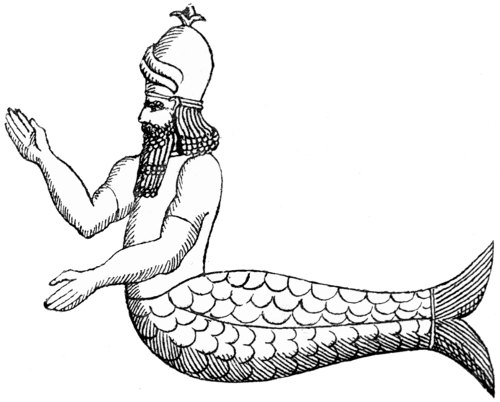
But, undoubtedly, the earliest representation of the real Merman—half-man, half-fish—comes to us from the uncovered palace of Khorsabad. On a portion of its sculptured walls is a representation of Sargon, the father of Sennacherib, sailing on his expedition to Cyprus, B.C. 720—on which occasion he had wooden images of the gods made and thrown overboard in order to accompany him on his voyage. Among these is Hea, or Oannes, which I venture to assert is the first representation of a Merman.
In Hindoo Mythology, one of the incarnations, or avatars of Vishnu, represents him as issuing from the mouth of a fish. The God Dagon (Dag in Hebrew, signifying fish) was probably Oannes or Hea—and Atergatis was depicted as a Mermaid, half-woman, half-fish.
These Tritons and Nereids, male and female, were firmly believed in by both Greek and Roman—who both depicted them alike—the Triton, sometimes having a trident, sometimes without, but both Triton, and Nereid, perfect man and woman, of high types of manly and feminine beauty, to the waist—below which was the body of a fish of the Classical dolphin type. So ingrained have these forms become in humanity, that it would seem almost impossible to realise a Merman, or Mermaid, other than as usually depicted.
Pliny, of course, tells about them:—“A deputation of persons from Olisipo (Lisbon) that had been sent for the purpose, brought word to the Emperor Tiberius that a Triton had been both seen and heard in a certain cavern, blowing a Conch shell, and of the form they are usually represented. Nor yet is the figure generally attributed to the nereids at all a fiction, only in them the portion of the body that resembles the human figure, is still rough all over with scales. For one of these creatures was seen upon the same shores, and, as it died, its plaintive murmurs were heard, even by the inhabitants, at a distance.
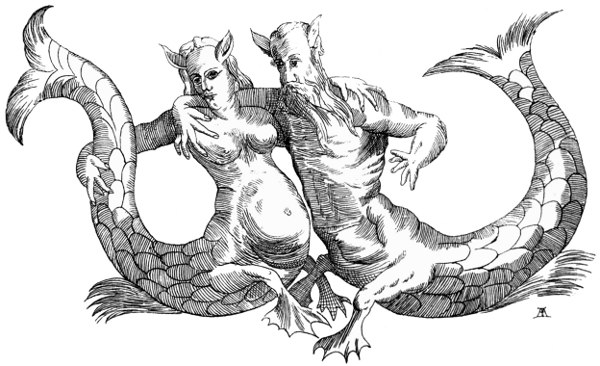
“The legatus of Gaul, too, wrote word to the late Emperor Augustus, that a considerable number of nereids had been found dead upon the sea-shore. I have, too, some distinguished informants of equestrian rank, who state that they themselves once saw, in the Ocean of Gades, a sea-man, which bore in every part of his body, a perfect resemblance to a human being, and that during
Ælian tells us, that it is reported that the great sea which surrounds the Island of Taprobana (Ceylon) contains an immense multitude of fishes and whales, and some of them have the heads of lions, panthers, rams, and other animals; and (which is more wonderful still) some of the Cetaceans have the form of Satyrs.
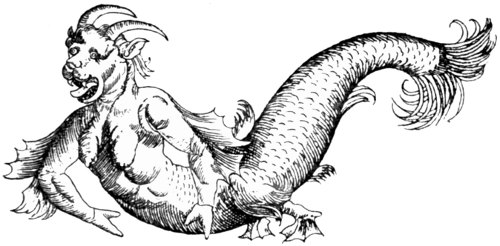
Gesner obligingly depicts this Pan, Sea Satyr, Ichthyo centaurus, or Sea Demon, as he is indifferently called, and wants to pass it off as a veritable Merman, probably on account of its human-like trunk. He also quotes Ælian as to the authenticity of this monster,—and he gives a picture of another Man-fish, which he says was seen at Rome, on the third of November, 1523. Its size was that of a boy about five years of age. (See next page.)
Mermen and Mermaids do not seem to affect any particular district, they were met with all over the world—and records of their having been seen, come to us from all parts. That was well, and occurred in the ages of
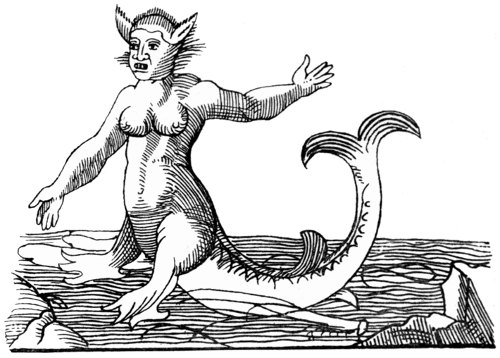
Sir J. Emerson Tennent quotes in his “Natural History of Ceylon” from the description of one of the Dutch Colonial Chaplains, named Valentyn, who wrote an account of the Natural History of Amboyna. He says that in 1663, a lieutenant in the Dutch army was with some soldiers on the sea-beach at Amboyna, when they all saw mermen swimming near the beach. He described them as having long and flowing hair, of a colour between grey and green. And he saw them again, after an interval of six weeks, when he was in company with some fifty others. He also says that these Marine
This last animal enjoyed European fame, as in 1716, whilst Peter the Great was the guest of the British Ambassador at Amsterdam, the latter wrote to Valentyn, asking that the marvel should be sent over for the Czar’s inspection—but it came not. Valentyn also tells how, in the year 1404, a mermaid, tempest-tossed, was driven through a breach in a dyke at Edam, in Holland, and was afterwards taken alive in the lake of Parmen, whence she was carried to Haarlem. The good Dutch vrows took kindly care of her, and, with their usual thriftiness, taught her a useful occupation, that of spinning; nay, they Christianised her—and she died a Roman Catholic, several years after her capture.
The authentic records, if trust can be placed in them, are various and many—but are hardly worth recapitulating because of their sameness, and the smile of incredulity which their recital provokes.
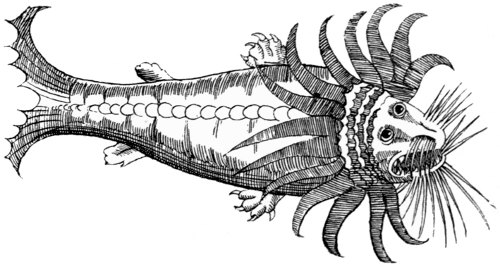
Let us therefore turn to the monarch of the deep, the Whale—and of this creature we get curious glimpses from the Northern Naturalists; but, before investigating this authentic denizen of ocean, we will examine some whose title to existence is not quite so clearly made out. Olaus Magnus gives us an introduction to some of “The horrible Monsters of the Coast of Norway. There are monstrous fish on the Coasts or Sea of Norway, of unusual Names, though they are reputed a kind of Whales; and, if men look long on them they will fright and amaze them. Their forms are horrible, their heads square, all set with prickles, and they have sharp and of the fish) is above eight or ten Cubits: the apple of the eye is of one Cubit, and is red and fiery coloured, which in the dark night appears to Fisher-men afar off under Waters, as a burning Fire, having hairs like Goose-Feathers, thick and long, like a beard hanging down; the rest of the body, for the greatness of the head, which is square, is very small, not being above fourteen or fifteen cubits long; one of these Sea Monsters will drown easily many great ships, provided with many strong Marriners.”
He also speaks of a Cetacean, called a Physeter:—“The Whirlpool, or Prister, is of the kind of Whales, two hundred Cubits long, and is very cruel. For, to the danger of Sea men, he will sometimes raise himself beyond the Sail yards, and cast such floods of Waters above his head, which he had sucked in, that with a cloud of them, he will often sink the strongest ships, or expose the Marriners to extream danger. This Beast hath also a long and large round mouth like a Lamprey, whereby he sucks in his meat or water, and by his
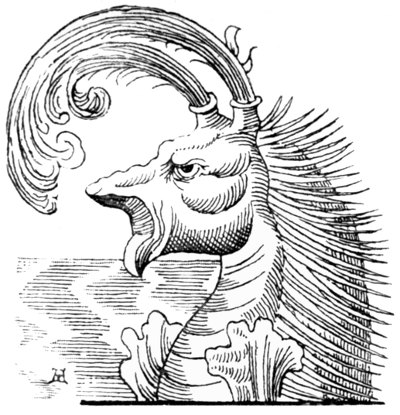
“Sometimes, not content to do hurt by water onely, as I said, he will cruelly over throw the ship like any small Vessel, striking it with his back, or tail. He hath a thick black Skin, all his body over; long fins, like to broad feet, and a forked tail 15 or 20 foot broad, wherewith he forcibly binds any parts of the ship, he twists it about. A Trumpet of War is the fit remedy against him, by reason of the sharp noise, which he cannot endure: and by casting out huge great Vessels, that hinders this Monster’s passage, or for him to play withall; or with Strong Canon and Guns, with the sound thereof he is more frighted, than with a Stone, or Iron Bullett; because this Ball loseth its force, being hindered by his Fat, or by the Water, or wounds but a little, his most vast body, that hath a Rampart of mighty Fat to defend it. Also, I must add, that on the Coasts of Norway, most frequently both Old and New Monsters are seen, chiefly by reason of the inscrutable depth of the Waters. Moreover, in the deep Sea, there are many kinds of fishes that are seldome or never seen by Man.”
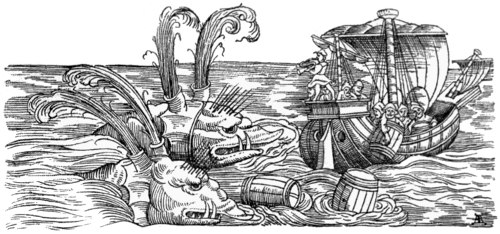
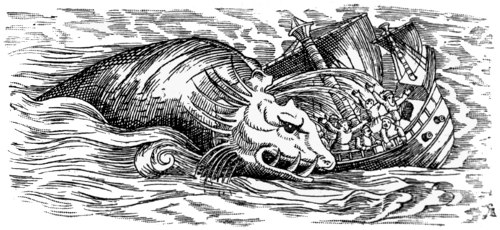
We have the saying, “Throw a tub to the Whale,” and we not only find that it is the proper treatment to conciliate Physeters, but Gesner shows us the real thing applied to Whales, trumpet and all complete, and he also shows us the close affinity between the Whale and the Physeter, in the accompanying illustration, which depicts a whale uprearing, and coming down again on an unfortunate vessel.
There is another Whale, described by Gesner, which he calls the “Trol” whale, or in German, “Teüfelwal,” or Devil Whale. This whale lies asleep on the water, and is of such a deceptive appearance that seamen mistake it for an island, and cast anchor into it, a proceeding which this peculiar class of whale does not 200):—
“Or that sea-beast Leviathan, which God of all His works Created hugest that swim the ocean-stream. Him, haply slumbering on the Norway foam, The pilot of some small night-foundered skiff, Deeming some island, oft, as seamen tell, With fixèd anchor in his scaly rind, Moors by his side under the lee, while night Invests the sea, and wishèd morn delays.”
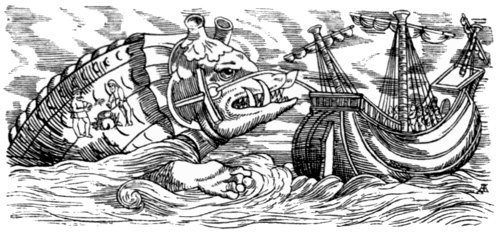
And the same story is told in the First Voyage of Sindbad the Sailor, or, as Mr. Lane, whose translation (ed. 1883) I use, calls him, Es-Sindibád of the Sea:—“We continued our voyage until we arrived at an island like one of the gardens of Paradise, and at that island, the master of the ship brought her to anchor with us. He cast the anchor, and put forth the landing plank, and all who were in the ship landed upon that island. They had prepared for themselves fire-pots, and they lighted the fires in them, and their occupations were various: some cooked, others washed, and others amused
Olaus Magnus, too, tells of sleeping whales being mistaken for islands:—“The Whale hath upon its Skin a superficies, like the gravel that is by the sea side; so that oft times when he raiseth his back above the waters, Sailors take it to be nothing else but an Island, and sayl unto it, and go down upon it, and they strike in piles upon it, and fasten them to their ships: they kindle
But apropos of the whale casting forth such quantities of water, it is, as a matter of fact, untrue. The whale has a tremendously strong exhalation, and when it breathes under water, its breath sends up two columns of spray, but, if its head is above water, it cannot spout.
One thing in favour of whales, is “The Wonderful affection of the whales towards their young. Whales, that have no Gills, breathe by Pipes, which is found but in few creatures. They carry their young ones, when they are weak and feeble; and if they be small, they take them in at their mouths. This they do also when a Tempest is coming; and after the Tempest, they Vomit them up. When for want of water their young are hindered, that they cannot follow their Dams, the Dams take water in their mouths, and cast it to them like a
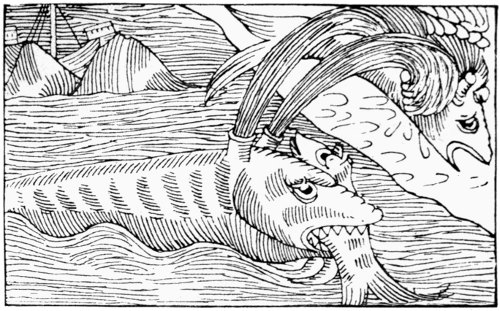
According to Olaus Magnus, there be many kinds of whales:—“Some are hairy, and of four Acres in bigness; the Acre is 240 foot long and 120 broad; some are smooth skinned, and those are smaller, and are taken in the West and Northern Sea; some have their Jaws long and full of teeth; namely, 12 or 14 foot long, and the Teeth are 6, 8, or 12 foot long. But their two Dog teeth, or Tushes, are longer than the rest, underneath, like a Horn, like the teeth of Bores, or Elephants. This kind of whale hath a fit mouth to eat, and his eyes are so large, that fifteen men may sit in the room of each of them, and sometimes twenty, or more, as the beast is in quantity.
“His horns are 6 or 7 foot long, and he hath 250 upon each eye, as hard as horn, that he can stir stiff or gentle, either before or behind. These grow together, to defend his eyes in tempestuous weather, or when any
Physeter macrocephalus) is the subject of a curious story, according to Olaus Magnus. He declares Ambergris is the sperm of the male Whale, which is not received by the female. “It is scattered wide on the sea, in divers figures, of a blew colour, but more tending to white; and these are glew’d together; and this is carefully collected by Marriners, as I observed, when, in my Navigation I saw it scattered here and there: This they sell to Physitians, to purge it; and when it is purged, they call it Amber-greese, and they use it against the Dropsie and Palsie, as a principal and most pretious unguent. It is white; and if it be found, that is of the colour of Gyp, it is the better. It is sophisticated with the powder of Lignum, Aloes, Styrax, Musk, and some Amber-greese will never melt so. It hath a corroborating force, and is good against swoundings and the Epilepsie.”
As a matter of fact, it is believed to be a morbid secretion in the intestinal canal of the whale, originating in its bile. It is found in its bowels, and also floating on the sea, grey-coloured, in lumps weighing from half an ounce to one hundred pounds. Its price is about £3 per oz. It is much used in perfumery, but not in medicine, at least in Europe: but in Asia and Africa, it is, in some parts, so used, and also in cookery.
Olaus Magnus, too, tells us of the benefits the whale confers on the inhabitants of the cold and dreary North. How they salt the flesh for future eating, and the usefulness of the fat for lighting and warming through the long Arctic winter, while the small bones are used as fuel. Of the skin of this useful mammal, they make Belts, Bags, and Ropes, whilst a whole skin will clothe forty men. But these are not all its uses.
“Having spoken that the bodies of Whales are very large, for their head, teeth, eyes, mouth and skin; the bones require a place to be described; and it is thus. Because the vehemency of Cold in the farther parts of the North, and horrid Tempests there, will hardly suffer Trees to grow up tall, whereof necessary houses may be builded: therefore provident Nature hath provided for the Inhabitants, that they may build their houses of the most vast Ribs of Sea Creatures, and other things belonging thereunto. For these monsters of the Sea, being driven to land, either by some others that are their Enemies, or drawn forth by the frequent fishing
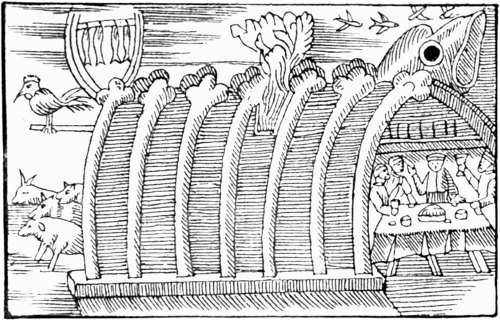
“When, therefore, the flesh of this most huge Beast is eat and dissolved, onely his bones remain like a great Keel; and when these are purged by Rain, and the Ayr, they raise them up like a house, by the force of men that are called unto it. Then by the industry of the Master Builder, Windows being placed on the top of the house, or sides of the Whale, it is divided into many convenient Habitations; and gates are made of
Besides men, Whales had their foes, in the deep, and there was, according to Du Bartas, one very formidable and cunning enemy, in the shape of a bird:—
“Meanwhile the Langa, skimming, (as it were,) The Ocean’s surface, seeketh everywhere, The hugy Whale; where slipping in (by Art), In his vast mouth, shee feeds upon his Hart.”
But it is cheering to find, on the authority of the same author, that he also has a helpful friend:—
“As a great Carrak, cumbred and opprest With her-self’s burthen, wends not East and West, Star-boord, and Lar-boord, with so quick Careers As a small Fregat, or swift Pinnass steers; And as a large and mighty limbed Steed, Either of Friseland, or of German breed, Can never manage half so readily, As Spanish Jennet, or light Barbarie; So the huge Whale hath not so nimble motion As smaller fishes that frequent the Ocean; But, sometimes, rudely ’gainst a Rock he brushes, Or in some roaring straight he blindly rushes, And scarce could live a Twelve month to an end, But for the little Musculus (his friend), A little Fish, that, swimming still before, Directs him safe from Rock, from shelf and shoar.”
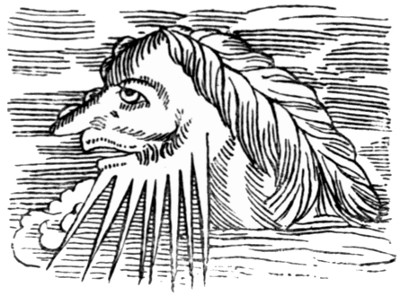
But we have only spoken of a very few varieties of Whales; some yet remain, which may be styled “fancy” Whales. At all events, they are lost to our times. Herodotus tells us that in the Borysthenes (Dneiper) were “large whales without any spinal bones, which they call Antacæi, fit for salting.” Then, Gesner gives us varieties of Whales, of which we know nothing. There is the bearded and maned creature with a face somewhat resembling that of a human being, found only in the remotest North, and there is the hairy whale, Cetum Capillatum vel Crinitum, or Germanice, Haarwal, but no particulars of this curious creature are given.
He presents us with the image of a Cetacean, which he calls an Indian Serpent—but he evidently is so doubtful of the creature’s authenticity that he tells us that Hieronimus Cardanus sent it formerly to him. He cannot quite make it out, with its monkey’s head, and
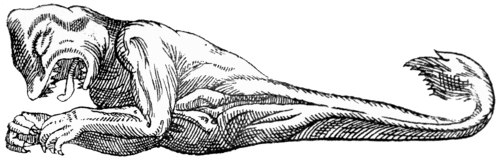
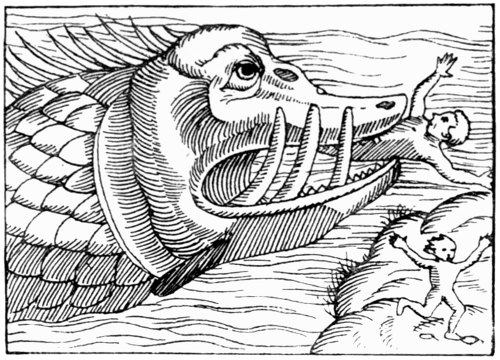
In his Addenda et Emendanda, he gives, on the authority of Olaus Magnus, a picture of an unnamed Whale—he says it was of great size, and had terrible teeth.
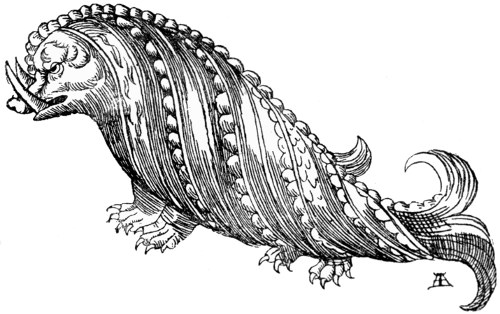
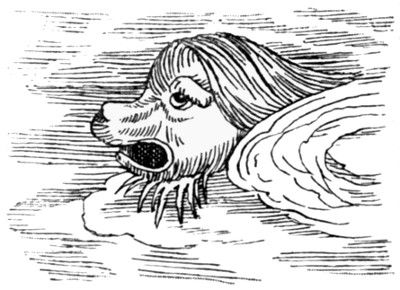
He also gives us two or three curious pictures of now extinct Cetaceans, something like terrestrial animals or men. And the first is a Leonine Monster, and for its authority he quotes Rondeletius.
This creature had none of its parts fitted to act as a marine animal of prey, but he says that Gisbertus (Horstius) Germanus, a physician at Rome, certifies that A.D. 1549. It was of the size and shape of a Lion, it had four feet, not mutilated, or imperfect as those of the Seal, and not joined together as is the case with the beaver or duck, but perfect, and divided into toes with nails: a long thin tail ending in hair; ears hardly visible, and its body covered with scales—but he adds that Gisbertus found fault with the artist, who had made the feet longer than they ought to have been—and the ears too large for an aquatic animal.
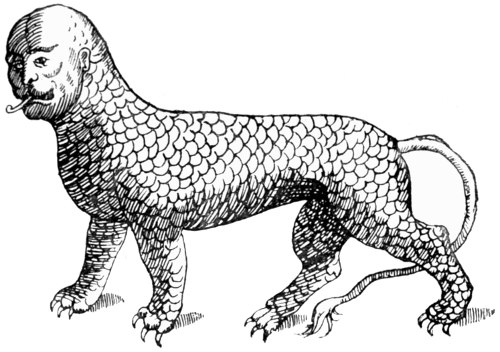
Gesner also gives us (and so does Aldrovandus) pictures of the Monk and Bishop fishes. The Monk-fish, he says, was caught off Norway, in a troubled sea: and he quotes Bœothius as describing a similar monster found in the Firth of Forth. The Bishop-fish was only seen off the coast of Poland, A.D. 1531.
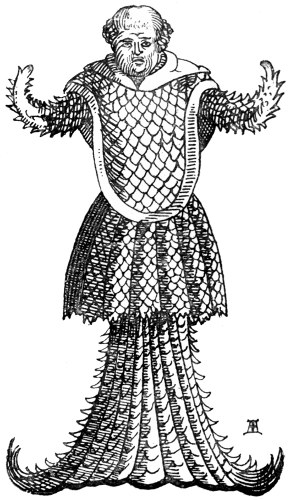
The existence of these marine monsters had, at all
“La Mer poissons en abondance apporte, Par dons divins que devons estimer. Mais fort estrange est le Moyne de Mer, Qui est ainsi que ce pourtrait le porte.”
And of the Sea Bishop:
“La terre n’a Evesques seulement, Qui sōt p̱ L’evesque croist en mer sembablement, Ne parlāt point, cōbien qu’il porte Mitre.”
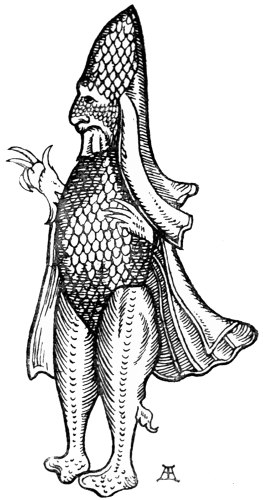
And Du Bartas writes of them, as if all in air, or on the earth, had its double in the sea—and he specially mentions these piscine ecclesiastics:—
“Seas have (as well as skies) Sun, Moon, and Stars; (As well as ayre) Swallows, and Rooks, and Stares; (As well as earth) Vines, Roses, Nettles, Millions,38 Pinks, Gilliflowers, Mushrooms, and many millions Of other Plants (more rare and strange than these) As very fishes living in the Seas. And also Rams, Calfs, Horses, Hares, and Hogs, Wolves, Lions, Urchins, Elephants and Dogs, Yea, Men and Mayds; and (which I more admire39) The mytred Bishop, and the cowled Fryer; Whereof, examples, (but a few years since) Were shew’n the Norways, and Polonian Prince.”
Was the strange fish that Stow speaks of in his Annales one of these two?—“A.D. 1187. Neere unto Orforde in Suffolke, certaine Fishers of the sea tooke in their Nettes, a Fish having the shape of a man in all pointes, which Fish was kept by Bartlemew de Glanville, Custos of the castle of Orforde, in the same Castle, by the space of sixe monethes, and more, for a wonder: He spake not a word. All manner of meates he gladly did eate, but more greedilie raw fishe, after he had crusshed out all the moisture. Oftentimes he was brought to the Church where he showed no tokens of adoration. At length, when he was not well looked to, he stale away to the Sea and never after appeared.” If this was not the real Simon Pure, yet I think it may put in a claim as a first-class British production, and, as far as I know, unique—all other denizens of the deep having some trace of their watery habitat, either in wearing scales, or a tail.
Following Du Bartas’ idea, let us take some marine animals which have a somewhat similar counterpart on shore.
Gesner gives us the picture, Olaus Magnus gives us
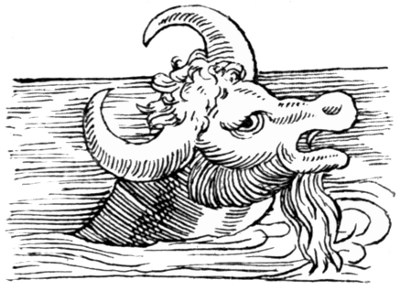
Olaus Magnus calls the Seal, the Sea-calf; and with trifling exceptions, gives a fair account of its habits, only there are some points which differ from the modern Seal, at all events:—“The Sea-Calf, which also in Latine is called Helcus, hath its name from the likeness of a Land-Calf, and it hath a hard fleshy body; and therefore it is hard to be killed, but by breaking the Temples of the head. It hath a voice like a Bull, four feet, but not his ears; because the manner and mansion of its life is in the Waters. Had it such ears, they would take in much Water, and hinder the swimming of it.... They will low in their sleep, thence they are called Calves. They will learn, and with their voyce and countenance salute the company, with a confused murmuring; called by their names, they will answer, and no Creature sleeps more profoundly. The Fins that serve them for to swim in the Sea, serve for legs on Land, and they go hobling up and down as lame people do. Their Skins, though taken from their bodies, Bothnick Marriners conjecture by their own Cloaths, that are made of these Skins, whether the Sea shall be calm, and their voyage prosperous, or they shall be in danger of Shipwreck.... These Creatures are so bold, that when they hear it thunder, and they see it clash and lighten, they are glad, and ascend upon the plain Mountains, as Frogs rejoyce against Rain.”
A very fine piece of casuistry is shown, in “the perplexity of those that eat the flesh of Sea-Calves in Lent,” and it seems to be finally settled that, according to “the men of a more clear judgment, rejecting many Reasons, brought on both sides, do say, and prove, that when the Sea-Calf brings forth on the shore, if the Beast driven by the Hunter, run into the Woods, men must forbear to eat of it in Lent, when flesh is forbidden; but if he run to the Waters, one may fairly eat thereof.”
Gesner, in giving this delineation of a Sea-Horse, openly says that it is the Classical horse, as used by Neptunus; but Olaus Magnus declares that “The Sea Horse, between Britany and Norway, is oft seen to have a head like a horse, and to neigh; but his feet and
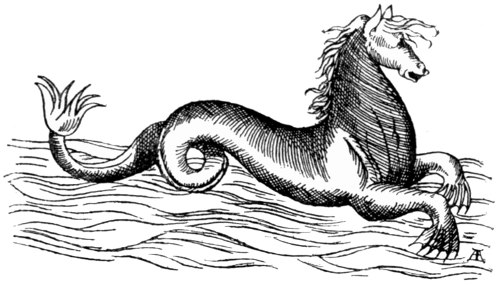
“The Sea-Mouse.
“The Sea-Mouse makes a hole in the Earth, and lays her Eggs there, and then covers them with Earth: on the 30th day she digs it open again, and brings her young to the Sea, first blind, and, afterwards, he comes to see.
“The Sea-Hare.
“The Sea-Hare is found to be of divers kinds in the Ocean, but so soon as he is caught, onely because he is suspected to be Venemous, how like so ever he is to a Hare, he is let loose again. He hath four Fins behind his Head, two whose motion is all the length of the fish, and they are long, like to a Hare’s ears, and two again, whose motion is from the back, to the depth of the fishes belly, wherewith he raiseth up the weight of his head. This Hare is formidable in the Sea; on the
The Sea-Pig.
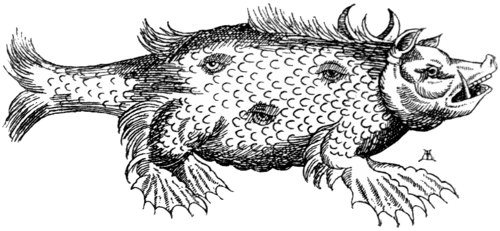
Again we are indebted to Gesner for the drawing of this Sea Monster. Olaus Magnus, speaking of “The Monstrous Hog of the German Ocean,” says:—“I spake before of a Monstrous Fish found on the Shores of England, with a clear description of his whole body, and every member thereof, which was seen there in the year 1532, and the Inhabitants made a Prey of it. Now I shall revive the memory of that Monstrous Hog that was found afterwards, Anno 1537, in the same German Ocean, and it was a Monster in every part of it. For it had a Hog’s head, and a quarter of a Circle, like the Moon, in the hinder part of its head, four feet like a Dragon’s, two eyes on both sides in his Loyns, and a third in his belly, inclining towards his Navel; behind he had a forked Tail, like to other Fish commonly.”
The Walrus.
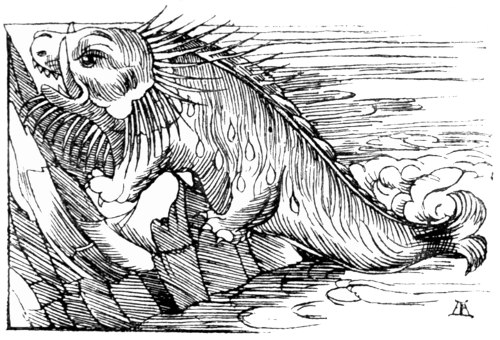
Of the Walrus, Rosmarus, or Morse, Gesner draws, and Olaus Magnus writes, thus:—“The Norway Coast, Morsi, or Rosmari, may be they are (called) so from their sharp biting; for, if they see any man on the Sea-shore, and can catch him, they come suddenly upon him, and rend him with their Teeth, that they will kill him in a trice. Therefore these Fish called Rosmari, or Morsi, have heads fashioned like to an Oxes, and a hairy Skin, and hair growing as thick as straw or corn-reeds, that lye loose very largely. They will raise themselves with their Teeth, as by Ladders to the very tops of Rocks, that they may feed on the Dewie Grasse, or Fresh Water, and role themselves in it, unless in the mean time they fall very fast asleep, and rest upon the Rocks; for then Fishermen make all the haste they can, and begin at the Tail, and part the Skin from the Fat; and unto this that is parted, they put most strong Cords, and fasten them on the rugged rocks or Trees, that are near; then they throw stones at his head, out of a Sling, to raise him, and they Scythians, the Muscovites, Russians, and Tartars, (as Ivory amongst the Indians,) by reason of its hardness, whiteness, and ponderousnesse. For which Cause, by excellent industry of Artificers they are made fit for handles for Javelins: And this is also testified by Mechovita, an historian of Poland, in his double Sarmatia, and Paulus Jovius after him, relates it by the Relation of one Demetrius, that was sent from the great Duke of Muscovy to Pope Clement the 7th.”
Although Olaus Magnus is very circumstantial in his detail as to the intense somnolence, and brutal flaying alive of the “thereby debilitated” Walrus, I can find no confirmation of either, in any other account—on the contrary, in “A Briefe Note of the Morse and the use thereof,” published in Hakluyt, it is described as very wakeful and vigilant, and certainly not an animal likely to have salt put on its tail after Magnus’s manner:—
“In the voyage of Jacques Carthier, wherein he discovered the Gulfe of S. Laurance, and the said Isle of Ramea in the yeere 1534, he met with these beastes, as he witnesseth in these words: About the said island are very great beasts as great as oxen, which have two great teeth in their mouthes like unto elephant’s teeth, and live in the Sea. Wee sawe one of them sleeping upon the banks of the water, and, thinking to take it, we went to it with our boates, but so soon as he heard us, he cast himselfe into the sea. Touching these beasts which Jacques Carthier saith to be as big as oxen, and to have teeth in their mouthes like elephants Boves marini or Vaccæ marinæ, and in the Russian tongue morsses, the hides whereof I have seene as big as any ox hide, and being dressed, I have yet a piece of one thicker than any two oxe, or bul’s hides in England.
“The leather dressers take them to be excellent good to make light targets against the arrowes of the savages; and I hold them farre better than the light leather targets which the Moores use in Barbarie against arrowes and lances, whereof I have seene divers in her Majesties stately armourie in the Toure of London. The teeth of the sayd fishes, whereof I have seene a dry flat full at once, are a foote and sometimes more in length; and have been sold in England to the combe and knife makers at 8 groats and 3 shillings the pound weight, whereas the best ivory is solde for halfe the money; the graine of the bone is somewhat more yellow than the ivorie. One Mr. Alexander Woodson of Bristoll, my old friend, an excellent mathematician and skilful phisitian, shewed me one of these beasts teeth which were brought from the Isle of Ramea in the first prize, which was half a yard long, or very little lesse: and assured mee that he had made tryall of it in ministering medicine to his patients, and had found it as sovereigne against poyson as any unicorne’s horne.”