PREFACE TO FOURTH EDITION.
Reading edition
I TAKE this opportunity of explaining why it is that (as stated in the Note to p. xix) I have used the symbols and to represent the words '' and ''.
The use of some symbols needs, I suppose, no more justification than the use of + and - to represent '' and ''.
These particular symbols are derived from the old theory of Trigonometry, in which sines, cosines, &c. were actual lines.
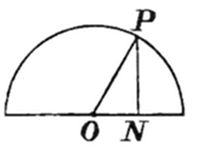
In this diagram, being taken as the unit of length, is the sine of the angle , and its cosine.
In each of my two symbols I have retained the semicircle in the symbol , I have merely moved to the middle; and, in the symbol , I have lengthened , taking it a little beyond the curve, in order to avoid confusion with the existing symbol for ''.
I also take this opportunity of adding a sort of Corollary (lately thought out) to the solution of Problem 59 (see p. 84).
If , , be given lengths, they must, in order that the Tetrahedron may be possible, fulfil certain conditions, as follows:—
(1) they have to form the sides of a Triangle: hence any two of them must be greater than the third;
(2) the three angles of this Triangle have to form a solid angle: hence any two of these angles must be together greater than the third: hence any two of them must be together greater than 90°: hence any one of them must be less than 90°: hence the cosine of any one of them must be greater than 0: i.e. must be greater than O, &c.: hence , , must be such that the squares of any two of them are together greater than the square of the third.
For example, the lengths 2, 3, 4 would not do as the given lengths, since, although fulfilling the first condition, by having , they fail to fulfil the second, as is not .
C. L. D.
CH. CH., OXFORD. March, 1895.