Chapter II
Reading edition
Answers.
5. (2, 31)
Two-thirds.
6. (2,32)
Calling the sides '', '', '' and the lines '', '', '', we have
.
7. (2, 33)
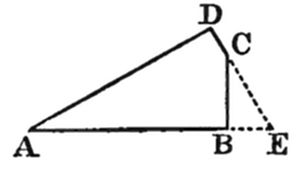
Let , be given sides, and , the right s; and let , .
(1)
(2) .
8. (2, 34)
7 men; 2 shillings.
10. (3, 36)
Either 2 florins and a sixpence; or else a half-crown and 2 shillings.
11. (3, 36)
The required ratio is equal to
If , this =
12. (4, 37)
If = semi-perimeter, = area, = volume; then
13. (4, 38)
If '' = area of Tetragon whose vertices are the Centres and the Points of intersection; and if its sides be '', '', and its diagonal, joining the Centres, '': required area
16. (4, 40)
The first course gives chance = ; the second, . Hence the first is best.
18. (5, 41)
(1) Divide base , at , so that .
(2) At , , make right angles , ; and join cutting at , which is the required Point.
19. (5, 42)
Eleven-seventeenths.
21. (5, 44)
(1) ; .
22. (5, 45)
Calling the given altitudes ', , '; and the fraction
(1)
(2)
(3)
23. (5, 46)
Two-fifths.
24. (6, 47)
; whence any one can be found in terms of the other two.
25. (6, 48)
27. (6, 50)
Seventeen-twentyfifths.
28. (7, 50)
31. (7, 53)
When the clock says '12h. 2m. '
32. (8, 53)
37. (8, 58)
.
38. (9, 60)
Fortynine-seventytwoths.
39. (9, 60)
They meet at end of 2d. 6h., and at end of 4d.: and the distances are 23 miles, and 34 miles.
41. (9, 62)
(1) Seven-twelfths. (2) One-half.
42. (10, 63)
45. (10, 67)
47. (11, 69)
One set of values is 0, 0, 0.
A 2nd set is ; has any value.
A 3rd is ; has any value.
And the 4th set is , ; where has any value.
If has any positive value less than 4, and are unreal.
49. (11, 72)
Two.
50. (11, 72)
Seventeen-twentysevenths.
52. (12, 75)
2l. 18s. 0d.
53. (13, 76)
The portion, cut off from the second side, is equal to
54. (13,78)
Side must be divided at , , so that and similarly for the other sides. Also each side of the Hexagon = .
56. (13, 80)
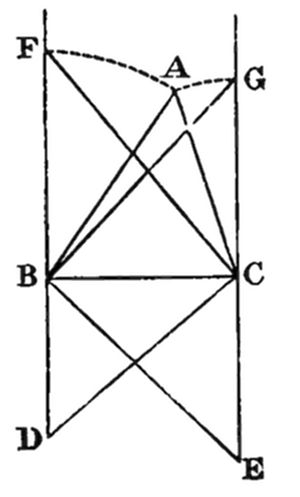
Draw , , equal to the given altitudes, so as to form right s at and : and produce , . Join , and draw to it. Join , and draw to it. With centre , and distance , describe a circle: with centre , and distance describe another: let them meet at : and join , . Triangle may be proved to be similar to required Triangle. The rest of the construction is obvious.
57. (14, 80)
(1) Geometrically.
If Squares be described externally on the sides of the given Triangle; and if their outer edges be produced to form a new Triangle; and if the sides of the given Triangle be divided similarly to those of the new Triangle: their central portions will be the bases of the required Squares.
(2) Trigonometrically.
If , , be the sides of the given Triangle, and its area; and if , , be the sides of the required Squares: then
58. (14, 83)
59. (14, 84)
Calling lengths of the 3 pairs of edges ', , ', and the corresponding s, in each facet, ', , '; volume =
60. (14, 87)
;
similarly, .
63. (15, 92)
If each side of each Square = 2, the volume =
66. (15, 97)
67. (16, 100)
If the centre of the horizontal facet be taken as the Origin, and if the -axis pass through one of the vertices of that facet, and the -axis be parallel to the opposite edge of that facet, and the -axis be perpendicular to that facet: and if the altitude (measured downwards) of the Tetrahedron be called '', and the intercept on the -axis be called '': the Equations to the Locus are
68. (16, 101)
(1) 5 dozen; (2) 8/4 a bottle.
69. (17, 102)
(1) ; ; .
(2) Calling new Triangle '',
70. (17, 105)
(1) Down the back-edge; up again; and so on. (2) about of the way down the back-edge. (3) About . (4) About .
72. (18, 109)
One is black, and the other white.