Chapter III
Reading edition
Solutions.
1. (1)
Let , be the Nos.
Then .
Evidently '' is a form for the squares.
Also, if we write '' for '2' (which will not interfere with the problem, as we can divide by , and get ), the above form becomes ''.
Now, as these are squares, their resemblance to at once suggests itself; so that the problem depends on the known one of finding , , such that is a square; and we can then take as .
A general form for this is
Q. E. F.
2. (1)
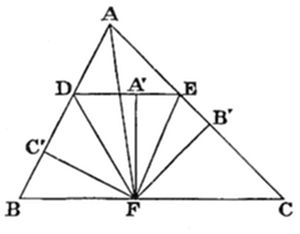
(Analysis.)
Let be the Triangle, and the required line, so that .
From cut off equal to ; then .
Join , .
Now ;
Similarly ;
, are bisected by , , and is centre of escribed to .
Drop, from , s on , , ; then these s are equal.
Hence, if be joined, it bisects .
Hence construction.
(Synthesis.)
Bisect by : from draw , , , : also draw and equal to : and through draw , i. e. . Then shall be line required.
s at , , , are right, and ,
s , , are bisected by , .
Now ; it ; ;
Similarly ; .
Q. E. F.
3. (1)
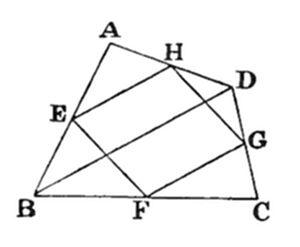
Let be the Tetragon; and let the 3 sides, , , , be bisected by vertices of the Parallelogram .
Join .
, in Triangle , sides , are bisected at and ,
is parallel to ;
but is parallel to ;
is parallel to ;
Triangles , are similar;
now is half of ;
is half of .
Q. E. D.
4. (1)
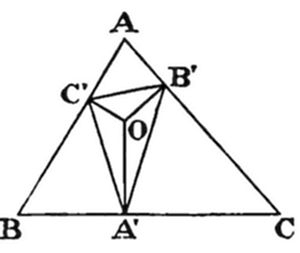
Let be the given Triangle, and the required Triangle, so that , &c.
Evidently , are equally inclined to a line drawn, from , ; and so of the others: i. e. these s bisect the s at , , ;
they meet in the same Point. Draw them; let them meet at ; and call the '', and so on.
Now ;
;
;
.
Similarly, .
Triangle is similar to Triangle ; and so of the others;
is foot of drawn, from , to . Hence the construction is obvious.
Q. E. F.
5. (2, 19)
At first sight, it would appear that, as the state of the bag, after the operation, is necessarily identical with its state before it, the chance is just what it then was, viz. . This, however, is an error.
The chances, before the addition, that the bag contains (a) 1 white (b) 1 black, are (a) (b) . Hence the chances, after the addition, that it contains (a) 2 white (b) 1 white, 1 black, are the same, viz. (a) (b) . Now the probabilities, which these 2 states give to the observed event, of drawing a white counter, are (a) certainty (b) . Hence the chances, after drawing the white counter, that the bag, before drawing, contained (a) 2 white, (b) 1 white, 1 black, are proportional to (a) (b) ; i. e. (a) (b) ; i. e. (a) 2 (b) 1. Hence the chances are (a) (b) . Hence, after the removal of a white counter, the chances, that the bag now contains (a) 1 white (b) 1 black, are for (a) and for (b) .
Thus the chance, of now drawing a white counter, is .
Q. E. F.
6. (2, 19)
Call sides ', , ', and lines in question ', , '.
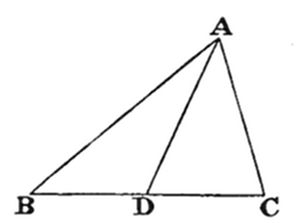
Now ;
To eliminate , , let us multiply by , , , so taken that hence we may make ; which gives lengths of sides.
Q. E. F.
7. (2, 19)
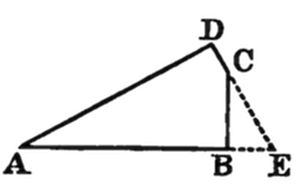
Let , be given sides, and , the right s; and let , .
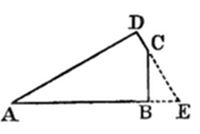
Produce to meet -produced at .
similarly, ; which answers (1).
Q. E. F.
8. (2, 20)
Let = No. of men, = No. of shillings possessed by the last (i. e. the poorest) man. After one circuit, each is a shilling poorer, and the moving heap contains shillings. Hence, after circuits, each is shillings poorer, the last man now having nothing, and the moving heap contains shillings. Hence the thing ends when the last man is again called on to hand on the heap, which then contains shillings, the penultimate man now having nothing, and the first man having shillings.
It is evident that the first and last man are the only 2 neighbours whose possessions can be in the ratio '4 to 1'. Hence either
The first equation gives , i. e. , which evidently gives no integral values other than , .
The second gives , which evidently gives no positive integral values.
Hence the answer is '7 men; 2 shillings'.
9. (2)
Let , , be the given Lines, and the given Point; and join .
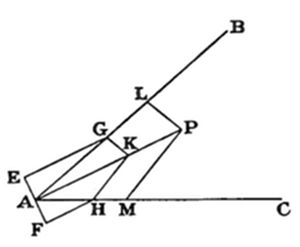
Through draw , , and bisected at ; from , , draw , , parallel to , and meeting , , at , ; join , and on it describe a semicircle cutting at ; and join , . Then is a right angle. From draw , , parallel to , .
Now Triangle has, to Triangle , the duplicate ratio of to ;
but so also has triangle to Triangle ;
also Triangles , , are equal, being on the same base , and having equal altitudes , ;
Triangles , are equal: and is evidently equal to ; it is a right angle.
Q. E. F.
10. (3, 20)
Call them , , ; and let .
The chance, that the pocket contains 2 balls, is ; and, if it does, the 'expectation' is the average value of
Also the chance, that it contains only one, is ; and, if it does, the 'expectation' is .
Hence total 'expectation' .
Hence the coins must be 2 florins and a sixpence; or else a half-crown and 2 shillings.
Q. E. F.
11. (3, 20)
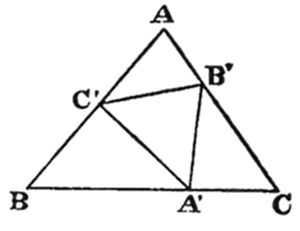
Now
but
Q. E. F.
Cor. Let ; then .
12. (4, 20)
Let semi-perimeter, area, volume.
We know that ;
Q. E. F.
13. (4, 20)
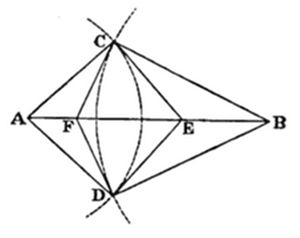
Let , , be the centres of the Circles; , , their points of intersection; and the Tetragon whose area is required.
Let the sides of the Triangle be , , ; and its s , , .
Then , and .
Also ;
.
Hence area of Triangle ;
area of Tetragon = .
Now, writing '' for area of Triangle , we have
Q. E. F.
14. (4)
This simply expresses the identity
Q. E. D.
Numerical Examples (not thought out).
15. (4)
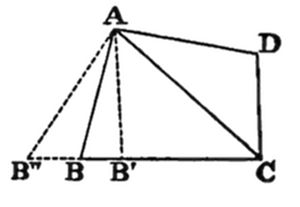
Let be an inscribed Tetragon. Join : and about Triangle describe a Circle.
Now, if this Circle does not pass through , let it cut , or produced, in or . Join , .
Then , or , is supplementary to ;
; which is absurd;
this Circle does pass through .
The same thing may be proved for any other Point on that portion, of the perimeter of the given Figure, which lies on the same side of as the Point .
Similarly for the other portion.
Hence the Figure is a Circle.
Q. E. D.
16. (4, 20)
The 'a priori' chances of possible states of first bag are ', ; , '. Hence chances, after putting in, are ', ; , '. The chances, which these give to the 'observed event', are 1, . Hence chances of possible states ', ', after the event, are proportional to 1, ; i. e. to 2, 1; i. e. their actual values are , .
Now, in first course, chance of drawing is ; i. e. .
And, in second course, chances of possible states ', ' are , : hence chance of drawing is ; i. e. .
Hence first course gives best chance.
Q. E. F.
17. (4)
(Analysis.)
Let be the given Triangle, and the line required.
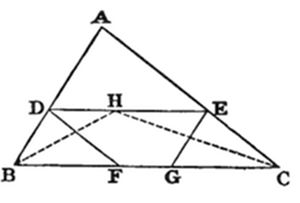
From , draw , , parallel to the sides. Then .
Because is a Parallelogram, ;
similarly ;
.
Hence construction.
(Synthesis.)
Bisect s , , by , , meeting at ; through draw parallel to ; and from , , draw , , parallel to , .
Because is parallel to ,
Similarly .
.
Because , are Parallelograms,
Q. E. F.
18. (5, 21)
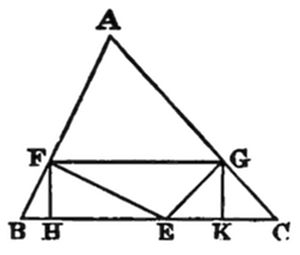
(1) Call required Point . From draw , sides. Join . From , , draw , . Call '', and ''.
Q. E. F.
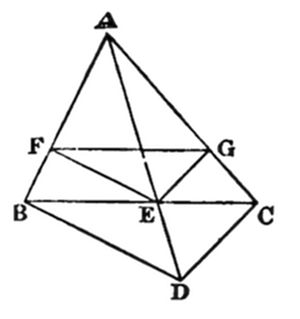
(2) At , , make right angles , ; and join , cutting at . From draw , sides; and join .
, are they are ; ;
, are they are ; ;
;
is parallel to .
Q. E. F.
19. (5, 21)
Call the bags , , ; so that contains a white counter and a black one; &c.
The chances of the orders , , , , , , are, a priori, each. Since they are equal, we may, instead of multiplying each by the probability it gives to the observed event, simply assume those probabilities as being proportional to the chances after the observed event.
These probabilities are:—
Hence the chances are proportional to 4, 3, 8, 4, 9, 6; i. e. they are these Nos. divided by 34.
Hence the chance, of drawing a white counter from the remaining bag; is
20. (5)
(Analysis.)
Let be the given Triangle, and the required Point. Draw , and . Then .
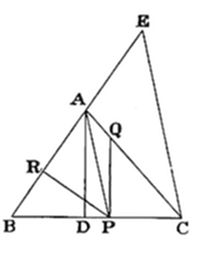
Hence ;
, (draw ,)
Hence construction.
(Synthesis.)
From draw . Produce to , making equal to . Join . From draw parallel to ; and from draw , and .
Q. E. F.
21. (5, 21)
(1) The th term is ;
the th term is ;
and
Q. E. F.
(2) , to 100 terms,
now ;
;
and twice this ;
.
Q. E. F.
22. (5, 21)
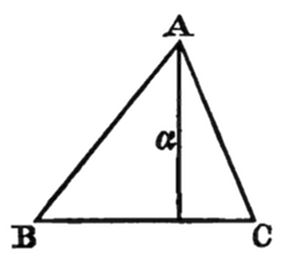
Call given altitudes ', , '.
Now ;
;
(say);
.
Now ;
;
;
;
;
;
;
;
, substituting for , &c., and dividing by , ;
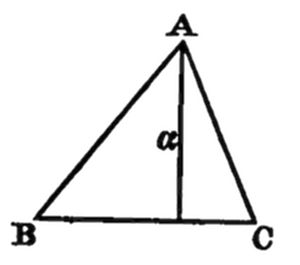
.
Now , &c.; which answers (2).
Also ; and similarly ;
, \text{&c.}; which answers (1).
Also area ;
which answers (3).
Q.E.F.
23. (5, 21)
The original chances, as to states of bag, are the chances, after adding 2 W and 1 B, are
Now the chances, which these give to the observed event, drawing 2 W and 1 B, are , , .
the chances, after this event, are proportional to , , ; i. e. to 2, 4, 1. Hence they are , , .
Hence the chances, as to states, now are
the chances, after adding , are
Now the chances, which these give to the observed event, of drawing , are 1, , .
the chances, after this event, are proportional to , , ;
i. e. to 6, 8, 1. Hence they are , , .
Hence the chance, that the bag now contains 2 white, is ; i. e. .
Q. E. F.
24. (6, 21)
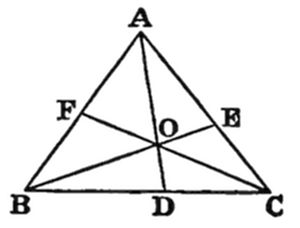
Q. E. F.
25. (6, 22)
Let '' mean 'having lost an eye', '' 'having lost an arm', and '' 'having lost a leg'.
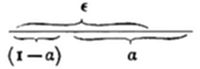
Then the state of things which gives the least possible number of those who, being and , are also , may evidently be found by arranging the patients in a row, so that the -class may begin from one end of the row, and the -class from the other end, and counting the portion where they overlap; and, the smaller the -class, the smaller will be this common portion: hence we must make the -class a minimum.
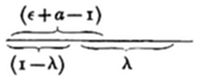
This may be done by re-arranging the patients, so that the -class may begin from one end of the row, and the -class from the other: and the least possible number for the -class is the common portion, i. e. , i. e. .
Then, as already shown, the least possible number for the -class is the common portion, i. e. , i. e. .
Q. E. F.
26. (6)
(Analysis.)
Let be the given Triangle, and the required one; and let the ratio, which has to , be ''; so that is less than 1.
Since , and that , , are parallel, it may easily be proved, by dropping perpendiculars from , , upon , which must necessarily be equal, that , , are equal.
Similarly, , , are equal; and so are , .
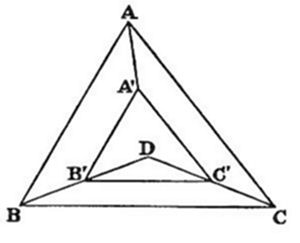
Call ''; then ;
;
.
Now , together ;
;
;
.
Hence, if , , be produced to meet at , Triangle will be isosceles, with a vertical equal to .
Now, if a Circle be drawn about , and its centre joined to and , the Triangle, so formed, will fulfil the same conditions;
hence the centre of this Circle will be ;
hence the construction.
(Synthesis.)
Bisect the sides, and draw perpendiculars, meeting at . Join to the vertices , . From cut off . From draw parallel to .
Then is easily proved equal to .
And if, from , , parallels to , , be drawn, it may easily be proved that they meet on , and that they are respectively equal to , .
Q. E. F.
27. (6, 22)
Call the bags , , .
If remaining bag be , chance of observed event = chance of drawing white from and black from + chance of drawing black from and white from :
i. e. it .
Similarly, if remaining bag be , it is ; and, if it be , it is .
chances of remaining bag being , , or , are as to to ; i. e. as 9 to 9 to 7. they are, in value, .
Now, if remaining bag be , chance of drawing white from it is ; chance, on this issue, is ; similarly, for , it is ; and, for , . And entire chance of drawing white from the remaining bag is the sum of these; i. e. .
28. (7, 22)
Let be the given Triangle; and let its sides be divided internally at , , , in extreme and mean ratio.
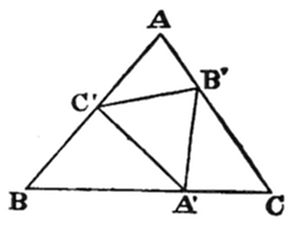
And let be the area of .
Let ; then ;
i. e. ;
, the other sign being excluded by the terms of the question.
Then area of Triangle
Similarly for and .
Hence the sum of these 3 Triangles , and area of Triangle .
Q. E. F.
29. (7)
This may be deduced from the identity
Now, if these last 2 sets are identical, must = ; for it cannot = ;
i. e., must = 0;
i. e., must = 0;
i. e., one or other of the first 2 sets is the sum of 2 identical squares.
Hence, contranominally, if each of the original sets consists of 2 different squares, their product gives the sum of 2 squares in 2 different ways.
Q. E. D.
30. (7)
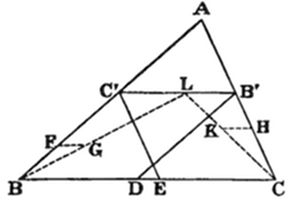
(Analysis.)
Let be the Triangle: and suppose so placed that , , drawn parallel to the sides, shall together = .
By Euc. I. 34, , and :
Hence, if be cut off equal to half ,
Hence construction.
(Synthesis.)
In take any point : draw , , and equal to half : and join .
Similarly, in take any point : draw , , and equal to half : and join .
Produce , , to meet at : and through draw : and from , , draw , , the sides.
, by similar Triangles, ;
Similarly ;
; i. e. .
But, by Euc. I. 34, ;
.
Q. E. F.
31. (7, 22)
On July 1, watch gained on clock 5m. in 10h.; i. e. m. per hour; i. e. 2m. in 4h. Hence, when watch said 'noon', clock said '12h. 2m.'; i. e. clock was 3m. slow of true time, when true time was 12h. 5m.
On July 30, watch lost on clock 1m. in 10h.; i. e. 6sec. per hour; i. e. 19sec. in 3h. 10m. Hence, when watch said '12h. 10m.', clock said '12h. 7m. 19sec.'; i. e. clock was 2m. 19sec. fast of true time, when true time was 12h. 5m.
Hence clock gains, on true time, 5m. 19sec. in 29 days; i. e. 319sec. in 29 days; i. e. 11sec. per day; i. e. sec. in 5m.
Hence, while true time goes 5m., watch goes 5m. sec.
Now, when true time is 12h. 5m. on July 31, clock is (2m. 19sec. + 11sec.) fast of it; i. e. says '12h. m.' Hence, if true time be put 5m. back, clock must be put 5m. sec. back; i. e. must be put back to 12h. 2m. sec.
Hence, on July 31, when clock indicates this time, it is true noon.
Q. E. F.
32. (8, 22)
The th term is ;
Q. E. F.
Also .
Q. E. F.
33. (8)
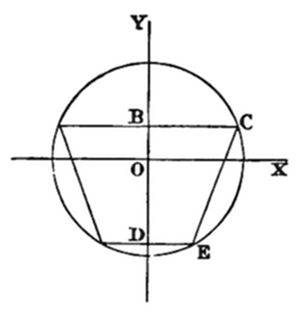
Let ; .
Area .
let .
, omitting , and dividing by , (upper sign being inadmissible, though this was not thought out.)
Q. E. F.
34. (8)
(Analysis.)
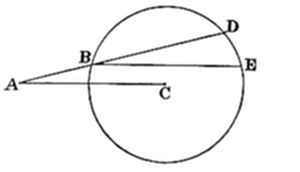
Let be the given Point, and the centre of the given Circle. Join , and let be the required Line. From draw the Chord parallel to . Then . Hence Arc = Arc ; i. e. Arc is bisected by ; i. e. is on perpendicular from .
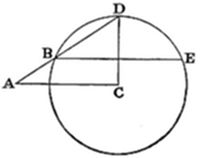
(Synthesis.)
Join . From draw perpendicular to . Join cutting Circle at . From draw parallel to .
It is easily proved that Arc = Arc . Hence Arc subtends, in the Circle, an angle = = .
Q. E. F.
35. (8)
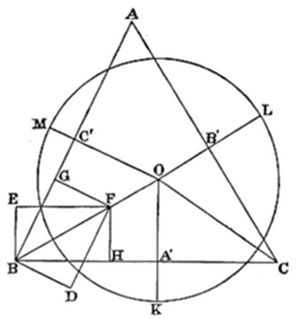
Let be the given Triangle; and let the portions of the radii, outside the Triangle, have to the radius the given ratios , , . (N.B. , , , are supposed to be proper fractions.)
From draw , and ; and make have, to , the ratio . Through draw parallel to , and parallel to ; and join . From draw , and .
Then .
Similarly, draw so that the s, drawn from any Point of it to and , are in the ratio ; and produce to meet it at .
From draw , , , the sides.
Then .
Produce to , so that .
With centre , and distance , describe a Circle; and produce , , to meet it at , .
Similarly, .
But .
Similarly , and .
Q. E. F.
36. (8)
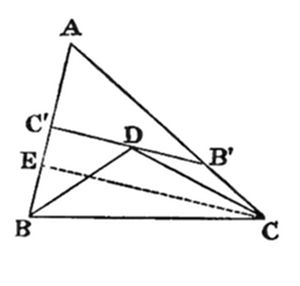
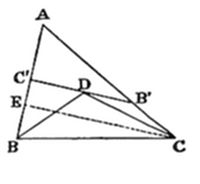
(Analysis.)
Let be required Line: and let at be right.
Cut off equal to : then .
Join , : then , and
From draw .
Then ; .
(Synthesis.)
Hence construction. Draw : bisect : at make . Let these lines meet at . Through draw .
Then ;
.
Q.E.F.
Limits of possibility:—
must not be ;
must not be ;
must not be half complement of ,
i. e. not .
37. (8, 22)
Let be the common chord, and , , the centres.
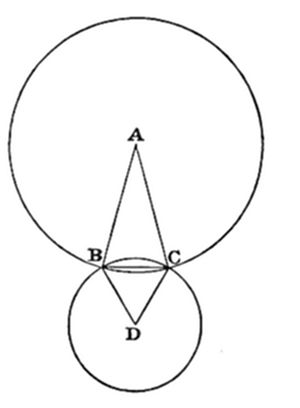
Let °, and °.
And let (which = .
And let .
Now ;
; ;
;
areas of Circles are and ;
areas of Sectors are and ;
their sum .
Again, area of Triangle ,
;
also area of Triangle ;
their sum .
Now the portion, of the smaller Circle, that is within the larger one, is the difference between these two sums;
it .
Hence its ratio, to the area of the smaller Circle, is this sum divided by ;
it ,
,
.
Q. E. F.
38. (9, 22)
Taking, in order, the bag from which this unknown counter is drawn, the bag from which a red one was twice drawn, and the remaining bag, we see that there are six possible arrangements of '', '', and '': viz.—
(1) , (4) ,
(2) , (5) ,
(3) , (6) .
Now the chance of the observed event is, in case (1), ; in case (2), ; in case (3), ; in case (4), ; in case (5), ; and in case (6), .
Hence the chances of existence, for these 6 states, are proportional to '12, 3, 18, 2, 9, 4'. Hence their actual values are ''.
Hence the chance of the unknown counter being red is the sum of ;
i. e. it is ; which .
Q. E. F.
39. (9, 22)
Let = no. of days.
Then ;
i. e. ;
; or .
Now the above solution has taken no account of the discontinuity of increase, or decrease of pace, and is the true solution only on the supposition that the increase or decrease is continuous, and such as to coincide with the above data at the end of each day. Hence '4' is a correct answer; but '' only indicates that a meeting occurs during the third day. To find the hour of this, let no. of hours.
Now in 2 days has got to the end of 19 miles, to the end of , i. e. 20.
.
i. e. .
Hence they meet at end of 2d. 6h., and at end of 4d.: and the distances are 23 miles, and 34 miles.
Q. E. F.
40. (9)
(1) Let be the given Triangle, and the line from the vertex.
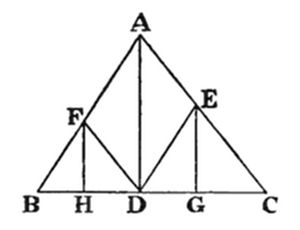
From draw , , parallel to the sides; and from and draw , , .
Then Triangles , , are similar to ;
.
Also, Triangles , , are equal and on the same base ,
their altitudes are equal; i. e. .
Q. E. F.
(2) Let be the given Triangle, and the line from the vertex.
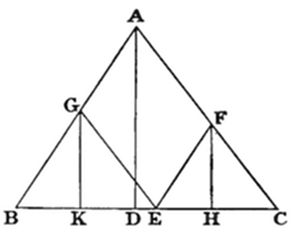
Make ; from draw , , parallel to the sides; and from , , draw , , .
Then Triangles , , are similar to ;
.
.
Q. E. F.
41. (9, 23)
(1) As there was certainly at least one in the bag at first, the 'a priori' chances for the various states of the bag, ', , , ' were ', , , '.
These would have given, to the observed event, the chances '1, , , 0'.
Hence the chances, after the event, for the various states, are proportional to ', , '; i. e. to ', , '; i.e. to '2, 3, 1'. Hence their actual values are ', , '.
Hence the chance, of now drawing , is ''; i. e. it is .
Q. E. F.
(2) If he had not spoken, the 'a priori' chances for the states ', , , , ', would have been ''.
These would have given, to the observed event, the chances '1, , , 0, 0'.
Hence the chances, after the event, for the various states, are proportional to ', , '; i. e. to '1, 2, 1'. Hence their actual values are ', , '.
Hence the chance, of now drawing , is ''; i. e. it is .
Q. E. F.
42. (10, 23)
Let be the given Triangle. Bisect its angles, and draw s to them, forming the Triangle .
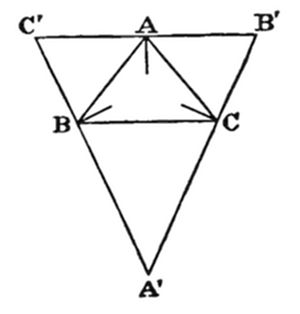
Now ; and so of the others.
Similarly, ;
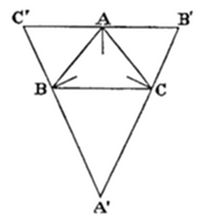
Similarly, ;
area of ;
Q. E. F.
43. (10)
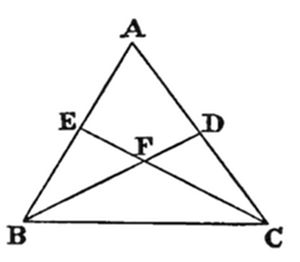
Let be the given Triangle; and let , , be the required lines, so that , and Tetragon = Triangle . And call the angle ''. It will suffice to calculate this angle.
Because Triangle Tetragon ,
.
Q. E. F.
44. (10)
Let be a No. not containing 2 or 5 as a factor, i. e. let it be prime to 10. Then, if be reduced to a circulating decimal, and that to a vulgar fraction, the digits of the denominator will be a certain number of 9's; i. e. it will be of the form .
And since this fraction , and that is prime to 10, and so prime to , the factor must be a multiple of .
This evidently holds good in any other scale of notation. Hence, if be the radix of the scale of notation, and a No. prime to , a value may be found for , which will make a multiple of .
Q. E. D.
EXAMPLES (not thought out).
(1) With radix 10, find a value, for , which will make a multiple of 7.
Ans. .
(2) Let the two given Nos. be 8, 9.
Taking 8 as radix, we get .
Ans. .
(3) Let the two given Nos. be 7, 13.
Taking 7 as radix, we get
Ans. .
45. (10, 23)
Divide each rod into parts, where is assumed to be odd, and the points of division are assumed to be the only points where the rod will break, and to be equally frangible.
Now, if ; then, when , ;
the chance that no rod is broke in the middle , when ;
i. e. it approaches the limit .
And Ans. .
Now . Hence if, in the series for , we call the sum of the odd terms '', and of the even terms ''; then ; and .
Q. E. F.
[N. B. What follows here was not thought out.]
46. (10)
Let be the given Triangle, and the given Point.
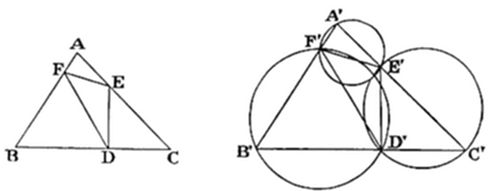
If we make a Triangle , having its angles equal to the given angles, and having as its assigned vertex, the Problem may be solved, if we can circumscribe, about the Triangle , a Triangle similar to .
Now we can construct, on , , , segments of Circles containing angles equal to , , . Hence the Problem may be solved, if we can place, in these Circles, a line , divided in the same proportion as .
This Lemma may be solved as follows. Let , , be the centres of the Circles. Join , and divide it, at , proportionally to .
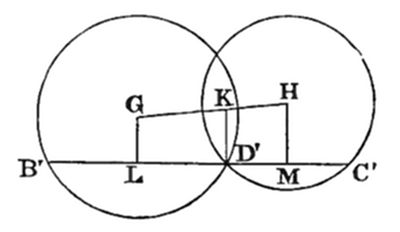
Join ; through draw ; and from , , draw , , .
Now it may be easily proved that
But , , are doubles of , ;
Q. E. F.
[The construction is now obvious, viz. to join , , and produce them to meet, on the third Circle (as they may be easily proved to do), at ; then to divide , , at and , proportionally to , ; and then to join , .]
47. (11, 23)
By inspection, '' are one set of values.
Subtracting, we get ;
, unless , in which case .
Now, by (1), ;
, when , ;
, unless be infinite.
Similarly, by (2), , unless be infinite.
Hence, if be finite, and if , either or , and also either or ; i. e. either , or else . But the latter is excluded by our hypothesis. Hence . Hence ; i. e. either or , and the other may take any value.
This gives us 2 more sets of values, viz.
We have now to ascertain what happens when .
By (1), ;
.
Similarly, by (2), .
This gives us a 4th set of values, viz. ; where has any value.
Now and may evidently have any real values, but is restricted by the equation in which y cannot be real, unless . Hence may have any negative value, and any positive value that is not less than 4; but it cannot have any positive value, less than 4, without making unreal.
Q. E. F.
48. (11)
Let be the given Triangle, , , , the centres of the semicircles, and , , , the common tangents; so that , , and .
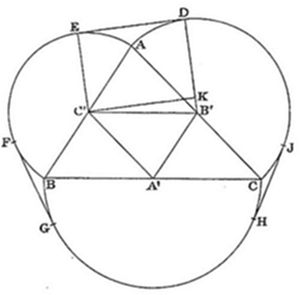
Join , ; and from draw . Hence .
Call sides of given Triangle ', , '.
Then , and ;
Q.E.D.
49. (11, 23)
Take, as unit, a side of one of the Triangles.
If the Tetrahedron be cut by a vertical Plane containing one of the slant edges, the section is a Triangle whose base is , and whose sides are ;
hence cosine of smaller base-angle
its sine its altitude;
and this is the altitude of the Tetrahedron;
volume of Tetrahedron .
Also altitude of Pyramid = altitude of Triangle whose base is , and whose sides are 1, 1;
i.e. it = ;
volume of Pyramid = .
Hence required ratio = .
Q. E. F.
50. (11,23)
At first, the chance that bag shall contain
, after adding a , the chance that it shall contain hence the chance of drawing a W from it is the chance of drawing a is .
After transferring this (unseen) counter to bag , the chance that it shall contain the chance of drawing a from it is the chance of drawing a is .
Before transferring this to bag , the chance that bag shall contain , after transferring it, the chance that bag shall contain
Hence the chance of drawing a is i. e. the odds are 17 to 10 on its happening.
Q. E. F.
51. (12)
Let be the given Triangle, and the given Point.
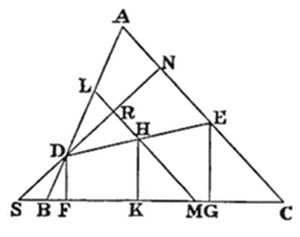
(Analysis.)
Let be the line required. Draw , , the base. Then their sum is equal to .
Bisect at , and draw the base: then it is evident that is the of , , and is equal to half their sum; i. e. it is equal to half of . Hence a Circle, drawn with centre and at distance , will pass through and , and will touch the base at .
Through draw parallel to . Then is evidently bisected at . Also passes through the centre of the Circle. Hence, if be drawn (or ), it is a chord of the Circle, and is bisected at . Produce to meet the base produced at . Hence cuts the Circle, and touches it at . But can be found, and can then be taken, so that sq. of may be equal to rect. of , .
(Synthesis.)
From draw , and produce it to meet the base produced at . Take , so that its square may be equal to rect. of , .
Bisect at , and from draw parallel to ; and from draw the base, to meet at . Join , and produce it to meet at , and draw , , the base.
Because , and that is parallel to ,
.
But .
Q. E. F.
[N. B. This proof is incomplete. I have assumed, without proving it, that . It may be proved thus. Because sq. of = rect. of , , is a chord of a Circle which touches the base at ; , which bisects it at right angles, passes through the centre. But also passes through the centre; is the centre; .]
52. (12, 23)
Let be the number of pennies each had at first.
No. (3) received , took out (2 + 4), and put in ; so that the sack then contained . Let us write '' for '.'
No. (5) received , took out (4 + 1), and put in enough to multiply, by , its contents when he received it. The sack now contained .
No. (2) took out (1 + 3), and handed on .
No. (4) took out (3 + 5), and handed on
No. (1) put in 2. The sack now contained .
Hence ;
Q. E. F.
53. (13,24)
Let be the given Triangle, and the given Point; and call its trilinear co-ordinates ', , '.
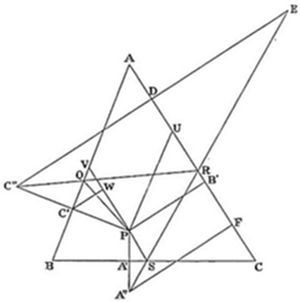
From draw , , , the sides, and therefore equal to , , . Produce and to and , making , and . From draw , and produce it to , making . Join , cutting in , and in . Join , cutting in . Join , .
The path of the ball is evidently ; and we have to calculate the length of .
Now .
First, to calculate .
From draw , , parallel to , ; from draw ; and from draw .
By similar Triangles, ;
;
.
Now ;
;
.
Similarly, ;
.
Again, ;
.
Similarly, ;
;
.
Now ,
;
,
.
Now ;
.
Q. E. F.
54. (13, 24)
It is evident that Triangle is similar to .
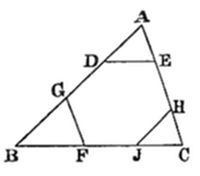
Let .
Now ; ;
;
;
;
but ;
;
;
(say).
Hence ·
;
·
Also ·
Q. E. F.
55. (13)
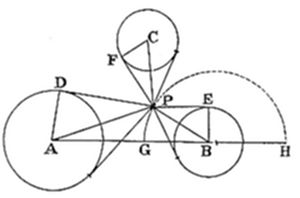
Let , , be the centres of the bases of the towers; and , , their radii. Suppose the required Point; and from draw a pair of tangents to each circle, and lines to the centres, which will evidently bisect the angles contained by the pairs of tangents.
Hence angles , , are equal;
;
i.e. ;
.
Draw a Line through , , and on it take Points , , such that .
Then the Semicircle, described on , is the locus of all Points whose distances, from and , are proportional to , .
Hence, if a Line be drawn through , , and a Semicircle described which shall be the locus of all Points whose distances, from and , are proportional to , ; the intersection of these two Semicircles will be the Point required.
Q. E. F.
[Note. "The locus of all Points whose distances &c.," if represented algebraically, is evidently a Circle, whose centre is on the Line through , , and which passes through and .]
56. (13, 24)
Draw , , , equal to the given altitudes, so as to form right s at and : and produce , . Join , and draw to it. Join , and draw to it. With centre , and distance , describe a circle: with centre , and distance , describe another: let them meet at : and join , .
Call the altitudes of , ', , '.
Now
= twice area of ;
also, taking as unit-line,
,
;
;
i.e. , , are proportional to given altitudes;
Triangle is similar to required Triangle.
The rest of the construction is obvious.
Q. E. F.
57. (14, 25)
(1) Geometrically.
Let be given Triangle.
(Analysis.)
Suppose the 3 Squares described, and that their upper edges form the Triangle . Join , , .
Now it is evident that, if be produced, the perpendiculars dropped, from any Point of it, upon , , will be proportional to , .
Similarly for and .
Hence these 3 Lines will meet at the Point from which the perpendiculars, dropped upon the sides of , are proportional to , , .
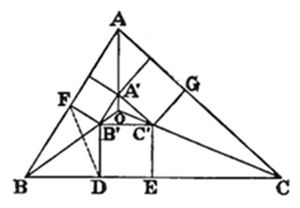
Hence, if Squares be described externally on the sides of , and if their outer edges be produced to form a new Triangle : this Triangle, with these 3 Squares, will form a Diagram wholly similar to that formed by the Triangle , with the 3 Squares inside it.
(Synthesis.)
Hence, if Squares be described externally on the sides of the given Triangle; and if their outer edges be produced to form a new Triangle; and if the sides of the given Triangle be divided similarly to those of the new Triangle: their central portions will be the bases of the required Squares.
Q. E. F.
(2) Trigonometrically.
Let , , be the sides of the given Triangle, and its area; and let , , be the sides of the required Squares.
It is evident that a Circle can be described about the Tetragon .
Hence .
Now, in Triangle , we know that
i. e. ;
.
Now is supplementary to ;
;
.
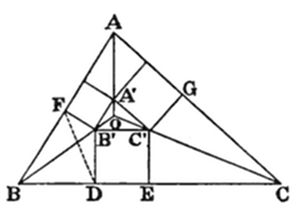
Now ;
·
Similarly, ·
But ;
;
;
i. e. .
Now it is evident that these Triangles are similar; so that
Hence, multiplying the last equation, throughout, by one or other of these equal fractions, we get
Hence, multiplying above and below by one or other of the equal fractions , , ,
Q. E. F.
58. (14, 25)
It may be assumed that the 3 Points form a Triangle, the chance of their lying in a straight Line being (practically) nil.
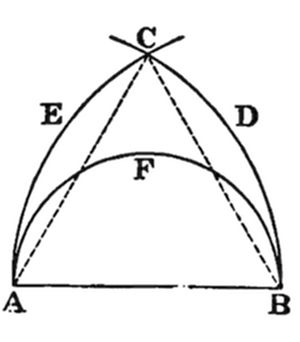
Take the longest side of the Triangle, and call it '': and, on that side of it, on which the Triangle lies, draw the semicircle . Also, with centres , , and distances , , draw the arcs , , intersecting at .
Then it is evident that the vertex of the Triangle cannot fall outside the Figure .
Also, if it fall inside the semicircle, the Triangle is obtuse-angled: if outside it, acute-angled. (The chance, of its falling on the semicircle, is practically nil.)
Hence required chance ·
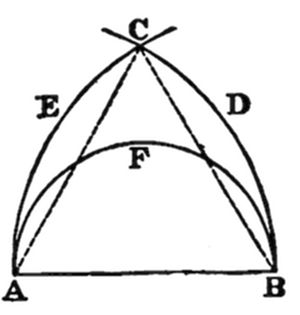
Now let : then area of semicircle ; and area of Fig. ;
·
Q. E. F.
59. (14, 25)
and let s , , be equal to ', , '; and similarly for the s of the other facets.
From draw base-facet . Also draw , , , . And join , , .
It is easily proved that s , are right.
The required volume is . The area of is of course known. All we need is the length of . Now ; and evidently . Hence all we need is the length of .
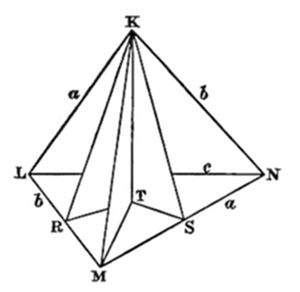
Now this requires a preliminary Lemma, in itself a very pretty problem, viz.—
LEMMA (1).
Given, in Tetragon , sides , , and , and that s , are right: find .
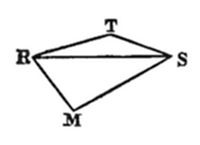
Now ;
also ;
Q. E. F.
Hence this requires another Lemma, in order to find the value of (or , which will do as well, and makes a prettier problem).
LEMMA (2).
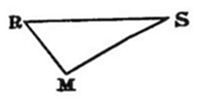
Given, in Triangle , sides , , and : find .
Q. E. F.
Hence, in Tetragon , we have by Lemma (1), and, by Lemma (2), ,
.
Now ;
,
;
therefore multiplied by , ,
= ,
which is symmetrical, as it ought to be.
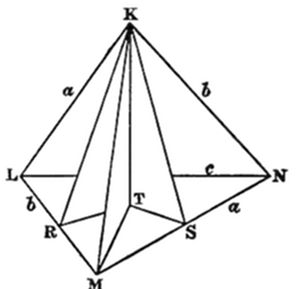
Now area of ;
hence volume of Tetrahedron
Q. E. F.
60. (14, 25)
Let , .
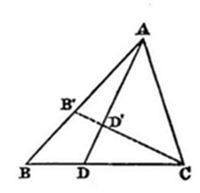
Now
;
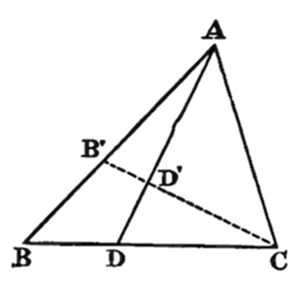
Similarly, .
Q. E. F.
COROLLARIES.
(1) .
(2) .
(3) If Triangle be equilateral,
i. e., if be drawn to , ;
e. g., if , ·
(4) Let ;
then ,
;
;
from which, if were given, we could find from a Quadratic Equation.
I tried various values, to find one which would give rational values for and , and found that would do, as it leads to the Quadratic in which becomes, after dividing all through by 6, , i. e. 49.
The Quadratic is ;
whence ; which solves the Problem 'Given a Triangle , having the tangents of its angles equal to 1, 2, 3: divide at , so that, if be joined, and drawn to it, the ratio may be '. The answer is 'Divide it so that '.
61. (14)
We know that the equation
'
'
is identically true.
Hence
;
, if () be a multiple of 3, so also is ;
is an integer;
and similarly for the other 2 fractions.
Also it may be proved that, if be equal to , or , or , then , , can be arranged in
First, let ;
then ; i. e. ;
secondly, let ;
then ; i. e. ;
thirdly, let ;
then ; i. e. .
And similarly for the other 2 fractions.
Hence, contranominally, if , , can not be arranged in , the 2 sets of squares have no common term.
Q. E. D.
Numerical Examples (not thought out).
62. (14)
Let , , be the given Lines, and the given Point.
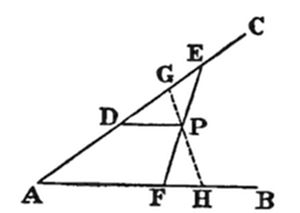
Through draw parallel to ; from cut off equal to ; join , and produce it to meet at .
Because , and that is parallel to ,
.
Now let be any other line through ;
then .
Because, in Triangles , , , and
, and .
To each add Tetragon ;
.
And so of any other line through .
Hence is the least possible Triangle.
Q. E. F.
63. (15, 26)
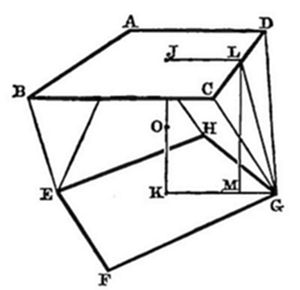
Let each side of each Square = 2.
Then , ;
;
.
Take as origin, the -axis to , and the -axis to ; and let be part of the -axis.
Let equation to plane containing Triangle be where is length of perpendicular dropped, from , upon this plane, and meeting it somewhere in .
Hence we can find from equation to , in the -plane, which will be now this line contains , whose co-ordinates are , and , whose co-ordinates are ;
,
and ;
;
;
;
.
Now area of ;
volume of pyramid, whose base is and whose vertex is ;
and there are eight such pyramids in the solid;
their sum = .
Also volume of pyramid, whose base is , and whose vertex is , = ;
and there are 2 such pyramids in the solid;
their sum = ;
volume of solid =
Q. E. F.
64. (15)
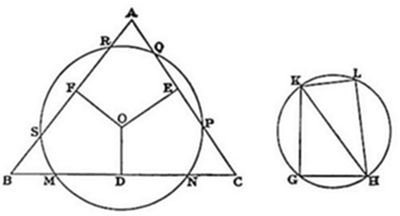
Let be the given Triangle, and the given Point; and let , its distance from , be less than either or , its distances from , .
Draw a line equal to , and it and equal to ; and join ; and about the Triangle describe a Circle; and place in it a line equal to ; and join .
Because sqs of , = sqs of , , and that is less than either or , is greater than either;
a Circle, with centre , and radius equal to , will cut all three Lines, in two Points each. Describe this Circle.
Hence , , , can be sides of a right-angled Triangle.
Q. E. F.
65. (15)
Calling the angles , , , of 360°, we must have an Indeterminate Equation with 3 unknowns.
Evidently none of them can be so small as 2.
(1) Let ; then .
Now, if , will = :
hence can only be 1, or 2, or 3, or 6; and the same is true of .
(N.B. It is assumed that the fractions , are in their lowest terms.)
Let . Then .
Then its possible values are
,
,
, .
This gives 5 sets of values for , , , viz.:
(2) Let . Then , and, as before, can only be 1, or 2, or 4, and the same is true of . Hence the possible values for are , so that
,
, .
This gives 3 more sets of values for , , viz.:
(3) Let ; then .
Hence denominator must contain factor "3", and can be only 1, or 2, or 5, or 10; and the same is true of .
Hence possible values of are , so that
,
, .
This gives 2 sets of values for , , viz.:— but the latter (a fact overlooked in thinking out) we have had already.
(4) Let ; then .
Hence can be only 1, or 3, and the same is true of .
Hence possible values for are , so that
This gives 2 sets of values, viz.:—
but the latter (a fact overlooked in thinking out) we have had already.
There is no use in giving, to , any values greater than 6; for these would make ; so that one or other must be ; i. e. either or must , and we should get old values over again.
Hence there are 10 different shapes.
Q. E. F.
The 10 sets of angles (I am not certain that they were all thought out) are
(1) 120°, 30°, 30°;
(2) 120°, 40°, 20°;
(3) 120°, 45°, 15°;
(4) 120°, 36°, 24°;
(5) 120° °, °;
(6) 90°, 45°, 45°;
(7) 90°, 60°, 30°;
(8) 90°, 72°, 18°;
(9) 72°, 72°, 36°;
(10) 60°, 60°, 60°.
66. (15, 26)
Write for . Now the counters must be either both white, or one white and one black. Let chance of first condition be ; hence chance of second is . Hence chance of drawing white is .
Let a counter now be drawn and prove white; then chance of 'observed event,' in 1st condition, is 1, and, in 2nd condition, ;
Hence the chances, of the existence of these two conditions, are proportional to , ; i. e. are proportional to , ;
hence these chances actually are , ;
hence the chance of now drawing white,
Hence the effect of one repetition of the experiment has been to change into .
Hence a second repetition of it will change
We have now to discover the law (if there is one) for the series regarding these as identical functions of 1, 2, 3.
We can write the 1st and 2nd term in the form of the 3rd, thus:— and, by inspection, we see that each is of the form where denotes the place of the term.
Suppose this law to hold for terms, what will be the effect of repeating the experiment once more?
We know that it changes into . Hence the new chance will be
i. e. the term of the series will follow the same law. But we know that the law holds for the , , and terms. Hence it holds universally.
Hence, after repetitions of the experiment, the chance of drawing white will be the term of the above series; i. e. it will be
Now, for , write .
Q. E. F.
Example—Let chance be ; and then let experiment be repeated 5 times more.
Here , ;
chance becomes , i.e. .
67. (16, 26)
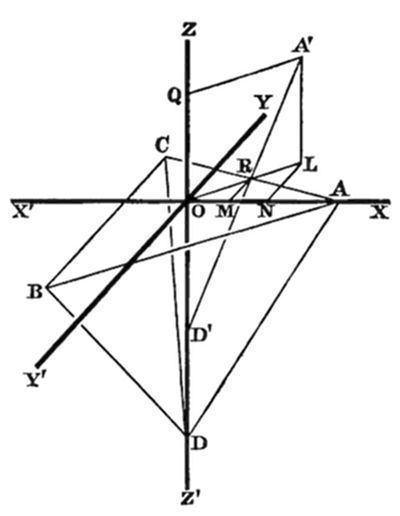
Let be the socket. Revolve the Tetrahedron until the plane, in it, has taken the new position ; and let edge , in its new position, meet the socket-rim at . From draw -plane. Join , and produce it to . And draw , , the -ordinates of and .
Then co-ordinates of are , , .
Call , , ', '; and , , , ', , '; and ''.
It is evident that the vertical axis of the Tetrahedron always coincides with the -axis.
Hence moves on the surface of a cylinder,
i. e.
Now ;
; Also Equation to is ; ;
Also, by similar s , ,
i. e. ;
;
but , and ;
;
i. e.
Equations (1) and (5) give the required Locus.
Q. E. F.
68. (16,26)
Let the Nos of bottles, taken out of the 3 days, be ', , '. Let each bottle have cost pence, and therefore be sold for pence.
Then the Treasurer's receipts, on the 3 days, were , , ; yielding, as profits (i. e. as remainders after deducting cost-price of bottles taken out), , , . Then these 3 quantities are equal.
Hence , and ;
total No. of bottles, being .
Now total profits are ; i. e. ;
profit, per bottle = ; and this must = 6;
.
Also ; i. e. ;
;
;
;
.
Now ;
;
No. of bottles = 60 or 48; but it is a multiple of 5;
it = 60.
Also ; i. e. ;
;
i. e. the wine was bought @ 8/4 a bottle, and sold @ 9/2 a bottle.
Q. E. F.
69. (17, 26)
§ 1. Let .
Then .
Now .
i.e.
Similarly,
and
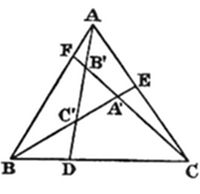
From equations (1) and (3), and may be found in terms of : but these, taken along with , will not be similar functions of the single variable . We must have a certain function of , , , and (say); a similar function of , , , and ; and a similar function of , , , and ; i. e. we must have
Now we know, by (1), that ;
i. e. .
Now, as an experiment, let then ;
These conditions will be fulfilled, if we make , and ; so that which would make
Now this may evidently be simplified by omitting , which is constant; and we then have ; or, in a yet simpler form, by again subtracting , .
Q. E. F.
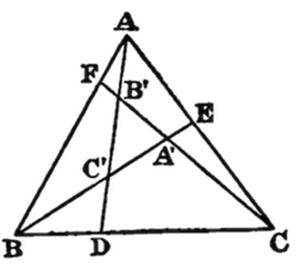
§ 2. We see that , so that is evidently equal to ; and so are s , .
This gives us a geometrical construction, viz. to draw lines from , , , so that each makes the same angle with the opposite side.
§ 3. Let us now ascertain the limits within which the value of must lie.
We know that .
Now ; i. e. ;
i. e. the supplement of ;
and of course this is true for each of the three angles , , ; i. e. if , , , be the order of the angles in a descending order of magnitude, supplement of .
Again .
Hence ; i. e. ;
and of course this is true for each angle.
Hence if , , , be the order in a descending order of magnitude, , and .
Q. E. F.
§ 4. We have now to ascertain the ratio which bears to .
In Triangle , whose s are , , , we have
, by symmetry, .
Now ;
Hence .
Q. E. F.
70. (17, 27)
Before folding the Plane containing the Triangles, the locus of their vertices is evidently a Line parallel to their common base. Hence, if the base of the Tetrahedron = 1, we may imagine a slip of paper, whose width is , attached to the front facet of the Tetrahedron, and wrapped round towards the right; and the upper edge of this slip will evidently be the locus of the vertices. This slip may be conveniently regarded as divided into equilateral Triangles, placed base-downwards and base-upwards alternately, and it is evident that these Triangles will successively cover the facets of the Tetrahedron, in the order 'front, right side, base, left side, front, &c.'; and its upper edge, made up of the bases of the inverted constituent Triangles, will evidently run as follows. Calling the successive Triangles, after the first (which occupies the front facet of the Tetrahedron), '' (base-up), '' (base-down), '' (base-up), '' (base-down), '' (base-up), and so on, the locus consists of the bases of , , &c. Now '' will occupy the right facet, its base coinciding with the back-edge of the Tetrahedron; '' will occupy the base of the Tetrahedron, its base coinciding with the front-edge; '' will occupy the left facet, its base coinciding with the back-edge; and so on. Hence the locus runs down the back-edge; up again; and so on. Which answers Question (1).
Q. E. F.
We may therefore, in answering the other three questions, consider the slip before it is folded, and calculate the positions of the vertices along its upper edge: and the problems thus become 'plane' ones.
(2) Gives us a right-angled Triangle, whose left-hand base-angle is 15°, and whose altitude is . We must calculate its base, and then, deducting half the base of the initial Triangle (i. e. deducting ), we shall get the distance, measured along the upper edge of the slip, from the vertex of the initial Triangle to the vertex of the given Triangle; and from that we can calculate how many times we must go down and up the back-edge to reach it. Call the base of this right-angled Triangle '.' Then .
Now call 't'; then ;
Deducting , we get as the required distance.
Now &c.; &c.
Hence we must go down back-edge, up again, and then about down again. This answers question (2).
(3) We need to go down the back-edge, and up again; i. e. we must use up the upward bases of '' and ''. Hence the base of the required right-angled Triangle is . Hence the required left-hand base-angle is
Hence, for the required base-angle, we have ;
and the required angle is about of the way from one to the other. But the difference is almost exactly 6°. Hence we must add, to the lesser, about degrees, or . And the total will be about .
(4) Here the right-angled Triangle has, for its base, .
the required base-angle has, for its tangent, ,
= nearly . Now
Now &c°.; and we must go about half-way to the next angle, viz. &c°. The difference is about 6°; we must add about 3°. Hence the answer is about °.
71. (18)
Let be the given Triangle, and the given Point.
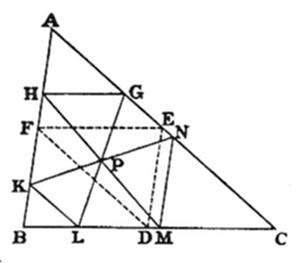
Bisect the sides of at , , ; and join these Points.
First, let be within the Triangle .
Draw parallel to , so that its distance from may be double the distance of from ; join , , and produce them to meet in , . From draw parallel to ; join , and produce it to meet at join .
Because is parallel to ,
;
,
.
Now the Triangles , are equal in all respects;
.
If lies on , and vanish, and the Hexagon becomes a Parallelogram.
If lies at , the Hexagon becomes the line .
If lies outside the Triangle , the Problem is insoluble.
Q. E. F.
72. (18, 27)
We know that, if a bag contained 3 counters, 2 being black and one white, the chance of drawing a black one would be ; and that any other state of things would not give this chance.
Now the chances, that the given bag contains , .
Add a black counter.
Then the chances, that it contains , , are, as before, , , .
Hence the chance, of now drawing a black one,
Hence the bag now contains (since any other state of things would not give this chance).
Hence, before the black counter was added, it contained , i. e. one black counter and one white.
Q. E. F.
THE END.