CRESTLANDS (continued 5)
Reading edition
Betsy, white, unnerved, and more frightened than she had ever been in her life, sprang to her mother's aid, who recovered from her faint only to go into violent hysterics. Gilcrest stood dazed and motionless, staring at his wife, with the riding-whip unconsciously clenched in his hand.
At this juncture the door was flung open by old Dilsey.
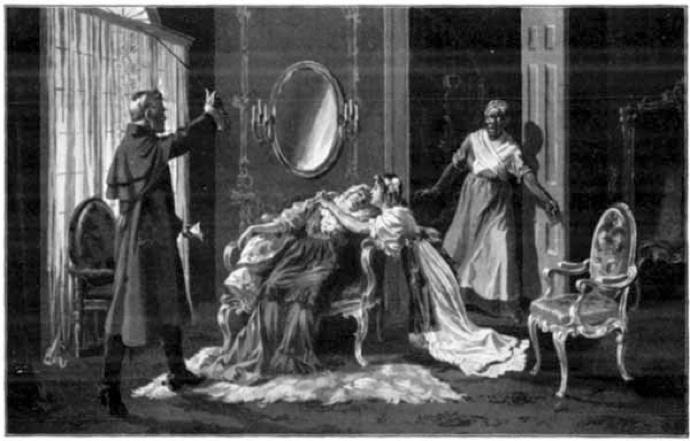
At this juncture, the door was flung open by old Dilsey. She stood a second on the threshold, as though paralyzed at the tableau before her. Mrs. Gilcrest leaned back in her chair, moaning and trembling; Betsy crouched by her side, in reality trying to pacify her mother, though apparently seeking shelter from her father, who stood before them with the uplifted whip. Then, her black eyes blazing, the negress sprang forward with the swiftness and fierceness of a tiger; and charging upon her master with such force as almost to throw him down, she seized his arm and wrenched the whip from his grasp.
"I said you had done gone plum crazy," she cried, "but I nebbah thought I'd lib teh see the day you'd raise yo' arm ag'in yo' own wife an' chile. Don' you dar' tech 'em! I'll p'otect 'em wid my life's blood!"
"Shut up, you old harridan!" returned Gilcrest. "Nobody's going to strike your mistress, or her daughter either. Take your Miss Jane to her room, and attend to her."
"I doan lebe dis room tell I speaks my min' 'bout yo' ongodly carryin' on an' yo' shameful 'buse ob my sweet lamb, my own Miss Betsy."
"Shut up, I tell you!" again cried Gilcrest.
"I woan shet up. I will speak my min'!"
"I'll cowhide you, you black witch!" shouted her master, threateningly.
"Whip me? Ole Dilsey? 'Deed you woan! Ef you lays de weight ob a fingah on me, I'll t'ar you limb f'um limb!" She faced him, arms akimbo, eyes snapping, and defiance in every line of her tall figure and in every fold of her red turban. "Does you think I'se feared ob you? Me, whut nussed an' tended you when you wuz a pore, sickly baby, an' bossed you, an' spanked yo' back sides many a time when you wuz a streprous, mis-che-vous boy?"
"Leave the room this instant!" cried Gilcrest, white with anger.
"Nary step does I budge tell I frees my mind," answered Dilsey with determination. "Hain't you no bowels ob marcy fur yo' own flesh an' blood? Is you done persessed by de Debble, dat you treats dat pore lamb so, whut hain't done nuthin' but be true to her sweetheart? Yo' fust borned chile, too, yo' leetle gal whut you kissed an' cried obah fur joy when ole Dilsey fotch her to you; an' you tuck her in yo' arms, de tears runnin' down yo' cheeks an' yo' voice trem'lin' an' a-shakin', ez you thanked de good Lawd fur yo' purty black-eyed baby gal, an' fur bringin' yo' pore young wife safe frew her trial!"
"There, there, Dilsey," said Gilcrest, moved in spite of himself by her rough eloquence. "You have entirely misconceived the situation. I had no intention of striking either your mistress or Miss Betsy. Leave off your foolish raving, and help me get your Miss Jane to her bed. Don't you see she is not able to stand?" Then to his daughter he added, "If all this excitement and trouble make your mother really ill, it is your fault, you rebellious girl."
CHAPTER XXX.
YOUNG LOCHINVAR
"So light to the croup the fair lady he swung," So light to the saddle before her he sprung;" 'She is won! we are gone—over bank, bush and scaur;" They'll have fleet steeds that follow,' quoth Young Lochinvar."
The next afternoon, Major Gilcrest, from the window of a back room, saw his daughter coming in alone through the shrubbery, and strongly suspected that she had been meeting Abner Logan again. Gilcrest, however, said nothing to her, and she went upstairs. She remained in her room, busy over some needlework, about an hour. Then, as it was getting too dark to sew, she put aside her work to go downstairs; but just then she heard the key turned in her door, and found it locked from the outside. She was a prisoner in her bedchamber.
She remained there for two days, without seeing any one but the negro girl Polly, who three times a day came to the room to replenish the fire and to bring her meals. From Polly, Betsy learned that Mrs. Gilcrest was ill and confined to her room, and that Major Gilcrest was preparing for a journey, and purposed taking his daughter with him. He sent by Polly a curt note which further enlightened Betty of his intentions. She was directed to pack her clothes and be in readiness to start with him for Massachusetts as soon as her mother's health would allow him to leave home. He also informed Betsy that he meant to leave her in Massachusetts at a boarding-school.
Instead of obeying her father's command, Betsy spent her solitary hours in trying to hit upon some mode of escape from her prison, or at least for some means of communicating with her lover.
On the third night of her imprisonment she retired early, feeling that she would need all her strength for the morrow's struggle; for she was fully resolved that no power on earth should be strong enough to compel her to leave home with her father. She was exhausted, and soon fell asleep. In the night she was awakened by some one shaking her and calling her name softly. She opened her eyes, and found Aunt Dilsey standing over her with a lighted candle in one hand.
"Sh—, sh—, honey, don't mek no noise!"
"How did you get here?" asked Betsy, sitting up in bed and now thoroughly roused.
"I stole de key f'um de nail in de hall, an' den slipped up de sta'rs. I allus walks jes lak a cat, you knows, so Marse Hi didn't heah me. But nebbah min' dat now. Git up quick, an' do whut I tells you. I'se gwineteh he'p you 'scape to Marse Abner, dis berry hour. He's waitin' fur you on his nag down to de bars at de eend ob de leetle woods pastur', an' he'll tek you straight to de preachah's house, an' you kin be married right off."
"But, mammy," began Betsy.
"Shet up, chile, an' do ez I says. It's yo' on'y chance; fur onct Marse Hi gits you 'way f'um heah, it'll be many a long day foh you sees yo' sweetheart ag'in. I tell you yo' pap's thet desprut dar's no tellin' whut he woan do teh keep you an' yo' sweetheart 'part. So doan let me heah no 'jections, but jes' listen to me. You'se to slip out frew de ole log-room heah—you carn't git out frew de hall; fur yo' pap'll heah you, shore, kaze his door's open, an' you knows he allus sleeps wid one eye an' bofe years open. But you go inteh de log-room, an' clamb out by de windah. See! Heah's a rope I done mek outen bedclothes. We'll tie it to de bed-post, an' it's plenty long 'nough to reach most to de groun' frew de windah, whut hain't more'n twelve or fou'teen foot f'um de groun'. 'Sides, dar's notches all down de wall outside whah de chinkin's done fell out. So you kin hold ontah de ropes, put yo' foots in de gaps, an' git down ez easy ez ef 'twuz on sta'r steps."
The chamber Betsy occupied was in the ell of the house, and communicated through a closet with the upper room of the old log house of two rooms which had been left standing when the new house was built. The lower apartment of this old structure was now used as a weaving-room.
"But why not go down through the window of the lower room?" asked Betsy.
"Kaze I carn't fin' de key to de door et de foot ob de sta'rway intah de loom-room. But you woan hab no trouble, noways, climbin' down dat wall. So hurry, an' while you dresses, I'll pack up some ob yo' clo's in a bundle. I'se done shet ole Jock an' Ponto up in de woodhouse to keep dem f'um barkin' an' rousin' yo' pap. Soon's you'se down safe, I'll go out an' lock yo' door ag'in, slip down de sta'rs, an' Marse, when he fin's you'se skipped, will think you'se 'scaped by yo'se'f. But, anyways, I doan much keer ef he does fin' dat ole Dilsey holped you; I hain't feared. He woan dar' tackle me."
"It seems hard," said Betty, "that I must steal out of my father's house in this way like a thief; but it's my only chance."
Aunt Dilsey's plan worked successfully. Betsy, by means of her bed-quilt rope and the chinks in the wall, had no difficulty in making her escape. Old Dilsey, as soon as her young mistress reached the ground, softly dropped the bundle after her, and then the girl sped across the snow through the side yard to the little woods, where at the bars her lover awaited her. She climbed up behind him on his brown mare, Bess, and in a short while reached Barton Stone's house.
Logan had already related the circumstances of the case to the minister, who said that the young couple were fully justified in the step they had taken; and so they were married. Stone and his wife urged them to remain the night with them, but Abner said that Mr. and Mrs. Rogers were expecting them. Accordingly they rode away, and reached the Rogers home about midnight. Late as it was, the entire family were up and fully prepared to receive them.
CHAPTER XXXI.
A NOVEL BRIDAL TOUR
The next morning the young couple, accompanied by Susan Rogers, with Rache in the capacity of serving-woman, set out on their bridal tour, a three-mile ride over the snow, to their future home. A stout sledge drawn by a yoke of oxen was the primitive equipage of the bridal party.
The wedding presents, though the gifts of but one family, were many and useful, if not beautiful and costly. A feather bed and a pair of fat pillows were Mrs. Rogers' most valuable gift. "No, Betsy," she said as she tied them up in an old quilt, "we hain't robbin' ourse'ves; we've got more beds an' pillahs then we hev people to sleep on 'em; besides, hain't we got plenty geese?"
"Nevah you mind, Betsy," chuckled Mason Rogers; "Cynthy Ann knows better'n you do whut she kin spar' tow'ds settin' you an' Ab up to housekeepin'. The real offus uv a bride is to be ornamental. So, all you got to do this mawnin' is to set up on thet ther sled, an' look purty."
A coarse but well-bleached tablecloth, a gourd of lard, a cheese, half a loaf of cake, a skillet and a coffee boiler completed Mrs. Rogers' list.
The gifts of her husband were no less generous: a side of meat, a supply of meal, potatoes, hominy, sugar, a jug of cider vinegar, and another of molasses, concerning which gifts he declared, in answer to Abner's protest: "Of course, you'n' Betty kin live on love; so I jes' put in them eatables fur Susan—pore gal, she ain't got no husban' yit to mek her fergit she's got a stommick. Besides, even you an' yer bride will find livin' on love a weak'nin' exper'ence artah the fust few days; an' this snow looks lak it hed come to stay all wintah. The roads 'tween heah an' Bourbonton won't be broke through 'nough fur you to haul a load o' things frum thar befoh March, mayby. Allus feed yer husban' good, Betty. With all the men whut evah I seen, the stommick 'pears to be the seat o' the affections; an' Abner hain't no exception. He kin mek an ash cake or a hunk o' middlin' disappear 'bout ez fast ez the nex' one; an' when it comes to tacklin' a stack o' flitters seasoned with maple merlasses, he kin beat all creation, unless 'tis Tommy an' Buddy, an' the amount o' vittels them two shavers kin manidge to stow 'way is 'nough to mek a pusson think ther laigs is holler. These two cheers," he continued as he tied them in place on the sledge, "air fur me an' Cynthy Ann to set on when we come ovah nex' Sunday to pay our bridal call an' to fotch Cissy an' Rache home. Abner hain't got but two cheers, Betty—one fur Susan, an' one fur you an' him; but me an' Cynthy Ann's done got pas' the time when one cheer kin 'commerdate us both comf'table. Whut you got thar?" he asked the negro Tom, as he came forward, while Rube lingered bashfully in the background.
"Me an' Rube wants tab gib somethin' ter spress our 'gratulatins ter Miss Betsy an' Marse Ab; so we presents dese ax-handles whut we'se made oursel's, an' dis bowl whut we'se hollered outen a ash-tree fur a nice bread-tray; an' we wishes you bofe much joy in de road you'se dis day sotten out on in double harnish." Grinning and bobbing, he presented the offerings, and then stepped back to make room for Uncle Tony. "Marse Ab, you'll 'cep' dis bunch o' brooms f'um ole Tony; kaze he wuz yer fus' 'quaintunce when you come ter dis kintry. Dese brooms will 'min' you ob yer ole home; kaze dey's tied wid de same twist an' loop jes' ez dey mek brooms wid in ole Virginny. An' I wishes you 'n' yer purty bride all de hap'ness an' prosp'ity whut kin come ter us pore morsels trablin' frew dis vale ob tears."
"Well, Ab," said Mason, gleefully, as Abner, after gratefully thanking the darkeys, proceeded to find a place for the things on the well-loaded sled, "you'd bettah walk straight now; a broom's a dangerous weepon in a woman's hands. You know the ole sayin' 'bout brooms, Betsy? 'In fair weathah use one eend; in foul weathah use t'other!'"
Susan's contributions were a pair of blankets and a supply of tow-linen sheeting and toweling, all of her own weaving. The twins, not to be outdone, begged Betsy to accept all their nine-patch pieces, "which only lack a few more squares," they said, "to mek a quilt big 'nough fur any bed."
"Tek 'em, Betty," laughingly urged Mrs. Rogers; "Lucindy an' Lucy air only too glad ter git 'em off ther hands; they know they'd hev ter finish thet quilt this wintah, ef them pieces stayed heah, an' they hate sewin' wussen a mad dog hates watah."
"We want you to have these, too," said Lucy, handing to Betsy a pair of plaster-of-paris angels. "Lucindy an' me bought 'em of the packman with our own money. They'll look mighty sweet settin' up on your mantel-tree. One of 'em's got its wing broke off, but thet won't show much when it's set facin' the room."
"Ha! ha! ha!" laughed Rogers. "The twins presents you with angels, an' Tommy an' Buddy contributes live stock." The two little boys advanced, Tommy with a curly black pup under his arm, Buddy with two half-grown kittens in his apron.
"Yes, yes, tek 'em," urged Mrs. Rogers; "you'll do me a favor to tek thet mis-che-vous pup, an' will save them kittens frum a grave in the hoss-pond; I've done said I'd drown the whole litter. Heah's a sack fur the kittens, an' you kin put the pup undah this heah kittle; 'twon't smothah undah thar; an' 'twon't mek no diffruns ef it does."
Every negro on the place, elated and excited by the romantic event of a runaway marriage, brought offerings. Rache gave gourds and a cymbling bowl; Eph, a string of red-pepper; the other little darkeys, gifts of maple sugar, walnuts and hickorynuts; while Aunt Dink presented a large blue-flowered platter which until now had been the chief ornament of the chest of drawers in her cabin, and was none the less precious to her because of the big crack through the middle and the nick out of one corner.
"The coach and four is now waiting with the bride's outfit already packed in the boot; so bride, bridesmaid and waiting-woman will please take their places," laughed Abner, happily, helping Betsy, Susan and Rache into the sledge. "You've loaded us so heavily with your generous gifts that I fear the bridal equipage will break down before reaching the end of the first stage, and bury bride, bridesmaid, waiting-woman and dowry in a snowbank."
At this moment, out came little Buddy again, carrying a tiny arm-chair which he had long since outgrown, and insisting that it should make part of the bridal outfit on the sledge.
"That's right, sonny," said Rogers, as he placed the chair. "They don't need it yit awhile, but 'tis likely it'll come in handy in a year or so. Hold on thar a minit," Rogers exclaimed, as Logan was hastily preparing to start off. Rushing into the house, he emerged in a few minutes, carrying a pine cradle with deep, sloping sides and broad, rough rockers. "Heah's a companion piece fur thet cheer. Hope you'll hev use fur it befoh we do ag'in," and nothing would do but that the cradle should be placed on the sled. "Ha! ha! ha!" Rogers laughed uproariously as he surveyed the outfit. "This turnout looks lak a emigrant wagon mekin' a journey frum Cumberlan' Gap to the settlements."
Good-by's were exchanged, and the train started. The bride with her two attendants sat bravely on the sledge surrounded by her household goods, while the groom stepped proudly on to guide his awkward team, his own faithful dog, Toby, following at his heels. His house was not on the main thoroughfare, and the shrubs and tangled vines, weighted down with snow, bent over the narrow, little-used roadway, making it in places almost impassable; but the cavalcade proceeded safely, if slowly, until about half the journey was accomplished. Then, as they were going down a steep hillside with a considerable slant to the left, the groom came back from his post at the head of the team, to the side of his bride. Susan was looking out across the landscape; Rache was engrossed with her efforts to keep the various small articles from falling off the sledge. The moment seemed propitious; he leaned over to give Betty a reassuring kiss and embrace. Just then the vehicle ran over a stump which was hidden, but not protected, by the snow, and it careened sharply to the left. Abner, on the right, instantly threw his weight to stay the tottering ark. This only added the proper impetus, with, as the result, a complete overturn.
Out tumbled bride, bridesmaid and servant in the snow.
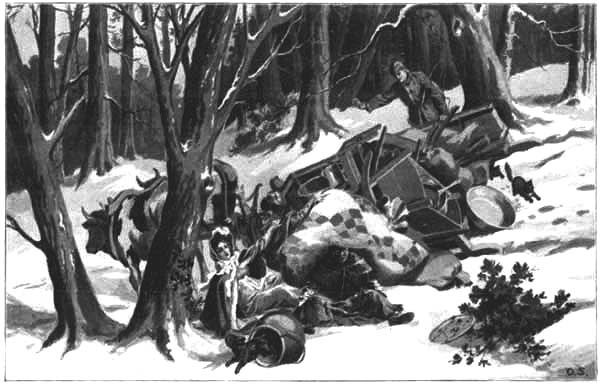
Out tumbled bride, bridesmaid and servant in the snow, with feather bed, chairs, table utensils, skillet, kettle, coffee boiler, buckets, brooms, provisions on top. The two kittens, escaping from their sack, and frightened out of at least four of their eighteen lives, scampered madly up the nearest tree, in which house of refuge they sat with arching backs and bristling tails, spitting and hissing. The pup, liberated from his kettle, and confident that Toby was somehow to blame for this melee, charged rashly at him. Toby, resenting this insinuation, met the curly pup with gaping jaws and bristling back. A terrific dog-fight ensued, in which the self-confident puppy was routed with great damage. During the excitement, it fortunately never occurred to the mild-eyed oxen to make a bolt with the sledge; on the contrary, they stood still in their tracks the whole time, gazing with placid indifference straight before them. No one was hurt, and the wintry woods rang with the merry laughter of the party as they righted the sledge, collected the scattered wedding outfit, and replaced it securely. The vanquished puppy was again confined in his iron dungeon. The kittens, after much coaxing, at last ventured upon a limb low enough for them to be reached by Abner's long arm; and the bridal car then proceeded, without further hurt or damage, to the future home.
Betsy, though the child of rich parents, was used to work and to household management; but here was housekeeping to be begun under an environment quite different from that to which she had been accustomed in her father's well-ordered house. It was a heavy draft upon the young bride's faith and love to gaze undaunted at the prospect before her; but she was of a brave and hopeful spirit, and soon her blithe laugh chimed in with that of Abner and Susan, as they talked over the ludicrous mishap on the wedding tour. Presently, however, as Abner looked around the uninviting interior of his future abode, and then glanced at his young bride, he was sobered.
"An empty hovel with unwhitewashed walls, stoneless hearth, and dirt-encrusted windows and floors, is certainly no fit welcome for you, my dearest," he said to her as they stood alone a moment, while Susan and Rache were taking a survey of the inner room. "Do you regret the step you have taken?"
"Regret? Not for one instant," she bravely answered. "'Better a dinner of herbs where love is, than a stalled ox and hatred therewith'—and how dare you slander my new abode by calling it a hovel?" she added playfully. "Instead of belittling this commodious mansion, set to work at once, sir, and build us a fire."
In a short time Logan had collected fuel. His flint yielded the ready spark, and fagots and logs soon blazed cheerily in the wide fireplace in each room.
"That big kettle which pa insisted upon our bringing, does come in handy right at the start," exclaimed Susan. "We'll have it filled and hung on that crane, so that Rache can scrub the floors; and while the water is heating, let's get something to eat. I'm as hungry as any bear that ever prowled through these woods."
"I'll lay the hearthstones, whitewash the walls, and put up some shelves over in that corner to-morrow," said Abner.
"When that is done, the windows cleaned and curtained, and the things all arranged, it will be quite a cozy place," added Susan.
"Yes," assented Logan, "it will do, I suppose, until I can get to town to buy whatever we need."
"Oh, it's good as it is, and we will soon make it a very inviting home," interrupted Betty. "Don't worry because you haven't a stately mansion for your bride. It's bad enough to have a wife thrust upon you in this unceremonious style, without your impoverishing yourself to fit up a luxurious home for her all at once."
The work went merrily forward during the next two days, although the season was hardly propitious for housecleaning. Rache, who enjoyed it all as much as any one, declared with a grin, "It's de fust time I evah hearn uv folks doin' ther spring cleanin' when de snow am two foot deep, an' it am so sinful cold thet it mighty nigh freezes de nose offen yer face."
The floors, by dint of repeated scrubbings, were soon, as Rache declared, "clean 'nough ter eat on." The walls and rafters were whitened, and the windows curtained with snowy dimity. At the foot of the bed, in one room, stood a packing-case to serve as a wardrobe, a valance of calico tacked on its top, concealing the true nature of the contrivance. Another box, set on end and similarly attired, served as a dresser; still another as a washstand. This room was sitting-room, parlor, library, and Susan's sleeping apartment. The other room was dining-room and kitchen, where Rache was accommodated with a pallet upon the floor in front of the fire; while, for the present, the rude loft over the two rooms, reached by means of a ladder in the sitting-room, was the bedchamber for bride and groom.
Consternation reigned at Oaklands when Betsy's flight was discovered the morning after the elopement. Her father, after giving orders that everything on the place which could be considered her personal property should be packed and sent to her immediately, then assembled the entire household, struck Betsy's name from the family Bible, and commanded that no one in his presence should ever again mention her name, and that no one on the premises should ever dare to hold any communication with her. Later, that same day, he drove to Lexington, sought a lawyer, and made a will disinheriting her.
Upon the third morning after the marriage there came to the new home a sled driven by a negro man from Oaklands. On the sled was Marthy, a negro woman of thirty-five; also a huge packing-case containing Betsy's clothes, books and ornaments, some bed quilts which she had pieced herself, some bright-colored rugs she had woven, besides china and a set of silver spoons which had descended to her from her maternal grandmother. Behind the sled rode Sambo on Betsy's saddle-horse, driving a young cow which was also considered the girl's property. The two negroes, Marthy and Sambo, had belonged to Mrs. Gilcrest, to do with as she pleased, and she sent them as a gift to her daughter.
CHAPTER XXXII
EXIT JAMES ANSON DRANE
"Treason doth never prosper, ... for, should it prosper, none dare call it treason."
During the spring of 1806 the country became greatly agitated over rumors of secret expeditions and conspiracies of a most startling nature, in which many men of prominence were concerned. The old difficulty over the free navigation of the Mississippi River, and the schemes which grew out of this difficulty, although already settled in a large measure by the purchase of the Louisiana Territory, had been too much agitated in Kentucky not to leave much material for conspirators. Hence, Kentucky became the stage upon which were enacted many of the incidents of that dramatic episode of American history known as "Burr's Conspiracy."
Opinion was then, as it will ever be, somewhat divided as to the exact nature of the schemes which Aaron Burr was at that time maturing. According to his own statements and to the extracts from his journal of that period, his designs were not actually treasonable; but they were certainly dangerous to the future well-being of the States along the southern Mississippi.
In 1805 this brilliant, ambitious and fascinating man, whose term as Vice-President had just expired, and who had, by his ill-advised attack upon the administration and by his duel with Alexander Hamilton, forfeited much of his political prestige, as well as the sympathy of most of his adherents in the North, came to Kentucky. He spent some weeks at Frankfort in an apparently quiet manner, and next proceeded on a tour down the Mississippi, visiting all important points from St. Louis to New Orleans. The following year he again appeared in the West, this time paying several visits to Lexington and Louisville. His headquarters on both these Western tours was the romantic, ill-fated island home of Harman Blennerhassett, where he was met more than once by many prominent men of Kentucky and other Western States. Soon after these visits, rumors began to be circulated that boats were being built in Kentucky and Ohio; provisions and military accoutrements ordered, which, when furnished, were stored on Blennerhassett Island; and that some daring military expedition was planned in which many were to be engaged.
Presently the "Western World," a newspaper published at Frankfort, came out with a series of articles in which the old Spanish intrigues and these later projects of Aaron Burr were blended in a confused manner. Mingled with hints and vague innuendoes, some facts were stated and some names given that created no little sensation. Sebastian, a judge of the Supreme Court; Brown, United States Senator from Kentucky; Innes, a judge of the Federal Court; Wilkinson and Adair, generals in the regular army, and many other Kentuckians of more or less prominence, were implicated by these articles, which also plainly denounced Aaron Burr as a traitor and his scheme as a treasonable design against the United States Government. Truth and error in these articles were so mixed together that no one was able to separate the two, and people all over the country were bewildered and excited. Friends of those implicated resented the attacks, and demanded a retraction of the charges; but the paper sturdily adhered to its policy. Other papers began to take up the matter, until the public awoke to the fact that some dangerous movement was on foot; and the unsettled condition of the country, and the unsatisfactory relations between the United States and Spain, caused these rumors to arouse alarm.
In November, 1806, Joseph Hamilton Daviess, United States attorney for Kentucky, brought at Frankfort an indictment against Burr for high treason; and Wednesday, December 2, was set for trial. Burr succeeded in convincing Henry Clay and John Allen, another able lawyer of the Lexington bar, of his innocence, and secured them as counsel.
Shortly before this movement of Daviess, however, Graham, a detective in the United States employ (though not known to be such at the time), came to Kentucky; and, after spending some time in Fayette and Woodford Counties, came out to Cane Ridge. He represented himself as a land agent, and in this capacity called on Abner Logan one evening about sunset. He was invited to stay the night, and accepted. After supper, taking up a copy of the "Western World" which was lying on the table, he naturally turned the conversation upon the charges which the paper had been making. He said that, as a stranger in the State, he was of course ignorant in a great measure of the charges, whereupon Logan enlightened him as well as he could, discussing the matter with him at some length. The next morning Graham took his departure, and the Logans attached no importance to the visit.
James Anson Drane had by no means severed his friendly relations with Hiram Gilcrest. He was at this time employed by Gilcrest to settle some old and troublesome land claims, and this business called him to Oaklands on the Thursday before the day set for Burr's trial at Frankfort. While Drane and Gilcrest were in the latter's library, one of the little negroes about the place brought Drane a note which the little darkey said had been left at the kitchen door by a peddler. The two men were seated at a center table littered with papers and documents. As Drane read the note, Gilcrest noticed that he appeared greatly disturbed; his cheeks and lips turned ashy pale, and the hand holding the note shook with agitation. He quickly commanded himself, however, thrust the note into his pocket, and explained that he was called to Lexington at once on urgent business. Gilcrest, seeing that the business must be of a grave and peremptory nature, did not urge Drane to stay, but gave the order for the lawyer's horse to be brought immediately. Telling his host that he would call again in a few days, Drane gathered up his papers which were scattered about the table, and hurried into the hall for his hat and great coat. He tried to thrust the papers into his breast pocket, but there were too many for one pocket, and, in taking some of them out to put in a different receptacle, the little note which he had just received fluttered to the floor unperceived either by himself or his host.
Shortly afterwards, Polly, the housemaid, brought her master a crumpled slip of paper, explaining that she had found it on the hall floor, and thought it might perhaps be something important. Without glancing at the address, or thinking much about the matter, Gilcrest opened the paper and read the contents before he realized that it was the note which had been handed to Drane a few minutes before. It read thus: "A sincere and disinterested friend warns 'A. D.' that he is to be summoned as a witness in the trial of B—— at F——, and advises him to leave the country at once, taking with him or destroying all compromising papers which he may have in his possession."
After gazing at the note in amazement for a few moments, Gilcrest crossed over to the secretary in one corner of the room, and took from a locked receptacle the two papers which James Anson Drane, four years since, had exhibited to him in that room.
As Gilcrest now sat musing with the two documents in his hand, he recalled several points which, had he not been so completely under the influence of the wily lawyer, would have aroused grave suspicions. One was the exceeding reluctance Drane had shown in regard to leaving the two papers at Oaklands; another was the singular fascination which, of late, the old mahogany secretary had seemed to hold for the lawyer; and still another was this, that once when Drane and Gilcrest were in this room, the latter had been called out. Returning unexpectedly, a moment later, he found Drane with his hand on the knob of that little locked inner drawer, as if he were trying to pull it open. At the time, Drane had averted suspicion by saying that he was examining the peculiar mechanism of the old and valuable secretary, and admiring its beautiful carving and workmanship.
Major Gilcrest now also remembered that for several months prior to the showing of the two papers—in fact, ever since Logan's visit to Virginia—Drane had been dropping hints and insinuations against Abner. But Gilcrest recalled, too, that even earlier than this, Logan had once, in a conversation at Rogers' house, expressed the greatest admiration for Aaron Burr; also that he had been seen in what appeared to be close counsel with Wilkinson, Sebastian and Murray at the tavern on court day, and that he had visited Blennerhassett Island in company with Sebastian and Murray. So that for several years Gilcrest had entertained no doubt that his son-in-law was to some degree implicated in this treasonable movement. But now, having read that anonymous warning which Drane had dropped in the hall an hour since, Gilcrest was altogether puzzled. There could be no doubt that the initials "A. D." in the anonymous note stood, not for Abner Dudley, but for Anson Drane, who probably for greater security had dropped his first baptismal name in the correspondence with the intriguers. "Can it be," he thought, "that both men are implicated in this nefarious matter? For even if this letter from B. S. to A. D. was written to Anson Drane instead of Abner Dudley, this torn fragment, which is undoubtedly in Logan's handwriting, seems suspicious; but, perhaps, if I had the whole letter, the references in it would bear an entirely different construction to that which I have placed."
Early Friday morning Gilcrest called for his horse, and rode to Lexington. Arriving there, he went straight to Drane's office, but found it locked. He then made inquiry at the young man's tavern, where he was told that Drane had left town very hurriedly the evening before, and had not said when he would return.
That was the last time that James Anson Drane was seen in Kentucky. When the day set for Burr's trial in Frankfort arrived, Drane was sought in vain. Later, when Burr, Blennerhassett, and other conspirators, were arraigned at Natchez, and still later at Richmond, Drane was again in demand, but he had completely disappeared; and his exact connection with that famous episode of American history, the Aaron Burr conspiracy, was never known. About twelve years later, a man said to be very like him was reported as an influential and wealthy lawyer of St. Louis.
Upon the same Thursday that Drane received at Oaklands the anonymous warning, Abner Logan, while at work in a field near the road, received from a passing packman a note which, the bearer said, had been given him for Logan, by a man whose name the peddler had forgotten, but who, as the peddler said, "lived down that way," pointing vaguely down the road. The messenger was not Simon Smith, the packman who periodically visited the neighborhood to sell his wares to the housewives thereabout, but a stranger. The note which he gave Logan was worded exactly as the one Drane had received an hour earlier at Oaklands.
Abner's first feeling upon reading this missive was bewilderment as to the identity of the friend who had sent it; his second, indignation that any one should think him in any way implicated in the Burr affair. "'A sincere and disinterested friend,' indeed," he thought; "it's some ruse to get me into this queer business."
Before receiving the anonymous communication, Logan, being desirous of hearing Clay and Daviess speak, had partly promised Mason Rogers, who felt a lively interest in the trial, to go with him to Frankfort. Logan now fully determined to let nothing prevent his going; and, fearing to alarm his wife, he resolved to say nothing of the warning he had received.
Upon the following Tuesday evening Graham, the detective, came to Oaklands, and spent the night there. He was able to supply to Gilcrest at least one missing link of evidence—the fellow to the torn piece of letter to Charles M. Brady. This, with one or two other documents of a more or less compromising nature, Drane had overlooked in his haste to get out of the vicinity of Frankfort; and Graham, when he searched the apartment a few hours after Drane's escape, had found the papers in the escritoire.
Early Wednesday morning Logan, in company of Mason Rogers, Samuel Trabue and William Hinkson, set out on horseback for the State capital. On the way they were overtaken by the Gilcrest coach-and-four driven by Uncle Zeke. In the coach sat Hiram Gilcrest, a strange gentleman from Louisville, and the pretended land agent, Graham. As the vehicle passed the four equestrians, Gilcrest gave a distant salutation to Trabue and Hinkson, who were riding on the left, but did not turn his head to the right where rode his son-in-law and his former bosom friend, Mason Rogers.
The trial at Frankfort did not come off, because of Daviess' failure to secure the attendance of some important witnesses; but those people who were gathered at the court-house were by no means defrauded of entertainment; for they heard a brilliant debate between Henry Clay and Joseph Hamilton Daviess. The crowds that filled the floor, windows, galleries and platform of the big court-room remained for hours spellbound while these two renowned men, each stimulated by the other's thrilling oratory, and glowing with the ardent conviction of the justice of his cause, met in intellectual combat. Henry Clay was the leader of the popular political party in the State, and had the sympathy of the audience on his side. Daviess was a Federalist, and his prosecution was regarded by many of his hearers as simply a persecution of an unfortunate and innocent man who, from motives of political hatred only, was here arraigned as a traitor. Daviess, however, was made strong by his full conviction of Burr's guilt; moreover, this very infatuation of the audience, and the smiling security and self-assurance of the suspected traitor who sat before him, spurred Daviess to brilliant effort. But all was in vain, for the present at least; for, on account of the non-appearance of proper witnesses, the prosecution was dismissed—to the great rejoicing of the friends of Burr, who were at that time so under the spell of his fascinating personality that even had the court found a true bill against him, they would still have believed him innocent. To show their admiration and sympathy, these friends and admirers gave a grand public ball at Frankfort the next evening to celebrate "Aaron Burr's triumph over his enemies." This ball was followed by another equally brilliant given by the friends of Daviess, to show their admiration of him and their belief in the justice of his suit against Burr.
Logan and his three companions returned from Frankfort late Thursday afternoon. On Saturday, as Logan was leaving the house after an early breakfast, he was astonished to see Hiram Gilcrest on horseback at the front gate. Abner hastened down the walk to meet him; but, instead of accepting the invitation to alight and enter the house, Major Gilcrest with stern dignity replied that he preferred to remain where he was, having called that morning, not to pay a visit, but to atone for an injustice of which he had for a number of years been guilty.
Logan, thinking that the "injustice" had reference to Gilcrest's opposition to his daughter's marriage, replied that no explanation or apology was necessary, as the very fact that Major Gilcrest was there at Crestlands was apology enough. He again invited the Major to come in, urging the pleasure it would be to Betsy to welcome her father in her own house, and to have him see her little son William, now a fine little fellow two years old, and the tiny baby daughter. Hiram, however, again refused the invitation.
"Mr. Logan," he said, "I have for some years back been greatly in error with regard to you, as the result of the base representations and lying statements of James Anson Drane, in whose character I have been most woefully deceived." Handing Logan the anonymous note that Drane had dropped in the hall, the letter from "B. S." to "A. D.," and the two torn parts of the letter to Charles Brady, he then entered into a full explanation of all the circumstances which had influenced him to think Logan a political traitor.
When Gilcrest had finished his explanation, Logan replied that he was fully satisfied, and that he could not wonder that, under the circumstances, Major Gilcrest had been deceived. "But now," he went on, smiling cordially and extending his hand, "let us forget all hard feelings, and be to each other henceforth as father and son should be. Betty will be wild with happiness to welcome her father into her own home."
But the stubborn old fellow would neither grasp his son-in-law's hand nor accept the invitation to enter the house. "No, Mr. Logan," he said firmly, "I am an honorable and, I hope, a just man; and my sense of honor and of justice prompted me to apologize for an unjust suspicion of you; but, sir," and his deep-set eyes flashed as he spoke, "though you are exonerated from all blame in this political intrigue, you are still guilty of a far greater wrong—that of alienating the affections of my child, my only daughter, of basely abducting her from her father's house, and well-nigh breaking that father's heart. That wrong, sir, I can never forget, and for that, sir, I can never forgive you."
"But—but, Major Gilcrest, I beg of you," began Abner, earnestly; but Gilcrest would not listen, and, with a wave of his hand to command silence, he continued: "No explanation, no apology, no reparation, or prayer of either you or your wife, can atone. I shall never under any circumstances enter your door; but I will no longer forbid my wife to visit her daughter, nor object to you and your wife returning those visits. I bid you good morning, sir," and the proud and unyielding old man rode away.
Several years later, Logan, while on a trip to Louisville, again encountered Graham, and learned from him that the strange peddler who had delivered the anonymous note to him and the one to Drane was Graham himself in disguise. He had employed this ruse to ascertain which of the two young men was the guilty one. When, in the guise of a land agent, he had in 1806 visited that region, his suspicions had already been slightly aroused against Drane. He had therefore managed to be much in the company of the young lawyer, who, if he suspected that Graham was other than he claimed to be, had the art to hide his suspicions, and in pretended unconsciousness and innocence had also managed to instill into the stranger's mind much doubt of Logan. These doubts were in a measure allayed by Graham's visit to Logan; but, to be entirely sure as to which was his man, he had resorted to the device of sending the two warnings, intending that the one who took alarm should be arrested. Drane, however, had been too swift in his movements, and had thus escaped.
CHAPTER XXXIII.
THE STRANGER PREACHER
One Thursday in June, several years later, Major Gilcrest was returning from a business trip which had called him to a distant county. His road led him by a little log schoolhouse on the banks of Shanklin Creek. Here he found a meeting in progress in the locust grove surrounding the schoolhouse.
When last he had been through this region, the little school building had been used occasionally as a Presbyterian meeting-house, there being no church building in the neighborhood. Accordingly, Gilcrest, thinking this a meeting of brethren of his own faith and order, tied his horse to a sapling, and, joining the congregation in the grove, sat down on a log not far from the speaker's stand, just as a minister was finishing his discourse. When he had concluded, a man who seemed to be the moderator of the meeting rose to speak.
"We are sorry indeed to announce that our beloved Brother Elgood, who was next to have addressed us, is providentially hindered from being here to-day. This is a great disappointment; for we who know how powerful and eloquent Brother Elgood is, had hoped to be greatly edified by his discourse. It still lacks an hour and ten minutes to noon; and while we await the time for dinner to be spread in the grounds, another brother, a stranger from a distant part of the State, will speak." Thereupon, a tall, ungainly man of about forty years rose from a seat at the back of the platform and came forward. He was clad in copperas-dyed jeans trousers, ill-fitting cotton coat, and homespun shirt. He wore neither stock nor waistcoat, his trousers were baggy and too short for his long legs, and his cowhide shoes were covered with dust. His face was pale, his eyes deep set, his hair long and straggling, shoulders stooping, form gaunt to emaciation. The moderator's mode of introduction had not been one to reassure a timid man, nor to prepossess an audience favorably toward a speaker. The stranger came forward with ungraceful hesitation, and stood silently facing his audience. The people stared an instant at the uncouth figure; some laughed, and many turned to leave the auditorium, thinking that a stroll about the grounds, chatting with friends, would be a more agreeable pastime until lunch was served than to sit before this awkward fellow.
Suddenly the stranger regained self-possession, and, drawing his figure up to its full height, he pointed a long forefinger at a group of people standing near, who were evidently making sport of him, and called out, "Thus cried Job unto his revilers, 'Suffer me that I may speak, and after that I have spoken, mock on.'" His penetrating tones reached every one in the grove. Some who had risen to leave, sat down, curious to know what manner of man this might be; but many more, after a moment's hesitation, started off again. He then cried in still louder tone, "'Hear, O my people, and I wilt testify unto thee, O Israel, if thou wilt but hearken unto me!'"
Many more, now smiling and willing to be amused, returned to their places; but the speaker, seeing many groups still hesitating in the distance, cried out for the third time, with all the strength of his powerful lungs, "'Hear my words, O ye wise men; and give ear unto me, ye that have understanding; for the ear trieth words as the mouth tasteth meat.'"
Then, as the last straggler returned to his seat, the speaker said with a winning smile which utterly changed the expression of his gaunt visage: "And now, friends, you are doubtless beset with curiosity as to who this strange fellow in butternut jeans and cowhide shoes may be; but it mattereth not who he is, whence he came, or whither he goeth. The message, not the man, is the important thing."
Without a Bible he quoted his text, "'Behold, I lay in Zion a chief corner-stone, elect, precious; and he that believeth on him shall never be confounded' (1 Pet. 2:6); 'Other foundation can no man lay than that is laid, which is Jesus Christ' (1 Cor. 3: 11)."
He described the church of apostolic days—its trials, its zeal, its simplicity, its oneness of aim. "The multitude of them that believed were of one heart and one soul," and "continued with one accord in prayer and supplication." He pointed out that this unity was not merely a spiritual and invisible union, but tangible, visible, organic, a union in which caste and nationality were ignored, and where Judean and Samaritan, Israelite and Gentile, Greek and barbarian, rich and poor, free and bond, formed one common brotherhood, working together with such harmony and power that, despite stripes and imprisonments, persecutions and tortures, they multiplied and strengthened, until idolatry was crushed, paganism vanquished, heathen philosophy confounded, and unbelief abashed.
For a time, Hiram Gilcrest sat upon his log and listened to the speaker's vivid eloquence with a satisfaction which amounted to enthusiasm. "Would that this man," Gilcrest mused, "had been our pastor at Cane Ridge, instead of that mischief-brewer, that pestilent heretic, Barton Stone. Then our church would not have been led off into this schism." But as the stranger proceeded in his discourse, Gilcrest awoke to the fact that he was listening to what was in his opinion most dangerous doctrine.
"To-day," the preacher said, "the church is so bound by the shackles of dogma and doctrine, so crippled by doubtful disputations over 'mint, anise and cumin,' that she is well-nigh powerless to carry on the task assigned to her, the evangelization of the world. Sectarianism, with her vermin swarm of envy, hatred, error, waste and confusion, devastates the land. In the kingdom of the 'Prince of peace' is heard the drum-beat of party warfare, where theology prevails against Christology, dogma against devotion, partyism against piety; and where the dictation of ecclesiastic councils is obeyed rather than the voice of Christ."
His musical tones fixed the attention and thrilled every heart. Without gesture or excitement, his manner was quietly forcible, until he reached the second head of his theme. Then his spirit seemed to overleap all impediments; and, as if inspired, he proclaimed the sovereign efficacy of the sacrifice upon Calvary.
"The existence and development of the church," he said, "rests not upon the acceptance of any system of opinion or tradition or interpretation, but upon the acknowledgment of Jesus as Redeemer and Messiah. 'Upon this rock I will build my church, and the gates of hell shall not prevail against it,' was the reply of Jesus to Peter's confession, 'Thou art the Christ, the Son of the living God.' This is the one basic truth upon which rests all the testimony of prophet and apostle. This is the one sure foundation upon which the whole superstructure of the Christian life must be built. It is the one inspired creed and summary of the entire purpose and plan of the gospel.
"Since the foundation of our faith," he continued, "is not a set of doctrinal tenets or a system of theological opinions, but a divine personality, it follows that the spirit of Christian unity must be as liberal and as broadly catholic as the spirit of Christ; and if we, the scattered hosts of the Lord's people, are ever to be brought together into one common bond of fellowship, we must each first learn to magnify our points of agreement upon all matters of Scriptural interpretation and exegesis, and to minimize our points of difference. Let us bear in mind that whether our own particular system of theology be based upon Calvin's predominating doctrine, the sovereignty of God and the unchangeableness of his decrees; or whether we, like Arminius, lay greater stress upon the doctrine of the freedom of the human will and man's individual responsibility; whether we be Calvinist or Arminian, Presbyterian or Methodist, Baptist or Quaker—we all worship the same God, and through the same Mediator. Therefore, laying aside all malice and envying and evil speaking and sectarian strife, let us preserve the 'unity of the Spirit in the bonds of peace.'"
Thus the stranger reasoned, and ere he had finished, Hiram Gilcrest, stripped of the armor under which he had so long battled for his stern creed, was left helpless and wounded; and the sharpest item of his defeat was this, that the Wellington of this Waterloo was proclaiming substantially the same doctrine as that of the hated Stone.
His armor broken, his weapons captured, himself wounded, the old man sat with bowed head, too weak and crushed to quit the field until the sermon was finished. Then, unheeded, he threaded his way out of the throng. Awe at last stole over him as he rode slowly along the quiet lanes, with his hat slouched low over his face; and he was conscious of a deeper meaning in his favorite texts of Scripture than he had hitherto felt. Presently, however, he returned to his own habitual and (to him) more reassuring reasoning. "That fellow seems to think the whole ocean of God's eternal purpose and decree can be caught up and held in one little pint cup; and in his self-confident ignorance he looks upon the Lord's ways as though they were a child's reading-book which any man could learn at once. Even if there be truth in what he says, the simple gospel is too mild and too broad to be used thus freely. It would make the road to salvation toe easy for the transgressor. The Westminster Confession and the Shorter and Longer Catechisms are the skillful condensation and concentration of all Scripture truth. They are the framework of the church; and one might as well try to build a house without beams and rafters as to try to hold a church together without creeds and covenants and confessions of faith."
He said nothing to any one of that sermon in the grove; but the next few weeks he searched the Scriptures as he had never done before. At first he sought to find texts to bolster up his preaccepted tenets, but as the weeks went by, and he grew more and more absorbed in the search, he began to study the Bible impartially and comprehensively; and, instead of being satisfied with fragments of truth taken here and there from disconnected texts, he studied the different passages with reference to their connected meaning. Reading, studying, pondering thus, his reason and judgment could not but admit the force of what Barton Stone and the other "New Light" ministers were teaching. Yes, his reason and judgment were at last convinced; yet this did not produce submission and a desire to acknowledge his error, but rather a feeling of resistance and defiance.
CHAPTER XXXIV.
THE CUP OF COLD WATER
In August of that same summer, Hiram Gilcrest, the man of strong nerve and iron constitution, whose boast it had been that he had never known a day's real sickness, was stricken down with disease, and after a few days of wasting illness, he was muttering in the delirium of typhus fever.
He had never forgiven his daughter and her husband their runaway marriage. True, since the partial reconciliation of five years before, which had removed the ban of total non-communication between the two households, Betsy had occasionally visited her mother; but always, when at Oaklands, her father's manner, cold, distant, formal, had made her feel that not as a child of the house, nor even as an honored guest, but merely as a stranger, would she ever again be received in the home of her childhood. This was a great sorrow to her, the one dark cloud in the otherwise serene sky of her married happiness; and Logan, although he cared little on his own account for the cold looks and haughty demeanor of his father-in-law, loved his young wife too tenderly not to sorrow at her sorrow.
Now that Major Gilcrest was ill, however, Abner and Betty forgot all his harsh injustice, and hurried to the bedside where he lay battling for life against the fire that filled his veins, sapped his strength and consumed his flesh. Mason Rogers, too, although he and Gilcrest had not spoken to each other since their stormy interview eight years before, now hearing of his old friend's illness, forgot all harsh words and thoughts, and hurried to Oaklands to offer assistance. Of Gilcrest's six children, only Betsy and Matthew, the first-born and the youngest, were there. Silas and Philip were in Massachusetts, students at Cambridge; John Calvin and Martin Luther, who had been among the first of those brave Kentucky volunteers to march to the defense of the territory of Indiana against the depredations of Tecumseh and the Prophet, were now with General Harrison at Vincennes.
During the day, Betsy, who had left her three little children in the charge of the negress Marthy, shared with Aunt Dilsey the care of the sick man; and during the night watch Abner was his most constant attendant. Although Gilcrest was too delirious to recognize any one, it soon came to pass that no one else could influence him as could his once despised son-in-law; for poor Mrs. Gilcrest could not bear the sight of her husband's sufferings, and was hardly ever allowed to enter the room.
All that the medical erudition of the time prescribed was done for the patient. He was bled twice a week, and smothered in blankets; he was poulticed and plastered, blistered and fomented; he was dosed with concoctions of fever-wort, boneset, burdock, pokeberry, mullein root, and other medicaments bitter of taste and vile of smell; and kept hot, weak, and miserable generally. Our forbears are represented to this generation as a brave, vigorous and healthy race; and no wonder, for disease in that heroic age was simply a question of the "survival of the fittest;" and the stringent remedies prescribed under the old dispensation were well calculated to eliminate all but the strongest members of the race.
August and September passed, and still the master of Oaklands lay helpless, while fever raged in his gaunt frame with unrelenting violence. One thing was constantly denied him, fresh, cold water; although he pleaded with such pitiful agony that his nurses wept when they refused him. In delirium he talked of the old spring at his far-away childhood home—of the babbling music of the water as it sparkled over its pebbly bed and trickled down the rocky hillside—and again and again he pleaded for one draught of its reviving freshness. "Water! water!" was the burden of his plaint from morn till night, and from night till morn; and when too weak to speak, his hollow, bloodshot eyes still begged for water.
Finally he was given up to die. "He can not last through the night," was the verdict of the two physicians to the mourning ones around the bedside. His fainting wife was carried from the room; and his daughter, not able to endure the sight of his dying agonies, allowed her husband to lead her to her old room, where she threw herself across her bed in a paroxysm of grief. "Oh, father, father, my poor, dear old father!" she wailed, "if only you could speak to me again before you die, and tell me that you forgive me and love me. And my brothers, so far away! Oh, if you could be with us in this dark hour! It is so hard, so hard!"
The doctors had left. Aunt Dilsey was upstairs in attendance upon her stricken mistress. The night wore on, and when the gray dawn was just beginning to creep into the chamber where Hiram Gilcrest lay unconscious and scarcely breathing, Mason Rogers and John Trabue, worn out with their long night's vigil, stole into an adjoining room to snatch an hour's rest. Only Abner Logan and William Bledsoe were left in attendance upon the dying man. Presently he opened his eyes and fixed his gaze on Abner.
"Do you know me, Mr. Gilcrest?" asked Logan, tenderly touching the shrunken, parched hands.
"Water! water!" was the reply; "for God's sake give me water! Have mercy, and let me have one drop before I die!"
"You shall have it, sir," said Abner, his eyes filling. Then, to a negro boy who was just entering the room, he cried, "Run quickly to the spring-house, and fetch a bucket of water."
"Are you not rash, Logan?" whispered Bledsoe. "You know the doctors have all along forbidden that."
"But they have pronounced him dying; in any case the water can make no difference, and I can not resist his plea any longer."
The water was brought, and Abner gave the sick man one sip, which was all he would take. To his fever-parched palate the water tasted a vile draught; and he turned from it in loathing and despair. With a tiny mop Logan then moistened the parched mouth with a solution of slippery elm. Presently the moan for water was again uttered, and now the fevered palate at last began to feel its coolness. With unnatural strength he seized the gourd, and drained its contents. "Bless you, my boy!" he exclaimed faintly; then fell back on his pillow exhausted, and dropped immediately into a deep sleep.
"He's gone!" exclaimed Bledsoe, as he saw the perspiration gathering upon his brow. "He will never wake from this stupor," and again the sorrowing family were summoned. The solemnity of death reigned in the chamber, where the watchers restrained their weeping, and waited in awe-struck silence the approach of man's last grim foe.
"He may live," Abner said at last as the moments passed and Gilcrest breathed on in quiet slumber.
"If he does," responded Bledsoe, "that water will have saved him."
Gilcrest slept on. Dawn gave place to full day, morning glided into afternoon. Late in the evening he awoke of his own accord, weak as a new-born babe, but with the fever gone and the light of reason once more in his sunken eyes.
During the long weeks of convalescence that followed, while his body was slowly regaining vigor, his heart, too, was gradually expanding into a new spiritual life. He had ample time for reflection as he sat propped with pillows in the cushioned chair in his quiet room; and in those long hours of solitude and feeble helplessness, he first began to feel the need of a religion more healing and cheering than that which showed God only as an avenger, stern, partial and dictatorial. Gradually, and as naturally as a plant turns to the sun, his mind turned to that all-loving Father who, being "touched with a feeling for our infirmities," ever tempers his righteous judgments with tenderest mercy, and is ever yearning to deliver all from the penalty of sin.
CHAPTER XXXV.
CONCLUSION
Upon the third Sunday in November, while the congregation in Cane Ridge meeting-house was singing the opening hymn, Hiram Gilcrest entered, and, walking slowly down the aisle, seated himself upon the steps of the pulpit platform. All eyes were turned upon him, and for a moment there was a perceptible pause and break in the singing. Then Mason Rogers lined out the fifth stanza, and the congregation sang with redoubled zest.
"Let us pray," said Barton Stone, coming forward with uplifted hands at the conclusion of the hymn; but Gilcrest arose, and, arresting him, stood facing the assembly. "Brethren," he said, "before we pray, allow me a few words. I have been a professor of religion for over forty years, and for twenty years of this time I was identified with this church. My walk was orderly, my conversation seemly. I gave tithes of all that I possessed, I was instant in season and out of season, and ever jealous for the well-being of the church. In things outward and, I thought, in things spiritual, I was a Christian; and though I was as self-righteous as any Pharisee, I was not a hypocrite, for I was self-deceived. In all these years I was as Simon the sorcerer, still 'in the gall of bitterness and the bond of iniquity,' having neither part nor lot in true Christianity. But, brethren, the Lord in his mercy did at last reveal unto me the dark places of my soul wherein lurked pride, prejudice, vindictiveness, and all uncharitableness; and, like the publican, I cried, 'God be merciful to me, a sinner!'
"For several years I have had at times an idea that in the position taken by this church in 1803, you were perhaps right and I wrong. A sermon by a strange preacher in a distant county last June further tended to convince me of this; but still I struggled with stubborn hardihood against the truth that was threatening to crush me. It was reserved for the Lord's own stroke to smite the rock and bring forth the sweet waters of repentance and confession. To-day I am here not so much because I have surrendered one jot or tittle of my former doctrinal tenets, as because of the conviction that no system of dogma, however true and logical, is of importance compared to this, that the professed followers of Jesus Christ should be a united people. I now see that whether the doctrines formulated by Calvin or those promulgated by Arminius be true, the acceptance of either interpretation of these disputed points does not constitute the vital essence of salvation. They are but matters of opinion, instead of the one supreme article of saving faith—belief in the redeeming efficacy of the sacrifice upon Calvary.
"As I now understand the position taken by this congregation in 1803, I see that so far as it may be considered a distinctive religious movement, it is distinctive only in its denial of the binding authority of human organizations, and in its renunciation of humanly devised creeds as unscriptural and as opposed to the simplicity and unity of Christian people. Therefore, leaving out of the question all matters of opinion upon doctrinal theology, and standing, as you do, upon the one sure foundation-stone, faith in and reliance upon our crucified Redeemer, I come to you to-day, begging forgiveness for my opposition and vindictiveness, and asking that my own and my wife's name be replaced upon your church book, and that we be restored to your fellowship."
Before he had finished, Barton Stone was beside him grasping his hand, but too overcome to utter a word. The congregation sat a moment in breathless silence, tears of sympathy and thankfulness in the eyes of even the most stolid. Then Mason Rogers, striding down the aisle, and facing the people, with one arm thrown over the shoulders of his old friend and comrade, lifted up his voice in thanksgiving. He prayed in his own homely words, but with fervency and fire as though his lips had indeed been touched with "a live coal from the altar."
"Amen!" and "Amen!" were the exclamations from all parts of the building. Then, in a clear, full voice, he started the hymn:
"I'm not ashamed to own my Lord,
Nor to defend his cause."
The congregation quickly joined in; and as the melody of noble old "Arlington" resounded through the building, the people left their seats, and, filing down the aisle, each in turn grasped the hand of the returned brother, and welcomed him again into fellowship.
Thus, like a sincere and peace-loving Christian, Hiram Gilcrest once more took his place among his brethren, humbly and lovingly, with never again a trace of his former spirit of prejudice and dogmatic intolerance.
As for the various other characters of this story, little more need be said.
Barton Stone labored for many years in various fields of usefulness in Kentucky, Tennessee, Indiana and Missouri. In 1843 he returned for a last visit to Cane Ridge. He was then an old man, bent and palsied, and so feeble that he had to be helped into the pulpit; but his eyes kindled with the old-time light, his bent form straightened with something of the old-time vigor, and his voice became full and vibrant as he stood facing that assembly where many seats were now occupied by the children and grandchildren of those who in this old meetinghouse forty years before had as a church renounced all human authoritative voice in matters of religious worship, and had resolved that henceforward the Bible should be their only rule of faith and practice, and belief in Jesus as the Christ their only creed. Stone preached this last sermon from the text of Paul's farewell to the brethren at Ephesus, "And now behold I know that ye all among whom I have gone preaching the kingdom of God shall see my face no more." He was truly the old man eloquent as, standing for the last time in that pulpit, he reviewed the past, spoke approvingly of the present, and admonished to future zeal. He died in 1844 in Missouri, and the following spring his remains were brought to Kentucky by the members of Cane Ridge Church, and reinterred in the old churchyard.
Cane Ridge meeting-house is still used as a regular place of worship. Its log walls have been weather-boarded, its clapboard roof replaced by one of shingles, and its rough-hewn puncheon benches have given way to more comfortable seats. The quaint little window over the pulpit and the slaves' gallery opposite have been removed, and more modern heating appliance substituted for the old fireplace. Otherwise, the building is the same as it was one hundred years ago.
To one who knows the history of its venerable walls and of those who rest in its old-fashioned graveyard, where, underneath the arching boughs of walnut and pine, oak and maple, there sleep Barton Stone and many others who took part in the first great religious movement of the nineteenth century, it is indeed a hallowed place. "What Geneva was to Calvin, Wittenberg to Luther, Edinburgh to Knox, and Epworth to the Wesleys,"3 this beautiful nook of Bourbon County is to that great reformatory or restoratory movement inaugurated in 1803, whose plea was and still is the restoration of the simplicity, the freedom and the catholicity of apostolic Christianity; and whose dominant effort has ever been for the union of God's people upon the only efficient platform of Christian union, faith in Jesus the Christ, the Son of God.
Mason Rogers and his bustling, kind-hearted wife lived to a ripe old age, happy in home, children and children's children, and in the affectionate regard of all who knew them. The warp of their daily life was plain and homely, but the bright threads of integrity and loving-kindness running through it, made it into a beautiful pattern, approved of all men.
Henry Rogers, after finishing his course at Transylvania, dedicated his splendid talents to the ministry, winning many souls to Christ, enduring many trials, encountering much opposition from those professed Christians in whom the spirit of sectarian intolerance still held sway. Bravely he endured, and nobly he deserved, at the end of his long life of unselfishness, the plaudit, "Well done, good and faithful servant!"
The strong bond of friendship between the Gilcrest, Rogers and Logan families was made still closer and stronger when John Calvin Gilcrest, at the close of the war of 1812, returned to Kentucky and married Susan Rogers.
For Abner and Betsy Logan, the years as they sped onward brought an ever-increasing measure of happiness; for their love for each other had that steady, faithful, fireside quality which endures, and fills the daily life with peace and charm long after the first blaze of passion has sunk into the smouldering glow of sympathetic affection.
Where once had stood their first humble log cabin, there arose in the course of a few years the new "Crestlands," a stately mansion of brick with spacious rooms, broad halls and pillared porches. This noble, historic homestead is to-day occupied by the fifth generation of Logans. Its founder, Abner Logan, realized his ideal; for his home became a center of peace and order, love and content—a radiating point, ever widening into increasing circles of beauty and usefulness; and the name, "Crestlands," is still a synonym for hospitality, integrity and Christian culture in that green and beautiful portion of "God's Country" called Cane Ridge.
3 J. T. Sharrard.
THE END.
APPENDIX
(See Chapter XXVI.)
In June, 1804, the several ministers of the new organization met at Cane Ridge meeting-house, and drew up the "Last Will and Testament of Springfield Presbytery." A copy of this quaint and remarkable document is here subjoined:
THE LAST WILL AND TESTAMENT OF SPRINGFIELD PRESBYTERY
The Presbytery of Springfield, sitting at Caneridge, in the county of Bourbon, in more than ordinary bodily health, growing in strength and size daily; and in perfect soundness and composure of mind; but knowing that it is appointed for all delegated bodies once to die; and considering that the life of every such body is very uncertain, do make and ordain this our last Will and Testament, in manner and form following, viz.:
Imprimis. We will, that this body die, be dissolved, and sink into union with the Body of Christ at large; for there is but one body, and one Spirit, even as we are called in one hope of our calling.
Item. We will, that our name of distinction, with its Reverend title, be forgotten, that there be but one Lord over God's heritage, and His name one.
Item. We will, that our power of making laws for the government of the church, and executing them by delegated authority, forever cease; that the people may have free course to the Bible, and adopt the law of the Spirit of life in Christ Jesus.
Item. We will, that candidates for the Gospel ministry henceforth study the Holy Scriptures with fervent prayer, and obtain license from God to preach the simple Gospel, with the Holy Ghost sent down from heaven, without any mixture of philosophy, vain deceit, traditions of men, or the rudiments of the world. And let none henceforth take this honor to himself, but he that is called of God, as was Aaron.
Item. We will, that the church of Christ resume her native right of internal government—try her candidates for the ministry, at to their soundness in the faith, acquaintance with experimental religion, gravity and aptness to teach; and admit no other proof of their authority but Christ speaking in them. We will, that the church of Christ look up to the Lord of the harvest to send forth laborers into His harvest; and that she resume her primitive right to try those who say they are apostles, and are not.
Item. We will, that each particular church, as a body, actuated by the same spirit, choose her own preacher, and support him by a freewill offering, without a written call or subscription—admit members, remove offences; and never henceforth delegate her right of government to any man or set of men whatever.
Item. We will, that the people henceforth take the Bible as the only sure guide to heaven; and as many as are offended with other books, which stand in competition with it, may cast them into the fire if they choose; for it is better to enter into life having one book, than having many to be cast into hell.
Item. We will, that preachers and people cultivate a spirit of mutual forbearance; pray more and dispute less; and while they behold the signs of the times, look up, and confidently expect that redemption draweth nigh.
Item. We will, that our weak brethren who may have been wishing to make the Presbytery of Springfield their king, and know not what is now become of it, betake themselves to the Rock of Ages, and follow Jesus for the future.
Item. We will, that the Synod of Kentucky examine every member who may be suspected of having departed from the Confession of Faith, and suspend every such suspected heretic immediately; in order that the oppressed may go free, and taste the sweets of gospel liberty.
Item. We will, that Ja—— ——, the author of the two letters lately published in Lexington, be encouraged in his zeal to destroy partyism. We will, moreover, that our past conduct be examined into by all who may have correct information; but let foreigners beware of speaking evil of things which they know not.
Item. Finally we will, that all our sister bodies read their Bibles carefully, that they may see their fate there determined, and prepare for death before it is too late.
Springfield Presbytery, June 28th, 1804. } L. S.
Robert Marshall, John Dunlavy, Richard McNemar, B. W. Stone, John Thompson, David Purviance, } Witnesses.
There seemed to be throughout the United States at about this time a growing realization among Christian people of the fact that the one essential principle of Protestant Christianity—belief in and acceptance of Jesus as Redeemer and Christ—was already held in common by all evangelical denominations. Hence, soon after this there began in widely separated parts of the country various other movements similar in aim and method to that inaugurated in Kentucky by the dissolution of the Springfield Presbytery.
It is only needed that these various movements become known to each other in order to become united. This union was effected in 1882; and rapidly crystalized into a body whose only distinguishing name is "Christian" or "Disciple," and whose differential character lies not in its advocacy of any new doctrine or theological tenet whatever; but in its rejection of that which in the way of human speculation, human interpretation and human dogma has been added to the original simple and all-comprehending faith of the apostolic church.