CRESTLANDS (continued 4)
Reading edition
CHAPTER XXII.
BANISHMENT
When Abner reached Oaklands next morning, Gilcrest, just returned from a ride to the lower farm, was standing on the stile-block, and a negro boy was leading his horse toward the stables. Gilcrest scowled at the young man as he rode up, and gave him no word of greeting, nor asked him to alight.
Abner began at once: "Major Gilcrest, I have come this morning to have a talk with you."
"Very well; state your business," was the curt rejoinder.
"It is private business and of grave importance. Can we not seek a more retired place than this?"
"Either here, or not at all, sir," answered Gilcrest.
"Major Gilcrest, no man has a right to treat another as you have me without some cause, and I demand the reason for your conduct."
"I'm answerable to no one save myself and my God for my conduct," returned Gilcrest. "Demand, indeed!" he continued with a short laugh. "What right has a popinjay like you to demand?"
"Well, then, I do not demand; I entreat you to assign some reason. I am willing to believe your motives to be good, but that you are laboring under some mistake."
"I have good reason for what I do, Mr. Dudley. Your conscience, if it be not already too much seared and deadened, ought to tell you why. I know more than you think, young man."
"My conscience certainly acquits me of any serious misdemeanor," answered Abner. "So far as I can see, my only offense is in loving your daughter and seeking her hand in marriage; and surely that is not an unpardonable crime. When I came to this community you treated me most cordially, inviting me to your house, and treating me when I did visit you with the utmost kindness, and even affection. In fact, up to the time of my return from Virginia, we were on terms of intimate friendship, notwithstanding the difference in age and position. But since my return all this is changed, and I'm convinced that this change is due to some far graver cause than disapproval of me as a suitor for your daughter. The matter is inexplicable to me; and so guiltless do I feel, that I'm certain you are but laboring under some egregious mistake."
"Young man, I'm laboring under no mistake."
"Then, what are your reasons for this course?" Abner asked again.
"That you have no right to ask. Moreover, it is quite unnecessary; for, in spite of your pretended ignorance, you know quite well to what I refer."
"As God in heaven is my judge, I do not, sir," exclaimed Abner.
"Do not call upon your Maker to witness your false protestations. Do not add blasphemy and perjury to the rest of your iniquities. Marry my daughter! You! I'd see her in her grave first!" By this time he had worked himself into a frenzy; his face was purple and the veins of his forehead were swollen and knotted like cords.
Abner, still apparently cool, though he could with difficulty restrain himself, replied stoutly, "Nothing which I have done or intended can justify your language to me, Major Gilcrest."
"Don't lie to me!" roared Gilcrest, "Don't I know what you have been about, plotting vagabond!" and he shook his cowhide riding-whip in Abner's face, causing the horse to rear and plunge.
The young man quieted his horse, then looked straight into Gilcrest's eyes, his own blazing and his face gray with passion. "Hiram Gilcrest, put down that whip. By God, sir, you shall retract your words!"
"I retract nothing," shouted Gilcrest, still brandishing the whip. "Get out of my sight, before I demean myself by striking you!"
Abner leaned over, and with a sudden movement snatched the whip from Gilcrest's hand, then flung it far over the fence into the adjoining field. Trying to master his anger and speak calmly, he said: "Now listen to me, Major Gilcrest. I love your daughter with an honorable love—stop! stop! You shall hear me through! I love your daughter, and the dearest wish of my life is to make her my wife; yet I should have accepted your decision, painful though it would have been, hoping that in time I could overcome your objections—be quiet! You shall listen to me!—but now, when you will give no reason for objecting to me, and in addition to this injustice heap opprobrious epithets upon me, I tell you emphatically that I shall pay no regard whatsoever to your wishes. Only Betsy herself shall decide. So long as she loves me and considers herself my promised wife, I will see her whenever I can, and will write to her whenever I have opportunity. But when she wishes to be free, I will then, and not till then, return to her her plighted word. As for you, you have forfeited all claim to consideration; you have grossly, wantonly insulted me, and without the shadow of reason."
"Out of my sight, you impudent impostor!" cried Gilcrest, choking with rage and shaking his fist at the young man. "You sneaking bastard, with no right to the name you bear!"
"You are so led away by passion, old man, that you are scarcely responsible for what you say—bastard and impostor, indeed!" he ejaculated, quivering with indignation. "Those epithets are as false as foul, and you know it. You shall not——"
"If they are false, prove them so, you insolent puppy!" shouted Gilcrest.
"Not even your gray hairs should protect you from the chastisement you deserve, were you not Betty's father; but I love her too well to forget consideration for you, on her account."
"Out of my sight! Go! this instant!" cried the old man, beside himself with fury. "If you ever set foot on this place again, my negroes shall drag you through the hog wallow. I would not demean my own hands by touching you."
Abner, feeling that, if he heard any more, he would forget his antagonist's gray head, his age and fatherhood, and strike him, wheeled quickly and rode away, leaving Gilcrest still shouting and gesticulating until horse and rider were out of sight.
CHAPTER XXIII.
MASON ROGERS' DIPLOMACY
Ever since Stone's memorable sermon in June of the preceding year, Deacon Gilcrest, who really believed that the young minister was subverting the truth and teaching dangerous heresies, had urged that the synod investigate the matter, and that until such investigation should be made, Stone should not be allowed to occupy the pulpit at Cane Ridge. But the majority of the members were convinced of the truth of Stone's teachings, and had, moreover, too warm a regard for their minister to permit them to listen to Gilcrest.
These were bitter days for the old man. In the main just and kindhearted, despite all his narrowness and vindictiveness, it was no small element of his trouble that his brethren with whom until now his opinions had been highly esteemed and his influence paramount, should pay no attention to his views. Especially did he sorrow because of Mason Rogers. The intense regard which these two men, so contrasted in culture and worldly position, had always felt for each other, was both strong and pathetic. More in sorrow than in anger had Gilcrest argued, reasoned and pleaded to bring Rogers to his own way of thinking. Rogers did not attempt to combat any of Gilcrest's arguments, and rarely protested against anything he said, except when he attacked his own beloved minister personally. Each valued the other too highly to lose self-control in these talks, both seeming determined that no matter what their differences of opinion with respect to church and minister, they themselves would live in neighborly harmony. But what neither minister nor religious difference could effect was presently brought about by the schoolmaster.
Abner, knowing the long friendship between Gilcrest and Rogers, and not wishing to be the means of causing a rupture, for some time told his kind host nothing of Gilcrest's altered demeanor toward himself. But after the encounter at the stile-block he informed Rogers of his engagement to Betsy and of her father's opposition and bitter enmity. Rogers accordingly went to Oaklands.
Several days had elapsed since Abner had been so grossly insulted. Gilcrest had had time for reflection and for realizing that he had said many things in that stormy interview which good feeling and prudence should have forbidden. He was at heart a gentleman, and since his passion had cooled he bitterly reproached himself for his brutal taunt in regard to Abner's probable illegitimacy; for Gilcrest was sure the poor boy was entirely ignorant on this point. Gilcrest also acquitted him of being knowingly a party to any fraud in claiming to be heir to the Hite estate. The Major likewise reproached himself for lack of caution; for until he and Drane had made full investigation into Mary Page's history, it behooved them to be absolutely silent concerning Mrs. Gilcrest's claim. Moreover, it was essential that for the present his suspicions of Abner's connection with political plots should not be revealed. So now that Mason Rogers was here, eager to set matters right between Betsy's father and her lover, Gilcrest was in a quandary. He refused to give his reasons for opposing Abner's suit; but he hinted darkly of nefarious schemes and dangerous, even treasonable, plots in which the young man was implicated.
"I nevah hearn tell uv sich an outrageous thing in my borned days," exclaimed Rogers, "I thought too high uv you, Hiram, to believe you'd listen to whispers an' insinerations ag'in sich a man as Abner."
"But, Mason, I tell you I have not heeded mere whispers and insinuations; I have clear proof, proof, man, for what I hold against this schoolmaster."
"Then, fur the sake uv common jestice, out with yer proofs!"
"I can not, Mason; I am pledged to silence; moreover, it would be dangerous to the peace of the commonwealth, and frustrate the ends of justice, to reveal anything now. I had intended to let no hint of my suspicions reach him, but when he presented himself as a suitor for my girl, and would demand my reasons for refusing him, and was altogether high-headed and arrogant and impudent, I was carried away by indignation, and hinted that I had knowledge of his intriguing schemes."
"High-headed he may be," said Rogers, "an' who hez a bettah right, I'd like to know? But arregent an' imperdent he ain't; an' not even you, Hiram, shell call him so to my face, 'thout me denyin' it."
"Mark what I tell you, my friend," interrupted Gilcrest; "I could with truth say even harder things of that young man. He has hoodwinked you finely, but the time is not far distant when you yourself will say that I am right."
"The time won't nevah come," said Rogers with homely dignity, "when I shell hev cause to think anything but good uv that deah boy. He's eat o' my bread an' sot et my h'arth fur three year come nex' October, an' he's lak my own son."
"Ah! he's deceived you grandly," retorted Gilcrest with a sneer, losing all patience. "I tell you he's a political schemer and traitor, and if he ever dares show his face on my premises again, I'll have him flogged."
"Yes, Hiram Gilcrest, I am deceived," Rogers answered slowly, but with rising anger, "an' it's in you, not him. I've stood a heap frum you lately. I've held my lip while you've been dissercratin' religion, an' tryin' to turn ole Cane Redge chu'ch upside down, inside out, an' wrong eend foremos'; but, blame yer hide! I won't stand ev'rything, an' I draw the line et yo' abusin' Abner Dudley."
"Why, Mason, old friend——" began Gilcrest.
"Don' you 'Mason' an' 'ole friend' me, Hiram Gilcrest! I'm done with you. Ef Abner hain't good 'nough to set foot on yo' place, you hain't good 'nough to set foot on mine; an', by glory, ef you evah do, I'll sick the dogs on you. You need hoss-whippin' to fetch you to yo' senses. You've got so et up with proud flesh an' malice, kaze you can't be high cock-o'-the-walk in Cane Redge chu'ch, thet you're gittin' rabid ez a mad dog."
"Not even from you, Mason Rogers, will I stand such words," exclaimed Gilcrest, furiously.
"Then, don't stand 'em!" retorted Rogers. "Set down on 'em, or lay on 'em, or roll ovah on 'em—jes' ez you please! I'm done with you," and, without once looking back, he strode wrathfully out of the house.
He was in a towering rage as he rode homeward, but, before reaching his own gate, he had cooled down sufficiently to plan what he should and should not say at home about his visit to Oaklands.
"'Twon't do to tell Abner whut thet ole sea skunk hinted 'bout plots an' treasons. Hiram'd be tortured by Injuns befoh he'd tell out plain whut he'd promised to keep secret; an' ef Abner knowed he'd hinted et sich damnation things ag'in him, he'd t'ar up the airth to mek him tell; fur Ab in his own way's ez stubbo'n an' sot ez the ole Scratch hisse'f. With the two uv 'em to manidge, I'm betwixt tommyhock an' buzzard, so to speak, an' I won't hev a minit's peace tell I wollop 'em both, an' mek 'em behave therse'ves. So I reckon I'll hafto talk in kindah gen'ral terms, or in par'bles, ez Brothah Stone would say, when Abner axes me 'bout my intahview with Hiram."
The opportunity for Rogers' diplomatic use of "par'bles" came that evening. "The angel Gabriel hisse'f couldn't mek heads or tails o' whut Hiram means," he said in answer to a question from Abner. "He don't know hisse'f whut he means. He's bittah an' sore ag'in ev'rything an' ev'rybody whut hain't ready to fall on Brothah Stone, an' eat him ha'r an' hide. You teched him up fust on thet p'int; then while he's still kindah riled with you—fur it teks him a long time to fergit a man's darin' to sot up opinions 'ginst his'n—up you prances ag'in 'bout Betsy. No, you didn't beg him sortah bashful an' meechin' lak—I know you so well, Ab—but you jes' demands his gal's hand in marridge. This riles him still futhah. Then, instid o' bein' meek an' lowly, an' smoothin' him down, an' axin' him to please be so kind ez to reconsidah the mattah, you puts on yo' I'm-ez-good-ez-you-an'-a-blamed-sight-bettah air, an' axes him to explain his conduc'."
"But indeed, Mr. Rogers, I was both respectful and deferential to Major Gilcrest."
"Oh, yes, ez meek ez Moses, I s'pose you think yo'se'f," ejaculated Mason, with a shrewd smile.
"I don't know exactly how meek Moses really was when he was courting Jethro's daughter," Abner began.
"Oh, go to thundah with yo' Moses an' yo' Jethro's daughtah!" laughed Mason, impatiently. "Mayby you thought you wuz meek an' differential; but don't I know you? Then, thah's anothah p'int," he added after a pause. "Thah's thet sneakin' fellah, Drane. Buttah won't melt in his mouth, an' maple syrup hain't ez sweet ez his ways. He's rich an' fine ez a fiddle, too, an' is all respect an' 'umbleness with ole Hi, who thinks jes' kaze the daddy, ole Anson Drane, wuz a honest man, thet the son is natchelly obleeged to be honest too. But with all this drawin' uv the wool ovah ole Hiram's eyes, Jeemes hain't succeedin' egzactly with the gal, an' he's cute 'nough to see whah the hitch is; so he uses his influence with her pap to belittle an' backbite the one she does favor. Mark my words, thet slick-tongued lawyer is et the bottom uv a lot o' this devilment."
"I never did thoroughly trust that fellow," exclaimed Abner, "but I've no proof against him; so what can be done?"
"No, you hain't no proof," returned Rogers, thoughtfully, "and mayby we mistrust him wrongful. So, fur the present," he added with quaint humor, "whut you got to do is to jes' fire low an' save yo' waddin'. 'Sides, ef Betsy loves you, an' you're both patient, things is bound to come out right in the eend."
"As for patience," Abner rejoined, "just think how long I've waited already. This state of things must not go on much longer, for Betty's sake as well as for mine."
"See here, my boy," said Rogers, quickly, a new gentleness in look and tone, "you hain't thought uv this thing in all its bearin's."
"Yes, I have. I've thought of nothing else for months," Abner responded gloomily.
"No, thah's one p'int you've ovahlooked," pursued the older man. "It's how ole Hiram will treat her, ef you an' her persists in goin' ag'in him; an' ef you love Betsy strong an' tendah, you'll hafto begin to think on it. Why, boy, that's the only way to spell love—to kiver self out o' sight, an' think only uv the peace an' well-bein' uv the gal whut hez given her heart intah yer keepin'. Hiram's a kind fathah usually, an' thet gal o' his'n is lak his very eyeballs to him; but thet very love an' pride he hez fur her will mek him more ovahbearin' an' obstrep'rous, ef she persists in open disregawd o' his wishes an' commands; an' thah's no tellin' how mean he might git. He might even lock her up."
"If I thought that——" cried Abner. "But he's not so much of a villain as that, for all his dictatorialness and his insulting treatment of me."
"But he hain't in his senses jes' now, I tell you," replied Rogers, judicially. "Thah's no tellin' how much uv a brute he may act, an' it's her we should be thinkin' uv."
"By heaven," Abner exclaimed, starting up, "if I thought he'd ever mistreat Betty, I'd——"
"You'd whut?"
"I'd run away with her," he answered, facing Rogers as he spoke. "If a father abuses his authority, he no longer merits consideration on the ground of his fatherhood."
"Well, my boy," said Rogers, kindly, "I advise patience an' prudence; but ef the wust comes to the wust, an' he begins to act mean to the gal, you'll do right to tek her away. I'll holp you all I kin; leastways, I'll wink et whut you do. Betsy's too fine a gal—bless her sweet face—to be made onhappy jes' bekaze her ole daddy's et up with spitefulness ag'in you an Parson Stone."
Rogers, knowing his wife's old feeling against the Gilcrests—a feeling compounded of envy on account of the superior social position of the family at Oaklands, jealousy on account of the friendship between her husband and Hiram Gilcrest, and resentment against Gilcrest's treatment of Stone—did not give her an account of his encounter with Gilcrest, but merely told her that Betsy and Abner loved each other, that her father did not favor the match, and that he had forbidden Betsy to have anything more to say to the young man.
"Reckon Hirum an' Jane expaict a dukedom or a king ter marry ther gal," remarked Mrs. Rogers, scornfully. "Abner not good 'nough! He's wuth the whole kit an' bilin' o' Gilcrests an' Temples; an' ef Betsy lets 'em threaten an' coax or skeer her inteh breakin' her word to him, she hain't the gal I tek her to be. But, pore thing! she must be havin' a hard time. An' who'd 'a' thought uv them two a-lovin' each othah lak thet? Come to think on it, though, it's a wondah I hain't suspicioned 'em foh this; but, la! they're both so young. Abner hain't more'n twenty-four or twenty-five, an' Betsy hain't but two yeah oldah'n our Cissy."
"You furgit, Cynthy Ann, thet Betsy's ez old or oldah then you wuz when you fust begun to mek eyes et me," observed Mason, with a droll smile.
"La, now, I wouldn't wondah ef Cissy didn't know all about Abner an' Betsy right 'long; her'n' Betsy wuz allus so thick," commented Mrs. Rogers, ignoring her husband's remark.
CHAPTER XXIV.
THE BAR SINISTER
Not even to Mason Rogers could Abner bring himself to mention Hiram Gilcrest's most insulting insinuation; but the memory of that base epithet, bastard, cut deeper and deeper into the young man's soul. "What could the vicious old man possibly have heard or imagined about my history to lead him to utter so foul a charge?" he thought again and again. "'A bastard who has no right to the name he bears,' those were his very words. I wonder I did not throttle him then and there—if he is the father of my betrothed wife. But, by heaven, he shall apologize and that right humbly, or else I'll—but pshaw! the old fellow was so enraged that he didn't know what he was saying. The epithet was simply a gratuitous insult which he in his anger was scarcely responsible for. But what could have turned him so completely against me?" Thus Abner tormented himself, his thoughts ever revolving about the puzzling question. At times he would find some comfort in the belief that the allusion to his parentage meant nothing but that Gilcrest was senselessly enraged when he made it. Then again, when he remembered that it was by accident that he himself had discovered his father's name, or when he thought of Richard and Rachel Dudley's singular reticence, and of Dr. Dudley's evident uneasiness and reluctance when pressed for the details of the life of Mary Hollis and John Logan, a sickening foreboding of he knew not what would seize him. "There's something about my father's and mother's life that Uncle Richard has always concealed from me," he would conclude, "and whatever it is, I must learn it. It's no use to write; I must see uncle face to face, and demand a full revelation. Much as I dread another long, lonely journey, it must be made, and that at once, if I am ever to know peace again. Everything is at a standstill: my hopes of Betty, my farm work, my other business. In no direction can I proceed, until I have solved this mystery. There may be nothing in it—surely there isn't, and I am tormenting myself unnecessarily. Still, if what Gilcrest said, meant nothing more, it certainly indicated most forcibly his extreme animosity to me; and I am convinced that the solution to his altered demeanor can best be discovered by another journey to Williamsburg."
It was getting late in the season, and farm work was pressing; but Mason Rogers promised that he would superintend the two negro men Abner had hired from Squire Trabue for the corn-planting, and that he and Henry would do all in their power to see that affairs at the farm on Hinkson Creek went on smoothly.
In addition to the facts already narrated in regard to Abner's parents, this was the story he heard the evening of his arrival in Williamsburg, as he and his uncle sat together in Dr. Dudley's office:
After an absence of several months, John Logan came to see Mary in the spring after the birth of his child. Mary had endured great privations and had led a lonely life during the last few months. Moreover, she was weak and nervous and broken in health. When her husband paid this brief visit, she bitterly reproached him for having drawn her into so imprudent a marriage, and for the hardships of her lot. Logan, who was weary and careworn, and had suffered many privations with the struggling army during the disastrous spring campaign, was in no mood to endure patiently Mary's tears and upbraidings. Hard words were exchanged, and he took his leave after but a partial reconciliation. She never saw him again. Late in June, she received tidings of his death on the battlefield at Monmouth. The comrade who brought this tidings was by Logan's side when he fell, had received his last messages, and brought Mary a letter from Logan, written the night before the battle. In this letter Logan acknowledged that he had wronged Mary, asked her forgiveness, and promised that if his life was spared he would try to atone to her and to their little son for all the wrong, assuring her that in spite of everything all the love of his heart was hers and their babe's. He also urged her to find refuge until the war was over with her sister Frances at Lawsonville.
Mary wrote Frances, telling of her sad plight, and asking shelter for herself and her babe. Richard Dudley could not come for Mary, but he sent a trusty messenger with money for her journey; and he assured her of a loving welcome and a home for herself and her boy.
She left Morristown at once, and on her way to Virginia, she stopped at Philadelphia. While there, she learned of a young woman in that city claiming to be the widow of a soldier, John Logan, who had been killed at Monmouth Court-house. Mary, in great foreboding, went to see this woman, who proved to be her cousin, Sarah Pepper. The two had heard nothing of each other during the years that had elapsed since Mary had quitted Chestnut Hall. Sarah was not penniless, but otherwise her condition was as pitiable as Mary's. The story she told Mary was this: She had first met John Logan in the summer of 1776. They fell in love with one another; and on account of her father's opposition and his threat of disinheritance if she did not renounce her lover, she and Logan were secretly married on her seventeenth birthday, November 19, 1776, at the house of Samuel and Ellen Smith, tenants on the Pepper estate. Her father was in Maryland at the time. The only one beside the Smiths, who was privy to this marriage, was Sarah's former nurse, Aunt Myra, a negro belonging to Jackson Pepper.
Logan remained in the neighborhood, meeting his wife at the Smiths' until early in February, when he left to join Washington's troops at Morristown. A week after his departure, Jackson Pepper returned home, and died suddenly of apoplexy a month later.
But even before Logan left the neighborhood, poor Sarah had cause to bitterly repent the step she had taken. Logan had proven a violent-tempered, dissolute, selfish man. He was constantly in want of money, and when Sarah supplied him, he would resort to the tavern in the village, and drink and gamble with a lot of low companions whose society seemed more congenial to him than that of the poor, deluded Sarah.
In April, Logan returned to the neighborhood, and he and Sarah were then quietly but openly married. Immediately afterward she quitted Chestnut Hall, and went to live in Philadelphia, her husband returning to his regiment. She only saw him after that at infrequent intervals and for a few hours at a time. His only object on these occasions appeared to be to extort money from her. Then, in June, came tidings of his having fallen in the battle of Monmouth.
"Were there two John Logans?" Abner asked huskily, his lips pallid, the shadow of a great horror upon his face.
"That was what both these poor women at first thought," answered Dr. Dudley, sadly; "but they were soon convinced otherwise."
"How was that?" asked Abner, feeling as if the ground which had hitherto seemed solid was giving way under his feet.
"Your mother," Richard continued, "had with her a miniature of your father. She showed it to Sarah, who recognized it as that of the man she had married. A further description of the man tended to prove this more conclusively—age, height, build, all corresponded. Logan, according to both women, was very tall and slender, had wavy dark hair, dark gray eyes, was a native of Kenelworth, Pennsylvania, and was twenty-eight years old at the time of his death. Soon after your mother came to us, I wrote to an old resident of this village, Kenelworth, and learned from him that he knew of but one family of Logans who had ever lived in the place. That was the family of Ezra Logan, who had been dead several years, and had left two daughters and one son. Both daughters had married and removed to a distant section of the country, and the son, John Logan, had been killed at the battle of Monmouth, in June, 1778."
"My God, my God!" Abner exclaimed, turning faint and sick, while the perspiration stood in great drops upon his forehead and about his drawn lips. He threw himself into a chair, and buried his face in his hands.
"My poor lad! my dear son!" said his uncle, sobbingly, standing over the stricken boy, and laying a hand tenderly on the bowed head. "Would that you could have been spared this. I have tried, God knows I have tried, to hide this from you."
"Yes, yes!" muttered Abner, grasping his uncle's hand, but not looking up, "you have done the best you could for me. You are all I have left now, you and Aunt Rachel. All else is gone. I a bastard! My father, whose memory I have revered as that of a brave soldier who gave his life for his country, a dastardly libertine! And my precious young mother—oh, my God in heaven! I can not bear this. Would that I were lying by your side, my poor, innocent, deceived mother; or, better still, that I had never been born! I have no name, no place in the world!" and as he thought of Betty, his heart was wrung with such agony as few can ever feel.
After a time, when the first storm of grief and horror had subsided somewhat, he again spoke. "Uncle Richard, if that clandestine marriage with Sarah Pepper was valid, why the open marriage five months later?" he asked, clinging to this straw of hope.
"Your poor mother asked that, my boy," Dudley replied, "and Sarah told her this: Several years before Sarah met Logan, her father had disowned and driven from home his son, Fletcher, on account of dishonorable conduct. The will, made soon after Sarah had been forbidden to have anything to do with Logan, left everything to her who, as this will read, 'had been a loving and dutiful daughter, ever ready to yield her own will in obedience to her father.' When the purport of the will was made known, after Jackson Pepper's death, Logan urged upon Sarah that the clandestine marriage ceremony must never be revealed, lest Fletcher Pepper should try to break the will on the plea that Sarah had not been a dutiful and obedient daughter."
"But why," asked Abner, "if she had discovered in the interval between the two marriages that this man Logan did not love her, and was a reckless, bad man, did she still wish to have more to do with him? Why, instead, did not she still hide the fact of the clandestine marriage, and refuse to go through with the open ceremony?"
"Because," answered Dudley, "she had discovered in the meanwhile that she was to become a mother; and on that account, although she had managed to hide her condition from every one except the negro woman, old Myra, she dared not refuse to be openly married to Logan. As soon as this second marriage ceremony was performed, she left Chestnut Hall, taking the faithful Myra with her. They went to Philadelphia, where they were strangers; and there, in September, 1777, Sarah gave birth to a child which, mercifully, was born dead. She told your mother all this, and also that once Logan, in one of his rages, because she had been unable to supply him money, had struck her, and had taunted her with having been his mistress before she had become his wife, asserting that the secret marriage was a fraud, the man who performed the ceremony not having been a real clergyman. He also told her that he had always loved another woman, and that his only motive in marrying herself had been that he might get control of her wealth. Then, at other times, when he was in better humor—so Sarah told your mother—he would deny all that he had asserted when angry, and would assure Sarah that the clandestine marriage was valid. Your mother, remembering that Logan in that last letter to herself had acknowledged that he had wronged her, was convinced that the clandestine marriage to Sarah was valid; and in that case, of course, her own marriage, three months later, was not."
"Was no trace of the scoundrel, if scoundrel he was, who performed the clandestine marriage ceremony, ever found?" asked Abner.
"Sarah never succeeded in locating him; but, years after, I, by accident, ascertained that without a doubt——"
"What?" eagerly asked Abner, his heavy, bloodshot eyes lighting with renewed hope.
"I found, my boy," answered Richard, sadly, "not what you hope, but the contrary. Thomas Baker was the man's name, and he was undoubtedly an ordained clergyman when he married Sarah Pepper to John Logan, November 19, 1776."
"What became of Sarah Pepper, or Sarah Logan?" Abner inquired after a long, miserable pause.
Dr. Dudley did not know where she was, nor whether she was still living. She had written once, he said, to her cousin, just before Mary's marriage to Page, and had said in her letter that she herself was on the eve of marrying again; but Dudley could not now remember, if he had ever heard, the name of her intended husband. "But," Richard continued, "the letter is no doubt in the package which your mother left with your Aunt Frances. When you feel equal to the painful task, you should go over these papers—they are in that old oak box in the garret—and then, perhaps, they had better be destroyed. You know," he continued presently, in explanation of his being unable to give any information about Sarah Pepper's whereabouts, "I never saw Mary's cousin. I married your Aunt Frances, who was seventeen years your mother's senior, at Plainfield, New Jersey, just before the death of John Hollis and his wife, and before Sarah Thornton, your mother's aunt, married Jackson Pepper. I brought my bride to Lawsonville, and she never saw her Pepper connections, who lived, as you are aware, in quite another part of the State."
"There is another fact in regard to your mother which I had better tell you now, Abner," Dr. Dudley went on after a time. "She did not die at Lawsonville, although I erected a stone there to her memory." He then related to his nephew what James Drane had already learned from Tom Gaines; namely, that Mary Hollis and her second husband, with her little son, then four years of age, had emigrated to Kentucky in the spring of 1782. Dudley likewise told Abner that Marshall Page had been killed the following August, at Blue Licks; that Mary had died at Bryan Station two days later; and that Marshall's brother had brought the little Abner back to the Dudleys late in that same year.
CHAPTER XXV.
THE PACKAGE OF OLD LETTERS
"I think you once told me, Uncle Richard," Abner said, later in the conversation with his uncle, "that Andrew Hite visited Lawsonville while my mother was living with you."
"Yes, he did," Dudley replied, "a week or so before she and Page were married."
"Did he learn of the cruel deception of which she was the victim?"
"Yes, I told him that, and of her approaching marriage and intended removal to Kentucky. She was in poor health, and I feared a decline, but she and Page thought her best chance for recovery was to marry, and to find a new home far from anything that could remind her of her connection with your father."
"This," said Abner, "explains Andrew Hite's will. He thought that my mother, being his nearest relative, had the first claim upon him; but, in case she died before he did—which doubtless appeared probable, owing to her frail health—he preferred that his property should go to his half-sister's child, rather than to me, the bastard son of a dastard father. I have, therefore, morally no claim whatsoever to this inheritance, and I will never touch a farthing of it. Oh, why," he went on bitterly, "was I not told, years ago, my true history? Had I always known it, the burden of shame which is my only lawful inheritance would have gradually adjusted itself to my strength, and would not now have such crushing weight. It is the contrast between what I thought I was and what I am that is the bitterest ingredient in my cup of misery."
"I deserve your reproaches, my poor boy," said Richard Dudley, sorrowfully; "but Heaven is my witness that my only motive in keeping this from you was to spare you shame and sorrow."
"Ah, I know that," cried Abner, "and it is ungrateful and cowardly to reproach you, my more than father. It was the suddenness of the shock that made me utter that unmanly plaint. Forgive me. I know you have been actuated in all that you have done by your regard for me."
"As to this inheritance," said Dudley presently, "it is lawfully yours. It was left to your mother, and you inherit it, not directly from Andrew Hite, but from her."
"No, no! The whole tenor of the will was to cut me out of all share in the estate. It would be infamous in me, knowing what I do, to claim it. Besides, my mother died before coming into possession of this property. How, then, could I inherit through her, when it was never actually hers?"
"Who, then, is heir under the will?" argued Dudley. "Not Sarah Pepper; for it is clearly set forth in the document that she inherits only under the condition that your mother be dead, leaving no legitimate heirs, before the date of the will."
"Then, the will must be declared null and void," firmly asserted the young man. "It is a mad will, anyway."
"In that case," retorted the doctor, "you being the only child of your mother, the next of kin, are, as you once pointed out, the rightful heir—at least, you are co-heir with Sarah Pepper."
But Abner stoutly adhered to his determination to have nothing to do with the property. It, therefore, became imperative to ascertain the whereabouts of Sarah Jane Pepper, or her heirs, if any.
That night Abner looked through his mother's papers. He found several letters beginning, "My Darling Wife:—" or, "My Own Mary:—." The signature to each of these epistles was, "Your affectionate husband, John Logan." The tone of each letter was thoughtful tender, solicitous. "These do not read like the letters of a villain," Abner thought, a momentary gleam of hope penetrating the thick gloom; "but then, the evidence to the contrary is conclusive. I must not allow myself to hope. I do not wonder, though, that my poor mother was deceived; for such words as these would mislead any simple, trusting heart like hers. He did love her, I suppose, as well as his craven, selfish nature would admit of his loving any one."
The last letter in the package gave the young man, alone in the low attic room, a shock of amazement. It was dated "Chestnut Hall, February 1, 1782," and was signed, "Your affectionate cousin, Sarah." It stated that the writer had returned to Chestnut Hall, after the death of the faithful Myra, and that she was now living alone with the negro attendants, in the home of her childhood; that she was betrothed to a man who held the rank of major in the Continental army. This man, she wrote, had been badly wounded the spring before in a skirmish with Arnold's raiders, near her home. He had been carried to the Hall, and she had nursed him back to complete recovery; and he was now in Kentucky looking for a suitable location for their future home. He intended to return in the course of a year, marry her, and remove to the new home across the mountains. The name of this man was Hiram Gilcrest. The letter likewise said that Major Gilcrest knew her to be a widow Logan, whose husband had fallen in battle, but that she had told her future husband none of the miserable details of her connection with John Logan except that he had treated her with great cruelty. She had extracted a promise from Major Gilcrest that no one in their new home in Kentucky should know that she had been a widow, and in order that this fact of her widowhood might the more easily be concealed, she had induced him to agree that if ever the question arose as to her maiden name, it was to be given as Jane Temple. Another motive, Sarah wrote, for this change of name from Pepper to Temple, was in order to prevent anybody knowing of her relationship to Fletcher Pepper, who had rendered the name of Pepper odious to all who had ever heard it, by his desertion of the patriot army to join the traitor Arnold.
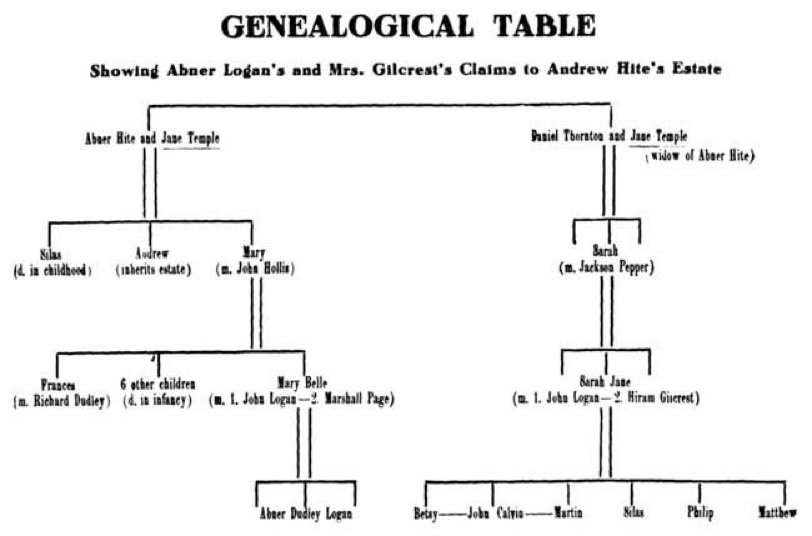
Until he read that letter, Abner had, half unconsciously, clung to the hope that even though his father had been a dastardly villain who had wrecked the happiness of two trusting women, it might still be possible to establish his own legitimacy. Now, even that shadowy hope must be abandoned. "What!" he thought despairingly, "prove my right to wear my father's name at the cost of the fair repute of Betty's mother! Never, never! Rather will I accept the bar sinister for my own escutcheon."
He could bear no more. Thrusting the papers roughly aside, he rushed down the stairs and out into the darkness. Here, throwing himself face downward upon the ground, his hands dug into the sod, he cursed the day upon which he was born. But at last the soft serenity of the starry June night soothed him into a better mood. He arose, and, with a prayer for strength and guidance, re-entered the house.
"My first duty must be to write to Major Gilcrest and Betty," was his first waking thought next morning. "My precious, loving Betty, I must give you up; for even should you, after knowing my history, be willing to marry me, I love you too well to allow one so sweet and pure, so high in worldly position, to link her fate with a base-born earthworm such as I am. O Father in heaven, give me strength to do the right! Uncle Richard must take the necessary steps toward establishing Mrs. Gilcrest in possession of the Hite estates," he concluded after more reflection. "Not that she has any claim under the will, but because she (barring myself) is Andrew Hite's next of kin. However, all this is Uncle Richard's affair, not mine; but I hope the business can be accomplished without revealing to any one that dark page in Jane Gilcrest's early life. Betsy, at any cost, must be spared the knowledge."
Abner wrote to Major Gilcrest, renouncing all claim to Betsy, and enclosing a note for her, which he requested her father to give to her.
After this duty was performed, the young man fell into a state of dull despair which benumbed every faculty. Holmes has said, "A great calamity is as old as the trilobites an hour after it has happened. It stains backward through all the leaves we have turned over in the book of life, before its blot of tears and of blood is dry upon the page we are turning." For weeks after Abner had learned the secret of his birth, it seemed to him that this blighting, blackening misery which had laid low his pride, and killed every hope, permeated, not only all his past, but all his future. He seemed to have been born for nothing else but to experience this agony of loss and shame. He could make no plans. The future stretched out before him a desert waste; for, with the downfall of family pride and the loss of Betty, his ambition likewise had perished.
He was finally aroused by a communication from James Anson Drane. This communication stated that, owing to certain facts which had recently come into the writer's possession, he must decline to act any longer as "Mr. Logan's" agent. These facts, as Mr. Drane wrote, were as follows: The Mary Belle Hollis Page named in the will of the late Colonel Andrew Hite, of Crestlands, Sterling County, Virginia, had died and been buried at the village of Centerton, Virginia, March 9, 1782, nearly two months prior to the execution of the will; she had left no legitimate issue; and, therefore, Sarah Jane Pepper, daughter of Sarah Thornton, and now the wife of Hiram Gilcrest, of Cane Ridge, Bourbon County, Kentucky, was the sole lawful heir to the estates of the said Colonel Andrew Hite, deceased.
Mr. Drane then went on to give an account of the manner of Mary Page's death, and to explain that it was not until immediately after her burial at Centerton that her husband, Marshall Page, accompanied by his brother and sister-in-law and his little stepson, had gone on into Kentucky. Enclosed in Drane's letter was a loose slip of paper containing a copy of the half-effaced inscription upon the oak slab which marked the grave at Centerton. The slip was headed "Copied at Centerton by James Anson Drane, from the slab marking the grave of Mary Belle Hollis Page."
This communication served to awaken Abner from his apathy; for the statement conveyed in it respecting the time and place of Mary Page's death, if not proven false, would tend to very seriously reflect upon the integrity of Richard Dudley, executor of the Hite will, and would probably render him liable to arrest and trial on the charge of being party to a fraud.
Abner was thoroughly convinced that the statement in Drane's letter, concerning Mary's death, was false. He had full confidence in Richard Dudley's clear-sightedness and uprightness. Moreover, his own intuition and his faint recollection of episodes in his own early life made him sure that his mother had died that August night in the stockade fortress of Bryan Station. These dim, tantalizing recollections which had been first partially aroused that November night by Gilcrest's and Rogers' recital of the horrors of the famous Indian uprising of 1782, had been kindled into stronger life by what his uncle had recently told him of the attack upon the cabin of the Pages, the flight to Bryan's, the death there of Mary Page, and the return of her little orphaned boy to his Lawsonville people. But, although his faith in his uncle's honor and in his own intuitions and memories were to himself "confirmation strong as Holy Writ," they would not be accepted as evidence in a court of law. Hence it now behooved him and Dr. Dudley to learn something more of Marshall Page's brother.
Neither Richard nor Rachel Dudley knew anything of the man—not even his Christian name.
"This Page and his wife did not start for Kentucky from Lawsonville," Dr. Dudley said. "They came from Maryland, and joined Marshall and Mary at some appointed place—I do not now recall—on the road, many miles from Lawsonville."
"But when the man returned with me," asked Abner, "did you not then learn his full name, and something of his history?"
"I did not see him," was Dudley's reply. "I was away from home, and he stayed only an hour or so after committing you into your aunt's care. She was too shocked by the tidings he brought and by her pity and care for you, cold, sick, half starved, and bewildered as you were by the long, rough travel, to think of anything else."
"Could it be possible," thought Abner, "that the man deceived the Dudleys in regard to the woman who had died at Bryan's, and that it was his own wife instead of Marshall's? No, that could not be," he concluded; "he could have had no possible motive for the deception. Surely, there must be numbers of persons still living who were in the siege of Bryan Station, or the battle of Blue Licks, and who could not only remember this man's full name, but other circumstances that will be of service to us now. Mason Rogers can, I'm certain, find some person or persons who can give the evidence we need. I will communicate with him; and, in the meanwhile, I will go to Centerton."
Abner returned from Centerton without having gleaned any information that would throw additional light upon the mystery. He was further perplexed that no reply to his letter to Rogers had reached Williamsburg.
"I suppose I will have to go to Cane Ridge for information," he concluded when another month had passed bringing no word from Rogers, "although my soul revolts against revisiting the place of my lost happiness. But go I must, unless I soon hear from Mr. Rogers. I will tell everything to dear Mr. and Mrs. Rogers. They are noble-hearted, discreet and sympathetic, and they will still be my staunch friends. I will also while there make some disposition of my farm—I think I can easily find a buyer or a renter for it. Afterwards, I do not know what I shall do, nor does it matter much, either, what becomes of a nameless, baseborn—no, no!" he broke off, ashamed of his momentary weakness. "I will not let such unworthy sentiments master me. It is unmanly to give way like this, and is a wrong to my noble, unselfish foster mother and father. And even if they were not still left me, I must still be true to myself, and rise above the shameful circumstances which would pull me down. It would not do for me to return permanently to Cane Ridge. It would try my strength too far, to be daily in the neighborhood of my lost darling; nor would it be kind to her and her family for me to do so; and it would be a source of embarrassment and trouble to the Rogers family, and would perhaps estrange them still more from their old neighbors at Oaklands. But I will not hide my head in some far-away, obscure corner where my birth and antecedents are unknown. No! Here is my battleground. Here, where I received the blow which bereft me of my love and my position, will I fight the fight, and attain the victory. I will take up the study of the law, as Uncle Richard always wanted me to do; and I will strive to become useful and honored in my profession. I can nevermore be happy; but I can, and I will, make the name of Logan an honored one, in spite of all."
CHAPTER XXVI.
SPRINGFIELD PRESBYTERY
Against the jealousy and strife which arose after the religious excitement induced by the revival meetings of the previous year, Barton Stone and other ministers lifted up their voices in protest, urging that the bitter discussion of doctrinal points should cease. This only turned the tide of warfare against themselves, and they soon became the objects of bitter invective, because they had ceased to teach speculative theology, and labored instead to show the people a more liberal view of the redemptive plan.
Among the ministers who at this time taught a free salvation offered to all men on the same conditions, was Richard McNemar, a member of the Presbytery of Ohio, which had carried him through a trial for preaching what was deemed to be anti-Calvinistic doctrine. By this presbytery his case was referred to the Synod of Lexington. Stone and three other ministers of the same views, perceiving in this trial of McNemar a blow aimed against themselves, drew up a protest against such proceedings. Then, declaring their freedom from synodical authority, they withdrew from the jurisdiction, but not from the communion, of the organization; although several unsuccessful attempts were made, before the synod convened, to reclaim them in view of their record as able and influential ministers.
In due time the synod met in Lexington, and took up McNemar's case. Stone and the other three ministers presented the protest to the synod through its moderator. A committee was sent to confer and to reason with the protesting ministers. One immediate result of the conference was that Matthew Houston, a member of the committee, became convinced of the justice of the views of Barton Stone and his associates, and became an advocate of their cause.
After prolonged discussion, the synod suspended the five ministers, upon the ground that they had departed from the established creed of their church. The ministers insisted, however, that as they had already protested and withdrawn from the jurisdiction of the synod, that body had no power to suspend them—"no more," to quote Stone's words, "than had the Pope of Rome to suspend Luther after he had done the same thing; for if Luther's suspension was valid, then the entire Protestant succession was out of order, and in that case the synod had no power; so that the act of suspension in this case was utterly void."
The action of the synod created great excitement and much dissension throughout the country, and not only churches, but families, were divided. Many persons, convinced that the turmoil was produced, not by the Bible, but by human, authoritative creeds, were henceforth set against such creeds, as being disturbers of religious liberty and detrimental to Christian unity.
At the first regular appointment at Cane Ridge, after this action of the synod, Barton Stone tendered his resignation of the ministry of that church. It was not accepted, however, for he had, during his six years' ministry, labored to good purpose, and, with the exception of Hiram Gilcrest and Shadrac Landrum, the church-members were all in harmony with their minister.
As soon as the church refused to accept Stone's resignation, Hiram Gilcrest demanded that his name and that of his wife should be stricken from the church books. The church would have granted them letters of dismissal, but these he would not accept. Shadrac Landrum, though equally bitter in his opposition to Stone's teaching, did not, when it came to the test, withdraw from the church. Thus Gilcrest stood alone; and it was a bitter day for the stern and narrow, but conscientious, old man, when he found himself thus deserted by his only ally, and turned adrift from the church of which, until two years before, he had been the most influential member.
Soon after their separation from the Lexington Synod, the five ministers constituted themselves into a separate organization, which they styled "Springfield Presbytery." In a pamphlet entitled "The Apology of the Springfield Presbytery," they stated the cause which had led to the separation from the Lexington body; their objections to confessions of faith of human origin; their abandonment from henceforth of all human authoritative creeds; and their adherence to the Bible alone as the only rule of faith and practice. It has been asserted that this pamphlet was the first public declaration of religious freedom in the western hemisphere, and the first in the world since that of Martin Luther was set at naught by the act of nullification of Augsburg. The pamphlet produced much inquiry throughout the country. It was speedily republished in several other States, and it soon found many adherents among both preachers and laymen of all denominations.
Under the name of "Springfield Presbytery," the ministers who belonged to the organization continued to preach and to plant churches for about one year. Later, perceiving that the name and the organization itself "savored of a party spirit," they, in the words of Barton Stone, "with the man-made creeds threw overboard the man-made name, and took the name 'Christian' as the name given to the disciples by divine appointment first at Antioch."1 "Thus divested of all party name and party creed," continues Barton Stone, "and trusting alone to God and the word of his grace, we became at first a laughing-stock and a byword to the sects around, all prophesying our speedy annihilation.... Yet through much tribulation and opposition we advanced, and churches and preachers were multiplied."
This was the beginning, in the dawn of the nineteenth century, of that great reformatory or restoratory movement, of which another writer says: "The first churches planted and organized since the grand apostacy, with the Bible as the only creed or church book, and the name 'Christian' as the only family name, were organized in Kentucky in the year 1804;"2 and of these churches so planted and organized, Cane Ridge, Bourbon County, was the first.
1 See Appendix, p. 269.
2 John A. Gano.
CHAPTER XXVII.
BETSY DECLINES THE HONOR
For Betsy Gilcrest the year of 1803 dragged along in dreary monotony. All through the radiant freshness of June, the rich glow of July, the intense, white heat of August, and the mellow charm of early autumn the temperature in her veins had been steadily declining; for she had no message from her betrothed.
In June her father had received Abner's letter. Its manly resignation of Betty, and its undertone of hopeless sadness, touched Major Gilcrest; for now that his soul was no longer vexed with apprehension for his daughter's future, his better nature asserted itself, and he felt the most profound pity for the unfortunate youth in his undeserved disgrace. For the time, Major Gilcrest even forgot his suspicions that Abner had been in league with Wilkinson, Sebastian and Powers in any traitorous designs against the Government.
A note for Betsy had been enclosed in the letter to her father. He thought best to withhold this note, lest its tender sadness might have the opposite effect to that which he desired; and, instead of causing her to forget her lover, it might make her cling the more tenaciously to the memory of her lost happiness.
During all these months Major Gilcrest had taken no steps toward establishing his wife's claim to the Hite inheritance; nor had James Drane made any move toward this end, since his letter declining to act as Abner's agent. The reason for this stay of proceedings was due to Mrs. Gilcrest. Her husband, while refraining from entering into full particulars, had told her enough of his hopes and intentions to cause her the greatest apprehension. If this claim was pushed forward openly, she thought, not only must the world learn her real maiden name, and that she had been a widow Logan, but, what was far worse to the weak, timid woman, her husband would learn that she had deceived him all these years about her clandestine marriage, and regarding all the shameful details of her connection with John Logan. She begged and prayed Major Gilcrest to make no claim to the inheritance. They did not need it, and the publicity and comment and surmise that would follow, if he tried to enforce her claim, would kill her, she said. He did not consent at once, but finally, when she became so agitated as to fall really ill, he, fearing that further agitation in her weak condition might prove actually fatal to her, decided to make no public move in the matter, for the present, at least—until her nerves and strength had recovered their usual tone.
Thus time wore on, and each succeeding day as it passed, bringing no tidings to poor Betty, carried hope and love and happiness further from her grasp. Oaklands had never before seemed desolate and drear; and she could not have believed, had she been told, that she could ever look with ungracious eyes upon the stately home of her childhood. She missed the boisterous gayety of her brothers. John Calvin and Martin were students at Cambridge University, Silas and Philip were absent all day at the neighborhood school, and only little Matthew was left at home. None of the family were allowed to attend services at Cane Ridge meeting-house; Betsy was forbidden to hold intercourse with the Rogers family; and she had no heart for any of the little merrymakings of the neighborhood. Her parents urged another visit to Mary Winston, but to this Betsy would not consent; for at the Winstons James Drane would be an almost daily visitor, and Betsy now shared fully her lover's distrust of the young lawyer.
One morning in early October, Betsy, sitting languidly with her sewing in the long side porch, saw Mr. Drane ride up the avenue. She at once gathered up her work and slipped away to her room, where she sat expecting every moment a summons to come down. When an hour had passed, she supposed that the visitor had departed, and she was folding up her work, intending to go for a ramble through the woods—for her chief solace now was to revisit the spot where she, nearly a year before, had plighted her troth—when little Matthew came with a message from her father that she was to come down at once to the parlor. "An' I mussen tum back wid oo, pappy says," added the little fellow; "I'se to doe to Mammy Dilsey an' det my face washed, an' my hair turled, an' a c'ean apawn on."
"Who's there, baby, besides father? and where's mother?"
"Her's dere too, an' Mistah Drane, an' he tissed me, an' say I'se a fine 'ittle man, an' he will tek me a nice wide on his pitty b'ack hawse; so huwy up, sisser, an' tum an' see him, so's we tan doe a-widin'."
When the girl entered the parlor, she saw at once that this was to be a momentous interview. Her mother, dressed in her best silk gown, but looking pale and nervous, was talking to Mr. Drane, who was seated beside her on the sofa; while her father, looking more bland than she had seen him for a long time, was slowly pacing the floor.
Mrs. Gilcrest gave her daughter an appealing, deprecating look as the girl entered, and then sank back on the sofa with her hands twitching nervously. Drane rose at once, and, stepping briskly across the room to meet Betsy, bowed long before her, and then extended his hand. After a moment's hesitation, she gave him hers in return, which he with graceful gallantry carried to his lips. Then, still holding her hand, he led her across the room and placed an arm-chair for her facing her father. After a slight hesitation, Drane was about to leave the room, but Major Gilcrest quietly invited him to remain, whereupon the young man retired to a position in a window-seat.
"My daughter," said Gilcrest, in his most stately manner, "our esteemed young friend has done us the honor of seeking an alliance with this family by a marriage with yourself; and, like the honorable gentleman he is, he has, before addressing you, laid his proposal before your parents. I have desired him to remain in the room that he may hear me tell you that there is no one to whom I would more willingly intrust my daughter's future. You have known him long, and, I dare say, esteem him highly; for he has everything to recommend him to your favor. Your mother and I have given our cordial approval, and we will now leave him to plead his cause with you. Knowing him as I do, and knowing you, I feel sure he will not plead in vain. Come, my dear," he said to his wife, "we will now withdraw."
If Gilcrest by this confident manner thought to overawe his daughter and surprise her into acceptance, he was speedily undeceived.
"Stop, father! Stop, mother!" Betty cried, rising from her chair and facing her father, her lips firmly set, her face pale, determination in every line of her graceful figure. "What I have to say to Mr. Drane must be said in your hearing." Gilcrest, surprised at the firmness of her voice and the determination and dignity of her bearing, stood still, facing her; Mrs. Gilcrest sank limply into the nearest chair. Betsy continued: "I am sensible of the honor Mr. Drane does me in seeking my hand; but I am surprised at his persisting in a suit which he must know is displeasing to me. More than once has he so plainly intimated his intentions that I could not fail to understand, and just as plainly have I intimated that I could not favor his suit. I now, in your presence, say what I have so often hinted to him—that I can never be his wife."
"Tut! tut! girl, have done with these unseemly airs!" said her father, sharply. "You are not capable of judging. Your parents know best what is good for you."
"No, sir," said Betty, firmly, "in this matter which involves my whole future, not even my parents shall choose for me. And you know, too, that my love is given and my troth plighted to another."
"Stop such maudlin raving! Your 'troth plighted'! Tut! you do not know what you are saying; and as for your love, it is but the puling sentimentality of a silly girl, which you will soon outgrow."
"Sir," said Betsy, turning toward the crestfallen young lawyer, "I beg that you leave us. I have given you my answer; it is irrevocable. Though humbly thanking you for the honor you would confer upon me, I can not be your wife."
"No, no! don't go, James. The girl does not know her own mind; but, by heaven, she shall be made to hear reason!" exclaimed Gilcrest, furiously. "Wait, man, I beg of you; I wish to confer further with you. As for you, you undutiful, foolish girl, you may leave the room while I talk with Mr. Drane."
"No," said James, "it will be better for me to leave you now," and, bowing low, he took up his hat and departed.
"But, James, I—we——" stammered Hiram; but the discomfited suitor was out of hearing.
Gilcrest turned angrily to his daughter. "You self-willed, troublesome baggage!" he ejaculated.
"Father," said Betty, quietly, "it is of no use for you to storm in this way. I have always been a dutiful daughter; but in this matter I mean to decide for myself."
"Why don't you speak to her, Jane?" he asked, turning to his wife. "Why do you sit there listless and dumb? Have you no influence over the girl?" But Mrs. Gilcrest was dissolved in tears, and leaned back tremblingly in her chair, saying never a word.
"Is everything going against me?" groaned the old man, pacing the room excitedly. "I'm thwarted and set at naught on every hand—church, neighbors, friends. I'll sell out and go back to Massachusetts. To think that my only daughter!—Truly a man's worst foes are often those of his own household."
"I grieve to cross you, father," answered Betsy, "for you have until lately been fond and indulgent."
Trying to control himself to speak gently, he continued: "Betsy, my daughter, believe me, I know what is best for you. As James Drane's wife, you will be tenderly loved and indulged in every luxury, and have every whim gratified; and I do think that my heartfelt desire in this matter should incline you to at least consider well before you reject a man whom any other girl in the State would be proud to accept."
"Dear father," said Betty, going up to him and laying her hand beseechingly upon his arm, "I can never marry James Anson Drane."
The old man wavered as he saw the tears in his daughter's eyes, and felt the clinging touch of her fingers. "There, there!" he said soothingly, as he tenderly touched her wet cheek, "dry your eyes, dear, and be comforted. It is only your welfare and happiness I seek. We'll say nothing more just now; after awhile you'll see differently; and I predict that before many months have gone by, you will not only be reconciled to marrying James, but will be happy in the shelter of his love, and will thank me for having urged you to accept him."
"Never!" exclaimed Betsy, drawing back defiantly. "I shall never again listen to him, nor to you even, upon this subject. I dislike him exceedingly, and I love Abner Dudley with my whole heart. Marry James Drane! The very thought of such a thing fills me with loathing. I have no confidence in his truth and integrity. I would beg my bread rather than be his wife."
"I'll lock you up!" cried Gilcrest, exasperated beyond bounds, his momentary tenderness completely vanquished by the girl's words. "I'll starve you on bread and water, you insolent, outrageous fool!"
"O Hiram! Hiram! don't!" wailed Mrs. Gilcrest. "Don't be so hard. I can not bear it! Oh, what shall I do! what shall I do!" and she wept and trembled, and wrung her hands, until her husband and her daughter were alarmed.
"This is your work," he said to Betsy, as he bent over his hysterical wife. "You are breaking your mother's heart, you obstinate vixen. Ring the bell for Dilsey, at once. Remain where you are, until I return," he added to Betsy when Aunt Dilsey had obeyed the summons, and was assisting him to carry his wife upstairs.
His anger had cooled somewhat when he returned to the parlor half an hour later. "I can not, of course, force you to marry any one," he said to his daughter; "nor for the present will I urge upon your consideration the suit of Mr. Drane, against whom you have taken so unreasoning and unjust a prejudice; but there's another point upon which I must do my duty without shrinking. I command you to give up thinking of Abner Dudley, now and forever."
"I can give you no such obedience," Betsy replied. "I am his promised wife; but even though loving him as I do, I would give him back his troth, if you could show just and adequate reason why I should. Instead, you give no reason whatever."
"Is not my wish reason enough?" he asked, desiring to spare her the humiliating knowledge of Abner's low birth, and the fact that he had given her back her freedom.
"No, sir, it is not. I am no longer a child, to be made to obey you blindly and unquestioningly."
"Then, if you will insist upon knowing my reasons, you willful girl, you shall be enlightened. Your precious lover has renounced you; and, what is more, he will never show his face in this community again."
"No, no! It can't be true. He is loyal. I will believe in him above all the world. He will return. I know he will," cried Betsy, shrinking and paling, but still strong in her faith.
"But he has renounced you, Betsy, my daughter. He has written me that he must give you up."
"Let me see the letter," said Betsy, still unbelieving.
Gilcrest crossed the hall to his office, and in a few seconds returned with Abner's letter. "I would have spared you this, my child, if possible," her father said as she eagerly seized the letter.
"Oh, what lie is this they have told you, my persecuted, darling Abner?" she exclaimed. "You, my proud, high-minded, noble lover, a bastard! Never, never, never! It's all a vile plot to cheat you of your betrothed wife and your inheritance. Ah! I know whose work this is. It is that smiling, treacherous Judas, James Anson Drane. I feel it, I know it."
"You rave, my miserable, deluded child," Gilcrest said sadly, "but even though you are for the moment well-nigh bereft of reason by the shock of hearing that your lover has given you up, you must not in your bitterness utter so wicked, so utterly unfounded an accusation against an honorable man who loves you truly and would make you his wife."
Nothing her father could say could induce her to believe that Abner was not laboring under some delusion about his being base-born. She could give no reason for this belief, she said; but her own heart and her own instincts told her it was all a mistake, or else a scheme to separate her and her lover. "This will all be cleared up, I feel that it will," she said again and again, "and he will come back to me soon, and without a stain upon his name. I intend to write to him at once, and tell him that though all the world should forsake him, I will still be true to him, and will believe, too, in his right to wear an honorable name."
Her father reasoned and pleaded in vain. He finally lost all patience, and grew angrier than he had ever been with her. "Go to your room, you unreasonable fool," he finally said. "Go! No longer offend my sight by your presence—but listen, first, and remember I will be obeyed. I forbid your writing one line to that base-born vagabond. Further, I forbid your leaving these premises or holding any communication with any one except members of this household, until you pledge me your word of honor to have nothing more to do with Abner Dudley."
"Then, I'm a prisoner for life," answered Betty; "for so long as I live and breathe, I shall love him. I mean to write to him as soon as I can manage to escape your vigilance and tyranny long enough to post a letter to him, and when he comes back to claim me, I will marry him in spite of you and that villain, James Drane."
CHAPTER XXVIII.
AT THE "BLUE HERON"
Upon the evening preceding Abner's contemplated return to Kentucky, to wind up his business there, and to hunt for evidence in regard to the Page brothers, he strolled down to the "Blue Heron," a tavern in an adjacent street. Entering the tavern, he found himself in the midst of rather an exciting scene, occasioned by a bet just made as to the relative height of two men who were standing leaning on the bar. Both men were of unusual height. At a casual glance the younger of the two, a frequenter of the tavern, would appear to be the taller, by reason of his extreme slenderness of build. The older man was a stranger. The two took their places in the center of the room, back to back; and it was then found that the older man was the taller by nearly an inch. Upon being measured, his exact height was ascertained to be six feet, two inches.
"Seems like I've shrunk some sence I wuz a young man," said the old fellow in a jocular tone, as he pocketed the stakes; "for then I measured six foot, two an' a ha'f, in my sock feet. Thar wuz only one feller in our reg'ment taller'n me, an' that wuz John Logan—'long John' we called him to 'stinguish him frum t'other John Logan, who wuz oncommon tall too, but nigh two inch shorter than 'long John.'"
For a moment Abner was unable to utter a word; then, under cover of the noise made by the hilarious group standing at the bar, drinking at the expense of the man who had lost the wager, he drew the old man to one side, and asked, "Were the two John Logans you speak of related?"
"Not thet I knows on, stranger—yes, sence I come to think on it, they wuz said to be cousins. I remember, too, thet they hailed frum the same place—somewhars in Pennsylvany."
"Can you tell me any more about them?" asked Abner, by a mighty effort managing to control his excitement, and to speak calmly.
"I don't know much uv Jack Logan, as the shorter uv the two wuz called," replied the stranger, who gave his name as Sam Butler, "'cept thet he wuz a fine feller, an' a brave soldier who wuz killed on the same day, in the same fight, as long John wuz. They both fell at Monmouth Court-house. But I knew long John well. He wuz my messmate an' marchin' comrid, an' we slept many a night side by side on the ground, under the same blanket, when we wuz fortunit 'nough to hev blankets to kiver us. Why, I wuz by his side when he fell, killed by a bullet through his heart. I drug him offen the field, an' thet night holped bury him in the trench whar we laid so many uv our men whut lost ther lives in thet hot, awful fight."
"Where was he from?"
"He wuz borned in Kenelworth, Pennsylvany; but his folks moved 'round consider'ble. They wuz sort o' sheftless, I should jedge, an' never stayed long in any place."
"Was he married?"
"He hed a wife in Philadelphy, though I hed never hearn him speak uv her. After he wuz dead, I found in one uv his pockets a worn letter, months old, frum her, dated Philadelphy; and I got her word uv his death, though frum her letter I gethered thet they hedn't been gittin' on well together, an' thet she 'peared to think he had misused her, an' keered nothin' fur her. He wuz a reckless, drinkin', high-tempered, rough feller; but, Lordee! how brave, when it come to fightin'! He wuzn't feared o' old Nick hisse'f or eny uv his imps."
"What was his wife's name?"
"Blest ef I kin re-collect, stranger. It's twenty-odd year ago, an' you see, I——"
"Was it Mary?"
"No, I don't think thet wuz it."
"Was it Sarah?"
"Yes, thet's it. Sarah—Sarah Jane, thet's it. I'm pos'tive it wuz Sarah Jane. Did you know eny uv her people?"
"Yes, I think so," Abner replied, "but I'm still more interested in the other John Logan."
"Well, sir, ez I said, I knew nothin' uv him, more'n whut I fust told you; but, stop, Peter Stump wuz his comrid, an' he——"
"Is this Peter Stump living, and, if so, where?" was the next anxious inquiry.
"Why, yes, he's alive an' a-kickin'; leastways, he wuz last Monday three weeks ago, when I seen him at Pockville. He lives two mile south uv thar, on the road to Richmond."
That night our much-tried hero went once more to the old box in the garret, and took from it the miniature of his father, and the letter to Mary, written the night before the battle. With these in his pocket, Abner the next morning went to Pockville. He had no difficulty in finding Peter Stump, and was soon in possession of information which filled him with renewed life and joy. Stump recognized the miniature as that of his messmate, John (or Jack) Logan. Stump remembered the other John Logan, and said that in features and sometimes in expression the two Logans were much alike, but that in complexion and disposition they were utterly dissimilar. Jack Logan was of dark and sallow complexion, had curly black hair, and was about six feet, one inch in height. He was reserved, quiet, sober in his habits, and peaceably inclined. The other John had a ruddy complexion, hair a shade lighter than his cousin's, and a temper so fiery and quarrelsome that he was forever in some broil with his comrades. He was a hard drinker, too, and a gambler. He was nearly two inches taller than Jack Logan, and was the tallest man in the regiment. Jack Logan, up to the beginning of the war, had always lived in Kenelworth, but the other John Logan, although born in Kenelworth, had lived a wandering life. Other facts which Stump revealed explained the message in Jack Logan's last letter to Mary. Stump and Logan had been close friends, and the former had learned from his friend the reason of the hasty marriage. Mary Hollis, at the time, was living with her cousins, two old maidens, who were ardent British sympathizers, and, therefore, did their utmost to prejudice the young girl against her lover, until he, fearing that if his sweetheart remained under the influence of her Tory relatives, she would finally be estranged from him, persuaded her to marry him at once. It was just after the battles of Trenton and Princeton, and Logan, elated by these two victories for the American cause, was inclined, like many other hopeful young patriots, to believe that the war would soon be over. So, although he knew that for the present he must be separated from his bride much of the time, and that he was but poorly able to provide for her, rashly persuaded her to marry him. As the months went by, and the Continental army, instead of achieving fresh victories, was suffering loss and increasing hardship, Logan grew more and more remorseful and unhappy about his young wife and infant son. The night before the battle of Monmouth, he seemed to have a premonition of his fate on the morrow, and was more than ever troubled over the future for his wife and babe. He wrote his wife, asking forgiveness for having persuaded her into the imprudent marriage, promising that if his life was spared, he would try to atone to her for all she had suffered, and begging her in any case to find shelter with her sister until the war would be over. After Logan was killed, Stump had himself managed to convey this letter to Mary at Morristown; but he could only stay a few minutes with her, as his regiment was hurrying eastward. During the Virginia campaign several years later, when Stump's regiment was with Lafayette around Yorktown—about twenty miles from Lawsonville—he had intended to ask for leave of absence, and go to see how it fared with his former comrade's widow; but, hearing that she had married again and removed to Kentucky, he did not go to Lawsonville.
When Abner Logan returned to Williamsburg the day after his conference with Peter Stump, he found a letter from Mason Rogers. Mr. Rogers wrote that he had questioned several men who had been in the fight at Blue Licks and who remembered the Page brothers well. The elder brother was Marshall, the name of the younger was Marcemus. Rogers further wrote that two women who had been in Bryan Station during the siege and who were now living in Fayette County, remembered that Marcemus Page, after his escape from the Indians, had come back to Bryan's for the little orphan boy whom he took to the mother's people in Virginia. These witnesses could swear that it was Marshall Page's wife who had died at the station in August, 1782, while the men were in pursuit of the Indians. Moreover, one of the women remembered that Marcemus Page had told her that he intended, after placing Marshall's little stepson in the care of the boy's Virginia relations, to go on to Maryland. The woman also said that Marcemus had told her that his own wife, who had died that spring on the way into Kentucky, was a native of Maryland, from Charles County.
After hearing what these women said, Rogers, knowing that Barton Stone was a native of Charles County, Maryland, had then gone to see him. Stone, though but a lad when his family had removed from Charles County, remembered the Page family. There were two brothers, Marshall and Marcemus, and Marcemus had married Mary Beale, a cousin of Stone's mother; and soon afterward had left Maryland with his wife to join his brother somewhere in Virginia, intending to go on with him to settle in the backwoods of Kentucky.
After receiving Rogers' letter, Abner Logan lost no time in returning to Kentucky. The day following his arrival at Cane Ridge, he sent Major Gilcrest a note asking for an interview. The messenger brought back the note unopened and the verbal message from Gilcrest declining to hold any intercourse with Abner or to receive any written communication from him.
Rogers then advised communicating with the Major through a lawyer, but Abner felt that he must see Betty before he could decide upon this course. He contrived, through Aunt Dilsey, to convey a note to the girl. She wrote back that she would meet him that afternoon at their former trysting-place. Here, accordingly, the two lovers met, after a separation of over half a year, and renewed their vows of love and fealty.
Abner gave Betsy a full account of everything, and consulted with her as to the best way to communicate with her father; for it was imperative that Major Gilcrest should immediately be made acquainted with Abner's true history and his right to the Hite inheritance. Betsy urged her lover not to place his affairs in the hands of a lawyer until she had first tried what she could do with her father. She also thought that her mother, first of all, should be told everything. To this Abner agreed.
That night Betsy had a long talk with her mother. Poor Mrs. Gilcrest, who for many years had been oppressed by the dark secret of her early life, felt now, when she had learned all that her daughter had to reveal, as if a great burden was lifted from her spirit. She rejoiced not only in the certainty that her own clandestine marriage was valid, and that her cousin had been a lawfully wedded wife, but also because of the knowledge that Abner Logan, whom she had always greatly liked, was the son of her well-beloved cousin and foster sister, Mary Hollis, and that he was in every respect a suitable mate for Betsy.
In her relief and joy she felt that she now had courage to confess all to her husband. The next evening she nerved herself for this ordeal.
Mrs. Gilcrest could not have chosen a less favorable occasion for her purpose; for Major Gilcrest had just learned, through one of the servants, that Betsy had met her lover the afternoon before. He was furiously exasperated that his daughter had thus set at naught his commands; and he raved in so frenzied a style of disobedience, deception, and of the infamy of any girl who would hold clandestine meetings with a man, that poor, cowardly Mrs. Gilcrest's newly acquired valor evaporated before the fire of her husband's wrath, and she dared not confess the secret she had withheld during all their married life. She did, however, intercede for Abner, venturing her conviction that in birth and character he was fit to wed with Betsy. But the poor creature was so cowed by her habitual awe of her lord and master, and by his present irascible temper, as well as by the burden of her own yet unconfessed secret, that the stammering, incoherent tale she told of the two John Logans, of the time and place of Mary Hollis' death, and of Abner's being Andrew Hite's legal heir, was anything but convincing. Her feeble attempt at explanation and intercession, instead of softening the obstinate Major, only wrought him up to a still higher pitch of exasperation.
Mrs. Gilcrest's effort to enlighten her husband having failed, young Logan engaged an attorney, through whom the lord of Oaklands was perforce convinced of Abner's legitimacy and right to the Hite possessions.
But there still remained in the secret drawer of the Major's escritoire those documentary proofs against "A. D.'s" political integrity, and in the Major's mind those convictions of the young man's connection with dangerous Spanish intrigues. More than that, there was the Major's ingrained obstinacy and his aversion to confessing himself in the wrong. So that, although he was not unduly covetous of the Hite inheritance, and although, had he not been so harassed and imbittered by his daughter's defiance, he would have rejoiced that Abner Logan was well born and prosperous, just now he was in a humor the reverse of rejoicing or yielding. Therefore his opposition to Betsy's suitor was as firm as ever; and the two lovers appeared as far as ever from the attainment of their hopes.
CHAPTER XXIX.
AUNT DILSEY TO THE RESCUE
"Send Miss Betsy to me at once," was Gilcrest's order to a negro girl who was sweeping the hall one cold, snowy morning in December, as he strode into the house, whip in hand, clad in overcoat and riding-boots. "Where's your mistress?"
"In the settin'-room, marstah."
"Then send Miss Betsy to me there. Put down that broom, and go at once—move quickly, nigger!" With a grim look he went into the sitting-room, where his wife was dawdling over her tambour frame; and Polly sped up the stairs. In the upper hall she encountered Aunt Dilsey.
"Whut's the mattah, gal?" asked the old negress. "You look lak a rabbit skeered outen a bresh heap."
"Marstah's stompin' an' ragin' 'roun lak a mad bull down thah," panted the girl. "He say teh fotch Miss Betsy to him to oncet in the settin'-room. She's gwine kotch it sho 'nough this time."
"'Deed she hain't, long's her brack mammy's heah teh p'otect her! Marse Hi's losin' his las' grain o' sense; but he bettah min' how he capers 'roun'. He's been pussecutin' thet bressed chile long 'nough—all kaze she's true teh her 'fections, an' woan give in when he say she shan't hev thet nice, rosy-cheek, perlite young gemmin she's begaged to. Ole Dilsey's done kep' still long 'nough; it's time fer her teh lay down de law a bit. I hain't feared o' Marse Hi, ef he does stomp an' rumpage. You heahs me, doan you?"
In this, as in all other large households throughout the Southern States, the "black mammy" was an indispensable part of the family. The real mother usually gave her children careful attention and superintended their training; but she took upon herself little of the drudgery and burden of their upbringing. A subordinate nurse was the children's guardian and companion when they went out for play or exercise, but the "black mammy" ruled over this negro and was the highest authority on all matters pertaining to the nursery. Even the real mother humored this foster mother in the management of the children; and when, as in the case of Mrs. Gilcrest, the mistress was frail of health and unassertive by nature, the black mammy's authority became almost paramount. And such was the nature of Dilsey's authority.
Silas Gilcrest, Hiram's father, had bought Dilsey from a Massachusetts slave-ship when she was a child of twelve years. She was just from Africa, and could not speak a word of English. Silas Gilcrest brought her at once into his own house, where she served first as nurse to the infant Hiram, and later as upper house servant. Her skin was black as ebony, but she was of superior intelligence and of stout and loyal heart. She nursed Hiram Gilcrest in his babyhood, was his caretaker and faithful attendant in boyhood, and his loyal adherent in early manhood. When he married, she went with him from Massachusetts to Virginia, and from there she and her husband and two children accompanied Hiram and his wife to Kentucky.
When Betsy, Hiram's first-born, was laid in old Dilsey's arms, she had just buried her own baby, and all the mother love of her passionate nature went out to this tiny scion of the house of Gilcrest. Thenceforward, the unreasoning, self-sacrificing devotion which in former days Dilsey had lavished upon Hiram was transferred to his daughter.
As time went on, and her cares and responsibilities multiplied with the advent of each new baby to her master and mistress, Mammy Dilsey, though still faithful and devoted, became more and more self-important and dictatorial. She felt herself superior in education and position to the other negroes, and almost, if not quite, as important a part of the household as the master himself. As for Mrs. Gilcrest, Dilsey's regard for her was compounded of admiration and pitying patronage. She loved and tended and ruled over all the children, but Betsy was her idol, for whom she would cheerfully have laid down her own life. Throughout Betsy's disagreement with her father, Dilsey had been her confidant and comforter; and her indignation against her master for the past few months had only thus far been restrained from actual outbreak by Betty's entreating her to be silent, lest by want of tactful patience she might still further provoke the irascible spirit of the master of Oaklands. On this particular morning, however, Aunt Dilsey's spirit was stirred within her, and she felt it high time to assert herself.
When Betsy reached the sitting-room she found her mother crying helplessly and her father fuming up and down the room.
"What do you mean by this, girl?" he asked, flourishing a folded paper in her face. "Did I not command you to have nothing more to do with that worthless fellow? And here you are actually writing to him, and bribing my servants to fetch his letters and to take him your answers! What do you mean?"
"I mean, sir," Betsy answered, facing him bravely, "that I'll not submit to your tyrannical treatment any longer—keeping me a prisoner in these grounds, and forbidding me to hold any communication with the man I love and honor and mean to marry. I have been for weeks under restraint; not even allowed to walk about the yard without a spying black slave at my heels. More than this, two weeks ago you intercepted a letter addressed to me, and you now hold in your hand—without any right whatever—a note of mine to Mr. Logan. What if I did 'stoop to bribe a servant' to carry a message to my lover? That is little in comparison with your keeping me in durance, and intercepting my letters. And you talk to me of 'stooping' and of dishonor!"
"Betsy! Betsy! my dear, my dear!" wailed her mother, "don't use such language. Oh, oh, you and your father are killing me!"
"Mother, mother, have you no feeling for your daughter, that you have said no word to help her in all these months? Are you so under the thrall of that tyrant that you meekly submit without a protest to such treatment of me? Yes," she said, turning to her father, who stood motionless, his eyes blazing, his face white with passion, "you are a tyrant, but I defy you. You shall not break my spirit. I mean to marry Abner Logan as soon as he says the word."
"Be silent, before I strike you!" cried her father, advancing toward her. "Go! Fling yourself into your lover's arms as soon as you please. I wash my hands of you, you willful, passionate hussy!"
"Stop! stop! this instant, Hiram Gilcrest," shrieked his wife, rising from her chair and stamping her foot. Then she rushed to him, caught his arm and actually shook him, crying: "You shall not heap such abuse on my child! I have been silent long enough."
If the portrait of old Silas Gilcrest, hanging above the mantel, had opened its mouth and spoken, father and daughter could not have been more astounded than at this outbreak. In the whole course of her married life this was the first time that Jane Gilcrest had ever asserted herself, or raised her voice against her lord and master. "Yes, you are a brute to use such language and to treat your daughter so! And now, I suppose you'll beat me, next; you look as though you'd like to fell us both to the earth with that whip—oh! oh! oh!" she shrieked, and fell back in a swoon.