CRESTLANDS (continued 3)
Reading edition
Though Barton Stone was, like John, gentle and tender, yet he was also, like Paul, ready at need to wield the double-edged sword of logic and truth to cut down sophistry and combat unbelief. Therefore, to those dominated by sectarianism, as well as to the indifferent and the scoffer, his work was unacceptable; but between the high-water mark of orthodoxy and the low-water mark of willful unbelief, there were many who heard him gladly.
His June appointment at Cane Ridge was an occasion never to be forgotten by those present. Indeed, his sermon that day was well calculated to make the more orthodox members of the congregation writhe in their seats.
He chose as his text the familiar sixteenth verse of the third chapter of John, announcing at the same time that his topics would be God's love as manifested in the gift of his Son; the gospel, the power of God unto salvation; faith, the first requisite, which all who willed might have.
Stone began by portraying, forcibly and tenderly, the love of God, emphasizing the fact that "he willed not that one of his creatures should perish." His love included the whole world, and Christ, instead of being surety for an elect few only, had satisfied the demands of the Father's love by dying for all mankind. Thus "by the righteousness of one the free gift came upon all men unto justification," and Christ, by office, became the Saviour, not of a few only, but of all who would accept him.
He said that the only way to reconcile the two passages of Scripture, John 6:44 and John 12:32, was to believe that the Father recognized no other means of drawing men to him than that of holding up his Son in the gospel; and that, therefore, all who believed on Christ and received the Word were elected to salvation.
Stone next pointed out what he considered to be a marked contrast between the teachings of the Scriptures and that of the Confession of Faith of his church upon this point. He then spoke of regeneration, or the "new birth," and said that the declaration, "born not of corruptible seed, but of incorruptible by the word of God," showed clearly that the Word must first be believed in order to produce this effect; consequently, faith preceded regeneration. Furthermore, this faith was wrought in the heart by no outside or miraculous influence, but was freely given to all who would believe. He explained the passage, "Faith is the gift of God," by saying that the object of faith, "the man, Christ Jesus," is the gift of God.
A strange sermon, indeed, to be preached at that time, to such a people, by an ordained minister of the Presbyterian Church! As he spoke, several of the staunch supporters of orthodoxy shook their heads, and looked frowningly at the daring young preacher. Many recalled an incident of his ordination in that very house three years before. Stone, who had long entertained doubts upon the doctrines of predestination, regeneration and effectual calling, as set forth in the Confession of Faith of his church, had, on the day before the one set for his ordination, called aside two of the pillars of the Transylvania Presbytery, and with characteristic honesty had made known to them his difficulties. After laboring in vain to remove his doubts, the two men asked him how far he was willing to receive the Confession. "So far as I see it to be consistent with the word of God," was the answer, which they declared to be sufficient. No objection was raised to his answer when given before the presbytery the next day, and, after making satisfactory replies to all other questions propounded, he was ordained.
When Stone had finished his discourse, he called upon Gilcrest to lead in prayer. With an angry shake of his head, and a frown upon his stern features, the old man declined. Old Brother Landrum was then asked to pray. In a voice which shook with emotion, he besought pardon for the error in the sermon just heard and enlightenment for the mind of the preacher that he might have a better understanding of the mysteries of the gospel. When he began further to petition that the Lord would in his own good time and way manifest himself to the unconverted elect in the congregation, he was interrupted by David Purviance: "Not to the elect alone, O Lord," he prayed, "but unto all—all within these walls; for thou, O God, art no respecter of persons, and salvation is free, free to all who will accept!"
Notwithstanding the evident disapproval of some of his flock, Stone continued to preach sermons of a like nature. A few who heard him were stunned by his boldness and shocked by his ruthless defiance of the established order of things. Others found his words forcibly convincing. Still another class, though not exactly understanding his reasoning, had so great love for the young preacher and so great confidence in his ability that they were his warm advocates. Of this blindly trustful number, none were stouter in their adherence than Mason Rogers.
To Hiram Gilcrest these sermons seemed the undermining, blowing up and pulverization of the whole structure of sound doctrine. One day, in the course of a discussion with Mason Rogers, Gilcrest angrily maintained not only that the church should take action against their minister, but that his transgressions should be reported at the next meeting of the synod. Rogers, of course, defended Stone. Hot words ensued on both sides, and the friendly relations between the two old neighbors were somewhat strained.
One afternoon Gilcrest, who was so full of the subject of the parson's iniquities that he could think or speak of little else, encountered Dudley, to whom in no measured terms he denounced Stone. Abner would gladly have avoided argument with Gilcrest upon any subject, and especially upon this, which he felt did not concern himself personally; but Gilcrest was not to be evaded.
"You know, Major Gilcrest," said Dudley at last, "that I'm not a church-member, and therefore it is not fitting for me to discuss the question."
"No matter," answered Gilcrest; "you're a man and capable of reasoning, and can surely see the fallacy of this fellow's doctrine."
"But Stone is a personal friend of mine," Abner urged.
"What of that?" asked Hiram. "It's not the man, but his doctrine, that I abhor."
Thus driven to bay, Abner had no alternative but to reply that from what he could learn by his own study of the Bible, Stone seemed to be right. This was literally throwing down the gauntlet to Gilcrest, and the discussion waxed hot and stormy.
"This is a fine way to win the daughter—to be locking horns with the father in theological combat," Dudley soliloquized ruefully as Gilcrest rode off; but he laughed, too, as he thought how little like one "saved by grace" and "sanctified by the Spirit" the old man had appeared as, with frowning brow, loud voice and vehement gesticulation, he had stormed and raved against the offending Stone. "What a fool the old fellow did make of himself," thought Abner; "but not a bigger one than myself, considering all things. 'Never discuss theology with your intended father-in-law,' is a safe maxim for lovers to follow."
Later in the summer, Abner Dudley received from his uncle, Dr. Richard Dudley, of Williamsburg, intelligence of a surprising nature; namely, that an uncle of Abner's mother, Andrew Hite, of Sterling County, Virginia, had died, leaving a will by which Abner was heir to all his worldly possessions.
Richard Dudley urged upon Abner the necessity of coming at once to Virginia in regard to this inheritance. Accordingly, Abner, merely telling the Rogers family that he was summoned to Virginia on important business, set out one August afternoon. He went first to Lexington, and from there on horseback to Limestone. His companions on this horseback ride of sixty-five miles were Judge Benjamin Sebastian and Judge William Murray, against whom Hiram Gilcrest had seen fit to warn him. Nothing, however, of the negotiations and intrigues in which Sebastian and Murray may or may not have been concerned, had at this time been made public; and young Dudley saw no reason why the mere suspicions of so prejudiced a man as Hiram Gilcrest should deter him from accepting the company of two such agreeable men.
Soon after taking the boat at Limestone, Sebastian and Murray told Abner that they intended spending the night at the island home of Harman Blennerhassett, and urged him to do likewise. He readily accepted; for he had heard of this secluded island paradise with its romantic surroundings, beautiful grounds and vast library, and of the gracious hospitality of the scholarly Irish recluse and his charming wife. He found the home and his host and hostess all that had been reported, and greatly enjoyed his little visit. The next day, leaving Sebastian and Murray still guests of the Blennerhassetts, Dudley continued his journey by boat to Pittsburg, and thence by horseback across Virginia to Williamsburg.
CHAPTER XVI.
A SINGULAR WILL
Upon reaching Williamsburg, Abner, of course, examined the will of his late granduncle. It was dated May 2, 1782, when Andrew Hite, being dangerously ill, thought death imminent.
Stripped of all legal verbosities, the purport of the document was that the testator bequeathed all of his earthly possessions, consisting of six hundred and forty acres of land in Henderson County, Kentucky; Crestlands, a Virginia estate of some three hundred acres, and all slaves, cattle, horses, goods and chattels pertaining to this estate, to his niece, Mary Belle Hollis Page, youngest child of Andrew Hite's sister, Mary Hite Hollis—"provided," so read the will, "Mary Belle Hollis Page, wife of Marshall Page, is still living at this date, the second day of May in the year of our Lord one thousand seven hundred and eighty-two. If, however, said Mary Belle Hollis Page, wife of Marshall Page, is already deceased, I, Andrew Thurston Hite, of Crestlands, Sterling County, Virginia, do give and bequeath all my worldly possessions above mentioned to her legitimate offspring, if any. In case my niece, Mary Belle Hollis Page, be already deceased and has left no legitimate offspring, I give and bequeath all houses, lands, slaves, live stock, goods and chattels of whatsoever nature of which I die possessed to my niece, Sarah Jane Pepper, of Chestnut Hall, Caxton County, Virginia, only child of my half-sister, Sarah Melvina Thornton Pepper, deceased."
Dr. Richard Dudley, of Lawsonville, "husband of Frances Hollis, deceased, sister of Mary Belle Hollis Page," was named as sole executor of this will. A codicil dated twenty years later, June 30, 1802, the very day of Andrew Hite's death, stated that all subsequent wills having been rendered null and void by the death of the testator's adopted son, Stephen Balleau Hite, were destroyed, and that the testator, Andrew Thurston Hite, decreed that the will dated May 2, 1782, should be his last will and testament. This codicil also named Richard Dudley, "late of Lawsonville, now of Williamsburg," as sole executor.
Contrary to his own convictions and the dictum of his physicians, Andrew Hite recovered from his illness in 1782, and five years later adopted a lad, Stephen Balleau, and reared him as his son. This Stephen, grown to manhood, but unmarried, was killed in a duel, four months before the death of his adopted father, then an old man of seventy-six years. After Stephen was killed, Andrew Hite seems to have lost all interest in life, and to have neglected making any provision as to the disposal of his property, until the very day of his death. Then, instead of making a new will, he on his deathbed, in the presence of his physician, his old body-servant, and a neighbor, simply added the codicil to the will made twenty years before.
"This strange will still holds good, I presume, eccentric though it be," Abner said to Dr. Dudley, after reading the document.
"Certainly," his uncle replied; "for your mother was undoubtedly living at the date specified in the will."
"Yes," Abner said, "that can be established by your testimony, which is corroborated by the inscription on her tombstone at Lawsonville and by the record in your family Bible—both of which give the date of her death as that of August 21, 1782, three months after the will was written."
"And," added the doctor, "even should the will not stand, you, the only child of your mother, are justly entitled to this bequest; for all that Andrew Hite possessed, save that Kentucky land which he in my presence promised your mother at his death, came through his father, your great-grandfather, Abner Hite; and Sarah Jane Pepper is connected only through her mother, Andrew Hite's half-sister, Sarah Thornton, who was not a descendant of old Abner Hite. Therefore, you need have no uneasiness on the score of either the justness or the validity of your claim; and you should at once take steps to put you in possession of your legacy."
"That I shall certainly do," said Abner; "and I shall do so, not as Abner Dudley, but as Abner Dudley Logan. In fact, Uncle Richard, aside from all question of this bequest, I had already determined to assume my full name; for, much as I honor you who have been a second father to me, I think it but justice to my own father's memory, now that I have arrived at man's estate, that I should wear his name. You know I wished to do so before I went to Kentucky; but you were so averse to the idea that I yielded for the time, contrary to my convictions of justice to my father's memory and against my own preference. But now I am fully resolved to be known in future by my full name, Abner Dudley Logan."
Dr. Dudley sat silent with downcast eyes, a gloomy, perplexed look upon his face; and his nephew went on:
"Uncle Richard, I wish you would tell me more about my father and about my mother's early life. You have always been singularly reticent on the subject. Why! I was a boy of eleven or twelve before I even knew that my real name was Logan, and then I discovered it by accident; and it was not until I read this will of Uncle Hite's that I learned that my mother had married a second time. The time has now come, I think, when you should tell me all that you know of my father and mother."
"Of your father," said Richard slowly, and, it seemed to Abner, reluctantly, "I know little more than the facts already in your possession. Briefly told, your mother's history is this: Her mother, Mary Hite, married John Hollis, of Plainfield, New Jersey. To this union were born eight children, of whom your Aunt Frances, my first wife, was the eldest, and your mother, the youngest. The six children intervening died in early childhood. Your grandfather, John Hollis, died when your mother was two months old, and his wife survived him but one month. Her half-sister, Sarah Thornton, who had just been married to Jackson Pepper, of Chestnut Hall in northern Virginia—a widower with one son—took your mother to raise as her own child. This Sarah Thornton Pepper died ten years later. She had but one child, Sarah Jane Pepper. Your mother, after her aunt's death, still lived at Chestnut Hall until she was about sixteen. Then she greatly offended Jackson Pepper by refusing to be betrothed to Fletcher Pepper, the son of Jackson's former marriage. Her home was rendered so unpleasant by Jackson Pepper's anger and Fletcher's persistence in his suit, that she went to live at Crestlands with her old bachelor uncle, Andrew Hite, until a few years later—in 1775, I think—when he went with a party of adventurers to Kentucky. He expected to be gone a year, and, before setting forth, he took your mother to Morristown, New Jersey, to find a temporary home with some of her Hollis connections, two maiden ladies, her father's cousins. When, however, Andrew Hite returned to Virginia, he, instead of recalling his niece and settling down with her at Crestlands, joined the Continental army. So your mother continued with her distant relatives at Morristown until the winter of 1776-77. After the battles at Trenton and Princeton, Washington's army, as you know, went into winter quarters at Morristown. In this army was a young soldier, John Logan. He and your mother met and immediately fell in love with each other; and in March, after an acquaintance of only five weeks, they were married. It was an ill-advised, imprudent marriage. Mary had nothing of her own, nor had John Logan; and, besides, he must necessarily be away from his young wife a great deal, and leave her unprotected and illy provided for while he was encountering the dangers and hardships of a soldier's life. Mary's relatives at Morristown were bitterly offended because of her marriage to a man of whose antecedents she knew nothing, and who was poor, and, still worse, a hated Continental soldier, for they were strong Tory sympathizers. They would have nothing whatever to do with Mary after her marriage. In the spring, when Washington left his winter quarters, Logan, of course, went with the army, and his wife was left alone at Morristown with a poor old couple of whom your father had rented lodgings. After the departure of the troops from Morristown, Logan very rarely could find opportunity to visit his wife, nor could he make adequate provision for her comfort. You were born there in the home of the old couple at Morristown, February 25, 1778. There your mother continued to live until after your father fell in the battle of Monmouth Court-house in June, 1778. Then she made her way with you, her four-months-old babe, back to your Aunt Frances and me. She lived with us until after the death of your Aunt Frances in March, 1781. Then that fall, and about five months before my marriage to Rachel Sneed, your mother was married to Marshall Page, and both she and he died the following August."
"What of this Marshall Page, my stepfather?" asked Abner. "Where was he from? Was he a man calculated to make my mother happy?"
"He was a brave, honest, hard-working fellow," acknowledged Richard, "from Maryland; but he had only a limited education, and had not been gently reared. I was not well pleased with the marriage; and had your Aunt Frances lived, I do not think Mary would have married him. But as I was a widower, and no blood relation to your mother, my house was hardly any longer a suitable refuge for her and her babe. When she and Marshall Page died the following summer, we—my second wife, Rachel, and I—took you as our own. It was your mother's dying request that you should, if possible, be spared all knowledge of her sad history, and be reared as our own child."
"Nobly have you and Aunt Rachel tried to fulfill that dying request!" said the young man in a choked voice and with tears in his eyes, as he arose and threw his arm across his uncle's shoulder.
"And nobly have you repaid our love and care, my boy," the older man answered huskily. "You have given us filial love and obedience, and have never crossed our wishes in anything, except when you persisted in going off to Kentucky, instead of staying here and becoming a lawyer. But there! there! you were right, I dare say. You had no liking for a legal profession, and that new country across the mountains is a better place than this old, aristocratic State for a young, energetic fellow who has nothing but his native ability and a good education to assist him forward. So enough of these saddening recollections," he added in a more cheerful tone, rising briskly and crossing the room to a table whereon were scattered various papers. "Now for the business pertaining to this fine fellow, Abner Dudley Logan, as he must be called in future, I suppose, and who has just come into a rich inheritance."
"Of which inheritance," said Abner, joining his uncle at the table and picking up one of the papers, "the most valuable part, I'm inclined to think, will prove to be this Kentucky land. As for this Virginian estate, I fear from what you tell me that I can realize very little from it."
"That is true," agreed Richard. "Owing to the recklessness and prodigality of Stephen Hite, and the neglect and mismanagement of Col. Andrew Hite during the last ten years of his life, the estate is well-nigh worthless. Besides being heavily mortgaged, the land is worn, and the grand old brick mansion built over a hundred years ago by your great-grandfather, Abner Hite, is sadly out of repair—in fact, is almost in ruins."
"'Lord of Crestlands, an ancestral estate in the proud old dominion of Virginia,' sounds rich and grand," laughed Abner; "but is only as 'sounding brass and tinkling cymbals,' after all, without money to lift mortgages and to repair the breaches made by the prodigality and carelessness of my predecessors. And, uncle, how about the negroes I am to inherit?" taking up the copy of the will, and reading therefrom, "'I give and bequeath all houses, lands, slaves, live stock, goods and chattels of whatsoever nature of which I die possessed, etc.' How many of these dusky retainers are there remaining in my ancestral halls?"
"Only three," the doctor answered, "out of the troops of slaves which Andrew Hite owned twenty years ago. The others, I find, have been sold from time to time, to pay the gambling debts and for the other vicious habits of the precious Stephen, I presume. And of the three negroes still left, two are old and decrepit, which leaves but one of marketable value. But, Abner, my boy," jokingly added Dr. Dudley, "when you have realized a fortune out of that Henderson County land which you think so valuable, you can use this wealth to lift mortgages and to rebuild this home of your forefathers; so that you will be, after all, 'lord of Crestlands,' the ancestral home of the family."
"That plan doesn't appeal to me," said the young man, stoutly. "For one thing, I do not consider Crestlands as my ancestral estate. My Grandmother Hite lived there only until her marriage, and neither Hollises nor Logans had part or lot in it. No, my ancestral halls shall be of my own rearing," he said promptly. "I intend indeed to be one day known as 'Logan of Crestlands;' but not of that ramshackle old manor house in southeastern Virginia, but of a new Crestlands in that transmontine paradise, Kentucky. Crestlands!" he said musingly. "Yes, I like the name. It has a pleasing sound, and I mean that in its symbolical sense it shall be appropriate; for I intend that life in this home I shall found shall be one of purity, truth, love, and high ideals."
"And from the light in your eyes, and that hopeful, exultant smile, I suspect," said Uncle Richard, "that you have found the fair damsel who is to reign queen of this goodly domain, this new Crestlands. Is it not so?"
"I see visions and dream dreams of such a consummation," acknowledged the young man, flushing warmly; "but at present I am on probation with this lady fair. I shall know my fate when I return in November for her verdict. But, uncle, whatever my hopes in that direction, there's another hope almost equally dear—that my loving foster parents should share my prosperity. Leave this old home which must be lonely to you and Aunt Rachel now that I am gone and your daughters both married and gone from the home nest. You have toiled hard, and have borne the burden and heat of the day, and now in your declining years I would have your life all ease and sunshine. Come to me, and share my new home. I promise you comfort, cheer and happiness. Will you not come?"
"No, my boy," answered his uncle. "'Ephraim is joined to his idols.' I am too old to transplant to a new soil, however vigorous and genial it may be; and your Aunt Rachel would never consent to go so far from her daughters and their children. But some day, when that saucy, black-eyed siren (I'm certain she is saucy and black-eyed) shall have come to reign as mistress of your hearth and home, I'll cross the mountains, old as I am, to spend a few months with you. But all this is far in the future, and we have too much business still to transact before we can hope to get you thoroughly established in your rights, to plan so far ahead."
"As to this Kentucky land, Uncle Richard," said Abner, presently, "when and how did Uncle Hite acquire it?"
"Back in 1775, I believe, when he went out there on that exploring trip. Under the provisions of the 'Henderson grant' made that same year, Andrew Hite purchased, as I see from these papers, a tract of four hundred acres in that part of the Green River valley now known as Henderson County. But, instead of remaining in Kentucky and settling on his land, he returned to this State and joined the army. Now, this 'Henderson grant' was annulled in 1778 by the Virginia Assembly, but the next year, when the war burdens were beginning to press heavily on the country, the Assembly enacted a new land law which, besides arranging for the sale of lands in her western territory, also offered as military bounty tracts of these western lands to her soldiers. So, Hite, then a colonel in the Continental army, applied for and received from the State of Virginia this same land he had purchased under the old Henderson grant, and sixty acres adjoining. His title, therefore, was made doubly secure, and he seems to have been little troubled, as so many others were, by rival claimants. He was wounded in the battle of King's Mountain, and after his wound had healed, before rejoining the army, he managed to make another short visit to Kentucky. Upon his return, on his way to join Lafayette at Yorktown just before Cornwallis' surrender, Hite stopped at Lawsonville. It was soon after your Aunt Frances died, and when your mother was on the eve of marrying Marshall Page. After the war, Hite went to France, where he found this waif, Stephen Balleau, and brought him home as his adopted son, a year or so later. That is all I know about Andrew Hite. After that flying visit to Lawsonville I never saw him, nor heard anything more directly of him, until I was notified last May of his death, and asked to be present at the reading of his will.
"This paper shows me," said Abner after a pause, "that Uncle Hite placed the management of his Kentucky affairs in the hands of an attorney, Anson Drane. Now, I know a young lawyer of Lexington named James Anson Drane. It must be the son of this old attorney."
"Yes," said Dr. Dudley, handing his nephew another document, "and from this paper you will find that this son, your James Anson Drane, was employed after the death of the father to act as Hite's factor. So your first step, when you return, will, of course, be to communicate with this young Drane."
CHAPTER XVII.
AT CANE RIDGE AGAIN
Abner returned to Kentucky early in October. At Pittsburg, on his return journey, he had again fallen in with Judge Sebastian, who intrusted him with a packet containing a sum of money, and with a package of books, requesting him to deliver them to Judge Innes. Arriving at Lexington, he delivered the money and books, and then went on to Cane Ridge, reaching Mason Rogers' about nightfall.
The next morning he set out for his farm, intending, after he had looked after affairs there, to ride on to Bourbonton to post a letter, as it was the day on which the once-a-week mail-coach passed through the village.
Over three months had elapsed since he had seen Betsy Gilcrest; and although he meant to obey her hint and wait until November to renew his suit, he felt that there was no prohibition against his seeing her. Accordingly, he purposed to return from Bourbonton by way of Oaklands.
On the way to the farm he met James Drane. Abner had not made known to the Rogers family the nature of the business which had called him to Virginia, nor did he now say anything to the lawyer about consulting him professionally; for he had resolved that Betsy should be the first to be told of his good fortune. Drane, after congratulating Abner upon his safe return, and expressing an intention of calling soon to learn the particulars of the visit to Virginia, added that he must now hasten forward, as he had business to transact at Bourbonton. Whereupon, Abner, thinking to save himself a ride to the village, handed him the letter to post, and then went on towards his farm.
As soon as Abner was out of sight, Drane took the letter from his pocket. When he saw its address, Judge Benjamin Sebastian, he uttered an ejaculation of surprise and pleasure. He rode on slowly for a time, in deep thought, then turned and galloped rapidly towards Oaklands. In a field adjoining the road was Hiram Gilcrest, superintending some negroes gathering corn. Drane, riding up to the fence, hailed Gilcrest, who advanced to meet him. Drane then took the letter from his pocket, and, showing its address, said, "You see, Major, my suspicions regarding your neighbor are well founded."
"Has Dudley returned?" asked Gilcrest in some surprise.
"Yes, last evening. He passed through Lexington yesterday. While there he doubtless gathered important information from others of the band, and this morning he asked me to post this letter, which, of course, transmits this information to Sebastian."
After some further conversation, Drane exacted a pledge from Gilcrest of absolute secrecy in regard to the letter, and, declining an invitation to dine at Oaklands, rode away.
Much to Abner's chagrin, he found, on arriving at Oaklands an hour after the interview between Drane and Gilcrest, that Betsy was on a visit to her friend, Mary Winston, who lived near Lexington. Mrs. Gilcrest, however, was unusually animated, and evinced great interest in his recent journey, and questioned him about people and places, changes and fashions in Virginia. Yet Abner could not but notice the lack of cordiality in Major Gilcrest. Thinking this due to recollection of the discussion just before the trip to Virginia, Abner tried to avoid all topics even remotely approaching church matters. He described his visit to Blennerhassett Island. Gilcrest, becoming interested, melted perceptibly, for a time; but when the young man, in the course of his narrative, mentioned the names of his two traveling companions from Lexington to Blennerhassett Island, Gilcrest's manner not only lost its lately recovered geniality, but became harder and more frigid than ever.
After striving vainly to bring his host back to a more pleasant mood, Abner felt that he could not, in the face of Gilcrest's increasing sternness and coldness, prolong the visit. Although it was raining heavily, he declined Mrs. Gilcrest's timid invitation to remain to dinner, and left a little before noon. As he rode home through the rain he thought over every trifling incident of his hour at Oaklands. He recalled every topic of conversation, without finding a clue to the enigma. "He's harking back to my old transgression in upholding Stone," was his conclusion. "Interest in the account of my journey did for a time beguile him into forgetfulness of my offense, but his mind at last reverted to it; hence his return to the Frigid Zone. It was a regular freeze-out toward the end. If he were not Betty's father, I'd have nothing more to do with him. But what a fool I was to discuss theological matters with him in the first place! After all, this church trouble is no affair of mine, and Stone did not need my advocacy; he's quite able, single-handed, to play St. George to the dragon of sectarianism that trails its length through this region. A pretty time I'll have now, trying to reinstate myself in the old gentleman's good graces! I hope to heaven something will happen to call him out of the way the first of November; for see Betty then I will, no matter what happens."
When James Drane, after his talk with Gilcrest, reached the main thoroughfare, instead of choosing the turning towards Bourbonton, he took the opposite course towards Lexington. As soon as he was in his office, and had barred his door, he carefully cut around the seal of Abner's letter. It contained merely a few lines stating that the money and books had been delivered to Innes.
"The devil take it!" he ejaculated. "This shows nothing as to whether Sebastian and Murray took advantage of their opportunity to sound the schoolmaster; and I now very much doubt if the self-sufficient young prig can be drawn into our schemes. However, showing the address to Gilcrest this morning did my own personal cause a good turn. Now, how to follow up this advantage? I wonder if I could counterfeit Sebastian's peculiar chirography." From an inner locked drawer of his escritoire he took a small metal box, and from a number of papers contained therein he selected a letter which he examined closely.
"No use to try imitation, when the original document will serve my purpose as well or better," he finally concluded. "The initials fit perfectly; and, thanks to Sebastian's cunning and to our cipher code, this letter is so obscurely worded that Gilcrest can gain from it no knowledge of our plans. But I'll have to wait some time yet in order to tell him a plausible tale. In the meanwhile, it would be well to try my skill at counterfeiting Dudley's writing. His precise, schoolmasterly hand would surely be easier to imitate than Sebastian's queer, crabbed characters, and there's no telling how or when my skill may be of use to me. But how to get more material to work upon? This short note to Sebastian isn't enough. Couldn't I get Dudley to copy some law papers for me?" He rose and paced the floor in deep thought. Finally he succeeded in elaborating a plan which would suit his purpose.
CHAPTER XVIII.
DRANE PRACTICES PENMANSHIP
One morning in October, Drane, who at this time seemed to have business demanding his frequent presence at Cane Ridge, passed by the Rogers' homestead just as Abner was coming from the house. The two conversed for a time at the stile, then Drane, as he was preparing to ride on, asked, "Any commissions I can execute for you in town, Dudley?"
"No," Abner replied, "I believe not; I was in Lexington myself Thursday. But stay," he added, "you may post a letter, if you will be so kind. Wait a minute," and he ran to the house and soon returned with a letter which he handed Drane.
This missive, which the lawyer opened as soon as he was in the privacy of his room, was addressed to Chas. M. Brady, Williamsburg, Virginia, and read as follows:
Cane Ridge, Oct. the 5, 1802.
Honored Sir;—I was in Lexington again on Thursday; saw Morrison, and del'v'd y'r enclosure containing recommendations, etc. But just now, owing to the absence of two of the trustees, John Meeks and Israel Power, I can accomplish nothing. Judge Barr favors y'r appointment, but he is so handicapped that he can do very little. I learn from a trustworthy informant that Ezra Spaiter, of Milledgeville, is also an applicant for this professorship. Therefore, it would not be advisable to open negotiations with Ingraham, for I know that he is strongly in favor of Spaiter. Nor do I think it would be well to make application through Brown, who, I learn, contemplates withdrawing altogether from the University. Consequently, I advise that you make no further move in this matter until you are apprised of Power's return. I will see him and Tarr as soon as possible; and you may rest assured that I will do all I can for you.
Y'r ob't, humble serv't to command,
Abner Dudley Logan. To Charles M. Brady,
Williamsburg, Va.
"Now, what does this mean?" Drane thought as he saw the full signature, Abner Dudley Logan. "Has the fellow been adopting an alias? I must investigate this matter. But meanwhile I've another task before me," and he spread the letter before him on the table, drew forth writing materials, and set to work. The next evening and the next found him similarly engaged, until by dint of repeated effort and close observation, aided by natural aptitude for such work, he produced a fair counterfeit of Abner's writing. While thus engaged, another scheme presented itself to his fertile brain. To carry out this scheme, he first made a copy of the letter to Brady. The wording was the same as that of the original, and the penmanship so good an imitation that only a suspicious and close observer could detect the difference.
"As this Brady is far away, and probably not so well acquainted with the schoolmaster's fist as Gilcrest is, it will be safer to send my copy to him," Drane decided, "and manipulate the original for the Major's benefit. If this, in conjunction with that other document I shall show at the same time, doesn't put an end to that upstart's chances with Gilcrest's daughter, I'm much out of my reckoning. Ah, Betty! bewitching, tormenting Betty! I'll have you yet in spite of your stand-off airs and half-veiled scorn of James Anson Drane."
The next afternoon found this unscrupulous plotter closeted with Major Gilcrest in the pleasant library at Oaklands.
First pledging Gilcrest to absolute secrecy, Drane submitted a letter beginning with the address, "Dear A. D.," and signed with the initials "B. S." Much of the letter was couched in language so obscure as to bear no precise meaning without a verbal interpretation which, the letter stated, would be given by the bearer, S. Swartwourt, to whom "A. D." was referred. The letter alluded to the confidence the writer had hitherto placed in "A. D.," and to the former correspondence between them. It also mentioned an enclosure from "Gen. W.," written in cipher, to which cipher "B. S." stated "A. D." had a key. "B. S." ended his letter with the request that the enclosure from "W." be shown to Messrs. "M." and "A.," and then promptly forwarded to "T. P."
Before showing this communication from "B. S." Drane had torn off that part which bore the date, "May 2, 1802," and at the bottom of the page had added in a fair likeness of the handwriting of "B. S.," the date, "Oct. 12, 1802."
It will be remembered that at this period there was a renewal of the old rumors in regard to Spanish intrigues, and that Gilcrest on April court day had seen Abner in what had appeared to be a confidential conversation with Wilkinson, Sebastian and Murray; and also that Abner, when calling at Oaklands after his return from Virginia, had mentioned traveling in the company of Sebastian and Murray and stopping with them at Blennerhassett Island. Moreover, early in the year, Gilcrest, through his friend, Dr. Bullock, of Louisville, had been apprised of a conspiracy in which Thomas Power, a Spanish emissary, and the three prominent Kentuckians, Wilkinson, Sebastian and Murray, were suspected of being involved. So great was Gilcrest's infatuation for Drane, he had violated his promise made to Bullock, and had hinted of these intrigues to Drane, who thus had much material to work upon in his attempt to prejudice Gilcrest against Betsy's lover.
"How in the world did this paper fall into your hands?" was Gilcrest's first query, after examining the communication of "B. S."
"Wait," Drane answered, "until you have seen this," placing before the old gentleman the following torn and crumpled fragment:
Can
Honored Sir:—I was in Lexington again and del'v'd y'r enclosure containing reco owing to the absence of two of the Power, I can accomplish nothing. Jud but he is so handicapped that he ca a trustworthy informant that Ez also an applicant for this pro be advisable to open negotiation he is strongly in favor of Spai well to make application through B withdrawing altogether from the Uni that you make no further move in th ed of Power's return. I will see him and you may rest assured that I will
Y'r ob't, humble serv't to
Abner Dudley
After this, too, had been examined, Drane explained. A short while before, he said, he was returning from a ride to Frankfort, and as he was on the road just by the woodland pasture belonging to Mason Rogers, had dismounted to dislodge a stone from his horse's foot. As he was preparing to remount, he spied a folded paper peeping out from some underbrush on the roadside. He had examined it. It was this enigmatical letter from "B. S." to "A. D." "I had my strong suspicions," Drane continued, "as to the identity of both writer and recipient; but, of course, not being sure that the document belonged to Abner Dudley, I did not think it wise to give it to him. Furthermore, it seemed that in view of what you had revealed to me in regard to certain malignant conspiracies with the Spanish Government, it behooved me to be cautious. It was too late in the day to see you; so I returned home, resolving that at the first opportunity I'd advise with you. The very day after finding that letter, last Thursday afternoon, Dudley rushed into my office and asked for writing materials. I furnished what he required, and he sat at my desk to write. He made several attempts and ruined several sheets of paper, which he tore up and tossed into the fire—all save this scrap," indicating the fragment shown above, "which lay on the floor under the desk and escaped his notice. He finally wrote a letter to suit him. This he sealed and directed, and then, saying a messenger was waiting, he thanked me hurriedly and rushed out. I have little doubt that this messenger was the 'S. Swartwourt' mentioned in 'B. S.'s' letter; for Swartwourt was in town that Thursday. I had seen him at noon at the tavern in close converse with William Murray, Isaac Adamson (in all likelihood, the Messrs. 'M.' and 'A.' of 'B. S.'s' letter), and Abner Dudley, who is as certainly 'A. D.' as 'B. S.' is Benjamin Sebastian; and that torn fragment before you is that shameless young hypocrite's answer to Sebastian's letter of October 12."
"You are undoubtedly correct in your surmises," said Gilcrest when Drane had finished. "The 'Power' referred to in this torn piece, and the 'T. P.' referred to in the letter signed 'B. S.,' both mean that vile and most dangerous diplomat, Thomas Power; and, see, Dudley mentions 'the enclosure,' too, which he had probably shown to Murray and Adamson, and then forwarded to Thomas Power. Notice, too, the expression in Dudley's letter, 'he is strongly in favor of Spai'—meaning, of course, Spain; and also this line, 'withdrawing altogether from the Uni', which last word, with its missing letters supplied, would be Union. Why, man, this is a most dangerous conspiracy against the Federal Government! We must be very wary indeed, if we would succeed in bringing the whole matter to light. But how careless of Dudley," he continued after a moment, "to lose that letter by the roadside! It is unlike his usual caution, and certainly not in keeping with the diabolical cunning and consummate skill with which the movers in this plot appear to be working. However, as the enclosure was already forwarded, and as the letter itself without the verbal interpretation is so obscure as to have no real meaning for one not in the scheme, I presume Dudley was not as cautious as he would have been had he dreamed that any one in this neighborhood had an inkling of these nefarious plots they are concocting."
After some further consultation and further pledges between Drane and Gilcrest as to caution and silence, the former prepared to leave.
"No, James," said Gilcrest, when the lawyer reached out to get the two documents, "you are impetuous and rather thoughtless; and besides, you are frequently away from home; so I had better take these papers into my charge for safe-keeping. You'll be showing them to some one, or, rather, somebody may get at them while you are out of town, and——"
"But, Major Gilcrest," remonstrated Drane, secretly much frightened at this unexpected move on the part of his confidant, "I—I found them, and they belong to me. I assure you they will be perfectly secure with me, and—and—I——"
"But they'll be safer with me," persisted Gilcrest.
James argued and remonstrated as much as he dared without endangering by overeagerness his own nefarious little plot; but he could not shake the old gentleman's purpose, and at last he had to depart, thoroughly discomfited. Much enraged he was, too, as he rode homeward, and fully determined, as he said, "to regain possession of those two documents, in spite of that blamed, stubborn old blockhead, Hiram Gilcrest."
CHAPTER XIX.
THE BETROTHAL
"For I'll believe I have his heart, As much as he has mine."
Betsy came home the last week in October. Even her mother, the least observant of women, noticed her daughter's unusual silence and restlessness for the first few days after her return, and, attributing it to loneliness, wished Betty had brought Mary Winston home with her for a visit.
"Rantin' 'roun' 'mong fine folks doan seem to 'gree wid you, honey," old Aunt Dilsey said one morning when she found Betsy in the parlor, her hands folded listlessly on the unheeded sewing in her lap, as she gazed dreamily before her. "You'se all onsettled sence you'se come home. Things would go tah rack an' ruin heah, wid yo' ma allus ailin', an' you so no-'count, ef 'twan't fur ole Dilsey tah keep dese lazy niggahs frum gwinetah sleep en thah tracks. I usetah think you'd be a he'p an' a comfo't to yo' old brack mammy, an' turn out ez fine a man'ger an' housekeepah ez Miss Abby; but you hain't been yo'se'f sence thet camp-meetin'. I 'lowed et fust 'twuz too much 'ligion wuckin' in you, an' thought it would bring you all right to go to Miss Mary Winston's fine place; but you'se come back wussen evah. You hain't gwinetah be sick, is you, chile? One minit you looks lak thah warn't a drap o' blood in yo' body, then suddent lak, you flash up an' look so narvous an' so excited thet I fears you'se tekin' the fevahs."
"No, mammy, I'm not the least sick. Nothing ails me, except that I feel the change a little from the gay times I've been having at Maybrook. I'll be all right presently."
Soon after dinner upon the first day of November, Betsy, evading Aunt Dilsey's watchful eyes, called Jock, the old house-dog who was dozing in the south porch, and set off for a ramble. The balmy air and the brisk walk refreshed her, and by the time she reached the bars separating the upper from the lower woods, she felt lighter hearted than she had for a long time. Her eyes glowed with exercise, a bright tinge showed in her cheeks, and her red cloak and brown quilted bonnet lined with crimson made a warm bit of color in the landscape, and blended harmoniously with the rich shades of the trees. Nature was steeped in that tender, dreamy haze peculiar to Indian Summer, and the air held a pleasing odor like that of burning leaves. The songbirds had gone away to winter homes in the South, and the stillness of the forest was broken only by the dropping of nuts from the hickory-trees.
"The first day of November!" she thought, as she stood leaning on the bars, with old Jock lying at her feet. "I wonder how soon he will come," and she smiled tenderly. "Not to-day or to-morrow, I know; for he has gone to Lexington again, so Susan said, and will not be back until the last of the week. It has been four months since I saw him. Perhaps I should not have kept him so long in suspense, but a girl should not be too easily won, and he must never know how nearly I came to complete surrender when he rode by my side that May day. How hard it was to resist the pleading tenderness of his eyes! Oh, Abner, Abner! how I love you!" she murmured, leaning her head upon the bars.
Approaching footsteps made no noise on the carpeting of leaves and moss in the pathway over which she had come; and Betty, absorbed in her love and yearning, did not look up, even when Jock gave a joyous bark of welcome to the young man standing behind her.
"I have come for my answer, Betty."
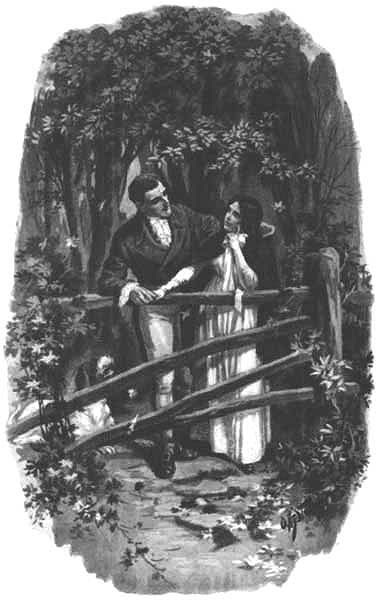
"I have come for my answer, Betty," he said, laying his hand over hers clasped on the topmost bar.
Her eyes lit up with gladness as she raised her face, suffused with crimson, toward him; but she uttered no word of welcome.
"You surely expected me," he said; "you did not think I'd wait one hour beyond the time, did you? Ah, sweetheart, did you but know what a torment of suspense and longing these last six months have been, you'd—— But now it's November, your favorite month, you said, because Thanksgiving comes in it. So now, my darling, say the word that alone can give me a thankful heart. You'll listen to me now, won't you, dear?" he asked of her as she still stood in trembling silence.
"I suppose I must, sir," she said, dimpling and blushing, with a saucy toss of her head. "I can't very well stop my ears, seeing that you have imprisoned both hands. Oh, don't! don't! I haven't pledged myself yet," she stammered, as he, raising her hands, drew them around his neck, folded her in his arms, and kissed her brow. Then, still holding her closely in one arm, with the other he turned her face to meet his, murmuring, "Not just your forehead, sweetness—O sweetheart! darling! wife!" as his lips closed over hers in a clinging kiss. "It is thus I take my pledge. You are mine, mine, you bewildering, tormenting Betty."
"No! no!" she protested stammeringly, as she struggled to free herself. "Oh, you're too—too—you hold me so close! You lose count of time and season, sir," she added presently with an attempt at playfulness, and trying to assume an ease and nonchalance she was far from feeling. "This is November, remember—solemn, quiet Thanksgiving time. The summer of fulfillment hasn't come yet."
"Yes, it has," boldly asserted her lover. "Winter is past, and summer is here—glorious, satisfying harvest time—and—and—it is thus I garner in my wealth," he murmured with tender rapture, gathering her still closer, and kissing the sweet eyes and throat and mouth. "No more half-way measures between us now! No more tormenting reserve! You trust me, sweetheart? You give yourself to me, do you not?"
"I don't seem to have much liberty of choice," she replied with a resumption of her old sauciness, as she again freed herself from his embrace. "As you have already stolen my heart, I may as well trust you with the rest—and I do, I do," she added solemnly. "My welfare, my happiness, my life itself, I commit to your keeping," placing both hands in his. "I give all unreservedly. You are worthy the trust."
"No," she said presently, in answer to the inevitable question as to when she had first begun to love him; "I shan't tell you that. You're too conceited and masterful as it is."
"But you have promised to tell me everything," he said teasingly.
"No, some things are better left unsaid, and if I were to tell you that, I'd never be able to get the upper hand with you again."
"But you know you always did obey me," he answered, smiling reminiscently, "though it was often with a sweet rebellious look in your eyes; and besides, a wife is bound to obey her husband."
"I don't know about that, sir. If that is the rule, I mean to be the exception that proves it; for I fully intend that you shall be the submissive one in our future relationship."
"In that case, fair lady mine, the sooner you marry me, the better; for even with so competent a ruler as yourself, it will take long and close application on my part to learn the role of submissive husband. You see, my position of schoolmaster has weakened my natural talent for meekness and submission, so that at present these qualities are far from being in perfect condition."
"You needn't tell me that," rejoined Betsy, with a demure smile and nodding her head sagely. "Cupid hasn't so blindfolded me but that I can still see a wee bit out of the corner of my eye—well enough, at least, to perceive that my lover has several imperfections in addition to a lack of meekness."
"That, my dear, isn't the fault of Cupid's bandages, but it is due to your always having held me at a distance," he answered placidly, drawing her nearer to him. "Seen at close range, these little peculiarities of mine, which you have labeled defects, will turn out to be budding virtues of the finest quality."
"Ah, then, most perfect and approved good master, you must give me back my pledge. I could stand a few faults and minor vices in my future lord; but such an array of excellencies appals me. I wed you not, Sir Paragon," she said, looking him full in the face and then dropping him a mocking little courtesy.
"'By my troth and holidame,' I could have better spared a better Betty!" Abner exclaimed with mock fervor. "No, no, sweet mistress mine, rather than resign this dimpled hand of thine, I'll begin at once to uproot all my promising little sprouts of virtue, and plant in their stead an assortment of fine, robust misdemeanors, for which, in truth, the soil is well adapted."
"Very well, then," she said with an air of resignation, "I foresee that I shall have to grow a few additional faults myself, to compete with you."
"And I don't think, my dearest, that you'll have much difficulty in doing so," was his audacious rejoinder, as he pinched her cheek. "Natural aptitude counts for a great deal, you know."
"Methinks, my lord, too much happiness hath weakened thy brain; what nonsense thou dost chatter," and she laughed with joyous abandon.
"Oh, anybody can talk sense, but it takes a heap o' sense to talk nonsense sensibly," he said suavely, with a fine air of self-complacency. "Until to-day I did not know I had it in me to be so brilliant a conversationalist. Happiness is bringing out all my latent abilities. Ah, Betty, sweetest, dearest, most bewitching of girls," he added, fervently, "how happy you have made me!"
They were now seated on a fallen tree, he indulging in a blissful sense of happiness realized, she sitting quiet and somewhat pensive. Presently he asked: "Of what are you thinking? Your brown eyes are filled with something that is almost sadness. Have you any regrets, any unfilled wish? I haven't—except that November might have come sooner."
"Yes, I have a regret," said Betty, laying her hand upon his shoulder and looking wistfully at him. "I give you everything—my present, my future, and my past; but you—I know you love me now, but I am not the one you loved first. That is what makes me sad. I want your past as well as your present and future. Perhaps you think I didn't see. You supposed, when you were so miserable after Abby went away, that I didn't understand! Many and many a night have I lain awake, sorrowing over your sorrow and my inability to help you."
"Listen to me, Betty dear. My feeling for your cousin, though pure and tender, was as nothing compared to what I have for you. Even when I was most under the spell of her beauty and sweetness, I thought of you as one who might well stir the pulse and thrill the heart of any man not made armor-proof by love for another."
"But you did love Cousin Abby?" she questioned with another wistful, half-timid look.
"Yes, I did, in a dreamy, poetical way. Or, rather, I was in love with love and romance, and all that, and she seemed the embodiment of beauty and poetry. But I never touched even the outer edges of her susceptibilities, and it was this complete unresponsiveness that healed my wound, even before I was aware. A man, warm-blooded, ardent, as I am, must have an answering love to keep his own alive. There was nothing in that first romantic feeling that need give you a pang of regret. It was a mere boyish fancy; this, dear, is the love of my manhood. And in fact, my darling, I don't believe there is so much as a kiss to choose between your love for me and mine for you. If there is," he added humorously, "this will restore the balance," and he kissed her fondly. "And now, my dear girl," he went on, speaking soberly, but with a glad light in his eyes, "I have great news for you; but first, let me ask, by what name do you propose to be known when we are married?"
"Well," exclaimed the girl in some bewilderment, "I said awhile ago that happiness had addled your brains; but I really did not suspect the trouble to be so serious as this. By what name, pray, should I be known but that of Mistress Betsy Dudley—ugly though it be? Oh, I see!" she cried, thinking she understood his meaning. "You don't like the name Betsy. Neither do I. It's perfectly horrid; and it is my standing grievance against my parents that they saddled upon their innocent babe so uncouth a prenomen. If father did wish to honor his mother by endowing his first-born with the name, why could he not have softened it into Betty, or Bettina, or Bessie, or, better still, have christened me Elizabeth, instead of insisting, as he always does, that I shall be called Betsy? I'll tell you what," she added archly, "when I'm married, I shall insist that everybody shall address me as Elizabeth. Isn't that more to your taste, my lord?"
"Elizabeth what?" he persisted.
"Upon my word, I begin to think you really are daft! Why, Elizabeth Dudley, of course," she said, flushing and looking shy and embarrassed; "that is, unless you mean for me to wed some saner man than this Abner Dudley, Esquire," she added saucily.
"Would not the name Elizabeth or Betty or Betsy Logan suit you better?" asked her lover, who then proceeded to tell her all.
She was greatly astonished, and rejoiced to learn of his brightened worldly prospects; but when he told her his full name, her countenance changed.
He was too absorbed to note this, and went on: "The question now is, my dearest, how soon will you marry me? I need you now. Every day, every hour, I long for you, my pet. So I shall speak to your father at once. For some time he has been rather cool with me—ever since last summer, when I argued with him about Barton Stone's views. But he's too just and reasonable to refuse me your hand, upon no other objection than that I did not side with him in a church quarrel. I will see him to-morrow, and——"
"No, no!" Betsy interrupted, "do not speak with him yet; and please do not let him know that your name is Logan. Let me tell him that, and also about your new inheritance."
"But, my dear girl, why should not I tell him?"
"I can't make it plain to you, I'm afraid," answered Betty; "but I have an instinctive feeling that things will not run at all smoothly—just at first, you know—when he learns your news."
"All the more reason, then," Abner said, "for my telling him at once, and thus get over this rough part as soon as possible."
"No, please let me speak to father first," urged Betsy.
"I fail to see why you should wish to do so," Abner said; "and it certainly is my duty to speak to your father myself. Nor would it be manly in me to shirk this duty off upon you."
"As I said," Betsy persisted, "I can't make my meaning clear to you. In truth, I can't understand myself why I wish this; but of one thing I am quite sure, both my father and mother, for some unknown cause, are greatly prejudiced against the name 'Logan.' Mother, in particular, abhors it. At some period of her life, she must have had some terrible knowledge of some one of the name—you know there are many Logans in this State and in Virginia—but whatever the reason for her extreme aversion to the name, that aversion certainly exists. Therefore, it behooves us to be very tactful in telling father and mother that you are a Logan. Just now I feel sure it would be unwise to tell them; for mother is unusually weak and nervous this fall, and father is so harassed over this church trouble that he is irritable and unreasonable, even with mother and me. We can't very well be married before spring, anyway; and long before then father'll be as cordial as ever with you; and he and mother will be fully reconciled to your new name, too. I'm your promised wife, and—and—I love you with all my heart. Isn't that happiness enough for you for awhile?"
"But, dearest, I think your parents should be told at once that you are my betrothed wife. I don't like any appearance of secrecy. I'm too proud of my love for that."
"No," Betsy still urged, "I know father better than you do. Please be guided by me in this, and say nothing to him for awhile."
"But I can not delay much longer to make public that my name is Logan, and about my newly acquired property. There's business to be transacted in regard to this Henderson County land; and your father must inevitably soon hear of my name, from some one; and it would be better from me than from an outsider."
However, Abner finally yielded to Betsy's pleadings, and agreed that they should take no one into their confidence at present in regard to their engagement; and that he should tell the Rogerses and James Drane about his real name, and of the inheritance left him by the will of the late Colonel Hite.
"And you mustn't even come to see me," said Betty. "In father's present mood it would only irritate him to have you come. Besides, if you did come, they'd be sure to find us out; for we couldn't act toward each other just in the old, quiet, friendly way—at least, I couldn't and—and—oh, I know it will be hard, this restraint, this secrecy; not to see you, and not to let every one know that we are pledged to each other. But for my sake, and because it is for the best, you will be patient, won't you?"
"I will try; but Heaven send your father a speedy change of heart toward your poor lover!" Abner fervently exclaimed as he kissed Betty good-by.
CHAPTER XX.
THE LONE GRAVE IN THE MOUNTAINS
That same evening, Abner took Mr. and Mrs. Rogers into his confidence concerning his name, and the business which had called him to Virginia. The good couple were greatly excited, and they could not have been more delighted had the inheritance fallen to one of their own children.
A few days later, Abner went to see James Drane.
"So old Colonel Hite is dead, and you are his heir," was Drane's astonished exclamation when his client had explained his business, and had shown a copy of the will. "I congratulate you most heartily upon your good fortune. Of course, I know all about this Henderson County tract; for my father was employed to survey it, and to record the claim, and afterwards to transact all business pertaining to it, until his death, five years ago; then I was employed as agent. I have here in my escritoire all papers relative to the business, and copies of all correspondence which passed between father and Colonel Hite. Colonel Hite visited Kentucky in '80 or '81, when I was a small boy; but I remember the circumstance. From what I can recall of him as he appeared then, and from what I gather from his correspondence since, I judge him to have been a very eccentric man. For several years after the tract came into Hite's possession, my father had considerable difficulty with rival claimants—squatters, you know, who claimed it by right of first settlement; but all such difficulties were adjusted long before the agency fell into my hands, and now I can foresee no trouble, nor any very great delay, in establishing you in your rights—to this part of your inheritance, at least. As to the Virginian estate, of course, you have already placed your interests in the hands of some competent attorney in that State, and have complied with all the necessary legal formalities. Now, in regard to this land of which I have been acting as factor," Drane continued, examining some papers which he had taken out of his desk. "Samuel Whitaker, whose claim adjoins the southeastern boundary of the Hite section, pays a yearly rental of forty-six dollars for 258 acres of the Hite land; and Daniel Pratt, who owns the homestead adjoining the southwestern boundary, holds a ten years' lease (three of which are unexpired) to 285 more acres. The remainder of the section—ninety-seven acres—lying on Buffalo Creek, is low and swampy, and has never been reclaimed."
A few more business details were explained, and then Abner told the lawyer, as he had already told the Rogerses, that for the present—until all business relative to the winding up of the Hite estate was completed—he preferred to be known only as Abner Dudley. He then took his departure, leaving with Drane a copy of the will.
When his client had gone, the lawyer barred his door, and then carefully examined the will. Although he had had the art to hide his feelings during the interview just closed, he was more astonished and puzzled than he had ever been before. Several months before this, in looking through some documents pertaining to the Gilcrest property, he had made two startling discoveries: First, that Mrs. Gilcrest's maiden name was Sarah Jane Pepper, instead of Jane Temple, as even her own children supposed it to be. Second, that she was a widow when Hiram Gilcrest married her, and that her first husband had been a John Logan who was killed in the battle of Monmouth Court-house. At the time when Drane had made these discoveries, Gilcrest had explained that Mrs. Gilcrest's first husband had been a worthless, bad fellow, and that for that reason her desire was that her children should be kept in ignorance of her ever having made this first marriage. On this account, and for another reason which Gilcrest did not confide to Drane, she had led her children to believe that her maiden name was Jane Temple, her maternal grandmother's maiden name.
Abner had stated that his father was John Logan, a soldier in the Continental army, who was killed in the battle of Monmouth Court-house. "It may be a mere coincidence," thought Drane, "that two men named John Logan were killed in that battle; but, then, why should this fellow have, until now, worn the name of Dudley? Then, there's the unusual wording of the will," and he seized the document and read the words, "'to her' (Mary Belle Hollis Page) 'legitimate offspring, if any.' 'There's something rotten in the state of Denmark'," was Drane's conclusion; "but how to discover it? Let me see, I'd better not mention this to old Gilcrest yet awhile; and certainly I must let no inkling of my suspicions escape to this Abner Dudley, or Abner Logan, or Page, or whatever his right name may be—why, good Lord! I don't believe he has a legitimate right to any name whatsoever. And this is the fine gentleman who dares lift his eyes to the peerless Betty! I needn't have run the risk I did in forging that letter, it seems; this will, I suspect, settle the schoolmaster's pretensions even more effectually, and with no danger to myself, either. But here, if his father and Madame Gilcrest's first husband were one and the same man, I must work very cautiously until I ascertain the exact date of the John Logan alliance with Sarah Jane and that of his connection with Mary Belle. It would be a pretty kettle of fish if I should take old Hiram into my confidence, and it should afterwards be revealed that Sarah Jane was the paramour and Mary Belle the true wife. Pshaw! that's not probable. Then, there's Hite's singular expression, 'to her legitimate offspring.' What a fine thing it would be to discover that Mrs. Gilcrest is Hite's lawful legatee. To do the schoolmaster justice, though, I believe him entirely innocent of intentional deception in this matter; but I'd stake my reputation for acuteness that this old Richard Dudley knows—only, of course, he bases his nephew's claim upon the fact that Mary Hollis Page was still living at the time Hite made this insane will. Abner Dudley, or Abner Logan, as the case may be, stated that she died in August, 1782. My first step must be to ascertain if this be correct. Let me see, Tom Gaines used to live in Lawsonville, and is still living in Culpeper County. I'll write him for information. On account of his connection with our Spanish schemes he can be trusted to mention my letter to no one. I'll write him immediately, and, while waiting his reply, I'll hover about Oaklands as much as possible, and try to ascertain the date of the Logan-Pepper alliance; and at the same time make another effort to recover possession of Sebastian's letter and that dangerous little specimen of forgery."
The postal system of our country was a slow business in that day and time; but, in due course, Drane had Gaines' reply. From this he learned that a certain old tombstone in the Lawsonville graveyard bore this inscription:
MARY BELLE HOLLIS PAGE born Feb'y 16th, 1758 died Aug. 21st, 1782.
Other information contained in Gaines' letter was this, Mrs. Page had not died at Lawsonville, notwithstanding the tablet erected there to her memory. She had married Marshall Page in October, 1781, and she and her husband and the little Abner had migrated to Kentucky. Late in the next year, a brother of Marshall Page, who had accompanied them to Kentucky, returned to Lawsonville with the little boy, Abner Logan, and the intelligence that Marshall Page had been killed by Indians, and that Mary Page had died at Bryan's Station. The child had been committed to the care of Mrs. Page's relations in Lawsonville, the Dudleys, who had adopted him. Drane's informant also wrote that it had always been the impression with the people of Lawsonville that Mary Hollis had not been legally married to Abner's father, but that she had been entrapped into a form of marriage with John Logan at a time when he had a wife still living.
"By the heavens above, this is the strangest affair that ever came within my ken!" said James Drane after reading Gaines' letter. "Why, I verily believe that the dainty schoolmaster is a bastard; and, what is more, that he has no claim to the Hite fortune. He certainly has not, if my surmises concerning that half-forgotten episode of that hamlet in the Cumberland Mountains be correct."
The episode to which he referred was this. He, when a boy of ten, had once accompanied his father on a visit into southwestern Virginia. On the third day of their journey night had overtaken them near Centerton, a little settlement of five or six cabins in the Cumberland Mountains. They had stopped for shelter at one of these cabins, owned by a family named Wheeler. The next morning there was a terrible rain storm which had detained the travelers in the village until the following day. While there James had seen a neglected grave marked by a wooden slab, on the mountain-side, just back of the Wheelers' cabin. He was filled with boyish curiosity concerning this lonely grave, and had asked its history.
Several years before, so Mrs. Wheeler had told him, some emigrants on their way into Kentucky had stopped at the Wheeler cabin. The wife of one of these emigrants had been bitten or stung on the cheek by some poisonous reptile while the party was camping in the mountains the night before. The poor woman was suffering horribly when they reached the Wheelers', and she died there the next day from the effects of the venomous wound in her face. They buried her under the trees back of the cabin, and her husband cut her name, age and the date of her death upon that oak slab, and placed it as a headstone to mark the last resting-place of his wife. He and the other emigrants then continued on their journey.
This sad story and the lonely grave on the mountainside had made a deep impression upon the lad, James Drane. He now recalled the story, and he was sure that the name upon that slab was Mary Page. Moreover, he believed that the date recorded on the wooden slab was that of a day of the spring of 1782. After much reflection, Drane decided to tell Major Gilcrest of these discoveries and surmises.
To say that Hiram Gilcrest was amazed at the story which the lawyer related would but feebly express his state of mind. "If our suspicions are correct," he said when he had thought over Drane's story, "as to the date of this woman's death, and if this son of hers is illegitimate, he has no rights at all, under the provisions of this will, to the Hite estates. My wife, in that case, is the heir; and, by heaven, she shall have her rights! It is not that I care so much for the monetary value of what this Andrew Hite left. I am not prompted by mercenary motives; for I have plenty to keep my wife and children in comfort, nor would I covet aught that lawfully or justly belonged to another; but I do not mean to be cheated, or to allow my wife to be cheated, out of her just rights by the crafty schemes of this Dr. Richard Dudley in behalf of his base-born nephew. I must say, though, that I have considerable commiseration for this young fellow, who is, I believe, not a party—that is, an intentional party—to this fraudulent scheme, notwithstanding his undoubted entanglement in those political plots of Sebastian, Wilkinson and Powers. I protest, I was never in all my life so deceived in a man as I have been in Abner Dudley, or Logan, if he pleases; and I flatter myself, too, upon being a pretty good judge of character. I was much taken with him when he first came to this community. I liked his face, his conversation, and his general bearing, and would have taken oath that he was one to be trusted in all things."
"We must move warily in this matter, James," was the Major's caution, after musing awhile, "until the affair is in shape to be proven in court. I would spare my wife all agitation, if it were possible. She is in an extremely weak, nervous condition, and until it is absolutely necessary to do so, I wish her to know nothing of this matter; and even when it must be brought up in court, I want to spare her all the details of the affair—if that can be done; for any mention of the matter will cost her much excitement and will bring before her again all her old troubles."
After further consultation and many admonitions from Gilcrest as to caution and secrecy, it was agreed that the lawyer should go at once to Centerton.
He started the next morning. Reaching there three days later, he could find no trace of the Wheelers. Their cabin was now occupied by another family who knew nothing of the former occupants except that they had moved away eight years since, and that their present habitation was supposed to be somewhere in the mountains of northern Georgia. No one now living at Centerton could give any information about the grave on the mountain-side. Drane visited it. It was now but a sunken spot covered with a tangle of vines and weeds. The slab was still there, but it was prone on the ground, face downwards, and was much worn and defaced. Drane copied in his note-book all of the inscription that was legible:
Ma-y Be—e
wif- -f
Mar—— Page
di-d h—e
o- w-y -o
K—t—k-
Ma-ch 9 1-82
-ged 22
CHAPTER XXI.
GILCREST'S ATTITUDE
Several weeks wore away, and still no one except Major Gilcrest, his daughter, the Rogers family and James Drane was aware of the change in Abner's worldly prospects. As to his business affairs, he felt no uneasiness; for he knew that his interests in Virginia were being looked after by Dr. Dudley; and in regard to the Henderson County land, he agreed with Drane that as it was still in the hands of tenants, nothing need be done at present towards making known his ownership. But he became extremely impatient over the unsettled state of his love affair.
Major Gilcrest, instead of growing more like his former self, became sterner, if possible, and had little to do with his neighbors. Betsy, strong in the belief that time would effect a favorable change in her father's attitude, still pleaded with Abner not to speak with him.
James Drane was often at Oaklands, and Abner, aware of this, while he, Betsy's betrothed husband, was prohibited from visiting her, grew more and more moody and impatient, and sometimes in his despondency he pictured the girl as listening with growing interest to Drane's entertaining talk, and yielding more and more to his fascination.
"With her headstrong old father so set against me, and so confoundedly wrapped up in Drane, it would be no great wonder if Betty were finally stolen from me," thought Abner bitterly, one afternoon when he knew that the lawyer was at Oaklands. He had little heart for social gayeties of the neighborhood, although he sometimes went to these gatherings in the hope of seeing Betsy. Yet these meetings amid a crowd of young people were very unsatisfactory.
"I reckon Betsy holds herse'f above common fo'ks, now she's visitin' 'mong the big bugs," Abner heard Mrs. Rogers say one day in answer to Lucy's remark that Betsy never came to see them now.
"No, ma," Susan ventured, "Betsy is not one to change. She loves us as well as ever, I feel sure."
"Well, ef she ain't too stuck up to notice us, her ma's too proud to let her," retorted Mrs. Rogers. "I allus said thet in spite uv Jane's meechin' ways, she felt herse'f above us. We ain't got blue blood in our veins. We ain't kin to the Temples an' Blairs an' Goodloes, and the rest uv them ristahcrats."
"Mrs. Gilcrest always treats me well when I go there," answered Susan, "and as for Betsy," she continued, her cheeks flushing and her eyes shining, "she's the truest, sweetest girl that ever lived."
"Then, why don't she come to see us lak she usetah?" demanded Mrs. Rogers.
Susan said nothing, but involuntarily glanced at Abner. Their eyes met; Susan quickly averted hers, and he thought, "I wonder if Susan knows!"
"Thah's her pap, too," Mrs. Rogers went on, "he's gittin' crusty an' stiff-lipped ez a sore-eyed b'ar."
"Hiram ain't hisse'f jes' now," interposed Mason; "he's plum crazy kaze folks ain't ready to jump on Brothah Stone an' t'ar him limb frum limb. Hiram's daft on whut he calls pure faith an' docturn, an' is allus boastin' thet his ancestry wuz burnt et the stakes, way back in them dark ages, fur ther religion."
"Religion! sich carryin'-on ain't no religion," exclaimed Mrs. Rogers. "'Tain't nothin' but stubbunness an' devilment, an' it'd be a good thing, I say, ef Hirum could be tied up an' sco'ched a bit hisse'f."
"Well, well, he's a good man et bottom," replied her husband. "We hev lived neighbors ovah twenty year, an' he's allus been ready to do us a good turn, in sickness, in health an' in trouble. As fur his wife, I wondah, Cynthy Ann, thet you kin find it in yer heart to say aught ag'in her. Hev you furgot thet wintah the twins wuz borned, an' I wuz crippled up with rheumatiz, an' the niggahs down with the measles, how she sent ole Dilsey (though Jane hed a young baby herse'f, an' could ill spar' the niggah) to wait on us? Ez fur Betsy," with a sly look at Abner, "I agree with Cissy; she's the smartest, purtiest gal in these parts, an' good an' true ez she is purty."
One Saturday afternoon in February, Betsy did come to see Susan Rogers. Mrs. Rogers had gone to spend the afternoon at a neighbor's, and Abner, who had been felling trees at his own place, did not return to the house until just as Betsy was leaving. With a timidity born of self-consciousness, Betsy grew still and embarrassed, and soon afterwards rose to go. "It gets dark so early now," she said, "and I came alone through the fields."
Abner caught up his hat while she was donning cloak and hood.
"Let's walk part way with Betsy," cried Lucindy. "Come, Lucy, an' you too, Cissy. Maybe we'll meet ma comin' home." But Susan said she must attend to supper; nor would she let the twins go.
"Instead of taking the short cut through the fields, let's go around by the woods, dearest," Abner proposed as soon as he and Betsy had set out on their walk.
"Very well, we have plenty of time," she agreed happily. "There's no telling when we may have another such chance, and I have much to say to you. You may walk as far as the upper woods with me, if you are good."
"No farther than that?" he asked reproachfully.
"Only to the bars this time, I think, dear," she answered gently, slipping her hand into his.
In spite of her loving little gesture, he still looked gloomy. "Oh, these long, wretched weeks when I have so hungered for a sight of your face and the sound of your voice!" he presently exclaimed. "And now when I am at last alone with you, you appoint boundaries and limits, and place restrictions upon my walk with you!" and he grasped her hand in a tighter clasp and looked at her somewhat sternly. "Oh, my darling," he broke off, as she turned a wistful, tearful gaze upon him, "forgive my harsh words," and he gathered her into his arms and kissed her tenderly. "It is only because I love you so passionately, my life, my sweetest one. Won't you speak to me, dearest?" he asked, as she continued silent.
"'Speech is silver, silence is golden,' according to some wise authority," Betsy at last said meaningly and rather reproachfully, although she smiled faintly and looked at him with love-lit eyes.
"But the oracle, when he uttered that bit of questionable wisdom, wasn't, I dare say, walking with his sweetheart after dreary weeks of separation," said Abner, squeezing her hand. "If he had, he would have preferred silvery speech to golden silence—or, rather, the utterances of his beloved one would have been to him as doubly refined gold; and I'm perfectly certain that his sweetheart could not have compared with my piquant, peerless Betty. Besides, you declared awhile ago that you had much to say to me."
"So I had, Sir Flatterer," the girl answered with a radiant smile, her momentary sadness completely banished by his fond words, "but at the present moment the delight of being in your improving society has robbed me of all desire to talk. And what greater proof could I give that I love you?" she continued with an arch glance. "It is surely a mighty power indeed that makes a chatterbox like me to revel in silence."
"How I love this dear old forest!" was Abner's exclamation presently. "Every tree, every stick and stone, every foot of ground, seems sacred. Do you not love it all, my darling?"
"I do indeed," she acknowledged. "In fact," she added laughingly, "I think, by rights, this woods belongs exclusively to us and our love, and I consider any one else guilty of sacrilegious effrontery in even walking through its sacred precincts. But you don't appear in especially radiant spirits, my friend, even though we are together in our hallowed woods," she said presently as he walked silently by her side.
"How can I be in radiant humor, Betty?" he retorted sadly. "This restraint and concealment are becoming unendurable to me. We are nearly to the bars now where you say I must turn back, and I must first have some serious words with you. For three months and more, I have obeyed your behest and have kept aloof from your house; but patience ceases to be a virtue. I am no nearer winning your father to a more cordial frame of mind than I was at first. On the contrary, in the few times I have encountered him of late, he has appeared to be getting colder and more formal, and I really believe this is due in a great measure to his suspecting that there is a secret understanding between you and me. He is a straightforward man and likes straightforward courses. Moreover, how can I ever win his consent to our marriage unless I ask him? That's only common sense; and furthermore, anything underhanded or clandestine is as obnoxious to me as to him."
"Oh," she begged with a frightened look, "please wait a little longer. He's sure to be in a more pliable humor after awhile, when this horrid old church difficulty is settled. Oh, Abner, my love, I know it is hard, but——"
"How hard," he interrupted gloomily, "you are far from realizing. These miserable weeks of suppression and concealment have worn my patience and self-control to the breaking-point. Now," he went on firmly, "I will wait no longer. I will see your father to-morrow. Patience, forsooth!" he ejaculated in answer to her further pleading, "when I'm debarred from entering your home, must be satisfied with an occasional stolen interview like this; when, too, I know that James Drane is a frequent and welcome guest at Oaklands! How can I help being moody and bitter and harassed? Sometimes I think I have overcome my former dislike for Drane; for he is, to give him his due, invariably cordial to me—in fact, he seems to seek and to enjoy my company—but when I think of him as a favored guest at your father's house while I'm prohibited from entering its doors, and while you, my betrothed wife, beg me not to come near the house, is it any wonder I am harassed? He was at Oaklands again yesterday, was he not?"
"Yes, he was; but that is of no moment," Betty answered frankly. "He is dad's friend, not mine. I treat him courteously, of course; but that——"
"Your father may consider himself the magnet that draws Drane to Oaklands," sneered Abner; "but I know better, and so do you, my girl. The attraction for him is very different. The fellow's in love with you. That's plain. 'He who runs may read.'"
"And he who reads had better run!" retorted Betsy, now thoroughly nettled, "if this reading construes anything I do or say into encouragement of this lawyer." And her eyes snapped wickedly, she drew herself up haughtily, and her face grew pale and set.
"No, dear," Abner replied, undaunted by her anger. "I do not mean that. You must not catch up my words in that way. I know the truth and steadfastness of your nature too well to believe that you encourage or coquette with Drane or any other man. My meaning is this: your father likes Drane and thinks so highly of his brilliant prospects that the mere fact that he is a possible suitor for your hand will dispose your father to think with the less favor of my pretensions. And indeed, Betty dear, though I do not for a moment think you encourage the fellow, still what I have said of the situation is true in regard to his feelings and intentions; he wears his heart upon his sleeve."
"That he does not!" returned Betty with spirit; "not all of his heart, at any rate; only such portions as are fit for public perusal. There's much in his heart that would, I'm convinced, make queer reading, if one could see into the depths of that well-controlled organ of his. You see, I haven't got over my original instinct of distrust of James Drane, if you have. Let him make love to me! Bah! I'd sooner listen to the uncouth love phrases of the veriest clodhopper in Bourbon County than to his honeyed, courtly utterances. Oh, there comes father!" she broke off abruptly, looking across the woods.
When Major Gilcrest came up to the couple, his conduct fully justified what Abner had been telling Betty. He nodded curtly to the young man, asked Betty where she had been, and appeared little pleased when she told him. Then, reminding her that it was getting late and that her mother would be anxious, he advised her not to linger.
When the three reached the stile, Gilcrest, instead of inviting Abner in, gave him another cool nod, and with a wave of his hand indicated that Betty was to enter the house. Abner, however, detained him a moment to request an interview on the morrow, which Gilcrest hesitatingly granted, and in a way that boded ill for the lover's hopes.
At the appointed hour next morning, the young man, screwing up his courage to the sticking-place, knocked at the door of Oaklands. The servant ushered him at once into her master's private office. Gilcrest received his caller with extreme hauteur. Abner at once made known his business.
Gilcrest heard him through without question or comment. Then, after a pause, he said, "I have other plans for my daughter, Mr. Dudley."
"But—but—if—if—she herself—" stammered poor Abner, striving to find the right words for Betty as well as for himself.
"There are no 'buts' nor 'ifs' about it, sir," Gilcrest answered haughtily. "Betsy will do as I wish. She's at times rather self-willed, and no doubt has been led away for the moment by some romantic nonsense; but she's a sensible girl in the main, and knows what's best for her. If she doesn't, I do, and I'm master of my own household, I assure you."
"Has she other suitors?" Abner ventured.
"That, sir, if you will permit my saying so, is no affair of yours. She shall not marry any one against my will, you may be sure; and when she does marry, it will be a man whose social position and worldly prospects are such as to preclude all suspicion of his seeking her from any selfish motives."
"Sir," Abner broke forth hotly, "do you mean to insinuate that I have self-seeking motives in wishing to marry your daughter?"
"I mean to insinuate nothing, young man."
"But you do, sir; by God, you do insinuate that my love is founded upon self-interest, and that is something I can not permit."
"Come, come, Mr. Dudley, keep your temper, and don't talk to me about not permitting. Let your motives be what they may, we will not discuss that. Suffice it to say, I refuse my consent."
"At least tell me this, Major Gilcrest: do you object to me personally, or is your refusal due to other reasons? I'm of as good blood as yourself, and I can maintain your daughter in comfort."
"Understand this, young sir, once for all," replied Gilcrest, "I decline positively to accept any proposal from you. If you will have a plain answer, I now tell you that aside from any other matrimonial views which I may or may not have for my daughter, I should in any case decline the honor of an alliance with you. I bid you good morning, sir. Polly, open the door for Mr. Dudley."
From an upper window Betsy was watching for Abner; and the angry flush on his face, and the way he flung himself into the saddle, told her that he had fared ill. She raised the window, and he looked up. He gazed at her yearningly, then, with a wave of his hand toward her father's room, rode down the long avenue.
Betsy waited in her room an hour, then sought her father. He was fumbling with some papers, too busy to take any notice of her. Finally, as he would not speak, she went to him. "Father, why have you sent Abner away?"
Major Gilcrest was proud of his only girl, and, in his own way, extremely fond of her; but he would listen to no plea in behalf of her lover. He gave no reason, but simply said that the young man was no suitable match for her, and that she would one day be thankful that she had not been allowed to marry him.
Betsy, at first gentle and pleading, grew indignant. Her father, even more indignant, finally ordered her to her room, forbidding her to hold further communication with her lover.
Next day, Abner wrote her. He assured her of his unchangeable love, and bade her have courage. He wrote also to Major Gilcrest, stating that although he would not at present seek Betsy or urge his claim in any way, he nevertheless considered that they were pledged to one another, and that he would never give her up unless she herself asked for her release.
One day, a month after this, Betsy from her window saw Mr. Drane riding up the avenue. She got her bonnet and stole out the back way to where her horse was saddled. Coming back after a gallop, she met Abner, and they rode together a short while. Then her father overtook them. Without even a bow to her escort, Major Gilcrest told his daughter she was wanted at home, and, laying hold of her bridle, compelled her to ride on with him. This was intolerable to Betty's lover, and, after tossing all night in a tumult of indignation, he again sought her father.