WALK VIII.
Reading edition
JULY.
LET us have another stroll on the moors. We pass over a small brook on our way, and of course stop on the bridge and gaze into the little rivulet. What do I see about four yards off in the shade? A number of small dark-coloured patches which I recognise at once as one of our most beautiful fresh-water algæ. We will gather some from the bottom. There! the little tufts are attached to the upper sides of stones. When taken out of the water, the plant looks and feels like a mass of very dark jelly. I will float a piece out in this bottle of water. Did you ever see anything more beautiful? It consists of a number of delicate branches, each arranged in a bead-like row, and from a certain resemblance which these beaded rows bear to frog-spawn, as well as from their jelly-like consistency, this alga has received the name of Batrachospermum, which means "frogs' spawn." If we take a bit home and spread it out carefully on a piece of drying paper, separating the numerous beaded branches one from the other with the point of a needle, and leave it to dry gradually, we shall get a very pretty object indeed. As you may suppose, the plant is a most charming object for the microscope. "Do you think," asked Willy, "it would do in my aquarium?" I have several times tried it in an aquarium; it would live for a few days, then gradually lose colour and break to pieces. The fact is that, as Dr. Hassall says, these plants "inhabit mostly pure and running waters, being usually met with in fountains, wells, and streams, the force of which is not considerable." The frog-spawn alga, therefore, will not thrive in any but the purest water, and a gentle flow is necessary to its growth and health. "These plants are so exceedingly flexible," Dr. Hassall continues, "that they obey the slightest motion of the fluid which surrounds them, and would seem almost to be endowed with vitality; nothing can surpass the ease and grace of their movements. When removed from the water they lose all form, and appear like pieces of jelly without trace of organization. On immersion, however, the branches again quickly resume their former disposition. They adhere strongly to paper, and in drying frequently change to some other tint usually much deeper; on being moistened after long intervals they recover much of their original freshness; and it is even asserted that, after having lain in the herbarium for some years, when they are replaced in water in a suitable locality, they will vegetate as before." This last assertion I must say I do not credit. I shall never forget the delight I felt when I first made the acquaintance of this curious and graceful alga. From the eyes of how many people are its charms hidden! It is only those that look closely that would notice the little jelly-like tufts growing modestly in shaded places for the most part. This species, however, is common enough in gently flowing and shallow streams, and we may often come across it in our rambles if we take the trouble to use our eyes. There are other extremely beautiful forms of fresh-water algæ.
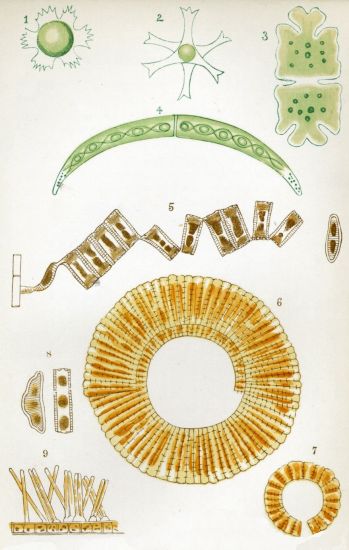
Here in this same stream are the long green threads of Cladophora glomerata. I use as few hard words as possible, but I cannot help using them sometimes, as many objects have no English names. This alga is also attached to stones and floats out with the current sometimes two feet in length; and, like the frog-spawn alga, is fond of pure water, but I have often kept the Cladophora alive in perfect health in an aquarium for weeks together. Its deep refreshing green colour and graceful form make it a very desirable acquisition for the aquarium. I break off a small bit. Now see its beautifully branched form. Do you remember a round green ball about the size of a small apple which I have at home? Well, that ball, which came from Ellesmere, is nothing else than a mass of this same Cladophora. Dr. Hassall is no doubt correct in his explanation of the formation of these balls. He says, "This state of Cladophora glomerata I believe to be formed as follows: A specimen by the force of some mountain stream swollen by recent rains becomes forced from its attachment; as it is carried along by the current, it is made to revolve repeatedly upon itself, until at last a compact ball is formed of it, which finally becomes deposited in some basin or reservoir in which the stream loses itself, and in which these balls are usually found." Here are some specimens in the water of a rich brown colour instead of green. This is caused by the growth of other algæ over its long branches. See! I shake a bit in my bottle, and you see a quantity of brown deposit comes off, showing the green threads of the Cladophora underneath. This brown deposit looks to you, I dare say, very uninteresting. I will show you some under the microscope when we get home, and you will see many extremely beautiful forms. These are known by the name of Diatomaceæ and Desmidiæ. I will not tell you more of them at present; but a picture which I will show you will give you the forms of some of these microscopic plants.
FRESH-WATER ALGÆ, DESMIDEÆ, AND DIATOMACEÆ. All highly magnified. 1.—Staurastrum. 2.—Trigonocystis. 3.—Euastrum. 4.—Closterium. 5.—Diatoma. 6, 7.—Meridion. 8.—Eunotia. 9.—Exilaria.
Here we are once more on the wild moors. There is really nothing very "wild" about them now; cultivation has turned them into excellent pasturage; the epithet, too, is a corruption of weald, signifying a wood. But this whole district, extending from Longdon-upon-Tern to Aqualate, was once, there can be no doubt, covered with water. Perhaps it was the bed of a large lake a great many years ago; the soil, you see, is composed of peat varying in thickness in different parts, and below the peat is often found sand and pebbles, which looks as if it was once the bottom of a vast lake ten miles or more long, and three broad. The village of Kinnersly was evidently once an island, and you can now see the moors extending all around it. Once, then, the whole district was covered with water, but about 200 years ago it was covered with wood.
KESTREL.
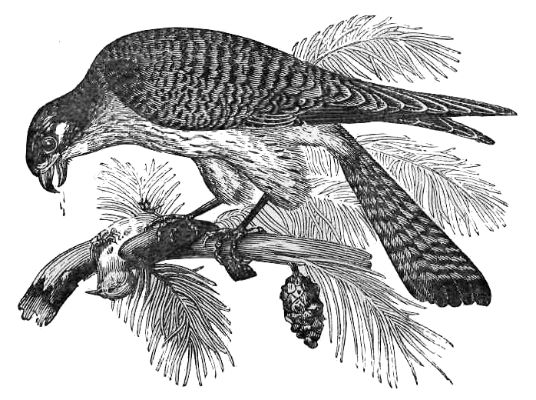
"Oh! papa, did you see that?" said Jack. "A hawk pounced upon a small bird and has taken him to that fir tree, where he is eating him." It is a kestril; one of the commonest of the British hawks, and which we may often see in this district; though I am afraid those destructive animals called gamekeepers will in time succeed in destroying every hawk in the neighbourhood. "Well, but, papa," said Willy, "do they not do a great deal of harm to young partridges and pheasants, and of course the gamekeeper will not stand that?" I dare say; indeed I have no doubt that a kestril will occasionally seize upon a young partridge, but it is also certain that mice form the principal part of its food. Remains of mice, shrews, beetles, lizards, have been found in the kestril's stomach, and I am sure it would be a great pity to seek to exterminate this handsome and attractive bird. "Is this the hawk that you very often see hovering steadily in the air over one spot?" asked May. Yes, it is, and from this habit it has got the name of windhover; the outspread tail is suspended and the head always points in the direction of the wind. The sparrow-hawk I occasionally see, and now and then the merlin, a beautiful little fellow and of great courage; the sparrow-hawk is a much greater enemy to young birds than the kestril, and ought not to be allowed to increase where game or poultry are reared, for so bold are these birds that they will not unfrequently skim over a poultry yard, seize a young chicken and carry it off. Have you never heard the cry of terror an old hen utters when a hawk is seen in the air near her little brood?
Mr. Gould gives us the following anecdote of a sparrow-hawk as related to him by a friend:—
"Three or four years since I was driving towards Dover, when suddenly a sparrow-hawk, with a stoop like a falcon's, struck a lark close to my horse's head. The lark fell as a grouse or a partridge will fall to a falcon or tiercel, and the sparrow-hawk did not attempt to carry, but held on his way. I jumped down and picked up the body of the lark and the head; the two being entirely disunited. The velocity and force of the stoop must have been tremendous. I have often seen grouse and partridges ripped up the back and neck, and the skull laid bare, but I never saw a head taken clean off before." A sparrow-hawk has been known to pursue a finch between the legs of a man, and to dash through a window-pane with the intention of seizing some cage-bird.
"What was that very large bird, papa," said Willy, "that you noticed near Eyton last November? It was one of the hawk family, was it not?" Yes; I have no doubt it was the common buzzard, though it would not allow me to get very near it; but I watched it at a distance for some time. It would remain on a tree for some time, and then take a slow flight away, returning again to some tree. Buzzards are not nearly such active fliers and bold birds as the smaller kinds of hawks. Though I said it was the common buzzard, you must not suppose that this bird is really common; it is called common as being the species most frequently seen in this country. Mr. Yarrell, in his book on 'British Birds,' has given the figure of a buzzard nursing and feeding a brood of young chickens. Is not that a curious thing?
He says, "The extreme partiality of the common buzzard to the seasonal task of incubation and rearing young birds has been exemplified in various instances. A few years back, a female buzzard, kept in the garden of the Chequers Inn, at Uxbridge, showed an inclination to sit by collecting and bending all the loose sticks she could gain possession of. Her owner, noticing her actions, supplied her with materials. She completed her nest and sat on two hens' eggs, which she hatched, and afterwards reared the young. Since then she has hatched and brought up a brood of chickens every year.
"She indicates her desire to sit by scratching holes in the ground, and breaking and tearing everything within her reach. One summer, in order to save her the fatigue of sitting, some young chickens just hatched were put down to her, but she destroyed the whole. Her family, in June, 1839, consisted of nine, the original number was ten, but one had been lost. When flesh was given to her, she was very assiduous in tearing and offering it as food to her nurselings, and appeared uneasy if, after taking small portions from her, they turned away to pick up grain."
What is this little mouse-like thing in the grass? how quickly it runs. Now I have got him. No! off again; burrowing under the grass-roots. Now I have him safe enough; he cannot bite me with this glove on. Look at the little rogue, with his soft short silky fur and long nose. See how flexible that pointed nose is; how useful in grubbing amongst the closest herbage, or under the surface of the soil. How sharp are the little creature's teeth. With them he eats worms and the larvæ of various kinds of insects. Well, what is its name? It is the common shrew, and though the form of the body is mouse-shaped, it is, properly speaking, not a mouse at all, being much more nearly related to the mole. It is said that shrews are very fond of fighting, and that if two be confined together in a box, the stronger will conquer the weaker and then eat him. Moles are said to eat their small relatives, but I have never had any evidence of the fact, though it is probable enough. May wanted to know whether cats eat shrews. I have often tried cats with dead shrews, and have always found they will not touch them. I dare say, however, they would kill them. The smell of the shrew is certainly unpleasant, as you may find out from this little fellow I hold in my hand. Mind he does not bite your nose. Now we have examined him I shall let him go. It is no pleasure to take an animal's life, and as this little shrew does no harm but good by destroying insect larvæ, it would be a shame to hurt him. Where injurious creatures must be killed, let us always be careful to take away life so as to cause the least possible pain. Now, would any of you have ever thought that the little shrew I have just released had ever been supposed to be one of the most dangerous enemies to cattle? This was really once believed by our ancestors, who thought that a shrew, by running over the backs of cattle, made them weak in the loins, and that its bite made a beast swell at the heart and die. Absurd as was the belief, the supposed cure for the injury was, if possible, still more ridiculous. It consisted in passing over the cow's back the twigs of a shrew ash. "Now a shrew ash," says Gilbert White, "is an ash whose twigs or branches when applied to the limbs of cattle will immediately relieve the pains which a beast suffers from the running of a shrew-mouse over the part affected, for it is supposed that a shrew-mouse is of so baneful and deleterious a nature, that wherever it creeps over a beast, be it horse, cow, or sheep, the suffering animal is afflicted with cruel anguish and threatened with the loss of the use of the limb. Against this accident, to which they were continually liable, our provident forefathers always kept a shrew ash at hand which, when once medicated, would maintain its virtue for ever. A shrew ash was made thus: into the body of the tree a deep hole was bored with an auger, and a poor devoted shrew-mouse was thrust in alive, and plugged in, no doubt with several quaint incantations long since forgotten." It is marvellous how people could ever have believed such stuff; but equal absurdities are still accepted by many people to this very day; so strong a hold on men's minds have the kindred vices of superstition and ignorance.
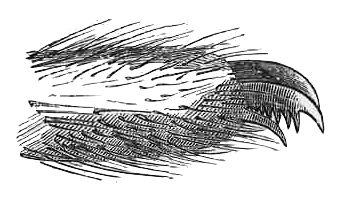
Look at these spiders' webs on this hawthorn hedge, they are formed of delicate silken threads, and are of a long funnel shape; the spider occupies the bottom part and soon rushes up should any insect get into the trap, and quickly rushes down and escapes at the back door if your hand enters the front. The top of the funnel is spread out into large broad sheets, and the whole snare is attached by silken cords to the twigs of the bushes. This is the snare and residence of a good-sized species, the Agelena labyrinthica. Such webs are common on hedges, on grass, heath, and gorse. Now you must distinguish between spiders' nests and spiders' snares. The very common wheel-like webs, which you see abundantly on hedges, are snares or traps for insects, and beautiful they look on a dewy morning all strung with liquid pearls. Here under this oak are a number of old acorn-cups of last autumn's produce; the acorns have fallen out and the black cups remain. Do you see a delicate spider's web filling this cup; inside are a quantity of tiny round eggs, and a small spider is keeping guard within; this is a spider's nest. Many spiders spin cocoons for their little round eggs, place them in various situations, and leave them; others show the greatest care for them and carry them about wherever they go. The cocoons of the species whose web or trap we are now looking at are made of strong white silk, each cocoon containing perhaps 100 round eggs, rather yellowish in colour. They are fastened to the inside of a web the spider spins by means of silken pillars formed by a number of threads closely glued together. The sac containing the cocoons is fastened to stems of grass or other objects, and partially hidden by a few withered leaves. "For the purpose of securing their prey," says Mr. Blackwall, the author of a splendid work on 'British Spiders,' "spiders have recourse to divers expedients. Numerous species run rapidly about in quest of those objects which constitute their food; others, approaching their victims with great circumspection, spring upon them from a distance; some lie concealed in flowers or among leaves, seizing such insects as come within their reach; and many species procure a supply of nutriment by means of complicated snares of their own fabrication." Of these snares the most beautiful, as I said, are the "wheel within wheel" nets of the various species of the family Epëiridæ. "What are those spider-like things," asked Willy, "with long thin bodies, you often see skating along the water? they are something like the spiders." They are not spiders at all, but insects called "water-measurers," from their peculiar habit of taking a short skate on the surface of the water and then stopping; having measured that distance, off they go again. However, many spiders do run along on the surface of the water, and you know there is one, the great water-spider, that lives habitually in it. Some years ago I had one of these water-spiders in a glass vessel of water, and saw it spin its curious dome-shaped web which it attached to the sides of the glass and some weeds. These domes are formed of closely woven white silk, in the form of a diving bell or half a pigeon's egg, as De Geer has said, with the opening below. It looks like a half-ball of silver; this appearance is due to a quantity of air. It is, in fact, a huge air-bubble surrounded by a covering of white silk, and, as you may suppose, a very interesting and pretty object. Within this silver dome the spider places her eggs, perhaps a hundred or more in number, which are enveloped in a cocoon, this being attached to the inner side of the dome. "But how," said Jack, "is the bubble formed? Where does the air come from?" You have asked a very interesting question, and one which can be answered; for the question was set at rest by Mr. Bell, an excellent observer and well-known naturalist, about twelve years ago, if I remember rightly. He found that the old spider actually took the air down with her from the surface of the water, and deposited it in her domed house. I shall now quote Mr. Bell's words: "The manner in which the animal possesses itself of the bubble of air is very curious, and, as far as I know, has never been exactly described. It ascends to the surface slowly, assisted by a thread attached to a leaf or other support below and to the surface of the water. As soon as it comes near the surface it turns with the extremity of the abdomen upwards, and exposes a portion of the body to the air for an instant, then with a jerk it snatches, as it were, a bubble of air, which is not only attached to the hairs which cover the abdomen, but is held on by the two hinder legs, which are crossed at an acute angle near their extremity; this crossing of the legs taking place at the instant the bubble is seized. The little creature then descends more rapidly and regains its cell, always by the same route, turns the abdomen within it, and disengages the bubble." Spiders have strong jaws; at the bottom of each hooked jaw there is a small sac which contains a poisonous fluid; this fluid is conveyed by a narrow channel from the sac along the jaw, and is pressed out at an opening or slit at the tip of the fang into the wound inflicted on its victim. The feet of spiders are generally terminated by two or more claws furnished with teeth; by means of these combs the animal is enabled to manage the threads of its web with great dexterity and efficiency.
SPIDER'S FANG, MAGNIFIED.
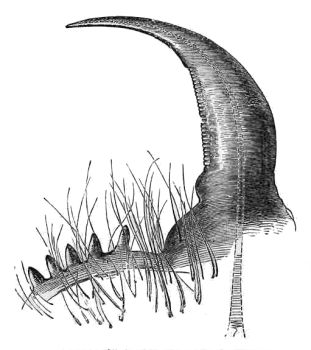
SPIDER'S FOOT, MAGNIFIED.