WALK II.
Reading edition
APRIL.
WE will walk to-day along the side of the canal bank as far as the aqueduct, then take the Duke's Drive and home by Lubstree Park; we shall find lots to see and to admire in the course of our ramble. We notice plenty of those beautiful balls of green jelly (Ophrydium versatile) in the clear water of the canal which, you know, we see every spring. These balls vary in size from that of a pea to that of Jack's fist; they are, you see, generally attached to some water-weed, and consist of myriads of very minute creatures called infusoria, which are imbedded in a mass of whitish jelly; these animals can detach themselves from the jelly and swim freely about; of course it requires a microscope to see the tiny green animalcules. If we examine a single specimen under a high power of the microscope we shall see its shape, which, when fully extended, is long and cylindrical, having at one end a mouth surrounded, as is usually the case in the infusoria, by a circle of very fine hairs, or cilia, as they are called, from the Latin word cilium an eyelash; the mouth opens into a long narrow channel; the creature's throat, which leads to its stomach; towards the opposite extremity the animal tapers, till it ends in an extremely long fine hair-like tail which is fixed in the jelly-like ball; when the little creature prefers to swim freely about in the water it leaves its tail behind it, unlike, in this respect, to little Bo-peep's sheep! These balls were once supposed to belong to the vegetable kingdom, but there is no doubt about their animal nature.
"Oh! papa, what is that bird with a black head that flew from the side of the canal to the hedge?" said Willy. "There, don't you see it?" Yes! I see, my boy, it is the black-headed Bunting or Reed Sparrow, common on the sides of rivers, canals, and ponds. The specimen you see on the hedge is a male bird, the females are a little smaller and have not black heads. See how beautifully contrasted are the deep-black head and white collar on the neck. In the spring and summer these birds may be frequently seen, male and female together; in winter they associate with others of the finch tribe, forming large flocks. The nest is generally placed on the ground amongst the sedges and coarse grass; the eggs, which are four or five in number, are laid in May and, I believe, a second brood sometimes is produced in July. The nests of the Reed-bunting are difficult to find, at least, I have seldom been successful. You know how cunning the peewit is in trying to lead people away from its nest or young ones. Well, some observers have remarked the same thing in the case of the reed-bunting. One writer says, "Walking last spring amongst some rushes growing near a river my attention was arrested by observing a black-headed bunting shuffling through the rushes and trailing along the ground, as if one of her legs or wings was broken. I followed her to see the result, and she, having led me to some considerable distance, took wing, no doubt much rejoiced on return to find her stratagems had been successful in preserving her young brood." "Ha! ha!" interrupted Jack, "the gentleman was nicely deceived then." No, not entirely, because he goes on to say he afterwards found the nest, which had five young ones in it. One thing more I ought to tell you; not to confuse the reed-bunting with the reed-warbler, a very different bird, which very probably we may notice in to-day's ramble.
WHIRLIGIG BEETLE, MAGNIFIED.
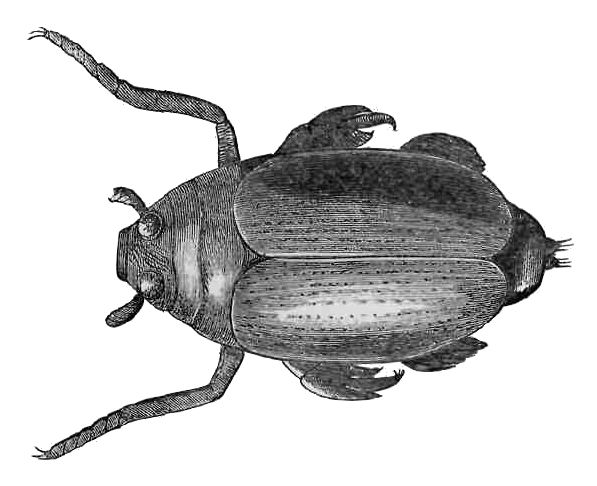
We now had another look into the canal, and saw numerous little whirligig beetles, performing their merry-go-rounds on the top of the water. With what amazing rapidity they skim along, to be sure! Some diving beneath the surface, some resting on a water leaf. If we catch one in our net and examine it more closely we shall see that, in form, it is like a miniature boat. It seems surprising that these little "whirligigs," "whirl-wigs," or "shiners," as they are called, should perform their rounds so closely together, without sometimes coming into collision. If you will look ever so long a time you will not see one animated boat run foul of another. Just think of a couple of hundred skaters on a small piece of ice playing at cros-stick. Oh! would they not be constantly knocking one another over?
HEAD OF WHIRLIGIG BEETLE, MAGNIFIED. a. Mouth. b, c. Eye.
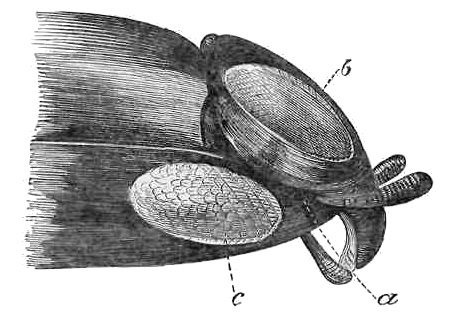
Now look at Mr. Whirligig's eyes, you see each is separated into two parts by a division; the one is on the upper part of the head and looks towards the sky, the other is on the under part of the head and looks into the water. Now let us all keep quite still—the whirligigs rest. Now let us move—just look, they see our motions and off they start on their merry-go-rounds. It was with this upper part of the eye they saw us; should some sly fish, from below the surface of the water, make a rush at one, the beetle sees the enemy with his under eye and avoids him. What have you caught now, Jack? fish him out whatever it is. Oh! a fresh-water mussel, and a very fine specimen too; there are plenty of these fellows in the canal all the way from here to Newport. "Are they good to eat, papa?" asked Willy. I never tried one, but, from having often dissected specimens, I should say they were as tough as the sole of a boot. I never heard of anyone eating them. These molluscs carry their eggs, myriads in number, within their gills. The young, at the time they are ejected, are very curious little animals with triangular shells, and, oddly enough, they will fasten upon the fins or tails of fish, on which they will stick for some time, but how long I do not know.
FRY OF SWAN-MUSSEL, PARASITIC ON A FISH'S FIN.
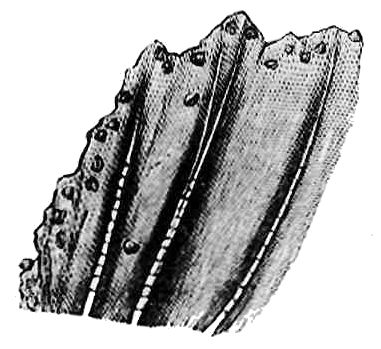
FRY OF SWAN-MUSSEL, HIGHLY MAGNIFIED.
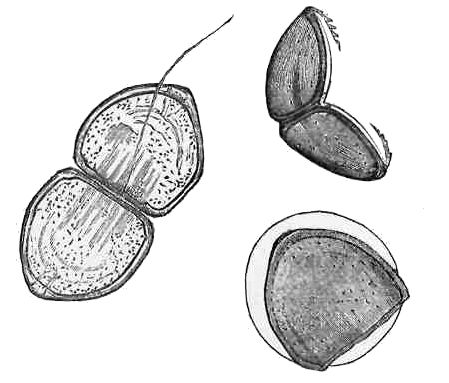
This particular mollusc is known by the name of swan-mussel; the young fry are sent into the water in April and May. There is another kind of fresh-water mussel in rivers and streams, called the pearl-mussel, pearls being occasionally found in them. I had one of these pearls once given me by a lad, taken from a river in the Isle of Man. I took it to a jeweller, in Liverpool, who valued it at a guinea. Your uncle Arthur, to whom I gave it, had it set in gold as a pin "I wish," said May, who had listened to this part of the story with great attention, "I wish pearl-mussels would live in the canal, it would be so nice to get the pearls out of them." Very few mussels are found to contain the pearls; perhaps you might have to open many hundreds before you found a single pearl, and I should not like to cause the death of so many harmless animals for the sake of a single pearl.
FRESH-WATER MUSSEL.
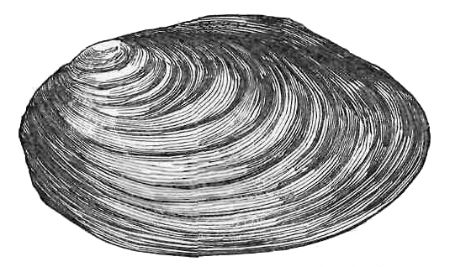
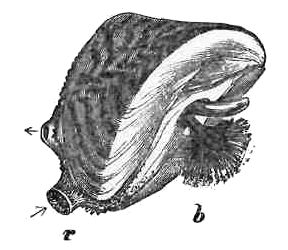
"Here is another swan-mussel, and, just look, papa," said Jack, "some other shells are fastened on it." So there are; it is a lot of the curious and pretty little zebra-mussel. How prettily they are marked with zig-zag stripes of reddish brown, especially the young specimens. The name of mussel is better suited to these molluscs than to the large kinds upon which the "zebras" are often attached, because, like the salt water mussel you have often seen at New Brighton, they have the power of spinning, what is called, "a byssus"—here, you see, is the substance I mean—by which they fasten themselves to shells, or to stones, roots, and other things.
ZEBRA MUSSEL.—b. BYSSUS.
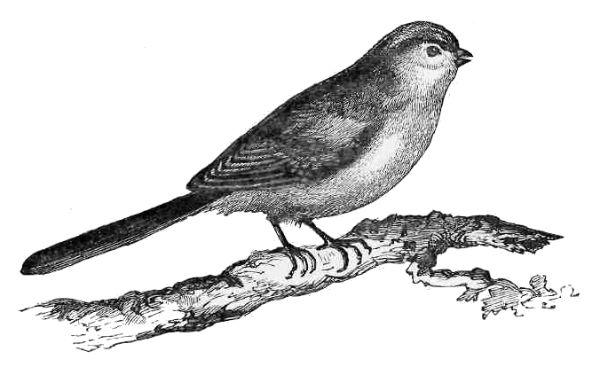
There flies one of those pretty little birds, the long-tailed titmouse; it is common enough, certainly, but I never fail to notice several upon the hedges and poplar trees of the "Duke's drive." There are several members of the titmouse family found in Great Britain; let me count them. First we have the great tit, then the little blue-tit, the long-tailed tit, the cole tit, the marsh, the crested and the bearded tit. How many does that make? Seven; but the crested tit is very uncommon, and the bearded tit does not occur in Shropshire. The other five are quite common and we shall, I dare say, be able to see all in the course of to-day's walk. The long-tailed tit, so called on account of the great length of the tail feathers, is a very active, lively little bird. Indeed, activity and liveliness belong to all the tit family. See how the little fellow flits from branch to branch, seldom remaining long on one spot. It is a very small bird, almost the smallest British bird we have; of course I am thinking of the tit's body and not taking into account its tail. The skin is remarkably tender, and thin as tissue paper. Like all the titmice, the long-tailed tit feeds on insects and their larvæ. I do not remember to have heard or seen this species tapping the bark of a tree with its beak, as the great and the blue tit are frequently in the habit of doing, but most probably they do the same. "What do they tap for, papa?" asked May. I suppose for the purpose of frightening the tiny insects, which lurk under the bark, from their hiding places, when they quickly snap them up with their sharply-pointed bills and devour them. "Is not this the tit which the people about here call a bottle tit, and which makes a very beautiful nest?" asked Willy. Yes, the nest is indeed a very pretty object, and one that you would never, I think, confuse with the nest of any other bird. The outside is formed of that white-coloured lichen, so pretty and so common, and moss, and if you were to put your finger, May, into the inside, which is full of the softest feathers, you would say it was as nice as your own muff. The nest is oval, with a hole at the side. I believe that sometimes two holes exist, but I have never seen two in a nest. The eggs are very small, and are white with a few lilac spots. As many as a dozen or more are sometimes found in a nest.
LONG-TAILED TIT.
The little blue-tit, which has just fled across our path is a very pretty active bird and common everywhere, in lanes, woods, and gardens. The blue-tit makes its nest in a wall or a hole in a tree and lays about nine or ten pretty little spotted eggs. How often I remember, when I was a boy, to have been bitten rather sharply by this little bird into whose nest I had placed my hand; I can fancy I hear the snake-like hissing which the blue-tit utters when some rude hand invades its home. Its food consists of various kinds of insects and insect larvæ, which it finds on the bark of trees and in fruit buds. I think it does much good by destroying numbers of injurious insects, though gardeners and others destroy this bird, because they say it harms the fruit buds. Look at that little sprightly fellow, how restless he is; in what curious attitudes he puts himself on yonder branch. Hark! you hear him tapping quite distinctly. Besides insects, blue-tit does not object to make a meal of dead mice or rats. Mr. St. John tells us that a blue-tomtit once took up his abode in the drawing-room, having been first attracted there by the house flies which crawl on the window. "These he was most active in searching for and catching, inserting his little bill into every corner and crevice and detecting every fly which had escaped the brush of the housemaid." He soon became more bold and came down to pick up crumbs which the children placed for him on the table, looking up into Mr. St. John's face without the least apparent fear. Boys sometimes call the little blue-tit Billy Biter, no doubt from personal experience of the sharpness of Mr. Tit's beak. The great tit which we can see under the yew tree in our garden, almost any hour of the day, is very common in the neighbourhood, and I dare say if we look well about us during our walk we shall see some to-day.
"Oh! papa," exclaimed Willy, "there are some birds on the towing-path of the canal, about sixty yards off; they seem to be breaking something with their beaks by knocking it against the ground; just look." Yes, they are thrushes, and I can tell you what they are doing and what we shall find when we come up to the spot. We shall see several broken snail shells (Helix), which the thrushes find on the grassy slopes of the canal bank, and then bring up to the path in order to get at the animals inside the shells by breaking them against the hard ground and stones. There! as I told you, you see at least a dozen broken snail shells. I am sure the thrushes do a great deal of good by destroying both snails and young slugs, and it is a pity their labours are not more appreciated than they are. Lads in the village, and great grown men from the collieries, are continually hunting for the nests, eggs, or young of thrushes, and many other useful birds, which they wantonly destroy. Now we get on the Duke's Drive, and there, on a branch of a poplar tree, I see the great tit. Look at him; he is the king of the titmice, and he seems to know it. He is a restless fellow, like tits in general. Look at his black head and breast, white cheeks and greenish back. Now, by one of his hooked claws, he hangs suspended from a branch; now again he is clinging by both legs; see how busy he is, examining the leaves and bark in search for insects. But Major Tit is a bit of a tyrant sometimes and uses that sharp short straight bill of his with deadly effect upon some of his feathered companions, on whose heads he beats repeated blows till he cracks the skulls and eats the brains! The marsh-tit and the cole-tit are pretty common in this neighbourhood, we may often notice them in our walks.
If Willy were to get over the hedge with his net and dip it amongst the weeds of the pool, I dare say he will succeed in catching a few water-insects, which he can put in his bottle and bring to me. Of course the boy was delighted at the idea of dabbling with his net in the water—boys generally get immense fun from such amusement, and their clothes frequently not a little dirt. A weedy pond is a grand place for naturalists, and various are the beautiful and strange forms of animal life which are found there. Dipping amongst the duckweed and water-crowfoot is always attended with numerous captures, and Willy's bottle was soon full of active little creatures. Let us see what it contains. A large beetle is very conspicuous amongst the contents, now rushing to the top of the water, now sinking to the bottom, scattering far and wide the tiny water-fleas, and other little creatures by the strong and rapid movements of his swimming legs. This is the great water beetle; we will sit down on this clump of poplar tree by the side of the road, and take the beetle out and examine him; we must take care he does not bite our fingers as we hold him, for his jaws are powerful and sharp. Mr. Dyticus, for that is his learned name—from a Greek word which means "fond of diving"—is one of the most voracious of water-insects, but let us first examine his form. You see it is well adapted for the kind of life the beetle leads; look at that long oar-shaped pair of feet, what a broad fringe of hairs besets them, how admirably fitted they are for swimming; the wing-covers are smooth and glossy, without any furrows; by this I know the specimen to be a male, for the wing-covers of the female are furrowed. The structure of the forefeet is very curious; you observe its under portion forms a broad circular shield, covered with a number of sucking-cups, two or three being much larger than the rest; by means of these sucking-cups the beetle can attach itself securely to any object it wishes. The wings are large and strong, and situated, as in all the beetle tribe, under the horny wing-covers. I will put this bit of stick near his mouth; there, Jack, you see his strong jaws, and great use he can make of them I can tell you. If Willy were to put one of these beetles into his aquarium with his favourite sticklebacks, he would soon have cause to lament the untimely loss of some of them; woe betide the unfortunate fish or newt that is once caught by the strong jaws of this fresh-water tyrant! I have seen Mr. Dyticus rush upon a full-grown newt, and no twistings and writhings could free the victim from the fatal embrace. They will attack young gold and silver fish, and Mr. Frank Buckland has told us of the sad havoc these water-beetles do to young salmon, as witnessed by himself in a pond in Ireland. The forefeet you see are strong but small; the beetle uses them as claws in seizing its prey and conveying it to the mouth. A young and tender fish, you can easily imagine, Mr. Dyticus would very readily devour, but he will attack beetles as large and even larger than himself, seizing them on the under side where the head joins the body, the only soft place in a beetle. Dr. Burmeister, a naturalist who paid great attention to insects, tells us that he once kept a beetle related to the great water-beetle, and saw it devour two frogs in the space of forty hours. After the eggs are laid, which always takes place in the water, the larvæ are hatched in about a fortnight. In time—I do not know how long—these larvæ grow to the size of about two inches in length, and queer fellows they are, and very voracious and formidable-looking. Now, Willy, lend me your net, and I dare say we shall soon secure a specimen. What have we here? how the pond swarms with water-fleas! Oh! here is a treasure! What can it be? a long animated thread of glass—we will put it into a bottle by itself and I will tell you about it afterwards. Splash goes the net again, but no water-beetle larvæ. Never mind; what does the child's songbook say—
"If at once you don't succeed, Try, try, try again."
GREAT WATER-BEETLE, LARVA AND PUPA.
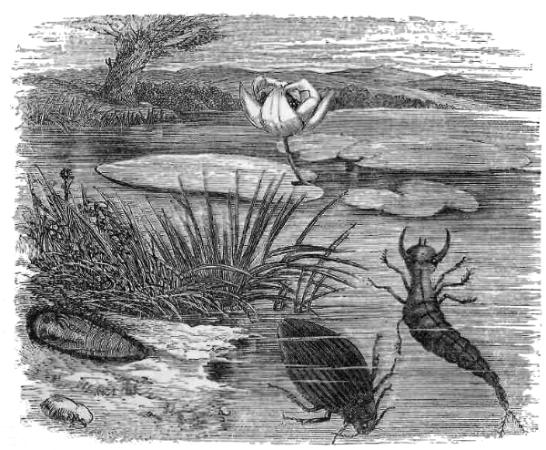
A capital little verse to remember, so we will try again; and there now we are rewarded by the capture of a dyticus larva—a creature with a long body—in some respects reminding one of a shrimp. Oh! look at his jaws, how wide he opens them! You see that the last segment of the body is provided with a long pair of bristly tails, by means of which the creature can suspend itself at the top of the water. I have often kept specimens of these larvæ in vessels of water and noticed their predaceous habits; they feed on the larvæ of other water insects, but are not able to destroy fish, not being furnished with jaws or bodies nearly so strong as the perfect insect itself possesses. When the larva wishes to turn into its pupa state, it makes a round hole in the bank of the pond it inhabits, and there undergoes its change, turning into a full-grown beetle in about three weeks' time. "Papa," said Willy, "I have often caught beetles that remind me of the great water-beetle, but they are not so large; what are they?" They belong to the same family as the great water-beetles, and are called Colymbetes, Acilius, Cybister; I do not know that they have any English names. Come, we have dabbled in this pond long enough for the present, let us proceed on our walk. "Well, but, papa," said May, "you have not told us what that long worm-like creature is in the separate bottle; do let us look at it again. Oh! really it is a curious creature, why it is as transparent as glass, now it jerks itself about, now it floats without motion in mid-water. What is it?" "I am inclined to think," said Willy, "judging from its wriggling, jerking motions that it must be the larva of some kind of gnat." Right again, my boy, it is the larva of a gnat, and one known to naturalists by the name of Corethra; you see there are eleven divisions or segments in the body; the head is of strange form, and near the mouth are two hooked arms which spring from the middle of the forehead and bend down in front of the mouth; with these weapons the Corethra larva seizes its prey and crushes it between two rows of sharp spikes placed under the mouth; after being bruised and mangled by this apparatus the prey is ready to be swallowed.
CORETHRA LARVA, MAGNIFIED.
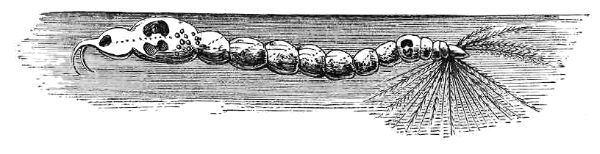
"But what," asked Jack, "are those four curious black bodies; one pair near the head, the other pair near the tail of the animal?" They are air-sacs, and are connected with the breathing or respiration of the larvæ. Some have supposed that they serve the same office as the swimming bladder of certain fish, which being compressed or dilated at will enables the creature to remain still in mid-water or to rise or sink in it. After a time the larva changes to a pupa, in which state it lives without eating for a few days, and then turns into a gnat. We now proceed on our walk and come to a part of the road which has a plantation on either side; we see a little active creature crossing the road and at once recognise a weasel. Let us keep quite still and silent, and we shall, I dare say, have an opportunity of watching it for a short time. Just look at him! how nimbly the little creature runs along; now he stops and raises his head as if listening for something, now off he starts again; he is evidently hunting, and probably is on the scent of a young rabbit, rat, or field-mouse. Ah! see he has caught something on the grass near the hedge; what has he got in his mouth? it is a small rat, I think; now he throws his flexible body over it and gives it one or two bites. Now, Jack, run up and catch him. Ah! he is off like a shot; you must not think to "catch a weasel asleep." I often see these little animals in my rambles, and always stop to witness their extraordinary activity. Weasels will sometimes climb trees and surprise some unfortunate bird on her nest; they are fond of eggs, and a bird's young brood are very dainty morsels; they will also eat moles and are sometimes caught in mole-traps. An excellent observer mentions a case of a mole-trap having been found many years ago with two weasels in it; they had been hunting in the mole's runs, had come in opposite directions, and "by a curious coincidence, must have both sprung the trap at the same instant." Weasels are generally classed as vermin and killed on all possible occasions; I think it is often a mistake to destroy them; no doubt they will occasionally catch a young rabbit or a leveret or suck a few partridges' eggs, but the common food of the weasel consists of such small animals as mice, moles, rats, small birds. In wheat or other grain ricks, they ought to be encouraged, as they enter them for the sake of the rats and mice they find there. I have been told by a friend that in some parts of Wales the farmers look upon the weasel as a friend, in consideration of the destruction it causes to mice and rats. A gentleman living near Corwen killed a weasel, and expected to receive the thanks of the farmer on whose land it had been killed; he was surprised to find that the farmer was by no means grateful. In this respect I think the Welsh farmers are wiser than the English ones. Hawks sometimes prey upon weasels.
STOAT AND EGGS.
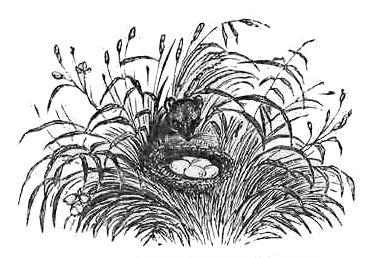
Mr. Bell tells a story of a gentleman who was riding over his grounds, once having seen a kite pounce upon some object on the ground and rise with it in his talons. "In a few moments the kite began to show signs of great uneasiness, rising rapidly in the air, or as quickly falling, and wheeling irregularly round, whilst it was evidently trying to force some hurtful thing from it with its feet." After a short but sharp contest the kite fell suddenly to the ground, not far from where the gentleman was watching the proceeding. On riding up to the spot "pop goes the weasel," none the worse for his aërial journey, but the kite was dead, for the weasel had eaten a hole under the wing. The weasel makes its nest in a bank or in loosely-constructed stone walls; three or four young ones are generally produced. Some years ago I remember seeing a mother-weasel and three young playing about on a bank. It was a most interesting sight. The weasel is much smaller than the stoat, and you can tell it at once by its tail, which is entirely red; that of the stoat has a black tip. But it is getting late and we must hasten home.