WALK V.
Reading edition
MAY.
TO-DAY we will go to Shawbury and try our luck with the trout. If the fish will not rise there will be plenty to observe, and I have no doubt we shall enjoy the day thoroughly; the wind is in the south-west and the day is cloudy; the May-fly is well out, and I think we have every chance of good sport. Let us look out our fishing-tackle and drive off at once to the river. How delightful it is to stroll by the river side and hear the rippling of the water; delightful, too, is the sensation of feeling at the end of your line the tugs and jumps of a good lively trout. I cannot resist quoting some lines from 'The Angler's Song,' which I think you will say are very pretty:
Merry in the greenwood is the note of horn and hound, And dull must be the heart of him that leaps not to their sound; Merry from the stubble whirrs the partridge on her wing, And blithely doth the hare from her shady cover spring; But merrier than horn or hound, or stubble's rapid pride, Is the sport that we court by the gentle river side. Our art can tell the insect tribe that every month doth bring, And with a curious wile we know to mock its gauzy wing; We know what breeze will bid the trout through the curling waters leap, And we can surely win him from shallow or from deep; For every cunning fish can we a cunning bait provide, In the sport that we court by the gentle river side. Where may we find the music like the music of the stream? What diamond like the glances of its ever-changing gleam? What couch so soft as mossy banks, where through the noontide hours Our dreamy heads are pillowed on a hundred simple flowers? While through the crystal stream beneath we mark the fishes glide, To the sport that we court by the gentle river side? For as the lark with upland voice the early sun doth greet, And the nightingale from shadowy boughs her vesper hymn repeat; For as the pattering shower on the meadow doth descend, And far as the flitting clouds with the sudden sunbeams blend; All beauty, joy and harmony, from morn to eventide, Bless the sport that we court by the gentle river side.
Well, here we are once more at the charming little village of Shawbury. How often, both as a boy and a man, have I wandered by the banks of the river Roden. What changes have taken place since my early rambles! Long familiar forms, companions in my fishing expeditions, have vanished; the mind fondly cherishes their memory, and recalls past hours of cheerful intercourse. We will put up the horse and carriage at the Elephant and Castle Inn and stroll away to the river.
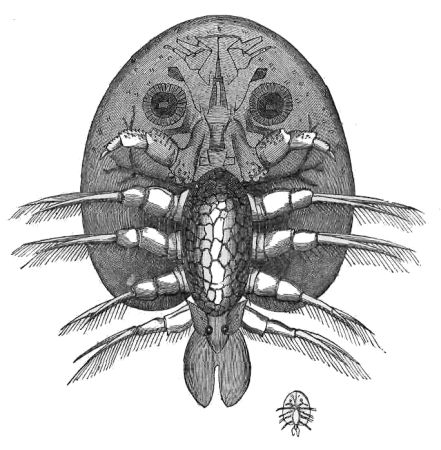
Ah! here is a capital place. Now, Master Willy, there is no tree to interfere with your throw, so cast in just near that spot, quietly, carefully, anxiously; if there is a fish there he cannot resist your green drake. I recommend him the artificial before the fat natural fly. As Christopher North says—"Devouring ephemerals! Can you not suffer the poor insects to sport out their day? They must be insipid eating—but here are some savoury exceedingly ... they carry sauce piquante in their tails. Do try the taste of this bobber—but any of the three you please." There, hold fast, Willy, for that's a good one. Bring him up carefully to the side; hold your rod erect; play him a little, for he is full of vigour. There! well done; I have got him in the landing net. Is not he a beauty? A pound weight, I'll be bound; and what condition! His flesh will be almost as pink as that of a salmon. Further down stream I managed to take a fish in very different condition; I took him where the river was rather muddy, and flowed very slowly. Just look at him, with a body lean and dark coloured, and an enormous head for so slender a body. "Oh! but, papa," said Willy, "what are these curious creatures crawling over him? Do look." Ah! I know them well; anglers call them trout lice. I will scrape off a specimen, and put him in the bottle. Now look at him. The body is nearly round, and almost transparent; colour rather green; it has four pairs of swimming feet, each pair beset with a fringe of hairs; a pair of foot-jaws; a small half-cleft tail; and a pair of fleshy circular suckers just in front of the foot-jaws, by means of which the little creature is able to attach itself, as a parasite, upon various fish. It is a graceful little creature, and, as you see, can swim with great activity in the water; now it swims in a straight line, now it suddenly turns quickly round and turns over and over. It is known to naturalists under the name of Argulus foliaceus; I do not think it has any English name. It is found on many kinds of fish, and generally in greater abundance upon individuals that are in an unhealthy state; though these parasites often attach themselves to fish in good condition. The mouth is furnished with a long, sharp sucking-tube, by means of which the animal can pierce the skin of the fish it lives upon, and suck up the juices. We will take a few home, and I will show you the different parts of the creature under the microscope.
PARASITE (Argulus foliaceus) ON TROUT, NAT. SIZE AND MAGNIFIED.
Let us now sit down and rest for an hour, and eat our lunch; the fish do not rise as freely as they did; perhaps later on they will be in the humour again. But what do I see sticking to the sides of that rail across the river; I must go and see. Well, really this is an interesting thing. An immense mass of flies, a few alive, but the greater number quite dead; and, look! a quantity of white eggs underneath them. Let us examine a fly; it is of a brown or tawny colour, and has rather long, diverging, colourless wings, marked with irregular brown spots. Why, there must be thousands of dead flies covering these eggs. What an odd idea! Presently up comes Mr. Collins from the farm near the bank of the stream. "Oh, sir, I know those flies quite well; they are oak-flies (Leptis scolopacea)." Certainly not, I replied, though they do somewhat resemble them in colour and appearance; but the farmer stoutly asserted he was right, and I did not think it worth while discussing the matter further with him. Mr. Collins is a good fly-fisherman; and fly-fishermen, unless they are naturalists, are generally very positive. How often have I tried to teach anglers that the May-fly does not come from a caddis worm; how often have I failed! Well, the two-winged fly I have just found in such thousands, with their dead bodies brooding over this mass of eggs, is known to entomologists by the name of Atherix Ibis; the females are gregarious, and, as we have seen, attach their eggs to rails, boughs, or other objects overhanging streams; each female, having laid her eggs, remains there and dies; shortly after comes another and does the same, and so on till immense clusters are formed. The larva, when hatched, falls into the water, its future residence; it is said to have a forked tail about one third the length of its body, and to "have the power of raising itself in the water by an incessant undulating motion in a vertical plane." I am not, however, acquainted with either larva or pupa, but hope to become so this summer. "It is very curious, papa," said Jack, "that the flies, after they have laid their eggs, should die there; why do not they fly away? Do any other animals do the same?" Yes, pretty much so. Some of the female insects of the genus called Coccus, scale insect, or mealy bug, common on the stems of various trees, to which they sometimes do incredible mischief, lay their eggs and die over them, the dead bodies of the parents forming coverings for the young. See how fast the green drake is appearing. Notice how it flies with head erect for a second or two, and then falls almost helplessly on the surface of the water.
There! did you see that fish rise at him? He has escaped the hungry trout, and has reached a blade of grass, where he will probably rest for some hours. But give me my rod; perhaps the same trout will rise at my artificial fly. There! that throw was exactly over the spot. No; he won't have it. I'll try again and again. No. Objects to sauce piquante, I suppose. Well, I will tempt him again in an hour's time or so. The water is smooth here, and free from rapids; let us lie down on the grass and see the birth of Ephemera—for that is the May-fly's proper name. Here comes something floating down. It is within the reach of my hand, so I will secure it. What is it? As I thought. Ephemera is throwing off its swaddling clothes. See how it twirls and twists itself about. Now it is free; and the strange-looking worm has changed into a beautiful fly. But there is yet one other operation to go through ere it assumes its final and complete form; you see at present it is a heavy flier, for the wings are scarcely dry, and the muscles as yet unequal to great exertion; so in their present imperfect form they are constantly dropping for a second or two in the water, and are often sucked down the throat of some roach, trout, or other fish on the look-out. You should remember that the Ephemera, or May-fly, in this its sub-imago, or imperfect winged state, represents the "green drake" of the angler. What have I here on this blade of grass? Do you see? What is the shadowy form that lifelessly clings to it? It is a delicate membrane, thin and light; see, I blow it away. You saw the split in the back, through which the former tenant left the abode. It is the cast-off skin of the green drake, now metamorphosed into a creature more active than harlequin or columbine, the male into a dark brown insect, with gauze-like wings, the female into a beautiful creature, with body marbled white and brown, and able to fly well and strongly, now high in the air, now sailing along close to the surface of the water, ever and anon dipping gently into it for the purpose of laying her eggs. The small oval eggs sink down to the bottom, and attach themselves to the weeds and stones that are found there. The flight of the male Ephemera is different; it is the males that practise together that peculiar up-and-down dance, with heads erect and bodies curving prettily upwards; of course, you can understand how countless multitudes fall victims to fish and bird, for dainty morsels they are. These flies, though voracious feeders both in the larval and nymphal state, never eat at all after they have assumed their perfect form. Indeed, they have no true mouth, only an imperfect or rudimentary one; and you would never find a particle of food in their stomachs, which are always more or less full of air-bubbles, which, no doubt, assist in buoying up the insect, and thus save the expenditure of muscular power. I'll catch one of those dancing males, and press him quickly in the middle. There! crack he goes! for the little air-bubbles in the stomach have burst by the pressure of my finger and thumb.
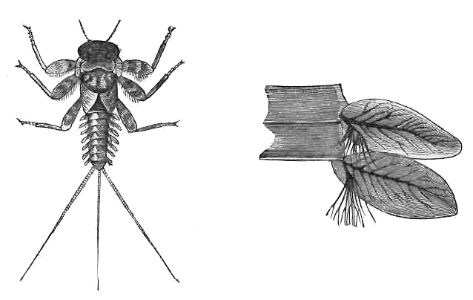
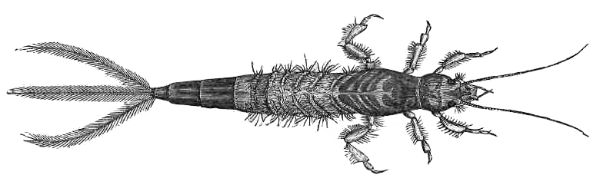
Abundant as are the May-flies at the latter end of May and the beginning of June in this country, in other countries they are sometimes more astonishingly numerous. In some parts of Holland, Switzerland, and France, their great numbers have been compared to pelting flakes of snow. "The myriads of Ephemeræ which filled the air," says Reaumur, "over the current of the river and over the bank on which I stood, are neither to be expressed nor conceived. When the snow falls, with the largest flakes and with the least interval between them, the air is not so full of them as that which surrounded the Ephemeræ." The occurrence of such prodigious numbers is, I believe, unknown in the British isles. In the perfect or imago state the May-fly lives but a short time. The word ephemera means "living only for a day;" and though individuals may live longer, yet the term is fairly correct as expressing their short existence. The May-flies (Ephemeræ) have all three long fine hairs at the end of the tail; some members of the same family, but belonging to a different genus, have only two hair-like appendages. For instance, the fly known to fishermen as the "March-brown" belongs to the same family as the May-fly; it is smaller than it, and has only two hairs at the end of the tail; but with this exception, the natural March-brown and the May-fly are wonderfully alike; yet it is most curious to notice what a wonderful difference there is in the larvæ of these two insects. Significant facts, no doubt, lie at the bottom of such differences in the case of insects so evidently allied, but these I will not speak of. Here are the two forms of larvæ, the one being the larva of the common May-fly (Ephemera), the other that of the March-brown (Baëtis).
LARVA OF BAËTIS, WITH BREATHING PADDLES, MAGNIFIED.
LARVA OF EPHEMERA, OR MAY-FLY, MAGNIFIED TWO DIAMETERS.
Come, we have lunched, and rested, and watched the May-flies; let us try to catch a few more trout. It is very strange why sometimes the fish will not rise, though the weather is propitious and the water in first-rate order. Holloa! master Willy, what game are you after now? "Oh, papa," he exclaimed, "there are a lot of dace on this shallow, so I put the spinning hooks on, and, see, I have managed to hook a couple out, by simply throwing the tackle on the other side of the fish and then drawing it smartly through the water over them." Well, that looks like a bit of poaching, at all events; the fish are spawning amongst that water-crowfoot, no doubt; just hook out some weed, and I dare say we shall see some eggs. To be sure; there they are, dotted over the long thread-like leaves of the plant, like little pearls. You have caught enough, for I think it is not sportsmanlike conduct to take such unfair advantage of the unfortunate dace. Put on your casting line and try under the old forge bridge. You think there is not much use? A true fly-fisherman should never say so. I have taken many a trout under the bridge, and I dare say you may be successful this time. There! I told you so. Keep your line tight, and Jack shall land him. He is not a large fish evidently, but very lively. Now you have him, throw him on the grass. Are there any parasites on him? Yes; but different to the last we observed. Here is a leech-like creature, rather small and cylindrical; it is the Piscicola, a not uncommon parasitic leech on fish. Well, put him into the bottle; we can take him home and examine him at leisure. How many trout have we taken now? "We have got nine, papa, and, remember, I have caught three." Yes; but I suppose you include the poaching? "No; I have caught three trout with the fly, and I don't count the dace." Not a bad day's sport, after all; for I threw back again three small fish. What is this showy plant, with large, yellow, globe-like blossoms? How pretty it is, growing in abundance in a little spot near the river! It is the globe flower, so called from the rounded shape of the corolla; it is one of the buttercup family, as you will, perhaps, guess. In its wild state I believe it is found in mountain districts, so I suspect it has found its way here from some of the cottage gardens which are only a quarter of a mile distant. We will grub up a few roots; perhaps Mrs. Charlton would like them for her wild garden shrubbery. When you go a-fishing always be provided, if not inconvenient, with a trowel and a small basket, as well as with a few wide-mouthed bottles; they will be very useful, especially if the trout will not rise. The trowel and basket you can leave at a cottager's house, and the bottles are indispensable to every angler-naturalist. What are you running after, Jacko? Oh! I see; one of the most beautiful insects that are found in this country. Ah! he is too quick for you. It is the brilliant steel-blue dragon-fly. Let us sit down for a few minutes and watch its flight. How rapidly it flies, now pursuing the course of the river, now suddenly darting back again. It is the Agrion virgo, the most splendid of all the dragon-flies, even rivalling the gorgeously coloured insects of tropical countries. All the dragon-flies proceed from water larvæ; strange creatures of unbecoming forms and ferocious dispositions. The mouth, or rather the lower lip of the larva is of very singular form. Two jaw-like organs are at the end of the lip, its basal portion being articulated to the head; this mask, as it has been called, is folded beneath the head when in repose, but it can be suddenly shot out in front of the head so as to seize any small creatures that may pass near it which the larva thinks good to eat. Imagine one of your arms being joined on to your chin, bend your elbow up till your hand covers your face—this will represent the dragon larva with the mask in repose; now shoot out your arm in a straight line from the head—this will represent the mask unfolded and in use; your fingers may be considered to represent the jaws of the creature. When the larva wishes to turn into an insect, it leaves the water and creeps up the stem of some water weed or other object out of the water, bursts its skin, and commences its new state of existence. If we look about us near the water side, we shall be sure to find some empty pupa skins. Here are two on this sedge; you see a slit on the back through which the dragon-fly has come out. The dragon-flies are the largest and most active of our British insects, and, to quote the descriptive words of Professor Rymer Jones, "are pre-eminently distinguished by the rapidity of their flight and the steadiness of their evolutions while 'hawking' for prey in the vicinity of ponds and marshy grounds, where in hot summer weather they are everywhere to be met with. Equally conspicuous from their extreme activity, their gorgeous colours, and the exquisite structure of their wings, they might be regarded as the monarchs of the insect race. The very names selected for them by entomologists would testify the perfection of their attributes; their titles ranging from that of Anax imperator, indicative of imperial sway, to epithets expressive of feminine delicacy and ladylike grace, such as virgo, puella, demoiselle, and damsel-fly, which are appropriated to the sylph-like forms that many of them exhibit. In their habits, however, they by no means deserve the gentle appellations bestowed upon them. They are, in truth, the tigers of the insect world, and their whole lives are devoted to bloodshed and rapine. Indomitable in their strength of wing, furnished with tremendous jaws, and possessed of acuteness of sight and rapidity of motion scarcely to be paralleled, there seems to be no escape from their ferocity, and terrible is the slaughter they effect amongst the insect legions they are appointed to destroy." It must not, however, be supposed from the above description that the dragon-flies are creatures that deserve to be killed. On the contrary, they are most serviceable to men, and destroy countless numbers of injurious flies and butterflies whose larvæ do damage to vegetation. "Well, papa," said Jack, "the boys in the village always kill them if they can catch them, and say they sting horses." I know that this is a popular tradition, inherited by the rural folks of our day from their great-great-grandmothers' grandmothers. Dragon-flies are often called horse stingers; in America they are sometimes called devil's darning-needles; in Scotland, I believe, they are known by the name of flying adders. Where is my net? I will try and catch a demoiselle. There! I have her, or I should rather say him, for these dark spots on the wings disclose the sex; the female has unspotted wings, and is of a rich green colour. "How splendidly it shines in the sun," said Willy; "nothing can exceed the beauty of its wings." Well, now you have looked at him closely and admired him, I will let him go again. Off he flies, none the worse for his temporary captivity. Now for my friend the trout, who would not take my fly an hour ago. Ah! I have got him the first throw; see how he jumps. Now, Willy, for the landing-net. Bravo! all safe, and a good fish too. Our sport is over for the day, and we must get ready to drive home. To-morrow, Willy, you may learn these lines from Thomson's 'Seasons:'
"When with his lively ray the potent sun Has pierced the stream and roused the finny race, Then, issuing cheerful, to thy sport repair; Chief should the western breezes curling play, And light o'er ether bear the shadowy clouds. Just in the dubious point where with the pool Is mixed the trembling stream, or where it boils Around the stone, or from the hollowed bank Reverted plays in undulating flow, There throw, nice judging, the delusive fly; And as you lead it round in artful curve With eye attentive mark the springing game, Straight as above the surface of the flood They wanton rise, or urged by hunger leap, Then fix with gentle twitch, the barbed hook. Some lightly tossing to the grassy bank, And to the shelving shore slow-dragging some, With various hand proportioned to their force. If yet too young and easily deceived, A worthless prey scarce bends your pliant rod; Him, piteous of his youth, and the short space He has enjoyed the vital light of heaven, Soft disengage, and back into the stream The speckled captive throw. But should you lure From his dark haunt, beneath the tangled roots Of pendent trees, the monarch of the brook, Behoves you then to ply your finest art. Long time he, following cautious, scans the fly; And oft attempts to seize it, but as oft The dimpled water speaks his jealous fear. At last, while haply o'er the shaded sun Passes a cloud, he desperate takes the leap, With sullen plunge. At once he darts along, Deep struck, and runs out all the lengthened line; Then seeks the furthest ooze, the sheltering weed, The caverned bank, his old secure abode, And flies aloft, and flounces round the pool, Indignant of the guile. With yielding hand, That feels him still, yet to his furious course Gives way, you, now retiring, following now Across the stream, exhaust his idle rage; Till, floating broad upon his breathless side, And to his fate abandoned, to the shore You gaily drag your unresisting prize."
There is some good advice here worth remembering; at any rate, persevere, persevere, and no doubt you will become in time
A MOST SUCCESSFUL ANGLER.