9. Around the Coast. From Land's End to Rame Head.
Reading edition
The south coast-line of Cornwall presents a great contrast to that of the north, except for the portion from the Land's End to Mounts Bay and the Lizard. We have no more the wind-swept background of heights, barren and often tortured by miners, turned into a waste of heaps of rubble and studded with ruined engine-houses. We find instead a gentler sea-board, pierced by long estuaries, and with valleys of rich vegetation running down to the sea. We speedily leave the granite and the culm measures, and are among the rocks of the Devonian series, less stern and forbidding in colour. In St Levan parish at Trereen Point is the Logan Rock, a block of granite weighing over 65 tons, once so nicely balanced that it could be made to rock by the finger of a child. In 1874 a young naval officer, with the assistance of a boat's crew, upset it. This raised a storm of indignation in Cornwall, and the Admiralty ordered him to replace it, which he did, at great expense.
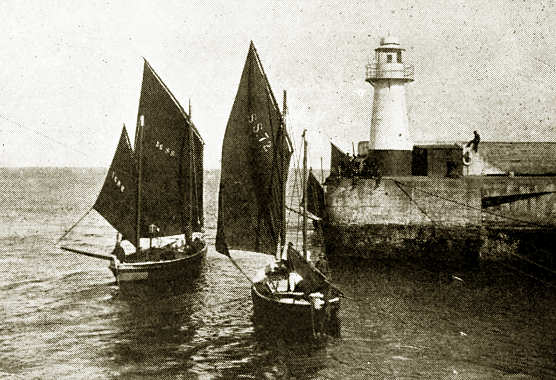
Newlyn Pier
Mousehole is a village of fishermen and boatmen, and was the residence of Dolly Pentreath, the last person in Cornwall who spoke the Cornish language, as also of some of the unfortunate sailors who joined Captain Allan Gardner in 1850 in his ill-fated missionary expedition to South America. All the members of the mission died of starvation in Tierra del Fuego.
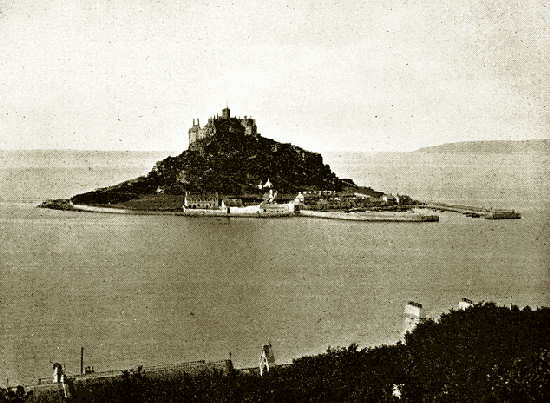
St Michael's Mount
Newlyn has become noted as a place of residence of a school of artists. It is on the wide and beautiful Mounts Bay over against St Michael's Mount.
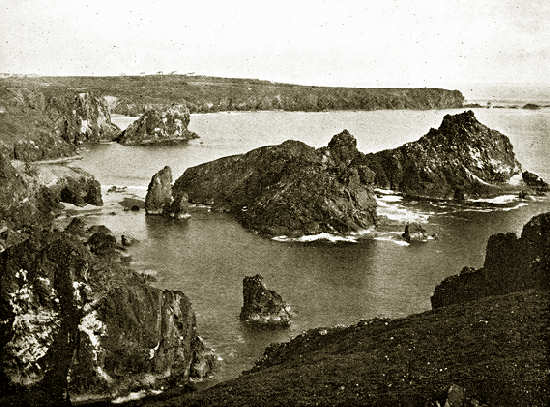
Kynance Cove and the Lizard
Penzance ("the Holy Head") has become a great resort of residents for the winter, owing to the mildness of the climate. Marazion or Market Jew does not derive its name from "the Bitter Waters of Zion" as has been absurdly asserted; Marazion has the same significance as Market Jeu (i.e. Jeudi), Thursday Market. Here is a submerged forest. St Michael's Mount is a rock that rises out of the sands and can be reached, when the tide falls, by a causeway. It is incomparably inferior both in elevation and in the dignity of the buildings that crown it to the Mont St Michel in Normandy, but is nevertheless a picturesque adjunct to the scene. Some writers suppose that it is the Ictis to which the natives conveyed the tin and trafficked with the Phoenicians, but it is totally unsuited by nature to serve as a market-site, and there is no certain evidence that the Phoenicians ever came to Cornwall. About Marazion daffodils, narcissus, and violets are cultivated largely for the London market. At Perran Uthnoe the cliffs again appear, and we reach Prussia Cove, once the haunt of smugglers. Inland, Godolphin and Tregonning's granite hills are conspicuous, and near the coast is Pergersick Castle, a picturesque ruin of which strange legends are told. Porthleven is a small fishing village, where the people live on the annual arrival of the pilchards. Loe Pool is a beautiful sheet of water cut off from the sea by a bar of sand. It was when standing on this bar, and watching the wreck of a vessel close in shore when those on the land were unable to communicate with it, that Henry Trengrouse conceived the idea of a rocket apparatus, to be not only employed on land, but also to be carried by every ship. He, of course, met with opposition from the Board of Trade and the Government, and he spent his life and his fortune in experiments, and in endeavours to push his apparatus.
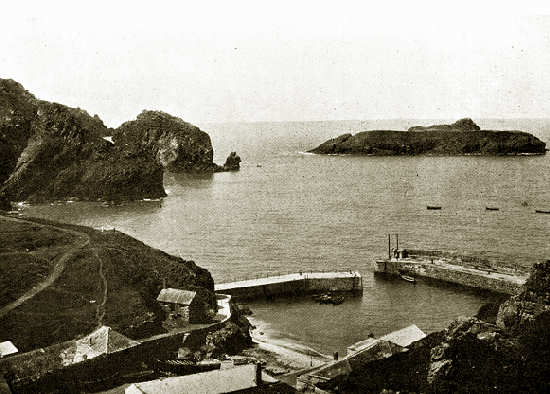
Mullion Cove
We now reach the superb serpentine cliffs of the Lizard with the beautiful coves of Polurrian, Mullion, and Kynance. At Lizard Point is one of the most famous of all lighthouses, the departure-point or landfall of thousands of ships in the course of the year. The peninsula of the Lizard is interesting, though the land does not rise much above 300 ft., and is monotonous moorland. All its charm is in its coast-line. The terrible Manacles rocks have been the scene of many a wreck. Helford river is a creek running up to Gweek in one arm and nearly to Constantine in another. We now reach Falmouth Bay, into which opens the Carrick Road. A curious peninsula, Roseland, runs to Zoze Point, where there is a lighthouse. Portscatho is a small place at the opening of Gerrans Bay, of which the eastern horn is Nare Point. Carn Beacon is traditionally held to have been the burial-place of Geraint, King of Devon and Cornwall. There were more than one of this name. The cairn has been opened and was found to contain a stone cist of the bronze period, and not, as tradition said, his golden boat with silver oars. Veryan Bay between Nare Point and the Dodman has in it no good harbour. Dodman stands nearly 380 ft. above the sea.
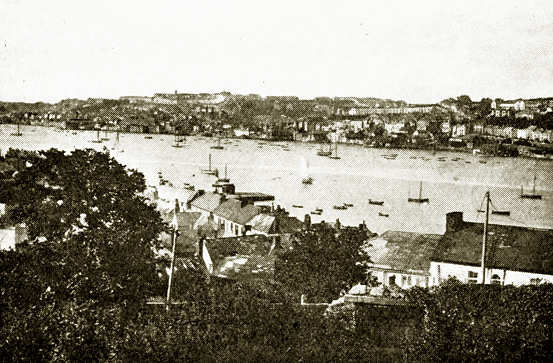
Falmouth, from Flushing
Mevagissey Bay is a shallow hollow between Chapel Point and Black Head, the latter crowned by one of the cliff castles found on almost every headland. Then comes St Austell Bay with that of Tywardreath opening out of it. Charlestown has latterly become of importance, as from thence much china-clay is shipped.
We reach now the narrow estuary of the Fowey river, with Fowey town consisting of one narrow street beside the tidal creek, and with Polruan on the further shore. The coast now becomes very bold, and Polperro, five miles beyond, was once a notorious haunt of smugglers.
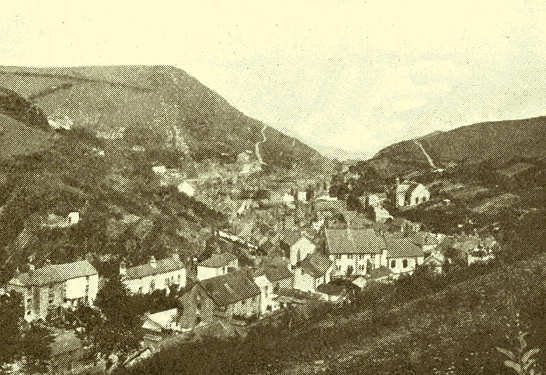
Polperro
At Looe, the two rivers bearing the same name fall into a bay, and seaward stands up Looe Island, crowned by the ruins of a chapel. This island was also a haunt of smugglers, and it was found necessary to establish a coastguard station on it to keep them in control. East Looe and West Looe each sent two members to Parliament before the passing of the Reform Bill.
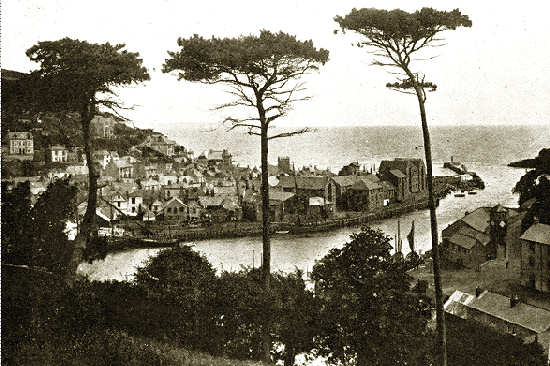
Looe
Between Looe and Rame Head is Whitesand Bay, so called from the whiteness of the sand. The quicksands have made it dangerous for bathers, but the cliff scenery is beautiful and romantic. There is a tiny watering-place at its western end, Downderry. At Tregantle is the most important of the western defences of Plymouth. A peninsula is formed by the Lynher river which discharges into the Hamoaze, and the neck of land between it and the sea is about two miles in breadth. Tregantle stands 400 ft. above the sea and commands every approach to Plymouth Sound.
Rame Head projects into the sea from Maker Heights and is the termination of a range of cliffs from Looe, and from hence a fine view can be had of the Cornish coast as far as the Lizard.
On the east of Penlee Point is Cawsand Bay, once infested with smugglers, sheltered by Rame Head from westerly gales. A rock with a cave in it and a white incrustation is regarded here with some superstitious reverence, and fishermen throw a few pilchards or herrings to it as an oblation when returning from fishing.