VIII
Reading edition
CORNISH TOWNS
If an enquiry were made among the Cornish towns as to which of them it were fittest to mention first, it can be easily imagined that one and all would claim the honour for themselves. And truly each has something to say for itself. Penzance is the town best known to the majority of visitors, because the railway ends there, and "London to Penzance" has become almost as common a phrase as "London to Cornwall." But so far as we are concerned we need not bother about Penzance as we have already given it full space. Truro could advance good claims for she is the seat of the Bishop's See and possesses the modern cathedral, the only one in the Duchy, and also she is the educational centre with fine county education offices. Bodmin, however, is really the county town as the Assizes are still held there, an honour she has disputed with Launceston for many centuries, the Assize Courts having swayed to and fro between them. Even now there is talk of removing them from Bodmin owing to the difficulty of getting there. Bodmin is not on the main Great Western line but only connected with it from Bodmin Road by a branch line. Launceston can outshine the others by reason of her fine ruin of the ancient castle and an historical record second to none, but at present official recognition she cannot claim.
TRURO
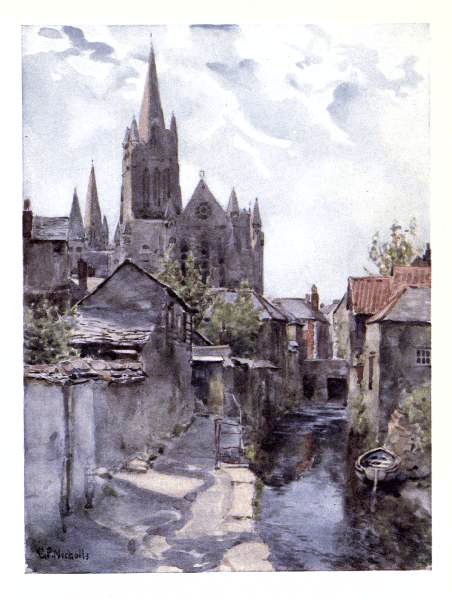
Beyond these three we need not go. The coast-towns have been already visited, and as for smaller ones inland, such as Liskeard, Camelford, Redruth, Cambourne, Callington and Helston, they cannot hope to compete.
Truro is just the picture of what one imagines a market-town to be. On market-days its open spaces are filled with country carts and the quaint little covered-in omnibuses, like those used by the peasantry of France on their immensely long straight roads. There is a buzz and clamour of talk outside the doors of the old Red Lion Inn, or, as it now seems to be the fashion to say—hotel. This is the house in which Samuel Foote, actor and dramatist, was born in 1720; his father was at one time Mayor of Truro. The house is worth seeing on its own account, for it has a massive carved oak staircase—alas, thickly overlaid with varnish, and some moulded ceilings unusual in an inn.
Truro is well watered, as it stands between two small rivers which join in the creek by which steamboats go down to Falmouth through pretty wooded scenery. The town itself is quite tolerably flat for a Cornish town, but long hills run up out of it on all sides. The oldest part of the cathedral is that which was the parish church, incorporated into the new building. About the cathedral there have been many opinions, but a modern cathedral can hardly escape severe criticism considering that it has to compete with all the dignity and reverence of those which have stood hundreds of years! The white stone shows up well, and though the town is more or less in a basin the tall spires are seen from the surrounding hills to advantage. There are good shops in Truro and much that is of interest, including the very fine collection in the Museum of the Royal Institution of Cornwall, now housed in a worthy building. Here anyone who has wandered in the hills and over the barren moors and seen the relics of hoary antiquity so freely scattered, can look with seeing eye on the more valuable specimens which have been found and are now cared for and preserved where they will not be stolen or lost.
Even in Domesday Book Truro is mentioned, and at that time there were two towns, Great and Little Truro, standing under the shadow of a fortress held by the Earls of Cornwall, now vanished, though its site is known and pointed out near the station. The town's charter was granted in 1130 and renewed in 1589, so it is not much matter for wonder the inhabitants look upon it as the first city in Cornwall, and, in olden times, so bore themselves that they earned for their city the nickname of "Proud Truro."
The cathedral was in great part due to the energy of Bishop Benson, afterwards Archbishop of Canterbury, who was made first Bishop when the See was created. Bishop Benson "delighted in the Cornish people and was never tired of observing and analyzing their character." He did much for Truro in many ways.
Bodmin stands almost in the middle of the Duchy with two long fingers, that of the inlet of Fowey on the south and that of the inlet of the River Camel on the north, pointing directly at it. It is a very quiet little town but has somehow managed to preserve its charm. The fine old parish church, almost worthy to take rank as a cathedral, is in the midst, easily to be seen. The church is the largest in Cornwall and parts of it date from 1125. It once had a very striking spire, destroyed by lightning in 1699. Bodmin means the Monks' Town, and even though it has the enormous barracks built in the usual style, just outside, it still keeps something of the monkish atmosphere. Bodmin scorns Truro's claims of long descent, turning to Athelstan as its founder. Athelstan, who founded here in 926 a Benedictine Priory of which some traces even now remain. The town is in a beautiful and well-wooded neighbourhood, and anyone taking the trouble to climb Beacon Hill just outside will be rewarded. It was at Bodmin in 1498 that Perkin Warbeck, who had disembarked near Land's End, gathered 3,000 men together and started his disastrous campaign by launching himself against Exeter. In Bodmin meet, or rather "meet with a gap between," the two rival railways—the Great Western and London and South Western; the latter station is a terminus, and the line running northward connects the town with Wadebridge and Padstow. The former comes from Bodmin Road where it joins the main line, and continues also to Wadebridge.
THE BANKS OF THE FAL, FALMOUTH
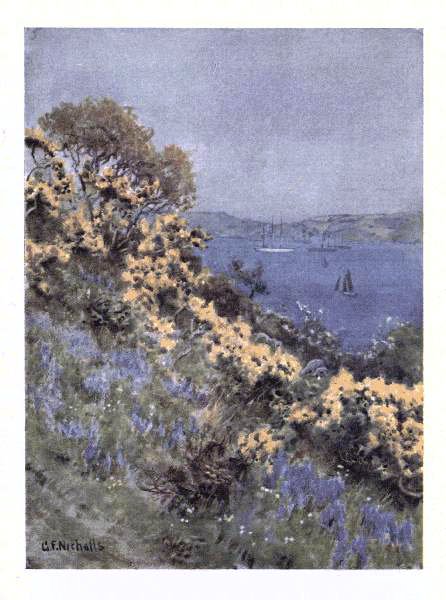
Between Bodmin and Launceston stretches the wild tract of country known as Bodmin Moor. A more desolate region it would be hard to find or one more covered with relics of primitive man. Norden has said in writing of Cornwall, "The rockes are high, huge, ragged and craggy not only upon the sea-coaste ... but also the inland mountayns are so crowned with mightie rockes as he that passing through the country beholding some of the rockes afar off may suppose them to be greate cyties planted on the hills, wherin prima facie ther appeareth the resemblance of towres, howses, chimnies and such like."
Though he flatters the Cornish highlands in calling them mountains, yet it is true enough that the tors out-cropping in this region do take on most curious shapes. The most remarkable of all is the unstable-looking Cheesewring, southwest of Launceston, and rather difficult of access. Here stones are piled one on the top of the other, each larger than the last, till the effect is that of a gigantic and misshapen mushroom. But it was not built deliberately, it just happened so. How—no one knows, but the suggestion is that the mass was once banked in by earth, which was washed away, leaving the bare pinnacle of stone. In the midst of the moor Brown Willy and Rough Tor rise with considerable picturesqueness, and their surfaces are strewn with the old beehive huts of a people whose history is lost.
But those who are not familiar with the country should not wander far from the road as the bogs and marshes are really dangerous. They find their culmination in the odd little lake called Dozmare Pool associated with the story of King Arthur. This has no apparent outlet, and was once reported to be of fabulous depth.
Launceston stands in a category by itself; though both the preceding towns are fairly hilly, it outdoes them magnificently in that respect! The streets up from the station are so steep that only by one of them, graded for the purpose, can vehicles mount at all. The others are merely for foot-passengers. Yet if looked at on a map which does not give contours, it will be seen that Launceston in reality is one very long straggling street running from end to end with various branches. This street dips down into the hollow where the railway is and mounts the other side. Baring-Gould says of Launceston, "Scarcely another English town has such a picturesque and continental appearance," but that is a matter of opinion. The name, meaning Church-Castle-Town, is very explanatory, for the church and castle are the two outstanding objects of interest. The former is most curious, for every foot of the walls outside is covered by granite carving, mostly of secular subjects and hacked out instead of chiselled.
At the east end beneath the east window is a recess with a figure of Mary Magdalene much worn and tormented, and no wonder, for it is one of the Launceston superstitions that anyone who can chuck a pebble so as to lodge on the statue's back—no easy feat as the slope is slippery—will have a year's good luck, and many there be that try! The church is dedicated to St. Mary Magdalene and is, as churches go, of no great age. Curiously enough it was not at first the parish church but merely the development of a chapel.
The present building dates from 1511 and the tower is older. What is very singular, and accounts for the choice of subjects on its quaintly carven walls, is that they were not designed for a sacred building at all. They were done for Henry Ashe of Trecarell, a wealthy Cornishman who had a great mansion and was rebuilding it regardless of cost; but in the midst of the work his only son, a child, was drowned and the mother died almost immediately from the shock, so the wretched father passed on the granite carvings, designed for a gateway to his mansion, to the church, where they now attract many curious visitors and adorn, not only the walls but the very fine projecting south porch. The rose, the pomegranate, the Prince of Wales's feathers are frequently repeated with the arms of Trecarell and Ashe. In order to give it an ecclesiastical finish certain sentences in Latin such as "Oh how terrible and fearful is this place. Surely this is none other but the house of God and the gate of heaven!" are embossed on shields round the base.
A much more ancient church is that of St. Stephen away on the opposite heights beyond the valley. Some authorities think that the name Launceston really means Llan Stephan, the church of St. Stephen, and there is some colour for this, as it is possible the original town was around the older church and that the other grew up near to the castle. Baring-Gould boldly claims that the present town has no right to the name at all, but should be called Dunheved meaning "Swelling Hill." The castle keep certainly stands on a most appropriate swelling hill, just the place for such a fortification, with a magnificent view over miles of country.
The present remains, the great keep with its rings of stone, is of Norman origin, but there was most certainly a Saxon castle here before it. It stands in delightful grounds, freely open to all, and a very sanctuary for birds. A winding stair runs within the wall and even in the present roofless condition it needs but little imagination to transport oneself back into feudal times, when the womenfolk cowered within the small rooms behind the solid masonry, and the warriors guarded the loopholes, watching, waiting for attack.
Launceston is peculiarly rich in churches; besides the two mentioned there is St. Thomas, in the valley between, where have been discovered the ruins of a priory. From this the doorway of the White Hart Hotel in the market-place came.
Down a side street is one of the old city gates, the only one remaining to show that Launceston was once walled. The chief point of interest about this, however, is apparently the very substantial tree, which, in most mysterious fashion, has found root-hold in the stone crevices and continues to flourish many feet above the ground.