IV
Reading edition
FURTHEST WEST AND FURTHEST SOUTH
It has been the invariable creed of every writer on Cornwall that visitors seeing the Land's End for the first time must be disappointed with it. Disappointment there may be after a very cursory inspection, but it is evanescent. It only lasts as one approaches across the flat ugly ground where sodden patches of raw earth lie in ridges, and the dun walls of the unsightly hotel present their dreariest side to the newcomers. Particularly is this so in the height of the season, when public vehicles of every variety and degree of manginess decorate the landscape and the picture-postcard craze is at its strongest.
But those who stay long enough to see the place quietly or those who visit it in the winter when there are few disturbers of the peace, tell another story.
The reef of broken and pinkish tinged granite, decorated by weird streaks of brilliant yellow lichen, is frequented by "guides" who point out fancy resemblances to faces in the weather carven rocks. The reef is small; there is not much that is grand about it; but if one sits there while the sun sinks, a glowing ball, into the sea exactly opposite, and the ruby and diamond points of the lighthouses flash out far and wide, and perhaps a clear pale sickle moon begins to sharpen in outline in the fading sky, there is plenty on which to exercise the imagination. The granite, being split by the action of the weather into long columns, and divided again horizontally into blocks, gives the impression of a series of obelisks built up of separate stones. The general effect is rather like the famous cavern at Staffa. In places however the rocks are split into such massive and even-edged blocks that it is very difficult to disentangle the natural from the artificial, and one often imagines oneself to be gazing at the ruins of a castle which is really only some cloven cliff hammered by natural elements and not by tools of man's making.
On the seaward side the hotel lounge has been carried out in a great bay, and from the sweep of windows there are no less than four lighthouses to be seen, with their varying flashes. The bright ruby spot is the Longships Light on a grisly reef so near that it looks as if you could throw a stone upon it, though really two miles away. It is only red on the landward side. Ships usually pass outside this reef unless the sea is very calm, for it is a dangerous coast. It seems hardly believable that at times the men in the lighthouse are held up for two months by the swell which prevents their relief arriving, but so it is, and even on the calmest days it is no easy matter to land. The Longships is a reef composed of several rocky islets, some of which are connected by bridges and in fine weather the men can walk about and even fish, but in rough weather the great doors in the tower are closed for days together. When the swell comes, rolling from out the profoundly disturbed depths of the Atlantic and heralding a storm, the sheeted foam flies high above the lantern and often the last vision one has before night drops like a black curtain is that white froth of breaking foam around the glowing red eye in the tower. Further out to the south is the well-known Wolf Lighthouse, and far to the west that on the Scilly Isles.
Even in the depth of winter, on clear white frosty moonlight nights, there are those who motor down to see the Land's End by moonlight, but usually the "trip" element occupies a very small part of the day and of the year; and for the greater part of the time the place is strangely solitary. When the storms beat on the coast, driven by the wild west winds, the boom and clangour is heard as far inland as Lamorna Cove.
The chief characteristic of the weather is its uncertainty; there are clear bright intervals when the sea and sky are of electric blue and the headlands are etched out on them in black, and then all in a moment the lowering wall of storm comes up visibly; the outlines of everything are obliterated in one sweep, and a squall of hail as big as peas shrieks around, whitening the ground, then flies on in its mad course, to be succeeded by the joyous freshness of the clean-washed air and the glory of the vivifying sun. In winter time it is not safe to go two hundred yards from the hotel without a mackintosh, and yet just across the waste of heather along the little sheep tracks on the slopes, what wonderful views are to be seen in the steep-sided bays filled with a smother of foam, where the stones being driven irresistibly against one another grind off their harshnesses.
It is a terrible coast, and nearly always, even on the calmest day, when the wolves might be supposed to be sleeping, the sudden baring of a fang in the whitening of some jagged rock, a moment before invisible, shows the lurking danger.
But what perhaps catches the imagination most sharply at that "raw edge" is the tradition of the Land of Lyonnesse, lying between here and the Scilly Isles.
There seems very little foundation for this poetic fable and though, as already said, the roots and trunks of trees have been found in Penzance Bay and it is possible there may have been some landslip on a large scale in prehistoric times, there seems geologically nothing to point to a complete submergence of miles of land at the extremity of Cornwall. Tradition speaks of a land covered with villages and churches—indeed, no less than a hundred and forty churches—all buried in the shifting water by reason of one great convulsion, and Tennyson has placed here the scene of Arthur's rule and his last battle:
"For Arthur, when none knew from whence he came, Long ere the people chose him for their King, Roving the trackless realms of Lyonnesse, Had found a glen, grey boulder and black tarn."
And again:
"So all day long the noise of battle roll'd Among the mountains by the winter sea; Until King Arthur's Table, man by man, Had fall'n in Lyonnesse about their lord."
The Scilly Isles are supposed to be the tops of the hills belonging to the lost land and so are the Seven Stones, a jagged ridge midway between them and Land's End, whence in fine weather the isles can be seen as faint cirrus clouds lying along the horizon. But though this is the nearest point to the islands, they can only be reached by steamer from Penzance, the Lyonnesse going and returning alternate days. There is no harbour at Land's End and the cruel fanged rocks would make the direct voyage very dangerous, so the journey has to be lengthened out from Penzance.
As for the islands themselves, those who brave the crossing come away with strangely mixed feelings according to their temperament. If they go bathed in the glamour of Armorel of Lyonnesse, by far the best of Besant's books, they will see the romance and charm of these windswept bits of rock. If they are there in the spring they will visit with delight the acres of carefully tended flowers guarded by high thick walls and hedges from the ever sweeping western winds; if a little later in the nesting time of gull and guillemot, razor-bill, puffin and cormorant, say the first week in June, then the sights of bird-life will well repay them. They may even find the nesting-places of the tern, shearwater, or such voracious pirates as the kestrel and peregrine, or the stormy petrel; but this will be in the outlying islets, as the greater traffic and population of late years has driven many of the shy birds away. The halcyon days when sea and sky are one soft blue dome and the water washes and laps around the rocky shores give a glimpse of peace and remoteness such as one might imagine form part of heaven. The masses of cloud piled up in towering grandeur, the vast horizons and even the beat of the sudden squalls will find response in some people. But there are few save islanders born and bred who can revel in the lash and struggle and constant menace of the black winter days.
Surrounded by water on all sides the temperature is kept equable, hence it is that narcissus, violets, anemones, daffodils and other of the earliest spring flowers can be grown in the open and sent to be delivered in London weeks before the home counties can produce them.
It is rather curious that the name by which the whole group is known should not be that of the largest, or even of one of the largest, islands. Scilly is a mere rock rising from the sea to the west of Bryher, it is flat and cleft in two by a deep chasm through which the water runs. The currents are very strong and it is not often a landing is possible here. St. Mary's, the principal island, is the one where the steamers arrive, at Hugh Town. This name has not any authentic derivation, though it has been suggested it may be connected with the word "huer," to call or cry out. Tresco is next in size, and in summer a steam launch runs across to it from St. Mary's. Here lives the proprietor of the Scillies, Mr. Dorrien-Smith, in a comfortable house amid a perfectly glorious garden, in which are the ruins of an old Abbey built in the time of Henry I. There is some fine rock-scenery to be found in the outlying islets, if one takes the trouble to look for it in a boat, and some of the views of the scattered islands seen from a height on a clear day can never be forgotten.
To the north of Land's End is the sweeping curve of Whitesand Bay leading up to Cape Cornwall. It is possible to bathe off the shore with certain precautions. Directly inland is the little village of Sennen, which for many years boasted "The First and Last" house in England; and down on the shore Sennen Cove, where the families of the lighthouse men live, and the Atlantic cable comes ashore.
Whitesand Bay has historical memories; Athelstan sailed from here to conquer the Scilly Isles after his sanguinary victory at St. Buryan. It was a bold undertaking considering the means at his disposal. The shore of Whitesand, which is low-lying on an otherwise iron-bound coast, has naturally been the landing-place for those who arrived at this extremity of England. Stephen disembarked here when he first came to the country from France and so did Perkin Warbeck. In the centre of the bay the granite and slate meet and mingle.
No other place can vie with the Cornish coast for curious and suggestive names. We have here Vell-an-Dreath meaning "The Mill on the Sand." All traces of the mill have disappeared, but the tradition of it lingers. It was kept by a father and son, it is said, who found themselves attacked by a roving gang of Spaniards who had landed to harry the country. The native Cornishmen made a stout resistance, and finally escaped the back way under protection of a cloud of smoke, carrying stout sacks of flour on their backs to protect them from bullets. The Spaniards destroyed the mill, which was never rebuilt.
Close to the southern end of the bay is a detached rock called The Irish Lady, which with some imagination may be likened to a mincing dame flouncing out to sea. Such rocks are not at all uncommon in Cornwall, one, very well known, is Queen Bess at Bedruthan Steps. Towering above the lady on the mainland is Pedn Men Dhu, Black Rock Headland, a pile of massive granite. Further along we find Carn Barges, the Kites' Rock; Carn Towan, the Rock on the Sandhills; Polpry Cove, the Clay-Pit; Carn Leskez, the Rock of Light, said to be where the Druids kindled their sacred fires, but much more likely the place where faked beacon fires were lit to lure ships to destruction in the bad old days! Close off Cape Cornwall are the Brisons, two fearful shattering piles, and near them Priests' Cove, right under the headland.
The coast to the south of Land's End is even more interesting, and if any of those who say they are "disappointed" with Land's End could walk round here they would soon recover. The coast-line is serrated by innumerable small bays like deep bites and in each one some wild and strange rock-forms imitating natural objects can be seen. We pass at first by Carn Greab, Cock's Comb Rock, where a conspicuous group includes the Armed Knight, and then we come to a tiny island called Enys Dodman, which has a great archway scored through it by the action of the waves. Pardenick Point rises perpendicularly about two hundred feet from the sea; the curious "pillar" appearance of the rocks is very striking, and not less so the reddish veins which run like streams sheer down the granite in places. Anyone lingering here, as the sun sets and the shadows grow long, can make out all sorts of weird shapes and haunting faces in the cliffs, as odd as any mediæval artist's conceptions embodied in gargoyles. We pass Mozrang Pool, the Maid's Pool, and then the Red Rock, and the Chilly Carn; next a chasm called by the poetical name of "The Song of the Sea," and so to the "Cove under the Vale." All along the coast, those who have time to explore it will find strange sea-caverns, logan-stones, natural arches and other fantastic forms.
Then we reach Tol Pedn, where is quite the grandest scenery in the whole district. Approaching from the landward side on an autumn or late summer day the heights are seen covered by a wonderful carpet of purple or crimson and gold. It is made by the intermingling of the dwarf gorse and the heather, which are so interwoven they could not be separated. As the result of this close embrace these two plants, both small, form a gorgeous tapestry of colour, and the vast heights and sounding hollows of the headland are glorified by them. Tol Pedn means Holed Headland and evidently refers to the Funnel, a great chasm a hundred feet in depth and eight feet in diameter, cut out as if by a giant cheese-scoop down to the roaring sea. Below, the tide scours the bottom at every return, and at low tide it is possible to enter from the beach. In early spring the close sward on the higher reaches is starred with little blue squills. Great care must be taken not to slip and lose one's balance on this short turf, because in Cornwall one is never fenced in by puny supports. The Chair Ladder usually attracts much wonder, it is an immense pile of upright blocks. The whole scarping and shaping of the cliff is vigorous and original, and looking down from above into one gully after another you can see the gulls float in effortless dignity over the measureless gulfs below.
Just round the corner from Tol Pedn is to be found one of the quaintest little fishing villages, Porthgwarra, where a tunnel has been cut through the solid rock to allow the fishermen to get down to their boats. The rocks are fine red granite, and with the brilliant blue of the sea on a sunny day and the yellow ochres of sand and sail there are "ready-made" pictures at every turn. Looking out from the darkness of the tunnel the colours are enhanced. One of the most attractive points about the many mighty caverns along the coast are the clean-cut, brilliantly clear pictures to be seen from their dark interiors.
All these and many other curious and fantastic things may be found by those sure of eye and foot. For one of the greatest charms of Cornwall is its variety and unexpectedness, at all events as regards the coast.
For a hundred people who go to Land's End it is safe to say only one visits the Lizard. Though the usual run of tourist conveyances have found it out, it is more difficult to get to than the western extremity, and is a little out of the way. Yet in the opinion of those who have seen both the Lizard beats even the fantastic scenery to the southward of Land's End.
The approach is nothing short of lamentable in its dulness. Except for an oasis about half-way across Goonhilly Downs, the wide, flat, dead-alive plateau occupying the heel of Cornwall, there is nothing to note. Even right on to the end the feeling of dismay grows. The meek green fields carry one down almost to the shore, for though we have come across a bit of heath en route which recalls how repeatedly we have been told that the Erica vagans grows here and nowhere else, we leave this behind and wind once more between grass fields toward the dreary little cluster of houses called Lizard-town, which looks not unlike a forsaken coast-guard station from the distance. To reach the famous Housel Bay Hotel we must branch off before getting to the town, and following a lane which looks as if it led merely to a lighthouse, we come quite suddenly on the building, facing due south in the centre of a little bay. Not until we have passed the hotel and got out to the cliff paths does the surprising interest of the scenery begin to unveil itself, and the orderly sanity of the fields, which vexed our eager souls, is forgotten. On the two horns of the bay stand the flashing lighthouse and Lloyds' signal station. We are here at the most southerly, as we have just been at the most westerly, point of our country.
The cliffs are carved into many fantastic and bewildering shapes. Before we have got very far we are brought up short by an immense hole or funnel, cut clean-lipped from the short turf, and just the shape of one of those paper twists shop-keepers make for sweets. It is much larger in circumference than the Funnel at Tol Pedn. No railing protects the edge; people at the Lizard are supposed to have their wits about them. By lying down flat and approaching cautiously, we can peer over and see that here also the sea runs in on the floor. This is one of the cliff vagaries made within the memory of man. On the night of February 19, 1847, the hole appeared suddenly, yet so quietly that no one knew of it until it was seen. There had apparently been a shell or roof which had given way as the sea scooped out the earth from below. Yet that such a sudden catastrophe is possible shows how little we know about what goes on under our feet.
A little further on a column of spray shoots in fluffy steam from a blow-hole every few seconds after the last billow has fallen away. Near it a huge boulder perched on a great plinth balances at an uncertain angle. How did it get there? At every turn "chairs" of stone extend a silent invitation to us to seat ourselves and gaze at the ships passing and repassing in a silent and endless procession.
The Serpentine rock streaked with hornblende, felspar, slate and green-stone, shows changing colours like a pigeon's breast. It weathers into columns and pillars and arches and caverns, as if on purpose to delight the hearts of children of a larger growth, too old for spades and pails. Only a mile or two away at Kynance Cove these wonders come to perfection in the torn and twisted rocks lying in masses on the shore, which is covered with shining sand in summer but scoured black and stony by the rough seas in winter. By Caerthillian Cove we may pass to Pentreath beach and Yellow Carn and thus to Kynance. At places the cliffs have broken away forming a natural quarry and here come the people from the little town above, and search for well-coloured fragments of serpentine to fashion into candlesticks, and brooches, and ash-trays to sell to tourists. Dark red is a rare and popular colour and dark green also; chocolate with splashes of green, like variegated marble, is often seen. There is little fishing to be done on this wild rigid coast, and beyond some rough farming and their "serpentine" shops, it is hard to see what the population live upon. The rocks at the Lizard are split more often horizontally than vertically, and instead of being sharp upright columns as the granite fragments are at Land's End, these are broad lumps giving a curious sense of steady untiring watching with uplifted heads.
CAERTHILIAN COVE
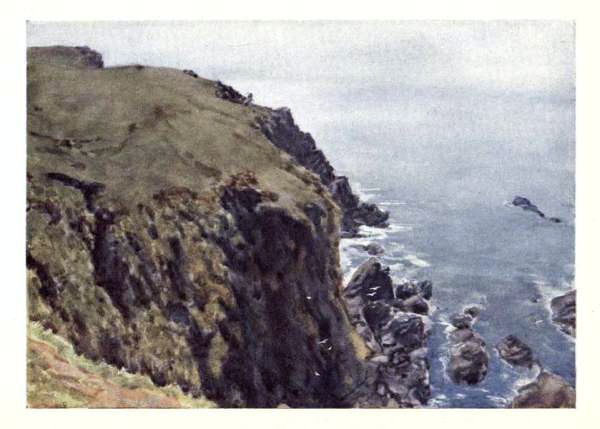
One interesting point about rock scenery is that it changes so little in the course of years that the impressions of those who saw it long ago are still not out of date. There are two very simple little books, two generations old now, but full of charm when read on the spot, Mrs. Craik's An Unsentimental Journey in Cornwall and the Rev. C. A. Johns's A Week at the Lizard, 1848. Mrs. Craik, who wrote John Halifax, Gentleman, came here with two nieces near the end of her life, and gives a picture of Lizard-town which might stand to-day. With a horse and "shay" they visited the various points of interest along the coast, climbed into the dank caves and mounted the slippery weed-strewn rocks. It was a bold journey to make at the time, and their taste was in advance of most of their contemporaries who had not learnt to delight in the grand and desolate places of the earth. The Rev. C. A. Johns is well known as the author of Wild Flowers of the Field, which ran through numerous editions and is the most popular of his many natural-history books.
Not many days after reading Mrs. Craik's book at the Lizard, I was in the light railway running to Newquay in the north of the county and saw a girl of about sixteen, deeply absorbed in a book, opposite to me. It was bound in the dingy maroon cloth so beloved by the librarians of Free Libraries, and peeping over I saw it was John Halifax, thus nearly sixty years after publication giving as much pleasure as when it was new! If the good lady could have known it, how pleased she would have been!
When the sun falls over the shoulder of the cliff in the west, the revolving light from the lighthouse begins to flash out with a regular monotonous beat on its long night vigil. At any time after dark one can see the huge pencil of light darting round, striking the white signal station opposite, losing itself in the sea and so returning. There is something awe-inspiring in that regular sweep of pulsing light every three minutes, hour after hour, carrying its silent sure message to those at sea. If anything happened to the Lizard light what terrible wrecks there would be on this jagged coast!
Nearly as impressive is it to catch by night the glimmer of the Morse code flashing from ships which are revealing their names and journeys to those ever-vigilant watchers in the signal station as they pass. What stories that signal station might tell of the journeyings to and fro, of the ships conveying food and clothes and necessaries from port to port! Here is a vessel bound from Galveston to Havre with cotton, she is British; about every second or third that come by is laden with coals from Cardiff; here is another from the other direction, bringing fruit from the Mediterranean to Liverpool, with all the beating up the Irish Channel yet to face; passing it, and doubtless hailing it in transit, is another Liverpool ship carrying a general cargo to Italy, and when times are peaceful and there are no scares from submarines, the great American liners from Plymouth swell the number with their enormous bulk. It is a regular, and, if one may use the expression, a well-beaten track around this great blunt headland, and it is small wonder the enemy submarines haunted it to find their prey, as men wait hidden beside the tracks of wild animals in the jungle.