III
Reading edition
THE "TOE" OF CORNWALL
Penzance is strongly reminiscent of the Channel Isles to those who know both. There is the same odd mixture of sternness in the bare outlines of the stone houses—as bare as those on the Cumbrian Fells—and the unexpected luxuriance of growth, the flourishing tree-shrubs such as hydrangeas and fuchsias, in backyards and odd corners. When one gets a vista down the Morab Gardens in the midst of the town, with the steep green depths framed by the bushy-topped palms falling away to the brilliant blue sea, one might almost be having a peep in the Riviera, if we accept the lack of orange-trees, with their golden lamps, so beautiful to the sight, so disappointing to the taste! It is surprising to those coming from harsher parts of England to see the deprecating droop of the blue-grey tongues of the eucalyptus, the feathery grace of clumps of bamboo, and the glossy-leaved bushes of camellia. At any rate, whatever one compares the place with, one is conscious of an odd surprise at its un-English characteristics.
ST. MICHAEL'S MOUNT
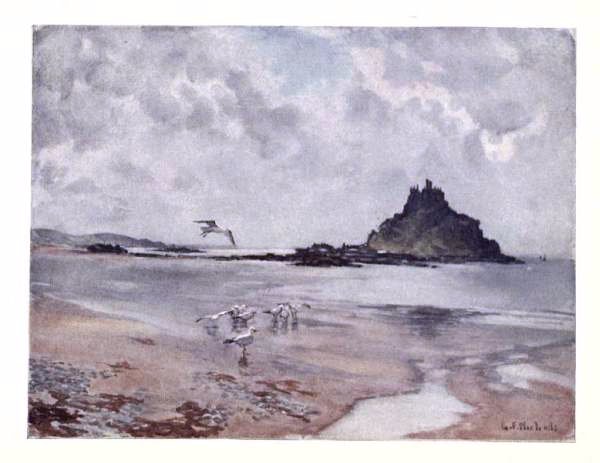
The "front" is not the great attraction at Penzance. No doubt the wonderful bay, with its priceless jewel of St. Michael's Mount, does at all times satisfy the imagination; but the flat esplanade, the singularly ineffective strip for sea-bathing, and the rather dull style in which most of the houses are built, are not in themselves attractive. The bay can be seen better elsewhere, from the heights of the very ample churchyard of St. Mary's for instance, overlooking the grey slate roofs, or from Newlyn Hill, when at sunset time all the colours of the spectrum may be reflected on the Mount, and the only thing one can say with perfect certainty is that it is never twice exactly alike. One of the most lovely visions is when the sun catches it through a rift in sombre clouds, bathing it in a kind of unearthly radiance or dawning light, while Penzance, with its tall-pinnacled church tower, is all mouse-grey. And when a rainbow arches over one side of the steep slope, as I have seen it, it is almost unearthly.
Sometimes the Mount disappears entirely, melting into its background, or only the castle is left visible, apparently unsupported except by a filmy mist. There is no end to the vagaries played by the lights and shadows and sea-colours on this wonderful instrument. Indeed the Mount is chiefly valuable for this reason, because, owing to the fact that it is private property, and that access to it is much restricted, it is not nearly so much an object of intrinsic interest as its grand counterpart in Brittany.
It must be a strange place to live on. When the St. Levan family arrive they have to go over by launch from Penzance, probably after a long journey by rail; and the weather, if tempestuous, must make even such a short crossing unpleasant. Once there, there is the stupendous steep to climb—no trifle, even though the roads are graded. Dining out with county neighbours must be an almost impossible feat, and grand as the surroundings are, they must pall very soon because of their limitations. Tradition says that the men-folk of the family are not supposed to be able to swim properly until they can swim all round the Mount, a fine undertaking in view of the rocks and shoals!
The Mount in Brittany is only 57 feet higher, but looks much larger, which is curious, as it stands considerably farther out to sea, being 1¼ miles away; the Cornish one is only about 1,200 feet from the mainland. Perhaps the reason is the greater variety and grandeur of the buildings on St. Michel.
The old name of Marazion was Market-jew, and the two together certainly make most people imagine there is some Israelitish association; but this is unfounded. Marazion is "the market by the seaside," and Market-jew "the market on the side of the hill." Some have supposed the Mount to have been the Ictis of the ancient tin trade, where the merchants from far met the inhabitants to barter for tin. "When they have cast it [the tin] into the form of cubes, they carry it to a certain island adjoining Britain called Ictis. During the recess of the tide the intervening space is left dry, and they carry over abundance of tin in carts" (Diodorus Siculus). Many other islands have been suggested to fit this account, even the Isle of Wight; but the bed of the sea must have changed very quickly if people could in historic times pass over to it on foot at low tide!
The legend of the fair land of Lyonnesse is supported by the evidence of a submarine forest in Mount's Bay, noted by Borlase in 1757. This seems to have been a wood chiefly of hazel, but with alders, oaks, and other trees, and is by no means the only case of a submerged forest being found around the shores of Cornwall. Great trunks have been disclosed, and even hazel-nuts and twigs; but it is a big step from the subsidence of some parts of the shore and the consequent submergence of forest land, to the story of the overwhelming of such a land as Lyonnesse, reaching out as far as Scilly and containing many villages and churches.
To return to Penzance. The town is very irregular, its meandering streets meet at all angles, and here and there are linked by narrow, passage-like cross-cuts, ofttimes as steep as wynds. There is a very noticeable prevalence of Nonconformist places of worship, and these show, as most of their kind do, a hideous lack of architectural beauty, a sort of defiance of the pride of the eye. The Cornishmen since Wesley's crusade have been strongly Nonconformist, notwithstanding the fact that Wesley himself was a son of the Church. They probably find the rigidity of the Established Church too formal for their fervent souls. Nonconformity appeals to them as it does to their cousins the Welsh, and it is a curious thing that St. Mary's, the most ancient of the churches, should be the opposite of this, with ritualistic services, whence the smell of incense is wafted into the uncompromising streets.
NEWLYN
The greatest son of Penzance is Sir Humphry Davy, who was born here in 1778. He belonged to an old Cornish family. His statue stands at the head of the sloping Market-jew Street.
Though Penzance has not in itself anything very remarkable to show in the way of beauty, it is certainly a good centre for excursions, being at the very joint of the swollen and deformed "toe" of the county. Roads start from it in all directions over this much-sought peninsula, and it would be easy to spend not one, but many weeks hunting out all the quaint and interesting things, both natural and artificial, to be seen within reasonable distance.
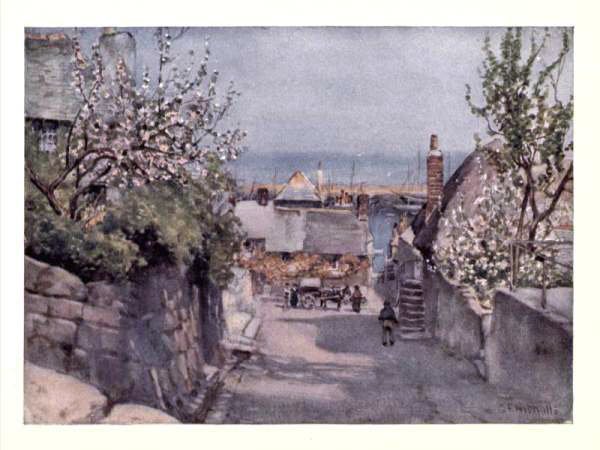
Newlyn, home of the painting colony known all the world over, is close to Penzance, and straggles up the side of a terrific hill. Rows of stereotyped villas in terraces now overlook the bay, and are eagerly taken as they are built. But round the harbour linger still the odours of the typical old fishing village, and there are few sights more suggestive to the imagination than the scattering of the red-sailed fishing-boats as one by one they pass at evening time out between the narrow horns of the harbour to their rough, wet nights of toil in the clammy sea air. Newlyn is famous for its apple-blossom, and the vision of the bay between masses of apple-blossom in springtime is one never to be forgotten. Newlyn itself is easily accessible compared with Mousehole, right round the corner, tucked away under the cliff. Here a name for once is thoroughly suitable, for the little place is hemmed in by the towering hills, and the principal ways on foot out of it are by tiny overgrown lanes, so narrow that two people can hardly pass, so steep that in places they are veritable staircases, with rotten wooden steps, or those made from hollowed mud worn by many feet. Yet whether the name really does mean what it appears to, or is only a corruption of some other word with a totally different significance, is not known. R. Edmonds (Land's End District) suggests "Mozhel" or "Mouzhel," meaning maids' brook or river, as a stream used for washing by the women runs through the town.
The constant steep places in Cornwall are a great puzzle to many people who come with an idea that the Duchy is neatly and evenly sloped, rising in the middle and falling down to the sea on each side. As has been explained, this is very far from the truth. A pilgrimage round the county is like climbing a succession of ridges. The steeps are so steep that they demand real physical effort, and even the drops put a strain on unaccustomed leg-muscles. Newlyn Hill taxes the strength of those coming from normally level districts. It is to be hoped that only horses born and bred in Cornwall are used for the charabancs and other public vehicles; it would be sheer cruelty to bring horses from flat-lands here.
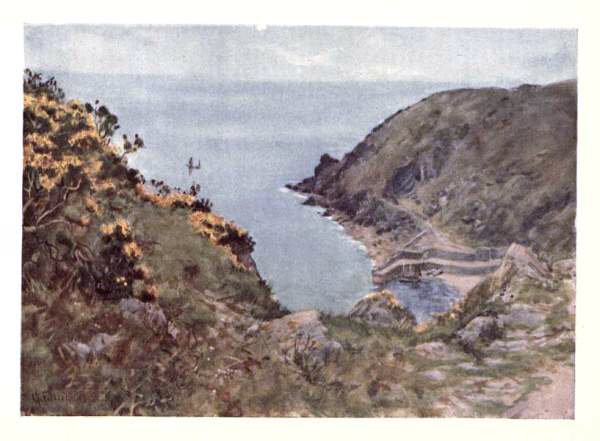
If we scrambled along the coast beyond Mousehole we should come to Lamorna Cove, a deep indentation filled with scrub-bush and small trees. Wherever it is possible trees grow in Cornwall; they take advantage of every atom of shelter, and every cleft in the ground out of the raging wind is filled with them.
The soil is wonderfully fertile, and the constant wet—not even its most ardent admirer denies that Cornwall gets rather more than its share of rain—develops a prodigal amount of growth in the way of ferns and creepers and other plants that like warm moisture. At Lamorna is a colony of artists; they have settled here as an outpost from Newlyn, for the natural beauty and remoteness of the place suit them. They have their picturesque houses within friendly reach all up and down the little glen, and take pride in their gardens, with wonderful rockeries and babbling streams, and all the rich growth that the soil and climate bring forth. They drop in on one another at all hours, and know all about each other's concerns. They are a friendly, kindly, generous-hearted clan. Here, where the woods are white with hawthorn in the spring, the stream gushes down in endless waterfalls, and the waves burst and break on the rocks in the cove below, every one of them can find endless scenes for his or her brush.
Mrs. Alfred Sidgwick's book, In Other Days, gives a picture of Lamorna Valley in the guise of fiction: "It was a brilliant March day, warm in the sun, cold in the wind. The gorse and the blackthorn were both out, spreading the wild copse and common of the valley with a shimmer of white and gold. The old bracken still lay in patches of ruddy brown, primroses were just beginning shyly, and the short grass of the open places had not put on its summer hues yet. The sky was clear and deep, with little white clouds scudding across it; larks were singing, and in the distance sounds of men at work in the fields were heard. The air was scented with herbs and fresh from the sea, but sheltered by the lie of the low hills, and by old, long-neglected trees. In some places the trees were of a great height and girth, making a gloom over the huge moss-grown granite rocks strewing the earth and edging the little stream.... A small swamp full of peppermint scented the air."
LAMORNA COVE
That is the work of a close observer.
In this neighbourhood there are many of those curious relics of bygone times, which are bestrewn about Cornwall more thickly than any other part of England. The Fougou Hole in one of the gardens is a weird place, and its meaning and use is even yet little understood. It is a tiny, damp vault, made of great, unhewn stones, and reached by a hole in the ground. Here it is said harried cavaliers took shelter in the Civil Wars, but the Hole is much older than that; it dates back to those strange times beyond the dawn of history of which we only get vague glimpses.
In the fields above, gaunt stones rise like pointing fingers to the sky. These are called "The Pipers," and mark the scene of Athelstan's defeat of the British in 936; it is the "place of blood." But if they were really erected by Athelstan in the tenth century, and are not, as is possible, relics of Druid worship, they are modern compared with the Fougou Hole. Not far from them, in the midst of a grass-field, are the "Merry Maidens," a circle of grey stones about 24 yards in diameter; there are nineteen of them altogether, none quite the height of a man, and some much smaller. They convey an impression of immovable solemnity, as such age-old things always do, for they are planted so securely, and look so indomitable with their grey, lichen-covered sides four-square to the winds. Local tradition tells how the Merry Maidens were caught dancing on the Sabbath to the music of the pipers, and turned to stone, but history is silent as to their origin. There is indeed all over Cornwall many a reminder of the ancient world now lost to all record. In various other places are to be found other circles of Merry Maidens just as much of a problem as these, but none so perfect or so impressive.
The long, narrow, rectangular tower of St. Buryan, crowned with pinnacles, dominates all the landscape; exactly of this pattern are most of the Cornish church towers. They are generally as much alike as if they had been turned out of a mould. This is one of the most interesting of the many interesting churches in Cornwall. After Athelstan's triumphant victory near Lamorna, he vowed he would establish here a large religious foundation if he were successful in his further expedition to the Scilly Isles; and when he returned a conqueror he carried out his vow. This was about 930. Of course, there is nothing remaining of that church, but the present building contains much grotesque carving of the fourteenth and fifteenth centuries, and the greater part of the building must have stood from the fifteenth or sixteenth. There is a peacefulness about the ancient church, set in the long, billowing fields bordered by rugged hedges, gorse and ivy-grown, that appeals peculiarly to some natures. It is all very quiet.
Down on the shore, not many miles away, is a great pile of splintered rocks jutting out into the sea, to be reached by a narrow neck. This is Treryn Dinas or Castle, where is the famous Logan stone. The striking thing about the rocks is that so many take the form of cubes, some of the most astounding being almost exactly the shape of the ancient Egyptian obelisks. There are so many shattered, square-edged lumps, resting on small bases, that the difficulty to the stranger is to discover the real Logan Rock, which brings hundreds of visitors to the place in summer. This headland has evidently been at one time a fortified cliff-castle, and in passing over to the peninsula visitors cross the first line of defence or earthworks, though few would notice it.
From Penzance we might run out by any one of the diverging roads across the peninsula, and be sure of coming upon some relic of the most ancient race inhabiting these islands.
By way of Madron we should pass the Lanyon Quoit or Cromlech, a great slab of rock 18 feet long, supported on three other slabs which are just a little too low to allow a man to stand upright beneath it. In 1816 it fell or was blown down; before this a mounted man could sit under it. When Lieutenant Goldsmith in 1824 committed the silly trick of upsetting the Logan Rock, and was condemned by the Admiralty to rebalance it at his own expense, the apparatus brought down to the duchy for the purpose was also used to replace the cap of the Cromlech, though why it should be of less height now than before is not known.
Amid the bleak hills around are to be found constant remains of ancient British villages, rather in the manner of the Picts' houses of Scotland. That the strange people who lived in them thrashed corn for food and kept cattle, there is plenty of evidence. They lived in these little beehive huts, which were sometimes placed singly, sometimes two or three together, often with an embankment round, or a good cave near for retreat if necessary. The huts are circular and built without cement or mortar. Fragments of pottery have been found in and around. Some of them are near Chun Castle, that ancient earthwork, one of the half-dozen or so in the "toe" of Cornwall. This district was the last stronghold of the British race, who had retreated before the Western invaders to the very extremity of the land.
By any one of these roads we should come at last out on to the coast road—rather grandiloquently called "The Atlantic Drive"—running from Land's End to St. Ives. This has been compared with the famous Corniche drives of the Riviera. But beware! Don't expect too much, or you will be terribly disappointed. Yet if you go with an open mind, expecting nothing, you will see something of very real interest and carry away new knowledge.
The fields are in many places simply covered with stones. How the corn finds room to grow is a miracle. The constant winds try everything growing very severely, and there is a look of bare poverty about the land. It is often compared with Ireland, and called the Connemara of England; but in some ways, especially in the amount of stones, it is more like bits of Galloway. Stone is employed for objects which elsewhere are usually made of wood. The stiles are broad slabs of granite, the gate-posts are granite blocks, and as we have seen, the very "hedges" are stone. The name Zennor suggests gauntness of a Puritan kind. The whole of the great hill above Zennor is covered with immense and, if one may use such an expression, dignified stones. Away up among them is another huge quoit or cromlech, probably marking the burial-place of some chieftain long before Arthur's date. It is a grand place for burial too, austere and solemn, overlooking the ocean, and with a limitless horizon. The man who was buried here must have had imagination if he chose the spot for himself beforehand. The tearing winds shriek over the ragged furze and mighty stones, and howl in the crevices of the monument above him; the great black clouds roll in, and the whole country is drowned in a blinding squall of hail; the sky clears, patches of brilliant blue appear, and the sun strikes down on the dripping stones, while all the little rills and streams race down the soaking ground and over the roads in the wayward manner of Cornish streams; and still the old chieftain sleeps on, lulled by all the music of Nature in this wild outpost which England thrusts into the sea.
The road surface round here is tolerably good. Much of it is granite, and the tiny crystals glitter in the sun like diamonds, and quickly dry up after the whirlwinds of rain that pitilessly descend in winter time. The road winds along around the desolate hills, keeping mostly rather far inland, and it passes by acres of rough land covered with the wayward gorse, where small, fox-red cows take an interest in the stranger. In spring primroses grow to enormous sizes, with leaves as large as those of foxgloves; and the foxgloves in their turn decorate the hedges, rearing their tall spikes of magenta-coloured bells in profusion. Pigs abound, and great grey sheep-dogs, of the Old English bobtail breed, come shyly to make friends. And everywhere in irrepressible masses is the furze, the quick-burning fuel of the poor, a godsend here where wood is so precious.
Almost due west of Penzance is the mining region, where until lately there was great activity, now comparatively still. St. Just is the centre of this district; but it is not what one would expect in a mining town. Right in the heart of it, where now the children make their playground, is a great amphitheatre, one of the best known and preserved of the many like it that at one time held hundreds of Cornish folk to watch the open-air plays that delighted their hearts until Wesley's teaching made them think them wrong. After that they served as meeting-places for Wesley himself in many instances. The church, with some peculiarly quaint frescoes, and the Plan-an-guaré, the plane as it is called locally, give St. Just a character of its own. Down one terrific hill, falling at an angle that no one unless he lived in Cornwall would dare to make a road, and up another, is Botallack, with its well-known mine, now stilled, and the taint of the red tin is felt in earth and air for many a mile beyond.