XVI WAR TIME 1912-1913 (continued 2)
Reading edition
VII.—REFUGEES
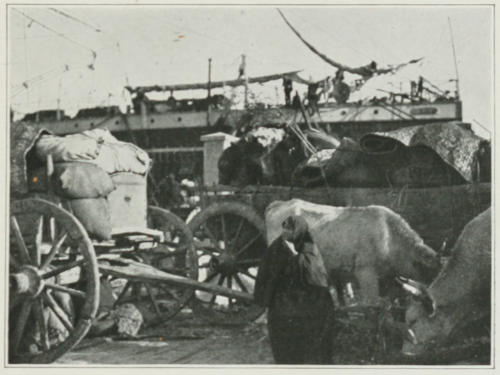
They say they do not like Christians to live in the sacred suburb of Eyoub. But they are used by this time to seeing us. Too many of us go there, alas, to climb the hill and look at the view and feel as sentimental as we can over Aziyadé. And certainly the good people of Eyoub made no objection to Lady Lowther when she established in their midst a committee for distributing food and clothing and fuel to the families of poor soldiers and to the refugees. The hordes of Asia had not stopped pouring through the city on their way to the west before another horde began pouring the other way, out of Europe. Within a month there could hardly have been a Turk left between the Bulgarian border and the Chatalja lines. It was partly, no doubt, due to the narrowness of the field of operations, lying as it did between two converging seas, which enabled the conquering army to drive the whole country in a battue before it. But I cannot imagine any Western people trekking with such unanimity. They would have been more firmly rooted to the soil. The Turk, however, is still half a tent-man, and he has never felt perfectly at home in Europe. So village after village harnessed its black water-buffalo or its little grey oxen to its carts of clumsy wheels, piled thereon its few effects, covered them with matting spread over bent saplings, and came into Constantinople.
How many of them came I do not imagine any one knows. Thousands and tens of thousands of them were shipped over into Asia Minor. Other thousands remained, in the hope of going back to their ruined homes. The soldiers and the sick had already occupied most of the spare room that was to be found. The refugees had to take what was left. I knew one colony of them that spent the winter in the sailing caïques in which they fled from the coast villages of the Marmora. Being myself like a Turk in that I make little of numbers and computations, I have no means of knowing how many men, women, and children, from how many villages, swelled the population of Eyoub. I only know that their own people took in a good number, that they lived in cloisters and empty houses, that certain mosques were given up to them entirely, that sheds, storehouses, stables, were full of them. I even heard of four persons who had no other shelter than a water-closet. And still streets and open spaces were turned into camping grounds, where small grey cattle were tethered to big carts and where people in veils and turbans shivered over camp-fires—when they had a camp-fire to shiver over. They could generally fall back on cypress wood. It always gave me a double pang to catch the aroma of such a fire, betraying as it did the extremity of some poor exile and the devastation at work among the trees that give Constantinople so much of its colour.
Exiles
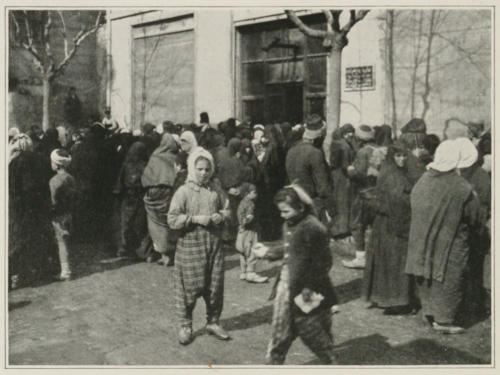
I have done a good deal of visiting in my day, being somewhat given to seek the society of my kind. But it has not often happened to me, in the usual course of visiting, to come so near the realities of life as when, with another member of our subcommittee, I visited the mosque of Zal Mahmoud Pasha, in Eyoub. The mosque of Zal Mahmoud Pasha is worth visiting. It was built by Sinan, and its founder, a Vizier of Selim II, was nicknamed Zal, after a famous Persian champion, because, with his own hands, he finally succeeded in strangling the strong young prince Moustafa, son of Süleïman the Magnificent. Like its greater neighbour, the mosque of Zal Mahmoud Pasha has two courts. They are on two levels, joined by a flight of steps, each opening into a thoroughfare of its own. And very cheerless they looked indeed on a winter day of snow, especially for the cattle stabled in their cloisters. The mosque itself was open to any who cared to go in. We did so, pushing aside the heavy flap that hangs at any public Turkish doorway in winter. We found ourselves in a narrow vestibule in which eight or ten families were living. One of them consisted of two children, a little boy flushed with fever and a pale and wasted little girl, who lay on the bricks near the door without mattress or matting under them. They were not quite alone in the world, we learned. Their mother had gone away to find them bread. The same was the case with a larger family of children who sat around a primitive brazier. The youngest was crying, and a girl of ten was telling him that their mother would soon be back with something to eat.
We lifted a second flap. A wave of warm smoky air met us, sweetened by cypress wood but sickeningly close. Through the haze of smoke we saw that the square of the nave, surrounded on three sides by a gallery, was packed as if by a congregation. The congregation consisted chiefly of women and children, which is not the thing in Turkey, sitting on the matted floor in groups, and all about them were chests and small piles of bedding and stray cooking utensils. Each of these groups constituted a house, as they put it. As we went from one to another, asking questions and taking notes, we counted seventy-eight of them. Some four hundred people, that is, were living huddled together under the dome of Zal Mahmoud Pasha. In the gallery and under it rude partitions had been made by stretching ropes between the pillars and hanging up a spare rug or quilt. In the open space of the centre there was nothing to mark off house from house save the bit of rug or matting that most of the families had had time to bring away with them, or such boundaries as could be drawn by the more solid of the family possessions and by the row of family shoes. Under such conditions had not a few of the congregation drawn their first or their last breath.
Nearly every “house” had a brazier of some kind, if only improvised out of a kerosene tin. That was where the blue haze came from and the scent of cypress wood. Some had a little charcoal, and were daily near asphyxiating themselves. Others had no fire at all. On a number of the braziers we noticed curious flat cakes baking, into whose composition went bran or even straw. We took them to be some Thracian dainty until we learned that they were a substitute for bread. The city was supposed to give each refugee a loaf a day, but many somehow did not succeed in getting their share. A few told us that they had had none, unless from their neighbours, for five days. It struck me, in this connection, that in no other country I knew would the mosque carpets still have been lying folded in one corner instead of making life a little more tolerable for that melancholy congregation. Of complaint, however, we heard as little as possible. The four hundred sat very silently in their smoky mosque. Many of them had not only their lost homes to think of. A father told us that when Chorlou was spoiled, as he put it, his little girl of nine had found a place in the “fire carriage” that went before his, and he had not seen her since. One old man had lost the rest of his family. He had been unable to keep up with them, he said: it had taken him twenty-two days to walk from Kîrk Kil’seh. A tall ragged young woman, who told us that her effendi made war in Adrianople, said she had three children. One of them she rocked beside her in a wooden washing trough. It came out only by accident that she had adopted the other two during the hegira from Thrace. We wondered how, if the effendi ever came out of Adrianople alive, he would find his wife and his baby; for hardly one in fifty of these peasants could read or write, and no exact register of them was kept. Many of them were ill and lay on the floor under a coloured quilt. If another member of the family wanted to take a nap he would crawl under the same quilt. Is it any wonder that diseases became epidemic in the mosques? Cholera did not break out in many of them except St. Sophia, which was used as a barracks. But in Zal Mahmoud Pasha there were at one time cases of consumption, pneumonia, typhoid fever, scarlet fever, measles, mumps, and smallpox. Five cases of the last were found under one quilt. Still, the refugees would not be vaccinated if they could help it. The only way to bring them to it was to cut off their bread. And not many of them were willing to go away or to let members of their families be taken away to hospitals. How did they know whether they would ever see each other again, they asked? A poor mother we knew, whose husband had been taken as a soldier and had not been heard of since, and whose home had burned to the ground before her eyes, lost her four children, one after the other. A neighbour afterward remarked of her in wonder that she seemed to have no mind in her head.
Lady Lowther’s refugees
In distributing Lady Lowther’s relief we did what we could to systematise. Having visited, quarter by quarter, to see for ourselves the condition of the people and what they most needed, we gave the head of each house a numbered ticket, enabling him or her to draw on us for certain supplies. Most of the supplies were dealt out on our own day at home. They say it is more blessed to give than to receive. I found, however, that it was most possible to appreciate the humorous and decorative side of Thrace when we received, in the coffee-shop of many windows which was our headquarters. It is astonishing how large a proportion of Thrace is god-daughter to Hadijeh or Aïsheh, Mothers of the Moslems, or to the Prophet’s daughter Fatma. Many, nevertheless, reminded one of Mme. Chrysanthème and Madam Butterfly. On our visiting list were Mrs. Hyacinth, Mrs. Tulip, Mrs. Appletree, and Mrs. Nightingale. I am also happy enough to possess the acquaintance of Mrs. Sweetmeat, Mrs. Diamond, Mrs. Pink (the colour), Mrs. Cotton (of African descent), Mrs. Air (though some know her as Mother Eve), Miss May She Laugh, and Master He Waited. This last appellation seemed to me so curious that I inquired into it, and learned that my young gentleman waited to be born. These are not surnames, you understand, for no Turk owns such a thing. Nor yet, I suppose, can one call them Christian names! To tell one Mistress Hyacinth from another you add the name of her man; and in his case all you can do is to call him the son of so and so.
If we found the nomenclature of Mistress Hyacinth and her family a source of perplexity, she in turn was not a little confounded by our system of tickets. We had one for bread. We had another for charcoal. We had a third for groceries. We had a fourth and a fifth for fodder. We had a sixth, the most important of all, since it entitled the bearer to the others, which must be tied tight in a painted handkerchief and never be lost. “By God!” cried Mistress Hyacinth in her honoured idiom, “I know not what these papers mean!” And sometimes it was well-nigh impossible to explain it to her. A good part of her confusion, I suspect, should be put down to our strange accent and grammar, and to our unfamiliarity with the Thracian point of view. Still, I think the ladies of that peninsula share the general hesitation of their race to concern themselves with mathematical accuracy. Asked how many children they had, they rarely knew until they had counted up on their fingers two or three times. It is evidently no habit with them to have the precise number in mind. So when they made an obvious mistake we did not necessarily suspect them of an attempt to overestimate. As a matter of fact, they were more likely to underestimate. Other failures of memory were more surprising, as that of a dowager in ebony who was unable to tell her husband’s name. “How should I know?” she protested. “He died so long ago!” When questioned with regard to their own needs they were equally vague. “I am naked,” was their commonest reply. “Whatever your eye picks out, I will take.” But if our eye failed to pick out the right thing, they would in the end give us a hint.
Altogether it is evident that the indirections of Mistress Hyacinth follow a compass different from our own. I remember a girl not more than sixteen or seventeen who told us she had three children. Two of them were with her: where was the third, we asked? “Here,” she answered, patting herself with the simplicity of which the Anglo-Saxons have lost the secret. Yet she was most scrupulous to keep her nose and mouth hidden from an indiscriminate world. Another woman, asked about a child we knew, replied non-committally: “We have sent him away.” “Where?” we demanded in alarm, for we had known of refugees giving away or even selling their children. “Eh—he went,” returned the mother gravely. “Have you news of him?” one of us pursued. “Yes,” she said. And it was finally some one else who had to enlighten our obtuseness by explaining that it was to the other world the child had gone. But none of them hesitated to give the rest of us an opportunity to go there too. Many women came into our coffee-shop carrying in their arms a baby who had smallpox, and were a little hurt because we got rid of them as quickly as possible.
With great discreetness would Mistress Hyacinth enter our presence, rarely so far forgetting herself as to lean on our table or to throw her arms in gratitude about a benefactress’s neck. For in gratitude she abounds, and in such expressions of it as “God give you lives” and “May you never have less.” With a benefactor she is, I am happy to report, more reserved. Him she addresses, according to her age, as “my child,” “my brother,” “my uncle,” or haply “my mother and my father.” I grew so accustomed to occupying the maternal relation to ladies of all ages and colours that I felt slighted when they coldly addressed me as their lord. Imagine, then, my pleasure when one of them called me her creamy boy! In the matter of discretion, however, Mistress Hyacinth is not always impeccable—so far, at least, as concerns the concealment of her charms. Sometimes, indeed, she will scarcely be persuaded to raise her veil even for a lady to recognise her; but at others she appears not to shrink from the masculine eye. One day a Turk, passing our coffee-shop, was attracted by the commotion at the door. He came to the door himself, looked in, and cried out “Shame!” at the disreputable spectacle of a mild male unbeliever and a doorkeeper of his own faith within the same four walls as some of Lady Lowther’s fairer helpers and a motley collection of refugee women, many of them unveiled. But the latter retorted with such promptness that the shame was rather upon him, for leaving the gyaour to supply their wants, that he was happy to let the matter drop. On this and other occasions I gathered a very distinct impression that if Mistress Hyacinth should ever take it into her head to turn suffragette she would not wait long to gain her end.
The nails of Mistress Hyacinth—speaking of suffragettes—are almost always reddened with henna, I notice, and very clean. The henna often extends to her fingers as well, to the palms of her hands, and to her hair. If she happen to be advancing in years, the effect is sometimes very strange to a Western eye. There is no attempt to simulate a youthful glow. The dye is plentifully applied to make a rich coral red. In other points of fashion Mistress Hyacinth is more independent than her sisters of the West. What the ladies of Paris wear must be worn by the ladies of Melbourne, New York, or St. Petersburg. But no such spirit of imitation prevails in Thrace, where every village seems to have modes of its own. We had great difficulty in getting rid of a quantity of clothing sent out by charitable but unimaginative persons in England, who could hardly be expected to know the fashions of Thrace. Articles intended to be worn out of sight were accepted without a murmur when nothing better was to be had, such as a quilted coat of many colours that we bought by the hundred in the Bazaars, called like the Prophet’s mantle a hîrka. But when it came to some very good and long golf capes, the men were more willing to take them than the women—until they thought of cutting them up into children’s coats. Mistress Hyacinth herself scorned to put on even so much of the colour of an unbeliever, preferring the shapeless black mantle of her country, worn over her head if need be, and not quite hiding a pair of full print trousers.
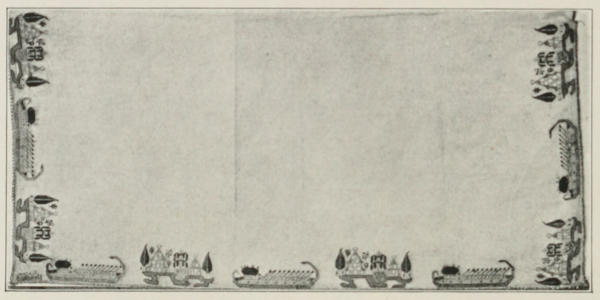
The village whose taste I most admire is that of Vizeh, the ladies of which weave with their own hands a black woolen crash for their mantles, with patches of red-and-blue embroidery where they button, and with trousers of the same dark blue as the sailor collar of a good many of them. I wish I might have gone to Vizeh before the Bulgarians did. There must have been very nice things to pick up—in the way, for instance, of such “napkins” as Lady Mary Montagu described to her sister on the 10th of March, 1718, “all tiffany, embroidered with silks and gold, in the finest manner, in natural flowers.” She added: “It was with the utmost regret that I made use of these costly napkins, as finely wrought as the finest handkerchiefs that ever came out of this country. You may be sure that they were entirely spoiled before dinner was over.” But you, madam, may be sure they were not, for I bought some of them from the ladies of Thrace, rather improved than not by their many washings. They are technically known as Bulgarian towels, being really Turkish; but it seems to me that the tradition which persists in this beautiful peasant embroidery must be Byzantine. Mistress Hyacinth was able to make it, as well as to sell it. And to turn an honest penny she and her friends set up their funny little hand-looms in a house we hired for them, and wove the narrow cloth of their country, loosely mingled of linen or cotton and silk, and shot, it might be, with bright colours of which they had the secret.
Peasant embroidery
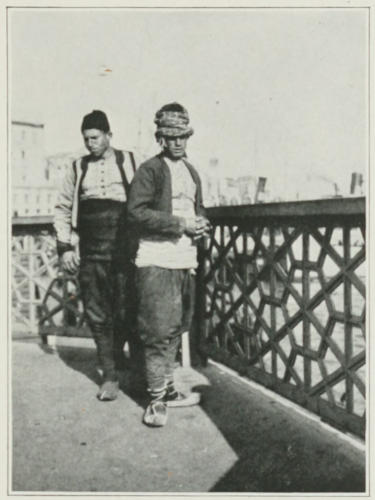
The consort of Mistress Hyacinth, I regret to add, seemed to show less willingness to add to the resources of the family. Perhaps it was because of an inward conviction of which I once or twice caught rumours, that as unbelievers had deprived him of his ordinary means of sustenance, we other unbelievers were in duty bound to keep him alive. For the rest he is outwardly and visibly the decorative member of the family. He inclines less to bagginess than Mistress Hyacinth, or than his brother of Asia. He affects a certain cut of trouser which is popular all the way from the Bosphorus to the Adriatic. This trouser, preferably of what the ladies call a pastel blue, is bound in at the waist by a broad red girdle which also serves as pocket, bank, arsenal, and anything else he pleases. Over it goes a short zouave jacket, more or less embroidered, and round my lord’s head twists a picturesque figured turban, with a tassel dangling in front of one ear. He is a surprisingly well-made and well-featured individual—like Mistress Hyacinth herself, for that matter, and like the roly-poly small fry at their heels. On the whole they give one the sense of furnishing excellent material for a race—if only the right artist could get hold of it.
Young Thrace
VIII.—SEMIPHILOSOPHIC FINALE
One day I stopped on the quay to watch a cheering transport steam down the Bosphorus. An old Turkish lady who happened to be passing stopped to watch it too.
“Poor things! Poor things!” she exclaimed aloud. “The lions! You would think they were going to a wedding!” And then turning to me she suddenly asked: “Can you tell me, effendim, why it is that Europe is against us? Have we done no good in six hundred years?”
The attitude of Europe was the crowning bitterness of the war. In the beginning, Europe had loudly announced that she would tolerate no change in the status quo. How then did Europe come to acquiesce so quickly in the accomplished fact? Why did Germany, the friend of Abd ül Hamid, and England, the friend of Kyamil Pasha, and France, the friend of everybody, raise no finger to help? I am not the one to suggest that Europe should have done otherwise. There is a logic of events which sometimes breaks through official twaddle—a just logic drawing into a common destiny those who share common traditions and speak a common tongue. I make no doubt that Austria-Hungary, to mention only one example, will one day prove it to her cost. Nevertheless, I am able to see that there is a Turkish point of view. And my old lady’s question struck me as being so profound that I made no pretence of answering it.
I might, to be sure, have replied what so many other people were saying: “Madam, most certainly you have done no good in six hundred years. It is solely because of the evil you have done that you enjoy any renown in the world. You have done nothing but burn, pillage, massacre, defile, and destroy. You have stamped out civilisation wherever your horsemen have trod. And what you were in the beginning you are now. Your enemy the Bulgarian has advanced more in one generation than you have in twenty. You still cling to the forms of a bloody and barbaric religion, but for what it teaches of truth and humanity you have no ear. You make one justice for yourself and one for the owner of the land you have robbed. Your word has become a byword among the nations. You are too proud or too lazy to learn more than your fathers knew. You fear and try to imitate the West; but of the toil, the patience, the thoroughness, the perseverance that are the secret of the West you have no inkling. You will not work yourself, and you will not let others work—unless for your pocket. You have no literature, no art, no science, no industry, worth the name. You are incapable of building a road or a ship. You take everything from others—only to spoil it, like those territories where you were lately at war, like this city, which was once the glory of the world. You have no shadow of right to this city or to those territories. The graves of your ancestors are not there. You took them by the sword, and, like everything else that comes into your hands, you have slowly ruined them. It is only just that you should lose them by the sword. For your sword was the one thing you knew how to use, and now even that has rusted in your hand. You are rotten through and through. That is why Europe is against you. Go back to your tents in Asia, and see if you will be capable of learning something in another six hundred years.”
So might I have answered my old lady—had my Turkish been good enough. But I would scarcely have convinced her. Nor would I quite have convinced myself. For while it is a simple and often very refreshing disposal of a man to damn him up and down, it is not one that really disposes of him. He still remains there, solid and unexplained. So while my reason tells me how incompetent a man the Turk is from most Western points of view, it reminds me that other men have been incompetent as well, and even subject to violent inconsistencies of character; that this man is a being in evolution, with reasons for becoming what he is, to whom Dame Nature may not have given her last touch.
In this liberal disposition my reason is no doubt quickened, I must confess, by the fact that I am at heart a friend of the Turk. It may be merely association. I have known him many years. But there is something about him I cannot help liking—a simplicity, a manliness, a dignity. I like his fondness for water, and flowers, and green meadows, and spreading trees. I like his love of children. I like his perfect manners. I like his sobriety. I like his patience. I like the way he faces death. One of the things I like most about him is what has been perhaps most his undoing—his lack of any commercial instinct. I like, too, what no one has much noticed, the artistic side of him. I do not know Turkish enough to appreciate his literature, and his religion forbids him—or he imagines it does—to engage in the plastic arts. But in architecture and certain forms of decoration he has created a school of his own. It is not only that the Turkish quarter of any Ottoman town is more picturesque than the others. The old Palace of the sultans in Constantinople, certain old houses I have seen, the mosques, the medressehs, the hans, the tombs, the fountains, of the Turks are an achievement that deserves more serious study than has been given them. You may tell me that they are not Turkish because they were designed after Byzantine or Saracen originals, and because Greeks and Persians had much to do with building them. But I shall answer that every architecture was derived from another, in days not so near our own, and that, after all, it was the Turk who created the opportunity for the foreign artist and ordered what he wanted.
I have, therefore, as little patience as possible with the Gladstonian theory of the unspeakable Turk. When war ceases, when murders take place no more in happier lands, when the last riot is quelled and the last negro lynched, it will be time to discuss whether the Turk is by nature more or less bloody than other men. In the meantime I beg to point out that he is, as a matter of fact, the most peaceable, with the possible exception of the Armenian, of the various tribes of his empire. Arab, Kürd, and Laz are all quicker with their blades. To his more positive qualities I am by no means alone in testifying. If I had time for chapter and verse I might quote more than one generation of foreign officers in the Turkish service, and a whole literature of travel—to which Pierre Loti has contributed his share. But I do not hesitate to add that this is a matter in which Pierre Loti may be as unsafe a guide as Mr. Gladstone. For blind praise is no more intelligent than blind condemnation. Neither leads one any nearer to understanding the strange case of the Turk.
To understand him at all, I think one needs to take a long view of history. When we consider how many æons man must have lived on this planet and how short in comparison has been the present phase of Western civilisation, it does not seem as if we had good ground for expressing definitive opinions with regard to Eastern peoples. A hundred years ago there was no hint in the West of the expansion that was to come through the use of steam and electricity. Three hundred years ago communications in most of Europe were not so good as, and I doubt if life and property were more secure than, they are in Turkey to-day. For some reason the Turk has lagged in his development. He is to all practical purposes a mediæval man, and it is not fair to judge him by the standards of the twentieth century.
Why it should be that men who have a common origin should have followed such different roads, and at such an uneven pace, is in many ways an insoluble problem. But it should not be, by this time, an unfamiliar one. It would rather be strange, and the world would be much poorer than it is, if humanity had marched from the beginning in a single phalanx—if the world had been one great India, or one great Egypt, or one great Greece. The Turk, then, as I have no need of insisting, is a mediæval man. And one reason why he is so may be that he has a much shorter heritage of civilisation than the countries of the West. He is a new man as well as a mediæval one. In Europe and in Asia alike he is a parvenu who came on to the scene long after every one else. It is only verbally that the American is a newer man; for in the thirteenth century, when the warlike Turkish nomads first began to make themselves known, the different states which have contributed to make America were already formed, while India, China, and Japan had long before reached a high degree of civilisation.
It seems to me that this fact might well account for much of the backwardness of the Turk. He has a much thinner deposit of heredity in his brain cells. It is conceivable, too, that another matter of heredity may enter into it. Whether civil life originated in Asia or not, it is certain that of existing civilisations the Oriental are older than the Occidental. Perhaps, therefore, the Asiatic formed the habit of pride and self-sufficiency. Then as successive tides of emigration rolled away, Asia was gradually drained of everything that was not the fine flower of conservatism. He who believed whatever is is best stayed at home. The others went in search of new worlds, and found them not only in the field of empire but in those of science and art. This continual skimming of the adventurous element can only have confirmed Asia in the habit of mind so perfectly expressed by the Book of Ecclesiastes. And the Turk, who was one of the last adventurers to emerge from Asia, impelled by what obscure causes we hardly know, must have a profound racial bent toward the belief that everything is vanity and vexation of spirit. He asks himself what is the use, and lets life slip by.
Many people have held that there is something in Islam which automatically arrests the development of those who profess it. I cannot think, myself, that the thesis has been sufficiently proved. While no one can deny that religion, and particularly that Islam, is a great cohesive force, it seems to me that people have more to do with making religions than religions with making people. The principles at the root of all aspiring life—call it moral, ethical, or religious, as you will—exist in every religion. And organised religion has everywhere been responsible for much of the fanaticism and disorder of the world. For the rest, I find much in Mohammedanism to admire. There is a nobility in its stern monotheism, disdaining every semblance of trinitarian subtleties. Its daily services impress me as being a more direct and dignified form of worship than our self-conscious Sunday mornings with their rustling pews and operatic choirs. Then the democracy of Islam and much of what it inculcates with regard to family and civil life are worthy of all respect, to say nothing of the hygienic principles which it succeeded in impressing at a very early stage upon a primitive people. At the same time there can be no doubt that Mohammedanism suffers from the fact that it was designed, all too definitely, for a primitive people. Men at a higher stage of evolution than were the Arabs of the seventh century require no religious sanctions to keep themselves clean. For modern men the social system of Islam, with its degrading estimate of woman, is distinctly antisocial. And many of them must find the Prophet’s persuasions to the future life a little vulgar. The question is whether they will be able to modernise Islam. It will be harder than modernising Christianity, for the reason that Islam is a far minuter system. Is there not something moving in the spectacle of a people committed to an order which can never prevail? Even for this one little ironic circumstance it can never prevail in our hurrying modern world, because it takes too much time to be a good Mohammedan. But the whole order is based on a conception which the modern world refuses to admit. The word Islam means resignation—submission to the will of God. And there can be no doubt that the mind of Islam is saturated with that spirit. Why does one man succeed and another fail? It is the will of God. Why do some recover from illness and others die? It is the will of God. Why do empires rise or fall? It is the will of God. A man who literally believes such a doctrine has no chance against the man, however less a philosopher, who believes that his destiny lies in his own hand.
It would be an interesting experiment to see what two generations, say, of universal education might do for the Turks. By education I mean no more than the three R’s, enough history and geography to know that Turkey is neither the largest nor the most ancient empire in the world, and some fundamental scientific notions. It is incredible how large a proportion of Turks are illiterate, and what fantastic views of the world and their place in it the common people hold. To nothing more than this ignorance must be laid a great part of Turkey’s troubles. But another part is due to the character of the empire which it befell the Turk to conquer. If he had happened, like ourselves, into a remote and practically empty land he might have developed his own civilisation. Or if he had occupied a country inhabited by a single race he would have stood a better chance. Or if, again, he had appeared on the scene a few centuries earlier, before Europe had had time to get so far ahead of him, and before the spread of learning and an increasing ease of communications made it increasingly difficult for one race to absorb another, he might have succeeded in assimilating the different peoples who came under his sway. Why the conquerors did not exterminate or forcibly convert the conquered Christians has always been a question with me. It may have been a real humanity on the part of the early sultans, who without doubt were remarkable men and who, perhaps, wished their own wild followers to acquire the culture of the Greeks. Or it may have been a politic deference to new European neighbours. In any case, I am convinced that it was, from the Turkish point of view, a mistake. For the Turk has never been able to complete his conquest. On the contrary, by recognising the religious independence of his subjects he gave them weapons to win their political independence. And, beset by enemies within and without, he has never had time to learn the lessons of peace.
Here, I think, we come very near the root of his difficulties. Not only has he paid, not only does he continue and will he long continue to pay, the price of the invader, incessantly preoccupied as he is with questions of internal order. He created a form of government which could not last. At its most successful period it depended on the spoils of war—not only in treasure but in tribute-boys, carefully chosen for the most famous corps of the army and for the highest executive posts in the empire. This form of government was highly efficient so long as the frontiers of the empire continued to advance. But it was not self-contained, and it kept the native-born Turk from developing normal habits and traditions of government. The traditions it chiefly fostered in him were those of plunder and idleness. Much of the proverbial readiness of Turks in office to receive “presents” is less a matter of dishonesty than the persistence of a time-honoured system of making a living in irregular ways. The system is one that naturally dies out with the disappearance of irregular sources of income. There must inevitably follow, however, a painful period of forming new habits, of creating new traditions. How radical this process had to be with the Turks can scarcely be realised by a country like England, for instance, which has been able to continue for a thousand years developing the same germ of government. The Turk himself hardly realises yet how little he can build on the foundations of his former greatness. And he has been the slower to come to any such realisation because circumstances have kept up an illusion of that greatness long after the reality was gone. If England, if France, if Germany, were to be left to-morrow without a bayonet or a battle-ship, they would still be great powers by the greatness of their economic, their intellectual, their artistic life. Could the same be said of the Ottoman Empire? For a century or more that empire has continued to play the rôle of a great power simply through comparison with smaller or the mutual jealousies of greater ones. It is a long time since the Turk has really stood on his own feet. He has too often been protected against the consequences of his own acts. And, the last comer into the land he rules, he has been too ready to ignore the existence of other rights. But now, stripped of his most distant and most ungovernable provinces, enlightened by humiliation as to the real quality of his greatness, he may, let us hope, put aside illusion and pretence and give himself to the humbler problems of common life. If he sincerely does he may find, in the end, that he has unwittingly reached a greatness beyond that won for him by the Janissaries of old.