Front matter
Reading edition
Illustrated by Kramer
[Transcriber's Note: This etext was produced from Unknown Worlds April 1943. Extensive research did not uncover any evidence that the U.S. copyright on this publication was renewed.]
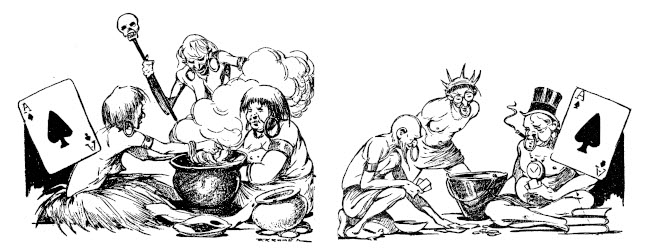
I.
"I keep wondering if she knows about Us," said the woman with black button eyes. She played the queen of spades.
The queen of hearts trumped the queen of spades. "You can put your mind at rest," said the silver-haired woman sweetly, gathering in the trick. "She doesn't. Tansy Saylor plays a lone hand. Like most women, she thinks she's the Only One. Co-operation such as ours is rare."
"But I'm afraid of her. Oh, I know she hasn't upset the Balance, and uses only Protective Procedures. But she isn't our kind. Neither is her husband. They don't belong."
The silver-haired woman nodded primly, peering through her thick glasses at the dummy with the empty chair behind it. "I agree. The Saylors are a disgrace to the Hempnell faculty. Modern. No sense of the traditional decencies."
"Yes, and she wants to make him president of Hempnell. She wants him to dictate to our husbands. She wants to condescend to us."
"This talk gets nowhere," broke in the stout, red-haired woman gruffly. "The point is that her Protective Procedures are effective—many things would have happened to the Saylors during the last ten years if they weren't. And she hasn't made the mistake of upsetting the Balance. So what can we three do about it?"
"Oh, the Balance!" said the woman with black button eyes, throwing down her last two cards. "Sometimes I think we ought to upset it ourselves." She evaded the shocked glance of the silver-haired woman. "We've our Sounds, and our Pictures, and our Numbers, and our Cards. We could finish the Saylors in a whiff. There's such a neat trick with cards I've just learned. Here, let me show you—" She slipped a dozen shiny paste-board oblongs out of her purse. They had the conventional backs, but their faces bore representations of a cryptic sort.
"Stop that!" The silver-haired woman stretched out fluttering hands.
"Put them away!" ordered the stout woman harshly. She glanced at the door. "Quickly!"
But the eyes of the little man who ambled in were not inquisitive. With white beard and amiable smile, he looked almost benign, in an absent-minded sort of way.
"I don't suppose you played much bridge while I was gone," he observed with mild joviality.
The silver-haired woman's laughter trilled sweetly. "It's his little joke. He always pretends that all women are fearful gossips. Well, at least I made the contract, dear. Four hearts."
His eyes twinkled. "Very commendable." He settled himself in the empty chair. "Still I imagine the three of you managed to find time for some very dark and devious plotting—" He chuckled innocently.
Norman Saylor, professor of ethnology at Hempnell College, was not the sort of man to go snooping around in his wife's dressing room. That was partly the reason why he did it. He was sure nothing could touch the security of the relationship between him and Tansy.
The house was very quiet. Spring sunshine and balmy air were sluicing gently through the bedroom windows. It wasn't five minutes since he had put in the final staccato burst of typing on his "Negro Recruit" brochure for the War Office. It looked as if for once they would have a lazy evening to themselves.
Totem, the cat, rose from her sun-warmed spot on the neatly piled silk quilt and indulged in a titanic, disruptive-looking yawn, neatly folded her white paws under her black waistcoat, and stared solemnly at Norman. Norman copied her yawn, and felt a partial unkinking of the twelve-work-hours-a-day tension that had traced lines on his chunky face and smudged shadows under his clear, yellow-brown eyes. Such moments as this did not come often these days, but when they did come, they sure felt good.
The door of Tansy's dressing room stood invitingly open. It was a tiny room, just a big closet, with no windows. But it was more than a rack of dresses and a creamy dressing table. It was Tansy. On the neat side, but not fussy. A slight pleasant disorder. Very sane—he wondered why that particular word came to his mind, but it hit the spot. A faint perfume conjured up amiable memories.
He studied the photographs on either side of the mirror. One of Tansy and himself in modified Indian costume, from three summers back when he had been studying the Yumas. They both looked rather solemn. Another, slightly faded, of an uproarious Negro baptizing in midriver. That was from when he had held the Hazelton Fellowship and been gathering material for his "Social Patterns of the Southern Negro" and his later "Feminine Element in Superstition." Tansy had done more work than two secretaries that busy year when he was hammering out a reputation.
There was an ample array of cosmetics—Tansy had been the first of the Hempnell faculty wives to use lipstick and lacquer her nails; there had been covert criticism and talk of "setting the students a bad example," but she had stuck it out. Flanked by cold-cream jars was a photograph of himself, with a little pile of small change, dimes and quarters, in front of it.
Idly he slid out a drawer, scanned the pile of stocking rolls, pushed it in, pulled at another, which jammed, so he had to give it a sharp tug. A large cardboard box toward the back caught his eyes. He edged up the cover and took out one of the tiny glass-stoppered bottles. What sort of cosmetic would this be? Too dark for face powder. More like a geologist's soil specimen. An ingredient for a mud pack?
The dry, dark-brown granules shifted smoothly, like sand in an hourglass, as he rotated the glass cylinder. The label appeared, in Tansy's clear script. "Julia Trock, Roseland." A cosmetician? Was Roseland a part of the name, or a place? And why should the idea that it might be a place seem distasteful? His hand knocked aside the cardboard cover as he reached for a second bottle, identical with the first, except that the contents had a somewhat reddish tinge, and the label read, "Philip Lassiter, Hill." A third, contents same color as the first: "J. P. Thorndyke, Roseland." Then a handful, quickly snatched up, of three: "Emelyn Scatterday, Roseland." "Mortimer Pope, Hill." "The Rev. Bufort Ames, Roseland."
The silence in the house grew thunderous; even the sunlight seemed to sizzle and fry, as his mind rose to a sudden pitch of concentration on the puzzle. "Roseland and Hill, Roseland and Hill, Roseland and Hill," like a nursery rhyme somehow turned nasty, making the glass cylinders repugnant to his fingers. "Roseland Hill—"
Abruptly the answer came.
The two local cemeteries.
Graveyard dirt.
Soil specimens all right. Graveyard dirt from particular graves. A chief ingredient of Negro conjure magic.
With a soft thud Totem landed on the table and began to sniff inquisitively at the bottles, but sprang away as Norman plunged his hand into the drawer. He felt smaller boxes behind the big one, yanked suddenly at the whole drawer, so it fell to the floor. In one of the boxes were bent, rusty, worn bits of iron—horseshoe nails. In the other were calling-card envelopes, filled with snippings of hair, each labeled like the bottles, but some of these names he knew. And in one—fingernail clippings.
In the third drawer he drew blank. But the fourth yielded a varied harvest. Packets of small dried leaves and powdered vegetable matter—so that was what came from Tansy's herb garden along with kitchen seasonings? Vervain, vinmoin, devil's snuff. Bits of lodestone, iron filings clinging to them. Goose quills which spilled quicksilver when he shook them. Small squares of flannel, the sort that Negro conjure doctors employed for their "tricken-bags" or "hands." A box of old silver coins and silver filings—strong protective magic; giving significance to the coins, all silver, in front of his photograph.
But Tansy was so sane—so healthily contemptuous of palmistry, astrology, numerology and all the other superstitious fads. A hard-headed New Englander. So well versed, from her work with him, in the psychological background of superstition and primitive magic. And yet—
He found himself thumbing through a dog-eared copy of his own "Parallelisms in Superstition and Neurosis." It looked like the one he had lost around the house—was it eight years ago? Beside a formula for conjuration was a marginal notation in Tansy's script: "Doesn't work. Substitute copper filings for brass. Try in dark of moon instead of full."
"Norman—"
Tansy was standing in the doorway, her hand stopped in the moment of drawing off the little half hat of deep-rose felt that matched her trim dress.
Never before had he had such a feeling that a human face was only an arbitrary arrangement of curved surfaces and colors. The tapering chin—an ellipsoid. The full lips—a complex arrangement of cycloids and other curves. The eyes—white spheres inscribed with gray-green circles centered with black. Without familiarity or significance. And yet, in the same instant he felt that it was desperately important that he spy out a significance. For a faint distortion of those angles and curves—a distortion so subtle as to be almost indiscernible—might signify ... yes, why not say it?... insanity.
The ghost of a smile curved Tansy's lips, and familiarity flooded back into her face.
"So you've found out," she sighed. And although it seemed incredible, he thought she sighed with relief.
For a moment he stood there confused, like a district attorney caught arranging evidence. Then he began his cross-examination.
"It all started so foolishly," she was saying soon. "Just before you came to Hempnell. I felt it was tremendously important that you get the appointment and just to relieve my nerves—no other reason—I did silly things. Put mild curses on the two other applicants, to confuse their thoughts during the interviews. I got the curses from your notes. I surrounded you with a web of protective magic, charmed the sociology faculty to make them regard you favorably.
"Well, you got the job, and I forgot all about my stupid private joke.
"Then, when your first book was at the publishers—you remember, Norm, in 1930—I tried again. We were so sure it would be rejected. I was planning to tell you all about my idiotic conjures as soon as it came back, so at least we'd have a laugh. But it was accepted. And I didn't tell you.
"Then in 1931, when you had pneumonia. I didn't want to, because it was too serious this time, but you got worse and I couldn't help myself. And you got well.
"That was the real beginning. Not that I was certain—I've never been certain—but I didn't dare take chances. Careers hang on such little strings, and Hempnell can be so vindictive. You know.
"But I wasn't superstitious. No, I wasn't! At least, I didn't have what you'd call the superstitious feeling. In a twisted logical way, I was trying to be empirical. I judged everything by results, step by step.
"And of course, when I say empirical, I don't mean experimental. I didn't dare to omit any charms as a test, because I was too afraid of something going wrong. You can't be experimental about someone you love, any more than a sane sociologist would induce fascism in his own country just to study the consequences."
He listened, his mind working like a telephone exchange during an emergency, catching a thousand hidden connections in trivial memories of his life and Tansy's. Whenever she paused, he had a question to hammer at her.
"Those mirror decorations on your dresses, and belts, and handbags—why?"
She nodded, tiredly. "Yes, that's it. To ward off evil spirits, by reflecting them. I got the idea from Tibetan devil masks. Yes, and the reason I always use hooks and eyes is—you've guessed—to catch evil spirits that try to get at me."
The room was dark by the time Tansy had finished the catalogue of her activities at Hempnell, and said, "So you see, I've never been sure. I've wanted to stop, but there's been too much at stake. It always worked—or did as soon as I made the proper corrections in the charms. I've wanted to tell you, but I've never dared. Now that you know, I'm glad."
The voice was very tired now.
Then, in the darkness he began his argument. It was the old, old argument of science against primitive ignorance, but he brought it home to her with careful persuasiveness. The argument which starts out with a demonstration that superstition is only mistaken empiricism, and ends with psychoanalysis.
"Didn't it really begin much earlier than Hempnell, Tansy?" he asked at one point. "I mean, the seeds of it?"
"No. Oh, I don't know. Perhaps. I've childhood memories of dark moments. Suspicions. Queer things people could do. Hints from I don't know where. But nothing certain. I just can't remember. I don't know."
Only once did the tired voice grow vehement.
"But I tell you I never tried to kill, or even to injure in a physical way! Never! Only to confuse or hinder people when they were working against you. It's terribly important that you understand this, Norman. Nine tenths of my magic was purely protective. To ward off evil."
He felt pettishly exasperated at this answer. What difference did it make whether or not she had tried to kill? It was all equally nonsense. And why should she harp on her efforts to protect him, as if he were some sort of incompetent? For a moment it occurred to him that, from one point of view, he had been very lucky in his career. He abruptly put aside this stray thought, along with his fit of impatience.
At another time she used a similar argument. "I never tried for anything really big. Like your inheriting a million dollars. Or becoming president of Hempnell overnight, even if I'd thought you wanted to. There's a law of reaction or retribution in all conjuring—I mean, I used to think there was. Like the kick of a gun. I was afraid."
After that there were no more interruptions—only the white smudge of Tansy's face in the darkness.
When he had finished his voice was tired, too.
There was a pause. Then she said, "I'll do what you want me to. I'll burn all my stuff. I'll never touch it again."
He snapped on the light, and it seemed to him that science and healthy skepticism had been created anew from the primeval dark. The hands of his watch stood at ten thirty. Then he saw that Tansy had begun to cry.
"Darling," she managed to say, "don't you see this is what I've wanted? Only I'd gotten in so deep I never dared. On your account. You had to find out and make me stop. That was the only way."
What followed was oddly anticlimactic—the ransacking of the house for all of Tansy's hidden charms. First the contents of the dressing table. He found then that he could be generous in his victory because his trust in Tansy was re-established—he did not demand to look into her locked little leather-bound diary, when she told him it contained no relevant material.
Then the rest of the house, Tansy darting from room to room, deftly recovering flannel-wrapped "hands" from the upholstery of chairs, the under sides of table tops, the interior of vases, until he marveled that he had lived in the house for more than ten years without chancing on any.
"It's rather like a treasure hunt, isn't it?" she observed with a rueful smile.
There were others outside—under front and back doorsteps, in the garage, and in the car. With every handful thrown on the roaring fire he had built in the living room, his sense of relief grew. Finally, she opened the seams of the pillows on his bed and carefully fished out two little matted shapes made of feathers bound with fine thread, so they blended with the fluffy contents of the pillow.
"See, one's a heart, the other an anchor. That's for security," she told him. "New Orleans magic. You haven't taken a step for years without being in the range of one of my protective charms."
The feather figures puffed into flame and were gone in an instant.
"There, that's the last one of them," she said. "All gone."
"You're sure?" For a moment his voice grew hard again. "Absolutely certain you haven't overlooked any?"
"Absolutely certain. There's not one left in the house. I've gone over it in my mind a dozen times. I'm tired now, really tired. I want to go straight to bed." Suddenly she began to laugh. "Oh, but first I'll have to stitch up those pillows, or there'll be feathers all over the place."
He put his arms around her. "Everything O.K. now?"
"Yes, darling. Only one thing I want to ask you—that we don't talk about this for a few days at least. I'm really terribly ashamed. But I'm glad it's happened, remember that."
After Tansy was gone, Norman threw a fresh log on the fire, and sank back in the easy-chair, watching the restless, rhythmic play of the flames. Gradually his thoughts began to unkink. He found himself wondering—not without admiration—at Tansy's relatively cool behavior. He would never have dared to try reasoned argument on any other woman in a similar situation. But that was like Tansy. Always fair. Always willing to listen to logic. Empirical. Except that she had gotten off on a crazy sidetrack.
He reached down to stroke Totem, who did not look away from the hypnotic flames.
"Time we got to bed, old man. Must be about twelve. No—quarter-past one."
As he slipped back the watch, the fingers of his other hand went automatically to the charm at the end of the chain—more a locket than a charm—a gift from Tansy.
He gazed ruminatingly at the flattened golden heart, weighed it in his palm. It seemed perhaps a trifle heavier than its metal shell would account for. He snapped up the cover with his thumbnail. There was no regular way of getting at the space behind Tansy's photograph, so, after a moment's hesitation, he carefully edged it out with a pencil point.
Behind the photograph was a tiny packet, wrapped in the finest flannel.
Just like a woman, was his first thought—to seem to give in completely, but to hold out on something.
Perhaps she had forgotten.
Angrily he tossed the packet into the fireplace. The photograph fluttered along with it, lighted on the bed of embers, and flared before he could snatch it out. He had a glimpse of Tansy's face curling and blackening.
The packet took longer. A yellow glow crept across its surface, as the nap singed. Then a wavering four-inch flame shot up.
Simultaneously a chill went through him, though he still felt the heat from the embers. The room seemed to darken. There was a faint, mighty roaring in his ears, as of motors far underground. He had the sense of standing suddenly naked and unarmed before something menacingly alien.
Totem had turned around and was peering intently at the shadows in the far corner. With an expectorant hiss she sprang sideways and darted from the room.
He realized he was trembling. Nervous reaction, he told himself. Might have known it was overdue.
The flame died, and once again there was only the bed of embers.
Explosively, the phone began to jangle.
"Professor Saylor? I just want to tell you that you're not going to get away with what you're trying to do to me. I'm not going to be flunked out of Hempnell without a protest."
The voice spluttered with rage. It was some moment before he recognized the student and cut in.
"Now listen, Jennings, if you thought you were being treated unfairly, why didn't you present your grievances three months ago, when you got your grades?"
"Why? Because I let you pull the wool over my eyes. I didn't realize until this minute that you were behind it all."
"Be reasonable. You flunked two courses besides mine last semester."
"Yes, because you dropped dirty hints. Poisoned everyone's mind against me."
"And you mean to tell me you only realized it now?"
"Yes, I do. It just came to me in a flash as I was thinking here. I saw your whole slimy plot. Oh, you were clever all right, but let me tell you, Saylor—"
The voice ranted on. Twice his "But what possible motive could I—" went disregarded. With a distasteful grimace he hung up.
He felt suddenly very tired. There was an unpleasant coincidence tangled up in the events of the past few minutes, if you bothered to figure it out, but a scientist ought to have a healthy disregard for coincidences.
He put the screen in front of the fire and went to bed.
II.
The red-haired woman knew immediately what had awakened her. She made no further movement, but lay there, propped on one elbow. From the opposite bed came placid snores.
Presently, although there was no further sound, her eyes were drawn to the blacker smudge of the phone. She lifted it quietly and whispered, "Expected you, dear. I was sure you'd feel it, too."
The other voice came over the wire in bursts—jerky. "How couldn't I feel it? Like a great gust of wind. Complete collapse of Protective Screen in her quarter. Balance gone. Oh, I told you this would happen. She's up to something. I'll go crazy until I know what."
"No need to lose your head," whispered the red-haired woman gruffly, eying the opposite bed. "She's upset the Balance, all right. But in a very peculiar way. Any upset I ever heard of came from Excessive Aggression, Unjustified Death-attempts, or sudden Career-smashing. But Tansy's done the reverse—let down her guard."
"Yes, just to hoodwink us! She's discovered a new weapon. Something bad. Why else should she take such a chance? She's planning to smash us. We've got to beat her to it!"
"Now, now, dear, no tantrums!" A third voice was coming over the wires, a sweetly reproving voice, just the sort to go with silver hair. "We mustn't do anything we'd be sorry for. We must be sure of our ground."
"Do you mean we're just to wait?" The jerky voice had grown stridently indignant. "When we know she must have a new weapon? While she gets ready to smash us?"
"I didn't say we were to wait forever." There was a chilling tingle of tartness in the sweet old voice. "I recognize the danger. I recognize also that she has upset the Balance and must take the consequences. When we are sure of our ground, we will act. A prospect which, I may say, delights me."
"And do nothing until then?"
"Yes, dear! Except to watch her—and him."
The red-haired woman smiled grimly, listening to the other two. Such chatterers! The other bed creaked as the sleeper changed position.
"In any case," she whispered, cutting in, "there should be consequences whether we act or not. With the Protective Screen down, things should begin to happen to her—and especially to him. Things which have been accumulating for a long, long, time—"
"And how is Tansy?" asked Mrs. Carr, with such sweet solicitude that for a moment Norman wondered if the silver-haired dean of women had even more of an inside wire on the private lives of the faculty than was generally surmised. But only for a moment. After all, sweet solicitude was the dean of women's stock-in-trade.
"We missed her at our last faculty wives' meeting," Mrs. Carr continued. "She's such a gay soul. And we do need gaiety these days." Cold morning sunlight glinted on her thick glasses and glowed frostily in her apple-red cheeks. She put her hand on his arm. "Hempnell appreciates Tansy, Professor Saylor."
Norman's "And why not?" changed to "I think that shows good judgment" as he said it. He derived sardonic amusement from recalling how five years ago Mrs. Carr was a charter member of The-Saylors-are-a-demoralizing-influence Club.
Mrs. Carr's silvery laughter trilled in the chilly air. "I must get on to my student conferences," she said.
He watched her hurry off, brisk and erect for all her near-seventy years, wondering if the sudden friendliness meant that there had been an unexpected improvement in his chances of getting the vacant chairmanship of the sociology department. Then he turned into Morton Hall.
When he had climbed to his office, the phone was ringing. It was Thompson, the public-relations man.
"A rather delicate matter, Professor Saylor." Delicate matters were Thompson's forte. "This morning one of the trustees phoned me. It seems he had just heard something—I haven't the slightest idea from where—concerning you and Mrs. Saylor. That over Christmas vacation you had attended a party given by some prominent but ... er ... very rowdy theatrical people. I was wondering if—"
"—I would issue a denial? Sorry, but it wouldn't be honest."
"Oh ... I see. Well, that's all there is to it, then." Thompson answered bravely after a moment. "I thought you'd like to know, though. The trustee was very hot under the collar. Talked my ear off about how these theatrical people were conspicuous for drunkenness and divorce."
"He was right. Nice folks. I'll introduce you to them some time."
"Oh ... yes," replied Thompson apprehensively. "Good-by."
The buzzer sounded, terminating the eight-o'clock classes. Norman swiveled his chair away from the desk and leaned back, amusedly irritated at this latest manifestation of the Hempnell "hush-hush" policy. Not that he had made any particular attempt to conceal the Berryman party, which had been a trifle more tempestuous than he had expected. Still, he had said nothing to anyone on campus. No use in being a fool. Now, after three months it all came out anyway.
From where he sat, the roof ridge of Estrey Hall neatly bisected his office window along the diagonal. There was a medium-sized cement dragon frozen in the act of clambering down it. For the tenth time that morning he reminded himself that what had happened last night had really happened. It was not so easy. And yet, when you got down to it, Tansy's lapse into medievalism was not so very much stranger than Hempnell's Gothic architecture, with its sprinkling of gargoyles and other fabulous monsters designed to scare off evil spirits.
Saylor's nine-o'clock class in "Primitive Societies" quieted down leisurely as he strode in a few seconds ahead of the buzzer. He set a student to explaining the sib as a factor in tribal organization, then put in the next five minutes organizing his thoughts and noting late arrivals and absentees. When the explanation, supplemented with blackboard diagrams of marriage groups, had become so complicated that Bronstein, the prize student, was twitching with eagerness to take a hand, he called for comments and criticisms, and succeeded in getting a first-class argument going.
Finally the cocksure fraternity president in the second row said, "But all those ideas of social organization were based on ignorance, tradition, and superstition. Unlike modern society."
That was Norman's cue. He lit in joyously, pulverized the defender of modern society with a point-by-point comparison of fraternities and primitive "young men's houses" down to the actual details of initiation ceremonies, which he dissected with scientific relish, and then launched into a broad analysis of present-day customs as they would appear to a hypothetical ethnologist from Mars. In passing, he drew a facetious analogy between sororities and primitive seclusion of girls at puberty.
The minutes raced pleasantly by as he demonstrated instances of cultural lag in everything from table manners to systems of notation and measurement. Even the lone sleeper in the last row surprised himself by listening.
"Certainly we've made important innovations, chief among them the scientific method," he said at one point, "but the primitive groundwork is still there, dominating the pattern of our lives. We're modified anthropoid apes inhabiting night clubs and battleships. What else could you expect us to be?"
Marriage and courtship got special attention. With Bronstein grinning delightedly, he drew detailed modern parallels to marriage by purchase, marriage by capture, and symbolic marriage to a deity. He showed that trial marriage is no mere modern conception but a well-established ancient custom, successfully practiced by the Polynesians and others.
At this point he became aware of a beet-red, angry face toward the back of the room—that of Gracine Pollard, daughter of Randolph Pollard, president of Hempnell College. She glared at him outragedly, pointedly ignoring the interest taken by the neighboring students in her blushes.
Automatically it occurred to him, "Now I suppose the little neurotic will go yammering to mamma that Professor Saylor is advocating free love." He shrugged the idea aside and continued the discussion without modification. The buzzer cut it short.
But he was left feeling irritated with himself, and only half listened to the enthusiastic comments and questions of Bronstein and a couple of others.
Back at the office he found a note from Harold Gunnison, the dean of men, asking for an interview. Having the next hour free, he set out across the quadrangle for the Administration Building, Bronstein still tagging along to expound some interesting theory of his own.
But Norman was wondering why he had let himself go. Admittedly, some of his remarks had been a trifle raw. He had long ago adjusted his classroom behavior to Hempnell standards, without losing intellectual integrity, and this ill-advised though trivial deviation bothered him.
Mrs. Carr swept by him without a word, her face slightly averted, cutting him cold. A moment later he realized the explanation. In his abstraction, he had lighted a cigarette. Moreover, Bronstein, obviously delighted at faculty infraction of a firmly established Hempnell taboo, had followed suit.
He frowned but continued to smoke. Evidently the events of the previous night had disturbed his mind more than he had realized. He ground out the butt on the steps of the Administration Building.
In the doorway to the outer office he collided with the stylishly stout form of Mrs. Gunnison.
"Lucky I had a good hold on my camera," she grumbled, as he stooped to recover her bulging handbag. "I'd hate to try to replace a lens these days." Then brushing back an untidy wisp of reddish hair from her forehead, "You look worried. How's Tansy?"
He answered briefly, sliding past her. Now there was a woman who really ought to be a witch. Sloppy, expensive clothes; bossy, snobbish, and gruff; good-humored in a beefy fashion, but capable of riding roughshod over anyone else's desires. The only person in whose presence her husband's authority seemed a trifle ridiculous.
Harold Gunnison cut short a telephone call, and motioned him to come in and shut the door.
"Norm," Gunnison began, scowling, "this is a pretty delicate matter."
Norman became attentive. When Harold Gunnison said something was a delicate matter, unlike Thompson, he really meant it. They played golf and squash together, and got on pretty well.
He braced himself to hear an account of eccentric, indiscreet, or even criminal behavior on the part of Tansy. That suddenly seemed the obvious explanation.
"You have a girl from the Student Employment Agency working for you? A Margaret van Nice?"
Norman nodded. "A rather quiet kid. Does mimeographing."
"Well, a little while ago, she threw an hysterical fit in Mrs. Carr's office. Claimed that you had seduced her. Mrs. Carr immediately dumped the whole business in my lap."
"Well?" said Norman.
Gunnison frowned and cocked an eye at him. "Things like this sometimes really happen," he muttered.
"Sure," Norman replied. "But not this time."
"Of course. I had to ask."
"Sure. There was opportunity though. We worked late several nights over at Morton, editing stuff."
Gunnison reached for a folder. "On a chance, I got out her neurotic index. She ranks way up near the top. A regular bundle of complexes. We'll just have to handle it smoothly."
"I'll want to hear her accuse me," said Norman. "Soon as possible."
"Of course. I've arranged for a meeting at Mrs. Carr's office. Four o'clock this afternoon. Meantime she's seeing the college physician. That should sober her up."
"Four o'clock," repeated Norman, standing up. "You'll be there?"
"Certainly. I'm sorry about this whole business, Norm. Frankly, I think Mrs. Carr botched it. Got panicky. She's a pretty old lady."
In the outer office he stopped to glance at a small display case of items concerned with Gunnison's work in physical chemistry. The present display was of Prince Rupert drops and other high-tension oddities. It occurred to him that Hempnell was something like a Prince Rupert drop. Hit the main body with a hammer and you only jarred your hand. But flick with a fingernail the delicate filament in which the drop ended, and it would explode in your face.
Fanciful.
He glanced at the other objects, among them a tiny mirror, which, the legend explained, would fly to powder at the slightest scratch or sudden change in temperature.
Yet it wasn't so fanciful, when you got to thinking about it. Any highly organized, complex, somewhat artificial institution, such as a college, tends to develop dangerous weaknesses. And the same would be true of a person or a career. Flick the delicate spot in the mind of a neurotic girl, and she would explode with wild accusations. Or take a saner person, like himself. Suppose someone should be studying him secretly, looking for the vulnerable filament, finger casually poised to flick—
But that was really getting fanciful.
Coming out of their eleven-o'clock classes, Hervey Sawtelle buttonholed him.
Hervey Sawtelle resembled an unfriendly caricature of a college professor. Sometimes he carried two brief cases, and he was usually on his way to a committee meeting. Routine worries chased themselves up and down his nervous face.
But at the moment he was in the grip of one of his petty excitements.
"Say, Norman, the most interesting thing! I was down in the stacks this morning, and I happened to pull out an old doctor's thesis—1930—by someone I never heard of—with the title 'Superstition and Neurosis.'" He produced a bound, typewritten manuscript that looked as if it had aged without ever being opened. "Almost the same as your 'Parallelisms in Superstition and Neurosis.' An odd coincidence, eh? I'm going to look it over tonight."
They were hurrying together toward the dining hall down a walk flooded with jabbering, laughing students. Norman studied Sawtelle's face covertly. Surely the fool must remember that his "Parallelisms" had been published in 1931, giving an ugly suggestion of plagiarism. But Sawtelle's nervous, toothy grin was without guile.
He had the impulse to pull Sawtelle aside and tell him that there was something odder than a coincidence involved, and that it did not reflect in any way on his own integrity of scholarship. But this seemed hardly the place.
Yet there was no denying the incident bothered him a trifle. Why, it was years since he had even thought of that stupid business of Cunningham's thesis. It had lain buried and forgotten in the past—a hidden vulnerability, waiting for the flick of the fingernail.
Asinine fancifulness! It could all be very well explained, to Sawtelle or anyone else, at a more suitable time.
Sawtelle's mind was back to routine worries. "You know, we should be having our conference on the social-science program for next year. On the other hand, I suppose we should wait until—" He paused embarrassedly.
"Until it's decided whether you or I get the chairmanship of the department?" Norman finished for him. "I don't see why. We'll be working together in any case."
"Yes, of course. I didn't mean to suggest that—"
They were joined by some other faculty members on the steps of the dining hall. The deafening clatter of trays from the student section was subdued to a faint din as they entered the faculty sanctum.
Conversation revolved among the old familiar topics, with an undercurrent of speculation as to what reorganizations and curtailments of staff the new war year might bring to Hempnell. There was some reference to the political ambitions of President Pollard—it was rumored that he might be persuaded to run for governor or senator; discreet silences here and there around the table substituted for adverse criticisms on this possibility. Sawtelle's Adam's apple twitched convulsively at a chance reference to the vacant chairmanship in sociology.
Norman managed to get a fairly interesting conversation going. He was glad that he would be busy with classes and conferences until four o'clock. He knew he could work half again as hard as someone like Sawtelle, but if he were compelled to do one quarter of the worrying that man did—
Yet the four-o'clock meeting proved to be an anticlimax. He had no sooner put his hand on the door leading to Mrs. Carr's office, when—as if that had provided the necessary stimulus—a shrill, tearful voice burst out with: "It's all a lie! I made it up."
Gunnison was sitting near the window, face a trifle averted, arms folded, looking like a slightly bored, slightly embarrassed but very stolid elephant. In a chair in the center of the room was huddled a delicate, fair-haired, but rather homely girl, tears dribbling down her cheeks and hysterical sobs racking her shoulders. Mrs. Carr was trying to calm her in a fluttery way.
"I don't know why I did it," the girl bleated pitifully. "I was in love with him, and he wouldn't even look at me. I was going to kill myself last night, and then I thought I would do this instead, to hurt him, or—"
"Now, Margaret, you must control yourself," Mrs. Carr admonished, her hands hovering over the girl's shoulders.
"Just a minute," Norman cut in, "did you say last night?"
"There, there, dear. I think you better leave, Professor Saylor." Mrs. Carr's eyes, magnified by thick glasses, looked fishlike. Her attitude was hostile. "There's obviously no need of asking questions."
"I think I should be permitted at least one," said Norman. "Just exactly at what time last night, Miss van Nice, did you get this idea?"
Gunnison registered puzzled but vague curiosity.
The tear-stained face looked up at Norman.
"It was just after one o'clock," she said. "I had been lying awake in the dark for hours, planning to kill myself. And then, in a flash the idea came to me." Suddenly she shook loose from Mrs. Carr and stood up, facing Norman. "Oh, I hate you!" she screamed. "I hate you!"
Gunnison followed him out of the office. He yawned, shook his head, and remarked, "Glad that's over."
"Never a dull moment," Norman responded, absently.
"Oh, by the way," Gunnison said, dragging a stiff white envelope out of his inside pocket, "here's a note for Mrs. Saylor. Hulda asked me to give it to you. I forgot about it before."
"I met her coming out of your office this morning," Norman said, his thoughts still elsewhere.
Somewhat later, back at Morton, Norman tried to come to grips with those thoughts, but found them remarkably slippery. The dragon on the roof ridge of Estrey Hall lured away his attention. Funny about little things like that. You never even noticed them for years, and then they suddenly popped into focus. How many people could give you one single definite fact about the architectural ornaments of buildings in which they worked? Not one in ten, probably. Why, if you'd asked him yesterday about that dragon, he wouldn't for his life have been able to tell you even if there was one or not.
He leaned on the window sill, looking at the lizardlike yet grotesquely anthropoid form, bathed in the yellow sunset glow, which, his wandering mind remembered, was supposed to symbolize the souls of the dead passing into and out of the underworld. Below the dragon, jutting out from under the cornice, was a sculptured head, one of a series of famous scientists and mathematicians decorating the entablature. He made out the name "Galileo," along with a brief inscription of some sort.
When he turned back to answer the phone, it suddenly seemed very dark in the office.
"Saylor? I just want to tell you that I'm going to give you until tomorrow—"
"Listen, Jennings," Norman cut in sharply, "I hung up on you last night because you kept shouting into the phone. This threatening line won't do you any good."
The voice continued where it had broken off, growing dangerously high. "—until tomorrow to withdraw your charges and have me reinstated at Hempnell. If you don't—"
"I told you not to threaten. There were no charges. You just flunked out. If you want to talk it over reasonably, come and see me."
The voice at the other end of the line broke into a screaming obscene torrent of abuse, so loud that he could still hear it very plainly as he was placing the receiver back in the cradle.
Paranoid—that was the way it sounded.
Then he suddenly sat very still.
At twenty past one last night he had burned a charm supposedly designed to ward off evil influence from him. The last of Tansy's "hands."
At about the same time Margaret van Nice had decided to accuse him of seducing her, and Marvin Jennings had decided to make him responsible for an imaginary plot.
Next morning Hervey Sawtelle, poking around in the stacks, had found—
Rubbish!
With an angry snort of laughter at his own credulity, he picked up his hat and headed for home.
III.
Tansy was in a radiant mood, prettier than she had seemed in months, younger-looking than her thirty-six years. Twice he caught her smiling to herself, when he glanced up from his supper.
He gave her the note from Mrs. Gunnison. "Mrs. Carr asked after you, too. Gushed all over me—in a ladylike way, of course. Then, later on—" He caught himself as he started to tell about the cigarette, and Mrs. Carr cutting him, and the interview in her office. No use worrying Tansy with things that might be considered bad luck. No telling what further constructions she might put upon them.
She glanced through the note and handed it back to him.
"It has the authentic Hempnell flavor, don't you think?" she observed.
He read:
Dear Tansy: Where are you keeping yourself? I haven't seen you on campus more than once or twice this year. If you're busy with something especially interesting, why not tell us about it? Why not come to tea this Saturday, and tell me all about yourself?
Hulda.
P.S. You're supposed to bring four dozen cookies to the Parents' Day Reception the Saturday after.
"Rather confused-sounding," he said, "but I clearly perceive the keen bludgeon of Mrs. Gunnison. She looked particularly sloppy today."
Tansy laughed. "Still, we have been pretty antisocial these last weeks. I believe I'll ask them over for bridge tomorrow night. It's short notice, but they're usually free Wednesdays. And the Sawtelles."
"Do we have to? That henpecker?"
Tansy laughed. "I don't know how you would ever manage to get along without me—" She stopped short. "I'm afraid you'll have to endure Evelyn. After all, Hervey's the other important man in your department, and it's expected that you see something of each other socially. To make two tables, I'll invite the Carrs."
"Three fearful females," said Norman. "If they represent the average run of professors' wives, I was lucky to get you."
"I sometimes have similar thoughts about professors' wives' husbands," said Tansy.
Then as they smoked over the coffee, she said hesitantly, "Norm, I said I didn't want to talk about last night. But now there's something I want to tell you."
He nodded.
"I didn't tell you last night, Norm, but when we burned those ... things, I was terribly frightened. I felt that we were ripping holes in walls that it had taken me years to build, and that now there was nothing to keep out the—"
He said nothing, sat very still.
"Oh, it's hard to explain, but ever since I began to ... play with those things, I've been conscious of pressures from outside. Things trying to push their way in and get at us. And I've had to press them back, fight back at them with my—It's like that test of strength men sometimes make, trying to force each other's hand to the table. But that wasn't what I was starting to say.
"I went to bed feeling miserable and scared. The pressure from outside kept tightening around me, and I couldn't resist it, because we'd burned those things. And then suddenly, as I lay in the dark, about an hour after I went to bed, I got the most abrupt tremendous feeling of relief. The pressure vanished, as if I'd bobbed up to the surface after almost drowning. And I knew then ... that I'd gotten over my craziness. That's why I'm so happy."
It was hard for Norman not to tell Tansy what he was thinking. Here was one more coincidence, but it knocked the others into a cocked hat. At about the same time as he had burned the last charm, experiencing a sensation of fear, Tansy had felt a great relief. That would teach him to build theories on coincidences!
"For I was crazy in a way, dear," she was saying. "There aren't many people who would have taken it as you did."
He said, "You weren't crazy—which is a relative term, anyway, applicable to anyone. You were just fooled by the cussedness of things."
"Cussedness?"
"Yes. The way nails sometimes insist on bending when you hammer, as if they were trying to. Or the way machinery refuses to work. Matter's funny stuff. In large aggregates, it obeys natural law, but when you get down to the individual atom or electron, it's largely a matter of chance or whim—" This conversation was not taking the direction he wanted it to, and he was thankful when Totem jumped up onto the table, creating a diversion.
It turned out to be the pleasantest evening they had spent together in ages.
But next morning he wished he had not gotten started on that "cussedness of things" notion. It stuck in his mind. He found himself puzzling over the merest trifle—in the precise position of that idiotic cement dragon. Yesterday he remembered thinking that it was exactly in the middle of the descending roof ridge. But now he saw that it was obviously two thirds of the way down, quite near the architrave topping the huge and useless Gothic gateway set between Estrey and Morton. Even a social scientist ought to have better powers of observation than that!
The jangle of the phone coincided with the nine-o'clock buzzer.
"Professor Saylor?" Thompson's voice was apologetic. "I'm sorry to bother you again, but I just got another inquiry from one of the trustees. Concerning an informal address you were supposed to have delivered at about the same time as that ... er ... party. The topic was 'What's Wrong With College Education?'"
"Well, what about it? Are you implying that there's nothing wrong with college education, or that the topic is taboo?"
"Oh, no, no, no. But the trustee seemed to think that you were making a criticism of Hempnell."
"Of small colleges of the same type as Hempnell, yes. Of Hempnell, specifically, no."
"Well, he seemed to fear it might have a detrimental effect on enrollment for next year. Spoke of several friends of his with children of college age as having heard your address and being unfavorably impressed."
"Then they were supersensitive."
"He also seemed to think you had made a slighting reference to President Pollard's ... er ... political activities."
"I'm sorry but I have to get along to a class now."
"Very well," said Thompson. He sounded hurt.
Gracine Pollard was absent from "Primitive Societies," Norman noted with an inward grin, wondering if it had become too much for her warped sense of propriety. But even the daughters of college presidents ought to be told a few home truths now and then.
Yesterday's lecture had had a markedly stimulating effect. Several students had abruptly chosen related subjects for their term papers, and the fraternity president had decided to capitalize on his yesterday's discomfiture by writing a humorous article on the primitive significance of fraternity initiations for the Hempnell Buffoon. They had a very brisk session. It put Norman in a good humor which lasted until after his three-o'clock class that afternoon, when he happened to meet the Sawtelles, in front of Morton Hall.
"I had lunch today with Henrietta ... I mean, Mrs. Pollard," Mrs. Sawtelle announced with the air of one who has just visited royalty.
"Oh say, Norman—" Hervey began, excitedly, thrusting forward his brief case.
"We had a very interesting chat," his wife continued, sweeping on as if her husband had not spoken. "We talked about you, too, Norman. It seems Gracine has been misinterpreting some of the things you've been saying in your class. She's such a sensitive girl."
"Dumb Bunny, you mean," Norman corrected mentally. He murmured, "Oh?" with some show of politeness.
"Dear Henrietta was a little puzzled as just how to handle it, though of course she's a very tolerant, cosmopolitan soul. I just mentioned it because I thought you'd want to know. After all, it is very important that no one gets any wrong impressions about the department. Don't you agree with me, Hervey?" she ended sharply.
"What, dear? Oh, yes, yes. Say, Norman, I want to tell you about that thesis I showed you yesterday. The most amazing thing! Its main arguments are almost exactly the same as those in your book! An amazing case of independent investigators arriving at the same conclusions. Why, it's like Darwin and Wallace, or—"
"You didn't tell me anything about this, dear," said Mrs. Sawtelle, as if he had cheated her.
"Wait a minute," said Norman.
He hated to make an explanation in Mrs. Sawtelle's presence, but it had to be done.
"Sorry, Hervey, to have to substitute a rather sordid story for an interesting case of independent investigation. It happened when I was an instructor here—1929, my first year. A graduate student named Cunningham got hold of my ideas—I was friendly with him—and incorporated them into his doctor's thesis. My work in superstition and neurosis was just a side line then, and so I didn't happen to read his thesis until after he'd gotten his degree."
Sawtelle blinked. His face resumed its usual worried expression. A look of vague disappointment had come into Mrs. Sawtelle's black button eyes, as if she would have liked to read the thesis before hearing the explanation.
"I was very angry," Norman continued, "and intended to show him up. But then I heard he'd died. There was some hint of suicide. He was an unbalanced chap. How he'd hoped to get away with such an out-and-out steal, I don't know. Anyway, I decided not to do anything about it, for his family's sake. You see, it would have supplied a strong reason for thinking he had committed suicide."
Mrs. Sawtelle looked incredulous.
"But, Norman," Sawtelle commented anxiously, "was that really wise? I mean to keep silent. Weren't you taking a chance? I mean with regard to your academic reputation?"
Abruptly Mrs. Sawtelle's manner changed.
"Put that thing back in the stacks, Hervey, and forget about it," she directed curtly. Then she smiled archly at Norman. "I've been forgetting that I have a surprise for you, Professor Saylor. Come down to the sound booth now, and I'll show you. It won't take a minute. Come along, Hervey."
Norman had no excuse ready, so he accompanied the Sawtelles to the rooms of the speech department at the other end of Morton, wondering how the speech department ever found any use for someone with as nasal and affected a voice as Evelyn Sawtelle, even if she did happen to be a professor's wife.
The sound booth was dim and quiet, a solid box with soundproof walls and double windows. Mrs. Sawtelle took a disk from the cabinet, put it on one of the three turntables, and adjusted a couple of dials.
From the amplifier came a strangely intermittent wailing or roaring, as of wind prying at a house. It struck a less usual chord, though, in Norman's memory.
Mrs. Sawtelle darted back and lifted the needle, hurriedly, so it grated against the disk.
"I made a mistake," she said. "That's some modernistic music or other. Hervey, switch on the light. Here's the record I wanted."
"It sounded awful, whatever it was," her husband observed.
Norman had identified his memory. It was of an Australian bull-roarer a colleague had once demonstrated for him. The curved slat of wood, whirled at the end of a cord, made exactly the same sound. The aborigines used it in their magic making.
But now his own voice was coming out of the amplifier, and he had an odd sense of jerking back in time.
"Surprised?" she questioned coyly. "It's that talk on civilian defense you gave the students last week. We had a mike spotted by the speaker's rostrum—I suppose you thought it was for amplification—and we made a sneak recording, as we call it. We cut it down here."
She indicated the heavier, cement-based turntable for making recordings.
"We can do all sorts of things down here," she babbled on. "Mix all sorts of sound. Music against voices. And—"
It was hard for Norman to appear even slightly pleased. He knew his reasons were no more sensible than those of a savage afraid someone will learn his secret name, yet all the same he disliked the idea of Evelyn Sawtelle monkeying around with his voice. Like her dully malicious, small-socketed eyes, it suggested a prying for hidden weaknesses. And then that talk about mixing sounds—somehow it did not set good with him.
What it all boiled down to was that he detested the woman.
Rather brusquely, he excused himself.
"We'll see you tonight," Evelyn called after him. It sounded like, "You won't get rid of me."
Back at the office, Norman put in a good hour's work on his notes. Then, getting up to switch on the light, his glance happened to fall on the window.
After a few moments, he jerked away and darted to the closet, to get his field glasses.
Evidently someone had a very obscure sense of humor to perpetrate such a complicated practical joke.
Intently he searched the cement at the juncture of roof ridge and clawed feet, looking for the telltale cracks. He could not spot any, but that was not easy to do in the failing yellow light.
The cement dragon now stood at the edge of the gutter, as if about to walk over to Morton along the architrave of the big gateway.
He lifted his glasses to the creature's head—blank and crude as an unfinished skull. Then on an impulse, he dropped them to the row of sculptured heads, focused on Galileo, and read the little inscription he had not been able to make out before.
"Eppur si muove."
The words Galileo was supposed to have muttered after recanting before the Inquisition his belief in the revolution of the Earth around the Sun.
"Nevertheless, it moves."
A board creaked behind him, and he spun around.
By his desk stood a young man, waxen pale, with thick red hair. His eyes stood out like milky marbles. One white, tendon-ridged hand gripped a .22 target pistol.
Norman walked toward him, bearing slightly to the right.
The skimpy barrel of the gun came up.
"Hello, Jennings," said Norman. "You've been reinstated. Your grades have been changed to straight A's."
The gun barrel slowed for an instant.
Norman lunged in.
The gun went off under his left arm, pinking the window.
The gun clunked on the floor. Jennings' skinny form went limp. As Norman sat him down on the chair, he began to sob, convulsively.
Norman lifted the phone and asked for an on-campus number. The connection was made quickly. "Gunnison?" he asked.
"Uh-huh, just caught me as I was leaving."
"Theodore Jennings' parents live right near the college, don't they? You know, the chap who flunked out last semester."
"I believe they do. What's the matter?"
"Better get them over here quick. And have them bring his doctor. He just tried to shoot me."
There was a pause. Norman visualized Gunnison's startled reaction! Then, "Right away!"
Norman put down the phone. Jennings continued to sob agonizingly. Norman looked at him with disgust.
An hour later Gunnison sat down in the same chair, and let off a sigh of relief.
"I'm sure glad they're gone," he said. "It was awfully good of you, Norman, not to insist on the police. Things like that give a college a bad name."
Norman smiled wearily. "Almost anything gives a college a bad name. But that kid was obviously crazy as a loon."
They lit up and smoked for a while in silence. Then Gunnison looked at his watch.
"I'll have to hustle. It's almost seven, and we're due at your place at eight."
But he lingered, ambling over to the window to inspect the bullet hole.
"I wonder if you'd mind not mentioning this to Tansy?" Norman asked. "I don't want to worry her."
Gunnison nodded. "Good thing if we kept it to ourselves." Then he pointed out the window. "That's one of my wife's pets," he remarked in a jocular tone.
Norman saw that his finger was trained on the cement dragon, now coldly revealed by the upward glare from the street lights.
"I mean," Gunnison went on, "she must have a dozen photographs of it. Hempnell's her specialty. I believe she's got a photograph of every architectural oddity on campus. That one's her favorite." He chuckled. "Usually it's the husband who keeps ducking down into the darkroom, but not in our family. And me a chemist, at that."
Norman's taut mind had unaccountably jumped to the thought of a bull-roarer. Abruptly he realized the analogy between the recording of a bull-roarer and the photograph of a dragon.
He clamped a lid on the fantastic questions he wanted to ask Gunnison.
"Come on!" he said. "We'd better get along!"
Gunnison started a little at the harshness of his voice.
"Can you drop me off?" asked Norman, more quietly. "My car's at home."
"Sure thing," said Gunnison.
After he had switched out the light, Norman paused for a moment, staring back at the window. The words came back.
"Eppur si muove."
IV.
They had hardly cleared away the remains of a hasty supper, when there came the first clang from the front-door chimes. To Norman's relief, Tansy had accepted without questioning his rather clumsy explanation of why he had gotten home so late. There was something puzzling, though, about her serenity these last two days. She was usually much sharper, and more curious. But of course he had been careful to hide disturbing events from her, and he ought only to be glad her nerves were in such good shape.
"Dearest! It's been ages since we've seen you!" Mrs. Carr embraced Tansy in a matronly fashion. "How are you? How are you?" The question sounded peculiarly eager and incisive. Norman put it down to typical Hempnell gush. "Oh, dear, I'm afraid I've got a cinder in my eye," Mrs. Carr continued. "The wind's getting quite fierce."
"Gusty," said Professor Carr of the mathematics department, showing obvious but harmless delight at finding the right word. He was a little man with red cheeks and a white Vandyke, as innocent and absent-minded as college professors are supposed to be, who gave the impression of residing permanently in a special paradise of transcendental and transfinite numbers.
"It seems to have gone away now," said Mrs. Carr, waving aside Tansy's handkerchief and experimentally blinking her eyes, which looked unpleasantly naked and birdlike until she replaced her thick glasses. "Oh, that must be the others," she added, as the chimes sounded. "Isn't it marvelous that everyone at Hempnell is so punctual?"
As Norman started for the front door he imagined for one crazy moment that someone must be whirling a bull-roarer outside, until he realized it could only be the rising wind living up to Professor Carr's description of it.
He was confronted by Evelyn Sawtelle's angular form, wind whipping her black coat against her legs. Her equally angular face, with its shoe-button eyes, was thrust toward his own.
"Let us in, or it'll blow us in," she said. Like most of her attempts at coy or facetious humor, it did not come off, perhaps because she made it sound so stupidly grim.
She entered, with Hervey in tow, and made for Tansy.
"My dear, how are you? Whatever have you been doing with yourself?" Again he was struck by the eager and meaningful tone of the question. For a moment he wondered whether the women had somehow gotten an inkling of Tansy's eccentricity, and the recent crisis. But Mrs. Sawtelle was so voice-conscious that she was always emphasizing things the wrong way.
There was a noisy flurry of greetings. Totem made a squeaky noise and darted out of the way of the crowd of human beings. Mrs. Carr's silvery voice rose above the rest.
"Oh, Professor Sawtelle, I want to tell you how much we all appreciated your talk on city planning. It was truly significant!" Sawtelle writhed, grinning in a flustered way.
Norman thought: "So now he's the favorite for the chairmanship."
Professor Carr had made a beeline for the bridge tables, and was wistfully fingering the cards.
"I've been studying the mathematics of the shuffle," he began with a bright-eyed air, as soon as Norman drifted into range. "The shuffle is supposed to make it a matter of chance what hands are dealt. But that is not true at all." He broke open a new pack of cards, and spread the deck. "The manufacturers arrange these by suits—thirteen spades, thirteen hearts, and so on. Now suppose I make a perfect shuffle—divide the pack into equal parts and interleaf the cards one by one."
He tried to demonstrate, but the cards got away from him.
"It's really not as hard as it looks," he continued amiably. "Some players can do it every time, quick as a wink. But that's not the point. Suppose I make two perfect shuffles with a new pack. Then, no matter how the cards are cut, each player will get thirteen of a suit—an event that, if you went purely by the laws of chance would only happen once in about one hundred and fifty-eight billion times as regards a single hand, let alone all four."
Norman nodded, and Carr smiled delightedly.
"That's only one example. What is loosely termed chance is really the resultant of several perfectly definite factors—chiefly the play of the cards on each hand, and the shuffle habits of the players." He made it sound as important as the Theory of Relativity. "Some evenings the hands are very ordinary. Other evenings they keep getting wilder and wilder—long suits, voids, and so on. Sometimes the high cards persistently run north and south. Other times, east and west. Luck? Chance? Not at all! It's the result of perfectly definite factors. Some expert players actually make use of this principle to determine the probable location of key cards."
Norman's mind went off on a tangent. Suppose you applied this principle outside bridge? Suppose that coincidences and other chance happenings weren't really as chancy as they looked? Suppose there were individuals with a special aptitude for calling the turns, making the breaks? But that was a pretty obvious idea—nothing to give a person the shiver it had given him.
"I wonder what's holding up the Gunnisons?" Professor Carr was saying. "We might start one table now. Perhaps we can get in an extra rubber," he added hopefully.
A peal from the chimes settled the question.
Gunnison looked as if he had eaten his dinner too fast, and Hulda seemed rather surly.
"We had to rush so," she muttered curtly to Norman as he held the door.
Like the other two women, she almost ignored him and concentrated her greetings on Tansy. It gave him a vaguely uneasy feeling, as when they had first come to Hempnell and faculty visits had been a nerve-racking chore. Tansy seemed at a disadvantage—somehow unprotected—in contrast to the aggressive air of purpose animating the other three.
But what of it?—he told himself. That was usual with Hempnell faculty wives. They acted as if they lay awake nights plotting how to poison the people between their husband and the president's chair.
Whereas Tansy—But that was like what Tansy had been doing. His thoughts started to gyrate confusingly, and he switched them off.
They cut for partners.
The cards seemed determined to provide an illustration for the theory Carr had explained. The hands were uniformly commonplace—abnormally average. No long suits. Nothing but 4-4-3-2 and 4-3-3-3 distribution. Bid one; make two. Bid two; make one.
After the second round, Norman applied his private remedy for boredom—the game of "Spot the Primitive." You played it by yourself, secretly. It was just an exercise for an ethnologist's imagination. You pretended that the people around you were members of a savage race, and you tried to figure out how their personalities would manifest themselves in such an environment.
Tonight it worked almost too well.
Nothing unusual about the men. Gunnison would, of course, be a prosperous tribal chieftain; perhaps a little fatter, and tended by maidens, but with a jealous and vindictive wife waiting to pounce. Carr might figure as the basket maker of the village—a spry little old man, grinning like a monkey, weaving the basket fibers into intricate mathematical matrices. Sawtelle, of course, would be the tribal scapegoat, butt of endless painful practical jokes.
But the women!
Take Mrs. Gunnison, now his partner. Give her a brown skin. Leave the red hair, but twist some copper ornaments in it. She'd be heftier if anything, a real mountain of a woman, stronger than most of the men in the tribe, able to wield a spear or club. The same sleepy brutish eyes, but the lower lip would jut out in a more openly sullen and domineering way. It was only too easy to imagine what she'd do to the unlucky maidens her husband showed too much interest in. Or how she would pound tribal policy into his head when they retired to their hut. Or how her voice would thunder out the death chants the women sang to aid the men away at war.
Then Mrs. Sawtelle and Mrs. Carr, who had progressed to the top table along with himself and Mrs. Gunnison. Mrs. Sawtelle first. Make her skinnier. Scarify the flat cheeks with ornamental ridges. Tattoo the spine. Witch woman. Bitter as quinine bark because her husband was ineffectual. Think of her prancing before a spike-studded fetish. Think of her screeching incantations and ripping off a chicken's head—
"Norman, you're playing out of turn," said Mrs. Gunnison.
"Sorry."
And Mrs. Carr. Shrivel her a bit. Leave only a few wisps of hair on the parchment skull. Take away the glasses, and then her eyes would be gummy. She'd blink and peer short-sightedly, and leer toothlessly, and flutter her bony claws. A nice harmless old squaw, who'd gather the tribe's children around her and tell them legends. But her jaw would still be able to snap like a steel trap, and her clawlike hands would be deft at applying arrow poison, and she wouldn't really need her eyes because she'd have other ways of seeing things and even the bravest warrior would grow nervous if she looked too long in his direction.
"Those experts at the top table are awfully quiet," called Gunnison with a laugh. "They must be taking the game very seriously."
Witch women, all three of them, engaged in booting their husbands to the top of the tribal hierarchy.
From the dark doorway at the far end of the room, Totem was peering curiously, as if weighing some similar possibility.
But Norman could not fit Tansy into the picture. He could visualize physical changes, like frizzing her hair, and putting some big gold rings in her ears and a painted design on her forehead. But he could not picture her as belonging to the same tribe. She persisted in his imagination as a stranger woman, a captive, eyed with suspicion and hate by the rest. Or perhaps a woman of the same tribe, but one who had done something to forfeit the trust of all the other women. A priestess who had violated taboo. A witch woman who had renounced witchcraft.
Abruptly his field of vision narrowed to the score pad. Evelyn Sawtelle was idly scribbling stick figures as Mrs. Carr deliberated over a lead. First the stick figure of a man with arms raised and three or four balls above his head, as if he were juggling. Then the stick figure of a queen, indicated by crown and skirt. Then a little tower, with battlements. Then an L-shaped thing with a stick figure hanging from it—a gallows. Finally, a truck bearing down on a man whose arms were extended toward it in fear.
Just five scribbles. But he knew that four of them were connected with a bit of unusual knowledge buried somewhere in his mind. A glance at the exposed dummy gave him the clue.
Cards.
But this bit of knowledge was from the ancient history of cards, when the whole deck was drenched with magic, when there was a Knight between the Jack and the Queen, when the suits were swords, batons, cups, and money, and when there were twenty-two special tarot cards in the pack, of which today only the Joker remained. Tarot cards were used for fortunetelling.
Four of the tarot cards were the Juggler, the Empress, the Tower, and the Hanged Man.
Only the fifth stick figure, that of the man and truck, did not fit in. But it gave him a peculiarly personal shudder. Death by being crushed or mangled, as in an automobile accident, was his pet phobia.
Mrs. Sawtelle scratched out the stick figures and looked up at him sullenly.
Mrs. Gunnison leaned forward, lips moving as if she might be counting trump.
Mrs. Carr smiled, and made her lead. The risen wind began to make the same intermittent roaring sound it had for a moment earlier in the evening.
Why not, he asked himself. Three witch women, using magic as Tansy had, to advance their husband's careers and their own. Making use of their husband's special knowledge to give magic a modern twist. Suspicious and worried because Tansy had given up magic; afraid she'd found a much stronger variety, and was planning to make use of it.
And Tansy—suddenly unprotected, possibly unaware of the change in their attitude toward her because, in giving up magic, she had lost her sensitivity to the supernatural, her "woman's intuition."
Why not carry it a step further? Maybe all women were the same. Guardians of mankind's ancient customs and traditions—including the practice of witchcraft. Fighting their husband's battles from behind the scenes, by sorcery. Keeping it a secret; and, on those occasions when they were discovered, conveniently explaining it as feminine susceptibility to superstitious fads.
Half of the human race still actively practicing sorcery.
Why not?
"It's your play, Norman," said Mrs. Sawtelle, sweetly.
"You look as if you had something on your mind," said Mrs. Gunnison.
"How are you getting along up there, Norm?" her husband called. "Those women got you buffaloed?"
Buffaloed? He came back to reality with a jerk. That was just what they almost had done. And all because the human imagination was a thoroughly unreliable instrument, like a rubber ruler. Let's see, if he played his queen it might set up a king in Mrs. Gunnison's hand so she could get in and run her spades.
After that round, Tansy served refreshments, and the usual shop talk began.
"Saw Pollard today," Gunnison remarked, helping himself to a section of chocolate cake. "Told me he'd be meeting with the trustees tomorrow morning, to decide among other things on the chairmanship in sociology."
Hervey Sawtelle choked on a crumb and almost lost his coffeecup.
Norman caught Mrs. Sawtelle glaring at him vindictively. She changed her face and murmured, "How interesting." He smiled. That kind of hate he could understand. No need to confuse it with witchcraft.
He went to the kitchen to get Mrs. Carr a glass of water, and met Mrs. Gunnison coming out of the bedroom. She was slipping a leather-bound booklet into her capacious handbag. It recalled to his mind Tansy's diary. Probably an address book.
Totem slipped out from behind her, giving what sounded like a hiss as he dodged past her feet.
"I loathe the animal," said Mrs. Carr bluntly, and walked past him.
Professor Carr had made arrangements for a final rubber, men at one table, women at the other.
"A barbaric arrangement," said Tansy, winking. "You really don't think we can play bridge at all."
"On the contrary, my dear, I think you play very well," Carr replied seriously. "But I confess that at times I prefer to play with men. I can get a better idea of what's going on in their minds. Whereas women still baffle me."
"As they should, dear," added Mrs. Carr, bringing a flurry of laughter.
The cards suddenly began to run freakishly, with abnormal distribution of suits, and play took a wild turn. But Norman found it impossible to concentrate, which made Sawtelle an even more jittery partner than usual.
He kept listening to what the women were saying at the other table. His rebellious imagination persisted in reading hidden meanings into the most innocuous remarks.
"You usually hold wonderful hands, Tansy. But now you don't seem to have any," said Mrs. Carr. But suppose she was referring to the kind of hand you wrapped in flannel?
"Oh, well, unlucky in cards ... you know." How had Mrs. Sawtelle meant to finish the remark? Lucky in love? Lucky in sorcery? Idiotic notion!
"That's two psychic bids you've made in succession, Tansy. Better watch out. We'll catch up with you." What might not a psychic bid stand for in Mrs. Gunnison's vocabulary? Some kind of bluff in witchcraft? A pretense at giving up conjuring?
"I wonder," Mrs. Carr murmured sweetly to Tansy, "if you're hiding a very strong hand this time, dear, and making a trap pass?"
Rubber ruler. That was the trouble with imagination. According to a rubber ruler, an elephant would be no bigger than a mouse, a jagged line and a curve might be equally straight. He tried to think about the slam he had contracted for.
"The girls talk a good game of bridge," murmured Gunnison in an undertone.
Gunnison and Carr came out at the long end of two-thousand rubber and were still crowing pleasantly as they stood around waiting to leave.
Norman remembered a question he wanted to ask Mrs. Gunnison.
"Harold was telling me you had a number of photographs of that cement dragon or whatever it is on top of Estrey. It's right opposite my window."
She looked at him for a moment, then nodded.
"I believe I've got one with me. Took it almost a year ago."
She dug a rumpled snapshot out of her handbag.
He studied it, and experienced a kind of shiver in reverse. This didn't make sense at all. Instead of being toward the center of the roof ridge, or near the bottom, it was almost at the top. Just what was involved here? A practical joke stretching over a period of days or weeks? Or—His mind balked, like a skittish horse. Yet—Eppur si muove.
He turned it over. There was a confusing inscription on the back, in greasy red crayon. Mrs. Gunnison took it out of his hands, to show the others.
"The wind sounds like a lost soul," said Mrs. Carr, hugging her coat around her as Norman opened the door.
"But a rather noisy one," her husband added with a chuckle.
When the last of them were gone, Tansy slipped her arm around his waist, and said, "I must be getting old. It wasn't nearly as much of a trial as usual. They seemed almost human."
Norman looked down at her intently. She was smiling peacefully. Totem had come out of hiding and was rubbing against her legs.
With an effort Norman nodded and said, "Yes, they did."
V.
There were shadows everywhere, and the ground under his feet was treacherous and of uncertain texture. The dreadful strident roaring, which seemed to have gone on since eternity began, shook his very bones. Yet it did not drown out the flat, nasty monotone of that other voice which kept telling him to do something—he could not be sure what except that it involved injury to himself, although he heard the voice as plainly as if someone were talking inside his head. He tried to struggle away from the direction in which the voice wanted him to go, but heavy hands jerked him back. He wanted to look up over his shoulder at something he knew would be taller than himself, but he couldn't muster the courage. There were great rushing clouds overhead making the shadows, and they would momentarily assume the form of gigantic faces brooding down on him, faces with pits of darkness for eyes, and sullen, savage lips, and great masses of hair streaming behind.
He must not do the thing the voice commanded. And yet he must. He struggled wildly. The sound rose to a rock-shattering pandemonium. The clouds became a black, ragged, all-engulfing torrent.
And then suddenly the bedroom became mixed up with the other picture, and he struggled awake.
He rubbed his face, which was thick with sleep, and tried unsuccessfully to remember what the voice had wanted him to do. He still felt the reverberations of the sound in his ears.
Gloomy daylight seeped through the shades. The clock indicated quarter to eight.
Tansy was still curled up, one arm out of the covers. A smile seemed to be tickling the corners of her lips and wrinkling her nose. He slipped out carefully. His bare foot failed to avoid a loose carpet tack. Suppressing an angry grunt, he hobbled off.
For the first time in months he botched shaving. Twice the new blade slid too sharply sideways, neatly removing tiny segments of skin. He glared irritably at the scowling face in the mirror, pulled the blade down his chin very slowly, but with a little too much pressure, and gave himself a third nick.
By the time he got down to the kitchen, the water he had put on was boiling. As he poured it into the coffeepot, the wobbly handle of the saucepan came completely loose, and his bare ankles were splattered painfully. Totem skittered away, and then slowly returned to his tin of milk. Norman cursed, and then grinned. What had he been telling Tansy about the cussedness of things? As if to prove the point with a final ridiculous example, he bit his tongue while eating coffee cake. Cussedness of things? Say rather the cussedness of the human nervous system! Faintly he was aware of a potently disturbing emotion—remnant of the dream?—like an unpleasant swimming shape glimpsed beneath weedy water.
It seemed most akin to a dull seething anger, for as he hurried toward Morton Hall, he found himself inwardly at war with the established order of things—and particularly educational institutions. The old sophomoric exasperation at the hypocrisies and compromises of civilized society welled up and poured over the dams that a mature realism had set against it. This was a great life for a man to be leading. Coddling the immature minds of grown-up brats, and lucky to get one halfway promising student a year. Playing bridge with a bunch of old fogies. Catering to jittery incompetents like Hervey Sawtelle. Bowing to the thousand and one stupid rules and traditions of a second-rate college. And for what!
He knew he was being silly, but some perverse quirk kept him from pushing back this intrusion of juvenile emotions.
Ragged clouds were moving overhead, pre-saging rain. They reminded him of his dream. He felt the impulse to shout a childish defiance at those faces in the sky.
An army truck rolled quietly by, recalling to his mind a little picture Evelyn Sawtelle had scribbled on a bridge pad. He followed it with his eyes. When he turned back, he saw Mrs. Carr.
"You've cut yourself," she said brightly, peering closely at his face.
"Yes, I have."
"How unfortunate!"
He did not try to answer. They walked together through the gate between Morton and Estrey. He could just make out the snout of the cement dragon poked over the Estrey gutter.
"I wanted to tell you last night how distressed I was, Professor Saylor, about that matter of Margaret van Nice, only I didn't think it was the right time. I'm dreadfully sorry that you had to be called in. Such a disgusting accusation! How you must have felt!"
She seemed to misinterpret his wry grimace at this, for she went on swiftly, "Of course, I never once dreamed that you had done anything the least improper, but I thought there must be something to the girl's story. She told it in such detail. Really, Professor Saylor, some of the girls that come to Hempnell nowadays are terrible. Where they get such loathsome ideas from is quite beyond me."
"Would you like to know?"
She looked up at him blankly.
"They get them," he told her concisely, "from a society which seeks simultaneously to stimulate and inhibit one of their basic drives. They get them, in brief, from a lot of dirty-minded adults!"
"Really, Professor Saylor! Why—"
"There are a number of girls here at Hempnell who would be a lot healthier with real love affairs rather than imaginary ones. A fair proportion, of course, have already made satisfactory adjustments."
He had the satisfaction of hearing her gasp as he abruptly turned into Morton. His heart was pounding pleasantly. His lips were tight. When he reached his office he lifted the phone and asked for an on-campus number.
"Thompson?... Saylor. I have a couple of news items for you."
"Good, good! What are they?" Thompson replied hungrily, in the tone of one who poises a pencil.
"First, the subject for my address to the Off-campus Mothers week after next, 'Pre-marital Relations and the College Student.' Second, my theatrical friends—you know the ones I mean—will be playing in the city at the same time, and I shall invite them to be guests of the college."
"But—" The poised pencil had obviously been dropped like a red-hot poker.
"That's all, Thompson. Perhaps I shall have something more interesting another time. Good-by."
He felt a stinging sensation in his hand. He had been fingering a little obsidian knife he used for slitting envelopes. It had gashed his finger. Blood smeared the clear volcanic glass where once, he told himself, had been the blood of sacrifice or ritual scarification. Clumsy—The nine-o'clock buzzer cut short his musing. He ripped a bandage from his handkerchief.
As he hurried down the corridor, Bronstein fell into step with him.
"We're pulling for you this morning, Dr. Saylor," he murmured heartily.
"What do you mean?"
Bronstein's grin was a trifle knowing. "A girl who works in the president's office told us they were deciding on the sociology chairmanship. I sure hope the old buzzards show some sense for once."
Academic dignity stiffened Norman's reply. "In any case, I will be satisfied with their decision."
Bronstein felt the rebuff. "Of course, I didn't mean to—"
"Of course you didn't."
He immediately regretted his sharpness. Why the devil should he rebuke a student for failing to reverence trustees as representatives of deity? Why pretend he didn't want the chairmanship? Why conceal his contempt for half the faculty? The anger he thought he had worked out of his system surged up with redoubled violence. On a sudden irresistible impulse he tossed his lecture notes aside and started in to tell the class just what he thought of the world and Hempnell. They might as well find out young!
Fifteen minutes later he came to with a jerk in the middle of a sentence about "dirty-minded old women, in whom greed for social prestige has reached the magnitude of a perversion." He could not remember half of what he had been saying. He searched the faces of his class. They looked excited but puzzled, most of them, and a few looked shocked. Gracine Pollard was glaring. Yes! He remembered now that he had made a neat but nasty analysis of the politic motives of a certain college president who could be none other than Randolph Pollard. And somewhere he had started off on that premarital-relations business, and had been ribald about it, to say the least. And he had—
Exploded. Like a Prince Rupert drop.
He finished off with half a dozen lame generalities. He knew they must be quite inappropriate, for the looks grew more puzzled.
But the class seemed very remote. A shiver was spreading downward from the base of his skull, all because of a few words that had printed themselves in his mind.
The words were: A fingernail has flicked a psychic filament.
He shook his head, jumbling the type. The words vanished.
There were thirty minutes of class time left. He wanted to get away. He announced a surprise quiz, chalked up two questions, and left the room.
The cut finger had started to bleed again through the bandage, and there was blood on the chalk.
And dried blood on the obsidian knife. He resisted the impulse to finger it, and sat staring at the top of his desk.
It all went back to that witchcraft business, he told himself. It had shaken him much more than he had dared to admit. He had tried to put it out of his mind too quickly. And Tansy had appeared to forget it too quickly, too. A person could not shake an obsession that easily. He must thrash it out with her, again and again, or the thing would fester.
But with Tansy seeming so happy and relieved the last three days, that might be the wrong course to take, the selfish course—
His eyes started to stray toward the window, but the telephone recalled him.
"Professor Saylor?... I'm calling for Dr. Pollard. Could you come in and see Dr. Pollard this afternoon?... Four o'clock?... Thank you."
He leaned back with a smile. At least he had gotten the chairmanship.
It grew darker as the day progressed, the ragged clouds sweeping lower and lower. But the storm held off until almost four.
Big raindrops splattered the dusty steps as he ducked into the portico of the Administration Building. Thunder crackled and crashed, as if acres of metal sheeting were being shaken above the clouds. He turned back to watch. Lightning threw the Gothic roofs and towers into sharp relief. Again the crackle, building to a crash. He remembered he had left a window open in his office. But there was nothing that would be damaged by the wet.
Wind swooped down past the portico with a strident, pulsating roar. The unmusical voice that spoke into his ear had the same quality.
"Isn't it a pretty storm?"
Evelyn Sawtelle was smiling for once. It had a grotesque effect on her features, as if a horse had suddenly discovered how to smirk.
"You've heard the news, of course?" she went on. "About Hervey?"
Hervey popped out from behind her. He was grinning, too, but embarrassedly. He mumbled something that was lost in the storm, and extended his hand vaguely, as if he were in a receiving line.
Evelyn never took her eyes off Norman. "Isn't it wonderful?" she hissed. "Of course, we expected it, but still—"
Norman guessed. He forced himself to grasp Hervey's hand, just as the latter was withdrawing it flusteredly.
"Congratulations, old man," he said briefly.
"I'm very proud of Hervey," Evelyn announced possessively, as if he were a small boy who had won a prize for good behavior.
Her eyes followed Norman's hand. "Oh, you've cut yourself." The smirk seemed to be a permanent addition to her features. The wind wailed fiendishly. "Come, Hervey!" And she walked out into the storm as if it weren't there.
Hervey goggled at her in surprise. He mumbled something apologetic to Norman, pumped his hand up and down again, and then obediently scampered after his wife.
Norman watched them. There was something unpleasantly impressive about the way Evelyn Sawtelle marched through the sheets of rain, getting both of them drenched to no purpose except to satisfy some strange obstinacy. He could see that Hervey was trying to hurry her and not succeeding. Lightning flared viciously, but there was no reaction apparent in her angular, awkward frame. Once again he became dimly aware of an alien, explosive emotion deep within him.
And so that little poodle dog of hers, he thought, is to have the final say on the educational policy of the sociology department. Then what the devil does Pollard want to see me for? To offer his commiserations?
Almost an hour later he slammed out of Pollard's office, tense with anger, wondering why he had not handed in his resignation on the spot. To be interrogated about his actions like some kid, on the obvious instigation of busybodies like Thompson and Mrs. Carr and Gracine Pollard! To have to listen to a lot of hogwash about his "attitudes" and "the Hempnell spirit," with veiled insinuations about his "moral code."
At least he had given somewhat better than he had taken! At least he had forced a note of confusion into that suave, oratorical voice, and made those tufted gray eyebrows pop up and down more than once!
Mrs. Gunnison was standing at the door of her husband's office. Like a big, strong slug, he told himself, noting her twisted stockings and handbag stuffed full as a grab bag, the inevitable camera dangling beside it. His exasperation shifted to her.
"Yes, I cut myself!" he told her, observing the direction of her glance. His voice was hoarse from the tirade he had delivered to Pollard.
Then he remembered something and did not stop to weigh his words. "Mrs. Gunnison, you picked up my wife's diary last night—by mistake. Will you please give it to me?"
"You're mistaken," she replied tolerantly.
"I saw you coming out of her bedroom with it."
Her eyes became lazy slits. "In that case you'd have mentioned it last night. You're overwrought, Norman. I understand." She nodded toward Pollard's office. "It must have been quite a disappointment."
"I'm asking you to return the diary!"
"And you'd really better look after that cut," she continued unruffled. "It doesn't look any too well bandaged, and it seems to be bleeding. Infections can be nasty things."
He turned on his heel and walked away. Her reflection confronted him, murky and dim in the glass of the outer door. She was smiling.
Outside Norman looked at his hand. Evidently he had opened the cut when he banged Pollard's desk. He drew the bandage tighter.
The storm had blown over, and yellow sunlight was flooding from under the low curtain of clouds to the west, flashing richly from the wet roofs and upper windows. Surplus rain was sprinkling from the trees. The campus was empty. A flurry of laughter from the girls' dormitories etched itself on the silence. He shrugged aside his anger, and let his senses absorb the new-washed beauty of the scene.
He prided himself on being able to enjoy the moment at hand. It seemed to him one of the chief signs of maturity.
He tried to think like a painter, identifying hues and shades, searching for the faint rose or green hidden in the shadows. There was really something to be said for Gothic architecture. Even though it was not functional, it carried the eye along pleasantly from one fanciful bit of stonework to the next. Now take those leafy finials topping the Estrey tower—
And then suddenly the sunlight was colder than ice, and the roofs of Hempnell were like the roofs of hell, and the faint laughter like the crystalline cachinations of fiends. Before he knew it, he had swerved sharply away from Morton, off the path and on to the wet grass, although he was only halfway across campus.
No need to go back to the office, he told himself shakily. Just a long climb for a few notes. They can wait until tomorrow. And why not go home a different way tonight, around Estrey? Why always take the direct route that led through the gate between Estrey and Morton? Why—
He forced himself to look up again at the open window of his office. It was empty now, as he might have expected. That other thing must have been some moving blur in his vision, and imagination had done the rest, as when a small shadow scurrying across the floor becomes a spider.
Or perhaps a shade flapping outward—
But a shadow could hardly crawl along the ledge outside the windows. A blur could hardly move so slowly or retain such a definite form.
And then the way the thing had waited, peering in, before it dropped down inside. Like ... like a—
Of course it was all nonsense. And there really was no need whatsoever to bother about fetching those notes or closing the window. It would be just like giving in to a neurotic fear. There was a rumble of distant thunder.
—Like a very large cat, the color and texture of stone.
VI.
"—and henceforth his soul is believed to be knit up in a manner with the stone. If it breaks, it is an evil omen for him; they say that thunder has struck the stone and that he who owns it will soon die—"
No use. His eyes kept wondering over the mass of print. He laid "The Golden Bough" aside, and leaned back. From somewhere to the east, the thunder still throbbed faintly. But the familiar leather of the easy-chair imparted a sense of security and detachment.
Suppose, just as an intellectual exercise, you tried to analyze it in terms of sorcery.
The dragon would be a clear case of sympathetic magic. Mrs. Gunnison animated it by operating on the photographs. And if you hypothesized a bull-roarer, or the recording of one, it would provide a neat magical explanation for the wind last night and the storm and wind today—both associated with Mrs. Sawtelle. And then the similar sound in his dream—He wrinkled his nose in distaste.
He could hear Tansy calling Totem from the back porch, rattling his little tin pan.
Put today's self-injurious acts in another category. The obsidian knife. The razor blade. The cranky saucepan. The carpet tack. The match that he had let burn his fingers a few minutes ago.
Perhaps the razor blade had been charmed, like the enchanted sword or ax which wounds the person who wields it. Perhaps someone had stolen the blood-smeared obsidian knife and dropped it in water, so the wound would keep flowing. That was a well-established superstition.
A dog was trotting along the sidewalk out in front. He could distinctly hear the clop-clop of paws.