Front matter (continued 2)
Reading edition
Tansy was still calling Totem.
Perhaps a sorcerer had commanded him to destroy himself by inches—or millimeters, considering the razor blade. That would explain all the self-injurious acts at one swoop. The flat voice in the dream had ordered him to do it.
The dog had turned up the drive. His claws made a grating sound on the concrete.
The tarot-card diagrams scribbled by Mrs. Sawtelle would figure as some magical control mechanism. The stick figure of the man and the truck had grim implications if interpreted in the light of his irrational fear of automobile accidents.
It really didn't sound so much like a dog. Probably the neighbor's boy dragging home by jerks some indeterminate bulky object. The neighbor's boy devoted all his spare time to collecting old metal.
"Totem! Totem!" Followed by the sound of the back door closing.
Finally, that very trite "sense of a presence" just behind him. Taller than himself, hands poised to grab. Only whenever you looked over your shoulder, it dodged. Something like that had figured in the dream—the source, perhaps, of the flat voice. And in that case—
His patience snapped. An intellectual exercise, all right! For morons! He stubbed out his cigarette.
"Well, I've done my duty. That cat can sing for his supper." Tansy sat on the arm of the chair and put her hand on Norman's shoulder. "How are things going at college?"
He smiled up at her. He had been afraid of that question.
"Not so good," he replied lightly.
"The chairmanship?"
He nodded. "Sawtelle got it."
Tansy cursed fluently. It did him good to hear her.
"Make you want to take up conjuring again?" Hold on! He shouldn't have said that.
She looked at him closely.
"How do you mean that?" she asked.
"Just a joke."
"Are you sure? I know you've been worrying about me these last few days, ever since you found out. Wondering if I were going totally neurotic on you, and watching for the next symptoms. Now, dear, you don't have to deny it. It was the natural thing. I expected you'd be suspicious of me for a while. With your knowledge of psychiatry, it would be impossible for you to believe that anyone could shake off an obsession so quickly. And I've been so happy to get free from all that, that your suspicions haven't bothered me. I've known they would wear off."
"But, darling, I honestly haven't been suspicious," he protested. "Maybe I ought to have been, but I haven't."
Her gray-green eyes were enigmatic and serious. She said slowly, "Then what are you worrying about?"
"Nothing at all." Here was where he had to be very careful.
She shook her head. "That's not true. You are worrying. Oh, I know there are some things on your mind that you haven't told me about. It isn't that."
He looked up quickly.
She nodded. "About the chairmanship. And that some student has been threatening you. And about that Van Nice girl." She smiled briefly, as he started to protest. "Oh, I know you aren't the type who seduces love-struck and innocent mimeograph operators." She became serious again. "Those are all minor matters, things you can take in your stride. You didn't tell me about them because you were afraid I might backslide, from the desire to protect you. Isn't that right?"
"Yes."
"But I have the feeling that what you're worrying about goes much deeper than that. Yesterday and today I've even felt that you wanted to turn to me for help, and somehow didn't dare."
He paused, as if thinking exactly how to phrase his answer. But he was studying her face, trying to read the exact meaning of each little familiar quirk of expression around the mouth and eyes. She looked very contained, but that was only a mask, he thought. Actually, in spite of everything she said, she must still be poised close to the brink of her obsession. One little push, such as a few careless words on his part—How the devil had he ever let himself get so enmeshed in his own worries and those ridiculous projections of his own cranky imagination? Here was the only thing that mattered—the mind behind this smooth brown forehead and these clear, gray-green eyes; to steer that mind away from any such ridiculous notions as those he had been indulging in, the last few days.
"To tell the truth," he said, "I have been worried about you. I thought it would hurt your self-confidence if I let you know. Maybe I was unwise—you seem to have sensed it, anyway—but that's what I thought. The way you feel now, of course, it can't possibly hurt you to know."
It occurred to him that it was easier to lie convincingly when you loved someone, provided the lie were for that person's sake.
She did not give in at once. "Are you sure?" she said. "I still have the feeling there's more to it."
Suddenly she smiled and yielded to the pressure of his arm. "It must be the MacKnight in me—my Scotch ancestry," she said laughing. "Awfully stubborn, you know. Monomaniacs. When we're crazy on a thing, we're completely crazy, but when we drop it, we drop it all at once. Like my great-uncle Peter. You know, the one who left the Presbyterian ministry and gave up Christianity on the very same day he proved to his satisfaction there was no God. He was seventy-two at the time."
There was a long and grumbling roll of thunder. The storm was swinging back.
"Well, I'm very glad you're only worried about me," she continued. "It's complimentary, and I like it."
She was smiling happily, but there was still something enigmatic about the eyes, something withheld. As he was congratulating himself on carrying it off successfully, it suddenly occurred to him that two could play at the game of lying. She might be holding something back herself, with the idea of reassuring him. She might be trying to protect him from her own blacker worries. Her subtlety might undercut his own. No sane reason to suspect that, and yet—
"Suppose I get us a drink," she said, "and we decide whether or not you leave Hempnell this year, and look for greener fields."
He nodded. She started around the bend in the L-shaped room for the sideboard.
"—and yet, you could live with a person and love a person for fifteen years, and not know what was behind their eyes."
There was the rattle of glassware, and the friendly sound of a full bottle set down on a table.
Then, timed to the thunder, but much, much closer, a shuddering, animal scream of anguished fear. It was cut off before Norman had sprung to his feet.
As he cleared the angle of the room, he saw Tansy going through the kitchen door. She was a little ahead of him down the back steps.
Light fanned out from the windows of the opposite house into the service yard. It revealed the sprawled body of Totem, head mashed flat against the concrete.
He heard a little sound start and stop in Tansy's throat. It might have been a gasp, or a sob, or a snarl.
The light revealed a little more than the body. He moved so that his feet covered the two prominent scuffs in the concrete just beyond the body. They might have been caused by the impact of a brick or heavy stone, perhaps the thing that had killed Totem, but there was something so suggestive about their relative position that he did not want Tansy's imagination to have a chance to work on them.
She lifted her face. She was never one to show much emotion.
"You'd better go in," he said.
"You'll—"
He nodded. "Yes."
She stopped halfway up the stairs. "That was a rotten, rotten thing for anybody to do."
"Yes. We'll try to find out who."
She left the door open. A moment later she came out and laid on the porch railing a square of heavy cloth, covered with shed hair. Then she went in again and shut the door.
He rolled up the cat's body and stopped at the garage for the spade. He did not spend time searching for any brick or heavy stone or other missile. Nor did he examine closer the heavy footmarks he fancied he saw in the grass beyond the service yard.
Lightning began to flicker as his spade bit into the soft ground by the back fence. He kept his mind strictly on the task at hand. He worked steadily, but without undue haste. When he patted down the last spadeful of earth and started for the house, the lightning flashes were stronger, making the moments in between even darker. A wind had started up and was dragging at the leaves.
He did not hurry. What if the lightning did indistinctly show him a large dog near the house toward the front? There were several large dogs in the neighborhood. They were not savage. Totem had not been killed by a dog.
Deliberately he replaced the spade in the garage and walked back to the house. Only when he got inside and looked back through the screen did his thoughts break loose for a moment.
The lightning flash, brightest yet, showed the dog coming around the corner of the house. He had only a glimpse. A gray dog who walked stiff-legged. He quickly closed the door and shot home the bolt.
Then he remembered that the study windows were open. He must close them. Quickly.
It might rain in.
When Norman entered the living room his face was composed. Tansy was sitting in the straight chair, leaning a little forward, an intent moody expression around her eyes. Her hands were playing absently with a bit of twine.
He carefully lit a cigarette.
"Do you want that drink now?" he asked, not too casually, not too sharply.
"No, thanks. You have one." Her hands kept on knotting and unknotting the twine.
He sat down and picked up his book. From the easy-chair he could watch her unobtrusively.
And now that he had no grave to dig or other mechanical task to perform, his thoughts were not to be denied. But at least he could keep them circling in a little isolated sphere inside his skull, without affecting either the expression of his face or the direction of his other thoughts, which were protectively focused on Tansy.
"Sorcery is," went the thoughts inside the sphere. "Something has been conjured down from a roof. Women are witches fighting for their men. Tansy was a witch. She was guarding you. But you made her stop."
"In that case," he replied swiftly to the thoughts inside the sphere, "why isn't Tansy aware of what's happening? It can't be denied that she has acted very relieved and happy."
"Are you sure she isn't aware or becoming aware?" answered the thoughts inside the sphere. "Besides, in losing her weapons, she has lost her sensitivity, which had probably declined in acuteness through familiarity. Without microscope or telescope, a scientist would be no better able than a savage to see the germs of typhoid or the moons of Mars. His natural sensory equipment would even be inferior to that of the savage."
And the imprisoned thoughts buzzed violently, like bees seeking escape from a stopped-up hive.
"Norman," Tansy said abruptly, without looking up at him, "you found and burned that hand in your watch charm, didn't you?"
He thought a moment. "Yes, I did," he said lightly.
"I'd really forgotten about it. There were so many."
He turned a page, and then another. Thunder crackled loudly, and rain began to patter on the roof.
"Norman, you burned the diary, too, didn't you? You were right in doing it, of course. I held it back, because it didn't contain actual curses, only the formulas for them. So in a twisted illogical way I pretended it didn't count."
That was harder to answer. He felt as if he were playing a guessing game and Tansy was getting perilously "warm." The thoughts in the sphere buzzed triumphantly, "Mrs. Gunnison has the diary. Now she knows all of Tansy's protective charms."
But he answered, "Yes, I did burn it. I'm sorry, but I thought—"
"Of course," Tansy cut in. "You were quite right." Her fingers played more rapidly with the cord. She did not look down at it.
Lightning showed flashes of pale street and trees through the window. The patter of rain grew in volume. But through it he fancied he heard the scrunch of paws on the drive. Ridiculous—rain and wind were making too much noise.
His eyes were attracted to the pattern of knots Tansy's restless fingers were weaving. They were complicated, strong-looking knots which fell apart at a single cunning jerk, reminding him of how Tansy had studied assiduously the cat's cradles of the Indians. It also recalled to his mind how knots are used by the primitives to tie and loose the winds, to hold loved ones, to noose far-off enemies, to inhibit or free all manner of physical and physiological processes. And how the Fates weave destinies like threads. He found something very pleasing in the pattern of the knots and the rhythmic movements which produced them. They seemed to signify security. Until they fell apart.
"Norman"—the voice was preoccupied and rapid—"what was that snapshot you asked Hulda Gunnison to show you last night?"
He felt a brief flurry of panic. She was getting "very warm." This was the stage of the game where you cried out, "Hot!"
And then he heard the heavy, unyielding clump-clump on the boards of the front porch, seeming to move questingly along the wall. The sphere of alien thoughts began to exert an irresistible centrifugal pressure. He felt his sanity being smothered between the assaults from without and within. Very deliberately he shaved off the ash of his cigarette against the edge of the tray.
"It was of the roof of Estrey," he said casually. "Gunnison told me she'd taken a number of pictures of that sort and I wanted to see a sample."
"Some sort of creature in it, wasn't there?" Knots flickered into being and vanished with bewildering speed. It seemed to him suddenly that more than twine was being manipulated, and more than empty air tied and loosed. As if the knots were somehow creating an influence, as an electric current along a twisted wire creates a complex magnetic field.
"No," he said, and then made himself chuckle, "unless you count in a stray gargoyle or two."
Thunder ripped and crashed deafeningly. Lightning might have struck in the neighborhood. Tansy did not move a muscle in response. "That was a Lulu," he started to say. Then, as the thunder crash trailed off in rumblings and there was a second's lull in the rain, he heard the sound of something leaping heavily down from the front edge of the porch toward that part of the wall where the large low window was set.
He got to his feet and walked toward the window, as if to look out at the storm. As he passed Tansy's chair he saw that her rippling fingers were creating a strange knot resembling a flower, with seven loops for petals. She stared like a sleepwalker. Then he was at the window, shielding her.
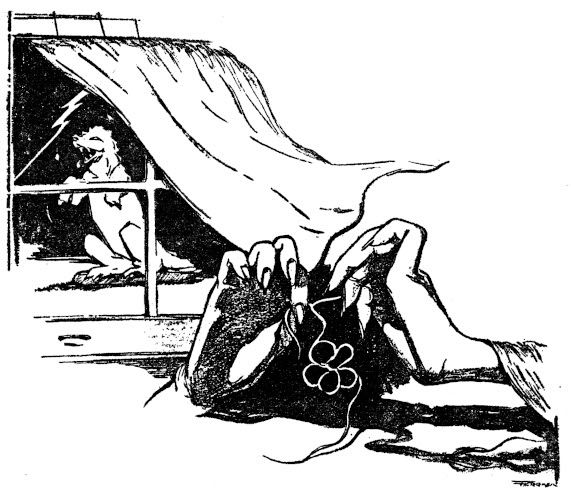
The next lightning flash showed him what he knew he must see. It crouched, facing the window. The head was still blank and crude as an unfinished skull.
In the ensuing surge of blackness, the sphere of alien thoughts expanded with instant swiftness, until it occupied his entire mind.
He glanced behind him. Tansy's hands were still. The strange seven-looped knot was poised between them.
Just as he was turning back, he saw the hands jerk apart and the loops whip in like a seven-fold snare—and hold.
And in that same moment of turning he saw the street brighten like day and a great ribbon of lightning split the tall elm opposite and fork into several streams which streaked across the street toward the window and the stony form upreared against it.
Then—blinding light, and a tingling electrical surge through his whole body.
But in his mind's eye was indelibly traced the incandescent track of the lightning, whose multiple streams, racing toward the upreared stony form, had converged upon it as if drawn together by a seven-fold knot.
The sphere of alien thoughts expanded beyond his skull at a dizzy rate, vanished.
His gasping, uncontrollable laughter rose above the dying reverberations of the titan thunder blast. He dragged open the window, pulled a bridge lamp up to it, jerked the cover from the lamp so its light flooded outward.
"Look, Tansy!" he called, his words mixed with the manic laughter. "Look, what those crazy students have done!" She must be made to think it was a joke. "Those frat men, I bet, I kidded in class. Look what they dragged down from campus and stuck in our front yard. Of all the crazy things—we'll have to call Buildings & Grounds to take it away tomorrow."
Rain splattered in his face. There was a sulphurous, metallic odor. Her hand touched his shoulder. She stared out blankly, her eyes still asleep.
It stood there, propped against the wall, solid and inert as only the inorganic can be. In some places the cement was darkened and fused.
"And of all mad coincidences," he gasped, "the lightning had to go and strike it!"
On an impulse, he reached out his hand, and touched it. At the feel of the rough, unyielding surface, still hot from the lightning flash, his laughter died, and a grim lucidity flooded his mind.
"Eppur si muove," he murmured to himself, so low that even Tansy, standing beside him, might not have heard. "Eppur si muove."
VII.
Next day he went around campus like a man in a daze. He had had a long and heavy sleep, but he looked as if he were stupefied by weariness. Even Harold Gunnison remarked on it.
"It's nothing," he replied. "I'm just lazy."
Gunnison smiled skeptically. "You've been working too hard. That's the temptation we're all up against. But it butchers efficiency. Better ration your hours of work. Your jobs won't go hungry if you feed them ten hours a day.
"Trustees are queer cusses," he continued with apparent irrelevance. "And Pollard's more a politician than an educator. But he brings in the money, and that's what college presidents are for."
Norman indicated that he appreciated the sympathy, but he felt as far removed from Gunnison as from the hordes of gayly dressed students who filled the walks and socialized in clusters. As if there were a wall of faintly clouded glass between. His only aim—and even that was blurred—was to prolong his present state of fatigued reaction from last night's events, and to avoid all thoughts.
Thoughts were dangerous. He felt their presence here and there in his brain, like pockets of poison, harmless as long as you left them encysted and did not prick them. One was more familiar than the others. It had been there last night. He felt vaguely thankful that he could not longer see inside of it.
Another was concerned with Tansy, and why she had seemed so cheerful and forgetful this morning.
Another—a very large one—was sunk so deeply in his mind that he could only perceive a small section of its globular surface. He knew it was connected with an unfamiliar emotion that he had sensed yesterday more than once, and he knew that it must under no circumstances be disturbed. He could feel it pulsate slowly and rhythmically, like a monster asleep in mud.
Another had to do with knots and lightning.
Another—tiny but prominent—was somehow concerned with cards.
And there were more, many more.
His situation was akin to that of the legendary hero who must travel through a long and narrow corridor, without once touching the morbidly enticing, poisoned walls.
He knew he could not avoid contact with them indefinitely, but in the meantime the thought-cysts might shrink and disappear.
The day fitted with his superficially dull and lethargic mood. Instead of the cool spell that should have followed the storm, there was a hot foretaste of summer in the air. Student absences rose sharply. Those who came to class were inattentive, and exhibited other symptoms of spring fever.
Only Bronstein seemed animated. He kept drawing Norman's other students aside by twos and threes, and whispering to them heatedly. Norman found out that he was trying to get up a petition of protest on Sawtelle's appointment. Norman asked him to stop it. Bronstein refused, but in any case he seemed to be failing in the job of arousing the other students.
Norman's lectures were languid. He contented himself with transforming his notes into accurate verbal statements with a minimum of mental effort. He watched the pencils move methodically as notes were taken, or wander off into intricate doodles. Two girls were engrossed in sketching the handsome profile of the fraternity president in the second row. He watched foreheads wrinkle as they picked up the thread of his lecture, smooth out again as they dropped it.
And all the while his own mind was wandering off on side tracks. They were too fugitive, too much like daydreams to be called thoughts.
One began when he recalled the epigram about a lecture being a process of transferring the contents of the teacher's notebook into the notebooks of the students, without allowing it to pass through the minds of either. That made him think of mimeographing.
Mimeograph, it went on. Margaret van Nice. Theodore Jennings. Gun. Windowpane. Galileo. Scroll—(Sheer away from that! Forbidden territory.)
The daydream backtracked and took a different turning. Jennings. Gunnison. Pollard. President. Emperor. Empress. Juggler. Tower. Hanged man—(Hold on! Don't go any further.)
As the long dull day wore on, the daydreams gradually assumed a uniform coloration.
Gun. Knife. Sliver. Broken glass. Nail. Tetanus.
War. Mangled bodies. Mayhem. Murder. Rope. Hangman. (Sheer off again!) Gas, Poison.
The coloration of blood and physical injury.
And ever more strongly, he felt the breath-like pulsations of the monster in the depths of his mind, dreaming nightmares of carnage from which it would soon awake and heave up out of the mud. And he powerless to stop it. It was as if a crusted-over swamp, swollen with underground water, were pushing up the seemingly healthy ground above by imperceptible degrees—nearing the point when it would burst through in one vast slimy eruption.
Starting home, Norman fell in with Mr. Carr.
"Good evening, Norman," said the old gentleman, lifting his Panama hat to mop his forehead, which merged into an extensive bald area.
"Good evening, Linthicum," said Norman. But his mind was occupied with speculating how, if a man let a thumbnail grow and then sharpened it carefully, he could cut the veins of his wrist and so bleed to death.
Mr. Carr wiped the handkerchief around his beard.
"I enjoyed the bridge thoroughly," he said. "Perhaps the four of us could have a game when the ladies are away at the faculty wives' meeting next Thursday? You and I could be partners, and use the Culbertson slam conventions." His voice became wistful. "I'm tired of always having to play the Blackwood."
Norman nodded, but he was thinking of how men have learned to swallow their tongues, and when the occasion came, die of suffocation. He tried to check himself. These were speculations appropriate only to the concentration camp. Visions of death kept rising in his mind, replacing one another. He felt the pulsations deepen, become unendurably strong. Mr. Carr nodded pleasantly and turned off. He quickened his pace, as if the walls of the poisoned passageway were contracting on the legendary hero and, unless the end were soon reached, he would have to shove out against them wildly.
From the corner of his eye he saw one of his students. She was staring at him puzzledly. He brushed past her.
He reached the boulevard. The lights were against him. He paused on the edge of the curb. A large red truck was rumbling toward the intersection at a fair rate of speed.
And then he knew just what was going to happen, and that he would be unable to stop himself.
He was going to wait until the truck was very close and then he was going to throw himself under the wheels. End of the passageway.
That was the meaning of the fifth stick figure, the tarot diagram that had departed from tradition.
Empress—Juggler—The truck was very close. Tower—The lights had started to change but the truck was not going to stop. Hanged man—
It was only when he leaned forward, tensing his leg muscles, that the small flat voice spoke into his ear, a voice that was a monotone and yet diabolically humorous, the voice of his dreams:
"Not for two weeks, at least. Not for two more weeks."
He regained his balance. The truck rushed by. He looked over his shoulder—first up, then around. No one but a small Negro boy and an elderly man, rather shabbily dressed, carrying a shopping bag. They were waiting to cross in the opposite direction. A shiver settled on his spine.
Eyes shifting warily from side to side, he crossed the street, and proceeded home. He no longer thought of death, except to fear it. As soon as he was inside, he poured himself a more than generous drink. Oddly, Tansy had set out soda and ice. He mixed the highball and gulped it down.
So he had been given two weeks? Two weeks in which to pick his life slowly apart, savor each stage of doom, before he should walk again the narrow corridor at the end of which a truck was always rumbling by.
Anger surged in him at the idea.
But perhaps that was what he was supposed to do—get angry.
He mixed himself another drink, took a gulp, then looked at it doubtfully.
Perhaps that was part of the plan, too.
Tansy came in, carrying a bundle. Her face was smiling and a little flushed. With a sigh of relief she set down the bundle and pushed aside the dark bangs from her forehead.
"Whew, what a sweltering day. I thought you'd be wanting a drink. Here, let me finish that one for you."
When she put down the glass there was only ice in it. "There, now we're blood brothers or something. Mix yourself another."
"That was my second," he told her.
"Oh, heck, I thought I was cheating you." She sat on the edge of the table and wagged a finger in his face. "Look, mister, you need a rest. Or some excitement. I'm not sure which. Maybe both. Now here's my plan. I make us a cold supper—sandwiches. Then, when it's dark and nobody can see us, we get Oscar out of the garage, and sinfully waste a half gram of rubber off his tires in driving to the Top of the Hill. We haven't done that for years. How about it, mister?"
He hesitated. Helped by the drink, his thoughts were veering. This was a crazy situation. Half his mind was still gripped by a sickening, panicky apprehension for his immediate personal future. The other half was coming under the spell of Tansy's gaiety.
She reached out and pinched his nose. "How about it?"
"All right," he said.
"Hey, you're supposed to act interested!" She slid off the table, started for the kitchen, then added darkly over her shoulder, "But that will come later."
She looked provocatively pretty, in her mock anger. He couldn't see any difference between now and fifteen years ago. He felt he was seeing her for the hundredth first time.
When the sandwiches came, he was reading the evening paper. The disquieting half-and-half mood persisted. He had found a local-interest item at the bottom of the fifth page.
STUDENT PRANKSTERS AT WORK AGAIN
A practical joke is worth any amount of trouble and physical exertion. At least, that is the sentiment of a group of Hempnell College students, as yet unidentified. But we are wondering about the sentiments of Professor Norman Saylor, when he looked out the window this morning and saw a stone gargoyle weighing a good three hundred pounds sitting in the middle of his lawn. It had been removed from the roof of one of the college buildings. How the students managed to detach it, lower it from the roof, and transport it to Professor Saylor's residence, is still a mystery.
Said Professor Saylor, "Thanks for the lawn ornament, boys, but I really don't want it."
When President Randolph Pollard was asked if the pranksters had been identified, he laughingly replied. "I guess our War Program of physical education for men must be providing them with reserves of excess strength and energy."
When we spoke to President Pollard he was leaving to address the Lions' Club on "The College in War-time." (For details of his address, see page 1.)
Just what you might expect. The usual repertorial inaccuracies. It wasn't a gargoyle; gargoyles are ornamental rainspouts. And the reporter had not used the lightning angle in his story. Probably thought it would sound too fishy.
Finally, the familiar touch of turning the item into an advertisement for the physical-education department. You had to admit that the Hempnell publicity office had a kind of efficiency.
Tansy swept the paper out of his hands.
"The world can wait," she said. "Here, have a bite of my sandwich."
VIII.
It was quite dark when they started for the Hill. He drove carefully, taking his time at intersections. Tansy's gaiety still did no more than hold in check the other half of his thoughts.
"I might be a witch," she said, "taking you to a hilltop rendezvous. Our own private Sabbat."
She was smiling impishly. She had changed to a light white sports dress. She looked like one of his students.
Again he felt the craziness of the situation. The line between reality and pretense was become harder to distinguish. He must keep carefully in mind that when she said things like that, she was making a courageous mockery of her previous behavior. He must on no account let her see the other half of his thoughts. Or was that what she wanted?
The lights of the town dropped behind. Half a mile out, he turned off sharply onto the road that wound up the hill. It was bumpier than he remembered from the last time—was it as much as ten years ago? And the trees were thicker, brushing the windshield.
When they emerged into the half acre of clearing on the top, the moon, two days after full, was rising redly.
Tansy pointed to it and said, "Check! I timed it perfectly. But where are the others? There always used to be two or three cars up here. And on a night like this!"
He stopped the car close to the edge. "Fashions in lovers' lanes change like anything else," he told her. "We're traveling a disused folkway."
"Always the sociologist!"
"I guess so. Maybe Mrs. Carr found out about this place. And I suppose the students range farther afield nowadays, or did until this year."
She rested her head on his shoulder. He switched off the headlights, and the moon cast soft shadows.
"We used to do this at Gorham," she murmured. "When I was taking your classes, and you were the serious young instructor. Until I found out you weren't any different from the college boys—only better. Remember?"
He nodded and took her hand. He looked down at the town, made out the campus, with its prominent floodlights designed to chase couples out of dark corners. Those garishly floodlighted Gothic buildings seemed for the moment to symbolize a whole world of barren intellectual competition and jealous traditionalism, a world toward which at the moment he felt as alien as if he were still twenty-six instead of forty-one and Tansy twenty-one instead of thirty-six.
"I wonder if that's why they hate us so?" he said, almost without thinking.
"Whatever are you talking about?" But the question sounded lazy.
"I mean the rest of the faculty, or most of them. Is it because we can do things like this?"
She laughed. "So you're actually coming alive. We don't do things like this so very often, you know."
He kept on with his idea. "It's a devilishly competitive and jealous life. The war, doing away with some of it, makes you more conscious of the rest. And competition in an institution can be nastier than any other, because it's so tight. Think so?"
"I've lived with it for years," said Tansy, simply.
"Of course, it's all very petty. But petty emotions can come to outweigh big ones. Their size is better suited to the human mind."
He looked down at Hempnell, and tried to visualize the amount of ill will and jealousy he had inevitably accumulated for himself. He felt a slight chill creeping around. He realized where this train of thought was leading. The darker half of his mind loomed up ominously.
"Here, philosopher," said Tansy, "have a slug."
She was offering him a small silver flask.
He recognized it. "I never dreamed you'd kept it all these years."
"Uh-huh. Remember when I first offered you a drink from it? You were a trifle shocked, I believe. Though you carried a flask, too."
"I took the drink."
"Uh-huh. So take this one."
It tasted like fire and spice. There were memories with it, memories of those crazy prohibition years, and of Gorham and New England.
"Brandy?"
"Greek style. Give me some."
Before that flood of memories, the darker half of his mind receded, was washed under. He looked at Tansy's sleek hair and moon-shadowed eyes. Of course, she's a witch, he thought lightly. She's Lilith. Ishtar. He'd tell her so.
"Do you remember the time," he said, "we slid down the bank to get away from the night watchman at Gorham? There would have been a magnificent scandal if he'd caught us."
"Oh, yes, and the time—"
When they went down, the moon was an hour higher. He drove slowly. No need to imitate the sillier practices of the prohibition era. A truck chugged past him. "Two more weeks." Rot! Who'd he think he was, hearing voices? Joan of Arc?
He felt hilarious. He wanted to tell Tansy all the ridiculous things he'd been imagining the last few days, so she could laugh at them, too. It would make a swell ghost story. There was a reason he shouldn't tell her, but it was an insignificant reason—part and parcel of this cramped, warped, overcautious Hempnell life they ought to break away from more often.
So when they arrived in the living room, Tansy flopping down on the sofa, he began, "You know, Tansy, about this witch stuff. I want to tell you—"
He was caught completely off guard by whatever force—subjective or objective—hit him. When it was over, he was sitting in the easy-chair, completely sober, with the outer world once more an icy pressure on his senses, and the inner world a whirling sphere of alien thought, and the future a dark corridor two weeks long.
It was as if a very large, horny hand had been clapped roughly over his mouth, and as if another such hand had grasped him by the shoulder, shook him, and slammed him down in the leather chair.
As if?
He looked around uneasily.
Maybe there had been hands.
Apparently Tansy had not noticed anything. Her face was a white oval in the gloom. She was still humming a snatch of song. She did not ask what he had started to say.
He got up, walked unsteadily into the dining room, and poured himself a drink from the sideboard. On the way he switched on the lights.
So he couldn't tell Tansy or anyone else about it, even if he wanted to? That was why you never heard from real witchcraft victims. And why they never seemed able to escape, even if the means of escape were at hand. It wasn't weak will. They were watched. Like a gangster taken on a ride from an expensive night club. He must excuse himself from the loud-mouthed crowd at his table and laugh heartily, and stop to chat with friends and throw a wink at the pretty girls because right behind him are those white-scarfed, top-hatted trigger boys, hands in the pockets of their velvety dress overcoats. No use dying now. Better play along. There might be a chance.
But that was storybook stuff, movie stuff.
He nodded at himself in the glass above the sideboard.
"Meet Professor Saylor," he said. "The distinguished ethnologist and firm believer in real witchcraft—"
But the face in the glass did not look so much disgusted as frightened.
He mixed himself another drink, and one for Tansy, and took them into the living room.
"Here's to wickedness," said Tansy. "Do you realize you haven't been anywhere near drunk since Christmas?"
He grinned. That was just what the movie gangster would do, to grab a moment of forgetfulness when the Big Boy had put him on the spot. And not a bad idea.
Slowly, and at first only in a melancholy minor key, the mood of the Hill returned. They talked, played old records, told jokes that were old enough to be new again. Tansy hammered the piano, and they sang a crazy assortment of songs—folk songs, hymns, national anthems, revolution songs, blues, Brahms, Schubert—haltingly at first, later at the top of their voices.
They remembered.
And they kept on drinking.
But always, like a shimmering sphere of crystal, the alien thoughts spun in his mind. The drink made it possible for him to regard them dispassionately, without constant revulsions in the name of common sense. He began to see world-wide evidence for the operation of witchcraft.
For instance, was it not likely that all self-destructive impulses were the result of witchcraft, more or less efficiently screened off by protective magic, or not screened off at all? Those universal impulses that were a direct contradiction to the laws of self-preservation and survival. Poe had fancifully referred them to an "Imp of the Perverse," and psychoanalysts had laboriously hypothesized a "death instinct" to account for them. How much simpler to attribute them to malign forces outside the individual, working by means as yet unanalyzed and therefore classified as supernatural.
His experiences during the past days could be divided into two distinct categories. The first included those natural misfortunes and antagonisms from which Tansy's magic had screened him. The attack on his life by Theodore Jennings should probably be placed in this category. The chances were that Jennings was actually psychopathic. He would have made his murderous attack at an earlier date, had not Tansy's protective magic kept it from getting started. As soon as the screen was down, as soon as Norman burned the last hand, the idea had suddenly burgeoned in Jennings' mind like a hothouse flower. Jennings had himself admitted it! "I didn't realize until this minute—"
Margaret van Nice's accusation, Thompson's sudden burst of interest in his extracurricular activities, and Sawtelle's chance discovery of the Cunningham thesis also probably belonged in the same category.
In the second category—active and malign witchcraft.
"A penny for your thoughts," offered Tansy, looking over the rim of her glass.
"I was thinking of the party last Christmas," he replied smoothly, "and of how Welby crawled around playing a St. Bernard, with the bearskin rug over his shoulders and the bottle of whiskey slung under his neck." He felt a childish pride in his cunning at having avoided being trapped into an admission. He simultaneously thought of Tansy as a genuine witch and as a potentially neurotic individual who had to be protected at all costs from dangerous suggestions. The liquor made his mind work by parts, and the parts had no check on each other.
His consciousness began to black out for indeterminate intervals. Things began to happen by fits and starts.
They were wailing "St. James' Infirmary."
He was thinking: "Why shouldn't the women be the witches? They're the intuitionalists, the traditionalists, the irrationalists. And like Tansy, most of them are never quite sure whether or not their witchcraft really works."
They had shoved back the carpet and were dancing to "Chloe." Sometime or other she had changed to her rose dressing gown.
He was thinking: "In the second category, put the Estrey dragon. Animated by a human or nonhuman soul conjured into it by Mrs. Gunnison and controlled through photographs. Inhibited by the Protective Screen so long as the Protective Screen existed."
They had put on a record of Ravel's "Bolero," and he was beating out the rhythm with his fist.
He was thinking: "All sculpture has a magical significance, from the Aurignacian Venus to Epstein's 'Genesis.' The underlying intention has always been to produce a manikin capable of being animated by sorcery."
He was watching Tansy as she sang "St. Louis Blues" in a hoarsely throbbing voice. It was true, just as Welby had always maintained, that she had a genuine theatrical flair. Make a good chanteuse.
He was thinking: "Tansy stopped the Estrey dragon with the knots. But she'll have a hard time doing anything like that again, because Mrs. Gunnison has her book of formulas and can figure out ways to circumvent."
They were sharing a highball that would have burned his throat if his throat had not been numb, and he seemed to be getting most of it.
He was thinking: "The tarot stick figure of the man and the truck is the key to a group of related sorceries. Cards began as instruments of magic, like sculpture. These sorceries aim at finishing me off. The bull-roarer acts as an amplifier or reinforcement. The thing standing behind me, with the flat voice and heavy hands, is a guardian, to see to it that I do not deviate from the path appointed. Bull-roaring and flat voice were associated in my dream. Narrow corridor. Two weeks more."
The strange thing was that these thoughts were not altogether unpleasant. They had a wild, black, poisonous beauty of their own, a lovely, deadly shimmer. They possessed the fascination of the impossible, the incredible. They hinted at unimaginable vistas. Even while they terrorized, they did not lose that chillingly poignant beauty. They were like the visions conjured up by some forbidden drug. They had the lure of an unknown sin and an ultimate blasphemy. He could understand the force that compelled the practitioners of black magic to take any risk.
His drunkenness made him feel safe. It had broken his mind down into its ultimate particles, and those particles were incapable of fear because they could not be injured. Just as the iron molecules of a battleship are quite safe from the bomb which blows the battleship apart.
But now the particles were whirling crazily. Consciousness was wavering.
They were in each other's arms.
Tansy was asking eagerly, coaxingly, "All that's mine is yours? All that's yours is mine?"
The question awakened a suspicion in his mind, but he could not grasp it clearly. Something made him think that the words held a trap. But what trap? His thoughts stumbled and reeled.
She was saying—it sounded like the Bible—"and I have drunk from your cup and eaten from your table—"
Her face was a blurred oval, her eyes like misty jewels.
"Everything you have is mine? You give it to me without hindrance and of your own free choice?"
Somewhere a trap.
But the voice was irresistibly coaxing, like tickling fingers.
"All you have is mine? Just say it once, Norm, just once. For me."
Of course he loved her. Better than anything else in the world.
"Yes ... yes ... everything—" he heard himself saying.
And then his mind toppled and plunged down into a fathomless ocean of darkness, and silence, and peace.
IX.
Sunlight made a bright, creamy design on the drawn blind. Filtered sunlight filled the bedroom, like a coolly glowing liquid. The birds were chirruping importantly. He closed his eyes again and stretched luxuriously.
Let's see, it was about time he got started on that article for the Journal. And there was still some work to do on the revision of his "Textbook of Ethnology." Lots of time, but better get it out of the way. No telling when the government would want another brochure. And he ought to have a serious talk with Bronstein about his thesis. That boy had some good ideas, but he needed a balance wheel. And then his address to the Off-campus Mothers. Might as well tell them something useful—
Eyes still closed, he enjoyed to the full that most pleasant of sensations—the irresistible tug of work a man likes to do and is able to do well.
No need to get started right away, though. Today was too good a day for golf to miss. Might see what Gunnison was doing. And then he and Tansy had not made an expedition into the country this whole spring. He'd talk to her about it at breakfast. Saturday breakfast was an event. She must be getting it ready now. He felt as if a shower would make him very hungry. Must be late.
He opened an eye and focused the bedroom clock. Twelve thirty-five? Say, just when had he got to bed last night? What had he been doing?
Memory of the past few days uncoiled like a loosed spring, so swiftly that it started his heart pounding and brought him up with a jerk. Yet there was a difference. From the very first moment it all seemed incredible and unreal. He had the sensation of reading the very detailed case history of another person. His memories could not be made to fit with his present sense of well-being. What was stranger, they did not seriously disturb that sense of well-being.
He searched his mind diligently for traces of supernatural fear, of the sense of being watched and guarded, of that monstrous self-destructive impulse. He could not discover or even suggest to himself the slightest degree of such emotions. Whatever they had been, they were now part of the past, beyond the reach of everything except intellectual memory. "Spheres of alien thought!" Why, the very notion was bizarre. And yet somehow it had all happened. Something had happened.
His movement had automatically taken him under the shower. And now, as he soaped himself and the warm water cascaded down, he wondered if he ought not to talk it all over with Jones of psychology or a good practicing psychiatrist. The mental contortions he'd gone through in the last few days would provide material for a whole treatise! Feeling as sound as he did this morning, it was impossible for him to entertain any ideas of serious mental derangement. No, what had happened was just one of those queer, inexplicable spasms of irrationality that can seize the sanest people, perhaps because they are so sane—a kind of discharge of long-inhibited morbidity. Too bad, though, that he had bothered Tansy with it. Especially when her own nervous system had been in a shaky state. Poor kid, she had been working hard to cheer him up, last night in particular. It ought to have been the other way around. Well, he would make it up to her.
He shaved leisurely and with enjoyment. The razor behaved perfectly.
As he finished dressing, a doubt struck him. Again he searched his mind, closing his eyes like a man listening for an almost inaudible sound.
Nothing. Not the faintest trace.
He was whistling as he pushed into the kitchen.
There was no sign of breakfast. Beside the sink were some unwashed glasses, empty bottles, and an ice tray filled with tepid water.
"Tansy," he called. "Tansy!"
He walked through the house, with the vague apprehension that she might have passed out before getting to bed. They'd been drinking like fish. He went out to the garage and made sure that the car was still there. Maybe she'd walked to the grocer's to get something for breakfast. Unconsciously he began to hurry as he went back into the house.
This time when he looked in the study, he noticed the upset ink bottle, and the scrap of paper just beside it on the edge of the drying black pool. The message had come within an inch of being engulfed.
It was a hurried scrawl—twice the pen point had gouged through the paper—and it broke off twice in the middle of a sentence, but it was undeniably in Tansy's handwriting.
For a moment it isn't watching me. I didn't realize it would be too strong for me. Not two weeks not—two days! Don't try to follow me. Only chance is to do exactly what I tell you. Take four lengths of four-inch white cord and—
His eyes traced the smear going out from the black pool and ending in the indistinct print of a hand, and involuntarily his imagination recreated the scene. She had been scribbling desperately, stealing quick glances over her shoulder. Then it had awakened to what she was doing and had roughly struck the pen out of her hand, and shaken her. He recalled the grip of those huge horny hands, and winced. And then ... then she had gotten together her things, very quietly although there was little chance of him awakening, and she had walked out of the house and down the street. And if she met anyone she knew, she had talked to them gayly, and laughed, because it was behind her, waiting for any false move, any attempt at escape.
So she had gone.
Where? Anywhere. Wherever the narrow corridor ended for her, no longer two weeks but only two days long.
In a flash of insight he understood why. If he hadn't been drunk last night, he would have guessed.
One of the oldest and best-established types of conjuration in the world. Transference of evils. Like the medicine man who conjures sickness into a stone, or into an enemy, or into himself—because he is better able to combat it—she had taken his curse upon herself. Shared his drink last night, shared his food. Used a thousand devices to bring them close together. It was all so obvious! He racked his brain to recover those last words she had said to him. "Everything you have is mine? All you have is mine?"
She had meant the curse.
And he had said, "Yes."
And then, without her formulas and her Protective Screen, the curse had proved too strong for her.
He wanted to run out into the street, to shout her name.
But the pool of ink had dried to glistening black flakes all around the margin. It must have been spilled hours ago—as early as last midnight even.
He beat his temple in a rage at his own impotence.
This mood did not last long. His anxiety persisted, grew stronger. But the supernatural terror rapidly died away. It could not sustain itself now that he no longer experienced it directly. Even the argument that he had lost his sensitivity only because the curse was now directed at her, did not convince him for a moment. No, there was nothing supernatural in this—no guardian except a figment of his and her neurotic nerves. What had happened was that he had suggested all this to her. He had forced upon her the products of his own morbid imagination. Undoubtedly he had babbled everything to her while he was drunk. And it had worked on her suggestible nature—she already believed in witchcraft—until she had got the idea of transferring his curse to herself, and had convinced herself that the transference had actually occurred. And then gone off, God knew where!
And that was bad enough.
There was a light chime from the front door. He extracted a letter from the mailbox, ripped it open. It was addressed with a soft pencil, and the graphite had smeared. But he knew the handwriting.
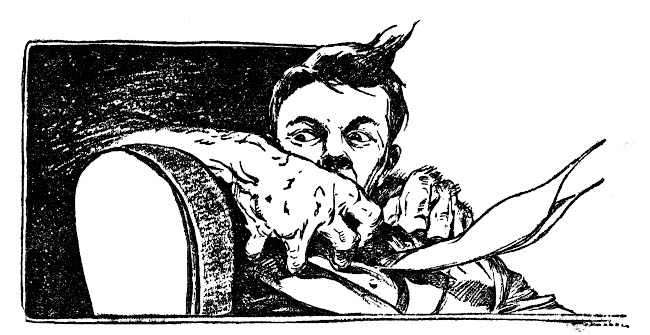
The message was so jerky and uneven that he was some time reading it. It began and ended in the middle of a sentence.
—and a length of gut, a bit of platinum or iridium, a piece of lodestone, a phonograph needle that has only played Scriabin's "Ninth Sonata." Then tie—
That was all. A continuation of the first message, with its bizarre formula. Had she really convinced herself that there was a guardian watching her, and that she could only communicate during the infrequent moments when its attention was elsewhere? He knew the answer. When you had an obsession you could convince yourself of anything.
He looked at the postmark. He recognized the name of a town several miles east of Hempnell. He could not think of a soul they knew there, or anything else about the town. His first impulse was to get out the car and rush over. But what could he do when he got there?
The phone was ringing. It was Evelyn Sawtelle.
"Is that you, Norman? Please ask Tansy to come to the phone. I wish to speak to her."
The question was rapped out with precision, as if its wording had been carefully planned.
"I'm sorry, but she isn't in."
Evelyn Sawtelle did not sound surprised at the answer—her second question came too quickly. "Where is she then? I must get in touch with her."
He thought. "She's out in the country," he said, "visiting some friends of ours. Is there something I can tell her?"
"No, I wish to speak to Tansy. What is your friend's number?"
"They don't have a phone!" he said angrily.
"No? Well, it's nothing of importance." She sounded oddly pleased, as if his anger had given her satisfaction. "I'll call again. I must hurry now. Hervey is so busy with his new responsibilities. Good-by."
He replaced the phone. Now, why the devil—Suddenly an explanation occurred to him. Perhaps Tansy had been seen leaving town, and Evelyn Sawtelle had scented the possibility of some sort of scandal and had wanted to check. Perhaps Tansy had been carrying a suitcase.
He looked in Tansy's dressing room. The small suitcase was gone. Drawers were open. It looked as if she had packed in a hurry. But what about money? He examined his billfold. It was empty. Forty-odd dollars missing.
You could go a long way on forty dollars. The jerky illegibility of the message made it look as if it had been written on a train or bus.
The next few hours were highly unpleasant. He checked schedules, and found that several busses and trains passed through the town from which Tansy's letter had been sent. He drove to the stations and made guarded inquiries, with no success.
He wanted to do all the things you should do when someone disappears, but he held back. What could he say? "My wife, sir, has disappeared. She is suffering from the delusion that—" And what if she should be found and questioned in her present state of mind, examined by a doctor, before he could get to her?
No, this was something for him to handle alone. But if he did not get a line on it soon, he would have no choice. He would have to go to the police, inventing some story to cover the facts.
She had written, "Two days." If she believed that she were doomed to die in two days, might not the belief be enough? That was his worst fear.
Toward evening he drove back to the house, repressing the chimerical hope that she had returned in his absence. The special delivery carrier was just getting into his car. Norman pulled up alongside.
"Anything for Saylor?"
"Yes, sir. It's in the box."
The message was longer this time, but just as difficult to read.
At last its attention is somewhere else. If I control my emotions, it isn't so quick to notice my thoughts. But it was hard for me to post the last letter. Norman, you must do what I tell you. The two days end Sunday midnight. Then the Bay. You must follow all directions. Tie the four white cords into a granny, a reef, a cat's-paw, and a carrick bend. Tie the gut in a bowline. Then add—
He looked at the post mark. The place was two hundred miles east. Not on the railroad lines, as far as he could recall. That should narrow down the possibilities considerably.
One word from the letter was repeating itself in his mind, like a musical note struck again and again until it becomes unendurable.
Bay. Bay. Bay. Bay.
The memory came of a hot afternoon fifteen years ago. It was just before they were married. They were sitting on the edge of a ramshackle little pier. He remembered the salt smell, and the faintly fishy, dry-wood smell of the splintery old planks.
"Funny," she had said, looking down into the green water, "but I always used to think that I'd end up down there. Not that I'm afraid of it. I've always swum way out. But even when I was a little girl I'd look at the Bay—maybe green, maybe blue, maybe gray, covered with whitecaps, glittering with moon-beams, or shrouded by fog—and I'd think, 'Tansy, the Bay is going to get you, but not for years and years.' Funny, isn't it?"
And he laughed and put his arms around her tight, and the green water had gone on lapping at the piles heavy with seaweed.
He had been visiting with her family, when her parents were still alive, at their home near Bayport on the southern shore of New York Bay.
The narrow corridor suited itself to its victim's most cherished fear. It ended for her in the Bay, tomorrow midnight.
She must be heading for the Bay.
He made several calls—first bus lines, then railroad and air. It was impossible to get a reservation on the air lines, but tonight's train would get him into Jersey City an hour ahead of the bus she must be traveling, according to the deductions he made from the place and time of the postmarks.
He had ample time to pack a few things, cash a check on his way to the station—
He spread her three notes on the table—the one in pen, the two in pencil. He reread the crazy incomplete formula. He shook his head.
He frowned. Would a scientist neglect the millionth-and-one possibility? Would the commander of a trapped army disdain a stratagem just because it was not in the books? This stuff looked like gibberish. Yesterday it might have meant something to him emotionally. Today it was just nonsense. But tomorrow night it might conceivably represent a fantastic last chance.
"Norman, you must do what I tell you." The scrawled words stared at him.
He went out in the kitchen and got a ball of white twine.
He rummaged in the closet for his squash racket and cut out the two center strings. That ought to do for gut.
The fireplace had not been cleaned since the stuff from Tansy's dressing table had been burned. He poked around the edges until he found a piece of lodestone.
He located the recording of Scriabin's "Ninth Sonata" and started the phonograph, putting in a new needle. He glanced at his wrist watch and paced the room restlessly. Gradually the music took hold of him. It was not pleasant music. There was something tantalizing and exasperating about it, with its droning melody and rocking figures in the base and shakes in the treble and elaborate ornamentation that writhed up and down the piano keyboard. It rasped the nerves.
He began to remember things he had heard about it. Hadn't Tansy once told him that Scriabin called his "Ninth Sonata" a "Black Mass" and had developed an antipathy to playing it? Scriabin, who had conceived a color organ and tried to translate mysticism into music, and had died of a peculiar lip infection. An innocent-faced Russian with a huge curling mustache. Critical phrases Tansy had repeated to him floated through his mind. "The poisonous 'Ninth Sonata'—the most perfidious piece of music ever conceived—" Ridiculous! How could music be anything but an abstract pattern of tones?
And yet—while listening to the thing—one could think differently.
Faster and faster it went. The lovely second theme became infected, was distorted into something raucous and discordant—a march of the damned—a dance of the damned—breaking off suddenly when it had reached an unendurable pitch. Then a repetition of the droning first theme, ending on a soft yet grating note low in the keyboard.
He removed the needle, sealed it in an envelope, and packed it along with the rest of his stuff.
On an afterthought, he tore out of the big dictionary a page carrying an illustrated list of knots.
The telephone stopped him as he was going out.
"Oh, Professor Saylor, would you mind calling Tansy to the phone?" Mrs. Carr's voice was very amicable.
He repeated what he had told Mrs. Sawtelle.
"I'm glad she's having a rest in the country," said Mrs. Carr. "You know, Professor Saylor, I don't think that Tansy's been looking so well lately. I've been a little worried. You're sure she's all right?"
"How do you mean?"
It was then the other voice broke in.
"What's the idea of checking up on me? Do you think I'm a child? I know what I'm doing!"
"Be quiet!" said Mrs. Carr. Then, in her sweet voice. "I think someone must have cut in on us. Good-by, Professor Saylor."
The line went dead.
He picked up his suitcase and walked out.
X.
The bus driver they pointed out to him had thick shoulders and sleepy, competent-looking eyes. He was standing by the wall, smoking a cigarette.
"Sure, she must have been in my bus," he told Norman after thinking a moment. "A pretty woman, on the small side, in a gray dress, with a queer-looking silver brooch like you mentioned. One suitcase. Light pigskin. I figured her out as going to see someone who was very sick, or had been in an accident, maybe."
Norman curbed his impatience. If it had not been for the hour-and-a-half delay outside Jersey City, he would have been here well ahead of the bus, instead of twenty minutes late.
He said, "I want, if possible, to get a line on where she went after she left your bus. The man at the desk can't help me."
The driver looked at Norman. But he did not say, "Whatcha wanta know for?"—for which Norman was grateful. He seemed to decide that Norman was O. K.
He said, "I can't be sure, mister, but there was a local bus going down the shore. I think she got on that."
"Would it stop at Bayport?"
The driver nodded.
"How long since it left?"
"About twenty minutes."
"Could I get to Bayport ahead of it? If I took a cab?"
"Just about. If you wanted to pay the bill there and back—and maybe a little extra for the rubber he'd burn—I think Alec could take you." He waved in casual recognition at a man sitting in a cab just beyond the station. "Mind you, mister, I can't say for certain she got on the shore bus."
"That's all right. Thanks a lot."
In the glow of the street lamp Alec's foxy eyes were more openly curious than the bus driver's, but he did not make any comments.
"I can do it," he said cheerfully, "but we haven't any time to waste. Jump in."
The shore highway led through lonely stretches of marsh and wasteland. Occasionally Norman caught the sibilant rustle of the leagues of tall stiff seagrass, and a brackish tang from the dark inlets crossed by long low bridges. The odor of the Bay.
Indistinctly he made out factories and scattered houses.
"There's a dimout some places," Alec volunteered once. He was paying close attention to the road.
They passed three or four busses without Alec making any comment.
After a long while Alec said, "That should be her."
A constellation of red and green taillights was vanishing over the rise ahead.
"About three miles to Bayport," he continued. "What should I do?"
"Just get to Bayport a little ahead of her, and stop at the bus station."
"O.K."
They overtook the bus and swung around it. The windows were too high for Norman to see any of the occupants. Besides, the interior lights were out.
As they drew ahead, Alec nodded confirmingly. "That's her all right."
The bus station at Bayport was also the railway depot. Vaguely Norman remembered the loosely planked platform and packed cinders on the track side. The station building was dark, but there were several cars and a lone local cab drawn up, and there were some men standing around talking in low voices, and a couple of soldiers going back to camp.
He had time to scent the salt air, with its faint and not unpleasant trace of fishiness. Then the bus pulled in.
Several passengers stepped down, looking around to spot the people waiting for them.
Tansy was the third. She was staring straight ahead. She was carrying the pigskin suitcase.
"Tansy!" he said.
She did not look at him. He noted a black stain on her right hand, and remembered the spilled ink on his study table. Odd that it should still be there.
"Tansy!" he said. "Tansy!"
She walked straight past him, so close that her sleeve brushed his.
"Tansy, what's the matter with you?"
He had turned and hurried after her. She was heading for the local cab. He was conscious of a silence, and curious unfriendly glances. It made him angry.
She did not slacken her pace. He grabbed her elbow and pulled her around. He heard a remonstratory murmur behind him, and realized that a couple of the men were closing in.
"Tansy, stop acting this way! Tansy!"
Her face looked frozen. She stared past him without a hint of recognition in her eyes.
That infuriated him. He did not pause to think. Accumulated tensions prodded him into an explosion. He grabbed both elbows and shook her. She still looked past him, completely aloof—a perfect picture of an aristocratic woman enduring brutality. If she had yelled and fought him, the men might not have interfered.
He was jerked back.
"Lay off her!"
"Who do you think you are, anyway?"
She stood there, with maddening composure. He noticed a scrap of paper flutter out of her hand. Then her eyes met his and for one terrible moment—but one moment only—he saw rise up behind her a shaggy black form twice her height, with hulking shoulders, out-stretched massive hands, and dully glowing eyes.
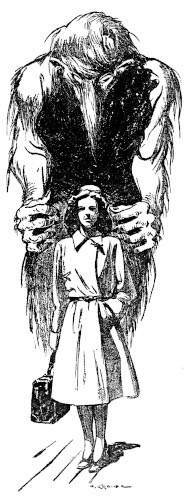
Only a moment, though. Then she turned away. But he fancied that a great shadow followed hers. Then they swung him around and he could no longer see her.
In a queer sort of daze—for the kind of fear he had just experienced mixes badly with any other emotion—he listened to them jabber at him.
"I ought to take a crack at you," he finally heard someone say.
"All right," he replied in a flat voice. "They're holding my hands."
He heard Alec's voice. "Say, what's going on here?" Alec sounded cautious, but not unfriendly, as if he were thinking, "The guy's my fare, but I don't know anything about him."
One of the soldiers spoke. "Where's the lady? She doesn't seem to be making any complaint."
"Yeah, where is she?"
"She got in Jake's cab and drove off," someone volunteered.
"Maybe he had a good reason for what he did," said the soldier.
Norman felt the attitude of the crowd change.
One of the men holding him retorted, "Nobody's got a right to treat a lady that way." But the other one slackened his grip and asked Norman, "How about it? Did you have a reason for doing that?"
"I did. But it's my business."
He heard a woman's voice, high-pitched. "A lot of fuss over nothing!"
Grumbling, the men let him go.
"But mind you," said the more belligerent one, "if she'd stuck around and complained, I'd 've sure taken a crack at you."
"All right," said Norman, "in that case you would have." His eyes were searching for a scrap of paper.
"Can anyone tell me the address she gave the cab driver?" he asked at random.
One or two shook their heads. The others ignored the question. Their feelings toward him had not changed enough to make them co-operative. And very likely, in the excitement, no one had heard.
Silently the little crowd drifted apart. People waited until they got out of earshot before beginning to argue about what had happened. Most of the cars drove off. The two soldiers wandered over to the benches in front of the depot, so they could sit down while they waited for their bus or train. He was alone except for Alec.
He located the scrap of paper in one of the slots between the worn planks. It had almost slipped through.
He took it over to the cab and studied it.
He heard Alec say, "Well, where do we go now?" Alec sounded dubious.
He glanced at his watch. Ten thirty-five. Not quite an hour and a half until midnight. There were a lot of things he could do, but he could not do more than a couple of them in that time. His thoughts moved sluggishly, almost painfully.
He looked around at the dim buildings. The seaward halves of some of the street lamps were painted black. Up a side street there were signs of life. He looked again at the scrap of paper.
Then he made a decision.
"I think there's a hotel on the main street," he told Alec. "You can drive me there."
"Eagle Hotel" read the black-edged gold letters on the plate-glass window, behind which the narrow lobby with its half-dozen empty chairs was nakedly revealed.
He told Alec to wait, and took a room for the night. The clerk was an old man in a shiny black coat. Norman saw from the register that no one else had checked in recently. He carried his bag up to the room and immediately returned to the lobby.
"I haven't been here for ten years," he told the clerk. "I believe there is a cemetery about five blocks down the street, away from the Bay?"
The old man's sleepy eyes blinked wide open.
"Bayport Cemetery? Just three blocks, and then a block and a half to the left. But—" He made a vague questioning noise in his throat.
"Thank you," said Norman.
After a moment's thought, he paid off Alec, who took the money and with obvious relief kicked his cab into life. Norman walked down the main street, away from the Bay.
After the first block there were no more stores. In this direction, Bayport petered out quickly. Most of the houses were dark. And after he turned left there were no more street lights.
The gates of the cemetery were locked. He felt his way along the wall, behind the masking shrubbery, trying to make as little noise as possible, until he found a scrubby tree whose lowest branch could bear his weight. He got his hands on the top of the wall, scrambled up, and cautiously let himself down on the other side.
Behind the wall it was very dark. There was a rustling sound, as if he had disturbed some small animal. More by feeling than sight, he located a headstone. It was a thin one, worn, mossy toward the base, and tilted at an angle. Probably from the middle of the last century. He dug into the earth with his hand, and filled an envelope he took from his pocket.
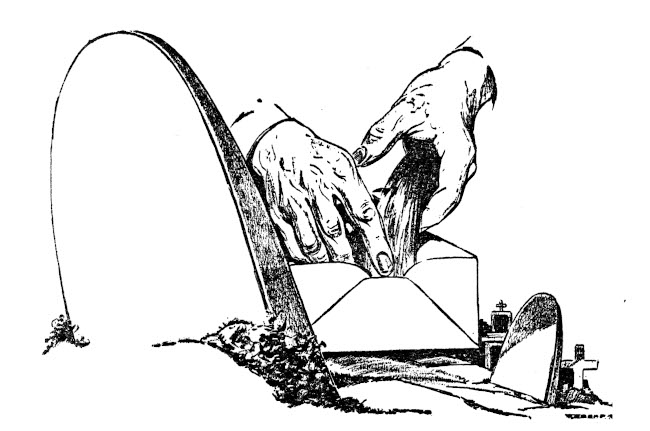
He got back over the wall, making what seemed a great deal of noise in the shrubbery. But the street was empty as ever.
On his way back to the hotel he looked up at the sky, located the Pole Star, and calculated the orientation of his room.
As he crossed the lobby, he felt the curious eyes of the old clerk boring into him.
His room was in darkness. Chill salt air was pouring through the open window. He locked the door, shut the window, pulled down the blind, and switched on the light—a glaring overhead which revealed the room in all its dingy severity. A cradle phone struck the sole modern note.
He took the envelope out of his pocket and weighed it in his hand. His lips curled in a peculiarly bitter smile. Then he reread the scrap of paper that had fluttered from Tansy's hand.
Add a small quantity of graveyard dirt, and wrap all in a piece of flannel, wrapping widdershins. Tell it to stop me. Tell it to bring me to you.
Graveyard dirt. That was what he had found in Tansy's dressing table. It had been the beginning of all this. Now he was fetching it himself.
He looked at his watch. Eleven twenty.
He cleared the small table and set it in the center of the room, jabbing in his penknife to mark the edge facing east. "Widdershins" meant "against the sun"—from west to east.
He placed the necessary ingredients on the table, cutting a short strip of flannel from the hem of his bathrobe, and fitted together the four sections of Tansy's note. The distasteful, bitter smile did not leave his lips.
Taken together, the significant portions of the notes read:
Take four lengths of four-inch white cord and a length of gut, a bit of platinum or iridium, a piece of lodestone, a phonograph needle that has only played Scriabin's "Ninth Sonata." Tie the four white cords into a granny, a reef, a cat's-paw, and a carrick bend. Tie the gut in a bowline. Add a small quantity of graveyard dirt, and wrap all in a piece of flannel, wrapping widdershins. Tell it to stop me. Tell it to bring me to you.
In general outline, it was similar to a hundred recipes for Negro tricken-bags he had seen or heard about. The phonograph needle, the knots, and one or two other items, were obvious "white" additions.
And it was all on the same level as the mental operations of a child or neurotic adult who religiously steps on, or avoids sidewalk cracks.
A clock outside bonged the half-hour.
Norman sat there looking at the stuff. It was hard for him to begin. It would have been different, he told himself, if he were doing it for a joke or a thrill, or if he were one of those people who dope up their minds with morbid supernaturalism—who like to play around with magic because it's medieval and aesthetic. But to tackle it in dead seriousness, to open your mind deliberately to superstition—that was to join hands with the forces pushing the world back into the dark ages, to cancel the term "science" out of the equation.
But, behind Tansy, he had seen that thing. Of course, it had been an hallucination. But when hallucinations start behaving like realities, even a scientist has to face the possibility that he may have to treat them like realities. And when hallucinations begin to threaten you and yours in a direct physical way—
He reached out for the first length of cord and tied the ends together in a granny.
When he came to the cat's-paw, he had to consult the page he had torn from the dictionary. After a couple of false starts he managed it.
But on the carrick bend he was all thumbs. It was a simple knot, but no matter how he went about it, he could not get it to look like the illustration. Sweat broke out on his forehead. Very close in the room, he told himself. "I'm still overheated from rushing about." The skin on his fingertips felt an inch thick. The ends of the cord kept eluding them. He remembered how Tansy's fingers had rippled through the knots.
Eleven forty-one. The phonograph needle started to roll off the table. He dropped the cord and laid the phonograph needle against his fountain pen, so it would not roll. Then he started again on the knot.
For a moment he thought he must have picked up the gut, the cord seemed so stiff and unresponsive. Incredible what nervousness can do to you, he told himself. His mouth was dry. He swallowed with difficulty.
Finally, by keeping his eyes on the illustration and imitating it step for step, he managed to tie a carrick bend. All the while he felt as if there were more between his fingers than a cord, as if he were manipulating against a great inertia. Just as he finished, he felt a slight prickly chill, like the onset of fever, and the light overhead seemed to dim a trifle. Eye-strain.
The phonograph needle was rolling in the opposite direction, spinning faster and faster. He slapped his hand down on it, missed it, caught it at the edge of the table.
Just like a Ouija board, he told himself. You try to keep your fingers, poised on the planchette, perfectly motionless. As a result muscular tensions accumulate. They reach the breaking point. Seemingly without any volition on your part, the planchette begins to roll and skid about on its three little legs, traveling from letter to letter. Same thing here. Nervous and muscular tensions made it difficult for him to tie knots. Obeying a universal tendency, he projected the difficulty into the cord. And, by hand and knee pressure, he had been doing some unconscious table tipping.
Between his fingers, the phonograph needle seemed to vibrate, as if it were being pounded by infinitesimal hammers. There was a very faint sensation of electric shock. Unbidden, the torturesome, clangorous chords of the "Ninth Sonata" began to sound in his mind. Rot! One well-known symptom of extreme nervousness is a tingling in the fingers—often painfully intense. But his throat was dry and his snort of bitter contempt sounded choked.
He pinned the needle in the flannel for greater safety.
Eleven forty-seven. Reaching for the gut, his fingers felt as shaky and weak as if he just climbed a hundred-foot rope hand over hand. The stuff looked normal, but it was slimy to the touch. And for some moments he had been conscious of an acrid, almost metallic odor replacing the salt smell of the Bay. Tactual and olfactory hallucinations joining in with the visual and auditory, he told himself. He could still hear the "Ninth Sonata."
He knew a bowline backwards, and it should have been easier because the gut was not as stiff as it ought to be, but he felt there were other forces manipulating it or other mentalities trying to give orders to his fingers, so that the gut was trying to tie itself into a slip-knot, a reef, a half hitch—anything but a bowline. His fingers ached, his eyes were heavy with an abnormal fatigue. He was working against a mounting inertia—a dangerous, crushing inertia. He remembered Tansy telling him that first day—"There's a law of reaction in all conjuring—like the kick of a gun—" Eleven fifty-two.
With a great effort, he canalized his mental energy, focused his attention only on the knot. His numb fingers began to move in an odd rhythm, a rhythm of the "Ninth Sonata," piu vivo. The bowline was tied.
The overhead light dimmed markedly, throwing the whole room into a sooty gloom. Hysterical blindness, he told himself in a despairing effort to maintain the appearances of sanity and scientific law. It was very cold now, so cold that he fancied he could see his breath. And silent, terribly silent. Against that silence he could feel and hear the rapid drumming of his heart, accelerating unendurably to the thundering, swirling rhythm of the music.
Then, in one instant of diabolic paralyzing insight, he knew that this was sorcery. No mere puttering about with ridiculous medieval implements, no effortless sleight of hand, but a straining, back-breaking struggle to keep control of forces summoned, of which the objects he manipulated were only the symbols. Outside the walls of the room, outside the walls of his skull, outside the impalpable energy-walls of his mind, he felt those forces gathering, swelling up, dreadfully expectant, waiting for him to make a false move so that they could crush him.
He could not believe it. He had to believe it.
The only question was—would he be able to stay in control?
Eleven fifty-seven. He gathered the objects together on the flannel. The needle jumped to the lodestone and clung. It shouldn't; it wasn't that magnetic. He took a pinch of graveyard dirt. Between finger and thumb, each separate particle seemed to crawl, like a tiny maggot. He sensed that something was missing. He could not remember what it was. He fumbled for the formula. A current of air was blowing the scraps of paper off the table. He sensed an eager, inward surge of the forces outside, as if they knew he was failing. He clutched at the papers, managed to pin them down. Bending close, he made out the words "platinum or iridium." He jabbed his pen against the table, broke off the whole nib, and added it to the other objects.
He stood at the side of the table away from the knife that marked the east, trying to steady his shaking hands against the edge. His teeth were chattering. The room was utterly dark now except for the impossible bluish light that beat through the window shade.
Abruptly the strip of flannel started to curl like a strip of heated gelatine, to roll itself up from east to west, with the sun.
He jerked forward, got his hand inside the flannel before it closed, drew it apart—in his numb hands it seemed like metal—and rolled it against the sun, widdershins.
The silence was intensified. Even the sound of his beating heart was cut off. He knew that something was listening with a terrible intensity for his command, and that something was hoping with an even more terrible avidity that he would not be able to utter that command.
Yet somewhere a clock was booming—or was it not a clock, but the secret sound of time? Nine—ten—eleven—twelve.
His tongue stuck to the roof of his mouth. He kept on choking soundlessly. He could feel the walls giving way.
Then, in a dry, croaking voice, he managed: "Stop Tansy. Bring her here."
The walls were shaken as if they were at the center of a whirlpool. Darkness became absolute. There was an eruption of force from the table. He felt himself flung across the room.
Then the forces were gone. In all things, tension gave way to limpness. Sound and light returned. He was sprawled across the bed. On the table was a little flannel packet, no longer of any consequence.
He felt as if he had been doped, or were waking after a debauch. There was no inclination to do anything. Emotion was absent.
Outwardly everything was the same. Even his mind, with automatic rationality, could still wearily take up the thankless task of explaining his experiences on a scientific basis—weaving an elaborate web in which psychosis, hallucination, and improbable coincidences were the strands.
But inwardly something had changed, and would never change back.
Considerable time passed.
He heard steps mounting the stairs, then in the hall. They made a squish-squish sound, as if the shoes were soaking wet.
They stopped outside his door. There was a soft rap.
He crossed the room, turned the key in the lock—
A strand of seaweed was caught in the silver brooch. The gray suit was dark now and heavy with water, except for one spot which had started to dry and was faintly dusted with a white powder—salt. The odor of the Bay was intimate and close. There was another strand of seaweed clinging to one ankle against the wrinkled stocking.
And around the stained shoes, a little pool of water was forming.
His eyes traced the wet footprints down the hall. At the head of the stairs the old clerk was standing, one foot still on the last step. He was carrying a small pigskin suitcase.
"What's all this about?" he quavered, when he saw that Norman was looking at him. "You didn't tell me you were expecting your wife. She looks like she'd thrown herself in the Bay. We don't want anything queer happening in this hotel—anything wrong."
"It's quite all right," said Norman, prolonging the moment before he would have to look at her face. "I'm sorry I forgot to tell you. May I have the bag?"
"—only last year we had a suicide"—the old clerk did not seem to realize he was speaking his thoughts aloud—"bad for the hotel—" His voice trailed off. He looked at Norman, gathered himself together, and came hesitatingly down the hall. When he was a few steps away, he stopped, reached out and put down the suitcase, turned, and walked rapidly away.
Unwillingly, Norman raised his eyes until they were on a level with hers.
The face was pale, very pale, and without expression. The lips were tinged with blue. Wet hair was plastered against the cheeks. A thick lock crossed one eye socket, like a curtain half drawn, and curled down toward the throat, where it merged with a strand of seaweed. The dull eyes stared at him, without sign of recognition. And no hand moved up to brush the lock of hair away.
From the hem of the skirt, water was dripping.
The lips parted. The voice had the monotonous murmur of water.
"You were too late," the lips said. "You were a minute too late."
XI.
For a third time their exchange of conversation had come back to the same question. He had the maddening sensation of following a robot that was walking in a huge endless circle and always treading on precisely the same blades of grass as it retraced its path.
With the hopeless conviction that he would not get any further this time, he asked the question again: "But how can you lack consciousness, and at the same time know that you lack consciousness? If your mind is blank, you cannot at the same time be aware that your mind is blank."
The hands of his watch were creeping toward three in the morning. The chill of night's lowest ebb pervaded the dingy hotel room. Tansy sat stiffly, wearing his bathrobe and big fleece-lined slippers, with a blanket over her knees and a bath towel wrapped around her head. They should have made her look child-like and perhaps even artlessly attractive. They did not. If you were to unwind the towel you would find the top of the skull sawed off and the brains removed, an empty bowl—that was the illusion Norman experienced every time he made the mistake of looking into her eyes.
The pale lips opened. "I know nothing. I only speak. They have taken away my soul. But my voice is a function of my body."
You could not even say that the voice was patiently explanatory. It was too utterly empty and colorless even for that. The words, clearly enunciated and evenly spaced, all sounded alike. They came with the regular beat of a machine.
The last thing he wanted to do was hammer questions at that stiff pitiful figure, but at all costs he must awaken some spark of feeling in the masklike face; he must find some intelligible starting point before his own mind could begin to work effectually.
"But, Tansy, if you can talk about the present situation, you must be aware of it. You're here in this room with me!"
The toweled head shook once, like that of a mechanical doll.
"Nothing is here with you but a body. 'I' is not here."
His mind automatically corrected "is" to "am" before he realized that there had been no grammatical error and shuddered at the implications of the trifling change in a tiny verb.
"You mean," he asked, "that you can see or hear nothing? That there is just a blackness?"
Again that simple mechanical headshake, which carried more absolute conviction than the most heated protestations.
"My body sees and hears perfectly. It has suffered no injury. It can function in all particulars. But there is nothing inside. There is not even a blackness."
His tired, fumbling mind jumped to the subject of behavioristic psychology and its fundamental assertion that human reactions can be explained completely and satisfactorily without once referring to consciousness—that it need not even be assumed that consciousness exists. Here was the perfect proof. And yet not so perfect, for the behavior of this body lacked every one of those little mannerisms whose sum is personality. The way Tansy used to squint and twist one little finger around another when thinking through a difficult question. The familiar quirk at the corners of her mouth when she felt flattered or slyly amused. All gone. Even the quick triple headshake he knew so well, with the slight bunny-rabbit wrinkling of the little nose, had become that robot's "No."
The sensory organs still responded to stimuli. They sent nerve impulses to the hindbrain or midbrain—or cortex—where they traveled about and gave rise to efferent impulses which activated glands and muscles, including the motor organs of speech. But that was all. None of those intangible flurries we call consciousness hovered around the webwork of nervous activity in the cortex. What had imparted style—Tansy's style, like no one else's—to every movement and utterance of the body, was gone. There was left only a physiological organism, without sign or indication of personality. Not even a mad or an idiot soul—yes! why not use that old term now that it had an obvious specific meaning?—peered from the gray-green eyes which winked at intervals with machinelike regularity, but only to lubricate the cornea, nothing more.
He felt a grim sort of relief go through him, now that he had been able to picture it in definite terms. But the picture itself—his mind veered to the memory of a newspaper story about an old man who had kept locked in his bedroom for years the body of a young woman whom he loved and who had died of an incurable disease. He had maintained the body in a miraculous state of preservation by wax and other means they said, had talked to it every night and morning, had been convinced that he would some day reanimate it completely—until they found out and took him away, and buried it. Had that body—
"Tansy," he was asking, "when your soul went, why didn't you die?"
"Usually the soul lingers to the end, unable to escape, and vanishes or dies when the body dies," the voice answered, its words as evenly spaced as if timed to a metronome. "But He Who Walks Behind was tearing at mine. There was the weight of green water against my face. I knew it was midnight. I knew that you had failed. In that moment of despair, He Who Walks Behind was able to draw forth my soul. In the same moment Your Agent's arms were about me, lifting me toward the air. My soul was close enough to know what had happened, yet not close enough to return. Its doubled anguish was the last memory it imprinted on my brain. Your Agent and He Who Walks Behind concluded that each had obtained the thing he had been sent for, and so there was no struggle between them."
The picture created in his mind was so shockingly vivid that it seemed incredible that it could have been produced by the words of a mere physiological machine. And yet only a physiological machine could have told the story with such total restraint.
"Is there nothing that touches you?" he asked abruptly in a loud voice, gripped by an intolerable spasm of anguish at the emptiness of her eyes. "Haven't you a single emotion left?"
"Yes. One." This time it was not a robot's headshake but a robot's nod. For the first time there was a stir of feeling, a hint of motivation. The tip of a pallid tongue licked hungrily around the pale lips. "I want my soul."
He caught his breath. Now that he had succeeded in awakening a feeling in her, he hated it. There was something so animal about it, so like some light-sensitive marine worm blindly yet greedily wriggling toward the sunlight.
"I want my soul," the voice repeated mechanically, tearing at his emotions more than any plaintive or whining accents could have done. "At the last moment, although it could not return, my soul implanted that one emotion in me. It knew what awaited it. It knew there are things that can be done to a soul. It was very much afraid."
He ground the words out between his teeth. "Where do you think your soul is?"
"She has it. The woman with the little black eyes."
"Evelyn Sawtelle?" He was remembering a phone call.
"Yes. But it is not wise to speak of her by name."
His hand shot out for the phone. At that moment he had to do something definite, or lose control of himself completely. For too long he had sat impotently by, watching the ghostly and harrowing drama unfold. Now he had to strike out.
After a time he roused the night clerk and got the local operator.
"Yes, sir," came the singsong voice. "Hempnell 1284. You wish to make a person-to-person call to Evelyn Sawtelle—E-V-E-L-Y-N S-A-W-T-E-L-L-E, sir?... Will you please hang up and wait? It will take considerable time to make a connection."
"I want my soul. I want to go to that woman. I want to go to Hempnell." Now that he had touched off the blind hunger in her, it persisted. He was reminded of a phonograph needle caught in the same groove, or a mechanical toy turned on to a new track by a little push.
"We'll go there all right." It was still hard for him to control his breathing. "We'll get it back."
"But I must start for Hempnell soon. My clothes were ruined by the water. I must have the maid clean and press them."
With a slow, even movement she got to her feet and started toward the phone.
"But, Tansy," he objected involuntarily. "It's three in the morning. You can't get a maid now."
"But my clothes must be cleaned and pressed. I must start for Hempnell soon."
The words might have been those of an obstinate woman, sulky and selfish. But they had less tone that a sleepwalker's.
She kept on toward the phone. Although he did not anticipate that he would do it, he shrank out of her way, pressing close against the side of the bed.
"But even if there is a maid," he said, "she won't come at this hour."
The pallid face turned toward him incuriously. "The maid will be a woman." It was a little while before he got the implication of the words. "She will come when she hears me."
Then she was talking to the night clerk. "Is there a maid in the hotel?... Send her to my room.... Then ring her.... I cannot wait until morning.... I need her at once.... I cannot tell you the reason.... Thank you."