Front matter (continued 3)
Reading edition
Norman was thinking: How can a physiological machine conceive and carry out even such a simple plan? Yet how could a conscious human being do it with such utter listlessness? Same paradox. He wondered if he ought to stop her. But an idea was growing in his mind.
There was a long wait, while he heard faintly the repeated ringing at the other end of the line. He could imagine the sleepy, surly voice that finally answered.
"Is this the maid?... Come at once to Room 37." He could almost catch the indignant answer. Then—"Can't you hear my voice? Don't you realize who is speaking?... Yes.... Come at once." And she replaced the phone in its cradle.
"Tansy—" he began. Then his eyes met hers, and once again he found himself asking a halting prefatory question, although he had not intended to. "You are able to hear and answer my questions?"
"I can answer questions. I have been answering questions for three hours." The lack of expression only made the irony more complete.
But—logic prompted wearily—if she can remember what has been happening these last three hours, then surely—And yet, what is memory but a track worn in the nervous system? In order to explain memory you don't need to bring in consciousness. Quit banging your head against that stone wall, you fool!—came another inward prompting. You've looked in her eyes, haven't you? Well, then, get on with it!
"Tansy, is that woman coming here because she's ... well, the same as you were?"
"Yes. But since you are present she will not speak of it."
"But if I weren't here—or if I hid myself?"
"She might respond to questioning." The hungry subanimal expression came back, and the tip of the tongue appeared between the lips. "If I make her speak ... if I make you believe—will we go back to Hempnell very quickly? Will you help me?"
"Yes." Of course he would. He wouldn't do anything else. But what good to say all that to a blank physiological machine beyond the reach of comfort? Besides, the maid should soon be here, and an unwholesome curiosity was eating at him.
"I'll leave the closet door just a little ajar," he said. "She probably won't notice. See?"
There were footsteps in the hall. The robot nod was his only answer.
"You wanted me, mum?" Contrary to his expectations, the voice was young, but very low. It sounded as if she had swallowed as she spoke.
"Yes. I want you to clean and press some things of mine. They're hanging on the edge of the bathtub. Go and get them."
The maid came into his line of vision, then. She would be very heavy in a few years, he thought, but she was handsome now, though puffed with sleep. She had hastily pulled on a dull-black dress, but her feet were in slippers and her hair was snarly.
"Be careful with the dress. It's wool," came Tansy's voice, sounding just as toneless as when it had been directed at him. "And I want them promptly at nine o'clock."
Norman half expected to hear an objection to this unreasonable request, but there was none. The girl walked rapidly out of the bathroom, the damp clothes hurriedly slung over one arm, as if her one object were to get away before she was spoken to again.
"Wait a moment, girl. I want to ask you a question." The voice was somewhat louder this time. That was the only change whatsoever, but it had a startling effect of command.
The girl hesitated, then swung around unwillingly, and Norman got a good look at her face. He could not see Tansy—the closet door just cut her off—but he could see the fear come to the surface of the girl's face as she turned, see the sleep-creased cheek pale.
"Yes, mum?" she managed.
There was a considerable pause. He could tell from the way the girl shrank, hugging the damp clothes tight to her body, that Tansy had lifted her eyes and was looking at her.
Finally: "You know The Easy Way to Do Things? The Ways to Get and Guard?"
Norman could have sworn that the girl gave a guilty start at that second phrase. But she only shook her head quickly, and mumbled, "No, mum. I ... I don't know what you're talking about."
"You mean you have never learned How to Make Wishes Work? You don't conjure, or spell, or hex? You don't know the Art?"
This time the "No" was almost inaudible. The girl was trying to look away, but failing.
"I think you are lying."
You could put any construction on those toneless words. The girl twisted, hands tightly clutching her overlapping arms. He wanted to go out and stop it, but curiosity held him rigid.
The girl's resistance broke. "Please, mum. We're not supposed to tell."
"You may tell me. What Procedures do you use?"
The girl's perplexity at the new word looked real.
"I don't know anything about that, mum. I don't do much. Just spells. Like now my boy friend's gone in the army, I do things to keep him from getting shot or hurt, and I've spelled him so that he'll keep away from other women. Honest, I don't do much, mum. And it don't always work. And lots of things I can't get that way." Her words had begun to run away with her.
"Very well. Where did you learn to do this?"
"Some I learned from ma when I was a kid. And some from Mrs. Neidel—she gets spells against bullets from her grandmother who had a family in some European war before the last one. But most women won't tell you anything. And some spells I kind of figure out myself, and try different ways until they work. You won't tell on me, mum?"
"No. Look at me now. What has happened to me?"
"Honest, mum, I don't know. Please, mum, don't make me say it." The girl's terror and reluctance were so obviously genuine that Norman felt a surge of anger at Tansy. Then he remembered that the thing beyond the door was incapable of either cruelty or kindness.
"I want you to tell me."
"I don't know how to say it, mum. But you're ... you're dead." Suddenly she threw herself at Tansy's feet. "Oh, please, please don't take mine! Please!"
"I would not take your soul. You would get much the best of that bargain. You may go away now."
"Oh, thank you, thank you." She hastily gathered up the scattered clothes. "I'll have them all ready for you at nine o'clock. Really I will." And she hurried out.
Only when he moved, did Norman realize that his muscles were stiff and aching from those few taut minutes of peering. The robed and toweled figure was sitting in exactly the same position as when he had last seen it, hands loosely folded, eyes still directed toward where the girl had been standing.
"If you knew all this," he asked simply, "why were you willing to stop last week when I asked you?"
"There are two sides to every woman." It might have been a mummy dispensing elder wisdom. "One is rational, like a man. The other knows. Men are artificially isolated creatures, like islands in a sea of magic, protected by their rationality and by the devices of their women. Their isolation gives them greater forcefulness in thought and action, but the women know. Women might be able to rule the world openly, but they do not want the work or the responsibility. And men might learn to excel them in the Art. Even now there may be male sorcerers, but very few.
"Last week I suspected much that I did not tell you. But the rational side is strong in me, and I wanted to be close to you in all ways. Like many women, I had not been awakened. I was not certain. And when I destroyed my charms and guards, I became temporarily blind to sorcery. Like a person used to large doses of a drug, I was uninfluenced by small doses. Rationality was dominant. I enjoyed a few days of false security. Then rationality itself proved to me that you were the victim of sorcery. And during my journey here I learned much, partly from re-examination of my own memories, partly from what He Who Walks Behind let slip." She paused and added, with the blank innocent cunning of a child, "Shall we go back to Hempnell now?"
The phone rang. It was the night clerk, almost incoherent with some sort of agitation, babbling threateningly about police and eviction. To pacify him, Norman had to promise to come down at once.
The old man was waiting at the foot of the stairs.
"Look here, mister," he began, shaking a finger, "I want to know what's going on. Just now my Sissy came down from your room white as a sheet. She wouldn't tell me anything, but she was trembling like all get-out. Sissy's my granddaughter. I got her this job, and I'm responsible for her."
He seemed genuinely concerned.
"I know what hotels are. I've worked in 'em all my life. And I know the kind of people that come to them—sometimes men and women working together—and I know the kind of things they try to do to young girls.
"Now I'm not saying anything against you, mister. But it was mighty queer the way your wife came here. I thought when she asked me to call Sissy that she was sick or something. But if she's sick, why haven't you called a doctor? And what are you doing still up at almost four? Mrs. Thompson in the next room called to say there was talking in your room—not loud, but it scared her. I got a right to know what's going on."
Norman put on his best classroom manner and blandly dissected the old man's apprehensions until they began to look very unsubstantial. Dignity told. With a last show of grumbling, the old man let himself be convinced. As Norman started upstairs, he was shuffling back to the switchboard.
On the second flight, Norman heard a phone ringing. As he was walking down the hall, it stopped.
He opened the door. Tansy was standing by the bed, speaking into the phone. Its dull blackness, curving from mouth to ear emphasized the pallor of lips and cheek and the whiteness of the toweling.
"This is Tansy Saylor," she was saying tonelessly. "I want my soul." A pause. "Can't you hear me, Evelyn? This is Tansy Saylor. I want my soul."
He had completely forgotten the call he had put in. It had been done in a moment of crazy anger. He hadn't even any clear idea of what he had been going to say.
He stepped forward. A low wailing sound was coming from the phone. Tansy was talking against it.
"This is Tansy Saylor. I want my soul."
He was almost there. The wailing sound had swiftly risen to a squeal, but mixed with it was an intermittent windy whirring.
He reached out to take the phone. But at that instant the phone twisted like a stumpy black worm, whipped tight to the skin, and dug into chin and neck just below the ear, like a double-ended black paw. The squeal became a muffled sucking.
If you tore that away, you would tear the face with it. He knew. He dropped to his knees and ripped the cord from the wall. Violet sparks spat from the torn wire. The loose end writhed like a wounded snake, whipped around his forearm, tightened spasmodically, then relaxed.
He stood up. The phone had fallen to the floor. There was nothing out of the ordinary about it now.
Tansy was still standing in the same place. Not an atom of fear showed in her expression. With the unconcernedness of a machine, she had lifted a hand and was slowly massaging cheek and neck. From the corner of the squeezed lips a few drops of blood were trickling.
The rack, he was thinking, would be too good for that woman. Or the scourge, or the wheel. So foully to attack a mere empty creature was an ultimate, unspeakable viciousness, like crushing a kitten under your heel. Perhaps the Boot, or the Funnel—
Swiftly the phantasmagoria of the Inquisition faded from his mind, as his first surge of anger spent itself and settled down to a steady hate.
"What did she say to you?" he asked evenly.
"She kept saying, 'Who is this? Who is this?' That was all. Then she stopped and the noise began."
"How did she sound?"
"She sounded very frightened."
"Good!" He smacked his fist against his palm. "Magic works," he said grimly. "We'll make it work better. She'll be more frightened after we begin."
"Perhaps you have already begun."
He did not understand at the time the significance of that toneless reply.
XII.
The rhythmic rattle and surge of the train had a soothing monotony. You could hear the engine puffing lustily. The wide, heat-baked, green fields swinging past the window of the compartment, drowsed in the noonday sun. The farms and cattle and horses dotting them here and there, looked equally somnolent. He would have liked to sleep, but he knew he would not be able to. And as for—She apparently never slept.
"I want to run over some things," he said. "Interrupt me if you hear anything that sounds wrong or you don't understand."
From the corner of his eye he noted the figure sitting between him and the window nod once.
It occurred to him that there was something terrible about an adaptability that could familiarize him even to—her, so that now after only a day and a half he was using her as a kind of thinking machine, asking for her memories and reactions in the same way that a man might direct a servant to put a certain record on the phonograph.
At the same time he knew that he was able to make this close contact endurable only by carefully directing his thoughts and actions—like the trick he had acquired of never quite looking at her directly. And he kept himself nerved up with the thought of what lay ahead, and his determination to regain what had been lost, and his hate. The present condition was only temporary. But if he once let himself start to think what it would mean to live a lifetime, to share bed and board, with that—blackness—coldness—vacancy.
Other people noticed the difference all right. Like those crowds they'd had to push through in New York yesterday. Somehow people always edged away, so they wouldn't have to touch her, and he had caught more than one following glance, poised between curiosity and fear. And when that other woman started to scream—lucky they had been able to lose themselves in the crowd.
The brief stopover at New York had provided him with some vitally necessary materials, though he still felt hampered by the lack of his library and notes. But he had been glad last night when it was over. The compartment seemed a haven of privacy.
What was it those other people noticed? True, if you looked closely, the heavy cosmetics only provided a grotesque and garish contrast to the underlying pallor, and powder did not wholly conceal the ugly dark bruise around the mouth. But the veil helped, and you had to look very closely—the cosmetics were practically a theatrical make-up. Was it her walk that they noticed, or the way her clothes hung—her clothes always looked a little like a scarecrow's now, though you could not put your finger on the reason. Or was it—
But that was what he must not think about.
"Magic is a practical science." He talked to the wall, as if dictating. "There is all the difference in the world between a formula in physics and a formula in magic, although they have the same name. The former describes, in terse mathematical symbols, some cause-effect relationship of wide generality. But a formula in magic is a way of getting or accomplishing something. It always takes into account the motivation or desire of the person performing the magic—be it greed, love, revenge, or what-not. Whereas the experiment in physics is essentially independent of the experimenter. In short, there has been little or no "pure"—nonpractical—magic, comparable to pure science.
"This distinction between physics and magic is just an accident of history. Physics is ultimately as practical as magic—but it possesses a superstructure of theory that magic lacks. Magic could be given such a superstructure by research in pure magic and by the investigation and correlation of the magic formulas of different peoples and times, with a view to deriving basic formulas which could be expressed in mathematical symbols and which would have a wide application. Most persons practicing magic have been too interested in immediate results to bother about theory. But just as research in pure science has ultimately led, seemingly by accident, to results of vast practical importance, so research in pure magic might be expected to yield similar results."
He waited a moment for comment, then went on.
"The subject matter of magic is akin to that of physics, in that it deals with certain forces and materials, though these—"
"I believe it is more akin to psychology," the voice interrupted.
"How so?" He still looked at the wall.
"Because it concerns the control of other beings, the summoning of them, and the constraining of them to perform certain actions."
"Good. That is very suggestive. Fortunately, formulas may still hold good so long as their reference is clear, though we are ignorant of the precise nature of the entities to which they refer. For example, a physicist need not be able to give a visual description of an atom, even if the term visual appearance has any meaning when applied to an atom—which is doubtful. Similarly, a sorcerer need not be able to describe the appearance and nature of the entity he summons. But the point is well taken. Many seemingly impersonal forces, when broken down sufficiently, become something very much like personality. It's not too far-fetched to say that it would take a science resembling psychology to describe the behavior of a single electron, with all its whims and impulses, though electrons in the aggregate obey relatively simple laws, just as human beings do when considered as crowds. The same holds true of the basic entities of magic, and to a much greater degree.
"It is partly for this reason that magical processes are so tricky and dangerous, and why their working can be so readily impeded if the intended victim is on guard against them—as your formulas have to our knowledge been nullified since Mrs. Gunnison stole your book. That one formula I used on Sunday night worked only because it was not anticipated that I would be the operator. And even at that its working was greatly hindered."
His words possessed for him an incredibly strange overtone. But it was only by maintaining a dry, scholarly manner that he could keep going. He knew that at the first touch of casualness or informality, the latent morbidity of the situation would engulf him.
"There remains one all-important consideration," he went on swiftly. "Magic appears to be a science which markedly depends on its environment—that is, the situation of the world and the general conditions of the cosmos at any particular time. For example, Euclidean geometry is useful on Earth, but there are regions—and it would be easy to imagine more—in which a non-Euclidean geometry is more practical. The same is true of magic, but to a more striking degree. The basic, unstated formulas of magic appear to change with the passage of time, requiring frequent restatement—though it might conceivably be possible to discover master-formulas governing that change. It has been speculated that the laws of physics show a similar evolutionary tendency—though if they do evolve, it is at a much less rapid rate than those of magic. It is natural that the laws of magic should evolve or change more swiftly, since magic depends on a contact between the material world and another level of being—and that contact is complex and may be shifting rapidly.
"Take astrology, for example. In the course of several thousand years, the precession of the equinoxes has put the Sun into entirely different celestial houses—signs of the Zodiac—at the same times of year. A person born, say, on March 22nd, is still said to be born in Aries, though he is actually born when the Sun is in the constellation Pisces. A failure to take into consideration this evolutionary change since the formulas of astrology were first discovered, has rendered the formulas obsolete and invalidated them for—"
"It is my belief," the voice broke in, like a phonograph suddenly starting, "that astrology has always been largely invalid. That it is one of the many pretended sciences which have been confused with true magic and used as a kind of window dressing. Such is my belief."
"I presume that may be the case, and it would help to explain why magic itself has been outwardly discredited as a science—which is the point I'm getting at.
"Suppose the basic formulas of physics—such as Newton's three laws of motion—had changed several times in the last few thousand years. The discovery of any physical laws at any time would have been vastly more difficult. The same experiments would give different results in different ages. But that is the case with magic, and explains why magic has been periodically discredited and has become repugnant to the rational mind. It's like what old Carr was saying about the run of the cards at bridge. After a few shuffles of a multitude of cosmic factors, the laws of magic change. A sharp eye can spot the changes, but continual experimentation, of the trial-and-error sort, is necessary to keep the crude practical formulas of magic in anything like working order, especially since the basic formulas and the master-formulas have never been discovered.
"Take a concrete example—the formula I used Sunday night. It shows signs of recent revision. For instance, what did the original, unrevised formula have in place of the phonograph needle?"
"A willow whistle of a certain shape, which had been blown only once," the voice told him.
"And the platinum or iridium?"
"The original formula mentioned silver, but a heavier metal serves better. Lead, however, proved altogether ineffective. I tried it once. It was apparently too unlike silver in other respects."
"Precisely. Trial-and-error experimentation. I have a modern substitute for the flannel wrapping which may prove more effective. Moreover, in the absence of thorough investigation, we cannot be sure that all the ingredients of a magic formula are essential in making it work. A comparison of the magic formulas of different countries and peoples would be helpful in this respect. It would show which ingredients are common to all formulas and therefore presumably essential, and which are not essential. I have in mind a method for making such a comparison."
There was a discreet knock at the door. Norman spoke a few words, and the figure drew down its veil and turned toward the window, as if staring stolidly at the passing fields. Then he opened the door.
It was lunch, as long in coming as breakfast had been. And there was a new face—coffee-colored instead of ebony. Evidently the first waiter, who had shown growing nervousness in his previous trips to the compartment, had decided to sacrifice the tip and send someone else.
With a mixture of curiosity and impatience, Norman waited for the reactions of the new-comer. He almost felt able to predict them. First a very quick inquisitive glance past him at the seated figure—Norman guessed they had become the major mystery of the train. Then a longer, sideways glance while setting up the folding table, ending with the eyes getting very wide; he could almost feel the coffee-colored flesh crawl. Only hurried, almost unwilling glances after that, with a growing uneasiness manifested in clumsy handling of the dishes and glassware. Then a too-pleasant smile and a hasty departure.
Only once Norman interfered—to place the knives and forks so they lay at right angles to their usual position.
The meal was a very simple one, almost ascetic. He did not look across the table as he ate. There was something worse than animal greediness about that methodical feeding. After the meal he put the left-overs into a small cardboard box, covered them with a napkin he had used to wipe all the dishes clean, and placed the box in his suitcase beside an envelope containing clippings from his own fingernails. The sight of the clean breakfast dishes had been one of the things which had helped to disturb the first waiter, but Norman was determined to adhere strictly to a complete set of taboos. They were an odd assortment, gleaned from his memories of Negro, Polynesian, and Indian practices. Of course, there might be no protection gained by observing taboos. But then again there might be. So he collected food fragments, saw to it that no knives or other sharp instruments pointed toward them, had them sleep with their heads nearest the engine and their destination, and enforced a number of other minor regulations. Eating in private satisfied still another taboo, but there was more than one reason for that.
He glanced at his watch. Only half an hour until Hempnell. He had not realized they were quite so close. There was the faint sense of an almost physical resistance from that region, as if the air were thickening. And his mind was tossing with a multitude of problems yet to be considered.
Deliberately turning his back, he said, "According to the myths, souls may be imprisoned in all sorts of ways—in boxes, in knots, in animals, in stones. Have you any ideas on this subject?"
As he feared, this particular question brought the usual irrelevant response. The answering words had the same dull persistence.
"I want my soul."
His hands, clasped behind his back, tightened. This was why he had avoided the question until now. Yet he had to know more, if that were possible.
"But where exactly should we look for it?"
"I want my soul."
"Yes." It was hard for him to control his voice. "But how, precisely, might it be hidden? It will help if I know."
There was a rather long pause. Then, "The environment of the soul is the human brain. If it is free, it immediately seeks such an environment. It may be said that soul and body are two separate creatures, living together in a symbiotic relationship so intimate and tight that they normally seem to be only one creature. The closeness of this contact appears to have increased with the centuries. Indeed, when the body it is occupying dies, the soul is usually unable to escape and appears to die, too, or to migrate to another level of being—I have no clear knowledge of that matter. But by supernatural means the soul may sometimes be divorced from the body it is occupying. Then, if it is prevented from re-entering its own body, it is irresistibly drawn to another, whether or not that other body possesses a soul. And so the captive soul is usually imprisoned in the brain of its captor, unable either to escape from or to control that brain, in immediate contact with the soul of the captor and forced to view and feel, in complete intimacy, the workings of that soul. Therein lies perhaps its chief torment."
Beads of sweat prickled his scalp and forehead.
His voice did not shake, but it was unnaturally heavy and sibilant as he asked, "What is Evelyn Sawtelle like?"
The answer sounded as if it were being read verbatim from the summary of a political dossier.
"She is dominated by a desire for social prestige. She spends most of her time in unsuccessfully attempting to be snobbish. She has romantic ideas about herself, but since they are too high-flown to find satisfaction, she is prim and moralistic, with rigid standards of conduct. She believes she was cheated in her husband, and is always apprehensive that he will lose what ground she has gained for him. Being unsure of herself, she is given to acts of maliciousness and sudden cruelty. At present she is very frightened and constantly on guard. That is why she had her magic all ready when she received the telephone call."
"I can't wait until tomorrow," he told himself. "I must begin with her this very afternoon."
Aloud, he asked, "Mrs. Gunnison—what do you think of her?"
"She is a woman of abundant vigor and appetites. She is a good housewife and hostess, but those activities hardly take the edge off her energies. She should have been mistress of a feudal domain. She is a born tyrant, and grows fat on it. Her appetites, many of them incapable of open satisfaction in our present society, nevertheless find devious outlets. Servant girls of the Gunnisons have told stories, but not often and then guardedly, for she is ruthless against those who oppose her or threaten her security."
"And Mrs. Carr? That is, if she comes in this category."
"Little can be said of her. She is conventional, an indulgent ruler of her husband, and enjoys being thought sweet and saintly. But I am uncertain of her deeper motivations."
"It may be then, that she is not hostile?" He was remembering the telephone call from Mrs. Carr just before he left for the East, when she had seemed to be trying to check on the activities of Evelyn Sawtelle.
"It may be. Yet at times I have been aware of her looking at me long and strangely."
There was a knock. It was the porter come for the bags.
"Be in Hempnell in five minutes, sir. Shall I brush you in the corridor?"
But Norman tipped him and declined the service. He also told him they would carry their own bags. The porter smiled jerkily and backed out.
Norman crossed to the forward window. There was only the gravel wall of a gully, and, above it, dark trees flashing indistinctly past. But almost immediately the gravel wall gave way to a wide panorama, as the tracks swung around and down the hillside.
There was more woodland than field in the valley. The trees seemed to encroach on the town, dwarfing it. From this particular point it looked quite tiny. But the college buildings stood out with a cold distinctness. He fancied he could make out the window of his office.
Those cold gray towers and darker roofs were like an intrusion from some other, older world, and his heart began to pound, as if he had suddenly sighted the fortress of the enemy.
XIII.
Norman looked briefly across the campus before he went into Morton. The thing that startled him most was something he had not expected—the air of normality. True, he had not looked forward—at least consciously—to any outwardly demoniac manifestations, any physical stench of evil. But this feeling of wholesomeness—the little swarms of students trooping back to the dormitories or over to the campus soda fountain, the file of girls in white bound for a tennis lesson, the friendly smiles and nods, the way his own steps fell so easily and gratefully into the old familiar paths—almost for a moment he wondered if everything else were not some crazy dream. It came to him almost with a shock that things were outwardly as normal as they had ever been, that only with respect to himself had they changed.
"Don't fool yourself," the voice inside told him. "Some of those laughing girls are already infected. Their very respectable mammas have given them delicate hints. Don't be too sure you know what they're thinking while they sip their cokes or chatter about their boy friends."
But there was much to be done this afternoon, and he had no right to waste a second. He turned into Morton and quickly mounted the stairs.
His capacity for surprise was not yet exhausted, however, as he realized when he saw a group of students emerging from the classroom at the other end of the third-floor corridor, after having waited the usual ten minutes for him to appear. That was right—he had classes, and committee meetings, and appointments. He slipped around the bend in the corridor before he was noticed.
Taking suitable precautions, he entered his office. Nothing seemed to have been disturbed, but he was careful in his movements and on the alert for unfamiliar objects. He did not put his hand into any drawer without closely inspecting it first.
One letter in the little pile of accumulated mail was important. It was from Pollard's office, requesting him to appear before a meeting of the trustees later this week. He smiled with grim satisfaction. His career was still skidding downhill. Hempnell still had its fangs.
He methodically removed certain sections from his files, stuffed his brief case full and made a package of the remainder.
Then he took from his pocket a small hard object, and looked at it reflectively.
It was made of lucite, and its shape was that of an egg. Sealed inside the thick, transparent shell were tiny bits of metal and fiber. It was the chief trophy of his stay in New York. His friend in industrial chemistry had been very mystified. But here it was.
Placed in the Sawtelle home, it ought to constitute the terminal of a kind of circuit and clear the way for the operations he intended to begin tonight, for the recovery of that which Evelyn Sawtelle had taken and was holding captive.
It remained to place it.
After a last glance around, during which he noted that the Estrey dragon had not been restored to whatever was its original position on the roof, he started downstairs.
Outside he met Mrs. Gunnison.
This was something he had not anticipated with sufficient vividness. He was acutely conscious of the way his arms were encumbered by the bulky notes. For a moment he did not seem able to see her clearly.
"Lucky I found you," she began immediately. "Harold's been trying every which way to get in touch with you. Where have you been?"
Suddenly she registered on him as her old, blunt, sloppy self. With a sense of mingled relief and frustration, he realized that the warfare in which he was engaged was a strictly undercover affair, and that outwardly all relationships were the same as ever. He found himself explaining how Tansy and he, weekending with friends out in the country, had gotten a touch of food poisoning, and how his message to Hempnell must have gone astray. This explanation was intended merely for general consumption. Routine excuses were still necessary, and this one had the added advantage of providing a reason for Tansy's appearance, if anyone should see her, and it would enable him to plead a recurrence of the attack as an excuse for neglecting his academic duties.
He did not expect Mrs. Gunnison to believe it, but he ought to tell it to her just to be consistent.
She accepted the story without comment, offered her sympathies, and went on to say, "But be sure and get in touch with Harold. I believe it has to do with that meeting of the trustees you've been asked to attend. You know, Harold thinks a great deal of you. Good-by."
Odd, but at the last moment he fancied he caught a note of genuine friendliness, a strange little look, as if she was appealing to him to do something. Could he possibly be wrong in his estimation of her?
But there was work to do. Off campus, he hurried down a quiet side street to where his car was parked. With hardly a sidewise glance at the motionless figure in the front seat, he stepped in and drove to Sawtelle's.
The house was bigger than they needed, and the front lawn was very formal. But the grass was yellow in patches, and the soldierlike rows of flowers looked neglected.
"Wait here," he said. "Don't get out of the car under any circumstances."
To his surprise, Hervey met him at the door. There were circles under Hervey's always-worried eyes, and his fidgetiness was more than usually apparent.
"I'm so glad you've come," he said, pulling Norman inside. "I don't know what I'm going to do with all these departmental responsibilities on my shoulders! Classes having to be dismissed. Stop-gap instructors to be obtained. And the deadline on next year's catalogue tomorrow! Here, come into my study." And he pushed Norman through a huge living room, expensively but stiffly furnished, into a dingy, book-lined cubbyhole with one small window.
"I'm almost going out of my mind," he said. "I haven't dared stir out of the house since Evelyn was attacked Sunday night."
"What!"
"Haven't you heard?" He stopped and looked at Norman in surprise. Even here he had been trying to pace up and down, although there was not room enough. "Why, it was in the papers. Though I wondered why you didn't come over or call up. I kept trying to get you at your home and the office, but no one could locate you. Evelyn's been in bed since Sunday, and she gets hysterical if I even speak of going out of the house. Just now she's asleep, thank heavens."
It was borne in on Norman that Sawtelle was not even aware that he had been out of town. Hastily he related his trumped-up excuse. He wanted to get back to what had happened Sunday night. There was an idea forming at the back of his mind, but it was still nebulous. For the moment he neglected the real purpose of his visit.
"Just my luck!" Sawtelle exclaimed tragically when Norman had finished. "The whole department falling apart the very first week I'm in charge of it. And young Stackpoole laid up with the 'flu'!"
"We'll manage," said Norman. "Sit down and tell me about Evelyn."
Unwillingly, Sawtelle cleared a space so he could perch on the cluttered desk. He groaned audibly when his eyes chanced to light on papers concerned with urgent business.
"It happened about four o'clock Sunday morning," he began, still aimlessly fiddling with the papers. "I was awakened by a terrible scream. Evelyn's bed was empty. It was pitch dark out in the hall. But I could hear some sort of struggle going on downstairs. A bumping and threshing around—"
Suddenly he jerked up his head. "What was that? I thought I heard footsteps out in the front hall." Before Norman could say anything he went on, "Oh, it's just my nerves. They've been acting up ever since.
"Well, I picked up something—a vase—and went downstairs. About that time the sounds stopped. I switched on the lights and went through all the rooms. In the sewing room I found Evelyn stretched unconscious on the floor with some ghastly bruises beginning to show around her neck and mouth. Beside her lay the phone—we have it there because Evelyn has so many occasions to use it. I nearly went frantic. I called a doctor and the police."
Norman knew now what must have happened.
"When Evelyn regained consciousness, she was able to tell us about it, although she was terribly shaken up. It seems the phone had rung. She went downstairs in the dark without waking me. Just as she was picking up the phone, a man jumped out of the corner and attacked her. She fought him off—oh, it drives me mad to think of it!—but he over-powered her and choked her unconscious."
Norman listened with grim satisfaction.
"Thank heavens I came downstairs when I did! That must have been what frightened him off. The doctor found that, except for bruises, there weren't any other injuries. Even the doctor was shocked at those bruises, though. He said he had never seen any quite like them.
"The police think that after the man got in the house he called Central and asked them to ring this phone—pretending he thought the bell was out of order or something—in order to lure someone downstairs. They were puzzled as to how he got inside, though, for all the windows and doors were shut fast. Probably I forgot to lock the front door when we went to bed—one of my pieces of unforgivable carelessness!
"The police think that he was a vicious burglar, but I believe he must have been a madman besides. Because there was a silver plate on the floor, and two of our silver forks jammed together strangely, and other odds and ends. And he must have been playing the phonograph in the sewing room, because it was open and the turntable was going and on the floor was one of Evelyn's speech records, smashed to bits."
Yes, the picture was all very clear now. What Norman had forgotten to take into consideration was the ever-present possibility of reaction, if magic miscarried—"like the kick of a gun," or, better, like the breech of a gun blowing up. When he had severed the wire at Bayport, the thwarted Agency of Death had instantly struck back at the sender. And afterward Evelyn Sawtelle had invented the obvious story.
One thing bothered him. If the police should trace that phone call in an effort to prove their own theory, they would find it had been placed by Norman Saylor, at Bayport. But at the worst that would only convict him of a peculiar lie. For the present he would say nothing about it.
"It's all my fault," Sawtelle was repeating mournfully. Norman remembered that Sawtelle always assumed that he was guilty whenever anything hurt or merely upset Evelyn. "I should have awakened! I should have been the one to go down to the phone. When I think of that delicate creature feeling her way through the dark, and lurking just ahead of her that—Oh, and the department! I tell you I'm going out of my mind. Poor Evelyn has been in such a pitifully frightened state ever since, you wouldn't believe it!"
"Good," thought Norman. "If she's really frightened, she may be easier to deal with." The idea of pity never occurred to him. Moreover, if what he had been told about the lodgment of captive souls were true, then Tansy's soul had suffered equally with that of Evelyn Sawtelle here in this very house on Sunday night.
"I tell you, I haven't slept a wink," Sawtelle was saying. "If Mrs. Gunnison hadn't been kind enough to spend a couple of hours with her yesterday morning, I don't know how I'd have managed. Even then she was too frightened to let me stir.... My God!... Evelyn!"
But it was really impossible to identify the agonized scream, except that it had come from the upper part of the house. Crying out, "I knew I heard footsteps! He's come back!" Sawtelle ran full tilt out of the study. Norman was just behind him, suddenly conscious of a very different fear. It was confirmed by a glance through the living-room window at his empty car.
He beat Sawtelle up the stairs and was the first to reach the bedroom door. He stopped. Sawtelle, almost gibbering with anxiety and guilt, ran into him.
It was not at all what Norman expected.
The pink silk coverlet clutched around her, Evelyn Sawtelle had retreated to the side of the bed nearest the wall. Her teeth were chattering, and her face was a dirty white.
Beside the bed stood Tansy. For a moment Norman felt a great, sudden hope. Then he saw her eyes, and the hope shot away with sickening swiftness. She was not wearing the veil. In that heavy make-up, with those rouged cheeks and thickly carmined lips, she looked like some indecently daubed statue, impossibly grotesque against that background of ridiculously feminine pink silk hangings. But a hungry statue.
Sawtelle scrambled past him, shouting, "What's happened? What's happened?" He saw Tansy. "I didn't know you were here. When did you come in?" Then, "You frightened her!"
The statue spoke, and its quiet accents hushed him.
"Oh, no, I didn't frighten her. Did I, Evelyn?"
Evelyn Sawtelle was staring at Tansy in abject, wide-eyed terror, and her jaw was still shaking. But when she spoke, it was to say, "No, Tansy didn't ... frighten me. We were talking together ... and then ... I ... I thought I heard a noise."
"Just a noise, dear?" Sawtelle said, somewhat taken aback.
"Yes ... like footsteps ... very quiet footsteps in the hall." She did not take her eyes off Tansy, who nodded once when she had finished.
Norman accompanied Sawtelle on a futile search of the top floor. When they came back, Evelyn was alone.
"Tansy's gone out to the car," she told Norman weakly. "I'm sure I just imagined those footsteps."
But her eyes were still full of fear when he left her, with Sawtelle fussing about straightening the coverlet and shaking out the pillows.
As he went down the stairs he became aware of a hard object in his pocket, and he remembered the lucite egg. He had not placed it. But, as things stood now, he must first know more.
Tansy was sitting in the car, staring ahead. He could see that the body was still dominated by its one emotion. He did have to ask a question.
"She does not have my soul," were the words. "I questioned her at length. As a final and certain test I embraced her. That was when she screamed. She is very much afraid of the dead."
"What did she tell you?"
"She said that someone came and took my soul from her. Someone who did not trust her very much. Someone who desired my soul, to keep as a hostage and for other reasons. Mrs. Gunnison."
And he had seen it and not known. The knuckles of his hands were white on the steering wheel. That puzzling look of appeal that Mrs. Gunnison had given him. For an instant Tansy had managed to look out of her eyes. And he had not known it.
XIV.
Professor Carr finished his inspection of the first of the five sheets.
"Yes," he said, "these are undoubtedly equations in symbolic logic."
Norman had been pretty sure they were, but he was glad to hear a mathematician say so. The hurried reference he had made to Principia Mathematica had not altogether satisfied him.
"The capitals stand for classes of entities, the lower case letter for relationships," he said helpfully.
"Ah ... yes—" Professor Carr's voice became a trifle diffident, and he rubbed his chin beneath the white Vandyke. "But what do they ... refer to ... if I may ask?"
"You could perform operations on the equations, couldn't you, without knowing the references of the individual symbols?" Norman countered,
"Most certainly. And the results would be valid—always providing that the original references had been made correctly."
"Then here's my problem," Norman went on hastily. "There are seventeen equations on that first sheet. As they stand, they are not consistent with each other. Now I'm wondering if one simple, underlying equation doesn't appear in each of the seventeen, jumbled up with a lot of nonessential terms and meaningless procedures. Each of the other sheets presents a similar problem."
"Hm-m-m—" Professor Carr began to finger a pencil, and his eyes started to go back to the intriguing sheet, but he checked the movement. "I must confess I'm rather curious about those references," he said, and added innocently, "I wasn't aware that there had been attempts to apply symbolic logic to sociology."
Norman was prepared for this. "I'll be frank with you, Linthicum," he said. "I have a pretty wild, off-trail theory, and I've promised myself I won't discuss it until I have a better idea of whether or not there's anything to it."
Carr's face broke into a reminiscent smile. "I think I understand your sentiments," he said. "I can still recall the disastrous consequences of my announcement that I had trisected the angle.
"Of course, I was only in high school at the time," he added hastily.
"Though I'm still convinced that I gave my teacher a bad half-hour," he finished with a touch of pride.
When he next spoke, there was a sly twinkle in his eyes. "Nevertheless, I'm very much piqued by those symbols. As it stands, they might refer ... hm-m-m ... to anything."
"I'm sorry," said Norman. "I know I'm asking a lot of you."
"Not at all. Not at all." Twiddling the pencil Carr glanced again at the sheet. Something seemed to catch his eyes. "Hm-m-m ... this is very interesting," he said. "I hadn't noticed this before." And his pencil began to fly about the sheet, deftly striking out terms, neatly inscribing new equations. The single vertical furrow between his gray eyebrows deepened. In a moment he was wholly absorbed.
With an unbreathed sigh of relief, Norman leaned back. He felt dog-tired, and his eyes hurt. Those five sheets represented twenty hours of uninterrupted work. Tuesday night, Wednesday morning, part of Wednesday afternoon. Even at that he couldn't have done it without Tansy to take notes from his dictation. He trusted the accuracy of her mindless neurons more than those of a conscious person.
The agile old fingers had half filled a fresh sheet of paper with derived equations. Their swift, orderly movements did not disturb but rather intensified the quiet almost monastic, mathematical atmosphere of the small office.
If Mrs. Gunnison had not shown herself to be so resourceful, he was thinking, he might have managed without using symbolic logic and Carr. But she was no Evelyn Sawtelle, to strike out viciously and then collapse. No, her competence and coolness under fire were of quite a different sort. She had become very elusive, and he had even been balked in the simple job of secretly planting a certain object in her home. And even if he had managed, he was doubtful whether he would have succeeded with the rest of the plan. Something of a decidedly stronger sort was necessary. Something new. Something basic.
Carr shoved a paper toward him, and immediately started working on the next sheet.
"You've found the underlying equation?"
Carr seemed almost annoyed at the interruption. "Surely ... of course." His pencil was once more darting about.
"Sorry to be making all this work for you," said Norman, wondering just what was the meaning of the brief ultimate equation. He could not tell without his code.
Carr spared him a glance. "Not at all. I'm enjoying it. I always did have a knack for these things, though it's not exactly my field." And then he was busy again.
The afternoon shadows deepened. Norman switched on the overhead light, and Carr thanked him with a quick, preoccupied nod. The pencil flew. Three more sheets had been shoved across to Norman, and Carr was finishing the last one, when the door opened.
"Linthicum!" came the sweet voice, with hardly a trace of reproachfulness. "Whatever's keeping you? I've waited downstairs fifteen minutes."
"I'm sorry, dear," said the old man, looking at his watch and his wife. "But I had become so absorbed—"
She saw Norman. "Oh, I didn't know you had a visitor," she said. "Whatever will Professor Saylor think! I'm afraid that I've given him the impression that I tyrannize over you."
And she accompanied the words with such a quaint smile that Norman found himself echoing Carr's "Not at all."
"Professor Saylor looks dead tired," she said, peering at Norman anxiously. "I hope you haven't been wearing him out, Linthicum."
"Oh, no, my dear, I've been doing all the work," her husband told her.
She walked around the desk and looked over his shoulder. "What is it?" she asked, pleasantly.
"I don't know," he said. He straightened up and, winking at Norman, went on, "I believe that, behind these symbols, Professor Saylor is revolutionizing the science of sociology. But it's a great secret. And in any case I haven't the slightest idea of what the symbols refer to. I'm just being a comptometer."
With a polite, by-your-leave nod toward Norman, Mrs. Carr picked up one of the sheets and studied it through her thick glasses. But when she saw the massed rows of symbols, she put it down.
"Mathematics is not my forte," she explained. "I was such a poor scholar."
"Nonsense, Flora," said Carr. "Whenever we go to the market, you're much quicker at totaling the bill than I am. And I try to beat you, too."
"But that's such a little thing," cooed Mrs. Carr delightedly.
"I'll only be a moment more," said her husband, returning to his calculations.
Mrs. Carr spoke across to Norman in a half-whisper. "Oh, Professor Saylor, would you be so kind as to convey a message to Tansy? I want to invite her for bridge tomorrow night—that's Thursday—with Hulda Gunnison and Evelyn Sawtelle. Linthicum has a meeting."
"I'll be glad to," said Norman quickly. "But I'm afraid she might not be up to it." And he explained about the food poisoning.
"How too, too terrible!" observed Mrs. Carr. "Couldn't I come over and help her?"
"Thank you," Norman lied, "but we have someone staying with her."
"How wise," said Mrs. Carr, and it sounded as if she really meant it.
Carr put down his pencil. "There," he said, "I'm done."
With further expressions of thanks, Norman gathered up the sheets.
"Really no trouble at all," Carr assured him. "You gave me a very exciting afternoon." He added wistfully. "I must confess that you've aroused my curiosity."
"Linthicum dotes on anything mathematical, especially when it's like a puzzle," Mrs. Carr told him. "Why, once," she continued, with a kind of roguish indulgence, "he made all sorts of tabulations on horse races."
"Er ... yes ... but only as a concrete example of the calculus of probabilities," Mr. Carr interposed quickly. But his smile was equally indulgent.
Her hand was on his shoulder, and he had reached up his own to cover hers. Frail, yet somehow hearty, withered, yet somehow fresh, they seemed like the perfect aged couple.
"I promise you," Norman told Carr, "that if I revolutionize the science of sociology, you'll be the first to hear of it."
As soon as he was home, Norman got out the code. "W" was the identifying letter at the top of the first sheet. He thought he remembered what that meant, but he looked it up just to be sure.
"W—To conjure out the soul."
Yes, that was it. He turned to the supplementary sheet covered with Carr's calculations, and carefully decoded the final equation. "C—Notched strip of copper." He nodded. "T—Twirl sunwise." He frowned. He would have expected them to cancel out. Good thing he'd gotten a mathematician's help in simplifying the seventeen equations, each representing a different people's formula for conjuring out the soul—Arabian, Zulu, Polynesian, American Negro, American Indian, and so on; the most recent formulas available, and ones that had known actual use.
"A—Deadly amanita." Bother! He'd been certain that one would cancel out. It would be a bit of time and trouble getting a deathcup mushroom. And there was another even more difficult item. Well, he could manage without that formula, if he had to. He took up two other sheets—"V—To control the soul of another," "Z—To cause the dwellers in a house to sleep"—and set to work on one of them. In a few minutes he had assured himself that the ingredients presented no special difficulties, save that Z required a Hand of Glory to be used as well as the graveyard dirt to be thrown onto the roof of the house in which sleep was to be enforced. But he ought to have little difficulty in filching a suitable severed hand from the anatomy lab. Now he was getting somewhere. With Z he could place the charm in the Gunnison house tomorrow night, and with V activate it.
Conscious of a sudden reaction of weariness, he pushed back his chair. For the first time since he had come into the house, he looked at her. She sat in the rocking chair, face turned toward the drawn curtains. When she had started rocking, he did not know. But the muscles of her body automatically continued the rhythmical movement, once it had begun.
With the suddenness of a blow, longing for Tansy struck him. Her intonations, her gestures, her mannerisms, her funny fancies—all the little things that go to make a person real, and human, and loved—he wanted them all instantly; and the presence of this dead-alive imitation, this poor husk of Tansy, only made the longing less bearable. And what sort of a man was he, to be puttering around with occult formulas, while all the while he—"There are things that can be done to a soul," she had said. "Servant girls of the Gunnisons have told stories—" He ought to go up there and take by force what was his!
The reaction was immediate. How could you take by force what was without form or material being? How could you use open force against someone who had your dearest possession as a hostage?
No, these repugnant occult formulas were his only hope, and he had gotten his usual punishment for making the mistake of looking at her. Deliberately he moved to the other side of the table, so his back was to the rocking chair.
But he was restless, his muscles itching with fatigue poisons, and for the moment, he could not get back to the work. All sorts of questions were plaguing his mind.
Suddenly Norman spoke. "Why do you suppose everything has become violent and deadly so abruptly?"
"What I believe they call the Balance was upset," was the answer. There was no interruption in the steady rocking.
"How was that?" He started to look over the back of his chair, but checked himself in time.
"It happened when I ceased to practice magic." The rocking was a grating monotony.
"But why should that lead to violence?"
"It upset the Balance."
"Yes, but how can that explain the abruptness of the shift from relatively trivial attacks to a deadly maliciousness?"
The rocking had stopped. There was no answer. But, as he told himself, he knew the answer already. This women's warfare was very much like trench warfare or a battle between fortified lines—a state of siege. Just as thick, reinforced concrete or armor plating nullified the shells, so countercharms and protective procedures rendered relatively futile the most violent onslaughts. But once the armor and concrete were gone, and you were out in a kind of no man's land—
Then, too, fear of the savage counterattacks that could be launched from such highly fortified positions, was a potent factor in discouraging direct assaults. The natural thing would be to sit pat, snipe away, and only attack if the enemy exposed himself recklessly. Besides, there were probably all sorts of unsuspected hostages and secret agreements, all putting a damper on violence.
This idea also seemed to explain why Tansy's apparently pacific action had upset the Balance. What would any country think if in the midst of a war, its enemy scuttled all his battleships and dismantled all his aircraft, apparently laying himself wide open to attack? For the realistic mind, there could only be one likely answer. Namely, that the enemy had discovered a weapon far more potent than battleships or aircraft, and was planning to ask for a peace that would turn out to be a trap. The only thing would be to strike instantly and hard, before the secret weapon could be brought into play.
"I think—" he started to say.
Then something—perhaps a faint whishing in the air or a slight creaking of the floor under the heavy carpet, or some less tangible sensation—caused him to glance around.
With a writhing jerk sideways, he managed—just managed—to get his head out of the path of that descending metal flail, which was all he saw at first. With a shocking swish it crashed downward against the heavy back of the chair, and there its force was broken. But his shoulder, which took only the end of the blow, went numb.
Clawing at the chair arm with his good hand, he threw himself forward against the table and whirled around.
He recoiled from the sight as from another blow, throwing back his good hand to save himself from overbalancing.
She was poised in the center of the room, having sprung back catlike after the first blow failed. Almost stiff-legged, but with the weight forward. In stocking feet—the slippers that might have made a noise were laid by the rocking chair. In her hand was the steel poker, stealthily lifted from the stand by the fireplace, so as not to make the slightest warning rattle.
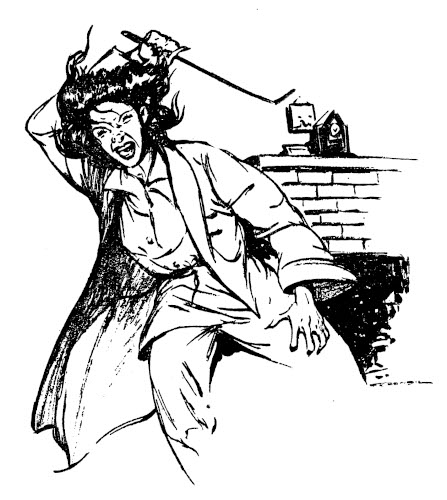
There was life in her face now. But it was life that champed the teeth and drooled, life that pinched and flared the nostrils with every breath, life that switched hair from the eyes with quick, angry flirts, life that glared redly and steadily. And there was more than that.
With a low snarl she lifted the poker and struck, not at him, but at the chandelier overhead. Yet, even as pitch darkness flooded the tightly curtained room, he realized what that more-than-animal life was.
There was no one conclusive reason, but from a multitude of almost indefinable impressions—too many to be realized separately—he knew with chilling certainty that the bestial spirit animating Tansy's body, the crude and unfinished soul conjured into her body—possessing her body as it used to be said demons possessed the bodies of the insane—was the same soul that had animated the stone creature that had crept from the roof.
And then the darkness was complete.
There was a rush of soft footsteps. He ducked to one side. Nevertheless, the swish came perilously close. There was a sound as if she had dived or rolled across the table after he eluded the headlong rush—he could hear the slur of papers skidding and the faint crackle as some drifted to the floor. Then silence, except for the rapid snuff-snuff of animal breathing.
He crouched on the carpet, trying not to move a muscle, straining his ears to catch the direction of that breathing. Abominable, he thought, how inefficient the human auditory system is at localizing a sound. First it came from one direction, then another—although he could not hear the slightest rustle of intervening movement—until he began to lose his sense of orientation in the room. He tried to remember his exact movements in springing away from the table. As he had hit the carpet, he had spun around. But how far? Was he facing toward or away from the wall? In his zeal to avoid the possibility of anyone spying on Tansy, he had blacked out this room and the bedroom, and the blackout was effective. No discernible atom of light filtered through from the night outside. He was somewhere on what was beginning to seem an endless expanse of carpet.
And somewhere else on that expanse, it was. Could it see and hear more than he? Could it discern form in retinal patterns that were only blackness to Tansy's human soul? What was it waiting for? Now even the rapid breathing was no longer audible—it possessed cunning.
This might be the darkness of some jungle floor, roofed by yards of matted creepers. Civilization is a thing of light. When light goes, civilization is snuffed out. He was rapidly being reduced to its level. Perhaps it had counted on that when it smashed the lights. This might be the inner chamber of some primeval cave, and he some cloudy-minded primitive huddled in abject terror of his mate, into whose beloved form a demon had been conjured up by the witch woman—the brawny, fat witch woman with the sullen lip and brutish eyes, and copper ornaments twisted in matted red hair. Should he grope for his ax and seek to smash the demon from her skull where it was hiding? Or should he seek out the witch woman and throttle her until she called off her demon? But how could he constrain his wife meanwhile? If the tribe found her, they would slay her instantly—it was the law. And even now the demon in her was seeking to slay him.
With thoughts almost as murky and confused as those of that ghostly primitive forerunner, he sought to grapple with the problem, until he suddenly realized what it was waiting for.
Already his muscles were aching. He was getting twinges of pain from his shoulder, as the numbness went out of it. Soon he would make an involuntary movement. And in that instant it would be upon him.
Cautiously he stretched out his hand. Slowly—very slowly—he swung it around until it touched a small table and located the large book he had remembered was there. Clamping thumb and fingers around the book where it projected from the table edge, he lifted it and drew it to him. His muscles began to shake a little from the effort to maintain absolute quiet.
With a slow movement he launched the book toward the center of the room, so that it hit the carpet a few feet from him. The sound drew the instant response he had hoped for. Waiting a second, he dove forward, seeking to pin it to the floor. But its cunning was greater than he had guessed. His arms closed on a heavy cushion that it had hurled toward the book, and only luck saved him as the poker thudded against the carpet close by his head.
Clutching out blindly, his hands closed on the cold metal. There was a moment of straining as it sought to break his grip. Then he was sprawling backward, and the footsteps were retreating toward the rear of the house.
He followed it to the kitchen. A drawer, jerked out too far, fell to the floor, and he heard the chilling clatter and scrape of cutlery.
But there was enough light in the kitchen to show him its silhouette. He lunged at the upraised hand holding the long knife, caught the wrist. Then it threw itself against him, and they dropped to the floor.
He felt her warm body against his, the touch of it an instant check to violence. He dared not harm it, and yet viciousness animated it to the last limits of its strength. For a moment he felt the coldness of the flat of the knife against his cheek, then he had forced the weapon away. He doubled up his legs to protect himself from its knees. It surged convulsively down upon him and he felt jaws clamp the arm with which he held away the knife. Teeth sawed sideways, trying to penetrate the fabric of his coat. Cloth ripped as he sought with his free hand to drag her body away from him. Then he found her hair and forced back the head so the teeth lost their grip. It dropped the knife and clawed with both hands at his face. He seized the fingers seeking his eyes and nostrils; it snarled and spat at him. Steadily he forced down the arms, twisting them behind it, and with a sudden effort got to his knees. Strangled sounds of impotent fury came from its throat.
Only too keenly aware of how close his muscles were to the trembling weakness of fatigue, he shifted his grip so that with one hand he held the straining wrists. With the other he groped sideways, jerked open the lower door of the cabinet, and found a length of cord.
XV.
"It's pretty serious this time, Norm," said Harold Gunnison. "A couple of trustees really want your scalp."
Norman drew his chair closer, as if the discussion were the real reason for his visit to Gunnison's office this morning.
Gunnison went on, "I think they're planning to rake up that Margaret van Nice business, and start yelping that where there's smoke there must be fire. And they may try to use Theodore Jennings against you. Claim that his 'nervous breakdown' was aggravated by unfairness and undue severity on your part, etcetera."
Norman nodded. Mrs. Gunnison ought to be here soon. The maid had told him over the phone that she had just left for her husband's office.
"Of course, those two matters aren't enough in themselves." Gunnison looked unusually heavy-eyed and grave. "But they have a bad taste, and they can be used as entering wedges. The real danger will come from a restrained but concerted attack on your conduct of classes, your public utterances, and perhaps even trivial details of your social life, followed by talk about the need for retrenchment where it is expeditious—you know what I mean." He paused. "What really bothers me is that Pollard's cooled toward you. I told him just what I thought of Sawtelle's appointment, but he said the trustees had overruled him. He's a good man, but he's a politician." And Gunnison shrugged, as if it were common knowledge that the distinction between politicians and scientists went back to the Ice Age.
Norman roused himself. "I'm afraid I insulted him last week. We had a long talk and I blew up."
Gunnison shook his head. "That would explain it. He can absorb insults. I've always said he was a good politician. If he sides against you, it will be because he feels it necessary or at least expeditious ... I hate that word ... on the grounds of public opinion. You know his way of running the college. Every couple of years he throws someone to the wolves."
Norman hardly heard him. He was thinking of Tansy as he had left her—the trussed-up body, the lolling jaw, the hoarse heavy breathing from the whiskey he had finally made it guzzle. He was taking a long chance, but he dared not give it an opportunity to carry off or destroy the body it had usurped. At one time last night he had almost decided to call in a doctor and perhaps have Tansy placed in a sanitarium. But if he did that he would be unable to protect her and might lose forever his chance to restore her rightful self. For similar reasons there was no friend he could call on for help. Now that his efforts to exorcise the thing by sorcery had failed, he had to strike quickly at the source of the usurping agency. But it was not pleasant to think of such headlines as: "PROFESSOR'S WIFE A TORTURE VICTIM. FOUND TRUSSED IN CLOSET BY MATE."
"It's really serious, Norm," Gunnison was repeating. "My wife thinks so, and she's smart about these things. She knows people."
His wife! Obediently, Norman nodded.
"Hard luck it had to come to a head now," Gunnison continued, "when you've been having more than your share of troubles, with sickness and what-not." Norman could see that Gunnison was looking with a faint shade of inquisitiveness at the strip of surgical tape close to the corner of his left eye and the other one just below his nostrils. But he attempted no explanation.
Gunnison shifted about and resettled himself in his chair. "Norm," he said, "I've got the feeling that something's gone wrong. You can weather this blow all right—you're one of our two-three best men—but I've got the feeling that something's gone wrong all the way down the line."
The offer his words conveyed was obvious enough, and Norman knew it was made in good faith. But only for a moment did he consider telling Gunnison even a fraction of the truth. It would be like trying to take his troubles into the law courts, and he could imagine—with the sharp, almost hallucinatory vividness of extreme fatigue—what that would be like. Imagine, even if the thing were exorcised out of her body, putting Tansy in the witness box. "You say, Mrs. Saylor, that your soul was stolen from your body?" "Yes." "You know that to be a fact?" "Yes." "You are conscious of it?" "No, I am not conscious." "How, then—" Bang of the judge's gavel. "If this tittering does not cease immediately, I will clear the court!" Or Mrs. Gunnison called to the witness box and he himself bursting out with an impassioned plea to the jury. "Gentlemen, look at her eyes! Watch them closely, I implore you. My wife's soul is there, if you would only see it!" Then the judge, harshly, "Remove the man Saylor!"
But even such a trial was an impossibility in this day and age. And his method for righting the wrong that had been done must necessarily be as far outside the law as sorcery is outside the domain of recognized science.
"What's the matter, Norm?" he heard Gunnison ask. The genuine sympathy of the voice tugged at him confusedly. Groggy with sudden sleepiness, he tried to rally himself to answer.
Mrs. Gunnison walked in.
"Hello," she said. "I'm glad you two finally got together." Almost patronizingly she looked him over. "I don't think you've slept for the last two nights," she announced brusquely. "And what's happened to your face? Did that cat of yours finally scratch it?"
Gunnison laughed, as he usually did, at his wife's frankness. "What a woman! Loves dogs. Hates cats. But she's right about your needing sleep, Norm."
The sight of her and the sound of her voice stung him into an icy wakefulness. She looked as if she had been sleeping ten hours a night for some time. An expensive green suit set off her red hair and gave her a kind of buxom middle-aged beauty. Her slip showed and the coat was buttoned in a disorderly way, but now it conveyed to Norman the effect of the privileged carelessness of some all-powerful ruler who is above ordinary standards of neatness. For once she was not carrying the usual bulging purse.
He did not trust himself to look into her eyes.
His hand stole from his pocket to the crevice at the back of the chair. He pushed the lucite egg out of sight. Then he stood up.
"Don't go yet, Norm," Gunnison told him. "There's a lot we should talk about."
"Yes, why don't you stay?" Mrs. Gunnison seconded.
"Sorry," said Norman. "I'll come around this afternoon if you can spare the time. Or tomorrow morning, at the latest."
"Be sure and do that," said Gunnison seriously. "The trustees are meeting tomorrow afternoon."
Mrs. Gunnison sat down in the chair he had vacated.
"My regards to Tansy," she said. "I'll be seeing her tonight at the Carr's—that is, if she's recovered sufficiently."
And to know that Tansy's soul was listening to the thoughts behind those words, in complete intimacy—He walked out rapidly and shut the door behind him.
While his hand was still on the knob, he saw Mrs. Gunnison's green purse lying on the table and, beyond it, the display case of items in physical chemistry. In that one long moment he smashed the plan he had been contemplating and built a new one.
There was one girl in the outer office—a student employee. He went up to her desk.
"Miss Miller," he said, "would you be so kind as to get me the grade sheets on the following people?" And he rattled off half a dozen student names.
"The sheets are in the Recorder's Office, Professor Saylor," she said, a little doubtfully.
"I know. But you tell them I sent you. Dr. Gunnison and I want to look them over."
Obediently she took down the names.
As the door closed behind her he pulled out the top drawer of her desk and found the key for the display case where he knew he would find it, on the bunch with the rest.
A few minutes later Mrs. Gunnison came out. She did not see him at first, because he was standing to one side of the door.
"I thought I heard you go out," she said sharply. Then, in her usual blunt manner, "Are you waiting for me to leave, so you can talk to Harold alone?"
He did not answer. He glanced at her nose, frowning a little.
She picked up her purse. "There's really no point in your trying to make a secret of it," she said. "I know as much about your troubles here as he does—in fact, considerably more. And, to be honest, they're pretty bad." Her voice had begun to assume the arrogance of the victor. She smiled at him.
He continued to look at her nose.
"And you needn't pretend you're not worried," she went on, her voice reacting irritably to his silence. "Because I know you are. And tomorrow Pollard will ask for your resignation. What are you staring at?"
"Nothing," he answered, hastily averting his glance.
"You saw a smudge on my nose!"
"Oh, no. No."
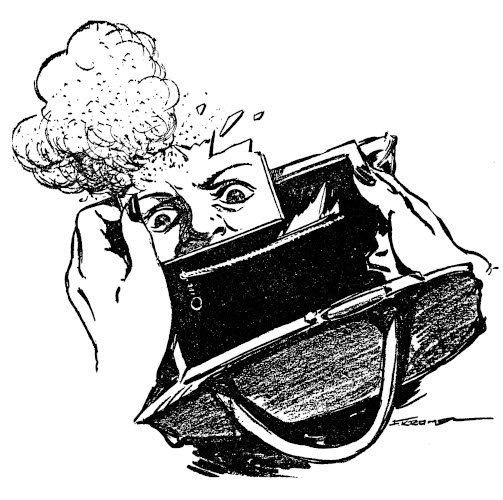
With an incredulous sniff, she took out her mirror, glanced at it puzzledly for a moment, then with a shrug held it up for a detailed inspection of her face.
Now was the moment, if only he could gauge it right. He was taut with expectation, cold with a feeling that the threads of destiny had come into his hands. The second hand of the wall clock seemed to stand still.
He dared not wait longer. In a soft yet straining voice he uttered the words, "Break glass. Shatter soul. Scatter glass. Come soul."
With a swift crackling, not very loud, yet with a tinkle to it, the mirror in Mrs. Gunnison's hand puffed into a little cloud of iridescent dust.
Instantly he felt a weight add itself to his mind, a tangible darkness press down upon his thoughts. And his mind seemed to grasp instinctively at the darkness and hold it there.
The gasp of astonishment or fear that issued from Mrs. Gunnison's lips was cut short. What seemed a loose, stupid look flowed slowly over her face, but that was only because her face lost all expression whatsoever.
He stepped up to her and took her arm.
"Come with me," he said. "It's your best chance."
Docilely she followed him into the hall. Near the stairs they met Miss Miller, returning with a handful of large cards.
"I'm very sorry to have put you to the trouble," he told her. "But it turned out that we didn't need them. You had better return them to the Recorder's Office."
The girl nodded with a polite but somewhat wry smile. Professors!
As Norman escorted Mrs. Gunnison out of the Administration Building, the darkness pressing upon his thoughts parted—as black storm clouds might part at sunset, letting through a narrow beam of crimson light. So, through the painfully bright slit in the darkness lying against his thoughts, there poured a flood of impotent red rage, of obscene anger. In a moment this cleared, and an intelligible thought appeared.
This thought, as the rage preceding it, was so intolerably like Mrs. Gunnison, such an intense concentration of what he had known only in diluted form, that his mind almost lost its hold on the dark entity pressing against it. For a moment his thoughts quailed at the touch of naked personality. He stared ahead, and his steps wandered like those of a drunken man. But only for a moment.
"How did you do it?" was the thought.
His own thoughts rallied, and, before he realized it, had answered:
"It was the Prince Rupert mirror from the display case. The warmth of your fingers shattered it. I held it lightly in folds of my kerchief while transferring it to your pocketbook. When the mirror breaks and the reflection is shattered, the soul is temporarily caught outside. At such times it is vulnerable."
All this, without the machinery of speech to delay it, flashed in an instant. He must be more cautious from now on.
"Where are you taking my body?"
"To our house."
"What do you want?"
"My wife's soul."
There was a long pause. The slit in the darkness closed, then opened again.
"You cannot take it. I hold it, as you hold my soul. But my soul hides it from you. And my soul holds it."
"I cannot take it. But I can hold your soul until you return my wife's soul to her body."
"What if I refuse?"
"Your husband is a realist. He will not believe what your body tells him. He will consult the best alienists. He will be very much grieved. But in the end he will commit your body to an asylum."
He could sense defeat and submission—and a kind of panic, too—in the texture of the answering thought. But defeat and submission were not yet admitted directly.
"You will not be able to hold my soul. You hate it. It fills you with abhorrence. Your mind will not be able to endure it."
Then, in immediate substantiation of this statement, there came through the slit a nasty trickle growing swiftly to a spate. His chief detestations were quickly spied out and rasped upon. He began to hurry his steps, so that the mindless hulk beside him breathed hard.
"There was Ann," came the thoughts, not in words but in the complete fullness of memory. "Ann came to work for me eight years ago. A frail-looking little blonde, but able to get through a hard day's work for all that. She was very submissive, and a prey to fear. Do you know that it is possible to rule people through fear alone, without an atom of direct force? A sharp word, a stern look—It's the implications that do it, not what's said directly. Gradually I gathered about myself all the grim prestige that father, teacher, and preacher had had for Ann. I could make her cry by looking at her in a certain way. I could make her writhe with fright just by standing outside the door of her bedroom. I could make her hold hot dishes without a whimper while serving us at dinner, and make her wait while I talked to Harold. I've looked at her hands afterward—"
Similarly he lived through the stories of Clara and Milly, Mary and Ermengarde. He could not shut his own mind from hers, nor could he close the slit, though it was within his power to widen it. Like some foul medusa, or some pulpy carnivorous plant, her soul infolded and clung to his, until it seemed almost that his was the prisoner. Not symbiosis, but parasitism.
"And there was Trudie. Trudie worshiped me. She was a big girl, slow and a little stupid. She had come from a farm. She used to spend hours on my clothes. I encouraged her in various ways, until everything about me became sacred to Trudie. She lived for my little signs of favor. In the end she would do anything for me, which was very amusing, because she was very easily embarrassed and never lost her painfully acute sense of shame—"
But now he was at the door of his house, and the unclean trickle of thoughts ceased, and the slit narrowed to the tiniest watchful crack.
He shepherded Mrs. Gunnison to the door of Tansy's dressing room. He pointed at the form huddled on the blanket he had thrown across the floor. It lay as he had left it, eyes closed, jaw lolling, breathing heavily.
"Take away what you have conjured into it," he commanded.
There was a pause. A black spider crawled off Tansy's skirt and scuttled across the blanket. Even as there came the thought, "That is it," he lunged out and cracked it under his heel as it escaped onto the flooring. He was aware of a half-cloaked comment, "Its soul sought the nearest body. Now faithful King will go on no more errands for me. I will have to find another dog."
"Return what you have taken," he commanded.
This time there was a longer pause. The slit closed entirely.
The bound figure stirred, as if seeking to roll over. The lips moved. The slack jaw tightened. Conscious only of the black weight against his mind, and of a sensory awareness so acute that he believed he could hear the very beating of the heart in Tansy's body, he stooped and cut the lashings, removed the carefully arranged paddings from wrists and ankles.
The head rolled restlessly from side to side. The lips seemed to be saying, "Norman ... Norman—" The eyelids fluttered and he felt a shiver go over the body. And then, in one sudden glorious flood, like some flower blooming miraculously in an instant, expression surged into the face, the limp hands caught at his shoulders, and from the wide-open eyes a lucid, sane, fearless human soul peered up at his.
Not for one instant after that wonderful relief could his mind hold the repellent darkness pressing against it. And the swift lifting of that darkness was a relief almost equal to the first.
With one venomous, beaten glance, Mrs. Gunnison turned away. He could hear her footsteps trail off, the front door open and shut. Then his arms were around Tansy and his lips were against hers.
XVI.
Urgently she pushed him away from her eager lips.
"We daren't be happy, Norm," she said. "We daren't be happy for one single moment."
A disturbed and apprehensive look clouded the longing in her eyes, as if she had become conscious of a great wall shutting out the sunlight. When she answered his unspoken question, it was almost in a whisper, as if even to mention the name might be dangerous.
"Mrs. Carr—"
Her hands tightened on his arms, conveying to him in a physical way the immediacy of their danger.
"Norman, I'm frightened. I'm terribly frightened. For both of us. My soul has learned so much. Things are different from what I thought. And they're much worse."
He took hold of her shoulders, straightened her up. "You're safe," he told her, and there was a scowling strength in his face and his voice. "I've gotten you back, and I'm going to hold you. I've powers you don't know about yet. They can never touch you again."
"Oh, Norman," she began, dropping her eyes, conflicting emotions evident in her expression, "I know how brave and clever you've been. Only I know the risks you've run, the sacrifices you've made for me—wrenching your whole life away from rationality in the bare space of a week, enduring of your own free will the beastliness of that woman's naked thoughts which I was able to endure only because I was forced to. And you have beaten Evelyn Sawtelle and Mrs. Gunnison fairly and at their own game. But Mrs. Carr—" Her hands transmitted her trembling to him. "Oh, Norman, she only let you beat them. She wanted to give them a fright, and she preferred to let you do it for her. That's always her way. But now she'll take a hand herself."
"I think you're exaggerating," he said slowly. "What you've gone through was enough to finish you a dozen times. But ... we'll talk about it. First I'll get a drink."
And yet, he began to think, Tansy is not the sort to exaggerate. The fact that she's gone through so much and come out so magnificently, is itself a proof that she would not give way to unnecessary fears. He would have to watch himself. His physical weakness, coupled with repugnance for what he had done, was liable to bias his judgment and make him believe anything that promised peace and rest. He rubbed his eyes and blinked them, shaking his head. Relief was making him relax too much. He downed a stiff drink, and poured himself another. Better go easy with that, though. Up to a point it would help, but then it would be worse than nothing at all.
Mrs. Carr, eh? He hadn't paid much attention to her. He'd even wondered if she were concerned at all. Still, that might only mean exceptional cunning. And yet she seemed such a silly old goat. But that might be pretense. Tansy had been in a position to learn a lot.
When he got back to the bedroom, Tansy had changed from her torn and creased dress into one of white wool, which he had always liked very much, but which she had not worn for some time. He remembered she had told him that it had shrunk and become too small for her. But now he sensed intuitively that, in the joy of her return, she took a naïve pride in her youthful body and wanted to show it to best advantage.
"It's like coming into a new house," she told him, with a quick little smile that momentarily cut across her apprehensive look. "Or rather like coming home after you've been away for a long time. You're very happy, but everything is a little strange. It takes you a while to get used to it."
Now that she mentioned it, he realized that there was a kind of uncertainty about her movements, gestures, and expressions, like a person convalescent after a long sickness and just now able to get up and about.
She had combed out her hair so that it fell to her shoulders, and she was still in her bare feet, giving her a diminutive and girlish appearance that he found very attractive. He felt a growing impatience with the possible dangers threatening him, although he knew such an attitude to be unwise. He'd smash anyone who tried to harm her or keep them apart!
She barely sipped her drink, and then put it aside.
"Back of everything, is Mrs. Carr," she began abruptly. "It was she who brought Mrs. Gunnison and Evelyn Sawtelle together, and that one act speaks volumes. Women are invariably secretive about their magic. They work alone. A little knowledge is passed from the elder to the younger ones, especially from mother to daughter, but even that is done grudgingly and with suspicions. This is the only case Mrs. Gunnison knew of—I learned most of this from watching her soul—in which three women actually co-operated. It is an event of revolutionary importance, betokening Heaven knows what for the future. Even now I have only an inkling of Mrs. Carr's ambitions, but they involve vast augmentation of her present powers. For almost three quarters of a century she has been weaving her plans. Her real age is closer to eighty than seventy."
Tansy's voice was rapid, and she had grown pale again. Norman was listening intently.
"She seems an innocent and rather foolish old lady, strait-laced yet ineffectual—but that's only part of a disguise, along with her cooing voice and simpering manners. She's the cleverest actress imaginable. Underneath she's hard as nails—cold where Mrs. Gunnison would be hot, ascetic where Mrs. Gunnison would be a slave to appetites. But she has her own deeply hidden hungers, nevertheless. She is a great admirer of Puritan Massachusetts. Sometimes I have the queerest feeling that she is planning, by some unimaginable means, to reestablish that witch-ridden, so-called theocratic community in this present day and age.
"She rules the other two by fear. In a way they are little more than her apprentices. You know something of Mrs. Gunnison, so you will understand what it means when I say that I have seen Mrs. Gunnison's thoughts go weak with terror because she was afraid that she had slightly offended Mrs. Carr."
Norman finished his drink. His mind was slipping away from this new menace, fumbling at it instead of grasping it firmly. He must whip his mind awake! Tansy pushed her drink over toward him.
"And Mrs. Gunnison's fear is justified, for Mrs. Carr has powers so deadly that she has never had to use them except as a threat. Her eyes are the worst. Those thick glasses of hers—she possesses that most feared of supernatural weapons, against which half the protective charms in recorded magic are intended. That weapon whose name is so well known throughout the whole world that it has become a laughingstock of skeptics. The evil eye. With it, she can blight and wither. With it, she can seize control of another's soul at a single glance.
"So far she has held back, because she wanted the other two punished for certain trifling disobediences and put into a position where they would have to beg her help. But now she will act quickly. She recognizes in you and your work a danger to herself." Tansy's voice had become so breathlessly rapid that Norman realized she must be talking against time. "Besides that, she has another motive buried in the darkness of her mind. I do not know what it is, but sometimes I have caught her studying my every movement and expression with the strangest avidity—"
Suddenly she broke off and her face went white.
"—I can feel her now ... I can feel her seeking me out ... she is breaking through—No!" Tansy screamed. "No, you can't make me do it!... I won't!... I won't!" Before he knew it, she was on her knees, clinging to him, clutching at his hands. "Don't let her touch me, Norman," she was babbling like a terrified child. "Don't let her come near me."
"I won't," he said.
"—oh ... but you can't stop her.... She's coming here, she says, in her own body—that's how much she cares for your powers! She's going to take me away.... I can't tell you what she's going to make me do—it's too repulsive."
"If she comes here, I'll stop her," he said in a flat voice.
Her babbling ceased. Slowly she lifted her white, frightened face until it looked up at his.
"You mean—"
He nodded. "I've still got a few cartridges for the revolver." His face was set.
"Norman, I can't let you do it ... except—"
"—that I am in as much danger as you are."
"Yes."
A semblance of control came back into Tansy's face.
"You might be able to do it," she said softly. "She wouldn't be expecting physical violence. But you would have to be very quick. If you hesitated for the tiniest instant, if you gave her the slightest opportunity to fix you with her eyes, you would be lost. She would seize control. You know the cobra that spits venom at its victim's eyes—it's like that."
Dully he tried to remember what you did when you committed a murder. There was the alibi—what would that be? And disposal of the body—the furnace, or he could steal some carboys of acid from the chem lab. What acid? And would it be wise to steal it? And then there was motive. That would be his strong point. The courts would not recognize his true motive.
He started. Tansy was shaking him insistently.
"Hurry, Norman. She's very close."
As if in some sticky nightmare of fear and rage and hate, he made his preparations. The curtains drawn. The door barely unlatched, so she could push her way in. Himself in the dark corner of the living room. She would make a good target, outlined against that oblong of daylight.
Suddenly Tansy slipped into his arms. Her body molded itself to his. Her moist lips found his own. Almost brutally he returned the kiss. He heard her whisper breathlessly, "Only be quick, darling. Don't let her look at you." And then she had retreated to the bedroom doorway.