COME OUT OF THE KITCHEN!
Reading edition
I
THE window of Randolph Reed's office was almost completely covered by magnificent gold block lettering. This to any one who had time and ability to read it—and the former was more common in the community than the latter—conveyed the information that Reed dealt in every kind of real estate, from country palaces to city flats. The last item was put in more for the sake of symmetry than accuracy, for the small Southern town contained nothing approaching an apartment house.
From behind this pattern of gold, Reed peered eagerly one autumn afternoon, chewing the end of a frayed cigar, and listening for the sound of a motor. He was a stout young man, of an amiable though unreadable countenance, but like many people of a heavy build, he was capable of extreme quickness of movement. This was never more clearly shown than when, about four o'clock, the wished for sound actually reached his ears. A motor was approaching.
With a bound Reed left the window, and, seated at his desk, presented in the twinkling of an eye the appearance of a young American business man, calm and efficient, on an afternoon of unusual business pressure. He laid papers in piles, put them in clips and took them out, snapped rubber bands about them with frenzied haste, and finally seizing a pen, he began to indite those well-known and thrilling words: "Dear Sir: Yours of the 15th instant received and contents—" when the motor drew up before his door.
It was an English car; all green and nickel; it moved like an expert skater on perfect ice. As it stopped, the chauffeur dropped from his place beside the driver. The driver himself, removing his glasses, sprang from the car and up the office steps, slapping the pockets of his coat as he did so in a search which soon appeared to be for cigarettes and matches.
"Sorry to be late," he said.
Reed, who had looked up as one who did not at once remember, in his vast preoccupation, either his visitor or his business, now seemed to recall everything. He waved the newcomer to a chair, with a splendid gesture.
"Doubtless the roads," he began.
"Roads!" said the other. "Mud-holes. No, we left Washington later than I intended. Well, have you got the house for me?"
Reed offered his client a cigar.
"No, thank you, prefer my cigarette if you don't mind."
Reed did not mind in the least. The real estate business in Vestalia was never brilliant, and several weeks' profits might easily have been expended in one friendly smoke.
His client was a man under thirty, of a type that used to be considered typically American—that is to say, Anglo-Saxon, modified by a century or so of New England climate and conscience. His ancestors had been sailors, perhaps, and years of exposure had tanned their skins and left their eyes as blue as ever. His movements had the gentleness characteristic of men who are much with horses, and though he was active and rather lightly built, he never was sudden or jerky in any gesture. Something of this same quietness might be detected in his mental attitude. People sometimes thought him hesitating or undecided on questions about which his mind was irrevocably made up. He took a certain friendly interest in life as a whole, and would listen with such patience to an expression of opinion that the expresser of it was often surprised to find the opinion had had no weight with him, whatsoever.
He stood now, listening with the politest attention to Reed's somewhat flowery description of the charms of the Revelly house—charms which Crane himself had examined in the minutest detail.
"Never before," exclaimed the real estate agent, in a magnificent peroration, "never before has the splendid mansion been rented—"
"Ah," said Crane with a smile, "I believe you there."
"Never been offered for rent," corrected the real estate agent, with a cough. "Its delightful colonial flavor—"
"Its confounded dilapidation," said the prospective tenant.
"Its boxwood garden, its splendid lawns, its stables, accommodating twenty-five horses—"
"Yes, if they don't lean up against the sides."
Reed frowned.
"If," he remarked with a touch of pride, "you do not want the house—"
The young man of the motor car laughed good-temperedly.
"I thought we had settled all that last week," he said. "I do want the house; I do appreciate its beauties; I do not consider it in good repair, and I continue to think that the price for six weeks is very high. Have the owners come down?"
Reed frowned again.
"I thought I made it clear, on my part," he answered, "that Mr. and Mrs. Revelly are beyond the reach of communication. They are on their way to Madeira. Before they left they set the price on their house, and I can only follow their instructions. Their children—there are four children—"
"Good heavens, I don't have to rent them with the house, do I?" exclaimed the other frivolously.
The real estate agent colored, probably from annoyance.
"No, Mr. Crane," he answered proudly, "you do not, as far as I know, have to do anything you do not wish to do. What I was about to say was that the children have no authority to alter the price determined by their parents. To my mind, however, it is not a question of absolute value. There is no doubt that you can find newer and more conveniently appointed houses in the hunting district—certainly cheaper ones, if price be such an object. But the Revelly family—one of the most aristocratic families south of Mason and Dixon's, sir—would not be induced to consider renting under the sum originally named."
"It's pretty steep," said the young man, but his mild tone already betrayed him. "And how about servants?"
"Ah," said Reed, looking particularly mask-like, "servants! That has been the great difficulty. To guarantee domestic service that will satisfy your difficult Northern standards—"
"I am fussy about only two things," said Crane, "cooking and boots. Must have my boots properly done."
"If you could have brought your own valet—"
"But I told you he has typhoid fever. Now, see here, Mr. Reed, there really isn't any use wasting my time and yours. If you have not been able to get me a staff of servants with the house, I wouldn't dream of taking it. I thought we had made that clear."
Reed waved his impatient client again to his chair.
"There are at this moment four well-recommended servants yonder in the back office, waiting to be interviewed."
"By me?" exclaimed Crane, looking slightly alarmed.
Reed bowed.
"I wish first, however," he went on, "to say a word or two about them. I obtained them with the greatest difficulty, from the Crosslett-Billingtons, of whom you have doubtless often heard."
"Never in my life," said Crane.
Reed raised his eyebrows.
"He is one of our most distinguished citizens. His collection of tapestry, his villa at Capri—Ah, well, but that is immaterial! The family is now abroad, and has in consequence consented, as a personal favor to me, to allow you to take over four of their servants for the six weeks you will be here, but not a minute longer."
Crane leaned back and blew smoke in the air.
"Are they any good?" he asked.
"You must judge for yourself."
"No, you must tell me."
"The butler is a competent person; the skill of the cook is a proverb—but we had better have them come in and speak to you themselves."
"No, by Jove!" cried Crane, springing to his feet. "I don't think I could stand that." And he incontinently rushed from the office to the motor, where three mummy-like figures on the back seat had remained immovable during his absence.
Of these, two were female and one male. To the elder of the women, Crane applied, hat in hand.
"Won't you give me the benefit of your advice, Mrs. Falkener," he said. "The agent has some servants for me. The wages and everything like that have all been arranged, but would you mind just looking them over for me and telling me what you think about them?"
To invite Mrs. Falkener to give her advice on a detail of household management was like inviting a duck to the pond. She stepped with a queen-like dignity from the car. She was a commanding woman who swam through life, borne up by her belief in her own infallibility. To be just, she was very nearly infallible in matters of comfort and domestic arrangement, and it was now many years since she had given attention to anything else in the world. She was a thorough, able and awe-inspiring woman of fifty-three.
Now she moved into Reed's office, with motor-veils and dusters floating about her, like a solid wingless victory, and sat down in Randolph Reed's own chair. (It was part of her philosophy never to interview a social inferior until she herself was seated.) With a slight gesture of her gloved hand, she indicated that the servants might be admitted to her presence.
The door to the back office opened and the four candidates entered. The first was the butler, a man slightly younger in years than most of those careworn functionaries. He came forward with a quick, rapid step, turning his feet out and walking on his toes. Only Mrs. Falkener recognized that it was the walk of a perfect butler. She would have engaged him on the spot, but when she noted that his hair was parted from forehead back to the line of his collar and brushed slightly forward in front of his ears, she experienced a feeling of envy and for the first time thought with dissatisfaction of the paragon she had left in charge of her own pantry at home.
She did indeed ask him a question or two, just to assure herself of his English intonation, which, it must be owned, a residence in the South had slightly influenced. And then with a start she passed on to the next figure—the cook.
On her the eyes of her future employer had already been fixed since the door first opened, and it would be hardly possible to exaggerate the effect produced by her appearance. She might have stepped from a Mid-Victorian Keepsake, or Book of Beauty. She should have worn eternally a crinoline and a wreath of flowers; her soft gray-blue eyes, her little bowed mouth, her slim throat, should have been the subject of a perpetual steel engraving. She was small, and light of bone, and her hands, crossed upon her check apron (for she was in her working dress), were so little and soft that they seemed hardly capable of lifting a pot or kettle.
Mrs. Falkener expressed the general sentiment exactly when she gasped:
"And you are the cook?"
The cook, whose eyes had been decorously fixed upon the floor, now raised them, and sweeping one rapid glance across both her employer and the speaker, whispered discreetly:
"Yes, ma'am."
"What is your name?"
And at this question a curious thing happened. The butler and Reed answered simultaneously. Only, the butler said "Jane," and Reed, with equal conviction, said "Ellen."
Ignoring this seeming contradiction, the cook fixed her dove-like glance on Mrs. Falkener and answered:
"My name is Jane-Ellen, ma'am."
It was impossible for even as conscientious a housekeeper as Mrs. Falkener to be really severe with so gentle a creature, but she contrived to say, with a certain sternness:
"I should like to see your references, Jane-Ellen."
"Oh, I'm sure that will be all right, Mrs. Falkener," said Crane hastily. He had never removed his eyes from the face of his future cook.
But Jane-Ellen, with soft gestures of those ridiculous hands, was already unfolding a paper, and now handed it to Mrs. Falkener.
That lady took it and held it off at arm's length while she read it.
"And who," she asked, turning to Reed, "is this Claudia Revelly? Mrs. Revelly, I suppose?"
"Why, no," answered Reed. "No, as I told you, Mrs. Revelly is in Madeira with her husband. This is one of the Miss Revellys."
"Humph," replied Mrs. Falkener. "It is a flattering reference, but in my time the word 'recommend' was spelled with only one 'c.'"
The cook colored slightly and flashed a glance that might have been interpreted as reproachful at Reed, who said hastily:
"Ah, yes, quite so. You know—the fact is—our Southern aristocracy—the Revellys are among our very—However, there can be no question whatever about Jane-Ellen's ability. You will, I can assure you from personal experience, be satisfied with her cooking. Mrs. Crosslett-Billington—"
"Humph!" said Mrs. Falkener again, as one who does not mean to commit herself. "We shall see. Let the housemaid come a little forward."
At this a young woman advanced; she bore a certain resemblance of feature to the butler, but entirely lacked his competent alertness.
"This young woman looks to me sullen," Mrs. Falkener observed to Crane, hardly modulating her clear, dry tone of voice.
Crane betrayed his embarrassment. He wished now that he had not invited his elderly friend's coöperation.
"Oh," he said, "I'm sure it will be all right. It must be a trifle annoying to be looked over like this."
"The best way to settle this sort of thing is at the start," replied Mrs. Falkener, and turning to the housemaid, she asked her her name.
"Lily," replied the young woman, in a deep voice of annoyance.
"Lily," said Mrs. Falkener, as if this were a most unsuitable name for a housemaid, and she looked up at Crane to confirm her opinion, but he was again looking at the cook and did not notice her.
"Well, Lily," continued the elder lady, as if she made a distinct concession in making use of such a name at all in addressing a servant, "do you or do you not want to take this place? There is, I suppose, nothing to compel you to take it if you do not want. But now is the time to say so."
Lily, with a manner that did seem a little ungracious, replied that she did want it, and added, on receiving a quick glance from the butler, Smithfield, "Madame."
"Well, then," said Mrs. Falkener, becoming more condescending, "we shall expect a more pleasant demeanor from you, a spirit of coöperation. Nothing is more trying for yourself or your fellow servants—"
Reed moved forward and whispered in Mrs. Falkener's ear:
"It will straighten out of itself, my dear madame—nothing but a little embarrassment—a grande dame like yourself, you understand me, a tremendous impression on a young woman of this sort—"
Mrs. Falkener interrupted him.
"What is the name of the boy in the corner?" she asked.
At this, a round-faced lad of perhaps eighteen sprang forward. The most striking items of his costume were a red neckerchief and a green baize apron and leggings, giving to his appearance a slight flavor of a horse-boy in an illustration to Dickens.
"I, ma'am," he said, with a strong cockney accent, "am the Useful Boy, as they say in the States."
"He's very good at doing boots," said Reed.
"Boots," cried the boy, and kissing his hand he waved it in the air with a gesture we have been accustomed to think of as continental rather than British, "a boot, particularly a riding-boot, is to me—"
"What is your name?" Mrs. Falkener asked, and this time the severity of her manner was unmistakable.
It did not, however, dampen the enthusiasm of the last candidate.
"My name, ma'am," he replied, "is B-r-i-n-d-l-e-b-u-r-y."
"Brindlebury?"
"Pronounced, 'Brinber'—the old Sussex name with which, ma'am, I have no doubt you, as a student of history—"
Mrs. Falkener turned to Crane.
"I think you will have trouble with that boy," she said. "He is inclined to be impertinent."
Crane looked at the boy over her head, and the boy, out of a pair of twinkling gray eyes, looked back. They both managed to look away again before a smile had been actually exchanged, but Crane found himself making use for the third time of his favorite formula:
"Oh, I think I'll find him all right."
Mrs. Falkener, remembering the pitiable weakness of men, again waved her hand.
"They may go now," she said to Reed, who hastily shepherded the four back again into the back office. When they were alone, she turned to Crane and said with the utmost conviction:
"My dear Burton, none of those servants will do—except the butler, who appears to be a thoroughly competent person. But those young women—they may have been anything. Did you not observe that their nails had been manicured?"
Crane stammered slightly, for the fact had not escaped him, in connection, at least, with one of the young women.
"Don't—don't cooks ever manicure their nails?" he said. "It seems rather a good idea to me."
Reed, who was once more approaching, caught these last words.
"Ah," he said, "you were speaking of the manicuring of servants' nails—"
Mrs. Falkener gave him a severe look.
"I was advising Mr. Crane not to engage any one but the butler."
"Indeed, how very interesting," said Reed. "Your judgment in the matter is very valuable, madame, I know, but perhaps you do not sufficiently emphasize the difficulties of getting any servants at all in this part of the country. In fact, I could not undertake, if these are not engaged—"
"Well, I could," said the lady. "I could telegraph to New York to my own intelligence office and have three really competent people here by to-morrow evening."
For a moment Reed looked profoundly distressed, and then he went on:
"Exactly, I have no doubt, madame. But what I was about to say was that I could not undertake to rent the Revelly house to a staff of unknown Northern servants. You see, these two young women have been practically brought up in the household of Mrs. Crosslett-Billington—an old family friend of the Revellys—and they know they would take care of things in the way they are accustomed to—"
"Of course, of course, very natural," said Crane. "I quite agree. I'm willing to give these people a chance. Of course, Mrs. Falkener, I don't know as much about these things as you do, but it's only for a few weeks, and as for their nails—"
"Oh, I can explain that," cried Reed; "in fact, I should have done so at the start. It's an idiosyncrasy of Mr. Billington's. He insists that all the servants in the house should be manicured, particularly those who wait on table, or have anything to do with touching the food."
Mrs. Falkener compressed her lips till they were nothing but a seam in her face.
"Humph!" she said again, and without another word she turned and swept out of the office.
Left alone, the two men stood silent, without even looking at each other, and finally it was Crane who observed mildly:
"Well, you know, they are a little queer in some ways—"
"Take my word for it," said Reed, earnestly, "you will make no mistake in engaging them all—except that boy, but you can manage him, I have no doubt. As for the cook, you will be surprised. Her cooking is famous in three counties, I assure you."
An instant later, the lease was duly signed.
When the motor was safely on its way back to Washington, Mrs. Falkener gave her companions on the back seat the benefit of her own impression. One was her daughter, a muscular, dark-eyed girl, who imagined that she had thoroughly emancipated herself from her mother's dominance because she had established a different field of interest. She loved out-of-door sport of all kinds, particularly hunting, and was as keen and competent about them as her mother was about household management. The two respected each other's abilities, and managed to lead an affectionate life in common.
The man on the back seat was Solon Tucker—Crane's lawyer, by inheritance rather than by choice. He was a thin, erect man, with a narrow head and that expression of mouth at once hard and subtle that the Law writes on so many men's faces. His mind was excellently clear, his manner reserved, and his invariable presupposition that all human beings except himself were likely to make fools of themselves. He had, however, immense respect for Mrs. Falkener's opinions on any subject except law—on which he respected nobody's opinions but his own, least of all those of judges; and he believed that nothing would so effectively lighten his own responsibilities in regard to Crane as to marry him to Mrs. Falkener's daughter, an idea in which Mrs. Falkener cordially agreed.
"You must make a point of staying with him, Solon," she was now murmuring into that gentleman's rather large ear, "if, as I fear, he actually takes this house. You have never seen such an extraordinary group of servants—except the butler. Do you suppose it could be a plot, a blackmailing scheme of some sort? The cook—Well, my dear Solon, a pocket Venus, a stage ingénue, with manicured nails! He was determined to engage her from the first. It seems very unsafe to me. A bachelor of Burton's means. You must stay by him, Solon. In fact," she added, "I think we had better both stay by him. Poor boy, he has no idea of taking care of himself."
"He can be very obstinate," said his lawyer. "But I fancy you exaggerate the dangers. You are unaccustomed to any but the very highest type of English servant. They are probably nothing worse than incompetent."
"Wait till you see the cook!" answered Mrs. Falkener portentously.
Tucker looked away over the darkening landscape.
"Dear me," he thought to himself. "What a mountain she makes of a mole-hill! How every one exaggerates—except trained minds!"
In Tucker's opinion all trained minds were legal.
II
ON the following Monday, late in the afternoon, the old Revelly house was awaiting its new master. Already hunters, ponies, two-wheeled carts, an extra motor, to say nothing of grooms, stable-boys, and a tremendous head coachman, had arrived and were making the stable yards resound as they had not done for seventy years. But they had nothing to do with the household staff. They were all to be boarded by the coachman's wife who was installed in the gardener's cottage.
The house, with its tall pillared portico and flat roofed wings, lost its shabby air as the afternoon light grew dimmer, and by six o'clock, when Crane's motor drew up before the door, it presented nothing but a dignified and spacious mass to his admiring eyes.
No one but Tucker was with him. He had had some difficulty in avoiding the pressing desire of the two Falkener ladies to be with him at the start and help him, as they put it, "get everything in order." He had displayed, however, a firmness that they had not expected. He had been more embarrassed than he cared to remember by Mrs. Falkener's assistance in the real estate office, and he decided to begin his new housekeeping without her advice. He would, indeed, have dispensed with the companionship even of Tucker for a day or two, but that would have been impossible without a direct refusal, and Burton was unwilling to hurt the feelings of so true and loyal a friend, not only of his own but of his father before him.
The dignified butler and the irrepressible boy, Brindlebury, ran down the steps to meet them, and certainly they had no reason to complain of their treatment; bags were carried up and unstrapped, baths drawn, clothes laid out with the most praiseworthy promptness.
Tucker had advocated a preliminary tour of inspection.
"It is most important," he murmured to Crane, "to give these people the idea from the start that you cannot be deceived or imposed upon." But Crane refused even to consider such questions until he had had a bath and dinner.
The plan of the old house was very simple. On the right of the front door was the drawing-room, on the left a small library and a room which had evidently been used as an office. The stairs went up in the center, shallow and broad, winding about a square well. The dining-room ran across the back of the house.
When Tucker came down dressed for dinner, he found Crane was ahead of him. He was standing in the drawing-room bending so intently over something on a table that Tucker, who was not entirely without curiosity, came and bent over it, too, and even the butler, who had come to announce dinner, craned his neck in that direction.
It was a miniature, set in an old-fashioned frame of gold and pearls. It represented a young woman in a mauve tulle ball dress, full in the skirt and cut off the shoulders, as was the fashion in the days before the war. She wore a wreath of fuchsias, one of which trailing down just touched her bare shoulder.
"Well," said Tucker contemptuously, "you don't consider that a work of art, do you?"
Burton remained as one entranced.
"It reminds me of some one I know," he answered.
"It is quite obviously a fancy picture," replied Tucker, who was something of a connoisseur. "Look at those upturned eyes, and that hand. Did you ever see a live woman with such a tiny hand?"
"Yes, once," said Crane, but his guest did not notice him.
"The sentimentality of the art of that period," Tucker continued, "which is so plainly manifested in the poetry——"
"Beg pardon, sir," said Smithfield, "the soup is served."
Crane reluctantly tore himself from the picture and sat down at table, and such is the materialism of our day that he was evidently immediately compensated.
"By Jove," he said, "what a capital purée!"
Even Tucker, who, under Mrs. Falkener's tuition, had intended to find the food uneatable, was obliged to confess its merits.
"I say," said Crane to Smithfield, "tell the cook, will you, that I never tasted such a soup—not out of Paris, or even in it."
"She probably never heard of Paris," put in Tucker.
Smithfield bowed.
"I will explain your meaning to her, sir," he said.
Dinner continued on the same high plane, ending with two perfect cups of coffee, which called forth such eulogies from Crane that Tucker said finally, as they left the dining-room:
"Upon my word, Burt, I never knew you cared so much about eating."
"I love art, Tuck," said the other, slapping his friend on the back. "I appreciate perfection. I worship genius."
Tucker began to feel sincerely distressed. Indeed he lay awake for hours, worrying. He had counted, from Mrs. Falkener's description, on finding the servants so incompetent that the house would be impossible. He had hoped that one dinner would have been enough to send Crane to the telegraph office of his own accord, summoning servants from the North. He had almost promised Mrs. Falkener that when she and her daughter arrived the next afternoon, they would find a new staff expected, if not actually installed. Instead he would have to greet her with the news that the pocket Venus with the polished nails had turned out to be a cordon bleu. That is, if she were really doing the cooking. Perhaps—this idea occurred to Tucker shortly before dawn—perhaps she was just pretending to cook; perhaps she had hired some excellent old black Mammy to do the real work. That should be easily discoverable.
He determined to learn the truth; and on this resolution fell asleep.
The consequence was that he came down to breakfast rather cross, and wouldn't even answer Crane, who was in the most genial temper, when he commented favorably on the omelette. In fact, he let it appear that this constant preoccupation with material details was distasteful to him.
Crane, as he rose from the table, turned to Smithfield:
"Will you tell the cook I'd like to see her," he said. "I'm expecting some ladies to stay, this afternoon, and I want to make things comfortable for them. Be off, Tuck, there's a good fellow, if this sort of thing bores you."
But wild horses would not at that moment have dragged Tucker away, and he observed that he supposed there was no objection to his finishing his breakfast where he was.
Smithfield coughed.
"I'm sure I beg your pardon, sir," he said, "but if you could tell me what it is you want, I would tell the cook. She has a peculiar nature, Jane-Ellen has, sir; has had from a child; and, if you would forgive the liberty, I believe it would be best for you not to interview her yourself."
Tucker looked up quickly.
"Why, what do you mean?" asked Crane.
"She is very timid, sir, very easily affected by criticism—"
"Good heavens, I don't want to criticize her!" cried Crane. "I only want to tell her how highly I think of her."
"In my opinion, Burton," Tucker began, when an incident occurred that entirely changed the situation.
A very large elderly gray cat walked into the room, with the step of one who has always been welcome, and approaching Tucker's chair as if it were a familiar place, he jumped suddenly upon his knee and began to purr in his face.
Tucker, under the most favorable circumstances, was not at his best in the early morning. Later in the day he might have borne such an occurrence with more calm, but before ten o'clock he was like a man without armor against such attacks. He sprang to his feet with an exclamation, and drove the cat ahead of him from the room, returning alone an instant later.
"It is outrageous," he said, when he returned, "that our lives are to be rendered miserable by that filthy beast."
"Sit down, Tuck," said Burton, who was talking about wines with the butler. "My life is not rendered in the least miserable. The champagne, Smithfield, ought to go on the ice—"
Tucker, however, could not distract his mind so quickly from the thought of the outrage to which he had just been subjected.
"I must really ask you, Burton," he said, "before you go on with your orders, to insist that that animal be drowned, or at least sent out of the house—"
"Oh, I beg, sir, that you won't do that," broke in Smithfield. "The cat belongs to the cook, and I really could not say, sir, what she might do, if the cat were put out of the house."
"We seem to hear a vast amount about what this cook likes and doesn't like," said Tucker, dribbling a little more hot milk into his half cup of coffee. "The house, I believe, is not run entirely for her convenience."
It is possible that Crane had already been rendered slightly inimical to his friend's point of view, but he was saved the trouble of answering him, for at this moment the cook herself entered the room, in what no one present doubted for an instant was a towering rage. She was wearing a sky blue gingham dress, her eyes were shining frightfully, and her cheeks were very pink.
At the sight of her, all conversation died away.
The butler approaching her, attempted to draw her aside, murmuring something to which she paid no attention.
"No," she said aloud, pulling her arm away from his restraining hand, "I will not go away and leave it to you. I will not stay in any house where dumb animals are ill-treated, least of all, my own dear cat."
It is, as most of us know to our cost, easier to be pompous than dignified when one feels oneself in the wrong.
"Pooh," said Tucker, "your cat was not ill-treated. She had no business in the dining-room."
"He was kicked," said the cook.
"Come, my girl," returned Tucker, "this is not the way to speak to your employer."
And at this, with one of those complete changes of manner so disconcerting in the weaker sex, the cook turned to Crane, and said, with the most melting gentleness:
"I'm sure it was not you, sir. I am sure you would not do such a thing. You will excuse me if I was disrespectful, but perhaps you know, if you have ever loved an animal, how you feel to see it brutally kicked downstairs."
"Preposterous," said Tucker, carefully indicating that he was addressing Crane alone. "This is all preposterous. Tell the woman to keep her cat where it belongs, and we'll have no more trouble."
"It hasn't troubled me, Tuck," answered Crane cheerfully. "But I am curious to know whether or not you did kick him."
"The question seems to be, do you allow your servants to be insolent or not?"
Crane turned to the cook.
"Mr. Tucker seems unwilling to commit himself on the subject of the kick," he observed. "Have you any reason for supposing your cat was kicked?"
"Yes," said Jane-Ellen. "The noise, the scuffle, the bad language, and the way Willoughby ran into the kitchen with his tail as big as a fox's. He is not a cat to make a fuss about nothing, I can tell you."
"I beg your pardon," said Crane, who was now evidently enjoying himself, "but what did you say the cat's name is?"
"Willoughby."
Burton threw himself back in his chair.
"Willoughby!" he exclaimed, "how perfectly delightful. Now, you must own, Tuck, prejudiced as you are, that that's the best cat name you ever heard in your life."
But Tucker would not or could not respond to this overture, and so Crane looked back at Jane-Ellen, who looked at him and said:
"Oh, do you like that name? I'm so glad, sir." And at this they smiled at each other.
"Don't you think you had better go back to the kitchen, Jane-Ellen?" said the butler sternly.
In the meantime, Tucker had lighted a cigar and had slightly recovered his equanimity.
"As a matter of fact," he now said, in a deep, growling voice, "I did not kick the creature at all—though, if I had, I should have considered myself fully justified. I merely assisted its progress down the kitchen stairs with a sort of push with my foot."
"It was a kick to Willoughby," said the cook, in spite of a quick effort on Smithfield's part to keep her quiet.
"O Tuck!" cried Crane, "it takes a lawyer, doesn't it, to distinguish between a kick and an assisting push with the foot. Well, Jane-Ellen," he went on, turning to her, "I think it's not too much to ask that Willoughby be kept in the kitchen hereafter."
"I'm sure he has no wish to go where he's not wanted," she replied proudly, and at this instant Willoughby entered exactly as before. All four watched him in a sort of hypnotic inactivity. As before, he walked with a slow, firm step to the chair in which Tucker sat, and, as before, jumped upon his knee. But this time Tucker did not move. He only looked at Willoughby and sneered.
Jane-Ellen, with the gesture of a mother rescuing an innocent babe from massacre, sprang forward and snatched the cat up in her arms. Then she turned on her heel and left the room. As she did so, the face of Willoughby over her shoulder distinctly grinned at the discomfited Tucker.
Not unnaturally, Tucker took what he could from the situation.
"If I were you, Burt," he said, "I should get rid of that young woman. She is not a suitable cook for a bachelor's establishment. She's too pretty and she knows it."
"Well, she wouldn't have sense enough to cook so well, if she didn't know it."
"It seems to me she trades on her looks when she comes up here and makes a scene like this."
"Beg pardon, sir," said Smithfield, with a slightly heightened color, "Jane-Ellen is a very good, respectable girl."
"Certainly, she is," said Crane, rising. "Nothing could be more obvious. Just run down, Smithfield, and ask her to send up a menu for to-night's dinner." Then, as the man left the room, he added to his friend:
"Sorry, Tuck, if I seem lacking in respect for you and your wishes, but I really couldn't dismiss such a good cook because you think her a little bit too good-looking. She is a lovely little creature, isn't she?"
Jane-Ellen sprang forward and snatched the cat from Tucker's knee
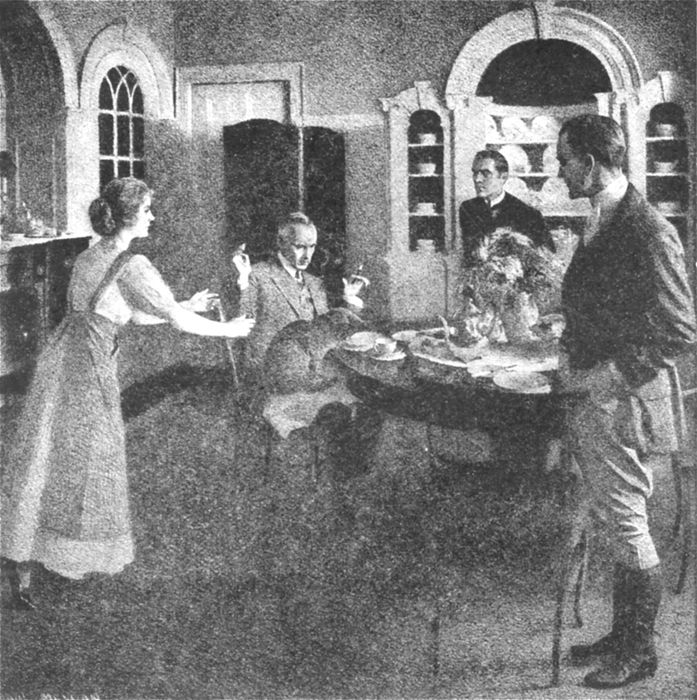
"She doesn't know her place."
Crane walked to the window and stood looking out for a minute, and then he said thoughtfully:
"If ever I have a cat I shall name it Willoughby."
"Have a cat!" cried Tucker. "I thought you detested the animals as much as I do."
"I felt rather attracted toward this one," said Crane.
III
HIS household cares disposed of, Crane went off to the stables. It was a soft hazy autumn morning, and though he walked along whistling his heart was heavy. These changes in background always depressed him. His mother had been dead about two years, and at times like this he particularly missed her. She had always contrived to make domestic difficulties not only unimportant, but amusing. She had been pretty and young, both in years and spirit, and had had the determining influence on her son since his childhood.
His parents had married early and imprudently. The elder Crane, stung by some ill-considered words of his wife's family, had resolved from the first to make a successful career for himself. Shrewd, hard and determined, he had not missed his mark. Burton's earliest recollections of him were fleeting glimpses of a white, tired, silent man seldom, it seemed to him, at home, and, by his gracious absences, giving him, Burton, a sort of prior claim on all the time and all the attention of his mother.
As he grew older and his father's fortune actually materialized, he began to see that it had never given pleasure to his mother, that it had first taken her husband's time and strength away, and had then changed the very stuff out of which the man was made. He had grown to love not only the game, but the rewards of the game. And Burton knew now that very early his mother had begun deliberately to teach him the supreme importance of human relationships, that she had somehow inculcated in him a contempt not, perhaps, for money, but for those who valued money. Under her tuition he had absorbed a point of view not very usual among either rich or poor, namely that money like good health was excellent to have, chiefly because when you had it you did not have to think about it.
Both her lessons were valuable to a young man left at twenty-five with a large fortune. But the second—the high delight in companionship—she had taught him through her own delightful personality, and her death left him desperately lonely. His loneliness made him, as one of his friends had said, extremely open to the dangers of matrimony, while on the other hand he had been rendered highly fastidious by his years of happy intimacy with his mother. Her wit and good temper he might have found in another woman—even possibly her concentrated interest in himself—but her fortunate sense of proportion, her knowledge in every-day life, as to what was trivial and what was essential, he found strangely lacking in all his other friends.
He thought now how amusing she would have been about the manicured maid servants, and how, if he and she had been breakfasting together, they would have amused themselves by inventing fantastic explanations, instead of quarreling and sulking at each other as he and Tucker had done.
Tucker had been his father's lawyer. It had been one of the many contradictions in Mrs. Crane's character that, though she had always insisted that as a matter of loyalty to her husband Tucker should be retained as family adviser, she had never been able to conceal from Burton, even when he was still a boy, that she considered the lawyer an intensely comic character.
She used to contrive to throw a world of significance into her pronunciation of his name, "Solon." Crane could still hear her saying it, as if she were indeed addressing the original lawgiver; and it was largely because this recollection was too vivid that he himself had taken to calling his counselor by his last name.
He sighed as he thought of all this; but he was a young man, the day was fine and his horses an absorbing interest, and so he spent a very happy morning, passing his hand along doubtful fetlocks and withers, and consulting with his head man on all the infinity of detail which constitutes the chief joy of so many sports.
At lunch, he appeared to be interested in nothing but the selection of the best mount for Miss Falkener—a state of mind which Tucker considered a great deal more suitable than his former frivolous interest in cats. And soon after lunch was over he went off for a ride, so as to get it in before he had to go and meet his new guests.
A back piazza ran past the dining-room windows. It was shady and contained a long wicker-chair. The November afternoon was warm, and here Tucker decided to rest, possibly to sleep, in order to recuperate from a disturbing night and morning.
He contrived to make himself very comfortable with a sofa pillow and extra overcoat. He slept indeed so long that when he woke the light was beginning to fade. He lay quiet a few moments, thinking that Mrs. Falkener would soon arrive and revolving the best and most encouraging terms in which he could describe the situation to her, when he became aware of voices. His piazza was immediately above the kitchen door, and it was clear that some one had just entered the kitchen from outdoors. And he heard a voice, unmistakably Jane-Ellen's, say:
"Stranger, see how glad Willoughby is to see you again. Just think, he hasn't laid eyes on you for all of three days."
Tucker could not catch the answer which was made in a deep masculine voice, but it was easy to guess its import from the reply of Jane-Ellen.
"Oh, I'm glad to see you, too."
Another murmur.
"How do you expect me to show it?"
A murmur.
"Don't be absurd, Ranny." And she added quite audibly: "If you really want proof, I'll give it to you. I was just thinking I needed some one to help me freeze the ice-cream. Give it a turn or two, will you, like a dear?"
It was obvious that the visitor was of a docile nature, for presently the faint regular squeak of an ice-cream freezer was heard. His heart was not wholly in his work, however, for soon he began to complain. Tucker gathered that the freezer was set outside the kitchen door, and that the visitor now had to raise his voice slightly in order to be heard in the kitchen, for both speakers were audible.
"Yes," said the visitor, "that's the way you are. You expect every one to work for you."
"Don't you enjoy working for me, Ranny? You've always said it was the one thing in the world gave you pleasure."
"Humph," returned the other grimly, "I don't know that I am so eager to freeze Crane's ice-cream."
"And Mr. Tucker's, don't forget him."
"Who the deuce is Tucker?"
The listener above sat up and leaned forward eagerly.
"Tucker," said Jane-Ellen, "is our guest at present. He's my favorite and Willoughby's. He has what you might call a virile, dominating personality. Please don't turn so fast, or you'll ruin the dessert."
"How did you ever come in contact with Tucker, I should like to know. Does he come into the kitchen?"
"Not yet."
"How did you see him at all?"
"Owing to his kicking Willoughby down the stairs."
"And you mean to say you stood for that? Why, my dear girl, if any one had told me—"
"Cruel, perhaps, Ranny, but the action of a strong man."
"I think it's a great mistake," said the masculine voice in a tone of profound displeasure, "for a girl situated as you are to have anything to do with her employer and his guests. What do you know about these fellows? How old is this Tucker?"
"Oh, about forty, I should think."
The listener's eyes brightened by ten years.
"What does he look like?"
"Oh, people are so difficult to describe, Ranny."
"You can describe them all right when you try."
"Well," ... Tucker's excitement became intense ... "well, he looks like the husband on the stage with a dash of powder above the ears, who wins the weak young wife back again in the last act."
With a long deep breath, Tucker rose to his feet. He felt like a different man, a strong, dangerous fellow.
"Dear girl," said the masculine voice below him, "you're not going to let this man make love to you."
"Oh, Ranny, he's never tried. He's much too dignified and reserved."
"But if he did try, you would not let him?"
"You, if any one, ought to know that it isn't always easy to prevent."
"I don't know what you mean by that. You've always prevented me, as often as you wanted to."
"Often, but not as often as that. There, Ranny, do get on with the ice-cream. That terrible old woman is coming to stay this evening with her daughter, and you may be sure she'll have us all turned out if everything isn't just right."
"Crane is supposed to be engaged to the daughter," said the male voice.
"Well, I don't envy him his mother-in-law."
"What do you think of Crane?"
There was a pause. At first Tucker feared he might have missed the answer, but presently the question was repeated.
"I asked you what you thought of Crane."
"Oh, I've seen a good many young men of that type in my time," was the reply.
"How strange women are," remarked the ice-cream maker, who had now once again settled down to work. "I should have thought Crane just the man to attract women, well built, good-looking, a splendid horseman—"
"Would you say good-looking?" asked the cook. Tucker had been putting exactly the same question to himself.
But the speaker did not intend to answer it, he went on with his own train of thought: "And here you go into raptures over an old fellow, old enough to be your father—"
"Should you say I went into raptures?"
"You talk as if you were prepared to make an idol of the man."
A pleasant laugh greeted this statement. Tucker grew grave. He did not feel that he thoroughly understood the cause of that laugh, but he took refuge in that comfortable and all-embracing theory that women were fond, unaccountable creatures, particularly when deeply moved.
Another explanation was offered by the man below.
"I believe you are just trying to tease me, Jane-Ellen."
"Trying, Ranny?"
"You know very well you can always do whatever you like with me." The voice deepened with emotion.
"Oh, dear me, no, I can't."
"Why not?"
"I can't keep you turning steadily at that crank. Here, let me show you how it ought to be done."
Tucker knew that she had come out of the kitchen. By leaning over the railing he could see the kitchen door.
He leant over.
The space before the entrance was paved in large square flagstones; here an ice-cream freezer was standing, and over it bent a young man of a somewhat solid build, but with the unmistakable manner and bearing of a gentleman. He straightened himself as Jane-Ellen came out, and watched her closely as she grasped the handle of the freezer; but it seemed to the spectator above that he watched her with other emotions than the sincere wish to learn the correct manner of freezing.
Tucker looked straight down upon her, upon the part in her light brown hair, upon her round little arms, for her sleeves were rolled up above the elbow, as she said didactically:
"It ought to be a steady, even—"
But she got no further, for her pupil without a word, stooped forward and gathering her into his arms, kissed her.
IV
THERE was no doubt whatsoever in the mind of the spectator that this caress, provoked or unprovoked, was not agreeable to its recipient. The young man was large and heavy and she was minute and probably weak, but the violence of her recoil was sufficient to free her within a second.
"'Her strength,'" thought Tucker, "'was as the strength of ten,'" and he hoped it was for the reason alleged by the poet.
She stood an instant looking at her visitor, and then she said, in a tone that no well-trained dog would have attempted to disobey:
"Go away. Go home, and please don't ever come back."
Tucker was deeply moved. It is to be feared that he forgot Mrs. Falkener, forgot his plans for his friend's protection, forgot everything except that he had just heard himself described as a hero of romance by a girl of superlative charms; and that that girl had just been the object of the obviously unwelcome attentions of another. He recognized that the stern but sympathetic husband on the stage would instantly have come to the rescue of the weak young wife in any similar situation, and he determined on the instant to do so; but he found a slight difficulty in making up his mind as to the particular epigram with which he should enter. In fact, he could think of nothing except, "Ah, Jane-Ellen, is the ice-cream ready?" And that obviously wouldn't do.
While, however, he hesitated above, the dialogue below rushed on, unimpeded.
"The truth is," said the young man, with the violence of one who feels himself at least partially in the wrong, "the truth is you are a cold, cruel woman who thinks of nothing but her own amusement; you don't care anything about the sufferings of others, and in my opinion Lily is worth ten of you."
"Then why don't you go and kiss Lily?"
"Because Lily isn't that sort. She wouldn't stand it."
This reply not unnaturally angered the cook.
"And do you mean to say I stand it? I can't help it. I'm so horribly small, but if I could, I'd kill you, Randolph, and as it is, I hate you for doing it, hate you more than you have any idea."
"You know very well it's your own fault. You tempted me."
"How could I know about your silly lack of self-control?"
"You've always pretended to like me."
"Just what I did—pretended. But I'll never have to pretend again, thank heaven. I don't really like you and I never did—not since we were children."
"You'll be sorry for saying that, when you're calmer."
"I may be sorry for saying it, but I'll think it as long as I live."
"I pity the man who marries you, my girl. You've a bitter tongue."
"You'd marry me to-morrow, if you could."
"I would not."
"You would."
"Not if you were the last woman in the world."
Scene from the Play Paul Daingerfield submits to inspection. Act I
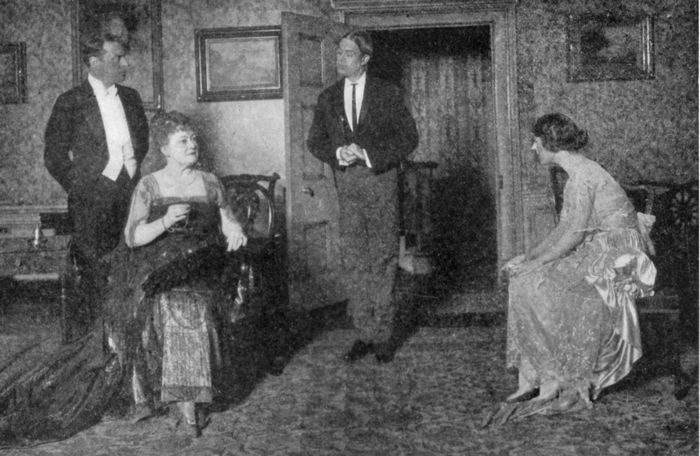
"Good night."
"Good-by."
The culprit seized his hat and rushed away through the shadows before Tucker had time to think out the dignified rebuke that he had intended.
There was a pause. He was conscious that an opportunity had slipped from him. He knew now what he ought to have said. He should have asked the young fellow—who was clearly a gentleman, far above Jane-Ellen in social position—whether that was the way he would have treated a girl in his own mother's drawing-room, and whether he considered that less chivalry was due to a working girl than to a woman of leisure.
Though his great opportunity was gone, he decided to do whatever remained. After a short hesitation he descended a flight of steps at one end of the piazza. The kitchen opened before him, large and cavernous. Two lamps hardly served to light it. It was red tiled; round its walls hung large, bright, copper saucepans, and on shelves of oak along its sides were rows of dark blue and white plates and dishes.
Tucker was prepared to find the cook in tears, in which case he had a perfectly definite idea as to what to do; but the disconcerting young woman was moving rapidly about the kitchen, humming to herself. She held a small but steaming saucepan in her hand, which was, as Tucker swiftly reflected, a much better weapon than the handle of an ice-cream freezer.
"Good evening, Jane-Ellen," he said graciously.
"Good evening, sir."
She did not even look in his direction, but bent witch-like over a cauldron.
"I wished to speak to you," he said, "about that little incident of this morning. You must not think that I am by nature cruel or indifferent to animals. On the contrary, I am a life member in the Society for Prevention of Cruelty to them. I love animals." And as if to prove his words, he put out his hand and gently pulled the ears of Willoughby, who was asleep in a chair. Cats' ears are extraordinarily sensitive, and Willoughby woke up and withdrew his head with a jerk.
Willoughby's mistress, on the other hand, made no reply whatsoever; indeed it would have been impossible to be sure she had heard.
"How different she is," thought Tucker, "in the presence of a man she really respects, and recognizes as her superior. All the levity and coquetry disappear from her bearing."
"I was truly sorry," he went on, drawing nearer and nearer to the range, "to have been the occasion—"
"You had better be careful, sir," she said, still without looking at him, "these sauces sometimes boil over." And as she spoke she put a spoon into the pan, and the next instant Tucker felt a small but burning drop fall upon his hand. He started back with an exclamation.
"I am truly sorry, sir," she said, "to have been the occasion—"
He glanced at her sharply. Was she conscious of repeating his own phrase? She seemed to be wholly absorbed in her task. He noticed how prettily the hair grew at the back of her neck, how small and well shaped were her ears. His manner became even more protecting.
"I am an older man than your employer—" he began.
"Yes, indeed, sir."
He decided not to notice the interruption.
"I am older and have seen more of life. I understand more, perhaps, of the difficulties of a young, and I must say, beautiful woman, Jane-Ellen—"
"Why must you say that, sir?" Her eyes fixed themselves on his.
"Because it is the truth, my dear child." He again approached the range, but as a fountain instantly rose from the sauce he retreated and continued: "I would like, if any little troubles in the household arise, to know that you look upon me as a friend, both you and Willoughby." (He thought it not amiss to introduce the comic note now and again.) "I have some influence with Mr. Crane. I should be glad to do you a good turn."
"You can do me one now, sir."
"Pray, tell me what it is."
"You can go away and let me get the dinner."
"You want me to go?"
"The kitchen is no place for gentlemen."
Tucker laughed tolerantly.
"Did you think so ten minutes ago?"
For the second time she looked in his direction, as she asked quickly:
"What do you mean?"
"Your last visitor was not so respectful."
She had put down the saucepan now, and so he approached and tried to take her hand.
Perhaps this is as good a time as any other to describe the sensation of taking Jane-Ellen's hand. The ordinary mortal put out an ordinary hand, and touched something, something presumably flesh and blood, but so light, so soft, so pliant, that it seemed literally to melt into the folds of his palm, so that even after the hand had been withdrawn (and in this instance it was instantly withdrawn) the feeling seemed to remain, and Tucker found himself staring at his own fingers to see if they did not still bear traces of that remarkable contact.
It was just at this moment that Brindlebury entered the kitchen and said, in a tone which no one could have considered respectful, that the motor was coming up the drive.
Tucker was more apt to meet an awkward situation—and the situation was slightly awkward—by an additional dignity of manner rather than by any ill-considered action.
"Ah," he now observed, "in that case I think I must go and meet it."
"I think I would, if I were you," replied the boy, and added to the cook, in case there was any mistake about his meaning: "It seems to me there are too many men in this kitchen in the course of the day."
"Well, goodness knows they're not here to please me," said Jane-Ellen.
Tucker, who understood that this reply had to be made, wished, nevertheless, that she had not made it with such a convincing sincerity of manner. He turned and left the kitchen, and, as he went up the piazza stairs, became aware that the boy was following him.
He stood still at the top, therefore, and asked with that hectoring tone which many people think so desirable to use with servants:
"What's this? You wish to speak to me?"
The boy hardly troubled to approximate civility as he answered:
"Yes; I just wanted to tell you that Jane-Ellen is my sister."
Tucker laughed with indulgent good humor.
"Indeed," he said. "Well, I cannot confess, Brindlebury, to taking a very deep interest in your family relations."
"It's this much interest, that I don't want you going into the kitchen to talk to her."
"Tut, tut," said Tucker. "I think I shall have to report you to your employer."
"And I may have to report you."
This was so beyond the bounds of convention that Tucker thought best to ignore it. He merely turned on his heel and walked into the house, where, in the hall, he found the two Falkener ladies taking off their coats.
Mrs. Falkener was all graciousness. She was engaged in unwinding a veil from her face, and as she freed her nose from its meshes she said briskly:
"And how is the housekeeping going? How is your staff working?"
Crane got them into the drawing-room, where tea was waiting. Mrs. Falkener spoke to him, but she cast a secret glance of question at Tucker. Under most circumstances he would have replied by raising his eyebrows, shrugging his shoulders, closing his eyes, or conveying in some manner the true reply to her demand. But now he merely looked into his teacup, which he was diligently stirring. He found himself uncertain what to do. He had no intention of mentioning the afternoon's incidents to Crane. He did not wish, he told himself, to tell on a poor young woman, and perhaps deprive her of her job. Besides, it is very difficult to tell a story in which you have been an eavesdropper, and tell it with any sort of flourish and satisfaction. The geography of the balcony was such that he would have to confess either to having leaned as far over the rail as possible, or else to having been in the kitchen. But the insolence of the boy Brindlebury put a new face on the matter. He deserved reproof, to say nothing of the fact that he might tell in a mistaken desire to protect his sister from annoyance. To tell any of this to Mrs. Falkener was to put a weapon in her hands which she would not fail to use to get Jane-Ellen out of the house within twenty-four hours. Tucker's first idea was that he did not wish Jane-Ellen to leave the house.
But, as he sat stirring his tea, another thought came to him. Why should she not leave, why should she not become his own cook? Crane, after all, only offered her employment for a few weeks, whereas he—He decided that it would be better for Crane to get rid of her; he decided, as he put it to himself, to be perfectly open with his friend. If Crane turned her out, then he, Tucker, would be there, helpful and ready, like the competent middle-aged hero of the drama, whom she herself had so well described.
He joined but little in the conversation round the tea-table, and Mrs. Falkener, watching him narrowly, feared from his gravity that something serious had happened, that the situation was worse than she had imagined. What, she wondered, had occurred in the last twenty-four hours? What had those evil women with manicured nails accomplished in her absence? She manœuvered two or three times to get a word with Tucker, but he seemed unconscious of her efforts.
When at last they all agreed it was time to dress for dinner, Tucker laid a detaining hand on his host's arm.
"Could I have just a word with you, Burt?" he said.
Crane always felt like a naughty child when his friend spoke to him like this.
"Wouldn't later do?" he asked. "I want to get a bath before dinner, and if we keep it waiting we may spoil some of those wonderful dishes that star-eyed beauty in the kitchen is preparing for us."
"It is about her I want to speak to you."
Both ladies and Crane turned instantly at these words. Then the Falkeners with a strong effort of self-control left the room, and the two men were alone.
"Well, what is it?" said Crane, rather sharply.
Tucker was now all suavity.
"I'm afraid, after all," he began, sitting down and swinging one leg over the other, "that you won't be able to keep that young person. I'm afraid Mrs. Falkener was right. Women know these things at a glance."
"What things?"
"Why, I mean that in spite of her good dinner, I'm afraid your cook, Burt, is not—Well, I'd better tell you just what is in my mind."
"Surely, if you can," said his host and client.
"I went out for a little while about dusk on the back piazza, which you know is just above the kitchen, and a conversation below is audible there. At first I did not pay much attention to the murmur of voices, but gradually I became aware that some one was making love to Jane-Ellen—"
"Who was it?" asked Crane. "That wretched boy? That smug butler?"
"Alas, no," said Tucker. "If it had been one of the other servants I should not have thought it much harm. Unhappily, it was a young gentleman, a person so much her social superior—Well, my dear fellow, you get the idea."
"No one you knew, of course?"
"I never saw him before."
"How did you see him at all?"
This was the question that Tucker had been anticipating.
"Why, to tell you the truth, Burt," he said, "when I realized what was going on, I thought it my duty for your sake to find out. I looked over the railing—and just at the psychological moment when he kissed her."
Crane was tapping a cigarette thoughtfully on the palm of his hand, and did not at once answer. When he did, he looked up with a smile, and said:
"Lucky dog, is what I say, Tuck."
"I don't think," answered his friend, "that that is quite the right attitude for you to assume."
"What do you think I should do?"
"Dismiss the girl."
Another pause.
"Or," added Tucker, magnanimously, "if you shrink from the interview, I shall be very glad to do it for you."
Crane looked up.
"No, thank you," he said. "I think you have done quite enough. I should not dream of imposing upon you further." He walked to the bell and rang it. Smithfield appeared.
"Tell the cook I want to see her," he said.
After a brief absence Smithfield returned.
"I beg pardon, sir," he said, "but the cook says if she leaves dinner now it will be spoiled, and won't after dinner do?"
Crane nodded.
"You know," said Tucker when they were again alone, "it is not always necessary to tell servants why you are dispensing with their services. You might say—"
Much to his surprise, Crane interrupted him with a laugh.
"My dear Tuck," he said, "you don't really suppose, do you, that I am going to dismiss that peerless woman just because you saw an ill-mannered fellow kiss her? I shall administer a telling rebuke with a slight sketch of my notions on female deportment. It would take more than that to induce me to send her away. Indeed, I was thinking of taking her North with me."
This was a serious suggestion, but Tucker could think of no better way to meet it than to raise his eyebrows; and Crane went off whistling to dress for dinner.
He whistled not only going upstairs, but he whistled in his bath and while he was shaving. The sound annoyed Tucker in the next room.
"It almost seems," he thought, "as if he were glad to see the woman again on any terms." And yet, he, Tucker, knew that she considered Crane quite a commonplace young man—not at all like a hero in the third act.
The way Crane had taken his suggestions was distressing. Tucker did not feel that he thoroughly understood what was in the younger man's mind. His first intention to tell Mrs. Falkener nothing began to fade. It would have been all very well if Burton had been sensible and had been willing to send the cook away and he, Tucker, had been able to engage her, to ignore the whole matter to Mrs. Falkener. Indeed, it would have been hard to explain it. But, of course, if Burton was going to be obstinate about it, Mrs. Falkener's aid might be absolutely necessary.
"After all," he thought, "candor is the best policy among friends."
He dressed quickly and was not mistaken in his belief that Mrs. Falkener would have done the same. She was waiting for him in the drawing-room. They had a clear fifteen minutes before dinner.
"Now tell me, my dear Solon," she said, "just what you think of the situation."
"I think badly of it."
"Yes," said Mrs. Falkener, not yet quite appreciating the seriousness of his tone. "I do, myself. That idiotic housemaid, Lily—I could have told him that name would never do—hooked me twice wrong, and left my daughter's dirty boots on top of her best tea-gown."
"Ah, if incompetence were all we had to complain of!"
"The cook?"
"Is perfection, as far as cooking goes. But in other respects—Really, my dear Mrs. Falkener, I am in doubt whether you should let your daughter stay in this house—at least, until Burton comes to his senses."
"You must tell me just what you mean."
Tucker decided to tell the story reluctantly.
"Why, it happened this afternoon, Burton was away with his horses, and quite by accident I came upon his pretty cook in the arms of a strange young man, a person vastly her social superior, one of the young landholders of the neighborhood, I should say. Seemed to assume the most confident right to be in Burton's kitchen—a man he may know in the hunting field, may have to dinner to-morrow. I don't know who he is, but certainly a gentleman."
"How very unpleasant," said Mrs. Falkener. "Did the woman take in that you had detected her?"
"Yes, and seemed quite unabashed."
"And now I suppose you are hesitating whether or not to tell Burton?"
Tucker was naturally cautious.
"And what would you advise?"
"It is your duty to tell him at once, and get such a person out of the house."
"You think if I told him, he would dismiss her?"
"I am confident he would, unless—"
"Unless?"
Scene from the Play Olivia hears of her father's critical illness Act II
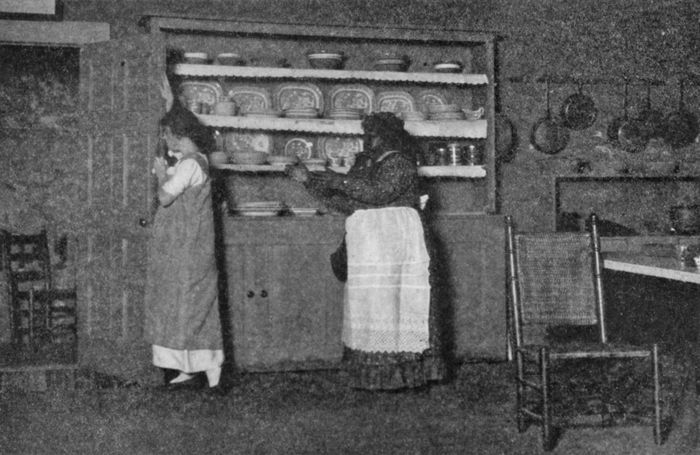
"Unless he has himself some interest in her."
"Ah," said Tucker, with a deep sigh, "that's the question."
At this moment Miss Falkener, looking very handsome in a sapphire-colored dress, came in. She, too, perhaps, had expected that somebody would be dressed a little ahead of time for the sake of a few minutes' private talk. If so, she was disappointed.
"Ah, Cora," said her mother brightly, "let us hear how the piano sounds. Give us some of that delightful Chopin you were playing last evening."
Cora, to show her independence of spirit, sat down and began to play ragtime, but neither of her auditors noticed the difference.
"You mean," whispered Mrs. Falkener, "that you have reason to suppose that Crane himself—?"
"Why, to be candid, my dear lady," replied Tucker, "I did tell him. You may have noticed I seemed a trifle abstracted at tea time. I was considering what it was best to do. Well, when you left us, I told him. What do you think he said? 'Lucky dog.' That was all. Just 'lucky dog.'"
"Meaning you?"
"No, no, meaning the fellow who had been kissing the cook."
"Dear me," said Mrs. Falkener, "how very light minded."
"It shocked me—to have him take it like that. And he would not hear of dismissing her. He intends merely to reprove her, so he says. But what reproof is possible? And the most alarming feature of the whole situation is that, to my opinion, he is looking forward to the interview."
"The woman must be sent out of the house immediately," said Mrs. Falkener with decision. "I wonder if higher wages would tempt her?"
"I see your idea," answered Tucker. "You think I ought to offer a position. I would do more than that to save Burt."
"A position as cook, you mean?"
"Why, Mrs. Falkener, what else could I mean?"
"Oh, nothing, Solon, I only thought—"
The friends were still explaining away the little misunderstanding when Crane came down, and dinner was announced.
Mrs. Falkener, with of course the heartiest wish to criticize, was forced to admit the food was perfection. The soup so clear and strong, the fried fish so dry and tender, even the cheese soufflé, for which she had waited most hopefully, turned out to be beautifully light and fluffy. Having come to curse she was obliged to bless; and her praise was delightful to Crane.
"Yes, isn't she a wonder?" he kept saying. "Wasn't it great luck to find any one like that in a place such as this? Tuck, here, keeps trying to poison my mind against her, but I wouldn't part with a cook like that even if she were a Messalina."
Mrs. Falkener, who couldn't on the instant remember who Messalina was, attempted to look as if she thought it would be better not to mention such people in the presence of her daughter.
"Tuck's an inhuman old creature, isn't he, Mrs. Falkener?" Crane went on. "I don't believe he ever had a natural impulse in his life, and so he has no sympathy with the impulses of others."
Tucker smiled quietly. It came to him that just so the iron reserve of the middle-aged hero was often misinterpreted during the first two acts by more frivolous members of the cast.
As they rose from table, Miss Falkener said:
"It's such a lovely night. Such a moon. Have you seen it, Mr. Crane?"
"Well, I saw it as we drove over from the station," returned Crane, a trifle absently. He had become thoughtful as dinner ended.
"Do you think," said Cora, "that it would be too cold to take a turn in the garden? I should like to see the old box and the cedars by moonlight."
"Not a bit. Let's go out. I have something to do first, but it won't take me ten minutes. But," he added, "you must not catch cold and get laid up, and miss the run to-morrow. I'm going to put you on a new Irish mare I've just bought." And they found themselves talking not about the garden, but the stable.
In the midst of it Smithfield came into the drawing-room with the coffee, and Crane said to him, in a low tone:
"Oh, Smithfield, tell the cook I'll see her now, in the little office across the hall."
Smithfield looked graver than usual.
"Beg pardon, sir," he said, "but the cook was feeling tired and has gone up to bed, sir."
Crane was just helping himself to sugar.
"She cooked this coffee, didn't she?" he said.
"Yes, sir."
"She can't have been gone very long then."
"About five minutes, sir."
"Go up and tell her to come down," said Crane.
He turned again to Miss Falkener and went on about the past performances of the Irish mare, but it was quite clear to all who heard him that his heart was no longer in the topic.
Smithfield's return was greeted by complete silence.
"Well?" said Crane sharply.
"Beg pardon, sir," said Smithfield, "Jane-Ellen says that she is very tired, and that if the morning will do—"
"The morning will not do," answered Crane, with a promptness unusual in him. "Go up and tell her that if she is not in my office within ten minutes, I'll come up myself."
Smithfield bowed and withdrew.
Silence again descended on the room. Mrs. Falkener and Tucker were silent because they both felt that thus their faces expressed more plainly than words could do that this was just about what they had expected. But Cora, who was young enough to understand that anger may be a form of interest, watched him with a strangely wistful expression.
After what seemed to every one an interminable delay, Smithfield entered again. He looked pale and graver than any one had ever seen his habitually grave countenance.
"Jane-Ellen is in your office now, sir," he said.
Crane rose at once and left the room followed by Smithfield.
V
JANE-ELLEN was standing in the office, with her hands folded, and an expression of the utmost calm upon her face. Crane came in quickly and would have shut the door, but for the fact that Smithfield was immediately behind him.
"Beg pardon, sir," he said firmly, sliding into the room, "but I must look to the fire."
Crane frowned.
"The fire's all right," he said shortly.
But Smithfield was not to be put off his duties, and began to poke the logs and sweep the hearth until peremptorily ordered to go.
When the door finally closed behind him, Crane stood silent a moment with his hand on the mantelpiece. The whole tone of the interview, upon which it now occurred to him he had rushed somewhat too hastily, would be decided by whether he spoke standing up or sitting down. His feelings were for the first, his intellect for the latter position.
His intellect won. He sat down in a deep chair and crossed his legs. As he did so, the cook's eyes, which had hitherto been fixed on the carpet, now raised themselves to the level of his neat pumps and black silk socks. He was aware of this, but did not allow himself to be disconcerted.
"I suppose you can guess why I sent for you, Jane-Ellen," he said.
"The dinner was not satisfactory, sir?"
"I doubt if you could cook an unsatisfactory dinner if you tried," he returned. "No, the trouble is over something that happened an hour or so before dinner."
"You did not approve, perhaps, of that gentleman, Mr. Tucker, coming into the kitchen? But, indeed, I could not help that."
"Oh," said Crane, "so Tucker was in the kitchen, was he?"
"Yes, sir, until Brindlebury told him the motor was coming with the ladies."
"No," said Crane, "the difficulty is over a former visitor of yours. I think it my right, even my duty to prevent anything happening in this house of which I disapprove, and I do not approve, Jane-Ellen, of strangers coming into my house and kissing the cook."
He looked at her squarely as he said this, but her eyes remained fixed on his feet as she replied docilely:
"Yes, sir. Perhaps it would be better for you to speak to the young man about it."
"Ah," returned her employer, as one now going over familiar ground, "you mean to imply that it was not your fault?"
She did not directly answer this question. She said:
"I suppose in your class of life a gentleman would not under any circumstances kiss a young lady against her will?"
"Well," answered Crane, with some amusement, "he certainly never ought to do so. And by the way, one of the points about this incident seems to be that the young man in question had the appearance of being a gentleman."
"He certainly considers himself so."
There was a pause, then Crane said, seriously:
"I don't want to interfere in your concerns further than I have to, or to offer you advice—"
"But I should be so glad to have you offer me advice, sir. It is one of the few things a gentleman may offer a girl in my position and she accept with a clear conscience."
For the first time Crane looked at her with suspicion. Her tone and look were demure in the extreme. He decided to go on.
"Well, then," he said, "if I were you I would not have a gentleman, especially such an impulsive one, hanging about, unless you are engaged to him with the consent of your family."
She raised her chin, without lifting her eyes.
"It's not the consent of our families that's lacking," she remarked.
"Oh, he's asked you to marry him?"
"Almost every day, sir, until to-day."
"And to-day he didn't?"
"To-day he said he wouldn't marry me, if I were the last woman in the world."
"And what did you think about that?"
"I thought it wasn't true, sir."
Crane laughed aloud at this direct answer.
"And it sounds to me as if you were right, Jane-Ellen," he said. "But, at the same time, I can't see for the life of me why, if you don't mean to marry him, you let him kiss you."
"If you please, sir, it's not always possible to prevent. You see I'm not very large."
Crane looked at her, and had to admit that the feat would be extremely easy. She hardly came to one's shoulder; almost any man—Hastily putting aside this train of thought, he said in a more judicial tone:
"You know your own affairs best. Is the young man able to support you?"
"Yes, sir, very comfortably."
"And yet you don't consider marrying him?"
"No, sir. I don't love him."
Matters had suddenly become rather serious.
"You would rather work for your living than marry a man you don't love?" Crane asked, almost in spite of himself.
For the first time the cook looked up, straight at him, as she answered:
"I think I would rather die, sir."
This time it was Crane's eyes that dropped. Fortunately, he reflected, she could not have any idea how sharply her remark had touched his own inner state. How clearly she saw that it was wrong to do just what he was contemplating doing—to marry for prudence, rather than for love. He found himself speculating on the genesis of the moral sense, how it developed in difficulties rather than in ease. That was why he could learn something on the subject from his cook. Here was a girl working for her living, working hard and long, for wages which though he had once, he remembered, told Reed they seemed excessive, now appeared to him the merest pittance; certainly it seemed as if all the hardships of such a life would be smoothed away by this suggested marriage, and yet she could assert clearly that she would rather die than make it; whereas he, with nothing very much at stake, had actually been contemplating for several months the making of just such a marriage—He was interrupted by her respectful tones:
"Will that be all, sir?"
"Yes," he answered in a voice that lacked finality. "I suppose that's all, except if that fellow comes bothering you any more, let me know, and I'll tell him what I think of him."
Jane-Ellen lifted the corner of her mouth in a terrible smile.
"Oh," she said, "I don't think he'll come bothering any more."
"You're very optimistic, Jane-Ellen."
"I beg your pardon, sir, those long words—"
"Very hopeful, I meant. He'll be back to-morrow."
"Not after what I said to him."
"Well, Jane-Ellen, if you have really found the potent thing to say under such circumstances, you're a true benefactor to your sex."
She looked at him with mild confusion.
"I'm afraid I don't rightly understand, sir."
He smiled.
"It was my way of asking you what you had said to him that you imagined would keep him from coming back."
"I told him I had only pretended to like him, all these years. People, particularly gentlemen, don't like to think you have to pretend to like them."
Crane laughed aloud, wondering if the girl had any idea how amusing she was. In the pause that followed, the sound of a deep masculine voice could be heard suddenly under their feet. The office was immediately above the servants' sitting-room, and it was but too evident that a visitor had just entered.
Crane looked at the cook questioningly, and she had the grace to color.
"Why, did you ever, sir," she said. "There he is, this very moment!"
"Shall I go down and forbid him the house?" asked Burton, and though he spoke in fun, he would have been delighted to act in earnest.
"Oh, no, sir, thank you," she answered. "I am not going back to the kitchen."
This reminded her employer of the extreme difficulty he had experienced in seeing his cook at all.
"Why did you try and get out of seeing me, Jane-Ellen?" he said. "You knew about what I had to say, I suppose?"
"I had a notion, sir."
"And were you afraid?"
At this question, the cook bent her head until a shadow fell upon it, but Crane had a clear impression that she was laughing, so clear that he said:
"And may I ask why it is a comic idea that a servant should be afraid of her employer?"
The cook now raised a mask-like face and said most respectfully:
"No, sir, I was not exactly afraid," and, having said this, without the slightest warning she burst into an unmistakable giggle.
Nobody probably enjoys finding that the idea of his inspiring terror is merely ludicrous. Crane regarded his cook with a sternness that was not entirely false. She, still struggling to regain complete gravity at the corners of her mouth, said civilly:
"Oh, I do hope you'll excuse my laughing, sir. The fact is that it was not I who tried to avoid seeing you. It was Smithfield's idea."
"Smithfield!" cried Crane.
"Yes, sir. He had the notion, I think, that you might be very severe with me, sir, and Smithfield is peculiar, he has a very sensitive nature—"
"Well, upon my word," cried Crane, springing to his feet, "that is exactly what Smithfield says about you. It seems to me I have a damned queer houseful of servants."
The cook edged to the door.
"Perhaps it seems so, sir," she said. "Will that be all for to-night?"
"Yes. No," he added hastily, "I have one more thing to say to you, Jane-Ellen, and it's this. Don't make the mistake of fancying that I have taken this whole incident lightly. I don't. It really must not happen again. Understand that clearly."
"You mean if that gentleman came back, you would dismiss me, sir?"
"I think I would," he answered.
"Even if it weren't my fault?"
"Was the fault entirely his, Jane-Ellen?"
"Ask him, sir."
"You know much more about it than he does. Was the fault entirely his?"
The cook wriggled her shoulders, crumpled her apron and seemed unwilling to answer a direct question directly. At last an idea occurred to her. She looked up brightly.
"It was the ice-cream, sir," she said. "I was trying to teach him how to freeze ice-cream slowly. It ought to be done like this." And bending over an imaginary freezer, she imitated with her absurdly small hand the suave, gentle, rotary motion essential to the great American luxury.
As he stood looking down on her, it seemed to Crane extraordinarily clear how it had all happened, so clear indeed that for a second it almost seemed as if he himself were in the place of the culprit whose conduct he had just been condemning.
He stepped back hastily.
"No, Jane-Ellen," he said, "it was not all his fault. Of that you have convinced me."
She stretched out her hand to the door.
"Will that be all, sir? The cook, you know, has to get up so very early in the morning."
He tried to counteract the feeling of pity and shame that swept over him at the realization that this young and delicate creature had to get up at dawn to work for him and his guests. The effort made his tone rather severe as he said:
"Yes, that's all. Goodnight."
"Good night, sir," she answered, with her unruffled sweetness, and was gone.
He stood still a moment, conscious of an unusual alertness both of mind and emotion. And that very alertness made him aware that at that moment there was a man in his kitchen against whom he felt the keenest personal animosity. Crane would have dearly liked to go down and turn him out, but he resisted the impulse, which somehow savored of Tucker in his mind. And what, by the way, had Tucker been doing in the kitchen? And Smithfield, why had Smithfield tried to interfere with his seeing the cook? He found plenty of food for reflection.
Among other things he had to consider his return to the drawing-room. Looking at his watch he observed that a longer time had elapsed since he left it than he had supposed. There would be comments, there would be attempted jokes from Tucker. Well, that would be easily met by a question as to Tucker's own interest in the culinary art. Mrs. Falkener's methods of attack were not subtle, either. But Cora—he wished Cora would not just look at him as if he had done something cruel.
But, as is so often the way when we prepare ourselves for one situation, quite another one turns up. The three were not sitting, awaiting his return. The drawing-room was empty except for Mrs. Falkener, who was reading when he entered, and instead of betraying a conviction that he had been too long away, she looked up and said chattily:
"Well, did you reduce the young woman to order?"
"That is a good deal to expect from an unaided male, isn't it?" said Burton, very much relieved.
"Ah, it depends on the male, my dear Burton. You, I imagine, could be very terrifying if you wished to be. What did the young woman do? Weep, protest, declare that it had all taken place quite without her consent?"
Burton smiled. He had no intention whatsoever of sharing his recent experiences with Mrs. Falkener.
"Ah," he said, "I see you know your own sex thoroughly. Where are Tuck and your daughter?"
"Solon is taking a turn on the piazza; he hopes it will make him sleep better; and Cora was tired and has gone to bed." Mrs. Falkener sighed. "Cora doesn't seem very well to me."
"I'm sorry to hear that," returned Crane. "I thought she was looking very fit this evening." He spoke more lightly than he felt, however, for something portentous in Mrs. Falkener's tone struck him with alarm.
"Sit down, Burton," said she, sweeping her hand toward a cushioned stool at her side. "I want to say something to you."
Crane found himself obeying, with his hands between his knees, and his toes turned in, like a school boy who has forgotten his lesson; then, becoming aware of this pose, he suddenly changed it—crossed one leg over the other, as he had done in the office a few minutes before.
In the meantime, Mrs. Falkener was saying:
"The truth is, I'm afraid that we must cut our visit short, delightful as it promises to be."
"Oh, Mrs. Falkener, we're not making you comfortable. What is it?"
"No, Burton, no." Mrs. Falkener held up her hand. "You are making us perfectly comfortable—at least, in all essentials. And who minds roughing it now and then for a week or so? It's good for us," she added playfully. "The housemaid is not—but no matter."
"What has the housemaid done?" asked Crane with what semblance of interest he could summon, but as he spoke his heart went out in sympathy to every hotel and boarding-house keeper in the world. "Good heavens," he thought, "suppose my living depended on my pleasing them, what a state I should be in!" Aloud he said: "What has Lily been doing?"
"Nothing, nothing. Lily means well, I'm sure, in spite of her lackadaisical ways. It is quite a privilege, I assure you, to be waited on by such an elegant young lady. She hooked me up wrong twice this evening, and when I not unnaturally objected, she stuck a pin in me. Oh, by accident, I'm sure. No, I have no fault to find with Lily, whatsoever."
"I'm glad to hear that," said Crane, punctuating his sentence to allow himself to indulge in a half-suppressed yawn. "Who is it, then? Not Smithfield? Or the boy?"
"Oh, I should never have anything to do with that boy," said Mrs. Falkener, bridling. "Oh, never in the world. I think he's half-witted. I saw him stick out his tongue at Solon this evening."
Crane laughed, though he knew he ought not to.
"Did Solon see?"
"No. The boy contrived it so that Solon had just looked away."
"Well, then, perhaps he's not half-witted, after all," said Burton. "It occurs to me that perhaps that is the only reply to a good deal that Solon says."
"I'm devoted to Solon," replied Mrs. Falkener, drawing herself up, "and I must say you ought to—"
"I am, I am," said Crane, hastily, "but I am at the same time able to understand why Brindlebury possibly isn't. But come, Mrs. Falkener, if it isn't these servants that are driving you away, what is it?"
"I don't know how to explain it," said Mrs. Falkener. "It's not really clear to me, myself. I'm sure I don't want to be unkind, or to hurt any one's feelings, least of all yours, my dear Burt." And she leaned over and laid her hand on his. Crane gave it a good brisk squeeze and returned it to her lap as if it were too dear for his possessing; and she went on: "I own I am anxious about Cora. She is very deep, very reserved; she tells me nothing, but she is not happy, Burton."
"I'm sorry for that," said Crane, in a very matter-of-fact tone. He got up and went to a table where the cigarettes were. The profound male instinct of self-preservation was now thoroughly awake, and he knew exactly what he was in for. Only, he noted, that if he had had this interview with Mrs. Falkener before he had seen the cook, he might quite easily have been persuaded that, in the absence of any more definite vocation, he had been created to make Cora Falkener's life tolerable to her. As it was, he saw perfectly that altruism was no sound basis for matrimony.
"You don't understand what it is to be a mother, Burt."
Crane admitted with a shake of his head that he didn't.
"But I have an instinct that this is not the best place for Cora."
"Well, if you were a man, Mrs. Falkener," said Crane, "I should say that that instinct was the result of being poorly valeted. It must be a bore for women to have a wretched maid like Lily. Don't you think that if I found some one a little more competent that you and Cora would feel you could put in at least a week or so with us? The hunting is really going to be good, and Cora does enjoy hunting."
Mrs. Falkener refused to lighten the tone of the conversation. She shook her head.
"No," she said, "no. I'm afraid even a good maid would not help. In fact, to speak plainly, my dear Burton—"
But at this moment the door opened and Tucker came in. His hair was somewhat rumpled by the wind, his hands were still in his pockets as he had had them during his constitutional on the front porch, and his eyes, contracted by the sudden light, looked almost white.
"Well," he said, "are you enjoying this musical party downstairs?"
All three listened in silence, and could hear the strains of "Home, Sweet Home" coming from below.
"They have a phonograph and they are singing in parts," said Tucker, as if this somehow made it worse.
"If we got Miss Falkener down, we might do something ourselves," said Crane, but there was nothing frivolous in his manner when he rang and told Smithfield there was too much noise downstairs.
Smithfield begged pardon and had not a notion it could be heard upstairs. Crane said the boy's, Brindlebury's, tenor carried some distance, and, Mrs. Falkener and Tucker having gone, he added that the house could be shut for the night.
Then he went to the table, and his eye fell again upon the miniature in the pearl frame. He took it up. There was no doubt about it, there was an extraordinary likeness to Jane-Ellen. He smiled to himself. How very charming she would look, he thought, in a mauve ball dress.
Raising his eyes, he found Smithfield looking at him with an expression he did not thoroughly like.
VI
ON the stroke of seven o'clock the next morning, Burton came downstairs with that exactness which even the most careless man can display in regard to his favorite sport. The rigors of the cub-hunting season being over, the meet did not take place until eight.
Cora was not yet ready for breakfast, and Crane went to fill his cigarette case before starting.
The drawing-room was still dark and in disorder. Crane lit a match to find his way to the table where the tobacco was kept. It was the same table on which had lain the miniature of the lady in the mauve ball dress; and as he held up his lighted match, his eyes sought once more that enchanting pearl circle. The flame died down and burned his fingers before his eyes had encountered what they were looking for. He lit a second match, and then a candle, before he could assure himself that the miniature was really gone.
He sprang into the hall and called: "Smithfield!" with a violence that had little respect for late sleepers.