COME OUT OF THE KITCHEN! (continued 2)
Reading edition
Smithfield came hurrying out of the dining-room.
"Where's the miniature that used to be on this table?"
"The what is it, sir?"
"The miniature, a picture in a pearl frame."
Smithfield looked thoughtful.
"And what was it a picture of, sir?"
"Of a lady."
"In a black lace cap, and she with white hair, sir?"
"No," said Crane, "she was young and lovely, in a ball dress and a wreath. You must remember it. It was here yesterday."
Smithfield shook his head blankly.
"No, sir," he said, "I can't rightly say that I remember it, but I'll inquire for it."
Crane swore with an uncontrollable irritation—irritation at Smithfield for being so stupid, irritation that he himself had been so careless as to leave the picture about among a houseful of unknown servants.
He was not distracted even by the sight of Cora coming downstairs, looking very workmanlike in her habit with her hat well down over her brows, and her boots, over which Brindlebury had evidently expended himself, showing off her slender feet.
They breakfasted alone; but Burton's mind ran on the loss of the miniature, and he did not really recover his temper until he had mounted Cora, found all the straps of her skirt, adjusted her stirrup, loosened the curb for her, and finally swung himself up on his own hunter, a big ugly chestnut.
The meet was near-by and they were going to jog quietly over to it. They took a short cut across the lawn, and at the sight of the turf, at the smell of the fresh clear morning, the horses began to dance as spontaneously as children will at the sound of a street organ. Crane and Cora glanced at each other and laughed at this exhibition of high spirits on the part of their darlings.
No horseman is proof against the pleasure of seeing one of his treasured animals well shown by its rider; and the Irish mare had never looked as well as she now did under Cora's skilful management. He told her so, praising her hands, her appearance, her understanding of the horse's mind; and she, very fittingly, replied with flattery of the mare and of Crane's own remarkable powers of selection.
They were getting on so well that Burton found himself saying earnestly:
"You really must stay on as long as I do, Cora. Don't let your mother take you away, as she wants to."
The girl's surprise actually checked the mare in her stride.
"My mother is thinking of going away?" she cried.
Well, of course, he wanted her to stay, wanted her, even, to want to stay, but somehow he did not want her to be so much terrified at the thought of departure, did not want her black eyes to open upon him with such manifest horror at the bare idea of departure.
He suggested sending the horses along a little, and they cantered side by side on the grass at the roadside. Crane kept casting the glances of a lover, not at Cora, but at the black mare, as she arched her neck to a light touch on the curb, so that the sunlight ran in iridescent colors along her crest.
Presently they saw two horsemen ahead of them, one of them in that weather-stained pink that, to hunting eyes, makes the most beautiful piece of color imaginable against the autumn fields.
"That's Eliot, the Master," cried Crane. "The hounds must be just ahead. He's a nice old fellow; let's join him. I can't make out who the other one is—no one who was out the last time we hunted."
The canter had given Cora a color. She looked straight before her for a moment, and then she said:
"I think I recognize that other man."
"Who is it?"
"Some one I should like you to know, Burt. His name is Lefferts."
The lane was now too narrow for four to ride abreast. Crane drew Eliot to his side. He wanted to ask him about the Crosslett-Billingtons, for since the disappearance of the miniature, he had made up his mind to investigate the references of his staff. But strange to say, Eliot had never heard of the Billingtons, of their collection of tapestry, or their villa at Capri. He wished to talk of the Revellys.
"A great loss they are to the county, Crane, though, of course, we gain you. I wonder where they are. Gone North, I heard, though I thought I saw one of the boys out the morning of the day you came. The Revellys will hunt anything, from a plow-horse to a thoroughbred. Hard up, you know. Glad they consented to rent their house. Didn't suppose they ever would. Too proud, you know. They have things in it of immense value. Portrait of the grandfather, Marshall Revelly. Second in command to Stonewall Jackson at one time. I'd like to have you know them. Paul, the elder brother, is a man of some ability; may make his mark. And the younger daughter, Miss Claudia Revelly—" Do what he would, Eliot's voice changed slightly in pronouncing the name. "—Miss Claudia is one of our great beauties, the recipient of a great deal of attention. Why, sir, last summer, when Daniel W. Williams, the Governor-elect of this State, saw Miss Claudia at—"
But the story, in which, to be candid, Crane did not take a great deal of interest, was interrupted by Cora who pushed her mare forward in order to attract Crane's attention and to introduce him to her companion.
The young man was extraordinarily good-looking. His eyes were a strange greenish-brown color, like the water in the dock of a city ferry; his skin was ivory in hue and as smooth as a woman's, but his hands and a certain decisiveness of gesture were virile in the extreme.
"We ought to have a good run," said Crane, in order to say something.
"If any run can be good," answered the young man.
"You don't like hunting?"
"I hate anything to do with horses," answered Lefferts, plaintively. "You must admit they are particularly unintelligent animals. If they weren't, of course they wouldn't let us bully them and ride them about, when they could do anything they wanted with us. No, I only do it because she," he nodded toward Miss Falkener, "makes me."
Cora, looking very handsome, laughed.
"He's a poet," she said.
"Is that why he has to hunt?" asked Crane, and he wondered if poetry had anything to do with the excellence of the young man's coat and boots.
"Yes, poets have to be athletic nowadays. It's the fashion, and a very good one, too."
"There are other forms of athletics I don't hate nearly as much," Lefferts went on to Crane, "swimming, for instance, and sailing, and even walking isn't so bad. It doesn't need so much preparation, and getting up early in the morning, and all that sort of thing."
"Fortunately, I know what's best for him," said Cora.
"She makes me think she does," said the poet, still plaintively.
Crane wanted to ask Cora where and how she had acquired this rather agreeable responsibility, but he had no opportunity before they were off.
He and Cora started together, less, perhaps, from chivalry on Burton's part than because of his desire to watch the performance of the mare, but in the course of the run they became separated, and he finally jogged home alone.
He dismounted in the stable-yard and stood watching one of the grooms loosening the saddle-girths, while he and the head man discussed the excellent conduct of his own horses as compared with the really pitiable showing of other people's, and debated whether the wretched deterioration in a certain Canadian bay horse ridden that day by the Master of Hounds was owing to naturally poor conformation on the part of the horse, or deplorable lack of judgment on the part of the rider.
In the midst of these absorbing topics, Crane suddenly became aware that Smithfield was waiting for him at the gateway. He stopped short in what he was saying.
"You wanted to speak to me, Smithfield?"
"When you've finished, sir."
Crane had finished, he said, and turned in the direction of the house with the butler at his side.
"There's been a terrible disturbance at the house, sir, since you went out this morning."
"Oh, my powers!" cried Burton. "What has been happening now?"
Smithfield was stepping along, throwing out his feet and resting on the ball of his foot with the walk that Mrs. Falkener had so much admired.
"Well, sir," he said, "the trouble has been between Mr. Tucker and Brindlebury."
Crane groaned.
"I don't defend the boy, sir. I fear he forgot his place."
"Look here, Smithfield," said Crane, "candidly, now, what is the matter with all of you? You know you really are a very queer lot."
Thus appealed to, Smithfield considered.
"Well, sir," he said, "I think the trouble—as much as any one thing is the trouble—is that we're young, and servants oughtn't to be young. They should be strong, healthy, hard working, but not young; for youth means impulses, hopes of improvement, love of enjoyment, all qualities servants must not have." The man spoke entirely without bitterness, and Crane turning to him said suddenly:
"Smithfield, what do you think about class distinctions?"
For the first time, Smithfield smiled.
"I think, sir," he said, "that if they were done away with, I should lose my job."
"Well, by heaven, if I were you, then," cried Crane, with unusual feeling, "I'd get a job that wasn't dependent on a lie, for if I believe anything it is that all these dissimilarities between rich and poor, and men and women, and black and white, are pretty trivial as compared with their similarities. It's my opinion we are all very much alike, Smithfield," and Crane, as he spoke, was astonished at the passion for democracy that stirred within him.
"That, sir," replied Smithfield, "if you forgive my saying it, is the attitude toward democracy of some one who has always been at the top. There must be distinctions, mustn't there, sir, and you would probably say that the ideal distinction was along the line of merit—that every one should have the place in the world that he deserves. But, dear me, sir, that would be very cruel. So many of us would then be face to face with our own inferiority. Now, as things are, I can think that it's only outside conditions that are keeping me down, and that I should make as good or even better a master, begging your pardon, than you, sir. But under a true democracy, if I were still in an inferior position, I should have to admit I belonged there, which I don't admit at all now, not at all."
"But how about my not admitting that I'm a master?" said Crane.
"In one sense, perhaps you are not, sir," answered Smithfield. "For, after all, some training is necessary to be a servant, particularly a butler, but for the exercise of the functions of the higher classes, no training at all seems to be required. Curious, isn't it, sir? Utterly unskilled labor is found only among the very rich and the very poor."
The conversation had brought them to the house, without the case of Brindlebury having been further discussed. Suddenly realizing this, Crane stopped at the foot of the steps.
"Now, what is it that's happened?" he asked.
Smithfield showed some embarrassment.
"I'm afraid, sir," he said, "that some rather hot words passed. In fact—I do so much regret it, sir, but I fear Brindlebury actually raised his hand against Mr. Tucker."
It was a triumph of self-control that not a muscle of Burton's face quivered at this intelligence.
"If that is true," he said, "the boy will have to go, of course."
"I had hoped you might wish to hear both sides, sir."
"No," answered Crane. "I might hear what Brindlebury had to say, or I might understand without hearing, or I might know that I should have done the same in his place, or, even, going a step farther, I might think him right to have done it, but the fact remains that I can't keep a servant who strikes a guest of mine. That's a class distinction, Smithfield, but there it is."
Smithfield bowed.
"If I might suggest, sir, perhaps you do not understand rightly how Mr. Tucker—"
"Nothing like that, Smithfield. Tell the boy to go, go this afternoon. Pay him what's right and get him out." He ran up the steps, but turned half-way and added with a smile: "And you know there really isn't anything you could tell me about Mr. Tucker that I haven't known a great deal longer than any of you have."
He went in. Tucker and Mrs. Falkener were sitting side by side in the drawing-room, with that unmistakable air of people who expect, and have a right to expect, that they should be given an opportunity to tell their troubles. The only revenge that Crane permitted himself, if indeed revenge can be used to describe so mild a punishment, was that he continued to ignore their perfectly obvious grumpiness.
"Well," he said, "you look cozy. Hope you've had as good a day as we have."
Tucker opened his mouth to say "We have not," but Crane was already in full description of the run, undaunted by the fact that neither of his listeners, if they were indeed listeners, could be induced to manifest enough interest in his story to meet his eye.
"I'm glad some one has enjoyed the day," said Tucker, as Crane paused to light a cigarette. He laid an unmistakable emphasis on the words "some one."
Crane patted him on the shoulder.
"Thanks, Tuck," he said; "I believe that's true. I believe you are glad. Yes, we had a good day—three foxes, and your daughter, Mrs. Falkener, went like a bird. She's a wonderful horsewoman—not only looks well herself, but makes the horse look well, too."
At this Mrs. Falkener's manner grew distinctly more cheerful, and she asked:
"And, by the way, where is Cora?"
Tucker, annoyed at the desertion on the part of his ally, pressed his hand over his eyes and sighed audibly, but no one noticed him.
"I took a wrong turn in search of a short cut and lost the rest of them," said Crane. "But she'll be back directly. She's perfectly safe. She was with Eliot, our neighbor, and a fellow named Lefferts, whom she seemed to know."
"Lefferts!" cried Mrs. Falkener. "That man here! O Burton, how could you leave my daughter in such company? O Solon, you remember I told you about that man!"
Tucker nodded shortly. He wasn't going to take any interest in any one's grievances until his own had been disposed of.
"What's the matter with Lefferts?" said Crane. "He's staying with Eliot, and they asked us all over to lunch to-morrow. Shan't we go?"
"No, nowhere that that young man is," cried Mrs. Falkener, who seemed to be a good deal excited by the news. "He's an idler, a waster. Why, Burton," she ended in a magnificent climax, "he's a poet!"
"So Cora told me."
"He affects to be devoted to Cora," her mother went on bitterly, "and follows her about everywhere, without the slightest encouragement on her part, I can assure you, but I have known him to take a most insolent tone about her. The very first time I ever saw him, he was sitting beside me at a party, and I said, as Cora came across the room with that magnificent walk of hers, 'She moves like a full-rigged ship, doesn't she?' He answered: 'Or rather, more like a submarine; you never know where she'll pop up next. Yes, there's a sort of practical mystery about Cora very suitable to modern warfare.' He called her Cora behind her back, but not to her face, be sure. And very soon a poem of his appeared in one of the magazines—'To My Love, Comparing Her to a Submarine.' I thought it most insulting."
"And what did Cora think?" asked Crane.
"She hardly read the thing through. Cora is far too sensible to pay much attention to poetry."
"But poets are different, I suppose," answered Crane. Personally, he was pleased with the submarine simile.
"No, nor poets, either," said Mrs. Falkener tartly, and rising she hurried away to see if by some fortunate chance her errant daughter had returned without letting her know.
Left alone, Crane decided to give his friend his long-desired chance.
"Well, Tuck," he said, "you look in fine form. What have you been doing since I went away?"
"I have not had a very agreeable day," said Tucker, in a voice so low and deep that it was almost a growl.
"No? Not a return of your old dyspepsia, I hope," said Crane.
Tucker shook his head impatiently.
"At breakfast," he said, "I heard from Mrs. Falkener, who had heard from her daughter, that you had observed the loss of the miniature that used to lie on this table. Such things cannot be taken lightly, Burton. The owners might put almost any price on an article of that kind—wretched as it was, as a work of art—and you would be forced to pay. You see, it could not be replaced. I thought it my duty, therefore, to send for each of the servants and question them on the subject."
"You thought it your duty to send for Jane-Ellen, Tuck?"
Again Tucker frowned.
"I said I sent for all of the servants. Smithfield displayed, to my mind, a most suspicious ignorance and indifference to the whole subject. The housemaid was so hysterical and frightened that if I did not know a great deal of such cases, I should suspect her—"
"And was the cook frightened?" said Crane, with a flicker of a smile.
"No," Tucker explained, "she did not appear to be frightened, but then, I may tell you that I do not suspect the cook of complicity in the theft."
"The deuce you don't!" said Crane. He found himself suddenly annoyed without reason, that Tucker should have been interviewing and questioning his servants during his absence; stirring up trouble, he said to himself, and perhaps hurting the feelings of a perfectly good cook. Suppose she had decided to leave as a result of these activities of Solon's! He found he had not been listening to the account his friend was giving of the conversation, until he heard him say:
"It seems Jane-Ellen had never been in this room before; she was very much interested in everything. I saw her looking at that splendid portrait of General Revelly, and she asked—in fact, she made me give her quite a little account of his life—"
"A little lecture on the Civil War, eh?" said Crane.
His tone was not wholly friendly and Tucker did not find it so. He colored.
"Really, Burton," he said, coldly, "in case of crime, or of theft, a man's lawyer is usually supposed to know what it is best to do."
"Possibly, but I see no point in having dragged the cook into it."
"I see even less point in treating her on a different plane from any of the other servants."
"It almost seems, Tuck, as if you enjoyed your constant interviews with her."
"That is just, I regret to say, Burton, what I was thinking about you."
"It seems to me," said Crane, "that this discussion is not leading anywhere, and might as well end."
"One moment," exclaimed the other, "my story is not finished. When it came to be the turn of that boy Brindlebury, in whom I may as well tell you I have no confidence whatever, his manner was so insolent, his refusal to answer my questions so suspicious—Well, to make a long story short, your boot-boy, Burton, attempted to knock me down, and I had, of course, to put him out of the room. The situation is perfectly simple. I must ask you either to dismiss him, or to order the motor to take me to the train."
There was a short pause, during which Crane very deliberately lit a cigarette. Then he said in a level tone:
"The boy is already dismissed. He is out of the house at this moment, probably. As to the other alternative—the ordering the motor—I will, of course, do that, too, if you insist."
But Tucker did not insist.
"On the contrary," he said, "you have done all I could desire—more, indeed, for you have evidently decided against the boy before you even heard my side of the case."
"One cannot always decide these cases with regard for eternal justice," said Crane.
Before Tucker could inquire just what was meant by this rather disagreeable pronouncement, Smithfield appeared in the doorway to say that Jane-Ellen would be glad if she might speak to Mr. Crane for a moment.
This was what Crane had dreaded; she was going to leave. His anger against Tucker flared up again, but he said, with apparent calmness, that Jane-Ellen might come in. Tucker should see for himself the effect of his meddling. Tucker suggested in a sort of half-hearted way that he would go away, but his host told him, shortly, to remain.
Jane-Ellen entered. There was no doubt but that she was displeased with the presence of a third party. She made a little bob of a curtsy and started for the door.
"I'll come back when you're alone, sir."
"No," said Crane. "Anything you have to say can be said before Mr. Tucker."
"Oh, of course, sir." But her tone lacked conviction. "I wanted to speak about Brindlebury. He is very sorry for what happened, sir. I wish you could see your way—"
"I can't," said Crane.
Jane-Ellen glanced at Tucker under her eye-lashes.
"I know, sir," she went on, "that there could be no excuse for the way he has acted, but if any excuse was possible, it did seem—" She hesitated.
"You wish to say," interrupted Burton who now felt he did not care what he said to any one, "that Mr. Tucker was extremely provoking. I have no doubt, but that has nothing to do with it."
"Really, Burton," observed his guest, "I don't think that that is the way to speak of me, particularly," he added firmly, "to a servant."
"It's sometimes a good idea to speak the truth, even to servants, Solon," returned Crane. "You are provoking, and no one knows it better than I have known it during the past fifteen minutes. But your powers of being provoking have nothing to do with the matter, except theoretically. The boy has got to go. I want him to be out of the house within an hour. That's all there is to the whole question, Jane-Ellen."
"But, oh, sir, if he is sorry—"
"I doubt very much if he is sorry."
"Oh, why, sir?"
"Because I feel sure that in his place I shouldn't be sorry in the least, except for having failed—if he did fail."
"I know it's a great liberty, sir, but I do wish you could give him another chance." Her look was extraordinarily appealing.
"What in the world is Brindlebury to you, Jane-Ellen?"
"Didn't Mr. Tucker tell you, sir? He's my brother."
"No, he didn't tell me. Did you know he was Jane-Ellen's brother, Solon?"
"Brin told him, himself, sir." She was a little overeager.
Tucker frowned.
"Yes, I believe the boy did say something to that effect. I own I was not much interested in the fact, and I can't say I think it has any bearing on the present situation."
Crane was silent for an instant. Then he said:
"No, it hasn't. He's got to go," and then he added, quite clearly, and looking at his cook very directly:
"But I am sorry, Jane-Ellen, not to be able to do anything that you ask me to do."
She looked back at him for an instant, with a sort of imperishable sweetness, and then went sadly out of the room.
Between Crane and his legal adviser no further words were exchanged.
Crane went and took out one of the motors and rushed at a high rate of speed over the country, frightening one or two sedate black mules, the only other travelers on the roads, and soothing his own irritation by the rapidity of the motion.
More and more he regretted not having been able to grant the favor Jane-Ellen had so engagingly asked, more and more he felt inclined to believe that in Brindlebury's place he would have done the same thing, more and more did he feel disposed to fasten upon Tucker all the disagreeableness of the situation.
VII
HE did not get back until almost dinner time. The meal was not an agreeable one, though Jane-Ellen's part of the performance was no less perfectly achieved than usual. It was evident that there had been a scene between the two ladies. Cora's eyes were distinctly red, and though Mrs. Falkener's bore no such evidence, she looked more haggard than was her wont. Tucker was still feeling somewhat imposed upon, Smithfield's manner suggested a dignified rebuke, Crane felt no inclination to lighten the general tone, and altogether the occasion was dreary in the extreme.
As soon as they had had coffee, Cora sat down at the piano, and drawing Burton to her by a request for more light, she whispered:
"Won't you take me out in the garden? I have something I must say to you."
Crane acquiesced. It was a splendid, misty November night. The moonlight was of that sea-green color which, so often represented on the stage, is seldom seen in nature. The moon concealed the bareness of the garden-beds, lent a suggestion of mystery to the thickets of what had once been flowering shrubs, and made the columns of the piazza, which in the daytime showed themselves most plainly to be but ill-painted wood, appear almost like the marble portico of an Ionic temple.
The air was so still that from the stables, almost a quarter of a mile away, they could hear the sound of one of the horses kicking in its stall, and the tune that a groom was rather unskilfully deducing from a concertina.
Crane whistled the air softly as he strolled along by his companion's side, until she stopped and said with great intensity:
"I want to say something to you, Burton. I'm not happy. I'm horribly distressed. I ought not to say what I'm going to say, at least the general idea seems to be that girls shouldn't—but I have a feeling that you're really my friend, a friend to whom I can speak frankly even about things that concern me."
"You make no mistake there, Cora," he returned.
He was what is considered a brave man, with calm nerves and quick judgment; physical danger had a certain stimulating effect upon him; morally, too, he did not lack courage; though good-naturedly inclined to have everything as pleasant as possible, he was not in the least afraid to make himself disagreeable. But now, at the thought of what Miss Falkener was going to say to him, he was frankly and unmistakably terrified. Why, he asked himself? Young and timid girls could go through such scenes and, it was said, actually enjoy them. Why should he be unreasoningly terrified—terrified with the same instinctive desire to run away that some people feel when they see snakes or spiders? Why should he feel as if prison walls were closing about him?
"Two years ago, when you and I first began to see each other," Miss Falkener went on, in a voice that she kept dropping lower and lower in order to conceal its tremors, "I liked you at once, Burton. I liked you very much. But, aside from that—you know, I'm not always very happy with my mother, aside from liking you, I made up my mind in the most cold-blooded, mercenary way, that the best thing I could do was to marry you."
"Well, I call that a thoroughly kind thought," said Crane, smiling at her, as a martyr might make a little joke about the lions.
"It wasn't kind," said Cora. "It was just selfish. I supposed I would be able to make you happy, but really, I thought very little about you in the matter. I was thinking only of myself. But I've been well repaid for it—" She stopped, almost with a sob; and while she was silently struggling for sufficient self-control to continue, Crane became aware that the front door had opened, letting a sudden shaft of yellow light fall upon them through the green moonshine, and that Tucker had come out on the piazza. He was looking about; he was looking for them. Not a sound did Burton make, but if concentration of thought has any unseen power, he drew Tucker's gaze to them.
"Burton," said Tucker.
There was no answer.
"Burton!" he called again.
Miss Falkener raised her head.
"Some one called you," she said.
Then Crane's figure became less rigid, and he moved a step forward. He was saved for the time, at least.
"Want me, Tuck?" he said.
Solon came down the steps carefully. He had reached an age when the eye does not quickly adjust itself to changes of light.
"Yes," he said, "I do want to see you. I want to ask you one question. Did you or did you not assure me the boy Brindlebury had left the house?"
"I did so assure you," answered Crane, "and I had been so foolish as to hope we had heard the last of him. Smithfield told me before dinner that he left early in the afternoon."
"Smithfield lied to you. The boy is in bed in his own room at this moment."
"How do you know?"
"Go and see for yourself."
Crane was just angry enough at every one to welcome any action. Only a few seconds elapsed before he was in the servants' wing of the house. All the doors were standing open, disclosing black darkness, except one which was closed, and under this a bright streak was visible.
Crane flung himself upon this, thinking it would be locked, but evidently Brindlebury had not thought any such precaution necessary. The door at once yielded, and Crane entered.
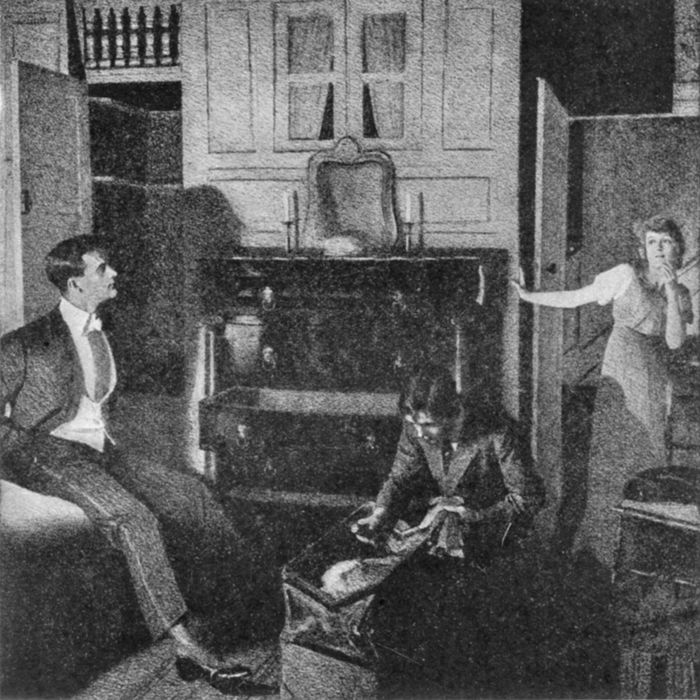
Brindlebury, fully dressed, was lying flat on his back on the bed, with his legs crossed in the air; a cigarette was in his mouth (one of Burton's cigarettes), a reading-lamp was at his elbow, and he was engaged in the perusal of a new novel which Crane had received the day before, and had strangely missed ever since. On the floor near-by was a tray, empty indeed, but bearing unmistakable signs of having been well filled only recently.
Crane took the cigarette from Brindlebury's mouth, and the book from his hand.
"Now," he said, "I'll give you five minutes to get your things together and get out." There were no signs that packing had ever been contemplated; all Brindlebury's belongings were undisturbed.
The boy looked at Crane. He would like to have answered, but he could not think of anything to say, so he got up slowly and tried to smooth his hair which was very much rumpled.
"I'm not positive I have such a thing as a bag," he observed at length, but a little search revealed one in the closet. It was marked "B. Revelly."
"A token of respect from your late employer, I suppose," said Crane.
The boy did not answer. He was rather sulkily putting on his clothes. He was not a neat packer. A tooth-brush and some pipe tobacco, a wet sponge and some clean shirts, boots and pajamas were indiscriminately mixed.
The five minutes, unmarked by any conversation, had almost elapsed when light steps were heard in the hallway, and a voice exclaimed:
"Did you have a good dinner, honey?" and Jane-Ellen came spinning into the room, all the demureness gone from her manner.
At the sight of her employer, she stopped, and her hand went up to her mouth with a gesture expressive of the utmost horror. Brindlebury did not stop packing. He was now filling in the corners with shaving soap and socks.
His sister turned to Crane.
"Oh, sir," she wailed, "we've acted very wrongly."
"Jane-Ellen," replied Crane, "that really doesn't go. It was a good manner, and you worked it well, but it is now, if you will forgive my saying so, old stuff. I cannot look upon you as a foolishly fond sister, trying to protect an erring brother. I think it far more likely that you are the organizer of this efficient little plan to keep him here unobserved, eating my food, reading my books, and smoking, if I am not greatly mistaken, my cigarettes."
"Oh, Brin, do you take Mr. Crane's cigarettes?" said Jane-Ellen.
"Not unless I'm out of my own," said her brother.
"Without clearing his own honesty, he impugns my taste," said Crane.
It was plain that Jane-Ellen was going to make another effort to improve the situation. She was thinking hard. At last she began:
At the sight of Crane, Jane-Ellen stopped with a gesture of the utmost horror
"I don't defend what we've done, sir, but if you would have let me see you alone this afternoon, I was going to ask that Brindlebury might stay just for this one night. Only I couldn't speak before Mr. Tucker, I'm so afraid of him."
"There you go again," said Burton. "You're not telling the truth. You're not in the least afraid of Tucker."
"Well, not as much as I am of you, sir."
"Jane-Ellen," said Crane, "I believe you are a very naughty girl." He was surprised to find that every trace of ill temper had left him.
"I know what you mean, sir," said the cook, and this time her voice had a certain commonplace tone. "And it's true. I haven't always been perfectly honest with you, but a servant can't be candid and open, sir; you know, yourself, it wouldn't do."
"I'd like to see it tried," returned Crane.
"Well, I'm honest now, sir," she went on, "in asking you to let Brin stay. He'll apologize, I'm sure—"
"I will not," said the boy, still packing.
But his sister hardly noticed the interruption.
"He will do what I tell him when he comes to think it over, if you will only relent. Don't you think you are just a little hard on him? He is my brother, and it would make me so happy if you would let him stay."
The desire to make others happy is not a crime, yet Crane felt nothing but shame at the obvious weakening of his own resolution under the peculiarly melting voice of Jane-Ellen. He glanced at the boy, he thought of Tucker, he looked long at Jane-Ellen. Who knows what might have happened if his eyes, which he decided he must wrench away from hers, had not suddenly fallen upon a small object lying undisguised on Brindlebury's dressing-table.
It was the pearl set miniature.
All three saw it almost at the same instant. The hands of all went out toward it, but Crane's reached it first. He took it up.
"Have you any explanation to offer, Brindlebury?" he said.
"I can explain," exclaimed Jane-Ellen.
"I'm sure you can," Crane answered. "The only question is, shall I believe your explanation."
"He took it because it reminded him of me. That's the only reason he wanted it."
Crane looked from the miniature to the cook. He knew that this was also the only reason why he himself wanted it.
"Jane-Ellen," he said, "go downstairs and order the motor to come to the side door at once."
"Mr. Crane, you're not going to have Brin arrested?"
He shook his head.
"I ought to, perhaps, but I am not going to. I'm going to take him in the motor to what I consider a safe distance, and drop him."
"Just like a stray cat," gasped Brindlebury's sister.
"Cats usually come back," said the boy, with a return of his normal spirits.
"Cats have nine lives," replied Crane, significantly.
Something about the tone of this remark put an end to the conversation. Jane-Ellen obediently left the room. Brindlebury struggled frantically to strap his bulging bag, and succeeded only with the assistance of Crane.
When they went downstairs, the motor was already ticking quietly at the side door. No one was visible, except Jane-Ellen, who was wistfully watching it.
Brindlebury got in, and set his bag upright between his knees; Crane got in, and had actually released the brake, when, looking up at the cook still standing there, he found himself saying:
"Do you want to come, too, Jane-Ellen, to see the last of your brother?"
Of course she did; she looked hastily about and then turned toward the stairs, but Crane stopped her.
"No," he said, "don't go up. There's a coat of mine there in the coat closet. Take that."
Immediately she reappeared in a heavy Irish frieze overcoat he had had made that spring in New Bond Street. It was an easy fit for Crane; it enveloped Jane-Ellen completely. The collar which she had contrived to turn up as she put the coat on, stood level with the top of her head; the hem trailed on the ground, and the sleeves hung limp from below the elbows. She looked like a very small kitten wrapped up in a very large baby's blanket. But she did not allow this superfluity of cloth to hamper her movements; she sprang into the little back seat, and they started.
After about half an hour, Crane stopped the car. They were now in the outskirts of the main town of the district.
"This is where you get out," he said.
Brindlebury obeyed.
"Smithfield paid you your wages, I believe," and Burton plunged into his own pocket. "Well, there's something extra."
At this, a trembling might have been seen in the right sleeve of the frieze coat, and the next second, Jane-Ellen's hand emerged from the cuff, and Crane for the first time experienced the touch of her fingers. She pushed his hand away from her brother's.
"Don't take that money, Brin," she cried.
Brindlebury's hand dropped.
"No, of course not. What do you take me for?" he said. Then he snatched off his cap and kissed his sister good-by, and, picking up his bag, he disappeared into the darkness.
There was a moment's silence between the other two, before Crane said:
"Better get into the front seat. You'll be more comfortable."
Holding up her coat, as if it were a coronation robe, Jane-Ellen stepped in, sat down, and wrapped it carefully about her knees—a process in which Crane by the greatest effort of self-control did not join. Again the brake squeaked and the motor moved forward.
A great deal has been said about silence as a method of spiritual communion, but few of us, in social situations, at least, have the courage of these convictions. Most hostesses, on looking about a silent dinner-table, would be more apt to think that they were watching a suspension of diplomatic relations, rather than an intercommunication of souls. But there are moments for all of us when we value silence as highly as Maeterlinck himself and this, in Burton's opinion, was one of them.
The moonlight, so much more beautiful and affecting than he had found it earlier in the evening in the garden, the smooth, quick motion, the damp night air blowing against his face, made him acutely aware of the presence at his side of that small, still companion. He felt no need of speech, nor did he speculate as to her state of mind. He drove, and enjoyed life deeply.
They were nearly at home again, before he asked:
"Why was it you did not wish your brother to take what I offered him?"
"Because," she answered, in a tone of simplicity and sincerity he had never yet heard from her, "it would not have been good for him. He's young, and takes things too easily. He ought not to have money he does not work for."
"I am glad that you feel like that," he said. "I was afraid you refused to let him have it, because you were angry at me for sending him away."
He was afraid that she would relapse into her old tone of mock servility and assure him that she would never be guilty of the liberty of criticizing her employer, but she did not. She said:
"But I was not angry at you. I should not have respected you if you had done anything else."
He answered seriously:
"You knew that I was sorry not to do what you asked me to do?"
"Yes, I knew," she said.
They did not speak again.
They left the car at the garage and walked to the house. There had been failure in coöperation, for Smithfield evidently had not known of the expedition. The side door was locked, and so was the front door.
"I suppose I'd better ring," said Crane reluctantly. Somehow he was not eager to face Smithfield's cold, reproving glance.
"No, follow me," whispered Jane-Ellen.
She led him to the kitchen entrance and pointed to a window.
"I don't believe that window has had a bolt for sixty years," she said.
"And to think," returned Crane, as he gently raised it, "that before I took the house I complained of its being out of repair."
He climbed in and opened the kitchen door for her. He had a match, and she knew the whereabouts of a candle. They still spoke in whispers. There was, of course, no real reason why they were so eager to let the household sleep undisturbed, yet they were obviously united in the resolution to make no unnecessary sound.
"Wouldn't you like something to eat?" breathed Jane-Ellen.
"A good idea," he answered.
She divested herself of his coat and beckoned him to the ice-box. They had entirely ceased to be master and servant.
"Some of that chicken salad you had for dinner," she murmured, "if any of it came down. I dare say it didn't though. Smithfield's so fond of it."
Crane laughed.
"You mean he eats in the pantry?"
She nodded.
"All butlers do, and Smithfield's a little bit greedy, though you'd never guess it, would you?"
They laughed softly over Smithfield, as they spread out their simple meal on the kitchen table. Jane-Ellen showed a faint disposition to wait upon her employer, but it was easily vanquished by his assertion that he would eat nothing unless she sat down, too. A few minutes later, it was he who was doing whatever work was to be done, and she sitting with her elbows on the table watching him. There seemed, after all, nothing unnatural in this new relation.
Presently, Willoughby, hearing the sound of dishes, or smelling the chicken salad, awoke and jumped on the table.
"Do you mind him?" asked his mistress in melting tones.
Crane didn't mind him at all. He offered the cat a bit of chicken. Willoughby seemed to enjoy it, chewing it with quick little jerks of his head. And presently, he raised a paw and deflected a fork which Crane was carrying to his own mouth. Even this Crane appeared to find amusing.
Before they had finished, the kitchen clock behind them suddenly and discordantly struck once. Burton started and half turned his head, but she stopped him.
"Let's guess what time it is," she said. "Of course, it's later than half past ten. It might be half past eleven."
"Or even half past twelve."
"It could be one."
"But certainly not half past."
They looked around. It was half past.
Jane-Ellen sprang up.
"Oh, how dreadful!" she exclaimed, without, however, any very real conviction. "How terribly late, and I have to get up so early in the morning."
"It makes me desperately ashamed," said Crane, "to think you have to get up to cook for all of us and that I can sleep just as late as I want to."
She laughed.
"If you haven't anything worse to worry about than that, you're very lucky."
But he had something to worry about, and as soon as she was gone, he began to worry about it, namely, the painful and complicated situation of a man who has fallen in love with his cook.
VIII
MRS. FALKENER never came down to breakfast. At nine to the minute, her bell tinkled, and Lily staggered up to her room bearing a tray, from which, it subsequently appeared, many essentials had been forgotten; the next ten minutes were spent by the unfortunate housemaid in trips to the pantry in search of salt, powdered sugar or a tea-strainer.
Cora, however, came down and poured out coffee for the two men. She looked handsome and vigorous in this occupation, and Crane, sitting opposite to her, wondered if it were his destiny to sit so for the rest of his life. He watched her thin white hands—strong as steel, they were—moving about among the cups. He had once admired them intensely. But now he knew that hands did not have to be so firm and muscular to accomplish wonderful achievements in all sorts of ways.
At ten, Mrs. Falkener came swimming down the stairs, all suavity and brightness. The evening before, while Crane had been struggling with the problem of Brindlebury's misdeeds, she and Tucker had had another council of war. A new attack upon the cook had been planned, which they felt sure would bring to light delinquencies that even Crane could not overlook.
"Come, Burton," she said as she entered the sitting-room, "aren't you ever going to offer to show me the kitchen? You know that to an old-fashioned housekeeper like myself, it is the most interesting part of the whole house."
Such interest, Crane felt inclined to answer, was not confined to old-fashioned housekeepers. Her suggestion roused conflicting desires in him; the desire to see Jane-Ellen, and the desire to protect her from Mrs. Falkener.
"Tuck could tell us all about it," he said slyly.
Tucker, who was reading the paper, pretended not to hear, and presently Crane rang the bell.
"Tell the cook, Smithfield," he said, "that Mrs. Falkener and I are coming down to inspect the kitchen in about ten minutes."
When Smithfield had gone, Mrs. Falkener shook her finger at Crane.
"That was a mistake, my dear Burton," she said, "a great mistake. Take them unaware whenever you can; it is the only way to protect ourselves against the unscrupulous members of their class."
"Crane," said Tucker, without looking up from his paper, "wants to give the young woman plenty of time to smuggle out any superfluous young man who may be visiting her at the moment."
"Well, I'm no gum-shoe man, Tuck," Burton replied, leaving all of his hearers in doubt as to whether or not he had emphasized the word "I."
Tucker laughed sarcastically.
"No, my dear fellow," he answered, "your best friend would not accuse you of having talents along the detective line."
"Perhaps not," replied Crane. "And by the way, did I tell you that the miniature had turned up all right?"
Tucker's face fell. He had depended a good deal on the loss of the miniature as a lever to oust the whole set of servants.
"No," he said. "Where was it discovered?"
"Oh, it had just been moved," answered Crane. "It was lying on another table, when I happened to notice it." He took it out of his pocket and looked at it. "I think now, I'll keep it in my room for safety. You approve of that, don't you, Tuck?"
Tucker, who felt that in some way he was being deceived, would not answer, and in the pause Mrs. Falkener rose and said chattily,
"Well, shall we be off?"
"Coming with us, Solon?"
"No, I'm not," returned Tucker crossly.
"Didn't mean to offend you," Crane answered. "I thought you liked kitchens, too."
Downstairs, they found the kitchen empty. Jane-Ellen was standing just outside the door watching Willoughby, who was exciting himself most unnecessarily over preparations which he was making to catch a bird that was hopping about in the grass near by. The great cat crouched, all still except the end of his tail, which twitched ominously, then he rose, and, balancing himself almost imperceptibly on his four paws, seemed about to spring; then abandoning this method, too, he crept a little nearer to his victim, his stomach almost touching the earth. And then the whole exhibition was ended by the bird, who, having accomplished its foraging expedition, lightly flew away, leaving Willoughby looking as foolish as a cat ever does look.
Jane-Ellen stooped and patted him.
"You silly dear," she said caressingly.
It was Willoughby who first saw Crane. With a vivid recollection of the previous evening's feast of chicken from the salad, the cat ran to him and bumped his nose repeatedly against Crane's legs in token of fealty and gratitude. Burton felt unduly flattered. He lifted Willoughby, who instantly made himself very soft and heavy in his arms and showed every disposition to settle down and go to sleep.
Mrs. Falkener looked at him sentimentally.
"How all animals take to you, Burton, at first sight!" she said.
Crane bent over and replaced Willoughby slowly on the ground, while Jane-Ellen turned her head away for an instant. Mrs. Falkener went on:
"What a nice, bright kitchen you have, Jane-Ellen. A good range, though old-fashioned. How bright you keep your copper. That's right." She wandered away in her tour of inspection. "See, Burton, this blue plate. It looks to me as if it might have value. And this oak dresser—it must be two hundred years old." She was across the room and her back was turned. Crane and the cook stood looking at each other. "How charming, how interesting!" Mrs. Falkener continued. "And you would not believe me when I said that the kitchen was the most interesting part of the house."
"I did not disagree with that," said Crane, still looking at Jane-Ellen.
"Oh, my dear boy, you would never have come down if I had not made you."
"One doesn't always do what one wants to do," said Crane.
Mrs. Falkener turned. The kitchen had revealed none of the enormities she had expected—not even a man hidden in the kitchen closet, the door of which she had hopefully opened; but one chance still remained. The ice-box! In her time she had known many incriminating ice-boxes. She called loudly to be taken to it.
"It's this way, madame," said the cook.
Mrs. Falkener drew Crane aside.
"That," she said, "is the very best way to judge of a cook's economical powers. See how much she saves of the dishes that come from the upstairs table. Now, last night I happened to notice that the chicken salad went downstairs almost untouched."
For the first time in years, Burton found himself coloring.
"Oh, really?" he stammered. "I had an idea that we had eaten quite a lot of it."
"No," returned Mrs. Falkener firmly, "no, a good dish went down. Let us go and see."
Crane glanced at Jane-Ellen. He thought she had overheard.
They reached the ice-box; the cook lifted the lid, and Mrs. Falkener looked in. The first sight that greeted her eyes was the platter that had borne the salad she had liked so much. It was almost empty.
"Why, Jane-Ellen," she said, "where is all the rest of that excellent salad?"
At this question, Jane-Ellen, who was standing beside the chest, gave the lid a slight downward impulsion, so that it suddenly closed with a loud, heavy report, within half an inch of Mrs. Falkener's nose.
That lady turned to Burton.
"Burton," she said, with the majesty of which she was at times capable, "I leave it to you to decide whether or not this impossible young woman did that on purpose," and so saying she swept away up the stairs, like a goddess reascending Olympus.
"Look here, Jane-Ellen," said Crane, "I don't stand for that."
"Oh, sir," replied the culprit, with a return to an earlier manner, "you surely don't think I had anything to do with it?"
"Unhappily, I was watching your hand at the time, and I know that you had."
Jane-Ellen completely changed her method.
"Oh, well," she said, "you did not want her going on any more about the old salad, did you?"
"I don't want the end of my guest's nose taken off."
"It's rather a long nose," said the cook dispassionately.
"Jane-Ellen, I am seriously displeased."
At this the cook had a new idea. She extracted a very small handkerchief from her pocket and unfolded it as she said:
"Yes, indeed, sir, I suppose I did utterly forget my place, but it's rather hard on a poor girl—one day you treat her as if she were an empress, and the next, just as if she were mud under your feet." She pressed the handkerchief to her eyes.
"Jane-Ellen, you know I never treated you like mud under my feet."
"It was only last night in my brother's room," she went on tearfully, "that you scolded me for not being candid, and now at the very first candid thing I do, you turn on me like a lion—"
At this point Crane removed her hands and handkerchief from before her face, and revealed the fact, which he already suspected, that she was smiling all the time.
"Jane-Ellen, what a dreadful fraud you are!" he said quite seriously.
"No, Mr. Crane," answered Jane-Ellen, briskly tucking away her handkerchief, now that its usefulness was over. "No, I'm not exactly a fraud. It's just that that's my way of enjoying myself, and you know, sometimes I think other people enjoy it, too."
"Do you think Mrs. Falkener enjoys it?"
"I wasn't thinking of Mrs. Falkener," replied Jane-Ellen, with a twinkle in her eyes.
"Burton!" called Mrs. Falkener's voice from the head of the stairs.
Crane and his cook drew slightly closer together, as if against a common enemy.
"Do you suppose she can have heard us?" he asked.
"I think she's perfectly capable of trying to hear."
Crane smiled.
"I took a great risk, Jane-Ellen, when I advised you to be candid."
"Burton!" said the voice again.
"Merciful powers!" exclaimed Crane. "She calls like Juliet's nurse."
The cook laughed.
"But you must be prompter than Juliet was."
"What do you know about Shakespeare, Jane-Ellen?"
"Moving pictures have been a great education to the lower classes, you know, sir."
He moved toward the stairs, but turned back to say,
"Good-by, Jane-Ellen."
She answered:
"'Think you that we shall ever meet again?'" and then even she seemed to feel that she had committed an imprudence and she dashed away to the kitchen.
Crane ascended the stairs slowly, for he was trying to recall the lines that follow Juliet's pathetic question, when he suddenly became aware of Mrs. Falkener's feet planted firmly on the top step, and then of that lady's whole majestic presence. He pulled himself together with an effort.
"Do you suppose that girl could have dropped that lid on purpose?" he asked, as if this were the question he had been so deeply pondering.
"I feel not the least doubt of it," returned Mrs. Falkener.
He shook his head.
"It seems almost incredible," he answered, moving swiftly across the hall toward the sitting-room, where Tucker and Miss Falkener were visible.
"On the contrary," replied the elder lady, "it seems to me perfectly in keeping with the whole conduct of this extraordinary young person." They had now entered the room, and she included Tucker and her daughter in an account of the incident.
"You know, Solon, and you, too, Cora, how easy I am on servants. I must admit, every one will confirm it, that my own servants adore me. They adore me, don't they, Cora? No wonder. I see to their comfort. They have their own bath, and a sitting-room far better than anything I had myself as a young woman. But in return I do demand respect, absolute respect. And when I am looking into an ice-box, examining it, at Burton's special request, to have that young minx slam down the lid, almost catching my nose, Solon, I assure you, almost touching my nose, as she did it!"
Tucker listened attentively, tapping his eye-glasses on his left palm. Then he said:
"And what did you do about it, Burton?"
Crane had gone to the bookcases and taken down a volume of Shakespeare. He was so profoundly immersed that Tucker had to repeat his question. This is what he was reading:
Juliet: Think you that we shall ever meet again?
Romeo: I doubt it not, and all our woes shall serve For pleasant converse in the days to come.
He looked up, vainly trying to suppress a smile.
"What did I do about what, Tuck?"
"About your cook's insulting Mrs. Falkener."
Crane replaced the volume and walked to the window.
"Oh," he said, "I stayed behind a moment—"
"A moment!" said Mrs. Falkener, with something that would have been a snort in one less self-controlled.
At this instant, Crane's attention was attracted by a figure he saw crossing the grounds, and he decided to create a diversion.
"Oh, look!" he exclaimed. "Do come and see the housemaid going out for a walk. Did you ever see anything smarter than she looks?"
The diversion was of a more exciting nature than he had intended. Mrs. Falkener came to the window and uttering a piercing exclamation, she cried:
"The woman has on Cora's best hat!"
"Not really?" said Crane, but it did seem to him he remembered having seen the hat before.
"It is, it is," Mrs. Falkener went on, in some excitement. "Call her back at once. Solon, do something. Call the woman back."
Tucker, thus appealed to, threw open the window, and with an extremely creditable volume of voice, he roared:
"Lily!"
The girl started and turned. He beckoned imperiously. She approached.
"Come in here at once," he said sternly.
Mrs. Falkener sank into a chair.
"This is really too much," she said, making fluttering gestures with her hands. "Even you, Burton, will admit this is too much. Stand by me, Solon."
"Don't say even I, Mrs. Falkener," returned Crane, "as if I had been indifferent to your comfort."
"Don't be so excited, Mother," said Cora. "You know it probably isn't my hat at all. Lily has probably been copying mine."
Mrs. Falkener shook her head.
"I should know a Diane Duruy model anywhere," she said.
At this moment, Lily entered, and good temper did not beam from her countenance.
"I had permission from Smithfield to go out," she began defiantly. "Smithfield sent me over to look up a boy to replace Brin—"
"The trouble is not over your going out," said Crane.
"Cora," said Crane, "is that your hat?"
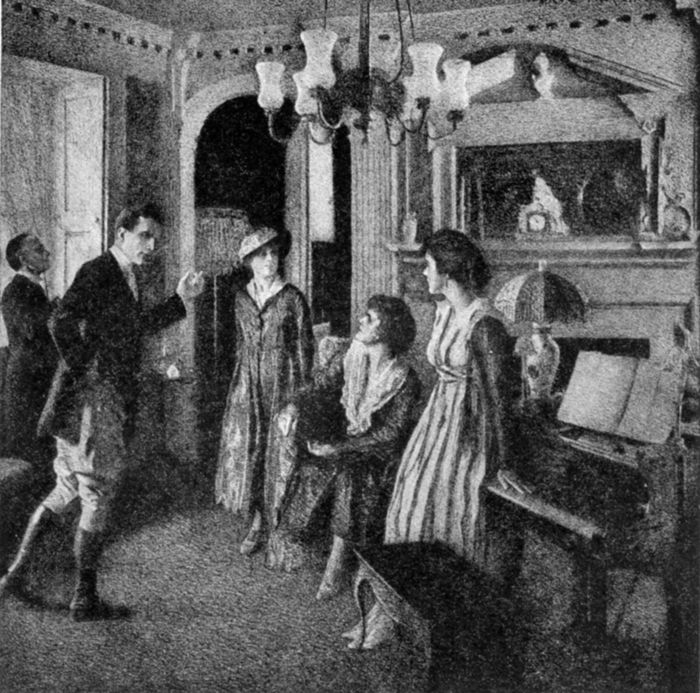
"What is the trouble, then?"
"The trouble," said Mrs. Falkener, seeing Crane hesitate for a word, "is that you have on my daughter's hat."
"Your daughter's hat!" said Lily contemptuously. "Nothing of the kind."
Mrs. Falkener turned to Tucker.
"This is intolerable. This is insufferable," she cried. "To have that woman standing there in Cora's hat, which I chose myself and paid forty-five dollars for at a sale, and cheap, too, for a Diane Duruy model; to stand there and tell me I don't know the hat when I see it—"
"Cora," said Crane, "is that your hat?"
"Why, yes, I'm afraid it is," answered Cora, rather reluctantly.
"Lily, have you any explanation to make?" he asked.
"None at all," replied the housemaid, looking like white granite.
"Cora," said Crane, "you did not by any chance say anything that could have led Lily to believe you meant to give her the hat?"
Miss Falkener smiled.
"No," she said. "My mother would not encourage such a generous impulse in regard to a French hat."
"Then, Lily," said Burton, "take off the hat, and give it back to Miss Falkener, and go and pack your things and be out of the house in an hour."
"You must have her luggage searched," said Tucker.
"Give the hat back!" cried Mrs. Falkener. "What good will that do? Do you suppose that I would ever let Cora put it on her head again, after that woman has worn it? She may as well keep it now."
"I shall," answered Lily. "It's mine."
The girl's determination impressed Crane more than it did the others, though even he could not see any loop-hole of escape for her. He rang the bell, and when Smithfield appeared, he said:
"Smithfield, I have dismissed Lily. We found her leaving the house in one of Miss Falkener's hats."
"Oh, begging your pardon, no, sir," said Smithfield. "It is really not Miss Falkener's hat. Surely, Lily, you explained it?"
"I don't care to speak to them at all," answered Lily.
"Oh, that's no way to speak to your employers, my girl," said Smithfield. "The explanation is this, sir: I understand those great French houses send out many hats alike, sir, and this one was given to Lily by a friend, by Mrs. Crosslett-Billington, to be exact, sir, she thinking it a trifle youthful for herself after she had bought it, and I can't but say she was right, sir, she being a lady now nearing sixty, though hardly looking forty-five. The first evening the ladies came, sir, when Lily had done unpacking their things, she mentioned in the kitchen that Miss Falkener had a hat similar to her own, and we all advised her, sir, under the circumstances, not to wear it during the ladies' stay, as being more suitable and respectful; and she agreed not to, but young women when they have pretty things, dear me, sir, they do like to wear them, and that I presume is why she put on the hat, in spite of our warnings, and I'm sure she regrets it heartily, sir."
"I don't," said Lily. "I'm right glad I did."
"Tut, tut," said Smithfield, "no way to answer, no way to answer."
"Cora," Crane said, "would you go up and see if your hat is in your room?" Cora agreed and left the room at once.
Complete silence reigned until she returned. She was carrying in her hand a hat, the exact duplicate of that which the housemaid wore. They looked from one to another. Lily's triumph was complete.
"Lily," said Crane, "an apology seems to be due to you, which I have great pleasure in offering you, but I must say that if you had been just a trifle more civil, the whole mistake might have been cleared up sooner and more agreeably."
"I think it outrageous," observed Mrs. Falkener, rising. "I think it perfectly outrageous that any servant should own a hat which anywhere but at a special sale must have cost sixty or seventy dollars."
"And now I'll tell you what I think outrageous," said Lily, her soft Southern drawl taking on a certain vigor, "and that is that women like you, calling themselves ladies, should be free to browbeat and insult servants as much as they please—"
"Shut up, Lily," said Smithfield, but she paid no attention.
"No," she said, "no one knows what I've put up with from this insolent old harridan, and now I am going to say what I think."
"Oh, no, Lily," said Crane, taking her by the arm, "you really are not. We're all sorry for the incident, but really, you know you can't be allowed to talk like that."
"But, Mr. Crane," drawled Lily, "you don't appreciate what a dreadful woman she is—no one could who did not have to hook her up every evening."
Between Smithfield and Crane, she was hustled out of the room.
Alone in the hall, Crane and his butler held a consultation.
"She's got to go, Smithfield. Why in the world wouldn't she hold her tongue? Poor girl, I felt every sympathy with her."
"Oh, sir," exclaimed Smithfield, "what shall we do? Jane-Ellen and I really can't run the house entirely alone, sir."
"Of course not, of course not," Burton answered. "You must get some more servants. Get as many as you please—black, white, or red—but for heaven's sake get the kind that won't be impertinent to Mrs. Falkener."
Smithfield shook his head.
"That's a kind will be hard to find, sir, begging your pardon," he observed.
Crane thought it best to ignore this remark.
"I tell you what to do," he said. "Call up Mr. Eliot and say we should all be glad to accept his invitation to lunch to-day if he can still have us. That will give you a little time to look about you. By to-morrow you ought to be able to find some one."
He waited to get Eliot's answer before he returned to the sitting-room, where he saw that Tucker and Mrs. Falkener had had a long, comfortable talk about their grievances and their own general righteousness. He hated to break into the calm that had succeeded by announcing that they were all going out to lunch.
"Burton," said Mrs. Falkener, directing a stern glance at her daughter, "I explained to you yesterday that was an invitation I did not care to accept."
"I know," said Crane, "but my household is now so short-handed that it seemed a question of lunching out or getting no lunch at all. If you really object to going to Eliot's, I dare say they could give you something cold at home, if you did not mind that. You will come, won't you, Cora?"
"With pleasure," answered Cora.
Crane's manner was unusually decisive, and Mrs. Falkener saw that it was time to make things smooth.
"Oh, no," she said. "No, if you are all going, I shall go, too. Only, home is so delightful, I hate the thought of leaving it."
"It hasn't seemed very delightful to me for the past few minutes," answered Burton, "but I'm glad if you've enjoyed it."
"Ah, Burton, my dear, you take these things too seriously," replied Mrs. Falkener. "A little trouble with the servants—an everyday occurrence in a woman's life. You of the stronger sex must not let it worry you so much. When you've kept house as many years as I have, you'll learn that the great thing is to be firm from the beginning. That's the only criticism I could make of you, Burt, a little weak, a little weak."
Tucker here rose, pressing his hand over his eyes.
"I think, if you don't mind, I won't go," he said. "I've a slight headache. Oh, nothing much, but I'll lunch quietly here, if you'll let me—a slice of cold meat and a glass of sherry is all I shall require."
If Crane were weak, he did not look so at this moment.
"I am sorry, Solon," he answered, "but it would be very much more convenient, if you went with us." He had no intention of leaving Tucker alone in the house with Jane-Ellen, while Smithfield was scouring the countryside for fresh servants.
"I'm not thinking so much of myself," said Tucker, "but of you. I fear I should not be much of an addition to the party."
"But I think of you, Tuck," answered his host. "What in the world would there be for you to do at home, except talk to the cook?"
Tucker said, rather ungraciously, that of course he would go if Crane wished him to, but that—
Crane, however, did not allow him to finish his sentence.
"Thank you," he said briskly. "That will be delightful. We shall be starting at half-past twelve."
IX
ELIOT'S large library, to which Crane and his party were led on their arrival, looked as only a room can look which has been occupied for several hours by a number of idle men. All the sofa cushions were on the floor, all the newspapers were on the sofas, cigarette ashes were everywhere, and the air was heavy with a combination of wood and tobacco smoke, everybody's hair was ruffled, as if they had all been sitting on the back of their heads, and Eliot, himself, now standing commandingly on the hearth-rug, was saying:
"Yes, and he did not have a sound leg when he bought him, and that must have been in 1909, for I remember it was the last year I went to Melton—" He broke off reluctantly to greet his guests.
Lefferts, who looked peculiarly neat and fresh among his companions, approached Burton, who was beside Mrs. Falkener.
"They have been talking for three hours," he observed, "about a splint on the nigh foreleg of a gray horse that doesn't belong to any of them. Sit down, Mrs. Falkener, and let us have a little rational conversation. Doesn't that idea attract you?"
"Not particularly, since you ask me," replied Mrs. Falkener, not deigning even to look at the poet, but sweeping her head about slowly as if scanning vast horizons.
"The rational doesn't attract you," Lefferts went on cheerfully. "Well, then we must try something else. How about the fantastic-sardonical, or the comic-fantastical, or even better, the—"
But Mrs. Falkener, uttering a slight exclamation of impatience, moved away.
Lefferts turned to Crane, with his unruffled smile.
"She doesn't like me," he said.
"Cora," he added, very slightly raising his voice so as to attract the attention of Miss Falkener, who immediately approached them, "Cora, why is it your mother hates me so much?"
"She certainly does," returned Cora frankly. "You know, Leonard, you are really rather stupid with her. You always begin by saying things she doesn't understand, and of course no one likes that."
Lefferts sighed.
"You see, she stimulates me so tremendously. One gets used to just merely boring or depressing one's friends, but to be actively hated is exciting. People who have lived through blood feuds and tong wars tell you that there is no excitement comparable to it. I feel a little like the leader of a tong whenever I meet Mrs. Falkener. Cora, would you belong to my tong, or would you feel loyalty demanded your remaining in your mother's?"
They went in to luncheon before Cora was obliged to answer, and here Lefferts contrived to sit next to her by the comparatively simple expedient of making the man who had already seated himself at her side get up and yield him the place.
Crane, sitting between his host and another man, enjoyed a period of quiet. Without his exactly arranging it, a definite plan for the afternoon was growing up in his mind—a plan which, it must be confessed, had been first suggested by Tucker's idea of staying at home, a plan based on a vision of Jane-Ellen and Willoughby holding the kitchen in solitary state.
Crane knew that luncheons at Eliot's were long ceremonies. Food was served and eaten slowly, you sat a long time over coffee and cigars, and at the smallest encouragement, Eliot would bring out his grandfather's Madeira. And after that you were unusually lucky if you escaped a visit to the stables, and that meant the whole afternoon.
So he awaited a good opportunity after lunch was over, when Tucker, under pretense of reading a newspaper, had sunk into a comfortable doze, and Mrs. Falkener, while carrying on a fairly connected conversation with Eliot, was really concentrated on preventing Lefferts from taking Cora into another room. This was Crane's chance. He slipped into the hall, found his coat and hat, unearthed his chauffeur and motor, and drove quickly home, sending back the car at once to wait for the others.
He did not, as his impulse was, go in the kitchen way. He did not want to do anything that might annoy Jane-Ellen. At the same time, he rebelled at the notion of having always to offer an excuse for seeing her, as if he were so superior a being that he had to explain how he could stoop to the level of her society. He wanted to say frankly that he had come home because he wanted more than anything in the world to see her again.
The first thing he noticed as he went up the steps of the piazza was Willoughby sleeping in the warm afternoon sun. Then he was aware of the sound of a victrola playing dance music. The hall-door stood wide open; he looked in. Smithfield and Jane-Ellen were dancing.
Though no dancer himself, Crane had never been aware of any prejudice on the subject; indeed, he had sometimes thought that those who protested were more dangerously suggestive than the dances themselves. But now he felt a wave of protest sweep over him; the closeness, the identity of intention, seemed to him an intolerable form of intimacy.
The two were quite unconscious of his presence, and he stood there for several minutes, stood there, indeed, until Jane-Ellen's hair fell down and she had to stop to rearrange it. She looked very pretty as she stood panting and putting it up again, but she exerted no attraction upon Crane. Disgust, he thought, was all he now felt. One did not, after all, as he told himself, enter into competition with one's own butler.
He went quietly away, ordered a horse and went for a long ride. A man not very easily moved emotionally, he had never experienced the sensation of jealousy, and he now supposed himself to have reached as calm a judgment as any in his life. Everything he had ever heard to Jane-Ellen's discredit, every intimation of Tucker's, every sneer of Mrs. Falkener's, came back to him now. He would like to have sent for her and in the most scathing terms told her what he thought of her—an interview which he imagined as very different from his former reproof. But he decided it would be simpler and more dignified never to notice her in any way again. On this decision he at last turned his horse's head homeward.
Smithfield let him in, as calm and imperturbable as ever.
"Your afternoon been satisfactory, Smithfield?" inquired his employer.
Smithfield stared.
"I beg pardon, sir?"
"Have you succeeded in finding a boy to replace Brindlebury?"
The butler's face cleared.
"Oh, yes, I believe I have—not a boy, exactly, quite an elderly man, but one who promises to do, sir."
"Good." Crane turned away, but the man followed him.
"Miss Falkener asked me to tell you when you came in, sir, that she would be glad of a word with you. She's in your office."
Crane stood absolutely still for a second or two, and as he stood, his jaw slowly set, as he took a resolution. Then he opened the door of his office and went in.
Two personalities sometimes advance to a meeting with intentions as opposite as those of two trains on a single track. Crane and Cora were both too much absorbed in their own aims to observe the signals of the other.
"Cora," began Crane, with all the solemnity of which the two syllables were capable.
"Oh, Burton," cried the girl, "why did you leave Mr. Eliot's like that? It has worried me so much. Did anything happen to annoy you? What was it?"
"I sent the car right back for you."
"It wasn't the car I wanted."
Crane began at once to feel guilty, the form of egotism hardest to eradicate from the human heart.
"I'm sorry if I seemed rude, my dear Cora. I thought you were settled and content with Lefferts. I did not suppose any one would notice—"
"Your absence? Oh, Burt!"
He became aware of a suppressed excitement, an imminent outburst of some sort. A sudden terror swept over him, terror of the future, of the deed he was about to do, terror even of this strange and utterly unknown woman whom he was about to make a part of his daily life, as long as days existed. For a second he had an illusion that he had never seen, never spoken to her before, and as he struggled against this queer abnormality, he heard that in set, clear and not ill-chosen terms he was asking her to marry him.
She clasped her hands together.
"Oh, it's just what I was trying to prevent."
"To prevent?"
"Burt, I've treated you so badly."
He looked at her without expression.
"Well, let's get the facts before we decide on that."
The facts, Cora intimated, were terrible. She was already engaged.
"To Lefferts?"
She nodded tragically.
Crane felt a strong inclination to laugh. The world took on a new aspect. Reality returned with a rush, and with it a strong, friendly affection for Cora. He hardly heard her long and passionate self-justification. She knew, she said, that she had given him every encouragement. Well, the truth was she had simply made up her mind to marry him; nothing would have pleased her mother more, but she did not intend to shelter herself behind obedience to her mother; she had intended to do it for her own ends.
"That was what I tried to tell you last evening in the garden, Burt. I deliberately schemed to marry you, but you mustn't think I did not like and admire you, in a way—"
"There's only one way, Cora."
This sent her off again into the depths of self-abasement. She had no excuse to offer, she kept protesting, and offered a dozen; the most potent being her uncertainty of Crane's own feelings for her.
"You behaved so strangely for a man in love, Burt," she wailed, "I was never sure."
"In the sense you mean, I was not in love with you, Cora."
"And yet, you want to marry me?"
"In your own words, I liked and admired you, but I was not in love. The humiliating truth is, my dear girl, that I was so fatuous as to believe that you were fond of me."
There was a short silence, and then Cora exclaimed candidly:
"Aren't people queer! Here I have been worrying myself sick over my treatment of you, and now that I find you are not made unhappy by it, do you know what I feel? Disappointed, disappointed somehow, that you don't love me!"
Crane laughed.
"I also," he said, "have been slightly oppressed by the responsibility of your fancied affection, and I, too, am conscious of a certain flatness in facing the truth."
Cora hardly listened.
"It seems so queer you don't love me," she murmured. "Why don't you love me, Burt?"
At this they both laughed, and went on presently to the more detailed consideration of Cora's affairs. She and Lefferts had met the winter before; she had not liked him at first, prejudiced perhaps by the fact that he was a poet, and that he pretended to dislike all the things she cared for, but she had found, almost at once, that he understood more about the things he hated than most men did about their favorite topics.
"He's really wonderful, Burt," she said. "He understands everything, every one. Do you know, he told me yesterday that I needn't worry about you—that you weren't in love with me. Only I did not believe him. He said: 'What confuses you, my dear, is that Crane is undoubtedly in love, one sees that clearly enough, but not with you.'"
"He did not just hit it there, though," answered Crane, in a rather feeble tone. Cora, however, was in a condition of mind in which it was not difficult to distract her, and she continued without paying any further attention to the example of Lefferts' extraordinary insight. She went on to say that she had had no idea that she was in love, until one day when she found herself speaking of it as if it had always been. Crane asked about Lefferts' worldly prospects, which turned out to be extremely dark. Had he a profession? Yes, such a strange one for a poet—he was an expert statistician, but, Cora sighed, there did not seem to be a very large demand for his abilities.
Among the many minor responsibilities inherited from his father, Crane remembered a statistical publication. He immediately offered its editorship to Lefferts. Cora's answer was to fling her arms about his neck.
"Oh, Burt," she said, "you really are an angel!"
It was Crane's idea of what would have happened if Mrs. Falkener had entered at this moment, which she did not, that made him ask how matters stood in regard to her.
"She doesn't know," answered Cora, "and I don't think she even suspects, and I'm such a coward I can't make up my mind to tell her. Every time I see Leonard he asks me if I have, and now he is threatening to do it himself, and that you know, Burt, would be fatal."
"Cora," said Crane, "I am about to prove that I am no fair weather friend. With your permission, I will tell your mother."
No permission was ever more easily secured.
It was now five o'clock, an hour when the elder lady became restless if not served with a little tea and attention. Crane rang and ordered tea for two served in the office, and then sent Smithfield to ask Mrs. Falkener if he might have a word with her. She and her daughter passed each other on the threshold.
"How cozy this is," she began as she seated herself by the fire. "Smithfield keeps the silver bright, but I'm afraid he has no judgment. Have you seen the man he has engaged instead of that dreadful boy?—why, he's so old and lame he can hardly get up and down stairs. He'll never do, Burton, take my word for that."
"I have something more serious to say to you than the discussion of domestic matters, Mrs. Falkener," said Crane; and for one of the few times in her life, Mrs. Falkener forgot that the house contained such a thing as servants. A more important idea took possession of her attention.
Burton began to speak about romance. He said he did not know exactly how an older generation than his looked at such questions; for his own part, he regarded himself in many ways as a practical and hard-headed man, and yet more and more he found himself gravitating to the belief that romance, love, the drawing together for mutual strength and happiness of two individuals, was the only basis for individual life. People talked of the modern taste for luxury; to his mind there was no luxury like a congenial companion, no hardship like having to go through life without it. Love—did Mrs. Falkener believe in love?
"Do I believe in love, my dear Burt?" she cried. "What else is there to believe in? No girl, no nice girl, ever marries for any other reason. Oh, they try sometimes to be mercenary, but they don't succeed. I could never forgive a woman for considering anything else."
"I thought you would feel like that," said Crane. "I thought Cora was wrong in thinking you would oppose her. For, prudent or not from a worldly point of view, there is no doubt that she and Lefferts are in love."
The blow was a cruel one, and perhaps cruelly administered. Mrs. Falkener, even in the first instant of disaster, saw and took the only way out. Love, yes. But this was not love, this was a mere infatuation on one side, and a dark and wicked plot on the other. She would never forgive Burton, never, for being a party to this scheme to throw her daughter, her dear Cora, into the arms of this adventurer. Burton, who had always professed such friendship for her! She would not stay another moment in his house. There was a six-thirty train to the North, and she and her misguided daughter would take it.
Crane began to see why Cora, for all her physical courage, dreaded a disagreement with her mother. He himself felt as if an avalanche had passed over him, leaving him alive but dazed.
Mrs. Falkener sat with her handkerchief pressed to her eyes, not so much to wipe away her tears, for she was not crying, but to shut out the sight of her perfidious young host.
"Be so kind," she directed from behind this veil, "as to give orders for the packing of my trunks, and let Cora know that we are leaving immediately."
Burton hesitated.
"I am afraid, since the housemaid has left, there isn't any one to pack for you, Mrs. Falkener," he said. "Won't you delay your going until to-morrow? I can't bear to have you leave me like this."
Mrs. Falkener shook her head.
"Call Solon," she said. "No, don't ask me to stay. And why, pray, can't the cook make herself useful, for once?"
Mrs. Falkener was not, of course, in a position to know that Crane would not at the moment stoop to ask any favor of Jane-Ellen. He was glad of an excuse to escape, however, and summon Solon to take his place. He found Smithfield in the hall and explained to him that the ladies were called suddenly away, and then he himself walked down to the garage to arrange for their departure.
When he came back he found the house in the sort of turmoil that only a thoroughly executive woman in a bad temper can create. Smithfield, Cora and Jane-Ellen seemed to be all together engaged in packing. Solon and the new man were running up and down stairs with forgotten books and coats and umbrellas, while Mrs. Falkener was exercising a general and unflattering supervision of every one's activities. To say the new man was running is inaccurate. Even Tucker's dignified celerity hardly deserves such a word. But the new man, crippled and bent as he was, attained only such velocity as was consistent with a perfectly stiff left leg. Crane really felt he ought to interfere on his behalf, when he saw him laboring downstairs with heavy bags and bundles. He probably would have done so, had not his mind been distracted by coming unexpectedly upon a little scene in the upper hall. Cora was trying to press a fee into the hand of Jane-Ellen, and Jane-Ellen was refusing it. Both were flushed and embarrassed.
"I wanted to give you this because—"
"Oh, I couldn't, really; I've not done any—"
"Oh, you've been such a—"
"Oh, no, miss, I've not done—"
The approach of Crane enabled the cook to escape. Cora turned to Burton.
"She's worked so hard, and she wouldn't take a tip," she said. "And you never felt anything like her little hands, Burt. It's like touching a bird."
"Yes, I know," said Crane. "I mean, they look so. I want just a word with you, Cora," he continued, rather rapidly. "I'm afraid I haven't done you much good except that your mother is angrier with me than she is with you, and that's something."
"Oh, I don't care, now it's over," she answered. "And you'll tell Len this evening all that's happened, and where to write to me, and we shall both be grateful to you as long as we live."
At this moment, Mrs. Falkener in hat, veil, and wrap swept out of her room, followed by Smithfield, Tucker and the old man, carrying the last of her possessions. The moment of departure had come.
X
AFTER the departure of the ladies, Tucker and Crane stood an instant in silence on the piazza. Solon, who had been waked from his customary afternoon nap by the frantic summons of Mrs. Falkener, was still a little confused as to all that had happened, and had gathered nothing clearly except that Burton was in some way very much to be blamed.
"It's too bad," he observed, "to have them go off like that. We shall miss them, I fear."
Crane was standing with his hands in his pockets, watching the tail-light as it disappeared down the drive.
"Let us avoid that, Tuck, by going away ourselves."
"You mean to leave here?"
"Why not? The experiment has not struck me as a very happy one. Our servants have gone, our guests have left us, and for my part, I am eager to be off as well."
The time had come, then, when Jane-Ellen was to be friendless and out of a job; the third act was here.
"Anything that suits you pleases me, Burton," said Tucker.
"In that case," answered Crane, "I will telephone Reed to come over at once and make arrangements for giving up the house. We can't, I suppose, catch that night train, but with luck we may get away to-morrow morning."
"You seem in a great hurry."
"I'd like never to see the place again," returned Burton.
In the moment of silence that followed this heartfelt exclamation, a figure came briskly around the corner of the piazza, a figure discernible in the light shed by the front door.
"Oh, come here," said Crane.
The figure betrayed no sign of having heard, unless a slight accentuation in its limp might be so interpreted.
"What's your name?" shouted Burton.
The old man looked up.
"Yes, yes," he said, in a high shaking voice, "I'm lame; you're right there, sir. I've been lame these twenty years, and carrying down all them trunks has put sich a crick in my back as never was."
"I asked you your name," repeated his employer.
"When I came? Why, this afternoon, sir. It was your butler engaged me. I worked at the hotel here once, and Mr. Smithfield he come to my wife and says, 'Susan,' he says, he knowing her since he was a little boy—"
"Let me look at you," said Crane sternly.
But the elderly man, still talking to himself, retreated into the shadow.
And then Tucker was surprised to hear his host exclaim with violence:
"By Jove, the young devil," and to see him hurl himself off the piazza at its highest point. He would have landed actually on top of his decrepit servitor, had not the old man developed an activity utterly unsuspected by Tucker, which enabled him to get away down the avenue with a speed that Crane could not surpass.
"Well, well, what are we coming to?" Tucker murmured as he watched them dodge and double around trees and bushes. Presently they passed out of the light from the house, and only the sound of their feet beating on the hard avenue indicated that the fugitive had taken to the open.
Solon was still peering nervously into the dark when at last his host returned. Crane was breathing hard, and held in his hand a small furry object that Tucker made out gradually to be a neat gray wig.
"Oh," said Burton, still panting and slapping his side, "I haven't run so hard since I was in college. But I should have got him if it hadn't been for his superior knowledge of the ground."
"My dear Burton," said Tucker crossly, "what in the world have you been doing?"
"What have I been doing? I've been trying to catch that wretched boy, Brindlebury, but it's as well I didn't, I dare say. I thought his limp a little spectacular this afternoon when the trunks were being carried down. But his deafness—the young fool!—that deafness, never found anywhere but on the comic stage, was too much for me. He runs fast, I'll say that for him. He led me through a bramble hedge; backed through, himself. That's when I got his wig."
"I should not be surprised if we all were murdered in our beds," said Tucker.
"That's right, Tuck," said Crane, "look on the cheerful side. Come with me now, while I speak to Smithfield. I want to know what he has to say for himself."
Smithfield, looking particularly elegant in his shirt sleeves, a costume which shows off a slim figure to great advantage, was rather languidly setting the dinner-table for two; that is to say, he was rubbing a wine-glass, shaped like a miniature New England elm-tree, to remove the faint imprint of his own fingers.
"Smithfield," said Crane briskly, "I'm afraid your new useful man isn't going to be very useful. He seems to me too old."
Smithfield placed the glass deliberately upon the table.
"He's not so old as he appears, sir," he answered. "Only sixty-six his next birthday."
"A married man?"
"No, sir, a widower of many years. His wife died when her first baby was born—that's Mr. Crosslett-Billington's present chauffeur. That's how I happened to get the old fellow. And when the rheumatism—"
"Smithfield," said Crane, "that's about enough. Put down that glass, put on your coat and hat, and get out. You're lying to me, and you've been lying to me from the beginning. Don't stay to pack your things; you can settle all that with Mr. Reed to-morrow. Get out of my house, and don't let me see you again. And," he added, throwing the gray wig into his hands, "there's a souvenir for you."
Smithfield, without the least change of expression, caught the wig, bowed, and withdrew.
"And now, Tuck," Crane added, turning to his lawyer, "I wish you would go and telephone Reed to come here at once and clear this whole thing up. Tell him I'll send the motor for him as soon as it comes back."
"It's dinner-time now," observed Tucker.
"Ask him to dinner then," said Crane. "I must go and see that Smithfield really gets out of this house."
Scene from the Play The dinner. Olivia, Lefferts, Tucker, Weeks and Crane. Act III
Both tasks had been accomplished when at about eight o'clock Tucker and Crane again met in the hall. Smithfield had been actually seen off the place, Tucker had telephoned Reed and despatched the motor for him, and now the sound of an approaching car was heard.
"That can't be Reed, yet," said Tucker, "there hasn't been time."
Crane shook his head.
"It isn't the sound of my engine, either," he answered.
Headlights came sweeping up the drive, and a few minutes later, Lefferts, in full evening dress, entered the house.
"I'm afraid I'm a little bit late," he said, "but I missed a turn."
For an instant Crane regarded him blankly. Then he remembered that once, ages before, or perhaps no earlier than that very afternoon, he had invited Lefferts to dinner. And at the same time he realized what had not heretofore occurred to him, that there was no one in the house to serve dinner, except Jane-Ellen, who had, in all probability, cooked dinner for only two. Reed might be there at any minute. It was really necessary, in so acute a domestic crisis, to put pride in his pocket and go downstairs and speak to his cook.
He put his hand on Lefferts' shoulder.
"Awfully sorry, my dear fellow," he said, "that things are not quite as anticipated. Tucker will tell you we have had rather a stormy afternoon. Give him a cigarette and a cocktail, Tuck, and I'll be back in a minute." He disappeared down the kitchen stairs.