COME OUT OF THE KITCHEN! (continued 3)
Reading edition
With what different feelings, he said to himself, did he now descend those stairs; but, when he was actually in the kitchen, when Willoughby was once again bounding forward to greet him, and Jane-Ellen was allowing herself that slow curved smile of hers, he was surprised and disappointed to find that his feelings were, after all, much the same as before. Over his manner, however, he was still master, and that was cold and formal in the extreme.
"I wanted to speak to you, Jane-Ellen," he began, but she interrupted.
"This time," she said gaily, "I know what it is that you are going to scold about."
"I am not going to scold."
She laughed.
"Well, that's a wonder," and glancing at him she was astonished to find no answering smile. "Are you really angry at me," she asked, "on account of this afternoon?"
"This afternoon?"
"On account of that silly plan about Brindlebury? I did not know they were going to do it, and when it was done, I couldn't betray them, could I?"
Crane made a gesture that seemed to indicate that he really had no means of judging what his cook might or might not do.
"You believe me, don't you?"
"Believe you?" said Crane. "I haven't considered the question one way or the other."
"Why, Mr. Crane," said Jane-Ellen, "whatever has come over you that you should speak like that?"
"This has come over me," answered Crane, "that I came down here in a hurry to give some orders and not to discuss the question of veracity."
The figure of Jane-Ellen stiffened, she clasped her hands behind her back.
"And what are your orders?" she said, in a tone of direful monotony.
Crane, as has been stated, was no coward, and even if he had been, anger would have lent him courage.
"There are two gentlemen coming to dine—four in all," and as he saw Jane-Ellen slightly beck her head at this, he added recklessly, "as Smithfield is gone, you will have to serve dinner as well as cook it."
"No," replied the cook. "No, indeed. Certainly not. I was engaged to cook, and I will cook to the very best of my abilities, but I was not engaged to be a maid of all work."
"You were engaged to do as you're told."
"There you are mistaken."
"Jane-Ellen, you will serve dinner."
"Mr. Crane, I will not."
The problem of the irresistible force and the immovable body seemed about to be demonstrated. They looked each other steadily and hostilely in the eyes.
"We seem," said Crane, "to be dealing with the eternal problem between employer and employee. You're not lazy, the work before you is nothing, but you deliberately choose to stand on your rights, on a purely technical point—"
"I do nothing of the kind."
"What are you doing then?"
"I'm making myself just as disagreeable as I can," answered Jane-Ellen. "Of course, I should have been delighted to do anything for any one who asked me politely. But when a man comes into my kitchen and talks about giving orders, and my doing as I'm told, and serving dinner, why, my answer is, he ought to have thought of his extra guests before he dismissed my brothers—"
"Your brothers!" cried Crane. "Do you mean to say that Smithfield is your brother too?"
"Well, I didn't mean to tell you," said the cook crossly, "but it happens to be true."
From the point of view of the irresistible force, the problem was now completely resolved.
"O Jane-Ellen!" he cried, "why in the world didn't you tell me so before?"
"I can't see what it has to do with things."
"It has everything," he answered. "It makes me see how wrong I have been, how rude. It makes me want to apologize for everything I have said since I came into the kitchen. It makes me ask you most humbly if you won't help me out in the ridiculous situation in which I find myself."
"But I don't see why Smithfield's being—"
"It would take a long time to explain," answered Burton, "although, I assure you, it can and shall be done. Perhaps this evening, after these tiresome men have gone, you will give me a few minutes. In the meantime, just let me say that I was angry at you, however wrongly, when I came down—"
"I'm not sure but that I'm still angry at you," said the cook, but she smiled as she said it.
"You have every right to be, and no reason," he returned. "And you are going to be an angel and serve dinner, aren't you?"
"I said I would if asked politely."
"Though how in the world I shall sit still and let you wait on me, I don't see."
"Oh," said Jane-Ellen, "if you never have anything harder to do than that, you are very different from most of your sex. And now," she added, "I'd better run upstairs and put two more places at the table, for it's dinner-time already."
"If I come back later in the evening, you won't turn me out of the kitchen?"
She was already on her way upstairs, but she turned with a smile.
"It's your kitchen, sir," she said.
Crane followed her slowly. It occurred to him that he must have a talk with Lefferts. He found him and Tucker making rather heavy weather of conversation in the drawing-room. Tucker had naturally enough determined to adopt Mrs. Falkener's views of Lefferts. He had conformed with Crane's request and given the poet a cigarette and a cocktail, but he had attempted no explanation beyond an unsatisfactory statement that the ladies had been called away unexpectedly.
"Nothing serious, I hope," Lefferts had said.
"I hope not," Tucker had returned, and not another word would he utter on the subject.
Lefferts was, therefore, glad to respond to Crane's invitation to come into the office for a few minutes and leave Tucker to the contemplation of his own loyalty.
Left alone, Tucker's eager ears soon detected the sound of dishes in the dining-room, and he knew that this could be produced by the hand of no other than Jane-Ellen. The moment seemed to have been especially designed for his purpose, and he decided to take advantage of it.
Jane-Ellen was setting the table with far more energy than Smithfield had displayed; in fact her task was almost finished when Tucker entered, and, advancing to the mantelpiece, leaned his elbow on the shelf and smiled down upon her benevolently.
"The time has come sooner than we anticipated when I can be of assistance to you, Jane-Ellen," he said.
"Yes, indeed, sir," she returned with a promptness that fifteen years before would have made his heart beat faster.
"Thank you for giving me the opportunity."
"The finger-bowls, sir," she interrupted, flicking a napkin in their direction, "they ought to be filled; not too full, sir; that's quite enough, it isn't a tub, you know. And now, if you've a match about you, and gentlemen always have matches, I believe, would you light the candles, and then, yes, I do think we're about ready now."
Tucker, who could not very well refuse such trivial services when he was offering one much more momentous, poured a little water from the ice pitcher into the glass finger-bowls, but he did it with such dignity and from such a height that he spilled much of it over the doilies. The cook did not reprove him directly, but she changed the doily with a manner that seemed to suggest that another time she would do the job herself. And when Tucker took a neat gold match-box from his pocket and prepared to light the candles, she coolly took the whole thing out of his hands, remarking that he might set the shades on fire and then they'd be in what she described as "a nice way."
Observing that she was about to leave the room, he put himself before the door.
"I want just a word, Jane-Ellen."
"No time now, sir. Perhaps to-morrow morning."
"To-morrow will be too late. You must know this evening. I don't want to say a word against Mr. Crane; young men who have always had everything they want are naturally thoughtless. But I can't bear to see you turned out at a moment's notice—"
"Turned out?"
"Yes, Mr. Crane is going either to-night or to-morrow morning. Didn't he tell you?"
He had her attention now. She looked at him intently.
"Mr. Crane going? I thought he had the house for six weeks."
"So he had, but he's bored with it. Miss Falkener has gone, and he sees no reason for staying on. He'll be off either at midnight or in the morning. You're about to lose your place, Jane-Ellen."
She stood staring before her so blankly that it grieved him to see her so deeply concerned about the loss of her position, and he pressed on.
"I can't bear to think of your comfort being dependent on the caprices of Crane, or any one. Come to me, Jane-Ellen. This is no life for you, with your youth and beauty and charm. I could offer you a position that you need never leave, never, unless you wanted to—"
"Please move from the door, sir."
"Not until you've heard me," and he moved toward her as if to take her in his arms.
At some previous period of time, the Revellys, presided over by a less elegant functionary than Smithfield, must have been in the habit of summoning the family to meals by means of a large Japanese gong that now stood neglected in a corner. To this, Jane-Ellen sprang, and beat it with a vigor that made the house resound.
The next instant Crane burst into the room.
"What's the matter?" he exclaimed, and added, fixing his eyes on his lawyer,
"What the deuce are you doing here, Tuck?"
"I," said Tucker, "was giving Jane-Ellen what help I could in setting the table."
"Like hell you were."
"Do you mean you doubt what I say?"
"You bet I do."
"And may I ask what you do think I was doing?" asked Tucker.
"I think you were making love to the cook."
"Gentlemen, gentlemen," murmured the cook, "won't you please let me go down and attend to the dinner. The chicken will be terribly overdone."
Nobody paid any attention to the request.
"Well," said Tucker, "I certainly wouldn't turn a poor girl out at a few hours' notice, as you mean to do."
"Who says I mean to?"
"You told me yourself you meant to leave to-morrow."
"And what kind of a job were you offering her?"
"I tell you I was trying to help her."
"And is that why she rang the gong?"
"She rang presumably because dinner was ready."
"There's another presumption that seems to me more probable."
"Burton, I shall not spend another night under your roof."
"I had reached the same conclusion."
Tucker turned with great dignity.
"The trouble is," he said, "that you have not the faintest idea of the conduct of a gentleman," and with this he walked slowly from the room.
The cook did not now seem so eager to get back to the kitchen. She stood twisting a napkin in her hands and looking at the floor, not unaware, however, that her employer was looking at her.
"The trouble really is, Jane-Ellen," he said gently, "that you are too intolerably lovely."
"Oh, sir."
"'Oh, sir, oh, sir!' You say that as if every man you knew had not been saying the same thing to you for the last five years."
Jane-Ellen had another of her attacks of dangerous candor.
"Well, a good many have said it, sir," she whispered, "but it never sounded to me as it did when you said it." And after this she had the grace to dart through the door and downstairs, so fast that he could hear her little heels clatter on each step as she went.
In the hall he found Tucker, standing under a lamp, studying a time-table, with glasses set very far down his nose. Opposite, Lefferts was leaning against the wall, his arms folded and the expression on his face of one who has happened unexpectedly upon a very good moving picture show.
Seeing Crane, Tucker folded up his time-table and removed his glasses.
"Your other guest has just arrived," he observed.
"Oh, is Reed here?"
"Yes," said Lefferts, "he's in your office taking off his coat."
"And you may be interested to know," added Tucker, with a biting simplicity that had impressed many juries in its time, "you may be interested to know that he is the man I found kissing Jane-Ellen last week."
"What, Reed!" cried Crane, with a gesture that might have been interpreted as ferocious.
Hearing his name called, Reed came hurrying out.
"Yes," he said, advancing with outstretched hand, "here I am. Sorry to be late, but I was ready before—"
"We'll go in to dinner," said Crane shortly. Tucker and Reed moved first toward the dining-room. Lefferts drew his host aside.
"Just one moment," he said. "You went off so quickly when that gong rang that I did not have any chance to tell you how I feel about your generosity. It makes—"
Crane grasped his hand.
"You have an opportunity this very moment," he replied, "to repay me for anything I ever have done or may do for you. Talk, my dear fellow, talk at dinner. Do nothing but talk. Otherwise, I shall knock those two men's heads together."
Lefferts smiled.
"I doubt if you'd get much sense into them even if you did," he murmured.
"No," answered Burton, "but I should have a great deal of enjoyment in doing it."
XI
THEY sat down at table, and, as Crane looked at his guests, he had little hope that even Lefferts' cheerful facility could save the situation. Circumstances would be too much against him. Even the poet himself could hardly be at his best, having just arrived in the hope of dining with his lady-love to find she had been spirited away by an irate mother. This in itself was enough to put a pall on most men; yet, of the three guests, Lefferts seemed by far the most hopeful. Tucker was already sullen and getting more sullen every moment. Crane knew the signs of his lawyer's bearing—the irritable eye that would meet no one's directly, the tapping fingers, the lips compressed but moving. Tucker was one of those people cursed by anger after the event. His nature, slow moving or overcontrolled, bore him past the real moment of offense without explosion; but with the crisis over, his resentment began to gain in strength and to grow more bitter as the opportunity for action receded more and more into the past. Crane knew now that Tucker was reviewing every phrase that had passed between them; every injury, real or fancied, that he had ever received at Crane's hands; these he was summoning like a sort of phantom army to fight on his side. No, Tucker was not a guest from whom any host could expect much genial interchange that evening.
Reed, on the other hand, was too unconscious. Placid, good-natured, confident in his own powers to arrange any little domestic difficulties that might have arisen, he sat down, unfolded his napkin, and turned to Lefferts in answer to the inquiry about real estate which Lefferts had just tactfully addressed to him.
"The great charm of this section of the country," he was saying, "is that from the time of its earliest settlement it has been in the hands of a small group of—" At this instant Jane-Ellen entered with the soup. Reed, who had expected to see Smithfield, stopped short, and stared at her with an astonishment he did not even attempt to disguise. Lefferts, following the direction of his eyes and seeing Jane-Ellen for the first time, mistook the subject of Reed's surprise.
"Oh," he said, as the girl left the room, "is this 'the face that launched a thousand ships'?"
Tucker, who was perhaps not as familiar with the Elizabethan dramatists as he should have been, replied shortly that this was the cook.
"A very beautiful little person," said Lefferts, imagining, poor fellow, that he was now on safe ground.
"I own," said Tucker, "that I have never been able to take much interest in the personal appearance of servants."
"You sometimes behave as if you did, Tuck," remarked his host.
"If you are interested in beauty," observed Lefferts, "I don't see how you can eliminate any of its manifestations, particularly according to social classes."
"Such a preoccupation with beauty strikes me as decadent," answered Tucker crossly.
"Indeed, how delightful," Lefferts replied. "What, exactly, is your definition of 'decadent'?"
Now in Tucker's vocabulary the word "decadent" was a hate word. It signified nothing definite, except that he disliked the person to whose opinions he applied it. He had several others of the same sort—hysterical, half-baked and subversive-of-the-Constitution being those most often in use. This being so, he really couldn't define the word, and so he pretended not to hear and occupied himself flicking an imaginary crumb from the satin lapel of his coat.
Lefferts, who had no wish to be disagreeable, did not repeat the question, but contented himself by observing that he had never tasted such delicious soup. Reed shook his head in an ecstasy that seemed to transcend words. Only Tucker scowled.
As Jane-Ellen entered at this moment to take away the soup-plates, Crane, who was growing reckless, decided to let her share the compliment.
"The gentlemen enjoyed the soup, Jane-Ellen," he said, "at least, Mr. Lefferts and Mr. Reed did, but Mr. Tucker has not committed himself. Did you enjoy the soup, Tuck?"
Tucker rapped with his middle finger.
"I care very little for my food," he answered.
"Well," said Crane, "I've heard of hating the sin and loving the sinner; I suppose it is possible to hate the cooking and—and—" He paused.
"I did not say I hated the cooking," answered Tucker. "I only say I am not interested in talking about it all the time."
"All right," said Burton, "we'll talk about something else, and you shall have first choice of a topic, Tuck."
"One moment before we begin," exclaimed Reed, "I must ask, where is Smithfield?"
Crane turned to him.
"Smithfield," he said, "in common with my two guests, the housemaid Lily and the boy Brindlebury, have all left, or been ejected from my house within the last twenty-four hours."
"You mean," gasped Reed, "that you and Mr. Tucker and the cook are alone in the house!"
"I regret to say that Mr. Tucker also leaves me this evening."
"But—but—" began Reed, in a protest too earnest to find words on the instant.
"We won't discuss the matter now," said Crane. "I have several things to talk over with you, Mr. Reed, after dinner. In the meantime," he added, looking around on the dreary faces of all but Lefferts, "let us enjoy ourselves."
"Certainly, by all means," agreed Reed, "but I would just like to ask you, Mr. Crane—You can't mean, you don't intend, you don't contemplate—"
"Oh, I won't trouble you with my immediate plans," said Crane, and added, turning to Lefferts, "my experience is that no one is really interested in any one else's plans—their daily routine, I mean, and small domestic complications."
"Oh, come, I don't know about that," answered Lefferts, on whom the situation was beginning vaguely to dawn. "Mr. Reed struck me as being very genuinely interested in your intentions. You are genuinely interested, aren't you, Mr. Reed?"
Reed was interested beyond the point of being able to suspect malice.
"Yes, yes," he said eagerly, "I am, genuinely, sincerely. You see, I understand what would be said in a community like this,—what would be thought. You get my idea?"
"I own I don't," answered Burton suavely, "but I will say this much, that in deciding my conduct, I have usually considered my own opinion rather than that of others."
"Of course, exactly. I do, myself," said Reed, "but in this case, I really think you would agree with me if I could make myself clear."
"Doubtless, doubtless," answered Crane, and seeing that Jane-Ellen was again in the room, he went on: "What is it exactly that we are talking about? What is it that you fear?"
Reed cast an agonized look at the cook and remained speechless, but Tucker, with more experience in the befogging properties of language, rushed to his assistance.
"It's perfectly clear what he means," he said. "Mr. Reed's idea is that in a small community like this the conduct of every individual is watched, scrutinized and discussed, however humble a sphere he or she may occupy; and that if any young woman should find herself in a position which has been considered a compromising one by every author and dramatist in the language, she would not be saved from the inevitable criticism that would follow by the mere fact that—"
But here something very unfortunate happened. The lip of the ice-water pitcher, which Jane-Ellen was approaching to Tucker's glass, suddenly touched his shoulder, and a small quantity of the chilling liquid trickled between his collar and his neck. It was not enough to be called a stream, and yet it was distinctly more than a drop; it was sufficient to cut short his sentence.
"Oh, sir, I'm so sorry," she cried, and she added, with a sort of wail, looking at Crane, "You see how it is, sir, I'm not used to waiting on table."
"I think she waits admirably," murmured Lefferts aside to his host.
"Extremely competent, I call it," said Crane clearly. "Don't give it another thought, Jane-Ellen. See," he added, glancing at Tucker's face which was distorted with anger, "Mr. Tucker has forgotten it already."
"Oh, sir, how kind you are to me!" cried the cook and ran hastily into the pantry, from which a sound which might have been a cough was instantly heard.
"Yours is a strange but delightful home, Crane," observed Lefferts. "I don't really recall ever having experienced anything quite like it."
"You refer, I fancy," replied Crane, "to the simple peace, the assured confidence that—"
"That something unexpected is going to happen within the next ten seconds."
Tucker and Reed, both absorbed in their private wrongs, were for an instant like deaf men, but the latter having now dried his neck and as much of his collar as was possible, showed signs of coming to, so that Crane included both in the conversation.
"Lefferts and I were speaking," he said, slightly raising his voice, "of the peculiar atmosphere that makes for the enjoyment of a home. What, Mr. Reed, do you think is most essential?"
"Just one moment, Mr. Crane," said Reed. "I want to say a word more of that other subject we were speaking of."
Crane's seat allowed him to see the pantry door before any one else could. On it his eyes were fixed as he answered thoughtfully:
"Our last subject. Now, let me see, what was that?"
"It was the question of the propriety of—"
"Fish, sir?" said a gentle voice in Reed's ear. He groaned and helped himself largely and in silence.
Lefferts, who was really kind-hearted, pitied his distress and decided to change the topic.
"What a fine old house this is," he said, glancing around the high-ceilinged room. "Who does it belong to?"
"It belongs," answered Tucker, "to a family named Revelly—a family who held a highly honored position in the history of our country until they took the wrong side in war."
"In this part of the country, sir," cried Reed, "we are not accustomed to thinking it the wrong side."
Tucker bowed slightly.
"I believe that I am voicing the verdict of history and time," he answered.
It was in remorse, perhaps, for having stirred up this new subject of dispute that Lefferts now went on rapidly, too rapidly to feel his way.
"Well, this present generation seems to be an amusing lot. Eliot was telling me about them last night. He says one of the girls is a perfect beauty. Now, what was her name—such a pretty one. Oh, yes," he added, slightly raising his voice, as his memory gave it to him, "Claudia."
"What?" said the cook.
"Nobody spoke to you, Jane-Ellen," said Crane, but his eyes remained fixed on her long and meditatively as she handed the sauce for the fish.
Lefferts continued:
"Eliot said that she was a most indiscriminating fascinator—engaged to three men last summer, to his knowledge. Our Northern girls are infants compared—"
Reed suddenly sprang up from the table.
"I'd be obliged, sir," he said, "if you'd tell Mr. Eliot, with my compliments, that that story of his is untrue, and if he doesn't know it, he ought to. I don't blame you, sir, a stranger, for repeating all you hear about one of the loveliest young ladies in the country, but I do blame him—"
At this the cook approached him and said with a stern civility:
"Do sit down and eat your fish, sir, before it gets cold." They exchanged a long and bitter glance, but Reed sat down.
"I'm sure you'll believe," said Lefferts, "that I'm sorry to have said anything I ought not, particularly about any friend of yours, Mr. Reed, but the truth is, I thought of it only as being immensely to the credit of the young lady, in a neighborhood which must be, you'll forgive my saying, rather dull if you're not fond of hunting."
"The point is not whether it is to her credit or not," returned Reed, who was by no means placated, "the point is that it is not true."
"Probably not," Lefferts agreed, "only," he added, after a second's thought, "I don't see how any one can say that except the young lady herself."
"Miss Claudia Revelly," answered Reed, "is one of the most respected and admired young ladies in the State, I may say in the whole South. I have known her and her family since she was a child, and I should have been informed if anything of the kind had taken place."
As he said this, the glance that the cook cast at him was indescribable. It was mingled pity and wonder, as much as to say, "What hope is there, after all, for a man who can talk like that?"
"Undoubtedly you're right, Mr. Reed," said Lefferts, "and yet I have never heard of a girl's announcing more than one engagement at a time, although it has come within my experience to know—"
"But, after all, why not?" said Crane. "Perhaps that will be the coming fashion. We shall in future get letters from our friends, which will begin: 'I want you to know of the three great happinesses that have come into my life. I am engaged to John Jones, Peter Smith and Paul Robinson, and I feel almost sure that one of these three, early next June—'"
Seeing that Reed was really growing angry, Lefferts hastened to interrupt his host.
"I think you might tell us, Mr. Reed," he said, "what the great beauty of the county looks like?"
"I can't think that this is the time or place for retailing the charms of a young lady as if it were a slave market," answered Reed; and it seemed to Crane that the cook, who had come in to change the plates, looked a little bit disappointed.
"No, not as if it were a slave market," said Lefferts, "because, of course, it isn't."
"I can see no reason, Reed," said Crane, "why you shouldn't give us a hint as to whether Miss Revelly is blond or brunette, tall or short."
"Perhaps I see reasons that you do not, sir," answered the wretched real estate man.
"Well," said Crane, "I tell you what, Jane-Ellen must have seen her often,—Jane-Ellen," he added, "you've seen Miss Revelly. What does she look like?"
Jane-Ellen advanced into the room thoughtfully.
"Well, sir," she said, "it isn't for me to criticize my superiors, nor to say a word against a young lady whom Mr. Reed admires so much, but I have my own reasons, sir, for thinking that there was more in those stories of her engagement than perhaps Mr. Reed himself knows. Servants hear a good deal, you know, sir, and they do say that Miss Revelly—"
"Claudia!" burst from Reed.
"Miss Claudia Revelly, I should say," the cook corrected herself. "Well, sir, as for looks—let me see—she's a tall, commanding looking lady—"
"With flashing black eyes?" asked Crane.
"And masses of blue-black hair."
"A noble brow?"
"A mouth too large for perfect beauty."
"A queenly bearing?"
"An irresistible dignity of manner."
"Jane-Ellen," said Crane, "I feel almost as if Miss Claudia Revelly were standing before me."
"Oh, indeed, sir, if it were she, it's you who would be standing," said the cook.
"For my part," said Crane, turning again to the table, "I had imagined her to myself as quite different. I had supposed her small, soft-eyed, with tiny hands and feet and a mouth—" He was looking at Jane-Ellen's mouth, as if that might give him an inspiration, when Reed interrupted.
"I regret to say, Mr. Crane," he said, "that if this conversation continues to deal disrespectfully with the appearance of a young lady for whom—"
"Disrespectfully!" cried Crane. "I assure you, I had no such intention. I leave it to you, Jane-Ellen, whether anything disrespectful was said about this young lady."
"It did not seem so to me, sir," answered the cook, with all her gentlest manner. "But," she added, glancing humbly at Reed, "of course, it would never do for a servant like me to be setting up my opinion on such a matter against a gentleman like Mr. Reed."
"What I mean is, if Miss Revelly were here, do you think she would object to anything we have said?"
"Indeed, I'm sure she would actually have enjoyed it, sir."
"Well, then, she ought not," shouted Reed sternly.
Jane-Ellen shook her head sadly.
"Ah, sir," she said, "young ladies like Miss Revelly don't always do what they ought to, if report speaks true."
"May I ask, without impertinence, Burton," said Tucker, at this point, "whether it is your intention to give us nothing whatsoever to drink with our dinner?"
"No, certainly not," cried Crane. "Jane-Ellen, why haven't you served the champagne?"
The reason for this omission was presently only too clear. Jane-Ellen had not the faintest idea of how to open the bottle. Crane, listening with one ear to his guests, watched her wrestling with it in a corner, holding it as if it were a venomous reptile.
"For my part," Tucker was saying, "I have a great deal of sympathy with the stand Mr. Reed has taken. Any discussion of a woman behind her back runs at least the risk—"
Suddenly Crane shouted:
"Look out! Don't do that!" He was speaking not to Tucker, but to the cook. His warning, however, came too late. There was the sound of breaking glass and a deep cherry-colored stain dyed the napkin in Jane-Ellen's hand.
All four chairs were pushed back, all four men sprang to her side.
"Let me see your hand."
"Is it badly cut?"
"An artery runs near there."
"Is there any glass in it?"
They crowded around her, nor did any one of them seem to be averse to taking the case entirely into his own control.
"There are antiseptics and bandages upstairs," said Crane.
"Better let me wash it well at the tap in the pantry," urged Reed.
"Does it hurt horribly?" asked Lefferts.
Tucker, putting on his glasses, observed:
"I have had some experience in surgery, and if you will let me examine the wound by a good light—"
"Oh, gentlemen," said Jane-Ellen, "this is absurd. It's nothing but a scratch. Do sit down and finish your dinner, and let me get through my work."
As the injury did not, after a closer observation, seem to be serious, the four men obeyed. But they did so in silence; not even Lefferts and Crane could banter any more. Tucker had never made any pretense of recovering his temper, and Reed seemed to be revolving thoughts of deep import.
As they rose from table, Crane touched the arm of Reed.
"Come into the office, will you? I have something I want to say to you."
"And I to you," said Reed, with feeling.
XII
ONCE in the little office, Crane did not immediately speak. He drew up two chairs, put a log on the fire, turned up the lamp, and in short made it evident that he intended to do that cruel deed sometimes perpetrated by parents, guardians and schoolmasters in interviews of this sort—he was going to leave it to the culprit to make a beginning.
Reed, fidgeting in a nearby chair, did not at once yield to this compulsion, but finally the calm with which Crane was balancing a pen on a pencil broke down his resolution and he said crossly:
"I understood you had something to say to me, Mr. Crane."
Crane threw aside pencil and pen. "I thought it might be the other way," he answered. "But, yes, if you like. I have something to say to you. I have decided to break my lease and leave this house to-morrow."
"You don't mean to go without paying the second instalment of the rent?"
"Why not? The Revellys have broken, or rather have never fulfilled their part of the contract. I took the house on the written understanding that servants were to be supplied, and you are my witness, Mr. Reed, that to-night I have no one left but a cook."
"Oh, come, Mr. Crane! We only agreed to provide the servants. We could not guarantee that you would not dismiss them. You must own they showed no inclination to leave the house."
"No, I'll not deny that," returned Burton grimly.
"No sane man," continued Reed eagerly, "would allow the payment of his rent to depend on whether or not you chose to keep a staff of servants in many ways above the average. You'll not deny, I think, sir, that the cooking has been above the average?"
Crane had reached a state of mind in which it was impossible for him to discuss even the culinary powers of Jane-Ellen, particularly with Reed, and so he slightly shifted the ground.
"Let us," he said, "run over the reasons for which I dismissed them: The housemaid, for calling one of my guests an old harridan; the boy, for habitually smoking my cigarettes, for attempting to strike Mr. Tucker, and finally, for stealing a valuable miniature belonging to the house; the butler, for again introducing this same larcenous boy into the house disguised as a lame old man. The question is not whether I should have kept them, but whether I should not stay on here and have them all arrested."
Reed's face changed. "Oh! I hope you won't do that, Mr. Crane," he said.
Burton saw his advantage. "I should not care," he answered, "to go through life feeling I had been responsible for turning a dangerous gang loose upon the countryside."
"They are not that, sir. I pledge my word they are not that."
"There is a good deal of evidence against that pledge."
"You doubt my word, sir?"
"I feel there is much more to be explained than you seem willing to admit. For instance, how comes it that you are a—I will not say welcome—but at least assured visitor in my kitchen?"
Reed felt himself coloring. "I do not feel called upon," he replied, "to explain my conduct to any one."
"In that case," said Crane, getting to his feet, "this interview might as well end. I shall leave to-morrow, and if you and your friends, the Revellys, feel yourselves aggrieved, we can only take the matter into court. If the record of these servants is as excellent as you seem to think, they can have nothing to fear. If it isn't, the whole matter will be cleared up."
This was the crisis of the conversation, for as Crane moved to the door, Reed stopped him.
"Wait a moment, Mr. Crane," he said. "There are circumstances in this connection that you do not know."
"Yes, I guessed that much."
"If you will sit down, I should like to tell you the whole story."
Crane yielded and sat down, without giving Reed the satisfaction of knowing that his nervousness at the expected revelation was as extreme as Reed's.
"The Revellys, Mr. Crane, are among the most respected of our Southern gentry. They fought for the original liberties of this country, and in the war of secession—"
Crane nodded. "I know my history, Mr. Reed."
"But, sir, their distinguished position and high abilities have not saved them from financial reverses. The grandfather lost everything in the war; and the present owner, Henry Patrick Revelly, has not been completely successful. Last winter a breakdown in his health compelled him to leave the country at short notice. His four children—"
"Four children, Mr. Reed? Two girls and two boys?"
"Four grown children, Mr. Crane. The eldest is twenty-six, the youngest seventeen. They were left with a roof over their heads and a sum of money—a small sum—to provide for them during the absence of their parents. Not a satisfactory arrangement, sir, but made in haste and distress. Mrs. Revelly's devotion to her husband is such that in her alarm for him, she did not perhaps sufficiently consider her children. At the moment when, left alone, their difficulties began to press upon them, your offer, your generous offer, for the house was made. There was no time to submit it to their parents, nor, to be candid with you, would there have been the slightest chance of Mr. Revelly's accepting it. He has never been able to tolerate the mere suggestion of renting Revelly Hall. But the four young people felt differently. It was natural, it was in my opinion commendable, that they decided to move out of their home for the sake of realizing a large sum—the largest sum probably that had come into the family purse for many years. But an obstacle soon appeared. You had insisted that servants should be provided. This was impossible. They tried earnestly. Miss Claudia told me herself that she went everywhere within a radius of twenty miles, except to the jails. At last it became a question of refusing your offer, or of—of—I believe you have already guessed the alternative."
"This is not a time for the exercise of my creative faculties, Mr. Reed. What was their decision?"
Reed's discomfort increased. "I wish you could have been present as I was, Mr. Crane, on that occasion. We were sitting round the fire in the sitting-room, depressed that Miss Claudia's mission had not succeeded, when suddenly she said, with a determination quite at variance with her gentle appearance, 'Well, I've found a cook for him—and a mighty good one, too.' 'Where did you find her?' I asked in astonishment, for only a moment before she had been confessing absolute failure. 'I found her,' she answered, 'where charity begins.' I own that even then I did not get the idea, but her brother Paul, who always understands her, saw at once what was in her mind. 'Yes,' she went on, 'I've found an excellent cook, a good butler, a rather inefficient housemaid, and a dangerous extra boy,' and she looked from one to the other of her family as she spoke. Her meaning was clear. They themselves were to take the places of the servants they could not find. As Paul pointed out, the plan had the advantage of saving them the trouble of finding board and lodgings, elsewhere. Miss Lily was opposed from the start. Her nature, exceedingly refined and retiring, revolted, but no one in the Revelly family can bear up against the combined wills of Paul and Miss Claudia. How the plan was carried out you know."
There was a short silence. It was now some days since Crane had suspected the identity of his servants, an hour since Jane-Ellen had turned at the name of Claudia and made him sure. Nevertheless the certainty that Reed's confession brought was very grateful to him; so grateful that he feared his expression would betray him, and he assumed a look of stern blankness.
Seeing this, Reed thought it necessary to plead the culprits' cause.
"After all, Mr. Crane, was there not courage and self-sacrifice needed? You see this explains everything. The miniature of their grandmother was taken upstairs for fear its likeness to Miss Claudia might betray them. Miss Lily, who as I said never approved of the plan, was constitutionally unable to be calm under the accusation of stealing a hat, made, as I understand, rather roughly by Mrs. Falkener. I should be very sorry if your opinion of the Revelly family—"
"I can't see what my opinion has to do with the situation," said Crane. Every moment now that kept him from Claudia was to him an intolerable bore. He drew his check-book toward him. "However, your story has convinced me of this—my only course is to pay my rent in full."
Reed began to feel the pride of the successful diplomat. "And one other thing, Mr. Crane. You see the necessity of not mentioning this. It would make a great deal of talk in the country. A young lady's name—"
Burton rose quickly. It was not agreeable to him to have Reed pleading with him for the preservation of Claudia's reputation.
"Here's your check," he said.
Reed pressed on. "And another thing will now be equally clear to you, I am sure. Miss Revelly cannot possibly spend the night here alone."
"That," replied Crane, "is a question for Miss Revelly herself to decide. My motors are at her disposal to take her anywhere she may choose to go." And he opened the door as if he expected that Reed would now take his departure.
But Reed did not move. "I cannot go away and leave Miss Revelly here alone with you," he said.
"Of the two alternatives," said Crane, "you might find it more difficult to stay in my house without my consent. But I'll leave it this way—do you think Miss Revelly would regard your presence as a protection?"
"I don't understand you, sir."
"Your last visit to my kitchen did not, I believe, inspire her with confidence. Shall we leave the decision to her?"
Reed went out in silence. He had had no reconciliation with Jane-Ellen since that fatal kiss in the kitchen, and he knew she would not now side with him. He decided to go away and find her brothers.
Lefferts, meanwhile, left alone, had stretched himself on a sofa, and was smoking, with his eyes fixed on the ceiling.
"My dear fellow," cried Crane with some compunction, "were you waiting to see me?"
"I was waiting for my motor," answered the poet. "You know that, imagining this to be an ordinary dinner-party, I ordered it back at a quarter before eleven."
"Where's Tucker?" asked Burton.
At this moment a step was heard on the stairs and Tucker, dressed in a neat gray suit, adapted to traveling, wearing a cap and goggles and carrying his bag, descended the stairs.
On seeing his host he approached and held out his hand. "Good-by, Burton," he said, "I hope the time will come when you will forgive me for having tried too hard to serve you. For myself, I entirely forgive your hasty rudeness. I hope we part friends."
Crane hesitated, and then shook hands with his lawyer. "There's no use in pretending, Tucker," he said, "that I feel exactly friendly to you, and, if you'll forgive my saying so, I can't believe that you feel so to me. You and I have got on each other's nerves lately; and that's the truth. How much that means, only time can show. Sometimes it is very important, sometimes very trivial; but while such a state exists, I agree with you that two people are better apart. Good-by."
Here, Jane-Ellen, who had just finished putting the dining-room in order, came out into the hall followed by Willoughby. As she saw Tucker, she had one of her evil inspirations.
Springing forward, she exclaimed: "Oh, wasn't it a pity, sir, you had to do your own packing! Let me put your bag in the motor for you."
Tucker was again caught by one of his moments of indecision. He did not want Jane-Ellen to carry his luggage, but he did not consider it dignified to wrestle with her for the possession of it, so that in the twinkling of an eye she had seized it and carried it down the steps.
But he was not utterly without resource. He had been holding a two-dollar bill in his hand, more from recollections of other visits than because he now expected to find any one left to fee. This, as Jane-Ellen came up the steps, he thrust into her hand, saying clearly:
"Thank you, my girl, there's for your trouble."
Jane-Ellen just glanced at it, and then crumpling it into a ball she threw it across the hall. Willoughby, who like many other sheltered creatures retained his playfulness late in life, bounded after it, caught it up in his paws, threw it about, and finally set on it with his sharp little teeth and bit it to pieces. But neither Tucker nor the cook waited to see the end. He got into the car and rolled away, and she went back to the kitchen.
Crane glanced at Lefferts, to whom plainly his duty as host pointed, and then he hurried down the kitchen stairs, closing the door carefully behind him.
XIII
JANE-ELLEN was shaking out her last dishcloth, her head turned well over her shoulder to avoid the shower of spray that came from it. He seated himself on the kitchen-table, and watched her for some time in silence.
"And is that the way you treat all presents, Jane-Ellen," he asked, "throwing them to Willoughby to tear to pieces?"
"That was not a present, sir. Presents are between equals, I've always thought."
"Then, Jane-Ellen, I don't see how you can ever hope to get any."
She looked at him and smiled. "Your talk is too deep and clever for a poor girl like me to understand, sir."
He smiled back. "They've all gone, Jane-Ellen," he said.
The news did not seem to disturb the cook in the least. Reed would have been shocked by the calmness with which she received it.
"And there was no truth in it?"
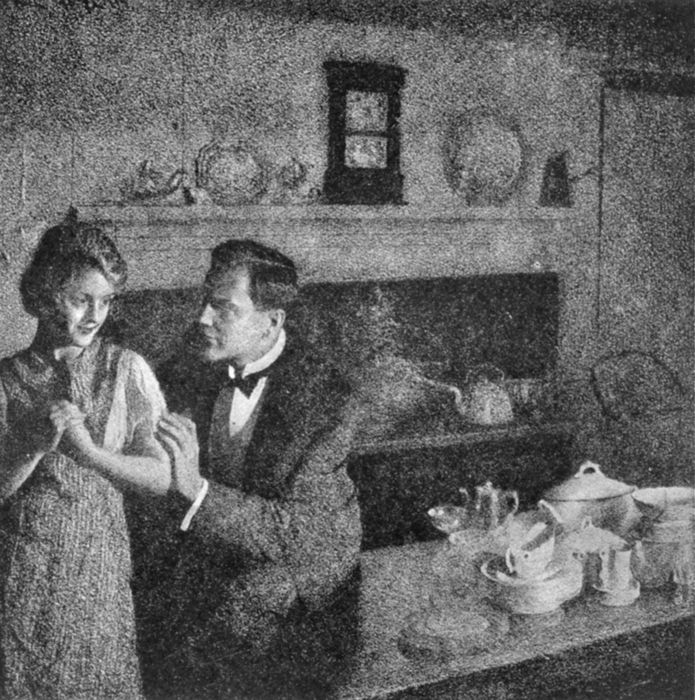
"And now you're all alone, sir," she replied.
"Absolutely alone."
She was still pattering about the kitchen, putting the last things to rights, but—or so it seemed to Crane—a little busier than her occupation warranted.
"They left early, sir, didn't they? But then it did not seem to me that they were really enjoying themselves, not even Mr. Lefferts, though he is such an amusing gentleman. Every one seemed sad, sir, except you."
"I was sad, too, Jane-Ellen."
"Indeed, sir?"
"Something was said at dinner that distressed me deeply."
"By whom, sir?"
"By you."
She did not stop her work nor seem very much surprised, but of course she asked what her unfortunate speech had been.
"I was sorry to hear you say you believed in Miss Revelly's triple engagement."
At this she did stop short, and immediately in his vicinity. "But I did not know you knew Miss Revelly."
"Yet I do."
"And when I was describing her—"
"It was as if I saw her before me."
"I am sorry I said anything about a friend of yours, sir. I had supposed she was quite a stranger to you."
"Sometimes it seems to me, too, as if she were a stranger," Crane answered. "Each time I see her, Jane-Ellen, she seems to me so lovely and wonderful and miraculous that it is as if I saw her for the first time. Sometimes when I am away from her it seems to me quite ridiculous to believe that such a creature exists in this rather tiresome old world, and I feel like rushing back from wherever I am to assure myself that she isn't just a creation of my own passionate desire. In this sense, I think she will always be a stranger, always be a surprise to me even if I should have the great felicity of spending the rest of my days with her. Does it bore you, Jane-Ellen, to hear me talking this way about my own feelings?"
Jane-Ellen did not answer; indeed something seemed to suggest that she could not speak, but she shook her head and Burton went on.
"So you see why it distressed me to hear from so good an authority as yourself that she had already engaged herself three times. It is not that I am of a jealous nature, Jane-Ellen, but when I ask her to be my wife, if she should say yes, I should want to feel sure that that meant—"
"Oh, Mr. Crane!" said Jane-Ellen, "I said that to make Mr. Reed angry."
"And there was no truth in it?"
There was a pause. Jane-Ellen looked down and wriggled her shoulders a little.
"Well," she admitted, "there was some truth in it. They were not exactly engagements. We think in this part of the world that there's something almost too harsh in a flat no—oh! the truth is," she added, suddenly changing her tone, "that girls don't know what they're doing until they find that they have fallen in love themselves."
"And do you think by any chance that this revelation may have come to Miss Revelly?"
"I know right well it has," answered Jane-Ellen.
"Oh, my dear love!" cried Crane and took her into his arms.
The kitchen clock, loudly ticking, looked down upon them on one side, and Willoughby, loudly purring, looked up at them from the other, and a good deal of ticking and purring was done before Claudia broke the silence by saying, like one to whom a good idea has come rather late:
"But I never said it was through you that the revelation came."
"You mustn't say that it hasn't even in fun—not yet."
"When may I?"
"When we've been married five years."
Sometime later, when, that is to say, they had talked a little longer in the kitchen, and then shut it up for the night, and had gone and sat a little while in the parlor so that he might realize that she really was Miss Claudia Revelly, and they had sat a little while in the office so that she might act out for him the impression he had made on her during that first famous interview when he had reproved her conduct, when all these important conversations had taken place, Crane at last took her hand and said gravely: "I mustn't keep you up any longer. Good night, my darling." And he added, after an instant, "I'm so glad—so grateful—that your mind doesn't work like Reed's and Tucker's."
"Like theirs—in what way?"
"I'm glad you haven't thought it necessary to make any protest at our being here alone."
A slight motion of his beloved's shoulders told him she was not fully at one with him.
"How foolish, Burton, of course I trust you absolutely, only—"
"Only what—"
She evidently felt that it was a moment when something decisive must be done, for she came and laid her head, not on his shoulder, but as near as she could reach, which was about in the turn of his elbow.
His arm was coldly limp. "Only what?" he repeated.
"Only we're not really alone."
"What do you mean, Claudia?"
"They're all here—my brothers and sister."
"What, Smithfield, and Lily, and even Brindlebury?"
She nodded in as much space as she had.
"Where are they?" he asked.
"They're playing Coon-Can in the garret. And oh," she added with a sudden spasm of recollection, "they'll be so hungry! They haven't had anything to eat for ages. I promised to bring them something as soon as the house was quiet, only you put everything out of my head."
"We'll give them a party in the dining-room—our first," said Crane. "I'll write the invitation, and we'll send Lefferts to the garret with it."
"Don't you think I'd better go up and explain?" said Claudia.
"The invitation will explain," answered Burton. It read: "Mr. Burton Crane and Miss Claudia Revelly request the pleasure of the Revellys' company at supper immediately."
They roused Lefferts, who had by this time fallen into a comfortable sleep. "Just run up and give this note to the people you'll find in the garret, there's a good fellow," said Crane.
Lefferts sat up, rubbing his eyes. "The people I'll find in the garret," he murmured. "But how about the little black men in the chimney, and the ghosts who live in the wall? This is the strangest house, Crane, the very strangest house I ever knew." But he took the note and wandered slowly upstairs with it, shaking his head.
On the landing of the second story, his eye caught the whisk of a skirt, and pursuing it instantly, he came upon Lily. He cornered her in the angle of the stairs.
"Hold on," he said, "I have a note for you, at least I have if you are one of the people who live in the garret."
Lily, knowing nothing of the explanation that had taken place between Reed and Crane, was not a little alarmed at being thus caught in a house from which she had been so recently dismissed. She did not think quickly in a crisis, and now she could find nothing to say but "I don't exactly live in the garret."
"How interesting it would be," observed Lefferts, "if you would sit down here on the stairs and tell me who you are."
"There's nothing to tell," said Lily, wondering what she had better admit. "I'm just the housemaid."
"Oh," cried Lefferts, "then there are lots of things to tell. I have always wanted to ask housemaids a number of questions. For instance, why is it that you always drop the broom with which you sweep the stairs at six in the morning? Why do you fancy it will conduce to any one's comfort to shut the blinds and turn on all the lights in a bedroom on a hot summer evening? Why do you hide the pillows and extra covering so that one never finds them until one is packing to go away the next morning? If you are a housemaid, you do these things; and if you do these things, you must know why you do them."
Lily smiled. "I'm afraid I was a very poor housemaid," she answered. "Anyhow, I'm not even that any more. I was dismissed."
"Indeed," said Lefferts. "Now that must be an interesting experience. I have had several perfectly good businesses drop from under me, but I have never been dismissed. Might I ask what led to it in your case?"
A reminiscent smile stole over Lily's face. "Mr. Crane dismissed me," she said, "for saying something which I believe he thought himself. I called Mrs. Falkener an old harridan."
Lefferts shouted with pleasure.
"If Crane had had a spark of intellectual honesty, he'd have raised your wages," he said. "It's just what he wanted to say himself."
"Oh! I was glad to be dismissed," returned she. "I never approved of the whole plan anyhow." And then fearing she had betrayed too much, she added, "And now you might tell me who you are."
"My name is Lefferts."
"Any relation to the poet?"
It would be impossible to deny that this unexpected proof of his fame was agreeable to Lefferts. The conversation on the stairs became more absorbing, and the note was less likely to be delivered at all.
In the meantime Claudia, while setting the table in the dining-room, had sent Crane down to the kitchen floor to get something out of the ice-box. As Crane approached this object about which so many sentimental recollections gathered, he saw he had been anticipated. A figure was already busy extracting from it a well-filled plate. At his step, the figure turned quickly. It was Brindlebury.
Even Brindlebury seemed to appreciate that, after all that had occurred in connection with his last departure, to be caught once again in Crane's house was a serious matter. It would have been easy enough to save himself by a confession that he was one of the Revellys, but to tell this without the consent of his brother and sisters would have been considered traitorous in the extreme.
He backed away from the ice-box. "Mr. Crane," he said, with unusual seriousness, "you probably feel that an explanation is due you." And there he stopped, not being able at the moment to think of anything to say.
Crane took pity on him. "Brindlebury," he said, "it would be ungenerous of me to conceal from you that our relative positions are reversed. At the present moment the power is all in your hands. Have a cigarette. I believe you used to like this brand."
"Only when I had smoked all my own."
"You see, Brindlebury, it is not only that I am obliged to forgive you, I have to go further. I have to make up to you. For the truth is, Brindlebury, that I want to marry your sister."
"You want to marry Jane-Ellen?"
"More than I can tell you."
"And what does she say?"
"She likes the idea."
"Bless my soul! you are going to be my brother-in-law."
"No rose without its thorn, I understand."
The situation was too tempting to the boy's love of a joke. He seated himself on the top of the ice-box and folded his arms.
"I do not know," he said, "that I should be justified in giving my consent to any such marriage. Would it tend to make my sister happy? The woman who marries above her social position—the man who marries his cook—is bound to regret it. Have you considered, Mr. Crane, that however you may value my sister yourself, many of your proud friends would not receive her?"
"To my mind, Brindlebury, these social distinctions are very unimportant. Even you I should be willing to have to dinner now and then when we were alone."
"The deuce you would," said Brindlebury, and added, "but suppose my sister's lack of refinement—"
"I can't let you talk like that even in fun, Revelly," said Crane. "Get off your ice-box and let us go back to Claudia."
"Ah, you knew all along?"
"I have suspected for some time. Reed told me this evening."
But when they reached the dining-room, Claudia was not there. She had gone herself to tell her news to her brother Paul. He was sitting alone in the garret with the remnants of the game of Coon-Can before him. Claudia came and put her hand on his shoulder, but he did not move.
"Do you know what I have made up my mind to do?" he said. "I mean to go and make a clean breast of this to Crane. The game is about up, and I don't think he's had a square deal. He's a nice fellow, and I'd like to put myself straight with him."
Claudia remained standing behind her brother, as she asked, "You like him, Paul?"
"Very much indeed. I think he's behaved mighty well through all this. Don't you like him?"
There was an instant's pause, and then Claudia answered simply:
"I love him, Paul."
Her brother sprang to his feet. "Don't say that even to yourself, my dear," he said. "You don't know what men of his sort are like. Spoilt, run after, cold-blooded. He's not like the men you've ruled over all your life—"
"No, indeed, he's not," said Claudia.
"My dear girl," her brother went on seriously, "this is not like you. You must put this out of your head. After all, that oughtn't to be very hard. You've hardly known the man more than a few days."
"Paul, that shows you don't know what love is. It hasn't anything to do with time, or your own will. It's just there in an instant. People talk as if it were common, as if every one fell in love, but I don't believe they do—not like this. Look at me. I've only known this man as you say a little while, I've only talked to him a few times, and some of those were disagreeable, and yet the idea of spending my life with him not only seems natural, but all the rest of my life—you and my home—seem strange and unfamiliar. I feel the way you do when you've been living abroad hearing strange languages and suddenly some one speaks to you in your own native tongue. When Burton—"
"Burton?"
"Didn't I tell you we're engaged?"
"My dear Claudia, you must admit we don't really know anything about him."
"You have the rest of your life for finding out, Paul."
They went downstairs presently to supper—a meal that promised to be a good deal more agreeable than dinner had been. For all Paul's expressed doubts, he had every disposition to make himself pleasant to his future brother-in-law, and even Lily had felt his charm. Lefferts, the only person in the dark as to the whole situation, served as an excellent audience. All four recounted—together and in turn—the whole story, from the moment when the idea had first occurred to Claudia, at eleven years of age, that she would like to learn to cook, down to the subtlest allusion of that evening's dinner-table.
Then suddenly there was a loud peal at the front door-bell. Every one knew instantly what it was—Reed returning to make one more effort to save Claudia's reputation.
"Well," said Paul, sinking down in his chair and thrusting his hands still deeper into his pockets, "I shan't let him in. My future depends on my getting over the habit of answering bells."
"Same here," said Brindlebury.
"I certainly shan't open the door for the man," said Crane, "and Claudia shall go only over my dead body."
Again the bell rang.
Lily rose. "I shall let him in," she said, "I think you are all very unjust to Randolph."
Claudia smiled as her sister left the room.
"There," she said, "that's all right. No one has such a good effect on Randolph as Lily has. In fifteen minutes he will be perfectly calm and polite. In half an hour she will have persuaded him he likes things better the way they are."
"I should think," said Lefferts, glancing at Claudia, "that it might take her a little longer than that."
It did take her a little longer.
THE END
ZANE GREY'S NOVELS
May be had wherever books are sold. Ask for Grosset & Dunlap's list
THE LIGHT OF WESTERN STARS
A New York society girl buys a ranch which becomes the center of frontier warfare. Her loyal superintendent rescues her when she is captured by bandits. A surprising climax brings the story to a delightful close.
THE RAINBOW TRAIL
The story of a young clergyman who becomes a wanderer in the great western uplands—until at last love and faith awake.
DESERT GOLD
The story describes the recent uprising along the border, and ends with the finding of the gold which two prospectors had willed to the girl who is the story's heroine.
RIDERS OF THE PURPLE SAGE
A picturesque romance of Utah of some forty years ago when Mormon authority ruled. The prosecution of Jane Withersteen is the theme of the story.
THE LAST OF THE PLAINSMEN
This is the record of a trip which the author took with Buffalo Jones, known as the preserver of the American bison, across the Arizona desert and of a hunt in "that wonderful country of deep canyons and giant pines."
THE HERITAGE OF THE DESERT
A lovely girl, who has been reared among Mormons, learns to love a young New Englander. The Mormon religion, however, demands that the girl shall become the second wife of one of the Mormons—Well, that's the problem of this great story.
THE SHORT STOP
The young hero, tiring of his factory grind, starts out to win fame and fortune as a professional ball player. His hard knocks at the start are followed by such success as clean sportsmanship, courage and honesty ought to win.
BETTY ZANE
This story tells of the bravery and heroism of Betty, the beautiful young sister of old Colonel Zane, one of the bravest pioneers.
THE LONE STAR RANGER
After killing a man in self defense, Buck Duane becomes an outlaw along the Texas border. In a camp on the Mexican side of the river, he finds a young girl held prisoner, and in attempting to rescue her, brings down upon himself the wrath of her captors and henceforth is hunted on one side by honest men, on the other by outlaws.
THE BORDER LEGION
Joan Randle, in a spirit of anger, sent Jim Cleve out to a lawless Western mining camp, to prove his mettle. Then realizing that she loved him—she followed him out. On her way, she is captured by a bandit band, and trouble begins when she shoots Kells, the leader—and nurses him to health again. Here enters another romance—when Joan, disguised as an outlaw, observes Jim, in the throes of dissipation. A gold strike, a thrilling robbery—gambling and gun play carry you along breathlessly.
THE LAST OF THE GREAT SCOUTS,
By Helen Cody Wetmore and Zane Grey
The life story of Colonel William F. Cody, "Buffalo Bill," as told by his sister and Zane Grey. It begins with his boyhood in Iowa and his first encounter with an Indian. We see "Bill" as a pony express rider, then near Fort Sumter as Chief of the Scouts, and later engaged in the most dangerous Indian campaigns. There is also a very interesting account of the travels of "The Wild West" Show. No character in public life makes a stronger appeal to the imagination of America than "Buffalo Bill," whose daring and bravery made him famous.
Grosset & Dunlap, Publishers New York
KATHLEEN NORRIS' STORIES
May be had wherever books are sold. Ask for Grosset & Dunlap's list.
MOTHER. Illustrated by F. C. Yohn.
This book has a fairy-story touch, counterbalanced by the sturdy reality of struggle, sacrifice, and resulting peace and power of a mother's experiences.
SATURDAY'S CHILD.
Frontispiece by F. Graham Cootes.
Out on the Pacific coast a normal girl, obscure and lovely, makes a quest for happiness. She passes through three stages—poverty, wealth and service—and works out a creditable salvation.
THE RICH MRS. BURGOYNE.
Illustrated by Lucius H. Hitchcock.
The story of a sensible woman who keeps within her means, refuses to be swamped by social engagements, lives a normal human life of varied interests, and has her own romance.
THE STORY OF JULIA PAGE.
Frontispiece by Allan Gilbert.
How Julia Page, reared in rather unpromising surroundings, lifted herself through sheer determination to a higher plane of life.
THE HEART OF RACHAEL.
Frontispiece by Charles E. Chambers.
Rachael is called upon to solve many problems, and in working out these, there is shown the beauty and strength of soul of one of fiction's most appealing characters.
Ask for Complete free list of G. & D. Popular Copyrighted Fiction
Grosset & Dunlap, Publishers New York