ALLEN TRUE
Reading edition
COPYRIGHT 1911 F. C. GRABLE ALL RIGHTS RESERVED
THE KISTLER PRESS DENVER COLO.
CONTENTS.
PAGE
CHAPTER I.
The Old, the New, and the Ocean Between 1
CHAPTER II.
Coronado 14
CHAPTER III.
Light in the East 40
CHAPTER IV.
Lieutenant Pike 54
CHAPTER V.
The Lost Period 75
CHAPTER VI.
Major Long 85
CHAPTER VII.
The Pioneers 99
CHAPTER VIII.
Christopher Carson and His Contemporaries 106
CHAPTER IX.
General Fremont and the Mormons 125
CHAPTER X.
Opportunity 143
CHAPTER XI.
A Vanishing Race 153
CHAPTER XII.
The Lustre of Gold 171
CHAPTER XIII.
Some Men of Visions 184
CHAPTER XIV.
The Stone Which the Builders Rejected 222
ILLUSTRATIONS.
A Glimpse of Estes Park Frontispiece
Face Page
CHAPTER I.
The Ocean Explorer 1
CHAPTER II.
Coronado Before a Zuni Village 16
CHAPTER IV.
(a) Pike and His Frozen Companion 66
(b) One of the Approaches to Cheyenne Mt. 74
CHAPTER V.
The Trapper 78
CHAPTER VI.
The Buffalo Hunter 94
CHAPTER VII.
Pioneers and Prairie Schooner 110
CHAPTER VIII.
A Government Scout 126
CHAPTER IX.
Indians Watching Fremont's Force 134
CHAPTER X.
Ventura, Historian of Taos Indians 142
CHAPTER XI.
(a) Indian Chief Addressing the Council 158
(b) Winnowing Grain 166
CHAPTER XII.
Making a Clean-up 174
DEDICATED
To the Pioneers of Colorado:
Whose work in laying the foundation of the magnificent superstructure of our great State, as Abraham Lincoln said of the heroes of Gettysburg, "is far beyond our poor power to add or detract."
PREFACE.
It is Emerson's beautiful thought that all true history is biography, and that men are but the pages of history. In felicitous language the author has pictured a period that is indeed the bright romance of American history. It is the story of the discovery of a new Continent in the Western Seas; the story of a graceful and cultured people of a mighty world-power in the Fifteenth Century; the story of the dream of a great Western Empire to be founded in the New World, where would be revived all the pomps and chivalries of Castile's ancient court; the story of the fading of that dream in the splendor of the great world-idea of the self-government of man carried by the Pilgrim Fathers to Plymouth Rock in 1620; the story that in the great drama of life man is ever changing from the old into the new, and from the bad into the better in unceasing, unchanging, inevitable evolution; the story of early Colorado, whose ancient Capital, Santa Fe,—in the sense that Colorado is a part of the old Spanish country—was the first white settlement west of the Floridas upon all this Western Continent within the present domain of the United States.
But more than all, it is a story of the human touch of those still living and of great empire builders not long since passed away, whose "hands bent the arch of the new heavens" over our beloved State of Colorado; whose eyes were filled with far-away visions and their hearts with sublime faith; pioneers and history makers of whom we would say as Cinneas said when asked by his master Pyrrhus after his return from his Embassy at Rome, "What did the Roman Senate look like?"
"An assembly of Kings!" replied Cinneas.
Wendell Phillips, in the greatest of all his lectures, pictures the "Muse of history dipping her pen in the sunlight and writing in the clear blue" above all other names the name of his hero "Toussaint l'Ouverture." The author in these pages which so graphically portray the early history of our State would not write the name of Colorado above any sister state; but we can catch between his lines the deep undertones of the music of the Union, which overmaster all sectional notes in the thought, that Colorado is a glorious part of it all.
And so it is enough that we read in the title of this book these magic words, as if traced in the clear sunlight of our mountain skies, "Colorado—The Bright Romance of American History."
J. F. Tuttle, Jr.
COLORADO—
THE BRIGHT ROMANCE OF AMERICAN HISTORY
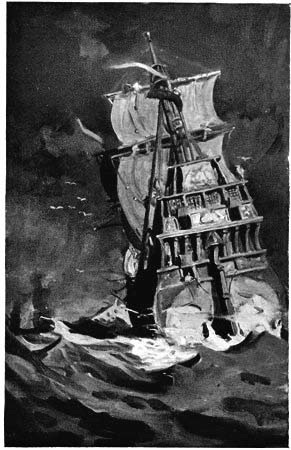
The Ocean Explorer.
CHAPTER I.
THE OLD, THE NEW, AND THE OCEAN BETWEEN.
1504 The great Queen Isabella was dead. She had died amidst the splendor of the richest and most powerful Court on earth, beloved by some for her noble qualities, and execrated by others for her tyrannical laws, for the heartlessness and cruelty she had practiced, for the wars she had kindled, and for the lives she had sacrificed. Because of the turbulence of the elements, the superstitious believed that her unconquerable spirit refused to be tranquilized even by death. Darkness lay upon the world, and the slowly moving funeral cortege made its way the three hundred miles to Granada, menaced by the lightning's flash, and accompanied by the thunder's roar, the rain and the hurricane, and the floods which swept men and horses to their death. At last, after thirty years of a masterful and memorable reign, Isabella lay at rest in the marvelously beautiful Alhambra, the burial place of her choice which she had wrested from the Moorish Kings. And Ferdinand ruled in her stead.
1506 Less than two years, and there was another notable death in Spain. The far-seeing eyes of a kingly man looked out upon the world for the last time. The active hands of a great navigator lay still, folded over the courageous heart that had long been broken; the heart that had been thrilled by the acclaim of the populace, and then chilled by the frowns of its sovereigns; the hands that had been bedecked with jewels by Ferdinand and Isabella, and later laden by them with chains. Columbus, the admiral of the ocean, who had joined two worlds by his genius and accomplished an event whose magnitude and grandeur history can never equal, and who had filled the center of a stage, brilliant with the famous actors of his time, had died; died in poverty and neglect; instead of chimes chanting a requiem in his praise, there was the rattle of the chains his hands had worn, as they went down into his sepulchre for burial with him according to his wish. Even his grave remained unmarked for ten years, until public opinion forced Ferdinand to a tardy recognition of his duty in the erection of a monument in honor of one of the greatest men of any age; a man great in thought and great in action; a man with such a mighty faith that we stand appalled at its mightiness!
Isabella left a united country; a country at the pinnacle of greatness. She left a highly organized army; an army wrought out of a fragment of incompetency. She raised the standard of science and the arts, and advanced the cause of morality. But the greatest and most enduring monument she erected was the result of the slight encouragement and scant help that she gave to the enthusiastic Italian mendicant, who became the founder of a New World and whose fame will continue undimmed to the end of time.
1516 "The King is dead" fell upon Ferdinand's unhearing ears. "Long live the King" greeted the advent of Charles, his successor. Charles, who was the son of the unfortunate Joanna, daughter of Ferdinand and Isabella; Charles I, King of Spain; Charles V, Emperor of Germany; Ruler over the kingdom of Naples; Monarch of the New World. Power, such as the world has seldom seen, centered in this man; an empire so vast that it encircled the globe, and upon whose domain military activities never ceased. The cruelties of Spain are proverbial, and they reached their climax under the rule of Ferdinand, Isabella and Charles; and under them the decadence of their nation began, which in four hundred years has never ceased. Now, shorn of every dependency, its power forever destroyed, it lies crushed, humiliated and broken by the greatness of its fall.
And here this sketch leaves Old Spain and we sail away across the ocean five thousand miles, to the New Spain of that period, in a ship whose sails flap lazily in the breeze, taking more weeks then than days now by the modern methods of this enlightened age.
1519 Hernando Cortez sprang from a noble but impoverished family. Educated for the law, he chose an adventurous life instead, and at the age of nineteen left Spain for San Domingo to try his fortunes in the New World, resulting in his brilliant conquest of Mexico; a country whose early history we can only imagine. The unknowable is there; for its secrets lie buried beneath the weight of centuries. Tragedy is there; for what derelict, never heard of more, dropped in from over the seas and cast its human wreckage on those unknown shores for the beginning of a nation? Who were those who may have been lost to home and friends and wandered in from Asia over that narrow strip of land long ago submerged? Whence they came, whatever their nation or color, they were human beings, with thoughts and affections like ours, whose beginnings we can never fathom. They grew in numbers, had flocks and herds, and gold and jewels. They had tribal governments, with differing customs and languages. They had the wandering habit. The streams, the mountains, and the plains beckoned them and they came and went, happy, care-free and prosperous. Some one among them said: "Let us all come together and unite as a people; establish a uniform government; build a city, and select some one of our number to rule over us." And it was done. Mexico City was built and became the Capital. Montezuma was made the ruler. They had laws and Courts of Justice; they had well-constructed and highly-decorated buildings, with architectural features the equal of some European structures prized for their beauty and durability. Their streets were laid out symmetrically, and their parks and landscape gardening added to the city's attractiveness. They had a system of canals and well-developed agriculture; an organized army and thoroughly equipped ships. Whence came this high civilization? We can never know. We only know that it existed. Two million people lived in and adjacent to Mexico City. They were rich, intelligent and contented, until the coming of Cortez; and when he reached the shores of Mexico in the Spring of 1519 it was a memorable day for them. He came in ten ships with six hundred Spanish soldiers. He disembarked, and when the last man was ashore and all the ammunition and guns and supplies were landed, he performed a feat of courage bordering on the sublime. He set his ships on fire, and he stood with his resolute men and saw them burn to the water's edge, knowing that the flame and smoke and destruction meant for each that he must conquer or die. And they marched away, a handful against a host, and they won!
But the fall of Mexico, like the fate of most nations, came from within and not from without. What could six hundred do against a united two million. That was where Cortez shone. To create discord, distrust and jealousy; to make them fight each other; to unite the disaffected under his own banner, was the work of a diplomat and general, and he was both. To their everlasting disgrace, the dissatisfied of the native race accomplished for Cortez the downfall of their own nation. And when, two years after he began his destructive warfare, the City of Mexico had been utterly destroyed; when a race had been subjugated; had been stripped of its vast treasure of gold and jewels for the greater glorification of the luxurious Court of Spain; had lost thousands by slaughter; then, and not till then, did the insurgents know that they had encompassed their own ruin. They were enslaved by the Spaniards. The last chapter in their national life was written. The Aztecs, as a people, were no more. They were given the name of Mexicans by the Spaniards, for "Mexitl" the national War God of the native race. Mexicans they have continued to this day, and Cortez as Captain General ruled over the Mexican Territory which he called "New Spain." He set four hundred thousand of the enslaved natives to rebuilding the City of Mexico, but their hearts were in the ruins of the old city, and not in the building of the new—for Cortez saw to it that there should be nothing in the new Spanish city that would remind them of the ancient grandeur of the old. Ten years after its completion there were not a thousand people in it. The old population was melting away, dying off from over-work in the mines to which they had been driven, and where they sickened from disease and hunger and heart yearning for the families from whom they had been forcibly separated, while nearly seven million dollars a year of their earnings were being sent to Spain, taken from the richest silver mines in all the world.
You were great Empire builders, oh Spain! But your wanton cruelty to mankind will forever cloud your glory as the eclipse darkens the sun! You permitted the Inquisition! You pitted strength against helplessness, burned thousands alive, and confiscated their property! You permitted the slaughter of twelve hundred thousand human beings in the West Indies, and never heard their pitiful cry, until the lack of earnings ceased to swell the income of the Crown, and then you carried captives from the mainland to take the place of the dead! You permitted the institution of the American slave trade, which only ended at Appomattox, with the destruction of hundreds of thousands of American soldiers, and millions of money!
The power and fame of Cortez had grown beyond the limit set by the Crown of Spain. Every forceful and successful man in the Dominion of Spain was a marked man; not marked for preferment and encouragement, but marked for humiliation and disgrace. The battles that Cortez had won for the King were forgotten; the treasure he had sent home counted for naught; and for the territory he had subjugated, there was no appreciation. His authority was ended. An officer and soldiers came from Spain to take him back, not with honor, but in ignominy. He arrested the officer, and induced the soldiers to join his army. He was so powerful that he thought he could be King of the New World. Finally, threats and promises secured his peaceable return to Spain, where all promises were broken, and his life was tempest-tossed until he died.
1528 Then Nuno de Guzman was named Governor General of New Spain. He started out to duplicate the successes of Cortez, whose ability he lacked, as well as the opportunity. He hunted in vain for another Mexico City to conquer and despoil. He pushed Northward hunting for riches, slaughtering the natives, burning their villages, and laying waste their country. He conquered a great territory on the western coast of Upper Mexico, along the Gulf of California, which he called "New Gallicia." His rule was so ruthless, cruel and desolating, that even Spain, hardened as she was to suffering, was shocked with his barbarous persecution of the natives, and after seven years, a warrant was sent out from Spain for his arrest and trial, on charges of inhuman cruelty. He was deprived of his office, taken to Mexico City, held there a prisoner for several years, and was then returned to Spain.
1535 Don Antonio de Mendoza, known as the "Good Viceroy," succeeded to the rule of Mexico, and put in practice a new policy, one not before tried in the New World, that of kindness. It had come too late for many, for the dead were everywhere, and the living had settled into a degree of hopelessness that a whole decade of kind treatment could do little toward counteracting. Three hundred and seventy-six years have passed since that day, and the scars of those sixteen years of Spanish murder and plunder have not yet been removed.
With which our narrative ends as to the mis-rule of New Spain.
1536 Pamfilo de Narvaez had been made Governor of Florida in 1527 by the Spanish Government, with a grant to explore and colonize a vast territory bordering on the Gulf of Mexico. He outfitted in Spain, sailed to Cuba where he repaired his vessels, thence into the Gulf of Mexico, meeting with storms that drove him out of his course, and so confused his mariners that they lost their reckoning. Consequently, he was left by his ships with his three hundred men and horses on the coast of Florida, instead of on the coast of Texas, as he thought. They rode away into the wilderness and nearly all to their death. Their wanderings, hardships and sufferings, the mind cannot conceive nor the pen describe. They worked to the West and North, crossing rivers and swamps, plains and mountains, through heat and cold, hungry and finally starving when their last horse had been used for food, mistreated by hostile Indians, lost and in despair. Beating their spurs into nails, they made boats, and using the hides from their horses for sails, they were borne down one of the Gulf Rivers, and out into the swift ocean current where they were carried to sea and drowned—all save four. Eight years after they had disembarked on the Florida Coast, these four were found by some slave catchers, away up on the Coast of California, whither they had wandered, and taken to Mexico City. Their sufferings had been so great, that when they reached civilization, they could no longer appreciate comforts. They continued to sleep on the ground, to eat unwholesome food, and to cling to the primitive habits they had formed. Slavery had in the meantime become so common, that Mendoza bought of the three Spaniards the negro, Estevanico, to act as guide to the far North, to which country Mendoza proposed to send an expedition.
1539 Fray Marcos, a Priest from Italy, had been a participant in the conquest of Peru, was a historian and theologian, picturesque in appearance and language, and was next to Mendoza in power. He was selected to go North on a visit preliminary to the proposed expedition, with the negro as guide. Rumors were in the air, and growing all the time, of wonderful cities and untold treasure in the North. Even the three returned Spaniards, rested from their wanderings, hinted at the fabulous wealth of which they persuaded themselves they had heard. The tales grew with the telling, so that Fray Marcos felt that he must be able to verify these reports, which he did, with the result that when the Coronado expedition found they did not exist, he had the great misfortune to ever after be called the "Lying Monk."

CHAPTER II.
CORONADO.
1540 About four years after the death of Columbus at Valladolid, there was born at Salamanca, about sixty miles away, one who was to become an explorer in the world that Columbus had discovered. Francisco Vasquez de Coronado grew up to have ambitions of his own. He removed to New Spain, where he married Beatrice, the beautiful and accomplished daughter of King Charles' cousin. Her father, Alonzo Estranda, was the royal treasurer of the New Country. Even at that remote period those Spanish gentlemen had a way of coming across the seas and weighing their titles in the scales against the money, bonds and lands of the relatives of the prospective wife, in the process of which the wife did not apparently seem to be taken into account. Coronado received from the mother of Beatrice, a great landed estate that had come to her as a grant from the Crown. Then, too, they had a law in New Spain, that confiscated the property of a man if he failed to marry by a certain time. One who preferred poverty to matrimony, had his vast fortune taken from him, and given to Coronado, which was very bad for one, and very pleasant for the other. So Coronado started out on his career very rich. He was made an officer in the Spanish army, and almost immediately attracted attention to himself. The negroes in the mines at Ametepeque mutinied, and set up a king for themselves, in order that the wealth which they were producing might become the property of their own king and themselves, instead of being sent to the Court of Spain. The promptness with which Coronado shot many of them to death and took their king away, shows that he was neither lacking in decision nor initiative even at the very early age of twenty-seven. A year later, 1538, he received the appointment of Governor of New Gallicia, the country in the subjugation of which, Guzeman the Viceroy of New Spain, had accomplished his own undoing. Coronado had helped Fray Marcos and his negro guide on their way through his territory as they passed northward. They went unattended and unprotected. It had seemed to Mendoza that Fray Marcos, in his priestly capacity, might accomplish more for the Crown than could the royal troops; alone he could gain the confidence of the Indians and learn of their strength and treasure. So he went without weapons, and with only a few friendly Indian carriers.
Spring turned to summer, and summer to autumn, and Estevenico, the negro guide, had become a memory only. The man who had so successfully faced the dangers of the wilds in his eight years of wanderings, was not to be so fortunate this time. He had an idea that he might become a person of importance himself, an explorer instead of guide, and reap the glory of the success of the trip. So at the first opportunity, he put his plans into practice. Fray Marcos had sent him on ahead for a few days of reconnoitering and then to wait. He reconnoitered, but he did not wait. Gathering an ever increasing number of the natives about him, he pressed on and Fray Marcos never did overtake him. He grew more arrogant all the time, until finally he was made prisoner by the Chief of one of the tribes, was tortured, put to death, his body cut into pieces and distributed as souvenirs among the tribes. Three hundred of his followers were killed, one escaping and bringing the news to Fray Marcos, who quickly began to retrace his steps, the Indians all the time becoming more threatening as he passed southward.
Coronado met the Monk as he returned, and accompanied him to Mexico City where he went to make what proved to be a much over-drawn report. Coronado had by this time become so enthusiastic over the possibilities of his own aggrandizement, and the wealth to be reaped from an expedition of conquest, that he proposed to Mendoza to pay the entire cost of the expedition himself, if he were allowed to head the party and share in its results. Mendoza was too guardful of his own prestige and prospects, and of the interests of the Crown, to accept the offer. But he appointed Coronado, General of the Army, to the disappointment of a number of its prominent members who desired the position for themselves. Acting upon the suggestion that had come from Coronado, Mendoza mortgaged all of his estates and joined his money to that of the Crown to pay the tremendous expense of the expedition. Because of the number engaged, the extent of the preparations, the time involved and the distance traversed, this is counted as the most notable exploration party ever engaged in exploiting the North American Continent. It comprised a picked company of three hundred Spanish soldiers and horsemen, eight hundred seasoned Indian warriors, and two ships under Alercon carrying extra supplies of food and ammunition, which were to take the ocean route and be subject to call. All being in readiness, the army marched, the ships sailed, the trumpets sounded and the people shouted, all on that memorable morning of February 23, 1540.
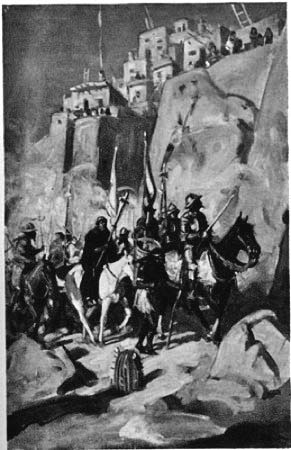
Coronado Before One of the Zuni Villages.
Up from Compostela, their starting point, northwest of Mexico City; up along the Pacific Coast; up through New Gallicia and on by the shore of the ocean they pushed, bearing inland to the east and away from their ships which they were never to see again. At last they passed through Sonora, across the northernmost boundary of Mexico, and were swallowed up in the wilderness of Arizona. Like the hunter traveling far for his prey, the expedition on July 7th found its quarry, and began the slaughter by the capture of the first of the "Seven cities of Cibola." Coronado named the captured city Granada, the city in Spain that was the birth place of Mendoza, and the burial place of Queen Isabella. The remaining six cities were much like the first; inhabited by the Zuni Indians, poor, ignorant and uncivilized. These were the cities which Fray Marcos had reported to be the rivals of the famous City of Mexico. They proved to be simple adobe houses, instead of imposing structures with classical architecture. The people were numbered by hundreds instead of by thousands, and were living in abject poverty instead of wealth. The outraged and indignant army brought Fray Marcos before them, and told him "Annanias estaba hambra vere fies a lado di te." The Monk was greatly chagrined and crest-fallen; his punishment consisted only in his being banished from the army and sent back to Mexico in disgrace. But would he have returned northward with the army if he thought he was deceiving them? Doubtless as he viewed the country of Cibola from a distance, what he described seemed to him true, though he may not have scrupulously controlled his imagination. The name Cibola is from Se-bo-la, meaning cow or buffalo. These seven cities were located in Upper New Mexico about one hundred miles west of Albuquerque.
General Coronado having been badly injured in battle, the army went into camp pending his recovery, and detachments were sent out on trips of discovery.
Alvarada with a party went east and found the Rio Grande River, lined with eighty native villages, and about 15,000 Indians. Crossing the river, he came out upon the great buffalo plains of northern Texas, and then made his way back to the army.
Maldonado had previously gone with a party to the ocean in fruitless search of the ships, but found marks made by Alercon on a tree, at the foot of which was a letter; in it they told of their arrival, of their sailing quite a distance up the Colorado River, of their finding that they were in a Gulf instead of on the Ocean, and that, not finding the army, they were starting on their return trip. There is no record of their ever having reached home. If they had been on the Ocean instead of in the Gulf of California, and could have sailed on North, and had discovered the mild climate of California and its luxuriant foliage, unquestionably Spain would have colonized that country, the Rocky Mountains would have been the dividing wall between Spanish Territory and that of the United States, and Dewey, instead of going to the Philippines to fight the Spanish fleet, would have bombarded the Spanish City of San Francisco and have sunk their ships at the Golden Gate. The Pacific Ocean was then unknown. It had only been discovered twenty years before, when Magalhaes in 1520 sailed into its South American waters, and called it "Pacific" because of its calmness as compared with the storms which he had just encountered.
Field Marshal Garcia Cardenas led a party westward, and found the Colorado River at the point now known as the Grand Canon of Arizona, where the river is seven thousand feet deep in the ground, and where the mighty rushing torrent is so far below, that it seems like a thread winding its way at the bottom of that wonderful gorge, to which the party tried in vain to descend. He was gone eighty days, and reported, upon his return, that the river was a barrier so frightful and insurmountable, that it would bar investigations to the westward forever.
It is a river that is eleven hundred miles long, and is formed by the union in Utah, of the Green River from Wyoming, and the Grand River from Colorado. It is navigable for five hundred miles, and its mighty volume pours unceasingly through a channel fifty feet deep, and thirteen hundred feet wide at the point in Mexico where it hurls its turbulent waters into the Gulf of California. The stupendous gorge where Cardenas touched the river, is two hundred and fifty miles long, and is made up of a maze of giant gorges. It is the most sublime spectacle on earth. Below the Niagara Falls is a tempestuous whirl-pool, seething, roaring, and dashing against the towering walls of granite that vie with the turbulence of the waters for the mastery. A thousand whirl-pools, more majestic and more inspiring, are gripped within the walls of the canons of the Colorado River. It is for this King of Rivers, that our State is named; a Spanish name, meaning "ruddy." In the naming of the river and the state, two extremes have met. In the river Colorado—is the labyrinthian terrifying chasm, filled with the terrific rush and deafening roar of the pounding waters, of the turbulent tidal waters laboring under the mighty swells from the tempestuous ocean. While in Colorado the State—there is peace, peace everywhere; the silent mountains, the quiet plains, the mellow skies, the sunny lakes, the balmy air, the murmuring streams—all soothe and charm and thrill, and life is all too short for the enjoyment of its perfections.
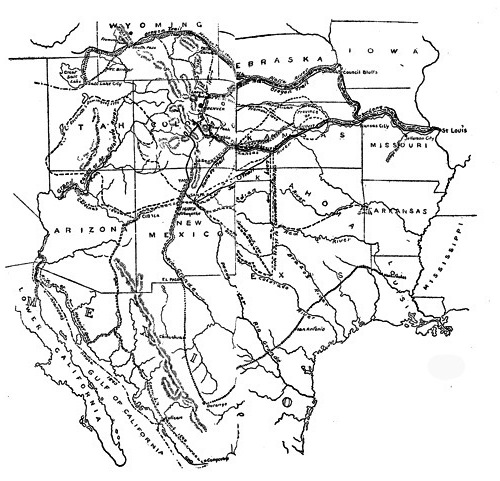
The army moved to the Rio Grande River and went into winter quarters, occupying the best of the houses of the natives whom they inhospitably turned out of doors to pass the winter. One of the Indians who had been taken prisoner by the Spaniards was a talkative person and told of a rich country far to the northeast, a country "filled with gold and lordly kings." It sounded good to the army, as just what they were seeking, and their enthusiasm grew as the winter passed. With the coming of Spring, April 23, 1541, Coronado began the march to the northeast with his whole excited army, guided by the Indian with the vivid imagination, whom they called the "Turk." After many days of travel with no result, and meeting different Indian tribes who said the guide's stories were untrue, and being repeatedly assured by other Indians that there was nothing to Turk's tales, the suspicions of the army became a certainty, and upon their insistent questions their guide yielded up his secret. To save his people, he was leading the army away on a far journey, in the hope that they would never get back, and if they did return, would be so weak and their horses so worn, that the natives could easily fall upon and destroy them. The work of the infuriated soldiers was cruel, swift and certain, and when it had ended, there on the ground lay the Indian, dead.
As die the heroes of all ages, so died this Indian guide. He died for his people. Coronado's army had invaded his country, turned his people out of their homes in midwinter, confiscated the supplies of their families, had killed some and imprisoned many. Leading the army away, out of reach of water and food, hoping to encompass its destruction, knowing that every step took him nearer to the death sure to be meted out to him, he moved stoically and unfalteringly to his fate. "Make way for liberty," cried Winkelreid, as he fell pierced by a dozen bayonets pinning him to the earth, while through the gap in the solid ranks of the enemy, poured his compatriots, sweeping Switzerland to its freedom—and his name will live forever. Just as nobly died the Indian on the western plains, but the wind that scattered his dust, blew into oblivion the remembrance of the heroic act of a humble, courageous, and self-sacrificing martyr!
The bewildered army halted for consultation. It was decided by Coronado that he would take thirty picked horsemen and proceed northeasterly on a tour of investigation, while the main army would return to the Rio Grande, to the point that had been the place of their winter quarters. He proceeded into Northern Kansas, and is supposed to have passed the boundary line between Nebraska and Kansas, and to have crossed the Platte River, whence he retraced his steps to the army, then at a place near the site of the present City of Albuquerque.
Upon his arrival he wrote a letter to the King of Spain, which is hereafter quoted. It is interesting to note how highly he regards the country of Quivira, which afterwards was called "Kansas," and which he likens to the soil of Spain. His description of the products of that section gives much information. The "cows," so frequently referred to in his letter, were the buffalo which we found just as plentiful when we came to settle the country. The Indians moved with the buffalo, and lived upon them, moving their tents along with the herds as they grazed northward in summer to escape the heat, mosquitoes and flies, and journeying south together in the winter, to escape the cold. The Indians knew no such word as buffalo, but called this greatly appreciated animal Ni-ai, which meant shelter or protector. The distance travelled by the expedition was measured by a footman trudging along beside a horseman, his steps being counted by the riders, seventeen hundred and sixty steps making a mile. They traveled forty-two days on their way to the Northeast, shortening the distance to thirty-five days for their return, and were twenty-five days in the country of Quivira. The distance traveled was three hundred leagues, which is about seven hundred miles. The same year that Coronado was in Eastern Kansas, the eminent Spanish warrior and explorer De Soto, back from his conquest of Peru with Pizarro, had discovered the Mississippi River, the Father of Waters, and ascended it from the Gulf of Mexico; there was only the State of Iowa between his exploring party and that of Coronado, though neither of them were aware of the fact.
"Holy Catholic Caesarian Majesty:
"On April 20 of this year (1541) I wrote to your Majesty from this Province of Tiguex, in reply to a letter from your Majesty, dated in Madrid June 11 a year ago * * * I started from this Province on the 23 of last April for the place where the Indian wanted to guide me. After nine days march I reached some plains so vast that I did not find their limit anywhere that I went, although I traveled over them for more than 300 leagues, and I found such a quantity of cows in these plains * * * which they have in this country, that it is impossible to number them, for which I was journeying through these plains until I returned to where I first found them there was not a day that I lost sight of them. And after 17 days' march, I came to a settlement of Indians who are called 'Querechos,' who travel around with these cows, who do not plant and who eat the raw flesh and drink the blood of the cows they kill and they tan the skins of the cows with which all the people of this country dress themselves here. They have little field tents made of the hides of the cows, tanned and greased, very well made, in which they live while they travel around near the cows, moving with these. They have dogs which they load, which carry their tents and poles and belongings. These people have the best figures of any that I have seen in the Indies. They could not give me any account of the country where the guides were taking me * * *
"It was the Lord's pleasure, that after having journeyed across these deserts 77 days, I arrived at the province they call Quivira to which the guides were conducting me and where they had described to me houses of stone with many stories and not only are they of stone but of straw, but the people in them are as barbarous as all those whom I have seen and passed before this. They do not have cloaks nor cotton of which to make these, but use the skins of the cattle they kill which they tan, because they are settled among these on a very large river * * * The country itself is the best I have ever seen for producing all the products of Spain, for besides the land itself being very fat and black, and being very well watered by the rivulets and springs and rivers, I found prunes like those of Spain * * * and nuts and very good sweet grapes and mulberries. I have treated the natives of this province and all the others whom I have wherever I went as well as was possible, agreeably to what your Majesty had commanded and they have received no harm in any way from me or from those who went in my Company * * * And what I am sure of is, that there is not any gold nor any other metal in all that country and the other things of which they had told me are nothing but little villages and in many of these they do not plant anything and do not have any houses except of skins and sticks and they wander around with the cows; so that the account they gave me was false, because they wanted to persuade me to go there with the whole force, believing that as the way was through such inhabited deserts, and from the lack of water, they would get us where we and our horses would die of hunger * * * I have done all that I possibly could to serve your Majesty and to discover a country where God our Lord might be served and the royal patrimony of your Majesty increased as your loyal servant and vassal. For since I reached the province of Cibola, to which the Viceroy of New Spain sent me in the name of your Majesty, seeing that there were none of the things there of which Fray Marcos had told, I have managed to explore this country for 200 leagues and more around Cibola and the best place I have found is this river of Tiguex, where I am now and the settlements here. It would not be possible to establish a settlement here, for besides being 400 leagues from the North Sea and more than 200 from the South Sea, with which it is impossible to have any sort of communication, the country is so cold as I have written to your Majesty that apparently the winter could not be spent here because there is no wood nor cloth with which to protect the men except the skins which the natives wear and some small amount of cotton cloaks. I send the Viceroy of New Spain an account of everything I have seen in the countries where I have been, and as Don Garcia Lopez de Cardenas is going to kiss your Majesty's hands who has done much and has served your Majesty very well on this expedition and he will give your Majesty an account of everything here as one who has seen it himself, I give way to him. And may our Lord protect the Holy Imperial Catholic person of your Majesty with increase of greater kingdoms and powers as your loyal servants and vassals desire. From this Province of Tiguex, Oct. 20 in the year 1541. Your Majesty's humble servant and vassal who would kiss the royal feet and hands.
(Signed) "Francisco Vasquez Coronado."
On August 5, 1540, Coronado wrote to Mendoza, the Viceroy of New Spain, a letter, of which a portion is introduced in these pages because of its reference to local conditions where the army wintered. The spelling in the letter to the King was changed for easier perusal, but the original quaint translation is preserved in the following, that the style may be observed. Both letters have been translated from the Spanish:
"It remaineth now to certifie your Honour of the seuen cities, and of the kingdomes and prouinces whereof the Father produinciall made report vnto your Lordship. And to bee briefe, I can assure your honour, he sayd the trueth in nothing that he reported, but all was quite contrary, sauing onely the names of the cities, and great houses of stone: for although they bee not wrought with Turqueses, nor with lyme, nor brickes, yet are they very excellent good houses of three or foure or fiue lofts high, wherein are good lodgings and faire chambers with lathers instead of staires, and certaine cellars vnder the ground very good and paued, which are made for winter, they are in maner like stooues: and the lathers which they haue for their houses are all in a maner mooueable and portable, and they are made of two pieces of wood with their steppes, as ours be. The seuen cities are seuen small townes, all made with these kinde of houses that I speake of: and they stand all within foure leagues together, and they are all called the kingdome of Cibola, and euery one of them haue their particular name: and none of them is called Cibola, but altogether they are called Cibola. And this towne which I call a citie, I haue named Granada, as well because it is somewhat like vnto it, as also in remembrance of your lordship. In this towne where I nowe remaine, there may be some two hundred houses, all compassed with walles, and I thinke that with the rest of the houses which are not so walled, they may be together fiue hundred. There is another towne neere this, which is one of the seuen, & it is somewhat bigger than this, and another of the same bignesse that this is of, and the other foure are somewhat lesse: and I send them all painted vnto your lordship with the voyage. And the parchment wherein the picture is, was found here with other parchments. The people of this towne seeme vnto me of a reasonable stature, and wittie yet they seem not to bee such as they should bee, of that judgment and wit to builde these houses in such sort as they are. For the most part they goe all naked, except their priuie partes which are couered: and they haue painted mantles like those which I send vnto your lordship. They haue no cotton wooll growing, because the countrye is colde, yet they weare mantles thereof as your honour may see by the shewe thereof: and true it is that there was found in their houses certaine yarne made of cotton wooll. They weare their haire on their heads like those of Mexico, and they are well nurtured and condicioned: And they haue Turqueses I thinke good quantitie, which with the rest of the goods which they had, except their corne, they had conueyed away before I came thither: for I found no women there, nor no youth vnder fifteene yeres olde, nor no olde folkes aboue sixtie, sauing two or three olde folkes, who stayed behinde to gouerne all the rest of the youth and men of warre. There were found in a certaine paper two poynts of Emralds, and certaine small stones broken which are in colour somewhat like Granates very bad, and other stones of Christall, which I gaue one of my seruants to lay vp to send them to your lordship, and hee hath lost them as hee telleth me. Wee found heere Guinie cockes, but fewe. The Indians tell mee in all these seuen cities, that they eate them not, but that they keepe them onely for their feathers. I beleeue them not, for they are excellent good, and greater then those of Mexico. The season which is in this countrey, and the temperature of the ayre is like that of Mexico: for sometime it is hotte, and sometime it raineth: but hitherto I neuer sawe it raine, but once there fell a little showre with winde, as they are woont to fall in Spaine.
"The snow and cold are woont to be great, for so say the inhabitants of the Countrey: and it is very likely so to bee, both in respect to the maner of the Countrey, and by the fashion of their houses, and their furres and other things which this people haue to defend them from colde. There is no kind of fruit nor trees of fruite. The Countrey is all plaine, and is on no side mountainous: albeit there are some hillie and bad passages. There are small store of Foules: the cause whereof is the colde, and because the mountaines are not neere. Here is no great store of wood, because they haue wood for their fuell sufficient foure leagues off from a wood of small Cedars. There is most excellent grasse within a quarter of a league hence, for our horses as well to feede them in pasture, as to mowe and make hay, whereof wee stoode in great neede, because our horses came hither so weake and feeble. The victuals which the people of this countrey haue, is Maiz, whereof they haue great store, and also small white Pease: and Venison, which by all likelyhood they feede vpon, (though they say no) for wee found many skinnes of Deere, of Hares and Conies. They eate the best cakes that euer I sawe, and euery body generally eateth of them. They haue the finest order and way to grind that wee euer sawe in any place. And one Indian woman of this countrey will grinde as much as foure women of Mexico. They haue no knowledge among them of the North Sea, nor of the Western Sea, neither can I tell your lordship to which wee bee nearest: But in reason they should seeme to bee neerest to the Western Sea: and at the least I thinke I am an hundred and fiftie leagues from thence: and the Northerne Sea should bee much further off. Your lordship may see how broad the land is here. Here are many sorts of beasts, as Beares, Tigers, Lions, Porkespicks, and certaine Sheep as bigge as an horse, with very great hornes and little tailes, I haue seene their hornes so bigge, that it is a wonder to behold their greatnesse. Here are also wilde goates whose heads likewise I haue seene, and the pawes of Beares, and the skins of wilde Bores. There is game of Deere, Ounces, and very great Stagges: and all men are of opinion that there are some bigger than that beast which your lordship bestowed vpon me, which once belonged to Iohn Melaz. They trauell eight dayes journey vnto certaine plaines lying toward the North Sea. In this Countrey there are certaine skinees well dressed, and they dresse them and paint them where they kill their Oxen, for so they say themselves.
(Signed) "Francisco Vasquez Coronado."
Emerging from the second wintering of the army on the Rio Grande, Coronado started in the Spring of 1542 with his disappointed soldiers on their return to Mexico City, where they arrived that Fall, and where they found grief corresponding to the gloom of the returning soldiers. Many had built their hopes on the result of the expedition, had borrowed money and given to those who were of the exploring party to make filings upon mines, and to pre-empt such treasure as could be found, as was the custom of those times. Mendoza was impoverished by the debts he had incurred in behalf of the expedition. Coronado instead of being a conquering hero, was greatly criticized, though not responsible for the disappointment attending his efforts. He reported to Mendoza who received him coldly. He returned to his province of New Gallicia, where he remained as Governor for a time and then resigned. Later we learn of the King sending a Commission over, to investigate the rumor that Coronado had vastly more than the allotted number of slaves working on his plantations.
Did Coronado discover Colorado? On the bench of the Supreme Court of the United States, there are nine judges, and the decision of five is final. If we were to apply that principle to this case, then we would unhesitatingly answer that the feet of Coronado were the first of any white man to tread the soil of Colorado and Kansas. Students of history differ in their opinion, but the majority believe that Coronado is the discoverer of Colorado. Much that has been written of this expedition has been lost. At the time of the massacre of the whites, and the destruction of the Missions at Santa Fe by the Indians, a great many Spanish manuscripts are supposed to have been burned, which might now throw light upon this question. In the monasteries of Old Spain there are many papers bearing upon the history of the New World, that are worn with age and buried in the dust and mould of cellars, many stories deep underground, that have not seen the light for centuries. These may someday be unearthed to answer positively our question. Scientific investigation is going on at this time under the direction and expense of Societies of Research of both Worlds. A map was issued by the Interior Department of the United States in 1908, that gives the supposed journeyings of Coronado and shows that he both went and returned through Colorado on his trip to Kansas. Other maps of writers give his journeyings both ways as following the old Santa Fe trail, which runs northeast and southwest along the Cimarron River, through the southeast corner of Colorado. So in either event, it is to be supposed that he was within the boundaries of our State, following either the Arkansas River or the Cimarron.
Wonderful to contemplate are the possibilities that might have arisen had the Coronado expedition been a success! Our country might have been settled by the Spaniards, and we might have been a Spanish speaking race, even after becoming strong enough to throw off our allegiance to the Crown of Spain; and Washington would not have been the Father of our Country. Government might have centralized between the Mississippi River and the Rocky Mountains, where the Capital might have been established. The Pilgrim Fathers might not have landed on the forbidding shores of New England, eighty years after Coronado's expedition started out from Compostela, and there might have been no tea thrown overboard into the harbor at Boston. Those grand forests of the middle and eastern states, of value now beyond computation, might have remained standing, instead of being devastated by fire and axe. Irrigation would have been early developed, the country would have been covered with cement-lined ditches, and every depression would have been a storage reservoir.
Coronado might have been the greatest man in the New World, and Coronado might have been King!
CHAPTER III.
LIGHT IN THE EAST.
1776 Two hundred and thirty-six years had passed since Coronado's gaily caparisoned army moved out from Compostela. The bright yellow leggings and rich green coats of the soldiers, their waving white plumes and coats of mail, had long since turned to rags and rust, while the bones of the troopers had crumbled to dust. With the defeat of their expedition, the curtain of silence descended upon this vast Rocky Mountain region. The Indian Chiefs whom Coronado fought had long been wrapped in the mantle of death, and their places had been filled by the children of their children's children. The buffalo herds and the Indian bands still roamed the plains together, and the tender calves grew strong and became the leaders of the herd. It was the endless procession of life and death, of strength and weakness, of growth and decay. The wild flowers bloomed, and shed abroad their fragrance; the trees budded and blossomed, and their leaves withered and fell; the earth was clothed in its carpet of green, that yellowed with the autumn's frosts; the period of seed time and harvest came, but there was no seed time and there was no harvest. The summer rains fell upon valley and plain, and the rivers ran unceasingly to the sea, as they had done for centuries, and as they will do until time shall be no more; rivers, born on the dome of the Great Divide, and nurtured by the clouds amongst which they nestle. Each season, the stately peaks stretched their arms aloft towards the heavenly orbs to receive their snow's feathery drapery that fell like a benediction over them. Mountains, radiant in their ever-changing hues of yellow and green, of purple and gold; mountains, whose breath was fragrant with the delicate perfume from their carpet of a thousand species of wild flowers; mountains, kissed by pearly rain drops, glowing with morning sun baths, draped in slumber-robes of silvery moon-beams—glorious, sunlit, sky-communing mountains, standing in their grandeur, silent, proud, eternal.
In Macaulay's eloquent and elevated treatment of the thirteenth century of English history, we find this pleasing sentiment, applicable to Colorado's rivers and mountains:
"The sources of the noble rivers which spread fertility over continents, and bear richly ladened fleets to the sea, are to be sought in the wild and barren mountain tracts, incorrectly laid down in maps and rarely explored by travelers."
We find similarity in our own uncharted streams and mountains; in the unapplied wealth of waters that our rivers bore to the seas; in the unwritten history of the Jesuit Fathers; in the romance of Spanish glory and Spanish defeat; in the tragedy of the red men; in the civilization that perished; in half a century's attainments in good government, in refining domestic influences, in Christianity, in intellectual growth, and in riches almost beyond computation.
Again we face the mysterious. Once more the names of Cortez and Montezuma meet, not as on the battle fields of Mexico that left one a conqueror and the other a prisoner; not as aliens and rivals, but in the friendly attitude of mutual interest and mutual trust. Montezuma led into battle a people whose beginnings can never be known. Montezuma County, Colorado, with Cortez as its County Seat, sheltered a pre-historic race, whose beginning and end we can never fathom. At the southwestern corner of our State, at the only spot in the United States where four states come squarely together, we find Utah, Arizona, New Mexico and Colorado, equally sharing in this unfathomable mystery. There, covering a stretch of country equal in extent to about eighty miles square, had lived a civilized people who followed the peaceful pursuit of agriculture, who farmed by irrigation and whose reservoirs were high up near the mountain tops. Their dwellings were amidst the cliffs along the canons tributary to the San Mancos and San Juan Rivers, as well as in the rocky and almost inaccessible gorges of those rivers themselves. The abandoned houses built of hand-dressed stone, are falling into ruins, but they still show painstaking care in their construction, and in their well-planned architecture. The decaying towns, towers and fortresses give every evidence of a state of preparedness for war. Whether these people were conquered, enslaved and carried into exile; whether they were warred upon by the marauding bands, and so weakened that they scattered and became lost; whether they may have been the very Aztecs, who, becoming more civilized and more prosperous, moved South, were finally subdued by Cortez and became the Mexican nation, are conjectures only, for those ancient foot prints have been forever submerged by the passing years.
A vast area of the country of the Cliff Dwellers has been made into a National Park and given the name of Mesa Verde. For three years the restoration of the principal ruins has been carried on by eminent scientists under direction of the General Government. Spruce Tree House, one of the restored dwellings, is over two hundred feet long and it is estimated that when inhabited, it sheltered about four hundred people.
In the East the light is breaking. A ray here and a ray there, at first, just the faintest touch of the awakening before the glorious bursting of the dawn. A voyager crossed the trackless seas, following Columbus; then another and another, all carrying the advance lights that were finally to illuminate the darkness and unfold the mysteries of a New World. It took one hundred years for nine voyagers on tours of discovery, scattered through the entire century, to sow the seeds of colonization along the Coast, which, when planted, failed to grow, withered and died. Much of the time of these navigators was spent in sailing up and down the eastern coast, seeking a channel through our Continent in search of the unknown, lying beyond.
Came John Cabot, an Italian Mariner, bearing the English Flag, authorized to take possession of any lands he found. Four of his ships went to the bottom and the son continued the discoveries started by his father. Came Cortereal from Portugal in 1501, who left signs of his visit along our Coast at various points between the Bay of Fundy and the coast of Labrador, and then his vessels and all on board plunged to the bottom. The following year a brother came with a searching party and they all found graves beneath the waves that for four hundred years have been sweeping over them. Another brother about to start to seek the others, was prevented by command of the King.
Came Ponce de Leon from Spain in 1512, having been with Columbus on his second voyage in 1493. He bore a patent from the King to what was supposed to be the marvellous Island of Bimini, which he renamed Florida, from "Pascua Florida," meaning in Spanish "Easter Sunday." Instead of finding a spring that the Indians claimed to possess great curative properties and supposed to be a fountain of perpetual youth, he found his death in an arrow wound from the Indians. Here he passed over the site of St. Augustine, which later became the oldest community in the United States, having been located in 1565.
Came Pineda from Spain in 1519, entering the Gulf of Mexico, sailing all along the Florida Coast, by Louisiana, past Texas, searching for the "Western Passage." Here he met Cortez, the Governor-General of New Spain. Came Narvaez in 1520, the Spanish slave gatherer, who lost his life on the trip, lost it in a bad cause. And then in 1524 came Verrazano, the Spanish Pirate and outcast. One hundred years later, when Spain sought to establish her claim to the country he had visited which might inure to her through his discovery, she said he was a very honorable gentleman, that her colors were flying at his prow, instead of the black flag of the Freebooter. Oh, Spain! Spain! The more I study you, the less I admire you! Then came Gomez in 1525 from Portugal commissioned to sail all the way along our coast from Newfoundland to Florida, in search of a channel through the American Continent to the Western Sea.
He was followed sixty years later by Greenville, a cousin of Sir Walter Raleigh, flying the English Flag. Raleigh's eyes were filled with visions of a golden future—a man of whom we would say in these days, that he always had an eye to the "main chance." "Whosoever commands the sea," he said, "commands the trade; whosoever commands the trade of the world, commands the riches of the world, and consequently the world itself." For a little practical expression of that philosophy, he threw his cloak down in the mud one day for his proud Queen to step upon. Even he little realized the wealth-product beneath its soiled folds, for from that little incident came the introduction of the potato into England. Raleigh became a great favorite of the Queen, and what he asked she granted. He asked of her a royal charter for his cousin, Sir Richard Grenville, and funds for an expedition to the New World. It resulted in those ships taking back to England the potato and tobacco. Forty-three years before, we sent them their Christmas dinner in the delectable wild turkey; we now gave them as an accompaniment, the mealy and nutritious potato. Came Davis in this same year of 1585, who discovered the Straits named for him, and also Falkland Islands, which he found in 1592.
And the century closed, with the lights going out all along the Atlantic Coast, for the attempts at colonization were failing. The roots of home-making would not take hold, with the buccaneers stirring up the savages to fight the colonists on one side, and the loneliness of the impassable sea terrifying them on the other.
The next century found Champlain in 1603, making his voyage to Canada, starting the French settlement at Quebec, in 1608, and sailing up the St. Lawrence and around the lakes, hunting for locations for settlements, and for a way to China. There was Lord de la Warr, coming over in 1607, and finding a little English settlement on the mainland at Jamestown in Virginia. The same year came the capable Captain Smith, a soldier of fortune, who killed his Turkish task master, and whose life was saved by a Senorita, to be saved again by Pocahontas.
There was the distinguished Sir Henry Hudson in 1607, trying to find another Cape Horn above Greenland; failing, he sailed south, entered New York harbor, thence up the Hudson River seeking China. Up past the monument of Grant, past the beautiful Palisades, by West Point and Poughkeepsie, beyond Albany, and all the time the water becoming more shallow and the banks narrower, until he had gone one hundred and fifty miles, sailing north instead of southwest to Southern California, which would put him opposite the country he was seeking. Turn back! Sir Henry, turn back! Your prow will soon be fast in the mud, your vessel's sides will scrape the river's banks, your boat will dam up the waters of the Hudson, and all the surrounding country will be inundated! It is not yet the day of the airship, so that you can sail over the Rocky Mountains, nor is it the time of tunnels, so that you can find a passage beneath them! Just north of you, at that very moment, sixty miles away, Champlain has turned back, and neither of you know it. This country is not for you, nor for him. There are no great waterways along which you both may sail, touching the shores, planting the flags of your countries, and claiming this Continent for your Kings. Go back! Sir Henry, and when Champlain has colonized Canada, and established Quebec, sail in and take it away from him! Which was the very thing that was done twenty-one years later. Where might seemed right then, so sometimes it seems right now, after all these years of Christianization.
The settlements are coming fast now. All up and down the Coast, the people are gathering; the Plymouth Fathers have come; the Scotch are at Nova Scotia; the Swedes and Dutch are at Delaware and New Jersey; the French are in Virginia and Louisiana; the English are in New England; the Spanish have killed all the Huguenots and are in Florida. Then there is the conscientious William Penn, Quakerlike, out among the Indians buying their lands, and we are saying to him "why buy, when you can take all without asking?" And there is Daniel Boone, the native-born American explorer, hero of every boy and girl, who has made his way through the wilderness and with an axe blazed his way, as later he marked his path by rocks and mounds of earth, all the way to the Mississippi River.
The echoes of Liberty Bell, ringing out our independence and ringing in the Continental Congress, had not ceased their reverberations, when the curtain that Coronado's defeat had rung down more than two centuries before, was again lifted, and we behold a new stage with a new setting, that had been prepared by the Church of Rome. Padre Junthero Serra who, as President of the California Missions, had for so long urged upon the Church the importance of laying out a route from the settlement of Santa Fe to the West, finally prevailed. Friar Francisco Andasio Dominquez, and Friar Sylvester Velez de Escalante, were selected for this undertaking, and on July 29, 1776, started from Santa Fe with eight soldiers and guides. Their route took them out of New Mexico, into Colorado, Nevada, Arizona and Utah. They were gone one summer, passed through the present site of Salt Lake City and laid out a route that could be followed. Otherwise their trip was wholly unproductive of any beneficial or permanent results. There are stations adjoining each other on the Rio Grande Railroad between Delta and Grand Junction named "Dominquez" and "Escalante" for these two explorers. If the laurels of Coronado's discovery are ever successfully removed from his crown, his mantle will fall upon the shoulders of these two Friars.
So we come to the close of the century with the glorious dawn breaking all along the East, glowing in the heavens, shining over the people, over the farms and the mills, over the towns and the country, bringing prosperity and contentment to thousands. Its beams are resting on our own Declaration of Independence; on our own Continental Congress; on the benign countenance of the revered Washington, as he bids the people an affectionate adieu in the stirring words of his great farewell address, from which we quote this noble sentiment—and may it abide with us forever:
"Profoundly penetrated with this idea, I shall carry it with me to the grave, as a strong incitement to unceasing vows that heaven may continue to use the choicest token of its beneficence—that your Union and brotherly affection may be perpetual, that the free constitution which is the work of your hands, may be sacredly maintained, that its administration in every department may be stamped with wisdom and virtue, that in fine the happiness of the people of these states under the auspices of liberty may be made complete by so careful a preservation and so prudent a use of this blessing as will acquire to them the glory of recommending it to the applause, affection and adoption of every nation which is yet a stranger to it."
How rapidly we have passed over these three hundred years, from the days of the great Queen Isabella, to the time of the immortal Washington! How lightly we have moved along, flitting here and there, as the bee gathers honey for the comb, picking out events that seemed essential in the preparation of the frame work for our picture; passing by the great events of history, past the smiling and the weeping, past the feasting and the hungering, past the living and the dying—of all those who smiled and wept, who feasted and hungered, who lived and died, in that crowded three hundred years of human endeavor!
And now for our picture: A simple picture of simple events, simply painted, with touches of human nature colorings, of the everyday joys and sorrows, of the hopes and disappointments that came to us out of the great West beyond the Mississippi River—in that portion of the marvellous century just closed, the most wonderful century of this most wonderful world!
CHAPTER IV.
LIEUTENANT PIKE.
1803 Enters the great Napoleon. He is in the midst of his never-ending wars. He is fighting England and having a hard time. Spain has ceded the Louisiana Territory to France, Louisiana as it was then, with its one million square miles of territory, and not Louisiana as it is now, with less than fifty thousand square miles, only one-twentieth its original size. Napoleon sold us Louisiana in 1803, because he needed the Sixteen Million Dollars we paid him for it, and it is said that he stated, that in this transfer of territory he would make us so powerful as a nation, that we would accomplish the downfall of England, his hereditary enemy, after he was in his grave. St. Louis had been started by the early French Fur Traders in 1764, and it took it forty-one years to reach a population of two hundred and fifty families. They had called it "Pain Court," which means, "short of bread."
It was in 1804, that the formal transfer of the Louisiana Territory had been made at St. Louis, first from Spain to France, and then from France to the United States. Time was unimportant in those days, and although France had owned her possessions in the New World for two years, she had not taken formal possession until the day of the transfer to the United States. This was accomplished on the morning of March 9, 1804, with such ceremony as was possible in that primitive community. Down came the Flag of Spain! Up went the Flag of France! Down came the Flag of France, and up went the Stars and Stripes to float forever! So at last, after three hundred years, was launched on its brilliant career, the country that Pope Alexander VI had given to Spain, and which she had lacked the ability to develop, and the capacity to govern. One hundred years later, the incident of the lowering and raising of the flags was celebrated on that very spot, by one of the greatest displays of modern times. To make it a fitting centennial celebration, St. Louis voted Five Million Dollars in bonds; there was a stock subscription of Five Million Dollars; the Government appropriated Five Million Dollars; and the State of Missouri donated One Million Dollars, making a total of the exact sum that was originally paid for a territory, out of which fourteen states and two territories have since been carved, that now contain the homes of 18,222,500 people, nearly a fifth of the 92,972,267 population of the United States, a population that in 1804 was but 6,081,040.
In all these years, the Spanish did little in New Spain to extend and colonize the country. The Spanish race seemed to have lacked the pioneer instinct; they were a luxury loving people, and did not possess the hardy qualities and stout hearts that could conquer unmurmuringly nature's comparatively insurmountable barriers. They liked the plunder that had intoxicated them under the rule of Cortez, and the enslavement of the humble and effeminate natives of a territory whose climatic surroundings sapped their strength and made them weak. The subjugation of the active and warlike northern Indians was a very different thing, much to the surprise and disappointment of the Spanish. They would fight. Large in stature as Coronado states in his letter to the King, they were made of stern stuff, and their fierce attitude interposed a permanent barrier to the encroachments of the Spaniards from the south. They were never meant to be enslaved. Think of making a menial of a Comanche, or an Apache! Think of old Geronimo, a body servant! Think of taming a full-grown wild cat, with its glaring eyes, its tearing teeth, and scratching claws!
When the Apaches found that the Spaniards were repopulating the West Indies with slaves from the mainland of this Continent, and had captured some of their own tribe and carried them into captivity, the indignation and wrath of these natives knew no bounds. They could fight like demons, and when cornered they could destroy themselves, but they could never be taken alive and enslaved. If this country had been inhabited by the docile and easily subdued negroes, we would have felt the domineering blight of Spain to this day. The reason Spain failed to rivet its paralyzing hold upon this nation was because the negro was not a native of this country, but a transplantment from Africa.
So the Spaniards made no further efforts to penetrate northward into a territory which they claimed to be uninhabitable for civilized man. They had made but one settlement—Santa Fe in 1605, which, next to St. Augustine, Florida, is the oldest town in the United States. Near Santa Fe, Coronado twice wintered his army on the Rio Grande, in the Province of Tiguex. For eighty-five years the Spaniards possessed Santa Fe, when, in 1690, there was an uprising of the Indians, who captured the town, burned the buildings, and massacred or drove out its inhabitants. It was at this time that valuable manuscripts are supposed to have been burned, that might have had to do with Coronado's expedition. The Spaniards always made triplicate copies of their State papers, for their better preservation, and it is copies of these papers that the Archæological Society hopes to unearth, in the mouldy and cob-webbed cellars under the monasteries of Old Spain. For two years, the Indians held Santa Fe, when, defeated in battle, they again gave way to the Spaniards, who later on, were to abdicate in favor of the United States.
1805 Washington made history at Trenton, New Jersey, in 1776, by the capture of a body of Hessian soldiers. About two years afterwards a child was born in that village whose name must have been given it by a pious mother with her Bible on her knee, and not, I ween, by the father, Captain Pike, of the Revolutionary Army, who would have doubtless called his son after one of the great generals of that time. It is in the thirtieth chapter of Genesis, we learn of a Zebulun for the first time, in the story of the sisters Leah and Rachael.
Zebulon Montgomery Pike went to school at Easton, Pa., and before he was twenty-one was made a Captain in the Army, which shows that it is a good thing to have a father with influence. In 1805, Pike started, under the authority of President Jefferson, on an expedition to discover the source of the Mississippi River. His trip, lasting nine months, was successful, and upon his return, he started almost immediately with a party to explore geographically the Louisiana Purchase. He outfitted at St. Louis, which was the last western point where supplies could be obtained.
In Lieutenant Pike's party there were twenty-four, including a guide and interpreter, and he had in his care fifty-one Indians whom he was to return to their tribe, the Government having rescued them from other tribes who had made them prisoners. He went by sail boats up the Missouri River from St. Louis, while the Indians traveled by land, the two parties camping near each other at night. He kept a journal in which he made a daily record of events, which he copied and sent in with his report of the expedition to the Government after his return. Some excerpts are given to help the reader to a better and closer knowledge of the man and the times. He records, as he passed through Missouri, his impression of that State in this language:
"These vast plains of the Western Hemisphere may become in time as celebrated as the sandy deserts of Africa, but from these immense prairies may arise one great advantage to the United States, the restriction of our population to some certain limits and thereby a continuance of the Union. Our citizens being so prone to rambling and extending themselves on the frontier, will, through necessity, be constrained to limit their extent on the West to the borders of the Mississippi and the Missouri, while they leave the prairies incapable of cultivation to the wandering and uncivilized aborigines of the country."
With regard to the Indians placed in his care, we read this:
"* * * Every morning we were awakened by the mourning of the savages, who commenced crying about daylight and continued their lamentation for the space of an hour. I made inquiry of my interpreter with respect to this practice and was informed that it was a custom not only with those who had recently lost their relatives, but also with others, who recalled to mind the loss of some friend, dead long since, who joined the mourners purely from sympathy. They appeared extremely affected, tears ran down their cheeks and they sobbed bitterly, but in a moment they dry their cheeks and cease their cries."
Of these same Indians, upon being turned over to their tribe, he says:
"Lieutenant Wilkinson informed me that their meeting was very tender and affectionate. Wives throwing themselves into the arms of their husbands; parents embracing their children and children their parents; brothers and sisters meeting—one from captivity, the other from the towns; at the same time returning thanks to the good God for having brought them once more together."
In Missouri, he records his first sight of a slaughter of animals by the Indians:
"After proceeding about a mile, we discovered a herd of elk which we pursued; they took back in sight of the Pawnees who immediately mounted fifty or sixty young men and joined in the pursuit; then for the first time in my life, I saw animals slaughtered by the true savages by their original weapons, bows and arrows. They buried the arrow up to the plume in the animal."
The Indians called the prairie dog the "wish-ton-wish" because of their shrill bark. He says, in part, of these little animals:
"Their holes descend in a spiral form, on which account I could never ascertain their depth; but I once had 140 kettles of water poured into one of them in order to drive out the occupant but without effect. * * * We killed great numbers of these animals with our rifles and found them excellent meat after they were exposed a night or two to the frost by which means the rankness acquired by their subterranean dwelling is corrected."
While still in Missouri we read from his diary this:
"Friday 12th of September.—Commenced our march at 7:00 o'clock and passed some very rough flint hills; my feet blistered and were very sore. Standing on a hill, I beheld in one view below me, buffaloes, elks, deer, cabrie, and panther. Encamped on the main branch of Grand River which has very steep banks and was deep. Doctor Robinson, Bradley and Baromi arrived after dusk, having killed three buffaloes, which with one I had killed and two by the Indians, made in all six. The Indians alleging it was the Kansas Hunting Ground, said they would destroy all the game they possibly could. Distance advanced eighteen miles."
In Missouri also, in addition to the many species of game which he daily describes in his journal, he speaks of the wild turkeys. A mistaken idea exists among some as to how this bird found its way to the western plains and mountains. In the Eastern States, before the time of easy transportation or cold storage, dealers would go through the country gathering the turkeys from the farmers, and driving them along the public highways to market, in great droves like sheep. From that, an impression went abroad that later, a drove of turkeys, crossing the plains to California, became scattered and wild. The facts are, wild turkeys were plentiful in New Spain and had been domesticated by the Aztecs before the conquest of Mexico by Cortez. They were never seen in England until 1541, when they reached there from New Spain, the very year Coronado was marching with his army towards Colorado. The highly ornamented head dresses of the Indians, which were first made from the feathers of the eagles and the owls, were later made from the glossy and richly hued feathers of the wild turkey.
Lieutenant Pike and his party passed on westward into Kansas and followed the Arkansas River into Colorado. Soon after he entered our State, near the place where the Purgatoire River empties into the Arkansas, he discovered the Rocky Mountains, then known as the Mexican Mountains. A legend containing a note of sadness comes to us out the buried centuries. Soldiers going from Santa Fe to St. Augustine with gold for the army were never heard of beyond the junction of the Arkansas and Purgatoire Rivers. As the months and years passed with no tidings of the soldiers, a Priest named one of the rivers El Rio de las Animas Perdidas—the River of Lost Souls. The French trappers later changed the name to Purgatoire. Long afterwards it is said that an Indian confessed to a Priest that the Indians had surrounded the men and killed every one. Much gold has been spent since that day searching for the gold the soldiers were supposed to have buried when they knew they were to be attacked.
It was on the afternoon of November 15, 1805, that, looking to the northwest, Pike saw what he took to be a small blue cloud. Then with a glass he discovered that it was a peak, towering above all the surrounding heights, and which then and after, his party spoke of as the Grand Peak. It was known by all the Indian tribes for hundreds of miles around, and the early hunters and trappers told that it was so high, the clouds could not get between it and the sky. It later became known as "Pike's Peak." Two days after the discovery of this Peak, whose altitude is 14,147 feet, he tells in his journal of the feast of marrow bones, and how deceptive distance is in this rarified air:
"Monday, 17th November.—Marched at our usual hour; pushed on with an idea of arriving at the mountains but found at night no visible difference in their appearance from what we had observed yesterday. One of our horses gave out and was left in a ravine not being able to ascend the hill, but I sent back for him and had him brought to the camp. Distance advanced twenty-three miles and a half.
"Tuesday, 18th of November.—As we discovered fresh signs of the savages, we concluded it best to stop and kill some meat for fear we should get into a country where we could not obtain game. Sent out the hunters. I walked myself to an eminence from whence I took the courses to the different mountains and a small sketch of their appearance. In the evening found the hunters had killed without mercy, having slain seventeen buffaloes and wounded at least twenty more.
"Wednesday, 19th of November.—Having several carcasses brought in, I gave out sufficient meat to last this month. I found it expedient to remain and dry the meat for our horses were getting very weak, and the one died which was brought in yesterday. Had a general feast of marrow bones. One hundred and thirty-six of them furnishing the repast.
"Saturday, 22d of November.—* * * We made for the woods and unloaded our horses, and the two leaders endeavored to arrange the party; it was with great difficulty they got them tranquil and not until there had been a bow or two bent on the occasion. When in some order, we found them to be sixty warriors, half with fire arms and half with bows and arrows and lances. Our party was in all sixteen * * * Finding this, we determined to protect ourselves as far as was in our power and the affair began to wear a serious aspect. I ordered my men to take their arms and separate themselves from the savages; at the same time declaring I would kill the first man who touched our baggage. * * *"
It was on November 27th that he arrived at the base of Pike's Peak, and because of the lateness of the season could not ascend it. Instead, he reached the summit of Cheyenne Mountain, and looked up to the grand pinnacle that stood out so grandly majestic, seeming so close, yet estimated by him to be fifteen or sixteen miles away. He looked down on the billowy clouds below, that rose and lowered like the tossing of mighty waves in a storm at sea. He stood speechlessly gazing on such grandeur as his eyes had never yet beheld, and he felt the awe, and immensity, and sublimity of it, down to the end of his life. It was the same Cheyenne Mountain where Helen Hunt, the writer, so loved to be. Here, she was enthralled with the beauty and majesty that surrounded her, and here she received the inspiration for those glowing descriptions of nature as she saw it in its restful moods, and as she pictured it in its times of frenzy. Her love for that mountain was so great, that on its bosom, high up near the stars, beneath the trees that spoke to her as they rustled in the summer's breeze, her grave was made and there she was buried according to her wish.
All winter, Pike prospected the mountains and the rivers, in the midst of such suffering as few people endure and survive. These few notes from his diary tell the story:
"Wednesday, 24th of December.—* * * About eleven o'clock met Dr. Robinson on a prairie, who informed me that he and Baromi had been absent from the party two days without killing anything, also without eating * * *
"Thursday, 25th of December.—* * * We had before been occasionally accustomed to some degree of relaxation and extra enjoyments; but the case was now far different; eight hundred miles from the frontiers of our country in the most inclement season of the year; not one person properly clothed for the winter; many without blankets, having been obliged to cut them up for socks and other articles; lying down, too, at night on the snow or wet ground, one side burning, whilst the other was pierced with the cold wind; that was briefly the situation of the party; while some were endeavoring to make a miserable substitute of raw buffalo hide for shoes and other covering. * * *
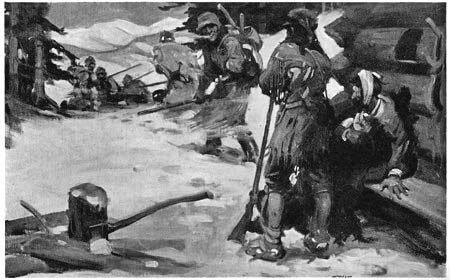
Pike Leaving the Two Comrades with Frozen Feet at the Log Fort They Built Near Canon City.
"Tuesday, 20th of January.—The doctor and all the men able to march returned to the buffalo to bring in the remainder of the meat. On examining the feet of those who were frozen, we found it impossible for two of them to proceed, and two others only without loads by the help of a stick. One of the former was my waiter, a promising young lad of twenty, whose feet were so badly frozen as to present every possibility of his losing them. The doctor and party returned toward evening loaded with the buffalo meat.
"Tuesday, 17th of February.—* * * This evening the corporal and three of the men arrived, who had been sent back to the camp of their frozen companions. They informed me that two more would arrive the next day, one of them was Menaugh, who had been left alone on the 27th of January; but the other two, Dougherty and Spark, were unable to come. They said that they had hailed them with tears of joy and were in despair when they again left them with a chance of never seeing them more. They sent on to me some of the bones taken out of their feet and conjured me by all that was sacred not to leave them to perish far from the civilized world. Oh! little did they know my heart if they could suspect me of conduct so ungenerous! No, before they should be left, I would for months have carried the end of a litter in order to secure them the happiness of once more seeing their native homes and being received in the bosom of a grateful country. Thus these poor fellows are to be invalids for life, made infirm at the commencement of manhood and in the prime of their course; doomed to pass the remainder of their days in misery and want. For what is the pension? Not sufficient to buy a man his victuals! What man would even lose the smallest of his joints for such a trifling pittance?"
The Louisiana Purchase had left a disputed boundary, which, with other things, threatened war between the United States and Spain. When Pike crossed over the Rocky Mountains to the West side, he was exploring disputed territory, though he was lost and thought he was on the Red River, instead of the Rio Grande, the former being within the limits of the Louisiana Purchase. He had passed that River, however, above its source, and had gotten over on the Rio Grande, which territory was still claimed by Spain. Had he found the Red River, it was his intention to build rafts and follow it towards its junction with the Mississippi, landing on his way at Nachitoches in Louisiana, which is about one hundred and fifteen miles west of Natchez—that being the Military Post to which he was to report. Notice of his presence in the Mountains had reached Santa Fe, where Spanish soldiers were stationed. The Governor sent an officer and fifty dragoons to bring him out. He was taken south to Santa Fe, going peaceably, but all the time protesting in the name of his Government at the indignity. Here he was questioned, his papers examined, and those in authority being undecided as to how to handle the matter because of its national character, they sent him far away to the south, to Chihuahua in New Spain, the headquarters of the Military Chief of Upper Mexico, where he arrived April 2d. After being detained for some days, all his papers again gone over in a vain endeavor to find something incriminating, it was determined to send him East to his destination, with an escort, his party, however, not to be permitted to accompany him, but to be sent after him.
In July, 1806, he arrived at Nachitoches, where he was warmly welcomed by his fellow officers. A little later he received a letter of thanks from the Government. He was made a Major in the Army in 1808; Lieutenant Colonel in 1809; Deputy Quartermaster-General and Colonel both, in 1812; Brigadier General in 1813. In that year he was sent by the Government on an expedition against York in Upper Canada, at the time of our second war with England. Here a magazine of the Fort exploded, a mass of stone fell on him and crushed him, and he died at the age of thirty-five. In his pocket was found a little volume containing a touching admonition to his son. He urged that he regard his honor above everything else, and that he be ready to die for his country at any time.
Lieutenant Pike had a pleasing personality, and had he lived, he would doubtless have been prominent in the affairs of the Government. He had strong features, keen kindly eyes, firm chin, high forehead, a nose that showed breeding, was clean shaven, had closely cropped hair combed straight back, and his picture somewhat resembles the portrait of Thomas Jefferson, once President of the United States. His modesty would not permit the giving of his own untarnished name to the great Peak that through the ages will proudly bear his name. The name came from a popular demand of the people, who were here at an early date, and who did away with the name of "James Peak" which Major Long gave it in honor of one of his own exploring party.
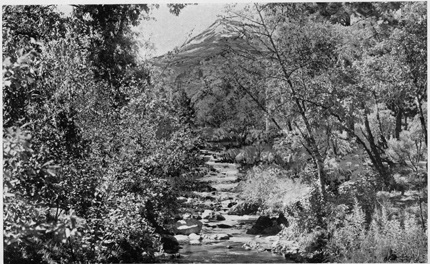
One of the Approaches to Cheyenne Mountain, Pike's Peak in the Background.
There is a singular coincidence attached to the name of this Peak. A pike in former times was the name given to anything with a sharp point. A road with toll gates was called a pike, because the gate consisted of a pole that swung up with the small end pointing towards the sky. In olden times the name of pike, instead of peak, was given to all summits of mountains. Gradually the word pike gave way to peak, and the former finally became obsolete. So in the name of Pike's Peak, we have it so securely named, that even the highest legislation in the land could not take away from it the name of Pike. And in this towering peak and its companions, if Prof. Agassiz is right, we have the first dry land that was lifted out of the great world's waste of waters. Colorado is to be congratulated that it has a monument in its midst that will forever commemorate the memory of a good man, who was intellectually, physically and morally clean and strong; who was faithful to every trust; tender in his sympathies; lofty in his ideals and character; and who loved his country so much, that he was willing to give it all he had—his life.
CHAPTER V.
THE LOST PERIOD.
As footprints on the sands of the ocean's beach are blotted out by winds and waves, so a Chapter of Colorado's History has been torn from its pages and can never be reproduced—the hunter and trapper. Exploring parties sent out by the Government were required to make careful observations, and a minute record of all they saw. It is by this we can follow them through their wanderings amidst primeval scenes, and can picture them moving slowly over the plains, solitary or in little groups, struggling forward, often hungry, lame, sick and desolate. But there will ever remain an untold story of those early times; as it can never be written by the hands long stilled, nor ever spoken by the lips long silenced. In that buried period are blended the romance, tragedy and adventures of the hunters and trappers who frequented Colorado in the beginning of the last century. They were few in number, mostly of French extraction, with St. Louis as their home. They were a type whose like will never be seen again, for the reasons for their existing can never again be duplicated. They were Indian Traders, who went at first to the outskirts of civilization, exchanging inexpensive articles for the rich furs of the Indians. As their acquaintance grew with the natives, they crowded into the Indians' country, and following the streams, took the otter and beaver at first hand. Because of their being so few in number, they were rarely molested; then, too, they were a medium by which the natives could realize on their furs, pittance though it was.
Some of these trappers would remain out on their expeditions for several years at a time, often living with the Indians and adopting their ways. As their clothes fell to pieces from age and use, they would replenish from the primitive blanket costumes of the Indians, whom in time they came to resemble. Often they would marry Indian wives and settle down to the nomadic life of the aborigines. Sometimes there would crowd upon them such stirring memories of the experiences they had once enjoyed, that the wives and children would be left to tears and loneliness, while the trapper with his face set toward the East, with his pack on his back, would tramp to the settlements, sometimes to remain, sometimes to return. We know some of the men who visited the mountains and streams of Colorado; knowledge of their presence here has floated down to us in various ways. When Major Long came on his exploring trip in 1819, he secured as guides two French Trappers, then living with the tribe of Pawnee Indians in southeastern Nebraska, who had trapped in the region of the Rocky Mountains.