ALLEN TRUE (continued 2)
Reading edition
James Pursley was here in 1805 and traded among the Indians; Lieutenant Pike in his report, speaks of him as the first white man who ever crossed the plains. He made the first discovery of gold in Colorado, which he found at the foot of Lincoln Mountain, doubtless at Fairplay on the Platte River, where once extensive placer diggings existed. As late as 1875, the Company operating there had a large number of Chinamen at work. The immense grass-grown gulch, wide and deep and long, at the edge of Fairplay, is the excavation out of which hundreds of thousands of dollars were taken. Colorado has done well to commemorate the name of Abraham Lincoln in one of its loftiest mountains.
A Frenchman named La Lande was sent out by an Illinois merchant in 1804, to make an investigation of the country and report. He came along the Platte Valley, crossed over to Santa Fe, where he concluded to remain. There was a party of French Trappers known to have been here about 1800 who went South into Arizona, in search of untouched territory to ply their avocation. Philip Covington in 1827 passed up the Cache La Poudre Valley with a pack train, on his way to Green River with supplies. He returned in 1828 and established a colony of trappers at La Porte, one of the oldest settlements in Colorado, and which is located near Ft. Collins. He was in the employ of the American Fur Company.
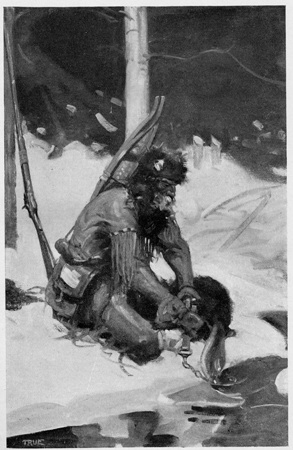
The Trapper.
The trappers would often go alone into these vast solitudes, with pack horses to carry their supplies in, and their furs but. Sometimes they would die in their lonely retreats, and never be heard of again, only as some sign of the fate that had overtaken them would be found years later. After a time, there were wagon routes of travel along the Arkansas River, with a trading post at Fort Bent and one at Santa Fe; also up the South Platte River, with trading centers at Ft. St. Vrain and at Ft. Lupton; and up the North Platte River, with the business centering at Ft. Laramie. Sometimes trappers who were brought out in the freighting wagons in the Spring from St. Louis by the Fur-Trading Companies, would be left with supplies along the streams, and in the Fall they would be picked up and taken with their peltries back to St. Louis.
The Astor Trail was made in 1810 through South Dakota west to the Coast. A great impetus was given to the fur business by the Lewis and Clark Exploring Party in 1804. They opened up the first Coast to Coast trail, and were the first white men to cross the Continent between the British operations on the North, and the Spanish on the South. Lewis had been President Jefferson's Private Secretary, and Captain Clark was his friend. They traveled eighty-five hundred miles, and they nationalized the fur business which grew to such proportions that years after they had opened up the line of travel, we were selling in London, alone, two million one hundred and seventy thousand furs annually. The rich peltries then were what gold and silver were later, and what grain, alfalfa, fruit, sugar beets and potatoes are now, and will be as long as water, soil, and sunshine blend. Buffalo and otter skins brought in the western market three dollars each; beaver skins four dollars; coon and muskrat twenty-five cents; deer skins thirty-eight cents per pound.
The early trappers could have been of inestimable benefit to the Government, had they been called upon to help solve the perplexing Indian problems that for so many years confronted us. They knew the Indians, their languages, habits and customs; and had their knowledge and influence with the natives been utilized, we might have peaceably settled many of the difficulties that required the sacrifice of so many lives and the unnecessary expenditure of so much money.
The fur industry, however, depended upon the keen perception of an awkward, unlettered, German boy for its growth and quick development. He came to London from Germany, with his bundle under his arm, to help in his brother's music store. John Jacob Ashdoer was his name, which by evolution became "Astor." With great frugality and unceasing industry, he saved enough in two years to pay his passage on a sailing ship to America, and there was enough left of his little hoard to buy seven flutes of his uncle, his sole stock in trade. When he reached this country, he traded one of his flutes for some furs; and that particular flute, and those particular furs, made history. It turned his attention to the fur trade, and laid the foundation for the greatest landed estate in America. With his pack on his back, he traveled among the Indian tribes of the Eastern States, and got their furs in exchange for gaudy trinkets, such as beads and ribbons. He personally took the furs to London, so as to realize the highest possible price for them and rapidly grew rich. In 1800 when he had only been in this country fifteen years, he was clearing fifty thousand dollars on a single trip of one of his sailing vessels.
It was at this time that Astor founded Astoria as a fur trading point, on the Columbia River, expecting to operate by ship, as well as freighting overland by the way of Ft. Laramie, and thus control the fur traffic along the tributary rivers. The destruction of Astoria by the British kept him from realizing his dream of becoming "the richest man in the world." Washington Irving and John Jacob Astor were friends, and the latter placed in Irving's hands all the records of his Company's operations, from which Irving gathered much interesting data, and many thrilling experiences from the lives of the early trappers and hunters. He wrote "Astoria" as a compliment to his friend. In this book he pictures the Rocky Mountains as having an elevation in places of twenty-five thousand feet, but frankly states that it is only conjecture, since their altitude had never been measured. The average height of the Rocky Mountains exceed that of the famous Alps, a number of the noted peaks being above thirteen thousand feet.
Some of Irving's interesting and pleasing prophecies of our country follow:
"It is a region almost as vast and trackless as the ocean, and at the time of which we treat, but little known, excepting through the vague accounts of Indian hunters. A part of their route would lay across an immense tract, stretching North and South for hundreds of miles along the foot of the Rocky Mountains, and drained by the tributaries of the Missouri and the Mississippi. This region, which resembles one of the immeasurable steppes of Asia, has not inaptly been termed 'The Great American Desert.' It spreads forth into undulating and trackless plains and desolate sandy wastes, wearisome to the eye from their extent and monotony, and which are supposed by geologists to have formed the ancient floor of the ocean, countless ages since, when its primeval waves beat against the granite bases of the Rocky Mountains.
"It is a land where no man permanently abides; for, in certain seasons of the year, there is no food, either for the hunter or his steed. The herbage is parched and withered; the brooks and streams are dried up; the buffalo, the elk and the deer have wandered to distant parts, keeping within the verge of expiring verdure, and leaving behind them a vast uninhabited solitude, seamed by ravines, the beds of former torrents, but now serving only to tantalize and increase the thirst of the traveler. Such is the nature of this immense wilderness of the far West, which apparently defies cultivation, and the habitation of civilized life * * * Here may spring up new and mongrel races * * * Some may gradually become pastoral hordes, like those rude and migratory people, half shepherd, half warrior, who, with their flocks and herds, roam the plains of Upper Asia; but, others, it is to be apprehended, will become predatory bands, mounted on the fleet steeds of the prairies, with the open plains for their marauding ground, and the mountains for their retreats and lurking places. Here they may resemble those great hordes of the North; 'Gog and Magog with their bands,' that haunted the gloomy imaginations of the prophets, 'A great Company and a mighty host all riding upon horses, and warring upon those nations which were at rest, and dwelt peaceably, and had gotten cattle and goods.'"

CHAPTER VI.
MAJOR LONG.
1819 Fourteen years have passed since Lieutenant Pike sold his two little sail boats to the Osage Indians as he left the Missouri River and started on his overland journey. Within this brief period a great invention has marked the progress of the century. After years of experiments, failures and disappointments; after sinking one vessel and abandoning others; Robert Fulton has returned from his trip to France, bringing with him his steam engine with which he had perfected water navigation, and by his genius linked together all the nations of the earth, increased the wealth and commerce of the world, and won for himself enduring fame.
The next exploring party was to start in a steamship owned by the Government of the United States, and under the leadership of Stephen Harriman Long. Born at Hopkington, New Hampshire, December 30, 1784, Long had graduated at Dartmouth College, and entered the corps of Engineers of the U.S. Army, in 1814; had been a professor of mathematics at the Military Academy at West Point, and had been transferred to the Topographical Engineers in 1815, with the brevet-rank of Major.
James Monroe was President, and John C. Calhoun Secretary of War, and they gave Major Long elaborate instructions as to his duty. We had owned the vast Louisiana Territory for sixteen years, and knew but little more about it than when it came into our possession. So, Long was to explore it and make a very thorough investigation of the "country between the Mississippi River and the Rocky Mountains, the Missouri and its tributaries, the Red River, the Arkansas River, and the Mississippi above the mouth of the Missouri."
On May 3, 1819, the party of nine started from the arsenal on the Allegheny River just above Pittsburgh, at which point they entered the Ohio River. Their steamer carried them down the Ohio to its junction with the Mississippi, a distance of about nine hundred miles, where they arrived May 30th. Here they turned north up the Mississippi River, about one hundred and seventy-five miles to St. Louis, which they reached June 9th. Then they steamed West up the Missouri, over the course that Pike had sailed fourteen years before, to the same point where the Osage River enters the Missouri, near the present location of Jefferson City and one hundred and thirty-three miles from the Mississippi River. The party divided; part of the number disembarked and proceeded with horses through Missouri, Kansas and Nebraska, meeting those of the party who remained on the boat at Council Bluffs on September 19th. There they established their winter quarters on the banks of the Missouri, about five miles below the present City of Council Bluffs, and so named because of a Council held with the Indians by the Government at that point. In the log houses, built by Pike and his party, and with the supplies they had brought on the ship, the party passed a comfortable and leisurely winter. On June 6, 1820, they started from Council Bluffs, the party then consisting of twenty men and twenty-eight horses. It is interesting to know what their pack ponies carried. Here is an invoice:
150 lbs. pork
500 lbs. biscuit
10 cannisters
300 flints
25 lbs. coffee
30 lbs. sugar
5 lbs. vermilion
2 lbs. beads
30 lbs. tobacco
2 doz. moccasin awls
1 doz. scissors
6 doz. looking glasses
1 doz. gun worms
1 doz. fire-steels
2 gross hawks bells
2 gross knives
1 gross combs
2 bu. parched corn
5 gal. whiskey
Bullet pouches
Powder horns
Skin canoes
Packing skins
Canteens
Forage bags
Several hatchets
A little salt
A few trinkets
Pack cards
Small packing boxes for insects.
They followed along the Platte River, and stopped for a time at the junction of the North Fork of that River with the South Fork, where North Platte is now situated. Here they tell of watching the beavers cut down a cottonwood tree. They observed that when it was nearly ready to fall, one of the beavers swam out into the river and posted itself as a sentinel. As soon as it saw the tops of the branches begin to move, it gave the signal by giving the water a resounding slap with its flat tail, when every beaver scampered out of reach of the falling tree. It must have been a moonlight night when they were there, otherwise they would not have seen the beavers at work, for they reverse nature's order and sleep in the daytime, working at night. They sleep in their houses, with their bodies in the water, and their heads resting out of the water on a stick. At twilight, a wise old mother beaver comes out and swims all around the pond or river, looking and smelling. Their sense of smell is very keen, and those who wish to observe them do so from treetops near the water. If after a careful investigation, the sentinel decides there are no man people, or wild animals around, one slap of the tail on the water is given, and out pops the nose of every beaver of the band, and all proceed with their work, exactly where it ended at sunrise. If the one on picket duty sees or hears anything that seems suspicious, three sharp resounding strokes of the tail sends every beaver in a flash to his hiding place, and nothing will tempt them out again that night. They have an instinct for making a tree fall in exactly the place where they want it, and it is used as a foundation for the numerous dams they build in the streams.
On June 30th, Long's party got their first glimpse of the Rocky Mountains. Later on, when they were camped near Ft. Lupton, opposite the Peak, they gave it the name of Long, its altitude being fourteen thousand two hundred and seventy feet.
None of the party were ever near the Peak. Two of them, more courageous than the others, rode out one memorable morning, under a cloudless sky, with their faces towards the snowy range—rode away to defeat and oblivion. As morning turned to noon and they seemed no nearer to the pinnacle than when they started, they retraced their steps across the silent plain. Thus they lost an opportunity of forever linking their names to undying fame. Had they proceeded, they could have electrified a nation by writing into their report a page that would have remained undimmed to the end of time. It was theirs, had they embraced it, to have discovered Estes Park, the gorgeous setting that crowns the approach to the King of Peaks. But they turned back; back from the snow-white mountains beckoning them onward; from the purple tints that veiled the mystic summits in a mellow haze; from the lights and shadows playing over hill and dale, under a canopy of fleecy clouds.
Beautiful Estes Park! Rarest gem of all the sparkling jewels that adorn the bosom of this fair world! In you the Divine Hand has created the masterpiece of all earthly beauty! You are so freighted down with scenic blessings that the mould was broken in your formation and there can be no duplication! Glorious is your resting place under the cloudless sky, as you lie in the embraces of the soft and balmy air that envelops you! Beautiful are your grassy slopes and velvet meadows, asleep beneath the gleaming stars, awake under the mellow skies, reaching away in a panoramic view of exquisite colorings! Faultless are Nature's highways as they wind in and out among your fir and spruce, your pine and aspen, through silvery glades and leafy dells, by rocky gorges and towering cliffs! Lovely are the azure lakes that rest against your mountain sides, reflecting in their limpid depths your rocks and trees, your lights and shades, your fleecy clouds and snow-clad peaks! How gentle is the flow of your sounding streams; how they eddy and fall; how they tumble and roar, as they hurry along to their far-away home in the sea! How grand and terrible are the awe-inspiring storms that gather in the mountains high above you, as cloud rolls upon cloud, black, dense, lowering; how the terrific peals of thunder crash from peak to peak, like the duel of artillery meeting on the field of carnage in the mighty shock of battle!
As light follows darkness, as sunshine comes after the rain, as peace succeeds strife, the clouds unveil, the tempest is calmed, the glory of the sun dispels the gloom, and the storm lashed pinnacles robed in eternal snow, light up under the glow of the lingering twilight. The tiny throated songsters warble their simple evening notes, ever old and forever new, rivaling the music of the streams, as they flood this paradise of parks with an ecstasy of melody. The eagle mounts skyward, rising higher and higher, in ever widening circles, standing out against the sky, then soaring away beyond the vision to his eyrie in the gaping gorge of the lofty crest.
The opalescent hues envelop the mountain rims. The fiery red, flames into a glow, melts to the softest purple, blends to the rarest gray, and in a delirium of rich colors the sun goes down in a cloud of glory. The sublimity of the scene clings like a halo around the sky-piercing summits. The day darkens, and the rosy tints of sunset fade into a flood of moonlight that mirrors the shining stars in the rivers, flowing far below under the mysterious shadows of the mighty cliffs.
Long and his party followed along the Platte River by the place where Denver is located, and on to Colorado Springs, at which point some of them attempted to climb Pike's Peak, but did not succeed. Greatly to their discredit, they named that Peak for "James," one of their number, instead of for "Pike," its discoverer. The people saw to it, however, that the name thus given it, should not be permanent. The people are nearly always right. The party proceeded on to Canon City and Pueblo, and then this exploring party made a discovery; they discovered that their biscuits were running short, so they immediately started home. They had left Council Bluffs, June 6th; they knew how long five hundred pounds of biscuits would last twenty men; so they knew they were on a pleasure trip and would have to start back July 19th, just one month and thirteen days after they set out, and ten days after they reached Colorado. When we think of the faithful Pike and his loyal men, freezing, starving, persisting; think of them with worn-out cotton clothing in winter, instead of warm flannel; of making shoes out of raw buffalo hides; of persevering in the face of every obstruction, and then read Long's report of starting back in midsummer, for the want of biscuits, our admiration grows for Lieutenant Pike and his devoted party of courageous men.
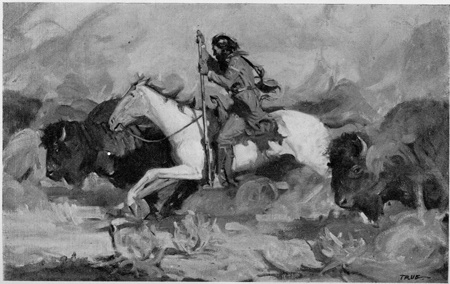
The Buffalo Runner.
Major Long's report to the Government was of such a discouraging nature that it retarded the settlement of the country for nearly half a century, and it should never have been written. He was quoted in the newspapers, and people everywhere read of a "desert inhabited by savages," a sentiment that became so firmly fixed in the minds of many in the Eastern States that the prejudices of the people have only in recent years been wholly removed. He often refers in his report to the enormous herds of fat buffalo that "darken the plains." How this queer-shaped animal with its powerful front and slender hind parts originated, or where it came from, will forever remain an unsolved mystery like the beginning of the race of Indians. They were here in immense droves. Ernest Seton Thompson thinks that there were seventy millions within the compass of their range, which was from the Allegheny Mountains on the East, to Nevada on the West; and that fifty millions of them were west of the Mississippi River. He bases his estimate on the amount of acreage they grazed over, and the number of animals the pasturage would sustain. I think he is far too low in his estimate. If we assign forty feet of space to each buffalo they would occupy an area, if bunched together, of but sixty-four thousand two hundred and eighty acres, or only one hundred square miles, which would be equal to a herd twenty-five miles long and four miles wide. The Government reports give an estimate of two hundred and fifty millions killed, from 1850 to 1883.
All the reports of explorers, scouts and emigrants dwell on the magnitude of these immense herds, which were so numerous that "the earth as far as the eye can reach, seems to be alive and to move." Coronado was never out of sight of them in traveling the seven hundred miles from New Mexico to Kansas, according to his letter to the King. Along every pioneer trail the prairies were covered in every direction with them, and away up in the Wind River Country, in the land of the Wyoming, Longfellow sings of the
"Billowy bays of grass ever rolling in shadow and sunshine, Bright and luxuriant clusters of roses and purple amorphas, Over them wander the buffalo herds, and the elk and the roebuck."
These peaceful herds, as they roamed over the plains, had their Nemesis at their heels, in the vast number of Indians trailing behind them and living upon them; while on all sides were thousands of hungry grey wolves devouring the calves or attacking the old, at will. In spite of these decimating influences, and their companion, the blizzard, the buffalo herds multiplied, and the Great Plains themselves seemed to be "alive and to move," as the countless numbers slowly grazed over them. Buffalo steak was good eating, and so adaptable that J. M. Bagley of Colorado, the veteran wood engraver, in relating early experiences tells how he started a restaurant on one buffalo ham, from which he served veal, beef, mutton, bear, venison, and all other wild game!
The first telegraph line reaching out over the plains, was a very primitive one. The posts were short and light, and they carried but one wire. A great deal of trouble arose from the cattle rubbing against the poles and wrecking the line. This was remedied by driving long heavy spikes into the poles at the point where the cattle would do the rubbing. But the workman got out of the cattle plague, only to get into worse trouble from the buffalo. They liked the spikes, and used the sharp points to scratch their rough hides. There seemed to be a buffalo language, for those shaggy and amiable animals flocked to the spikes from all sections. They reveled in the luxury of having their backs scratched, and to show their appreciation rubbed so hard that they completely demolished the line. Telegraph wire entangled in the horns of a buffalo was found as far away as Canada when it was killed. Only the rebuilding of the line with heavy poles and leaving off the scratching comforts, enabled business to proceed.
It seems strange that everyone lost sight of the productiveness that must lie in land that would sustain such quantities of grass-devouring animals; and that in the instructions given by Congress, the Presidents of the United States, and the Secretaries of War, to the leaders of these various exploring parties, the important question of irrigation should have never been considered, nor mentioned by the explorers themselves. It is true, irrigation was wholly unknown in our country at the time, but Egypt and China had been artificially watered for centuries, and it is strange that no Congressman or Government official, or enterprising newspaper editor called attention to this vital question.
The Long party divided as it started East. Captain Bell with eleven men went down the Arkansas River, while Major Long with nine, went farther south in search of the Red River. They all met at Ft. Smith, in western Arkansas, the middle of September; thence the united party crossed through Arkansas to the Mississippi River, where their trip ended.
Major Long looked like a college professor. He wore glasses over very black eyes; had thin, firm lips; high cheek bones; long wavy hair, and was close shaven, except for a little tuft of side whiskers back close to his ears. He later explored the source of the Mississippi River for the Government, and then became Engineer in Chief for the Western and Atlantic Railroad in Georgia.
When Major Long in 1805 turned the prow of his steamer into the mouth of the Missouri River, the first that ever ploughed its waters, he little thought that just above the junction of those two rivers would some day, on the Illinois side of the Mississippi, be built a City that would be named Alton; and little did he think that, fifty-nine years later, at the age of eighty, his grave would there be dug, and there would he be buried.
CHAPTER VII.
THE PIONEERS.
Of all those to whom we owe honor and loyalty, and affection; to whom belongs the first place of honor at the banqueting board; the highest monument to mark their passing; whose memory should be longest cherished, and beside whose grave we should tread most lightly; in all the generations of the past and future, we owe our allegiance first and always to the old settler! The very name marks the whole span of life. We see its spring time—youth and strength, teeming with energy; we see its autumn—the last leaf upon the tree, clinging, poised, ready to float away into eternal silence. Twilight, the lengthening shadows, the old settler; they blend into a harmonious setting for the slowly descending curtain upon the drama of life, ere the "silver cord is loosened or the golden bowl broken at the fountain." The old settler—what a train of thought the words suggest! He is the corner stone of civilization. He it is who pushes out beyond the confines of safety; out into scenes of privation and hardships; into conditions calling for sacrifices and disappointments; into danger and ofttimes death. Through it all he is so brave and so loyal, so earnest and capable, so patient and cheerful, so tender in his sympathies, so strong in his forceful grasp, so superior in his principles, that his name deserves to be written high up on the walls of the Temple of Fame! Nationally and locally, as a people, we have a feeling of veneration for those who clear the way and conquer the formidable obstacles that stand in the path of progress. They develop the highest type of rugged manhood and womanhood—strong, fearless, independent and self-sustaining. For nearly three centuries history has been repeating itself in this country of ours. As the Pilgrim Fathers endured and conquered, so in each succeeding generation have there been those who have given the days of their lives to labor, in the midst of loneliness, and the nights to vigil, surrounded by danger, that security and prosperity might come to those who followed them. They are the battle scarred veterans who fought for a foothold in a hostile country, and through their untiring efforts and indomitable courage made possible the enjoyment of others in the midst of congenial and ennobling surroundings.
Napoleon, as all the world knows, instituted the Order of the Legion of Honor in recognition of merit, civil or military. To be a member of that Order was an honor so great that the decorations were cherished long afterwards by the descendants of the recipients. History records that a French Grenadier, returning from a leave of absence, was astonished to find the Austrian Army secretly advancing through the mountains by a comparatively unknown path. Hastening forward to give warning to the handful of soldiers stationed in a strong tower to defend the path, he found to his dismay that they had fled, leaving their thirty muskets behind. Undeterred by such a calamity, he entered the tower, barricaded the door and loaded his muskets, determined to hold the post against the whole Austrian Army. This he succeeded in doing for thirty-six hours. Every shot told. Artillerymen were killed the moment they appeared in the narrow path, and cannon were useless. Assaults were repulsed with great loss in killed and wounded. Finally, when not another round of ammunition was left, the Grenadier signalled that the Post would be evacuated if the garrison could march out with its arms, and with its colors flying proceed to the French Army. This was agreed to; and when the old Grenadier came staggering out under all the muskets he could carry, and it developed that he was the whole garrison, the admiration of the Austrians was boundless; they sent him with an escort and a note to the appreciative Napoleon, who knighted him on the spot. When, later, he was killed in battle, he was continued on the roll call of his regiment, and when the name of Latour d'Auvergne was called, the ranking sergeant stepped forward, saluted the commanding officer, and answered in a loud voice, "dead on the field of honor."
To such a class belong the courageous, vigilant and enthusiastic advance guard of civilization everywhere. They placed the plowshare and the pruning hook where the rifle and the tomahawk long held sway. They worked with rough hands and stout hearts to solve the problems that beset the West, and to make gardens bloom where the desert had cast its blight for centuries. They brought order out of chaos and from the woof of time wove the lasting fabric of justice and good government. Such were the old settlers of our own beautiful mountain land. They came, many of them, in the slow, monotonous, wearisome, creaking, covered wagon drawn by heavy-footed oxen; through midday heat and wintry blasts, through blinding storms of sand and snow, they wended their way for months from far-off countries, sometimes leaving their dead in unmarked graves by the wayside, and with set faces and leaden hearts, pushed on to unknown scenes.
Half a century has wrought wonderful changes! Now, the traveler sees the sun go down upon the middle west, with the Missouri winding its way to the sea; the morning's radiance glints the summit of the Great Divide, and unrolls a picture of rare beauty and majesty! Five hundred miles in a night; sleep, comfort, luxury; no hunger, or thirst, or fear, or discomfort; cushioned seats, soft carpets, fine linen; dining cars shining with polished woodwork, beveled mirrors, solid silver; a moving palace such as was unknown even in the days of luxurious Rome.
I have listened to many pathetic stories of our old pioneers that touched me deeply. The history of those distant days is full of interest. An air of romance envelops those early western scenes. Many a troth was plighted in the long trip across the plains, and many a friendship was formed that ended only in death. The novelist clothes his characters with the imaginary joys and griefs of imaginary people; but imagery never was and never can be as interesting as real incidents in the lives of real people. A dignity crowns the memory of the men whose feet were set where never human feet were placed before; honors cling around the names of those who lived in the days when the buffalo roamed the plains unmolested, when the skulking savage lurked in hiding, and when the weird bark of the hungry coyote penetrated the solitude of night. Out of such experiences empires are born. The founders of our prosperous state little knew that here they were opening up the richest mineral and farming country in all the world! Nor did they realize that they would here plant the future metropolis of the Great Rocky Mountain Region. We honor them—the living and the dead—for what they are, and what they did! Their ranks are rapidly thinning. It will not be long until at Old Settlers Roll Call there will be no response—save only from out the stillness will be heard, like an appreciative echo, the voices of their successors as they answer, "Dead on the field of honor."
CHAPTER VIII.
CHRISTOPHER CARSON AND HIS CONTEMPORARIES.
Christopher Carson.
1826 Down in the blue-grass region of Kentucky; down in the land of the cotton, the corn and the banjo; where the tiny feathered warblers carol their sweetest roundelays; where perennial flowers unceasingly bloom, and the trees are early at their blossomings; where silvery streamlets are kissed by the moonlight, and linger in the embraces of the warm southern suns; in that land, the home of lovely women, splendid men and fine horses; that has sent out its great generals, polished orators and renowned statesmen—two children were born, nearby, in the very memorable year of 1809. Abraham Lincoln grew to an uncrowned kingship. Christopher Carson won the highest place in the hearts of the empire builders of this wonderful West; and their names will never die. Lincoln was splitting rails by day, studying by the light of a log fire by night, and climbing hand over hand to his bed on the floor of the loft, by means of pegs driven in the logs of the cabin, as later he went hand over hand straight into the confidence and hearts of his countrymen.
Carson, the father, had apprenticed Kit, the son, to a saddler, as was the custom of those times. He rose before the break of dawn, made saddles and bridles all day and far into the night and was paid with poor food, a comfortless bed, and cheap and scanty clothing. Such was to be the lot of this unhappy boy until he was twenty-one. But he rebelled. Out into the blackness of the night, and to the light of freedom, crept the friendless youth, without a penny in his pocket or a bundle under his arm! And to such freedom! The limitless West with its stirring scenes beckoned him and he sped away, ahead of the advertisement that called him back, and in which the munificent reward of one cent for his return was offered by the man who had the legal right to call himself the master. At Franklin, where he lived, he had absorbed the spirit of the widening West that was calling him thither, and he quickly became an important factor in its upbuilding. Along that memorable Santa Fe trail, he crossed and re-crossed the southeastern part of Colorado.
Kit Carson became noted as a fearless hunter, trapper, miner, stockman, farmer, scout, guide, Indian fighter, Indian pacificator, treaty maker, Indian agent—all culminating in his Brigadier-generalship in the Civil War. In every capacity, he was faithful, persevering, energetic and capable. He learned the languages of the different tribes with painstaking study. He grew to understand the Indians as individuals, their ways, and their thoughts; he became their advisor and counselor, settled differences between tribes, and between the tribes and the Government; was the Government's advisor in treaty making, and was the first man to urge the attempt to domesticate the Indians. He knew the Spanish language as well as the Mexican and Indian patois; and he aided the Government in the solution of its troubles with the Indians as well as with the Mexicans and Spaniards. His influence for good stretched across a country, beginning with the Missouri River on the East and ending where the restless waves of civilization listened to the beating of the surges on the shores of the Pacific. He was a Lincoln sort of man with malice toward none. He had few enemies, and many friends. He was for peace, when peace was possible, but how he could fight when nothing else would do! Abbott, who does not realize that the towering peaks, the murmuring streams and the boundless plains, develop high ideals through the silent language that is all their own, says of Carson, "It is strange that the wilderness could have formed so estimable a character."
In Christopher Carson I see a serious man, modest and retiring, soft spoken, with quiet manners, medium in height, blue eyes and broad shouldered. I see a priestly looking man, with thoughtful mien, with face clean shaven; high, broad forehead, with receding hair flowing toward his shoulders, long and wavy; thin, firmly compressed lips; in all, very like the strong, splendid face of the world-famed artist, Liszt. I see a domestic man, adoring his amiable Spanish wife. I see him lying on his buffalo robe, with his children playing over him, and hunting the sugar lumps out of pockets that were never empty. I see him standing, gazing into the eyes of the Indian whose hand he clasps, vieing with each other in erectness, while at their feet lie the idle guns and cartridges, the broken bows and arrows, and the pruning hooks into which their swords have been beaten. I see him dying, two score and three years ago, with his honest homely face illuminated, as he smiles his "adios" to all about him and sinks gently into his last, long, dreamless sleep.
Richens Wooten.
1838 Seventy-five years have come and gone since Richens Wooten joined a wagon train at Independence, Missouri, and came out over the Santa Fe trail. Until 1859 he felt that he was temporarily in the West; that he would go back to his old Missouri home and end his days in the midst of the peaceful scenes of boyhood joys, the memory of which had clung to him through all the exciting years of his frontier life. Then when he had achieved success; had money and property; had loaded his belongings on his wagons; had turned the heads of the horses to the East; looked into the faces of the friends who had surrounded him all the years, at the plains he knew and loved, at the magnificent mountains, silent, majestic, eternal, at the rivers murmuring to him as they went by—his courage faltered! He awoke from the dream he had dreamed for years, unhitched his horses, unloaded his wagons, and lived and died in the country from which his heart-strings could not be severed.
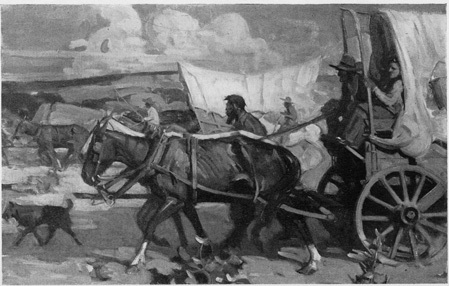
Pioneers and a Conestogal Wagon or Prairie Schooner.
Like those of his day, he was everything he should be. He hunted and trapped; he was a Government scout; he raised stock; he farmed; everyone knew him as "Uncle Dick," and they knew him wherever a trail was laid. He lived at the junction of the Huerfano River with the Arkansas River about twenty miles East of Pueblo. He farmed there by a process of simple irrigation, as far back as 1854, which made him the Pioneer farmer of Colorado. He had a mill that was built by his own hands, that was run by water power in a sleepy sort of way. He would empty a couple of sacks of grain into the hopper at night and the flour would be ready for breakfast in the morning. He trapped mostly along the streams of Colorado and New Mexico. By handling his furs himself, at St. Louis, he realized as high as Fifteen Dollars for a beaver skin. He says "robes" were the cause of the disappearance of the vast buffalo herds; that those killed for meat by the whites and Indians would have made no appreciable inroad on the numbers that inhabited the Great Western Plains, but desire for hides caused their ruthless slaughter by the tens of thousands; that while they were gentle at first and had to be driven out of the way of the emigrant trains, they were hunted so much that later they became savage and would fight. He started a buffalo farm in 1840 where Pueblo is located, and sold the young to menageries. Wooten hated the Indians with exceeding great hate. There was a reason. He had chased them many and many a time; shot at them, hit them, had seen them fall, and their riderless ponies flee over the prairies, while a form lay silent beneath the sun and beneath the stars. But sometimes the tables were turned, and sometimes the chaser was chased! Ah! There's the rub, for Wooten could never look defeat in the face and be happy.
The Indians, he says, had a system of long distance communication, carried on among themselves by means of fire and smoke signals from the mountain tops. A puff of smoke was like a telephone message, and as easily understood; a second puff had its own peculiar meaning, and a blaze carried its special message to distant tribes. The whole country could be aroused in a day and night—the signals being taken up and repeated from mountain top to mountain top. The Indians spread themselves out to sleep in their tents, on buffalo robes or willow mattresses, with their feet towards a common fire in the center. They would place their dead in trees, or on a platform built on the top of four poles planted in the ground. The dead would be placed in a blanket, a buffalo robe wrapped around it, and then all bound together with strips of hide; the dead would thus lie for years. It was gruesome to happen upon these graveyard scenes at night, with the uncanny owls hooting in the treetops, and the wolves howling their warning notes. The Indians rode bareback with a rope for a bridle that would be fastened around the under jaw of the pony, which was trained to obey the slightest pressure of the knees or swaying of the body.
One of the feats of which Wooten was proud, and with good reason, was taking a great drove of sheep through to California. To do this successfully in the face of possible depredations from the Indians, to whom the sheep is a savory morsel; to escape the bands of thousands of aggressive grey wolves; to swim unbridged rivers when sheep so dislike to swim; to follow narrow mountain paths where overcrowding would precipitate the herd into the chasms below; to get by the crops of the Mormons who were all the time hunting for trouble; to reach his destination with every sheep fatter than when he started—that, says Uncle Dick, was the work of an artist.
Wooten came to Denver in 1858, where a few cabins had been built, and where a handful of people had centered. He started a store and built a two-story log house, the first pretentious building ever erected in Denver. Later, he built a frame residence when the saw mill came, a mill that had been stolen in the East and brought to this out-of-the-way country, where it was thought it could never be traced—in which, however, the plunderers were disappointed.
But Uncle Dick felt crowded. He could not breathe. He was elbowed by the people who were settling here. The wilds called to him. He wanted to get out alone, under the quiet stars; to have the glories of the setting sun all to himself; to see the wonderful moonlight shadows in the rivers; to feel the great orb creeping up in the morning, as he had seen it out on the broad plains and from the mountain tops nearly all the years of his life. So he went away; off to New Mexico, upon whose mountains he got a Government Charter for building a toll road by the abysses and along the over shadowing crags to shorten the trail. And there, with the years creeping on, he set himself down by the side of his toll gate, which was never shut down for the Indians, for they could not understand that in all this great free world, a road was not as free as sunshine or air. But is not this all told by Richens Wooten himself, in his very own book, in the picturesque and forceful style of a picturesque and forceful pioneer?
And finally, the toll that is taken from all mankind was collected from him, and he passed out alone by the road that every one must travel, and over which no one has ever traveled twice.
Oliver P. Wiggins.
1838 Straight as an arrow, towering six feet and three inches, stands Oliver P. Wiggins, the oldest living pioneer of all the "winners of the West." Eighty-nine years have brought a dimness to the eyes and a slowness to the steps, but they have not touched the keen intellect, trained by such experiences as no other living man will ever acquire. He remembers distinctly every event that has occurred during all the years of his life on the plains. He talks slowly and impressively, and you feel as you leave his presence that you have been in touch with another age and another race of people. He will tell you his story as he told it to me.
"I was born on the Niagara River; that is, on an Island just above Niagara Falls, where my father had taken up some land. His father had selected his own land near by the American side of the Falls, and it became later on very valuable. Boylike, I wanted to fight Indians, and I dreamed about scouts and tomahawks, and the war dance, for I was a reader of the blood-curdling cheap Indian novels of that day. So I left home when I was fifteen and went by sailboat from Buffalo to Detroit, where I found some French emigrants just starting to Kankakee, Illinois, where they were going to take up land. I went with them as far as Ft. Dearborn, which afterwards became Chicago; it had but about three hundred people then and as many soldiers; there was one short street just South of the Chicago River, and among the houses was one they called a hotel that had nine rooms. A squaw man, that is, a white man with an Indian wife, was sent from the Fort with a paper to St. Louis, that had something to do with paying the Indians their annuities by the Government. I went along in the canoe down the Illinois River, and the Indians, knowing what we were going for, kept joining us in their canoes, until there must have been two thousand following us when we reached St. Louis. There was not a single house all the way from Chicago to St. Louis, which was not known as St. Louis then. Later my uncle settled there, and had the Wiggins Ferry, and four acres of land on what was known then as 'Bloody Island.' He sold it recently for Three Million Dollars. The Indians had some flour, bacon and blankets apportioned to them, and they traded a good deal of it off for whiskey, and many of them got drunk and had an awful time.
"The following Spring, which was 1838, I went by steamer up to Independence, Missouri, which is just above where Kansas City was located later. It was the Eastern end of the Santa Fe Trail, while eight hundred miles away, Santa Fe was the Western terminus. At Independence, all the outfitting was done for the great overland freighting business, which at that early period had assumed important proportions. I joined a train, consisting of one hundred wagons and one hundred and twenty men. There were five yoke of oxen to each wagon, which made one thousand oxen; then there were a large number of extra oxen along to rest those that got sick or sore footed. By following close after each other, our wagon train stretched out about three miles. I was still on behind driving the cavy-yard, which was the name given to the sore-footed oxen. When we got to the Arkansas River where the trail crossed, which was very swift, we made boats out of two of the prairie schooners; calked them so they wouldn't leak, and loaded into these two boats all the loads that were on the rest of the wagons. A prairie schooner is a long deep wagon bed with flaring sides, about eight feet high and twenty feet long. The oxen swam across; then we chained all the empty wagons together, one behind the other, and hitched the oxen to a chain that reached back across the river to the wagons, pulled the wagons into the stream and on to the other side, where, as fast as one reached the bank, it was unchained from the rest, run up on the dry land, and the work of reloading began. It took four days to get all our outfit across. Our wagons were loaded mostly with merchandise for the stores to sell to the Mexicans, and with mining machinery. The wagons would carry on an average about seventy-five hundred pounds and the price of freight for the eight hundred miles from Independence to Santa Fe was generally eight dollars per hundred-weight, so the cost to the shippers of that trainload of freight run into the thousands. It would take from ten to sixteen weeks to cross the plains, owing to storms and the condition of the roads. We would shoe our own oxen and some of them had to be shod every morning. We would rope them and throw them for that purpose. It was not like a horseshoe, for the hoof of the ox is split and it requires a piece for each half of the hoof. We would make from fifteen to twenty miles a day. The dust was so great, that we traveled in a cloud of it all the time and the teams and drivers would change off; those who were ahead to-day, were behind to-morrow, all but me; I never got to go ahead with my cavy-yard, and I have never forgotten those weeks of frightful dust. They wouldn't let me stay back far, for fear the Indians would pick me off and run the cattle away.
"About a day and a half after we left Big Bend, we met a friendly Indian, who was much excited when he saw us. He said we must not try to go on, for we would all be killed, as the Kiowas were on the war path. Be we couldn't stop, so we kept right on, knowing that Kit Carson was coming with an escort to meet us. We brought up the rear half of the wagon train, however, and put two abreast, thus shortening the train to about a mile and a half. Pretty soon Carson met us with forty-six men, who were all well armed and mounted on good horses and then we felt easy once more. When we reached the Kiowa country, where we were most likely to be attacked, Carson and his men all got inside the covered wagons and led their horses behind. After awhile we saw the Indians coming charging down upon us, yelling and shooting with their bows and arrows; all the drivers in the meantime having gotten on the other side of their wagons. Carson kept his men quiet until the Indians were close enough, when every man shot from the wagons, and about forty-six Indians tumbled off their ponies dead or wounded at the first shot. Then Carson's men mounted their horses and there was a great fight. About two hundred of the three hundred Indians were killed. Not one of Carson's men or of our party were killed. 'Did we bury the Indians?' No, we left them where they were; they made good coyote beef.
"When we got opposite where Carson lived, which was at Taos above Santa Fe, he left the train, for there was no further danger and I went with him to his home about twenty miles off the trail, losing my pay because I did not go through with the party, this being a rule of freighting. I stayed with Carson two years. I became a guide and Government Scout and got eighty dollars a month. I was with General Fremont on his first and second trips. He wasn't liked by any of the men. He was very dictatorial and it didn't seem to us that he knew much. He had a German Scientist along whom all liked, and who knew his business. When we were with Fremont on his second trip, it was so late in the season when we reached the eastern foot of the Sierras, that twelve of us refused to go with him for we felt it was certain death. The snow falls in those mountains seventy feet deep at times, and it was the season for snows. Carson was along and had to go on because he had signed an agreement to go through, and he went, knowing he was taking his life in his hands. We were arrested for mutiny and put in charge of a sergeant, but soon got out of his reach, made a detour of several miles through the mountains, got on the back track and reached a place of safety after several days, thoroughly chilled from sleeping in that high cold country with no blankets, but glad to escape with any sacrifice. Fremont's party then consisted of fifteen, and they had a terrible time. They froze, and starved, and suffered, so that three men lost their minds and never recovered. Carson finally went on ahead, so weak he could hardly walk or crawl, and sent help back just in time to save the party.
"The first gold discovered in Colorado, was in August or September, 1858, by Green Russell. He had stopped here on his way to California where he was going to mine. He came from Georgia and knew about gold mining there, and said there must be gold in Cherry Creek. He found it up at the head of that Creek at a place called "Frankstown" where the trail from Ft. Bent on the Arkansas River crossed over to Ft. Lupton. Russell and Gregory and others came together, and Russell stayed here a year and located Russell Gulch at Central City, which became a great paying property. I did a great deal of hunting and trapping in those early days and made money until 1858, when the fur business died down, as silk had taken the place of fur. I was the first white man to visit Trappers Lake, which is about thirty miles north of Glenwood Springs and was considered inaccessible, because of the density of the fallen timber. We brought out in one season about two thousand dollars worth of furs and hides. The elk covered that country and was comparatively tame as they had not been hunted. We took Indians along for guides, and their squaws to tan the hides. This they did by boiling the brains of the animals we killed and rubbing the soft brain powder into the pores of the skin, folding the hides together, and in a week they were cured and were soft and pliable. The brains were used because of certain properties they possessed, and because of their pliant nature. To catch the beaver we would set our steel traps in the water about seven inches below the surface so the young could swim over them and not get caught. Then just above where the trap was set, we would fasten a branch from the limb of a tree into the bank, the bark of which the beaver lives on. We would rub beaver oil into the bark of the limb, so the beaver would think others of his kind had been there ahead and found no harm; they are a very suspicious little animal. The trap would have a spring that would close on the hind legs of the beaver, as they would swim above it.
"Until 1857, the trappers recognized the claim of the Indians, that one-half of all game and hides belonged to them. It was changed in that year by Government Treaty. In dividing with them they were very insistent, and they usually got the biggest half of the meat and the largest hides. We used to take hot mud baths at Glenwood Springs which is a very pleasant sensation. I fought the Indians and fought them hard, but had many friends among them and I did them many good turns which they appreciated. I have had an eventful life, had many thrilling experiences, saw life held very cheaply, and have seen such developments as I never dreamed I should witness."
CHAPTER IX.
GENERAL FREMONT AND THE MORMONS.
John C. Fremont.
1842 This noted explorer so prominently identified with our early Colorado history, was educated at Charleston College. He then became a teacher on a United States Sloop of War on board of which was detailed a young Lieutenant who later became famous as Admiral Farragut. Afterwards, Fremont was employed as a surveyor for a railroad in South Carolina. In 1838 he was made a Second Lieutenant in the U.S. Topographical Corps—the same corps that gave us Major Long. He was selected to make a trip of geographical research and observation into Iowa, Minnesota and Dakota with a noted French Scientist named Nicollet, who had been sent to this country by his Government. In 1840 Fremont headed an expedition for the establishment of Military Posts in the West, and to definitely fix the position of South Pass on the head waters of the North Platte River, which was on the line of travel to the western coast. He was a long time getting ready, and did not leave Washington for St. Louis until May 2, 1842, from which point he took a public steamer up the Missouri River. On board he met Kit Carson, with whose personality he was so pleased that he dismissed the French trapper he had already engaged as guide, and selected Carson instead. Carson was then on his way back to the West, from having given his little girl into the care of the Sisters at a Convent in St. Louis; her mother, who was an Indian woman, having recently died. They left the steamer at the mouth of the Kansas River, which empties into the Missouri where Kansas City is now located. It was then a little settlement of a few rude houses, known as Kansas Landing, and later became Westport. A little way above was Roubidoux Landing, named for a French Fur Trapper and Trader who operated in Colorado. This Landing afterwards became St. Joseph. Fremont says, as they started out across the prairie to the westward, "It was like a ship leaving the shore for a long voyage, and carrying with her provisions against all needs in its isolation on the ocean."
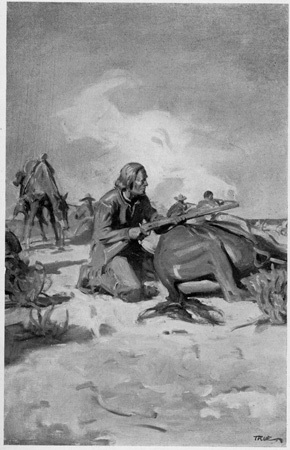
A Government Scout.
They traveled northwest until they reached the Platte River where the City of Kearney is now situated, near which a Fort was established, called "Fort Kearney." From this point they proceeded west along the south bank of that stream, one hundred miles to the junction of the two Platte Rivers. Here they divided, Fremont with three others following the South Platte, the remaining nine going by way of the North Platte to the fur-trading station that later became Fort Laramie, at which point the Laramie River joins the Platte. On the way, Fremont was entertained one night by the Indians at a feast. It was a banquet with no suggestion of fairyland, such as so often delights us now; no subdued strains from a hidden orchestra pouring forth its entrancing harmonies; no myriads of electric lights dazzling with their splendid brilliancy; no wealth of roses filling the air with their rich perfume; no polished mahogany, damask linen, glowing glassware or priceless silver; no well groomed men or richly gowned women, radiant in their loveliness. There were none of these accessories, but there was princely hospitality. There was the ushering of the guests to their places by the Chiefs, with the courtly dignity that white men might equal but never excel. In honor of the occasion the choicest robes were spread upon the ground for seats. There was the rich soup of fat buffalo meat and rice, served in deep wooden bowls, with tin spoons, by the women. There was the dog boiling in the pot for the second course, in token of a state occasion, while the disconsolate puppies moaned pitifully in the corner of the wigwam.
On July 10th Fremont reached Fort St. Vrain on the Platte, established about ten miles south of where the Cache la Poudre River and the Platte unite. He remained here a few days and then headed north to Fort Laramie, getting too far East, however, over on Crow Creek, where he had to travel forty miles without water—the first and only hardship on his trip going and coming. He found the rest of the party waiting for him, and they proceeded west up the Platte to the South Pass, the point of his destination when he started from Washington. He found the Pass a well-established thoroughfare, made so by the fur-trading companies. He ascertained its height to be seven thousand eight hundred and seventy-three feet. There was no pass anywhere about of so low an altitude. It is about two hundred miles due west of Fort Laramie—which is not, however, the Laramie City located on the Union Pacific Railroad northwest of Cheyenne.
Fremont saw to the perpetuation of his name in the highest mountain peak, about forty miles northwest of the Pass, and just east of Green River, having an elevation of thirteen thousand seven hundred and ninety feet. He then started on his return to St. Louis, where he arrived October 10, 1842, his journey both ways being without special value or interest.
Fremont's second trip was made in 1843, and seems to have been principally for the purpose of establishing a shorter route through the mountains than the Oregon Trail by the way of South Pass. He came in from the east, up one of the branches of the Republican River to Fort St. Vrain on the Platte, where he arrived July Fourth. On his way he no doubt approached the Platte between Akron and Fort Morgan, where there is a Butte named for him. He tried to learn from the hunters, trappers and Indians, of a trail west through the great range of mountains, but there was no one who could give him any information. Following the Platte from Fort St. Vrain, he reports finding a Fort Lancaster about ten miles up the river, which was the trading post of Mr. Lupton and had then somewhat the appearance of a farm. He passed through a village of Arapahoe Indians, probably near the mouth of Clear Creek, camped a little above Cherry Creek, and followed the Platte River to its entrance into the mountains at the canon. Needing meat, he went east on to the plains in search of buffalo; crossed Cherry Creek and the road to Bent's Fort; reached Bijou Creek, thence up to its head on the divide where he reported an elevation of seventy-five hundred feet—being the same altitude as at Palmer Lake, twenty-three miles west. Altitudinal ascertainings are taken by the simple process of looking at a watchlike, vest-pocket instrument, whose delicately adjusted mechanism is affected by air-pressure. From this place, he made a sketch of Pike's Peak, and is "charmed with the view of the valley of Fountain Creek," on which Manitou and Colorado Springs are located, and which he reached a little north of its junction with the Arkansas River. He speaks of finding at this point a "Pueblo" where a settlement of mountaineers were living, married to Spanish wives, "who had collected together and occupied themselves with farming, and a desultory Indian trade." They had come from the Taos Valley settlements, the Valley that was later named the Rio Grande. "Pueblo" was the name given by the Mexicans to their civilized villages. Taos is taken from the name of the Taos tribe of Indians. Returning he followed up Fountain Creek to Manitou Springs, thence north over the Divide to Fort St. Vrain.
Fremont then decided to go up the Cache la Poudre Valley and cross the Divide to the Laramie River. He describes the buttes he saw on this trip "with their sharp points and green colors"; the same so clearly defined now, on the automobile road beyond Dale Creek, between Fort Collins and Laramie City, one of the most picturesque scenes in the whole State of Colorado. He followed the Laramie River down to the present line of the Union Pacific Railroad, then west to the North Platte River and beyond, where, getting tangled up in the hills, he finally recognized the Sweetwater Mountains to the north to which he proceeded; thence to the familiar Oregon Trail which he followed to Salt Lake and on to California.
On his return he entered Colorado near the mouth of Green River, went northeast and encountered some branch of the White River, possibly the Snake River, which he followed over the Divide to the North Platte River, and thence up into North Park. While in Middle Park, a number of squaws came to his camp greatly excited and made known the fact that nearby a great battle was in progress between two Indian tribes, and they wanted him to go with his party to help their side. He declined and hurriedly departed. He passed over into the Cripple Creek country, where after a few days of aimless traveling he descended a branch of the Arkansas River to Pueblo.
Fremont's memoirs are very rambling, and contain such a mass of undigested material that it requires much reading and study to follow him in his wanderings through Colorado. The streams, mountains and localities had no names, and he gave them none. We can only trace his journeyings by his camping places where he gives his latitudes and longitudes, and which is only incidentally given and not in its regular order. He ascertained latitude and longitude by the use of a scientific instrument in its application to the sun, moon and fixed stars, as the Indians often found their own locations by the study of these same heavenly bodies, from centuries of observation without an instrument, the knowledge being passed down from father to son, generation after generation.
On one of his trips, as he came in sight of Bent's Fort, the three cannon mounted on its parapets, belched forth a greeting that sounded sweet to the ears of the trained soldier, as the reverberating music of the booming of the guns rolled down the Valley of the Arkansas to meet him.
A storm in the mountains is a frightful thing in winter and more than one was encountered by General Fremont and his party. A number of the men sacrificed their lives through the mistaken judgment of a leader, who ordered them forward to breast the fury of those icy blasts of snow and sleet. Oh! The terror of such a death! The awe of those cold, bleak, snow-capped pinnacles; how cruelly they look down upon the lost and helpless victim, prostrate at their feet, snow-bound, hopeless and in despair! How subtly and menacingly the sharp wind moans; how it shrieks and roars through the gulches, and how the giant pines creak, and writhe, and groan, as they bend before the gale! How the blinding, biting, swirling snow falls through the freezing air, burying the trail and filling the icy gorges with ever deepening drifts! And at last, the shivering sufferer meets his doom as he sinks in utter exhaustion on his bed of snow, and drifts away into the stupor of death. The inanimate form is buried deeper and deeper under its white shroud, and heedless of the tempest raging above, sleeps the sound, dreamless sleep of death.
Fremont tells little of his last three trips; some being on secret missions for the Government; one was for his own benefit and that of Senator Benton of Missouri, whose daughter, Jessie Benton, he had married—a lady of many fine womanly qualities and personal charms. On one of his trips, William Gilpin was along, on a visit to the settlements of Oregon. Gilpin later became Colorado's first Governor. One expedition took him up the Rio Grande to Salt Lake and on to the Coast.
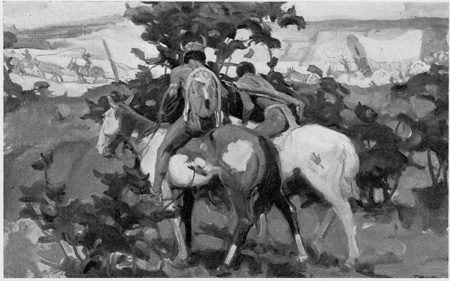
Indians Watching Fremont's Force Fording the Platte.
When representing the Government, Fremont's work was along military lines principally, his operations leading up to the conquest of California in 1847. The name California appears in an old Spanish romance as an Island, where innumerable precious stones were found, and Cortez applied the name to the Bay and to the country that is now California which he thought was an Island. Fremont's work, however, was not all military, for at the same time he was mapping streams, taking altitudes, and making reports that would assist in ascertaining facts about a country then little known or understood. Colorado has a County named for him, of which Canon City is the County Seat. There are Counties in Wyoming, Idaho and Iowa, similarly named. Eighteen states of the union have towns bearing his name. "Fremont Basin" covers the western part of Utah, all of Nevada, and a part of the southeastern portion of California—in all, a region about four hundred and fifty miles square. "Fremont Pass" in the Rocky Mountains has an elevation of eleven thousand three hundred and thirteen feet and is in the Gore Range, about ten miles northwest of Leadville.
General Fremont occupied many positions of trust under the Government. He was Governor of California when there was much trouble that diplomacy might have averted. He was Governor of Arizona from 1878 to 1882. His exploring trips had made him famous and he secured the Republican nomination for the Presidency in 1856, but was defeated by Buchanan. In 1864 his name was put in nomination for the Presidency but Lincoln's popularity so overshadowed him that his name was withdrawn. He was Major-General of the Army in the Civil War, with headquarters at St. Louis, where he promulgated the unauthorized order freeing the slaves of those in arms against the Government, which so embarrassed the Administration that the order was repealed and he was relieved of his authority. Later, reinstated, he refused to take part in a battle because command of the army had been given to General Pope whom he claimed to outrank.
Fremont journeyed all over Colorado and failed to find anything worthy of note. While camped on the sites of Cripple Creek and Leadville, he saw no signs of the enormous gold deposits of the greatest gold mines in Colorado. While at North Park he did not observe the coal outcroppings there—probably the most extensive coal fields in the United States. While traveling through our valleys he could not look into the future and see them groaning under a diversity of crops, the most valuable ever raised in any country. He drank from our cool sparkling streams, but he did not see how that wealth of water could be supplied to the thirsty crops. He saw millions of fat buffalo on the plains, but he failed to realize that the same nutritious grasses would make beef equal to the corn-fed product of the East. He viewed the most sublime scenery ever looked upon by the eyes of man, but his reports contained no adequate description of the majestic outlines of the mountains whose grandeur thrills the beholders from all the countries of the world.
The Mormons.
1847 The Mormons as a religious body, attempting to get beyond the reach of the power of the United States Government which they claimed was persecuting them, sought solace in the bosom of the Dominion of Mexico, which then owned much of our country west of the Rocky Mountains, wrested by them from Spain in their war for freedom. At this very time the United States was fighting Mexico, and the Mormons had no more than gotten out of the United States before they were in again by Mexico ceding to our Government in 1848, the very territory which these much persecuted people had chosen for a new settlement. The Mormons had gathered from all quarters at Florence, Nebraska, just above Omaha, where the water works of that City are now located. They had wintered at this point in great discomfort, with much sickness, and so many deaths that the country seemed to be one vast grave yard.
In January, 1847, Brigham Young started West with one hundred and forty-two in his party to find a location to which the rest should follow. They had seventy-three wagons which moved two abreast for protection, and they had a cannon and were well armed. They reported seeing hundreds of thousands of buffalo grazing along the Platte Valley, and were obliged to send outriders ahead to make a way through the herds for their caravan. They traveled on the north side of the Platte River so as to have an exclusive trail of their own, and it became known as the "Mormon Trail"; the fur traders having made their trail along the south side of that river. When they reached Fort Laramie, they ferried across to the south side of the river where the Government Post had been located; the change from the north to the south side being necessary because of the physical difficulties on the side of the river where they had been traveling. Here on June 1, 1847, they were joined by a party of Mormons who had started from Mississippi and Illinois; had wintered where Pueblo now is; had passed north through Colorado, and doubtless over the ground occupied by Denver following the Platte River to Greeley where they would travel almost due north to Fort Laramie. These Mormons at Pueblo were the very beginning of anything approaching white citizenship in Colorado, for no other white families had ever spent so long a time within the present limits of our State.
General Fremont had passed by Salt Lake in 1843 on one of his expeditions, and doubtless the Mormons knew of that Valley from his report as well as of other points of the West. But the Mormons did not know where they were going to settle, and had started north-westerly from South Pass in search of a location and then turned to the south to Salt Lake Valley. Upon their arrival there, the first day, they planted six acres of potatoes because of the necessity of having food for the vast numbers who were to follow them. The rest of the people started from Florence July 4, 1847, and consisted of nearly two thousand persons, about six hundred wagons, over two thousand oxen, and many horses, cows, sheep, hogs and chickens. Following later, came hundreds with push carts, who started too late to get through before winter set in. Their suffering, starving, sickness, and the death of nearly a quarter of their number on the way is a sad story, and is the toll exacted in the settling of a new country.
For many months, the Mormon Trail was lined with the traffic of thousands of emigrants from all parts of the United States and Europe. There were wagon trains hauling supplies of all kinds, such as merchandise, machinery, seed and building materials. There were the two-wheeled carts into which food and a small allowance of necessary apparel were placed for the trip; and those carts were pushed all the way across the plains by both old and young. It was said that every step of the way was marked by a grave. No such sight and no such suffering has ever been witnessed before in the settlement of any part of the world.
Ten years afterwards, the Church, grown arrogant, defied the power of the United States Government and proposed war. General Albert Sidney Johnson was sent on an expedition against them. Starting too late to cross the mountains, the army became storm bound and was compelled to winter at Fort Bridger in the southwest corner of Wyoming, at a tremendous loss of lives, both of men and horses. They were short of supplies, and an expedition was sent to New Mexico for food. It was successful, and returned north through Colorado, skirting the eastern base of the mountains and, no doubt, passed through the site of Denver just before the gold excitement broke out in Colorado. They doubtless followed the trail taken by Fremont to Fort Laramie in 1842, and by the Mormons in 1847.
1849 The rush for the new gold discoveries in California began in 1849 and in a year it became a panic, so great was the hurry to reach there from the East. It is estimated that seventeen thousand persons passed Fort Laramie in June, 1848, coming up the Platte from Omaha; while from Kansas City, Leavenworth and St. Joseph, many thousands passed through southeastern Colorado on the Santa Fe Trail, and thence to Salt Lake where the Mormons grew rich in their trade with these excited gold seekers. Nothing has ever been seen resembling the gold developments of California. Fortunes were made in a day when a treasure house was unlocked, and poverty claimed the affluent in a night, when a pocket pinched out. The wealth that was poured into the laps of the fortunate prospectors was fabulous. The Comstock Mine alone, named for the man who opened it up and lost it, yielded a solid mass of treasure, amounting to one hundred and eight million dollars to the four fortunate owners. It sent to the United States Senate, Fair, Stewart and Jones, three of the partners, and gave the Atlantic Cable Line to Mackey, the fourth, whose son still controls it.
So, having been discovered by General Coronado and his army with their brilliant cavalcade and martial music; by the two black-robed Friars with their noiseless followers; by Lieutenant Pike and his loyal band; by Major Long and his associates; and last, by General Fremont with his five exploring parties; while the tidal wave of travel and excitement is sweeping by us to its destiny on the sunny western slope, and we are left in solitude, awaiting the bright awakening ten years hence; let us take an introspective view of the people whose history is forever interwoven with ours, whose race is nearly run, while ours is just begun.
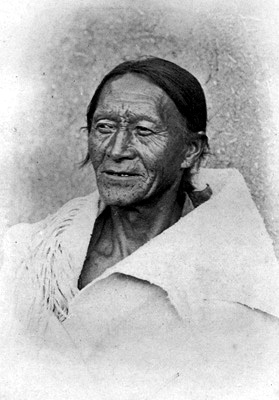
Ventura, Historian of the Tribe of Taos Indians, Garbed in His White Buffalo Robe—Made White by Tanning.
Indian History was Transmitted Orally to the Youth, the Brightest of Whom Became in Turn the Historian.
CHAPTER X.
OPPORTUNITY.
"Master of human destinies am I, Fame, love and fortune on my footsteps wait, Cities and fields I walk; I penetrate Deserts and seas remote, and, passing by Hovel, and mart, and palace, soon or late I knock unbidden once at every gate! If sleeping, wake—if feasting, rise before I turn away. It is the hour of fate And they who follow me reach every state Mortals desire, and conquer every foe Save death; but those who doubt or hesitate, Condemned to failure, penury and woe, Seek me in vain and uselessly implore— I answer not, and I return no more." —Ingalls.
A Fortune Won and Lost.
Hanging in a room of the White House when the magnetic, able and masterful Roosevelt was President, was this beautiful poem of Senator Ingalls. A gem of rarest value in word painting; a literary production beyond criticism; but in sentiment, harmful and discouraging! It is not true! Opportunity has knocked repeatedly at the door of countless numbers, and future generations will hear its call again and again. Only one chance to be given us? No! Life is too fine and means too much for "the hour of fate" to hang on so slender a thread as a single opportunity. It comes many times to some; it comes but once to others; it does not come to all. To Antoine Janis, a French Trapper, it knocked unbidden at his door but once; he failed to answer, and he lived to appreciate his great loss, for he had fortune placed within his grasp and did not realize it. Once, all the beautiful Cache la Poudre Valley was his; every acre of land from La Porte to the Box Elder; every lot in Fort Collins; wealth which would run into the millions. It was the gift of the Indians, and was his as absolutely as though it had come by Deed of Warranty with all its covenants, clear and indefeasible. The Government in its Treaties with the Indians recognized their grants, and had Janis asserted his rights to this vast property, his claim would undoubtedly have been recognized by the Government as in many similar cases. He continued his residence in Larimer County for thirty-four years, going then to the Indians at the Pine Ridge Agency and remaining there until his death. The close friendship, early formed between him and the Indians, was never broken, and they buried him with honors.
I like to imagine that famous meeting at La Porte, when that Valley, then nameless, changed hands. The Indians as a race were dignified, serious, and on formal occasions acted with great deliberation. They were a generous people, and were about to make a present to the White Brother who had come to dwell among them. Bold Wolf, the Chief, called his counsellors together. From out the seven hundred tepees they came, in their brilliant dress of state. They gathered around the camp fire, seated on their feet, with Antoine Janis as their honored guest. They smoked the pipe of peace; not a pipe for each, but one for all, that would draw them closer in lasting friendship. Resting their painted cheeks on the palms of their hands, they listened with the utmost respect to those who spoke. The oratory of the Indian is proverbial. His dignified and serious bearing, his simple words and brief sentences, his profound earnestness and apt illustrations, made him a master of eloquence. It was an occasion for thrilling discourse. The land where they were assembled was theirs. It was the land of their fathers. It was theirs by right of discovery, by right of occupancy. Here they had lived their lives; here their children had been born; here their dead were buried, and here they had worshipped the Great Spirit to whom their ancestors had bowed. And they were to give away the best of their heritage; the luxuriant meadows of the richest and most beautiful valley in their vast domain were to go to the White Brother forever. Thereafter, every man, woman and child of the tribe recognized that the country they looked out upon, over which their ponies grazed, across which the buffalo roamed, even the very ground upon which their wigwams stood, was the property of Antoine Janis.
The Call of the Blood.
About the year 1800 some French trappers and hunters were passing out of Colorado, into New Mexico, in quest of new streams in which to ply their avocation. The pack ponies which they were driving on ahead suddenly stopped and centered about an object at which they sniffed intelligently. The trappers coming forward to investigate looked at each other in amazement as they gathered around a deserted child lying on the bosom of the unfeeling earth, hungry and helpless. These bronzed and bearded men were heavy handed, but not stony hearted; and they met the responsibility as best they could. Moses had been left in the bullrushes of a stream for his preservation. This child had been left in the tangled weeds on the bank of a stream for its destruction. Moses lived to become the leader of a nation. This child was saved—but let us see. It was taken by the trappers, named Friday for the day upon which it was found, as in the tale of Robinson Crusoe, an Indian youth was named Friday for the day of his discovery. Friday grew and thrived, was adopted by one of the party, and at the age of fourteen was taken along to St. Louis, where he was sent to school, and shared in the joys and griefs of other boys of his age. When he was twenty-one, the cry that had long been suppressed gave utterance. He wanted to see his people. Leaving home, he came to Colorado, and to the tribe of the Arapahoes, who had crossed the path of the trappers twenty-one years before. It was a new life to which he was admitted. During his visit a buffalo hunt was organized in his behalf. He watched the preparations, saw the gathering of the ponies from off the prairies, the testing of the bows and arrows, the night of feasting and dancing before the start at earliest dawn. Wending their way over the plains, they finally spied the herd. At once the dullness of the hunters gave place to trained alertness; absolute quiet reigned; the ponies crept forward slowly and softly, step by step, with their riders clinging to their sides to give the appearance of a band of grazing horses. At last they were near enough, and then the signal. Away went the horses and riders in a whirlwind of excitement, the eyes of the riders blazing, the nostrils of the horses dilating. Away went the herd, shaking the earth with the thunders of their flight; away flew the arrows to the twang of the bows, as they sped straight and true into the heaving sides of the struggling animals. Down went the buffalo, down on their trembling knees, down on their quivering sides, as they stretched themselves out for their final death struggle. Down went the Indians to dance in glee around the prostrate bodies of their trophies.
And Friday? No one ever hunted as Friday hunted! The thirst of blood was upon him. He had plunged into the midst of danger, and knew no pity, no compunction, no fatigue. The instinct of his race that had been sleeping for years surged to the surface at a bound, never again to be dormant. That night he threw off the garb that stood for the civilizing influences of the past, donned the yellow blanket of his race and adopted the life of his people. That day of daring, and his education, marked him as a leader, and he became a Chief of the Arapahoe nation.
Chief Friday had a son. He was called Jacob after that Patriarch, who, when asked his age by Pharaoh, replied so poetically "the days of the years of my pilgrimage are an hundred and thirty years; few and evil have the days of the years of my life been, but have not attained unto the days of the years of the lives of my fathers in the days of their pilgrimage." There is a superstition among the Indians that if they have lost a battle, they must sacrifice some member of another tribe as an offering to the Great Spirit. Jacob had been chosen for the sacrifice. Hearing of it he fled. Returning two years later when he supposed there was no further fear of his destruction, he was set upon and left dead upon the ground. Friday loved Jacob with a very great love, and so did he love the good of his people. He counseled peace, and instead of plunging two nations in war, he buried his son with a breaking heart, hidden by the stoicism of his race.
Chief Friday had a daughter. A winsome lass. Light of foot, with a singing voice and dancing eyes. She was called "Little Niwot" by her father, because she used her left hand, and Niwot in the Indian tongue means "left hand." I asked a doctor once, those wisest of wise men, why it was that out of fifteen hundred million of the earth's inhabitants, so few used the left hand prominently, and this was his reply: "Upebanti manusinistra ob herededitatum."
Niwot's education was not alone like that of the other Indian children, whose eyes were trained to see the beauty in the sun, the moon and the stars; whose ears were attuned to catch the voices in the murmuring brooks, the music in the rustling trees, the melody in the warbling birds; but she had learned of her father as well, who taught her from the remembrances of those far-off days in the St. Louis schools. Little Niwot loved an Indian youth, who was not the choice of her mother. So she ran away with her dusky mate and became the wife of the man of her choice. Friday was left alone. Jacob was dead and Niwot was gone; he grieved for them, and could not be comforted. Niwot became the name of a Creek near Longmont, and of a near-by station on the Colorado and Southern Railway. So in station and stream, the memory of a little Indian maiden is to always be kept green.
And Friday died; died in the happy thought that in the civilizing processes that had been going on about him, he had always tried to stay the hand of his people when raised to check the white wave that was sweeping them to their destruction. Chief Friday was well known to the early settlers, and from them has come this story, here a little and there a little, and now woven into print for the first time. The unhappy ending of his life is like that of Chief Logan, whose heart-breaking plea has been handed down to us in this great burst of touching eloquence:
"I appeal to any white man to say if ever he entered Logan's cabin hungry and he gave him not meat; if ever he came naked and he clothed him not. During the course of the last long and bloody war, Logan remained idle in his camp, an advocate of peace. Such was my love for the whites that my countrymen pointed as I passed and said, 'Logan is a friend of the white man.' I had even thought to have lived with you but for the injuries of one man; Col. Cresap, who, the last Spring, in cold blood and unprovoked, murdered all the relations of Logan, not even sparing my women and children. There runs not a drop of my blood in any living creature. This called on me for revenge. I have sought it. I have killed many. I have fully glutted my vengeance. For my country, I rejoice at the beams of peace; but do not harbor a thought that mine is the joy of fear. Logan never felt fear. He will not turn on his heel to save his life. Who is there to mourn for Logan? Not one."
CHAPTER XI.
A VANISHING RACE.
There was a white man once with an idea. So modest was this man that he was unwilling that even his name and the idea should be linked together. He wanted the Indians to become better known to the whites, to themselves, to their children, and to the future generations of children. So he passed from one tribe to another and made known his plan to them. They were to write a book; a book that would contain a record of their thoughts and ideals, their songs and unwritten music, their folk-lore, their views of the past, and their beliefs in the mysterious future. The idea pleased them, grew on them, and ended in their becoming deeply interested. The book was prepared and printed and it contains the following touching and stately introduction by the High Chief of the Indian Tribes. It moves forward so like a majestic anthem, so solemn in its unspoken sorrow, so full of gentle dignity that it sweeps into our souls like the cadence of a great Amen:
"To the Great Chief at Washington, and the Chief of Peoples Across the Waters:
"Long ago, the Great Mystery caused this land to be, and made the Indians to live in this land. Well has the Indian fulfilled all the intent of the Great Mystery for Him. Through this book may men know that the Indian was made by the Great Mystery for a purpose.
"Once, only Indians lived in this land. Then came strangers from across the Great Waters. No land had they; we gave them of our land; no food had they; we gave them of our corn; the strangers have become many and they fill all the country. They dig gold—from my mountains; they build houses—of the trees of my forests; they rear cities—of my stones and rocks; they make fine garments—from the hides and wool of animals that eat my grass. None of the things that make their riches did they bring with them from across the Great Waters. All comes from my lands—the land the Great Mystery gave unto this Indian.
"And when I think on this, I know that it is right, even thus. In the heart of the Great Mystery, it was meant that the stranger—visitors—my friends across the Great Waters should come to my land; that I should bid them welcome; that all men should sit down with me and eat together of my corn; it was meant by the Great Mystery that the Indian should give to all peoples.
"But the white man never has known the Indian. It is thus: there are two roads, the white man's road, and the Indian's road. Neither traveler knows the road of the other. Thus ever has it been, from the long ago, even unto to-day. May this book help to make the Indian truly known in time to come.
"The Indian wise speakers in the book are the best men of their tribe. Only what is true is within this book. I want all Indians and white men to read and learn how the Indians lived and thought in the olden time and may it bring holy—good upon the younger Indian to know of their fathers. A little while and the old Indians will no longer be and the young will be even as white men. When I think, I know it is the mind of the Great Mystery that the white man and the Indians who fought together should now be one people.
"There are birds of many colors, red, blue, green, yellow—yet it is all one bird. There are horses of many colors, brown, black, yellow, white—yet it is all one horse. So cattle, so all living things—animals, flowers, trees. So man; in this land where once were only Indians and now men of every color—white, black, yellow, red—yet all one people. That this was to come to pass was in the heart of the Great Mystery. It is right thus, and everywhere there shall be peace."
(Sgd.) By Hiamovi (High Chief), Chief among the Cheyennes and Dakotas.
Who is the Indian? This question has been asked for more than four hundred years, and from out the buried silence of the past has come no answering voice. Columbus asked it as approaching the border of a New Hemisphere he gazed thoughtfully upon the features of another race of beings. Ferdinand and Isabella asked it, as these strange men doomed to vassalage stood proudly before them speaking in an unknown tongue. Cortez asked it, as he riveted the chains of servitude upon two million of them in the Conquest of Mexico. Coronado asked it, as his army moved among the wandering tribes with their differing languages and customs. The Pilgrim Fathers asked it with varying emotions, as they viewed the curious natives waiting for them on the bleak New England shores. France asked it, and trusted its most highly cultured scientist to bring reply. "Nothing," he said as he returned, "Nothing." He had visited many tribes, studied their languages, customs and character, read everything ever written about them, and he knew nothing and nothing ever will be known.